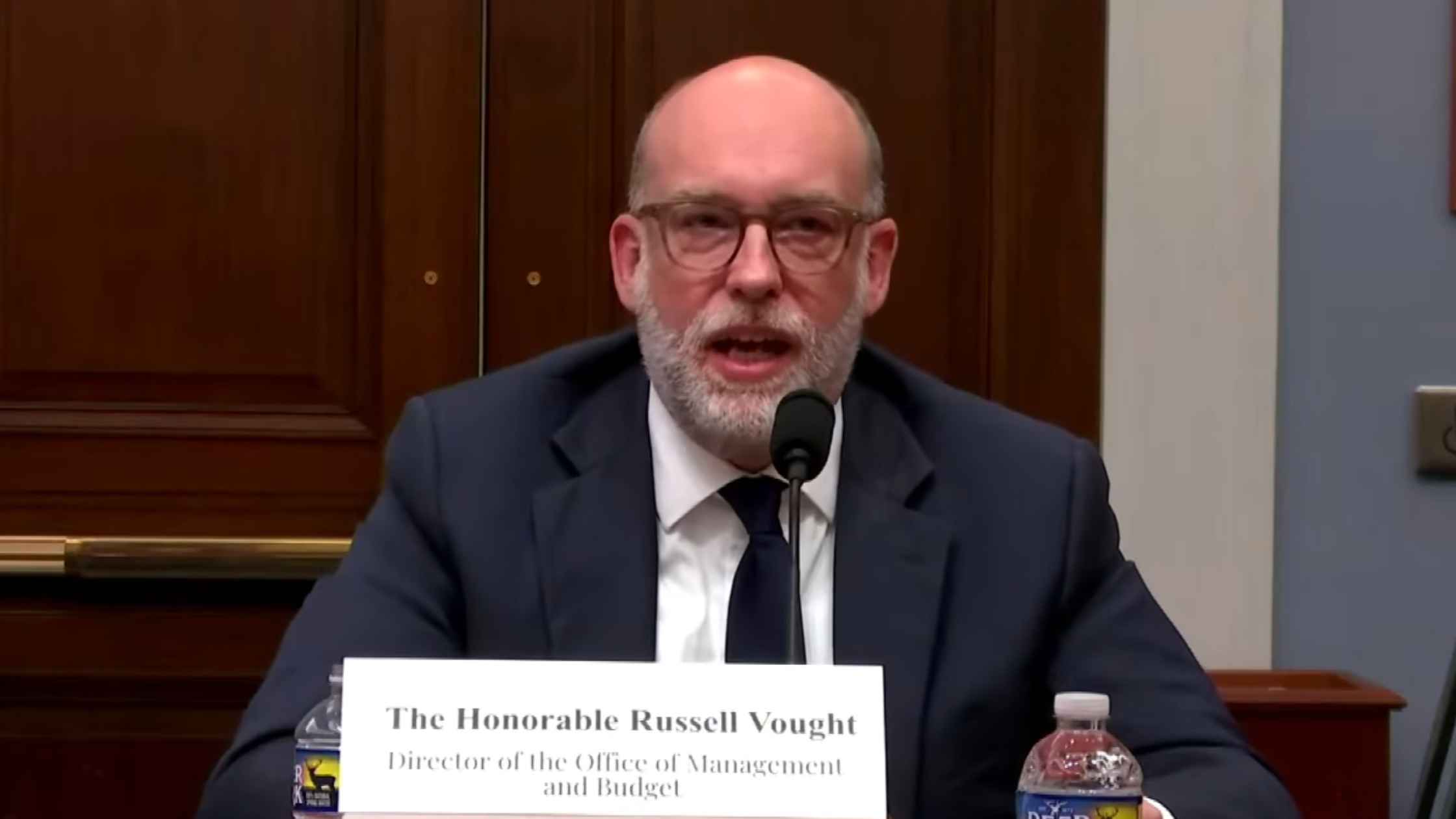
Jodey Arrington (00:00):
... remarks. It's important, Director, to hear the president's vision and priorities for resourcing the people's government to provide for the common defense. It's important to hear about the president's vision and priorities for stewarding the people's treasure to promote the general welfare of the public. And it's important to hear the president's vision and priority for resourcing the government to protect and preserve our children's future and to secure the blessings of liberty for the next generation. That's why I think this is the most important committee in the United States Congress, Russ. And that's why meetings like today and discussions and debates like today, I think are paramount for the governing of our great nation.
(00:56)
With that, I'm just going to jump into yielding myself such time as I may desire. Okay, no notes here, just some thoughts. We've done well to have some constructive conversation and have civil tone. Today, I suspect will be a little more amped up and I'm pretty amped up myself. I hope we hear honest, constructive comments and good-faith debate, but I suspect we're going to hear some spin. I anticipate we'll hear some false narratives and fear-mongering, conjecture, and even flat out misrepresentations of the truth. That's what I expect, sadly. I hope that doesn't happen. But what I think is important, Director and colleagues, and ladies and gentlemen, is that we put out what I believe is factual context to this conversation. Russ, I don't know of a president in my lifetime, maybe in history, but in my lifetime that has inherited such a complete and utter mess as President Trump did in January of last year. One self-inflicted disaster after another for four years of the Biden-Harris administration. Utter lawlessness, incompetence, a border that was wide open, millions of people, criminals, gangs, drugs that killed a plane load of Americans effectively every week, more people dying of the drugs coming across the border than the people dying from the Vietnam War. Again, all because of the dereliction of duty to uphold the laws of this land and a failure to do the first and most important job, which is to provide for the common defense. And the American people suffered. Our resources were drained, our safety was jeopardized, and there was no rule of law, the cornerstone of any civil society.
(03:38)
We had feckless foreign policy. The withdrawal from Afghanistan was a dumpster fire. We didn't do anything to preempt or prevent Vladimir Putin from invading Ukraine. We were spending our time at the Pentagon teaching our troops a masterclass in pronouns in the era of transgenderism, and we were socializing our troops in radical ideology instead of preparing them to fight and win wars and to restrain evil. And the result was we had a much more unstable world. I think we were made a mockery by our enemies. And finally, we saw unbridled spending, about seven to eight trillion record deficit spending.
(04:37)
If you add in the additional cost of interest that went skyrocketing, it's about $12 trillion overall. We had a weaker economy, recessionary economy. We had a cost-of-living crisis that we haven't experienced as a nation in almost a half a century. We were paying people not to work. The failed policies and the spending that created this unaffordability crisis was that we were paying people not to work. Let's remember this. We were bailing out union pension funds without fixing it, bailing out schools that didn't open for our children. We waived work requirements for able-bodied adults in every welfare program, while we allowed tens of billions of dollars to be drained from these important social programs for our citizens by illegal immigrants in this country, millions of them. The list goes on. We taxed and regulated our job creators. And again, the most regressive tax in my lifetime was the 20-plus percent increase in prices for working families. Trump comes in, you and the team, in one year, secure the border, stop the flow, deport criminal aliens, broker a peace deal in the Middle East, provide the greatest investment in national defense in the history of our country, pull down the drain and the drive of our deficit and looming debt crisis in mandatory spending by rooting out waste, fraud and abuse to the tune of about $1.5 trillion, constrain spending on the discretionary side, cut taxes, cut spending at historic levels, open up domestic energy production. We had lower interest, lower inflation, a growing economy, wages are up, people putting more money in their pockets before my Democrat colleagues shut the government down over a COVID era, fraud-ridden program to expand a failed underlying policy of Obamacare. That was the first shutdown before the shutdown that we're in today.
(07:13)
We would have been at 2.5% plus growth. We were made a mockery and derided for putting that assumption in our Big Beautiful Bill, but that's exactly what CBO said where we'd be. Over the 10-year budget window, that's a trillion and a half dollars to reduce the deficit. So, there is a reason that CBO in their recent report, six months into this fiscal year, shows a 10% reduction in our deficit. It's been decades since we've seen that. 10% reduction in our deficit because of growth, because of rooting out waste and bending the curve on mandatory spending and controlling cost and cutting wasteful and unnecessary spending on the discretionary budget. And because President Trump decided to lead on the world stage with respect to trade and give our workers, manufacturers and farmers a head-to-head fighting chance at trade deals and the revenue helped shore up our balance sheet.
(08:20)
So, I'm pleased with what the president has done. I'm proud he's our commander-in-chief. I'm going to hear and think we'll hear a lot about a war of choice. Let me tell you something. It's a choice to play pattycake and have a policy of appeasement with a jihadist, genocidal, radical terrorist regime to the point that they are knocking on the door of having a nuclear weapon. And that is what we've seen, not just from our Democrat colleagues or Democrat presidents, but for almost 50 years. So, yes, we choose to defend our country's interest and protect our homeland and the American people from serious and imminent threats.
(09:08)
And I've said before, I pray to God that whether it's a Democrat or Republican in the Oval Office, when they get those briefings, they're willing to put politics and personal interests aside and do what's right for the country. It's not easy. It won't be easy, but never is easy to do the right thing in this town, Russ. So, thanks for being here. That's the context. I think this budget of yours shows directionally that we're going to continue to do that and double down on it, right? Reduce wasteful spending, invest in our defense, and continue to promote the growth that we so desperately need, and all boats will rise on that prosperity.
(09:48)
With that, I yield time to my colleague and ranking member, Mr. Brendan Boyle.
Brendan Boyle (09:54):
Well, thank you, Mr. Chairman. And thank you, Mr. OMB Director. I didn't know how shy you were until the last 15 months when you weren't before our committee, but do appreciate you taking the time today.
(10:05)
You know how bad this economy is when we hear Joe Biden being invoked, we hear trans people being invoked. I was waiting for Jimmy Carter to be blamed next, but apparently we didn't get quite there. Let me just do a reset and present to you a set of facts, a set of data. Right now, according to opinion polls, the approval of the economy of the American people is at its lowest level since 2008, the great recession. 29%, an average of the last three polls shows 30% approval. Disapproval over approval of this administration's handling of the economy, more than two-to-one disapproval over approval. The Michigan consumer data, consumer confidence level, the lowest level ever recorded, even lower during COVID, even lower than during the great recession.
(11:14)
If you look at the job creation over the last 15 months, there's one thing missing, and that's job creation. We have been in a jobless economy over the last 15 months. Inflation, which actually, even though there's no question, we had an inflation crisis, not just in the United States, but all throughout the world after the COVID pandemic in 2022, after the pandemic had ended, every single month in 2024 inflation dropped over the preceding month. What happened around April of last year, Liberation Day? Inflation was liberated. You saw inflation begin to increase in every single month we've seen inflation increase and gas prices.
(12:06)
Yesterday, I was in Northeast Philly where I'm from and where I live, a working-class part of the city of Philadelphia. Was in front of the gas station. The gas at that particular location was $4.11, which is slightly lower than the average nationally and in the United States of about $4.15 a gallon. Six weeks ago, that same gas station was under $3 a gallon. We've seen over the last month the largest increase in gas prices in my lifetime, in the lifetime of most people here.
(12:47)
What's different about this economy, unlike the inflation crisis after the pandemic, unlike the great recession, unlike the recession of 2001, unlike the recession of 1992, the economic downturn that we're experiencing, no jobs, record inflation, gas prices through the roof, consumer confidence plummeting, all of this is directly related to the policies of the Trump administration that you carry out, Mr. Vought. None of those previous examples that I cited, none of them could be directly attributed to the policies of the president at that time. We can debate about certain things that did influence them, particularly going into the '08 recession. But with this president, the change is so abrupt. The fact inflation was dropping month-over-month. The fact that we had an incredible jobs economy until it was lost a year and a half ago.
(13:53)
I'm from Pennsylvania, the biggest battleground state in the nation, also the nation's birthplace, which we're making a big to do about this year in 2026 and celebrating our semi-quincentennial, but Pennsylvania is really known over the last decade in our politics is the nation's biggest battleground state. So, as a result, basically every day in 2024, in the fall, we had either Donald Trump or the Democratic nominee, Kamala Harris, in our state. Donald Trump had, I have to say, a brilliant campaign slogan. He said, "Your prices are too high. I will lower them..." And I quote him, "I will lower them on day one." Well, here we are about day 450. He hasn't lowered anything. The only thing he's lowered is his approval rating on the economy, he has lowered that.
(14:52)
Donald Trump and this administration have failed miserably on this economy. They failed to bring prices down, and in fact, they made the situation worse. With that, we have a lot of questions on this side since it's been 15 months. You're the first OMB director ever to not appear before this committee last year. I appreciate you're, at least today, taking the time. We have a lot of questions, and I certainly hope after today, if we send to you questions in writing, that you would respond, finally, as you've ignored all of our previous requests. It's a matter of basic respect for the Congress of the United States and for this committee.
(15:32)
And with that, I yield back.
Jodey Arrington (15:33):
I thank the ranking member. In the interest of time, if any other member has an opening statement, I ask you to submit it for the record. We'll hold the record open to the end of the day to accommodate those members who may not have prepared written statements.
(15:45)
Now, I'd like to recognize Director Vought. Again, thank him for his time. Committee, Mr. Vought has received your written statements. It will be made part of the formal record. You now have five minutes for your remarks.
Russell Vought (16:04):
[inaudible 00:16:04], Ranking Member Boyle, members of the committee, thank you for having me here to testify on the president's budget request for fiscal year '27. I look forward to a productive conversation on how to continue the fiscal progress we've made so far.
(16:17)
When President Trump took office, the nation was facing financial catastrophe under the failed leadership of the Biden administration and decades of status quo spending strangling our nation. Those decades produced nothing in the area of fiscal restraint. A lot of talk about the program and the problems, but utter futility about doing anything about it. That fiscal futility has ended with the return of President Trump.
(16:40)
In just one year, the Trump administration and Congress have made historic progress on righting our fiscal ship, the speed and scope of which have not been seen in Washington for many years. The president drove enactment of the Working Families Tax Cut Act, which is a once-in-a-generation legislation to end fiscal futility, invest in critical priorities, and cut taxes for working Americans.
(17:03)
This bill bent...
Jodey Arrington (17:05):
Mr. Vought, just hold on for a second.
Speaker X (17:07):
[inaudible 00:17:12].
Jodey Arrington (17:14):
The chair notes a disruption in the hearing and requests that the Capitol Police restore order immediately. The committee will briefly take a recess until we restore order.
(17:25)
Shut the door, please.
Speaker X (19:11):
[inaudible 00:19:14].
Jodey Arrington (19:28):
Mr. Vought, please resume.
Russell Vought (19:29):
This bill bent to cost curve for federal spending, achieving nearly $2 trillion in mandatory savings while securing historic investments in our nation's defense and the Department of Homeland Security without corresponding increases in objectionable non-defense spending. The president also shepherded legislation through Congress that rescinded $9 billion in wasteful and weaponized-
Jodey Arrington (19:50):
Mr. Vought, back up. Start again where you left off. We're going to wait until these folks move down. I can't hear anything and we're not going to let them disrupt this hearing. As the ranking member said, we have some serious business to do. I certainly don't think that these guys condone this disruption. This is not the way this committee works, never has since I've been here. And I don't think it's going to work that way either side. So, let's move those guys.
Brendan Boyle (20:21):
If you don't mind, in the three years and three months since Jodey's been chair and I've been ranking member, I think this is the first we've had of this. It's a very serious issue, so I understand why they're passionate. But we have actually, unlike other congressional committees that really do devolve into the partisan food fight, this committee has conducted its business with seriousness and purpose. And I hope for the next three hours we can be true to that as we have been for the last three years and three months.
Jodey Arrington (21:01):
Thank you. Thank you. Well-said.
Speaker X (21:01):
[inaudible 00:21:07].
Jodey Arrington (21:51):
Okay. I think we're in a better spot. Speak loudly into the mic and let's proceed.
Russell Vought (21:58):
The president also shepherded legislation through Congress that rescinded $9 billion in wasteful and weaponized spending, which was the first standalone rescissions package enacted by Congress since 1992. He canceled $3 billion in excessive spending that was wrongly designated as an emergency by the Congress and executed a historic pocket rescission to eliminate $5 billion in wasteful foreign aid. Upon signing this year's appropriations bills, President Trump continued to bring discretionary spending under control. The full 2026 appropriations bills enacted the first real spending cut in over a decade to discretionary spending.
(22:35)
It rooted out wasteful spending that the administration identified across federal agencies. The enacted bills reaffirm administration policies to eliminate ineffective federal agencies that do not serve a useful purpose. For example, the bills eliminated all programming for USAID as the administration works to fully shut down the agency after decades of mismanagement and abuse. This also included the complete elimination of the corporation for public broadcasting, which funneled billions of taxpayer dollars into biased and woke program at NPR and PBS.
(23:09)
We look forward to working with you to achieve even more progress in the next appropriations cycle. This budget builds on the president's vision by continuing to constrain non-defense spending and reform the federal government. The budget proposes a 10% cut to non-defense, compared to 2026 levels. Within this total, the budget maintains investment and border security and immigration enforcement. It delivers on the president's commitment to support law enforcement and combat violence crime with a 13% increase to the Department of Justice and honors the nation's sacred obligation to our military veterans.
(23:44)
In addition, this 2027 budget eliminates wasteful Green New Deal projects that are dependent on foreign supply chains, returns control of education back to American families, and roots out waste, fraud and abuse in programs, both at home and abroad, ensuring that every taxpayer dollars makes Americans safer, stronger, and more prosperous. The budget simultaneously builds upon the historic $1 trillion fiscal year '26 defense top line by requesting $1.5 trillion for 2027, a 42% increase as promised by President Trump last year.
(24:21)
The 2027 budget will ensure that the United States continues to maintain the world's most powerful and capable military as we grapple with an increasingly dangerous world. It is a sizable increase, and I want to explain that. It is meant for significant paradigm shifting investments. For instance, the president and his Department of War are exhibiting tremendous leadership to build ships, planes, drones, munitions, and satellites faster without the backlog of status quo. For the industrial base to double or triple and build more facilities, not just add shifts, it requires multi-year agreements to purchase into the future. That cost has to be booked in this first year.
(25:03)
Under President Trump's bold leadership, every tool in the executive fiscal toolbox has been used to achieve real savings and our administration will continue to do so. A historic paradigm shift in the budget process is occurring, and it is producing real results for the American people. Fiscal futility is over. Now, that our fiscal ship has finally turned and is facing the right direction, I look forward to working with you to continue to move it forward. We have much work to do. Together, we will achieve significant savings while implementing the president's bold vision.
Jodey Arrington (25:37):
I thank the gentlemen, Director Vought, and we'll now move to Q&A, and I will yield myself five minutes. So, Director Vought, you heard my ranking member put forward some economic metrics to compare and contrast four years of Biden-Harris and the first year of the Trump administration. The average inflation rate, it got as high as 9%, but the average was 5%. The average inflation rate during President Trump's first year, and it went down 2.7%. The gas prices under Biden-Harris were $5, it also went down. We expect a bump up in that for a time being, but we expect it to go back down.
(26:35)
But in terms of comparing and contrasting the measures of economic success and the things that would have driven the affordability crisis in this country, to speak to that from your perspective. Again, what drove those things, where we were then, where we are now, one year into this administration?
Russell Vought (27:00):
Thank you, Mr. Chairman. I'm honestly astounded that the Democrats would make an issue of inflation when they had 9% inflation under the Biden administration. We hadn't seen anything in nearly a generation. And when we left office, you and I, Mr. Chairman, were having trouble reminding the political class, the economic class, the policy community, that inflation could be a problem again. And when the Biden administration began to pass the COVID packages and the Inflation Reduction Act, of course, which weren't anything but, and to spend at a level that we haven't seen in a very long time, it was me and Larry Summers, a Democrat, that were saying, "We are going to see inflation skyrocket." In fact, we did. It was not because the supply chains or economic shocks, it was because of spending was dramatically increased at a time where there was no need for it at that time. The important rescue measures had already occurred and ensured that we didn't have any deflationary spiral in the midst of COVID. It was because of spending.
(28:08)
And so, this administration has come into the economic disaster, which was the Biden administration, and gotten costs lower. It has ensured that we have fiscal progress, so that the era of big spending is over. Like I've said, we have the end of fiscal futility. I look around at many of the pictures of the chairman who have labored to work at getting the cost curve down, most of them unsuccessful. This particular budget committee has not. They have been successful in conjunction with the president of the United States, I hope that continues. We're in the midst of passing and we passed the extension of the president's tax cuts. Many of those were aimed at working-class individuals. They're now going through their first season of seeing what changes that will make on their bottom line and I think that's going to lead to an explosion in affordability for the American people.
(29:11)
This side of the aisle would have said, "We're not going to extend those tax cuts." And that would have led to an economic depression. The notion that you're going to raise people's taxes by 30% and 40% not impact the economy is simply not true. And it's a dishonest debate to be able to say that one side didn't want to extend tax cuts-
Jodey Arrington (29:35):
... that is sapping these entitlement programs and safety nets for those who need them the most. What you will hear and what I've heard now for as long as I've been in this position, at least over the last year since the president has been in the Oval Office, and certainly, during the Big Beautiful Bill debates, was that we were cutting much-needed program for vulnerable American citizens. But the nonpartisan CBO put out a missive that outlined the millions of people who were ineligible or illegal or who were healthy, able-bodied adults refusing to work, again, that were draining the social safety nets and the tax dollar and hard-earned treasure of the American people.
(30:30)
Any comment on just the waste and fraud focus? And then, I'll move on to the ranking members' question.
Russell Vought (30:36):
I mean, it was historic welfare reform that the Congress passed and the president signed into law. Just to give people a reminder historically, you had President Clinton sign into law welfare reform with the Republican Congress. Those historic reforms which led people to get off of welfare, experience the dignity of work, led to lower caseloads with one program, TANF, cash assistance, was then added to Medicaid and to food stamps, historic reforms. And we're going to see the benefit of that with people getting back to work.
(31:12)
Remember, this is the able-bodied population within Medicaid. This is not those that can't work. This is the able-bodied population in Medicaid that can work. And it will lead to people that were ineligible for Medicaid previously and subject to fraud, no longer being on the books. There were substantial reforms made to ensure that states tighten their roles and we get back in the business of having a social safety net that we can afford and is thriving for the American people.
Jodey Arrington (31:49):
Thank you, Director Vought. Okay. I'm going to give my ranking member some extra time because I know I went over and then I'm going to be unusually disciplined on the clock, but you get some extra time
Jodey Arrington (32:00):
I'm just in fairness, okay? So your Q&A for five minutes plus.
Brendan Boyle (32:05):
All right. Thank you, Mr. Chairman. There are a lot of areas I would like to get to, but between me and my colleagues, at least on this side of the dice. I think we'll get to them all. Let me start by reminding people back nine months ago what President Trump called at the time, though he wants to rebrand it and never talks about it now, his One Big Beautiful Bill, though it has been known by many other names. That piece of legislation, despite your rhetoric about this budget committee succeeding on deficit and debt, according to the Congressional Budget Office, as well as other nonpartisan groups, both left of center and right of center, have said that single piece of legislation adds more to our deficit and debt than any other piece of legislation passed by Congress in American history.
(33:01)
In addition to the over $4 trillion it adds for our national debt, it eliminates healthcare coverage for more than 15 million Americans, according to the CBO, the Kaiser Family Foundation says there's actually more than 17 million Americans who will lose their healthcare. Are they really all, according to you? Really? You're going to sit here with a straight face and say they're all illegals, they're all defrauding the system, that's actually your position?
Russell Vought (33:32):
Yes. With regard to the people that have [inaudible 00:33:35]
Brendan Boyle (33:35):
I mean, that's laughable. Sorry, I'll give you a chance to respond.
Russell Vought (33:39):
I have number of issues with regard to your comments there.
Brendan Boyle (33:43):
Wait, wait, wait, let me just-
Russell Vought (33:44):
Number one is-
Brendan Boyle (33:45):
Sorry. Wait, wait, reclaiming my time. I just want to be clear. I'm citing, we acknowledge the CBO figure, that's where I'm getting the 15 million from, and the Kaiser Family Foundation says 17 million. You're saying none of them are legitimately on this, even though we had one of them actually testify before us at this committee.
Russell Vought (34:03):
I didn't say all of them are illegals. I said there's also the benefit of people returning to the workforce because they are able-bodied individuals or they should not have been on the system regardless because of the inability to address fraud in the aftermath of the draft-
Brendan Boyle (34:17):
Okay. So they're all either illegals or defrauding the system?
Russell Vought (34:21):
Well, that's certainly not a provocative statement that we have fraud all over the country, is it, Mr. Ranking member?
Brendan Boyle (34:28):
I imagine there are fraud in all sorts of private and public sector areas, but the idea that 15 million Americans are about to lose their healthcare, the single biggest loss of healthcare in American history, mind you, not even during the Great Depression did 15 million Americans lose their healthcare coverage. The idea that all of those people who are about to lose their healthcare are defrauding the system or are illegal immigrants, that is not supported by any facts whatsoever.
Russell Vought (34:59):
Are now working and getting the benefit of a job with employer-sponsored healthcare coverage. Look, these assessments by CBO and others are often very static. It's one reasons-
Brendan Boyle (35:11):
Wait. So, I mean, it's right of center groups as well. Well, reclaim my time. I only have a few minutes, so excuse me. But it's not just CBO. I mean, right of center groups, left of center groups, nonpartisan groups, you're saying they're all wrong.
Russell Vought (35:25):
I am saying that the budget community typically relies on static thinking, static scoring, current law baselines. And so you don't get an accurate picture of the extent to which the reforms that are being made are going to have a dynamic impact with better programs, more healthcare firms and it's $50 billion for rural healthcare plan that you voted against.
Brendan Boyle (35:46):
All right Well, before you get to the... I only have a couple minutes. So let me actually transition to my next subject because I think I'll only have time now for this. The President recently said, I mean, he was talking about the record increase in gas prices thanks to him and his war of choice in Iran, but he diverted in a spontaneous, speaking extemporaneously in the White House just a few days ago, he said, and I quote, "The United States can't take care of daycare. That has to be up to a state." He then added, "Medicaid, Medicare, all these individual things, they can do it on a state basis. You can't do it on federal." So I'm just curious from your perspective at OMB, have you taken any actions to turn Medicare back to the states?
Russell Vought (36:35):
No, and the President doesn't want to do that with regard to these important programs.
Brendan Boyle (36:37):
Well, he said it. I mean, he said it.
Russell Vought (36:40):
What he's referring to-
Brendan Boyle (36:40):
So you're disagreeing with that President said?
Russell Vought (36:41):
No, I'm saying that the President meant is he's talking about fraud in these programs. He's talking about [inaudible 00:36:46]
Brendan Boyle (36:46):
He didn't mention ... Excuse me. Reclaim my time. Nowhere... I have the full statement in front of me. Nowhere in front of me is the word fraud presented. What he was talking about, he later at a different part said, "We have to pay more for wars, and instead we can't afford Medicaid, Medicare, childcare, things like that." And looking at the budget proposal, this is why I raise it, 442 billion, correct me if I'm wrong, 442 billion increase in defense. That's what you're asking for, about a 42% increase, is that right?
Russell Vought (37:20):
Correct. For many paradigm shifting investments that we need this [inaudible 00:37:25]
Brendan Boyle (37:24):
A 42% increase on what was already a record high for defense. And look, I serve as part of our US delegation to the NATO parliament. I am no pacifist. I believe in a strong national defense. I believe the United States... I believe the world is at its best when the United States is the strongest military. The idea that we're going to pay for a 42% increase in this military, in this Department of Defense, and at the same time, cut Medicaid, Medicare, not pay for childcare, all of these things that the American people need, in the case of Medicare have paid into, that is a reflection of priorities that are out of whack. And I see I've gone over my time. I appreciate your indulgence.
Speaker 1 (38:10):
You're good. No, you're good.
Jodey Arrington (38:13):
Thank you, Mr. Ranking member. Without objection, I'd like to submit for the record this letter from CBO that confirms in fact that the One Big Beautiful Bill and the coverage impacts that have been discussed here, that those millions of people that were mentioned were either ineligible for the program, illegal immigrants, or they were able-bodied adults who refused to work. And then I'm going to submit this, which is CBO's final analysis that confirmed the same thing. So without objection-
Brendan Boyle (38:51):
I mean, I'm not going to object to the submission of the letter. I do object though to your characterization of the letter. Everyone should read the letter.
Jodey Arrington (38:59):
Absolutely.
Brendan Boyle (39:01):
But nowhere has it been found by anybody that the 15 million Americans about to lose their healthcare are all illegal immigrants or defrauding the system.
Jodey Arrington (39:10):
We'll bring it up when we have the next CBO oversight hearing and we'll go through that letter in great detail along with the facts that support it. With that, I'm going to yield to the rank to the vice chairman of the committee, Lloyd Smucker for five minutes, then Lloyd Doggett, Tom McClintock, Bobby Scott.
Mr. Grothman (39:27):
Thank you, Chairman. Thank you, Director, for being here with us. The ranking member mentioned he's from Pennsylvania. I'm from Pennsylvania as well. And I've talked to my constituents about how they feel or what they're experiencing under the policies of the Big Beautiful Bill, under the policies of your office and of the President compared to what they were experiencing under the Biden administration. And I can tell you that I am willing any day to put our record up against what they experienced during the Biden years. I just want to remind listeners of what happened. 9% inflation, an average of 5% and wages not keeping up, meant that working families literally lost about a month's worth of the entire year of spending power. And so they really felt it when they went to the grocery store, they filled their tanks with gas. It just simply had become unaffordable for them.
(40:36)
And what I'm really proud of under the policies that we've advanced with your help is that we are now in a period of time when wage growth is outpacing the increase in costs of goods. And so this started, I think, back in June, maybe you could clarify that for me. So over time, people are feeling like they're in a better position due to the policies of this administration. And I want to remind, it's April 15th. People are seeing the impact of the tax bill that we had done. And so it's maybe appropriate that you're here on this day because I think we can be very proud of the assistance and the help that we've given to working families all across America. I want to remind members here that 20 million Americans took advantage of the no tax on overtime, a very important policy to folks in my district and the districts of everybody here. And I want to remind folks that Democrats voted against that policy.
(41:49)
Millions of Americans took advantage of the no tax on tip. I can talk to a lot of them who are very grateful that they're able to keep more of their hard-earned dollars. Every Democrat here voted against that policy. We effectively eliminated taxes on 88% of those who are receiving social security. Every Democrat here voted against that policy. And in fact, we prevented what would have been the largest increase on middle income Americans when we passed the One Big Beautiful Bill and every Democrat here voted against that policy. The Republican Party through that bill and other things that we've done under this administration is the party that is working to improve the lives of working Americans all across the country. They're feeling better because of that, and I'm very proud of the work that we've done.
(42:49)
To the questions that the ranking member had asked regarding the individuals on Medicaid or healthcare who he alleges will lose their healthcare coverage, we put in place provisions that prevented illegal immigrants from accessing taxpayer dollars. Democrats voted against that. They don't care that some of those, and I don't know the number, literally are individuals who are here illegally in the US and taking hard-earned taxpayer dollars for their benefit. Democrats don't care about that. They voted against that. They don't seem to care that our policies have moved people from relying on government policies and they've entered the workforce and have probably better healthcare through their employees, which is a significant portion of their job. They don't care about that. They literally don't care about that. They voted against every one of these policies that are helping working Americans.
(43:53)
And then I'm taking a lot of my time, but in regards to adding to the debt, because I know you care about the debt, I care a lot about the debt. We've talked about moving to 3% deficit to GDP within the hopefully not too distant future. We've made progress on that. And this is the point I just wanted you to address briefly. Our deficit this year or last year was lower than the year before for the first time in a long time, due to the policies of the bill that we passed, and we're having increased federal revenue. I wonder if you would just very briefly talk about that. How could we pass a bill that literally keeps taxes low for Americans, but yet we're seeing increased federal revenue?
Jodey Arrington (44:35):
Gentleman's time's expired brief response, and then we're going to go to Mr. Doggett's [inaudible 00:44:39]
Russell Vought (44:39):
This is a phenomena that our side tends to make often that when you continue to have good tax policy, revenues are going to go up. And revenues, we expect to be higher than their historical average with the extension of the tax cuts that was done with the One Big Beautiful Bill. We use multiple names for them. The President as recently as two days ago, referred to as the One Big Beautiful Bill. We are trying to get the word out to the American people. Congress did so much in that bill, so much that helps the American people. We want to explain that working family tax cut at every opportunity that we possibly can so that they're aware of what they're going to see in their tax returns.
Jodey Arrington (45:16):
I yield five minutes to my friend from Texas, Mr. Lloyd Doggett.
Lloyd Doggett (45:19):
Thank you. Under your direction, Mr. Vought at the National Institutes of Health, last year grants for Alzheimer's and aging research were cut almost 50%. Mental health, 47%, new grants for cancer research, 23%. And as I read the budget that you're here presenting today, the Trump regime's response is that medical research has not yet been cut sufficiently. Doesn't your budget propose another 12% cut at the National Institutes of Health?
Russell Vought (45:48):
Most of what you said is untrue. NIH was not cut at all last year. We proposed a series of reforms to lower the cost. We continue, although not as much to lower the lower the costs this year
Lloyd Doggett (45:59):
Reclaiming my time. My question to you is, don't you propose to cut the National Institutes of Health by another 12%?
Russell Vought (46:05):
We propose to have a cut to the National Institute of Health-
Lloyd Doggett (46:09):
Thank you, sir. Reclaiming my time.
Russell Vought (46:10):
... that goes after specific programs-
Lloyd Doggett (46:12):
Yes, sir, thank you. Reclaiming my time let's talk about your-
Russell Vought (46:14):
... and institutes like the Minority Health Disparity Institute, like Fogarty Center.
Lloyd Doggett (46:16):
Reclaiming my time, Mr. Chairman. If the gentleman will please yield, he can filibuster when he's in the Senate.
Jodey Arrington (46:22):
Gentlemen reclaims his time.
Lloyd Doggett (46:24):
What we do know as far as the truth is that there are fewer grants for new cases last year at NIH than at any time in the last 30 years. Is it your feeling in proposing further cuts at NIH that there are just not enough worthwhile projects out there or that we cannot afford to invest more in doing something about Alzheimer's, cancer, Parkinson's, HIV, other dread concerns?
Russell Vought (46:52):
There are many worthy health investments out there. I think post COVID for an institution that contributed to the pandemic itself with the funding of gain-of function-research, to give that institute $42 trillion, which is more than it got under the COVID pandemic is very generous. The kinds of things that we're trying to do with the National Institute of Health, indirect cost rates. We don't think when Bill Gates gives 10% for parkings and administrative costs and buildings that should go-
Lloyd Doggett (47:19):
Yes, sir. Reclaiming my time, Mr. Chairman.
Jodey Arrington (47:20):
Gentleman reclaims his time.
Lloyd Doggett (47:21):
After giving last year, fewer grants that at any time in the last 30 years, you are proposing further cuts there. And of course, the cuts are not only to medical research, but is it correct that in your budget you would cut the National Science Foundation, which has in the past provided grants that helped on artificial intelligence on laser eye surgery, on MRI technology, among others, that you propose to cut it by 55%?
Russell Vought (47:50):
We have a sizable cut to National Science Foundation-
Lloyd Doggett (47:52):
Science foundation. Over half of the funding of the National Science-
Russell Vought (47:54):
... bu I will not impact our investments on artificial intelligence, quantum physics.
Lloyd Doggett (47:58):
Well, it's good to know because you may be the only person along with President Trump who believed that reading from the director of a consortium of research universities, he says your budget cuts are the equivalent of working in a company that feels like it's on the verge of bankruptcy. Another one says, "Slow scientific progress, threatening the nation's position in the world economy." And that's one of my concerns because when you eliminate these research budgets, you impact long-term economic growth. Are you aware that one international organization has recently said already the United States has fallen behind China when it comes to research?
Russell Vought (48:35):
We have no doubt in our mind that we are going to still be the leading innovator, funder of research, both private and public. Our view is that we want to make sure that there's a dollar that's actually well spent on research and not blown-
Lloyd Doggett (48:49):
Yes, sir. Thank you very much. I'll accept that as you're disagreeing with the international organization that says we've already fallen behind China. Do you agree that the impact of federal research dollars helps to stimulate private investment? In fact, one estimate is every federal dollar generating eight times as much in private investment on research.
Russell Vought (49:11):
Mr. Congressman, I don't think the Fogarty International Center, which is at the NIH should spend 224,000 for a survey on how Buddhism creates HIV stigma in Thailand. That's what your hard-earned tax dollars is going to fund under the guise of research investment. I don't think 20,000 should go to evaluate-
Lloyd Doggett (49:28):
Well, that's fine, Mr. Vought. Thank you. It's fine that you go through and eliminate any project like that, but that doesn't justify providing the fewest number of grants for these key dread diseases in 30 years. I want to ask you about the comment that was referred to by President Trump about the fact that we can't afford daycare at the federal level. And of course, your budget provides no increase in funding for childcare, does it?
Russell Vought (49:56):
We flat fund childcare, which you would not get from question that you have asked.
Lloyd Doggett (49:59):
Flat fund. And you also eliminate the program, do you not, that provides assistance for some people with heating and air conditioning, the LIHEAP program. You terminate that entirely.
Russell Vought (50:08):
It is a historically fraudulent program.
Lloyd Doggett (50:11):
Do you terminated entirely or not?
Russell Vought (50:13):
We do not have funding for LIHEAP because-
Lloyd Doggett (50:16):
Yes, sir.
Russell Vought (50:16):
... we believe in the moment where we are fighting fraud-
Lloyd Doggett (50:20):
Unfortunately, all the many things the President says he wants to cut, you have not gotten to Medicare in this budget yet.
Russell Vought (50:25):
I don't see [inaudible 00:50:26] why he funds-
Lloyd Doggett (50:26):
I guess will be the next one. That's coming up next is Medicare because as the President said, that's a state function. Well, many of us believe it's a vital program to protect the health of our people. We don't want to see what happened to it, what happened to Medicaid already and to the Affordable Care Act happens to Medicare, and that's very much what's at stake here. I yield back.
Russell Vought (50:50):
Can I address that, Mr. Chairman? Very quickly.
Jodey Arrington (50:54):
30 seconds.
Russell Vought (50:54):
We do not believe that LIHEAP should go to incarcerated individuals and dead people. It is a notoriously fraudulent program by the same experts that the ranking member continues to cite on a number of other issues.
Lloyd Doggett (51:06):
Well, I'm sure the dead people argument applies just about as much as it did President Trump's claim that people that were 300-years-old were getting social securities, it's all phony.
Jodey Arrington (51:15):
The gentleman's time has expired. My friend from Texas, time has expired, gave the gentleman an opportunity to answer your question or respond. Mr. Tom McClintock, you have five minutes.
Tom McClintock (51:25):
Well, thank you. Mr. Chairman, if I were the ranking member, I'd be very careful about reproaching this administration on inflation. We need to remember every dollar that you had the day that Biden and the Democrats took power was worth only 79 cents the day they left office. Compare that to Trump's first term. Every dollar when he took office was still worth 92 and a half cents when he left office. And since he's returned to office, a dollar on Inauguration Day is still worth 97 cents today. That's still too much inflation, but it's a fraction of what we suffered because of the spending spree that the Democrats unleashed and that produced the worst inflation that Americans have suffered in 40 years.
(52:06)
He's correct that gas prices have increased to more than $4 a gallon nationally as a result of the international supply disruption, but that's brief and temporary. If the ranking member's concerned about long-term gas prices, I invite him to come to California where the Democrats war on fossil fuels has caused the highest gas prices in the United States. It was $6.19 a gallon yesterday in Sacramento.
Speaker 2 (52:32):
Damn.
Tom McClintock (52:32):
And that's a long-term problem caused by the very policies that his colleagues advocate nationally. Mr. Vought, I don't need to lecture you about the precarious condition of our nation's finances. And I believe the domestic reforms that you're proposing are an essential element in restoring fiscal responsibility. But I take a very different view of grants and subsidies than Mr. Doggett. In my view, grants and subsidies are the root of all fiscal evil, specifically grants to politically connected organizations where there's little oversight or accountability, grants to pay for local projects that benefit one community at the expense of another. If the federal government needs a good or service that can't produce itself, it ought to send out an RFP, award a contract to the lowest responsible bidder, and then hold that bidder accountable to the terms of the contract.
(53:23)
Subsidies cost us hundreds of billions of dollars. They substitute consumer judgment with the judgment of politicians, which both reduces the quality of life of Americans and the overall prosperity of our country, and again, goes to well-connected business interests. How do you see things and how does your budget reign in this waste?
Russell Vought (53:44):
Thank you, Congressman. This is one of the areas where we really tried to tighten how federal dollars are spent looking at NGOs that are the ones that are sending this money out the door. Many of our concerns on the foreign aid was because they were going through NGOs that don't share this administration's perspective on a host of issues. And we are very concerned with regard to nonprofits that are in receipt of these grant programs and have a very different governing philosophy than this administration. So we're going to do everything we can. This is a $70 billion cut to non-defense discretionary. Many of these are at the grant programs that you're specifically talking about. When you're $39 trillion in debt, you can't begin to deal with the non-defense side if you're not willing to pull back on these grant programs that unfortunately, even if you were to assume that a dollar spent is a dollar advertised, when you dig into it, you find that that's quite frankly not the case.
Tom McClintock (54:50):
The Manhattan Institute's economists estimated that just in California, $180 billion has been lost to fraud just during the administration of Governor Gavin Newsom. Federal taxpayer dollars that were entrusted to him to manage, that's $180 billion. That's roughly $4,500 for every man, woman, and child living in California. We've seen whistleblower testimony of billions of dollars lost to Somali fraud in Minnesota while Governor Tim Waltz went after the whistleblowers. We've heard an audio tape of Minnesota Attorney General meeting with Somali fraudsters as they assured themselves that they had each other's backs, their words. How much do you estimate is lost to fraud in these programs and what are you proposing to do about it?
Russell Vought (55:37):
Our administration cares deeply about the fraud problem that we have in this country, particularly in many blue states across the country, as we've seen in Minnesota, that you identified in California. We've established a fraud task force with the Vice President in the lead. And part of that is to remove government barriers that may be working to be able to ensure that people are prosecuted for fraud or that they don't have the resources to investigate it in these programs. We want to make sure the Department of Justice is going after fraudulent claims. We want to make sure that the agencies have that resource and we want to get after this. We believe that fraud destroys the American people's view of government. Quite frankly, if you're on the other side of the aisle, I think it destroys people's view of what the social safety net should be. And so it's vital on a bipartisan basis that we get after the fraud in our country, and this administration's going to do it like never before.
Tom McClintock (56:33):
Yes, but as we learn from the Ellison audio tape, it does enrich their supporters. Yield back.
Jodey Arrington (56:42):
Mr. Bobby Scott from Virginia for five minutes.
Bobby Scott (56:45):
Thank you, Mr. Chairman. Mr. Chairman, you outlined the Biden administration. I want to reiterate some of the things that the ranking members said, including out of 48 months in the Biden administration, 47 of those had job growth. The only month that there was a job lost was the month that Trump had come in and actually was president for significant part of that month. On average monthly gain in jobs, about 300,000 over the Biden administration. And that compares to five months of job loss already run up by this administration, five months of job loss, and an aggregate total that doesn't even amount to one month's average month of job growth in the Biden administration. I heard the chairman mention bailing out pension funds. I think he's referring to the fact that in the American Rescue Plan, we saved a million people's pensions. They were losing their pensions, wasn't their fault, but they were about to lose their pensions and we saved those pension plans and pensions in the American Rescue Plan Act. And I think that was a good thing.
(57:57)
If you ask those who are about to retire, whether they thought it was a good thing, I think most would agree. When inflation, the ranking member pointed out that we had global inflation under Biden, the American Rescue Plan Act and the other spending, I think most experts said added a little bit of marginal inflation, but the spending also included in the American Rescue Plan Act for families of 4 about $5,000 in stimulus checks, $6,000 in child tax credits, many received enhanced SNAP benefits and lower Obamacare premiums. And the question of whether it worked, if you looked at the end of the year, credit card delinquencies were the lowest in 30 years. Child poverty dropped 40%, so I think it worked. And inflation under Trump, as the ranking members pointed out, specific policies like tariffs, inflation and the war have added to inflation.
(58:57)
And as far as 15 million losing their healthcare is a good thing because they might be getting jobs. All of the information that we've received from states that have imposed work requirements on Medicaid and SNAP have found virtually no increase in jobs. So if you have, Mr. Vought, any evidence that people will get jobs as a result of that, other than just people losing their healthcare, would like to see it. Now, and the CBO estimates that you said the bill had a lot of different names. Big Ugly Bill is one of the names we like to call it. With interest, that's going to add about $4 trillion to the debt. What is your estimate of the damage done to the fiscal situation by that bill?
Russell Vought (59:45):
It will reduce the deficit by $1.5 trillion over the next 10 years if you account for the right baseline, Congressman.
Bobby Scott (59:52):
Okay. So everybody thinks it's going to add about four trillion to the debt, and you think it's going to save money. Eisenhower was the last Republican president to leave to Democrats a lower deficit measured by a percentage of GDP, which is a normal measurement, a lower deficit than they inherited. Does this administration plan to leave a lower deficit than the one they inherited? And if so, are tax increases part of that plan?
Russell Vought (01:00:25):
The fiscal situation was very steep when we inherited and what we inherited from the Biden administration. We're doing everything we possibly can. I think the things that we did this year collectively with the Congress, as I've said, is the end of fiscal futility. For 20, 30 years, and you all know that I'm a budget person, worked on the budget committee as a staffer for members. I know this place well. There was no success. A lot of people talked about the issue that we need different drafts, no success.
Bobby Scott (01:00:53):
It's a simple question. Do you plan to leave a better deficit than you inherited?
Russell Vought (01:00:55):
This is intentionally a discretionary budget proposal. We don't give you what our deficits long term are. Your intention is trying to make progress every year.
Bobby Scott (01:01:04):
Reclaiming my time. Let me ask you another question. What does the budget assume for the future of the Department of Education, especially the Office of Civil Rights if Congress fails to vote to abolish the department?
Russell Vought (01:01:15):
Well, as you know in this budget, we both reflect the fact that we're trying to close the Department of Education, but that substantial resources will continue to flow to communities for education. There's only a 2% reduction in this budget for that particular department. And what's interesting about the bill, that thankfully you all voted for, is that you voted to endorse many of the restructuring that we did. You voted to eliminate USAID. You voted not to have Corporation for Public Broadcasting when you voted for that omnibus bills, those bills that worked its way through. And so our belief is that we make as progress on the ground with these agencies, Department of Education included with interagency agreements, to transfer work where we think that can be better done, that we're going to make the case to Congress in a way that affirms and enacts those reforms long term.
Jodey Arrington (01:02:09):
The gentleman's time has expired. You mentioned me, Mr. Scott, the jobs essentially and virtually were 100% government jobs. I could create as many government jobs as you want if we just spend a bunch of money. The second piece was the Butch Lewis Act essentially. Look, we had to do something, you're right for these retirees, but we needed to do it and fix the structural problem so that we didn't end up where we were in the first place. And so my criticism is it was a bailout because there weren't policy reforms to prevent us from being back in that situation.
Lloyd Doggett (01:02:43):
Well, I work with you on making some policy changes to make sure it doesn't happen.
Jodey Arrington (01:02:48):
You got it. You got it. Thank you. Yielding five minutes now to my colleague from the Hoosier State, Mr. Stutzman.
Mr. Stutzman (01:02:57):
Thank you, Mr. Chairman and Director, thank you for being here today. I want to touch on a couple things, but I want to give you plenty of time to give us some answers specifically to something that you said that the era of big spending is over. Hopefully that's for good, but I appreciate what this administration has done and then also tariff policies. But since it is tax day today, I do want to point out that the Big Beautiful Bill has made a huge impact for Hoosiers. This year, the average Hoosier is seeing a tax cut of $3,037 and that is real money in their pockets. Eliminating the death tax, it's huge for farmers. It protects over two million families from a tax penalty for passing their farm to the next generation. The no tax on auto loan interest is huge for Indiana and the auto belt.
(01:03:48)
That's just a couple of things, of course, no tax on tips, which we talk a lot about. No tax on overtime. It is an incentive for over 80 million hourly workers to keep more of their hard-earned money
Mr. Stutzman (01:04:00):
... money in their own pocket. And so thank you for your leadership and what you're doing on that. I do want to just point out real quick, the folks that were in here earlier that were talking about PEPFAR, only about 40% of PEPFAR funds supported actual service delivery, including medications, testing, commodities, and on. But the remaining 6% wasted on duplicative administrative costs, unwieldy supply chains and layers of endless bureaucracy. In the last administration under the Biden administration, PEPFAR funded health workers who performed over 21 abortions in Mozambique. They are promoting reproductive health education and access to birth control and other harmful programs couched under family planning in Ghana. So thank you for what you've been doing in eliminating wasteful spending.
(01:04:51)
So talking about wasteful spending, people at home are trying to make ends meet. And with the Big Beautiful Bill and the cuts in spending, we're putting more money back in their pocket. But it's the policies of the past that have driven insurance costs up. It has driven utility prices up. Inflation has been a tax on the American people and what the Big Beautiful Bill and what you're doing with the administration is bringing those costs down. Can you talk a little bit about tariff policy broadly and how we should look at that? And then also you talked of the end of big spending and where we're saving dollars for the American taxpayer.
Russell Vought (01:05:37):
Sure. Thank you, Congressman. I mean, tariff policy is a part of how we believe we need to address the fiscal situation of the country, along with spending reductions, along with savings and reforms. And I don't want to suggest that the work is over with regard to spending. We have a lot to do. I'm a balanced budget guy. This administration is typically always putting forward budgets that are getting to balance over some period of time. That is important work. And my point is though, to draw attention to the fact that you can talk about the problem for a long time, but if you don't actually make progress in that direction, you haven't done anything. And I think that is what we've tried to really emphasize. Tariffs are a part of that fiscal picture. So we believe there will be trillions that come in from tariffs. We've seen that in the first year.
(01:06:27)
We don't believe the Supreme Court's decision will impact that much at all. We had a backup plan to allow us to keep those trillions of dollars from tariffs that are contributing to our fiscal picture, somewhere in the neighborhood about 4.7 trillion of new America First tariffs that this fiscal picture is now able to assume. And as a result, along with the spending reductions in the one Big Beautiful Bill, the trajectory from the non-defense side of what you all were able to vote on to end or hopefully soon end this fiscal year, we came into office with $32 trillion staring us in deficits. We've got that down in one year to $18 trillion. I think I'll probably hear a theme of which is we have a lot of work to go, but we've gotten a lot of work done and we will continue to do that work as evidenced by this budget with savings and reforms wherever we can find them.
Mr. Stutzman (01:07:25):
Yeah. Thank you. Well, in the long run, I would love to see us move away from income taxes, especially since today's April 15th. I know there's a lot of discussion around tariffs on our side, on how they affect the American people, but I think that it balances and it levels a playing field, especially with China and competition. I mean, coming from a manufacturing district and how they can pay low labor costs. Their utilities are subsidized. They can produce much cheaper because that's the way they play compared to us. And I think tariffs is a way to level the playing field with a country, especially like China. So thank you again for your leadership on these issues.
Jodey Arrington (01:08:06):
Gentleman's time has expired. I now give five minutes to my colleague, Mr. Scott Peters from California.
Scott Peters (01:08:12):
Thank you. And director, thank you for being here today. The Impoundment Control Act of 1974 says that the executive cannot unilaterally withhold congressionally appropriated funds without a rescission or deferral request submitted to Congress. Director, has OMB withheld or delayed the obligation of funds appropriated by this Congress without submitting rescission or deferral notices?
Russell Vought (01:08:33):
We have fully complied with the Impoundment Control Act. As you probably know, we are not fans of the Impoundment Control Act. We think it's unconstitutional. The president ran against it.
Scott Peters (01:08:41):
Okay. But you can just answer the question.
Russell Vought (01:08:42):
However, we have complied with it.
Scott Peters (01:08:44):
Did you withhold congressionally appropriated funds without a rescission or deferral request submitted to Congress? That's yes, right?
Russell Vought (01:08:50):
Not in violation of the Impoundment Control Act. We've done programmatic reviews of varies programs to across the government.
Scott Peters (01:08:52):
Did you ever submit decisions? Did you ever submit rescission or deferral requests to Congress? Have you sent any?
Russell Vought (01:08:59):
We submitted a rescissions package last year, and actually two. We continue to do programmatic reviews-
Scott Peters (01:09:06):
To Congress?
Russell Vought (01:09:07):
... of programs. That is not a withholding under the Impoundment Control Act.
Scott Peters (01:09:10):
Did you submit it to Congress?
Russell Vought (01:09:12):
We don't need to submit.
Scott Peters (01:09:13):
Did not.
Russell Vought (01:09:13):
Congressman, if we're just assessing a program for waste and abuse-
Scott Peters (01:09:17):
Understand you don't think you have to, but I'm just trying to establish you did not, right? You did not, correct?
Russell Vought (01:09:22):
Well, we submitted rescissions bills to Congress last year.
Scott Peters (01:09:25):
Okay.
Russell Vought (01:09:26):
Two of them.
Scott Peters (01:09:26):
But not deferral notices that you were withholding.
Russell Vought (01:09:29):
They're not deferrals under the Empowerment Control Act.
Scott Peters (01:09:31):
Okay. The government accountability office has already found that the administration illegally withheld another $8 billion in NIH grants, $7 billion for funding to support K to 12 public schools nationwide, and hundreds of millions of dollars for head start programs across the country. Do you dispute GAO's findings?
Russell Vought (01:09:50):
Yes. GAO is typically wrong. They're very partisan. They are typically on the exact opposite of wherever the Trump administration is. Unfortunately, I know you all look to them. They are a branch of the legislative body. We have a very different view with regard to the merit of their opinions, and so it's not surprising me that they have a different view on that.
Scott Peters (01:10:12):
Do you have a legal opinion on that?
Russell Vought (01:10:14):
We defend to the hilt all of our legal decisions. Most of the time with regard to GAO, we don't have to do this.
Scott Peters (01:10:21):
Have you got a formal legal opinion on that?
Russell Vought (01:10:22):
Actually, most of the time we will put out from OMB a defense in response of any of the GAO. Not always, but we try to be very forward-leaning and articulate because we feel like we have the moral and legal high ground every time we make a decision.
Scott Peters (01:10:35):
I'm sure you feel like you have the moral and legal high ground. I get that impression. I would just ask Mr. Chairman for the record that we add without objection, if we add the decision from GAO of August five and July 23 on Head Start and NIH impoundment.
Jodey Arrington (01:10:53):
Without objection.
Scott Peters (01:10:57):
I understand that the GAO's part of the government you don't like. We don't get to decide what parts of the government we follow and we don't. We have laws that are there for a reason. And I guess we should expect that you would abide by those procedures, but whether it's tariffs or the war or the way you've manipulated the budget, the administration just does not want to deal with Congress. And I have to say to my colleagues in general that we've reached a point where if something's not going well in this administration, the response is not, "Let's do something different." The response is, "Well, Biden did it worse." It is absolutely irrelevant. Joe Biden is gone.
(01:11:39)
You guys won that election. We don't dispute the results of elections. You won the election. Joe Biden's gone. Our job is today, what do we do in 2026 to make things better? And this budget will not meet that 3% target that we set without aggressive, aggressive growth assumptions, which I don't think we're going to see. But why are we talking about Joe Biden? Joe Biden's been gone for two years. It doesn't matter. It doesn't matter. The other thing I'd suggest is one of my colleagues, Mr. Smucker said, "Democrats don't care about fraud." And I just want to just call that out a little bit because if Mr. Smucker and I sat down together, I think we could have a discussion about fraud.
(01:12:29)
I think we do care about fraud. We want to know what's real fraud and what's not real fraud, but I ask you not to question my motives. Don't say that. I will pledge to you that I will bash your policies. I think you guys are wrong. I think you're wrong, but I don't question your motives. I think everyone in this room is a patriot that wants to do the right thing for the country. And when we make each other our enemies, the Democrats versus Republicans, this is the weakest situation we can create for this country. When we are really not thinking of ourselves as colleagues, but as enemies who don't care about stuff, I think that's really something we should stay away from. And I think I'm sort of least worried about Mr. Smucker because he's a friend. I know him, but I hear this all the time.
(01:13:16)
Let's not question each other's motives. I think you guys are really wrong in the policy. I don't think that what you're doing is good for kids, but it doesn't mean I don't think you care about kids. I just think you're wrong in the policy. And so maybe if we can get away from questioning each other's motives, we can start to get back to a level of collegiality that maybe we can focus on policies, but that is 2026, folks. It is not 2023. It's not 2024. Joe Biden doesn't matter. Okay? What matters today is what's going on today? What is this budget committee's job? We are not getting to the 3% target we all agreed to a few weeks ago from the gate. And I just want to say that we have a lot of work to do, but-
Jodey Arrington (01:13:59):
Well, the gentleman is making some fair and fine remarks and I have to us utmost respectfully.
Scott Peters (01:14:06):
Sorry, I went over.
Jodey Arrington (01:14:06):
We're over time. I do think that Mr. Smucker's comments were intended to be on record, contrasting on record, not on motive. However, that came out, I believe it was about the record, not the motive, but I appreciate your comments. Let's move-
Scott Peters (01:14:24):
Saying we don't care about something is a personal attack.
Jodey Arrington (01:14:30):
Let's go to Chuck Edwards now for five minutes, our colleague from North Carolina.
Chuck Edwards (01:14:34):
All right. Thank you, Mr. Chair. Director Vought, thanks for being here. Before I get to my questions, I've got to make a number of the committee members here aware and I want to express my appreciation to you. A number of us had a meeting a few weeks ago and I expressed my concerns about the velocity of which funding was coming out of FEMA going to Western North Carolina. In that meeting, you invited me to the White House that very afternoon, and I'm really proud and appreciative, and I want the committee members that were there to know that within a number of hours, $173 million was distributed to Western North Carolina. So thank you. Thank you very much for that. I've got more questions than I'm going to have time, so I'm just going to jump right in. The president's budget currently reduces CBGD funding by $3.3 billion. That type of funding is critical to Western North Carolina. And it's my job representing Western North Carolina to make sure that we've got the resources that we need to rebuild.
(01:15:46)
About two billion in CDBG-DR funding has already been allocated to North Carolina. We had a storm of Epic proportion, September 27th, 2024, that we estimate costs about $60 billion, and yet we've only received about two billion in CDBG-DR funding. Admittedly, the drawdown of that is operating somewhat slowly, but the fact that we're reducing, that the president's budget reduces the CDBG-D funding by $3.3 billion and sites, and this is probably accurate, that that program fails to target communities in need and that it's somewhat of a slush fund. I would just appeal to you and say that any of that funding that comes to Western North Carolina right now is not being used as a slush fund. We've got $60 billion in damage to recover from and only a fraction in CDBG-DR. And so my question for you is rather than just cutting that under the pretense that that fund is failing to target communities in need, would you be open, would the president be open to talking about some ways that we can better target communities in need?
Russell Vought (01:17:12):
Always open to that kind of conversation. And as you know, there's some bills moving through regarding the authorization of CDBG-DR, of which the disaster recovery part of it is not authorized. So when we talk about the CBDG program, we're talking about that typical formula program that goes to paying sidewalks in Greenwich, Connecticut, which I think is an improper use of federal taxpayer funds. When we're in $39 trillion in debt, I think we need to look very closely at those types of funding programs and to make sure that somewhere in the federal government, people or communities are getting the funds that they need, but we do have issues with that program, particularly the non-disaster part. And if there's an issue with regard to North Carolina not getting its DR, I'm happy to go back and try to figure out where that is.
Chuck Edwards (01:18:04):
All right. Thank you for that. That's more conversation I think that we need to have because we have a number of businesses that have been wiped out, a number of homes, schools, local governments that have not been made whole yet. I think we could find a way to direct those funds and target the specific needs. One other question real quick, and this is regard to Capital Magnet Fund. Those dollars funded outside the appropriations process through Fannie Mae and Freddie Mac fee revenue have been transferred to treasury, but reportedly haven't been apportioned by OMB. CDFIs are one of the most effective tools that we have for increasing affordable housing, especially in rural and hard to serve communities like I represent. Can you tell us what is the status of the fiscal year 2026 apportionment for the Capital Magnet Fund and when can CDFIs expect those resources to be released so they can move forward on affordable housing projects?
Russell Vought (01:19:11):
Thanks, Congressman. We have released the '25, '26 CDFI funds, but I will tell you, this is a program that I think needs oversight from Congress. If you look at what these CDFIs were funding, many of them continue to be woke. They continue to be pushing an ideology that is very harmful. I'll just give you, 4.9 for local initiative support corporation that publishes blogs condemning the level of whiteness in community development. In addition, when a CDFI does a loan, it is exempt from ability to repay requirements. So you're getting a loan on the books that is not necessarily as sound and secure as one that would come from a typical bank. So we have issues with this program. The president proposed to eliminate this program in an EO. That's why you see a reduction in our budget. We eliminate the main program and then we have a new hundred million dollar program for what we would think of as new rural CDFIs that I think can be more targeted. So I get the question, but that's where we're coming from.
Jodey Arrington (01:20:20):
The gentlemen's time has expired.
Chuck Edwards (01:20:22):
Thank you very much. I'll yield.
Jodey Arrington (01:20:23):
I yield five minutes to my friend from California, Mr. Pineda.
Mr. Pineda (01:20:27):
Thank you, Mr. Chairman. Ranking member. Director, it's good to have you here before the budget committee. Although I agree with the ranking member, it shouldn't have taken this long. And unfortunately though that we've seen is that that delay to me is one of many examples of the broader disregard by this administration for Congress and for a system of checks and balances. Now don't get me wrong. Executive authority exists. We get that. We understand that, but it does not extend to the administration unilaterally withholding funding that's been appropriated by Congress. I'm not just saying that, the law mandates it. Impoundments occur when the administration refuses to implement federal expenditures authorized and appropriated by Congress and enacted in law.
(01:21:11)
In fact, there's been 235 years of constitutional interpretation, case law and statute, which have made that clear that once the law is enacted, the executive branch is not permitted to refuse to execute that law. An impoundment would basically replace the rule of law with the rule of one person. Article one, section nine of the constitution clearly gives Congress the power of the person that states that no money shall be drawn from the treasury, but in consequences of appropriations made by law. And the constitution mandates that the president take care that the laws be faithfully executed. Now, as we heard today, and as you know, in 1973, President Nixon attempted to impound billions of dollars of enacted clean water appropriations over the objection of Congress. And as you know, in trained by the city of New York, the Supreme Court unanimously disagreed with President Nixon.
(01:22:11)
That decision was even relied upon as precedent in the court's '98 decision striking down President Clinton's use of a line item veto to block certain portions of a spending bill. As you know, Nixon's attempt at impoundment was the basis for the '74 Impoundment Control Act, which banned impoundments. Despite that law, despite those Supreme Court rulings, and as you mentioned today, this president, this administration, and you believe that impoundment is within the president's power. Your general counsel argued that nearly all enacted laws are merely just suggestions and guidelines that give the president and the executive branch substantial discretion to follow, alter, or even disregard. Your administration basically asserts that a president has mandate to eliminate spending to balance the budget by any means necessary. The problem with that though, Director, is that the Constitution of the United States does not have a presidential mandate exception.
(01:23:09)
And when it comes to impoundment, there is no language in the Constitution that makes it optional. If this administration continues to impound or our appropriated spending, you are basically eliminating Congress's power of the purse. You are basically cutting off Congress in the budget process. And I think as members of this committee, that is something we should continue to push back on. But since this Congress, especially with the leadership in this Congress, has given up that power and let this happen, the courts thankfully have been the bulwark against you and your impoundments and your elimination of programs. Your attempt to lay off CFPB employees got struck down in NTEU, this verse vote. The preliminary injunction was granted to stop your attempts to withhold congressionally appropriated funds from the National Endowment for Democracy. The council for opportunity in education versus Department of Education, there was a preliminary injunction to stop the releasing of federal TRIO funding. In Pacito v. Trump, there was another preliminary injunction to suspend the US Refugee Assistance Program. And in the city of Chicago versus DHS, the administration tried to impound FEMA Shelter and Services Program, but that was stopped by a court. In the National Council of Nonprofits versus OMB, the administration tried to put a government wide funding freeze, and that was stopped by the courts. In the National Fair Housing Alliance verse HUD, HUD refused to release fair housing initiatives programs funding, and that was stopped by the courts. Director, given these court decisions, given the Constitution of the United States, given the law of this land, do you still believe in impoundments?
Russell Vought (01:24:52):
200 years of presidents had the ability to spend less money and Congress provided.
Mr. Pineda (01:24:58):
Once again Do you believe in impoundments?
Russell Vought (01:24:59):
Of course, I believe in impoundments.
Mr. Pineda (01:25:00):
Okay. Thank you. Thank you.
Russell Vought (01:25:01):
The Supreme Court has never spoken on this issue, by the way. All of what you said is largely not true and heavily new.
Mr. Pineda (01:25:08):
In regards to Train v. City of New York-
Russell Vought (01:25:10):
Well, it's not true. It was not impounded. It was a textual issue.
Mr. Pineda (01:25:13):
... they stuffed that down. And isn't it true that Article one, Section nine of the constitution clearly gives Congress the power of the purse?
Russell Vought (01:25:18):
To set the limit.
Mr. Pineda (01:25:18):
Isn't that correct?
Russell Vought (01:25:19):
To set the limit on what an appropriation should be.
Mr. Pineda (01:25:22):
And despite all this, you still believe in impoundment, correct?
Russell Vought (01:25:25):
We believe vitally in the Constitution's ability to make sure that we can't spend a dollar that you haven't appropriated. That is the Constitutional provision.
Mr. Pineda (01:25:33):
Director reclaiming my time, once again, that is why I believe this Congress needs to push back. We're not seeing it with this leadership, but come November of this year, the American people are going to make sure that you understand what impoundments are about. Thank you, and I yield back.
Jodey Arrington (01:25:47):
Gentlemen's time's expired. I yield five minutes to my friend from Texas, Mr. Roy.
Mr. Roy (01:25:53):
I thank the chairman. I thank you, Director Vought for your appearance here today. I thank you for what you've been doing for the country. And on impoundment, let me just ask you questions so the average American can understand what we're talking about. You're talking about the power of the president to reduce spending where appropriate in certain areas, but not to actually spend additional money, correct?
Russell Vought (01:26:11):
Absolutely correct.
Mr. Roy (01:26:12):
So we're talking about a ceiling and Congress says, "We're going to spend X." And the president says, "You know what? Maybe just maybe somebody ought to be responsibly looking at how we spend money and say that we're not going to spend every single dollar that has been put in that account." Is that roughly what we're saying?
Russell Vought (01:26:26):
Right. If Congress has given us the charge and said, "We're going to X billion dollars on nursing facilities across the country and you give us a number and we can do it less than you have given us, why on earth wouldn't we not spend less and the American people benefited this for 200 years?" And as a result, in 1974, now we have a system where agencies and bureaucracies push the money out the door at the end of the fiscal year. So we have big screen TVs and copy machines in every agency across the federal government trying to make sure that Congress knows that they have spent every last dollar up to that ceiling.
Mr. Roy (01:26:59):
And in fact, has Congress given you any indication or belief that they are willing to constrain spending as a body?
Russell Vought (01:27:06):
Well, until this last year where we had the end of fiscal futility, we sent up hundreds of billions of dollars in cuts and reforms in the first Trump administration, all of which were ignored.
Mr. Roy (01:27:18):
But now we've changed course to some degree. And now I want to talk to you about trajectory because trajectory matters. And I think that's what you're getting at in your testimony. I don't want to put words in your mouth, but that shifting the direction in order to try to get some sort of fiscal sanity in this country, is it true or false that the vast majority of the deficit increases out into the, say even just over the 10-year budget window, are coming from Medicare and Social Security?
Russell Vought (01:27:43):
There are structural entitlements and mandatory programs that are a big mathematical driver of the deficits that we're seeing.
Mr. Roy (01:27:52):
But for Social Security and Medicare, we're talking 2.2 trillion to 4.4 trillion. We're talking about a significant growth in deficits as a result of those programs. Is that a fair statement?
Russell Vought (01:28:01):
That's a fair assessment.
Mr. Roy (01:28:02):
Right. My point of bringing that up is, is none of that is a part of your budget for the most part, correct?
Russell Vought (01:28:08):
There are no mandatory reforms unless there is a tie to a discretionary proposal.
Mr. Roy (01:28:12):
And in what we tried to accomplish in the Big Beautiful Bill last summer where we were able to get reforms to Medicaid, we were able to actually transform policies, get people off of welfare to work, try to stop all of the wasteful spending in the green new scam subsidies and create economic growth through tax policy, and none of that were we addressing social security or Medicare. Is that correct?
Russell Vought (01:28:29):
Nothing in this budget addresses or over the next year, social security or Medicare.
Mr. Roy (01:28:33):
Is it not important that what the president has been doing and what this Congress under Republican leadership has been doing to hold discretionary spending roughly flat, is that roughly true over the last three years that we've managed to hold over the last three fiscal years, discretionary spending roughly flat?
Russell Vought (01:28:48):
Yes, but we've actually gone beneath current loss spending. In both '25 and '26, we've reduced between 17 billion and then $18 billion in spending.
Mr. Roy (01:28:57):
In significant part because of our work to hold it flat, both in the work in Congress and the executive branch, but also with respect to rescissions. Is that correct?
Russell Vought (01:29:04):
Yes, sir.
Mr. Roy (01:29:05):
Because of the work and the efforts of the administration to try to constrain that spending. If we're talking about a trajectory shift in this country, is holding discretionary spending flat or at a very low amount of growth important while we also have to go deal with those other issues driving the budget deficits?
Russell Vought (01:29:20):
It is absolutely critical. And I would argue that's where you have to begin because that's what Congress has a vote on every single year. And for a long time, I would argue 20 years, Congress did not really focus in each and every appropriation's process on what they could do. We've seen a sea change in that over the last several years.
Mr. Roy (01:29:39):
Is it not an important message for the country that Congress in dealing with its annual budget that it can actually control, that we show the fiscal discipline of holding that spending flat? And then to that question, we've got a budget before us that has a significant increase in defense spending for the purposes that I think the director has laid out, I don't need to repeat them. That we need to defend our country as a core constitutional duty, that you've then constrained the vast majority of the other departments and agencies and funding in order to try to keep that spending relatively flat as we work out a mix of mandatory and discretionary and defense. Is that correct?
Russell Vought (01:30:14):
That's correct.
Mr. Roy (01:30:15):
And the goal here is to keep that on a low growth trajectory while we see if Congress, in its imminent wisdom, will ever step up to the plate to address Medicare and Social Security, knowing Social Security is scheduled to go bankrupt in 2032. Is that roughly correct?
Russell Vought (01:30:31):
Well, I think it's important to focus on where this Congress has focused on. And as you know, the president believes that it's important to protect those two programs, Social Security and Medicare. This Congress has gone at it from the right perspective, which is going after fraud, waste and abuse, welfare reform so that we get people back to work. I believe that is the way that we go after and get to a better fiscal situation is to have those types of reform efforts of which you were able to do with a very slim Congress.
Mr. Roy (01:31:00):
I think I'm past my time. Just one last quick point. I would just appreciate being able to work with the director. And I know my friend, the chairman also a Texan to work. I know Secretary Noem was working with us now. Secretary Mellon, no doubt, well, to achieve the $10 billion of refund at the state of Texas and other states because of what we had to endure under the previous administration with open borders and expenditures to our budget, I assume that the director will work with us to achieve that objective.
Russell Vought (01:31:23):
I'm happy to. We are working on that fund. We want to make sure all of the DHS funds are flowing. I will just say it's very critical that we get DHS funded. We're in this vital moment. It's precarious where we are trying to pay all DHS employees for a period of time when that has not occurred. And I know that we're moving reconciliation to be able to pay for what the Senate Democrats have not been willing to fund, but we have to get those funds funded so that we can ensure that the allotments that you provided in the One Big Beautiful Bill are able to go out.
Jodey Arrington (01:31:58):
I associate myself with the gentleman's comment. Appreciate the response, Mr. Vought. Now yield five minutes to Ms. Watson Coleman of New Jersey.
Ms. Watson Coleman (01:32:09):
Thank you. So I was just trying to figure out where could I find the needle large enough to burst the bubble that you guys live in because you're not living in reality and you're creating a narrative and just because you say it, you think it's true. And so I've sat up here and I've listened to a whole bunch of explanations that I don't in any way, shape or form relate to reality. I got a couple of questions to ask you, sir. I'm going to start with one that's going to give you a moment to speak, and then I'm going to ask you a series of yes or nos. And when I say yes or nos, I want yes or nos. What would you say right now to the mothers of the kids who died because of your dismantling of USAID? Harvard study says there are more than a hundred and thousand of them. Can you give me a quick response to what you would say to those mothers? Just don't talk to me about the study. Talk to me about what you would say to the mothers of the children who've died.
Russell Vought (01:33:18):
Congressman, with great respect, I would just contest that the extent to which institutions that benefit from federal largess put out studies that say that the world has ended, that the world has not in fact ended.
Ms. Watson Coleman (01:33:31):
Well, it's going there. If you're not going to answer the question-
Russell Vought (01:33:33):
We've only cut USAID spending last year to the tune about $8 billion. There was far more that we could have done, Congresswoman.
Ms. Watson Coleman (01:33:39):
Reclaiming my time. If a mother came before you who told you that her child died because she didn't have access to healthcare or medicine, that usually would be available because of the kindness of the United States of America that you and this administration have eliminated, would you have anything of empathy, compassion, and humanity to say to her? Would you say to her, "I am sorry that was a mistake."
Russell Vought (01:34:14):
I always have empathy for individuals, including those that get improper and false information from the media that pumps this false and ignorant information out to the American people.
Ms. Watson Coleman (01:34:26):
Thank you. I am so sorry to hearing false fraud and abuse from any of my colleagues and even from you. Because if we wanted to eliminate abuse and fraud, we'd eliminate the President of the United States on the office right now and the rest of the sycophants in his administration that are allowing him to do so many illegal things. So here's my yes or nos. This is about your budget and this is about your priorities. Do you think that it is more important to fight a war of choice with a country that represented no threat to us rather than supporting cuts to economic development administration, to K through 12 programs, to community service block grants, to National Institute of Health, to the TSA?
(01:35:23)
And let me speak something about the TSA. Any time you wanted to spend money to pay DHS, you could, because this president thinks he's a king and can do what he wants to do. And if he wanted to pay those DHS workers, he could have because he finds money to do everything else he wants to do. What about the money that goes to homeless assistance programs? That's 393 million or 60 million for fair housing or eliminating or cutting job poor to the point that it's of no help
Ms. Watson Coleman (01:36:00):
Oh, to getting people on the right direction. And even the money for community development, financial institutions. Sir, do you think that those programs which address the quality of life, the opportunity of life, the healthiness of the people in this country, including their access to healthcare, is less important than fighting a fricking war across the world that never, ever, ever had to be started? Yes or no is all I want.
Russell Vought (01:36:37):
It's not a war of choice.
Ms. Watson Coleman (01:36:39):
Just say yes or no.
Russell Vought (01:36:40):
It's not a war of choice. It's an important national security objective.
Ms. Watson Coleman (01:36:40):
I've not a care what you think it is. I asked you for a yes or no. That's all I want from you.
Russell Vought (01:36:46):
It is an important national security objective that I ran [inaudible 01:36:49].
Ms. Watson Coleman (01:36:50):
That is another piece of the bubble that you live in. And that's another part of the information that you all share to create a narrative that has nothing to do with reality. And the people of this country are showing you location by location, state by state, county by county and city by city, that they don't believe you all anymore.
(01:37:13)
And let me talk to you a little bit with my three minutes or three seconds about the cost of living. You keep talking about what you saved here and what you saved there and how you saved this one and how you are more diligent in your savings. Well, the people in this country, they don't feel it with their healthcare, they don't feel it with the gas they got to put in their cars, they don't feel it when they go to the grocery store, they don't feel it when they try to avoid evictions. They don't feel that you all have stood up to any of your promises, that this is an unfortunately monetizing, lying, corrupt administration, and you're a representative of it.
Jodey Arrington (01:37:59):
The gentlelady's time has expired.
Ms. Watson Coleman (01:37:59):
I yield my time.
Jodey Arrington (01:38:01):
We're now going to yield five minutes with Mr. Andrew Clyde from Georgia.
Andrew Clyde (01:38:07):
Thank you, Mr. Chairman. And thank you, Director Vought, for testifying before us today. Apologize for the abuse you've had to take from the other side.
(01:38:17)
Now, President Trump's fiscal year '27 budget builds on last year's progress to cut wasteful spending, promote economic growth, and invest in our armed forces to advance his peace through strength agenda, which I fully support.
(01:38:31)
In fiscal year '26, Congressional Republicans delivered 12 more fiscally responsible appropriation bills, avoiding a bloated omnibus while reducing overall discretionary spending by approximately $1 billion and non-defense discretionary spending by about 18 billion.
(01:38:47)
Director Vought, with your help and hard work, we also enacted the first successful rescissions package since really 1999, cutting nearly 9 billion in wasteful spending, including cutting nearly 4 million that was scheduled to be used to promote LGBT democracy initiatives in the Western Balkans, cutting nearly 40 million for low-emission development in West Africa, and cutting nearly 25 billion scheduled for climate resilience programs in Honduras.
(01:39:17)
Think about all those millions of taxpayer dollars that have been saved by in large part due to the incredible work of you, Director Vought, and of your staff that some of them are here, and so thank you very much for your hard work as well.
(01:39:31)
Building on that progress, President Trump's FY27 budget continues to reduce wasteful spending, right-sized bloated bureaucracies and put the federal government on a more sustainable fiscal path. It cuts non-defense spending by 72 billion, roughly 10%, while continuing to invest in veterans, seniors, law enforcement, and farmers.
(01:39:51)
These savings are achieved by continuing President Trump's promise to rid the government of woke and wasteful spending and weaponization of the federal government and terminate the Green New Scam.
(01:40:02)
So Director Vought, first, with the federal debt exceeding $39 trillion, how does the rising cost of debt service threaten the long-term viability of federal health programs, veterans benefits, and other critical benefits for seniors, farmers, and other vulnerable populations?
Russell Vought (01:40:20):
Thank you, Congressman, and thank you for your leadership not just within this Congress but also within the Appropriations Committee on this.
(01:40:26)
When you spend $1 trillion in interest costs every year, that for the first time had exceeded the national defense of this country, that should be a great warning light that we can't afford the government that we had.
(01:40:40)
And just to give you a perspective, when I left office the first time, we were somewhere in the neighborhood of about $350 billion in interest cost, and so you saw that just escalate in just four short years.
(01:40:52)
So that is something we can't afford, and it will eventually crowd out other priorities. And it means that, I got asked about whether we could adjust our spending proposal to meet this need or that, our margin is reduced when we have interest costs at that level. And that's why it's so important to get a handle on it, and I appreciate the work that this Congress has done in particular in that vein.
Andrew Clyde (01:41:18):
Well, we will continue trying to make us as fiscally responsible as possible.
(01:41:25)
Within the president's budget, I noticed something new, a new initiative focused on the Second Amendment. $1.4 million to a new office within the Department of Justice Civil Rights Division dedicated to protecting the Second Amendment from unlawful infringement.
(01:41:41)
I say finally, and thank you. We are beginning to comply with our Declaration of Independence regarding the protection of unalienable rights endowed by our creator. And it goes on to say, "To secure these rights, governments are instituted among men." That means our government is supposed to secure the rights endowed by the creator.
(01:42:03)
And this finally, we have an office to secure one of the most incredible rights that we have, and that is the right to keep and bear arms, the Second Amendment of our United States Constitution.
(01:42:14)
So my question to you is how do we best ensure that this office is aggressive in protecting the Second Amendment and will never allow it to become an office of gun control infringing on this critical constitutional right?
Russell Vought (01:42:28):
Well, thanks for the question. I think part of that is to trust the team that the president has that envisioned this office, and then to continue to make sure that we give progress reports to the Appropriations Committee for those who have a great interest in this area, and to make sure that over the long haul, the culture does not become completely reversed to that which what it was set up to do.
Andrew Clyde (01:42:52):
Would it help if we codified some of that?
Russell Vought (01:42:54):
I think that would be a great idea. Yeah.
Andrew Clyde (01:42:56):
Okay. All right. I'll work on it. Thank you.
Russell Vought (01:42:58):
Yep.
Andrew Clyde (01:42:58):
And I yield back.
Jodey Arrington (01:43:00):
Thank the gentlemen, and now yield to Ms. Balint from Vermont. Five minutes.
Ms. Balint (01:43:05):
Thank you, Mr. Chair. Mr. Vought, it's good to finally see you before the House Budget Committee.
(01:43:10)
Mr. Vought, you lead the Office of Management and Budget, you're one of the architects of Project 2025, and OMB is a powerful agency that's at the center of President Trump's illegal refusal to spend federal money.
(01:43:25)
Mr. Vought, I want to go over your political weaponization of this agency against the American people and specifically against those states that voted primarily for Democrats.
(01:43:39)
Yes or no, Mr. Vought, a federal judge found that you terminated $7.6 billion in clean energy grants based on whether the recipient lived in a blue state, yes or no?
Russell Vought (01:43:50):
I don't recall what that judge said, but we have not made the determinations based on whether the state is-
Ms. Balint (01:43:55):
In fact, Mr. Vought, on January 12th, 2026, US Judge Amit Mehta said, quote, "Defendants," meaning you, Mr. Vought, "freely admit that they made grant determination decisions primarily, if not exclusively, based on whether the awardee resided in a state whose citizens voted for President Trump in 2024."
(01:44:16)
Mr. Vought, yes or no, federal judges said OMB's freeze of $10 billion in childcare and family assistance funding, quote, "appear designed to punish communities that the administration agreed with." Yes or no, was that something that federal judges said about you and your leadership?
Russell Vought (01:44:34):
I think the judge's characterization is getting at the degree to which we are focused on states that we think are mismanaged heavily [inaudible 01:44:41].
Ms. Balint (01:44:40):
Okay. That is not in fact the case. In fact, US District Judge Trina Thompson found the administration broke the law and froze funds as a politically-motivated move disguised as fraud prevention. So your characterization actually is false.
(01:44:57)
Other courts have said that withholding congressionally-approved funding is, quote, "vindictive and unlawful." Courts have found that freezing funds create, quote, "irreparable harm against the American people."
(01:45:08)
And the GAO, the Government Accountability Office, the watchdog agency that investigates how federal agencies spend taxpayer dollars, has reported that you broke the law multiple times, and they have said that you have refused to spend money that was dedicated for Americans.
(01:45:29)
The Constitution gives Congress, Congress the power to spend money and not the president. Mr. Vought, your actions clearly show that you want to cut federal funds from anyone who didn't vote for Donald Trump. Are you trying to get revenge on states that did not vote for your boss?
Russell Vought (01:45:49):
No, of course not. What's interesting about the question is that Joe Biden withheld federal funding for the wall.
Ms. Balint (01:45:54):
Oh, for goodness sakes, can we please bring it back to my question?
Russell Vought (01:45:56):
Joe Biden withheld federal funding for the wall.
Ms. Balint (01:45:57):
It was a yes or no question.
Russell Vought (01:45:58):
Was it [inaudible 01:45:59]?
Ms. Balint (01:45:59):
Are you trying to get revenge against blue states because they did not support the president? Courts have said that in fact you did do that, that in fact you are being vindictive, in fact you are punishing because of political persuasions.
(01:46:17)
It's not members of Congress who suffer when you do an end run around Congress. That's not what I'm angry about. It's not about you taking the power away from us. It's that it's their money. It's their power. Of the people, by the people, and for the people. The House is closest to the people. So when you do an end run around Congress, you're taking Americans' power.
(01:46:40)
I want to move on now to wasteful government spending, particularly the $350 billion set aside for this, yes, war of choice against Iran included in this president's budget.
(01:46:51)
His budget asked for a shocking surge in Pentagon spending up to $1.5 trillion. We have never in the history of this country seen spending like this paid for by slashing healthcare, education, and housing.
(01:47:05)
Donald Trump has said, as my colleagues have said earlier, "We're fighting wars here. We can't take care of daycare." Mr. Vought, yes or no, is $350 billion for the war in Iran lowering costs for Americans? Those Americans who ask us in every single town hall why they can't afford to live in this country. Is the war lowering costs for Americans?
Russell Vought (01:47:27):
It is certainly not defunding childcare. We fully fund childcare in this budget.
Ms. Balint (01:47:31):
Is it lowering costs for the American people?
Russell Vought (01:47:35):
But doesn't that get at the premise of your question?
Ms. Balint (01:47:37):
You can find money for illegal wars in Iran. You can find money for all the pet projects of this administration, and yet we can't find money to alleviate the costs of food and housing and gas on the home front. But according to you-
Russell Vought (01:47:54):
Fully-funded childcare, fully-funded headstart.
Ms. Balint (01:47:56):
Mr. Vought, Mr. Vought, with the money that is set aside in this budget, the additional funding for the war in Iran, $350 billion, we could fund the ACA tax credits for 10 years, for a decade.
(01:48:13)
And I can tell you what my constituents want to know. How is it that we can continue to spend money on foreign wars and yet we cannot find a solution to the fact that people can't afford healthcare?
(01:48:27)
And again, in closing, I just want to say again, we're not so angry because you're taking our power, we're angry because you are taking the people's power. I yield back.
Jodey Arrington (01:48:37):
The gentlelady's time has expired if the gentleman wants to respond.
Russell Vought (01:48:40):
I would just say this president has been a person who has campaigned and led for peace and against endless wars. He has-
Ms. Balint (01:48:48):
So is it peace through war?
Jodey Arrington (01:48:48):
The gentleman's responding-
Ms. Balint (01:48:51):
Is that where are right now, peace through war?
Jodey Arrington (01:48:53):
Ms. Balint, I'm giving our witness the time to respond to your question and then I'm going to yield five minutes to Mr. Estes. So finish the response, uninterrupted, and then let's go to Mr. Estes.
Russell Vought (01:49:02):
The president has also been equally clear that he is not going to allow a nuclear Iran. He is not going to allow them to have nuclear weapons, he is not going to allow them to have missiles in the Navy that impacts our national security. And so he is doing what is necessary to keep us safe while at the same trying to pursue diplomacy so that we can get out of wars and lower those costs over time.
Jodey Arrington (01:49:23):
I thank the gentlemen. Yield five minutes to Mr. Estes from Kansas.
Mr. Estes (01:49:26):
Well, thank you, Mr. Chairman. And thank you, Director Vought, for being here at the Budget Committee to talk about the administration's priority and fiscal roadmap for the coming year.
(01:49:34)
And I'll just start, deviate a little bit from my original remarks in terms of saying thank you for working to make the world safer against the nuclear Iran.
(01:49:44)
I mean, they've spent 47 years chanting death to America and threatening nuclear reaction against so much of the world, not just the United States, and we need to make sure that bad actors in the world are contained.
(01:49:59)
We're at a critical moment in our nation's history as we look forward to celebrating the 250th anniversary of America. We need to ensure that the economic foundation that we leave for the next generation is one of stability and not crushing debt for families nationwide and for hardworking people in my district.
(01:50:16)
I'm encouraged to see that this budget request prioritizes cutting wasteful spending and rooting out the kind of fraud that has plagued federal spending for so long.
(01:50:25)
Earlier this year I joined a group of bipartisan members to introduce House Resolution 981, the 3% Resolution. Our objective is simple, to reduce the federal deficit to 3% of the GDP or lower within five years.
(01:50:39)
Currently, our deficit is double that benchmark. I'm interested as we talk through this in talking about how some of your thoughts on your fiscal '27 budget request helps to get us towards that point.
(01:50:52)
Just a quick overview of my district in Kansas, the fourth congressional district. I mean, we're proudly known in Wichita as the Air Capital of the World. We currently make 35% of all general aviation aircraft in the United States and are home to more than 450 aerospace suppliers.
(01:51:08)
Working family tax cuts has been great jet fuel to help support and grow our economy in terms of making sure that we restore immediate R&D expensing and capital expenditures to help invest in the future.
(01:51:22)
When we keep taxes low for workers and provide full expensing for factories, we're ensuring that high-paying high-tech jobs help maintain America's gold standard for global aviation.
(01:51:35)
Beyond aerospace, the tax savings have amounted to Kansas family saving, but are acquiring about between 3,400 and $6,100 in inflation-adjusted wages over the next four years.
(01:51:50)
And focusing on so many good policies and helping make sure businesses like the small businesses take advantage of the 199A aid deduction as we focus on how do we make sure mainstream succeeds in America, whether it's in Wichita or Newton or Winfield or so many other communities across my district.
(01:52:10)
And then just in a general comment, the federal government lost 162 billion in proper payments in fiscal year 2024, and we can't ask Kansas to pay more to governments that's going to lose billions of dollars.
(01:52:26)
Just in talking a little bit about, you've talked about so many things already, the Working Family Tax Cut contain many healthcare provisions to eliminate some of that waste fraud and abuse in Medicare and Obamacare, ensuring that federal subsidies for healthcare go to those who are intended. Are there further reforms that Congress should consider to help reduce fraud throughout the healthcare system?
Russell Vought (01:52:47):
Potentially. We're working on that right now. One of the activities of the task force that we have for fraud is not just to surge resources to make sure people are prosecuted, but to really do a review of whether agencies have enough resources to do the fraud hunting, but also, are there things that make it impossible for you to get at fraud?
(01:53:08)
For instance, a lot of times when we ask states for their roles, we can't get it. And so what are your tools to withhold funding under the law, mandatory programs until they give you those roles? Those are the kinds of things that we are likely to come to you after we get through this next reconciliation package as it pertains to ways to combat fraud.
Mr. Estes (01:53:31):
Yeah, which is a good point because the Democratic governor of my state actually has not been forthright in helping the federal government make sure that there's not waste fraud and abuse in some of those programs for that.
(01:53:44)
As mentioned earlier, the US debt exceeds $39 trillion, and you talked earlier about the cost of serving that debt, servicing that debt, paying over the trillion dollars in interest. And are there some specific examples or other areas as healthcare programs that are maybe crowded out because we do not have the money because of the interest cost?
Russell Vought (01:54:05):
Well, I think the extent to which the crowd out will occur with interest payments and servicing the debt is ultimately the crisis in front of us. I mean, we've been able to absorb the cost of our interest payments, but we actually have to treat this as the crisis that it is.
(01:54:26)
And that's one of the reasons that this administration has been so dogged to support and champion reforms, to make changes to how we do things, to at times think differently about our executive tools to control spending for the last 50 years, because we have a problem and we can't just continue to point at the problem, point at the interest cost, point at the deficit and just acknowledge that it's never going to be fixed. That's just not the way the president operates with regard to wanting to be in charge of solutions on these big problems facing the country.
Mr. Estes (01:54:59):
Yeah. Well, thank you. Thank you for your effort to cut out the bloated spending and the waste. Thank you.
Jodey Arrington (01:55:03):
I thank the gentlemen, and lost my list to yield to Ms. Jayapal, my classmate from the great State of Washington, for five minutes.
Ms. Jayapal (01:55:16):
Thank you so much, Mr. Chairman. Welcome, Mr. Vought.
(01:55:18)
Despite President Trump's promise to lower prices on day one, consumer sentiment plummeted to its lowest level on record last week. Gas prices are at a record high in Seattle. Diesel is now over $7, and families are feeling this every time they go to the grocery store.
(01:55:37)
Meanwhile, fraud reports have only gone up and efforts to hold big corporations accountable have just disappeared. So congratulations, Mr. Vought, you and Donald Trump have managed to successfully tank the futures of millions of Americans.
(01:55:52)
Now, Republicans' so-called One Big Beautiful Bill, which I notice our colleagues have literally changed the name of because it is so unpopular, it is not beautiful to strip healthcare for millions of Americans, that bill costs $4.7 trillion and is expected to make up 20% of the next decade's deficit, and it's all to pay for tax breaks for the wealthiest Americans and corporations.
(01:56:18)
The Institute on Taxation and Economic Policy just published a report that shows that Trump's policies are a tax increase for all Americans except the wealthiest 5%. So for 95%, those policies are a tax increase. Do you know, Mr. Vought, how many of the largest corporations in America paid absolutely nothing in federal income tax in 2025?
Russell Vought (01:56:44):
Not off the top of my head, but our view is that the tax policy [inaudible 01:56:47]-
Ms. Jayapal (01:56:48):
Let me just tell you, Mr. Vought, reclaiming my time, let me just tell you the number of corporations, large corporations that paid absolutely zero in federal tax was 88, at least that we know of, including Tesla, which paid zero on almost $5.7 billion of income, as well as Coinbase, Citigroup, CVS Health, and Palantir. And those companies together had over $105 billion in profits. Now, meanwhile, Mr. Vought, what's the average income tax paid by Americans?
Russell Vought (01:57:21):
Look, Ms. the Congresswoman, this bill that you are opposed to that you voted against is what [inaudible 01:57:26]-
Ms. Jayapal (01:57:26):
Do you know the answer to my question? Because I get to ask the questions here.
Russell Vought (01:57:29):
I understand, but you're asking [inaudible 01:57:31] question.
Ms. Jayapal (01:57:30):
So I'm asking you what the average income tax rate is that's paid by Americans.
Russell Vought (01:57:36):
And I'm suggesting that you were not a part of keeping tax bills low.
Ms. Jayapal (01:57:40):
Okay. So you don't know, it's 14.5%. So while all these corporations paid nothing, average Americans are paying 14.5%.
(01:57:49)
Now, are you aware that thanks to stripping healthcare from Americans, the middle 60% of Americans will pay $900 more on average than before Trump came in and created chaos with tariffs and healthcare and tax law that benefited the wealthiest? You can just say yes or no.
Russell Vought (01:58:06):
This administration did not strip healthcare, and in fact, we've provided $50 billion for rural healthcare that you voted against.
Ms. Jayapal (01:58:12):
In the president's budget request, you state that, quote, "It ensures that every taxpayer dollar makes Americans safer, stronger, and more prosperous." So please answer yes or no to these questions.
(01:58:23)
According to one survey, one in six, that's 17%, returning ACA marketplace enrollees say they are not confident that they will be able to afford their premiums this year. Does that make Americans stronger and more prosperous?
Russell Vought (01:58:36):
It certainly makes it more prosperous to have a healthcare system that ensures that people who [inaudible 01:58:42]-
Ms. Jayapal (01:58:42):
Okay. So you're okay with all these Americans not being able to afford their healthcare premiums. Now you're trying to eliminate the low-income energy assistance programs while Trump's illegal Iran war raises gas prices. Does that make Americans stronger and more prosperous?
Russell Vought (01:58:57):
It's important to not have fraudulent programs [inaudible 01:58:59].
Ms. Jayapal (01:58:59):
Oh, I'm so glad you asked about fraud, because you are coming back to ask for a $1.5 trillion budget for the Department of Defense. How many consecutive audits has the Department of Defense failed as of the end of 2025?
Russell Vought (01:59:16):
The department is making progress towards the audit.
Ms. Jayapal (01:59:19):
How many audits has the Department of Defense failed?
Russell Vought (01:59:22):
[inaudible 01:59:24].
Ms. Jayapal (01:59:24):
The number is eight. And Mr. Vought, the Department of Defense is the only federal agency that has never passed an audit. And you want to talk to me about fraud? There is over at least $10 billion in confirmed fraud within the Department of Defense, but you're not going after any of that.
(01:59:41)
Now, let me turn to the Consumer Financial Protection Bureau, since you're also the acting director there. This was an agency that was established to protect consumers from financial predation, deception, fraud, and abuse from the biggest banks, biggest corporations, and the CFPB has stepped in and really done that work under the last administration.
(02:00:02)
CFPB put real money back in consumers' pockets, returned over $21 billion to consumers who were cheated or scammed by big banks, giant corporations. It ordered Wells Fargo to pay over 2 billion and Bank of America to pay 727 million to consumers who were harmed, but you have a mission to eliminate the CFPB. Why are you protecting big corporations instead of consumers, Mr. Vought?
Russell Vought (02:00:28):
I'm not. CFPB caused $ 350 billion of added cost on consumers [inaudible 02:00:34].
Ms. Jayapal (02:00:33):
Mr. Vought, you are asking to reduce the CFPB's workforce to just 1/3 of its 2025 level, which means that the department that oversees the banks and other financial companies that hold trillions of dollars in mortgage, auto, credit card, and student loan debt would drop from 500 employees to just 77, and the enforcement department would only have 50 workers.
(02:00:59)
What do you have to say to the millions of service members, veterans, older adults, and students that are seeing costs rise, and now, because of your unprecedented rollback of consumer protection staff, have nobody at the agency that is actually policing those big corporations that are scamming consumers?
Jodey Arrington (02:01:19):
The gentlelady's time is expired.
Russell Vought (02:01:20):
We are policing it. And in fact, we do not believe that an agency that increased the cost on the American people should not have oversight. That's why we've reined it in.
Jodey Arrington (02:01:28):
You have five minutes to Mr. [inaudible 02:01:29] the gentlelady's time has expired.
Ms. Jayapal (02:01:29):
It is clear to me that you are just protecting those biggest corporations, Mr. Vought.
Mr. Grothman (02:01:35):
Thank you.
Jodey Arrington (02:01:35):
The gentlelady's time has expired.
Ms. Jayapal (02:01:35):
And you should be ashamed of that. I yield back.
Jodey Arrington (02:01:36):
The gentlelady's time-
Mr. Grothman (02:01:36):
Okay. Thank you for coming over here. We got the great...
Jodey Arrington (02:01:39):
Five minutes for Mr. Grothman.
Mr. Grothman (02:01:41):
I've been asking for this, so glad to see you. A couple things. Thanks for going into USAID. It was a bunch of social work programs and Americans are far too broke to pay for something like that.
(02:01:58)
We hope you get rid of not just wasting programs, but get rid of some whole programs altogether. Everybody knows I was very disappointed in the Big Beautiful Bill that we didn't get rid of the low-income housing tax credit, which is ridiculous. So there's money out there to go after.
(02:02:12)
In any event, one of my disappointments I'd ask you to comment on it is DOGE supposedly exposed a lot of people sitting in all agencies that were not necessary. And before I voted for the last defense bill, I thought I got a commitment that we're going to try to reduce the number of non-uniform personnel.
(02:02:37)
We had some people in, I think it was this room yesterday, one of these rooms, and they were not reducing non-defense spending. We know anecdotal evidence all around this building that people are sometimes getting paid to do nothing in the Department of Defense. Six figures.
(02:02:57)
Can we get a commitment of you to make something in the next budget here, a definite decrease in the non-uniform defense staff and other staff that we apparently haven't gone after like DOGE suggested?
Russell Vought (02:03:18):
We'll certainly look at it, Congressman, and just if I could, it builds on the Congresswoman's question before. The notion that we're not trying to find any kinds of inefficiencies at the Department of Defense is not true. Our view is that we would want to plow those in to being able to invest in procurement and research, and so we are doing that and we have been doing that. The Secretary of Defense and the Deputy Secretary has been doing it. But as it pertains to your specific idea, we will put a fine point on that and take that back as a suggestion.
Mr. Grothman (02:03:51):
I don't think you're doing it enough. I mean, as I understand, when Trump took over, we had 770, we knocked it back down to 690, and now it might be bouncing back up. And it's not a matter of looking hard. I mean, this is just, I think, way too many, and I'm not going to vote anymore unless we have that. You haven't completed an audit. I've been around here for 11 years, I can't believe I'm here for 11 years. I remember when Tom Price was the chairman instead of Jodey, and he was demanding that the Department of Defense complete an audit.
(02:04:17)
That was 11 years ago. They still haven't done it. There is so much arrogance in that agency. I keep holding my nose because defense is the most important thing, and they just say, "We don't have to do an audit. We're so damn important, we don't care what Congress thinks." I hope that they dial up this audit and they have to have their guys work around the clock, complete an audit by July 31st, or before we eventually have to pass this stuff.
(02:04:44)
I will point out, as far as you need to spend more on procurement, I'm a big fan of John Boehner who was the speaker when I was here, and one of his goals until the foolish Freedom Caucus kicked them out, was to get rid of the unnecessary things that were being procured just because they provided jobs in powerful congressmen's districts.
(02:05:02)
And they admitted it yesterday, the people at that table, they admitted it that we are spending money because factories are in people's districts or we have unnecessary basis because they're in people's district. Can we count on the administration to crack the whip over there and try to cut some of that spending?
Russell Vought (02:05:23):
Well, let me just take a stab at that, Congressman. What I would say is that we believe it's important... There's only so much time in the day, and this administration is doing everything we can to fix many of the longstanding problems with defense procurement that have led to wasteful outcomes. And so we're doing that work.
(02:05:43)
There may be byproducts, for instance, funding that is spent in someone's district, but I guarantee you we've never made that argument as our primary argument. We make the case about what the country needs from a national security standpoint, and we will note that it has an economic impact here in this country, but we are making these investments because they are vital for us to be able to protect the country not just now, but into the future.
Mr. Grothman (02:06:08):
Okay. Like I said, the guys who were in here yesterday, they implied that both those things are true. And I've heard it anecdotally from other people on the Armed Services Committee. So I will make a couple other points.
(02:06:26)
I think a lot of corporations who don't pay taxes don't pay taxes because they're a pass through to corporations to individuals. So that's not the same thing as not paying taxes.
(02:06:36)
And I think when they talk about jobs going up and down, insofar as we remove people in this country who are here illegally and they are no longer working in this country, that's a positive. And I hope when you guys look at, don't get all panicky because employment rate did not go up, I think we could increase the number of people working if we cracked on unemployment fraud. That'd be a good way to do it. But insofar as there's not much unemployment because we're kicking people out of the country who came here illegally, that's a good thing. We shouldn't apologize for it.
Jodey Arrington (02:07:08):
Thank the-
Mr. Grothman (02:07:09):
Thank you much. You're great.
Jodey Arrington (02:07:11):
Thank you. Thank the gentleman from Wisconsin. Now yield five minutes to Ms. Judy Chu from California.
Judy Chu (02:07:17):
Director Vought, I represent the cities of Altadena and Pasadena in Southern California that are still living through the aftermath of the Eaton Fire that destroyed 6,000 homes last January.
(02:07:28)
For tens of thousands of my constituents, the experience looked like this. It was the early hours of the morning and they were sleeping peacefully in their homes. Suddenly they were awoken by loud sirens and the smell of smoke as flames surrounded their properties. Their lives flashed before their eyes.
(02:07:46)
They frantically gathered their loved ones, their pets, and escaped with simply the clothes on their backs. 19 of my constituents could not make it out on time and they tragically lost their lives. The trauma that everybody
Judy Chu (02:08:00):
Everybody witnessed was harrowing and unspeakable. They saw the places that they called home for decades, the lives they built, all of their most treasured belongings engulfed in flames. But here we are today over one year after the Eaton and Palisade fires, and more than 70% of survivors have not yet returned home. Families are depleting their savings, delaying lifesaving medical care, and many are homeless. Of the 6,000 homes that burned, only half have yet to start the rebuilding process at all. This is a crisis and my constituents need assistance now.
(02:08:39)
Luckily, there's a straightforward solution to stopping this suffering, and that is finally granting Governor Newsom's federal disaster supplemental funding requests to provide an influx of capital and resources to my constituents. And that request includes CDBG Disaster Recovery or DR, which is essential to my constituent's ability to rebuild their homes and lives. But every single day that this funding is delayed, recovery becomes more expensive and painful for survivors in my district and across this country. So, director vote.
(02:09:18)
I'd like to hear what your plan is to ensure that natural disaster survivors receive this federal disaster supplemental funding, whether it's the wildfires in California, the hurricanes in North Carolina, or the floods in Texas. For every major disaster of the scale and recent history, the federal government has intervened to help survivors. When can my constituents expect this relief?
Russell Vought (02:09:45):
A couple of points, Congressman. The federal government is intervening. FEMA is funding the cleanup and disaster work in your district. And one of the things that we're fighting, quite frankly, is the degree to which the state and locality are impacting the ability of permitting for businesses and homes to build back. FEMA is the frontline funder for disasters. It's not alternative supplementals. Supplementals are what's on top of a FEMA program that right now is in dire straits because the fact that the Democrats will not DHS. Dire strait...
Judy Chu (02:10:20):
Director Vought. Actually, there has been supplemental disaster funding for every major disaster in this country, whether it's a red state or a blue state. And in fact, the permitting process is proceeding forward. Let me just say though, on FEMA, it is the federal government's responsibility to provide both immediate and long-term assistance to survivors and what you're talking about are the immediate assistance to the survivors. Natural disasters know no political affiliation and neither should the federal government's response.
(02:10:56)
Yet I'm deeply concerned about recent reporting indicating that your administration has rejected disaster aid requests from Democratic led states at a rate higher than any time in FEMA's history. Republican led states saw 89% of their requests approved while Democratic led states saw a mere 23% of their requests approved. And there's never been such a sharp partisan disparity in the approval of federal disaster funds since FEMA was created in 1979. And actually, it's a staggering disconnect from Trump's first term where he approved 93% of the requests from Democratic states and 89% from Republican states.
(02:11:45)
So, Director Vought, yes or no, will you commit to taking immediate steps to reverse this unconscionable pattern?
Russell Vought (02:11:54):
No administration has looked more carefully at FEMA dollars and how they're being spent. One of the challenges that we face, let's have what we'll repeat. We need Democrats to come alongside and continue to help us fund the FEMA Disaster Relief Fund. When you vote against DHS spending and vote against a bill that the Democratic appropriators had blessed.
Judy Chu (02:12:13):
So, let me just say...
Russell Vought (02:12:14):
What you are doing is making it sure that we're going to have a crisis...
Judy Chu (02:12:16):
Professor Vought. I have another point, which is the best way to prepare communities is through BRIC funding, the Building Resilient Infrastructure and Communities Grant Program. That's why I was alarmed when the administration canceled billions of dollars of BRIC funding, but a federal judge ordered that this funding be restored. I urge you to comply with the federal judge's order to restore this program.
Russell Vought (02:12:41):
I think the general agreed with it, you on the BRIC funding. It was not meant to be canceled and it will go out the door.
Jodey Arrington (02:12:47):
Let the record reflect we have agreement with a Democrat and Mr. Vought. So, man, maybe we should just gavel out right here, but we got too many folks that want to participate in this discussion. Like my good friend from North Texas, I mean Oklahoma, Josh Brecheen, you have five minutes, sir.
Josh Brecheen (02:13:10):
I thank the chairman from Southern Oklahoma for allowing me this time. Director, many of us know what a great fit you are for the White House. I mean that sincerely in terms of you have a tough job and you are bilingual, you speak Fiskanese. Your adherence to fiscal discipline is something that you can relate to a lot of us that know that it's in your heart. So, with that said, I think it's going to require the sizeable ask on the defense side. Something I'd said to one of the people that works under you yesterday, it's going to require sizable reforms to be able to thread the needle.
(02:13:55)
And some of those reforms you guys are talking about, I love the task force that you set up. You're talking about the fraud division, correct. Yeah. And so, with the fraud division, you alluded to that's more than just fraud itself. That could mean looking at how can we in a reconciliation, which would match the mandatory side of some of the requests, how can we in a reconciliation look for ways to ensure there's compliance with federal law. And then it's not just SNAP. We know there's 21 states that have refused to surrender to the USDA information about social security numbers, making sure that they are legal recipients, and that's tied up in court. And so, I'm assuming that's a part of it.
(02:14:42)
There's a snap element. But I think this also is something that needs to be looked at in terms of transportation. And the CDL issues that have been making the news, again, it's something the White House has been really picking up on. I held a hearing as a subcommittee chair. We think there's 20,000 commercial driver's license holders that are on the roads today. We know between California and New York, the worst actors who are violating FMCSA Federal Motor Carrier Safety Administration guidelines, they're issuing these driver's license and they're changing some things, but that does not get these people off the road.
(02:15:18)
I have a Class A CDL, believe it or not, I actually can drive a semi-truck, and mine's a 10-year license. And so, the duration of some of these and the inability to get these people off the road, not only is it a safety hazard, but the states, as these people are being picked up, as they go through different way stations in different states and we find out that it's fraudulent, are you all looking at a means of withholding trust fund monies, FMCSA, Federal Motor Carrier Safety Administration, earmarks, bike paths. I'm wondering if this is something that could bird out.
(02:15:52)
It's something that Secretary Duffy, I hope, is having some assistance on because it's a real issue. So, I want to yield for a moment to see if you've had any thoughts on that.
Russell Vought (02:16:00):
I'm definitely happy to consider it with Secretary Duffy in the months ahead. I mean, the trust funds are, these are mandatory funds, so the ability to withhold until you get some kind of activity from the state level and the fraud roles example is much more challenging, but that's why you need to come before Congress and ask for mandatory reforms that give more authority to do this kind of thing. So, we're happy to take a look at it with you and for me to get smart on that particular issue.
Josh Brecheen (02:16:30):
I think it'd be great. I think it's something that's very much on the minds of people. There's been fatalities all across the country. You can take a 80,000 pound vehicle and turn it into a ticking time bomb, especially if you have a hazmat authorization with hazardous chemicals in the trailer. Also, I had a conversation with someone in the last week reminding me of a time, and I'm sure it still goes on, on the defense operations where there are countries that are benefiting because of our installations, and those installations are providing security for those countries and payment that could be made for support of operations that used to come from these countries.
(02:17:16)
I think Saudi Arabia is one of these countries years ago that did this. Where are we looking at in terms of the defense spending on... I think it very much aligns with what President Trump has talked about. If we're providing you security, there ought to be some payment. Is that something that the fraud division is looking at? Not that that's fraud, but it's another area of finding funds, again, sizable ask from Congress for sizable reforms. Is that something that you all may be looking at?
Russell Vought (02:17:40):
So, I wouldn't want to suggest that the fraud task force has become kind of such an expansive institution that it's working at the same level office of management budget or previously DOGE. I mean, we're always looking for good ideas, good reforms that have congressional interest and we're happy to engage in that. I would say that there's an enthusiasm within the administration to find what we don't know about and what has not been identified unless you're on the ground level.
(02:18:12)
And I think that's what the Fraud Task Force is meant to do, is if we have an enterprising individual like Nick Shirley going around and finding things, we should have as much energy and a lot more at the federal government level to not only find it, but also to hold people accountable.
Speaker 3 (02:18:30):
I yield.
Jodey Arrington (02:18:30):
Thank the gentlemen from Oklahoma and yield five minutes to my friend from the great state of Texas.
Speaker 3 (02:18:36):
Thank you, Mr. Chairman. Thank you, ranking member. I am very grateful that we are finally having this hearing, Mr. Vought. Many of us have done a deep dive in your project 2025, and much of what was in there is obviously being executed now, but I think it's important to note that the American people are really unhappy with the direction that we're moving in. Our economy is moving in. In fact, I just saw a Fox News poll that shows a record 64% of voters disapprove of President Trump's handling of taxes, and that's up 11% since last year. Project 2025, as we all know, defunds programs that save lives and help Americans, hardworking Americans while enriching billionaires.
(02:19:35)
But I want to begin with a very easy yes or no question, Mr. Vought. Do you agree that the federal government has the fiduciary responsibility to be good stewards of the American taxpayer's dollar?
Jodey Arrington (02:19:50):
Yes.
Speaker 3 (02:19:50):
Okay. And you and I agree with that. And so, given that it's tax day, I want to focus a little bit on the IRS. And the Budget Lab has a great report that I'd like unanimous consent to enter into Without objection. Thank you, Chairman. And it's entitled A Weakened IRS Has Substantial Consequences. So, spending on the IRS has decreased, obviously, in this administration. And what perplexes me is that the IRS actually has a return on investment. When we invest in the IRS, we're able to invest in fighting tax fraud and we're able to bring in revenue.
(02:20:38)
The IRS reductions from funding and layoffs have resulted that are a result of Project 2025 and the one big, so called one big beautiful bill have resulted in about $861 billion in decreased revenue. The layoffs from DOGE have likely resulted in almost $600 billion reductions in revenue. And if DHS gets access to IRS data, that will cost an additional $300 billion in revenue. And we know that the programs that hardworking Americans depend on need revenue. And so, I need to ask you, Mr. Vought, what is the logic behind defunding an agency that actually has a return on investment?
Russell Vought (02:21:39):
The logic is that the Biden administration had increased the IRS to such a degree that it was intrusive on small businesses and people across the country. And I don't want to live in a country in which the IRS is auditing every American in the country because they've filed a tax return.
Speaker 3 (02:21:56):
So, you are okay with tax fraud?
Russell Vought (02:21:59):
Certainly not.
Speaker 3 (02:22:00):
Okay.
Russell Vought (02:22:00):
But I don't assume that the American people are doing tax fraud when they file their taxes.
Speaker 3 (02:22:04):
Okay. Well, you and I agree on that. We all file our taxes. We pay heavily into the tax system, but billionaires getting massive tax breaks. Really, that's where we are seeing instances of fraud, but they are being let off the hook. I just don't understand why we would eliminate employees who are helping us find fraud and recoup our investment.
Russell Vought (02:22:32):
We're just trying to get back to historic levels of IRS. And in fact, we actually increase taxpayer services.
Speaker 3 (02:22:37):
Yeah, Mr. Vought, I will tell you as a member of Congress, one of the biggest complaints I get from constituents is they can't talk to a person at the IRS anymore and the wait times are incredible. So, We increase funding. I prefer a system that actually works and that is a return on the investment. And I will tell you, what is alarming about the budget are the cuts to housing, the cuts to education, the cuts to healthcare. Can you answer, can you let us know, there are reports that the defense appropriation supplemental will cost about $100 billion. What are you all asking for in order to fund the war in Iran? How much will you be asking?
Russell Vought (02:23:24):
We're not ready to come to you with a request. We're still working on it. We're working through to figure out what's needed in this fiscal year versus next fiscal year.
Speaker 3 (02:23:32):
Do you have a ballpark? Will it be...
Russell Vought (02:23:33):
I don't have a ballpark.
Speaker 3 (02:23:34):
Would it be more than 50 billion?
Russell Vought (02:23:36):
I don't have a ballpark for you, counselor.
Speaker 3 (02:23:38):
Okay. Well, I appreciate that. I know the American public is eager to know how much this war is costing them, especially at the expense of programs that make their lives easier. Mr. Chairman, I yield back.
Jodey Arrington (02:23:49):
Thank the gentle lady and now yield five minutes to Mr. McDowell from North Carolina.
Mr. McDowell (02:23:54):
Well, thank you, chairman and director. Thank you for being here today as part of the regular budget process. I think it's fitting that this hearing falls on tax day. And it also happens to be my oldest daughter's third birthday, and so happy birthday, Mary Margaret. And when I explain to her why I have to go to Washington DC to work, I have to do it in a way that makes sense to a 3-year-old. And because of my colleagues either inability to understand what the One Big Beautiful Bill Act actually did, or their just refusal to acknowledge what it did, I want to explain it like I explained it to her because her birthday is on tax day, which is a real blessing as a fiscal conservative to be able to talk to her about that.
(02:24:39)
What I told her this week, "Daddy, why do you have to go to Washington? Why have to go to Washington to make sure that when you get your birthday money and the government comes and takes 25% of it, if it weren't for daddy and his Republican friends, the government would've taken 30%." And so, they want to say that this is a bill for billionaires, they're just wrong. And I don't know if it's that they don't understand the bill or that they just refuse to acknowledge what it actually does, but director, let me ask you a couple questions about the overall economy. The inflation rate in June of 2022 was 9.2% and that marked a 40-year-high. Who was the president at that point?
Russell Vought (02:25:17):
Joe Biden.
Mr. McDowell (02:25:18):
And mortgage rates, they hit nearly 8% in 2023. That's the highest level since the year 2000. Was President Trump the president then?
Russell Vought (02:25:27):
No.
Mr. McDowell (02:25:28):
Economists across the ideological spectrum agree that the so called American Rescue Plan heavily contributed to inflation. Who was the president that signed that into law?
Russell Vought (02:25:40):
Joe Biden.
Mr. McDowell (02:25:41):
And who controlled Congress?
Russell Vought (02:25:43):
The Democrats.
Mr. McDowell (02:25:46):
I'm not saying that their motives are impure, but I am saying they just don't understand the policy. Director, do you consider the Obamacare marketplace to be affordable for working people in my district?
Russell Vought (02:26:00):
It's not affordable enough. We want to make sure that we are driving down those costs for sure.
Mr. McDowell (02:26:05):
And it is named after President Obama, but is he a Republican or a Democrat?
Russell Vought (02:26:13):
He's a Democrat.
Mr. McDowell (02:26:14):
They continue to tell us that this is all our fault. The reason that healthcare is expensive is all our fault. They're wrong. Again, I don't know if it's their refusal to acknowledge the truth or that they're just simply not tethered to reality, but I just, for the life of me, can't understand why they continue to say that this is somehow Republican's fault. On immigration, how costly is the current Democrat shutdown of the Department of Homeland Security for the American taxpayer?
Russell Vought (02:26:44):
It's very dire. And I would just say that this is something that the secretary and I are monitoring very closely. Obviously, we had a record shutdown with regard to the Department of Homeland Security. The Democrats did not fund TSA, did not fund Board of Security. And so, we are having to go through extraordinary measures right now to make sure DHS literally can keep together. We don't want people on sick outs. We don't want people quitting and finding other jobs. And I am very worried. People are getting paid right now for a short period of time, but I'm very worried if we don't fund DHS, we're going to have a real crisis on our hands.
Mr. McDowell (02:27:23):
So, it is estimated that under the Biden administration that an unprecedented 2.86 million aliens were granted parole during his administration. Did this qualify them for taxpayer benefits?
Russell Vought (02:27:41):
Yes.
Mr. McDowell (02:27:42):
And I guess my follow-up to that would be, my colleagues, they've continued to cry outrage about USAID money. I tend to think that my constituents would disagree with where that money was going. And so, I think that it's good that the president's budget doesn't include a lot of those things, but can you just yes or no, does the president's budget include $11 million for producing the Middle Eastern version of Sesame Street?
Russell Vought (02:28:17):
No.
Mr. McDowell (02:28:17):
That's good. Does it include 10.3 million for supporting male circumcision programs in Mozambique?
Russell Vought (02:28:24):
No.
Mr. McDowell (02:28:24):
That's also very good. Does it include $2.5 million for supporting green energy businesses in Vietnam?
Russell Vought (02:28:31):
No.
Mr. McDowell (02:28:32):
Does it include $2 million for supporting gender-affirming healthcare and LGBTQ advocacy in Guatemala?
Russell Vought (02:28:39):
No.
Mr. McDowell (02:28:40):
Does it include $99,000 for supporting increased production of yogurt in Uganda? No. That's probably smart considering our national debt. Does it include $84,000 for supporting spa and wellness entrepreneurs in Nigeria?
Russell Vought (02:28:56):
No.
Mr. McDowell (02:28:57):
That's good. Mr. Chairman, I would just like to highlight that the president's budget compared to what former administrations have spent on. I mean, we're out of control here with the spending. I'll yield back.
Jodey Arrington (02:29:09):
I thank the gentleman and now yield...
Speaker 4 (02:29:13):
If I might, Mr. Chairman, ask for unanimous consent to enter into the record. The three cases that Ms. Ballant at her question time referenced, I would like to submit all three of those cases into the record.
Jodey Arrington (02:29:29):
Without objection, so ordered. Now yield to my friend from the Commonwealth of Kentucky, Mr. McGarvey for five minutes.
Mr. McGarvey (02:29:36):
Thank you, Mr. Chairman. I've said for a long time that the budget is our ultimate policy document. Yeah. You can talk about what you value, but the budget is literally when you put your money where your mouth is. And I'm shocked by Trump's budget proposal, by its sheer cruelty, by its fiscal irresponsibility. And you can do the magic math, but the actual math is that there's $4.5 trillion in revenue cuts. The money we take in, but only $1.1 trillion in spending cuts. That gives you $3.4 trillion right off the bat and an increase to the debt and deficit of this country. But if you add in the increased debt servicing, that is estimated by the congressional budget office to go up to $4.7 trillion in debt.
(02:30:20)
But take away the cruelty and the irresponsibility. I think right now what I'm so offended by is the indifference to how American families are struggling right now in Donald Trump's economy. Yesterday, just yesterday, your Department of Labor released its monthly price tracking report. Energy prices, according to your numbers, are up nearly 11% last month. Gas went up over 21%. Home energy went up over 30%. We've talked about some of these cuts. Right now, against this backdrop, there's six million Americans, including 150,000 Kentuckians who rely on the low income home energy assistance program to heat and cool their homes during the hottest and coldest months of the year.
(02:30:59)
You admitted earlier to zeroing out that program, but you said it was because of fraud. Do you believe that the 150,000 Kentuckians, the seniors who rely on this program to heat their homes in the winter are all committing fraud?
Russell Vought (02:31:13):
I believe that there have been numerous government studies and nonprofit studies that have said this is a fraudulent...
Mr. McGarvey (02:31:19):
I'm going to reclaim my time here because what you told me is you said just a second ago, "I don't assume the American people engage in tax fraud, but I guess you assume every senior in Kentucky is engaging fraud because they want to have a cool home in the summer and a warm home in the winter." But it's not just energy prices that are up. Everything at the grocery store is more expensive. Come to the Kroger on Bardstown Road with me in Louisville, Kentucky. You'll see it for yourself. And the Iran war is only going to make that worse because of the shocks to fertilizer and fuel costs. A lot of our neighbors, they rely on a little bit of extra help, especially when they can't afford their groceries.
(02:31:53)
Look at the wildly successful nutrition program for women, infants, and children known as WIC. It helps pregnant, breastfeeding and postpartum women feed themselves and their kids when they need it most. After Republicans enacted the deepest cuts in our country's history to food benefits, and more and more families are struggling right now due to the president's policy, your budget cuts breastfeeding moms fruit and vegetable benefit from $54 to $13 a month. Is that correct?
Russell Vought (02:32:19):
We fully fund the WIC program.
Mr. McGarvey (02:32:21):
No, you don't. Here it is right here on page 164 in the second column of your budget... I'm talking right now. If you want to talk, you can run for Congress. On page 165 in the first column, it cuts it. It cuts it from $54 to $13 a month. And it looks like you're not stopping there. You're coming for the roof over people's heads too. Look at HUD's Continuum of Care program. It keeps 950 Kentuckians in stable long-term housing. That includes 886 people with disabilities. It includes 383 survivors of domestic violence. More than half of those housed in Kentucky right now are families with kids. This budget zeroes out that program, doesn't it?
Russell Vought (02:32:57):
You know what's interesting about your comments...
Mr. McGarvey (02:32:58):
Yes, it does. No, I'll reclaim my time. Reclaim my time, Mr. Chairman. Right now, it does. It's right here on table one three, it zeroes it out in your budget. I could go on and on enlisting the moral crimes in this budget, but I only have five minutes. This budget cuts the SBA program for minority and women owned business. It cuts programs for health and safety programs for coal miners. It cuts funding for daycare for working parents. Across the board, it slashes the parts of government that help working people and replaces them with more war and more ICE abuses.
(02:33:27)
Even with all of these cuts, just like your budget did last year, when it cuts a trillion from healthcare to pay for tax cuts for the rich, it still manages to blow up the debt and the deficit by trillions. But the budget isn't just a policy document, it's a moral document. Like you, Director Vought, I'm a Christian. I won't question your faith. I won't question the President's faith despite what he did depicting himself as Jesus and his attacks on the Pope. But I grew up in a family where we read Matthew 25. A couple of Sundays ago on March 22nd, my twins were confirmed in our Presbyterian church and they chose to be baptized.
(02:33:59)
We're a Matthew 25 church. Matthew 25:31, the parable of the sheep and the goats. It says, when I was thirsty, you gave me a drink. When I was hungry, you fed me. When I was without clothes, you closed me. When I was a stranger, you welcomed me when I was in prison, you visited me. And of course it ends with, for the least of these you did for me as well. This budget sees the hungry. It sees the homeless. It sees the vulnerable and it turns away. That is not what we should be doing and it's why I cannot support it. Mr. Chairman, I yield back.
Jodey Arrington (02:34:34):
I thank the gentlemen and now yield five minutes to my friend from the Palmetto State, Mr. Ralph Norman.
Ralph Norman (02:34:41):
Thanks. Thanks so much, chairman. Director Vought, thank you for coming here. Appreciate the job you're continuing to do for this great country. Can I yield you 30 or 45 seconds to respond? He really wouldn't let you talk. Would you like to respond to any of that?
Russell Vought (02:34:54):
Sure. There was a lot of inaccuracies with regard to the funding levels and the various programs that he mentioned. But I would just say to those that are looking at Matthew, you can't fund the least of these if you are sending too much of your hard-earned dollars to the federal government and your state and local government. And so, if you're going to be in a position where families and communities can actually look around and meet needs and be leaning forward to meet needs, they need to have margin in their life. And I agree, we want to make sure that people have... We're driving down affordable policies wherever we possibly can. But I reject the characterization of the congressman with regard to this budget. This budget is in fact what he says he would like in a budget in terms of one that presents is what you stand for and what your morals would have you stand for.
Ralph Norman (02:35:45):
Well, you were questioned by one of my fellow congressmen from California about FEMA and how funds weren't available. Should funds be available to a state where they didn't have water in their fire hydrants? Should funds be available for regulations that are not letting the housing go back up as largely as a result of Newsom and his policies, which people have put up with unbelievably. And then when you talk about budgets, the USAID budget, which y'all did a great job, those did a great job identifying waste, fraud and abuse. Pre-Trump, $47 billion. Under you as OMB director, 34 billion. That's a 13 billion cut.
(02:36:36)
Let me tell you some of the things that when you were being questioned about hungry children and whatnot, that you were cutting programs. In the USAID, would a 550 million bribery scandal help children and those in need?
Russell Vought (02:36:52):
No, and it wouldn't surprise me.
Ralph Norman (02:36:56):
Would two million for sex changes in Guatemala help starving children and families in South Carolina and the country?
Russell Vought (02:37:06):
No, sir.
Ralph Norman (02:37:07):
Would 47,000 for transgender opera in Columbia, would that qualify to help children if you really cared about children?
Russell Vought (02:37:18):
No.
Ralph Norman (02:37:21):
So, really, what you have successfully done and this president has done is highlighted the waste, fraud and abuse that is rampant. My Democrat friends aren't willing to even look at anything. Just like with the FEMA funds, North Carolina suffered under what the $700 they got, which under Biden, he ignored them. Yet in California, they're asking for the moon when they're not using common sense not to mention the cuts in the fire department, the police department, whatnot. What are your goals with the 300 billion mandatory spending for defense events in '27 and reconciliation package.
Russell Vought (02:38:03):
We want to continue the paradigm shift that this Congress started with ensuring that when we need to have additional resources for defense aren't held hostage by the appropriations process to ensure that that's another dollar for every of non-defense spending. So, yes, we're going to have to increase in the main appropriations base level for defense, and we do that. We go up to $1.1 trillion, but a part of how we will secure this has to be knowing that we have reconciliation available. And I think that is something that for the first time, and we don't talk a lot about it.
(02:38:39)
This Congress has changed the way we can spend money through the reconciliation process to avoid the pitfalls that really caused two decades of not being able to accomplish anything. And I think you should be commended for that.
Ralph Norman (02:38:54):
We shouldn't forget about the tremendous costs that you are having to deal with, with the deportation of criminals and illegals of the 15 to 20 million illegals that came into this country. Your former head of OMB, he made the comment during a hearing and budget that he thought that the illegal immigration was a net gain for the country. What amount of dollars are going to get the criminals out and try to abide by the Constitution?
Russell Vought (02:39:26):
I would say it's probably hundreds of billions of dollars. It's certainly not a net gain to have a legal immigration. I know that CBO will have a different view as it pertains to that. I think the discrepancy is often about the extent to which you think people who are coming in and going to be on our benefit systems, of which we see constant and repeated evidence of that. And that's one of the byproducts. I think first and foremost, it's safety and security of the American people, having communities that aren't under the threat of illegal immigration,
Russell Vought (02:40:00):
... immigration but there's certainly a cost to taxpayer of being under the Biden regime.
Congressman Ralph Norman (02:40:05):
Well, we appreciate the job you're doing, and thank you for being available to all of us.
Congressman Jodey Arrington (02:40:10):
I thank the gentlemen from South Carolina, and you've five minutes to my friend, Mr. Amo, from Rhode Island.
Congressman Gabe Amo (02:40:16):
Thank you very much, Mr. Chairman, for holding this much needed oversight hearing.
(02:40:20)
Director, I'm sure you know you've got a lot of nicknames, things like Grim Reaper, but I'm not here to call you names. I am here to call you out on the pain that you have inflicted on Rhode Islanders and Americans who are fed up. I want to get to the point, so I'll keep things simple. I've got a few yes or no questions. Should Americans have access to medical care? Yes or no?
Russell Vought (02:40:43):
Yes.
Congressman Gabe Amo (02:40:44):
Well, that's great that we're in agreement because if you cared about the sick, you wouldn't be forcing states to make impossible decisions about who will feel the pain of Trump and Republicans' cruel healthcare cuts from that big ugly law. So bad that you keep renaming it. You've rebranded it about three times now. Kids with disabilities, cancer patients, seniors, who do you think should feel the pain? You have forced Rhode Island to make impossible decisions about who should suffer. You want us to believe that we can't afford to help by sick constituents, but you claim a smart budgeting to request $1.5 trillion in defense funding for a department that already has more money than they know what to do with to fight illegal wars. I've got another question for you. Should hungry children be fed, yes or no?
Russell Vought (02:41:35):
Yes, and they are.
Congressman Gabe Amo (02:41:37):
Look, I would believe you if your shutdown strategy didn't put 144,000 Rhode Islanders at risk of going hungry.
Russell Vought (02:41:45):
Our? Our shutdown strategy?
Congressman Gabe Amo (02:41:46):
Yes, your shutdown.
Russell Vought (02:41:47):
Really?
Congressman Gabe Amo (02:41:48):
Yes, because, sir-
Russell Vought (02:41:49):
Who's the one who voted against those bills?
Congressman Gabe Amo (02:41:51):
Sir, you have had a position where you have seen shutdowns as ways to break federal workers-
Russell Vought (02:41:59):
Absolutely not.
Congressman Gabe Amo (02:41:59):
... as ways to hurt the American people. I'm reclaiming my time.
Russell Vought (02:42:02):
You caused that shutdown.
Congressman Gabe Amo (02:42:03):
I'm reclaiming my time, sir. Was $6 a day too generous for you? Look, from Woonsocket to Providence, in the first congressional district of Rhode Island, I visited food banks, and I've seen the struggle to keep up with rising demand from hungered Rhode Islanders. And that's thanks to your cruelty.
(02:42:20)
Look, I have seen your actions, and I want you to take time with this particular question because you brought up it being our shutdown. Do you think a lot of good comes from government shutdowns? Yes or no?
Russell Vought (02:42:35):
No.
Congressman Gabe Amo (02:42:36):
Well, do you disagree with President Trump then? Because that's a quote from President Trump. You don't care about the 1.4 million Americans who missed a paycheck during Trump shutdown last year. You want public servants, as you've said, to be viewed as villains.
Russell Vought (02:42:55):
Never said that.
Congressman Gabe Amo (02:42:55):
From air traffic controllers to naval officers, to VA employees, I heard constituents harmed by your shutdown. There is nothing good about that. It's damaging to real people, sir.
Russell Vought (02:43:04):
You caused it. You voted for it.
Congressman Gabe Amo (02:43:06):
Look-
Russell Vought (02:43:06):
You were the person that... With all of your votes, you voted for the shutdown.
Congressman Gabe Amo (02:43:11):
Mr. Vaught, just like you did with DOGE, you think that good things come from breaking people. You have said it's fine to break things and pick up the pieces later. I didn't make up these words. Those are your words. That has no regard to Rhode Islanders who are still trying to put their lives together, people around this country who are still trying to put their lives together. If you don't know your own words, how can you show up here to speak? Look, I'm going to wrap up because I don't want to afford you more time to tell more lies to the American people. You don't get to override Congress because you disagree with how funds are spent. You don't get to force government shutdowns to break people. Your decisions have done nothing but hurt my constituents. They don't need Washington bureaucrats like you making funding decisions that upend their lives. You've said a lot of things today. I've watched some of your participation from my office. I saw some of it here. And your actions reveal the truth despite your words.
(02:44:02)
When given the choice, you have chosen cruelty and chaos over billionaires over and over and over again. Billionaires, cruelty, chaos. You attacked health care. You put food for hungry kids at risk. You ignored Congress. You jacked up prices. The American people are fed up. Read every poll. And you embrace shutdowns that hurt working people.
(02:44:25)
So at its core, sir, I don't think you value the American people. Your disregard for their lives is creating a great amount of pain. And as you're hearing from our side, our constituents are paying the price. Yet you put forward a budget that grows, but cuts again at the things that help the American people. I hope you have time to reflect on that and the pain that you're inflicting on constituents around this country. I yield back.
Congressman Blake Moore (02:44:58):
Gentleman yields. I'll yield myself five minutes, but I will yield you some time. There was a lot there. We'd like you to be able to give you some time to respond to anything in particular. The accusations don't jive with my experience with you in any way, shape, or form.
Russell Vought (02:45:15):
It's a fascinating juxtaposition of this side that they voted for a shutdown. They voted not to fund all of these federal agencies. When WIC was about to run out of money, it wasn't these individuals that were voting to fund it. It was in fact the president of the United States that encouraged us to find a place that wasn't the normal appropriation to fund WIC. That's because of what they voted. And they're going to come here and lecture the Republican side, and me in particular, and say that somehow we were not funding the federal government as intended by the normal appropriations process and as negotiated by many of the appropriations Democrats. I mean, we're in a DHS shutdown because the Democrats walked away from the table when there was a DHS bill that was negotiated on a bipartisan basis.
Congressman Blake Moore (02:46:02):
Thank you. I appreciate that. I can't emphasize enough that the biggest issue for every person, no matter what area, what industry you work in, wherever you are in our country, a debt to GDP ratio that continues to climb. I don't know of anybody in the world of Washington politics and policy that is working to reduce our deficits more than the new director. I've had many conversations with you about it, and I can't tell you how much I appreciate your willingness to do a very, very difficult thing. Because if we can no longer cover our deficits with treasuries and all that world, guess what? These programs that we're all arguing are so important, they're the first to go. So we need to be able to reduce our deficits year over year. And I don't know of anybody that's been more focused on that than you. So I think it's very disingenuous.
(02:46:47)
Mr. Vaught, I just want to open briefly my remarks, and I'll keep to time, but I want to thank you and President Trump for your proposed investment towards restoring and maintaining the Great Salt Lake. This may sound like it's a large price tag. This investment is monumental, but I want to ensure my colleagues that the investment now in this will save taxpayers down the road from future calamity. The Great Salt Lake isn't just a namesake of Utah's capital city. It's an environmental and economic anchor for the whole Great Basin region, affecting air quality, snow pack, and thousands of jobs across the west. I look forward to working with you and the president to ensure that the lake can be a mainstay for the Intermountain West, and of course, in good shape for the Winter Olympics return to the U.S. and to Utah in 2034. So thank you for your work on that.
(02:47:36)
I want to hit on a piece on health. I'll offer a question to you, but the budget request rightly points out that NIH has broken the trust of the American people with wasteful spending and dangerous ideologies that undermine public health. I think it's worth noting that the only institute that received an increase in this request is the National Cancer Institute, which among other things provides funding for the Huntsman Cancer Institute's great work in Utah. Several other institutions back home are recipients of awards and grants from NIH, including Utah State University and the University of Utah, which together received nearly $50 million in NIH funds last year for various research programs.
(02:48:13)
Can you walk me through your process for identifying wasteful programs and how your team identified and chose to scale reductions, but like I mentioned, still investing in important areas that you never get credit for? You only get to talk about any of the cuts, but you're actually reshaping it.
Russell Vought (02:48:29):
Thank you, Congressman. First and foremost, we want to be surgical at the National Institute for Health. We want to be able to address the indirect cost rate. When Bill Gates and other individuals in the private marketplace are giving 10% for indirect cost rates, which is buildings and administrative parking lots when they're funding salaries at 60% in the case of Yale, that should be a bipartisan problem. That is not going to research. So we have said if Bill Gates is doing 10%, our policy's going to be 15%. We get about four and a half billion dollars in savings to the NIH, of which we apply. When you see that cut, that's what you're looking at. We also have reductions to parts of the NIH that we think are most problematic. The Fogarty Center, the National Institute on Minority Health Disparity, those are some of the areas which we think are most problematic.
(02:49:21)
Again, for a long time, NIH knew no oversight and knew no one stepping forward to ask questions about how its business was occurring. And I think we saw what happens when an agency gets that kind of freedom from any kind of oversight. It results in what occurred during the COVID pandemic. We want to continue to challenge Congress to look at finding surgical reductions where appropriate at NIH.
Congressman Blake Moore (02:49:49):
Thank you so much. I'll just briefly mention, and we'll discuss offline, one of my most important responsibilities in Congress is representing Hill Air Force Base, which serves as the Fighter Jet Center for Excellence for all F- 16, F-22, F-35 maintenance. Thank you for your budget requests. We've got a lot of focus on depots. We do a lot of good depot work across the country, and we want to make sure that maintains a strong focus. So thank you for that. I won't delve into the conversation about it and will yield my time. We'll now recognize the gentleman from New York, Mr. Tonko, for five minutes.
Congressman Paul Tonko (02:50:21):
Thank you, Mr. Chair. Director Vaught, I'm glad that you are finally here to testify before this committee. A budget is a statement of our priorities. Throughout your tenure at OMB, you've made the Trump administration's priorities clear: terrorizing federal employees, ripping health care away from millions of Americans, we see many of those in the halls of Congress today blabbing, and illegally withholding money allocated by Congress. This is indeed unacceptable. The American people deserve better from you and from the budget. I'm extremely concerned by this year's budget treatment of behavioral health infrastructure and resources.
(02:50:56)
Let me begin with a focus on SAMHSA, a small but mighty agency whose impact is felt in every community. SAMHSA's mission is to lead efforts to promote mental health, prevent substance misuse, and provide treatments and support to foster recovery while ensuring access and better outcomes for all. It serves those of us who are most in need. It is not an exaggeration to say that SAMHSA's public servants prevent overdoses and suicides, thereby saving lives. This budget and the recent actions of the Trump administration are betraying the Americans who rely on SAMHSA for behavioral health treatment and support. So, Director Vaught, under this budget, as part of an HHS reorganization, would SAMHSA be relegated under the so-called Administration for a Healthy America, AHA? Is that yes or no?
Russell Vought (02:51:46):
We engaged in a non-reorganization. I'd have to check as to where it's residing, but we endorsed the mission of SAMHSA in terms of substance abuse prevention and mental health. We have a block grant in which we adequately find-
Congressman Paul Tonko (02:51:59):
I'll reclaim my time because I don't have much time here to ask questions, but if you could get back to us, whether that's yes or no, your budget document is certainly indicating that it would be restructured under AHA.
(02:52:16)
The whole reason Congress created SAMHSA as an agency that reports directly to the HHS secretary was to ensure that behavioral health was prioritized despite the longstanding stigma surrounding it. Instead, AHA would take us back to the time when behavioral health is buried beneath bureaucracy and deprioritized. In January, the Trump administration abruptly canceled $2 billion of mental health and addiction grants at SAMHSA. I was proud to lead the groundswell of opposition. Within hours, we gained bipartisan signatures, over a hundred, opposing these cuts, and delivered them over to the administration, and their announced reversal was a victory for anyone who cares about addressing mental health and addiction. So again, yes or no, Director Vaught, did you sign off on the cancellation of more than $2 billion with that effort at SAMHSA with their grants?
Russell Vought (02:53:08):
I can't recall the extent to what you're referring to. I mean, we are constantly dealing with an interagency review on how we're making funding. Sometimes things get leaked to the press before they're final, and I don't know what you're referring to beyond that.
Congressman Paul Tonko (02:53:22):
This was not leaked to the press. Grant award recipients were notified. They called our office and several other offices on the Hill on both sides of the political fence and both houses. So a yes or no back to the committee would be appreciated. These cuts should never have been considered in the first place. I sincerely hope there are no further attempts to ignore direction from Congress and deny people access to these critical lifesaving services.
(02:53:46)
I'd like to focus on another area where the administration has failed to deliver for the American people. In 2024, the president claimed that Americans would see their energy bills cut in half during the first year of his administration. Director Vaught, do you know what your home energy bills looked like over the last month? And if so, were they cut in half over the past year?
Russell Vought (02:54:06):
Look, I'm not going to get into what my home energy bills are. I would think that the American people know that this administration is doing everything we can to lower energy prices, and we are going to continue to do that. Our party, Congressman, is the party that actually wants energy and not to have renewable energy subsidies that lead to extremely high energy bills in blue states.
Congressman Paul Tonko (02:54:27):
Let me reclaim my time because I was looking forward-
Russell Vought (02:54:28):
The congressman that was talking to that 7% energy, 7%, that's the kind of thing that comes from bad energy policies in the state.
Congressman Paul Tonko (02:54:36):
Well, I disagree with you. I mean, there was a way to provide for the cleanest, most efficient, and cheapest power in the grid, in the pool. So we failed to do that. My constituents are painfully aware of their energy costs, and in fact, many of them have seen their bills go up under this administration. They're not alone. The average American paid $123 more in electricity costs in 2025 compared to 2024. That trend is expected to get worse in the years ahead. And as the president wages in a legal war with Iran, the average price of a gallon of gasoline has increased by over a dollar in just six weeks. That's more pain at the pump on top of rising electric and heating bills.
(02:55:16)
Meanwhile, your budget proposed the elimination of $4 billion worth of funding for the Low Income Home Energy Assistance Program, or LIHEAP, that puts more than six million households at risk. The budget says LIHEAP dollars aren't needed because lower energy costs, prices are on the way. Well, we've heard that before from this president, and all the evidence points to this being yet another broken promise waiting to happen. Americans are already struggling because of the irrational actions of this administration.
Congressman Blake Moore (02:55:42):
Gentleman's time is expired.
Congressman Paul Tonko (02:55:43):
This budget will only make those struggles worse.
Congressman Blake Moore (02:55:45):
Thank you. The gentleman's time is expired.
Congressman Paul Tonko (02:55:46):
So, Look forward to getting back to us with the answers to my questions.
Congressman Blake Moore (02:55:49):
The chair recognizes the gentlewoman from Indiana in this house.
Congresswoman Erin Houchin (02:55:52):
Thank you, Mr. Chairman. Thank you, Director Vaught, for being here today. Thank you for your patience with this committee. It's always great to see another Senator Dan Coats alumnus.
(02:56:01)
As I've reviewed the president's budget request, it's obvious that the Trump administration has decided the American people have finally had enough. Under the Biden administration, the budget included a laundry list of liberal priorities that put Americans last. Now we have an administration that's leading the effort to reorient the federal government back to its core mission to protect the United States and put America first.
(02:56:23)
One of the responsibilities that we have is following that each dollar we borrow and we take from future generations is tracked, and the dollars we've decided to spend must be vetted to ensure every taxpayer dollar is invested responsibly. And under the leadership of President Trump with you at the helm of OMB, it's clear you understand that.
(02:56:47)
A critical part of evaluating whether these investments are spent wisely is that we are eliminating inefficiencies and waste that siphon money for the causes that they're intended to serve. Under the Biden administration, the Pentagon's inspector general identified markups as high as 8,000% for simple soap dispensers, rigged bids, falsified invoices, and wire fraud schemes. As I said at the beginning of my remarks, this administration has made it clear from day one that they're going to do things differently.
(02:57:16)
So my first question, and my only question really, and then I'd like to give you an opportunity just to respond to the baseless claims that have been made from the Democrats here today, but the president's budget specifically noted the establishment of a new national fraud division. Can you talk about how this will build on the success of the Working Families Tax Cuts Act to prevent taxpayer dollars from being wasted? And then feel free to respond to any of the baseless claims that have been made here today.
Russell Vought (02:57:42):
Thank you, Congresswoman. We are trying to scale resources to fight fraud wherever we possibly can. The National Fraud Task Force sits within the executive branch, but we also need to pull resources from the agencies to do the actual work. Some of the agencies had... Dr. Oz in particular will give you kind of horrifying stories about the extent to which fraud was really amped up under the Biden administration because they did not fund enough investigators. We think we were probably into single digits for Medicaid fraud, which is totally unsustainable. You wonder why we see it in our federal programs.
(02:58:21)
It's not just hunting for fraud, it's also looking at policies. President Biden and his administration changed the childcare program, which we fully fund, changed the childcare program so that it was not connected to individuals, but was going towards entities unrelated to whether they were caring for children. And then we wonder why we see what we see in Minnesota. So we are looking for all of those kinds of policies. We're going to be very surgical where we ask for investments. This is an example of one. But this administration is very, very committed to going after fraud because we think it shreds the fabric of the expectation that the American people have with their government.
Congresswoman Erin Houchin (02:59:07):
Well, thank you for your attention to that. It's very important as we're spending money that we're borrowing from the future, that we are trying to do that as responsibly as possible, and also spending the curve of our future deficit spending in the right direction. You guys are certainly attentive to that and to our concerns with that. I appreciate you very much. Is there anything else you'd like to add in response to any of the claims that were made today?
Russell Vought (02:59:34):
No, thank you though.
Congresswoman Erin Houchin (02:59:34):
Thank you so much. I yield back.
Congressman Ron Estes (02:59:36):
Thank you, Ms. Houchin. Now recognize Ms. Kaptur for five minutes.
Congresswoman Marcy Kaptur (02:59:40):
Thank you. Thank you very much, Mr. Chairman. Well, Director Vaught, you've had quite a day here. I welcome you before this committee, a serious committee. I would just communicate that I believe that the billionaires in our country are doing extremely well. They're thriving. And you get to meet a lot more of them than I do. I don't represent them really. I represent a different part of America, and I'm deeply concerned about the rising prices of everything on the people that I represent, the American people, the working class.
(03:00:13)
President Trump's tariffs have really added to the troubles that they face, and the price of everything has gone up. Gas is bad. I mean, it's over $4 a gallon now. Diesel is worse. And I come from a major distribution center in the heartland of America. Beef, hamburgers, $8 a pound. Our food banks have never had as many people come in. I'm just telling you that. Energy and water bills in Toledo, Ohio have doubled in our region of the country. The new farm bill, which is vital to eight of the counties I represent, it keeps bumping along and bumping along and never goes forward.
(03:00:54)
And then the president gave $40 billion to Argentina, which put a dagger through the heart of the cattlemen I represent. And the ethanol 15, what's the big deal about that? You're a powerful person. You can make a difference. You know they do E60 down in Brazil? I'm for E30, but I can't even get it up to E15. Our farmers are in a very precarious situation. With what's going on with health insurance, sir, I can't predict the future. I expect many of our rural hospitals, one has already gone out of business. It's really happening. I see you spend a lot of time in Washington at think tanks and so forth. I'd invite you out to our region. I think you have friends at Hillsdale College. You could visit them and then come down to my area. I want to show you what's going on.
(03:01:48)
I believe we have a generational challenge. History won't regard us well. They'll view us as very shortsighted in this generation. Our debt is going up $40 trillion. You and I understand what GDP is. We're in a bad situation as a country. And the debt, I checked the numbers. Last year, I think we paid 280 billion, 280 billion to foreign holders of our debt. And I start thinking, 280 billion, I could take a billion of that and give it to the mayor of the largest city I represent to reduce the city's bonded indebtedness, which is over $2 billion, because of where we live and what we had to do to purify the water. But it's upside down.
(03:02:39)
Now, the first Trump administration, you were a very important person in that one too, from 2016 to 2020. And under that administration, the first administration, you added 6.7 trillion to the US debt. That was 33% increase. So I judge you by your works. The pandemic started during those years, but again, we added debt.
(03:03:06)
I have this chart here. I urge you to take it back to OMB. Tell me where I'm wrong. If you look at history, going back 40 years, there were wars. Ask yourself, who was president when those wars were started? Eight trillion, not paid for. Now we got another one. We got another one going. Trump tax cuts in the first term, two trillion. Bush II tax cuts. Under the Republican presidents, yes, they have cut taxes, but the debt grew. It didn't grow the economy fast enough to offset the debt that was generated. If you look at the pandemic spending, okay, there was four trillion there. We had the great recession. But really, the tax cuts, going back to the Reagan presidency, the Bush II presidency, the Bush I presidency, if you look at that, the tax cuts were never paid for. So we can't reach a solution unless we're honest with ourselves. I get tired of the political badminton here. We really have a serious problem.
(03:04:15)
The greater indebtedness and the ratio of GDP to the accumulated debt of the country is frightening. You'll probably laugh at this, but what I want you to do, I want you to go to the Department of Treasury, and I want you to help me sell U.S. savings bonds through every postal office in this country. I want grandmas and godmothers like me to be able to give a bond to those that will follow us. I can't do that. I have to go to the internet and then they mail it. That's not a gift. So it goes... So anyway, I did have one question, Mr. Chairman. Do you have to take an oath to the Constitution before you assume your position at OMB?
Russell Vought (03:04:55):
Yes.
Congresswoman Marcy Kaptur (03:04:55):
Thank you, Chairman.
Congressman Ron Estes (03:04:55):
Gentlelady's time is expired.
Congresswoman Marcy Kaptur (03:04:58):
And then I urge you to look at the Article I of Section 9.
Russell Vought (03:04:59):
May I address that?
Congressman Ron Estes (03:04:59):
Certainly. If you'd like to, that's fine.
Congresswoman Marcy Kaptur (03:05:03):
I have many questions I'll submit to the record on U.S. Department of Defense spending without a vote of Congress.
Congressman Ron Estes (03:05:09):
The witness would like to respond.
Russell Vought (03:05:10):
I just want to commend the congresswoman for focusing on debt. Very rarely do you hear someone on that side of the aisle who talks about the $39 trillion in debt. The only thing I would say, and I will take a copy back to OMB of that pie chart, the pie chart doesn't include anything with regard to the trillions of dollars that we're spending as a federal government. So it has all of these things, many of all of which occurred, but it has nothing that reflects the fact that we spend trillions of dollars in government on that. So how would that not be a part of the 39.4 trillion? That would be my initial instinct with response, but I'm happy to take a look at it, and I appreciate your concern about that.
Congresswoman Marcy Kaptur (03:05:48):
All right, let's be honest with one another here.
Congressman Ron Estes (03:05:49):
Thank you.
Congresswoman Marcy Kaptur (03:05:50):
Mr. Chairman, this does include that.
Congressman Ron Estes (03:05:53):
Gentlelady's time is expired.
Congresswoman Marcy Kaptur (03:05:54):
That is residual.
Congressman Ron Estes (03:05:55):
Thank you. Thank you, Director Vaught, for appearing today. I know it's been a long day for you. You put in a lot of time. Please be advised that members may submit written questions to be answered later in writing. Those questions and your answers will be made part of the formal hearing record. Any member who wishes to submit questions for the record may do so within seven days. With that, committee stands adjourned.