


Victor Manuel Fernandez (00:00):
[foreign language 00:27:03].
Pietro Parolin (00:00):
[foreign language 00:31:34].
Anna Rowland (33:20):
Grazie. Holy Father, eminences, excellencies, sisters and brothers, I came that they might have life and have it abundantly proclaimed Jesus. In this light, Magnifica Humanitas asks, "What does it mean to be a flourishing human being in a time of AI?" This letter is not a neutral consideration of that question any more than today's technologies embody neutral worldviews. This encyclical brings the vision of the gospel to bear on the cultures of AI. It warns of a growing culture of power that is reshaping work, families, education, and political life. It calls us to transform modes of power that dominate into forms of shared power and to measure technological developments by their contributions to true social and ethical progress.
(34:28)
11 years ago, Laudato Si' called us to an urgent and urgent care for the earth and for the poorest, warning of a technocratic paradigm that measures human worth by utility. Today, Pope Leo shows that to overcome this technocratic paradigm requires us now to just as urgently safeguard the human. An integral ecology requires an integral humanism centered on Jesus Christ. This appeal is no platitude. No idea is more central to modern society than that of the free human being. Yet this ideal is now at breaking point. This leads some to grief, to anger, to despair, others to a desire to overcome our humanity, striving to become our own gods.
(35:28)
Instead, Magnifica Humanitas presents human freedom as a gift anchored in a truth that is personal, embodied, and relational. Our freedom and intelligence express themselves in a knowing that is irreplaceably embodied through work, care, contemplation, suffering even, and friendship. The uncyclical names free human beings as a loved creation, equal indignity, created for relationship, rational shapers of the world and a neighbor without exception.
(36:12)
The power that we have is the capacity to nurture this truth together. Without such guiding truths, our freedom becomes little more than an instrument in the hands of arbitrary powers. Distilling these truths for a time of AI, Magnifica Humanitas offers a new synthesis of the church's social doctrine. As recent times have perhaps shown when the church speaks on social matters, some complain of unwelcome interference. Yet, the church rightly speaks because her mission is to reveal the face of God in history and to accompany humanity as it struggles towards its true good and to foster unity.
(37:02)
Discerning our path in history is a communal task in dialogue with cultures, with sciences, with people of all faiths and beliefs. Many social vocations bear a special responsibility for this task. However, a healthy social dialogue means that we must step out of our silos and recognize ourselves as more than tools of the state, market agents, or user tools of an algorithmic order.
(37:38)
The church's social doctrine invites us into a space of encounter and mutual accompaniment to share in a collective search for truth, for justice and for flourishing. In this space, the most vulnerable and victims, the newly enslaved, have faces and names and they are heard first.
(38:01)
Magnifica Humanitas offers social principles to assist this dialogue. Over 135 years, the popes have taught that the foundation of the social order is the dignified human person, that the common good cannot truly be sought without the recognition and the participation of all, that the resources of the earth are to meet the needs of all, including future generations, and that Jesus Christ makes us neighbors bound in structural and personal solidarity. That power must be transparent and accountable and exercised at multiple social levels. This encyclical insists that these principles apply inside the church as well as outside.
(38:56)
The uncyclical tradition also traditionally exposes false idols. The Popes have taught we will not be saved by the market, nor by historical forces, nor by the nation state. Today, Pope Leo cautions that we will not be saved by AI either or by its post and transhumanisms. Such ideologies present total autonomy, radical automation, machine consciousness, and the overcoming of human limits as saving goals. In doing so, they create new dependencies, exclusions, and inequalities to quote the Holy Father. Instead, limits are part of how we learn compassion, generosity, and healthy interdependence, part of how the heart is pierced and how it expands towards communion, and part of how the soul grows in a wisdom that is more than mere knowledge. Yet, the uncyclical tradition, we should be clear, tells a fundamentally positive story about technologies. Since our origins, humans have created technologies that augment their freedom, alleviate suffering, and meet real needs. When technologies remain tools serving a clear good, they can be viewed as an extension of the freedom that God gives us in Genesis to till and keep the land.
(40:29)
Technologies belong therefore within the terms of the covenant between God and humanity, serving the human vocation to decent work, to raise families, to seek truth as a common good, to build community, and to foster peace and unity. The traditions question is therefore constructive. How do we cultivate technologies that are truly good news for all? Today's sophisticated technologies are not mere tools but tools that like the languages they harvest carry cultures and bear moral architectures.
(41:10)
Magnifica Humanitas notes that the powers of innovation that have traditionally resided with states are today concentrated in the hands of a few wealthy individuals whose cultures are concealed from common good scrutiny and risk appearing as a new imperium. Pope Leo prompts us to ask, "In the interest of the common good, how can we resist such distorted concentrations of power in the hands of the few? How can we re-engage technologies as a matter of the common good, accountable to the good of every human and all humanity?
(41:54)
Magnifica Humanitas acknowledges that many of us, perhaps including in this room today, do not feel confident to explore these questions. This letter empowers each of us to play our part, asking what kind of vision of human excellence do I encounter here in this time of AI? What image of human worth and who determines that worth? For our freedom to be augmented and not habituated or coerced or eroded we must be free in work, in education, and families to use these technologies or not to support them or not.
(42:38)
Pope Leo quotes Romano Guardini's observation made nearly a century ago, "Contemporary man has not been trained to use power well." This spiritual diagnosis runs like a connecting thread through the uncyclical. Addressing how technology is reshaping multilateral politics, Pope Leo diagnoses a deep connection between poverties of relationship and a culture of power characterized by polarization and violence. He describes deep connections between what he calls the false realisms that normalize war and social domination, that automate reality and reduce the person to data, and that lockers into friend-faux collective identities. He observes that might is right masquerades it pretends to be strength, but is simply force that reveals impoverished relationships behind its mask.
(43:44)
Those rich in relationships know how to dialogue, how to negotiate and how to speak across languages without domination. This encyclical helps us to discern when a culture risks misrecognizing and disordering virtue and vice, strength and weakness, courage and cowardice.
(44:08)
Magnifica Humanitas helps us to see that the desire for domination, what Saint Augustine called the libido dominandi, might be lauded by the world of strength, but it is never a Christian virtue. Instead, we are called to a civilization of love. Pope Leo says this means deescalating conflict by disarming our words, focusing on justice as the basis for peace, adopting the perspective of the victims, cultivating a healthy, not a false realism, reviving dialogue and multilateralism and praying.
(44:49)
Mary's Magnificat concludes this uncyclical. Alongside Christ's cry of dereliction on the cross, Mary's hymn is perhaps the most viscerally embodied cry in the New Testament, echoing today in our disembodied age. It is the hymn of a woman abundant with new life with the life of God who proclaims the terms of the common good. Hearing the suffering first, she points to a human history where God reigns. Here, the hungry are fed, the mighty overthrown, and the lowly are raised up. Her magnificat gives flesh to the insistent question of this uncyclical. How can we form communities that in an age of accelerating technological change place the human first, cultivating spiritual and ethical growth, justice and unity, and celebrate that humanity's author, architect, and soul savior is the Trinitarian God in whom we place our trust.
Pietro Parolin (45:59):
[foreign language 00:46:04].
Christopher Olan (46:03):
Oui, Father. Your eminencies, your excellencies, distinguished speakers, ladies and gentlemen, good morning to you all. It's an honor to be here today.
(47:55)
I want to begin with something that may sound strange coming from the co-founder of an AI company and someone who chose this work out of a desire to help things go well for humanity. Every frontier AI lab, including Anthropic, operates inside a set of incentives and constraints that can sometimes conflict with doing the right thing.
(48:21)
The pressure to stay commercially viable and to stay at the frontier of research, geopolitical pressure and the older plainer pressures of pride and ambition, no matter how sincerely any of us intend to do the right thing and I believe many of us do, we will always be influenced by those incentives. That is why if we want this technology to go well, it is enormously important that there be people outside those incentives, people who care about things going well, who are paying close attention, who are willing to say hard things and insist on safety, who are willing to be our earnest, thoughtful critics. It is through dialogue and mutual effort, through the push and pull that humanity will achieve great things. That is what I see in Magnifica Humanitas, and it is why I'm grateful to his holiness and to the church for taking up this work of discernment.
(49:29)
We dwell so often on what divides us, but humanity full of dignity and conscience, has so much common ground. In conversations we at Anthropic have had with faith leaders and cultural leaders, we have found one shared and deeply held conviction. If this technology is coming, it must go well for a common home and for the children to come. Some might believe the matters of AI are best handled by computer scientists like myself. They are mistaken. The questions raised by AI are bigger than the AI research community, not just in their implications but also in their nature. AI systems are not engineered the way a bridge or an airplane is engineered. We understand an airplane because we designed every part of it, and we understand the physics that act on it. AI models are not like that. They are grown on a structure roughly modeled after the brain on an enormous inheritance of human thought and speech. And what has grown is far more subtle, odd, and beautiful than science fiction prepared us for. They are not the cold calculating robots we were promised. They are made from us from our words. And as the Holy Father observes, they remain in important ways, mysterious even to those of us who create them.
(51:03)
If it helps, one way I sometimes describe this is that it's a little bit like bringing a fictional character to life. And now we're entering an extraordinary world where those fictional characters speak to us, do work, have jobs. This clearly raises questions beyond computer science. The machinery that makes this possible is the work of math and programming and science. But what character we choose, how it interacts with the world, how it ought to interact with the world, these are more clearly questions for the humanities, for religion, for philosophy, for society at large.
(51:44)
His Holiness call for discernment is profoundly timely. I wish to name three questions where I think the church's voice is especially needed. The first is our duty to the global poor. There is a real possibility that AI will displace human labor at a very large scale. If that happens, supporting those displaced will be a moral imperative of historic proportions. This task will be difficult enough, but I worry most dialogue misses an even harder challenge. AI development is concentrated in a handful of wealthy nations. How will we ensure that the gains of AI are shared globally? We do not have a mechanism for this. It is an unsolved problem, and it is the kind of problem the church has historically refused to let the world ignore.
(52:32)
The second is the need for moral imagination and ambition regarding human flourishing. If AI models are going to be widespread, what does it look like for humans, families, and the world to flourish? Today, parents are already worried about their children's minds, individuals about the future of their work. These are not questions a lab can answer, but they are questions traditions like yours have carried for millennia, and we need you to keep carrying them into this new moment in history.
(53:06)
The third is the need for discernment on the nature of AI models. I am a scientist. I lead a research team that studies the internal structure of these models. What is actually happening inside them? And I will be honest. We keep finding things that are mysterious, even unsettling. We find structures that mirror results from human neuroscience. We find evidence of introspection. We find internal states that functionally mirror joy, satisfaction, fear, grief, and unease. I don't know what that means, but I think it warrants ongoing discernment.
(53:41)
I'd like to close with a request. We need more of the world, religious communities, civil society, scholars, governments, and indeed all people of goodwill to do what his holiness has done here, to take seriously, to look closely and to push events in a better direction-
Christopher Olan (54:00):
... to look closely and to push events in a better direction. We need informed critics who will tell the labs when we are failing. We need moral voices that the incentives cannot bend. Today is just the beginning, the start of a long collaboration between those of us who are building this and those who can see what we from the inside cannot. Today is a powerful illustration of the form this global project of goodwill might take. Let it also be a decisive step towards a hopeful future for a magnificent humanity. Thank you.
Pietro (54:34):
[foreign language 00:54:46].
Anna Rowland (55:50):
Holy Father, your eminences, your excellencies, distinguished speakers, ladies and gentlemen. Pope Leo the XIV magnifica humanitas I'd light for concerns regarding artificial intelligence influence, issuing a call to descend its effect on human flourishing and to deepen our understanding of Christian theological anthropology. The first cautions concerns self-guarding the capacity of mind to attend truth. Pope Leo remind us that machine ought to not replace our responsibility to apprehend the truth according to our own intellectual agency. We lose our ability to collaborate creatively with one another if we offload our personal responsibility for making judgment onto machine.
(57:25)
We must find the truth in ourself and in relation to others growing in consciousness of who we truly are. The second cautions center on preserving inner-freedom. Pope Leo reminders to be aware of digital platform that are, I quote, "Designed to capture user time and attention, exploring their vulnerability and weakening the internal freedom", end of quote. Pop Leo continues, I quote again, "What prevails its efficiency, rather than respectful freedom and the human dignity," end of quote. We may know many things but lack a sense of purpose. Human can know not only a set of fact, but also make coherence a sense of information, thereby building a world view.
(58:35)
Pope Leo means if we afford our judgment onto machine, then we will no longer strive to know the whole and will consign ourself to mere recognition of partial aspect. Pope Leo argues that maintaining internal freedom requires a healthy attitude, characterized by attitudes such as silence, deep study, reading, and colorful analysis. The third caution, magnifica humanitas, regard the fact that truth is deeply relational. Data and fact are subject to, I quote Pope Leo, "Verification, cross checking of sources, and responsible argumentation," end of quote. He means that knowledge is relational, for it is built through bound of trust and shared practices, as well as am honest exchange with others and with the word. A point made by a theologian, the 25th century Jesuit philosopher, Bernard Lonergan, fit well here when he says that the scientific collaboration requires trust. Knowledge is fundamentally communal because it's fundamentally rooted in our trust of one another and our openness to dialogue.
(01:00:19)
So, the social and the relational nature of consciousness and learning is announced by diverse historical experiences, human ties, emotions, joys, sorrow. It grows with families and the multi-facets cultures and expression that we have, including what we call in Latin America [foreign language 01:00:47]. Arising out of the problems of the people. Consciousness arises from among the poor. As claimed by Saint Óscar Romero, I quote him, "It is the poor who tell us what the word is and what the churches service to the world should be," end of quote. The poor raise our consciousness that those devoid of human facets are to recover humanness, for they too, like all of us, are embodiment of magnificent humanity.
(01:01:38)
Consciousness also arise through living the gospel. Genuinely, new from work emerge from embodied intercultural and intercontextual relationship, which will hardly be met through AI. The automization of learning, that is going to AI to learn rather than learning from one another, is destructive of the shared inheritance of communities. We learn the best when we are loved and encouraged to be confident with our abilities. We cannot actualize our cognitive capacities without the love of others. In most communal culture of Africa, there is this concept of Ubuntu, a philosophical concept that is according to Desmond Tutu, Philosopher John Mbiti. I quote, "I am because I belong. I participate, I share," end of quote.
(01:02:53)
The Ubuntu African anthropological vision resonate deeply with the communal culture of Asia. In Korea, we have the concept Jeong, in the sense of emotional connectedness that value the we over the individual success. In Indonesia and Malaysia, we have the concept of gotong royong, meaning to share and carry heavy burden together. In the Philippines there is this concept by Bayanihan, which is mutual support within villages that hold communities together. So, most tribal and indigenous cosmological vision teach us that human and the environment are in a symbiotic relationship, affirming the self as muntu, the person existing beyond the material focus on efficiency and accumulation, that magnifica humanitas call on us not to lose these human values to AI.
(01:04:03)
AI can lead people to treat learning as an artificial isolated transactional process, rather than a communal dialogical one. So, there is therefore a danger that those culture that understand learning as a matter of relationship, community, and dialogue, will be eroded. This will make those culture even more vulnerable to colonial extra-activism. For this reason, I emphasize Pope Leo claim that, and I quote, "Even today, colonialism assumes new forms. It no longer dominate only bodies, but appropriate data, transforming personal lives into exploitable information," end of quote. Yes, AI can very easily be colonial because it's timely social imagination, creativity and insight.
(01:05:15)
The speed of AI extinguishes the desire to ask questions. Pope Leo warns us that knowing is not merely an accumulation of data already stimulated by technology, but rather the ability to engage in the four basic human cognitive activities that Lonergan suggested, that are experiencing, understanding, judging and deciding, knowing goes with this for operation. Pope Leo cautions us not to forfeit wonder to AI. And to remember that, I quote, " Nothing in the world of AI is immaterial or magical," end of quote. It suggests rethinking the role of teachers, schools, and evaluation method to provide an authentically integrated education that forms the inner and the whole person, enabling growth in virtue.
(01:06:25)
One way the church and society in the Global South could leverage this technology for good is by giving people a voice, making good use of the local means that preserve the culture of encounters or the many culture, the many structure of brotherhood and sisterhood that we have, where we can hold each other accountable, where we can touch each other, we can cry with each other. Finally, the four cautions articulated by Pope Leo concern the protection of workers, especially the vulnerable workers. AI is increasing the vulnerability of those seeking jobs, especially in developing countries. Magnifica humanitas recall the need to look beyond GDP, and like Pope Francis, to care for our common home and break, I quote, "The chains of new forms of slavery."
(01:07:38)
These chains need to be disarmed. Technology need to be disarmed. But that does not mean renouncing it, but using it as a means, not as an end in itself. Pope Leo calls for the irreplaceable social function of credit in creating jobs, using us to reject finance for its one sec. So, technology should serve human flourishing and human dignity, not control consciences. Pope Leo denounce a technological development that repress human dignity and widens the gap between the rich and the poor, as AI tend to do, following the patterns of economic globalization.
(01:08:36)
As Pope Francis already suggested in the World Day peace letter in January 2024, I quote, "Technological development that do not lead to an improvement in the quality of life of all humanity, but on the contrary, aggravate inequalities and conflict can never count as true progress," end of quote. Magnifica humanitas shared light on the transnational actors and international forces at play that benefit from AI to the detriment of the poor, especially the workers who are the poorest. And I quote Pope Leo saying, "Who pay the highest price are the poorest, of the promise automatic general prosperity often proved to be illusory," end of quote. He goes beyond mutuality. Pope Leo goes beyond reciprocity to emphasize alterity. That is the otherness of the victim.
(01:09:50)
And here, I remember Gustavo Gutierrez when I read Pope Leo saying [foreign language 01:09:56]. It is a demand to make a space for the irredisciple otherness of Christ in the list of these as it's written in Matthew 25. Pope Leo says, I quote, "In some regions of the world, especially in the Global South, which is my emphasis, children and adolescents work in dangerous conditions, crushing the material from which rare earth element are extracted. The bodies of the people are scared, endured, and worn down so that computational flow may continue uninterruptedly," end of quote.
(01:10:55)
Indeed, some mining workers, the mining workers define the place and condition of work, as we work in our own grave. The ethical obligation to shatter these oppressive chains and define the right of vulnerable workers rest with us all. And to conclude, magnifica humanitas remind us that safeguarding the dignity of all workers is fundamental to the common good, especially in the age of AI, where workers suffering often goes unnoticed in the global supply chains as AI provide user with immediate result, leaving them without understanding whose life made those result possible. And here, I think especially of all immigrant workers, including the farm workers, most of whom do put food on our tables. Thank you.
Pietro (01:12:16):
[foreign language 01:12:29].
Michael (01:14:06):
Dear Holy Father, your eminences and excellencies, distinguished speakers and ladies and gentlemen. I am so grateful for this opportunity to speak on the occasion of immense significance, when Pope Leo the XIV presents magnifica humanitas to the church and to the world, asking us to view the age of artificial intelligence with clarity and hope. My address centers on three expressions and their different perspectives. Ingenuity, consciousness and conscience, and care. The first word is ingenuity. Artificial intelligence is one of the great accomplishments of human ingenuity. It gives ample proof of extraordinary capacities for research and design. Humanity can rightly be proud of what so many men and women of science and technology have been able to achieve.
(01:15:12)
There is, however, something even deeper that deserves to be recognized. In artificial intelligence, humanity can glimpse a reflection of itself, the capacity to abstract, to learn, to seek order within complexity. Every genuine achievement of human intelligence reveals something of the greatness of the human person and for believers, points to the mystery of creation, men and women made in the image of God and participating in a finite way in divine creativity. This perspective allows us to face the challenges of artificial intelligence with gratitude, as well as discernment. Extremes of uncritical enthusiasm and paralyzing fear are understandable.
(01:16:11)
Since changes brought about by new technologies are advancing at a pace that outstrips the cultural, political, and educational processes through which societies used to assimilate major historical transformations. While the industrial revolution gradually transformed work [inaudible 01:16:35] and leave behind those who are already on the margins. The direction that AI takes is not written into the technology itself. It depends on our choices, on the institutions that host and underpin that choosing, and on our ability to manage innovation responsibly to serve the common good.
(01:18:15)
The second expression is consciousness and conscience. In Italian and other romance languages, we have only one word, [foreign language 01:18:26]. But in English, we have two and I think both are at play. Magnifica humanitas proposes a clear vision and focus. The human being is a creature embedded in a network of relationships with other living beings and with all of creation. Artificial intelligence affects the quality of our lived relationships and shapes the human environment in which our decisions occur and our relationships develop. The question of technology becomes inseparable from the question of humanity, who we are, how we inhabit the world, and how we treat each other.
(01:19:15)
A related question much debated today is whether and in what sense we can speak of consciousness or conscience in relation to the most advanced artificial intelligence systems. It is a serious question, one that deserves attention and further study. Note, however, please, that it is not merely a technical query. More fundamentally, this is a philosophical question, for it concerns the meaning of experience, interiority, subjectivity, and freedom. As such, it remains open to various interpretations. The church welcomes these debates with respect, and recognizes the value of the scientific and philosophical contributions.
(01:20:12)
Her engagement in these matters stems from her own vision of the human person received through revelation and developed within her living tradition. Here, the affirmation of the Second Vatican Council is indispensable. I quote, " Conscience is the most secret core and sanctuary of a man. There he is alone with God, whose voice echoes in his depth." But as I said before, I think the sentence also has to be read with consciousness. Consciousness is the most secret core and sanctuary of a man. There he is alone with God whose voice echoes in his depth. The council treats consciousness and-
Michael (01:21:00):
... Steps. The council treats consciousness and conscience as that innermost part of the person where the human being is touched by the voice of God, recognizes what is good, hears the call of truth, and becomes capable of responding. For this reason, it is part of the unique vocation of the human person to be God's interlocutor, a partner in the covenant, and a subject before Him. Other religions and secular thought also contribute richly to our understanding of consciousness and conscience. And the third and final word is care. Magnifica Humanitas highlights the impact of artificial intelligence on our common home and, from this perspective, stands in profound continuity with Laudato si' and Laudate Deum. In those texts, Pope Francis taught that when technical power is separated from wisdom capable of safeguarding relationships, it can turn into domination over humanity and over creation. In the age of artificial intelligence, this awareness takes on new urgency.
(01:22:22)
The digital construction site and the construction site of our common home converge on the same question. What kind of world are we building? And what place does the human person have in it? This arises on the material level two given that the most advanced AI systems require energy infrastructure on a massive scale. The digital transition is also an ecological issue.
(01:22:58)
Moreover, caring for the future depends decisively on education. It is urgent to teach new generations that technological evolution does not follow a predetermined path, but can be guided by personal and collective responsibility. Educating in the age of artificial intelligence means forming people capable of employing powerful tools while maintaining inner freedom, accessing vast amounts of information while retaining critical judgment, and living in digital environments without losing the joy of real listening, encounters, and interpersonal relationships. As Christians, we enter this endeavor with a specific hope rooted in the one who came down from heaven to create a new story here below. Our hope springs from the certainty that the Holy Spirit acts in history, also in this present age, supporting every choice that orients technology toward the good.
(01:24:15)
The encyclical expresses this with words of great intensity. In the humble fidelity of daily life, even the era of artificial intelligence can become a time in which the Holy Spirit brings about the civilization of love in our lives. This invites us to look beyond the levels of technical control or institutional regulation. The stakes are deeper. They concern the very nature of human existence and the possibility that in the age of artificial intelligence, people may grow in fraternity and develop in peace. This is perhaps the most original contribution that Christian faith brings to the debate on artificial intelligence. And I should say now not so much the debate, but the conversation. The conversation on artificial intelligence. The conviction that human beings always transcend the sum of their achievements, their data profiles, and any possible technical simulation because we are called to a fullness of life that finds its truth in relationship and its fulfillment in a constant and sincere gift of oneself.
(01:25:41)
To safeguard this truth and this freedom, facing the challenges of our time is the task that Magnifica Humanitas entrusts to us all. Thank you so much.
Cardinal Pietro Parolin (01:25:53):
[foreign language 01:26:04].
Christopher Olan (01:31:07):
Your brothers and sisters, I want to thank all of you for being here today, for your interest. I sincerely thank those who have organized this meeting today and especially those who have shared their competence and experience in the different reflections that we have listened to. In a special way, I'd like to thank Mr. Olah for accepting our invitation. In turn, in the name of the church, I accept your invitation to walk together, to listen and to speak, and together, to find the way for humanity in this time of artificial intelligence.
(01:31:48)
What a great sign of hope it is that with our differences, we can listen to one another. This interchange clearly bespeaks the gravity of the moment as well as confidence that together, we can discern the major questions of our time, and so the future of humanity. At key moments in history, the church is called to decipher the new things in the light of the gospel and the dignity of the human being.
(01:32:26)
135 years ago, my venerable predecessor, Leo XIII, observed the situation of factory workers, their families uprooted, and new forms of poverty generated by rapid industrial transformation. He understood that the church could not remain distant. Within an epical turning point, menacing human dignity, the encyclical Rerum Novarum spoke its evangelical and social word about new things underway. Today, we find ourselves facing a transformation of similar magnitude with perhaps even greater consequences. Artificial intelligence already touches many areas of our lives and affects decisions that shape human coexistence. It is also dramatically changing how war is waged. Like the earlier Leo, I feel entrusted to look upon another huge transformation with eyes of faith, with lucidity of reason, with openness to mystery, and with cries of the poor and the earth resounding in my heart. Magnifica Humanitas was born from listening, like Leo XIII did. I've listened to scientists and engineers, who work with sincere enthusiasm and technologies capable of alleviating immense suffering, to political leaders and public officials, who have perseveringly sought just rules, to parents and teachers, who are deeply concerned for the future of younger generations.
(01:34:17)
Other very troubling voices have also reached me about increasingly autonomous weapon systems practically beyond any human reach to govern them effectively. I hear very troubling accounts of algorithms that can block access to healthcare, employment, and security on the basis of data tainted by prejudice and injustice. And I've heard the silence of those who have no voice when decisions are made, decisions likely to generate new forms of exclusion and suffering. From this listening matured a disturbing conviction expressed in Magnifica Humanitas. Artificial intelligence needs to be disarmed. The word is strong, I know, but deliberately chosen because this moment needs words capable of attracting attention, awakening consciences, and indicating paths forward for humanity. The church has long been working for nuclear disarmament, aware that every great technical power can affect people's lives, and so must be accompanied by adequate moral discernment and public control. Nuclear disarmament remains a service to peace and the dignity of the human family.
(01:35:43)
In a similar sense, artificial intelligence now demands to be disarmed, freed from logics that turn it into an instrument of domination, exclusion, and death. Like nuclear energy, it must be at the service of all and of the common good. Decisions about technology must never be separated from conscience and responsibility. "Let us not sleep as others do," admonished the apostle Paul, but let us keep awake. Such vigilance is necessary today. Peace, not merely the absence of war, is justice at work, but when technology weakens our critical sense, peace itself is at risk. Disarming, however, is not enough. We must build. The word build reminds me of my years as a missionary in Peru. In 2017, torrential rains and floods struck the north of the country. Many families saw their homes swallowed by mud, and many roads too. There, I learned that rebuilding does not mean simply replacing what has been destroyed. It means repairing bonds, restoring trust, and reawakening hope in the future. Moreover, no one rebuilds alone. In Magnifica Humanitas, I recall the biblical prophet Nehemiah. Before the ruined walls of Jerusalem, he gathers discouraged people to bring about rebirth. The image of walls does not legitimize closures or divisions, but invites each and every one to do their part. Brick by brick, a more just coexistence takes shape capable of safeguarding the dignity of all. Nehemiah's effort speaks to our time. Artificial intelligence can be a construction site of history from within a horizon of communion in which technical progress learns to serve human life.
(01:37:56)
"Let each builder choose with care how to build," warns St. Paul. He does not fear the work site. Rather, he warns against building without solid foundations. Let's not fear artificial intelligence, but constantly keep the question of the human in play. We cannot be careless with our most powerful technical instruments. "True development," says St. Paul VI, "Always concerns each man and the whole man." "Each," means that no person can be left at the margins of digital transformation. "Whole," means that no one can be reduced to productivity, to cognitive performance, or to mere data. The person bears within him or herself a freedom, an interiority, and a vocation to love and worship that no machine can replace or block. Only with such an integral vision can artificial intelligence be directed toward the common good.
(01:39:06)
Only together, those who design systems and those affected by them, richer countries and poorer ones, institutions and individuals, power centers and peripheries, will we be able to build a future, not for a privileged few, but for the entire human family. This is the civilization of love, which St. Paul VI spoke and which St. John Paul II so forcefully proclaimed as a horizon to seek together. It's not a naive dream. It is a direction. It is the path that Jesus Christ opens within history. For this reason, the church wishes, with humility and frankness, to be part of conversations on artificial intelligence. We do not possess the technical answers, nor do we seek to displace those with expertise, but we bring a wisdom concerning the human that our present time desperately needs. Every person is unique and irreplaceable, a free and intelligent subject with a conscience capable of seeking God, serving one another, and caring for our common home. I therefore invite all members of the church and of the human family.
(01:40:31)
Let us learn to listen to one another, face the present challenges with courage, and cooperate in building a more human and fraternal society. From this launch of Magnifica Humanitas, please take with you a commitment to stay awake and, as artisans of hope, to keep on building the work site of our time. May the spirit of the risen Lord sustain our work together. I entrust each of you to our Mother Mary. Her Magnificat sings of the greatness of God, who uplifts the lowly. May she teach us to recognize the true greatness of every man and every woman in loving and serving. May the Lord make fruitful the great enterprise that today we entrust to His grace, letting the civilization of love mature in history. And upon all of you, I heartily invoke God's blessing.
(01:41:45)
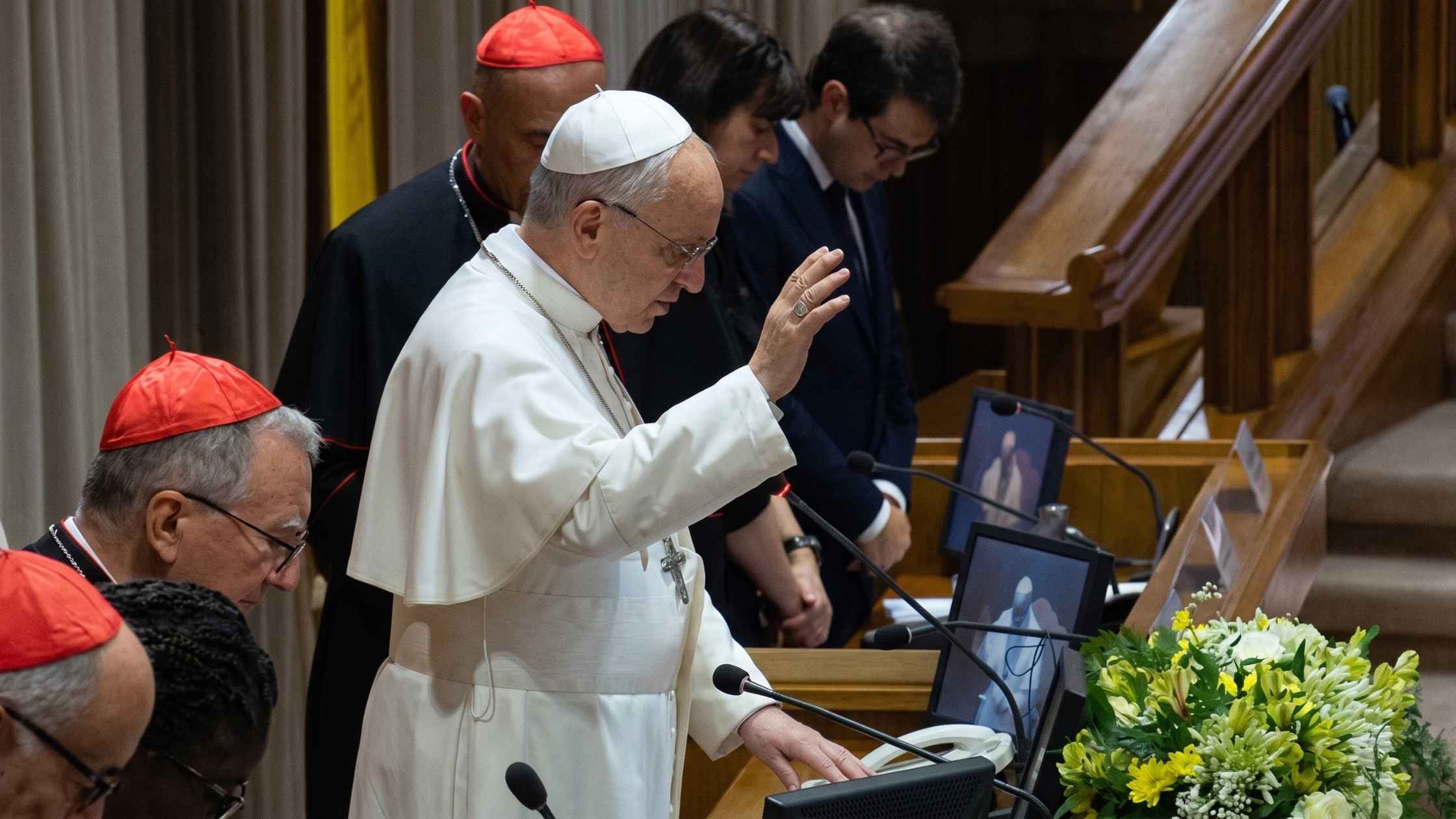
The Lord be with you.
Audience (01:41:46):
[inaudible 01:41:49].
Christopher Olan (01:41:48):
May the peace of God, which surpasses all understanding, keep your hearts and minds in the knowledge and love of God and of his son, our Lord Jesus Christ. Amen.
Audience (01:41:58):
Amen.
Christopher Olan (01:41:59):
And may the blessing of Almighty God, the Father, the Son, and the Holy Spirit come down upon you and remain with you forever. Amen.
Audience (01:42:08):
Amen.
Christopher Olan (01:42:08):
Thank you very much.
Speaker 1 (01:42:09):
[foreign language 01:43:53].