Karen Durham-Aguilera (00:00):
... sacrifices and legacy of our service members who have protected our freedom for a quarter millennium. At Arlington National Cemetery, every day is Memorial Day as we honor our nation's service members from every conflict in our nation's history. These hallowed grounds embody our nation's character and values, symbolizing America's past, present, and future. Our history is not only remembered here, it is lived. Nearly 430,000 are laid to rest here at Arlington National Cemetery. As you look across the rows of white headstones and the Columbarium, remember that every individual marker tells a story of service and sacrifice, weaving together America's history. This memorial landscape honors generations of men and women who have answered the call of duty and defended our American freedom from the Revolutionary War through today, in war and in peace. Today, we pause to express our deepest gratitude, ensuring that their stories of valor and sacrifice are forever etched in the heart of our nation.
(01:10)
Thank you, and let's all enjoy the [inaudible 00:01:13] program.
Speaker 1 (01:46):
Please welcome Gold Star family members, Karen and Billy Vaughn and family.
Billy Vaughn (02:08):
Good morning. It's both an honor and very humbling for Karen and I to be able to speak in front of you this morning. The first time I visited Arlington National Cemetery was in 2003, with my wife Karen and our only son Aaron. At the entrance, Karen took our picture beneath a sign that read, "Welcome to Arlington National Cemetery, our nation's most sacred shrine. Please conduct yourself with quiet dignity and respect at all times. Remember, these are hallowed grounds." We walked these grounds for hours that day, understanding, though not yet fully, the weight of those words.
(02:52)
The second time I visited Arlington was on August 26, 2011 to bury Aaron. For most of my life, I'd heard the phrase, the cost of freedom. Like many Americans, I honored Memorial Day understanding what it represented, but never truly feeling its weight personally. For many, it becomes a three day weekend filled with sales, family, friends, and backyard barbecues. But on August 6th, 2011, the cost of freedom knocked on our family's front door. Every Gold Star family member here today remembers that moment. The knock at the door, the phone call, the words that instantly divide your life into two chapters, before they died and after.
(03:53)
For our family, it felt as though a mirror had shattered. One piece was gone forever and every remaining piece would never be the same again. There were days, weeks, even months when it felt like it would be easier to die than to continue to live. But we cannot remain in that place forever. Their sacrifice is too great. Our families are too important, and this republic must endure for those who come after us. As my friend Tim Brown has said, "We can allow the weight of their sacrifice to crush us, or we can honor it by serving others and by living lives worthy of their sacrifice." I want to thank President Trump, Secretary Hegseth, and our military leaders for giving our war fighters the freedom to fight as they've been trained to fight, to defeat the enemy decisively without unnecessary restrictions placed on them that have too often hindered them in recent years.
(04:59)
And to every Gold Star family here today, your loved ones are not forgotten. Their lives mattered. Their sacrifice matters. And may we live every day worthy of the freedom they help preserve. Thank you.
Karen Vaughn (05:26):
For 250 years, the world has waited for America to fail. Empires around us have risen and fallen, borders have shifted, and governments have collapsed. But through every trial faced, our republic endured. Why? Because this nation was founded upon a single idea powerful enough to outlive kingdoms and empires, and that idea was freedom. For 250 years, Americans have possessed the God-given right to confront injustice, to resist tyranny, to worship freely, to speak openly and make our voices heard, not only in voting booths, but also in the streets. Something most people in the world are unable to do without facing prison or even death. And by the way, one of the greatest lies Americans absorb is this, that freedom is normal. It isn't, it never has been. Freedom is not humanity's default condition.
(06:33)
Those of us fortunate enough to have grown up in America have never known life without it. And because of that, we rarely stop to consider how precious it is or how staggering the price has been to preserve it. But our surroundings today memorialize one important truth. We only remain free because of the brave men and women throughout our history who have signed their names on that dotted line and said, "Even if it cost me my life, I will fight to preserve and defend this, the American dream." Every stone surrounding us represents a name, a story, a circle of family and friends who loved that person so much that they could not imagine a world without them in it, which brings me to my son, Aaron.
(07:26)
Aaron Vaughn was many things. A son, a brother, a husband, a father, a Navy SEAL, a fierce warfighter, a really good football player, and a warm, loving, kind, funny man who would give you the shirt off his back. But the most important thing I will ever tell you about Aaron is this. He had a personal and deep relationship with Jesus Christ, and that's why you see hope, joy, and resolve on this mother's face today because I know that one day I will hold my son again.
(08:04)
Throughout my life, freedom was a concept, a moment in history, a story about brave people who refused to bow any longer to the chains of tyranny. It was something we celebrated on the 4th of July. But on August 6th, 2011, freedom became a sentence that began with, "We regret to inform you." Freedom became the silence left behind by a boy whose laughter filled every room he ever entered. Freedom became a folded flag placed in my arms on behalf of a grateful nation. My son had given his life for me, for us, for every American who wakes up under the protection every day of the red, white, and blue. In his after, it has become my mission to remind people that freedom is not an abstract idea and certainly not something owed to us simply because we're here. As Ronald Reagan once said, "You and I have a rendezvous with destiny. We can preserve this, the last best hope of man on earth, or we can sentence the next generation of young people to take the first step into 1,000 years of darkness."
(09:26)
And he went on to say, and this is my favorite part, " If we are destined to fail, if this way of ours is to be lost, then at least let our children and our children's children know that it did not fail because we failed to try." And I wonder, have you ever stopped to consider that our national anthem ends with a question mark? "Oh say, does that star spangled banner yet wave?" For generations, our military has defended that banner on battlefields across the globe, but my greatest fear has never been that America will be conquered from abroad. My greatest fear is that we, the citizens of this nation, will fail to preserve her from within, that we will grow so cynical, so divided, and so ungrateful for what we've inherited that we forget what was sacrificed to give it to us in the first place. And God forbid we ever let that happen.
(10:29)
The men and women buried in these sacred fields left us with one charge. Don't let America fall. You can almost hear their final pleas around us, make sure my sacrifice was worth the cost, not only to me, but to all those who had to go on living without me. I make no apologies for loving this country. America is not perfect. We have flaws, we have failures, and we have dark chapters in our history, but the reason I love this country so much is that because I understand a fundamental truth, that history can only be shifted where freedom exists, freedom to speak, freedom to challenge, to protest and disagree, freedom to strive towards something better.
(11:24)
And if you've started believing that America's best days are behind her, I encourage you to do two things. Turn off your television and step away from social media, because when you or I walk into a grocery store and we begin chatting with the people around us in line or when we witness strangers helping each other after a devastating storm, or when we're standing in a crowd at a ballgame cheering for our favorite team, it is of no concern to us how the person standing beside us voted. What we're witnessing there in those situations is the real America, not the America we are constantly told to hate, but the America still worth believing in, still worth fighting for, and still worth dying for.
(12:16)
Over the past 15 years, since our family lost Aaron, we have been loved on so well by this nation. Americans literally and figuratively wrapped their arms around us through our darkest hours. I've seen too much generosity, too much goodness to ever buy into the lie that the American way of life was not worth the cost. So no, I don't look around this country and see only the bad. Everywhere I look, I see the reason Aaron Vaughn gave his life.
(12:50)
My prayer I leave you with today is this, that you see it too, and that we as a nation of people blessed enough to live in the United States of America live lives worthy of the sacrifices that brought us this far. Thank you.
Speaker 1 (13:33):
Please welcome the Medal of Honor recipient, Jim McCloughan.
Jim McCloughan (13:45):
Good morning. Every day should be Memorial Day. It is here at Arlington National Cemetery and at the Tomb of the Unknown Soldier. Joseph Campbell said, "A hero is someone who has given his or her life for something bigger than oneself." That's why we are gathered here today. But we cannot remember the dead unless we remember the living that are left behind. We wrap our arms around the Gold Star families who have an empty chair today and every holiday. Would the Gold Star family members in the audience please raise your hand so those around you know that you're sitting near them? Thank you for being here.
(14:39)
We remember also those who fought beside these heroes. The Native Americans call them Ogichidaa, which means warrior. Warriors are those who have seen things that human beings should never see. Those who have done things which cannot be discussed in polite company. Those who even at this night will be visited with late night terror. And yes, those who have fought in wars are injured both visibly and invisibly. Would those in uniform and those veterans raise your hand so those around you know that you're here? Thank you. We soldiers start out loyal to the army and our country, but we soon realize that getting as many of us out of there alive as possible and back to their families will be our main goal. The men in their new family came from every part of this great nation, took their basic and advanced training, and ended up as blood brothers in a place far different from the hometowns that they grew up in.
(16:01)
I'm often asked, "Why is it that you got to be a medic?" Because I was drafted, true draft, two years. When you draft, you don't get to ask for what you can do, but I think it's because when I was preparing to be a coach at Olivet College, I took kinesiology, physiology, anatomy, first aid, advanced first aid, strapping, and taping. I think they thought I had a step up. But nothing, absolutely nothing can prepare you to be a medic in a war.
(16:37)
In that new family, I had what I called a positive job in a negative situation. As a combat medic, I was trained to save lives while lives were being taken all around me, to make the sick and the diseased better. My father had instructed me when I was a really, really little boy. " Jim, never do a job halfway. Do it to the best of your ability, and do it until the job is finished." I remembered those words in Vietnam when my company of fewer than 100 men faced nearly 3,000 NVA and VC. My job was to save the lives of my men and I was going to make sure that I did it. That's why I refused medical evacuation though hit by a rocket propelled grenade. That's why I ran through the open field and carried the injured men to safety. That's why I stayed through those long hellish nights treating the wounded.
(17:45)
I would rather be dead in a rice patty than alive in a hospital and find out that one of my men lost their lives because I was not there to do my job in my family. I was President Trump's first Medal of Honor recipient in 2017, 48 years after my action at the Battle for Nui Yon Hill in May of 1969. In 2019, two years later, I received a letter in the mail that went like this. "My name is Austin. You don't know me, and I don't know you, but you saved my grandpa's life in 1969. My mom was born the next year after grandpa came home with his wounds. I was born in 1991, and last week, my wife and I had a baby boy. And this Sunday, I get to celebrate Father's Day because of you." I had never thought of it that way. I saved 10 Americans and one Vietnamese interpreter, but as I read that to my wife, Chérie, she said, "Jim, you saved 11 family trees."
(19:04)
That grandpa, Bill Arnold, was the first man that I saved in that battle. He called me in November of 2019 with his fourth battle with cancer. He said, "I'm not going to survive this one, Doc. They've told me, so I'm not taking any treatment, but I want you to know that I appreciate the 50 extra years of life that you gave me." But today we remember those who didn't make it, not just those in current generations and my generation, but all of those and generations in these 250 years that we have preserved our freedom. I stand here as a personal witness to the sacrifices made by some of these heroes. I held 18, 19, and 20 year old boys in my arms. I treated their wounds, and I tried to keep them alive. I heard their last words and I saw the last breath of life leave their body.
(20:20)
Our freedom has a price, and some have paid that price in full. Freedom and a lunch is not free. We may not know all of these men and women who we honor today, but they were people that we knew. They were family. They were neighbors. How about people in your class, your classmates, friends and colleagues, Americans who answered the call with extraordinary courage. More than 120,000 are buried in 26 United States military... I'll get it. Cemeteries in 17 different countries. They are from World War I and World War II. Thousands still remain missing in action from World War II, Korea, Vietnam, and the modern conflict in the Middle East. Those buried overseas and those missing in action never came home. President Ronald Reagan put it best. "Those who died and gave up their life in war actually gave up two lives. They gave up the life that they were living when they were killed in action, and they gave up the life that they never got to live."
(21:52)
They never got to meet their soulmate and marry. See the birth of a child. Watch that child grow, graduate. Maybe get to coach them like I got to coach my two boys. They never got to walk their little girl down the aisle, and the ceremony after the wedding, and dance that father-daughter dance that you wait for for so long. And every birthday, every anniversary, every reunion, and every holiday, they're not there. They gave up all of their tomorrows so that we can have all of our todays. It's an old belief that a person is never gone until their name is no longer spoken. As you leave this place here today and walk through the graves and the memorials of those who have sacrificed their all, say their name, speak it out loud. Keep their spirit and their soul alive. We at least owe that to them. I was one of the lucky ones. I came home. I taught high school psychology and sociology for 40 years. I coached baseball, football, and wrestling for another 38 years.
(23:18)
I will leave you with the biggest lesson, though, that I learned in Vietnam. It was the second day of the battle for Nui Yon Hill and I heard, "Medic." And I went towards the sound, and I found a man who had been shot in the stomach. I knew I had to get pressure bandages on there right away, and I did. I had nothing to eat or drink for 48 hours battle. And so, this is why I reached back at this point and I put water on those pressure bandages so his insides would not dry up and he would die anyway. I dragged him into a nearby trench left by the French in the French Vietnam War. I'm trying to decide how am I going to carry this guy out of here. I can't throw him over my shoulder or everything that I will do will become undone. So I'll hold him close to my chest, carry him like a baby.
(24:06)
All of a sudden, in the middle of a war, a thought came over me. It had been since I was a little boy that I had told my father that I loved him. Oh, I knew that my dad loved me, and I'm sure he knew that I loved him, but in those days in the '40s, '50s, and '60s, fathers didn't say that to their sons and sons didn't say that to their fathers. I had a conversation with my creator upstairs, and I said, "Lord..." Now you know why I was so busy. I said, "Lord, if you get me out of this hell on earth so I can tell my father one more time, look him in the face and tell him that I love him, I'll be the best coach, I'll be the best teacher, and I'll be the best father that I can be."
(25:03)
I ran to my father in the O'Hare Airport, threw my arms around him, and I said those three words, "I love you." And guess what? He bounced them right back at me as if we'd been doing that for 24 years of my life so far. It was our greeting and our departure from then on. I've taught my children, my grandchildren, my athletes, my students, and 72 assistant coaches, those are the three most important words that you can say. And I'm giving you all, everyone here, an assignment. There must be someone that recently you probably should have said those three words to. You haven't forgotten them on purpose. You've been busy. After all, it's a holiday. Well, you're going to say those three words to them, and if you can do it face to face, do it. But if you can't, you take those darn cell phones you got and you make sure they hear those three words. Oh yes, and there's a B part to the assignment. Tell them why you love them. You see, I almost waited too long with my father. God bless the heroes that we stand over here today. God bless the military and the veterans. God bless the Gold Star families and all of you seated here today. And on a final note, I gladly stand up next to you and defend her still today because there ain't no doubt I love this land and God bless the USA.
Speaker 1 (27:17):
Presented in the order of admission to the Union, today we honor the 50 states, six US territories, and tribal nations represented across our country, and the generations of Americans from each who answered the call to serve. Representing this roll call today are active duty members of the United States Armed Forces. Representing the United States Army Sergeant First Class Heath Sorensen. Representing the United States Marine Corps Staff Sergeant William Liddell. Representing the United States Navy Chief Musician Kevin McDonald. Representing the United States Air Force Master Sergeant Emily Snyder. Representing the United States Space Force Specialist 3 Michael Solis. And representing the United States Coast Guard Chief Petty Officer Timothy Natoli.
Speaker 2 (28:32):
Delaware, First State, admitted 1787, birthplace to 13 Medal of Honor recipients. Pennsylvania, admitted 1787, birthplace to 336 Medal of Honor recipients. New Jersey, admitted 1787, birthplace to 71 Medal of Honor recipients. Georgia, admitted 1788, birthplace to 27 Medal of Honor recipients. Connecticut, admitted 1788, birthplace to 59 Medal of Honor recipients. Massachusetts, admitted 1788, birthplace to 177 Medal of Honor recipients. Maryland, admitted 1788, birthplace to 66 Medal of Honor recipients. South Carolina, admitted 1788, birthplace to 33 Medal of Honor recipients. New Hampshire, admitted 1788, birthplace to 47 Medal of Honor recipients.
Speaker 3 (30:04):
Virginia, admitted 1788, birthplace to 62 Medal of Honor recipients. New York, admitted 1788, birthplace to 477 Medal of Honor recipients. North Carolina, admitted 1789, birthplace to 30 Medal of Honor recipients. Rhode Island, admitted 1790, birthplace to 25 Medal of Honor recipients. Vermont, admitted 1791, birthplace to 43 Medal of Honor recipients. Kentucky, admitted 1792, birthplace to 56 Medal of Honor recipients. Tennessee, admitted 1796-
Speaker 3 (31:01):
... admitted 1796, birthplace to 39 Medal of Honor recipients. Ohio, admitted 1803, birthplace to 221 Medal of Honor recipients. Louisiana, admitted 1812, birthplace to 20 Medal of Honor recipients.
Speaker 4 (31:31):
Indiana, admitted 1816, birthplace to 68 Medal of Honor recipients. Mississippi, admitted 1817, birthplace to 15 Medal of Honor recipients. Illinois, admitted 1818, birthplace to 108 Medal of Honor recipients. Alabama, admitted 1819, birthplace to 26 Medal of Honor recipients. Maine, admitted 1820, birthplace to 84 Medal of Honor recipients. Missouri, admitted 1821, birthplace to 47 Medal of Honor recipients. Arkansas, admitted 1836, birthplace to 23 Medal of Honor recipients. Michigan, admitted 1837, birthplace to 76 Medal of Honor recipients. Florida, admitted 1845, birthplace to 14 Medal of Honor recipients.
Speaker 5 (32:50):
Texas, admitted 1845, birthplace to 68 Medal of Honor recipients. Iowa, admitted 1846, birthplace to 33 Medal of Honor recipients. Wisconsin, admitted 1848, birthplace to 44 Medal of Honor recipients. California, admitted 1850, birthplace to 60 Medal of Honor recipients. Minnesota, admitted 1858, birthplace to 26 Medal of Honor recipients. Oregon, admitted 1859, birthplace to six Medal of Honor recipients. Kansas, admitted 1861, birthplace to 23 Medal of Honor recipients. West Virginia, admitted 1863, birthplace to 26 Medal of Honor recipients. Nevada, admitted 1864.
Speaker 6 (33:58):
Nebraska, admitted 1867, birthplace to 21 Medal of Honor recipients. Colorado, admitted 1876, birthplace to 13 Medal of Honor recipients. North Dakota, admitted 1889, birthplace to six Medal of Honor recipients. South Dakota, admitted 1889, birthplace to four Medal of Honor recipients. Montana, admitted 1889, birthplace to four Medal of Honor recipients. Washington, admitted 1889, birthplace to 23 Medal of Honor recipients. Idaho, admitted 1890, birthplace to 10 Medal of Honor recipients. Wyoming, admitted 1890, birthplace to three Medal of Honor recipients. Utah, admitted 1896, birthplace to four Medal of Honor recipients.
Speaker 7 (35:15):
Oklahoma, admitted 1907, birthplace to 26 Medal of Honor recipients. New Mexico, admitted 1912, birthplace to 11. Medal of Honor recipients. Arizona, admitted 1912, birthplace to 16 Medal of Honor recipients. Alaska, admitted 1959, birthplace to two Medal of Honor recipients. Hawaii, admitted 1959, birthplace to 24 Medal of Honor recipients. District of Columbia, established 1790, birthplace to 31 Medal of Honor recipients. Puerto Rico, U.S. territory since 1898, birthplace to eight Medal of Honor recipients. Guam, U.S. territory since 1898.
Speaker 8 (36:25):
33 American Indians have received the Medal of Honor for acts of valor across various conflicts in our nation's history, representing tribal nations across the United States. From every state and territory, and from tribal nations across this country, we honor all who have served and all who gave their lives in defense of the United States of America.
MUSIC (42:45):
The God who gave us life.
(42:45)
Gave us liberty.
(42:45)
At the same time.
(42:57)
At the same time.
(42:57)
The hand of force may destroy.
(42:57)
The hand of force may destroy.
(42:57)
But cannot disjoin them.
(42:57)
Cannot disjoin them.
(42:57)
Cannot, cannot disjoin them.
(42:57)
The God who gave us life.
(42:57)
Gave us liberty.
(42:57)
At the same time.
(42:57)
At the same time.
(42:57)
The hand of force may destroy.
(42:57)
The hand of force may destroy.
(42:57)
But cannot disjoin them.
(42:57)
Cannot disjoin them.
(42:57)
Cannot, cannot disjoin them.
(42:57)
The God who gave us life.
(42:57)
Gave us liberty.
(42:57)
At the same time.
(42:57)
At the same time.
(42:57)
The hand of force may destroy.
(42:57)
The hand of force may destroy.
(42:57)
But cannot disjoin them.
(42:57)
Cannot disjoin them.
(42:57)
Cannot, cannot, cannot disjoin them.
(42:57)
Liberty.
(42:57)
Liberty.
(42:57)
Liberty.
(42:57)
Liberty.
(42:57)
[inaudible 00:42:58].
Speaker 9 (42:57):
Please welcome back to the stage Ms. Karen Durham-Aguilera.
Karen Durham-Aguilera (43:08):
Oh my gosh, what a powerful start to the program here at Memorial Day. So as we commemorate America's 250th within these hollow grounds, it ties our nation's founding to the sacrifices that have preserved them. At Arlington National Cemetery, there are no distinctions between service branch, rank or religion. No place here could ever be purchased. Each must be earned. Medal of Honor recipients lie next to privates, generals lie next to junior officers, but all are united in their commitment to our country. All have rightfully earned their final resting place through dignified and honorable service.
(43:51)
To those with loved ones laid to rest here, a grateful nation shares your loss. Your loved ones service and sacrifice will always be remembered in our legacy celebrated, and we will always take care of your loved ones. To our veterans and active duty service members, the profound sacrifices you and your families have endured throughout your military careers, time away from home, physical and unseen burden, and the willingness to lay down your lives, have shaped and sustained our nation for 250 years.
(44:22)
It is this unrelenting commitment to bear the cost of freedom that continues to strengthen our republic today. And thank you to all who have served or are currently serving in any capacity. You remind us that a purpose-driven life often demands immense personal cost. Your example of placing the nation needs above your own inspires us to honor the ultimate sacrifices of those who rest here, and to teach future generations the true exacting price of liberty and service to this great country, the United States of America. So thank you all for being here. And again, welcome to Arlington National Cemetery.
Speaker 9 (45:02):
Ladies and gentlemen, this concludes our program opening. Please enjoy these selections from the United States Army Band and Chorus.
MUSIC (49:18):
Eternal Father, strong to save.
(49:18)
Whose arm does bind the restless wave.
(49:18)
Who bids the mighty ocean deep.
(49:18)
Its own appointed limits keep.
(49:18)
O hear us when we cry to Thee.
(49:22)
For those in peril on the sea.
Speaker 9 (52:43):
Ladies and gentlemen, welcome to the 158th National Memorial Day Observance at Arlington National Cemetery. The wreath laying ceremony will begin with the firing of a 21 gun salute, indicating that the President of the United States has entered Arlington National Cemetery. It is requested that all persons viewing the wreath ceremony remain silent and standing. Appropriate honors should be rendered for the playing of the National Anthem and during the playing of Taps. All personnel in the amphitheater should remain silent and standing and render the appropriate honors during the playing of the National Anthem and Taps. If you have electronic devices, please set them on silence mode or turn them off.
(53:36)
Ladies and gentlemen, please enjoy this musical prelude, courtesy of the United States Army Band "Pershing's Own" under the direction of Colonel Scott McKenzie.
MUSIC (53:45):
(instrumental music)
Choir (53:45):
(Music).
Cadets (53:45):
[inaudible 01:03:41].
Choir (01:08:00):
"To fallen soldiers let us sing, where no rockets fly nor bullets wing. Our broken brothers let us bring, to the mansions of the Lord.
(01:08:00)
No more bleeding, no more fight. No prayers pleading through the night. Just divine embrace, eternal light, in the mansions of the lord.
(01:08:00)
Where no mothers cry and no children weep, we will stand and guard through the angels' sleep, while through the ages safely keep, the mansions of the lord.
(01:08:00)
Oh, through the ages safely keep, the mansions of the lord."
(01:08:00)
(Music).
Announcer (01:10:27):
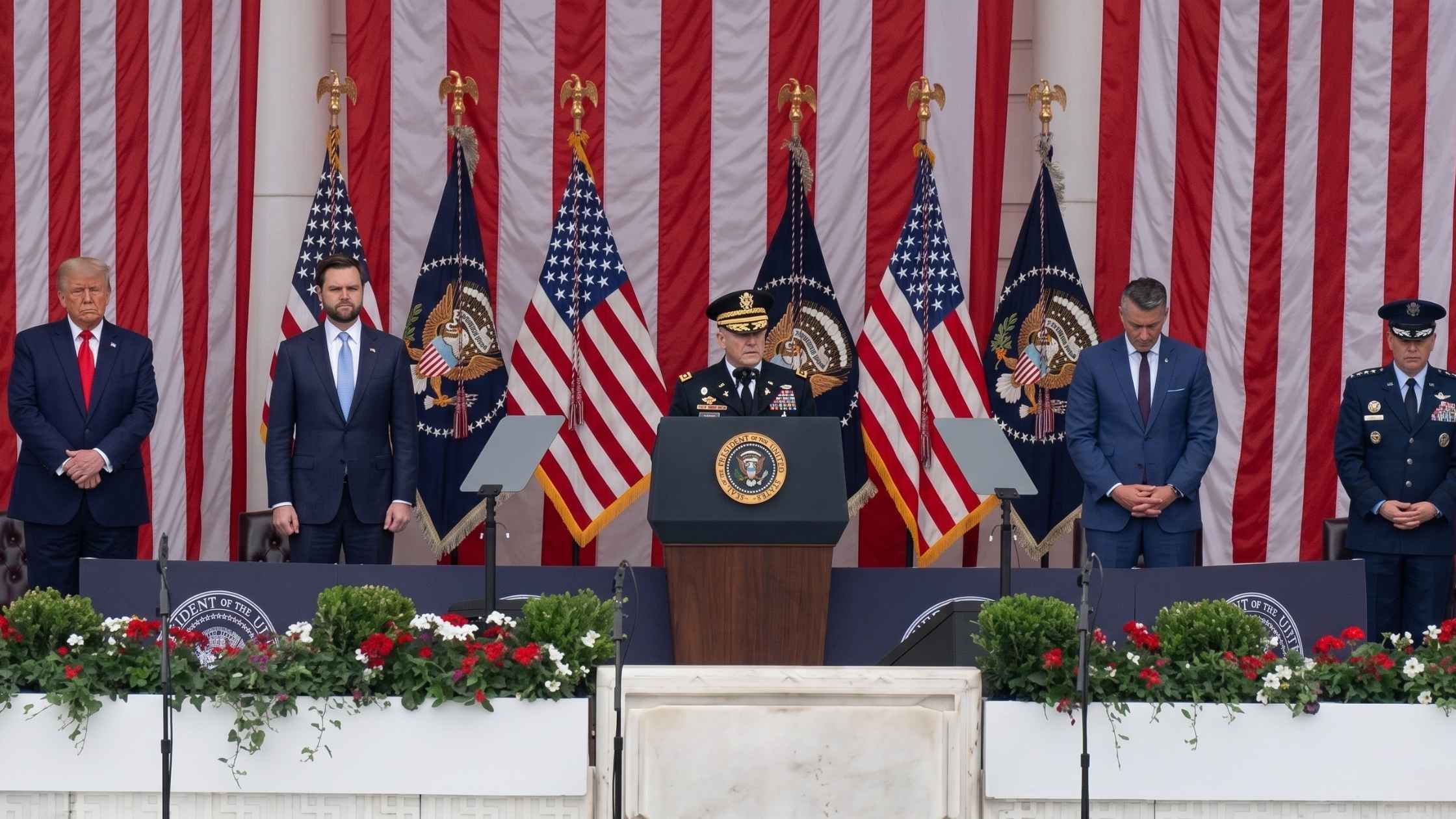
The President of the United States, the Honorable Donald J. Trump has arrived and is [inaudible 01:10:30] with today's host, the Honorable Pete Hegseth, Secretary of War; accompanied by the Vice President, JD Vance; General Dan Caine, Chairman of the Joint Chiefs of Staff; Ms. Karen Durham-Aguilera, Executive Director, Office of Army Cemeteries and Army National Military Cemeteries; and the Major General Antoinette R. Gant, Commanding General, Joint Task Force National Capital Region and the United States Army Military District of Washington.
Cadets (01:10:58):
[inaudible 01:13:20].
(01:10:58)
[inaudible 01:17:21].
Speaker 10 (01:10:58):
[inaudible 01:18:37].
(01:10:58)
[inaudible 01:19:21] we're standing here with [inaudible 01:19:24] so we're going to stay here [inaudible 01:19:25] official [inaudible 01:19:27] right over there [inaudible 01:19:32].
(01:10:58)
[inaudible 01:20:05].
Announcer (01:20:12):
The Armed Forces [inaudible 01:20:03] and the United States Army Band are formed and [inaudible 01:20:07] as the president moves to the Tomb of the Unknown Soldiers placed [inaudible 01:20:12].
(01:20:12)
Ladies and gentlemen, please stand for the playing of the national anthem.
(01:20:16)
[inaudible 01:20:17] play Taps while the president observes the [inaudible 01:20:21] of the flag.
Cadets (01:20:16):
[inaudible 01:20:36].
(01:20:16)
Present.
(01:20:16)
Present.
(01:20:16)
[inaudible 01:20:55].
(01:20:16)
(Music).
(01:20:16)
Hold [inaudible 01:21:34].
(01:20:16)
Hold [inaudible 01:21:34].
(01:20:16)
[inaudible 01:21:34].
(01:20:16)
Present.
(01:20:16)
Present.
(01:20:16)
[inaudible 01:22:53].
Announcer (01:20:16):
[inaudible 01:22:54] will now be placed by the [inaudible 01:22:55].
(01:20:16)
(Music).
Cadets (01:20:16):
Shoulder!
(01:20:16)
Right shoulder!
(01:20:16)
[inaudible 01:25:21].
Announcer (01:20:16):
The president [inaudible 01:25:37] will be [inaudible 01:25:41] minutes silence.
(01:20:16)
[inaudible 01:26:12].
(01:20:16)
[inaudible 01:27:03] now [inaudible 01:27:08] will begin [inaudible 01:27:13].
Choir (01:21:34):
"Mine eyes have seen the glory of the coming of the Lord. He is trampling out the vintage where the grapes of wrath are stored. He hath loosed the fateful lightning of his terrible swift sword. His truth is marching on.
(01:21:34)
Marching on.
(01:21:34)
Glory, glory, hallelujah!
(01:21:34)
Gloria.
(01:21:34)
Glory, glory, hallelujah!
(01:21:34)
Gloria, gloria.
(01:21:34)
Glory, glory, hallelujah!
(01:21:34)
Gloria.
(01:21:34)
His truth is marching on.
(01:21:34)
I have seen him in the watch-fires of a hundred circling camps. They have builded him an altar in the evening dews and damps. I can read his righteous sentence by the dim and flaring lamps. His day is marching on.
(01:21:34)
Glory, glory, hallelujah!
(01:21:34)
Glory, glory, hallelujah!
(01:21:34)
Glory, glory, hallelujah!
(01:21:34)
His truth is marching on.
(01:21:34)
(Music).
(01:21:34)
In the beauty of the lilies Christ was born across the sea, with a glory in his bosom that transfigures you and me. As he died to make men holy, let us die to make men free, while God is marching on.
(01:33:03)
Glory, glory, hallelujah!
(01:33:03)
Glory, glory, hallelujah!
(01:33:03)
Glory, glory, hallelujah!
(01:33:03)
His truth is marching on.
(01:33:03)
Glory, glory, hallelujah!
(01:33:03)
Glory, glory, hallelujah!
(01:33:03)
Glory, glory, hallelujah!
(01:33:03)
His truth is marching on.
(01:33:03)
[inaudible 01:33:04]-"
Audience (01:34:04):
45. 45.
Conductor (01:34:04):
[inaudible 01:37:32].
Audience (01:34:04):
[inaudible 01:37:34].
Conductor (01:34:04):
Oh.
Audience (01:34:04):
[inaudible 01:39:27].
Conductor (01:34:04):
[inaudible 01:39:33]. Let's go. All right, here we go. Instruments up. [inaudible 01:39:41].
Announcer (01:39:52):
Ladies and gentlemen, the President of the United States, accompanied by the Vice President, the Secretary of War, and the Chairman of the Joint Chiefs of Staff. Ladies and gentlemen, Chaplain Lieutenant Colonel Kevin Trimble, Deputy Command Chaplain, Joint Task Force National Capital Region, and the US Army Military District of Washington.
Kevin Trimble (01:40:54):
In your faith tradition, would you bow with me in a word of prayer? Almighty God, creator, sustainer, and redeemer of all mankind, on this day of remembrance, we gather as one people here in America's cemetery, humbled by the cost of freedom and united in gratitude for those who have given their lives in the last full measure of devotion. We remember the soldiers who stood in the breach when liberty was threatened. The sailors who braved the seas in defense of our peace, the airmen who soared into danger so others might live, and the guardians of our homeland who did not return to their families' embrace. From the fields of Gettysburg to the Beaches of Normandy, from the hills of Korea to the jungles of Vietnam, from the sands of the Middle East to the skies above distant lands, their courage has been the shield of our nation.
(01:42:01)
Lord, grant us wisdom to honor their memory, not only with words, but with lives worthy of their sacrifice. May we cherish the freedoms they have preserved, defend the justice they have sought, and extend compassion they carried in their hearts. Comfort the families who still feel the ache of absence. May they know their loved ones are not forgotten, that their names are spoken with reverence, and their legacy lives on in the soul of our nation. As we stand among the markers of the fallen, may we be reminded that liberty is never free. It is fought and paid for in courage, in service, and in love. God, we pray for peace that one day swords may be beaten into plowshares and no mother need weep for a child lost to war. Until that day, give us strength to be faithful stewards of the freedom entrusted to us. In your holy name, we remember, we honor, and we render thanksgiving. Amen.
Audience (01:43:11):
Amen.
Announcer (01:43:15):
Please remain standing and join the United States Army Band, Pershing's Own, in the play of our national anthem.
Audience (01:43:21):
[inaudible 01:44:37].
(01:43:21)
[inaudible 01:44:38].
Announcer (01:43:21):
Please be seated.
Audience (01:43:21):
[inaudible 01:44:45].
Announcer (01:44:47):
Ladies and gentlemen, General Caine.
Dan Caine (01:44:55):
Well, good afternoon, Mr. President, Mr. Vice President, Secretary Hegseth, members of the President's Cabinet, distinguished guests, veterans, my fellow joint chiefs, my fellow Americans, and most importantly, our Gold Star families. Welcome to Arlington National Cemetery and thank you for being here on this special day. Memorial Day is a day of remembrance, a day of mourning, and a day of celebrating the great American spirit, and most of all, gratitude. Gratitude for the men and women who stepped forward without hesitation when their nation called and said simply, "Send me." Today, as we gather on this sacred ground, surrounded by rows and rows of beautiful white headstones, we are reminded as Americans that each marker represents a life cut short, an individual story of American courage, tenacity and grit. This summer, our nation will mark its 250th anniversary. And two and a half centuries have passed since a group of patriots declared themselves an independent nation.
(01:46:14)
But words alone were not enough to deliver on this declaration. Gaining independence as a nation required action. And a young group of soldiers, sailors, and Marines went out into the battlefields to fight and secure our independence and set the course for our great nation that we know today. Many of them lie here on this hallowed ground. For 250 years, the men and women of America's armed forces have always been willing to sacrifice for something greater than themselves. The patriots buried here connect the frozen encampments of Valley Forge to the cold forests of Europe, the sands of the Pacific to the mountains of Korea, and the jungles of Vietnam to the deserts of the Middle East. Across the centuries, the character, courage, and commitment of the American warfighter has never wavered and it never will. It's that same warfighting spirit we recently saw in Operation Epic Fury and we remember and honor those who made the ultimate sacrifice, adding their names to the story of American heroism.
(01:47:36)
To the Gold Star families here today and those watching across this great nation, we know that for you, Memorial Day is not a single date on a calendar, it's literally every single day. You bear a burden that most of us cannot comprehend, but you do so with a grace and resilience that inspires an entire nation. We cannot replace what you've lost, but we can promise you this. Your loved ones' names will never be forgotten. Their names are etched into the stones in this great cemetery, but more importantly, woven into the fabric of the story of our nation. May we always strive to be worthy of their sacrifice and may we honor them by continuing to fiercely defend the nation they died to protect. We will never forget our fallen and their families and may we always keep in mind our members of the deployed joint force right now and their families. It is now my distinct honor and privilege to introduce the secretary of war and a combat veteran himself, ladies and gentlemen, the Honorable Pete Hegseth. Mr. Secretary.
Pete Hegseth (01:48:54):
Well, Mr. President, Mr. Vice President, Chairman, thank you. Gold Star families, ladies and gentlemen, thank you for joining us to remember our fallen warriors from the sacred names of bygone eras, to the 13 souls of Epic Fury. On this sacred occasion for our nation, we take the day for memories of our very best. They now lie in silent rows here at Arlington in more than 170 national cemeteries throughout our nation and across 17 countries around the world. They answered the call when it mattered the most and they gave the last full measure of devotion so that this great republic of ours might endure. This day began as Decoration Day when widows and orphans and other mourners placed flowers and ribbons on some 20,000 graves. They were soldiers once and as they marched off to battle, they sang the lines of the hymn. In the beauty of the lilies, Christ was born across the sea with a glory in his bosom which transfigures you and me. As he died to make men holy, let us die to make men free while God is marching on. The mourners of that first decoration day knew what we know on this Memorial Day, that these graves are more than names and dates with a dash in between. Each grave marker is a story. The young American on the battlefield away from home, he stayed in combat with loved ones, stayed in contact with loved ones by writing letters. In World War II, they called it victory mail. GIs wrote of coming home and watching sunsets again, of having a cigarette and a beer with their buddies, going to football games and on dates, loving their wives, seeing their children grow tall and great. Different wars, still the same letters today. Those we remember today will never get those sunsets. They'll never get those dates. They'll never get to raise their children. Instead, they were delivered from the battlefields into the arms of a loving Lord and savior.
(01:51:31)
Their families and their buddies greeting them home with a folded triangle of stars and the piercing sound of a sole bugle playing Taps. Picnics, barbecues, and time at the beach, those things are wonderful aspects of Memorial Day weekend and we should enjoy them for the fallen. They would want it that way. But this solemn day, we must remember that our republic was forged and purchased with blood. American blood. So take pause today and consider the transformation these warriors went through for our nation. Share it with your kids and your grandkids. We must. Ordinary men when called can become our heroes. They fought not because they hate what's in front of them, but because they love what's behind them. And so may the ones we remember today live on in every flag that flies. May they live on in every voice of a schoolchild who says the Pledge of Allegiance. May they live in our prayers to Almighty God.
(01:52:41)
Today, with this humble ceremony, we owe at least this, that with every salute, with every ceremony, with every parade, with every prayer, every day and every year, we remember. That by our remembrance, we guard the eternal flame that they lit with the price of their youth. They were Americans from small towns and big cities. And in the words of the apostle Paul, they stood against the darkness of the world wearing the breastplate of righteousness.
Audience (01:53:14):
[inaudible 01:53:16].
Pete Hegseth (01:53:17):
They've now gone on to their reward, but we remember them here on this hallowed ground. To them, to those, I say your watch is finished, but the legacy of what you left is eternal. You raced to the breach so that we could walk in freedom and prosperity. May we live lives worthy of their sacrifice and boldly carry forth their fight for freeing, picking up the sword of the spirit and charging forward daily. May Almighty God bless our warriors and may Almighty God bless our fallen and those they love. Always remember. And amen. Thank you.
Audience (01:54:15):
Yeah.
Announcer (01:54:15):
Ladies and gentlemen, please welcome special guest, Craig Morgan, and the United States Army Band, performing Soldier.
Craig Morgan (01:54:22):
All right. Ready?
Conductor (01:54:22):
Go and two, one, two.
MUSIC (01:55:12):
Na, na, na, na.
(01:55:12)
Na, na, na, na, na, na.
(01:55:12)
Na, na, na, na, na, na, na, na.
(01:55:12)
Where did all the people go?
(01:55:12)
They got scared when the lights went low.
(01:55:12)
I'll get you through it nice and slow.
(01:55:12)
While the world's spinning out of control.
(01:55:12)
Afraid of what they might lose.
(01:55:12)
Might get scraped or they might get bruised.
(01:55:12)
Yeah, you can try, but what's the use? And that's why it's called the moment of truth, yeah.
(01:55:36)
I'll get it if you need it.
(01:55:36)
I'll search if you don't see it.
(01:55:44)
If you're thirsty, I'll be rain.
(01:55:47)
If you get hurt, I take your pain.
(01:55:49)
I know you don't believe it.
(01:55:49)
I said it and I still mean it.
(01:55:57)
When you heard what I told you. When you get worried, I'll be your soldier.
(01:56:04)
Funny when times get hard.
(01:56:11)
At the last moment when you're supposed to charge.
(01:56:47)
Always on the longest yard.
(01:56:47)
Oh, they feel their feet getting cold.
(01:56:47)
Hiding here and hiding there.
(01:56:47)
Find them underneath the stairs.
(01:56:47)
Yeah, people hiding everywhere.
(01:56:47)
Trying to be still as a stone.
(01:56:47)
I'll get it if you need it.
(01:56:47)
I'll search if you don't see it.
(01:56:47)
If you're thirsty, I'll be rain.
(01:56:47)
If you get hurt, I'll take your pain.
(01:56:47)
I know you don't believe it.
(01:56:47)
I said it and I still mean it.
(01:56:47)
When you heard what I told you.
(01:56:47)
When you get worried, I'll be your soldier.
(01:56:47)
My aim is so true.
(01:56:47)
I want to show you.
(01:56:47)
I'll try forever.
(01:56:47)
I'm never gonna say, "Surrender"
(01:56:47)
And I'll get it if you need it.
(01:56:47)
I'll search if you don't see it.
(01:56:47)
If you're thirsty, I'll be rain.
(01:56:47)
If you get hurt, I'll take your pain.
(01:56:47)
I know you don't believe it.
(01:56:47)
I said it and I still mean it.
(01:56:47)
When you heard what I told you. When you get worried, I'll be your soldier.
(01:58:00)
I'll be your soldier.
(01:58:00)
I'll be your soldier.
(01:58:00)
Na, na, na, na, na, na.
(01:58:00)
Na, na, na, na.
(01:58:00)
Na, na, na, na, na, na.
(01:58:00)
Na, na, na, na, na, na, na, na, na.
Announcer (01:58:13):
Ladies and gentlemen, Vice President JD Vance.
JD Vance (01:58:33):
Thank you, all, and Mr. President, Mr. Secretary, Mr. Chairman, all of our honored guests, but especially our Gold Star families. I want to say just a few things today because I believe that the most important lesson of Memorial Day is perhaps that all of us owe a debt, that we owe a debt to the people who went overseas and gave their lives that the United States might be prosperous and peaceful and free, that we owe a debt to the people who put on a uniform knowing they might never come back. And indeed, today, we pay tribute to those who never came back. I think, like a lot of veterans, and we're joined by so many of you, sometimes Memorial Day is the most somber and the most sacred of the days on the American calendar. People will come up to our veterans and say things like Happy Memorial Day, or may you have a blessed Memorial Day. And those of us who served know acutely that today is not for all veterans as much as we love all of our veterans. Today is for those veterans who put on the uniform, who went overseas, and who never came home. When I think about the debt that we owe them, I think about all the things that they gave, which can't be measured in dollars or in the things of this world, but are measured in things like weddings that they never got to attend, children that they never saw grow up, daughters and sons that they never got to hug and kiss again, loved ones, husbands and wives. They traded every moment from the moment where they gave their lives to the moment where they would ultimately meet their natural end. Every single one of those moments they gave up that the United States might remain the freest and best country in the entire world. What an amazing thing. What an amazing gift.
(02:00:39)
On this Memorial Day, I just ask two things of all of our fellow Americans, the first is that we be the very best version of ourselves in honor of those who gave everything that this nation might be worthy. To all the husbands and fathers, that we be the best husbands and dads that we can. To all the mothers and wives, that they be the best moms and wives that they can. To the sons and daughters, that they be the very best version of themselves. And that second, we always remember that every moment that we're able to enjoy with our loved ones, everything that gives our life and our nation meaning and purpose was given to us often by total strangers who laid down their lives that this might be the best nation in the history of the world.
(02:01:43)
And finally, to our Gold Star families, I hope you know that I will never forget. I'll never forget your loved ones, that the good life that I have and that my family have is fundamentally because you paid debt that I can never repay. I'll never forget their smiling faces. I'll never forget their skill and bravery and battle. I'll never forget that all the moments that I'm able to have with my family, they're not able to have with theirs. And most of all, I know from every American across every political persuasion, that we love you, we're grateful to you, we're proud of you, and we commit to make the United States of America the very best version of itself, and that is how we honor those who gave their lives to this country. And without further ado, it is my great honor to introduce the 45th and 47th Commander-in-Chief of these United States, President Donald J. Trump. Mr. President.
Craig Morgan (02:02:51):
Well, thank you very much, everybody. What a beautiful day as it turns out. It's just perfect. We'd rather have this than the heat. It's just beautiful. It's always beautiful being here. My fifth time and it never changes. Vice President Vance, Secretary Hegseth, Chairman Caine, members of the Cabinet, members of the United States Armed Forces, veterans, and fellow citizens. Today, here at Arlington, a very special place, that [inaudible 02:03:48] burial grounds, battlefields across the country, and around the world, we unite in solemn observance. With reverend hearts, we honor those who fell so that...
Craig Morgan (02:04:00):
With reverend hearts, we honor those who fell so that our republic might stand. Those who died so that our nation could live, those who gave up their sacred light on earth so that the sublime light of American freedom would shine forever and ever. This Memorial Day, we salute them. We exalt them, and we thank them for all that we have and for all that they gave. They gave everything. God bless our fallen heroes. We're joined today by some of those they left behind, our incredible Gold Star families, incredible people. To every person here and across America who holds tight to the memory of a warrior taken from them, we will never, ever forget the ones you loved. Gold Star family members, please stand. Receive our thanks, please. Thank you.
(02:05:26)
Thank you very much. It's my honor. Less than six weeks from now, our nation will reach a historic milestone: 250 years of majestic American independence. It's something. But it's only right that first we remember the immense sacrifice that has been brought to us and this momentous anniversary year. That's what it is. It's a momentous year. Before we hail the founding, we honor the fallen. Before we celebrate the triumph, we pay the tribute. Before we crown the victory, we count the cost. Today we are reminded that there could be no 4th of July without America's armed forces and there could be no Independence Day without Memorial Day. We owe our liberty, our self-government, the glories of our history, and our very nation itself to the generations who paid for it with everything they had, the ultimate sacrifice. The first Americans to give their lives in battlefields on April 1775 when eight patriots were cut down by redcoats.
(02:06:51)
Those guns, they were shot on Lexington Green. They had answered the call to muster against the force five times their strength. They said at the time the greatest in the world in defense of their cherished rights and their cherished liberty. As the British approached Massachusetts, militiamen summoned destiny itself, saying, "If they mean to have a war, let it begin right here." Caleb Harrington was 23 years old when he accompanied his father to the green that day, torn apart from each other in the chaos of combat. That American son died trying to fight his way back to his father. He wanted to get back to dad. Caleb's cousin Jonathan was struck down at age 31, shot within the sight of his home and his young wife and child, who awaited his return. Jonathan crawled, bleeding, back to them to die on his own doorstep for a final, terrible but beautiful farewell.
(02:08:11)
His widow and orphan were perhaps the very first Gold Star family in a long unbroken chain that reaches up through the ages to us right here today. When our founding fathers put the ideas of the Declaration of Independence to paper in Philadelphia, they signed and sealed an oath that had already been written in blood by patriots at Lexington, Concord, and Bunker Hill. Their sacrifice birthed the most incredible and exceptional nation in all of history, and our nation is doing better today than it's ever done before. That's right. The cause of independence exploded from that part of the American soul that will not be tamed, that will never be conquered, that will rather face death than to live as slaves to the arbitrary will of another. This is the unyielding spirit that has always set Americans apart and driven generations of American warriors into battle.
(02:09:28)
They're chest-beating with the cry that says, "We will govern ourselves. We will control our destiny. We will bow to no one but the righteous God who made us and who gave us our rights and blessed this land, free and the bravest of the brave." 10 days into the legendary Battle of the Bulge in World War II, Lieutenant Colonel Keith Ware led 11 men in a tank against entrenched German positions, the toughest positions anywhere in the world. Half the patrol, including Ware himself, were soon wounded. Yet still, he killed five enemy riflemen, demolished three German machine gun nests, forced a fourth to surrender, and captured the hill. For his heroism, he received the Congressional Medal of Honor. Unlike most drafted soldiers, Ware stayed in the army and rose to the rank of general, a highly respected general. In Vietnam, as commander of the 1st Infantry, the Big Red One, they called it.
(02:10:43)
That's very nice. He led from the front, and in 1968, that's where he was shot down surveying enemy positions for the famous assault on Hill 222, known as the fighting general. He's buried here in Arlington, and with us is his grandson and namesake, Staff Sergeant Keith Ware, and Air Force Veteran Keith. Where are you, Keith? Where are you, Keith? Hi, Keith. Thank you very much. Great honor. We're also honored to be joined by a man who, like General Ware, is a veteran of the largest battle in US Army history, the Battle of the Bulge. At 15, Harry Miller lied about his age, toward list, and we're soon fighting to stop the SS Panzer Divisions as part of the famed 740th Tank Battalion, the "Daredevils" they were called, of which he is among the last surviving members at 97 years old. Within six months after the battle, Harry's unit lost 42 comrades. He's remembering them today, Sergeant Miller. It is a true honor to have you with us, Sergeant Miller.
(02:12:15)
And he looks great. Thank you. Many of the greatest men of that generation followed along an epic path from World War II to Korea and to Vietnam. Major Charles Kelly was the father of aggressive Dustoff helicopter flying that made army medical evacuation pilots among the most fearless. In Vietnam, the greatest helicopter pilots they say that ever lived. Like Sergeant Miller, Charles enlisted to serve in World War II at age 15. He was wounded at the Battle of Aachen and went on to fight in Korea, but flying helicopter ambulances in Vietnam is what etched his name into history. "Since I have been here," he wrote in 1964. "We have evacuated 1,800 casualties, and in the last three months we've flown 242 hours at night." No other unit can match us, and they flew the most dangerous routes probably in the history of warfare. Two weeks later, under brutal enemy fire, Kelly refused to withdraw until he had loaded the wounded aboard. As he prepared for takeoff, an enemy bullet pierced his heart, yet Charles Kelly's heroic lifesaving style lived on in his comrades, and command passed on to Captain Patrick Henry Brady, and four years later, Brady piloted three damaged helicopters in turn to evacuate an incredible 51 wounded warriors under intense fire, fire like no one has seen up until that point. For this, he received also the Congressional Medal of Honor. General Brady is with us at 89 years old as we salute his fallen mentor, Charles Kelly. Thank you very much. Thank you for being here. Thank you very much. Sergeant First Class Matthew McClintock enlisted in the army in 2006 and became a very special Green Beret. In 2016, he found himself in an hour's long firefight with Afghan terrorists. When a comrade was severely wounded, Matthew wanted to find a landing zone for a medevac rescue, a very dangerous, horrible, horrible way to be flying. He was reminded of the dangers, but Matthew replied, "We have to save him. We have to do it." Running out in the face of mortars and rocket-propelled grenades, he went to work but was soon gravely wounded. He was hit from every possible angle. Matthew fell that day, but the soldier he gave his life to save, survived and thrived, and Matthew was awarded the Silver Star. We're deeply honored to be joined by Matthew's mother, Joyce, his widow Ali, and his precious young son, Declan. Here to remember Matthew at his grave in Section 60, 10 years later. So Joyce and Ali and Declan, we salute Sergeant Matthew McClintock as an American hero, please. Thank you.
(02:16:45)
These are tremendous people. These are brave, brave people. In two wars recently, we've lost a total of 13 service members in Venezuela, which was a complete and total victory where we're working very closely with the Venezuela government right now. We took that over in one day, and we lost no one. In Operation Epic Fury, we lost 13 wonderful souls, wonderful, special people. These incredible men and women gave their lives to ensure that the world's number one state sponsor of terror will never have a nuclear weapon. Oh, and they won't. They will never have a nuclear weapon. I'm sure you know that. One of them was Major Ariana Savino, Linse, and we're joined by her great family, Omira, Darren, Zevin, and Wick. Stand up, please, please. There he is. There he is. Thank you very much. Thank you, Wick. Thank you very much. To all of you.
(02:18:17)
Ariana's selfless gift will not be in vain. Our debt to you is everlasting, and it's always going to end in victory. We're having victories all over the place more than we've had in many, many decades. Scripture tells us, "Precious is the sight of the Lord is the death of his faithful servants." 400,000 souls rest on these grounds, these beautiful grounds in the sacred soil, which was first consecrated in the hours of America's greatest division to be eternal symbol, national unity. It cannot be by chance alone that the very first service member laid to rest here in this place of supreme sacrifice was a union soldier by the name of Private Christman, Private William Henry Christman of Pennsylvania, who died at 19 years old. He was a great young man, they say.
(02:19:24)
Beside him are more than 18,000 other young men named William. Over 20,000 named John, over 13,000 named James joined over time by Isaac, Elijah, Earls, Hanks, Helens, Juans, Margarets, Marius, Donalds, not too many. And others whose names tell the true story of American greatness, and greatness it is. Here beneath arching trees and white stones, so beautiful, these many are made one again, united forever as brothers and sisters and arms and children of our fathers in heaven from coast to coast, from proud cities to humble towns, and from heartland fields. From every race and religion, they came because they could not bear the thought that the nation they love so much might ask for heroes and hear no answer, but they answered and they answered very, very loudly at Ticonderoga and San Juan Hill, at Manila Bay and Midway, at Pointe du Hoc and Busan, the courage of the American warrior has forged a path through every sea and every place that's marked a trail to every corner on the earth.
(02:20:54)
In 250 years, America's heroes have saved more lives, freed more captives, accomplished more good, and spread more hope than any other people at any time in the history of the world. Whole nations, no liberty today; entire generations, no freedom. Billions and billions of people have been delivered from poverty, tyranny, and oppression because of the sacrifices we honor this day. That's why from Brittany to Sicily, from Panama City to Saipan, from the Netherlands to North Africa to New Zealand, this whole planet is adorned with memorials to America's fallen and to America's greatness, to their courage carved in marble and engraved in the hearts of all of mankind. We will never forget you. From 1776 to 2026, America has always stood as a great and moral cause. Our warriors are no mere mercenaries. They are guardian angels who stride across the battlefields of history and stand. Watch over the highest and most beautiful planes the human spirit has ever seen, holding the line between liberty and tyranny, between civilization and barbarism, between good and evil.
(02:22:25)
Wherever the American soldier walks, wherever he fights, wherever he fails and wherever he falls, he does it for the destiny of a nation like no other. There's never been anybody like you, and for the fate of freedom on this earth, we salute you like nobody has ever been saluted before. By their deaths, those who have gone before us in battle have redeemed the promise of our founding for each future generation. They've not just made the ultimate sacrifice; they've offered the ultimate proof that we Americans do indeed love liberty. We do cherish the self-government given to us by our forefathers. We do believe with all our souls in the mission that God has given to America, and we do intend with all our strength and heart to hold high the torch our heroes handed to us, and we will never, ever let it fall. Thank you very much. You are special, special people. We love you all. God bless the families of the fallen. God bless the men and women who serve and God bless the United States of America. Thank you very much, everyone.
Announcer (02:23:55):
Ladies and gentlemen, please remain standing for the plaque of Taps and the benediction.
Kevin Trimble (02:25:40):
We now receive the benediction. God of all creation, we pray you bless our nation, our leaders, and those who make decisions over us with wisdom, unity, and grace toward all. Now may the God of peace who provides freedom to gather equip us and guide us as we leave this place. May we carry the burden of the brave who paid the ultimate sacrifice by honoring their legacy through our pursuit of justice and compassion. In your strong name, I pray. Amen.
Announcer (02:26:16):
Ladies and gentlemen, please be seated.
(02:26:48)
Please welcome back Craig Morgan and the United States Army Band performing Paradise.
MUSIC (02:27:20):
They gave me a green uniform and black boots for my feet.
(02:27:21)
18 and wild as hell, I thought it would be neat.
(02:27:21)
They put me on a plane to some strange and foreign land.
(02:27:35)
I said my goodbye to Mom and Dad and hello to Uncle Sam.
(02:28:09)
Once I was a soldier and not afraid to die.
(02:28:09)
Now I'm a little older and not afraid to cry.
(02:28:09)
Every day I'm thankful just to be alive.
(02:28:10)
When you've been where I've been any kind of life, is paradise.
(02:28:10)
Christmas of '89 was a lonely time for me.
(02:28:29)
Panama was probably fine, but it was nothing like Tennessee.
(02:28:36)
I never thought the day would come when I might have to kill a man.
(02:28:39)
I did not sleep a wink that night, but we won for Uncle Sam.
(02:28:47)
Once I was a soldier and not afraid to die.
(02:28:47)
Now I'm a little older and not afraid to cry.
(02:28:47)
Every day I'm thankful just to be alive.
(02:28:47)
When you've been where I've been any kind of life, is paradise.
(02:28:47)
When you've been where I've been any kind of life, is paradise.
(02:28:47)
It's paradise.
(02:28:47)
It's paradise.
(02:28:47)
Paradise.
Announcer (02:30:24):
Ladies and gentlemen, please rise as you are able and remain in place as the official party departs and the colors are retired.
(02:30:31)
Ladies and gentlemen, this concludes today's Memorial Day Observance. Thank you for attending and enjoy the rest of your day.