


Speaker 1 (00:00):
(silence)
Speaker 2 (20:57):
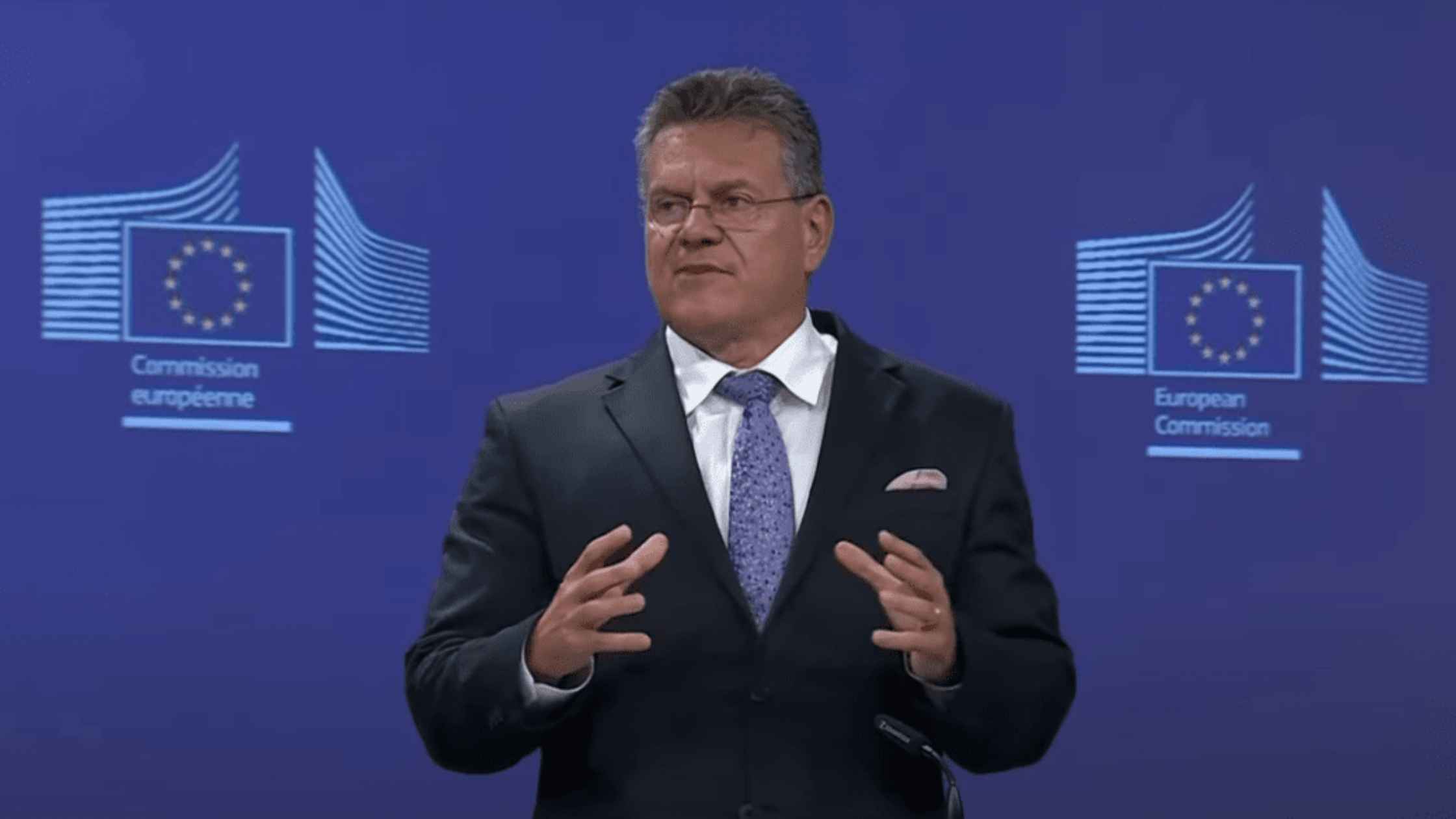
Good afternoon again. Dear colleagues, thank you for staying in the room and to everyone online hello. It's our pleasure to be back here in the press room with the EU Trade and Economic Security Commissioner Maroš Šefčovič, the man who has been making and continues to make superhuman efforts to move our trade agenda forward, including in our talks with the United States. So the Commissioner will give some introductory remarks and then we'll open the floor for your questions. Thanks very much.
(21:23)
Commissioner, the floor is yours.
Maroš Šefčovič (21:25):
Good afternoon, everyone. I'm glad to be here today to follow up on the breakthrough achieved in Scotland yesterday. It was an honor to join Commission's President Ursula von der Leyen at the pivotal meeting with the US President, Donald Trump. If I were to sum up this EU-US agreement in one sentence, I would say it brings renewed stability and opens door to strategic collaboration. This is the result of months of genuine and relentless efforts, unmatched in the intensity and matched only by the unparalleled importance of our transatlantic trade. It's $1.7 trillion value underscores just how much was at stake. From the start, we have been convinced that our transatlantic relationship deserves a negotiated outcome. That is why my team and I made 10 visits to Washington only this year. Given the depth of integration and mutual reliance of our economies, it was essential to take the time needed to get this right to calibrate an outcome that works for both the European Union and the US, as well as ensures that trade between us can continue. Let's pause for the moment and consider an alternative. A trade war may seem appealing to some, but it comes with serious consequences. With at least a 30% tariff, our transatlantic trade would effectively come to a halt putting close to 5 million of jobs, including those in SMEs in Europe, at grave risk. Our businesses have sent us a unanimous message, avoid escalation and work towards a solution that delivers immediate relief. And I appreciate that several business groups have welcomed the contours of the deal. The sense of stability and prospect of strategic collaboration are reinforced by the fact that the agreement addresses not only current reciprocal and high sectoral tariffs, but also forthcoming tariffs on pharmaceuticals, semiconductors, and lumber.
(24:10)
You are now familiar with the key pillars of the deal discussed in Scotland, notably a single 15% tariff ceiling, then $750 billion in strategic purchases, and an additional $600 billion in anticipated private investments into the US economy. On top of that, let me highlight the following three points. First, over the past few months, we have gained a better mutual understanding of each side's sensitivities. As stated before, we can relate to the objective of re-industrializing the US economy as we are pursuing the same goal ourselves. That is why the agreement sees a significant list of goods on which both sides will apply a zero tariff rate where it is in our shared interest to strengthen our trade. And importantly, this list remains open to further additions.
(25:16)
Second, we also believe that certain prospects and certain aspects of global trade policy need fundamental change. For instance, non-market overcapacity is equally destroying the EU steel industry. That is why the agreement sees clear prospect of joint action on steel, aluminum, copper, and their derivatives in what I like to call a metals alliance, effectively creating a joint ringfence around our respective economies through tariff rate quotas at historic levels with preferential treatment. We will also establish a common approach to addressing source economies of overcapacity. Moreover, we are reducing tariffs on our cars from current 27.5% to 15% while enabling EU carmakers to expand their exports from the US. This will enhance the global standing and strengthen our value chain as numerous European SMEs support production activities in the United States. Third, we believe we need to think strategically about future technologies. That is why the agreement also sees strategic purchases of gas oil, nuclear, but also US AI chips. Here, the aim is to strengthen our technological edge in a way that benefits both sides. All in all, this is an agreement which should generate meaningful and mutual benefits, and I hope it will be a stepping stone to a broader EU-US trade and investment agreement in the future, while also fostering our joint efforts to tackle pressing global challenges, such as much needed reform of the WTO.
(27:18)
We have been in constant dialog with our member states and key stakeholders, and I want to sincerely thank them for their trust in the Commission and our continued unity throughout this process. This morning, we briefed the member states as well as members of the European Parliament. In conclusion, I want to appreciate once again the leadership of President von der Leyen, as well as the collaboration with my counterparts for the countless hours of intense engagement, which I hope will pay off. Thank you.
Speaker 2 (27:56):
Many thanks, Commissioner. We will start the questions here in the room. Jorge?
Jorge Valero (28:05):
Thank you very much, Commissioner. Jorge Valero with Bloomberg. Two questions. The first one, are you rock-solid convinced that President Trump will maintain his commitment of 15% tariff for pharma and chips after the investigations are concluded, knowing how President Trump behaves and what you saw during the negotiations? And secondly, given that the energy purchases are totally in the hands of companies, do you fear that the US might retaliate if you don't achieve this 250 billion Euro of purchases per year? Thank you.
Speaker 2 (28:42):
Please go ahead, Commissioner. Take them on your time.
Maroš Šefčovič (28:46):
Thank you. Thank you very much, Jorge. So on your first question, this was the issue which was discussed already for quite some time. And for us, it was very clear that 15% is acceptable in the case that 15% is seen as inclusive. So no stacking and would also cover the ongoing 232 investigation. And I think that it's very clear in summing up the negotiation yesterday that this point was made very clearly by President von der Leyen.
(29:23)
And I believe that with our American counterparts, we are opening a new chapter. We spend a lot of time together. We know each other much better than before. We understand each other's sensitivities, each other's perspectives, and we also will be informing each other much more frequently about all the important decisions taken. So I believe that this commitment will be honored, will be respected in
Maroš Šefčovič (30:00):
… in this case as well. If it comes to energy purchases, Jorge, I think we discussed in the past how we've been working together from the perspective of common purchase platform. Of course, we will discuss of this approach with my colleague Danny Jorgensen, who is responsible for the energy sector right now. But if you look at the current purchases and if you look at the perspective that we will be phasing out the Russian energy supply by 2027. So it's very clear that Europe will need the solid, consolidated, and reliant supply of energy. We are not talking only about LNG, we are talking about oil, and I would say what is also new element, this is the nuclear fuel. As I'm sure you know, Europe is going through the nuclear energy renaissance; and therefore new technology, nuclear fuel will be very much needed for the current but also future nuclear power plants in Europe.
(31:16)
And I would add that significant addition to the strategic purchase list is something what we very much need in the European Union, and these are high-quality AI chips. I think you know our policies quite well and you know how much emphasis we put on developing AI centres, AI gigafactories in Europe. And therefore for me, this is one of the very important strategic achievements that we have now the clarity, that the top-quality chips would be available for us Europeans, that we will collaborate in this field very, very closely with our American partners. Because this is clearly opening new chapter strategy cooperation in such a future-oriented sector like AI.
Speaker 3 (32:05):
Thanks, Commissioner. Thomas Moller-Nielson.
Thomas Moller-Nielson (32:09):
Hello. Thank you very much. Thomas Mellon-Nielsen at Euractiv. I have two questions, Commissioner. So the first is on this joint action on steel, aluminum, and copper derivatives to combat overcapacities. Are you suggesting that the EU and the US will jointly impose tariffs on Chinese metals? And if not, what exactly is it that's been agreed?
(32:26)
And second of all, I'd just like to ask, so a couple of months ago you gave an interview with the Financial Times where you said the EU is prepared to make a 50 billion Euro trade offer. Obviously, the final deal was significantly larger, 250 billion just for energy purchases alone. So could you just expand how this went from 50 billion to 250 billion energy, plus the 600 billion investment, plus military purchases as well. Could you explain how that transformation happened? Thanks very much.
Maroš Šefčovič (32:52):
Thank you very much, Thomas. Starting with the first question, if it comes to these metals union, I think in these many hours of discussions we had with our US counterpart, I think it became very, very clear that if it comes to steel and metals, we are not each other's problem. We are not destroying US steel sectors and they're not destroying our steel sector. On top of it, we are very complementary, and I know that United States are very much in need of our high-specialty steel.
(33:23)
So what we concluded after these negotiations was very clear that what would benefit both of us as much as possible is if we would have kind of metals union between us, meaning that we would set the tariff rate quota based on let's say historic flows between EU and US and trade, let's say, at MFN level as we've been trading until now. So it means that the complementarity of our metal sectors would continue, will be further developed, and that we will take jointly on what is the global problem for the steel sectors, and this is global overcapacity.
(34:05)
So of course, US prefers tariffs. We've been working with the quotas with the TRQs until now. You're familiar that just a few weeks ago we adopted the Steel Action Plan, which was very much expected by our steel industry. We are actively preparing the additional measures for post-2026 safeguard situations. So it's a pressing issue. It's a pressing issue. I'm talking to the ferroalloys companies, I'm talking to aluminum companies. It's a pressing, pressing issue.
(34:39)
So it's very clear that what we need to do is to address the overcapacity, because this is really killing our industry. And if we can do it together with our US partners, we definitely would go in that direction. And of course, details how this would work, the mechanics of it clearly would need to be discussed, but we want to be complementary to help each other here to make sure that the steel and metal industries in both EU and US would thrive and will not be threatened by overcapacities built over the last decade.
Speaker 3 (35:16):
Many thanks. Kim.
Kim Mackrael (35:21):
Hi, Kim Mackrael from The Wall Street Journal. Thanks for doing this, Commissioner. I wondered if this builds a little bit on the last question about the Metals Alliance you mentioned. But between the Metals Alliance and what was said so far and what we understood from the briefing about semiconductor purchases and the decision to preference the US for semiconductor purchases over China, for example, taking those together, what do you think the outcome of this deal means for the EU's relationship with China? Are you working with the US right now to box China out of the trade that you're doing between perhaps the US and the EU and perhaps other major trading partners?
(36:06)
And just a quick question about the EU's WTO obligations. The way I understood from the technical briefing, this to work in terms of the EU's decision to lower some tariffs, is that some tariffs will be lowered unilaterally and only for the US. Is that in line with the EU's obligations under the WTO to do it that way as opposed to most favored nation? Thanks.
Maroš Šefčovič (36:32):
Thank you. Thank you very much, Kim. The first question on China, as you know, just last week we had the EU-China Summit and President von der Leyen and President Costa visited the counterparts in Beijing. Of course, at the beginning of the year we hoped for better results, which would be delivered by the Summit. But I have to say that despite the strenuous efforts of my colleagues and myself and several long meetings with my Chinese counterparts, unfortunately the list of the accumulated issues on the table will not get shorter, but just grew longer. And clearly, the issue is overcapacity. The issue is linked with what we perceive as illegal subsidies, the question mark over how our companies are treated in China, if they get the fair access to public procurement and other issues, and quite a few absolutely unwarranted trade defense measures taken above the products coming from Europe.
(37:50)
And I think that all this was very clearly remunerated and highlighted in a preparatory long VTC. I had with my counterpart Minister Wang Wentao just a few days before, I think it was actually the day before Summit, and then by both Presidents von der Leyen and Costa in Beijing. So I think it's quite clear that there is a lot of issues we have to deal with China, because we just want to have a fair trade relationship with them. I would underline fair, fair treatment of our companies and also clear commitment if it comes to subsidies of the products exported to the EU because we cannot afford to have another development like we had with photovoltaic panels a couple of years ago.
(38:54)
So, of course the US in many aspects are in similar situation. We are dealing with critical raw materials issues. We are dealing with the permits and export permissions for rare earth permanent magnets and I would say the strategic elements which are also needed for our industry. So it's only natural for the close of eyes like we are with the US to compare the notes and to cooperate in all these aspects.
(39:29)
As you know, we also work very, very closely with the US if it comes to the dual-use technologies. You know how complementary we are if it comes to the semiconductors, because if the US have the best chip designers, we have the best machine on this planet to print this chip. So clearly, we are complementary here and we want to consolidate this further by building very solid and strong AI capacities in Europe.
(39:59)
If it comes to the WTO, you know that European Union is and will remain the strongest champion and supporter of WTO and rules-based trade. And nothing changes about it. At the same time, I am in frequent contact with Dr. Ngozi, Director General of the WTO. And I think we both recognize the fact which became so clear after the ministerial meeting in Paris a couple of months ago, that WTO needs deep reform. And I appreciate the efforts of Dr. Ngozi, which are very much supported by us to deliver on these reforms. And I think we have a precious opportunity to progress between now and the spring Ministerial Council in Cameroon to achieve that. Otherwise, it will be extremely difficult for the WTO to play the same role as they're playing now or as they're playing next year. But we, from the EU side, will help them at every step on the way to achieve that goal, because we're absolutely convinced we need the rules, we need the well-functioning WTO, and we need real clarity for the global global trade.
(41:23)
And of course, the last part of your question was that if you look at that agreement which was agreed upon yesterday as an opening of the process. We want to end up with a trade agreement with the US and the trade agreement which would be fully compatible with the WTO rules.
Speaker 3 (41:46):
Okay. Thanks, Commissioner. Bright.
Bright (41:53):
Thank you. Thank you, Commissioner. I have a political question. Some members states say they are disappointed with this agreement because it's not balanced enough. How do you plan to convince them? Thank you.
Maroš Šefčovič (42:13):
Thank you. Thank you very much. I think first and foremost, we did our utmost to keep our member states involved and informed at every step of the way. And we had, I would say, almost permanent contacts with them, including the corporate meetings before and after every engagement on my level, every engagement on the level of technical teams, and of course before and after the meeting of President von der Leyen with President Trump. And we've been of course explaining to them the complexity of the situation. And if some still believe that we can return to the pre-April 2nd situation I think also with the agreements which were struck between United States and its trading partners over the last couple of weeks or I'm sure the number of letters just setting the new tariff lines between now and the 1st August, it's quite obvious that the world which was there before the 2nd of April is gone. And we simply need to adjust. We need to address the challenges which are coming from this new approach. And I believe that the strategic cooperation with our strategic partner is better outcome than all-out trade war.
(43:49)
In my introductory remarks, I was just describing what would it mean: tariffs more than 30%, then huge political tension, lots of SMEs under dramatic pressure, and loss of potentially of hundreds of thousands if not millions of jobs. And what would happen after that? The situation would become so unbearable that we have to get to the negotiated solution after that. We will have to sit and negotiate a new deal, but in much, much worse conditions.
(44:25)
So therefore, I believe that the tasks we set for ourselves, when I for the first time met my counterpart, Secretary of Commerce, Howard Lutnick, the next day after this confirmation when I said, "Howard, let's work together to avoid this mutual pain. Because as two allies, we should be able to find the deal to understand each other. You want to re-industrialize, we want to re-industrialize. You want have high-value AI chips, we want to have high-value AI chips. We want to have energy security. You want to have energy security." So
Maroš Šefčovič (45:00):
So, I think that what is important at this stage, even though I know that for some that potential kind of other outcome might seem very appealing now, but they didn't go through all the numbers, through all the consequences, through all the impact it would have at every sector. And we did that. And we did that, and therefore with full consciousness, I'm 100% sure that this deal is better than the trade war with the United States.
Speaker 2 (45:31):
Many thanks, Commissioner. We don't have too much time left for the Commissioner. He's under pressure. So, we'll take a few questions in the room and then we wrap up. Jorge?
Jorge Liboreiro (45:40):
Hello, Commissioner. Jorge Liboreiro with Euronews. Just following up on my colleague what he said, I mean, it's objective that this deal is quite unbalanced because you have 15% on one side and almost 0 or virtually 0 on the other side. So, do you consider this a good deal or just a case of damage control? And second, do you have any regrets about not using retaliation at any stage of the process in a bid to secure more concessions? Thank you.
Maroš Šefčovič (46:13):
Thank you. Thank you very much, Jorge. At first, I would say that this is clearly the best deal we could get under very difficult circumstances. And I have to say that you were not in a room, but if you have been in a room yesterday, you would see that we really started with 30%. That was absolute real perspective, that as of 1st of August, we will have 30% tariff on our exports, which would, as I already mentioned, practically halt, stop all the trade. And I have to say that President Von der Leyen did terrific negotiations yesterday. She was absolutely great in managing this negotiations, which led to the conclusion of the deal, which I'm absolutely convinced saves the trade, saves the trade flows, saves the jobs in Europe and opens new chapter EU-US relations, how to adjust our mutual trading patterns in this new age of geoeconomics and geopolitics.
(47:16)
And that's, for me, it's very important political answer because it's not only about the trade. It's about security. It's about Ukraine. It's about current geopolitical volatility. I cannot go into the all details what everything was discussed yesterday, but I can assure that it was not only about the trade. So, therefore, I mean, to have a possibility that the two biggest economies and two closest allies can openly discuss all sensitive issues, and, as I can judge, from the discussion yesterday, they are very much aligned on the geopolitical issues of today, I think has additional price. It has additional worth in having this deal done because I believe that from now we can go only for the better. We can go for the improvement, closer cooperation, fair trade agreement, and simply work on all these issues which been kind of accumulating on the table for quite some time.
Speaker 2 (48:20):
Many thanks, Commissioner. Commissioner, we have 100 of our hard-working journalists tuned in online, so we should give one of them the floor and on top of my list is Rebecca Gualandi from Carbon Pulse. Rebecca, the floor is yours. Go ahead. Rebecca, can you knock on your mic? Can we see you please?
Rebecca Gualandi (48:44):
Sorry. Sorry. Can you hear me now?
Speaker 2 (48:45):
We see you and hear you. Please go ahead.
Rebecca Gualandi (48:47):
Okay, thank you. So, in 2024, the EU imported 76.9 billion euros of energy from the US. So, if we want to get to the target, then that means roughly tripling our purchases of US energy, taking into account exchange rates. So, how do we do that? Do we put a target? Is it feasible? I've heard from energy experts that it's actually not feasible. The target is not actually possible because the US doesn't even produce that much LNG or energy products. So, yeah, I'm just wondering how we're going to monitor these purchases, if there's going to be a platform, how you're going to convince EU member states and companies? And also this target actually seems very in opposition to the climate targets and to the objective of reducing energy prices in the EU. So, it seems a bit contradictory to many of the things that the EU has said. Thank you.
Maroš Šefčovič (49:54):
Thank you very much, Rebecca, for your questions. I think that, look, when we approach the assessment of these goals, so, we look at gas, we looked at oil, we look at nuclear fuel, which is new, and we also look at AI chip. So, these are the four basic categories and we look what can be achieved in the term of President Trump, but what can go also beyond the term of President Trump. And as you know, I was responsible for managing the joint purchase of gas platform in the last commission, and I know what the LNG exporters need to give you a good price. They need predictability. They need long-term contracts so they can invest in development of further infrastructure. And once the further infrastructure is built, then, of course, you have more competition in the market and you have a good price.
(51:09)
So, if you look at what are the amounts of energy we would need, especially if you're proceeding through phasing out of Russian energy supplies in the next years, if you're looking at the nuclear renaissance in Europe, if you're looking at the booming industry of AI where we would need 40 billion of the chips, we believe that these numbers are achievable. And, of course, we will work with our companies, with the member states, with my colleagues in the commission, how to set up that mechanism. And, of course, this would be one of the issues which we would be regularly discussing with our US counterparts because, of course, from our perspective, that's the offer. We are ready to go for that purchase. And I know that on this side, they're also working very hard to be able to produce that volumes, that quantity of energy, and therefore I would say it would be joint effort.
(52:13)
But to have the solid supplies for your close allies and to have it at a good price and good quality is something what in these volatile times where, as you know from the past, we have seen how energy supplies could be weaponized. I think it's also very important for overall competitiveness of the European economy.
Speaker 2 (52:37):
Many thanks, Commissioner. And with this, we draw our press point to a close. Huge thanks to the Commissioner for making the himself available. Thank you to our wonderful interpreters. Thank you to our technical experts for keeping the show on the road. Get in touch with us at the SPP if you have any follow up questions and we look forward to talking to you again soon.
Speaker 4 (52:51):
Commissioner. Commissioner, I did want to ask a question, because member states-