


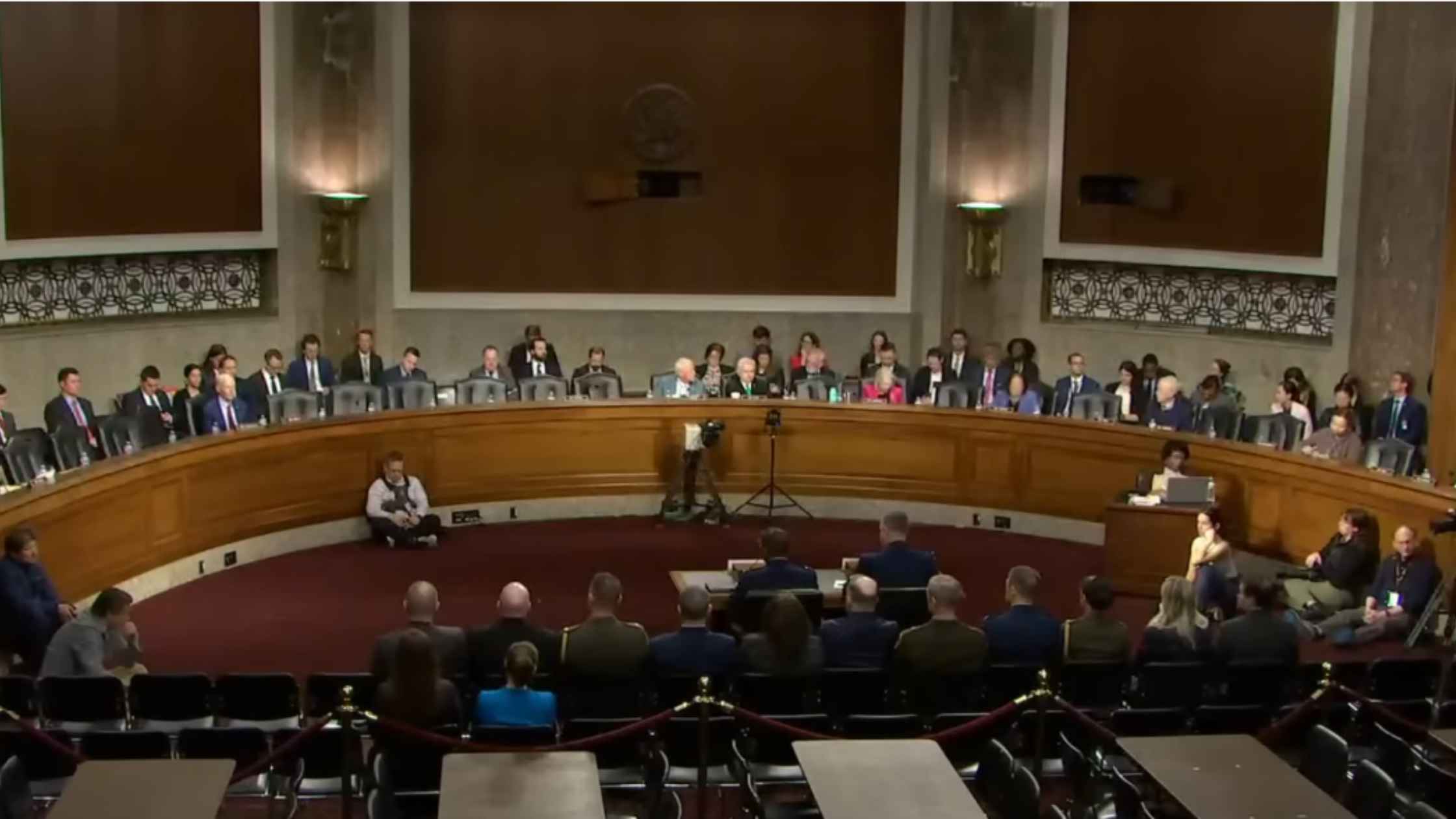
Roger Wicker (00:00):
... targeted a school.
Kirsten Gillibrand (00:04):
That a missile hit a school.
Roger Wicker (00:06):
No, but it's the word targeting-
Kirsten Gillibrand (00:08):
Yes, of course.
Roger Wicker (00:09):
... that you did not mean.
Kirsten Gillibrand (00:10):
How we chose a target that turned out to be a school, albeit next to a appropriate target of a naval base, but the fact that it is chosen as a target, I'd like to know, and I hope that we can have an open hearing on this, Mr. Chairman.
Roger Wicker (00:28):
Thank you. Senator Ernst.
Joni Ernst (00:29):
Thank you, Mr. Chair. And thank you to our witnesses today for your service to our nation. President Trump has pushed our NATO allies very hard to commit 5% of their GDP toward defense and resilience. And we've seen a lot of headlines highlighting new defense investments across Europe. At the same time, NATO defense plans depend on interoperability across 32 allies operating across air, land, maritime, cyber, and space domains. So General Grynkewich, are these new investments translating into shared capabilities with NATO that are interoperable, or are there gaps that our allies need to find and fill?
Alexus Gregory Grynkewich (01:19):
Senator, that's a terrific question. We focus very much on interoperability across the alliance and at US European Command. And I would say one of the best ways to ensure interoperability is when our allies buy American equipment from our defense industrial base. That solves the interoperability problem just at face value.
(01:40)
Of course, the US industrial base can't deliver everything that Europeans need, so they're investing in their own industrial base as well. And to ensure that everything works together, we have NATO standards that both countries in the Alliance and outside the Alliance, including in the Indo-Pacific, adhere to in order to ensure that interoperability. But they're especially new members of the Alliance or folks who are newly certified to NATO standards. We do need to help them along and make sure that they understand that this gets to be very technical when you get into the beeps and squeaks, if you will, of making sure that things can work together.
Joni Ernst (02:11):
Yeah, I appreciate that very much. And the shout-out as well about the defense industrial base. And I think this just lends credibility to all of our voices when we are saying that we need to invest in more here in the United States. I'm glad that our partners are stepping up and developing their own industrial base, but certainly we need a stronger one here in our own nation.
(02:35)
Just very briefly, I am a huge supporter of the state partnership program. I know we have spoken about this before. Our Iowa National Guard and Kosovo are partnered through SPP, and we know that a strong American presence in these countries does maintain stability. Can you speak briefly about the state partnership program and your thoughts?
Alexus Gregory Grynkewich (03:01):
Yeah, Senator, thanks. I've spent some time with your commanding general of the guard unit and of your guard, and they do tremendous work in Kosovo, and I'm very thankful for it. Writ large, the SPP builds deep and lasting relationships. Some of our state partners have been in the program for 30 years or more. And over the course of those 30 years, as exercises happen on both sides of the Atlantic, it just builds a bond you can't replace.
Joni Ernst (03:27):
Yes. Thank you so much. I'm in full agreement. General Reed, we have automatic equipment identifiers, identification tags that help rail providers track the location of our assets across our transportation system. But one of the largest manufacturers of those tags and the technology is owned by a parent company with ties to the Chinese Communist Party.
(03:54)
Currently, TRANSCOM uses our rail system to move heavy assets like tanks from Fort Stewart, or you name it, or other armored vehicles throughout the US. So my concern is that the CCP could utilize these tracking technologies to monitor our military movements, which is a major security risk during a buildup or a surge. So would you agree with that vulnerability? Do you think we are giving the Chinese access into a window of our military movements and engagements, and what can we do about that?
Randall Reed (04:34):
Senator, first and foremost, the department works really hard to eliminate any kind of Chinese component wherever we find it. And that continues with all the energy and effort that we can put to that. Second of all, when it comes to all domain being contested in all domain, the cyber realm is one where this presents itself plain and clear.
(05:03)
With that being said, while it may be a vulnerability, there are ways that we can harden that and we continue to do that. There are alternative ways to make sure that we can track the information. Increasingly, as we get stronger tools, we apply those tools. And one thing that's very, very important is as we continue to use the commercial realm, there are lots of other things that move in the commercial space, and that itself makes it very, very hard for folks to track our equipment.
Joni Ernst (05:37):
Yeah, very good. We need to recognize if we do have vulnerabilities and make sure they're not being exploited. So thank you very much. Thank you, Mr. Chair.
Roger Wicker (05:47):
Thank you, Senator. Senator Kaine, I understand you intend to yield your time to a person who is not yet in the room.
Tim Kaine (05:54):
That is correct. So I'll take my time.
Roger Wicker (05:56):
I think that would be the best backup plan. You're recognized.
Tim Kaine (06:00):
Thank you. America's been at war with Iran for 12 days. The cost to our troops, to everyday Americans, and to innocent Iranian civilians, even school children are dramatic. The war is deeply unpopular. To begin, the war is illegal. The Constitution makes plain that only Congress can declare war. The reason for this provision was articulated by Abraham Lincoln.
(06:20)
Kings had always been involving in impoverishing their people in wars, pretending that the good of the people was the object. This, our convention, understood to be the most kingly of all kingly oppressions, and they resolved to so frame the Constitution that no one man should hold the power of bringing this oppression upon us.
(06:39)
The President has escalated his use of military to carry out hostilities all over the globe without Congress, while threatening military action against many more nations. We're at war because of the unilateral actions of one man who has grown very confident that Congress will not challenge his kingly behavior.
(06:57)
The war is unprecedented. We've heard from the President many shifting reasons for the war, but senators have now heard both publicly from the Secretary of State and from multiple sessions with civilian and military leaders a more precise and consistent reason. The President sent our sons and daughters, spouses, parents into war because another nation was determined to invade Iran. And if that occurred, Iran would likely target US troops for retaliation.
(07:23)
The trigger event of this war was Israel's decision to invade Iran on February 28. We could have avoided this war by persuading Israel that it shouldn't invade and that doing so would hurt its ally, America, and cause global instability. There's no evidence that we tried to do that. Or we could have focused on protecting our own troops from retaliation following an Israeli invasion. Instead, President Trump decided to join an invasion of Iran initiated by another nation.
(07:52)
He is not the first American president who has been urged to take this step. Others wisely resisted, he did not. The war's unnecessary. Iran and America were allies during and after World War II until America engineered the toppling of Iran's democratically elected government in 1953. That act followed by 26 years of a brutal dictatorship that the US helped fund, created deep hostility between our two nations, formerly friends. When the Iranian people finally threw off that oppressive dictatorship in 1979, that hostility resulted in five decades of violence between our countries, the facts of which are well known to American and Iranian citizens alike.
(08:35)
Iran engages in dangerous behavior toward the US, its neighbors and its citizens, but does that danger more than 6,000 miles from our shores warrant the sacrifice of our troops, the killing of innocent civilians, and the expense of billions of taxpayer dollars? If more war between Iran and the United States were the answer, we would have found it sometime in the last 73 years.
(08:57)
We had a diplomatic off-ramp to decades of hostility in the Iranian nuclear deal that the US and Iran together with our European allies plus China and Russia negotiated in 2015. President Trump's decision to abandon that deal, even though it was working and even though many of his closest advisors told him to maintain it, ushered in a sharp spike of Iranian aggression. American troops are dying because this nation's political leadership tragically abandoned diplomacy.
(09:28)
We owe our troops better than this. They serve with such skill and bravery, but as our experiences in Vietnam and Iraq have shown, the bravest patriotic service cannot overcome poor civilian decision making, whether by a president grown too fond of war or a Congress unwilling to provide a check against such behavior.
(09:47)
Virginians feel this deeply. One of the first casualties of the war, Chief Warrant Officer Robert Marzan lived in Spotsylvania County. Hundreds of Virginias are now deployed with the Ford Carrier Strike Group. More have received orders that they'll deploy with the Bush Carrier Strike Group. Their families ask me, "Have we learned nothing?" From 25 years of war in the Middle East, more than 14,000 American troops and contractors dead, more than 65,000 injured, more than $8 trillion spent that could have gone to our education or healthcare or economic development. Have we learned nothing?
(10:22)
Like all in this room, I pray that this war ends soon. Virginians have suffered this year as a smattering economy burdened by tariffs and chaos, produces higher prices, fewer jobs, and slower growth. Gas has gone up 60 cents a gallon in the last 11 days, costing Virginians nearly $5 million a day, just in increased fuel costs. We need a president who will honor his promises to avoid foreign wars of choice and strengthen the economy here at home, and we need a Congress who will not stand silent as these promises are broken. I yield back.
Roger Wicker (11:00):
Senator Scott, you are recognized.
Rick Scott (11:02):
Thank you, Chairman. First, I want to thank our troops. I had the opportunity to serve in the Navy at the tail end of Vietnam. Fortunately, I didn't have to go to Vietnam, but anybody that puts on the uniform, you have to admire them, because they're making the decision to put their life on the line for our freedom. We have a lot of troops at risk right now. I pray for their safety. Unfortunately, we've lost seven members, one in Florida, Cody Khork. I know we have 140 or so injured. I hope they have a full recovery, but I want to ...
(11:41)
The most important thing I think we can all say is we admire what the military has done. We respect what the military has done. We support what the military is doing, and we hope they all come back safely. And the goals of this conflict is that they don't have a nuclear weapon. The goals of this conflict, they don't have the ability to have ballistic missiles that it's going to kill Americans like they've been doing for decades. So I don't think any of us ever want to go to war, but I think we all do respect our freedom and want to keep our freedom. So I want to thank all of our troops for what they're doing.
(12:16)
Thank you both for being here. Thank you for your hard work. One of the things I appreciate about this president is he sees the value in putting America first and working with our friends across Europe, Asia, and around the world to ensure peace through strength. Over the past few years, I've had the opportunity to visit a lot of our allies. Last year, I went to Denmark, Estonia and Finland, all of which are doing their part to increase their national defense spending. They all had some great things to say about President Trump's efforts in the defense space and as a partner.
(12:45)
But a number of allies have been frustrated with being told it's a matter of policy that they can't buy US weapons and the White House and the secretary I know have had to deal with that. Nevertheless, the problem I want to focus on today is that they're also frustrated with the foreign military sales program. Frankly, I understand why. They're facing a defense industry that too often fails to deliver ships and aircraft. I think you've talked about that a little bit. Our manufacturers are not getting things done on time or on budget, or people in the Department of War saying they can't have the weapons that they want.
(13:15)
It's forcing them to turn to other countries, because they need the weapons now. They're doing exactly what we've asked. They're stepping up their defense spending, but there's not enough American weapons to buy. They want our weapons because they know they're the best weapons in the world. They want to train with us. They don't want to buy other systems, and I know you're working on interoperability, but they want to buy American weapons.
(13:37)
What's unfortunate is the President and Secretary Hegseth have made clear why it's good for our allies to buy American-made ships, aircraft, and weapons. It creates good paying jobs in America, allows our allies to fight their own fights and do it with the best weaponry in the world. And what I've gone over, I've said the most important thing is you got to defend yourself. We'll be a partner, but we're not going to be your first line of defense.
(13:58)
So General Grynkewich, is it good for our allies to buy American-made planes, ships, and weapons, and to train with us? And how does this impact our relationship with our allies? And does it make all our military a better fighting force?
Alexus Gregory Grynkewich (14:12):
Yes. Senator, I encourage our allies to buy American equipment as often as possible. We do make the best equipment in the world. It's the highest end kit in so many different areas, and it does enhance interoperability when they do so. Fortunately, there is action that's being taken here with the America first arms export strategy that the department is working on at the direction of the President, which will move several things out of the very frustrating FMS process that you described rightly so. I've heard that from allies time and time again, in moving things into direct commercial sales, which will speed the pace at which they can acquire. And then I'd also say that the work that Secretary Feinberg, our deputy, is doing to supercharge the defense industrial base is going to have a big payoff here and help allies get equipment quicker than they would without those actions.
Rick Scott (15:02):
General, when General Cavoli testified before Congress, he told us the current force posture was five brigade combat teams and two division headquarters. He said it was his advice to maintain that force posture. Is that the force posture the same today?
Alexus Gregory Grynkewich (15:17):
Senator, we have one infantry brigade combat team returned home at the end of last year, so that's the only adjustment that's been made.
Rick Scott (15:25):
Okay. Well, first off, I just want to finish by thanking you for what you're doing. I pray all our troops come home safely. Thank you.
Roger Wicker (15:34):
Thank you, Senator Scott. Senator Kelly.
Mark Kelly (15:38):
Thank you, Mr. Chairman. General Reed, everything happening in Iran in the Middle East right now highlights how critical the maritime domain is, not just for our ability to sustain military operations, but for the global economy. I want to drill into this a little bit with you. So first, on March 2nd, while docked at the port in Bahrain, the US flagged tanker Stena Imperative was struck by projectiles that caused a fire on board. Are you familiar with this, General?
Randall Reed (16:15):
I'm aware, Senator.
Mark Kelly (16:16):
Yeah. Thankfully, the crew is safe. One shipyard worker was killed. That vessel is part of MARAD's Tanker Security Program. Is that correct?
Randall Reed (16:26):
That's correct.
Mark Kelly (16:28):
And how many tankers are enrolled in that program?
Randall Reed (16:32):
Sir, the program is fully subscribed at this point, and it's upwards of 60.
Mark Kelly (16:38):
Upwards of 60.
Randall Reed (16:42):
Excuse me. If you're talking about the Tanker Security Program.
Mark Kelly (16:44):
Yes.
Randall Reed (16:45):
Yes. We currently have 10 that are funded.
Mark Kelly (16:49):
Okay. 10 that are funded. This ship, Stena Imperative was one of those, it's now damaged. So obviously, not a large fleet, 10 ships. So when even just one of these vessels is damaged or unavailable, it can have an outsized impact. Is that correct?
Randall Reed (17:10):
That's correct.
Mark Kelly (17:11):
So in your opening statement, you highlighted the importance of the commercial maritime industry to TRANSCOM strategic sealift capability during a crisis, and I agree with that. But what we're seeing in the Middle East also demonstrates that we need to do more to support the commercial industry we rely on. So let me ask a practical question here. So since TRANSCOM relies on commercial vessels that require insurance, what happens when no one is willing to ensure ships that are operating in a conflict zone?
Randall Reed (17:50):
Senator, thanks to the emergency program of the Tanker Security Program. The value of that for US Transportation Command is the fact that we have assured access to those ships. Those ships are committing to serve with us and to partner with us, and we have the ability to employ them in a maneuver scheme in conjunction with the theater commanders. Part of that also drives us to plan with the theaters to make sure that we have force protection with them as well, but to meet the need. We fully understand-
Mark Kelly (18:29):
Can you explain, General? Can you explain the Tender Security Program that you just mentioned? I mean, is this the reinsurance that the president mentioned the other day?
Randall Reed (18:39):
Sir, the Tanker Security Program is our US flagships.
Mark Kelly (18:46):
No, no, no. I thought you said something else. So my concern is with the insurance, right? Can these ships in the Tanker Security Program, the 10 ships, which really nine are available right now, without the required insurance because they're in a conflict zone, how does that affect their ability to be used to our benefit?
Randall Reed (19:10):
There is a provision for war risk insurance. That program by and large is run by the maritime administration within the Department of Transportation. USTRANSCOM works with them in conjunction. If that is required, there is a conversation and cooperation that exists between the two of us, and we can recommend the requirement for that, at which time the carriers have the opportunity to apply for the insurance.
Mark Kelly (19:42):
So do you see this as an issue today that it's going to be challenging to get some of these ships underway through the Straits of Hormuz because of insurance issues, or do you think there's no problem?
Randall Reed (19:57):
Senator, the challenge with transiting the strait really depends on the conditions that exist and actually to make the safe transit. That will depend on the conditions at hand. That will be judged best by the theater commander, in this case, CENTCOM, but once the conditions are set, we'll sail.
Mark Kelly (20:18):
So no resistance by the ship owners in the Tanker Security Program to sail as soon as TRANSCOM says it's okay?
Randall Reed (20:28):
We hold conversations with the ship owners several times a week. There's an information exchange that exists. There's also a forum that we have called the Executive Working Group. In that, we advise them of the situation. We point out to them what's going on. They fully understand the risk and they also give advice to us in terms of the best way ahead.
Mark Kelly (20:51):
If I could just have 30 more seconds, Mr. Chairman. So I think a lot of this highlights. We only have 10 ships in the Tanker Security Program. MSC has a limited number of vessels. Would you agree that our country needs a whole of government national maritime strategy so that our maritime transportation system is prepared for crises? When we look at a conflict going across the Pacific, in the Western Pacific, let's say in the future with China, are we prepared with our current maritime industry to support a long-term conflict with a near-peer adversary?
Randall Reed (21:32):
Senator, I'll tell you that if we were given the task to go today, we would all go. We would all take what we have and we would execute and support the combatant commander and their needs based on what they require. I will tell you that there is a lot of work to be done to strengthen the health of the fleet, to strengthen the help of the workforce. Part of the challenge of that is cargo. Having cargo available will actually drive the overall plan for the demand to build ships, the demand to have the ships and work to be done by the crews.
Mark Kelly (22:09):
Well, thank you, general, because I'm out of time, but that's what my ... And that issue is addressed in my bipartisan SHIPS for America Act. So I hope to move that legislation forward so you're in a better position to be able to do your job. Thank you.
Roger Wicker (22:23):
General Reed, have you had a chance to look at the SHIPS for America Act?
Randall Reed (22:30):
Excuse me. Chairman, I have.
Roger Wicker (22:32):
You have?
Randall Reed (22:34):
Yes, I have.
Roger Wicker (22:35):
What do you think about it? You've got a pretty good suggestion, don't you think?
Randall Reed (22:40):
Chairman, there are a lot of aspects in that and it's incredibly comprehensive and it does address a lot of things, but it does bring home the fact that we do need a comprehensive approach with comprehensive investment. And we also need to make sure that there's a provision to invite the commercial leaders as well to help us through this. In the end, the fundamental success will ultimately be driven by the amount of cargo. And when we have cargo, that will drive the demand for shipping, we'll find a way to actually construct here and then we'll actually have the crews, because they'll have work to do.
Roger Wicker (23:23):
Thank you for that insight. Senator Sheehy.
Tim Sheehy (23:30):
Thank you, Mr. Chairman. And I would second what Senator Kelly was saying and some others that we need to be focusing not just on our exquisite platforms, but also the broader capacity of the logistics system that's going to support that frontline fight. And to that end, to General Reed, and I'm sorry you're getting all the inbounds here, but specifically I'd like to talk about our future airlift platforms. We spend a lot of time in these hearing rooms talking about the F-47 and the B-21 and the F-35 and the F-22. And of course, those are all critical platforms,
Tim Sheehy (24:00):
... platforms, but at the end of the day, moving material into theater, especially as we evaluate a WestPac engagement with a peer adversary. I don't say near peer, because I believe we're in a peer-to-peer situation now with China, physically moving people, bullets, bombs, food, clothes. Physically moving millions of tons of gear halfway around the world quickly, especially in an area where we're fighting in someone else's backyard and we're having to project that material around the world to tiny islands that we may not be in control of.
(24:34)
Our C-5s are, I've heard in some cases, 40% dispatch reliability, they're half century old, if not more. Our C-17s, as incredible platform as they are, are also aging. And as far as I know, we don't currently have a follow-on long range, heavy lift logistics aircraft that's been decided on, awarded, and certainly not in production, but isn't quite even in decided conceptual stages. And when we look at how challenging a KC-46 program has been to roll out to replace ... I still hear that the last KC-135 pilot hasn't been born yet, and that's probably true. And the KC-46 rollout has been very problematic. So I think we need to have a very serious focused effort. This committee does, but also at the general officer level of focusing on bringing that next generation heavy airlift platform into reality.
(25:27)
And whether that's restart on the C-17 with some great upgrades or whether that's reimagining a new platform, whatever we do, we got to do it quick. So I'd like your thoughts on that, please. And I understand you're not the procurement command for this. I realize you're the customer of this platform, but I think part of the defense acquisition paradigm we're trying to change at this committee is making sure the customer is closer to the actual specification process for the platforms because we've given the power to the PEOs and the contract officers and the most powerful voice in any acquisition process should be the actual end user customer. So you and your captains and majors flying these planes and driving these ships should be the ones driving the requirements, not bureaucrats somewhere else. So if you could talk to us about next gen airlift and where you think it needs to go, I'd appreciate that.
Randall Reed (26:12):
Thank you. Our primary job at TRANSCOM is to set the conditions to move within the headquarters ... Excuse me. We frequently start with the idea. We need to set the globe to set the theater. What that means is we have aircraft that are operating around the world each day along with sealift, but when a crisis arises, there's the need to make the shift. Once we do that, every aircraft that we have available that already originates in the region, we employ them directly. All the aircraft that we have here in the United States, we generate that, and then we build the network to connect the two.
(26:58)
Our C-17s and our C-5s are the most capable things in the world right now to make that bridge to get the force out of the United States. That's incredibly key, because greater than 85% of the joint force still resides here. And so when they're needed abroad, those are the aircraft that we use to start that move.
(27:19)
The challenge that we have predominantly with our competitor is that they are actively developing weapon systems to threaten our aircraft. And so not only do we need new aircraft to get us into the future, we also need the aircraft that are more survivable. So in dealing with the Air Force, we are working with them on the requirements to meet that, but also to track the development of the threats as they emerge from our competitors.
Tim Sheehy (27:51):
What I'd also encourage us to explore all alternatives, expanding and having a wider guarantee for our contract operated cargo carriers, not best for contested environments, but at least they can get tonnage forward. And then exploring things like amphibious aircraft or even submarines that can provide logistical support. Subs have typically been reserved for exquisite tactical missions as they should. But when we're going to be operating in a WestPac, first, second island chain contestant environment, literally moving logistics under the water where we still have dominance. So thanks for your time today. I yield back, sir.
Roger Wicker (28:26):
Thank you, Senator Sheehy. We have Senator King and then Senator Hirono.
Mark Kelly (28:33):
Thank you, Mr. Chairman. There's been a lot of confusion about the war and the effects, the causes, why we did it, why we didn't, what our strategy is. But one thing has emerged just in the last few days, there is a clear winner in this war. The clear winner is Vladimir Putin and Russia. Estimates released a few hours ago are that Russia has reaped $6 billion of benefit from this war since it began just two weeks ago. It's about $400 million a day from the increase in oil prices and the easing of sanctions, which is somewhat puzzling to me. So I just think the record should show that the real winner so far is Vladimir Putin to the tune of $6 billion in two weeks. General Reed, can you give me a percentage? If we had a serious need for transport, what percentage of the transport on the sea and in the air would be commercial carriers who are under contract to TRANSCOM?
Randall Reed (29:39):
Senator, day-to-day in competition, about 40% of what we fly around the skies is commercial. When we transition to crisis or conflict, we make a conscious decision on where we actually employ the commercial aircraft. Even as we're supporting operations in CENTCOM today, the commercial airlines are supporting us in high volume in places outside the theater.
Mark Kelly (30:08):
So in a conflict situation, that 40% would go up, I presume.
Randall Reed (30:14):
If it's required, yes. In the case of sealift, once the ready reserve force makes the initial surge, commercial really plays in for sustainment and greater than 90% of all the sustainment is done by the commercial fleet.
Mark Kelly (30:30):
Okay. That's what worries me. You have controlled and I'm sure paid great attention to cyber possibilities, but we're talking about hundreds, if not thousands of commercial carriers who may or may not be as secure in terms of cyber as you are.
(30:48)
My question is, what steps do we take to ensure that this, you said 90% on the ships, 40%, 50%, 60% in the air are commercial carriers to ensure that they are protected from a cyber attack? Because if we're in a serious conflict with a significant adversary, the first thing that's going to happen is a major cyber attack to attempt to blind us and disable our transportation system. Do you red team, for example, the commercial carriers to determine the extent of their cyber vulnerability?
Randall Reed (31:23):
Senator, we do, and there's a lot of cooperation in that realm. We operate mainly through two different channels. So within the Department of War, when we organize and plan, that is done on secure systems and we have a lot of help to make sure that we can protect ourselves that once that-
Mark Kelly (31:41):
I understand that. What I'm worried about is Delta Air Lines security if they're called upon to be transporting troops and the extent to which they can be penetrated, their systems, not yours, but theirs.
Randall Reed (31:53):
Yes, Senator. Once that planning is complete, we do have some secure channels with the commercial transportation providers. And also, we red team and we cooperate and provide help with them for cyber hygiene. Among some of the sources are CYBERCOM, National Security Agency, as well as the Department of War Cyber Crime Center.
Mark Kelly (32:18):
I would urge you to step up those efforts because this is where the first wave of the attack is going to come. General Grynkewich, to what extent are the Russians, and there's been some discussion about this, probing in Eastern Europe and doing asymmetric warfare in the Baltics, for example, in Poland, disinformation, cyber attacks, even drone incursions? What are the Russians up to? Are they building troops up along their Western border?
Alexus Gregory Grynkewich (32:51):
Yeah. Senator, right now, we see a fairly robust amount of what we call Russian hybrid activities or asymmetric activities. And you mentioned some of those, whether it's information operations or sabotage and those types of things. There have been several incidences in the Baltics and in Poland in particular over the last several months since I've been in command.
(33:14)
As far as conventional troop buildups, most of the Russian ground forces are focused on Ukraine, so we do not see significant Russian buildups right now, but I know that there are concerns that those could be coming at some point in the future, particularly once Russia is able to reconstitute its forces.
Mark Kelly (33:35):
I'm sorry. If President Zelenskyy was here, what would be the one thing he would tell us that he needed right now?
Alexus Gregory Grynkewich (33:43):
Senator I-
Mark Kelly (33:44):
I suspect you hear that fairly regularly.
Alexus Gregory Grynkewich (33:46):
Yes, sir. He would ask for air defense capability based on the Russian attacks on his heating and electrical infrastructure.
Mark Kelly (33:54):
And a great deal of our air defense capability is now tied up in the Gulf region. Is that correct?
Alexus Gregory Grynkewich (34:01):
Senator, yeah, we do have a robust set of air defense capabilities in the Middle East, and I've used some of our EUCOM air defense capabilities to defend some of our NATO allies as well.
Mark Kelly (34:11):
In the Middle East?
Alexus Gregory Grynkewich (34:14):
Near the Middle East, if you will, in the Eastern Mediterranean.
Mark Kelly (34:17):
Okay. So air defense capabilities have been moved toward the Middle East as a result of this conflict. That's correct?
Alexus Gregory Grynkewich (34:25):
Yes, sir. Absolutely.
Mark Kelly (34:26):
Thank you. Absolutely. Thank you, Mr. Chairman.
Roger Wicker (34:28):
Senator Cotton.
Tom Cotton (34:30):
Thank you, gentlemen. Thank you for your appearance today, and more importantly, for your service. General Grynkewich, it's well known that Iran has supplied Russia with hundreds, maybe thousands of one-way attack drones since the start of the Ukraine conflict. I assume you agree that passing on the counter-drone warfare lessons that Ukraine and EUCOM has learned from that fight to the forces in the Middle East today and also to the Pacific is a top priority, right?
Alexus Gregory Grynkewich (34:58):
Absolutely, Senator. And we are doing that and deploying capabilities into the Middle East for those purposes.
Tom Cotton (35:04):
Could you use some additional funds to ensure that we have all the right people and processes to capture all those lessons and implement them?
Alexus Gregory Grynkewich (35:12):
Senator, more funds for things like that is always welcome.
Tom Cotton (35:15):
I agree. And I look forward to working with the committee to consider the funding for the NDAA or a potential supplemental down the road. I know that the experience that Ukraine has had and that EUCOM's had in that fight has saved lives in the Middle East today. General, can you tell us a little bit about what's going on on the southern flank of EUCOM in Cyprus right now?
Alexus Gregory Grynkewich (35:42):
Yeah. Senator, down in the ... We have a fair amount of activity in the Eastern Mediterranean. Our destroyers are out in the Eastern Mediterranean defending our allies and defending our US forces in that region. Several capabilities are on the island of Cyprus. I could go into some of the details of what those are in the classified session, but we are very, very much watching that. There have been a few one-way attack drones that we've assessed have come from somewhere, likely from Lebanon towards Cyprus, and so we are focused on defending that piece of terrain.
Tom Cotton (36:14):
Okay. Thank you. You're an old fighter pilot, right?
Alexus Gregory Grynkewich (36:20):
Yes, sir.
Tom Cotton (36:21):
16s and 22s?
Alexus Gregory Grynkewich (36:23):
Yes, sir.
Tom Cotton (36:26):
Well, I think that the men and women we have in uniform are the best fighting force in the world. I know you agree, and that our Air Force and Navy right now are on the forefront of the current campaign, Operation Epic Fury. So I have just a few questions about what they may be seeing based on your tactical experience. How complex of an operation is it for our fighters to conduct a campaign the size of Operation Epic Fury?
Alexus Gregory Grynkewich (36:53):
Senator, based on my experience looking at campaigns like this in the past, it is incredibly complex and the sequence of events and the technical acumen that's required at the operational and the tactical level is quite high.
Tom Cotton (37:08):
It's my understanding from the briefings that the secretary and the chairman have given is that our combined force and the CENTCOM commander, I should say, that the combined forces drop no less than 5,000 bombs on key enemy targets. How impressive is it for our bombers to execute a mission of that size with such precision?
Alexus Gregory Grynkewich (37:27):
Senator, that's a very powerful demonstration of American strength. And to orchestrate that size of a campaign, I think Admiral Cooper deserves great praise for how he's been able to manage that at the operational level.
Tom Cotton (37:42):
Yeah. General Caine has said that ballistic missile attacks continue to trend downward 90% from where they've started and one way attack drones have decreased 83% since the beginning of the operation, a testament to our air defenders and our air defense system. Based on your experience flying those fighters, I would assume that you would agree with him that Operation Epic Fury is a real testament to those young men and women we have on the front lines operating those systems and flying those aircraft.
Alexus Gregory Grynkewich (38:14):
Senator, I would. And I'll just take the opportunity to say it's always better to get the archer than the arrows. And so the offensive counter air aspect of this that is being prosecuted in US Central Command is impressive as the defensive side of things.
Tom Cotton (38:26):
Okay. General Reed, you also have prior experience in the cockpit. How impressive is it that our tanker fleet has supported these continuous operations in the Middle East for the largest air campaign in recent memory?
Randall Reed (38:41):
The tanker fleet has been very impressive to get the forces across the ocean and to get them into CENTCOM. I'm also very grateful to my friend here who's also been able to help with the portion of his fleet, but the fact that we were able to get our forces in place to get defense set and to go on the offensive is quite impressive.
Tom Cotton (39:02):
Do you think there's any other force in the world that has the tanker and mobility aircraft to sustain an operation like Epic Fury?
Randall Reed (39:10):
Not to the scale that we can at the moment. Thank you.
Tom Cotton (39:12):
Yeah, I didn't think so either. All right. Thank you, gentlemen.
Roger Wicker (39:15):
Thank you, Senator Cotton. Senator Blumenthal.
Richard Blumenthal (39:19):
Thank you, Mr. Chairman. Thank you both for being here today and for your service. General Grynkewich, I've recently visited Ukraine. And in addition to going to Odessa to visit with the men and women of the Ukrainian Armed Services who are serving there, also met with the American Chamber of Commerce, 600 major businesses with operations in Ukraine. Almost half of them have been targeted and attacked by Russia. Within days of my visit, an Oreo manufacturing plant was hit by Russian attacks. Are you looking into the attacks on American businesses in Ukraine? Are you familiar with that issue?
Alexus Gregory Grynkewich (40:22):
Senator, I am familiar with that. This is mostly managed through the US embassy in Kyiv who takes those reports and sends them back through state department channels, but our defense attache office is also aware of them and reports them to me.
Richard Blumenthal (40:34):
Are you taking action to protect those businesses?
Alexus Gregory Grynkewich (40:38):
Sir, we are not taking any direct action, but I would tell you that all the support that the department and the United States provides to Ukraine is certainly going to have a benefit for those businesses as the Ukrainians fight back against the Russian assaults.
Richard Blumenthal (40:54):
Isn't an attack on those businesses, in effect, an attack on American interests? Act on American property, is it not?
Alexus Gregory Grynkewich (41:05):
Certainly it is, Senator. I think it's a complex issue. And from a policy perspective, the approach that we've taken is to try to help the Ukrainians to defend things that are within their country as best as possible, and so that's where we're focused in EUCOM.
Richard Blumenthal (41:21):
Wouldn't you recommend that we take a more aggressive posture vis-à-vis Russia when it's attacking our businesses purposefully? These are not mistakes. Close to 300 American businesses have been damaged significantly as a result of these attacks targeting them by Russia.
Alexus Gregory Grynkewich (41:44):
Yeah, Senator, it's certainly a tragedy that Russia targeting is indiscriminate. It's indiscriminate against American businesses. It's indiscriminate against other targets across Ukraine. As we think about how do we best enable the Ukrainians to fight back against the Russians, all of this goes into our calculus.
Richard Blumenthal (42:02):
Well, I respectfully disagree with your use of the word indiscriminate. It is very discriminating. They are purposely targeting hospitals. I saw a hospital specifically destroyed in large part. They are targeting electric generation facilities, which I also saw, and they are targeting American businesses discriminating in a very purposeful way. Let me move on.
Roger Wicker (42:34):
Well, I'll give you a little extra time. Do you agree with that, General Grynkewich? He's pretty much correct.
Alexus Gregory Grynkewich (42:42):
Yeah. Senator, I do agree. So when I use the word indiscriminate, I'm applying to the moral lens perhaps that they're looking at this through and that they aren't discriminating in the way that we would under the law of armed conflict as to what the targets are.
Roger Wicker (42:55):
Yeah. I think you and the senator actually agree on that. You can resume your time, Senator.
Richard Blumenthal (43:02):
Thank you, Mr. Chairman. And I think your questions were helpful, and I appreciate the distinction that you're drawing, General. EUCOM is the global integrator for all defense matters relating to Russia. So I'm presuming you know about Russia's role in the war with Ukraine. I know you've been asked a bit about it so far. I am assuming the public reports are correct and that Russia is aiding Ukraine. Can you tell us more about requests from ... I'm sorry, aiding Iran. Can you tell us more about the request from Iran to Russia for assistance and how Russia has responded?
Alexus Gregory Grynkewich (43:57):
Senator, I'm certainly aware of all the public reporting on this. I can go into specifics on your question in the classified session, but I would just echo what Secretary Hegseth has said recently that if Russia is doing this, they would be wise to reconsider providing any assistance to the Iranians during Epic Fury.
Richard Blumenthal (44:14):
You believe that we should respond aggressively to that kind of assistance that's putting our men and women in greater harm's way?
Alexus Gregory Grynkewich (44:24):
Senator, anytime anyone puts American service members in harm's way in any manner whatsoever, I believe we should respond robustly.
Richard Blumenthal (44:33):
Why haven't we done it?
Alexus Gregory Grynkewich (44:36):
Senator, I am confident that we are responding robustly to anyone who is assisting the Iranians with targeting US forces.
Richard Blumenthal (44:47):
Perhaps you can tell us more in a classified setting?