

4 in 5 Legal Professionals Are Burned Out: Can AI Be the Lifeline?
New report: 4 in 5 lawyers experience burnout. Learn how overwhelming workloads lead to stress and how AI is helping legal professionals find balance.


While incredibly rewarding, the inherent pressures of a legal career can push even the most dedicated professionals to their limits, leading to burnout. Burnout is more than just feeling tired after a long day — it’s a pervasive challenge impacting mental health and overall well-being.
The good news? There's growing recognition that this is a systemic issue demanding new solutions. As administrative tasks continue to pile up, many legal professionals are turning to technological innovations, particularly artificial intelligence, as a potential antidote.
We surveyed lawyers and legal professionals on the state of burnout in the profession to gain insight into its causes, consequences, and the promising role AI could play in fostering a healthier, more sustainable legal practice.
Key Takeaways
- Nearly 80% of legal professionals have experienced feelings of burnout at least "sometimes" in the past year.
- 9% experience "constant" burnout.
- Nearly 30% identify administrative tasks, and over 29% cite insufficient support as primary contributors to their stress.
- Over half of legal professionals have considered leaving their role or the profession altogether due to stress or burnout.
- Over 33% value AI for reduced stress and improved well-being, and 11% estimate potential financial gains of $100,000 or more annually.
What Is Lawyer Burnout?
Burnout is an "occupational phenomenon" resulting from chronic workplace stress that hasn't been managed successfully. Specific characteristics include:
- A profound feeling of exhaustion
- A sense of mental detachment or cynicism toward your job
- A feeling that your accomplishments are dwindling
While anyone in any field can experience burnout, legal professionals are particularly prone, our study finds, with close to 4 in 5 expressing at least occasional feelings of burnout, compared to just 44% of the general working population (SHRM).
The high demands, high stakes, emotionally charged nature of cases, potentially adversarial environments, and the sheer volume of work can create a fertile ground for burnout to take root and flourish.
79% of Legal Pros Have Felt Burned Out
Our survey of legal professionals reveals a startling reality: A staggering 79.8% of legal professionals reported feelings associated with burnout in the past year.
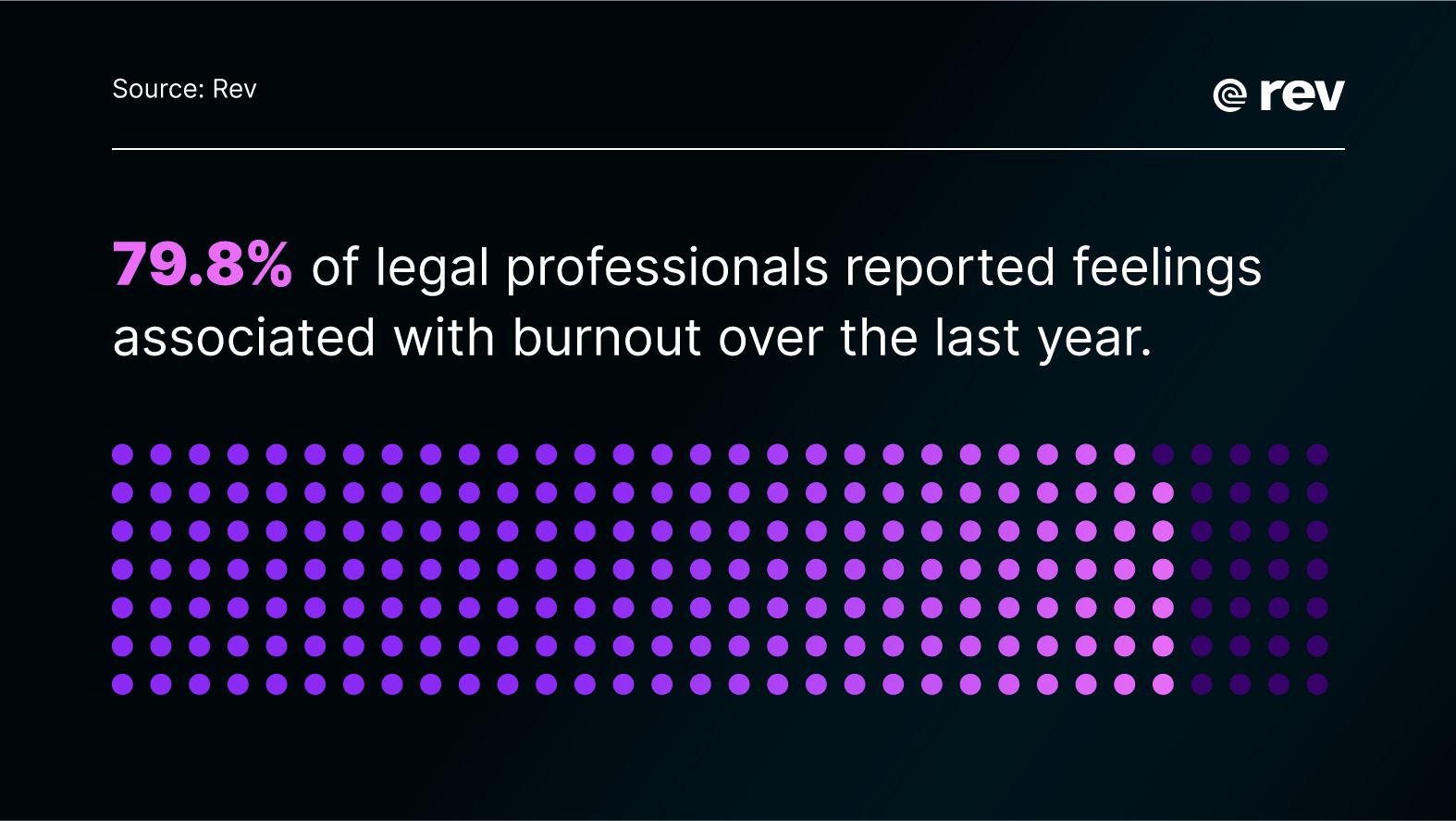
For nearly 40% of that group, these debilitating feelings are a regular or constant challenge, and this is even more pronounced (46%) for legal professionals with 10 or fewer years of experience. These findings suggest that burnout in the legal profession isn't an isolated incident, but a deeply embedded, systemic issue that impacts daily productivity and long-term well-being.
What's particularly striking is how few legal professionals seem immune. Fewer than 4% of respondents reported never feeling burned out in the past year.

And it's not just lawyers, as paralegals experience burnout at similar rates. According to our data, 77% of our paralegal respondents experience burnout sometimes, often, or constantly, indicating widespread burnout issues within this group.
Over Half of Legal Pros Have Considered Leaving Due to Burnout
If you've ever found yourself scrolling through job boards or contemplating a drastic career change, you're part of a massive group of legal professionals.
Our survey found that nearly 60% of legal professionals have seriously considered leaving their current role, or even leaving the legal profession altogether, due to work-related stress or burnout in the past year.
It's worth noting that this impulse isn't necessarily pervasive for those who feel it. Of the professionals considering career changes, just 14% think about it often, 9% think about it very often, and 5% think about leaving constantly.
These numbers trend even higher among legal secretaries and partner attorneys, 8% of whom say they think about leaving on a daily basis due to feelings of stress and burnout, likely because of high administrative demands and responsibilities.
No matter how often legal professionals think about leaving their careers, the prevalence signals that for many, the current demands are unsustainable. If unaddressed, the trend poses a threat of talent drain and reduced job satisfaction across the legal landscape.
Nearly 1 in 2 Legal Pros Face Long Hours and Intense Workloads
If you're a legal professional, you understand the regular (if not persistent) feeling of being overwhelmed by your work. "Burnout is not just a headline," says Andrew Izrailo, Senior Corporate and Fiduciary Manager at Astra Trust. "Anyone juggling tax law across sixteen jurisdictions can feel the wheels wobbling. I slid into that space after four straight years without a long weekend."
Our survey responses validated this feeling by pinning down some of the key factors that contribute to daily stress and burnout in the legal profession.
For 47% of respondents, the biggest culprits for workplace burnout combined were a heavy workload and long hours, followed closely by a lack of work-life balance (33%).
Comparing roles, solo practitioners were more likely to report poor work-life balance (47%) and a lack of support and resources (41%), while in-house counsel lawyers were more likely to cite intense workloads as the highest burnout contributor (53%). These numbers represent the personal toll that relentless caseloads can take on legal professionals.
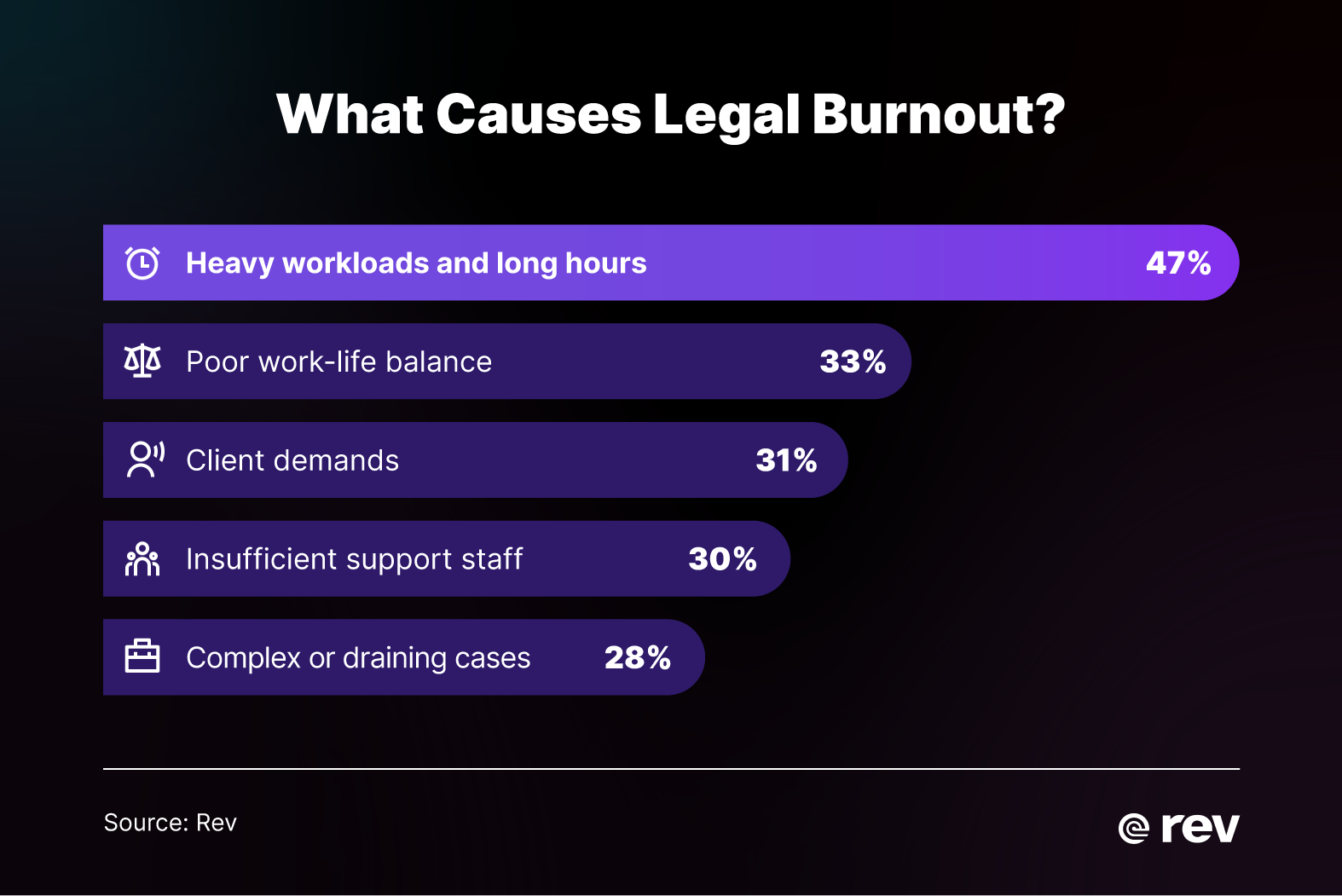
Beyond the sheer volume of work, nearly 30% of legal professionals also point to insufficient support staff or resources as a primary contributor to their stress. This suggests that many are attempting to manage overwhelming demands with too little help, creating a bottleneck that can lead to high levels of case backlogs.
Nearly 80% Are Sidetracked by Administrative Tasks
A striking 78% of respondents report that preparatory or administrative tasks prevent them from dedicating time to essential duties like strategic case planning, client counsel, or professional development. Partner attorneys see even higher rates, with 87% stating that administrative tasks get in the way of key responsibilities.
And these tasks also lead to stress, with 27% of respondents saying that administrative work directly contributes to their feelings of burnout. Duties like scheduling, billing, and accounting aren't just time-consuming—they actively add to the overall burden legal professionals face.
Our survey reveals that nearly half (49%) of legal professionals spend seven or more hours per week on administrative or non-specialized legal work, with 28% of that group spending over 10 hours. That's a major chunk of time each week going to tasks like reviewing deposition recordings, summarizing documents, or managing schedules.
And what’s more, our data shows that very few legal professionals have found a way around this burden, with only 2% currently outsourcing these tasks or avoiding them entirely.
The result? Tedious, non-specialized duties force many legal professionals to sideline critical thinking and direct client service, leaving them feeling less effective and with less time to spare for those important tasks.
Nearly Half of Legal Pros Are Familiar With AI
For many in the legal profession, the concept of artificial intelligence can spark both curiosity and caution. The fact is, AI has the potential to alleviate the very burdens that contribute to burnout.
A combined 46% of legal professionals report some level of familiarity with AI tools for administrative tasks like transcription or summarizing complex documents or contracts.
Our survey found that the barrier to AI use in the legal field stems from several key concerns. The main barrier identified by 41% of respondents revolves around accuracy and reliability.
When dealing with sensitive legal documents and client information, the margin for error is virtually nonexistent. Any doubt about a tool's precision understandably poses a significant hurdle.
Closely following is the concern for data security and client confidentiality, noted by 40% of respondents. Safeguarding privileged information is a non-negotiable priority, making trust in new technology paramount.
Whether or not legal professionals are ready to explore AI, at the very least, the desire for what AI can offer if implemented effectively is undeniably strong, particularly for emotional and psychological effects.
While 34% of professionals see the ability to provide faster client turnaround times as a key advantage, over 33% also believe reduced stress and improved personal well-being would be valuable benefits.
Another 34% prioritize improved work-life balance, with those who have most often contemplated leaving their job citing better work-life balance (41%) as the top benefit.
How AI is Already Making a Difference
For those legal professionals who have embraced AI, the promise of the technology isn't just theoretical; it's already translating into tangible benefits. They are finding that AI can be a game-changer in combating lawyer stress and improving daily workflows.
Among the small percentage of legal professionals currently using AI tools, the impact on their stress levels and feelings of burnout is largely positive.
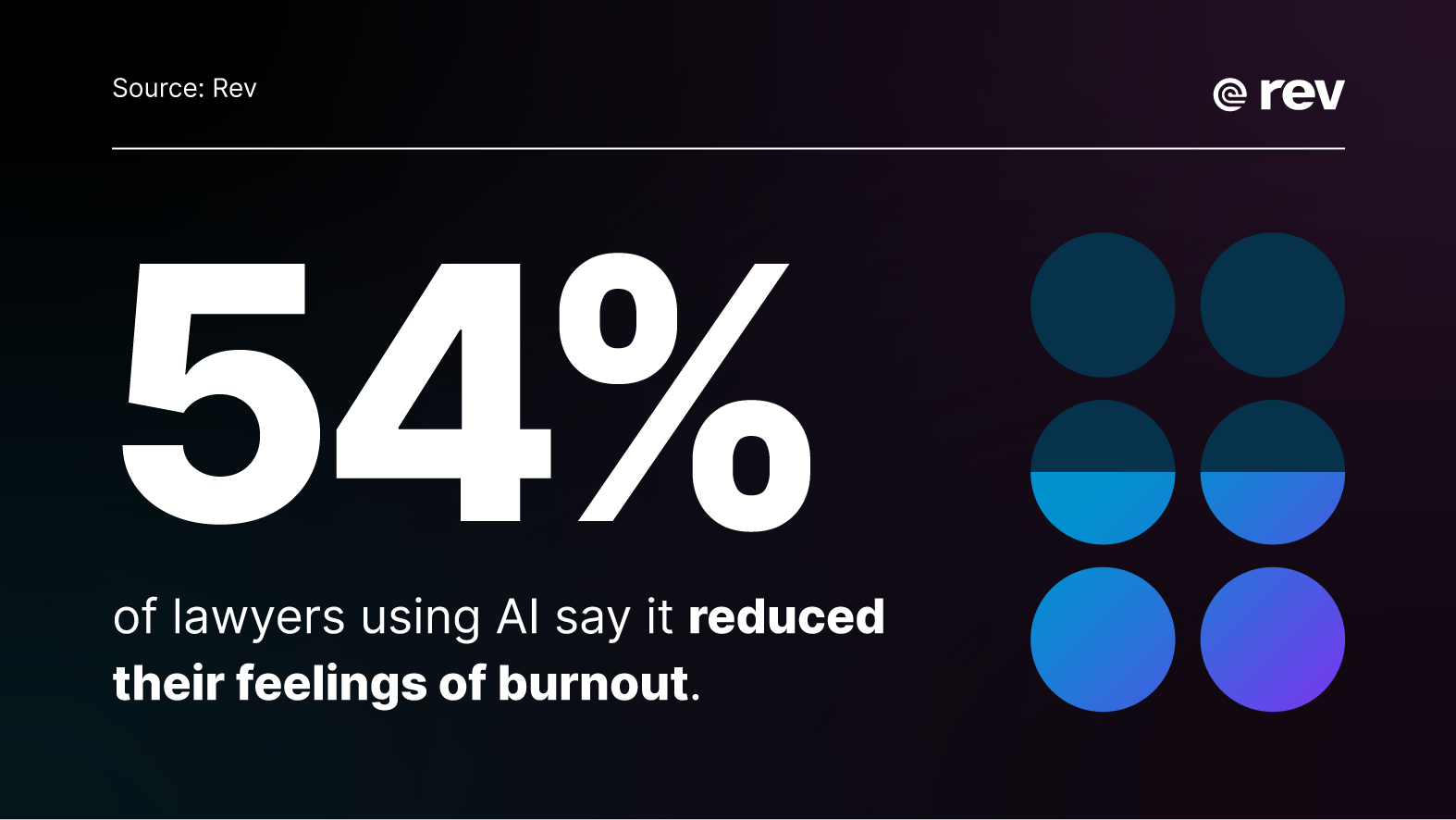
Our survey found that more than half (54%) of respondents who are currently using AI felt a reduction in work-related stress or burnout, showcasing just how much AI is actively easing their load.
Beyond personal well-being, AI is also showing its potential for practice growth and financial foresight. Nearly 30% estimate that AI represents potential financial gains of $25,001 or more annually through increased efficiency, reduced expenses, or the ability to pursue new opportunities. Of those, over 9% anticipate even larger impacts of over $100,000 per year, with some (2%) estimating gains of over $500,000 per year.
The legal professionals who anticipate the highest financial gains from AI say they would use the tools to provide faster turnaround times to clients and reduce errors in administrative work.
These figures highlight AI's dual role. It’s both a powerful pathway to mitigating lawyer burnout and a strategic advantage for fostering practice growth and increased profitability. As the trope goes, it's about working smarter, not harder, and seeing the benefits reflected in both your well-being and your bottom line.
Reduce Administrative Stress With Rev
Lawyer burnout is a widespread issue, but not an insurmountable one. The path to a more sustainable and fulfilling legal career increasingly lies in smart efficiency, allowing you to reclaim valuable time from the administrative burdens that fuel stress.
By strategically leveraging technology, particularly AI, your practice can foster a healthier work-life balance and focus on the higher-value tasks that define your profession. That's where Rev transcription comes into play.
Here's what that looks like for Matthew A. Dolman, a personal injury attorney at Dolman Law: "Rev sits on my desktop like a patient junior associate, cranking out clean transcripts almost before the bailiff stops talking. I feed it the day's testimony, sip lukewarm coffee, and by sundown the file is ready for a final comb-through. The payoff in hours saved is almost unfair."
Ready to combat legal burnout by streamlining your administrative tasks? Rev's advanced transcription and summarization tools can help you regain control of your time, reduce stress, and save hours spent on documentation, transcription, and case note preparation.
Methodology
The survey was conducted by Centiment for Rev. The survey was fielded between June 19 and June 23, 2025. The results are based on 550 completed surveys. In order to qualify, respondents were screened to be residents of the United States, over 18 years of age, and identify as legal professionals in roles including attorneys, legal assistants, paralegals, legal analysts, and associates. Data is unweighted, and the margin of error is approximately +/-2% for the overall sample with a 95% confidence level.