


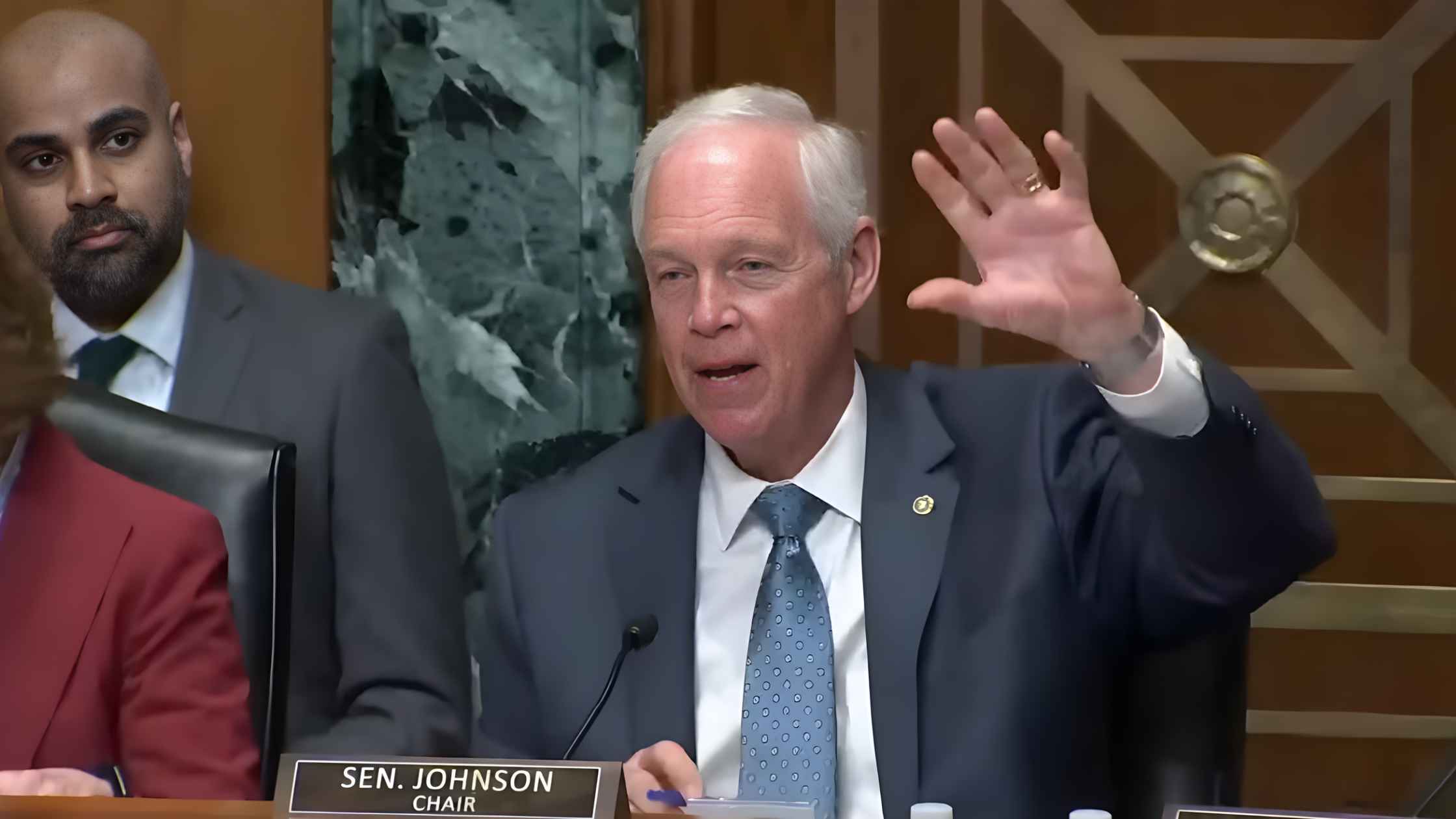
Senator Ron Johnson (03:23):
This hearing of the subcommittee will come to order. I want to thank everybody, first of all, for attending. I was mentioning to ranking member and my colleagues here, I was expecting lines around the halls waiting to get in. But I truly appreciate you coming. I really want to thank the witnesses for all the time and effort you put into your testimony and time you're putting in here today. I certainly want to thank the ranking member of the subcommittee, Senator Smith and the chair and ranking member of the full committee, Chairman Crapo and Senator Wyden and their staff for all the help in facilitating this, what I consider a pretty important hearing. When I entered Congress, our nation's total debt was $14.7 trillion and 96% of GDP. Soon it will hit and surpass $39 trillion and 124% of GDP. Within 10 years, it'll almost certainly exceed $60 trillion and 134% of GDP.
(04:21)
Although both sides claim to be concerned about our dire fiscal situation, neither side. And let me emphasize that, neither side has demonstrated a genuine desire to seriously address it. Democrats insist the solution is simply making the rich pay their fair share, yet when they had power to do so, they didn't. Republicans respond, "We don't have a revenue problem. We have a spending problem." Yet when we had the power to return spending to a reasonable pre-pandemic level, the One Big Beautiful Bill simply did not meet the moment. When I arrived in Congress in 2011, America's debt and deficit was the topic of discussion. Now, $24 trillion of added debt later, it's barely mentioned, and most members of Congress, the administration, and the public seem content on continuing to whistle past the graveyard. Again, I want to thank our witnesses for their testimony that describes our growing fiscal situation in all its gory detail.
(05:20)
I don't expect to find agreement on solutions here at the hearing today, but because we still haven't taken the first step in solving the problem, which is admit we have one. If we are ever willing to collectively take that first step, the next is probably defining it. Our financial problem lends itself to charts and graphs. I love them. And the written testimony is chock-full of some really good ones that I highly recommend that people study. I've been developing a few charts and graphs and I want to quick go through them. Everybody's got a copy in front of them. I'll go through this pretty quickly. This is the depressing debt chart. We passed the $5 trillion debt level in 1996, $10 trillion in 2008, $15 trillion in 2012. $25 trillion, 2020, and we'll probably pass $40 trillion this year. It's a pretty depressing outlook.
(06:17)
As a percentage GDP, we were keeping under 70% from 1980 through about 2008. And then we hit basically 100% in 2012, over 120% in 2020. And again, we're on a path to higher levels. Next. I know Treasurer Secretary Bessent is pretty well... And others, economists have laid out deficits of percentage GDP, a benchmark level of about 3%. Since our last surplus, which is in 2001, which is $128 billion, we've only been under 3% of GDP with our deficits seven times in those 24 years. Otherwise, we've been over that. And this chart shows CBO's current baseline, which is based on 1.8% growth, which I think people might... Hopefully we do better than that. But at 1.8% growth, we never really go below 6%. Even if you grow 3%, you're still not getting down to a 3% level of GDP. You literally have to have 4% growth over the next decade for us to dip below 3% in the last three years of this decade.
(07:36)
Deficits composed of two parts, revenue and spending. I've had this chart now ever since I arrived in Congress in 2011. Just to point out, quite honestly, the folly of trying to punish success. Going back 66 years, we've had top marginal tax rates as high as 91%, 70%, 50%, a low of 28%, 39.6%. We're at 37% right now. And no matter how much we try and punish success, on average, we collect about 17.1% of GDP. At some point in time, we ought to realize that reality and start getting spending back in line with that. Next chart is spending outlays.
(08:16)
I think the most noteworthy thing here is you can see it grow dramatically from the year 2000 to 2019, the year before the pandemic, where we spent $4.4 trillion and then the pandemic hit and spending exploded. But unlike, for example, World War II, where prior to World War II, spending was 11.7% of GDP, went up to, I think, way over 40% during the war. With responsible leadership, we went back to 11.4%, actually lower than what we were. We didn't do that with the pandemic. We went from $4.4 trillion to $6.5 trillion and if you look back this year, we'll spend about $7.4 trillion, which is 67% higher than 2019. There is absolutely no justification for that whatsoever. Another way to look at this is average deficits per four year presidential term. And you look back to what I only wish levels we were at today under George Bush, they average about $250 billion per year.
(09:23)
That's when $100 billion seemed like a lot of money, and we were all crapping about that. Then President Obama came in first term, $1.27 trillion average deficits. Tea party, eyes ran from the tea party. We came in and we restrained spending. There was actually public pressure. We concentrate on it. That dropped to $550 billion per year average deficits. Then Trump came in, had to work with the other side, $810 billion average deficits. Then the pandemic hit and a spending blowout, $3.1 trillion has been averaging $1.9 trillion basically ever since. And according to the CBO, in the next 10 years, this is the most recent numbers, we'll incur $24.4 trillion of deficits over the next 10 years. That's an average of $2.4 trillion per year. And of course, it grows over those 10 years. Next chart, this shows annual deficits. And the main point in this chart is when you go back to the CBO projection prior to the pandemic, CBO was projecting the next 10 years from 2037 to 2035, we have about a $17.4 trillion deficit versus now the estimate is $24 trillion. $7 trillion higher. Okay?
(10:36)
Now, quick point. Yes, the One Big Beautiful Bill scored at about $4 trillion. Most of that was preventing a massive automatic tax increase, which again, I will point out when the Democrats had the exact same opportunity to use reconciliation, they could have increased taxes, it could increase taxes on the wealthy. They didn't. So I consider it's a bipartisan agreement. We didn't want to increase taxes, we understand how economically harmful that is. So that's that point. Next couple of charts. This shows, again, the four-year average deficits if you have 3% growth. Notice it doesn't bend the deficit curve down. Flattens that out a little bit, doesn't bend it down. Go to the next chart. This is 4% growth. Now we're finally bending the deficit curve down, but we're not even close to balance by the end of the decade.
(11:34)
We're still $1.4 trillion. Here's my solution that I recommended, starting with the column in the Wall Street Journal January 1st of last year. Go back to a pre-pandemic level spending. I chose three different options. Bill Clinton in 1998, Barack Obama, 2014, President Trump 2019. You take their actual total outlays, you exempt Social Security, Medicare, and interest. You spend what you need to spend. But all the other outlays, you apply reasonable control, increase in inflation and population. If we were to do that, go back to Clinton in '98, we'd be spending $5.9 trillion this year. And that's $1.5 trillion less. That's a $15 trillion savings over 10 years. If you go back to Obama in 2014, if Clinton's too aggressive for you, go back to Obama. Be $6.6 trillion. That's $800 billion less than we're going to spend this year. That's $8 trillion over 10 years.
(12:33)
Just go back to prior to the pandemic under Trump. 6.9 trillion, that saves us a half a trillion in one year, five trillion over 10. And that's the solution. I'm not saying you take everyone, but you use those as baselines, as an evaluation for getting back to a reasonable pre-pandemical spending, it's entirely possible. There's no justification to go from $4.4 to $7.4 trillion. As I said earlier, I don't expect to find agreement on solutions, but let me describe what I believe our two primary initiatives should be. First, return to reasonable pre-pandemic level spending. I've given three different options. We should look seriously at doing that. And by the way, I'm working with OMB. We passed $100 million of funding for a line by line, program by program review. We've already purchased AI system. We're hiring people to do that kind of forensic analysis. That's underway. That's basically another three-year project. Second thing is we have to simplify and rationalize our tax code.
(13:33)
It's simply too complex, costs at least $400 billion to comply with. It's also totally irrational. Instead of treating all income the same, we arbitrarily treat it differently, hoping to create different various economic incentives. In our quest to create economic incentives, I think we probably create at least as many uneconomical, harmful disincentives. So I truly believe reducing spending and deficits combined with creating a simple and rational tax system would be the most growth inducing solution and action we could take. With that turned over to ranking member Smith.
Senator Tina Smith (14:10):
Well, thank you very much, Chair Johnson. And thank you also to our panelists for being here today. I greatly appreciate it. And congratulations on your first hearing of the subcommittee. And I want to also thank all of our staff on both the majority and minority side for helping to put this hearing together. I have been looking forward to it. So CBO's last and latest 10 year budget outlook paints a grim picture. Our national debt is ballooning at an unsustainable rate. And regardless of your party or where you fall on the political spectrum, I think that there is agreement on this. So I really welcome this hearing and I appreciate the opportunity for us to examine this important issue. And I hope that our discussion today can lay out the facts and also provide groundwork for real bipartisan work in this crucially important area.
(15:02)
I come at this myself before I came to the Senate. I helped to lead the city of Minneapolis and also the state of Minnesota where we passed a budget every year. We pretty much passed it on time and it was always balanced. And so I have some experience with this and I understand the discipline involved in putting together budgets that are financially sustainable. It requires making hard decisions, but they're necessary decisions. The looming budget problem that our nation faces may not be top of mind, is also fair to say, for many of Americans, and I understand that. Every day folks are struggling to figure out how to pay rent and put food on the table and pay for their pills and their doctor visits, and the national debt can feel a bit abstract in that day-to-day struggle.
(15:49)
But in fact, our fast rising national debt does and can have an effect on everyone's lives. And it can drive up inflation and raise costs for families. It can stifle economic opportunity and make it harder to buy a home or start a business, and it can make it harder for the federal government to do the work that it ought to be doing. If you consider this as an example, CBO's outlook projects that interest, not social security or Medicare, is our fastest growing expense. Net interest costs are expected to double to more than two trillion over the next decade. So that is a lot of money leaving the treasury with no meaningful improvement to people's lives.
(16:29)
And I think as Chair Johnson and I would agree, we didn't end up here by chance. We got here because of the policy choices that we have made, that Congress has made, the executive branch has made. It seems to me that deficit spending in times of a crisis like World War II or the Great Recession or even the COVID-19 pandemic, that makes sense. And deficit spending may even make some economic sense when interest rates are at or near zero. But it does not make sense in the current environment, especially with the current environment of high interest rates. I also think it's important to be clear that deficits aren't caused just by spending that's too high. They're just as contingent on the revenue side ledger. And this is where, in my view, we have made some of our costliest policy choices. In the last two decades, Congress has reduced revenue by enacting big tax cuts that we simply can't afford.
(17:28)
The latest installment in that series, the One Big Beautiful Bill is now expected to add $4.7 trillion to our national debt. With most of that benefit going, I would argue to the wealthiest folks and the biggest corporations. And in my mind, that's just irresponsible. I want to note though that as you say, this reluctance to think about the revenue side of the equation as well as the spending side of the equation, this is again, not a partisan thing. And this is something that we all have to grapple with. In contrast, I think it's also important to note, in contrast, spending on discretionary programs is actually projected to decline in CBO's latest outlook. But this is not to say that spending doesn't deserve scrutiny as we try to solve this problem. Every dollar that we collect from American taxpayers should be put to good use, and Congress must be willing to cut and reform when it is not.
(18:22)
Too often, both Congress and the executive branch fall back on defending the status quo rather than doing the hard work of evaluating what needs to be changed or what old ideas aren't working anymore. And I would be the first to say that not every federal program is working the way that it should. And when we can save money, we should of course do that. We have to figure out ways of doing that better. I think we also need to acknowledge another big issue that is affecting our financial and situation right now, and that is the war in Iran, which is reportedly costing us a billion dollars a day or more. And as we think about that spending in the context of the Pentagon having never passed an audit to fully account for its $1 trillion budget. At the same time, we're being told that Congress is unable to afford healthcare for Americans.
(19:12)
So it's no wonder to me that people are frustrated with Washington. And what do we do about this? Well, if we can agree that we're hurdling towards a financial crisis, and that we need to then take the next step and figure out how to talk productively about solutions. This includes reevaluating the policy choices that we've made and fixing the things that aren't working. So I hope that today's hearing will give us all a better understanding. There is far too much at stake for us to remain sort of stubbornly entrenched in our respective corners on this crucial issue for the long-term health and vitality of our country. And I hope that we can walk toward, that we can talk about the path ahead to get federal spending and revenue back in balance so that we can avert this looming crisis. So I want to thank you all for being here and I look forward to your testimonies today.
Senator Ron Johnson (20:03):
Thanks, Senator Smith. Our first witness is CBO director Philip Swagel. Director Swagel became the 10th Director of the Congressional Budget Office in 2019. Previously, he was a professor at the University of Maryland School of Public Policy. From 2006 to 2009, Dr. Swagel was assistant secretary for economic policy at the Treasury Department. He also served as chief of staff and senior economist at the Council of Economic Advisors in the White House as an economist at the Federal Reserve Board and the International Monetary Fund. He earned his PhD in economics from Harvard University and his BA in economics from Princeton University. Director Swagel.
Phillip Swagel (20:41):
Thank you. Thank you, Chairman Johnson, ranking Member Smith and members of the committee. Thank you for inviting me to testify about the federal budget and the US economy. It's a pleasure to participate on this panel with distinguished panelists. The sustained large deficits in the projections we published on February 11th are historically unusual, given that the unemployment rate is projected to remain below 5%. Federal debt held by the public in our projections grows from 99% of GDP at the end of 2025, to 120% in 2036, and then 175% of GDP in 2056. The balance of Social Security's Old Age and Survivors Insurance Trust Fund is exhausted in 2032, and that's one year earlier than we projected in January of last year. The trust fund for Part A of Medicare is exhausted in 2040. Now, these projections do not incorporate the administration's termination of tariffs affected by the recent Supreme Court ruling.
(21:42)
This termination results in projected deficits that are $2 trillion larger over the 2026 to '36 period than in our baseline projections last month that I just mentioned. The estimate also does not reflect tariffs imposed on February 24 of this year under Section 122 of the Trade Act of 1974. The tariffs are still changing and we are analyzing them. We will provide our projections on the new tariffs once they're more set in place. Now, as Chairman Johnson, as you said, stronger economic growth would reduce the deficit. As one example that we've calculated, GDP growth of 2.6% per year on average over the next decade, would reduce the deficit by about $1.3 trillion over the next decade. And this deficit reduction is the net of several effects. It's on revenues, interest outlays, and net interest outlays. All of those would change with stronger growth. Revenues would be higher, about $2.5 trillion over the next 10 years, but net outlays for interest would also be higher, about $1 trillion over the next 10 years, and that's because when the economy is stronger, interest rates tend to be higher.
(23:04)
Non-interest spending would also be about $100 billion higher. With this stronger growth in 2036, the deficit would be 5.5% to GDP instead of 6.7% of GDP. Debt at the end of the window will equal 109% instead of 120% of GDP. So this illustrates that stronger growth helps with the fiscal imbalance, but is not enough by itself. And spending, of course, could be less than we project or interest rates could be lower than our projections. That could come about if economic growth is slower than we've projected or if labor force growth is slower than we've projected, because slower labor force growth, less immigration, slower growth would bring about lower interest rates. And of course, the challenge is that those lower interest rates and a lower debt service would come about as the economy is weaker and there'd be lower revenues. A challenge is that a key aspect of the growth of federal spending in the long term is higher spending on programs that support older people, including Social Security and Medicare, and the rising number of beneficiaries in those programs is a major contributor to spending growth.
(24:20)
And given the aging of the population, our projections of the number of social security and Medicare beneficiaries are among the most certain of our projections. In sum, our projections continue to indicate that the trajectory for budget deficits is not sustainable. Now, our projections are inherently uncertain, but I can tell you with high confidence that policy action is needed to reduce the budget deficit. Thank you.
Senator Ron Johnson (24:47):
Thank you, Director Swagel. Our next witness is Maya MacGuineas. Maya MacGuineas is the president of the committee for a responsible federal budget. Previously, Ms. MacGuineas worked at the Brookings Institution and Wall Street. In the spring of 2009, she did a stint on the Washington Post Editor Board covering economic and fiscal policy. Ms. MacGuineas.
Maya MacGuineas (25:06):
Thank you. Thank you so much for having me here today, and thank you for holding this important hearing. I think our national debt is the issue that everybody knows is a problem, but very few people are willing to do anything about at this point. It's particularly troubling as the issue has shifted from one that I think used to be primarily an economic issue, and now it encompasses national security, our ability to respond to emergencies and major crises and our role in the world. And this is being tested more and more frequently. I worry that if we don't make changes, we'll look back at this moment and ask ourselves how we failed to recognize the risks for the future of our nation.
(25:43)
In my remarks, I want to cover our fiscal trajectory and the drivers of the debt, risks of future deterioration, and a path forward to a more desirable outcome. So when it comes to the national debt, there is pretty much no good news, right? Our debt is about to be past
Maya MacGuineas (26:00):
Past the record as a share of GDP that was set after World War II, and after that it went down. This time, it's going to continue growing. Deficits will average more than 6%, which is twice the fiscal target of 3%, which is the absolute minimum that people are talking about that would be a sensible goal.
(26:18)
Interest payments at $1 trillion have now become to the point where the borrowing of our past is really limiting and dictating our opportunities for the future. And our major trust funds are headed towards insolvency. Social Security, in particular, it's going to be insolvent in six years. This is an unconscionable situation that we found ourselves in, and yet the conversation still continues to be people competing not to do anything to fix the program, with some important exceptions.
(26:49)
But I will say that the ARP that says its focuses on protecting seniors is one of the organization that actively opposes any changes to fix it, and it tries to intimidate members whenever they start to talk about those changes. We have got to start talking about how to fix Social Security.
(27:05)
All the warning signs are there, yet we do nothing. With the exception of the Fiscal Responsibility Act last year, almost everything that we've done in the past decade and more has relied on more borrowing. Un-offset tax cuts, infrastructure bill packed, spending on seniors, which made Social Security insolvent even sooner. There are more and more things that we continue to choose to borrow for. It's going to cause a generational resentment, and younger people are going to be right to be angry about it. Politics don't help. Both parties spend a lot of time blaming each other. We know that all sorts of policies have contributed to this. About 37% of the increase in GDP since we had budget surpluses comes from tax cuts. About 33% comes from spending increases. About 28% comes from responses to recessions. Really importantly, three quarters of all those policies were bipartisan. Nobody likes to raise taxes. Nobody likes to cut spending. We need to do both of them.
(28:05)
As bad as these numbers are, they could easily be worse. Just a few examples, I think, include if we don't replace the tariff revenue. If we extend the tax cuts and don't have them expire, as some of them are built into OBA. If we revert and include, if we bring back the ACA subsidies, just those three things alone, another $5 trillion. And there's so many more things that we could look at: an emergency supplemental, increases in defense spending, scaling back to Medicaid savings, unforeseen emergencies, higher interest rates, and the list goes on and on of things that we could continue to borrow more for.
(28:40)
So, what do we do? Thank you again for holding the hearing. We just have to talk about it. And I was encouraged by the opening remarks where there's really such an overlap of understanding of the issue. And I think we all understand that the politics of this is really hard and it's quite thankless. We know the effort's going to have to be bipartisan. We've put forth a couple of ideas to kind of try to get the discussion going.
(29:03)
The first is there really should be an agreement that there will be no new borrowing. We're already going to borrow $24 trillion over the next 10 years under CBO's estimates. We could agree that any new policies are offset. We believe that we should adopt a fiscal target, again, of a minimum of 3%, which is something that Secretary Bessent has put out there and many others have embraced as a target that's enough to reassure financial markets, but not so much as to be impractical.
(29:32)
Whenever we adopt really aggressive targets like, "Oh, we're going to balance the budget," we fall short right away and we tend to give up. And I should point out that getting to 3% of GDP would require $10 trillion in savings. Given that one and a half trillion in savings is the most we've had in over a decade, this would be in itself an incredibly heavy lift.
(29:52)
Other options, we are pushing are something called Super PAYGO, where every time there's a dollar in tax cuts or new spending, we'd actually offset it by two for one so that we could start to have a down payment on deficit reduction. Fixing Social Security immediately and putting forth a fiscal commission, bipartisan fiscal commission, which I'm so pleased was introduced yesterday in the Senate by a broad bipartisan group of senators. That would bring some political cover to the issue.
(30:18)
Realistically, I fear we're not going to get this done, or at least I think there's a real risk we aren't going to get this done without an emergency or crisis. I've got to emphasize that seems absurd to me that a country is strong as we are with so much warning, would let a crisis push us to act, but I fear that's going to happen.
(30:37)
We have just released a Break Glass Plan. So, in case of emergency, there would be a plan that would be on the shelf that lawmakers would embrace that would first make sure any stimulus is really targeted and only what's necessary for Christmas Tree Stimulus. Second, that it would be fully offset using Super PAYGO, so it's $2 for one. Third, we'd have some policies that we would phase in that would automatically put us on a better trajectory. And finally, we would include a fiscal commission.
(31:05)
So, to conclude, thank you so much. I look forward to the discussion. The four of you are actually people who I know are engaged in the issue, and I really appreciate you having us here today.
Senator Ron Johnson (31:14):
Well, thank you, Ms. MacGuineas. Our final witness is Ms. Martha Gimbel. Ms. Gimbel is the executive director and co-founder of the Budget Lab at Yale. Previously, she was a senior advisor at the White House Council of Economic Advisors, Director of Economic Research at indeed.com, Senior Manager of Economic Research at Schmidt Futures, Senior Economist and Research Director of Congress's Joint Economic Committee, and a senior policy advisor to the Secretary of Labor. Ms. Gimbel.
Ms. Martha Gimbel (31:43):
Chair Johnson and Ranking Member Smith, members of the subcommittee. Thank you so much for having me. I appreciate the opportunity to come and testify.
(31:50)
As we would all agree, forecasting is an inherently uncertain art, but the act of forecasting gives us a chance to examine where we are, where we could be going, and what that means for policymakers and citizens in the meantime. As will be emphasized many times in this hearing, the US fiscal trajectory is likely unsustainable. The deficit is projected to be 5.8% this year and to slowly deteriorate to 6.7 as of 2036. This is despite the fact, as Phil mentioned, that the unemployment rate is projected to decline to 4.2% by 2036. It is highly unusual to run these types of deficits outside of recessions.
(32:24)
For context, based on data before 2000, if the average unemployment rate were below 4.5% in a fiscal year, we'd have expected a slight deficit of 0.5% and a primary surplus of around 1%. So, what does that mean? We are not running a large deficit in response to an economic need, but because of policy choices.
(32:45)
It's also important to emphasize that CBO projections reflect current law, not current policy. For instance, The Budget Lab, which I run, has forecasted that if the temporary provisions, such as no tax on tips, and the One Big Beautiful Bill Act were made permanent, that would increase deficits by 725 billion over 10 years, raising debt to GDP in 2055 by almost seven percentage points.
(33:08)
This is not to say that balancing the budget at all costs should necessarily be the goal. There's global demand for our debt and borrowing allows us to make important investments in our country. In addition, we will always need to spend in response to crises like recessions, but running deficits at a rate that puts us on an unsustainable debt trajectory, during a time of solid economic growth, is not a responsible policy decision.
(33:29)
Sometimes when we talk about debt and deficits, it can feel very removed from the average person. We like to pontificate about large numbers and say that they are bad, but what does this actually mean for the budgets of American families?
(33:41)
So, Budget Lab has looked at this. Higher government debt, specifically government deficits, leads to higher borrowing costs for everyday Americans by driving up interest rates. According to new research from the Budget Lab, the cumulative effects of fiscal policy since 2015, as measured by CBO's estimated costs of legislation, have raised 10-year projected federal debt by about 49 percentage points of GDP.
(34:06)
As a result, long-term treasury yields have risen by about 97 basis points. What does that mean? For a family taking out a 30-year mortgage at like a typical home price, that's raising borrowing costs by about $2,500 per year or roughly 76,000 over the life of the loan. You can go to our website and plug in your mortgage or the average mortgage in your state and see what it's costing people there. So, how did we get here? It's important to remember that in January 2001, CBO was projecting surpluses that would "exceed the amount of debt available for redemption beginning in 2006." They were projecting revenues would be sufficient to cover costs. Instead, we've seen a rise in outlays and a drop in revenues. Between 2000 and 2024, non-interest spending usually exceed previous spending projections. These increases were driven by legislative decisions and economic shocks, COVID, the Great Recession, the war in Iraq, the bipartisan infrastructure law, Medicare Part D. Revenues also generally fell short of projections driven by substantial tax cuts under President's Bush, the renewal of those tax cuts under President Obama, and further large tax cuts under President Trump.
(35:13)
While we often point to the aging of the population as an important driver of increased federal spending in recent years, which it is, we should keep in mind that in October 2000, CBO projected that non-interest spending would rise to 21% of potential GDP by 2030, given the aging of the population and cost growth in healthcare. That level's higher than our current projections, not lower.
(35:32)
In other words, while it's true demographics and healthcare cost growths are pushing up spending above previous levels, old projections always knew that would happen, and current projections have spending coming in below where those old projections thought spending would be. Main reasons total spending projections are up relative to old projections is that they include the interest costs from financing past debt incurred.
(35:53)
So far, this century has spent more than CBO anticipated in 2000, 2001, that excess largely driven by temporary spending. But now, non-interest spending is projected to come in below projections. The issue on the spending side relative to previous projections is the interest burden of past debt accumulation. So, we have rising interest costs on past debt accumulation and revenues that have been cut repeatedly.
(36:17)
The question is what we do to close the primary deficit so we can stabilize the debt to GDP ratio. A few additional concerns to flag here does not mean that we shouldn't do anything on spending. In particular, it's really important to think about what we are spending on. We spend relatively little on children. Children have a much higher return, particularly from an economic perspective than other types of spending that we can think about, for instance, spending on older Americans.
(36:43)
There are other factors that can affect the path of debt and deficits. For instance, immigration has driven a substantial amount of economic growth in recent years, and immigrants in general tend to be a net fiscal positive for the United States. Particularly given declining fertility, a substantial slowdown in net immigration will have implications for the fiscal trajectory. Finally, given the projected debt load and the rising role of interest payments, it's particularly important to ensure that markets feel calm about the direction of policy and governance in the United States. To date, markets held up and not registered substantial ongoing concern, but the greater our debt burden, the more we are reliant on markets to trust us and to trust that we will handle our economy, our debt, and our governance responsibly. Thank you for the opportunity to provide testimony, and I look forward to your questions.
Senator Ron Johnson (37:27):
Thank you, Ms. Gimbel. Senator Cassidy has to leave, so I'll let him start the questioning.
Sen. Cassidy (37:32):
Thank you, Chairman Johnson. Dr. Swagel. Social Security, I noticed that the discretionary spending goes down, but the debt goes up, and several people have said that's related to more people on Medicare, more people on Social Security. So, my goal is how do we preserve the benefits for the senior, but not go bankrupt doing it. So, what percentage of the long-term structural unfunded accrued liability, that's a mouthful, of the federal government is related to this security program?
Phillip Swagel (38:06):
Ah, okay. I can tell you through the end of the budget window, the unfunded part-
Sen. Cassidy (38:12):
And the budget window goes how long?
Phillip Swagel (38:14):
Through 2036. The 10-year window, Social Security, the unfunded part is about $2.8 trillion, so that it's a meaningful number, but compared to the $26 trillion increase in deficits over that period, it's only part of it. The number gets much bigger as you go past the 10-year horizon.
Sen. Cassidy (38:35):
Typically, you score Social Security over 75 years. Do you have a sense of what percent of the future debt is related to social over 75 years?
Phillip Swagel (38:45):
Okay. I'm sorry. I don't have that offhand. The imbalance, the shortfall in Social Security is equal to about 1% of GDP. So, 1% of GDP into the future. We have debt rising from about 100% to 175% over the next 30 years, so that's more than 2% a year. So, you can think of it as-
Sen. Cassidy (39:13):
Well, but just for Social Security, that's all I'm interested in.
Phillip Swagel (39:14):
And just for Social Security, you can think of it as a meaningful part of that, but not the majority of it.
Sen. Cassidy (39:19):
Got it. Now, I'm told that current law requires, once the trust fund goes insolvent in six years, like Ms. MacGuineas speaks to, that at that point, there should be a benefit cut adequate to make up for that decrease in income, correct?
Phillip Swagel (39:38):
That's correct.
Sen. Cassidy (39:39):
But in here, the CBO's assessment assumes that Congress is going to borrow and not make those cuts.
Phillip Swagel (39:48):
That's correct. That we are required by law to show the benefits being paid in full even after the trust fund is exhausted.
Sen. Cassidy (39:56):
So, if you will, Congress tipping its hand that it won't cut benefits, but that it will just continue to borrow.
Phillip Swagel (40:03):
Obviously, we don't-
Sen. Cassidy (40:04):
I get that.
Phillip Swagel (40:05):
Yeah, we don't have a choice... And actually, can I just say, in the report, we do it both ways.
Sen. Cassidy (40:09):
I understand that.
Phillip Swagel (40:10):
So, we have an appendix that shows, "Well, what if Congress doesn't provide the money?"
Sen. Cassidy (40:13):
Do you have a sense that if benefits are cut by 28%, the impact that would have in increasing the rate of poverty among the elderly?
Phillip Swagel (40:23):
It would have a big impact, especially of course, at the bottom half of the distribution for which those benefits are an important part of retirement income.
Sen. Cassidy (40:32):
We have a, if you will, a imperative to prevent that increase in poverty among the elderly, but this is a meaningful contribution to our long-term indebtedness, and we've heard from the other two witnesses, the negative aspect of that. Now, I also, looking at your testimony, it seems that the longer we wait to address this, the more punitive the cuts, the more confiscatory, if I get that right, are the tax increases required to offset the imbalance in revenue to Social Security relative to [inaudible 00:41:05], is that correct?
Phillip Swagel (41:06):
That's correct. Intuitively, you can think of it as some generations, if we wait longer, there's some generations who don't share in part of the burden of the fiscal adjustment.
Sen. Cassidy (41:17):
For example, it seems here that if increase in revenue from what, 4.27 percentage increase to almost 16.7%, if we wait till 2034 to make the change?
Phillip Swagel (41:29):
That's right. It's the revenue increase is larger the longer we wait.
Sen. Cassidy (41:36):
That's quite remarkable. And what impact would that have upon economic growth if we had to increase a regressive tax, knowing that it would be poor people paying a greater percentage of their income if all we did was raise taxes or cut benefits? In both cases, it's regressive, the burden falling disproportionately upon those less well off. Any estimate of the impact upon the economy?
Phillip Swagel (41:57):
No, it's a good question. We haven't done that analysis, but as you said, there'd be a negative effect from the higher tax rates on incentives, a positive from the deficit reduction, but the net would be a negative from the higher tax rate.
Sen. Cassidy (42:09):
So, if we're going to preserve the benefit and avoid a regressive, either cut benefits or aggressive increase in taxes, we have to figure out some way to prop up the program beyond just borrowing.
Phillip Swagel (42:21):
That's right. And that's in such as those, the policy levers are more revenues, changes in benefits, and of course you can change benefits differently for people at different parts of the income distribution.
Sen. Cassidy (42:31):
Okay. Thank you.
Senator Ron Johnson (42:33):
Senator Cassidy, before I turn it over Senator Smith, just clarification while we're talking about Social Security. So, in your tenure projection, are you assuming and you're accounting Social Security spending as if we're maintaining the benefits, which is kind of current policy versus current law?
Phillip Swagel (42:50):
That's correct. And that's by statute, we are directed to do that.
Senator Ron Johnson (42:53):
I understand, but that's so your projections in terms of spending maintain benefits at full level.
Phillip Swagel (42:59):
That's correct.
Senator Ron Johnson (43:00):
So, you kind of have current law, current policy mixed here in your projections. Current policy for Social Security, current law for everything else.
Phillip Swagel (43:08):
Yeah, that's correct. You could see it that way.
Senator Ron Johnson (43:09):
Just wanted to make sure. Senator Peters.
Sen. Peters (43:14):
Thank you. And I will defer to Senator Welch.
Sen. Welch (43:16):
Thank you. Ms. MacGuineas, you mentioned that this debt situation, which all three of you described, perils us in ways that previously weren't so dangerous. If we have a new emergency starting out with this debt level, it's going to make it more difficult for us to respond. Could you just elaborate a little bit on those points that you made?
Maya MacGuineas (43:39):
Yeah, certainly, Senator. Thank you for the question. When I started working on this, you and I were working together on this when you were in the House, many of us were in a bipartisan way. The world seemed much more peaceful at the time and we had much more fiscal space. And so we looked at it, we worried about the crowding out, we worried about the growing interest payments, but even then interest rates were low. Now, it suddenly is upon us that there may be a huge new amount of unexpected needs in our budget. The national security pressure that we have right now is immense. You are hearing all over the place about our inability to respond in multiple arenas at once, which used to be the goal of national security policy, two medium size wars at once. We are not able to do that in the same way that we used to be able to.
(44:23)
Our borrowing is dependent on foreign countries, not all of whom are aligned with us. China has close to, I think, $800 billion in treasuries. We've seen that treasuries could be weaponized if people wanted to dump treasuries, even coordinate it, that could have a huge profound effect on our own economic stability. That's just one thing.
(44:40)
The second thing is, we can talk about AI. I'm both this huge AI optimist and pessimist at the same time, and AI may do a lot for productivity growth, but I think it's almost certain it's going to also do significant disruption. And yet, we are not having a conversation about how we are going to change our economic system in order to make sure that if people have to change jobs, if there are disruptions, if there are huge shifts for concentration of wealth, what's going to happen? You want fiscal flexibility to deal with either of those examples or the many other things that happen.
Sen. Welch (45:11):
So, less debt is more fiscal flexibility.
Maya MacGuineas (45:13):
Fiscal flexibility, right? It's a vulnerability not to be able to borrow when you need to and have flexibility.
Sen. Welch (45:19):
Right. Let me ask Ms. Gimbel. One of the things that's increasingly disturbing to me is despite record deficits, despite relatively low unemployment, despite record stock market, you have the significant majority of families who can't pay their bills at the end of the month, even though they work full-time jobs and then some. And it's said that like 50% to 60% of Americans, if they had a $2,000 bill for a car or $500 bill for a car, they wouldn't be able to do it. And one of the things you pointed out is that the consumer spending is really largely driven by the top 20%. So, how does the debt allow us to have an economy that starts diminishing rather than expanding income inequality? And how are they related, if at all, in your mind?
Ms. Martha Gimbel (46:14):
I mean, I think one thing we have to think about is how we're thinking about revenues. I think there's been a lot of discussion about a K-shaped economy. I would argue the data's not as clear as some people think it is, but I think there's certainly a sense that there has been growing inequality and that has led to, I think, this increasing desire to get as much revenue as possible from the top.
(46:42)
I am not saying that we shouldn't get revenue from the top, but I think it is a thing that people like to tell themselves that we can solve any revenue problems entirely from the top, and there's just simply not enough revenue there.
Sen. Welch (46:55):
Right. We do have an economy now where the wealth that's created through the deployment of capital and the application of labor is going far more to capital and much less to labor. So, that's not sustainable.
(47:10)
Ms. MacGuineas, I want to ask you one other thing. In addition to the obvious, we have a mismatch of revenues and a mismatch of spending. One of the ways to bank spending down is to reform things. Our healthcare system is the most expensive and we have, really on the low end of the outcomes, are things like trying to get a better healthcare system that gets more quality and we spend less, and less than $15,000 per person. I'm talking about prescription drugs or monopoly pricing power at various other sectors of the economy. What does that potentially play in bringing down the deficit?
Maya MacGuineas (47:49):
Absolutely. Healthcare reform is probably the area with the most potential where we could generate savings and still actually protect the beneficiaries. I am not a pusher of the free lunch. I believe that we have to make trade-offs, but there are areas of the budget where we can squeeze out real savings that would actually protect the recipients in so many ways. If, and this is a big if, we're willing to acknowledge that there are lots of powerful industries in healthcare who one person's waste is another person's profit. And we need to look at prescription drugs. We need to look at site neutral changes. We need to look at upcoding in Medicare. There are so many policies that have been embraced by both sides of the aisle that I wish we could... I think that there is a real potential of hundreds of billions of savings that would still protect consumers, and in fact help them.
Sen. Welch (48:33):
Thank you very much.
Senator Ron Johnson (48:37):
Thank you, Senator Welch. I just have to clarify something. I'm somewhat outnumbered on the diets. We've been hearing this. We enacted massive tax cuts. We did enact additional tax cuts, but basically what we did is pretty much what Democrats did because they were able to do it in action. When they had two chambers and presidency, they did not change the Tax Cut and Jobs Act. They did not cancel those tax cuts, nor did we. We prevented a massive automatic tax increase, which we believed would have been harmful.
(49:15)
Now, I'm the first one to say we ought to completely reform our tax system. Simplify and rationalize it. I wish we would have done that. We didn't, but we did not enact a massive tax cut. We just prevented a massive tax increase. I think that has to be on the table. I think a couple of you have mentioned that we were actually decreasing discretionary spending. No, we're not. I mean, I'm looking at CBO's estimate here. It's going up every year. Plus, if you're taking a look at how much of the added deficit is because of revenue versus spending, you're comparing spending from 20... It's not the 4.4 trillion pre-pandemic level, you're comparing it to pandemic levels, which we never went down from. And you're also, again, assuming it was a tax cut when we just didn't increase taxes. I mean, isn't that true? Ms. MacGuineas, I think you made that point.
Maya MacGuineas (50:18):
Okay. So, I'll make a couple of points in terms of what we're thinking. I think your point about that spending has gone up since pre-COVID is very important. Spending has remained elevated. I do think it's important also to note that a big chunk of that is from the inflation that kicked in, and a lot of it is automatic growth. And we need to think about what legislatively is increasing spending and what is built into the budget. And the part I worry about the most is the increases that are automatic that we don't have enough control over.
(50:48)
The second thing is, I think I kind of agree and I kind of disagree with you on tax cuts. So, I think it was surprising and disappointing that Democrats didn't raise taxes when they had the majority or all of the parties. We should have. We need to. Just like it's been disappointing that Republicans no longer talk about entitlement reform the way they used to. Both parties have walked away from the areas that they used to be more fiscally responsible and kind of embraced the other side, where now nobody's talking about reforming spending and the only revenues we can look at are the top 2%. That's not a practical agenda. We're going to have to do more on both sides.
(51:24)
So, I'm not sure if that got at your point. It may not be what you were looking for, but the bottom line, we know if we're going to be real, we have to reduce spending. We have to look at mandatory spending, Social Security and Medicare and veterans are all growing much faster than the economy. This has led to the problems with interest. We need to look at the revenues, probably where we should look is tax expenditures and massively broadening the tax base there and doing the fundamental reforms.
Senator Ron Johnson (51:48):
Well, what we have to do is we have to agree on the numbers. We have to agree in the facts, and we can't distort it. And I actually entered into the record during the debate of the One Big Beautiful Bill, I published a 30-page
Senator Ron Johnson (52:00):
... report. I didn't hold back. I mean I laid out, "Here is the financial situation," and quite honestly, it's why No Label's approached me to lead our evaluation of what we would do if we did a debt crisis. That's my next question.
(52:16)
I'll let each of you answer as you want to. Describe what a debt crisis would look like. What's going to facilitate it? I mean I have to admit, coming here at $14 trillion because I thought we were bankrupting this nation, we haven't had the debt crisis yet. I think we've had a chronic debt crisis, which is called the devaluation of the dollar, the 1998, 2014, 2019 levels that I suggest. A dollar you held in 1998 is worth 51 cents. The dollar you held in 2014 is worth 74 cents. The dollar you held before the pandemic is worth 80. That's permanent devaluation. That's why people can't afford things. So that to me is a chronic debt crisis. I'm talking about a acute debt crisis.
(52:58)
So, Director Swagel, just describe what's going to be the catalyst for that. What's it going to look like? What's it going to feel like?
Phillip Swagel (53:05):
Okay, sure. I mean the debt crisis would manifest as sharply higher interest rates, a weaker dollar, lower investment, lower consumer spending, fewer jobs that our economy incentives would crack. Now I can't tell you when that will happen or what the catalyst will be. The longer our unsustainable fiscal situation continues, the higher is the risk.
Senator Ron Johnson (53:31):
Miss MacGuineas.
Maya MacGuineas (53:32):
Yes, it could take a lot of forms. It could take a currency crisis, an inflation crisis, a crisis that happens around auctions, treasury auctions. There's not enough demand. But even without that acute crisis, we see in the CBO's projections that this R versus G relationship, interest rates versus growth, is going to switch in 2031, I believe it is, where interest rates will be higher than growth. So right there, you already have a built-in risk even without there being a shock to the system. But, basically, we are on thin fiscal ice and basically anything could cause it to crack. Once it started, it would spiral.
Senator Ron Johnson (54:06):
Are you saying interest expenses, the total dollar amount is higher than the amount of growth GDP? I mean define what you're talking about.
Maya MacGuineas (54:13):
No, interest rates. So there was a big discussion about this where interest rates, as long as interest rates are lower than your growth rate and you have a stable primary deficit, there's less to worry about. We've been in that situation for most of our economies, most of history, but we are now changing to the point where our interest rates are likely to be higher than our growth rate, which just adds a whole lot more pressure as you're turning over this borrowing. Remember, a lot of our debt is short term. About a third of it has reissued in under a year. And so, when rates go up, your interest payments grow up very quickly. That's going to happen even without a crisis.
Senator Ron Johnson (54:48):
So, again, we kept interest rates artificially low-
Maya MacGuineas (54:48):
We did.
Senator Ron Johnson (54:48):
... which is the only reason growth was slightly above interest rates, correct?
Maya MacGuineas (54:56):
Well, we kept them low. Right.
Senator Ron Johnson (54:56):
I mean that's flipped to a great extent.
Maya MacGuineas (54:58):
There was demand. There was central bank activity. This caused this general feeling of, oh, maybe deficits don't matter. Look, rates are so low. We don't need to worry. There were even some papers that said rates are so low, we should borrow more. That's what got us into the ... It was like a credit card teaser rate where now we're in this problem whereas they go up, we're incredibly vulnerable and our payments can go up quite quickly.
Senator Ron Johnson (55:18):
Miss Gimbel, Miss MacGuineas talked about a failure at a Treasury auction. I personally think that's probably going to be maybe the first signal of this, but again do you want to describe what you think is going to spark or be the catalyst for a debt crisis, what it's going to look like, what it's going to feel like?
Ms. Martha Gimbel (55:35):
Yes, senator. I mean, per your point, I do want to distinguish between the slow-moving costs for American families, which I discussed earlier, and also the acute crisis. You raised this question of why hasn't it happened yet. I think one thing to keep in mind is that currently markets don't have a better, great option than US Treasury debt. The way that I put it is we are currently the boyfriend at the beginning of the Hallmark movie in the big city where the girlfriend is still going out with him, even though she knows that it's wrong.
Maya MacGuineas (56:06):
That's good.
Ms. Martha Gimbel (56:06):
But at some point she's going to go home to the small town and find the nice firefighter and realize that there's another option. We don't know when that will happen, but you're already seeing, for instance, the Eurozone trying to do things to make their debt more appealing to markets.
(56:28)
Right now, we have really benefited from the lack of a alternative option to the United States. But the more that other people try to create more appealing debt options outside of the United States ... You've already seen a big move into Switzerland, for instance; we're just lucky Switzerland can't absorb that much ... and the more we make ourselves less attractive to markets, the more likely it is that you will have a fiscal crisis along the lines of what Phil and Maya described. We are literally relying on the fact that markets have no place to go.
Senator Ron Johnson (57:05):
Okay. We'll definitely have a second round of questioning. I'll just prepare you for my next questions, because I think all three of you talked about how much more we are supporting seniors at the expense of the young. I want you to thinking about is there a good way to describe that? I used to have a chart for that. It was pretty good. But I'll let you take a look at that and go to Senator Whitehouse.
Senator Wyden (57:31):
[inaudible 00:57:30] say big thanks to both of them, and I'm going to be brief. I'm interested in exploring with a couple of you what I've been reading about in the press about Senator Cruz and Senator Scott calling for yet another big break, what looks to me like a handout to the ultra wealthy. This time it's hidden behind some industry jargon called indexing capital gains for inflation. As I understand it, you can, in effect, erode the tax code and just do it administratively, and I'm going to ask about that. But let's see if we can get on the table fairly quickly how much money we're talking about. Miss Gimbel, how much would indexing capital gains for inflation cost and how much of the benefit, I understand you've done some work in these precincts, so to speak, would go to ultra-wealthy taxpayers?
Ms. Martha Gimbel (58:29):
So indexing all capital gains to inflation would cost almost one trillion over the budget window. If you just limited it to new asset purchases, this figure would be a mere 170 billion. It's also quite regressive. The top 0.1% by income would see an average tax cut of about $350,000. Those in the bottom two quintiles would not benefit.
Senator Wyden (58:52):
Okay. So lots of money. Is this something that the administration has the authority to do via executive action or would this, in effect, require congressional action? In other words, what we normally think of as taxes. Senator Johnson is the chair today. We get together, we bang the gavel, we do it here. Can you do this administratively by just executive action?
Ms. Martha Gimbel (59:21):
I am not a lawyer, and I do want to emphasize that despite the fact that I am at Yale Law School, but the Supreme Court has repeatedly struck down similar levels of spending through administrative action.
Senator Wyden (59:34):
Okay. So, Miss MacGuineas, good to see you.
Maya MacGuineas (59:37):
Nice to meet you.
Senator Wyden (59:37):
I remember all the meetings that we were in over the years talking about these kinds of reforms, and it's good to be able to ask this to you as well. Is it appropriate, in your view, and you've been working in this area for a long time, for the administration to further erode the tax code through executive action?
Maya MacGuineas (59:58):
Thank you, senator. It's nice to see you. I think there's two fundamental issues there. One, it is not appropriate to have further tax cuts or revenues that are not offset, and I would argue we shouldn't even do it if they are offset until we have a debt deal in place. We cannot afford to have this loss of revenue.
(01:00:16)
Second, when it comes to executive actions and doing it out, I also am not a lawyer, and so we should follow the rule of the law. But it's clear that doing these kinds of huge budgetary actions not through Congress don't make sense. They are often illegal. They do not stick. We have been in a situation where policymaking has become a pendulum of one party does it, the other party repeals it, back and forth. The fact that you don't have any certainty makes policymaking, business decisions, all these things terrible.
(01:00:47)
There is a lot of discussion right now ... This is just on the policy itself, but there's a lot of discussion about whether we need to be worrying about taxation of capital, how we should treat taxation of capital versus labor. It is not at all clear that what we need to be doing is subsidizing the returns to capital right now, given the shifts in our economy.
(01:01:06)
But from where I sit, the main point is that's a lot of revenue. We should not have offset tax cuts, period.
Senator Wyden (01:01:13):
Well, thank you. As I say, I remember all the times we'd be in a room. Maybe Peter Orzag or somebody else from another administration would be there and we'd be talking through these things. Heaven forbid, what you've said is probably way too logical for Washington, DC.
(01:01:28)
But I just get the sense that something like this is not a close call. You bring it to the Congress of the United States and you offer your proposal, you take your prospects where you can, you see an opening to discuss it, and then you have a vote on it. But the idea of administratively, without the United States Congress stepping in, and the numbers that Miss Gimbel has talked about, I mean you were, to your credit, taking a rough estimate, but if we're talking about hundreds of billions of dollars, this is something that Congress ought to be debating. Senator Smith, thank you very much for your thoughtfulness to my friend Senator Whitehouse. I yield back.
Senator Ron Johnson (01:02:11):
Senator Wyden, the only way we're going to fix this is we find areas of agreement. So let's lay out an area of agreement. I agree with Senator Wyden. First of all, if we're going to index capital gains inflation, which I would be in favor of doing, but then taxing the gain at ordinary income rates. Again, I was talking about ... It's an irrational system. We take capital gains and we come up with a tax rate for it. It's meant to eliminate some of the inflationary gain, but it does it in a completely uneconomic way.
(01:02:42)
So I would be in favor of indexing gains for inflation, but then taxing in ordinary income rates. I also don't believe that could be done through executive action. But, again, we've talked in the past. I'm concerned about this gap, this growing gap, between the ultra wealthy and labor. One of the ways we could fix that would be literally turn all business income or tax all business income at the ownership level at ordinary individual rates. You can do that. That actually would raise revenue. It would rationalize our tax system.
(01:03:14)
So I wished during the One Big Beautiful Bill we would have focused on simplifying and rationalizing our tax system. I didn't want to have an automatic tax increase. I did not support internally additional tax increases other than no tax on cash tips, cash.
Senator Wyden (01:03:32):
[inaudible 01:03:34].
Senator Ron Johnson (01:03:34):
Can't collect it anyway. No-
Senator Wyden (01:03:36):
[inaudible 01:03:37] you say cash tips.
Senator Ron Johnson (01:03:39):
Cash tips.
Senator Wyden (01:03:40):
That's my memo.
Senator Ron Johnson (01:03:40):
Yeah, just cash tips. I mean you can't collect it anyway, so let's not tax it. But credit card tips, I'd tax that. But, again, I lost that argument internally, but that's where you know ... The purpose of this hearing is to lay out the facts and figures, and as long as we're here at the dais, lay out ... There are areas of agreement. If we can set aside all ... And there are a lot of differences and a lot of acrimony. If we can ... "Okay, I agree with that. I agree with that." If we can start working together, no matter who's in charge here, and actually rationalize and simplify a tax system, you've got a willing participant. Senator Whitehouse.
Senator Whitehouse (01:04:14):
Thank you, Chairman. Director Swagel, are your projections that the Medicare Hospital Insurance Trust Fund would be depleted 12 years earlier due in part to changes made by the Republican reconciliation law?
Phillip Swagel (01:04:28):
Yes, that's correct.
Senator Whitehouse (01:04:31):
Miss MacGuineas, do you support the Medicare and Social Security Fair Share Act, which would extend the solvency of both programs for the full 75-year actuarial window?
Maya MacGuineas (01:04:46):
Yes.
Senator Whitehouse (01:04:47):
Do you think it's a fair way of going about protecting Social Security and Medicare in terms of the balance of who has to contribute?
Maya MacGuineas (01:04:55):
It is not my personal preference of the way to do it. We don't have policy takes on the policies. We look at whether you're going to achieve solvency and/or improve the fiscal situation.
Senator Whitehouse (01:05:08):
That's why you endorse the bill.
Maya MacGuineas (01:05:11):
Right.
Senator Whitehouse (01:05:11):
Miss Gimbel, what has the Trump effect been on US debt and deficits?
Maya MacGuineas (01:05:18):
Which one was that?
Ms. Martha Gimbel (01:05:19):
So you've seen a substantial increase in debt and deficits under the Trump administration.
Senator Whitehouse (01:05:27):
Both terms?
Ms. Martha Gimbel (01:05:28):
Yes. So you've been ... Particularly seen with the One Big Beautiful Bill Act. Again, I think one thing that's really important to talk about with that is when that was scored by CBO, by us, by Penn Wharton, it was unusual for a tax cut bill in that when it was scored dynamically, it actually became more expensive. Because of where we are, it would then drive up interest costs, which then made it more expensive than when even just scored conventionally. I think that speaks to this particular moment where we don't need more deficit spending and it's very expensive to do so.
Senator Whitehouse (01:06:10):
Miss MacGuineas, did you track the Enzi-Whitehouse budget reform proposal that ended up passing the bicameral commission on the-
Maya MacGuineas (01:06:19):
Sure did. Sure did.
Senator Whitehouse (01:06:21):
That worth reopening and pursuing again?
Maya MacGuineas (01:06:24):
Could we ... Please bring that back and, again, get to work on that. There are a lot of tremendous improvements there.
Senator Whitehouse (01:06:29):
Thank you. Finally, I want to mention that, for all the talk about debt and deficit-driven economic collapse, there are abundant warnings out there that climate risk is bearing down on insurance markets, most particularly home insurance markets, which in some places are already in a state of upheaval. When home insurance markets fail, that cascades into mortgage markets.
(01:07:02)
There are already considerable warnings that mortgage markets will fail. When they do, that crashes property values for everybody except a billionaire. Anybody who needs to sell their house to somebody who needs a mortgage to buy it is going to be hurt badly by that. And so, the predictions are pretty formidable, including from Fed Chair Powell, that in 10 to 15 years, whole regions of the United States will be uninsurable and unmortgageable, and that will cascade into the banking system.
(01:07:36)
A piece that I'd commend from the board member of Allianz, the biggest insurance company in the world, about where this is going with accompanying warnings by the president, US president of Aon, the enormous insurance giant, warnings by Dr. Becketti, the former chief economist at Freddie Mac, doesn't care much about climate, cares a lot about mortgages and sees this coming.
(01:07:58)
Mortgage Bankers Association has warnings out. Economist Magazine predicted a 25 trillion, trillion, dollar hit to global real estate markets. The International Financial Stability Board has warnings out to the world banking system of this collapsing into banking insolvencies. First Street has warnings about $1.4 trillion loss just in US real estate value. The former top risk manager for Goldman Sachs has issued warnings, as has the former chief of the Bank of England.
(01:08:35)
So I just don't want to be talking about financial dangers without pointing out that that's a very significant financial danger. It is floating out there. I would conclude by asking that my exhibits one through eight that backstop what I just said be admitted to the record.
Senator Ron Johnson (01:08:57):
Without objection.
Senator Whitehouse (01:08:57):
I thank Senator Smith, whose questioning of Fed Chair Powell extracted his concession that we are headed for a insurance and mortgage failure across entire regions of the country that risks putting our economy and banking system into peril. Thank you.
Senator Ron Johnson (01:09:19):
Senator Smith.
Senator Tina Smith (01:09:23):
Thank you, Mr. Chair. So I want to get at a bit of the interplay between spending and revenues and how that's contributed to where we are right now, just as a follow-up to what a lot of my colleagues have been asking. So, Dr. Swagel, am I saying your name correctly?
Phillip Swagel (01:09:38):
Yes, that's correct.
Senator Tina Smith (01:09:39):
Swagel. Okay.
Phillip Swagel (01:09:39):
Swagel, yeah.
Senator Tina Smith (01:09:40):
Okay. So before the Bush tax cuts were extended in 2013, CBO was projecting that revenue would be about, what was it, like 21% of GDP?
Phillip Swagel (01:09:52):
Somewhere around there. Yeah.
Senator Tina Smith (01:09:54):
What's the latest projection right now?
Phillip Swagel (01:09:57):
I mean we have revenue this year coming in at 17.5 and then 17.8 at the end of the 10-year [inaudible 01:10:05].
Senator Tina Smith (01:10:05):
Okay. So down from 21.8% to 17%. Then non-interest spending back then was projected to be about 20 ... I think maybe a little under 21% of GDP. What's it projected to be now?
Phillip Swagel (01:10:20):
Total spending today ... This year we project at 23.3% and interest is 3.3% to GDP. So it's 20% to GDP is the non-interest.
Senator Tina Smith (01:10:32):
Okay. So we're bringing in less revenue than we were as a percentage of GDP, which is the way that we look at this, because it normalizes for all of the changes that have happened in other parts of the economy, right?
Phillip Swagel (01:10:44):
Mm-hmm.
Senator Tina Smith (01:10:44):
More people, more spending, all everything. We're bringing in less money and we're spending a little about the same.
Phillip Swagel (01:10:54):
About the same. Yeah.
Senator Tina Smith (01:10:55):
About the same. That's right.
Phillip Swagel (01:10:58):
That's right. The spending is set to rise with the aging of the population and higher social security and Medicare spending.
Senator Tina Smith (01:11:04):
That's right. That's right. And so, Miss Gimbel, let me ask you this. So let me also then just get at this question of the Inflation Reduction Act. So if memory serves, the Inflation Reduction Act had a net deficit reduction. Is that what you recall?
Ms. Martha Gimbel (01:11:24):
Yes.
Senator Tina Smith (01:11:24):
Yes. I think it had a net deficit reduction of about $238 billion, as I think that that was caused by two things. One, tax increases that we did in that reconciliation bill. I think the second big component of that was the prescription drug negotiation, which was another big cost cut. Is that-
Ms. Martha Gimbel (01:11:48):
Yeah. Prescription drug negotiation makes a huge difference.
Senator Tina Smith (01:11:51):
That was a huge part of it. That's right. Okay. So just to level set on what the situation is. Let me just ask, with these tax cuts that we ... These tax cuts, spending as a percentage of GDP basically the same, what have we seen in terms of how that meaningfully contributed to GDP growth or higher incomes amongst middle class folks in this country, those kinds of assessments of economic strength?
Ms. Martha Gimbel (01:12:24):
Yeah. So the TCGA had a small but positive impact on economic growth. The One Big Beautiful Bill Act is forecast in the short run to have functionally no impact on economic growth and, over the long run, to actually slow down economic growth because of the drag from higher interest rates.
Senator Tina Smith (01:12:41):
Because interest rates go up-
Ms. Martha Gimbel (01:12:43):
Correct.
Senator Tina Smith (01:12:43):
... and then that has a drag on the economy overall.
Ms. Martha Gimbel (01:12:46):
Correct.
Senator Tina Smith (01:12:46):
Okay. I don't ... Is there any assessment of what impact it's having on the income inequality that we are seeing, which is such a challenge in this country right now?
Ms. Martha Gimbel (01:12:58):
Yeah. I mean I think for this conversation, when you're focusing on taxes, it's important to look at post-tax, post-transfer. If you look at analysis of the One Big Beautiful Bill Act, both CBO and we show that it largely benefits wealthier people and hurts lower income people when you're combining it with the spending cuts.
(01:13:21)
One thing I should note is one thing that was repeatedly emphasized during the debate was that tariffs, despite not being part of the bill, were an important pay for for the bill. If you include tariffs in that distribution number, the regressivity of the bill, because tariffs are regressive, becomes even more extreme.
Senator Tina Smith (01:13:42):
Okay. So just in the spirit of trying to understand exactly what the facts are telling us about where we are and how we got here, I wanted to just make sure I was understanding that. I want to go to something that I think Senator Whitehouse was getting at a little bit too, because we know that this big challenge ... One of the biggest challenges is what happens with social security. I appreciated Senator Cassidy's questions about what our obligations are around social security and the impacts of not making sure that social security is strong.
(01:14:15)
But if we simply raise the cap on social security taxes amongst folks that make $200,000 or more, so that they're paying the same rate that people who are making less are paying, that would have a pretty significant impact on the long-term health of Social Security. Do I have that right, Mr. Swagel?
Phillip Swagel (01:14:41):
Yes, that would bring more revenue into the system and extend the life of the trust fund. I don't have the number offhand-
Senator Tina Smith (01:14:49):
That's fine.
Phillip Swagel (01:14:49):
... but we put that out every year.
Senator Tina Smith (01:14:51):
As you say, there are basically three levers when it comes to social security. You can cut benefits or you can raise revenue, but that would be a ... I mean, to me, that would be a fair way of raising revenue into social security by asking folks that the higher incomes pay basically the same as folks that are at lower incomes. I'm not asking you to comment on that. I know that that's not your job. But, okay, I'll stop there. Thank you very much.
Senator Ron Johnson (01:15:18):
Senator Warren.
Senator Warren (01:15:19):
Thank you, Mr. Chairman. So back in 2002, the Bush White House said that the war in Iraq would be "a cakewalk" and estimated that its cost would be about $50 billion. Well, it wasn't a cakewalk. And what did it cost? About $756 billion. That doesn't even count the longterm costs of war, like caring for our injured service members and veterans.
(01:15:53)
Dr. Swagel, you are the director of the Congressional Budget Office, and Congress relies on your office to help us understand the financial costs of the policy decisions that we make. But CBO is in a difficult position of forecasting when there's a rapidly spiraling war of choice.
(01:16:16)
So, Dr. Swagel, President Trump plans to ask Congress for an extra $50 billion to fund his war with Iran. Can you definitively say that the war with Iran will cost only $50 billion?
Phillip Swagel (01:16:35):
No, I can't. We don't know the duration or the scope. We will find out as much information as we can, but we can't say that right now.
Senator Warren (01:16:45):
Yeah. Interesting that it'd be the same number that the Bush administration picked, only to have it turn out to be more than $750 billion. Now this war is also costing American lives and a lot of money, money that could instead be spent lowering costs like healthcare. So, Dr. Swagel, based on the CBO's previous estimates, how much would it cost to extend the ACA's enhanced premium tax credits for just one year?
Phillip Swagel (01:17:20):
For one year, our last estimate was around $30 billion.
Senator Warren (01:17:24):
$30 billion. So let's do a little math here. So the Trump administration says this war will cost $50 billion. That means that we could help all of the people who are getting pushed off of their healthcare or whose healthcare costs are rising enormously and still have an additional $20 billion leftover. Is my math right?
Phillip Swagel (01:17:48):
That math is correct, yes.
Senator Warren (01:17:50):
That math is correct. Okay. Now some estimates say that Trump's war with Iran costs roughly a billion dollars a
Senator Warren (01:18:00):
... Day. If that is right, how long until we've blown through the money that we could have spent to support the ACA's enhanced premium credits this year?
Phillip Swagel (01:18:16):
The math again is 30 days by that, by any...
Senator Warren (01:18:20):
One month?
Phillip Swagel (01:18:20):
Yep. I was going to say the $1 billion figure I've seen also, we don't have that, but it's a figure I've seen as well.
Senator Warren (01:18:29):
That's right. And one of the administration has certainly not walked away from, have they?
Phillip Swagel (01:18:34):
No, I haven't seen that. No.
Senator Warren (01:18:36):
Look, all of us want to make sure that our troops have whatever they need to be safe. But we know right now that the Department of Defense is swimming in money. And we also know that there is no guarantee that Trump will end his illegal war anytime soon, or that he won't be coming back for more money over and over for this. It seems to me that when we're talking about money here, that the way that we could save the most money would be to stop bombing Iran now. And just as a side benefit, we could also save a lot of lives. Thank you. Thank you, Mr. Chairman.
Senator Ron Johnson (01:19:21):
And Senator Warren, why don't you bring that one chart up on taxes? Again, I need to clarify things because it's very easy to cherry-pick a particular year and say, "We're going to pick this percentage of spending and this is what it's always been. It's just not true." So, Director Swagel, this is pretty accurate, right? I mean, this is accurate. Over 66 years, the average amount we've collected in taxes, 17.1%.
Phillip Swagel (01:19:49):
That's right. I have a 50-year figure in front of me, but it's almost the same. Yeah.
Senator Ron Johnson (01:19:53):
But current spending is a real aberration, correct? By the way, the Bush tax cuts were extended under President Obama. Not all of them, but the vast majority of them. But go back to 2017, we were at 17.1% of GDP and we were at 20.6% of spending, of at least, correct? We actually had surplus, because I think spending was as low as 18%, and we did have that aberration of revenue approaching 21. I'm not sure we ever hit 21, but darn close. Again, that was a booming economy during the Clinton years, the dotcom economy. So, it happens, but it's an aberration. In general, at some point in time, you have to recognize, here's the reality, we can extract about 17% of GDP and revenue. Would you agree with that, Director Swagel?
Phillip Swagel (01:20:50):
As your chart shows, that's the historical average that, yeah, the tax revenue fluctuates right around that.
Senator Ron Johnson (01:20:56):
So, again, what's an aberration is we've gone from... And spending was increasing. We hit $2 trillion around the year 2000 up to 4.4 through 2019. Then all of a sudden, bam, we hit 26.5 and never looked back. This year, we'll spend $7.4 trillion. It's just undeniable what's primarily driving the deficits is spending. And both neither side wants to increase taxes beyond the 17.1. Obama extended the Bush tax cuts. You blame Bush for passing, but Obama extended them. I was here. I extended them as well. I don't like increasing taxes. I realized you can only squeeze so much out of a turnip.
(01:21:37)
And then again, when Democrats were in control and they had the House, the Senate and the presidency, they did reconciliation, they could have canceled the Tax Cut and Jobs Act. They didn't do that. Again, I think it would've been very unwise for them to do that. What they could have done is what responsible leadership did after World War II, going from 11.7 to over 40% and then come right back down to 11.4% of GDP. We're not at 20% of GDP and spending. We're at 23%, 24%. It's a spending problem. Now, I was willing to vote against the one big, beautiful bill because we weren't cutting spending enough. I thought, well, if we're not willing to reduce spending, maybe we're going to have to increase taxes, not this way.
(01:22:21)
One thing you have to admit, we are increasing revenue through tariffs. And as much as I hate increasing taxes, if you have to increase them, it's probably not a bad way to go. From my standpoint, you want a simple tax, you want a low rate, you want a broad base. And tariffs have the added advantage that foreigners, to a certain extent, over some period of time, pay part of that tax. So, Trump administration is tariffing. Now, again, it's creating all kinds of disruptions, instability, uncertainty in the economy. Maybe that's something we want to look at. Maybe we ought to codify a generalized tariff. And I'm open to these discussions, but we have to talk honestly.
(01:23:05)
We have to be agreeing on the same figures. We can't be taking a look and cherry-picking a particular year and this percentage. You got to look at the whole thing. I don't have the full historical tables where I go back and really kind of school folks. Let's get back to what has happened in terms... because I think it's unconscionable. What we've been doing since a great society, basically robbing from our young people for the benefit of the old people. I don't think the elderly understand this, the extent they're doing it, how we are literally mortgaging our children's future. But again, you all mentioned it.
(01:23:40)
So, why don't you put in your own words in terms of what we've done to our kids, Director Swagel?
Phillip Swagel (01:23:46):
No, that's right. That's one way of looking at the fiscal imbalance. The trajectory means that future generations, our children today and their children, will bear the burden of the deficit reduction that has to come at some point in the future.
Senator Ron Johnson (01:24:01):
Ms. MacGuineas.
Maya MacGuineas (01:24:05):
So, we try to focus just on the effect of the bottom line, and we try not to get too into this is a good policy or a bad policy. But if there is one thing that our budget reflects, and a budget is a statement of a nation's priorities. If there is one thing that I just find so alarming and frustrating and disappointing, it's that we choose to spend $6 per senior on every one that we spend on children under 18. And this is a value thing and people can have different priorities, but I do not think that reflects a budget that is sound for the growth of the country, the strength of the country, and the right thing to do.
(01:24:39)
Social Security began, seniors were the poorest cohort there was, and it was very important to start that program. Today, children are the poorest cohort and seniors are the richest. And the problem is the constituency is immensely powerful. And I know that with changes that we're going to make, we're going to protect seniors. Current seniors do not need to worry about it. Though I will say there are so many well off seniors who come to me when I'm talking about and say, "I don't need it. I would give it back if I knew it were going to the program to strengthen it."
(01:25:08)
So, these are important programs, but we need to think about how we're reforming them and the priorities in terms of investment in younger and children and human capital and all of those things. So, it is absolutely a value that I think is reflecting political power and not what the country's values are.
Senator Ron Johnson (01:25:24):
Ms. Gimbel, do you have the stats in terms of percent of people in poverty young versus old?
Ms. Martha Gimbel (01:25:30):
Oh, I can't remember off the top of my head, but poverty for seniors is extremely low. Partly, I mean, largely...
Senator Ron Johnson (01:25:36):
And it's higher for youth, correct?
Ms. Martha Gimbel (01:25:38):
It is much higher for youth.
Senator Ron Johnson (01:25:39):
And in addition to that, $1 to $60 spending, that'd be bad enough if we were spending with a balanced budget, but $1 versus $6 and-
Maya MacGuineas (01:25:49):
We're borrowing.
Senator Ron Johnson (01:25:50):
... we're borrowing money, which is going to rob our children of our future. Again, it's unconscious. It's one of the reasons I was not... By the way, it wasn't a no tax on... Very few people pay tax on Social Security, correct, Mr. Swagel? I mean, you have to be at the very top.
Phillip Swagel (01:26:07):
It's very small and the bill reviews it. That's right.
Senator Ron Johnson (01:26:11):
And it wasn't in no tax on Social Security. We just increased the standard deduction, correct?
Phillip Swagel (01:26:15):
Right, that was the...
Senator Ron Johnson (01:26:18):
So, if you've got a senior that makes $100,000 and you got a 30-year-old who can't buy a house who's struggling, trying to raise a family, making $100,000, who has the lower marginal tax rate? Mr. Swagel.
Phillip Swagel (01:26:35):
No, yeah, you've got the balance there. That's the challenge.
Senator Ron Johnson (01:26:39):
The elderly person making the same amount of money is going to have a lower marginal tax rate. Is that fair, America? It's not. Maybe we can come to an area of agreement on that. So, I know one thing was talked about, and then I'll turn it back over to you, Senator Smith, that we need to take the cap off of payroll tax on income. Social Security was set up as a forced savings plan to cover people if they were lucky enough to reach retirement. The retirement age back then was set I think 65 and life expectancy was under 62. Now that's a retirement program is going to work, it's going to last. And there were dozens of people that were working versus every person on Social Security.
(01:27:33)
Now we're getting close to two to one, correct? But again, it was a forced savings program. The idea was we're going to force you to say, "We're going to invest it for you, so that money's going to be yours that we'll do out to you if you get just lucky enough to retire." That was the concept. It wasn't a welfare program. So, if you remove the cap on the payroll tax, you're going to dramatically increase the marginal tax rate for people and it turns Social Security and complete welfare system is what it does. That's why again, I'd be opposed to be incredibly harmful tax. But again, you have to be honest about this was how Social Security was set up. This is what taking that top off.
(01:28:21)
Again, those solutions simply don't work. They're economically harmful. They're simply not fair. And what's really not fair is how much we spend on seniors while we're impoverishing our young people. Senator Smith.
Senator Tina Smith (01:28:33):
Thank you, Mr. Chair. I actually have a floor speech in about 15 minutes, and so I don't have any further questions and I want to thank you for the hearing.
Senator Ron Johnson (01:28:42):
Okay. Well, thank you. And again, appreciate you helping me facilitate this. I hope we can have more of these. We just have to lay these things out. I mean, I'm so appreciative of the No Labels group and what we're trying to do. And we're kind of going through each one of these things, whether it's defense spending and just laying out the actual figures so we can agree on that because until we do that, again, we're just going to keep fighting. Okay? But anyway, really appreciate your cooperation on this and thank you again for the time and effort of the witnesses. Members wishing to submit questions for the record for today's witnesses have until 5:00 PM on Wednesday, March 18th.
(01:29:19)
With that, this hearing of the Subcommittee of Fiscal Responsibility and Economic Growth of Senate Committee of Finance is concluded.