


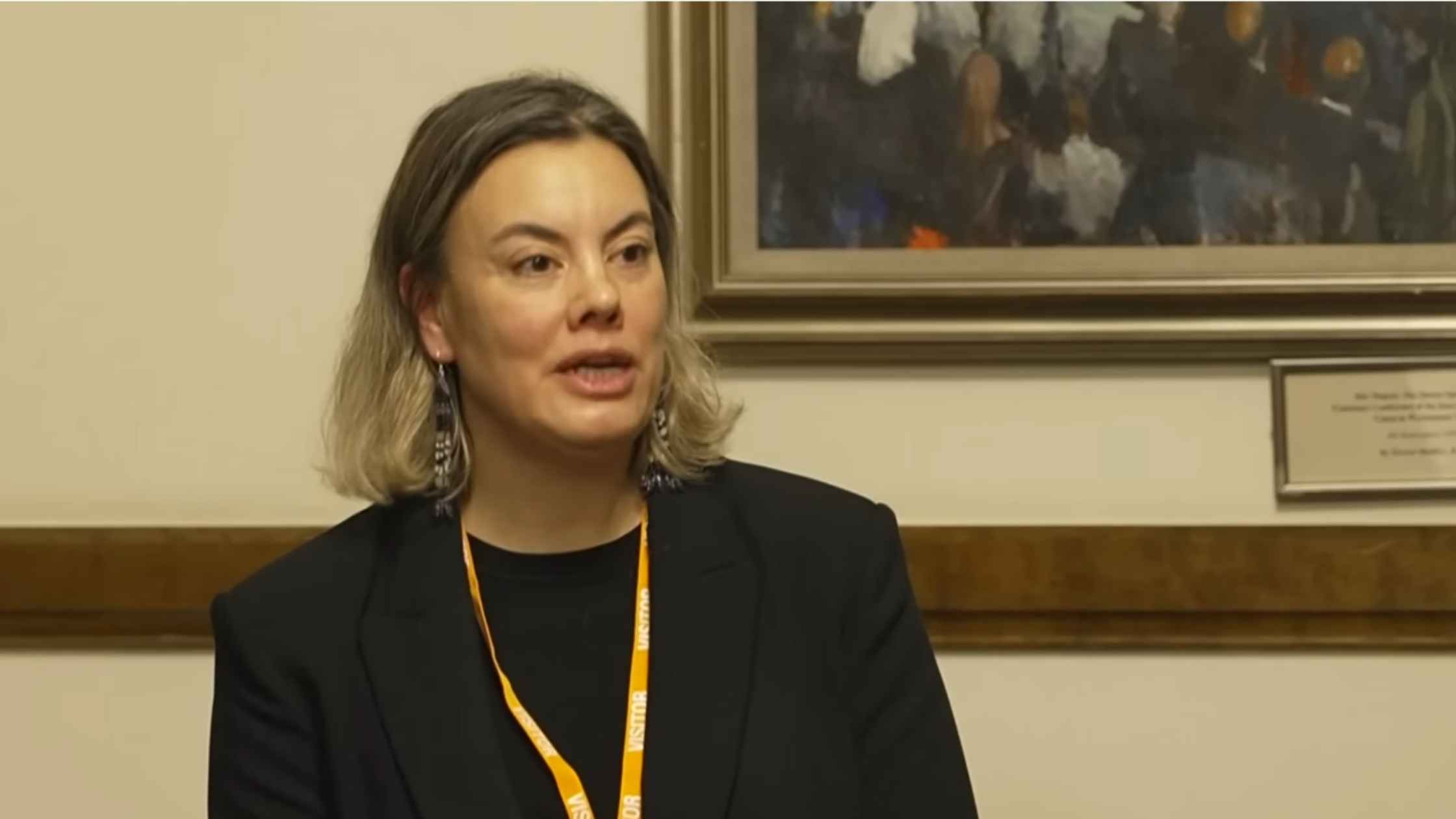
Naaja Nathanielsen (00:00):
… I have. I have to have a press conference discussing a possible annexation or selling of Greenland. So for us, this is not something we sought. This is not something we think we deserved. I think we have been good partners.
Ken (00:16):
Thank you. And Mari from the Financial Times.
Mari (00:19):
Hello. Can I ask two questions? First, do you expect more US investments in Greenland as a consequence of all of this? And then secondly, I have a bit more of a specific question. Greenland has banned uranium mining. And I was wondering, would the government reverse that ban if mined uranium was going to the US or to Denmark as a consequence of everything that is happening? Do you have any thoughts on that?
Naaja Nathanielsen (00:56):
Well, I cannot speak to what happens after tomorrow, of course. But I think the ban on uranium stands quite clear, that the people of Greenland have spoken, they do not want mining of uranium. And we have developed a mineral strategy that works perfectly around this. We are able to provide the minerals needed without using uranium as a source in this process.
(01:18)
So I think we have been quite clear and the parliament has voted on this and I respect that vote and we have no current plans on moving in any other direction than that. Your first question was about investments from the states. Well, we do welcome American investments into Greenland, and have done so and tried to advocate for it for quite a while actually. We don't have a lot of American investments. Will there be more? I cannot really speak to that. I can see that they are welcome. We are an open economy.
(01:51)
Right now, I think in the mineral sector, what you would see is more UK investments. We have a lot of European investments, Danish investments, Canadian primarily. So not a lot of American at the moment. He just-
Ken (02:07):
One thing.
Mari (02:07):
Just quickly.
Ken (02:08):
Very quickly.
Mari (02:08):
Do you think this will be part of the talk tomorrow?
Naaja Nathanielsen (02:12):
I wouldn't know. I cannot speak to that. But what I can say is I think there is more than one interest into Greenland from the US side. Of course, there is a matter of national security that we are perfectly willing to discuss. There's also the matter of access to minerals, which we are perfectly willing to discuss. And there is possibly concerns about maybe the different routes and interests from other countries that we also are interested in discussing. So I think there are nothing that shouldn't be on the table tomorrow for discussion. And I expect that that will take place as well.
Ken (02:52):
Jack, from The Sun. Hiya.
Jack (02:55):
Hi. Thanks very much for coming. Just touch on Chris's point. In the worst possible case scenario that American troops did end up on Greenland shores, would they be met with a resistance?
Naaja Nathanielsen (03:08):
We are not a country that finds ourselves at war with the US and we want a peaceful solution and we will work towards that for as long as we can at all. We see no point in using weapons against each other. We should be friends. We are allies. So this is my answer to you.
Jack (03:29):
Just one quick follow up. Trump's central claim that Russia and China are flexing their muscles in that part of the region. Do you accept that and is there any scope for more US presence on Greenland to deter that threat?
Naaja Nathanielsen (03:43):
I don't think there are call for concerns that can be really prevented by a use of force in Greenland. Of course, China and Russia have interest in the Arctic there. Russia is an Arctic state. China has been interested in the Arctic for many years. I think that for us in Greenland, we have called for more monitoring of the Arctic for many years and we are quite content with this moving forward, if that's part of the agreement. We see no reason why this shouldn't be part of the agreement.
(04:11)
We detect an actual threat, but we have no problems being more aware of what is going on around Greenland and I think it makes a lot of sense. So we don't see a lot of Russian interest directly into Greenland either. Actually we have, as following the sanctions, we have stopped all export to Russia of our fisheries and have found new markets. And we don't see any investments from either Russia or China into Greenland as well.
Jack (04:42):
Thank you.
Ken (04:43):
Hamish, from The National.
Hamish (04:45):
Thanks, Ken. And just to go back to the point about potential US invasion, would you expect backing from NATO allies like the UK if that was to happen?
Naaja Nathanielsen (05:01):
If this scenario was to happen, I think everybody in this room and everybody in your countries will have to figure out what is this new world order about. And I think we will stand in a completely new situation. So I really cannot answer your question because it implies that it would be one country being attacked by another NATO partner, but actually we would all be under attack. So I think it will be a breakdown of rule of law and international law and existing agreements and treaties.
(05:40)
And I think that will be a bad outcome and a big shame for us, because I think we have all prospered a lot from the NATO alliance. I think it has brought peace and prosperity and stability, not only to member countries, but wider than that. And I think it has served everybody quite well, all the member states. So I do hope we will not get to that situation. I think we should do everything we can to prevent it from happening.
Hamish (06:09):
Would that be worth defending with force from [inaudible 00:06:12]
Naaja Nathanielsen (06:12):
I cannot answer your question. You would have to answer the member countries themselves.
Ken (06:18):
David, from The Mirror.
David (06:21):
Hiya. Thank you all so much for holding this briefing. What's been the sense from your visits in the UK, in terms of UK's resolving, helping in the situation? And you view that Keir Starmer should be prepared to be UK boots on the ground as part of the wider UK… as a NATO mission, as an alternative to you guys can involve?
Naaja Nathanielsen (06:42):
I will not speak to other countries' decisions in such a difficult matter. I think we should all await the meeting tomorrow and hope for a good dialogue and from honest conversation in a closed room and trying to figure out what is up and down in this entire debacle and try to find our way through and give them time to do that. But even though I just flew in this morning, I can say that the support from the UK, the support from France, from other countries, from Germany are deep. We feel it in Greenland and we take note of it and we are very touch about it.
(07:21)
So we think that it shows the national community, global community standing together, I think, on some very principle points about how to engage with each other. And if you think about international law, I think it was really… A lot of the conventions that we rely on, a lot of the treaties we rely on was built on some very dark chapters in the world history. And I think it would be such a shame for us all to leave those principles behind because that would mean a totally changed reality for all of us.
Ken (08:00):
Jill, from AP.
Jill (08:02):
Hi, thank you very much. Can I come back to Russia and China? One of the claims that President Trump has made, that there are multiple Russian and Chinese ships and subs around Iceland or around Greenland, sorry. I mean, are there?
Naaja Nathanielsen (08:18):
Not that we are aware of. There will be some, of course, but I also expect us to be aware of some of the whereabouts. As I mentioned, we support more monitoring. We are not against this. We think it makes sense to ramp up the monitoring of the Arctic and are quite happy to house these installations if that's necessary. So I think we would all be naive if we were to say that nothing was going on, but I don't think there's any imminent threat also because I think in the geopolitical community, America is still recognized as quite a big superpower and I don't see any appetite from Russia or China to destabilize this or to, what do you call it [foreign language 00:09:09], challenge this.
Ken (09:11):
Thank you. Keiran, from the Guardian.
Keiran (09:18):
Can I just ask a little bit more about what you would like to see from the UK at this point? Is there anything that you can [inaudible 00:09:26] that's already issued?
Naaja Nathanielsen (09:28):
I think it's very important for the UK to insist upon the global community upholding international law in these times and speak your mind about that. I also think it's of great importance to stress the relevance of NATO as a relevant and important alliance that has played a positive role in all of our lives and should continue to do so. I think those two things would be really of massive help for Greenland and also of course when hopefully all of this cools down a bit, that you continue your collaboration investments into Greenland, we are quite happy about your partnerships. So that would be a path forward.
Ken (10:17):
Abby, Political [inaudible 00:10:19]
Abby (10:19):
Hi, thanks so much for this. What message were you hoping to get across to UK parliamentarians with your [inaudible 00:10:25] today? And UK Prime Minister was here, what would your message to him be?
Naaja Nathanielsen (10:29):
Well, what I just mentioned really that we are greatly happy for the support from the UK. And I think that dialogue is really, really what is needed at this point and that even though problems in this world is complex, this should not be a reason not to go into these complex dialogues. They can be solved through dialogue instead of violence and force.
(10:54)
I mentioned out of the presentation, and maybe these algorithms and so on has made us uncomfortable to venture into complex relations and difficult relations, but there can be more truth at the same time. And I think we can all understand that not all countries do have the same interest, but there should still be a path, a compromise of some sort that we try to find common ground. And I think this is possible.
(11:27)
I think that we can accommodate both American interests and Greenland's interests and the kingdom's interests and the ones of the UK and European Union, even though they might differ on several points. But we have done so in the past, why shouldn't we bring this into the future as well? So to insist on having the dialogue, even though it's difficult, to dare to have principles and believe in international law, I think we will all be asked about that in the next couple of years.
Ken (12:00):
Absolutely. Thank you. And Ellen from Bloomberg.
Ellen (12:04):
I also have two questions. Do you think that Donald Trump is more interested in Greenland's minerals or in it as a defense base? And you gave an entry to the Financial Times last year and you said that if US and European mining firms would invest more in Greenland's minerals, that you would look elsewhere including to China for that investment. Do you still stand by that?
Naaja Nathanielsen (12:28):
I think that was actually a very bad headline that gave me a lot of trouble. That was not at all what I said in the article if you read it.
Ken (12:34):
[inaudible 00:12:36].
Naaja Nathanielsen (12:35):
What I said is that we will try to look for investments from other places. We did not mention China. We have a foreign policy that clearly states that we want to develop with like-minded countries, such as Australia, for instance, or other countries. So it was not China I mentioned. That was, what do you call it, an angling. But your first question was?
Ellen (12:58):
Whether Donald Trump is more interested in-
Naaja Nathanielsen (13:02):
Yes. I think, again, I think there are more than one narrative at play here. I think there is more than one answer to your question. I think there are Americans that are interested in Greenland due to national security reasons. I think there are some interest due to mining and supply chains, and there could be maybe a more ideological approach about expansionism. And I think that all these narratives can be at play and that there are different actors in this. So there's not, I think, one single true answer to that. So many agendas.
Ken (13:39):
And Alistair, from Reuters.
Alistair (13:42):
Hi there. Prime Minister Nielsen earlier today said that Greenland would choose Denmark instead of the United States. Will Greenland suspend its efforts to achieve independence in order to demonstrate that commitment to being part of the Kingdom of Denmark? And do you think that would calm the US concerns that Greenland went on its own way, then perhaps NATO would come under the threat?
Naaja Nathanielsen (14:09):
I think it's a very interesting question that is also a bit maybe binary. I mentioned under the presentation that in Greenland we have maybe unprecedented in many places in the world, a long history with a colonizer. We have been a colony and we have moved forward with a colonizer to gain more and more self-determination and maneuver room over the years, over the decades. And now we have a fully functioning democracy with our own government, our own parliament, and we are still on this path of dialogue with Denmark to how do we get more room to maneuver.
(14:48)
This is not the same as people wanting independence tomorrow. And I think I often get asked that question and I often get a bit frustrated by it. Because I think right now what people in Green are concerned about is to lessen a dependency on the Danish block grant. That doesn't mean we don't want to be independent tomorrow. It just means we want to be able to pay our own way. So there are so many layers in this that it's not just about independence tomorrow. It's a long process.
(15:19)
And if you ask Greenlanders today, they have clearly stated they do not want independence tomorrow and they have also said they are quite happy with being part of the Kingdom of Denmark. That is not the same as saying that we don't want to change the interior of the house, that we do have some discussions with Denmark about the future. So if you ask me if future Greenlanders in maybe five generations time should say they do not want independence, I cannot speak to that because my lived reality is that we have been moving towards independence for more maneuver room for many years. And it's not a sprint, it's a marathon and it's about so much more than sovereignty. It's about economic sustainability and so on.
(16:10)
So the short answer is I cannot answer that because I cannot speak on behalf of future Greenlanders, but the ones living today have no appetite for independence.
Ken (16:22):
I've got a few bit of time, so there's a forest of hands, Kay, and then we'll put two and three.
Kay Burley (16:28):
Yeah, Kate Burley from the Independent. Thanks very much for coming today. I wanted to ask what your message, if you was here, to President Trump would be? Would it be to even think about putting his hands on your country?
Naaja Nathanielsen (16:43):
I would ask to respect the wishes of Greenland and to collaborate, which is actually what all that we are asking to continue down the path of partnerships. We are an ally. Yeah, I'm not sure. Do we need to start or something?
Kay Burley (17:04):
No, I've got a couple of minutes. Okay. Sorry, And then we'll come to here.
Speaker 12 (17:08):
Two very brief questions. Thank you for your time [inaudible 00:17:11]. First of all, I want to ask you about, have there been any conversations with Greenland's allies as to what happens if the US military does end up on your territory? And how much do you trust that they will put aside alliances with the US to come to your aid in that scenario?
(17:28)
And secondly, how do you view this form of diplomacy? I mean, obviously you're in a leadership role, you perhaps wouldn't go about it the same way. There are questions as to whether it is all part of a grand plan, a big strategy on behalf of the US, but is that the right way in your view to go about diplomacy on the world stage?
Naaja Nathanielsen (17:49):
I'm not sure I would call it diplomacy. So I think that to answer your questions, we do of course have dialogue all the time with our partners. Even though we might not think the same, we still have quite a few partners out there, and of course we have the dialogue with them. We are not into precise discussions about your questions, but we do have contact and it was not so many months ago that my premier was visiting several European capitals and engaging.
Ken (18:25):
Just [inaudible 00:18:26]
Arj Singh (18:26):
Arj Singh from The i Paper. Just to follow up on Dave's question, I believe European NATO allies have been talking about potential deployment to Greenland to try and use those American fears about security in the region. How likely do you think that is? And is that something you're going to be bringing to the table and talks tomorrow?
Naaja Nathanielsen (18:47):
Well, as it is, it is already possible for the US to add to the security in Greenland if it's so wanted. And we have no problems with granting more access for NATO in Greenland. For us, it's only natural and actually we used to have far more military presence than we do at the moment. So for us, it's not something that is either new or foreign to us. We would be absolutely open to that.
Arj Singh (19:15):
And from European side as well?
Ken (19:16):
Okay, gentleman at the back there and then we'll come here. [inaudible 00:19:21]
Chris Brown (19:21):
Chris Brown from CDC Canada. The president has talked a lot about actually owning the territory, not so much using it. And I'm curious internally, do you have any idea, are you going to get an offer, like an actual… an offer to buy it, an annexation? What are you expecting and will Greenlanders get a vote on it or a say on it depending what comes your way?
Naaja Nathanielsen (19:47):
Well, actually I don't know more than you when you read the paper and the media. So the proposals you're mentioning is also the ones we've been hearing through the press and that's why we've been very insisting on trying to get the direct dialogue to get a better understanding is what is the actual wishes from the American side. And we hope to gain more clarity about this tomorrow. And your last question was?
Chris Brown (20:09):
Well, if you get an offer, whatever it looks like, will people vote on it?
Naaja Nathanielsen (20:14):
Yes. I would say that for me, my deepest dream, or hope, is that the people of Greenland will get a say no matter what. I think we are the ones to have a say in the decision about our own future and of course, be it being part of America, I think we should have a vote on it. I think we should be able to have a say ourselves in the future of our lives. For others, this might be a piece of land, but for us it's home.
Ken (20:48):
Gentleman there.
Will Stanley (20:51):
Will Stanley, Bloomberg. Earlier you said that you think Trump's getting involved with national security or mining or even expansionist ideology. I was wondering why think he's turned to Greenland now?
Naaja Nathanielsen (21:03):
Well, I think the American interest is not new. It's a decade's long interest. Our treaty is more than 80 years long now, old now. So we have had collaboration with the US over many decades, so it's not a renewed interest.
Will Stanley (21:18):
Upping threats.
Naaja Nathanielsen (21:20):
The threats, of course, are new. But the idea that we matter for the States, we have always known this. It's been part of our baseline for everything we do, that we do realize that we have to take into mind what is important for the US as well. And we recognize that we are part of their national fair of interest. We do understand that. So for us, this is not new. When it comes to threats, I cannot speak to a single person's state of mind about that. You must ask the president.
Ken (21:55):
Okay. Well, thank you so much. I really appreciate you coming. As you say on behalf of the All-Party Parliamentary Group, we have made it absolutely clear. And I can say without fear of contradiction that the view of parliamentarians has been unequivocal in saying that the future of Greenland is a matter for the people of Greenland and only for the people of Greenland, and that's something that we will be pursuing as parliamentarians.
(22:20)
And thank you again to Naaja for taking the time to come and speak to us. It's been an absolute privilege for us to have you here, and this is something which we will continue [foreign language 00:22:34] very, very soon. Thank you.
Naaja Nathanielsen (22:36):
Thank you.
Ken (22:36):
Thank you for coming.
Naaja Nathanielsen (22:36):
Thank you.
Ken (22:38):
I need to run and vote.
Naaja Nathanielsen (22:39):
Yeah, that's fine.
Ken (22:39):
And I'll leave you. But go back to the office and get a cup of tea in the office.
Naaja Nathanielsen (22:41):
Okay. Yeah.
Ken (22:43):
Okay. I'll leave you in Kirsty's capable hands. See you back at the office, I need to go vote.
(22:46)
Kirsty.
(22:46)
[Inaudible 00:22:56].
Speaker 18 (22:46):
Here, [inaudible 00:23:47].
Speaker 19 (22:46):
Thanks.
Speaker 18 (22:46):
I'm going to say hello to some people.
Speaker 19 (22:46):
Right.
(22:46)
[inaudible 00:23:59]