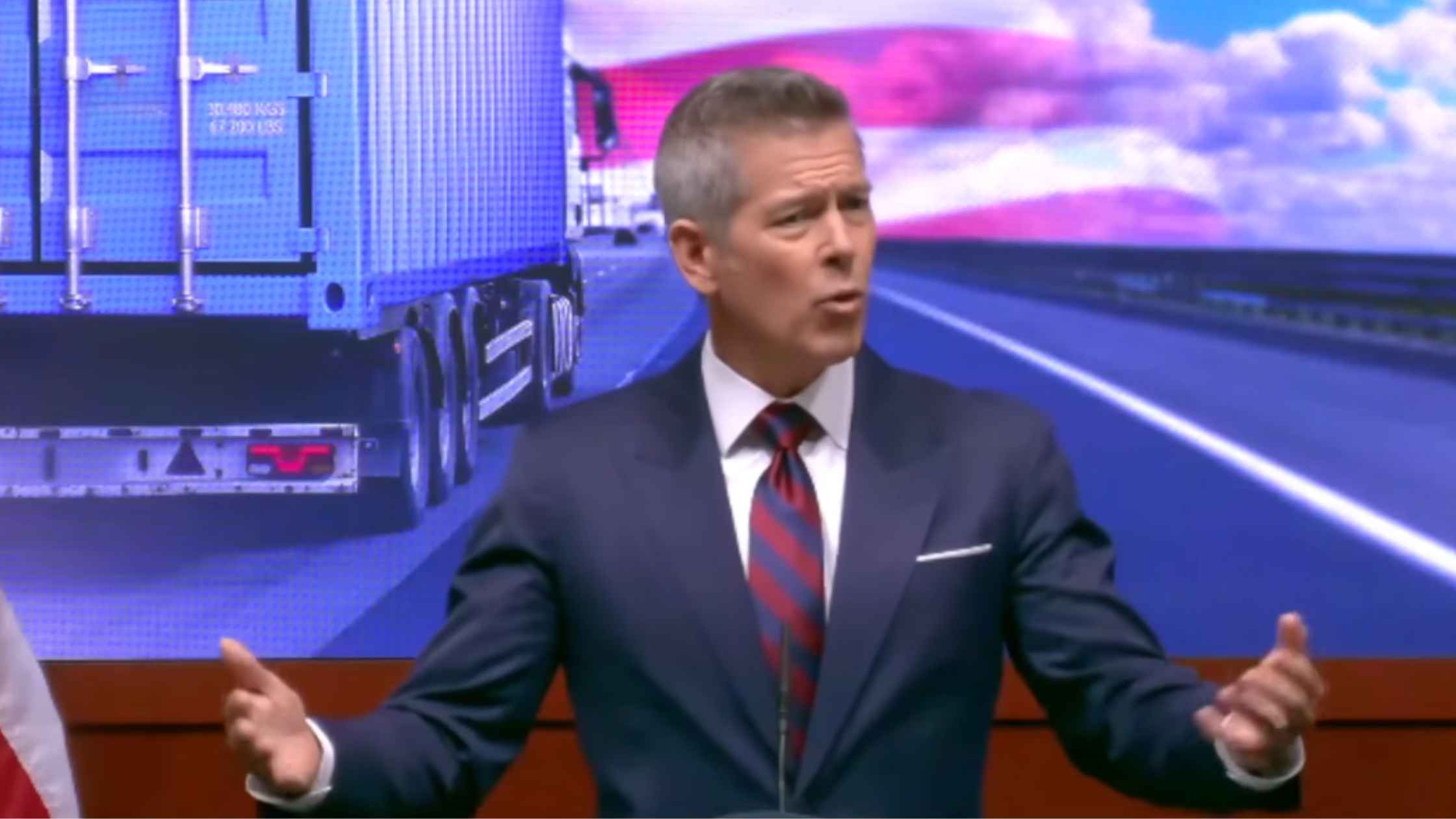
Sean Duffy (00:02):
Good afternoon, everyone. Sean Duffy here, along with the administrator of Federal Motor Carriers, Derek Barrs. There has been a lot of conversation recently about what's happening in American trucking, a lot of coverage on Americans who've lost their lives because of truckers, who I would argue, are doing some crazy things on American roadways.
(00:24)
So, I want to talk about how do we get here, where we are and where we're going, then I'll turn it over to our administrator. But under Joe Biden's term, he let 12, 15, 20 million people come into this country illegally. And many of those people thought, "Well, a great way for me to make a living is I should drive truck." And so, they went out and they got commercial driver's licenses and got behind a big rig and drove across this country.
(00:53)
And so, how did they do that is what I want to talk about. How did this come to pass? Well, first off, the prior administration didn't enforce English proficiency rules. If you couldn't speak the language consistent with our rules, there was no penalty for that. And then, the foreigners were able to get driver's licenses, but many of our states issued those driver's licenses illegally. In California, 20,000 foreign driver's licenses were issued unlawfully, 50% of the driver's licenses issued in New York were issued unlawfully, 20% in the state of Illinois.
(01:36)
And so, one of the problems that we've seen is just because you're a foreigner, that doesn't mean that you can't drive a big rig, you can't drive a truck, but what's happened that we've had so many unskilled, unqualified, untrained drivers on American roads? Well, what's happened is many of these potential drivers would go to a commercial driving school. Well, Pete Buttigieg in the last administration decided there shouldn't be any rigorous requirements to certify that a school is well-qualified to train drivers. He said, "The schools across America, they could actually self-certify." So, any of you here in the room could say, "I'm going to start a commercial driver's license school. I'm going to certify that I'm well-qualified and I can train students in America." Self-certification in the last administration has brought us CDL mills.
(02:34)
And what we found through some of our investigation, and we are not done yet, some of these commercial driver's license schools, some of them don't even have a curriculum or others that do have a curriculum, it's only a partial curriculum. They don't have trucks or buses to train any of their students. So, what this actually is a CDL mill where you can pay $800 or $1,000 and you don't get any training and they just certify that you have gone through the schooling requirements to then go and be tested. So, that's how we get individuals who have no training.
(03:16)
Well, the next part of this is, well, if you go through a school that doesn't give you any training, well, how do you still get a driver's license? How does that come to pass? My daughter's 15 and she's getting her driver's license in Wisconsin and she goes through a school, but then the state of Wisconsin actually gives her the written test and the state of Wisconsin will give her a behind-the-wheels test, and the DMV of Wisconsin will certify that she's qualified. That happens in Wisconsin. But in a number of states, they've outsourced the testing to a third-party tester. So, you can go to a fake school, no training. And then, in some of these states you go to a third-party tester and the third-party tester is participating in the scam because they're not adequately testing these individuals who have gone through the fake school.
(04:14)
We don't run the third-party testing institutions in the states. The states are the ones who say, "Either we'll test at the DMV or we'll outsource this to a third-party tester." But our rules require them to audit all of these third-party testers, to do covert operations to make sure they're adequately testing the students that are doing the skills tests and the knowledge test. What we're finding is many of these third-party testers in states aren't adequately going through the process and testing the students. So, you go to a fake school, you go to a fake third-party tester, and you go in with a piece of paper to the DMV and they will take your picture and they will give you a commercial driver's license and you basically have no skills to get behind the wheel of what is a potentially a very dangerous weapon.
(05:09)
So, what have we done at DOT and Federal Motor Carriers? Well, we've increased the penalties For those drivers that are not proficient in English, we'll take their vehicle out of service. The last administration, if you didn't speak English, the penalty was nothing, get back behind the wheel and keep driving. We've done a nationwide audit exposing the states for giving foreigners these CDLs unlawfully. Again, that's where we get the 50% in New York and 20,000 licenses in California unlawfully issued. We've issued new rules making it much stricter for someone to get a foreigner or a non-domiciled commercial driver's license.
(05:57)
So, think about this for a second. You're born in America, you're an American citizen and you want to become a commercial driver. Well, what the DMV will do is say, "Well, who are you? I want to look at your driving record. How many infractions do you have? Do you have an OWI or a DWI? Do you have a criminal record? We'll do a background check on you to see what kind of person you are and whether you're qualified to actually get an American commercial driver's license." But if you came across the border under Joe Biden's tenure and Pete Buttigieg's tenure, we don't do any background check. We don't go back and look at their driving record. Did they have an OWI, a DWI? Do they have a criminal record?
(06:42)
No review is done of who these individuals are. So, we have zero insight into the people we're giving a commercial driver's license to. So, in essence, you're an American, you have one standard that's way up here, and if you've come across the border unlawfully under Joe Biden's term, the standard is way down here. Unacceptable. What we're going to do is increase those standards and make them all equal, increasing the requirements for a foreigner to get a commercial driver's license.
(07:17)
We have shut down 7,000 of the CDL mills, the commercial driver's school mills, 7,000 of those schools have been taken out of service. We're not allowing them to self-certify, to tell us that they have a curriculum and a driving instruction unit that can train our students well enough to go take the commercial driver's license test. We've also set up a sting operation. We have a number of states that are partnering with us where our local law enforcement, along with motor carriers, they're going out and basically stopping our 18 wheelers, our big rigs. And in those stops, verifying their licenses, but also, that they are proficient in the English language.
(08:05)
And so, that's what we've done thus far. The question becomes, well, what else are we doing? And that's the question I get often, "What else is DOT and Motor Carriers doing?" But just as a side note, you would've never thought that trucking is so complicated and it gets to be really complicated very quickly. And I think the problem is it's just been allowed to maybe rot, I don't know if that's the right word, but it's been allowed to rot and no one's paid attention to it for decades. And once you start to pay attention, you see that all of these bad things have been happening and the consequence of that is that Americans get hurt. When we can on the road, we should expect that we should be safe and that those who drive those 80,000-pound big rigs, that they're well-trained, they're well-qualified and they're going to be safe, but they're going to keep me and my family safe as well. And that has not been the case.
(08:59)
So, what do we do from here? If you can't proficiently speak English right now, we'll take you out of the rig. But what we're going to do in the future is ask states to disqualify your license. Now, I would love, if I had the power to revoke someone who can't speak English per our rules, I'd love to be able to revoke their license. I can't, that goes to the states. So, we're asking states to disqualify those who can't speak the language consistent with our rules.
(09:33)
In the state of California, you can take the driver's test, the skills test and the proficiency test, you can take it in 20 different languages, 20 different languages. What we're doing is implementing a rule that'll say there's one language in which you can take your test, it's English only. You take the test in English. You can't speak English, you can't read English, you're not going to do well in the test because every test is going to be required to be given in English.
(10:07)
We're going to have way more stringent regulations for our carriers, the companies. So, we want to know that who you say you are, you actually are. Because right now it's a very loose set of requirements. One individual can get 100 different DOT numbers. We want to make sure that the DOT number is connected to an actual individual. You saw in Indiana a couple of weeks ago that the person, individual, company that had the DOT number, they had multiple DOT numbers and they were in an apartment, that is not necessarily the place of business.
(10:51)
So, we're going to crack down on this. We're going to verify your physical location, verify who you are. You can't have 200 DOT numbers going to a PO box. In essence, what we're doing is shutting down the million carriers. How that works, one bad actor continues to bad act as they switch from one DOT number to the next. We are going to put an end to that. And then, we're going to crack down on illegal electronic logging devices. So, again, we don't have a driver who's fraudulently driving 20 hours a day. Again, that's not safe. And we see a lot of fraud in this space as well.
(11:33)
The work here is just beginning and it has been a very thoughtful process. And again, I would love, if I had the ability to change all the rules, because we had all the power in the federal government, we don't. We partner with our states. The DOT has a in having smart good rules to protect the American people. But I also need the states to say... This is not partisan. This is not politics that we're playing here. We can have a debate about whether Joe Biden should have had an open border or Donald Trump, which I would agree with, shut down and secured the border. That's a different debate.
(12:13)
The debate really is do you want well-trained, well-qualified drivers behind the wheel of a big rig driving on American roads? It's very simple. I think the answer is every single American, no matter what your political stripes are, that's exactly what you want. That's what you would expect from the federal government and the state government. And to a greater extent, I think we need our states to say, "Listen, we can be good partners."
(12:41)
I told you Gavin Newsom, who I've criticized oftentimes from this podium, they're starting to enforce the English proficiency requirements. That's a really good thing. Kudos to Gavin Newsom, I'm proud of him. Now, he has not done as much work as he needs to on the non-domiciled CDLs. He's not going back and revoking the licenses that were unlawfully issued, but we can partner as one government, different parties, but to protect the American people.
(13:09)
We're going to continue to provide information. We're going to continue to ask our states to partner with us. And in the end, if we do this together, Americans for Americans, we are going to have much safer roads and that is our mission. Protect lives, safer roads, more qualified individuals.
(13:28)
And to go into a little more detail, Derek Barrs, our administrator has... I don't know that he knew what he was signing up for when he took the job, but he and his team, they're small and they're mighty and they have just been outstanding in all the work they've done to see through the problems and think through the solutions that we can implement to protect the American people. So, I'll give you Derek Barrs.
Derek Barrs (13:48):
Thank you, Mr. Secretary. Give me just one second. We'll get started. What I've got here.
(13:55)
So, some of the things I'm going to talk about the secretary's already touched on, I'm going to try to go a little bit more in-depth with those and what we're doing at FMCSA to really strengthen the industry, and we've got to hold every link in the chain accountable as we move through this entire process.
(14:10)
Today, I want to outline how FMCSA is confronting fraud chameleon carriers, unsafe operators and abuse across the commercial motor vehicle industry, and that's where we're going to talk about where we're going to go next. But before I do that, I want to acknowledge why we're here, he's talked about that earlier, but why we're here is very urgent of what we do because people's lives are in danger and we need to make sure that we're doing every single thing that we can do to make sure that we save lives.
(14:35)
But just two days ago in Indiana, a preventable crash involving a non-domiciled driver took the life of Terry Schultz. And in Jay County, Indiana, another preventable crash claimed four innocent lives of an Amish community. The driver held a non-domiciled CDL, was trained by a non-compliant school and worked for a motor carrier operator as a part of a chameleon network that he talked about earlier. And they're designed to evade and get away with enforcement compliance and doing the right things. This is not an isolated incident. It exposes serious vulnerabilities that we have in our system that we're going to be addressing and we'll be addressing them throughout this process today.
(15:18)
But we've got to unmask chameleon carriers. Our investigation on this particular crash confirmed that Indiana crash resulted from a coordinated chameleon effort network that repeatedly changed their names and their USDOT numbers to again to evade that oversight. Following the crash, our FMCSA investigators placed three of these carriers out of service in record time. We don't have time for this. And I'm going make a statement of these folks that are listening, we have people that are going to be investigating this and we're going to put you out of service and we're going to do it quickly as we can within the rules that we have and the tools in our toolbox.
(15:54)
This network is not unique. FMCSA has identified similar chameleon carrier operators nationwide and we're actively investigating these with our federal and state partners. And I want to thank them for what they've done in working closely with us side-by-side on these investigations. But to further disrupt this network, we are restoring principle place of business enforcement operating. Without a valid principal place of business or safety records should be held, and they have to produce those within a 48 hour period, that's not tolerated any longer. And furthermore, it shouldn't have been in the first place.
(16:32)
But to enhance our enforcement against chameleon carrier network is just not enough. We must also protect our FMCSA front doors, what I like to call it, through our registration system. We have got to find ways and the way that we're going to be doing this is through our Motus system. And our Motus system is our system of registration. So, when a company comes into the system, they will actually will know who they are and what they are and what the company's name is, so that's the way that we're going to combat the fraud is through our registration system.
(17:08)
So, with that being said, as we move into the next couple of things I want to talk about here, is we're going to modernize that. It's been like 40 years since the last time it was modernized. It's going to rigorous verification system. And with these chameleon carriers, they're all over the place. They may be at a principal place of business where they're out in the middle of nowhere where there's 400 or 500 of those. But in addition to that, we're initiating today three rule makings that we're going to talk about, that we're going to address this issue.
(17:42)
The first rulemaking is to codify enhanced procedures for granting suspended and revoking regulations. The second is to ensure application carriers or applicant carriers are thoroughly knowledgeable about the application and the safety requirements before they actually become a new entrant carrier. This is a long-standing process that we should have actually been putting into place a long time ago. We're also going to put requirements to ensure all brokers are qualified and tested as a part of their registration process as well.
(18:15)
Right now, you can pay $300 and become a carrier and run interstate commerce, that's not acceptable. Good carriers understand what it takes to be safe, and we're going to to hold those folks that are not doing what they're supposed to do, we need to hold them accountable. Just as we are demanding more of our motor carriers, we're completely overhauling how we vet drivers. The secretary talked about non-domiciled CDLs, we're closing that loophole and we're moving into making sure that that standard is equal. Whether you're a foreign driver or whether you're an American driver, those standards need to be the same.
(18:54)
Had this rule been in place, a lot of lives would've been saved. Of course, our CDL is only reliable as that we have for the training. We have started and we will continue to work on cracking down on entry-level driver training schools. As a part of our response to the Indiana crash, FMCSA has shut down that particular driver training school and is still under investigation. As I said, we'll be working closely with our law enforcement partners on this. The driver training schools responsible for ensuring CDL applicants meet safety standards, that's what they're supposed to be doing. This is why we announced recently that we went into 1,500 of our driver training schools and we found that over 550 of those driver training schools were cutting corners, as the secretary mentioned earlier.
(19:44)
We are not done here. We will continue working to make sure that they are compliant. I said this in a previous interview before that if you're not following the rules, we're going to put you out of business and that's exactly what we're going to do. But as we clean up the CDL mills, we need to make sure that we have rules that are in place to strengthen the entry-level driver training process. And with that, we will work to reform with a new rule to end the self-certification process for these training schools.
(20:16)
And finally, for drivers who are out here working, doing things every single day on our roadways and we appreciate the work that they do, enforcement is key for everything that we do and the educational piece is key. But as we go through this, I'm going to talk a little bit about the English language proficiency process that the secretary talked about. We placed over 14,000 individual drivers out thus far for ELP violations. He mentioned California. California has placed over 600 drivers out of service during roadside inspections. So, FMCSA is initiating rulemaking to ensure that all knowledge written tests will be given in English, this will ensure that all drivers can understand road signs.
(21:03)
He talked about Safe Drive. Safe Drive is just one initiative that FMCSA is working on with our state partners. We will continue to do these particular operations. They will be unpredictable and we'll be working closely with them on different operations to address these issues on an ongoing basis. FMCSA and our law enforcement partners are key. I understand that as being a former law enforcement officer, how key our relationship is with FMCSA. But again, these are going to be reoccurring, widespread and they're going to be unpredictable.
(21:36)
And finally, non-compliant electronic logging devices have allowed bad actors to violate hours of service rules. We have removed 42 from our list thus far. We had over 238 folks that have tried to come in to be ELD providers that we have not let in because of our vetting process. But FMCSA is announcing again that we'll be initiating rulemaking to strengthen the vetting process and to reform the self-certification process that is in place today. We're also developing criminal interdiction training courses for our state partners for commercial vehicle enforcement operations.
(22:15)
So, I want to end with this. We are biting off a lot at FMCSA, but we're going to keep chewing. And we're going to keep going after it and to make sure that our American roadways are safe. And I want to thank Secretary Duffy for his leadership and the great team that we have at FMCSA for the work that they do in saving lives. We have a lot of work to do, but we're not shying away from it and we will continue working with our partners who want to work with us to make things safer on our roadways. Thank you, sir.
Sean Duffy (22:47):
I'll take your questions in one second, but if I could just point something out, and this is not just DOT, this is government, I think as a whole. One administration will pass off to the next administration what they inherit. Just one goes to the next, the goes to the other. And no one ever stops and says, "Well, how is this organization organized? What rules do we have in place? And what do we have to do in this administration to fix the problems that exist?"
(23:16)
I've talked to you all about air traffic control. This should have been done 20 years ago and no one did it. And we said, "We're going to grapple with the hard problems and we're going to fix and modernize our air traffic control system." But it didn't happen over the last 10 or 20 years, but it should have. This is not that much different. This has been rotting for decades and we are not going to pass these problems off to the next administration. We are going to fix the problems that exist today that you report on, that you all see, but also, the problems that you don't see that we see internally, we are working to fix.
(23:54)
And I think that's important because these things bubble up. And because of the years of neglect, bad things have been happening for way too long. And to get our hands around it takes a little more time. The rules that we were using from the last administration and before, these are decades old. And then, the enforcement, the technology that we use is also decades old. And so, we have to update the rules, but we also have to update our technology. AI is a great way for us to flag many of the bad actors in this space.
(24:31)
And the last point I'll bring up to you, and I'll take your questions. I'm not the FBI, right? We don't have a massive team of law enforcement officers that go out around the country and enforce motor carrier laws. We rely on our state partners and good relationships with the states where we set up rules, things that are in our purview and the issues that are in their purview, but it's a team we relationship that we have to have together. And some states are better than others, but I can't deploy 100 officers to a state. We don't have that capacity. And so, again, I want to encourage our state partners to engage with us because in the end, we are looking at saving lives, protecting Americans and making this country better off than what we found it, which was the mission that President Trump has given us.
(25:25)
With that, if you have questions, we're happy to take them. Yes.
Aisha (25:34):
[inaudible 00:25:31]. Sorry. Thank you. Aisha from DC. Your post on X over El Paso airspace closure from last week has been widely discredited and didn't add up. Would you word it differently today? Did you get it wrong?
Sean Duffy (25:47):
Well, I use information that I get, but I'll tell you this. In regard to El Paso, we have a briefing next week on Capitol Hill and we're going to go through that briefing, talk to the members of Congress and I'm sure we'll have additional conversations after that, but this is on trucking.
Aisha (26:09):
Thank you.
Alexandra Skores (26:11):
Alexandra Skores to CNN. As a follow-up to the El Paso situation, just wondering if you could break down whether or not there was a lack of communication among those involved or what really went down?
Sean Duffy (26:24):
No, I don't think there was a lack of communication. But again, I think what I want to do is make sure that I have The Hill fully briefed about what happened, what information everybody had. That's important for the Hill to have that information and that's going to happen next week, and I'm sure we'll have additional conversations after that. But listen, we have good partners. I'm friends with all the players that are involved. From Marco, to Pete to Kristi, we all know each other well and we all communicate well. But I want to wait and we want to talk to The Hill first and I'm sure we'll have additional information that comes out.
Alexandra Skores (27:02):
Was it a mistake to close the air space?
Sean Duffy (27:04):
No. Anybody else? Anything on trucking? You got a trucking question. Great.
Noël Fletcher (27:12):
Hi, Noël Fletcher-
Sean Duffy (27:13):
I didn't think I was going to get an El Paso question thing. Of course. Appreciate that.
Noël Fletcher (27:15):
I'm Noël Fletcher, from Transport Topics-
Sean Duffy (27:18):
[inaudible 00:27:19].
Noël Fletcher (27:20):
Can you explain what the criminal interdiction training is going to be about?
Derek Barrs (27:25):
Yeah, so over the years, FMCSA has created, used to call it DIAP, Drug Interdiction Program. This one is going to be criminal interdiction, where we can train our law enforcement partners to better interdict criminal activity that may run across our highways in commercial motor vehicles. It's not just drug-related, it can be human trafficking, it can be anything criminal that we will be developing our training curriculum to help our state partners.
Noël Fletcher (27:47):
So, it'll be cargo and drivers too? Cargo and drivers?
Derek Barrs (27:50):
Yes. Yes, absolutely. Thank you.
Sean Duffy (27:56):
Anybody else? Listen... Okay, one more.
Speaker 6 (28:03):
Hey, Mr. Secretary, I know you want to talk to The Hill about El Paso next week, but I just want to know if you understand the concerns that the public had about closing a major US airport for 10 days. Was it drone testing that caused that to happen? And what would you have done differently given that what the mayor said, others, that this forced medical helicopters to have to divert and the TSA didn't find out for four hours till after it went into effect.
Sean Duffy (28:26):
I appreciate the question and I appreciate the interest in El Paso. Again, I served on The Hill, as you know, and I think we owe a conversation with The Hill before I have a conversation with you. And so, that's what we'll do and we'll come back after The Hill gets briefed, asks their questions. I'll take The Hill's questions before yours and we'll go from there. Anybody else? Thank you. Appreciate it, guys.
Derek Barrs (28:54):
Thank you.