


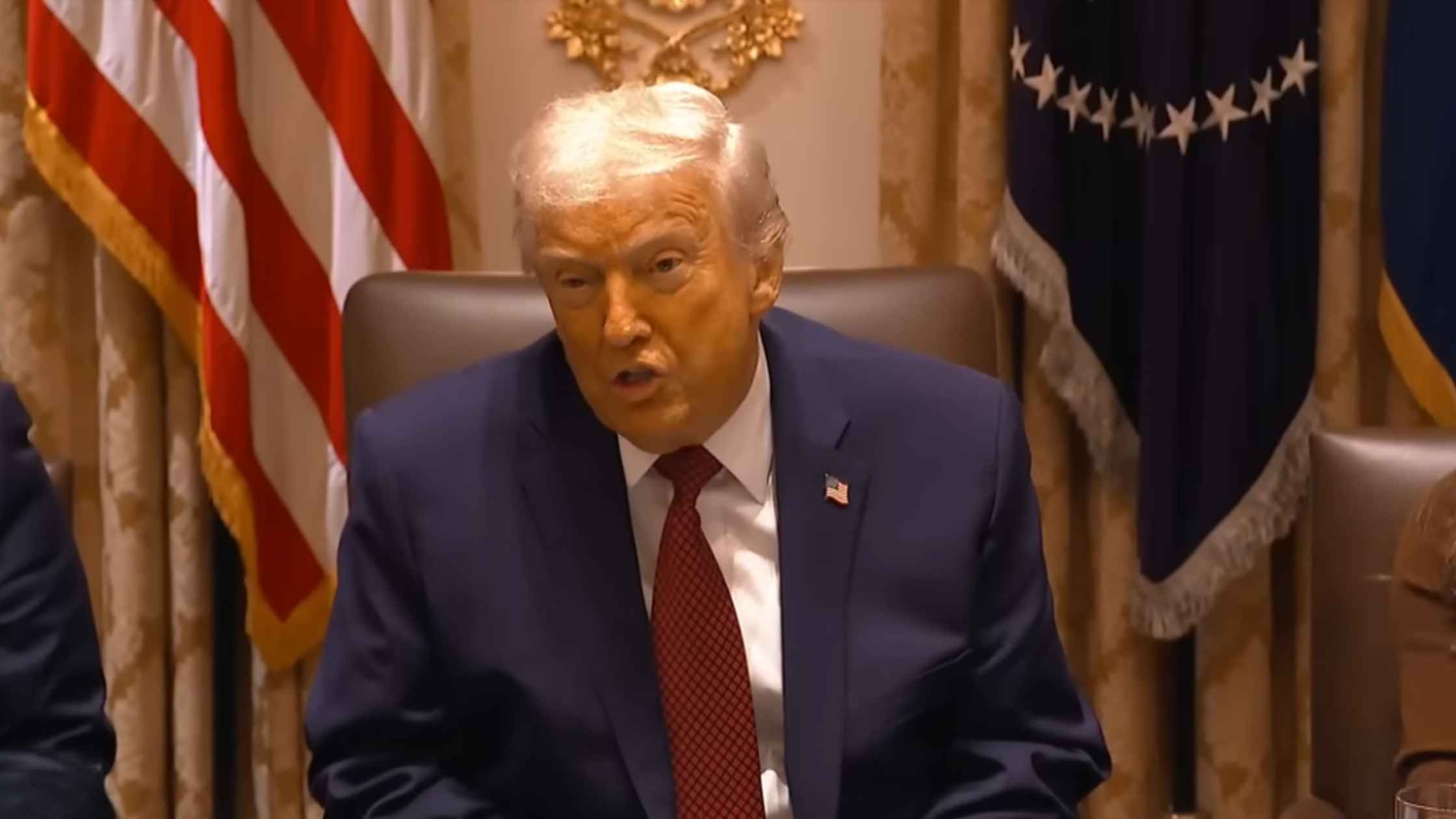
President Donald Trump (00:00):
… gasoline comes down everything… It's such a big category that when gasoline comes down, everything sort of follows, but we inherited a mess. Affordability, but you can call it affordability or anything you want, but the Democrats caused the affordability problem and we're the ones that are fixing it. So it's a very simple statement. They caused it, we're fixing it. And they have a tendency to just say this election's based on affordability. And nobody questions them, John. Nobody says, "Oh, well, what do you mean by that?" But they just say the word. They never said anything else because they caused the problem, but we're fixing the problem. And we're pleased to be joined today by many of the wonderful members of the farming community, as well as the Secretary of Agriculture Brooke Rollins. Brooke, thank you.
Brooke Rollins (00:49):
Thank you, Sir.
President Donald Trump (00:50):
Treasury Secretary Scott Bessent. Thank you very much, Scott. Senator John Boozman. Thank you, John. Good job. John Hoven. Thank you, John. And Deb Fischer. Thank you very much.
Deb Fischer (01:05):
Thank you, Sir.
President Donald Trump (01:06):
As well as Representative Austin Scott has been with us right from the beginning. Thank you, Austin. Good job.
(01:12)
I'm delighted to announce this afternoon that the United States will be taking a small portion of the hundreds of billions of dollars we receive in tariffs. We are making a lot of money from countries that took advantage of us for years. They took advantage of us like nobody's ever seen. Our deficits are way down because of tariffs. I guess because of the election, because without the election, you wouldn't have tariffs. You'd be sitting here losing your shirt. But we're taking in billions. We're really taking in trillions of dollars if you think about it, Scott, because the real numbers, when you think of all the money being poured into the country for new auto plants and all of the other things, AI.
(01:54)
So what we're doing is we're taking a relatively small portion of that and we're going to be giving and providing it to the farmers in economic assistance. And we love our farmers. And as you know, the farmers like me, because based on voting trends, you could call it voting trends or anything else, but they're great people. They're the backbone of our country. So we're going to use that money to provide $12 billion in economic assistance to American farmers. 12 billion is a lot of money, Meryl. What do you think?
Meryl (02:29):
[inaudible 00:02:30].
President Donald Trump (02:30):
Peanuts for you though, right? She's a farmer of rice.
(02:35)
This relief will provide much needed certainty to farmers as they get this year's harvest to market and look ahead to next year's crops. And it'll help them continue their efforts to lower food prices for American families. And again, we inherited something that… We inherited the worst inflation in the history of our country and we're taking care of it. Farmers are an indispensable national asset, part of the backbone of America. I've always felt it so strongly. They're so important.
(03:11)
Unfortunately, under Sleepy Joe Biden, he's a sleepy guy, our farmers were crushed by the worst inflation in modern history and crippling restrictions on energy, water, and countless other necessities for farmers. And what they did to the farmer in terms of putting the brakes on was just absolutely unacceptable. In my first term, we had an agricultural trade surplus by a lot. We had a big surplus. I mean, we were exporting American agricultural products all over the world, making a net profit, and in many cases, a very substantial profit. He came in and ruined it. Biden turned that surplus into a gaping agricultural deficit that continues to this day, but we're knocking it down. It's starting to go very good.
(03:58)
In fact, China, as you know, is buying a tremendous amount of soybeans and the number… I spoke with President Xi recently, very recently, and I think he's going to do even more than he promised to do. So I think the relationship is a very good one. I think he's going to do more than he promised to do. And what he promised to do is a lot. So we're very happy with that.
(04:21)
In the last year, Biden bankruptcies rose by 55% having to do with farms. So farm bankruptcies under Joe Biden went up 55%. That's not good. But now we're once again in a position where a president is able to put farmers first, but unfortunately I'm the only president that does that.
(04:44)
On day one, I terminated the green new scam. Energy prices are down, gasoline prices are down. We slashed record numbers of crippling regulations and we're working on huge trade deals, already securing $60 billion in agricultural purchase commitments. And Biden made none. He didn't make any trade deals having to do with the farmers or any of it. It's crazy.
(05:07)
China committed… He was the worst president in the history of our country, by the way, in case anybody has any questions.
(05:13)
China committed to over $40 billion of soybean purchases, and that's a commitment. And I asked President Xi if he could even up it. And I think he'll do that. I mean, not a commitment. 40 billion's a commitment. But the soybean farmers are quite happy. Since my successful meeting in South Korea with President Xi, purchases have been made and soybeans are being exported out of the United States to China as we speak. And I say that our soybeans… I told this to President Xi, our soybeans are more nutritious than competitors. Somebody said, "Is that a Trump statement or is that real?" In fact, you know who asked me that question? President Xi asked me that question. He said, "Really? I had never heard of it. " And he was a food purchaser for a long time, but that's what I hear.
(06:04)
And Japan agreed to 8 billion in purchases of corn, soybeans, ethanol, fertilizer, aviation, biofuel, and rice. Japan never bought rice from anybody else. It's like a very important thing to them, and they agreed to buy rice. Okay?
Meryl (06:23):
Absolutely.
President Donald Trump (06:23):
So I also proudly signed into law the largest tax cuts in history in the One Big Beautiful Bill, the monumental tax relief bill that is benefiting, very, very strongly benefiting the American farmer. And I think also for farmers, we have, as you know… And we got this, the estate tax or the death tax, as they call it, on farmers, on small businesses. You don't have to pay it anymore. A lot of farms, you love your children and your children are great and they want to be farmers, and you leave the farm to your children and a lot of farms are sort of cash poor. Land rich, cash poor. And the kids would go to the local bank or to any bank and they'd borrow money to pay the estate tax and they'd end up losing the farm. They go bankrupt. And a lot of death, too, literally because they love their farm and they love their business and they love that way of life, they end up committing suicide. A lot of suicides.
(07:26)
We have no more estate tax. How about that? Do you have children? Huh?
Meryl (07:31):
I do.
President Donald Trump (07:32):
Well, let them know. Now, if you love your children, then it's good. If you don't love your children, you don't have to leave them anything. It doesn't matter what I just said.
Meryl (07:39):
They're still young. I still love them.
President Donald Trump (07:39):
I have a feeling you love them.
Meryl (07:39):
I still love them.
President Donald Trump (07:43):
I have a feeling you love your children. But the estate taxes are very big thing. So you don't have estate tax. You die, you leave your farm, or whatever, or small business to your children, you don't have to pay estate tax. It seems to affect the farmer more than anybody else because you can have a farm that's very valuable and therefore you have to pay a big tax, but it's not a big value in terms of cash.
(08:06)
Maximizing domestic farm production is a big part of how we will make America affordable again and bring down grocery prices for American families. And again, these are prices that we inherited. When I left, we were doing incredible. In four years, what they've done to this country and so many… And not even mentioning the border and the criminals allowed into our country and all of the others.
(08:28)
So I just want to say it's a tremendous honor being with you. I'd now like to ask Secretary Rollins to provide some of the details, followed by Secretary Bessent, Director of the National Economic Council, Kevin Hassett, Senator Boozman, Representative Scott, and then we go to a couple of the farmers' representatives, but we'll all get involved a little bit. You can speak. Anybody who's shy to speak in front of the press, and I don't blame you if that's the case, but farmers Cordt Holub and Meryl Kennedy will say a few words also. And then we'll have a little discussion. Okay? Madam Secretary?
Brooke Rollins (09:09):
Thank you to the greatest boss in the world for a long time now. It's just an honor to be here. I'm going to keep my comments very short because I really want to make sure that you and the world gets to hear from our farmers.
(09:20)
So a couple of quick points. Number one, this country and our farm economy is facing a crisis that we inherited that most of these farmers have not seen in their lifetime. Profitability is down. It's just one crisis after another. When we came into office, Sir, when you did and you were sworn in on January the 20th, as you mentioned, not one new trade deal had been struck in four years. The cost of inputs for our farmers, fertilizer up 36%, manual labor up 47%, interest rates up 73%, when you combine the cost of inputs for our farmers, married to no new trade deals, and then you're facing an administration whose priorities were DEI, climate change, putting the farmer aside, I mean, it was an absolute war on agriculture and on our rural communities.
(10:17)
That all changed on January 20th. So as, Sir, we are working and you have been just so resolute. I mean, these are our people. Rural America is the fabric of our country. This is the way of life that preserves the American dream for the next 250 years as we celebrate the first 250 years.
(10:36)
So we began to go to work immediately. What these elected officials sitting across from us did with the One Big Beautiful Bill, with a lot of help and direction from you, was the largest investment in rural America in any of our lifetimes. We will begin to see that effectuated next year in 2026. As we have fought to bring input costs down, you have talked about, and even this weekend, did an executive order, signed one, on looking into the reason that so much of these costs have been driven up over and over, equipment, again, fertilizer, seed, et cetera, et cetera. We have to make sure we understand why that is.
(11:14)
And then the continuing of the additional trade deals across the world. And no longer will America be held and beholden to the regime of other countries' tariff infrastructure. Instead, we are moving our products out across the world.
(11:29)
Having said that, and we have been listening to the farmers for the last 10 months, 11 months, Sir, that the bridge that is needed to get from the last administration and what basically happened under the last president and the last US Department of Agriculture to this new golden age for farmers where instead of farming for government checks, they can farm to feed their family and sell their products and pass it on to the next generation, that this bridge is absolutely necessary based on where we are right now.
(12:00)
So as the president said, we are very pleased to announce that today we are going to be effectuating an $11 billion trade… Not trade, but bridge payment to our farmers. The money will move by February 28th of 2026. But by the end of this month, so just in the next couple of weeks, every farmer that is able to apply for it will know exactly what that number looks like. So as you are going to your lender, as you are working to ensure and understanding what you can plant for next year, you will have that number in hand. And we will continue to talk to our farmers, continue to understand exactly what this looks like and what is necessary.
(12:43)
The final thing I'll say is-
President Donald Trump (12:44):
It's 12 billion.
Brooke Rollins (12:45):
Well, we are holding one billion back. So today we are announcing 11 billion.
President Donald Trump (12:49):
Ah.
Brooke Rollins (12:49):
We are holding one billion back-
President Donald Trump (12:51):
Very tricky.
Brooke Rollins (12:52):
… just to ensure that we are covering. So today's announcement covers all of our row crops-
President Donald Trump (12:56):
Very tricky.
Brooke Rollins (12:57):
… all of our row crops, but some specialty crops and others that we are still working with to best understand where they are in the farm economy and ensure that we're making every forward-moving position that we need to.
(13:11)
And then finally, as we move to this new golden age for agriculture and for rural America, as we continue to fight for these farmers and ranchers, their way of life and those that are represented here, represent hundreds of thousands of farmers across this country. Just know that this president, I have never been around anyone who every time we talk, he asks, "How are my farmers?" Every single time. So we will never stop fighting. We will make sure that we're doing everything we can to ensure the next 250 years is just as bright, if not brighter than the last. So thank you, Sir.
President Donald Trump (13:47):
Thank you, Brooke.
Brooke Rollins (13:47):
Thank you.
Meryl (13:47):
Thank you.
President Donald Trump (13:48):
And this money would not be possible without tariffs. The tariffs are taking in hundreds of billions of dollars and we're giving some up to the farmers because they were mistreated by other countries for, I don't know, maybe right reasons, maybe wrong reasons. They weren't… They were trying to show us something and it's really worked out really well. But because of the tariffs, this is possible.
(14:13)
The other thing I'd like to add before going to Scott, and I think it's very important, we're going to also give the tractor companies, John Deere and all of the companies that make the equipment, we're going to take off a lot of the environmental restrictions that they have on machinery. It's ridiculous.
(14:29)
I know because I buy a lot of that machinery for different things. We have a lot of big clubs with hundreds, thousands of acres, and I buy a lot of stuff. And you buy it. It's got so much equipment on it for the environmental, it doesn't do anything, except it makes the equipment much more expensive and much more complicated to work, and it's not as good as the old days. And we're going to take a lot of that nonsense off of the equipment, which is going to reduce… And we're going to do it, and we're going to say you're going to reduce the prices. We're not going to do it and they're not going to reduce it. They're going to have to reduce their prices because farming equipment has gotten too expensive. And a lot of the reason is because they put these environmental excesses on the equipment, which don't do a damn thing except make it complicated, make it-
Brooke Rollins (15:15):
That's right.
President Donald Trump (15:16):
… impractical. And you really have to be… In many cases, you need about 185 IQ to turn on a lawnmower. So we're going to take that off, that crap off that they put on, Biden mostly. And we're going to take that off. So that's going to make a big… That'll bring down the equipment prices a lot.
Brooke Rollins (15:36):
That's right. That's right.
President Donald Trump (15:37):
And we're going to do that immediately. You're going to work with Lee Zeldin, who's not here, he's doing a fantastic job, and Lee is going to work that out. And that would be most of it. It's crazy. The machines, they're always under repair because they're so complicated that you can't fix them. The old days, you used to fix it yourself. Now you can't do that. You have to be a PhD from, let's say MIT. Okay.
Scott Bessent (15:59):
Good-
President Donald Trump (16:00):
Okay. So we're going to get that done. Scott, please, go ahead.
Scott Bessent (16:03):
Good. Thank you, Mr. President. Thank you to the farmers to join us today. And I will tell all of you here, either in person or when we were on a call with President Xi, the first thing the President asking for is more soybean purchases.
Speaker 1 (16:18):
That's right.
Scott Bessent (16:20):
We don't talk about geopolitics, we don't talk about trade, it's about soybean purchases.
President Donald Trump (16:25):
We don't even say hello, we immediately start soybean.
Scott Bessent (16:27):
It's true.
President Donald Trump (16:27):
We start with the soybean, please.
Scott Bessent (16:31):
It's always, "Could you do a little more?" And I think President Xi heard President Trump. This group represents an American way of life that has fed our nation and its spirit for hundreds of years. You are the caretakers of the most productive agricultural country on Earth. You drive hundreds of billions of dollars in exports, support millions of jobs, and keep America's economy running strong, and this administration is committed to keeping it that way. By putting farmers first, President Trump is ushering in a new golden age for agriculture.
(17:05)
The President's 11 billion relief package for America's farmers comes at a critical time. These direct payments will give producers the breathing room they need to market this year's harvest and plan for next season. This serves as a liquidity bridge during a period of adjustment, supporting the strongest agricultural sector in the world. Add this to President's success in reining in Biden era inflation, thanks to the administration's pro- growth policies, input costs like fuel, fertilizer, are easing, and credit conditions are improving, interest rates are coming down, helping farmers prepare for the next harvest. President Trump scored a massive victory for America's farmers when he secured an arrangement with President Xi and Busan to reopen China's markets to US agricultural exports, especially soybeans, sorghum and other commodities. Under this framework, China committed to purchase at least, at least, 12 million metric tons of US soybeans this growing season, followed by a minimum of 25 million tons annually for the next three years.
(18:09)
And it's not just China, at the President's direction, Treasury, USTR and the Department of Commerce have secured supplemental purchases of US agricultural goods and major trade agreements across the world to open new markets to America's farmers. The One Big Beautiful Bill also delivered transformative benefits for America's small farmers. It locked in full expensing for farm equipment and 100% expensing for farm structures built during the President's term. I believe Representative Scott and a group in the House, we were originally just going to do factories, and they called us and said, "You need to do farm structures too." And the President said, "We're all in." And it extended and enhanced much needed relief from the punishing death tax, giving family farms greater certainty as they plan for the next generation. Mr. President, thank you for putting America first by putting your farmers first. Through pro-growth, pro-farm agenda, you're ushering in a new golden age of American agriculture, and Treasury is proud to help in this.
President Donald Trump (19:14):
Thank you, Scott. You know what we'll do? We're going to go a little faster, because the last meeting we had was three hours. We're the most transparent group, so if we can go faster, it'd be great. And then, we'll take some questions from the fake news. Is that okay? Kevin, go real fast. Kevin.
Kevin (19:34):
Yeah, I can go really fast, sir. Sir, the farm economy, you always ask me to just get a few numbers to put it in perspective, and as I've looked through the incredible performance of these people that work so hard and are such important people for keeping communities alive, the thing that struck me the most, because you and I were here in the White House during COVID, is that during those terrible COVID times, farm production didn't go down. These farmers, they went to work every day and they produced so much, but then Joe Biden came in. So we had COVID and farm production didn't go down, and then Joe Biden came in and he really wrecked the farm economy. And so, during Biden's term, 150,000 farms closed, sir, 150,000 farms closed, after we went through COVID and we didn't have a problem.
(20:27)
Now, why did we do it? Why were we able to do that? I'm going fast. The first is that, do you know the expenses for farms fell 5% while we were here because of all the things that we did, expensing and everything else? But under Joe Biden, they went up 13% because of all the regulations, energy, everything else. But the thing that really jumped out at me the most is, because you had high growth and low inflation, interest expense for the farm economy fell $120 million per year while you were there in the White House. But under Joe Biden, it increased by eight billion per year. And so, you wonder why it is that we need this $11 billion, maybe $12 billion to build a bridge loan to America's farmers, it's because we know how to fix it, but there really was a hole that was done in the previous administration. Thank you.
President Donald Trump (21:17):
Thank you very much. That was quick, that was good. Appreciate it. Senator, please.
John (21:22):
Yes, sir. No, thank you so much. Thank you for convening this great announcement and all your hard work for farmers. I was reading the clips, and I think yesterday, you talked about, Mr. Secretary, about farmers needing certainty, which is so true. This bridge note is one of those things that provides certainty. I also, as I was reading that, thought to myself, the one thing that farmers can be certain of is the fact that you've got their back, and you've proved that through the years in the last administration and now this.
(21:59)
I was giving a presentation to the Senate a while back, and I was talking about us having the cheapest, safest food supply of any place in the world. It's not just about the farmers in rural America. And so, Marco Rubio was sitting by me prior to coming over here and becoming the great Secretary of State, but he punched me and said, "John, always remind them," he was head of the committee on intelligence then, he punched me, he said, "Always remind them, food security is national security." So this is important for so many different reasons. And again, I appreciate you for recognizing that, not only now, but when you were campaigning in your first election, how you treated the farmers in your first administration, and now, now stepping up. So we look forward to helping you, if you need some additional help looking to Congress, whatever, we'll be there for you.
President Donald Trump (23:03):
We've taken in so much money with the tariffs now that it's such a pleasure. Without it, we wouldn't be able to help you. We're the richest country in the world now, and we have a big decision. Hopefully, we're going to get the right decision. It's such a big thing in the Supreme Court right now. We have a lot of bad people opposed to this, people that hate our country. Other countries are involved, some real sleaze bags that I know, political sleaze bags, and they're trying to take that away from us. We have other methods, but they're not as powerful, they're not as quick. Some of the wars that I solved wouldn't have been solved using those methods. So it's a very important thing, the tariff. The decision of the Supreme Court's a very important thing. And Scott, we can do it other ways, but it's slow and it's cumbersome and it doesn't have the national security power that we have. So I hope we're going to be successful, that's all I can tell you. Austin, please. Thank you, John.
Austin (24:07):
Well, first of all, President, thank you for the selection of Brooke Rollins as Secretary of Agriculture. That was a big first step.
President Donald Trump (24:16):
You want to keep her?
Austin (24:17):
Absolutely.
John (24:19):
Can I butt in and second that? Not only her, but her staff, does a tremendous job.
President Donald Trump (24:25):
I agree. Remember the eggs? Remember we came in, and the people in the media, I'm going to be nice, the people in the media… We're three days into offices, they were saying, "Egg prices are up like 90%, more than that." And I said, "I just got here, I didn't know about it." Anyway, she got those prices down to below what they were before, she's doing a great job. Now, beef is starting to come down and some other things are starting to come down. Again, we inherited these problems, but we're getting them down. Go ahead, please.
Austin (24:58):
[inaudible 00:24:58] fact-based decision-maker, and the egg issue is where I learned about her. She said, "We're not going to use a vaccine that doesn't work, we're going to develop a vaccine that does." And that is 100% what it takes. And so, we have to make decisions based on facts.
(25:10)
And President Trump, the trade issues, I want to thank you for exposing what other countries are doing to us. I want to mention one specifically for the benefit of Kevin and Scott, I hope they're paying attention to it. The European Union Deforestation Regulation, where they are imposing on our landowners rules that were established for Brazil, and now they're telling the American farmer what they can and can't do on their own land through this European Union Deforestation Regulation.
President Donald Trump (25:39):
What is it? Explain that.
Austin (25:41):
They are telling the American farmer that if their timber is cut and they are going to use that land for pasture land or for production agriculture, that they will not take the timber or the byproducts from the sale of that timber. And I have talked with James a little earlier about we need to make it clear to Europe, Mr. President, if you would-
President Donald Trump (26:03):
If you can give me a two paragraph statement on that, I will give that to them, and they will do what they have to do.
Austin (26:09):
Yes, sir.
President Donald Trump (26:10):
We're always helping them, and they do this kind of stuff and they pass little regulations that cost billions of dollars. It takes them two minutes to do it, they do it. Very tough, no good. You give me a couple of paragraphs, that's all, we don't have to do a lengthy study, and I'll get that changed fast, okay?
Austin (26:30):
Thank you very much, President. We love you.
President Donald Trump (26:32):
It's incredible, it's incredible. Every day, it's something else.
Austin (26:36):
A country that can't feed itself doesn't know what freedom is, and so thank you for making sure that our farmers have the tools that they need so that we as a country can feed ourselves.
President Donald Trump (26:45):
Well, just what you said to me about the European Union [inaudible 00:26:49] the European Union, we have to be able to act quickly with tariffs. We can't just go to a committee, go to a study that takes seven months and talk, we've got to be able to act quickly. So thank you very much. John?
John (27:05):
So thank you, I think that's the message from farm country is thank you very much. In the Working Family Tax Relief Act, or as my young staffers call it, OB3, there is a tremendous amount for farmers and ranchers. You mentioned the credit as far as estate tax, which is so important, you analyzed it just right. But also in there, we enhanced ARC and PLC, which is a countercyclical safety net, thanks to the strong leadership of Senator Boozman and our colleagues in the House. We also included the Farmer Act, which was my bill to make crop insurance more affordable.
(27:44)
These tools will kick in next year, Mr. President, in a big, big way for our farmers, big time. And people aren't even really looking at it yet, but it's going to be a very big deal. So today is all about bridging to get there. And I want to thank Secretary Bessent and Jamieson Greer, they're tremendous and they're negotiating hard out there for farmers and ranchers.
President Donald Trump (28:05):
They are.
John (28:06):
And I know it's because you're setting the tone, but this is that bridge. And so, we need to come back to Secretary Rollins, thank you, your leadership on this was vital, and Mr. President, you're right, they love you in farm country out there. All you have to do is drive out and see the flags and-
President Donald Trump (28:26):
There's signs all over the fields.
John (28:28):
On the hay bales, right?
President Donald Trump (28:29):
It's a great honor. They're great people, the best people.
John (28:32):
This is really important, really important for our farmers and ranchers. Thank you very much.
President Donald Trump (28:36):
Thank you. You're doing a great job too, John, thank you. And whatever we need, we get through the Senate, we get through the House, we'll get it done. I think we'll start maybe with Cordt Holub, and you come from a place that I'm very happy with, Iowa.
Cordt Holub (28:52):
I hail from the great state of Iowa. I'm surrounded here by some of the greatest farmers in the area and from across the country, anything from rice farmers, we've got all sorts of cotton farmers, everything, everything is here represented so well. And first off, from me, I want to say thank you for this bridge payment, it's Christmas early for farmers. And just to have an icebreaker here for this story, I've got a two-year-old little boy at home, a two-year-old little boy and a four-month-old little girl. And the other day, I was reading my little boy a story at night, putting him to bed, and he said, " Daddy, I don't want Santa Claus to come to our house for Christmas, I want President Trump." And I think, Mr. Trump, I think you brought Christmas to farmers with this bridge payment, we'll be able to farm another year, help us get by. It's such an honor to be here with you.
(29:58)
I lost my grandfather and our hired hand in 2002 in a farming accident, and he instilled in me at an early age to love the land, to take pride in what we do.
President Donald Trump (30:13):
Was that a machine accident?
Cordt Holub (30:14):
It was a machine accident. And it gets in your blood to farm, it's in our blood. Despite what happened, I want my two-year old to farm, I want my four-month-old daughter to have an opportunity. And what you're doing here in D.C. is working. You have a backbone to stand up to other countries for trade, you're getting things done, tax provisions. I'll be able to potentially pass on a farm to my children because of you. Ethanol, you're working for ethanol, trying to get E15 year-round. We're dealing with California, Prop 12, let's continue to work on that. I think we can have a lot of domestic product used here in the country, and we can keep America first, and you're good at that, that is who you are. And if we keep that E15, you could have the biggest-
President Donald Trump (31:16):
So E15 is a big deal?
Cordt Holub (31:18):
E15 is a great deal year-round. You could have the biggest stamp, I did that, Trump did that, and we would thank you. Farmers would love you more than anything if we could continue that, continue to use domestic product, use the byproducts, and even be able to export to other countries. And so, what you've done here and just having us here in the White House with you, sitting beside the Secretary and all these other great individuals here, what a true honor. I will take pride in this meeting, and I'll take this home for many generations to come, and because of what you're doing, hopefully them generations can stay on the Holub Farm.
President Donald Trump (31:57):
Well, we're going to bring you into the Oval Office when we're finished, okay?
President Donald Trump (32:00):
The farmers. Nobody else, just the farmers. And we'll take some pictures. Our representatives also, we have to salute them because they're doing a great job. John and John and Austin, we appreciate it. You're doing a great job. Meryl, go ahead please. Tell us about Rice.
Meryl Kennedy (32:19):
Rice. Well, thank you first of all for inviting me here. And my friend, the secretary, you have an incredible lady right here. She really is. Along with being a mother of three and a wife, I run my family's agribusiness, Kennedy Rice Mill, in a little town called Mer Rouge, Louisiana. About a thousand people in the northern part of the state. We employ around 150 people, taking rice from the field to a finished product. Supplying some of the largest food companies that many of you would know here domestically, but also abroad.
(32:57)
And my sisters and I, because there is four of us, I'm the youngest of four daughters, started our own rice brand a few years ago to just tell the story of American agriculture that hadn't really been told before. But I wish I was here under better terms. I'll tell you, I think the rice industry thanks you sincerely for what you have done for the California rice market and to Japan. It has been monumental for our industry, but us in the south are really struggling. I mean, this is not just a crisis. I would say it's almost a market dynamics that really are true anticompetitive nature. So it follows what you sent out this weekend. And we do believe that countries are dumping rice into this country today. We've never seen imports this great.
President Donald Trump (33:50):
Which countries?
Meryl Kennedy (33:52):
India, Thailand, even China into Puerto Rico. Puerto Rico used to be one of the largest markets for US rice. We haven't shipped rice into Puerto Rico in years. So this has been happening for years. This didn't start during your administration. But unfortunately, we're seeing it in a much bigger way now. The tariffs are working, but we need to double down because-
President Donald Trump (34:16):
You want more. I understand.
Meryl Kennedy (34:17):
Well, they're cheating, right? They're just subsidizing and then-
President Donald Trump (34:24):
India. Tell me about India. Why is India allowed to do that? They have to pay tariffs. Do they have an exemption on rice?
Scott Bessent (34:29):
No, sir. We're still working on their trade deal, so-
President Donald Trump (34:32):
Yeah, but they should be dumping. I mean, I heard that from others. You can't do that.
Meryl Kennedy (34:36):
There's a WTO case against India right now.
President Donald Trump (34:38):
Give me the countries, if you could. Go ahead. India, who else?
Meryl Kennedy (34:42):
So India-
President Donald Trump (34:43):
Mark it down, would you, Scott?
Scott Bessent (34:43):
Yes, sir.
Meryl Kennedy (34:46):
India, Thailand, China into Puerto Rico, not into the continental US, but into Puerto Rico. Those are the main culprits.
President Donald Trump (34:56):
So Puerto Rico used to do a lot of business and now you're-
Meryl Kennedy (34:58):
100%, Puerto Rico was US based.
President Donald Trump (35:01):
All right. So easy to set up. Okay.
Meryl Kennedy (35:05):
But there's others too, and I can get you a full list as well.
President Donald Trump (35:07):
Get me a full list. Yeah.
Meryl Kennedy (35:08):
Of course I can.
President Donald Trump (35:08):
All right. Go ahead.
Meryl Kennedy (35:12):
So truly, this is a national security issue. I think you put it just perfectly. And so I want for all of us in the room to know that rice is more than just a commodity. It's a currency in many of these countries.
President Donald Trump (35:25):
And you love rice, right? Do you love-
Meryl Kennedy (35:27):
I love rice. Yes. I'm going to get you to love rice too. The next time, you're not going to have a button for a Coke, you're going to have a button for rice.
Brooke Rollins (35:32):
Get a little bit of rice.
President Donald Trump (35:35):
The farmers love what they do.
Brooke Rollins (35:37):
It's true.
Meryl Kennedy (35:38):
Well, our farmers can feed this nation and many nations abroad, but we need fair trade, not free trade. And so we appreciate what you've done today. We appreciate what you did in the Big Beautiful Bill. I mean, my word, you really changed reference prices and we're hopeful that we can even move that further. I know that prices right now are the lowest they've been in over 40 years, so we're going to struggle. We're going to max out on our payments probably. So that's something that I know those in Congress can potentially help us with to change. But again, we appreciate everything you're doing.
President Donald Trump (36:13):
It's solved so quickly with tariffs to these countries that are illegally shipping. It's solved. Your problem is solved in one day. That's why we have to win the Supreme Court case. And one day that problem solved, it's so unfair. They go out of business, they put everyone out of business. That's what they did to our car, we lost more than 50% of our car industry because of that. Our chip industry went to Taiwan because of that. If you had a president that said, "No, you can't do that. It's 100% or 200% tariff on chips if you make them outside of the United," we would have never lost our chip industry. But we're going to have 40% or 50% of it back very shortly because they're all coming in now from Taiwan. They're building chip companies. But it's the same thing with rice.
(36:58)
Thank you, darling, very much. Very nice.
Meryl Kennedy (37:00):
Thank you.
President Donald Trump (37:00):
It'll be good. We'll get it solved very quickly. We just need the countries. We just give us the names of the countries. Tariffs again-
Meryl Kennedy (37:08):
They own the largest brand-
President Donald Trump (37:10):
… it solves the problem in two minutes.
Meryl Kennedy (37:11):
Yeah. They've bought the largest brands at retail too, so they have an incentive to subsidize their products that they can keep it on the shelf.
President Donald Trump (37:21):
Yeah. Who did that?
Meryl Kennedy (37:21):
The Indians own the two largest brands.
President Donald Trump (37:25):
And we'll take care of it. It's so easy.
(37:29)
So do you have any questions?
Speaker 6 (37:31):
Yes. President Trump. How are you?
President Donald Trump (37:33):
How about keeping it on farming?
Speaker 6 (37:35):
Your team answered all of my questions on farming. But I do-
President Donald Trump (37:38):
Exactly. Do you have a farm question?
Speaker 6 (37:40):
In the interest of affordability with this aid package, I assume that that's something you want consumers to see before midterms next year. How quickly will that affect prices at the grocery store?
President Donald Trump (37:50):
Well, I think the prices are going to be going down already. I mean, the prices are way down. We brought prices way down from what it was. We inherited high prices. We inherited the biggest inflation in the history of our country. That means prices going up. And we've brought it down very substantially. Now inflation is essentially gone. We have it normalized and it'll go down even a little bit further. You don't want it to be deflation either. You have to be careful. But we brought it way down. We had inflation that was the highest in the history of our country. They say 48 years, but I say the history. 48 years is pretty bad too. So we're solving those problems. We're bringing them way down. Yeah.
Speaker 5 (38:34):
Would you consider Maga incentives for farmers that go by Maga guidelines?
President Donald Trump (38:39):
Well, a lot of the farmers like those Maga guidelines. Yeah. So I mean, they do. We like Maga. How do you feel about that?
Brooke Rollins (38:45):
Yeah. Let me answer that. So this is another reason. I didn't mention it, but this is another reason I think that what we're moving into is a golden age for agriculture. As Secretary Kennedy and I, and across our cabinet with the president's leadership focusing on making America healthy again, the undergirding foundational effort in that is our agriculture industry. It is our farmers and our ranchers.
(39:07)
So as the new dietary guidelines come out in early January, where USDA alone spends $400 million a day on nutrition programs. That's a whole other SNAP fraud, et cetera. But when you think about what a market mover that is, as we begin to move the market toward more locally produced, American made, healthier products, closer to the schools, the hospitals, et cetera, you again begin to open up so much of the market for the great products produced by these farmers instead of ultra processed foods out of a box. So there's a lot that's going to be coming on that as well.
Cara Castronuova (39:43):
I have a question. It's not related to farming, but if you'll entertain. I'm Kara from Lindell TV, Cara Castronuova, and I'm not fake news, just so you know. And everybody's talking about the pipe bomber over the weekend, the suspect that was taken into custody. I reported on Biden's kangaroo court for four years, and this is an important question to me. Everyone knows that J6 was a fedsurrection to set you and your supporters up.
(40:06)
So my question is, what's your gut instinct about the new pipe bomber suspect taken into custody? Does your instinct tell you that he acted alone? And also, Mr. President, how do you feel about the lead prosecutor on the pipe bomber case? Jocelyn Ballantine is the same prosecutor that allegedly asked a J6er to lie to frame you for J6 when you did nothing wrong. What are your thoughts?
President Donald Trump (40:26):
Well, thank you. I really appreciate that question. It's sort of a statement and I appreciate it very much. Jocelyn is being looked at. They all have to be looked at. What they're doing is so bad. This was a whole Democrat hoax. The whole thing was a Democrat hoax and it's all being looked at. Appreciate that.
Speaker 2 (40:42):
Is this the final aid package, Mr. President, or is more expected? Is this the final aid package, farming package?
President Donald Trump (40:48):
It depends on where we go. China's buying a lot, other countries are buying a lot. And the interesting thing about the farm, they don't want aid. They want to just have a level playing field.
Meryl Kennedy (40:58):
No, please.
President Donald Trump (40:59):
I've seen that more with farmers than anybody else. Any other industry, right there? Right, Deb?
Deb (41:02):
Right.
President Donald Trump (41:03):
We've seen it more with farmers where I've had meetings like this, primarily in the first term, and we did a great job. We turned it around. This is going to be the golden age, but the farmers don't want aid. They want to have a level playing field. Because if they have a level playing field, they'll do better than anybody else. They're better than anybody else. Our product is incredible. Our machinery is incredible. I mean, we do have the best machines.
(41:28)
It's a very big statement I made though, the environmental excess that we have put onto our tractors and all of our machinery. Do you all agree with that, by the way?
Cordt Holub (41:37):
It's got to go.
President Donald Trump (41:39):
It doesn't do anything except make the machines break all the time. And I must say, I like to buy old machinery. I said buy old because it's better. The new stuff is terrible. It never works. Never works.
Speaker 4 (41:56):
Mr. President, you said you would have no problem with releasing the full video of that strike on September 2nd off the coast of Venezuela. Secretary Hegseth now says-
President Donald Trump (42:05):
I didn't say that. You said that. I didn't say that. This is ABC fake news.
Speaker 4 (42:08):
You said that you would have no problem releasing the full bit. Okay. Well, Secretary Hegseth-
President Donald Trump (42:12):
No, whatever Hegseth wants to do is okay with me.
Speaker 4 (42:14):
He now says it's under review. Are you ordering the secretary to release that full video?
President Donald Trump (42:18):
Whatever he decides is okay with me. So every boat we knock out of the water, every boat, we save 25,000 American lives. That was a boat loaded up with drugs. I saw the video. They were trying to turn the boat back to where it could float, and we didn't want to see that because that boat was loaded up with drugs just like everything else. But every boat we shoot down, and I don't know if you know, we're 92% or 94% down in drugs coming in by the sea, and we're trying to find who are the 6%. Because I don't know, people aren't liking to drive boats right now, loaded up with drugs.
(42:55)
Think of that. Every single boat we shoot out, on average, we save 25,000 American lives. Do you feel okay about that, Cordt?
Cordt Holub (43:03):
Keep us safe.
President Donald Trump (43:06):
Okay, I know my man, but what about you. Meryl? Are you okay with that?
Meryl Kennedy (43:06):
Totally fine with that.
Speaker 4 (43:07):
Were you committed to releasing the full video?
President Donald Trump (43:11):
Didn't I just tell you that?
Speaker 4 (43:13):
You said that it was up to Secretary Hegseth.
President Donald Trump (43:15):
You're the most obnoxious reporter in the whole place. Let me just tell you. You are an obnoxious, actually a terrible reporter, and it's always the same thing with you. I told you, whatever Pete Hegseth wants to do is okay with me.
Speaker 3 (43:28):
[inaudible 00:43:28] and I just have a quick question. There's at least 20 House Republicans who have either said they're going to retire or not run again. Do you have any concerns about the-
President Donald Trump (43:39):
And democrats also.
Speaker 3 (43:39):
Right.
President Donald Trump (43:40):
So why didn't you mention them? How many Democrats are going to retire? How many democrats?
Speaker 3 (43:45):
Well, that's what I was going to ask you.
President Donald Trump (43:46):
Why don't you tell me the number of Democrats too, you tell me about the-
Speaker 3 (43:49):
Are you concerned about the narrow margins?
President Donald Trump (43:50):
No, I'm not concerned. I think we're going to do well. We will have the greatest economy.
Speaker 3 (43:58):
And Congresswoman Elise Stefanik and Nassau County's Bruce Blakeman, who you know as well, is considering running for governor.
President Donald Trump (43:58):
We have the greatest economy in history. How many Democrats are retiring? How come you only know the Republicans, but not the Democrats?
Speaker 3 (44:05):
Because I came prepared to ask you a question about-
President Donald Trump (44:06):
No, no, you're unprepared because you should know the Democrats. You're totally unprepared. Go ahead.
Speaker 3 (44:12):
Well, can I ask a quick follow up about-
President Donald Trump (44:14):
Who are you with?
Speaker 3 (44:14):
I'm with New York Newsday, and I also have a quick follow up. Congresswoman Elise Stefanik is among those who is running for New York Governor.
President Donald Trump (44:24):
She's great.
Speaker 3 (44:25):
Bruce Blakeman, who you also know is also-
President Donald Trump (44:27):
He's also Great.
Speaker 3 (44:28):
Are you planning on making any endorsements or any-
President Donald Trump (44:30):
Well, I think about it, but he's great and she's great. They're both great people. We have a lot of great people with the Republican Party. Go ahead.
Speaker 4 (44:36):
Can I get back to farming?
President Donald Trump (44:37):
Yeah.
Speaker 4 (44:37):
So you talked about the profitability issue, the machinery playing a role in that. Fertilizer plays another role now. A lot of that way, I understand it, it comes in from Canada, different countries like that. What are we doing to bolster domestic fertilizer production to help make that more affordable? And then I think that will transition down-
President Donald Trump (44:57):
Well, one of the things, a lot of it does come in from Canada.
Meryl Kennedy (44:59):
It does.
President Donald Trump (45:00):
And so we'll end up putting very severe tariffs on that if we have to, because that's the way you want to bolster here and we can do it here. We can all do that here. But I would say what you do, you put very severe tariffs on from coming into other countries, you'll be making your own fertilizer very short.
Brooke Rollins (45:18):
And in fact, Secretary Burgum, this cabinet is so remarkable. Instead of just seeing each other every month, we're literally talking every day, multiples of times a day. But our secretary of the interior, I, and Secretary Bessent and others, we have a whole plan in place, including the reshoring of fertilizer and the opportunity to do it in America.
(45:36)
Having said that, we've also, per the president's guidance, issued a directive, these fertilizer companies, the seed companies, the equipment companies, all of the above, as our farmers have struggled year over year, these meat packing companies continue to make a lot of money, hand over fist, a lot of foreign owned companies. So that's why the president has been very unequivocal in saying, "We got to figure out why all these input costs are skyrocketing and all of our farmers are struggling, which we're going to do." It's a great question.
President Donald Trump (46:07):
When they take fertilizer out of the country, all of a sudden we don't do it anymore. Then they start charging and sending very high prices from other countries, whether it's Canada or somebody else. We're not going to let that happen.
Speaker 7 (46:23):
On the quality of foreign produce, you spoke about soybeans and how the quality here in the United States obviously is a lot better.
President Donald Trump (46:28):
That's what I've heard.
Speaker 7 (46:30):
Yeah. Is the default of this administration, because that's an issue I understand with root vegetables, citrus as well. Is the default of this administration that even if it's a little bit more expensive, homegrown, you will choose homegrown over cheaper produce abroad?
President Donald Trump (46:43):
I like homegrown. Some things we can't grow because we don't have the heat. There are some things, little delicacies or maybe not such delicacies, but they grow better in warmer climates, very warm climates actually. But for the most part, I like homegrown.
Speaker 2 (46:59):
And Mr. President, thank you. One on this announcement and then one on foreign policy, if I may. Are you open to tapping into tariff revenue again should farmers find they need additional relief to get to that level?
President Donald Trump (47:10):
Yeah, we're going to make the farmers so strong, and I'm not even talking about financially, because they just want to be able to produce what they can produce. We're going to make them so strong that it will be indeed a golden age for farmers.
Speaker 2 (47:27):
And then on Russia and-
President Donald Trump (47:29):
We had it going in the first administration, and then Biden came in and ruined everything. They had no idea what they were… They did. I mean, I think they wanted, they hated the farmer. I love the farmer. That's why I got 94% of the vote from the farmers, but they hated the farmers. I love the farmers. Go ahead.
Speaker 2 (47:47):
And then on Russia and Ukraine, obviously your administration has been having talks with each side. Given that there is no peace deal at this point, will your administration stay engaged in those talks to effort a peace deal?
President Donald Trump (47:57):
Well, we just want to see people stop from being killed.
President Donald Trump (48:00):
As you know, Joe Biden gave them $350 billion. You know what I gave them, nothing. Well, I did give them javelins at the beginning and knocked out a hell of a lot of tax. And Obama gave sheets. Remember, Obama gave sheets and I gave javelins. But no, we have a great situation going over there except for one problem. You got a lot of people dying and I want to see that stop. So you have Ukrainian, mostly Ukrainian soldiers and Russian soldiers. Last month, 27,000 soldiers died, mostly soldiers. A few people from there, the dropping of a missile in the middle of Kiev or wherever, which is a terrible thing. But mostly soldiers. 27,000 soldiers died last month. That's what I want to see stopped.
(48:46)
We, as you know, we now sell equipment to NATO at full price. And NATO takes that equipment and probably gives it to Ukraine. I guess they could give it to others too, but for the most part, give it to Ukraine. And they're working with Ukraine in terms of distribution of equipment, missiles, et cetera. But we aren't spending money. What we are doing is spending time on a humane basis. We want to see if we can stop the killing of… It would have never happened. This war would have never happened if the election weren't rigged. If I were president, this war would have never happened.
Speaker 8 (49:21):
Could you talk about the soybean purchases?
President Donald Trump (49:27):
Say it.
Speaker 8 (49:27):
You've talked a lot obviously about China's soybean purchases. Some lawmakers from North and South Carolina have raised concern that US tobacco farmers were told that China would not purchase flue-cured tobacco this year. Has that come up in your conversations at all?
President Donald Trump (49:43):
No, I haven't heard that, but we're doing well. The tobacco people, because of the deals I made, they're doing very well. But that could be… If it's the case, I can get it solved very quickly.
Speaker 9 (49:53):
President Trump, let us know how you settled on this 12 billion or 11 billion plus one more billion dollar figure.
President Donald Trump (49:59):
We looked at how they were hurt, to what extent they were hurt. We did a very steady progression of charts, and we figured out a very exact number, and it was about $12 billion.
Speaker 10 (50:12):
President Trump, if you had one Christmas wish for America, besides making American farmers great again, what would it be?
President Donald Trump (50:17):
I would say very simply… I go by a statement when people ask that question. Remember that question was asked to Ted Kennedy and they said, "Well, what are you going to do to make America great?" And he couldn't answer the question. I have a very simple… We're going to make America greater than ever before, and we're going to do it through a series of tariffs, intelligent taxes and incentives, and our country has never been stronger. We've never had anything like coming in. We have $18 trillion coming into our country right now. There's never been anything like it. And if you ask me that, I'll say, "I just want to keep doing what I'm doing because there's never been anything like this happened."
Speaker 10 (50:56):
Do you support that?
President Donald Trump (50:57):
The biggest number ever in history was $2 trillion and we're at $18 trillion. This is money pouring into our country on building car plants, on building AI plants. We just want to keep doing exactly what we're doing because nothing like this has ever happened in the history of the world, not just our country. There's never been… Scott, would you say that's right? There's never been anything like the investments coming into America.
Speaker 11 (51:23):
Sir, this is a record year. Record year.
Speaker 12 (51:26):
Do you support the Paramount deal, sir?
Speaker 13 (51:28):
On healthcare, Mr. President, 22 million Americans are expected to see their healthcare insurance premiums start to rise by the beginning of next year.
President Donald Trump (51:36):
You're talking about because Obamacare is so bad?
Speaker 13 (51:38):
Yes. Well, sir, because the Obamacare subsidies are expiring. Are you going to do-
President Donald Trump (51:42):
That's because Obamacare is so bad.
Speaker 13 (51:44):
What is the Republican plan? Are you going to let that happen on your watch?
President Donald Trump (51:47):
What I'm going to do is, if the Democrats go along with it, which they don't want to, because they want to make the insurance companies very rich, okay? I want the money to be paid to the people to go out and buy their own healthcare instead of paying to the… You know the insurance companies, their stock has gone up 1700% in a short period of time. Did you know that? 1700. You wish your corn went up by that. But the insurance companies, stock has gone up by 1700%, 1800%. They're taking in trillions of dollars. I don't want to pay the insurance companies anything. And I know a lot of them, but they're owned by the Democrats and the Democrats have… Obamacare is a setup to make insurance companies rich. And I want to pay the people and I want the people to go out and buy their own healthcare.
(52:41)
And that's what we want to do. And that's what the Republicans want to do because Obamacare is a disaster. And I said it five years ago, four years ago, three years ago, it was always a disaster. It's bad healthcare that's too expensive for people. And now your premiums, and you said it better than I said it. You said the Obamacare premiums are going to go up. They're going way up. And what I want to do is have the money. And you know who's getting that money, a lot of it? Is the insurance companies. I want the people to get the money and go out and buy their own healthcare. And everybody wants that, right?
Speaker 14 (53:15):
Mr President, [inaudible 00:53:16] on the floor, sir?
Speaker 15 (53:18):
Do you have any reaction on the fine that was imposed to X by the European Union?
President Donald Trump (53:22):
For what?
Speaker 15 (53:23):
To X, to the platform X, the fine that the European Union imposed.
President Donald Trump (53:25):
That was pretty amazing. You're talking about, is that European Union or is it… Who did that? European Union or UK?
Speaker 15 (53:34):
European commissioner.
President Donald Trump (53:34):
Whoa, that's a nasty one.
Speaker 15 (53:36):
[inaudible 00:53:38].
President Donald Trump (53:38):
Elon has not called me to ask for help on that one, but no, it's a tough thing. I don't think it's right. No, I don't think it's right. I don't see how they can do that. No. I'll speak about it later. I'm going to get a full report on it. Look, Europe has to be very careful. They're doing a lot of things. We want to keep Europe, Europe. Europe is going in some bad directions. It's very bad. Very bad for the people. We don't want Europe to change so much. You're going in some very bad directions. That was a big thing.
Speaker 16 (54:16):
You directed a review of the childhood vaccine schedule possibly to match what is on par with pure nations in Europe. Would you support ending federal mandates and just making those recommendations for schools?
President Donald Trump (54:27):
You're going to have to say it again.
Speaker 16 (54:29):
As far as the vaccine-
President Donald Trump (54:30):
Louder, louder.
Speaker 16 (54:30):
As far as the vaccine schedule for children, would you support ending the federal mandates and making it optional for schools?
President Donald Trump (54:36):
Well, we're looking at a lot of things having to do with vaccines and with the different… I think we take like 88 different shots all wrapped up in one, one big glass of stuff like that. And we're going to be reducing it very substantially.
Speaker 12 (54:54):
Do you support the Paramount-
President Donald Trump (54:55):
It will be safe. But we're going to be reducing it very substantially.
Speaker 12 (54:58):
Do you support the Paramount bid for Warner Brothers that can-
President Donald Trump (55:01):
I don't know enough about it.
Speaker 12 (55:03):
You spoke about Netflix last night saying you have concerns about them.
President Donald Trump (55:06):
I know the companies very well. I know what they're doing, but I have to see. I have to see what percentage of market they have. We have to see the Netflix percentage of market, Paramount, the percentage of market. I mean, none of them are particularly great friends of mine. I want to do what's right. It's so very important to do what's right.
Speaker 12 (55:26):
Paramount is supported by Jared Kushner, Mr. President. Would that impact your decision?
President Donald Trump (55:32):
If Paramount is? I don't know. I've never spoken to him about it. He's really trying to work on Gaza. His primary thing is Gaza.
Speaker 17 (55:41):
We're making house visits on Christmas Eve as [inaudible 00:55:44]. Does the Beast need to be fitted with sleigh rails?
President Donald Trump (55:49):
You want to answer that question?
Speaker 18 (55:52):
Absolutely. We used to put sleigh rails on the Beast. Yes.
Speaker 17 (55:58):
[inaudible 00:55:58] do you support that?
President Donald Trump (55:58):
Go ahead.
Speaker 19 (55:58):
That Republican plan that you just talked about when it comes to healthcare, when do you expect Republicans to put that on?
President Donald Trump (56:04):
We're looking at it very strongly, and we're also going to the Democrats and asking them to do it. The Democrats want to make the insurance companies rich. They're all paid off by the insurance companies. A tremendous amount of the insurance company funding goes to Democrats. Why don't you ask that question of the Democrats? Because I would love to do it. I'd love all of the money to go to the people. They go to the people. I put that out two weeks ago. It became number one viral. People love it. I want the money to go for healthcare, to go to the people and let the people buy their own healthcare through an account. They can buy their own healthcare. And everybody loves it, except for the Democrats. And you know why they don't? Because they're paid off by the insurance companies. Okay, what else?
Speaker 20 (56:47):
Alina Habba says she's stepping down as U.S. Attorney for the District of New Jersey after the courts disqualified her. Do you have any comment on that?
President Donald Trump (56:54):
Well, she's not disqualified. You've got a blue slip thing that's horrible. It's a horrible thing. It makes it impossible to appoint a judge or a US attorney, and it's a shame. And the Republicans should be ashamed of themselves that they allow this to go on because I can't appoint a US attorney that's not a Democrat because they put a block on it. So if you appoint in Virginia or in New Jersey or in California, a US attorney or a judge, I mean, a judge situation is ridiculous. The only people that you can get by are Democrats because they will put a hold on it. If I put up George Washington and Abraham Lincoln to be US attorney in New Jersey or to be US attorney in Virginia, we have Democrat senators. They will not approve them. And this is a gentleman's agreement that's lasted for too long and it doesn't make it… Especially in light of what's going on today.
(57:57)
It means you can't appoint a Republican US attorney and we don't play the same game with them, but they do. And I hope that somebody speaks to Senator Grassley about doing something about the blue slip, because I'm telling you, John, I put up great people, top people, highest education, the best lawyers to be US attorney and both senators… It only takes one, but if they're Democrat senators, they say, "We're not going to approve it." I had a couple of them say, "Why don't you appoint Democrats?" All because Senator Grassley with his blue slip stuff will not let anybody go by. By the way, the Democrats have violated the blue slip provision on numerous occasions, but we don't do it. And what it means is, I guess they just have to keep appointing people for three months and then just appoint another one, another one.
(58:53)
And it's a very sad situation. We're losing tremendous… We're losing a lot of great people. We have about seven US attorneys who are not going to be able to keep their jobs much longer because of the blue slip, because unless… I think I know why they did that, to protect their ass. That's why they did that. But it should be done away with. I want to be able to appoint great, the utmost highly educated, the most respected people. They can't keep their jobs because of the blue slips. Terrible.
(59:27)
Okay. Thank you very much everybody. Thank you. The farmers, let's come into the Oval Office. All right, Deb, come on. We're going to go into the Oval Office. You're going to see what a real office is. Keep you a little…
Speaker 21 (59:43):
Thank you, press. Let's go. Let's go. Thank you. Keep going. Thank you, press. Thank you. Thank you, press. Keep going. Let's go. Thank you. Thank you, press. Keep going. Keep going. Thank you. Thank you, press.
President Donald Trump (01:00:00):
Hey, Jeff. You know I cannot appoint them.
Speaker 22 (01:00:04):
Huh?
President Donald Trump (01:00:04):
I can't appoint anybody. Everybody I've appointed…