


Speaker 1 (00:00):
Ladies and gentlemen, please join me in welcoming NASA administrator, Jared Isaacman.
MUSIC (00:05):
Don't stop believin-
Speaker 1 (00:09):
Ladies and gentlemen, please join me in welcoming NASA administrator Jared Isaacman.
MUSIC (00:13):
Don't stop believin'
(00:13)
Hold on to that feelin'
(00:32)
Streetlights, people
Jared Isaacman (00:32):
Good morning everyone. Mr. President, welcome to Johnson Space Center. I am grateful to serve under a president with the vision and determination to ensure American leadership across the great frontier of space. A president with the foresight to see the diplomatic potential and give us the Artemis Accords. We now have 70 nations that have signed the 71st will sign on Monday. The foresight to see the national security implications and give us the United States Space Force. The foresight to see the scientific, the economic, the inspirational potential, and give us Artemis and moon base.
(01:07)
President Trump knows great nations do great things and he has given NASA the mandate and the resources to undertake the big bold endeavors and achieve them. I'm so grateful also to Chairman Cruz, Chairman Babin, Director Hassett, Director Kratsios, Director Pulte, and so many others that are also here from Congress for the support and the flexibility to enable the world's greatest space agency to compete in this very real second space race. To the Artemis crew too, you stand here incredibly deserving of this recognition. Thank you for showing us the moon again, for showing the world your humanity and for passing your knowledge and the baton to the astronauts who will follow in your very accomplished footsteps.
(01:51)
There are no finer humans we could have sent as our ambassadors to the stars. To the NASA workforce representing the absolute best talent across the United States of America, alongside our industry and international partners, you showed the world that when we commit to these hard, these consequential endeavors, there is nothing we are not capable of achieving. And as we take this moment to reflect on what we have accomplished, let us look to where we go from here. Next year, we will launch Artemis III and what we learn from that mission will enable the grand return in 2028 when Artemis IV brings American astronauts back to the surface of the moon.
(02:27)
In parallel, we will launch our robotic landers, our rovers, and begin establishing that enduring presence on the lunar surface, the moon base, because this time, we are going back to stay. We are not slowing down, Mr. President. This is an energized NASA determined to do extraordinary things in and out of the atmosphere. We are rebuilding the ex-plane fleet, launching more missions of science and discovery in the years ahead. And sir, in late 2028, SR-1 Freedom will launch and America will finally get underway on nuclear power in space.
(02:59)
And at that moment, we will be one step closer to that next giant leap you called for during your inauguration speech when American astronauts plant the Stars and Stripes on Mars. Along the way, we will pursue the secrets of the universe, unlock the economic potential in space, ensure our national security in the ultimate high ground and inspire the next generation to carry the fire of exploration even further. Ladies and gentlemen, we are here with your Artemis II heroes. This is your National Aeronautics and Space Administration. This is your president, the President of the United States of America, Donald J. Trump.
MUSIC (03:37):
And I'm proud to be an American
(03:37)
Where at least I know I'm free
(03:37)
And I won't forget the men who died
(03:44)
Who gave that right to me
(03:52)
And I gladly stand up next to you
(03:54)
And defend her still today
(03:54)
'Cause there ain't no doubt I love this land
(03:54)
God Bless the USA
(03:54)
From the lakes of Minnesota
(04:18)
To the hills of Tennessee
(04:22)
Across the plains of Texas
(04:25)
From sea to shining sea
(04:28)
From Detroit down to Houston
(04:36)
And New York to LA
(04:36)
Where there's pride in every American heart
(04:38)
And it's time we stand and say
(04:40)
That I'm proud to be an American
(04:40)
Where at least I know I'm free
(04:40)
And I won't forget the men who died
(04:40)
Who gave that right to me
(04:40)
And I gladly stand up next to you
(04:40)
And defend her still today
(04:40)
'Cause there ain't no doubt I love this land
(04:40)
God Bless the USA
(04:40)
And I'm proud to be an American
(04:40)
Where at least I know I'm free
(04:40)
And I won't forget the men who died
(04:40)
Who gave that right to me
(04:40)
And I gladly stand up next to you
(04:40)
And defend her still today
(04:40)
'Cause there ain't no doubt I love this land
(04:40)
God Bless the USA
Donald Trump (05:58):
Thank you very much and thank you to Jared. He's unbelievable. That man is unbelievable. I want to thank you to the very special, to the men and women of one of the most legendary landmarks anywhere in the world, the Johnson Space Center, very special place. It's an honor to be here and it's a place that is a monument to grit and determination and pure American excellence and produce some of the greatest achievements in human history. And I have no doubt that under this great administrator and all of you people, you're going to have no question it's going to go further than it ever has. I really believe that. Or I made a big mistake in getting it going again because I had to get it going.
(06:40)
It was a little bit not going too well. You know that better than I do. We gather here on these storied grounds out to celebrate the immense courage and service of four intrepid space heroes whose sense of daring and adventure led them further from earth than anyone has ever traveled before. Incredible. That was an incredible evening. For us, it was evening. A lot of different times all over the world, but for me, it was evening and everybody stopped. I was at a very important meeting with the biggest people in the country, maybe some of the biggest people in the world. And somebody said, "I'd like to watch Artemis." I said, "You would really right in the middle of our meeting, you want to watch?"
(07:22)
And we actually had a television pulled up and everybody was spellbound. Somehow, maybe it's Jared, but somehow that just caught the imagination and we watched every minute of it. In fact, the meeting was a disaster because after that was over, they were so excited, nobody did anything. So, it was a total waste of time, but what can I tell you? But it really brought spirit. There is a spirit that we didn't see in this space so much and now you've really brought it back. And today, we're proudly awarding the Congressional Space Medal of Honor to the remarkable crew of Artemis II.
(08:03)
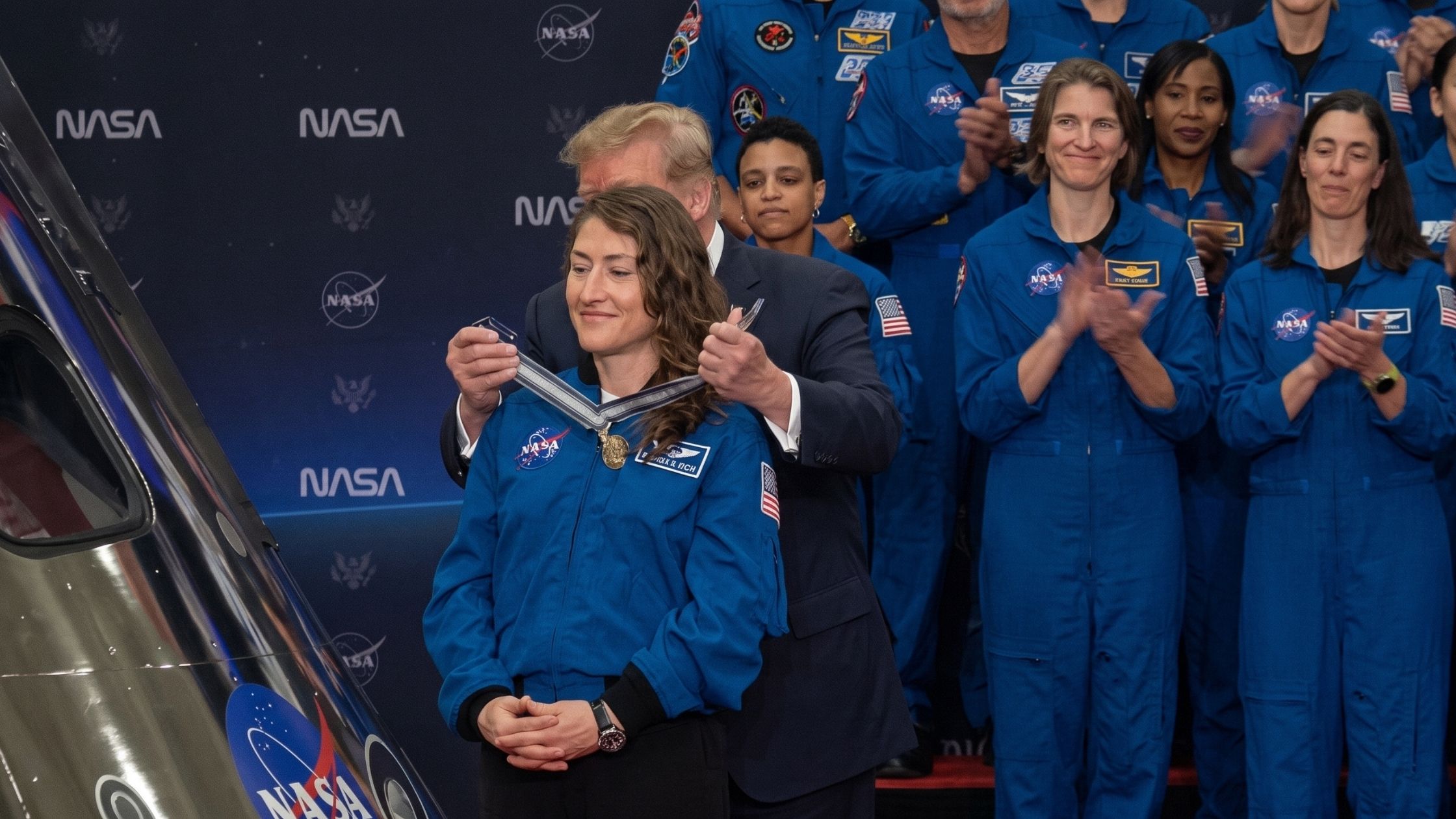
Please join me in congratulating Commander Reid Wiseman, pilot Victor Glover, mission specialist Christina Koch and mission specialist Jeremy Hanson. Great people. Thank you. Congratulations. And I'm going to be presenting them a little something in a couple of minutes, but these astronauts did not do it alone. I want to salute all of the engineers and scientists, launch and landing specialists, everyone at NASA who helped make this mission a great success. I had an uncle who was a great scientist, a great man. He was at MIT for 41 years, Dr. John Trump, and he loves space. He used to tell me about space, space, all space. He would throw in the word nuclear every once in a while, but he loves space.
(09:05)
We have genetically, I believe in that stuff. I love it. I find it so interesting, so amazing. It's very special. Thanks to also associate administrator, chief engineer, Amit Kshatriya and it's Artemis II lead flight director, Jeff Radigan, Artemis II landing and recovery director, Lili Villarreal. And thanks as well to friends of NASA. We have Senator Ted Cruz. Where's Ted? Are you here, Ted? Look at this guy. He's such... Standup, Ted. He is a good man. We've had good moments and bad moments together. And I will tell you, he's good and he's smart and he loves what he's doing right here. This is something special, right, Ted?
(09:55)
Also, another great warrior and friend of mine, Brian Babin, representative, Congressman, does a fantastic job. Thank you, Brian. And Jake Ellzey. Jake, thank you. What a group political, so I won't, but I will tell you from 2015, everyone thinks I ran in '27. I actually announced in 2015, Lieutenant Governor Dan Patrick called up. He said, "I want to be the chairman of your campaign in Texas and you've never left, right?" And we won in record, record, record votes. Nobody came close. And I just want to thank you for that. You were a fantastic chairman. We didn't even have to speak too much. It was sort of good. And that's what we have to do in a little while in the election coming up. So important.
(10:38)
Texas Comptroller, Don Huffines. Congratulations, Don. That was a great win you had. Congratulations. We watched that very closely. Great job. And of course, we're honored to be joined by amazing members of the NASA Astronaut Corps, past and present. They are amazing indeed. And thank you for all you do and risking your lives to advance our voyage into the heavens. It's where you go, you go to the heavens. And I understand this weekend that NASA has a very big launch coming up, the Roman Space Telescope. I was asking Jared, "Is that a big one?" He said, "It's really big."
(11:17)
So, I hope everyone that's watching, look at all the media back there, all the press, I hope you're going to inform people because it's hundreds of times more powerful than Hubble and it will help unlock the secrets of the universe. So, to everyone involved here at NASA, good luck this weekend. It's a big deal. And he was giving a little briefing. I said, "I want to know about this if it's so big and it really is something hundreds of times more powerful than Hubble." From the very beginning, America has always been a frontier nation and space is the highest of all the frontiers. Our manifest destiny is to explore and settle this great unknown carry forward the light of American liberty into the stars...
Donald Trump (12:00):
The light of American liberty into the stars. And Americans were the first in flight, the first in Moon, and will they be the first in space no matter where it is? And I know we're going to be looking at Mars very shortly. In fact, you're already partially there. A lot of work's been done and that seems to be the next frontier. You'll be stopping on the Moon and you're going to be going to Mars. What excitement. What excitement.
(12:27)
Yet when I took office in 2017, America's endeavors in space had come to a complete halt. It was held back by decades of gross mismanagement in Washington. Well, maybe they didn't like it. Maybe they didn't like the concept. I don't know, but it was certainly not anything. It was very embarrassing actually what had happened. Not only had the United States lost its ability to send our astronauts to the Moon, but under a number of administrations, I have to tell you, but in particular the Obama administration, we even lost our ability to send astronauts into orbit at all.
(13:05)
We had no ability in space whatsoever. We totally lost it with everything we spent. With all of the talent and all of the genius and all of the money. We had nothing. And when I got here, I came here, I went to Florida. I visited a couple of the places. I wanted to see what was going on. NASA was closed, absolutely closed. There was almost nobody there. It was like an empty building, not a good look. And I went down, I looked at Kennedy Space Center in Florida in particular. I saw something that you rarely see. They had grass growing out of the cracks in the runway. You had a runway that was all broken up. It was all bad. I know all about that from being very good at construction. You had the cracks in the runway. We had grass growing out of the cracks. It's almost hard to do.
(13:58)
And I said, "Boy, this is sad." It was very sad. That's where we started. Yet as the world can see today under the Trump administration, we have brought back America's space program and came out of the dark age and it's now into the golden age. This is the golden age of America and this is a big part of it. So to every astronaut here today, I want to make this promise to you. Our nation will conquer and we will conquer indeed this vast frontier that we have before us and we'll reach American courage and we'll use American genius and daring and all of the things that we have that nobody else can ever compete with. We will explore it. We will tame it and we will win it. We will always win.
(14:42)
In 2016, the United States of America and our government, private sector launched just 22 rockets into orbit combined. So we did 22. And last year we conducted nearly 200 orbital launches and that number will continue to grow very, very rapidly as you probably know, you know every one of them that's getting ready. There are a lot of them. By embracing competition in the private sector, we freed up NASA to focus on what it does best, leading the cutting edge of exploration and human space flight. In my first term, I signed the orders creating the Artemis program and officially directed NASA to return American astronauts to the moon and then push onward to Mars. And that's exactly what we're doing. And we had a little interlude of four years, but somehow it was limping along. It was okay. It was limping along and now I'm back and we're doing more than limping. We don't limp. Eight years later, these dreams are really coming through at a level that nobody ever imagined.
(15:49)
Nobody imagined what is happening now. And even more importantly, what space has done for our military in terms of offensive and defensive capability is incredible. Don't forget, I was the one that gave you Space Force and we had no Space Force. And when people heard about it, they thought we were kidding. If they thought it was like comic book stuff, it wasn't at all. It's turning out to be one of our most important branches. And only getting more important with time. And we were number three in space at the time I did that. And now we're leading by a tremendous amount. We made some very good original initial hires. We put some people in charge that were really outstanding and they did it right from the beginning.
(16:34)
On July 4th of this year, I presented a veteran of the last mission to the moon, Apollo 17 astronaut, Jack Schmitt, with a very special American flag that flew over the United States Capitol on our nation's 250th birthday. Very, very special flag. And it's here today right next to me and Jack is here also. Where's Jack? Where's Jack? Number one, where's Jack? And number two, where's the flag? Anybody letting me know? Jack, you look good. I know the flag looks good. Where's the flag? Oh, it's over there. It's hidden behind a lot of rockets. Thank you, Jack. Very good. I was wondering, I'm saying, "Am I supposed to be introducing a flag that I can't see? It's invisible." Great job, by the way. Great guy. Still a good-looking guy. You were always a good-looking guy. Now I think you're better with the white hair if you want to know the truth. You look better than you did 20 years ago.
(17:33)
Before the end of my term, American astronauts will return to the lunar surface and we're looking forward to that. We'll do it and we're then going to the next step. And when we do, they'll plant this very important flag to mark the site of the first permanent American settlement on the Moon. They're going to have a settlement. They're building a settlement up in the Moon and we're not going to stop there because under administrator Isaacman, and I have to tell you with Jared, everybody wanted him. You know that, Ted? Everybody. I got calls from you, but I got calls from Democrats. Can you believe it? I won't say anything bad about them. I'm not going to change their term or their name, but Democrats, DEM. And they called and they said "He's fantastic," which set him back a lot because when I got so many calls from Democrats, I said, "Is that good or bad?"
(18:29)
But I got a lot of calls from Republicans and Democrats, something that doesn't happen very often. And the people just said, "He's just the best." There was no competition. There was actually no competition. And I made it and these turned out to be better than we even thought possible, right? Even better. So we're lucky to have Jared, but NASA has already begun to work on the first ever nuclear-powered interplanetary spacecraft, which will launch in 2028 on a mission to Mars. It's something so incredible. They have to go nuclear because they have unlimited, essentially, unlimited fuel.
(19:08)
You don't have to fill up the tanks every so many miles. It's incredible. This ship will be among the first of what will ultimately be a massive American star fleet, making space travel almost as common as ocean travel today and bringing our military to a new level of excellence. Again, so much of this has to do with our military. I don't know if I'd be as enthused about it, but what it's done to our offensive and defensive capability is incredible. So we're doing this, but we're also, when you think of space or when you think of what we're doing here, the military is a very big factor. We're at levels that nobody ever thought would ever happen. And you see how well we fight. We fight very well. We're getting so much of our information from Space Force as an example, makes us a much better military.
(20:00)
You look at Venezuela, what happened there. One day, actually to be exact, it was 48 minutes and so much of that information came from space and all the attacks are, you look at our blockade, which is incredible, it's so successful, being helped by space, being helped by space. So who would think? But it's so important and that's a big component of what you're doing out here. These are ambitious goals, but as I said in my inaugural address last year, ambition is the lifeblood of a truly great nation. If you don't have ambition, you're not going to have a great nation. When Americans are determined, nothing can hold us back and American dominance in this domain is not a choice. It's an economic and national security necessity. A nation cannot be first on earth if we're going to be second in space, just not going to happen. Somehow it just doesn't work that way.
(21:05)
It makes sense. I was going to say, "Does it make sense?" Yeah, I guess it does when you think about it, right Brian? For this reason, in my first term I created the sixth branch, United States Armed Forces, Space Force. And today I have another historic announcement to make. This is something that's so exciting for me, given the rapid growth of the Space Force and the commercial space industry and the expansion of our ambitions to the Moon and far beyond the Moon. Far beyond the Moon will someday be thought of a close location like in the old days, the subway, the first stop, the Moon will be a close location. But it's clear that we will need to educate and train an entire generation of skilled service members, engineers, civil operators and everything else to do what we have to do. Right now doing the best and will continue and I think by leaps and bounds. And that's why in a few moments I will sign an executive order to begin the process of creating a new national academy. It's called the U.S. Space Academy. That's a big deal.
(22:19)
So you think of West Point and you think of Annapolis and you think of the Air Force Academy and you think of the Coast Guard academies. Great. They're all great, but we're going to have a Space Force. We're going to have an academy for what the people in this room love the most. That's exciting. That's really exciting. And I'm going to be choosing a location very shortly. I know where some people want it that are in this audience. Some people come down at this one guy over there, he's lobbying me, I say, "Leave me alone. Just leave me alone." I'm not sure he's going to get it. I don't know if he's going to get it, but everybody wants it because it's the hot thing. Space is the hot thing. Tell you, Ted Cruz and Brian, you guys are in there working too, I have to tell you. Just leave me alone, Ted, please.
(23:12)
United States Space Force as well as NASA and the civilian space flight industry. And it'll attract, train and graduate the very best of our nation and our nation really has to offer. And this is going to be, I said, "I'll do it, but it's got to be top line. It's got to be the equivalent of the others, which are great." They're among the hardest schools to get into. You talk about the Ivy League schools. It's tougher to get into West Point, Annapolis, the Air Force Academy. Coast Guard too. We can't forget that, but so tough, all of them among the hardest schools to get into and they're great and they're great scholars, great everything. So they have to have a lot of everything, not a little, but a lot of everything. But I said, "This has to be comparable to that."
Donald Trump (24:00):
... of everything. But I said, "This has to be comparable to that." Not a little, but a lot of everything. But I said, "This has to be comparable to that. We don't want to do it in any other way, and it's going to be even architecturally... We don't want to do it in any other way. Even architecturally, it's going to be beautiful. It's going to be the top. It's going to be as good as it can get." Doing a bad building doesn't cost a lot less than doing a great building. I've always said it. Doing great architecture, doing something really great that's also practical. It doesn't cost much more than doing some of the bad stuff that you see all over the place. But we're going to make this so good and so exciting.
(24:45)
But first we have to honor the heroes who are inspiring the next generation of astronauts and pioneers and the people behind me. These people, I looked at them coming before I came up. I said, "That's a good looking group of people. I don't like speaking with those people behind me, to be honest. They look too good, but they're great people. They're great, great people." But the Congressional Space Medal of Honor, that's exactly what it says. This is a very rare thing. It's for courageous people, brilliant people, bestowed on astronauts who have distinguished themselves with exceptional service to the nation and all of mankind. Only 30 extraordinary men and women, long period of time too, in the history of our country have received this extremely rare and distinguished honor.
(25:36)
Real legends like Neil Armstrong, John Glenn, Alan Shepard, and the immortal heroes of Apollo 1. Today, we add four new names to this elite roster of fearless explorers. That's really what they are when you think of it, fearless explorers. They're very smart. The crew of Artemis II blasted off from Kennedy, NASA's great space center last April and flew more than 250,000 miles from earth. And very interestingly, our 250th anniversary year only. Jared could have thought of that, I assume. I hope that wasn't just by luck. I hope they... But it's pretty good. They actually went far beyond what would be the normal target, the furthest anybody's ever been in space. They crossed behind the dark side of the moon and glimpse sights never seen before, never seen by human eyes and returned to earth at 30 times the speed of sound and splashed down in the Pacific Ocean completing the flawless mission. It was absolutely flawless.
(26:48)
Artemis II was led by a Navy veteran, a pilot father and a great patriot, commander Reid Wiseman with unfailing strength and calm. Reid led the crew through every phase of the flight and their safe return to earth. He was a great leader, respected by everybody, respected by everybody. As many people will remember during the mission, the crew named a previously unnamed lunar crater in loving memory of Reid's wonderful wife who we lost to cancer. So, they call it the Carol Crater. So, that's making Reid a little weepy right now because she was an incredible woman. Will never be forgotten now. She'll never be forgotten. We honor her. And truly the memory is all about the moon. That's a great one. I wish they'd named something like that after me, Reid, but I don't know. I'll have to get the governor's approval. I like that. That's beautiful. So Reid, we salute you, we salute your family, and we congratulate you. Thank you very much.
(28:12)
And today we also honor a distinguished naval aviator with an outstanding record as a test pilot. He served in 24 combat missions for our country before taking on the most dangerous mission of all, Pilot Victor Glover. Victor led guidance, navigation, and control operations with perfect skill and absolute total precision. And you have to have great precision or things will not go well. And he did it with the heart and the faith that brought out the best in this incredible team before the spacecraft passed behind the moon and lost communication. And they did. I was watching. There was absolutely none. I said, "What's going on?" But they lost total communication with Earth for a fairly extended period of time. Victor turned to prayer and reminded us all of God's love for all of his children. And Victor, thank you very much and congratulations. It's incredible. Great story. Thank you.
(29:26)
We also recognize mission specialist Christina Koch, who before this flight had already set a world record for the longest continuous flight ever by a woman in space. On Artemis II, Christina led major science and observation tasks, making vital contributions to future missions and the advance of human knowledge. Christina tells young people, "Do what scares you." It's an interesting statement. I don't know about that, Christina. I don't know about that Christina, but that's the attitude that you have to have. You want to do this. And that is the attitude that she has and I think that everybody standing behind me has, frankly. And the further she went, the stronger she got. She was really amazing, they say on the trip. She was just amazing. So Christina, thank you very much. We appreciate it. Great job. And finally, we honor a master of science and physics, a fighter pilot, a great one, and a beloved member of the astronaut team mission specialist, Jeremy Hansen. On Artemis II, Jeremy became the first non-American in history to travel beyond low earth orbit. He documented lunar terrain while contributing enormously to space science and physics research. And along with Christina, he helped the crew stay healthy and develop standards and best practices. Jeremy, thank you very much. Great job. Great job.
(31:15)
So, with unmatched bravery and unwavering faith, these four extraordinary astronauts renewed the legacy of the pioneers and explorers who chartered the world's oceans, climbed its highest summits and tamed the American West. Great people, great men and women, incredible. That spirit is written into the soul of our nation and in the daring deeds of these heroes, we're reminded that for America, no aim is too high, no journey is too far, no challenge is too tough. In this country, we're limited only by the size of our aspirations and the scale of our dreams. We have the American dream and the American dream is back. I think the American dream is back stronger than ever before. We're doing great. This country is doing great right now. Never did anything like it. 81 stock market highs in one and a half years never been anything like it, including they broke it again yesterday for the 81st time. And $19.2 trillion is being invested in our country from outside countries and interests and people, and we've never seen it. That's why I call it the golden age. It's an exciting time. Tomorrow's going to be very exciting.
(32:37)
And today, thanks to the crew of Artemis II. Those dreams are closer than ever before, and we're on the cusp of an adventure and something that's so special that people have really not imagined anything. Civilization is into the scars. The stars are up there and they're beautiful and you're right next to them. You have the courage to be right next to them. Few people do, but you're leading the way. It's great bravery.
(33:07)
I want to thank again, Reid, Victor, Christina and Jeremy, very special people. And now I will sign the executive order creating the US Space Academy, and then we will do the honors. Thank you very much everybody. Great honor. Okay. Got to pick a good one. Pick a good pen. That's a good one. Thank you very much. I think he deserves it. Okay. Thank you guys. Take these around and give them out to some of the people. We'll go over here.
Speaker 2 (35:01):
Ladies and gentlemen, the President will now present awards to the crew of Artemis II. As mission specialists on Artemis II, Jeremy Hansen demonstrated exceptionally meritorious contributions by executing spacecraft communications, navigation procedures, and pre-launch verification activities, including pressure suit regulator checks and Orion systems configuration. Throughout the lunar fly by sequence, he led and executed detailed observation protocols, capturing and documenting lunar topography, eclipse phenomena, and solar corona behavior while directing real time scientific data collection for geology and heliophysics research.
(35:38)
He performed manual control assessments and crew health evaluation tasks, including the orthostatic intolerance garment test, advancing validation of systems and human factors performance essential to future lunar landing operations and long duration deep space missions. During the mission, he was integral to the crew surpassing the Apollo 13th distance record and reaching approximately 252,760 miles from earth, farther than any humans in the...
Speaker 3 (36:00):
... 760 miles from Earth, farther than any humans in history. As mission specialist on Artemis II, Christina Koch demonstrated exceptionally meritorious service by leading major science and observation tasks during the mission's seven-hour lunar flyby, capturing and documenting impact craters, lava flows, surface fractures and eclipse phenomena that significantly expanded understanding of lunar geology and solar corona behavior. She configured and oversaw Orion's cabin for flyby operations, including sensor alignment and systems readiness and executed target Earth-Moon imaging sequences conducted from Orion's optical windows and solar array cameras. Her execution of in-orbit procedures, including participation in the orthostatic intolerance garment test, evaluating human physiological response during return to Earth's gravity, produced critical data that advanced crew health standards on future deep space missions. During the mission, she was integral to the crew surpassing the Apollo 13 distance record and reaching approximately 252,760 miles from Earth, farther than any humans in history. As pilot of Artemis II, Victor J. Glover distinguished himself through exceptionally meritorious performance by commanding and executing guidance, navigation, and control operations throughout launch, translunar injection and return phases. He led manual control evaluations during Orion's return trajectory operations, validating spacecraft control modes and confirming the spacecraft's piloting characteristics for future missions. He maintained precise control of spacecraft attitude during lunar observation periods, enabling the crew to capture essential scientific imagery and meet mission-critical documentation objectives. His professional skill was further demonstrated during trajectory correction maneuvers and during final atmospheric entry and splashdown, ensuring the mission's safe completion and advancing deep space operational readiness for upcoming Artemis expeditions. During the mission, he was integral to the crew surpassing the Apollo 13 distance record and reaching approximately 252,760 ...
(39:22)
... Than any humans in history. Under his command, the crew executed return trajectory correction burns, manual control evaluations and system verification procedure ...
Speaker 4 (40:08):
... Do this with you three. Mr. President, it means a lot that you are here at the Johnson Space Center. It underscores the important work that is going on here at Mission Control in furthering human exploration ... On the launchpad when we're getting ready to ride this magnificent rocket, the crew said three things. Victor Glover said, "We are going for our families." Many of you are here today. Thank you so much for supporting us. Christina Koch said, "We're going for our teammates." Mr. President, when we were backstage and we heard you mentioning some of those names of those people who sent us on this mission and brought us back safely, that was warming our hearts. Thank you for honoring those people. And then Jeremy said, "We're going for all humanity."
(40:52)
When we went around the far side of the moon, which has now been rounded up to 252,760 miles, we'll take it, keep rounding it up, we got to talk ... To us, as you said, how proud you are and how proud our nation is of the job that we have just accomplished. And for us, that is what we set out to do. We wanted to inspire this nation and inspire the world, and for us, that showed us we were on the right track. So thank you for that call.
(41:22)
We wear these four medals and we are going to wear them with pride, but please know it is not pride for ourselves that we feel, and I truly mean that. It is pride for the grit that our families had. It is pride for that team, this NASA team that sent us on this mission, and it is pride for the international community that stood alongside ... This NASA team, that sent us on this mission, and it is pride for the international community that stood alongside us, got this vehicle ready, operated it, and cheered us on. So thank you for bestowing this honor on us. And in closing ... Bestowing this honor on us. And in closing, how cool it is to be an astronaut here in Houston and to see our entire astronaut corps standing here supporting us. And behind me, you have the Artemis III crew, Randy, Luca, Frank, and Dr. Andre Douglas. And we are so excited to see where Artemis III goes and where the rest of this office goes ... Leadership. Thank you all. I'm going to hand it over to our esteemed pilot, Victor Glover.
Victor Glover (42:48):
So Mr. President, when we were in your office and you were so gracious to us, lavishing us with gifts and so much of your time, we had mentioned getting you one of these blue flight jackets. Here we have your jacket today and you'll notice the NASA, we affectionately call this the NASA Meatball, but on the sleeve you'll see the team that we are a part of in the astronaut office and that is the flight operations directorate. There's a lot of neat symbology on that patch and I can explain it to you or some of the team can later. Underneath that you have the Artemis II mission patch, which we told you a little bit about, and then you've got 45 and 47 patches which represent that vision that Reed was talking about earlier. So we are people of our word and it is great to be able to give this to you in front of everyone. Thank you, sir. [inaudible 00:43:46].