


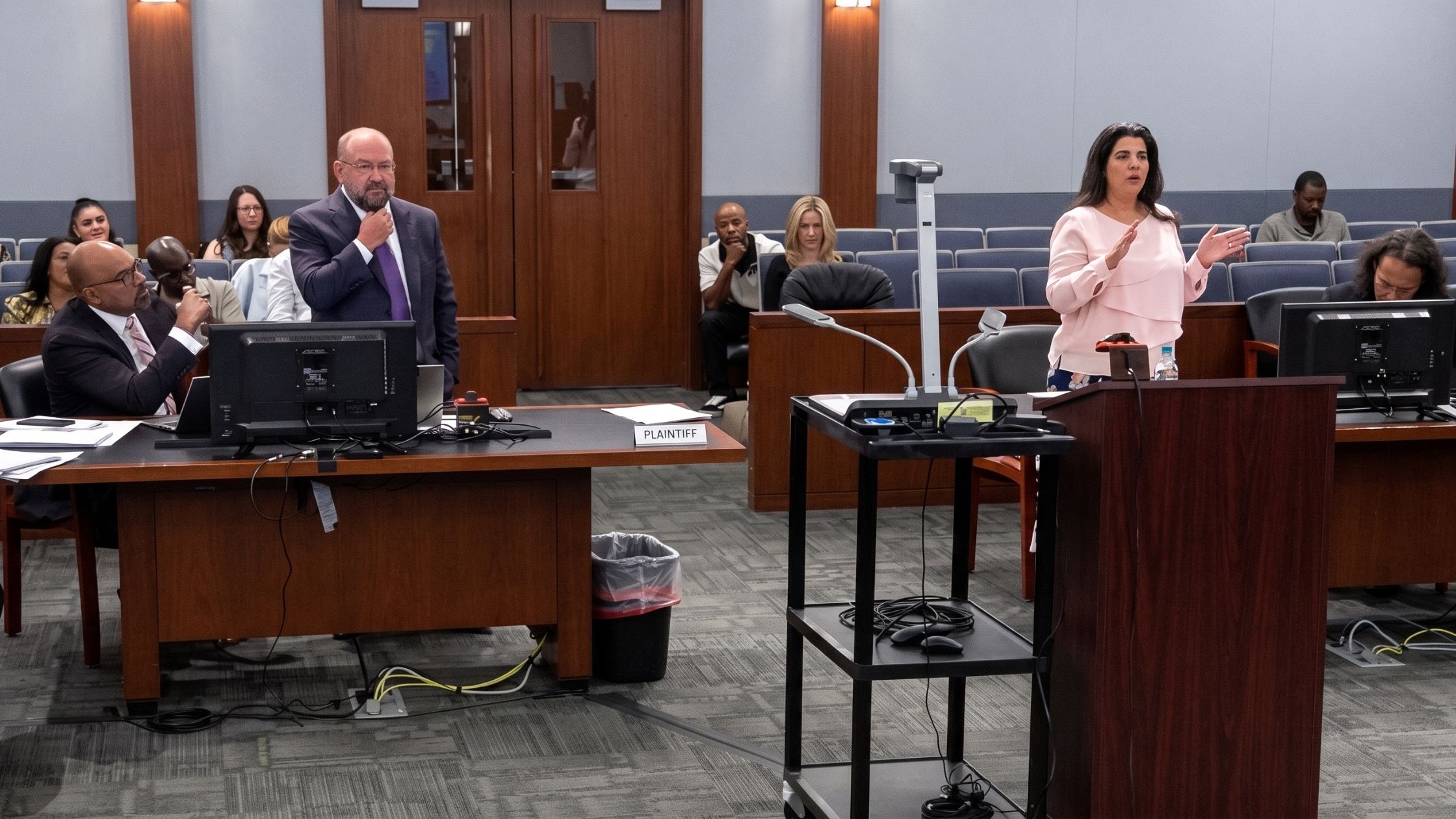
Carli Kierny (00:21):
On record in State v. Davis, C377407. For the record, Mr. Davis has waived his appearance for this hearing previously. What document are we working off of, Mr. DiGiacomo?
Mr. DiGiacomo (00:33):
The one I just sent you.
Carli Kierny (00:35):
Okay.
Mr. DiGiacomo (00:38):
We negotiated some language in a bunch of the instructions.
Carli Kierny (00:41):
Okay.
Mr. DiGiacomo (00:42):
The issue still before the court, and you got the defense instructions earlier.
Carli Kierny (00:47):
Yes.
Mr. DiGiacomo (00:47):
Is one, whether or not we give a voluntariness and if we give a voluntariness of the statement, what voluntariness of the stated instructions should be given.
Carli Kierny (00:56):
Okay.
Mr. DiGiacomo (01:01):
Two, we have a dispute over what corpus delicti rule instruction we give.
Carli Kierny (01:07):
Of course.
Mr. DiGiacomo (01:08):
The defense has withdrawn their 51069 request, the attacking, the hearsay as if he testified to the client as if he ... They've withdrawn that.
Carli Kierny (01:19):
Okay.
Mr. DiGiacomo (01:20):
And then the defense does not want self-defense instructions, but the state believes we're entitled to them since Mr. Davis claimed self-defense in at least one of his statements.
Carli Kierny (01:28):
Okay.
Taleen Pandukht (01:43):
Good morning, Your Honor. Attorney Taleen Pandukht, bar number 5734 on behalf of the defense. I did print a copy of our initial defense proposed instructions. Would you like a printed copy for now?
Carli Kierny (01:54):
I have an email copy if you want those filed. Go ahead as proposed.
Taleen Pandukht (01:59):
Well, we are withdrawing one of the instructions on page six.
Carli Kierny (02:11):
Okay.
Taleen Pandukht (02:11):
We're withdrawing the hearsay instruction. Pages seven, eight, and nine, the state has agreed to modify those and use our proposed exhibit.
Carli Kierny (02:20):
Okay.
Taleen Pandukht (02:21):
So you are here to determine if the Defendant is guilty or not guilty based on the evidence in this case as opposed to guilt or innocence.
Carli Kierny (02:29):
Okay.
Taleen Pandukht (02:29):
And then we also, the state also changed the one about the subject of punishment to not say guilt or innocence, but to talk about the burden of proof.
Carli Kierny (02:38):
Sure.
Taleen Pandukht (02:38):
The state has also agreed to give the instruction on page nine of our proposed instructions on the constitutional right of a defendant not to testify.
Carli Kierny (02:46):
All right. So then what I think makes the most sense, tell me if I'm wrong, is just to go through individually. When there's no objection, just number that, move on to the next one and organically raise the issues as they come up with the instructions. If there's something that doesn't get raised ultimately by the end, then I'll circle back and ask about the defense proposed.
Taleen Pandukht (03:07):
I agree.
Mr. DiGiacomo (03:08):
I would agree with that except for I don't think you want to number, if you do wind up given the voluntariness, I don't think you want to number them after the last instruction.
Carli Kierny (03:17):
So you want to start with voluntariness?
Mr. DiGiacomo (03:19):
... Whether or not we should be giving voluntariness and then when we get to the area where you want to argue voluntariness.
Carli Kierny (03:24):
All right. Let's go voluntariness of statement as our first issue. Let me pull up the instruction that you have proposed. And then state has presented an alternate.
Taleen Pandukht (03:50):
What I-
Mr. DiGiacomo (03:50):
An alternate, but also an argument that there is no voluntariness that gets submitted to the jury.
Carli Kierny (03:57):
Okay. So is the instruction that you are ... If you actually just want to approach with yours at this point, I don't know. It doesn't look like I received your entire packet or everything. So it doesn't look like I received your entire packet, or everything. So I can just go through it printed. Thank you ... One that I start with.
Taleen Pandukht (04:25):
I'm happy with all three of them.
Carli Kierny (04:26):
Okay. So you'll take any of the first three. So either ...
Taleen Pandukht (04:29):
And definitely the second one on page three talks about the difference between an admission or a confession. So that one's different from the page four one, which talks about the totality of the circumstances and the voluntariness.
Carli Kierny (04:44):
State, what's your objection regarding a voluntariness instruction being given at all?
Mr. DiGiacomo (04:49):
In both the cases cited by the defense, and I recognize, both of them say the statement is an issue that you have to submit it to the jury. The mere fact that they filed a motion to suppress on voluntariness doesn't create an issue. They have presented you have to, as Connelly says and Vasquez Diaz says, you have to establish some improper police coercion and they have not done that in this case. The audio of the statements do not reflect any improper police coercion. Both of those, neither one of those have you found to be custodial. And so ... Statements of defendants who are in custody. There is a lot of law that if there's evidence of self-defense, you got to give self-defense. If there's evidence of a voluntariness, you have to give a voluntariness, voluntary manslaughter. There is zero evidence before this jury that they could factually make any sort of determination as to the voluntariness of the Defendant's statements.
(06:05)
By its very definition, a proffer cannot be involuntary because it is a negotiated contract between two people. So the only statement this could apply to would be the 2009 statement. And when you listen to the 2009 statement, it's clear there's not a single improper coercive conduct by Detective Long. Now, had the Defendant got on the stand and said, "Hey, they beat me with rubber hoses before I went in the room," or, "Hey, the cops told me this or the cops told me that or the cops told me this." The evidence before this jury is he was caught with PCP, a gallon of PCP and a kilo of cocaine. "They told me I could be prosecuted for that or I could give a statement. I negotiated a contract with my lawyer with the government to go in and give them a statement." By its very definition, it cannot be involuntary.
(07:11)
And so if you instruct a jury on this, particularly the instructions they're requesting, it would be highly, highly confusing to the jury. And it's not an issue in the trial because they've brought zero evidence of coercion, improper police coercion into this case. And because of that, I would say they're not entitled to a voluntariness instruction.
Carli Kierny (07:42):
In reviewing the instructions that are proffered, Ms. Pandukht-
Taleen Pandukht (07:47):
... Approach to ... And Morrison.
Carli Kierny (07:49):
You may. My initial concern in reviewing what you have stated before I even get to the threshold matter of whether you've met ... Well, first I have to decide the threshold matter, but if we were to give an instruction, all instructions say that ultimately if a jury concludes that the confession or admission was not made voluntarily, then it's up to the jury to determine whether they should consider it. However, none of the three instructions give any insight to the jury as to how they would determine voluntariness. As a judge, when there's this motion to suppress brought up before me, in general, I have factors to consider. The jury would have none of those in the proposed instructions, and so it would be giving them a task that they have no way of accomplishing, essentially, is what is in front of me.
Taleen Pandukht (08:34):
And what the defense is submitting in the Carlson case, they had an instruction that they, the Nevada Supreme Court ruled ... In that case, and that is in the state's first proposed exhibit. And they actually gave the footnoted instruction of the fact that, "The court is admitted into evidence, the alleged confession or admission of the Defendant does not find the jury to accept the court's conclusion. And the jury, before it may take a confession or admission into consideration, must for itself find whether or not it was voluntary confession or admission. If the jury concludes that a confession or admission was not made voluntarily, it is the duty of the jury to entirely disregard the same and not consider it for any purpose." That is directly from the Carlson case.
Carli Kierny (09:18):
They're saying voluntary carries a clear meaning without need for further definition or explanation.
Taleen Pandukht (09:22):
That was going to be my very next argument, Your Honor. And they did say that it was ... Not give that instruction. And what they talked about was, and this is going to be something that's a theme running through all of our objections. There is a difference between admissibility and the question of fact that the jury now needs to decide. So here, Mr. DiGiacomo is absolutely correct that you have the initial determination of admissibility. You have ruled that it was voluntary. This will be an issue on appeal. This will be something that will be brought up by the defense should Mr. Davis get convicted. However, you also then are required by the Nevada Supreme Court to instruct the jury based upon their role now, which is determining whether or not there is evidence beyond a reasonable doubt.
(10:10)
To me, that is how I read these Nevada Supreme Court cases, that you need to give these instructions. I do see the court and Mr. DiGiacomo's concerns. It is the defense position that we'd rather have all of the instructions given as opposed to just the state's. So I think it's better to instruct the jury than to not about all of the applicable rules. But I do think, and this will become even more important in the next argument about corpus delicti, I think that we do not need to instruct the jury on questions of admissibility. I do not want them to be confused about the proper standard that they need to decide, which is proof beyond a reasonable doubt. At this stage, it's a question of fact for the jury.
Carli Kierny (11:03):
So let's work backwards then. Where in this record do we have evidence of improper police coercion or we don't have ... We have a statement that was given in the presence of his attorney that he brought there. We don't have any of the typical [inaudible 00:11:25] factors present of someone who's very young, someone who's very hungry, someone who's very tired, someone who's very susceptible to police coercion because of their lack of familiarity with the criminal justice system. We have none of those factors present here.
Taleen Pandukht (11:47):
I think we have-
Carli Kierny (11:48):
Additionally, we have a defendant.
Taleen Pandukht (11:49):
... Defense would disagree.
Carli Kierny (11:50):
But hang on a minute. And we also have someone who has not testified to explain a circumstance outside of what is actually within the videos, and then ultimately no evidence that ... Well, apparently ... It would be difficult to know what to apply to this situation, but what is the, I guess, improper police coercion here?
Taleen Pandukht (12:21):
Well, the defense, we all should not be arguing this right now. It's a question of fact for the jury. I'm not going to restate the evidence that we already heard at the trial because it's up to the jury to decide.
Carli Kierny (12:32):
You need to make a prima facie case.
Taleen Pandukht (12:34):
Exactly. But it is our position that those factors, whether they've been met or not, would be up to the jury to determine. Both sides are going to have arguments and closing arguments that are going to be very different. This is one of the biggest issues in this case, and I think it's important to continue on to allow these instructions to be given as decided by the Supreme Court. I think it would be error not to give the instructions. And I think that there is some evidence of psychological pressure. That is going to be something that the defense may argue in this case based on the testimony at trial. But I don't think it's appropriate for us because it's a question of fact for the jury.
Carli Kierny (13:12):
But we need to get at least that there's something in the record to show, if we're talking about a voluntary manslaughter, you have to have at least that scintilla of evidence to get over that very small molehill. What evidence is there to give these voluntariness instructions at all to get that first hurdle that Mr. DiGiacomo is, I guess, complaining about?
Taleen Pandukht (13:35):
And I know that this court disagreed with the defense when it filed its motion to suppress the statements, but the defense detailed at length what the promises were. There were explicit promises made to the Defendant in the 2008 proffer. There were implicit promises not to use it against him in the second 2009 interview. And those promises, while contested by the state and contested by the court, there was evidence of promises made to the Defendant. There was evidence about confidentiality that they agreed to keep. There was evidence about when that confidentiality was broken, who broke it first. These are all issues that are going to come up during closing arguments, and I'm sure there are going to be issues that are going to be deliberated by this jury in making a decision.
Mr. DiGiacomo (14:32):
But none of that goes to voluntariness. Somebody violating something five year or three years afterwards doesn't change the voluntary nature of this statement. The person or the entities that contracted have never violated the agreement that was contracted. The contract was between Mr. Higgins and the U.S. government. U.S. government never violated the contract. The suggestion that as a matter of law, you can never have an involuntary proffer. There would have to be some additional information that is elicited. The fact that they don't like what Mr. Kading did does not somehow change the nature of what happened three years before. And so the psychological pressures that they're talking about are exactly what Colorado v. Connelly say are not appropriate for purposes of the Sixth Amendment involuntariness. That is clearly not a situation where they're allowed to argue to a jury that because him and his family were wrapped up in a drug deal, that he somehow has the right to claim that his statements are involuntary.
(15:59)
The Sixth Amendment is there to protect against improper police conduct. It is not there for this purpose. So when they use the term voluntary, he didn't have a choice. Well, he did have a choice. He could go to prison for the rest of his life on drugs, but he chose to make a statement to the police. And so there is no evidence of anything improper police conduct that has occurred here.
Taleen Pandukht (16:26):
May I add something, Your Honor?
Mr. DiGiacomo (16:27):
You may.
Taleen Pandukht (16:28):
I wanted to clarify that the burden of proof is on the state to prove by a preponderance of the evidence that the confessions were voluntary. That is a burden of proof at the time of trial, not at the time of the motions. So in this case, they do have that burden to prove that beyond a preponderance of the evidence. So I think that's also relevant, and I think it's important in this case that we give this question to the jury based on the Supreme Court law that's in place. But as Your Honor well knows from all of the briefing in this case, there is very little law specifically on point to this issue. This is a unique issue. This is something that could create new law in the State of Nevada because there's very little law in Nevada that even remotely talks about the situation that we have in this case. I think that it's very important to protect the record that the instructions be given, and I'll submit it to Your Honor.
Carli Kierny (17:32):
Okay. I think it's safest to give some sort of voluntariness instruction to this jury given the precedent in the Nevada Supreme Court, given the Carlson v. State case. I definitely agree with a lot of the state's arguments and that's why I've ruled the way that I did initially. However, it's clear that this has been an issue that has been raised by defense. It's something that they disagree with my ruling with pretty strenuously. And in the record, there is that statement by Detective Kading in that 2008 interview that this will never be used or this will never be heard, which was the basis for that voluntariness. I still think that wasn't the correct framework, but I think giving it ultimately to the jury is maybe a way to hedge our bets. So that being said-
Mr. DiGiacomo (18:33):
Then I'd ask you to look-
Carli Kierny (18:36):
Let's talk about the various instructions and how we're going to do this.
Mr. DiGiacomo (18:40):
I would ask the court, and I will tell the court that, and I cannot believe I'm actually going to say this, but I pulled those instructions on voluntariness from the Nevada pattern jury instructions. The only thing only ... To this case and added to Colorado v. Connelly portion that says self-interest or an expectation of receiving a benefit does not make a statement involuntary. That isn't actually in the pattern instructions, but clearly it's the law and that's why I sent you Vasquez Reyes because Nevada has adopted Colorado v. Connelly. And so the instructions I gave you on voluntariness, and I'm trying to pull them up here because I didn't have them up on my computer initially here.
Carli Kierny (19:51):
And so these are ... Your instruction is the pattern?
Mr. DiGiacomo (20:05):
Is the pattern with the exception of the last line on the first page.
Carli Kierny (20:15):
Okay.
Mr. DiGiacomo (20:15):
I believe.
Carli Kierny (20:15):
And so Ms. Pandukht, the instructions that you've given me, obviously the one on page two involves Carlson and Larson.
Taleen Pandukht (20:23):
Yes.
Carli Kierny (20:24):
Those are Nevada Supreme Court cases. The other two cites are simply for the stock CCDA brief bank instruction. Do you know where those necessarily come from and if they were not incorporated into ultimately the pattern, the idea was to incorporate those stocks into the patterns?
Taleen Pandukht (20:41):
Those have been instructions that have historically been used by the district attorney's office that have been upheld by the Supreme Court. So those have not been challenged. There have been no problems associated with those instructions. That was initially what I had asked the state to include that precipitated all of this.
Carli Kierny (20:59):
Okay.
Taleen Pandukht (21:00):
So I wanted to make sure that the court had those instructions.
Taleen Pandukht (21:00):
Okay. So, I wanted to make sure that the court had those instructions. I agree with the state that their instructions are a correct statement of part of the law that applies. I'm not saying it's complete in terms of all the issues in this case, but as to the Passama factors, those are the factors. And I do agree that they're correct statements of the law. So, we do not object to the admission of all the instructions, both the state's proposed as well as the defense proposed.
Mr. DiGiacomo (21:29):
Well, the second two DA brief bank, I'll be honest with you, and she was at Appellate for a long time. Those are no longer in our stock instructions, these pattern instructions of what we've put into our stock instructions, because those are clearly, as the court noted, not adequate to explain to the jury voluntariness in a legal sense what that is. And so, if you're going to give the instructions, I would urge you to give the Nevada pattern instructions with the Connelly addition to them. Well, I mean, I think it's superfluous to even have the, what is it? The Carlson Laursen one because these fully explain, these two instructions fully explain, "Hey, there's a confession and admission. Here's what the difference between the two are. Here are the factors to consider in determining voluntariness. There needs to be improper police coercion involved in them."
Taleen Pandukht (22:36):
I don't believe those two are sufficient. And I think that under Carlson, them saying that the term voluntary contains a clear meaning without need for further definition or explanation. That's also a clear mandate by the Supreme Court. But I would ask at a minimum that-
Carli Kierny (22:52):
Mandate from 1968.
Taleen Pandukht (22:53):
Right. But there's been nothing new-
Mr. DiGiacomo (22:55):
In which the defense was actually asking to give the factors to the jury. And the court said it was sufficient in 1968. But this is a very specific voluntary issue, right?
Carli Kierny (23:07):
Okay. Turning back to Ms. [inaudible 00:23:13], when I look at the instruction the state is offering, it does seem to incorporate what you've included for three. It talks about what an admission is, what a confession is, and what the definitions are. It seems to be very similar language. And I think it was probably what was used to make the stock pattern, the stock instructions that the Supreme Court is encouraging us to use.
Taleen Pandukht (23:36):
Yes.
Carli Kierny (23:37):
And so it seems to be the predecessor to that. Would you agree with that?
Taleen Pandukht (23:41):
Yes, it is fine to use both of those instructions.
Carli Kierny (23:44):
Well, I'm just saying I don't know that we need instruction three if that one is being given.
Taleen Pandukht (23:49):
That's fine, Your Honor.
Carli Kierny (23:50):
Okay.
Taleen Pandukht (23:50):
I just want to make a complete record.
Carli Kierny (23:52):
No, I understand. I'm just, if you agree with me that it's already incorporated in the instruction, I'm not going to give duplicates.
Taleen Pandukht (23:58):
Exactly.
Carli Kierny (23:59):
So, three doesn't seem to make sense. Page three doesn't seem to make sense. Page four, let me compare that. I think page four does include additional factors, which include that the state has the burden of proving voluntariness by a preponderance, but then it goes into the voluntariness being a question of fact to be determined by the... And what you're to do if it is determined to be involuntary.
Taleen Pandukht (24:41):
And I would ask that that instruction be given.
Carli Kierny (24:43):
And I think four is incorporating your instruction two. It has all the same features. So, my thought is to give the state's instruction as well as page four.
Taleen Pandukht (24:58):
Okay.
Carli Kierny (24:58):
And I'll let Mr. DiGiacomo be heard on that just because it will avoid duplication of the exact same issues that could confuse the jury. Additionally, it includes an explanation to the jury of what to do to determine when you determine it's voluntary or involuntary and who has the burden.
Mr. DiGiacomo (25:24):
Okay. So, you're going to give both of the states and then you're going to add four?
Carli Kierny (25:29):
Oh, the state has a second? I haven't gotten to the second.
Mr. DiGiacomo (25:33):
The second one actually has all the factors listed out and it does cover everything that's in her number four.
Carli Kierny (25:40):
Okay. Let me look at that one. I apologize. Page two?
Mr. DiGiacomo (25:46):
Page two of ours, the Passama factors.
Carli Kierny (25:49):
And it includes that the state has the burden of proving, which I indicated earlier was a very important part of instruction four. I think ultimately in comparing page two, it does encompass all of the ideas of page four.
Taleen Pandukht (26:17):
So, instruction number two will not be given on page two.
Mr. DiGiacomo (26:29):
Right. I think what she's saying is she's going to take R2 and encompasses all three of yours. Is that what you're saying?
Taleen Pandukht (26:36):
No, she's going to give on page four.
Carli Kierny (26:38):
Well, I didn't realize there was a page two to the state. What does the state's proposed either omit? I see that it adds the Passama factors and you guys don't want the Passama factors given. Is that sort of the difference there?
Taleen Pandukht (26:53):
I already said it was fine to give all five instructions. So, I'm not saying that their proposed instructions are an inaccurate statement of the law.
Carli Kierny (27:00):
Got it. Understood. So, at this point, I'm going to give voluntariness instructions over the state's objection. However, I'm going to use the two that the state has proposed because they are pattern instructions which we're encouraged to use. Additionally, in reviewing them and comparing them to the ones that were sent over by the state or by the defense, they do include all of the factors as well as the fact that the state has the burden of proving the voluntariness by preponderance of the evidence. So, I think they encompass everything that is necessary. They encompass the defenses and to avoid confusion, I'm not going to give all five. I'm just going to give the two that include the same ideas.
Taleen Pandukht (27:45):
What about the one on page four? You had said earlier you were going to give that one.
Carli Kierny (27:49):
And I think that was before I knew that the state had given me even a second page. All right. So, the voluntariness instructions will be given as proposed by the state, but to be clear, the state does not want voluntariness instructions. The other issue that we needed to address was corpus delecti. The defense is proposing on page five.
Taleen Pandukht (28:18):
And to be clear, Your Honor, the defense objects to the corpus delecti instruction proposed by the state. The only reason that we provided an alternative proposed instruction is because they included it in their packet. The defense objects to any corpus delecti instruction being given to this jury at all for these reasons. While the first attorney in this case had potentially raised a corpus delecti issue in his motion to dismiss, this defense team has not raised corpus delicti either in a motion or in front of this jury. That issue has not come up. It is a question of admissibility, not a question as to weight. And the defense objects to this instruction being given because we believe that it is confusing and misleading to the jury because their duty is beyond a reasonable doubt and their duty is as to weight and it's confusing to even have this instruction.
(29:15)
However, if the court disagrees with the defense position and will give an instruction, the case provided by the state Sefton, that's actually from 1956, and the proper standard is the Doyle case. In the Doyle case they provided, this is the exact instruction that comes out of Doyle, which is Doyle versus State, 112 Nevada 879 from 1996 Nevada Supreme Court. And that instruction is a more accurate statement of the law.
Binu Palal (29:48):
Your Honor, may I be heard?
Carli Kierny (29:52):
Which one is your corpus instruction?
Taleen Pandukht (29:54):
That is on page five.
Carli Kierny (29:57):
No, I'm sorry. State, I'm on yours. Okay.
Binu Palal (29:59):
It's near the end.
Mr. DiGiacomo (30:03):
It's near the end.
Carli Kierny (30:05):
Give me the first couple of words once you find it so I can-
Binu Palal (30:07):
Where independent evidence.
Carli Kierny (30:09):
Where independent evidence. Okay. Then I can control F then.
Mr. DiGiacomo (30:18):
It's about 42 of 53. Although I just added in the voluntary instruction, so maybe not.
Carli Kierny (30:26):
So, the instruction the state is proffering reads, "Where independent evidence establishes the victim's death was caused by the criminal agency of another, a defendant's own statements admitting the crime may not be further corroborated by evidence connecting the defendant to that crime." I don't know that that's necessarily a corpus issue.
Binu Palal (31:03):
It is, Your Honor. So, this is what, and I'm going to disagree with Ms. Pandukht with regards to the defendants never taking the position about the corpus delicti issue. What Mr. Sanft told the jury in his opening statement is you have to corroborate what the defendant says. That is not the law. So, the question is when we talk about what's clarity to the jury, what is the law? The law is we have to prove when a person gives a confession, absent their confession, we have to prove one, that a person is killed, two, by the criminal agency of another. But what Sefton says and what even Ms. Pandukht's case says, and I'll get to why that's not applicable here, but what even Ms. Pandukht's case says is that once you've established there's a crime occurred, you don't have to corroborate any other aspect of a defendant's statement. Now, of course they can give it to whatever weight they want, but they-
Carli Kierny (32:02):
Isn't that the inverse though of what a corpus argument would be, is that there is only a statement and nothing to back it up?
Binu Palal (32:09):
Yeah.
Carli Kierny (32:10):
You're kind of inverting it.
Binu Palal (32:11):
No, this came up specifically in Sefton. In Sefton, specifically what happened was there was a dead body, the person confessed to the crime, and what the defendant argued is, "Well, you never independently corroborated my other statements connecting me to the crime, therefore it's a corpus issue." And what the Nevada Supreme Court held is that there's not a third prong to corroboration. There's one death, two by criminal agency. Three, what the defense had proposed and what Mr. Sanft has proposed to this jury specifically is that the third thing you have to do is corroborate that a defendant's statements connecting himself to that crime are true. I don't think there's any credible argument to say that that's not what Mr. Sanft said. I mean, it's a direct quote from his opening statement, but that's not the state of the law. And when Mr. Sanft makes a argument that is an inaccurate aspect of the law increasing our burden, we are entitled to an accurate statement of the law.
(33:12)
And what an accurate statement of the law is, is that we do not have to corroborate anything beyond the corpus delecti. That is the corpus delecti rule, is that we don't have to corroborate anything beyond that. And so, the question before this court is, is Mr. Sanft, because he's certainly going to say it during his closing argument, and he said in the opening statement, "Is Mr. Sanft allowed to give a false impression about the law to the jury?" And the question of that should absolutely be no, because the corpus delecti rule is that we don't have to. And even if you don't want to call it the corpus delecti rule, the rule is regarding confessions is that we do. And even if you don't want to call it the corpus delecti rule, the rule is regarding confessions is that we do not have to corroborate anything beyond a person being killed and the criminal agency.
(34:07)
And so, Ms. Pandukht again in Doyle v. State, the thing that she pulls is from a kidnapping case or from a kidnapping charge. But in another case that Ms. Pandukht cites, West v. State, gives a very similar understanding of the-
Carli Kierny (34:25):
You actually cite West v. State too.
Binu Palal (34:26):
Yes. Well, as she cited it, we cited it. We both cited it.
Carli Kierny (34:28):
Yeah.
Binu Palal (34:29):
And the one thing that we can agree is the two parts of corpus delecti, the only thing that we have to independently establish is the death and by criminal agency. That's the only thing we have to establish. We don't have to corroborate anything else. And so the only question is, is the jury going to be misled about whether we have to corroborate or not? And what the instructions are there to do is to have them not misled as to what our burden is.
Taleen Pandukht (34:52):
May the defense respond?
Carli Kierny (34:54):
One second. I'm not quite through with understanding the state's argument. Sefton states that you need, for a homicide, you need proof of corpus delecti, which we've always had in this case, right? No one ever-
Taleen Pandukht (35:12):
Never challenged that. Well, not during the trial.
Carli Kierny (35:14):
There have been challenges in the media as to whether Mr. Shakur is alive or dead, but in general, we've always had the fact that Mr. Shakur died that day and the body of the crime has always existed. And so corpus delecti wasn't really the issue here. It was the defendant's corroborating confession. Is that enough? And so-
Binu Palal (35:33):
Okay, so we can-
Carli Kierny (35:34):
So, I think that's -
Binu Palal (35:37):
So, if you want to get rid of the first sentence where independent evidence established that the victim's death was caused by criminal agency of another, that's fine. But a defendant's own statements admitting the crime need not be further corroborated is an accurate statement of law. And if I may read from Sefton v. State, it does say, "A conviction based on confession will stand, although it is uncorroborated otherwise by proof of corpus delecti." So, what Sefton specifically says is we do not need to corroborate a defendant's statement. What Mr. Sanft told the jury is we need to corroborate a defendant's statement. So, the question before this court is simply whether the jury gets the accurate state of the law or they do not.
Carli Kierny (36:20):
You may respond.
Taleen Pandukht (36:21):
Thank you.
Carli Kierny (36:21):
Ms. Pandukht next.
Taleen Pandukht (36:22):
What the state argues is actually incorrect. The issue is regarding admissibility. So, this instruction is only relevant for admissibility. If there was no corpus delecti, then none of the defendant's confessions could even be admitted at all. You would've been precluded from admitting them to even let the jury hear about them. What the defense's concern is now is that this is improperly impeding upon their duty to find guilt beyond a reasonable doubt. This is infringing upon that standard. There is absolutely no law that talks about the fact that you do not have to corroborate a defendant's confession in terms of a jury verdict with beyond a reasonable doubt as a standard. And I would like to use the example. There is one situation that is the Gaxiola case and the Gaxiola case, I believe. Oh, here it is. I have the cite. 121 Nevada 638 from 2005.
(37:18)
The testimony of a victim of sexual assault does not need to be corroborated, and that is entirely different than the situation in this case. The confessions were admitted into evidence. That was correct. They absolutely can be admitted into evidence, but this instruction improperly instructs the jury that there's arguments by the state, arguments by the defense that they get to consider, they get to consider all of the evidence, and we cannot interfere with the burden of proof. So, the state is wrong.
Binu Palal (37:53):
So, Your Honor, if I may be heard, Sefton is not about admissibility. Sefton doesn't say this is about admissibility. It is about the threshold of proof, which is here. Now, if the court wants to add, it's still up to the jury to determine what weight to give to a statement, that's fine. But in terms of the inaccurate statement of law being offered to the jury-
Carli Kierny (38:13):
Where in Sefton does it say a defendant's own statement admitting the crime need not be further corroborated by evidence connecting the defendant to that crime?
Binu Palal (38:18):
Okay. If you do a control F cert, F5, if you're there.
Carli Kierny (38:23):
Sure.
Binu Palal (38:24):
It says, "Use conviction based on a confession will stand, although it is uncorroborated otherwise than by proof of the corpus delicti."
Taleen Pandukht (38:35):
It doesn't cite to any other cases.
Binu Palal (38:37):
Actually, it does. In footnote 41, it goes on to say, it says, "To this text, many authorities in support of this rule and where corroborated evidence has been adduced, the rule is further stated. The corroborating evidence need not be such as to connect the accused with the crime." And then it goes on to say, "Hundreds of cases supports this rule and are cited in this note."
Taleen Pandukht (39:00):
I believe Doyle supersedes that.
Carli Kierny (39:02):
All right. Let's look at Doyle.
Binu Palal (39:05):
And again, Doyle is a-
Carli Kierny (39:06):
That is a kidnapping case.
Binu Palal (39:07):
Doyle is... They're talking about specifically a kidnapping case or kidnapping charge. It's a murder case, but a kidnapping charge is where the corpus comes in.
Taleen Pandukht (39:14):
I don't think that matters.
Mr. DiGiacomo (39:15):
[inaudible 00:39:18] Gaxiola, but not instructing this case.
Carli Kierny (39:21):
The West case that you guys both agree on, let's talk about that maybe.
Mr. DiGiacomo (39:24):
Okay.
Carli Kierny (39:25):
So, that is clearly, that's a no body homicide, correct? Brookey West, right? That's what you're citing?
Taleen Pandukht (39:28):
Yes, there is no body in that case.
Carli Kierny (39:29):
Okay. So, obviously a very different situation.
Binu Palal (39:37):
And that's just the two precedent factors that the state has to independently prove, which is the fact of death and the death occurred by the agency of another.
Mr. DiGiacomo (39:48):
And I don't want to jump in, but she mentioned Gaxiola. Why would we be entitled to instruct a jury that a victim's sex assault cannot be corroborated, but we can't instruct that in a defendant's statement? Gaxiola supports the argument.
Binu Palal (40:09):
And this isn't an attempt to change the burden if the court wants to add to this that the state still needs to prove the case beyond a reasonable doubt or it's up to the jury to give what weight it wants to give to the statements, that's fine too. But it is axiomatic that we do not have to corroborate a confession, and the law supports that position. And Mr. Sanft has told the jury different, which is not true.
Carli Kierny (41:45):
I need the proof of court testimony. So, really the argument here boils down to whether the defendant's statements need to be corroborated by any evidence or in the case of the... Ms. Pandukht is stating it needs to be slight or prima facie for the kidnapping.
Binu Palal (42:03):
Well, that is-
Carli Kierny (42:01):
... For the kidnapping.
Binu Palal (42:03):
Well, that is regarding whether the crime occurred. That's not even about whether or not the statement, I mean, the-
Carli Kierny (42:11):
Right. Okay. Because in the kidnapping context, there's a situation where that crime could have not occurred. There could have been no kidnapping whatsoever. It could have been a complete fallacy, a complete made up situation. Whereas when we're talking about a homicide, there is proof of corpus automatic within the body existing.
Binu Palal (42:30):
Correct.
Carli Kierny (42:31):
Okay.
Taleen Pandukht (42:32):
Doyle is just not used in kidnapping cases. That's the standard that's been used since it came out. Everyone cites to Doyle. Doyle is the standard for the corpus delicti rule.
Binu Palal (42:42):
Not according to West, which says the corpus delicti rule in Nevada is well established. To prove that a murder has been committed, the state must demonstrate the fact of death and the death occurred in a criminal agency of another. So that's what we got to establish. And then independently. And then the only question is, do we have to corroborate anything else or not? And the law is clear. We don't have to corroborate anything else. Now, of course, Ms. Pandock does have a fair point. They're not required to accept it, but we're also not required to corroborate it. And that's the impression that the jury was given by Mr. Sanft when he said, "You are required to corroborate it." We know that's not the law.
Carli Kierny (43:18):
So a defendant's statement's essentially if believed, kind of borrowing that phrase from Gaxiola.
Binu Palal (43:23):
Okay. Yes. If believed, that is fine. I think that's fair. They don't have to believe it. I'm not trying to communicate that. I'm saying they don't have to believe it, but they don't have to corroborate it.
Taleen Pandukht (43:32):
The defense still believes that also in West, it says, "Corpus delicti must be established before evidence of a confession or admission may be considered to prove that the accused was the criminal agency that caused the victim's death." So the defense maintains this is a question of admissibility, not a question of fact for the jury. It doesn't apply and should not be given.
Carli Kierny (43:50):
You just stated that in order to get into the statement, you have to show that a crime has been committed. And the state did that because we have a body. That's literally the corpus. So a corpus is beyond approved, right?
Taleen Pandukht (44:06):
Correct. We didn't raise-
Carli Kierny (44:08):
Brookey West is totally different because Brookey West, there's no body. And so how do we know that it's a crime? Those are all the issues. Here we have a body, always had a body.
Taleen Pandukht (44:17):
I know, but I don't think the instruction should be given because it was not an issue in this trial.
Binu Palal (44:21):
Corroboration-
Taleen Pandukht (44:22):
You admitted the confessions. This would be an issue to keep the confessions out of the jury's hearing, but here they got to hear all the confessions. So now we're infringing upon the right of counsel to argue their case in front of the jury and the right of the jury to make the decision, the duty of the jury to make their decision beyond a reasonable doubt. This instruction should not be given at all.
Carli Kierny (44:40):
All right.
Binu Palal (44:42):
I'm sorry.
Carli Kierny (44:44):
You might want to just listen for a second, Mr. Paul. Okay. So the state's instruction, I believe is in reading through and reconciling it with Septon v. State, as well as the reiteration in the Brookey West case is a correct statement of the law. However, I think the arguments of defense and everyone has been that these statements are not to be believed. And so I think the if believed language borrowed from Gaxiola adds that component in. So what I'm going to do on this instruction is say where independent evidence establishes the victim's death was caused by the criminal agency of another, a defendant's own statements if believed, admitting the crime need not be further corroborated by evidence connecting the defendant to that crime.
Taleen Pandukht (45:31):
Your Honor, so you're going off of the state's?
Carli Kierny (45:33):
Correct.
Taleen Pandukht (45:34):
Can you do it a little bit slower please?
Carli Kierny (45:35):
Absolutely. I'm going to send you guys a copy of everything, but where independent evidence establishes that the victim's death was caused by the criminal agency of another, and just paraphrasing, that is directly from West. A defendant's own statements, if believed, admitting the crime need not be further corroborated by evidence connecting the defendant to that crime.
Taleen Pandukht (46:08):
Are you going to add any of this defense proposed exhibit? I mean the defense proposed instruction?
Carli Kierny (46:26):
Well, the defense proposed instruction says there needs to be slight corroborating evidence independent of any confession or admission, but that ultimately goes to the crime to whether corpus is established. So the first paragraph or the first line is literally saying where corpus is established, but explaining what corpus is. So I don't think that there's any way, given the court's ruling, to include that a slight prima facie showing permitting the reasonable inference that a crime was committed is sufficient because that would be impeding essentially on the corpus determination, which we've all agreed in this case is established. There need not be. And additionally, the final line of what this defense has proposed does say, "There need not be independent support for each fact contained in the confession or admissions in order for the crime to be proven independently of defendant's confession or admissions." Is that something that you're seeking to have added Ms. Pandock?
Taleen Pandukht (47:31):
I moved to have the entire instruction and I would ask that any part of it still be given because I believe it is more informative and less confusing and misleading than the instruction that the state is proposing.
Carli Kierny (47:44):
Okay. Any objection to the final line being added?
Binu Palal (47:48):
Is that relevant? Yeah, I think it actually confuses the instruction as currently given. There need not be independent support for each fact contained in the confession or admissions in order for the crime to be proven independently of defendant's confessions or admission. To me is less clear than the defendant's own statements. If believed, admitting the crime may not be further corroborated by evidence connecting the defendant to that crime. I think our language is far clearer for the jury and I think this is more duplicative than anything else.
Taleen Pandukht (48:24):
I also believe that there should be a reasonable doubt admonition then as well-placed in here. I believe this is still confusing to the jury and the defense should be able to do the arguments as they intended.
Carli Kierny (48:37):
What's the proposal to add a reasonable doubt instruction into this instruction? Or is that something that you believe could be fixed by putting it close to the reasonable... Well, what are you asking?
Taleen Pandukht (48:50):
No, I would ask that in this instruction right after here that it is up to the jury to determine the weight to be given to the confessions or admissions and they must determine beyond a reasonable doubt.
Binu Palal (49:08):
I don't have a problem.
Taleen Pandukht (49:09):
But definitely weight.
Binu Palal (49:10):
Yes.
Carli Kierny (49:10):
It's up to the jury to determine the weight to be given any confession or admission.
Binu Palal (49:16):
I think that's a fair statement of the law.
Carli Kierny (49:18):
The instructions one by one would be the argument regarding self-defense. My initial reaction when you said this was self-defense is ultimately a defense. And so all of the instructions in Runyon or whether they're given goes to the amount of evidence that a defendant presents and that a defendant argues. And I've never seen it given over the objection of the defendant.
Mr. DiGiacomo (49:51):
Well, while I appreciate that, and I know Mr. Sanft has made a number of arguments to this jury, there is evidence of self-defense present and the state is required to rebut that evidence beyond a reasonable doubt. Part of that evidence of self-defense involves earned self-defense. Let's say they only believe the book version or they reject everything else and only believe the book version. The book version is it was committed in self-defense. It's sort of like the mere presence instruction that's in here. The 2009 statement is more, I'm merely present at this particular event. Both the 2017 and the 2019 book is like, "Tupac shooting at us, so someone from the backseat started busting." Okay. Well, Tupac would've been allowed to shoot at you. I know that there isn't a lot of evidence to support that, but the jury needs to know. But defendant himself in his own statements, his defense is self-defense. And so we're entitled to have a proper instruction of that isn't self-defense. Even if you believe what he says only in the book, that is not self-defense.
Carli Kierny (51:06):
But in order for you to tie Mr. Davis into this event whatsoever, there has to be an overarching plan already at the time that the self-defense came in.
Mr. DiGiacomo (51:18):
I agree. That's why legally he's wrong, right? He doesn't know the law of self-defense, but a lot of defendants gives confessions and statements and go, "Hey, it was in self-defense when they ran up on somebody with a gun and that guy pulled the gun out and shot them, shot at them and hit the woman behind them." Right? I mean, that case we have right now, that defendant says, "I committed the crime of self-defense." In that case we have right now, that defendant says, "Oh, I committed the crime of self-defense."
(51:46)
Well, as a matter of law, you ran up with a gun on somebody, you don't get to claim self-defense. So the jury needs to be instructed on what the law of self-defense is because there is some evidence of self-defense in the case. Whether the defense is going with that defense offense or not, whether Mr. Sanft argues it was in self-defense or not isn't relevant. The law is if there's evidence of self-defense present, the state must disprove it beyond a reasonable doubt. And since the defendant has asserted in at least two statements that the car was acting in self-defense, the jury's entitled to know what the law of self-defense is.
Carli Kierny (52:29):
Remind me, does he actually say-
Mr. DiGiacomo (52:32):
He says the word self-defense.
Carli Kierny (52:33):
Self-defense or does he say that we thought he was going to get to popping or something like that?
Mr. DiGiacomo (52:39):
No, no. At one point he says-
Carli Kierny (52:41):
I'm confusing it with a different statement.
Mr. DiGiacomo (52:44):
At one point he says, and I can't remember if it's in 2017, I think it's in the 2017 audio recordings where he tells Mr. Diaz, "Yeah, it was in self-defense." He actually uses the word. I can word search the various statements, but when I heard that, that's what caused me to go, "Wait a second. We need to put an instruction in here because..."
Carli Kierny (53:09):
Okay. So I guess I see where you're coming from now. State or sorry, defense, what's your position regarding this?
Taleen Pandukht (53:17):
First of all, I would note that if the state brings these instructions in, they're adding to their burden of proof at trial because they have then the burden of proving that the defendant did not act in self-defense. So I don't know why the state would want to add to their burden if the defense is not even requesting.
Carli Kierny (53:37):
Leave that on then.
Taleen Pandukht (53:37):
That I don't understand. We are not asking for those instructions because we are not going to be arguing self-defense. We believe it would be confusing to the jury. It certainly is an accurate statement of the law under Runyon, but also under Runyon. It's up to the defense to ask for those instructions. I don't know of there being any case where the state can ask for them when the defense has not, but in the end, the defense will submit that to Your Honor.
Carli Kierny (54:11):
Okay. Final word, state?
Mr. DiGiacomo (54:14):
Yeah, it's in 2017 where Mr. Diaz is, "So you're saying it's in self-defense is what really happened?" And Davis says, "Yeah."
Carli Kierny (54:26):
So Mr. Diaz says that [inaudible 00:54:27]
Mr. DiGiacomo (54:27):
Well, he uses the word self-defense, but I mean the description of what Mr. Davis is saying is, "Hey man, Tupac pulled out a gun and started shooting at us, and so we had to shoot back." And so Diaz is saying, "So you're now saying it's in self-defense?" And the defendant says, "Yeah."
Carli Kierny (54:48):
I mean, Ms. Pandock brought up a good point. I don't know why you'd want to take on a burden of disproving something that they're not even raising, but...
Mr. DiGiacomo (54:56):
Well, that's on me though, right?
Carli Kierny (55:00):
Yeah. All right. I'll give you the Runyon instructions. So we've gone through voluntariness of statement that was granted. We're going to give instructions on that over state's objection. We've gone through corpus delicti. That was given over defense objection and then self-defense is sort of, you're asking to take this on and we're not sure why, but you want it, so we're going to give it to you. All right.
Taleen Pandukht (55:27):
Also for the record, I don't know if I made this record earlier, but there were wordings in the state's proposed instruction that I suggested making some additions and the state granted that and they made all the additions that I requested to other instructions. So I don't think we need to make a record as to those specific-
Mr. DiGiacomo (55:48):
Except for she doesn't have those in front of her. I have been taking down notes of everything you said. I now have a clean copy with our instructions in order as it relates to the voluntariness. How about I save these, send them to the court and we use those [inaudible 00:56:01]
Carli Kierny (56:02):
Oh, you look at that in every other case. How come I have to do it every other case? Anyway. Okay. Just kidding. All right. So at this point, I'm going to have you email all the parties with the notes that you've taken. We'll review them and then we'll go through one by one, making sure there are no further objections. While you're doing that, any way you can make page three?
Mr. DiGiacomo (56:26):
I mean, maybe-
Taleen Pandukht (56:28):
Yes, to not one or more.
Mr. DiGiacomo (56:30):
Maybe Anne can get page three to get that word off. I couldn't figure out how to get-
Carli Kierny (56:33):
The question on that. Determine whether or not the defendant is guilty of one or more of the offenses charged.
Mr. DiGiacomo (56:38):
Guilty, I guess.
Carli Kierny (56:39):
Of the offense charged because there's only one charge.
Mr. DiGiacomo (56:42):
Yeah. Yeah, that'll solve it.
Carli Kierny (56:44):
Okay. Or just start making an extra [inaudible 00:56:46]
Mr. DiGiacomo (56:45):
Of the offense charged.
Carli Kierny (56:47):
Or make it smaller.
Mr. DiGiacomo (56:52):
Guilty of one or more of the...
Carli Kierny (56:56):
Okay. If you do guilty of the offense charged, it actually fixes the issue.
Mr. DiGiacomo (57:00):
It does.
Carli Kierny (57:01):
Okay. That was just us being-
Mr. DiGiacomo (57:03):
State this is the final-
Carli Kierny (57:04):
.... style wonks. All right. Send it over.
Taleen Pandukht (57:08):
It's charge. Okay.
Mr. DiGiacomo (57:11):
Yeah. Before I make sure I did put those Passima ones in here. And there's self-defense [inaudible 00:57:37]. Come on. Come on.
Carli Kierny (57:39):
So the one that you sent me at 9:13 AM?
Mr. DiGiacomo (57:43):
Didn't have the self-defense ones in them. Or it didn't have the Passima ones in it in place. So that's why I added those. Statement made during police interview. Okay. Yeah, they're in here. Okay. This is ready to go. I'm emailing it now.
Carli Kierny (58:09):
Thank you. Do you have the Bolden instruction in there somewhere?
Mr. DiGiacomo (58:16):
There is-
Carli Kierny (58:17):
On conspiracy.
Mr. DiGiacomo (58:18):
... multiple versions of Bolden in there. Do you want me to send it to Anne too?
Carli Kierny (58:36):
No, I'm going to print it out myself. And you're getting rid of the cites on the Septon and West case, obviously?
Mr. DiGiacomo (58:54):
Oh, did you have cites on there? Hold on a second before I do this then. Oops.
Carli Kierny (59:06):
Is there a playback in here too somewhere?
Mr. DiGiacomo (59:08):
There is.
Carli Kierny (59:09):
One second.
Mr. DiGiacomo (59:14):
Okay. I think it's good now. Let's see. Go back to jury instructions. Insert, insert. Okay. I think these are all right. People check. Mike, I didn't send it to you. I sent it to Megan. I sent it to Colleen and Megan.
Michael Sanft (59:37):
How dare you?
Mr. DiGiacomo (59:37):
Because you don't even know how to open your email.
Michael Sanft (59:37):
Well, I have it open, straight into it right now.
Mr. DiGiacomo (59:37):
Oh, well you want me to forward it to you right now?
Michael Sanft (59:47):
No. I don't want to read it.