


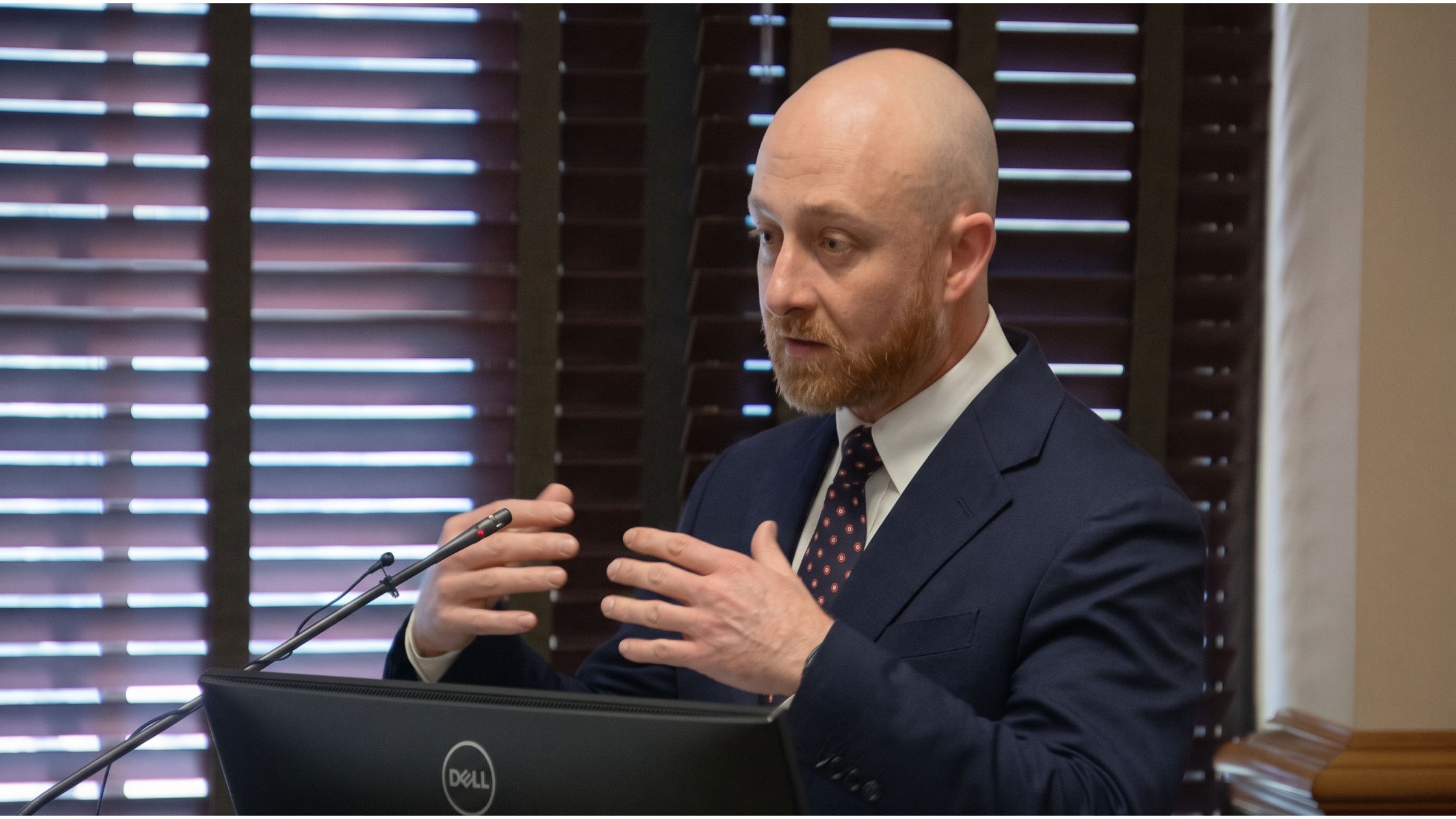
Luke Ihnen (00:00):
... justice to transfer this case. Your Honor, as we've argued in our filing, certainly the first requirement was met. This court determined that it did not have subject matter jurisdiction at the time, and it transferred to the Tennessee Supreme Court. The Tennessee Supreme Court, as we put in our filing, has reminded us that it is not a court of original jurisdiction.
Chancellor I'Ashea L. Myles (00:19):
And if I remember, when you all were here on the motion to dismiss, we had a very robust conversation about whether or not the Supreme Court was a court of original jurisdiction. And when the court looked at the 12 (4)(E), I remember that discussion and the court's thoughts that there was perhaps not the proper procedure in order to get a case as Ms. Pike's to the Supreme Court for the new implication of 12 (4)(E). Do you recall that?
Luke Ihnen (01:00):
That's correct, Your Honor.
Chancellor I'Ashea L. Myles (01:02):
And so I sent the case anyway versus dismissing it.
Luke Ihnen (01:05):
That's right, Your Honor.
Chancellor I'Ashea L. Myles (01:07):
And then I frankly didn't hear anything else until I received your motion. So it's the court's understanding from just looking at the procedural timeline that the Supreme Court in fact dismissed the case?
Luke Ihnen (01:24):
Yes, Your Honor. If we could just back up for a second. I believe part of the argument we had on that original motion was the plaintiff's confusion over how the rule applied, whether it applied, when it applied. And to be frank, Your Honor, I'm not sure that the Tennessee Supreme Court order denying Ms. Pike's relief on her Rule 12 motion clarifies that any further. But turning back to... And to answer Your Honor's question, so the Tennessee Supreme Court dismissed that case without prejudice to filing a Rule 12 motion, which Ms. Pike did. And as we put in our pleadings, as we were briefing this matter before the United States Supreme Court prior to her execution, the state repeatedly reiterated that that type of relief, the Rule 12 motion was interlocutory in nature. It was limited to the stay posture, the stay of execution, and that the trial matter remained pending in this court. And so I think-
Chancellor I'Ashea L. Myles (02:27):
But didn't the Supreme Court actually dismiss the transferred case? And this frankly came a bit of a surprise to the court. It appears that on or about May 12th, 2026, the Supreme Court dismissed the case. And so that's where the court is kind of... Who has jurisdiction at this point? Is this a Rule 60.025 kind of discussion that we need to have or procedurally, where are we?
Luke Ihnen (03:09):
I think, and Your Honor's right. Again, when the state was briefing that issue at the United States Supreme Court, the argument that they were making were a surprise to us as well.
Chancellor I'Ashea L. Myles (03:20):
They said that the case was still open down here, isn't it?
Luke Ihnen (03:23):
That's correct, Your Honor. Multiple times as we put in our briefing. And so I think that there are multiple ways that this court can maintain jurisdiction over this case. We've argued that both requirements of the transfer statute aren't met. And there was a case that I cited in my brief, I believe it was the Auten case, A-U-T-E-N.
Chancellor I'Ashea L. Myles (03:41):
I read it.
Luke Ihnen (03:43):
I don't have that cite in front of me, but the Supreme Court actually in that case remanded an improperly transferred case back to the trial court. That of course did not happen here, but I think the posture of the case is similar. Also, as we briefed in our motion, the statute 161102 allows this court, and I'm looking at part six to control its process and orders. I think the case that was closed on the Chancery Court docket administratively could certainly be reopened under your equitable powers. And then I think we can look at Rule 6002.5. I've got that here as a motion to reconsider. Sorry, Your Honor.
Chancellor I'Ashea L. Myles (04:34):
That's okay.
Luke Ihnen (04:43):
And I'm looking at, this is Bidow Killion versus Tennessee Department of Human Services, 845 Southwest 2nd 212. This is a Tennessee Supreme Court case from 1992. "The purpose of Tennessee Rule of Civil Procedure 60 is to alleviate the effect of an oppressive or onerous final judgment." Another case, Tennessee Court of Appeals, Whitaker versus Whirlpool Corporation, 32 Southwest 3D 222. It's a year 2000 case. "Although the purpose of Tennessee Rule of Civil Procedure 60 is to alleviate the effect of an oppressive or onerous final judgment, the rule is equally aimed at striking a balance between the competing interests of justice and finality." And then the Zeitlin case, this is a Tennessee Court of Appeals case from 1976. The cite for that, Your Honor, is 544 Southwest 2D103. "Tennessee Rule of Civil Procedure 60 affords relief from judgments which have actually been entered and does not provide entry of a judgment which was not entered."
(05:47)
I think again, Your Honor, there are multiple bases that this court could exercise jurisdiction over the case. Pennington versus Pennington, "The court has the authority to correct an error of oversight or omission at any time on its own initiative or own motion. The Tennessee Rule of Civil Procedure 60.025 is to be invoked in cases of overwhelming importance or those involving extraordinary circumstances or extreme hardship." That's-
Chancellor I'Ashea L. Myles (06:18):
Would you contend that this is one of those cases that the court should rely upon 60.025 to reopen this case?
Luke Ihnen (06:26):
Yes, Your Honor. I think this is a fairly straightforward motion that we've presented to the court to preserve evidence. Obviously our audience and the interest that this case has drawn is because of the extraordinary circumstances surrounding that motion for preservation of evidence. And again, that case, Your Honor, was Underwood versus Zurich, 854 Southwest 2D94. And just one more, Your Honor. "Tennessee Rule of Civil Procedure 60.025 is, as a general rule, applicable to situations that are not covered by other clauses in that rule or to cases of extreme hardship." And that's Duncan versus Duncan.
(07:05)
So as we briefed in our supplemental briefing, we believe that the court retains jurisdiction. We believe that there are multiple... If the court itself does not believe that the transfer statute itself confers jurisdiction, then we believe that the motion can be construed under rule 60. There are multiple ways that this court retains jurisdiction. And the state, as I said multiple times in their filings, has stipulated that this court has jurisdiction over this case.
Chancellor I'Ashea L. Myles (07:36):
Okay. You also touched point on restraining order that if the court did not find that it had jurisdiction over the prior case, I could perhaps construe your emergency motion as a motion for a restraining order. Are you walking away from that argument or is that still-
Luke Ihnen (07:53):
No, Your Honor. I think that's true. If the court could not find jurisdiction independently based on either the transfer statute, based on Rule 60, I do believe that this court using its equitable powers can construe that motion as a motion for temporary restraining order. The requirements for that pursuant to the local rule have been satisfied. We're obviously here today hearing this matter. The state has received notice of that.
Chancellor I'Ashea L. Myles (08:22):
What about the verification of the complaint that would be required pursuant to Rule 65.03?
Luke Ihnen (08:29):
So two answers to that. First, Your Honor, there was a verified complaint submitted originally here in January. Part of the issue that we are facing is up until yesterday, our client was unconscious, unable to communicate with counsel, unable to communicate with her medical providers. And without her consent, we are not able to bring a new lawsuit. And so Ms. Pike, as it's been widely reported, regained consciousness yesterday and is speaking limitedly. And so obviously I think the original complaint stands, but we have not been authorized by our client to pursue a new cause of action.
Chancellor I'Ashea L. Myles (09:15):
Okay. So I am looking at the original complaint here and I was looking for the verification and perhaps I am missing it in one of the exhibits. Would you point the court to where it's verified? And it could just be that I missed it.
Luke Ihnen (09:36):
I'm not sure that it contains that specific language, Your Honor.
Chancellor I'Ashea L. Myles (09:40):
Okay. All right. Thank you. I'll hear from the state.
Will Ayers (09:51):
Good morning, Your Honor. Will Ayers here for the state of Tennessee.
Chancellor I'Ashea L. Myles (09:54):
Good morning, Mr. Ayers. Do you contend that I have jurisdiction? I've read your briefing before the United States Supreme Court. I have read the dismissal order from the Supreme Court, frankly, that I did not know was in existence. So is it your position, and I read your papers in response, is it your contention that this court retains jurisdiction of this matter?
Will Ayers (10:22):
The state's position has been and continues to be that this case is still pending before this court. While it does appear closed on the docket, we are in a bit of an unusual procedural position here.
Chancellor I'Ashea L. Myles (10:36):
We are.
Will Ayers (10:38):
And just to address some of the points the court was asking about earlier, if we go back to the history of this case, when this court transferred to the Supreme Court, the court concluded that it lacked jurisdiction because the action itself needed to be filed in the Supreme Court under Rule 12 (4)(E).
Chancellor I'Ashea L. Myles (10:57):
And that was a brand new rule that did not have the normal comment period for the bar. And so it was a new rule, kind of a new procedure. And this was the first case since that new rule was changed back in December. This case was filed in January, isn't that correct?
Will Ayers (11:16):
That is correct, Your Honor. The rule was amended in December of last year. And as far as I'm aware, this was the first case that implicated that rule.
Chancellor I'Ashea L. Myles (11:24):
And if the court looks at the plain language of the rule, said, "After a date of execution is set, any state court collateral litigation that will potentially affect the method or timing of execution must commence with a filing of a motion in this court," meaning the Supreme Court. And so when this court listened to your arguments on your motion to dismiss, it was the state's position that this court did not have jurisdiction and that the case should be dismissed. And so is it the court's understanding that when you all made that argument, that was an erroneous argument because dismissal is what you all requested from this court?
Will Ayers (12:17):
Yes, that was requested in so far as the court lacked jurisdiction to issue injunctive relief that would've implicated the Tennessee Supreme Court's execution order. The state did not take the position that there was no jurisdiction to entertain declaratory relief. And so the state's position as to dismissal was related to the interplay between the Tennessee Supreme Court's execution order and Rule 12 (4)(E), which as the court later clarified, is designed to facilitate this kind of collateral litigation by allowing a plaintiff to file a motion in the Tennessee Supreme Court for stay of execution and if necessary, a special master to conduct factual findings, which of course is what wound up happening. And a special master was appointed. The hearing was held in August and then the Tennessee Supreme Court later denied relief, denied a stay, and the execution went forward. But the state's position is consistent today that the court did lack jurisdiction to issue any injunctive relief with respect to that impending execution that would've affected the method or timing of that execution.
(13:31)
And as the Tennessee Supreme Court made clear in Black versus Strada last year, that's impermissible. And so what 12(4)(E) is designed to do is allow a plaintiff to get a stay of execution so that they can pursue litigation in a court like this one. And the state's position has been consistent throughout this litigation that because this court never entered an order of dismissal following the transfer, the case remained live. Now it is true that the Tennessee Supreme Court said in its order of May 12th that with respect to the transfer, when the court concluded that it lacked jurisdiction, dismissal was the appropriate option.
Chancellor I'Ashea L. Myles (14:13):
So did the Supreme Court though have the authority, subject matter jurisdiction to actually dismiss the case in toto? Because this court did dismiss the case. This court transferred the case, closed it, dismissed it, said it was done and well, transferred it rather because I found that dismissal was a harsh sanction. So I didn't want to foreclose the door altogether. So why didn't the Supreme Court, when they felt that they did not have jurisdiction or it wasn't a proper transfer, why didn't they just send it back? They didn't remand it to this court. So this court closed the case and now we're here.
Will Ayers (14:55):
Reading the Supreme Court's order, Your Honor, in the context of the attempted transfer, the court stated that the transfer was not appropriate, which by the way is why the transfer statute does not apply here. But as to the transfer, they concluded that as a court of appellate jurisdiction only, they could not hear the complaint because it wasn't the equivalent of a Rule 12(4)(E) motion. It lacked the requisite motion for a stay. And so the transfer was dismissed, but-
Chancellor I'Ashea L. Myles (15:29):
But did they have the ability to, if they're not a court of original jurisdiction, did they have the ability to dismiss the transfer action or should they have vacated it and remanded it back to this court is the court's question.
Will Ayers (15:45):
That part of the Supreme Court's order was rather short and they did not elaborate further on their reasoning. So I cannot speak for the Supreme Court on that point other than to say that when an appellate court does find that it lacks jurisdiction to entertain an action, generally dismissal is the only option available to it.
Chancellor I'Ashea L. Myles (16:06):
It's your contention standing here today that this is a live case and do you believe that Rule 60.025 should apply? Where do you stand on that?
Will Ayers (16:22):
Rule 60.02 does not apply because that rule provides for relief from a judgment and there's been no judgment entered in this case. So the rule, just based on its plain text, does not apply. We also cited a case for that proposition in our briefing. So Rule 60 does not apply. As Your Honor has noted, this cannot be construed as a motion for a TRO because there is no verified complaint filed. In addition, Rule 60 is designed for relief from judgments and it's unclear how a discovery motion, which is targeted at a preservation of evidence could be related to a judgment. Typically, a party on a Rule 60 motion is arguing that there is some kind of error in the court's reasoning that led to the judgment and that should be set aside for some reason. That's not been the argument here. The argument and the relief sought is for preservation of evidence.
(17:17)
Now I do want to bring to the court's attention the issue of justiciability, the fact that the claims that were pleaded in this action are now stale because all the claims and all of the requests for relief were aimed at the attempted execution on September 30th.
Chancellor I'Ashea L. Myles (17:34):
But if this court retains jurisdiction, this court could enter a scheduling order giving the plaintiff time to amend her complaint and bring new claims perhaps. And if we're going to retain jurisdiction and revive this case, could not the court in its equitable powers and seeing as how there has not been a scheduling order, frankly, nothing has been done with this case, could not the petitioner add different claims, should she so choose?
Will Ayers (18:08):
That's possible, Your Honor. But as we stand here today, no request to supplement or amend the pleadings has been submitted to this court.
Chancellor I'Ashea L. Myles (18:15):
But we're here on an emergency motion. We're not really here on the substance of the matter. We're here in what I remember from practice as a preservation of evidence letter, which is what we would typically send to opposing counsel asking them to preserve all of the documentation and all of the proof as the case gets ready to be litigated. So we're not really here on any other matter, isn't that correct?
Will Ayers (18:43):
That's correct, Your Honor. But the motion is targeted at evidence and it has not explained why this evidence would be relevant to any claim pending. There's been no effort to explain even what an amendment might look like that could establish some claims, some underlying claims to which a discovery request could be directed. I'll also direct the court's attention to the fact that no discovery requests have been served here that could serve as the basis for this court to make an order to preserve evidence.
Chancellor I'Ashea L. Myles (19:14):
But isn't that kind of an untenable position as we stand today? Ms. Pike was set to have been executed on September 30th. You all came here on a motion to dismiss. The court transferred the case. The Supreme Court had its motion practice and its case there in regards to the execution. They did not stay the execution. September 30th came, you all went to the United States Supreme Court and we are here improvidently at this point in time. And so is it really fair to say to the petitioner, "Well, you haven't moved on your underlying action," when the petitioner was focused on what... I don't want to put words in her mouth, but there was something that was more pressing than discovery in an underlying case. So can you really stand before the court and say, "Well, the petitioner hasn't asked for any discovery"?
Will Ayers (20:23):
The state's position is, as stated in our briefing, that discovery is governed by the rules of civil procedure and those rules must be followed.
Chancellor I'Ashea L. Myles (20:32):
All right. It's also your position that some federal court litigation would govern the state's court's ruling on this matter. Isn't that correct? Why don't you talk with me about that?
Will Ayers (20:43):
So the state's position is that the King Middlebrooks preservation order, which was filed as an exhibit to our response, unquestionably governs most, if not all of the requested evidence to be preserved. The parties met and conferred on this issue yesterday before the state filed its response in an effort to try to come to an agreement, narrow down some of these categories of evidence. And the state stated to Ms. Pike's counsel, as it stated in the briefing, that the state believes that these orders are to be construed broadly by their own terms and they direct TDOC to preserve all evidence, including several listed subcategories of evidence.
Chancellor I'Ashea L. Myles (21:28):
But isn't that federal court litigation and this is state court litigation? So can the court adopt basically a secondary source that it would not adopt in regular jurisprudence to rely on for its orders? Can the court really take a federal order and apply it to the state court litigation? Or does this case need its own order?
Will Ayers (21:53):
This case does not need its own order. Again, Your Honor, because the evidence is the evidence. It must be preserved under that order regardless of what other litigation comes in the future. And in fact, that's why the order is written the way it is, to specifically contemplate future litigation. And I can give the court a brief status update about efforts to preserve evidence so far, if that would put the court's mind at ease.
Chancellor I'Ashea L. Myles (22:19):
Well, so again, when I set this matter, it was for the narrow issue of jurisdiction. So let's get through that. And then if Mr. Ihnen is prepared to get into the substantive argument about the emergency motion, then we can do that. But let me hear from him. Thank you for your argument on jurisdiction and I'll hear from Mr. Ihnen and then we'll see where we go.
Luke Ihnen (22:48):
Thank you, Your Honor. I think you were hitting on something with my friend here. The conversation that we had in January [inaudible 00:22:59]. But after reexamining the transfer statute, after looking at Rule 60, we do believe that this court either retains jurisdiction or has independent bases for exercising jurisdiction. And as Your Honor pointed out, certainly an amendment to the complaint can be made. I think it's also important to make sure that we have not asked the state to produce anything. We have not made a discovery request. We are asking the state to preserve evidence of Ms. Pike's botched execution. That's the limited issue before the court.
Chancellor I'Ashea L. Myles (23:50):
Okay. So are you ready to get into the merits of that or is that the argument?
Luke Ihnen (23:54):
I can, Your Honor.
Chancellor I'Ashea L. Myles (23:55):
Okay. So as a procedural matter, since the state concedes that...
Chancellor I'Ashea L. Myles (24:00):
[inaudible 00:24:00].
Luke Ihnen (24:35):
On this case. So this includes, and then a definition, that may be relevant to this litigation as currently pled, or that may be relevant to future litigation regarding Tennessee's protocols, procedures, and processes for executing persons sentenced to death. The state is apparently interpreting the court's language, future litigation, to mean any future litigation brought by any plaintiff in the state. That is certainly not how federal court orders apply to state courts.
(26:18)
I also wanted to address some of the state's arguments about rule 26. Again, rule 26 applies to discovery. We have not asked the state to turn over any evidence. We have not had any discussions about relevance. We are asking the state to preserve anything that it has related to Ms. Pike's botched executions. Furthermore, the Tennessee Rules of Civil Procedure don't apply in federal litigation. And one of the contentions that the state makes in their response is that the preservation order that we are seeking from this court is actually narrower than the order in the federal court, which sort of begs the question why they're opposing it so much.
(27:03)
One of the other arguments that the state makes in their response is that the evidence that we are requesting to be preserved, again, not disclosed, not turned over, but that the evidence that we are requesting be preserved is not, quote, "probative of any claim or relief sought in this litigation." And first of all, I'd like to say that Tennessee Rules of Civil Procedure rule eight clearly contemplates notice pleading. We're a notice pleading state. Rule 8.06 says that pleadings are construed to do substantial justice.
(27:38)
And West v. Schofield, which is a case that the state cites regularly in these matters, and Your Honor, the cite for West v. Schofield, you may have it memorized by now, but just in case the cite... [inaudible 00:27:57] And I'm looking on page 125 of that opinion, Your Honor. This court, talking about the Tennessee Supreme Court, has recognized that the subject matter of a case, quote, "is not limited to the merits of the case because a variety of fact oriented issues may arise during litigation that are not related to the merits." And so even the case that the State of Tennessee relies on to say that this evidence isn't relevant, which again, we're not at that point yet, says that cases change over time. And that also complies with common sense.
(28:41)
Your Honor, I'd like to go through the complaint that we filed in this case because I think the state is wrong that the requests that we've made are not related to any claims that were pled in that complaint. First of all, on page eight, paragraph 17, the new protocol is 44 pages compared to the previous 106 page protocol. On page 10, paragraph 28, the selection criteria for the members of the execution team are vague, subjective, and secretive. Next paragraph. The selection criteria... trained non-department personnel are vague, subjective, secretive.
(29:25)
Paragraph 31. The new protocol allows for the placement of a quote, "central line. However, upon information and belief, the defendants do not have the medical personnel or equipment and cannot secure the same in order to place a central line." On page 12, this is paragraph 40. "The use of pentobarbital in lethal injections causes flash acute pulmonary edema as it enters the bloodstream and passes through the lungs and burns the membranes of the lungs. The drowning sensation is one of the most powerful excruciating feelings known to man.
(29:59)
Paragraph 41. The injection of pentobarbital itself can cause extreme pain upon injection. It can also, quote, "damage the veins in the body causing the drug to leak into the surrounding tissues causing significant excruciating pain." Paragraph 42. Pentobarbital is a barbiturate that causes unresponsiveness but not unconsciousness. As a result, even if a prisoner appears drowsy upon injection of the pentobarbital, they're sharply awakened with the sensation of drowning and are very likely conscious and being tortured as they are executed.
(30:31)
On page 15, paragraph 58, the plaintiff, referring to Ms. Pike, has a history of difficulty with blood draws and needle insertion. Prison medical staff often use a butterfly needle on her arm to draw blood because her veins are so difficult to access. The plaintiff's physical characteristics will make it significantly more difficult to achieve and/or maintain... [inaudible 00:31:59] difficulty with blood draws and needle insertion. Prison medical staff often use a butterfly needle on her arm. The new protocol does not provide for medical staff, this is paragraph 78, to achieve and/or maintain peripheral IV access.
(32:14)
And count one of that complaint, looking at, this is page 20, paragraph 83, the new protocol is unconstitutional in the way that it would be applied to the plaintiff, again, this is Ms. Pike, because of her serious medical conditions, including but not limited to thrombocytopenia, thrombocytosis, bipolar disorder, post-traumatic stress disorder, hyperlipidemia, and small veins that make insertion of a needle difficult.
(32:43)
Your Honor, this complaint was filed in January. Certainly as based on publicly available information about what happened during the execution, based on what we know about Ms. Pike's current condition, these allegations that were made in the complaint certainly appear to be at least related to the botched execution.
(33:07)
In the response, it also says that Ms. Pike makes no allegation, presumably in our motion to preserve evidence, that she is under threat of, quote, "imminent execution." That's their word, imminent. Imminent does not preclude future execution. The state has made no promises that Ms. Pike will not be subject to a future execution. And the evidence that we are seeking to preserve now is relevant for any future challenge that she makes. Because as we pled in January, the same thing is likely to happen. The state also makes some reference to private hospital records. Clearly TDOC cannot preserve records it does not have. We're simply asking them to preserve what they do.
(33:57)
I believe the state has expressed some frustration about the overly broad requests that we've made. But to be completely honest, we are frustrated that the information that the state has is repeatedly and deliberately secreted away pursuant to execution secrecy statutes, pursuant to the whims of the Department of Corrections, and which attorney is arguing the case. We don't know what they have because they won't tell us. And so the preservation order seeks the broadest possible preservation of evidence.
(34:47)
Well, I'll go ahead and say a couple more things. One of the requests we made was for inspection of the, this is in part B of exhibit three, sub- part B, was for inspection of any residue of the chemicals. I will say Mr. Ayers and I spoke yesterday. We've had discussions about that process. If the court does not want to rule on that matter today, I would ask that you reset this for a status, perhaps a teleconference, just to get an update from the parties on where that is.
(35:25)
There's also an issue of access to Ms. Pike. Members of Ms. Pike's legal team were able to see her yesterday after a more than two and a half hour wait. TDOC continues to put up roadblocks for not only the providers at the hospital, but for counsel. And so we would ask for an order granting continuous liberal access to Ms. Pike subject to scheduling restrictions imposed by the hospital that she's being held at. Another issue, Ms. Pike has no way to contact counsel. And so we would request that that obligation, that access to Ms. Pike, allows her phone access.
(36:08)
Two more things, Your Honor, and then I'll be finished. We would also request that this court enter an order that the Tennessee Department of Corrections must notify counsel for the plaintiff 48 hours before Ms. Pike is transferred from the private hospital she's currently at to any state hospital, state facility, or otherwise. And then as has been reported, Ms. Pike is shackled to the bed. Based on our understanding, medical staff have asked that the shackles be removed, and have been denied that request by TDOC. So we would also amend our request to ask for that relief.
Chancellor I'Ashea L. Myles (36:45):
A couple of questions that I have for you. So when Ms. Pike was incarcerated, what was your access to her then?
Luke Ihnen (36:55):
So Ms. Pike was incarcerated at the Debra Johnson Rehabilitation Center, that's the Tennessee Prison for Women. Counsel would regularly request visits with Ms. Pike. That process would go through the warden. Yesterday afternoon, after repeated attempts to contact Mr. Ayers and his office, we were finally told that we could try to schedule visits with Warden Nelson, who's the warden at the men's prison where Ms. Pike's attempted execution took place.
Chancellor I'Ashea L. Myles (37:26):
Is there a reason that the warden at the women's prison does not have control over this at this point?
Luke Ihnen (37:33):
Your guess is as good as mine, Your Honor. Again, that's more information that we have not been provided. And counsel was actually waiting in the lobby of the hospital for two and a half hours before that visit was approved. And so again, yes, we were able to see Ms. Pike, but there are still obstacles being put in our way for that.
Chancellor I'Ashea L. Myles (37:53):
So what is the normal turnaround? So you make a request to see your client, and then what?
Luke Ihnen (37:59):
Within an hour usually.
Chancellor I'Ashea L. Myles (38:05):
And are those in-person visits or are those virtual?
Luke Ihnen (38:08):
In-person contact visits at the women's prison, yes.
Chancellor I'Ashea L. Myles (38:23):
And how was that access normally granted? Was it a phone call, email? You have to educate the court on what the normal process is.
Luke Ihnen (38:30):
So there's a scheduler at the Tennessee Prison for Women. That request goes to the scheduler. And then, again, there's a little bit of secrecy behind what that process looks like, but the warden I think ultimately makes... That request is sent to the warden of the Tennessee Prison for Women who grants the request.
Chancellor I'Ashea L. Myles (38:49):
And what is the warden at the women's prison? What is her name?
Luke Ihnen (38:52):
It's a man. His last name-
Chancellor I'Ashea L. Myles (38:53):
Sorry. Excuse me.
Luke Ihnen (38:53):
... is Jordan...
Chancellor I'Ashea L. Myles (38:56):
Sorry.
Luke Ihnen (38:57):
I'm sorry. I don't have that on my fingertips.
Chancellor I'Ashea L. Myles (38:59):
But it's the same warden that has been there for...
Luke Ihnen (39:04):
Jordan Clark. Sorry, Your Honor.
Chancellor I'Ashea L. Myles (39:05):
Mr. Clark. Okay.
Luke Ihnen (39:09):
Yeah.
Chancellor I'Ashea L. Myles (39:10):
Okay. All right. Okay. And typically, would Ms. Pike have had access to a phone unfettered or would there have been phone calls at designated times? Kind of walk the court through what that looked like.
Luke Ihnen (39:34):
So Ms. Pike has a, this is prior to her current situation, would've had a tablet, which she could contact friends, family, attorneys. We could also schedule legal calls separate from that. The communications over the tablet are usually monitored. And so currently she has access to neither of those options.
Chancellor I'Ashea L. Myles (39:57):
Is she able to utilize a tablet if the court were to, say, give her the tablet?
Luke Ihnen (40:05):
We're not sure about that right now, Your Honor.
Chancellor I'Ashea L. Myles (40:09):
And then the phone calls, were those at set times when she was incarcerated?
Luke Ihnen (40:15):
We would schedule those, yes.
Chancellor I'Ashea L. Myles (40:18):
And you would schedule those with the scheduler?
Luke Ihnen (40:20):
Yes, Your Honor.
Chancellor I'Ashea L. Myles (40:20):
Okay. Is there anything else?
Luke Ihnen (40:30):
No, Your Honor.
Chancellor I'Ashea L. Myles (40:30):
Okay. Thank you. Mr. Ayers. The nature of the claim now that the claims are no longer justiciable. And I would like to understand that a little bit more. When I look at the prayer for relief, she is seeking declaratory relief in regards to the protocol, contingency plans, isolation periods, equal protection of the law. So help me understand why you believe that these claims are no longer justiciable.
Will Ayers (41:29):
The reason, Your Honor, is because all of the prayers for relief were directed at an event that is now in the past. A person cannot be executed in this state without an order of the Tennessee Supreme Court. There is no pending execution order for Ms. Pike. There is no allegation that one is coming. And so given that all of these requests for relief are targeted at a past event that has come and gone, there is no relief to grant.
Chancellor I'Ashea L. Myles (41:59):
You have a case... Because, so when cases are filed, they are usually based on an event and they ask for things in relation to a past event. Why is this case any different than that? If someone is involved in a contract dispute, a breach of contract that happened on date X, they come to court later to discuss relief for a contract that was breached in the past. And those matters are still justiciable. So why would these claims not be justiciable simply because the execution date has passed?
Will Ayers (42:40):
Because of the nature of the relief requested. The nature of the relief requested was for an injunction against applying the protocol to Ms. Pike. The relief request was also to declare the protocol unconstitutional as applied to Ms. Pike. And without a pending execution order, at least as we stand here today, there's no showing that Ms. Pike is subject to execution again.
Chancellor I'Ashea L. Myles (43:08):
So is the state's position that the state is not going to revive an order? I understand that all executions have been suspended for now. Is that going to be permanent? Or is the state prepared to take the position that Ms. Pike will not be rescheduled? And if you cannot answer that question, this court understands, but you are asking the court... Go ahead.
Will Ayers (43:38):
No, I can't answer that question, Your Honor. I'm not in a position to.
Chancellor I'Ashea L. Myles (43:41):
Okay. But you're also not in the position to say that tomorrow a new execution order will not be presented. Is that correct?
Will Ayers (43:50):
Your Honor, that is within the purview of the Tennessee Supreme Court.
Chancellor I'Ashea L. Myles (43:53):
Okay. All right. Okay. You may proceed.
Will Ayers (43:58):
So if we can zoom out and look at the big picture for a moment, the parties are engaged in a collaborative process that governs what kind of evidence is going to be preserved. We are working together to ensure that counsel for Ms. Pike is able to get the evidence that they believe they're entitled to. TDOC has been instructed to preserve the evidence that's covered in the King Middlebrooks order, and we have invited counsel for Ms. Pike. If there's anything that they believe that is not covered in that order, please let us know and we can pass that along.
Chancellor I'Ashea L. Myles (44:37):
But Ms. Pike is not a party to the federal case, correct? So how could Ms. Pike access information or preserve information that is unique to her situation in a case about another incarcerated individual?
Will Ayers (44:53):
Yes. Your Honor, our position is not that this federal court order boxes this court out or impairs Ms. Pike's ability to discover evidence in her own litigation. That's going to depend on the nature of her amended or supplemented claims, and what kind of discovery request she decides to serve in the future. Right now, all we're talking about is the preservation of physical evidence, and that is required by the King Middlebrooks order. It's also being preserved by TDOC.
(45:25)
And so again, the issue before the court here is relatively narrow today. It's not necessarily what evidence might be discoverable, whether Ms. Pike might be able to obtain that evidence in future litigation, whether that's in this case or another case. The question is just whether is the evidence being preserved, and under the existing King Middlebrooks order, it must be. And again, we've conferred with counsel to state that if you are concerned about any evidence that you believe may not be preserved, please let us know. We will make efforts to ensure TDOC preserves that evidence.
Chancellor I'Ashea L. Myles (46:02):
Well, but efforts are different than an order from a court, right? So efforts to preserve and a court order requiring one to preserve are fundamentally different, are they not?
Will Ayers (46:12):
Yes. And TDOC is subject to that court order. Now, Ms. Pike is correct that she is not a plaintiff to that matter, but she doesn't need to be a plaintiff to that matter for TDOC to be subject to that order, which it unquestionably is. And as Mr. Ihnen mentioned, counsel are discussing a possible mechanism by which we might have evidence tested by agreement. And that goes to the second item B at the very end of their exhibit three to their motion.
(46:43)
And so again, this is a collaborative process. This has just begun. The parties have just started discussions on this. And so as we stated in the briefing, it would be premature for the court to enter this order now when the parties are working together, when evidence is being preserved, when TDOC is subject to an existing federal court order.
(47:07)
Now, if I can pivot to the matter of access, because this is another issue that counsel had been discussing in an effort to resolve this issue. As Mr. Ihnen stated, it's our understanding that counsel for Ms. Pike were able to visit her yesterday. There is now a mechanism to request visitation.
Chancellor I'Ashea L. Myles (47:27):
And what is that mechanism?
Will Ayers (47:29):
To email the warden.
Chancellor I'Ashea L. Myles (47:31):
Email Mr. Clark, or is it Mr. Nielsen?
Will Ayers (47:35):
It's Warden Nelson.
Chancellor I'Ashea L. Myles (47:37):
Okay. And why the change from Mr. Clark versus Mr. Nelson?
Will Ayers (47:42):
I don't know the exact answer to that, Your Honor. What I can say is that, because Ms. Pike is in a private medical facility, a new process had to be set up that would guarantee her security, the security of others, that would take that facility's needs and interests into account. And so if the process is different from-
Will Ayers (48:00):
... account. And so if the process is different from how it usually works, there are good reasons for that.
Chancellor I'Ashea L. Myles (48:08):
So you were explaining the process.
Will Ayers (48:10):
Yes.
Chancellor I'Ashea L. Myles (48:10):
You email Mr. Nelson, and then what happens after that?
Will Ayers (48:15):
And then the warden will consider the request and approve it according to the same policies that would apply normally.
Chancellor I'Ashea L. Myles (48:23):
And what are those policies?
Will Ayers (48:25):
TDOC has policies on visitation generally. There are also policies that govern visitation in outside facilities, because inmates do from time to time have to go to a hospital. So there are specific policies that govern that as well. It's our understanding that Mr. Ihnen and another attorney have requested a visit for later this afternoon. I believe that request was made late this morning. And Mr. Ihnen may have an update on that. All I know is that the request has been made at this juncture.
Chancellor I'Ashea L. Myles (48:59):
And typically how long does it take the warden to respond to a request for visitation [inaudible 00:49:05]?
Will Ayers (49:05):
I don't know the answer to that, Your Honor.
Chancellor I'Ashea L. Myles (49:09):
Okay.
Will Ayers (49:12):
A couple of other things in the way of the current status, because this is an evolving situation. TDOC has advised us that evidence, physical evidence was collected from the execution chamber on the night of September 30th and has been logged into a preservation room. Among the things collected are log books, observation logs, medical waste and products, EKG readouts. I will say there may be some equipment that the plaintiffs are seeking in this motion that may not be in TDOC's possession. Specifically, it's my understanding that the IV lines were cut, and so there may be portions of those IV lines that could have been still attached to Ms. Pike when she was transported to the hospital.
(50:11)
And I say that just to draw the court's attention to the issue we raised in our briefing, that TDOC can't be ordered to preserve evidence that's in the custody of another party. And so there may be items that were originally in TDOC's custody that got transported to the hospital on the night of September 30th. Again, counsel can confer on that and establish where that evidence is, but it would be premature and prejudicial, quite frankly, to enter an order requiring preservation of that kind of evidence before counsel had a chance to confer on it and get a picture of where that evidence might be. Now, as I stated earlier, the parties have tried to come to an agreement to try to narrow these issues down, and we put in our briefing the specific categories that we believe are covered that TDOC must preserve. And there are a couple, though, that I want to bring to the court's attention that are problematic.
(51:24)
If the court were to enter the order as requested, it could do a number of things. It could require TDOC to preserve evidence that's in the custody of non-parties, as we've been discussing. In particular, I'd point the court to item C on exhibit 3 to the motion, which asks for biological and chemical residue associated with the execution process. There is a question about what this means, what biological and chemical residue means. We attempted to resolve that in our conference yesterday. We still don't have a clear answer as to what the evidence specifically is being targeted here and whether or not that would be residue that would've been created or preserved before, during, or after the execution attempt or whether that occurred at a TDOC facility or at a private medical facility. So again, in the interest of avoiding implicating a non-party's interest here, we'd ask the court to give the parties time to confer about these issues. And as Ms. Serenan suggested, perhaps a status conference would be a good way to do that.
(52:36)
I'll also point the court to item G. This is also in exhibit 3. It requests any medical charts, records, et cetera, before, during, and after the attempted execution. So again, this appears to be targeted at evidence that could have been created and is in the custody of the medical facility where Ms. Pike is. That medical facility is not party to this action. There's been no attempt that I'm aware of to direct that facility to preserve that evidence. And it's important the court understand that TDOC has no ability to exert control over that kind of evidence.
(53:15)
There are other requests that are just vague and difficult to understand and interpret. For example, item I refers to the complete execution chamber and all associated areas. It's unclear what associated areas means. There are a number of rooms in that part of Riverbend. Again, we attempted to confer on this yesterday, but it just wasn't clear what associated areas are contemplated here, and whether the expectation is that TDOC seal off those areas and not allow anybody to enter, which would be highly prejudicial and impractical. It also contradicts other requests for relief, because if TDOC is to preserve evidence and collect medical waste, for example, out of the execution chamber, that would necessarily change the condition of the execution chamber. And so one could theoretically freeze the execution chamber in amber or collect evidence out of the execution chamber, but not both.
Chancellor I'Ashea L. Myles (54:18):
Well, could you not document what was in the chamber prior to preserving the evidence so that there's documentation and pictures and logs, perhaps, and if a table is moved from point A to point B, a documentation of where the table was at the end to where it is now. So there is a way to, in essence, preserve and still collect, is there not?
Will Ayers (54:47):
Oh yes, Your Honor. And in fact, TDOC has taken pictures of the chamber as it was on that night. But the point being that the request as written is contradictory and difficult to interpret. Again, our hope is that, through a collaborative process, this can be resolved so that we can find out, are you looking for pictures? Would that suffice? Are there specific elements you don't want moved? Are there specific elements you're not so concerned about? The way the discovery process is supposed to work is a party serves a preservation demand and then sues, and then there's discovery. And if there's spoliation, if evidence is not preserved, then there can be a motion for sanctions. We're a long way from that here. We're just talking about a preservation request. The evidence is being preserved. It must be preserved. And so, as we stated in the briefing, the court's order would largely be advisory because it's directed at things the parties are already doing.
(55:55)
Now, there are also requests that are legally improper for the reasons we laid out in our briefing. The demand that TDOC produce the samples immediately, I think has been resolved. I believe Mr. Ihnen said that, accurately, the parties are conferring on this, so there is no need to order immediate production of evidence for testing. As for the other three requests that were just presented for the first time before this court, without any legal basis, the State can't engage on that. To grant relief on those requests would be completely improper.
Chancellor I'Ashea L. Myles (56:34):
As far as the access to their client that they normally would've had if she was at the women's prison, the ability for her to contact counsel and...
Will Ayers (56:54):
And I believe there's-
Chancellor I'Ashea L. Myles (56:55):
... 48 hour notice prior to transfer.
Will Ayers (56:57):
Yes. Yes. Those three requests were not advanced in the motion. This is the first we're hearing of it. Again, TDOC is committed to a collaborative process, but it can't respond to requests that are advanced for the very first time in a court hearing.
Chancellor I'Ashea L. Myles (57:13):
But why would the access... So it's the court's understanding that she perhaps is able to communicate now and perhaps she was not prior to, but the court struggles... If counsel was able to talk with their client while she was incarcerated, why would they not be able to talk with her when she is at a hospital? Frankly, the court does not understand that. And frankly also, the court doesn't understand why the State would take a contrary position to allowing counsel to confer with its client.
Will Ayers (57:48):
Oh, that's not the State's position at all, Your Honor. And I apologize for any misunderstanding. TDOC does not intend to obstruct access to counsel. That's why there's been a process set up to request visitation to facilitate that. Now, these requests that were just layered on today go above and beyond what the conditions were before. As the court's question indicated, Ms. Pike never had unfettered access to a phone. The phone calls were arranged in advance.
Chancellor I'Ashea L. Myles (58:19):
But she did have unfettered access to a tablet?
Will Ayers (58:22):
Yes. And that technology is proprietary to the prison system. It is not something that's designed to be used outside of correctional facilities. And so again, perhaps the parties could confer on this and talk about whether that might be possible, but having received this request for the first time 10 minutes ago, it would be improper for the court to enter an order requiring that. Again, access to counsel is being facilitated. TDOC is not taking the position that counsel should be excluded. I want to return back to opposing counsel's comments about the complaint and how certain factual allegations might be relevant to what happened on September 30th. The point again is what are the requests for relief? It's not necessarily what the factual allegations were about. Courts act on requests for relief that are within their jurisdiction, and those requests for relief were all directed at a past event. And I'll point out again, as we said in our briefing, this motion was never properly served. Even as of this morning, the State never received proper service of the motion.
Chancellor I'Ashea L. Myles (59:47):
But you're here today defending. You obviously got the court's order and were prepared to argue.
Will Ayers (59:52):
Yes.
Chancellor I'Ashea L. Myles (59:52):
So you all are signed up for the e-service with the clerk, are you not?
Will Ayers (59:59):
Yes.
Chancellor I'Ashea L. Myles (01:00:00):
And you still didn't get the motion even though you signed up for e-service?
Will Ayers (01:00:06):
That's correct.
Chancellor I'Ashea L. Myles (01:00:08):
You have CIA access?
Will Ayers (01:00:09):
Yes.
Chancellor I'Ashea L. Myles (01:00:11):
And the petitioner contends that she emailed you, is that correct? A copy of the motion?
Will Ayers (01:00:21):
I don't believe that was a contention.
Chancellor I'Ashea L. Myles (01:00:22):
Just one second. Let me look at service. Please silence your phones or step out. Everyone, please take a moment and check your phones and make sure that they are on silent. I don't mind if they are vibrating, but the court will not take kindly to another phone going off. We made that announcement prior to. So on the certificate of service, Mr. Ihnen said, "I certify that on October the 2nd, a true, correct copy of the foregoing was served via the court's electronic filing system to opposing counsel." And so it's your contention that that is not service because it needed to be either email, or tell me what your contention is on that.
Will Ayers (01:01:18):
It is a minor point, Your Honor, but the point is that the State never received proper service of the motion, either through the electronic filing system or email.
Chancellor I'Ashea L. Myles (01:01:27):
So how did you know to appear here today?
Will Ayers (01:01:30):
We received a news report that the motion had been filed.
Chancellor I'Ashea L. Myles (01:01:33):
So you didn't get the court's order either?
Will Ayers (01:01:35):
We did receive the court's order.
Chancellor I'Ashea L. Myles (01:01:42):
And you all are signed up for the e-file and serve? Okay. Because I'm looking at the motion here in the court's record, and if you're signed up for e-file and serve, typically you would get a courtesy copy, but okay. I have a question for you, if you would bear with me. Continue your argument while I look for what I'm looking for.
Will Ayers (01:02:13):
If I could just confer with my co-counsel for a minute.
Chancellor I'Ashea L. Myles (01:03:56):
Yes.
(01:03:56)
An as applied challenge does not depend on a future event, such as an execution date being set, as far as justiciability issues. So if that's what the court said, I would love to hear why, even though there's not a pending date as of today, Ms. Pike's claims are still not justiciable.
Will Ayers (01:04:20):
I'd have to read that opinion, Your Honor, but yeah, I think the answer is, again, the event to which the claims for relief were directed, an event that is now in the past. Again, Ms. Pike could move to amend, move to supplement and target a possible future execution date, but that is not how the complaint before the court is pleaded.
Chancellor I'Ashea L. Myles (01:04:49):
But on the one contention, you asked the court to rely on Middlebrooks in that there does not need to be a separate protective order should the court be so inclined to issue one. But then when it comes to justiciability and as applied challenges, the Middlebrooks case takes a different direction than what you're asking the court to do on justiciability. So should the court rely on the order in Middlebrooks? Because if it relies on the order on Middlebrooks and does not grant its own protective order, the court also should rely on its analysis on as applied challenges for justiciability issues in regards to execution dates, should it not?
Will Ayers (01:05:32):
No, Your Honor. This court is not bound by the Middlebrooks court's analysis.
Chancellor I'Ashea L. Myles (01:05:37):
But I should be bound by its protective order?
Will Ayers (01:05:40):
The State's position is that this court is not bound at all. The Middlebrooks preservation order's effect is to require TDOC to preserve evidence. That's precisely what Ms. Pike is asking this court to do. Whether or not this court grants that request, TDOC is still obligated to preserve the very same evidence we've been talking about. And so it's not that this court is bound by Middlebrooks or King. Far from it. It's that TDOC is bound to preserve the evidence contemplated in that order.
Chancellor I'Ashea L. Myles (01:06:12):
For Mr. Middlebrooks?
Will Ayers (01:06:14):
For any future protocol litigation, including Ms. Pike. And that is the State's position in its filings that Ms. Pike's attempted execution clearly falls under that order. So any evidence that that order contemplates that's related to that event on September 30th must be preserved.
Chancellor I'Ashea L. Myles (01:06:36):
Okay.
Will Ayers (01:06:37):
Thank you.
Chancellor I'Ashea L. Myles (01:06:38):
Thank you, Mr. Ayers. Mr. Ihnen, you have the last word, if at all.
Mr. Ihnen (01:06:42):
Briefly, Your Honor.
(01:06:42)
... Pike filed this complaint in January seeking declaratory relief and seeking injunction.
(01:07:03)
... preserve that evidence. The preservation motion itself says the plaintiff, Christa Gail Pike, through counsel, moves for an order requiring TDOC to protect and preserve any and all events related to its botched attempt of Ms. Pike's execution. If they don't have it, they can't preserve it. We're asking this court to order them to preserve all information and records that they have.
(01:09:43)
And then there was some confusion over whether we want pictures, whether we want IV lines. We want all of it. That's the request. Everything that they have in their possession should be preserved. And I'm not sure who Mr. Ayers is referring to when he says that this is prejudicial. Certainly I think denial of this evidence is prejudicial to Ms. Pike. Certainly what happened to Ms. Pike is prejudicial.
(01:10:15)
He also said that there's policies for access to Ms. Pike in outside facilities. Those have not been provided to us. We got a one paragraph email yesterday informing us that we could send requests to Warden Nelson. That was the first time anything had been communicated to us. So yes, this is an evolving situation. We're certainly not attempting to take the State off guard, we're certainly not trying to put them in a difficult place, but I think the circumstances warrant this relief that we're requesting.
Chancellor I'Ashea L. Myles (01:10:48):
All right.
Mr. Ihnen (01:10:48):
Thank you.
Chancellor I'Ashea L. Myles (01:10:49):
Is there anything else?
Mr. Ihnen (01:10:50):
No, Your Honor.
Chancellor I'Ashea L. Myles (01:10:51):
All right. Thank you, gentlemen, for your briefing. So this case is unique, to say the least. I am quite sure that, at least in the procedural posture that the parties and this court find themselves, it was not something that could have been anticipated. In light of the evolving situation, the court will pin and grant its own order granting the motion to preserve relevant evidence. As a primary matter, we want all drugs, syringes, IV lines, tubing that are within the State's possession. Needles, catheters, medical supplies, restraints, gurneys. Anything that was in the actual room needs to be preserved and maintained. That would include waste, all packing, labels, inserts, anything in regards to the-
Chancellor I'Ashea L. Myles (01:12:00):
... inserts. Anything in regards to the actual drug that was used needs to be maintained and preserved, as well as any supplies that would have come from whatever manufacturer administering those products. All photographs, video recordings, audio recordings, any surveillance footage of the execution will need to be maintained. Anything going on in the witness rooms, recording rooms, any recording of that evening, September 30th, will need to be preserved and maintained. All handwritten notes and logs, checklists, timelines, incident report, witness accounts, any persons who were assigned to the execution that day, emails, text messages, anything in signal that would have not already have some type of encryption and/or disappearing mechanism will need to be preserved.
(01:13:19)
I also want encrypted communications or other communications concerning the events of September 30th, all documentation, communications, anything concerning the deviation from the protocol, anything concerning any complications, delays, equipment issues, anything in regards to the ability to access veins, just the administration of this particular execution, it needs to all be maintained. And frankly, the State will have no problem doing this because you all are already doing that, as Mr. Ayers has said.
(01:14:03)
Any medical records that would be in the State's possession, monitoring records, time logs, any documentation reflecting her psychological condition before, during, and prior to the events of September 30th, any policies, protocols, training manuals, directives, internal guidelines and/or procedures that may have been referenced in regards to the events of September 30th, all training materials. As I said, the Court will pen its own order, but I do want you all to walk away with at least something. Of course, the orders of the Court do not become orders until they are actually penned and signed by the Court.
(01:14:58)
All communications in regards to contacting emergency, 911, if those have been documented, the Court wants to ensure that those are preserved. Any other state actors who may have been called during the time that the decision was made to contact ambulatory services, all communications related to the decision, if any, to stop the second attempt, and any communications between TDOC, its staff, state actors, and any representative from the governor's office or any other official, I want you all to preserve all of that information. I want to ensure that you all take special care not to lose, misplace, accidentally delete any information that may be pertinent to this litigation.
(01:16:12)
To any extent that any information or any evidence has already been discarded, deleted, destroyed, or no longer exists, I want TDOC to take an affirmative step to try to claw back that information, and put in policies and procedures while this incident litigation is pending to ensure that no information is discarded and/or destroyed.
(01:16:53)
The State asks the Court to rely upon the Middlebrooks case, which is federal court's jurisprudence, and at this point in time, the Court declines to do so. In regards to justiciability, that issue is not squarely before the Court as far as the briefing is concerned. But I would say that if the Court looks at the Middlebrooks v. Parker decision, the Court does deal with justiciability issues and the Court will entertain motions on justiciability when they are present before the Court.
(01:17:34)
The petitioner does have the ability to amend her complaint should she so choose. In regards to access to Ms. Pike, it is the Court's understanding that the tablet is proprietary to the TDOC prison system. However, Mr. Ayers, do you know, does the tablet work on internet? I would assume so. Does it function like an iPad?
Mr. Ayers (01:18:20):
I don't know the answer to that question, Your Honor. I just know that there are a number of security considerations that have to be taken into account, tablet access, what kind of networks they're connected to, who has access, that sort of thing.
Chancellor I'Ashea L. Myles (01:18:35):
Okay. So the Court will reserve ruling on the tablet, allowing Ms. Pike while she is in a private hospital to have her tablet. What I would ask is that the State provide the Court with some more information on how the tablet is used and what type of network it would need to be able to access in order to be usable offsite, if at all. If you could file that pursuant to a notice of filing, I am happy for you to file that in camera for the Court's eyes only, so that the Court can look at what that may be to be able to ascertain whether or not she may use her tablet. In regards to Mr. Ihnen ability to confer, is Mr. Ferrell still on this case as well?
Mr. Ihnen (01:19:34):
Yes, Your Honor. [inaudible 01:19:35]
Chancellor I'Ashea L. Myles (01:19:35):
Okay. So in regards to counsel's ability to confer with their client, the Court will require email communication to both Warden Nelson and Warden Clark two hours prior to an anticipated request for time. Mr. Ihnen if I were you, I would send it earlier.
Mr. Ihnen (01:20:16):
Yes, Your Honor. And then I will require a response by Warden Clark and Warden Nelson within that two- hour period. And so Mr. Ihnen, as I said, it's better that you submit it. If you want to come at 2:00, I would not wait until 12:00. I would probably send communication by 10:00 or 11:00 with the understanding you would like to come at 2:00. The wardens will have two hours from the time that the communication has been sent to respond-
Mr. Ayers (01:21:01):
Your Honor, may I place a comment on the record on this matter?
Chancellor I'Ashea L. Myles (01:21:05):
Sure. Well, let me ... May I finish?
Mr. Ayers (01:21:07):
Yes.
Chancellor I'Ashea L. Myles (01:21:07):
Okay. Thank you. To respond to the request for access. Access shall be given as it would be if she were incarcerated at the women's prison. I'm not quite sure what the on and off valve is as far as what goes into the process of determining when an attorney may speak with their client. But what I would say, just because Ms. Clark is currently in a hospital does not mean that she should have any less access to her attorney than she would when she is in the women's prison. So if there have been any barriers, I understand that she was unable to communicate before, now that she is, the same protocols that would have been followed while she is incarcerated at the women's prison should be followed there.
(01:22:25)
And if you all have set up an email communication, I want Mr. Clark on that email as well. And then I would like a two-hour response time from prison officials as to whether or not visitation will be allowed. Mr. Ayers, you wanted to preserve?
Mr. Ayers (01:22:42):
Yes. Just a factor for the Court's consideration. While Ms. Pike is at a private facility, that facility has its own policies that govern visitation-
Chancellor I'Ashea L. Myles (01:22:51):
Okay.
Mr. Ayers (01:22:51):
... that are outside of TDOC's control.
Chancellor I'Ashea L. Myles (01:22:54):
Okay.
Mr. Ayers (01:22:54):
For example, there are limits on the number of people who can be in the room at one time that would not necessarily apply at Debra Johnson. So there are factors that bear on this that are outside of TDOC's control that would need to be addressed by the medical facility.
Chancellor I'Ashea L. Myles (01:23:12):
Okay. And so what I would say in my order is that counsel are expected to follow all visitation policies that are in place at the respective hospital. I understand that you cannot control the third party visitation hours and/ or timing or number of persons in the room, but what you have expressed to the Court is that there is a mechanism for email communication and approval by the warden. And so the onus will be upon Mr. Ihnen and Mr. Ferrell to coordinate their understanding of what the hospital visitation policies are. If a person is in ICU, I understand that just from experience that those visitations are different than if you were in a general room. So the onus will be upon you, Mr. Ihnen, to understand what the visitation protocols are at the facility and to make your request within the facility's protocols. This court will not run afoul of whatever the facility has already in place.
(01:24:25)
But as far as Mr. Ayers, what the communication needs to be back to Wardens Nelson and Wardens Clark is, once you receive the email ... And Mr. Ihnen, I would copy Mr. Ayers on that email so everyone is in the loop, that there is a two-hour response on whether or not visitation will be allowed. And I will echo that whatever policy, if an incarcerated individual is allowed visitation once a day from counsel, the Court does not expect TDOC to deviate from that simply because the petitioner is in a hospital facility versus a prison facility.
Speaker 1 (01:25:11):
Your Honor, may I also make a note to this?
Chancellor I'Ashea L. Myles (01:25:14):
You may.
Speaker 1 (01:25:14):
So my office is jointly appointed to represent Ms. Pike with the office [inaudible 01:25:19]
Chancellor I'Ashea L. Myles (01:25:49):
All I know is who's in this case, so I will leave it up to you. I have said that she is entitled to visits with her counsel, and so I will leave it up to you all to determine who those persons are. I'm not going to be that prescriptive.
(01:26:21)
Mr. Ayers, a question. So the petitioner has asked for a 48-hour notice to counsel before transfer. This may be a first of its kind case, so does the TDOC have a policy that they normally ... Why don't you do this? I've had a few of these cases, so I may still have policy and procedure, but if there are certain policies in relation to transfer of incarcerated individuals, would you please file those pursuant to an in-camera notice of filing with the Court so the Court can look at [inaudible 01:27:10]
Mr. Ayers (01:27:08):
... preserve the anonymity of the medical personnel. We'd like to file that under seal.
Chancellor I'Ashea L. Myles (01:29:17):
You can file it in camera or under seal?
Mr. Ayers (01:29:19):
[inaudible 01:29:20]
Chancellor I'Ashea L. Myles (01:29:20):
Okay. So you all file those things in camera, and what the Court will do is, I will look at it and then I will pen an order if it needs to go under seal or remain in camera. If I say that it does not go under seal, then you all will get those back. Yes, sir.
Mr. Ayers (01:29:37):
Your Honor, may the State have an opportunity to respond to that request?
Chancellor I'Ashea L. Myles (01:29:40):
Yes.
Mr. Ayers (01:29:41):
That's particularly important given that Ms. Pike has an escape history and a history of [inaudible 01:29:47]
Chancellor I'Ashea L. Myles (01:30:22):
... from the hospital. How quickly can you get that to the Court?
Mr. Ihnen (01:30:26):
We can try to do it by this afternoon.
Chancellor I'Ashea L. Myles (01:30:29):
Okay. All right. Is there any further business?
Mr. Ihnen (01:30:33):
No, Your Honor.
Chancellor I'Ashea L. Myles (01:30:33):
Ms. Ayers?
Mr. Ayers (01:30:33):
No, Your Honor.
Chancellor I'Ashea L. Myles (01:30:33):
All right. Well, thank you all so much. I'm sure I will be hearing from you all again.
Bailiff (01:30:39):
All rise. Court is now adjourned.