
DUI Defense Strategies + Using AI to Investigate
There are a variety of DUI defenses available for defense attorneys. Explore the most effective defense strategies and learn how AI can help you work faster.


Drunk driving cases represent one of the most common criminal charges in America. According to the CDC, there are over one million arrests every year for driving under the influence.
But DUI cases aren’t what they used to be. Even the most experienced DUI defense attorneys are now facing unique challenges: tight deadlines, a delayed start compared to prosecution teams, and hundreds of hours of evidence.
What once consisted of a police report and maybe a breathalyzer test now includes hours of dash and body camera footage, audio recordings, and complex technical data. While all this data often means there are more potential defenses, it also leaves legal teams strapped for time. That’s where the power of AI really shines.
Below, we explore the most effective DUI defense strategies and how AI can help attorneys work faster.
1. Challenge the Traffic Stop
Almost every DUI case begins with the traffic stop. Law enforcement must have reasonable suspicion to pull over a vehicle—they can't just stop someone on a hunch.
Common justifications that can lead to a DWI arrest include speeding, swerving between lanes, and running a red light. But even issues as simple as having a broken taillight or an expired registration can be enough to warrant a stop.
For this defense tactic, DUI lawyers need to determine whether the officer had legitimate grounds for their action. They should review video and audio recordings carefully to ensure that what happened lines up with what their client (and the officer) said. If there’s confusion on what happened, or if the officer didn’t have enough cause, any evidence gathered may be thrown out.
Attorneys can gather this information quickly through AI transcription. Tools like Rev turn hours of footage into searchable documents, so the moments that matter can be found with just a few strokes of a keyboard.
2. Analyze Field Sobriety Test Administration
Standardized field sobriety tests are chock full of potential issues: results are often subjective, and the tests themselves are prone to improper administration. The three standardized tests—horizontal gaze nystagmus, walk-and-turn, and one-leg stand—have specific protocols that officers must follow exactly.
When considering this defense tactic, examine body camera footage for differences from proper procedure. Ask the following questions:
- Was the test conducted on uneven ground?
- Were the instructions given unclear or hard to hear?
- Did medical conditions or physical limitations affect your client's ability?
- Were the weather conditions a hindrance to the test?
- Did the client’s footwear prevent them from performing the test well?
- Does the client have a history of nervousness? What about the officer?
For DWI cases, defense attorneys should focus on three critical elements. As Sean Hightower, criminal defense attorney at Hightower, Franklin, & James, explains: "the reason for the stop, the field sobriety test, breath or blood test—that's the three main things."
3. Contest Chemical Test Results
Breathalyzer and blood test results aren't foolproof. In order to produce accurate results, the machines that run these tests need proper calibration, consistent maintenance, and administration.
Review maintenance logs for the breathalyzer device used in your client's case. Was it calibrated correctly? Who administered the test, and were they properly trained? The answers to these questions can help you build your defense case.
For blood tests, defense opportunities lie within the chain of custody. How was the sample stored? How much time passed between collection and testing? Challenge any irregularities to shine a light on the arresting officers' inefficiencies.
4. Research Medical Conditions That Mimic Intoxication
There are a variety of medical conditions that can produce symptoms that officers mistake for intoxication. Diabetes, certain medications, neurological disorders, inner ear problems, and even allergies can cause slurred speech, bloodshot eyes, balance issues, or overall confusion.
Review your client's medical history thoroughly. If they have documented conditions that could explain their behavior, obtain medical legal transcripts to present to the court. In addition, consider bringing in expert testimony to back up your claims.
5. Challenge Officer Observations and Testimony
Police reports often include observations about a defendant's appearance and behavior—bloodshot eyes, slurred speech, the smell of alcohol. But these observations are interpretations, not facts.
Compare the officer's report against their body camera footage. Do their observations hold up against the facts of the footage? Use timestamped transcripts and AI analysis to quickly identify inconsistencies between what the officer claims happened and what the video shows.
6. Consider the Rising Blood Alcohol Defense
Alcohol takes time to absorb into the bloodstream. Your client's blood alcohol concentration (BAC) may have been below the legal limit while driving, but rose above it by the time testing occurred. This "rising BAC" defense is particularly effective when there was a lot of time between the stop and the test itself.
Expert testimony from a toxicologist can demonstrate how absorption rates work and establish that your client was under the legal limit when actually operating the vehicle.
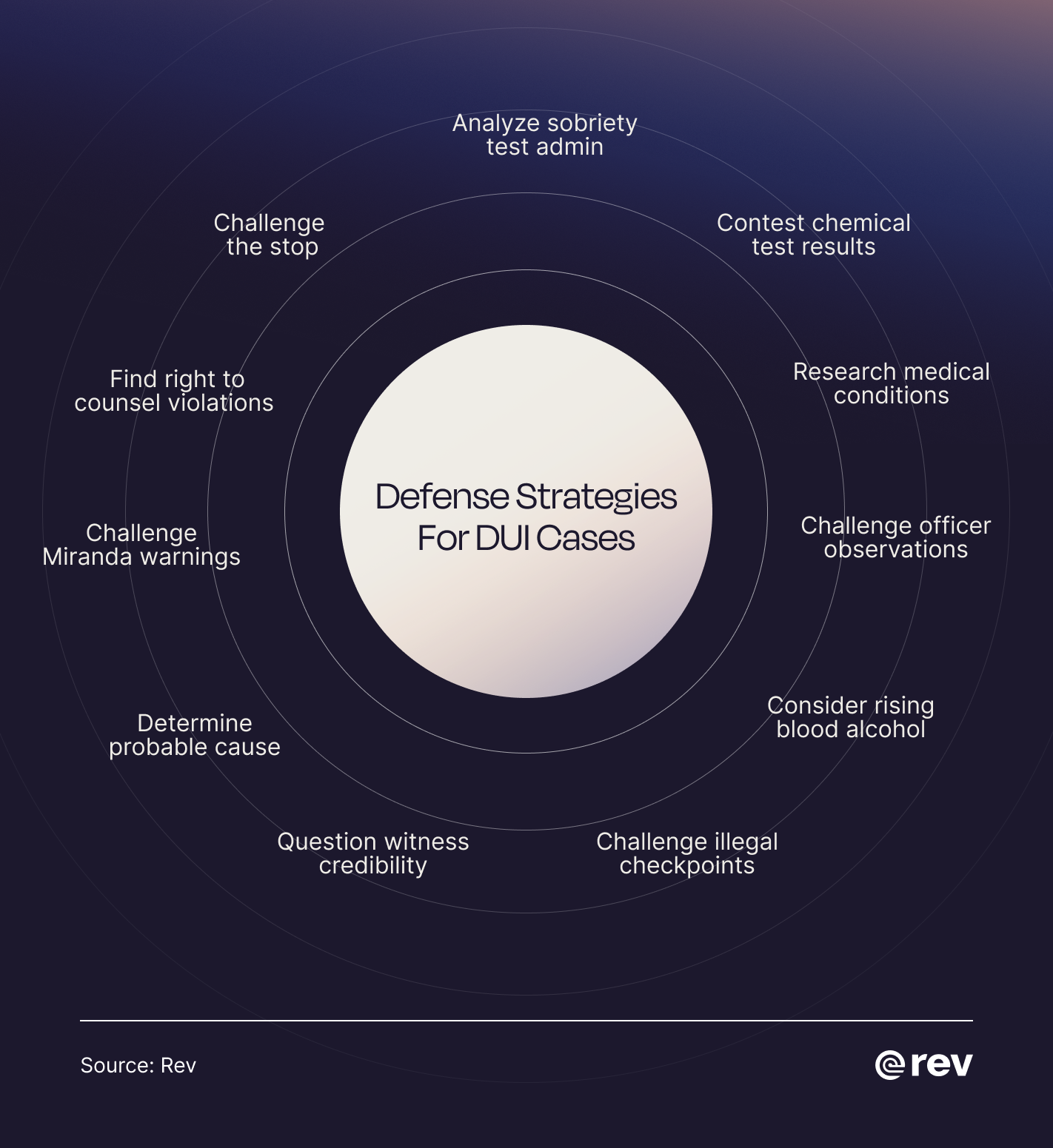
7. Challenge Illegal Checkpoints
DUI checkpoints must follow specific constitutional requirements. Law enforcement can't set up roadblocks as they please—they must use neutral criteria for stopping vehicles, provide adequate warning, and limit officer discretion.
If your client was arrested at a checkpoint, investigate whether it complied with state and federal guidelines. Were supervisors present? Was the location chosen based on public safety data? Were drivers stopped according to a predetermined pattern?
As a DUI attorney, these small discrepancies are a gold mine for reducing or eliminating jail time for a client.
8. Question Witness Credibility
In some cases, the prosecution will call upon witnesses who reported erratic driving. These witnesses may have their own internal biases, limited vantage points, or difficulty accurately judging another driver's behavior.
During discovery, obtain any 911 calls or witness statements and upload them all to your chosen AI software. Analyze the documents and recordings for inconsistencies or details that don't align with other evidence. Then, use these details in cross-examination to weaken the prosecution's argument.
9. Determine Probable Cause for Arrest
Even if the initial stop was legal, police officers must have probable cause before making a DUI arrest. If the evidence supporting probable cause is weak—say a client performed field sobriety tests reasonably well, or the officer's observations were minimal—the argument that the arrest itself was unlawful may hold up in court.
10. Challenge Improper Miranda Warnings
Say you discover a client made incriminating statements after their arrest. If they weren’t read their Miranda rights, those statements could be deemed invalid and give your case a leg up.
First, review recordings of the arrest and subsequent questioning. Were the rights read clearly? Did your client understand and knowingly waive them? Were they coherent enough to make that waiver?
If the arrest was particularly long, AI agents can help you find the specific moment you’re looking for, without scrubbing through hours of audio.
11. Identify Violations of the Right to Counsel
Once arrested with a DUI charge, defendants have the right to speak with a lawyer. If officers continued to interrogate after a client requested counsel, or if they were denied the opportunity to contact a lawyer within a reasonable time frame, any evidence obtained may be forbidden in court.
Luckily, most interrogations are recorded these days, so all it takes is a simple searchable transcript to find out if a client’s rights were violated.
How To Integrate State and Local Laws
DUI laws vary significantly by jurisdiction. Some states have mandatory minimum sentences, while others offer diversion programs for first-time offenders. Blood alcohol limits, offense history, and drunk driving defenses all differ based on location.
Research your state's specific laws and recent case developments. Stay current on changes to implied consent laws, which govern whether drivers must submit to testing. Understanding these differences can help you find the best argument for each case.
Local prosecutors often have policies about plea negotiations in DUI cases. Building relationships with assistant district attorneys and understanding their office's priorities can inform your strategy. Some jurisdictions are more willing to reduce charges or recommend alternative sentencing, especially for defendants with no prior record.
Preparing Your DWI Case For Trial
Thorough trial preparation separates winning cases from lost ones. Follow these steps to build a compelling defense for trial:
- Collect and organize all evidence: Request body camera footage, dashcam recordings, breathalyzer calibration logs, and police reports as soon as possible.
- Transcribe all audio and video evidence: Searchable transcripts allow you to quickly find key moments and identify inconsistencies.
- Review footage multiple times: Watch the traffic stop, then the field sobriety test, and then the officer's statement. If you’re using an AI software, ask it a variety of questions about each event that occurred.
- Identify timeline inconsistencies: Note exact timestamps for critical events and compare them across different evidence sources.
- Consult with experts early: Medical professionals or accident reconstruction specialists may strengthen your case, but they’re often busy. Make sure to get information from them early on, and if you want to put them on the stand, let them know ahead of time.
- Create a detailed chronology: Map out every event from the initial stop through the arrest and interrogation with timestamps and supporting evidence, this includes a medical chronology of any health issues your client has.
- Prepare exhibits: Juries respond to visual aids—consider creating graphics, timelines, or video compilations of your evidence.
- Anticipate prosecution arguments: Identify what you believe are the weakest points in your defense, and develop rebuttals before trial.

The Future of DUI Defense: How AI Helps You Work Faster
Imagine being able to upload all of your documents for a case at once for bulk analysis, turning hours of evidence review into mere minutes. And all without sacrificing accuracy and confidentiality. Well, with AI, you can do just that.
See How Banks & Bower Reduced Review Time By 80%
Rev's legal platform transforms multimedia evidence into a searchable source of truth. Upload body camera footage, jail calls, or witness interviews, and receive accurate transcripts with speaker identification. And for DUI lawyers, the perks don’t stop there.
Our custom AI templates can automatically extract the most relevant information from DWI cases—the stated reason for the stop, sobriety test details, and even chemical test procedures.
“Transcription is a huge help for case prep,” explains Robert Southwell, Criminal Defense Lawyer at Southwell Law.
“Having accurate written records of depositions, client interviews, or witness statements lets me quickly review key points and build arguments, rather than sifting through hours of audio. It's a massive time-saver for the whole team and ensures we don't miss crucial details. Plus, professional transcripts often pick up nuances that might get lost if you're just taking notes.”
These tools don't replace attorney judgment; they enhance it. That’s the power of integrating AI into your defense workflow.
Build Stronger DUI Defenses With Rev
The most effective DUI defense strategies challenge every single aspect of the prosecution's case, from the traffic stop and test to the arrest and interrogation. By combining modern technology with traditional legal expertise, defense attorneys can level the playing field against well-resourced prosecution teams.
Ready to transform how you handle DUI evidence?