Speaker 1 (00:00):
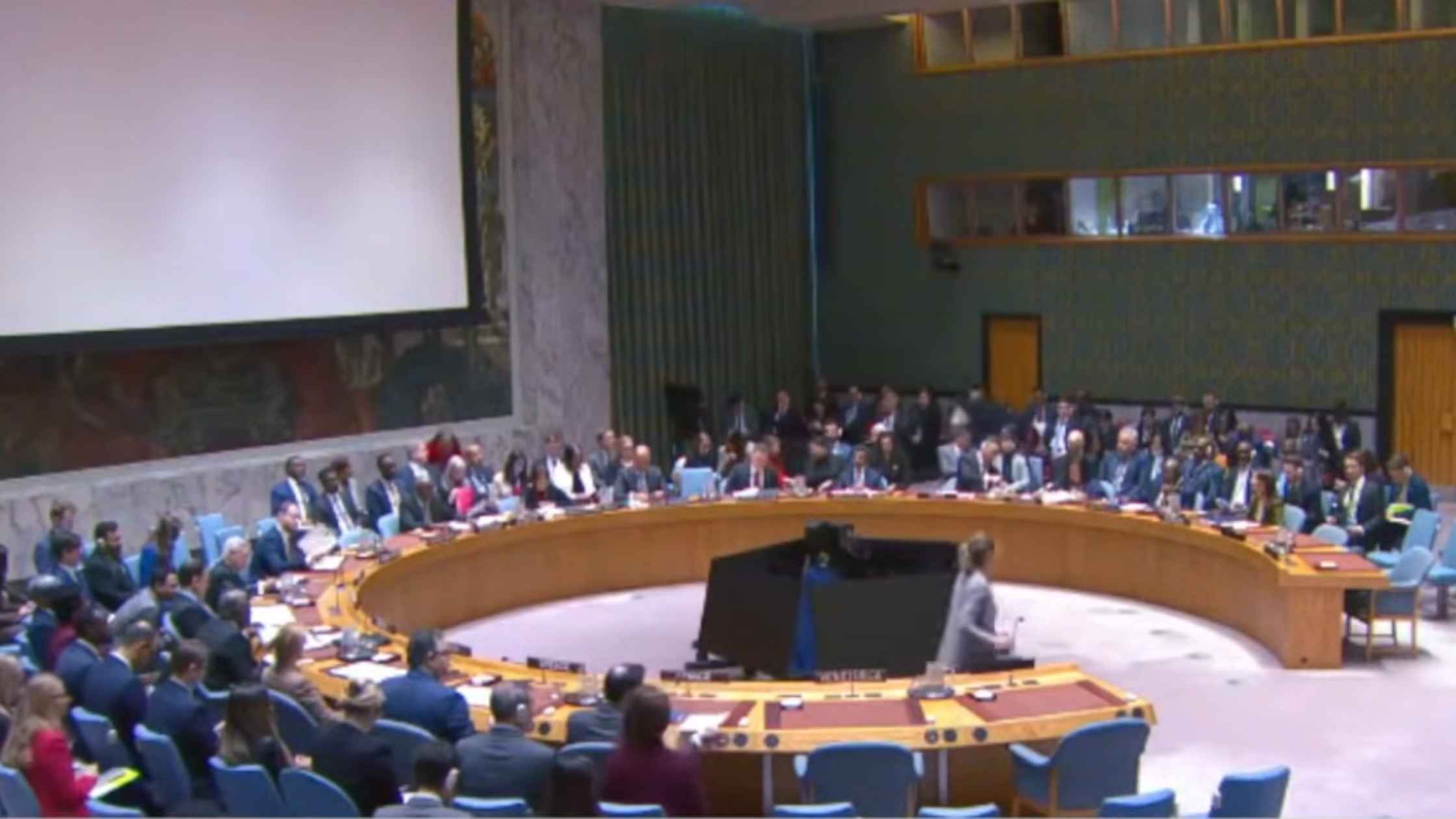
… Spain, Trinidad and Tobago, Uganda, and the Bolivarian Republic of Venezuela, to participate in this meeting. It's so decided. In accordance with Rule 39 of the Council's Provisional Rules of the Procedure, I invite the following briefers to participate in this meeting. Ms. Rosemary DiCarlo, the Under-Secretary-General for the Political and Peace Building Affairs, Mr. Jeffrey Sachs, President of UN Sustainable Development Solutions Network and Director of Center for Sustainable Development at Columbia University, and Ms. Mercedes De Freitas, founder and executive director of Transparencia Venezuela. It's so decided. Security Council will now begin its consideration for item two of the agenda. I now give the floor to Ms. Rosemary DiCarlo.
Rosemary DiCarlo (01:12):
Thank you, Mr. President. Today, I'm going to deliver a statement from Secretary General Antonio Gutierrez, who is not able to be here this morning. Mr. President, members of the Security Council, we meet at a grave time following the 3 January United States military action in the Bolivarian Republic of Venezuela. The broad outlines of the events of Saturday have been widely reported. Early that day, US forces were active across Caracas and in the northern states of Miranda, Aragua, and La Guaira. The extent of casualties resulting from these actions remains undetermined. In a statement on social media on Saturday, President Donald Trump announced the conduct of a, I quote, "large-scale strike against Venezuela and its leader, President Nicolás Maduro," end-quote.
(02:13)
During a press conference on Saturday, President Trump stated, and I quote again, "We are going to run the country until such time that we can do a safe, proper, and judicious transition," end-quote. The government of Venezuela has characterized the United States action as a military aggression carried out in civilian and military areas and as a flagrant violation of the Charter, posing a threat to international and regional peace and security. As we speak, President Maduro is being held in New York accused by US authorities, along with his wife, Cilia Flores, of serious criminal offenses. What is less certain is the immediate future of Venezuela. I am deeply concerned about the possible intensification, the instability in the country, the potential impact on the region, and the precedent it may set for how relations between and among states are conducted.
(03:18)
Mr. President, the situation in Venezuela has been a matter of regional and international concern for many years now. Attention on the country only grew following the contested presidential elections in July 2024. The panel of electoral experts I appointed at the Venezuelan government's request to accompany the elections highlighted serious issues. We have consistently called for the full transparency and the complete publication of the results of the elections. As reported to the Council on 23 December, the Office of the High Commissioner for Human Rights has cataloged serious violations.
(04:05)
On 3 January, Venezuelan interim President Delcy Rodríguez invoked an emergency decree throughout the national territory extending additional security powers to the government. Mr. President, the latest developments follow a period of heightened tensions beginning in mid-August, as discussed in this Council on two previous occasions. I have consistently stressed the imperative of full respect by all for international law, including the Charter of the United Nations, which provides the foundation for the maintenance of international peace and security.
(04:44)
I remain deeply concerned that rules of international law have not been respected with regard to the 3 January military action. The Charter enshrines the prohibition of the threat or use of force against the territorial integrity or political independence of any state. The maintenance of international peace and security depends on the continued commitment of all member states to adhere to all the provisions of the Charter. Mr. President, Venezuela has experienced decades of internal instability and social and economic turmoil. Democracy has been undermined. Millions of its people have fled the country. The situation is critical, but it is still possible to prevent a wider and more destructive conflagration.
(05:38)
I call on all Venezuelan actors to engage in an inclusive democratic dialogue in which all sectors of society can determine their future. This entails the full respect of human rights, the rule of law, and the sovereign will of the Venezuelan people. I also urge Venezuela's neighbors and the international community more broadly to act in a spirit of solidarity and in adherence to the principles, laws, and rules erected to promote peaceful coexistence. I welcome and am ready to support all efforts aimed at assisting Venezuelans in finding a peaceful way forward.
(06:22)
Mr. President, excellencies, in situations as confused, as complex as the one we now face, it is important to stick to principles. Respect for the UN Charter and all other applicable legal frameworks to safeguard peace and security, respect for the principles of sovereignty, political independence, and territorial integrity of states, the prohibition of the threat or use of force. The power of the law must prevail. International law contains tools to address issues such as illicit traffic in narcotics, disputes about resources, and human rights concerns. This is the route we need to take. Thank you, Mr. President.
Speaker 1 (07:10):
I thank Ms. DiCarlo for her briefings. I now give the floor to Mr. Jeffrey Sachs.
Jeffrey Sachs (07:20):
Mr. President, distinguished members of the Security Council. The issue before the Council today is not the character of the government of Venezuela. The issue is whether any member state, by force, coercion, or economic strangulation, has the right to determine Venezuela's political future or to exercise control over its affairs. This question goes directly to Article 2, Section 4 of the United Nations Charter, which prohibits the threat or use of force against the territorial integrity or political independence of any state. The Council must decide whether that prohibition is to be upheld or abandoned. Abandoning it would carry consequences of the gravest kind.
(08:08)
Let me offer some background. Since 1947, the United States foreign policy has repeatedly employed force, covert action, and political manipulation to bring about regime change in other countries. This is a matter of carefully documented historical record. In her book, Covert Regime Change, political scientist Lindsey O'Rourke, documents 70 attempted US regime change operations between 1947 and 1989 alone. These practices did not end with the Cold War. Since 1989, major United States regime change operations undertaken without authorization by the Security Council have included, among the most consequential, Iraq, 2003, Libya, 2011, Syria, beginning in 2011, Honduras, 2009, Ukraine, 2014, and Venezuela from 2002 onward.
(09:09)
The methods employed are well-established and well-documented. They include open warfare, covert intelligence operations, instigation of unrest, support for armed groups, manipulation of mass and social media, bribery of military and civilian officials, targeted assassinations, false flag operations, and economic warfare. These measures are illegal under the UN Charter, and they typically result in ongoing violence, lethal conflict, political instability, and deep suffering of the civilian population.
(09:45)
The recent US record with respect to Venezuela is also clear. In April 2002, the US knew of and approved an attempted coup against the government. In the 2010s, the United States funded civil society groups actively engaged in anti-government protests. When the government cracked down on the protests, the US followed with a series of sanctions. In 2015, President Barack Obama declared Venezuela to be, and I quote, "An unusual and extraordinary threat to the national security and foreign policy of the United States." In 2017, at a dinner with Latin American leaders on the margin of the UN General Assembly, President Trump openly discussed the option of the US invading Venezuela to overthrow the government.
(10:34)
During 2017 to 2020, the United States imposed sweeping sanctions on the state oil company, PDVSA. Oil production fell by 75% from 2016 to 2020, and the real GDP per capita declined by 62%. The UN General Assembly has repeatedly voted overwhelmingly against such unilateral coercive measures. Under international law, only the Security Council has the authority to impose such measures. On the 23rd of January 2019, the United States unilaterally recognized Mr. Juan Guaidó as interim president, and a few days later froze approximately $7 billion of Venezuelan sovereign assets held abroad and gave the designated authority over certain of these assets. These actions form part of a continuous US regime change effort spanning more than two decades.
(11:34)
In the past year, the United States has carried out bombing operations in seven countries, none of which were authorized by the UN Security Council, and none of which were undertaken in lawful self-defense under the Charter. The targeted countries include Iran, Iraq, Nigeria, Somalia, Syria, Yemen, and now Venezuela. In the past month, President Trump has issued direct threats against six UN member states, including Colombia, Denmark, Iran, Mexico, Nigeria, and of course, Venezuela.
(12:11)
Members of the Council are not called upon to judge Nicolás Maduro. They are not called upon to assess whether the recent US attack and ongoing naval quarantine results in freedom or in subjugation. Members of the Council are called upon to defend international law and specifically the UN Charter. The realist school of international relations articulated most brilliantly by John Mearsheimer accurately describes the condition of international anarchy as the tragedy of great power politics. Realism is therefore a description, not a solution for peace. Its own conclusion is that anarchy leads to tragedy.
(12:55)
In the aftermath of World War I, the League of Nations was created to end the tragedy through the application of international law. Yet the world's leading nations failed to defend international law in the 1930s, leading to renewed global war. The United Nations emerged from that catastrophe as humanity's second great effort to place international law above international anarchy. In the words of the Charter, the UN was created, quote, "To save succeeding generations from the scourge of war, which twice in our lifetime has brought untold sorrow to mankind."
(13:32)
Given that we are in the nuclear age, failure cannot be repeated. Humanity would perish. There would be no third chance. To fulfill its responsibilities under the Charter, the Security Council should immediately affirm the following actions. The United States shall immediately cease and desist from all explicit and implicit threats or use of force against Venezuela. The United States shall terminate its naval quarantine and all related coercive military measures undertaken in the absence of authorization by the UN Security Council. The United States shall immediately withdraw its military forces from within and along the perimeter of Venezuela, including intelligence, naval, air, and other forward deployed assets positioned for coercive purposes. Venezuela shall adhere to the UN Charter and to the human rights protected in the Universal Declaration of Human Rights.
(14:29)
The Secretary General, I recommend should immediately appoint a special envoy mandated to engage relevant Venezuelan and international stakeholders and to report back to the Security Council within 14 days with recommendations consistent with the Charter, and the Security Council should remain urgently seized of this matter. All member states should refrain from unilateral threats, coercive measures, or armed actions undertaken outside the authority of the UN Security Council.
(15:02)
In closing, Mr. President and distinguished members of the Council, peace and the survival of humanity depend on whether the United Nations Charter remains a living instrument of international law or is allowed to wither into irrelevance. That is the choice before this Council today. Thank you very much.
Speaker 1 (15:24):
I thank Mr. Sachs for his briefings. I now give the floor to Ms. Mercedes De Freitas.
(15:31)
Okay. My apology. I now give the floor to Ms. Mercedes De Freitas.
Mercedes De Freitas (16:04):
Good morning. I speak in Spanish.
Interpreter (16:14):
Good morning, ambassadors, representatives of states and governments. [inaudible 00:16:18] for giving me this opportunity to speak. Can you hear me? Can you hear me?
Mercedes De Freitas (16:33):
Good morning. I speak in Spanish.
Interpreter (16:44):
Good morning, ambassadors, representatives of heads of state and government. Thank you to enable me to tell you something about Transparency Venezuela, the work that we have been doing. We have organized … I've organized some information I'm going to put forward to you in five points.
Speaker 1 (17:38):
Continue.
Mercedes De Freitas (17:38):
[Spanish 00:17:40]-
Interpreter (17:42):
I've arranged the information I'm going to give to you in around five points. Let me make the most of my time. First of all, one, the corruption in Venezuela is seen in some [inaudible 00:17:58] countries of the world. We've seen hundreds of cases that we have documented over the years, more than 500, 600 cases in various countries.
(18:26)
Can you hear us?
Mercedes De Freitas (18:26):
[Spanish 00:18:31]-
Interpreter (18:33):
We looked at the justice systems of 30 countries and 172 cases were dealt with for corruption and more than 72 trillion dollars were involved. Million dollars were involved. This was public Venezuelan money. Nicolás Maduro and his family … The interpreter cannot hear the speaker. It was a system that was involved in 90% of the corruption cases.
(19:17)
Point number two. The national criminal organizations. The interpreter cannot hear the speech to provide sufficient interpretation. I apologize.
Mercedes De Freitas (19:31):
[Spanish 00:19:33]-
Speaker 1 (19:43):
Ms. Freitas. Can you hear us? Ms. Freitas? Can you hear us? The interpreters cannot hear you. Can you slow down and raise your voice a little bit?
Interpreter (20:08):
There's a delay, says the speaker. The problem the interpreter's having is with the quality of the sound, which is insufficient for interpretation. It's not the speed.
Speaker 1 (20:19):
[Spanish 00:20:23]-
Interpreter (20:24):
I'm hearing you, but with a delay, says the speaker. I can hear you though.
Speaker 1 (20:31):
Please proceed. Please proceed now.
Mercedes De Freitas (20:38):
Okay. [Spanish 00:20:39].
Interpreter (20:39):
Very well. Point two. National and international criminal organizations have a symbiotic relationship with the regime of Nicolás Maduro, sharing capacity, using the state structures to facilitate their work and to protect illicit operations, in gold, for example, drugs, extortion, and human trafficking. And according to our estimates, this accounts for about $8 billion. Gold, for example, only 20% is reported to the national treasury. The rest goes to private accounts where there are members and allies with the government. This mining industry has exploited so many people using national parks and also the Amazon area. And then to launder the money from corruption, the network has money laundering structures that are very sophisticated, and since 2021, they've been involved in this work.
(22:01)
Three, great corruption has led to a decrease in the income of the state and therefore public expenditure, and therefore affecting the quality of basic services. The current economy is in crisis. [inaudible 00:22:19] no money either to service the debt. And Venezuela has been in technical default since 2017. We owe more than $15 million.
(22:39)
Four, Venezuelans have had to learn to live with just a few hours of electricity per day in very many parts of the country. And we've learned to protect ourselves from daily extortion from the armed Colombian groups or the organized crime groups, but also elements of the state. So many families only have one meal per day below the calories that they need, affecting their nutrition, which is getting worse day by day. Humanitarian programs are not sufficient.
(23:25)
And then, five, there's no checks and balances between government departments. The government has captured all institutions beginning with the justice institutions and also the oil company responsible for the majority of income for the country. In order to maintain control and the impunity of these illicit operations, a repressive system that's getting worse and worse is being applied. And today, there are more than 1,000 political prisoners. At the end of the year, 26 people died during torture or because a lack of medical care. United Nations has documented many of these cases.
(24:27)
We need a transparent state that is accountable that will guarantee the rule of law and human rights, that will protect public goods for everyone without privilege, a system that's autonomous and independent. We need investment in building capacity that will enable us to have a dignified life. We must respect the will of the Venezuelan people to live in peace and democracy. And finally, a request to you. Freedom for all political prisoners in the country. Thank you very much.
Speaker 1 (25:06):
I thank to Ms. Freitas for her briefing. I now give the floor to those Council members who wish to make statements. I give the floor to the representative of Colombia.
Interpreter (25:24):
Mr. President, Colombia would like to thank Somalia in your quality as president of the Security Council for having quickly responded to our request to convene this emergency meeting, as well as thanking China and Russia for their support for holding of this meeting. And we wish you, Mr. President, a successful month managing the work of the Council at a particularly delicate time for international peace and security. I'd also like to thank Under-Secretary-General for Political Affairs and Peace Building of the United Nations and the invited briefers. We thank them all for their briefings. This is the first time Colombia is taking the floor in the Security Council as a non-permanent member for the period 2026-2027.
(26:24)
Colombia is taking on this responsibility with a deep sense of duty, and we are going to do this from the first day, defending international law and the purposes and principles enshrined in the United Nations Charter. International peace and security, the peaceful settlement of disputes, the prohibition of the use of force, sovereign equality, respect for the territorial integrity and political independence of all states.
(27:02)
Colombia condemns categorically the events that occurred in the early morning of the 3rd of January in Venezuela, where we saw multiple explosions and air activity over Caracas and other areas of the country as part of a military attack carried out by the United States, which included bombings of civilian and military infrastructure, creating panic amongst the population. All of this represents clear violations of the sovereignty, political independence, and the territorial integrity of Venezuela. There is no justification whatsoever under any circumstances for the unilateral use of force to commit an act of aggression.
(27:54)
Such actions constitute a serious violation of international law and the United Nations Charter, including the prohibition, prohibition on the use or the threat of the use of force, the principle of the respect for sovereignty and the full authority of states over their territory, including their natural resources, the territorial integrity of states, and the principles of collective defense, particularly when they directly endanger the population and civilian assets. Defending these principles is not an option. Indeed, it's a common obligation that we have in order to preserve international peace and security.
(28:42)
We need to remember that the provisions of the Charter allow for the use of force only under exceptional circumstances in legitimate defense in the face of an armed attack or when there is an express authorization by this Council in accordance with chapter seven. And even in those cases, this does not amount to assuming political control of another state. In this regard, we reject any unilateral military action, any act that could worsen the situation or endanger the civilian population, and we would call for a deescalation and non-resort to the use of force, which endangers people finding themselves in this delicate situation. They must be the absolute priority.
(29:36)
We have learned from our experience that the civilian population is always the one that pays the highest price in armed conflict. Mr. President, Latin America and the Caribbean have proclaimed themselves to be a zone of peace and this collective commitment and will of our region must be respected. Unilateral action that is contrary to international law endangers regional stability, increases insecurity, and worsens the already complex conditions being faced by the civilian population with devastating effects that will transcend the sovereign borders of Venezuela to have a direct impact on countries of the region, such as Colombia.
(30:35)
In order to act preventively, Colombia has engaged in measures to protect the civilian population and preserve the stability of the border, addressing the possible needs of the population, particularly the migrant population in coordination with local authorities. Colombia has been and will continue to show solidarity in receiving the Venezuelan people who, given the uncertainty created by these attacks, this may lead to a massive outflow of migration, which will require significant efforts in terms of resources and capacities to provide the necessary support and assistance to those areas affected by taking in the migrants.
(31:24)
Mr. President, these actions that we have seen remind us of the worst interference in our area in the past, in our zone of peace, and it calls to mind the commitment that we have as states to resolve our differences peacefully through dialogue and negotiation or other forms of peaceful settlement in full accordance with international law and with its instruments to which we have subscribed at the hemispheric and regional levels, such as the Charter of the Organization of American States.
(32:01)
It's also important to understand the dimension of this situation for international peace and security beyond our region, particularly when a permanent member of the Security Council takes the decision to use force and assume control unilaterally of another sovereign state with the aim, amongst other things, of taking its natural and strategic resources. This is very worrisome for the international community, the international order that was established after the Second World War, and flagrantly violates international law and is in clear contradiction with the United Nations Charter and the very goal for which this Council was created.
(32:55)
If a country and particularly a country that is a permanent member of this Council disregards international law that we designed in San Francisco, what then is the role of this Council and where are the foundations for international peace and security? We are accepting that the law and the interests of the strongest prevail over multilateralism and over agreements that we have forged with dialogue and diplomacy in this very chamber.
(33:29)
Democracy cannot be promoted or defended through violence or coercion, and it cannot be superseded either by economic interests. Democracy can only be built and sustained through respect for the will of peoples, the reaffirmation of the rule of law, through political dialogue and peaceful and inclusive processes. Venezuela deserves to live in peace, in democracy, prosperity, and dignity, with a government that is defined in sovereignty by no one else than the Venezuelan people and their institutions. This is why Colombia has reiterated its call to open up paths for democracy in Venezuela through specific popular decisions being taken. The importance of preserving peace, respect for international law and the protection of life and human rights must prevail over anything else.
(34:39)
Colombia reaffirms its conviction that working tirelessly under these principles in our new role as a non-permanent member of the Security Council is what we plan to do and we make ourselves available, good offices available for a diplomatic way out
Speaker 2 (35:00):
…out of the current crisis in this brotherly country. We will meet our responsibility, primary responsibility to maintain international peace, and security. And given the seriousness of the events, we will continue to pay attention to this issue. And we'd also like to thank the Secretary General of the United Nations for providing his good offices to defend the purposes, and principles of the United Nations Charter to activate channels for mediation available to him, and facilitate dialogue with the parties concerned, looking in the search for alternatives that will make it possible to find a way out of the situation led by Venezuelans themselves, and provide assistance to Venezuelans that need this. In conclusion, we'd urge the parties to exercise maximum caution, and restraint to deescalate tensions, and to follow dialogue, and diplomatic channels, and develop mechanisms to avoid continued flagrant violations of international law. This will require the help of the United Nations, and of regional organizations. Thank you very much, Mr. President.
Speaker 3 (36:20):
I thank the Representative of Columbia for her statement, and now give the floor to the representative of Russian Federation. [foreign language 00:36:30]
Speaker 4 (36:30):
Mr. President, first, and foremost, we wish to congratulate you on your accession to the Presidency of the Security Council. And second, we wish to welcome the newly elected members of the Security Council. The beginning of this new year shocked all of those throughout the world who cherish the hope that respect for international law, and non-intervention in domestic affairs of other states, as well as the reliance upon diplomacy, and seeking of compromise became key principles in the work of the new US administration. The assault against the leader of Venezuela compounded by the deaths of dozens of Venezuelan, and Cuban citizens, in the eyes of many, become a harbinger of a turn back to the era of lawlessness, and US domination by force, chaos, and lawlessness, which continues to afflict dozens of states in various regions of the world.
(37:38)
There is no, and can be no justification for the crime cynically perpetrated by the United States in Caracas. We firmly condemn the US Act of armed aggression against Venezuela in breach of all international legal norms. In connection with the confirmed reports about the presence of the abducted president of Venezuela Nicholas Maduro, and his spouse in the United States today, as we are aware they are in New York, we propose, we call upon corrective speaker, the US leadership to immediately release the legitimately elected president of an independent state, and his spouse. Any problems existing, or conflict between the United States, and Venezuela need to be resolved through dialogue. And this is precisely what is enshrined in the UN charter for purposes, and the principles of which a number of states in recent years have begun to apply selectively depending upon the political landscape. Today, we are reaping the consequences of their recklessness, and selectivity in matters related to respect for the norms of international law, which were linked to the so called rules-based world order.
(39:02)
Here is your rules-based world order in all of its glory, which is horrifying, even the staunchest Atlanticists. Mr. President, we extend our firm solidarity with the people of Venezuela in the face of the external aggression. We firmly support, and completely support the policy of the Bolivarian government, which is geared towards protection of their national interests, and the sovereignty of the country. Washington's aggressive acts have already been condemned by many states, and multilateral associations, including the non-aligned movement, the African Union, as well as a group of friends in defense of the Charter of the United Nations. We hope that the international banditry will immediately be met with objective, and comprehensive assessment at the international legal level with United Nations, universal mechanisms, and other multilateral formats being brought to bear. This process must not be impacted by the recognition, or non-recognition by any given states, or groups of states of the legitimacy of Nicholas Maduro.
(40:09)
For this reason, unintelligible murmurings, and attempts to avoid principled assessments by those who on other circumstances at the mouth, and demand that others respect the UN charter today seem particularly hypocritical, and unseemly. We hope you will recognize this, and we hope that you will abandon double standards, and that you will not attempt to justify such an egregious act of aggression due to a fear of angering the American global gendarme which is attempting to once again rear its head. We are particularly appalled by the unparalleled cynicism, with which Washington did not even attempt to conceal the true aims of its criminal operation, namely the establishment of unbridled control over Venezuela's natural resources, and the assertion of their hegemonical ambitions in Latin America. In this way, Washington is generating fresh momentum for neocolonialism, and fore imperialism, which were repeatedly, decisively, condemned, and repeated by the peoples of this region, and by the global south as a whole.
(41:16)
Distinguished colleagues under these circumstances, it is exceedingly important for the entire international community to unite, and to definitively reject the methods, and tools of the methods, and tools of US military foreign policy, which have been demonstrated within the case of Venezuela. This is the only way it is possible to compel Washington to revisit, and to abandon their dangerous misconceptions. As we stated during previous meetings on Venezuela, the bell now tolls across the region ringing for every country of the Western hemisphere. The bell is ringing for all UN member states, and for the future of the organization itself. Failing to hear this call today is tantamount to projecting cowardice, and the lack of principle, essentially blessing ongoing encroachments of international law, and rejecting civilized international conduct as a whole. We cannot allow the United States to proclaim itself as some kind of a supreme judge, which alone bears the right to invade any country, to label culprits, to hand down, and to enforce punishments irrespective of notions of international law, sovereignty, and non-intervention.
(42:43)
Is this the world we sought to attain as we marked the 80th anniversary of the adoption of the Charter of the United Nations when we all signed on to the relevant security council presidential statement? Is this the aim of United Nations reform, which we all advocate? Or has the United Nations, and Security Council thereof, do they no longer exist? And is there a need now to seek from Washington a patent to rule, so to speak? And is it a self-determination of every person's, and their right to determine their future worthless? These are the questions that we all must address today. And if this response is sincere, if it is principled, then perhaps the US leadership too, which openly has asserting intention to run another country for the benefit of the United States, they will perhaps glance at their own constitution, their constitution of the United States, which begins with the words, "We the people of the United States, and will begin in fact to recognize the sovereignty of other states rather than deposing inconvenient regimes." Thank you.
Speaker 3 (43:55):
I thank the representative of Russian Federation, and now give the floor to the representative of China.
Speaker 5 (44:06):
President, China supports the Security Council holding an emergency meeting regarding the United States military strikes on Venezuela. And thanks USG DiCarlo for reading out the briefing of the Secretary General Gutierrez. I have listened carefully to the statements of the briefers, and we welcome to this meeting, the permanent representative of Venezuela, and representatives of other countries. On January the 3rd, the United States blatantly launched large scale military strikes against Venezuela, forcefully seized Venezuelan President Nicholas Maduro, and his wife, and took them out of the country. It claimed that it will run Venezuela, and even didn't rule out launching a second round of military operations on an even larger scale. China is deeply shocked by, and strongly condemns the unilateral illegal, and bullying acts of the US. For some time now, the international community has repeatedly expressed grave concern over the US sanctions, blockade, and threats of force against Venezuela.
(45:11)
The council convened two emergency meetings during which Secretary General Gutierrez many council members, and countries in the region, and beyond unanimously called for abiding by the UN charter, and the international law, maintaining calm, and restraint, resolving disputes peacefully, deescalating tensions, and safeguarding regional stability. However, as a permanent member of the council, the US has disregarded the grave concerns of the international community, wantonly trampled upon Venezuela's sovereignty, security, and legitimate rights, and interests, and seriously violated the principles of sovereign equality, non-interference in internal affairs, peaceful settlement of international disputes, and the prohibition of the use of force in international relations. This brings the pose constitute the fundamental tenants of the UN charter, and form the cornerstone of maintaining international peace, and security. The US has placed its own power of multilateralism, and military action above diplomatic efforts, posing a grave threat to peace, and security in Latin America, and the Caribbean, and indeed internationally.
(46:31)
China firmly opposes this, and the international community has also expressed widespread grave concern, and strong condemnation. We urge the US to heed the overwhelming voice of the international community, abide by international law, and the purposes, and principles of the UN charter seize infringing upon the sovereignty, and security of other countries. Stop toppling the government of Venezuela, and return to the path of political solutions through dialogue, and negotiations. We call on the US to ensure the personal safety of President Maduro, and his wife, and to release them at once. We support the council in fulfilling its primary responsibility to maintain international peace, and security. And we support all efforts by the UN Secretary General, regional countries, and organizations that contribute to promoting dialogue, and deescalating the situation. President, the lessons of history are stark warning. Military means are not the solution to problems, and the indiscriminate use of force will only lead to greater crisis.
(47:37)
The US bypassed the council to launch military operations against Iraq, blatantly attacked Iran's nuclear facilities, and imposed economic sanctions, military strikes, and even armed occupations on multiple countries in Latin America, and the Caribbean. These actions have caused persistent conflict instability, and immersed suffering for the ordinary people. Did these actions bring peace, and stability? Did they bring development, and prosperity? The international community sees this clearly. Venezuela is an independent sovereign state with every right to defend its sovereignty, and national dignity. Countries in Latin America, and the Caribbean are important forces in maintaining world peace, and stability, and promoting global development, and prosperity. And they have every right to independently choose their development paths, and partners. No country can act as the world's police, nor can any state presume to be the international judge. China firmly supports the government, and people of Venezuela in safeguarding their sovereignty, security, and legitimate rights, and interests.
(48:48)
We firmly support the regional countries in upholding the status of Latin America, and the Caribbean as a zone of peace. We demand that the United States change its course, cease its bullying, and coercive practices, and develop relations, and cooperation with regional countries on the basis of mutual respect, equality, and non-interference in international affairs. China stands ready to work with the regional countries, and the international community to strengthen solidarity, and cooperation, uphold fairness, and justice, and jointly peace, and stability in Latin America, and the Caribbean. I thank you, president.
Speaker 3 (49:26):
I thank the Representative of China for this statement, and now give the floor to the representative of Liberia.
Speaker 6 (49:36):
Thank you, Mr. President. I have the honor to deliver this statement on behalf of the A3 members, namely the Democratic Republic of Congo, Somalia, and my own country, Liberia. We thank the presidency for promptly convening this important meeting. We congratulate Somalia on assuming the presidency of the Security Council this month, and warmly welcome all new members. The A3 appreciates USG DiCarlo's comprehensive briefing, and listened carefully to the remarks offered by Civil Society of Representatives. We also welcome the representative of Venezuela, and the representatives of the region to this meeting. Mr. President, the A3 aligns itself with the recent communique of the African Union on the situation in the Bolivarian Republic of Venezuela, and continues to monitor developments there with deep concerns. In particular, we note reports regarding the detention of President Nicholas Maduro, and his wife, and incidents involving Venezuelan institutions. Such developments present serious challenges, not only to Venezuela's internal stability, but also underscore the imperative to safeguard the broader peace, and security of the region.
(51:46)
The A3 remains steadfast in its commitment to the fundamental principles of international law, including the full respect for the sovereignty, and territorial integrity of states as enshrined in the charter of the United Nations in the interest of regional stability, and international peace. We believe these are essential foundations for international cooperation, and peaceful coexistence. Our position underscores the importance of dialogue, the peaceful settlement of disputes, and respect for constitutional, and institutional frameworks. Mr. President, the complex situation in Venezuela requires a comprehensive response that is both inclusive, and nationally owned. We continue to hold that a sustainable, and peaceful resolution can only be found through constructive dialogue among Venezuelans themselves with genuine respect for the aspiration, and rights of the Venezuelan people, and with the constructive support of the international community. The A3 expresses its solidarity with the people of Venezuela, and reiterates the African Union's commitment to peace, stability, and mutual respect among nations, and regions. It's important for all parties, both within Venezuela, and in the broader international community to exercise restraint, and responsibility, upholding international law, and avoiding any action that could escalate tension, or threaten regional stability. The A3 stands ready to support all efforts within this council, and in cooperation with regional partners to facilitate a peaceful, inclusive, and lasting resolution to the situation in Venezuela. I thank you.
Speaker 3 (54:43):
I thank the representative of Liberia for this statement, and now give the floor to the representative of the United States.
Speaker 7 (54:54):
Mr. President, thank you for chairing. And I particularly want to thank you, Mr. Fritas, for your briefing. And I'll point out that Mr. Fritas is in exile having fled the regime. Thank you for your courage, and thank you for shedding a light on the true atrocities of the illegitimate Maduro regime. This past weekend, colleagues of United States successfully carried out a surgical law enforcement operation facilitated by the US military against two indicted fugitives of American justice, narco terrorist Nicholas Maduro, and Celia Flores. Colleagues, Nicholas Maduro is responsible for attacks on the people of the United States for destabilizing the Western hemisphere, and illegitimately repressing the people of Venezuela. As Secretary Rubio has said, there is no war against Venezuela, or its people. We are not occupying a country. This was a law enforcement operation in furtherance of lawful indictments that have existed for decades. The United States arrested a narco trafficker who is now going to stand trial in the United States in accordance with the rule of law for the crimes he's committed against our people for 15 years. A similar action was taken in 1989 against Manuel Noriega. He was arrested, indicted, convicted in a court of law, served in prison in the United States, and in Panama, and the Panamanian people, the American people are safer for it. And undeniably, the region was more stable. This law enforcement action was directed consistent with the President of the United States' responsibility as Commander-in-Chief to protect Americans at home, and abroad against a fugitive who is directly responsible for narcoterrorism that has killed hundreds of thousands of Americans, and created destabilizing violence throughout our hemisphere. Nicholas Maduro, and his co-defendant, Celia Flores, have been transferred here to the United States to stand trial for their crimes. Maduro was indicted by a grand jury in the Southern District of New York, and faces very serious criminal charges for his involvement in a wide ranging conspiracy to conduct narcoterrorism, to traffic cocaine, and other drugs, and conducting international weapons trafficking.
(57:53)
The overwhelming evidence of his crimes will be presented openly in US court proceedings. Colleagues, Maduro is not just an indicted drug trafficker. He was an illegitimate so called president. He was not a head of state. For years, Maduro, and his cronies have manipulated Venezuela's electoral system to maintain their illegitimate grip on power. In fact, just two years ago in 2024, a UN panel of experts report found that the election in that year was absolutely, and completely a farce, and fell well short of the most basic transparency integrity measures essential to upholding credible elections. If the UN, and the United Nations in this body confers legitimacy on an illegitimate narco terrorist, and the same treatment in this charter of a democratically elected president, or head of state, what kind of organization is this? We should note that over 50 countries, many nations, including the European Union, including a number of Latin American countries in the region. And of course the United States, again, over 50 countries rejected the legitimacy of Maduro's reelection following the disputed 2024 elections, and do not, do not recognize him as Venezuela's legitimately elected president.
(59:49)
Maduro unlawfully refused to peacefully cede power after the Venezuelan people voted him out of office in the 2024 election. So, therefore, Maduro was a fugitive from justice. He is the head of a vicious foreign terrorist organization, Cartel De La Soles. This regime-sponsored enterprise coordinates with, and relies on other vicious criminal organizations, namely Tren de Aragua, again, among others, to carry out its objective of using illegal narcotics as a weapon against the United States. And for its part, Tren de Aragua is a designated foreign terrorist organization with thousands of members, many of whom have unlawfully infiltrated the United States, and are conducting irregular warfare, and undertaking hostile actions against the American people, and against the United States. It's terrorizing criminals commit brutal crimes, including murders, kidnappings, extortions, and human drug, and weapons trafficking. This administration, President Trump will not stand for it.
(01:01:06)
In fact, in March of 2025, President Trump declared that Tren de Aragua is undertaking… Excuse me, quote, "Tren de Aragua is undertaking hostile actions, and conducting irregular warfare against the territory of the United States, both directly, and at the direction, clandestine, or otherwise of the Maduro regime in Venezuela." Maduro, and his cronies have partnered with some of the most violent, and prolific drug traffickers, and narco terrorists in the world for decades, facilitating the flood of illegal drugs coming in the United States, estimated to be several hundred tons annually. He has become rich, incredibly wealthy off the misery of untold numbers of Americans, Venezuelans, and others, aiding, and abetting international terrorist organizations like Hezbollah, coordinating with corrupt Iranian officials, and other malign actors to influence not only the region, but to malignly influence the United States. In fact, in its own 2025 World Drug Report, the United Nations Office on Drugs, and Crime identified Venezuela as a key trafficking route in the Western hemisphere, the illegal drugs, predominantly cocaine, entering the United States, and increasingly Europe.
(01:02:39)
As Secretary Rubio stated just yesterday, this is the Western hemisphere. This is where we live, and we're not going to allow the Western Hemisphere to be used as a base of operation for our nation's adversaries, and competitors, and rivals of the United States. You can't turn Venezuela into the operating hub for Iran, for Hezbollah, for gangs, for Cuban intelligence agents, and other malign actors that control that country. You cannot continue to have the largest energy reserves in the world under the control of adversaries of the United States, under the control of illegitimate leaders, and not benefiting the people of Venezuela, and stolen by a handful of oligarchs inside of Venezuela, but it doesn't stop there. Numerous UN, and international human rights organizations have issued reports documenting serious human rights abuses by the Maduro regime, including reports of extrajudicial killings, political prisoners, torture, and arbitrary, and unlawful detentions.
(01:03:50)
In fact, over eight million Venezuelans have fled the country, destabilizing their neighbors in the region, and creating the world's largest refugee crisis. Members of this council, colleagues, the United States wants a better future for Venezuela. We believe a better future for the people of Venezuela, and for the people of the region, and the world is stabilizing the region, and making the neighborhood that we live in a much better, and safer place. And this is why millions of Venezuelans that have fled this brutal regime are celebrating, and cheering around the world as this body pontificates, including those celebrating, or including in my home state of Florida where hundreds of thousands of Venezuelans have fled this regime's brutality.
(01:04:56)
I want to reiterate, President Trump gave diplomas see a chance. He offered Maduro multiple off-ramps. He tried to deescalate. Maduro refused to take them. President Trump made it clear that the narcoterrorism must stop, and yet it continued. The United States will not waiver in our actions to protect Americans from the scourge of narcoterrorism, and seeks peace, liberty, and justice for the great people of Venezuela. I thank you, Mr. President.
Speaker 3 (01:05:35):
I thank the Representative of the United States, and now give the floor to the representative of Panama.
Speaker 8 (01:05:41):
Gracias, senor.
Speaker 2 (01:05:44):
Thank you, Mr. President. We'd like to extend a warm welcome to the representatives of Bahrain, Columbia, Liberia, Latvia, and the Democratic Republic of Congo, and who have joined the Security Council as elected members, and who are joining us today in the chamber. And we congratulate Somalia on assuming the presidency of the Security Council this month. We'd like to thank Under Secretary General for Political Affairs, Rosemary DiCarlo for her detailed report representing Secretary General Antonio Gutierrez. She's briefed us on the situation under discussion today. We're also very grateful for the very valuable presentations by Mr. Jeffrey Sachs, and Ms. Mercedes DeFreitas. In this context, the Republic of Panama would like to refer to the situation that has taken place in the territory of the Bolivarian Republic of Venezuela, which is of concern due to its possible impact on peace, and regional stability. However, in the light of the unfortunate reality of the facts that we have seen, we now need to turn our attention constructively towards the future of Venezuela.
(01:07:14)
However, it's important to point out that in terms of a constant principle of our foreign policy, Panama would like to reiterate our unfailing commitment to multilateralism, to the sovereignty of states, and to the unrestricted respect for international law, especially the principles enshrined in the United Nations Charter, including non-intervention, respect for territorial integrity, and the prohibition of the use of force. This is mentioned in Article two of the United Nations Charter. These principles are, and they continue to be the indispensable framework for the peaceful coexistence between nations. Panama also believes it's necessary to highlight that the situation Venezuela is facing is unfolding in an environment marked by the disregard for the Willewitz people as well as by a sustained erosion of democratic institutions. In this regard, Panama reiterates that it does not, and will not recognize the authoritarian, and illegitimate regime that has held Venezuelan men, and women hostage, plunged them into one of the gravest political, social, humanitarian, and security crises in our region.
(01:08:53)
Unfortunately, we have witnessed how the situation has gradually deteriorated under the regime, especially over the last year, with increased systemic erosion of democracy, the hollowing out of institutions, and the rise of authoritarian, and repressive practices, which have contributed to an unfortunate outcome, and therefore cannot be ignored by the international community. In particular, it is essential to call for the unconditional release of persons detained for political reasons. Many of them have been deprived of their liberty merely for raising their voices in a context in which dissent is not tolerated. From this moment on, we must demand that all political prisoners that the regime continues to hold hostage, Venezuelans,
Speaker 9 (01:10:00):
… and foreigners alike be released without delay. Their physical wellbeing and safety must be guaranteed. Likewise, freedom of expression and the unequivocal respect for human rights must be immediately insured. In this context, Panama underscores that its position does not stem solely from a principled democratic solidarity, but also from direct impact. A Panamanian citizen, Mr. Olmedo Nunez, remains arbitrarily detained in Venezuela without formal charges, without due process, without full access to a defense and without effective consular guarantees. Added to this is the human impact of a multidimensional crisis that has forced around nine million Venezuelans, men and women, to leave their homes, compelled to live in displacement and vulnerability as a consequence of the institutional and social collapse generated by the regime.
(01:11:11)
A crisis that has had significant regional repercussions reflected both in the irregular migration flows from south to north of a significant number of Venezuelan nationals as well as reverse migration movements, including also a lot of Venezuelans, the effects of which are felt particularly in countries of transit and destination that this affects, including Panama, and this has decisively contributed to illegal migration.
(01:11:49)
In the face of this reality, Panama issues a clear and firm call for Venezuela's short-term future to be fully democratic. Power emanates from the people. And as stated by his excellency, the president of the Republic of Panama, José Raúl Mulino, the people, the true sovereign, have already spoken at the polls, granting an indisputable victory, with 70% of the votes on July 28th, 2024, to the opposition candidate, Mr. Edmundo González Urrutia, as well as to María Corina Machado, who was prevented by the regime from running, despite having won the primary with 93% of the votes on October 22nd, 2023.
(01:12:45)
Additionally, the popularity of both has increased in recent months, including among police and military sectors. The elected government has the teams and work programs ready to be implemented immediately, guaranteeing an orderly transition that provides the rule of law, respect for human rights and confidence. In line with this commitment, Panama proudly safeguards the electoral records that reliably certify said victory as testimony to the inalienable right of the Venezuelan people to determine their own political destiny. Recognizing any authority other than that of the elected president would amount to legitimizing electoral fraud, normalizing authoritarianism and undermining the universal principle of free elections as the source of legitimacy. Likewise, any attempt to establish a permanent government headed by figures from the repressive apparatus, such as Delcy Rodríguez, would constitute continuity of the system and not a genuine transition.
(01:14:08)
Any political solution must be peaceful, it must be democratic and led by the Venezuelans with the responsible assistance of the international community, including the United Nations and regional mechanisms, such as the Organization of American states. Panama does not wish and would like to avoid a scenario in which Venezuela's reality simply evolves into a change from one crisis to another, one crisis replacing another. There can be no genuine transition with Madurismo if it remains or if we have the same power structures preserved under new names. Any arrangement that keeps figures associated with the repressive apparatus at the center of governance would, in practice, constitute continuity of the system and not a real transition.
(01:15:12)
Comparative experience shows that merely nominal transitions tend to prolong conflicts, intensify migratory flows and perpetuate regional instability to the detriment of international peace and security. Panama will always stand in solidarity with an orderly and democratic transition process anchored in the popular will already expressed at the polls on July 28th, 2024, aimed at restoring democratic institutions through an interim period strictly limited in time. The sole purpose of which is to create the conditions necessary for the effective exercise of the Venezuelan people's right to self-determination. As a country that recovered its democracy and sovereignty, Panama can state clearly that there can be no peace without legitimacy, nor legitimacy without democracy and that every democracy is ultimately based on respect for the popular will.
(01:16:27)
Mr. President, Panama, due to our commitment to multilateralism and international law, in its capacity as member of the Security Council will continue to contribute responsibly to collective efforts aimed at preserving peace, strengthening democracy, and supporting legitimate and sustainable solutions anchored in the sovereign will of people's and respect for international law.
(01:16:58)
Thank you very much.
Speaker 10 (01:17:01):
I thank the representative of Panama for the statement. I now give the floor the representative of Latvia.
Speaker 11 (01:17:10):
Thank you, Mr. President. At the outset, I would like to congratulate Somalia on assuming the presidency of the United Nations Security Council in January and wish you all success.
(01:17:23)
Latvia exits seats on the council with a profound sense of honor and responsibility for this role. And let me thank Under-Secretary General Rosemary DiCarlo for today's briefing on behalf of the secretary general, and I thank the invited briefers.
(01:17:39)
The Security Council bears primary responsibility for the global efforts to uphold peace, security, and rule of law worldwide. Latvia recalls that under all circumstances, the principles of international law in the UN Charter must be upheld. All efforts now focus on ensuring deescalation and stability in Venezuela based on inclusive dialogue and broad societal support. Latvia encourages all relevant actors to prioritize diplomatic efforts and work collectively towards a peaceful, democratic, unsustainable future for Venezuela. Latvia stands in solidarity with the people of Venezuela and their right to freedom and democracy. Rights that were not respected by the Maduro regime during 2024 presidential elections and before, and which remain unmet to this day.
(01:18:36)
The regime of Nicolás Maduro was rooted in mass repression, corruption, organized crime, including drug trafficking, and posed a grave threat to security of the region and the world. It has repeatedly violated the UN charter and undermined international law, including through open support for Russia's aggression against Ukraine. The Maduro regime does not represent the will of the Venezuelan people and has relied on widespread systematic repressions of human rights across the country to maintain power. Eight million Venezuelans have been forced to flee the country since 2014.
(01:19:15)
Latvia also remains committed to working jointly together with partners to global transnational organized crime networks, including in Latin America and Caribbean. Such criminal activities place the lives of countless people at grave risk, particularly women and children. Addressing these challenges requires sustained cooperation in full respect of international law. Latvia continues to closely monitor the situation in Venezuela and stands prepared to continue working with its partners to support a peaceful democratic and just transition that reflects the aspirations of the Venezuelan people, and I thank you.
Speaker 10 (01:19:53):
I thank the representative of Latvia for her statement. I now give the floor the representative of Denmark.
Speaker 12 (01:20:00):
Thank you, Mr. President. And let me also thank Under-Secretary General DiCarlo for her briefing on behalf of the secretary general. We also listen carefully to the briefing by Ms. de Freitas and Mr. Sachs.
(01:20:15)
Mr. President, Denmark joins the Secretary General in expressing deep concern over the evolving situation in Venezuela. Since this council met to discuss the situation two weeks ago, we've seen a drastic escalation culminating a large scale military operation on January 3rd. At our last meeting, Denmark urged all actors to strictly adhere to international law and to deescalate tensions and exercise the necessary restraint. Today, we echo the Secretary General in his concern regarding the worrying implication of this military action. Independent of the situation in Venezuela, these developments constitute a dangerous president. International law and the UN charter as a pillar of the international security architecture must be respected by all states. Denmark recalls the foundational principle of international law that forbids states from threatening or using force against another state's territorial integrity and political independence.
(01:21:26)
This imperative is enshrined in article two, paragraph four of the UN Charter. Members of the UN Security Council have a special responsibility to uphold these principles. The principles of sovereignty, political independence, and territorial integrity must be respected. The inviolability of borders is not up for negotiation. These are universal sacrosanct principles enshrined in international law. They apply everywhere. Mr. President. Once again, Denmark calls on all parties to urgently deescalate tensions that could threaten peace and civility in the region and beyond. International disputes should be settled by peaceful means as stated in the UN charter. We further call on all parties to exercise maximum restraint and to engage in dialogue and diplomacy. Denmark takes note of official statements from the United States government stating that the military operations are to combat drug trafficking and stem the illicit flow of illegal narcotics. Denmark shares the priority of combating organized crime and drug trafficking while reiterating that counter-narcotic efforts, as all other efforts must be conducted in strict accordance with international law, including the fundamental rules and principles of the UN charter. Mr. President, against this backdrop, Denmark wishes to recall our solidarity with the people of Venezuela. Denmark does not recognize Nicolás Maduro as the legitimate president of Venezuela, following the lack of transparency and integrity in the 2024 presidential elections, which failed to meet basic democratic standards. In Maduro's attempts to cling to power, his authoritarian regime grew increasingly oppressive. His regime bears responsibility for widespread and systematic violations of human rights against his fellow citizens and he should be held accountable. The victims of the Maduro regimes alleged crimes against humanity have to be heard.
(01:23:52)
The Venezuelan people have a right to democracy and self-determination exercise through peaceful, inclusive, and credible democratic processes free from fear of political persecution, intimidation or repression, and external political interference. This includes the rights of Venezuelans alone to determine the political, economic, and social future without coercion, pressure or manipulation by external actors. No state should seek to influence political outcomes in Venezuela through the use of threat of force or through other means inconsistent with international law. Venezuela's future can be decided only by the Venezuelans.
(01:24:36)
We call on all parties and stakeholders to come together for a negotiated and peaceful transition to democratic rule in a process led by and owned by Venezuelans. At this critical and uncertain time, it is imperative that all parties fully respect human rights and international law. Denmark remains committed to supporting Venezuela and the aspirations of its people on its path to lasting political stability. I thank you.
Speaker 10 (01:25:05):
I thank the representative of Denmark for her statement. I now give the floor the representative of United Kingdom.
Speaker 13 (01:25:14):
Thank you, President. I congratulate Somalia on the assumption of the presidency of the council for the month of January. And I thank our briefers for their remarks.
(01:25:26)
Colleagues, the Venezuelan people have suffered for years. This council now meets at a pivotal moment for Venezuela's future. Maduro's actions created extreme levels of poverty, violent repression, and failing basic services. His regime's rule precipitated a displacement crisis affecting the whole region. The United Kingdom has long been clear that Maduro's claim to power was fraudulent. To date, Venezuela's National Electoral Council has failed to publish the full results of the July 2024 presidential elections and independent domestic and international reports also observed significant irregularities and a lack of transparency. Presidents, the United Kingdom wants to see a safe and peaceful transition to a legitimate government that reflects the will of the Venezuelan people. They deserve a government which reflects their vote at the ballot box and delivers a more stable, prosperous future for all Venezuelans.
(01:26:48)
Finally, President, the United Kingdom reaffirms its commitment to international law and the principles enshrined in the Charter of the United Nations. These foundations are essential for maintaining global peace, security, and the rule of law. I thank you.
Speaker 10 (01:27:12):
I thank the representative of United Kingdom for his statement. I now give the floor to the representative of France.
Speaker 14 (01:27:20):
Thank you, Mr. President. First and foremost, I wish to congratulate you upon your presidency of the Security Council during the month of January. I also wish to thank Madam Rosemary DiCarlo for having conveyed to us that the information from the secretary general, the United Nations on the recent developments which have taken place in Venezuela.
(01:27:39)
Mr. President, France has continued to stand in solidarity with the Venezuelan people as they face the crisis that has been plaguing them for far too many years, specifically and in particular since the summer of 2024. On the 20th of July, 2024, the Venezuelan people exercised their right to vote peacefully in order to shape the future of their country. Their right to choose their leaders nonetheless has been stripped away from the people by Nicolás Maduro. Must we recall the facts? The electoral process has been marred, was marred by numerous irregularities, and the final counting of votes was marred by a flagrant lack of transparency.
(01:28:29)
In light of the democratic aspirations of the Venezuelan people, Nicolás Maduro has systematically responded with the repression of the dissident voices of members of the opposition and of civil society, as well as with numerous arbitrary detentions. France has always expressed itself with clarity about the fact that these practices are unacceptable and that respect for human rights must be upheld. Mr. President, the military operation which has led to the capture of Nicolás Maduro runs counter to the principle of peaceful dispute resolution and runs counter to the principle of non-use of force. The proliferation of violations of the charter of the United Nations and the violations of international law by states vested with responsibility as permanent members of the security council chips away at the very foundation of the international order. Contravening the principles of the charter, including the principle of respect for independence and the territorial integrity of states undermines the foundation of the United Nations and weakens international peace and security.
(01:29:44)
France remains faithful and committed to respect for the Charter of the United Nations and of the principle of peaceful dispute resolution. We have an obligation to uphold these principles at all times and in all places. Respect for these principles is indispensable. Mr. President, France wishes to reiterate our commitment to respect for the will of the Venezuelan people. The transition which is currently being opened up for Venezuela needs to be peaceful and democratic and carried out in a manner which respects the choice of the Venezuelan people, a sovereign people. This transition must be led by and for the Venezuelans. France stands ready alongside states in the region and our partners at the European Union to uphold dialogue with a view to the restoration of the free democratic expression in Venezuela. We stand ready to support regional stability. This also needs to be the role of the Security Council.
(01:30:49)
Thank you.
Speaker 10 (01:30:51):
I thank the representative of France for this statement. I now give the floor to the representative of Bahrain.
Speaker 17 (01:31:02):
Mr. President, I wish to take this opportunity to congratulate first and foremost the Federal Republic of Somalia on its presidency of the Security Council during this month of January. We wish you every success.
(01:31:17)
We also wish this opportunity to thank delegations whose mandate that the council ended, namely Algeria, Guyana, the Republic of Korea, Sierra Leone, as well as Slovenia. We wish to thank them for their significant contributions to the attainment of the goals and the mission of the council. I also wish to thank Madam Rosemary DiCarlo, under-secretary general for Political and Peace Building Affairs, for her valuable briefing related to the latest developments which have taken place in the Bolivarian Republic of Venezuela and I wish to thank all the briefers as well. We appreciate the reformation by his excellency of the secretary general of the United Nations, reaffirmation of the commitment to the fundamental principles of the Charter of the United Nations, a commitment to the peaceful diplomatic resolution of disputes.
(01:32:04)
The Kingdom of Bahrain supports the call of the secretary general for all stakeholders in Venezuela to engage in inclusive dialogue, dialogue which guarantees respect for international law, and this in order to ease tensions to preserve regional stability and to avoid any potential adverse repercussions for security and stability in the region. The Kingdom of Bahrain also extends its support for efforts undertaken the regional and international levels in order to reduce tensions and to enhance diplomatic means in order to provide for international peace and security. The kingdom stresses the importance of the promotion of international cooperation in order to support all regional and international efforts, which are geared towards combating international organized crime, trafficking and drugs, as well as scourges which are related to this. This undermines the stability of societies, undermines achievement of sustainable development. Therefore, these issues need to be dealt with in accordance with international relevant conventions.
(01:33:13)
By way of conclusion, the Kingdom of Bahrain reaffirms our support for regional and international efforts to achieve a political lasting solution in the Bolivarian Republic of Venezuela. This needs to be achieved through regional cooperation and with respect for national sovereignty. The goal is to provide for security and stability in Venezuela to avoid risks of conflict and division, to protect civil peace, and to contribute to the preservation of regional security and stability, as well as international peace and security.
(01:33:46)
Thank you, Mr. President.
Speaker 10 (01:33:48):
I thank the representative of Bahrain for this statement. I now give the floor the representative of Pakistan.
Speaker 15 (01:33:55):
Thank you, Mr. President. Allow me to begin by congratulating Somalia on its assumption of the presidency for this month and assuring you of my delegation's full support and cooperation. We welcome the new members joining the council.
(01:34:10)
I thank Under-Secretary General Rosemary DiCarlo for reading out the remarks of the secretary general and the valuable briefing. We also take note of the views chaired by Mr. Jeffrey Sachs and Ms. Mercedes de Freitas. I welcome the participation of the permanent representative of Venezuela, alongside the representatives of other countries from the region and beyond in the meeting.
(01:34:33)
Mr. President, Pakistan views the recent developments in Venezuela with profound concern. In a world already beset by multiple crises, escalating tensions and instability in the Caribbean do not augur well for regional and international peace and security. The UN Charter enjoins us to refrain from the threat or use of force against the territorial integrity or political independence of any state. The UN charter also binds member states to sovereign equality, non-interference in the internal affairs of others and settlement of international disputes by peaceful means.
(01:35:13)
Unilateral military action contravenes the sacrosanct principles and the doctrine of sovereign immunity. Such actions set dangerous precedents that risk eroding the foundations of the global legal framework. They also fuel instability, which, as history has shown time and again, can lead to unpredictable and uncontrollable outcomes for years to come. Mr. President, at this critical juncture, the path forward must be one of dialogue and diplomacy. Durable solutions to political differences can only be found through peaceful means with full respect for the will of the Venezuelan people free from any external interference. We hope that Latin American and the Caribbean region, as a zone of peace, will remain free from conflict and confrontation and continue its march towards enhanced regional cooperation and improved prosperity for the people.
(01:36:13)
We urge all parties to exercise maximum restraint, deescalate tensions, pursue peaceful coexistence, refrain from any actions that could exacerbate the volatile situation and engage in dialogue, including by utilizing the sincere offers of mediation. The good Offices of the Secretary General also always remain available for that purpose.
(01:36:38)
Lastly, Mr. President, I affirm Pakistan's commitment to contributing constructively to the discharge of the Security Council's primary responsibility for addressing the threat to international peace and security by diffusing tensions, promoting Pacific settlement, and upholding respect for international law and the UN Charter. Peace and stability of Venezuela and the welfare and prosperity of its people with full ownership must be the overriding objective of all efforts.
(01:37:11)
I thank you.
Speaker 10 (01:37:13):
I thank the representative of Pakistan for this statement. I now give the floor to the representative of Greece.
Speaker 16 (01:37:19):
Thank you, Mr. President. At the outset, I would like to congratulate Somalia for assuming the presidency of the council for the month of January, and I would like to welcome the newly-elected members joining the council. I would also like to thank USG DiCarlo for her briefing on behalf of the secretary general, as well as Mr. Sachs and Ms. de Freitas for their remarks.
(01:37:45)
Mr. President, Greece is closely monitoring developments in Venezuela. We urge all actors to exercise maximum restraint and to refrain from actions that would deepen the crisis and undermine prospects for peace and stability. Greece reiterates that the charter of the United Nations and international law, including human rights law, must always be respected. We also recall the obligation of all parties to protect civilians, especially in times of heightened tensions.
(01:38:19)
Greece serves the priority of combating transnational organized crime and drug trafficking, which pose a significant security threat worldwide. We reiterate that these challenges should be addressed through sustained cooperation in full respect of international law. Mr. President, Greece firmly believes that dialogue and diplomacy are the only viable tools for a peaceful transition and a sustainable resolution of the crisis. We join the secretary general in encouraging all actors in Venezuela to engage in inclusive and meaningful dialogue in full respect of human rights, democratic principles, and the rule of law.
(01:39:04)
We have long been clear that Nicolás Maduro, an illegitimate president's claim to power, lacks legitimacy. Greece has not recognized the results of the rigged elections of July 28, 2024 and has always supported initiatives aimed at achieving a democratic solution for Venezuela. We stand firmly with the people of Venezuela in their pursuit of a democratic future, and we express the hope that the recent events will lead to this effect. The voices of all Venezuelans need to be heard, and they deserve governance that reflects their will through peaceful and inclusive processes.
(01:39:50)
In this period, we will continue to support efforts aimed at achieving a peaceful negotiated transition that ensures the will of all Venezuelans is fully respected. Greece stands ready to support all regional and international efforts aimed at the peaceful resolution of the crisis in line with the charter of the United Nations and international law.
(01:40:17)
I thank you.
Speaker 10 (01:40:19):
I thank the representative of Greece for this statement. I now give the floor representative of Bolivarian Republic of Venezuela.
Speaker 18 (01:40:32):
Thank you very much, Mr. President. Before coming to the substance of our statement today, I think we need to make an institutional clarification. We note with concern that an attempt is being made to present to the Security Council a supposed representative of civil society, a person whose public career trajectory bears the hallmarks of sustained funding from foreign governments and transnational corporations. This has been the case for years. As well as participation in processes of political destabilization and the promotion of institutional breakdown in her own country. The instrumental use of this person to legitimize narratives of confrontation justify the use of force or minimize violations of international law does not contribute in any way to the purposes of this council or to the strengthening of multilateralism. On the contrary, it erodes the credibility of the debates and distorts the Security Council's mandate entrusted with the maintenance of international peace and security.
(01:41:45)
Mr. President, on January 3rd, 2026 is a date of profound historical significance, not only for Venezuela, but for the international system as a whole. On that day, the Bolivarian Republic of Venezuela was the target of an illegitimate armed attack, lacking any legal justification by the government of the United States of America, which included bombing of our territory, the loss of civilian and military lives, the destruction of civilian infrastructure, essential infrastructure, and the kidnapping of the constitutional president of the Republic, Nicolás Maduro Moros, and the first lady, Cilia Flores.
(01:42:25)
Venezuela comes before this council today with a deep conviction that international peace can only be sustained if international law is respected without exception, without double standards and without selective interpretations. The events of January 3rd constitute a flagrant violation of the UN Charter perpetrated by the US government, in particular, the violation of the principle of sovereign equality of states, of the absolute prohibition of the use or threat of use of force against the territorial integrity or political independence of any state, as enshrined in article two, paragraph four, and a violation of the duty to settle disputes by peaceful means. Similarly, these acts also seriously violate the Geneva Conventions and as indiscriminate attacks were carried out against the civilian population and assets.
(01:43:27)
International human rights law has also been violated, particularly the right to life, personal integrity, and security. Of particular seriousness is the kidnapping of the president of the republic by the government of the United States of America, which constitutes a direct violation of an essential norm of the international legal order, namely the personal immunity of heads of state in office. This immunity is not an individual privilege. It is an institutional guarantee that protects the sovereignty of states and the stability of the international system. Its disregard not only affects Venezuela, but also sets an extremely dangerous precedent for all states represented in this chamber, regardless of their size, power or alliances.
(01:44:24)
Mr. President, General Assembly Resolution 3314 clearly defines as an act of aggression, the bombing of the territory of one state by the armed forces of another state, as well as the invasion or occupation, even without formal annexation. The events we are denouncing here unequivocally fit this definition.
(01:44:49)
In 2004, the International Court of Justice affirmed that occupation exists when a state exercises effective control, even
Speaker 19 (01:45:00):
… even without formal annexation or the continuous presence of troops. Security Council Resolution 242, for its part, emphasizes that the acquisition of territory by force is inadmissible, while General Assembly Resolution 2625 establishes that the territory of a state shall not be subject to military occupation as a result of the use of force in contravention of the UN Charter. Allowing such acts to go without an effective answer would amount to normalizing the replacement of law by might while eroding the very foundations of the collective security system. Today, it is not only Venezuela's sovereignty that is at stake, the credibility of international law, the authority of this organization, and the validity of the principle that no state can set itself up as a judge, party, and executor of the world order are also at stake.
(01:46:02)
Mr. President, we cannot ignore a central element of this US aggression. Venezuela is the victim of these attacks because of its natural resources. Our country's oil, energy, strategic resources, and geopolitical position have historically been factors of greed and external pressure. When force is used to control resources, impose governments, or redesign states, we are faced with a logic that harks back to the worst practices of colonialism and neocolonialism. Accepting such a logic would mean to open the door to a deeply unstable world in which countries with greater military capacities can decide by force the political and economic destinies of other states.
(01:46:58)
This scenario not only threatens Venezuela, it threatens international peace and security as a whole. If the kidnapping of a head of state, the bombing of a sovereign country, and the open threat of further armed action are tolerated or downplayed, the message sent to the world is a devastating one, namely that the law is optional and that force is the true arbiter of international relations.
(01:47:33)
Venezuela firmly believes in diplomacy, dialogue, and peaceful coexistence among nations. That has always been our historical position and it remains so today, even in the face of an aggression of this magnitude. It is precisely that commitment to peace, the one that was violated on the 3rd of January. Therefore, Venezuela urges the Security Council to fully assume its responsibility and to act in accordance with the mandate conferred upon it by the Charter of the United Nations.
(01:48:06)
In that regard, we request, A, that the government of the United States of America be demanded to fully respect the immunities of President Nicolas Maduro and First Lady Cilia Flores, as well as their immediate release and safe return to Venezuela. Two, that the use of force against the Bolivarian Republic of Venezuela be clearly and unequivocally condemned. Thirdly, that the principle of non-acquisition of territory or resources by force be reaffirmed. And four, that measures aimed at deescalation, the protection of the civilian population, and the restoration of international law be adopted.
(01:48:51)
Mr. President, in spite of the seriousness of the events, Venezuela would like to inform this body and the international community that its institutions are functioning normally, that constitutional order has been preserved, and that the state exercises effective control over all of its territory. In accordance with our constitution, Executive Vice President Delcy Rodriguez is being sworn in as acting president of the Republic, thereby guaranteeing institutional continuity, stability, and internal peace.
(01:49:34)
We wish to convey a message of serenity, confidence, and hope to the Venezuelan people. Venezuela is a nation that believes in peace, work, and dignity. Our commitment is to diplomacy and law, and the law is firm and unwavering. We defend our sovereignty without renouncing our values. We bet on dialogue without accepting imposition. We believe in a future of coexistence, development, and mutual respect among nations. We trust that the Security Council will rise to the historic moment facing humanity and choose the path of legality, collective responsibility, and peace.
(01:50:17)
Thank you very much, Mr. President.
Speaker 20 (01:50:19):
I thank the representative of the Bolivarian Republic of Venezuela. I'll now give the floor the representative of Argentina.
Speaker 21 (01:50:30):
Good morning, and thank you very much, Mr. President.
(01:50:34)
Mr. President, the government of the Argentine Republic values the decision and determination demonstrated by the President of the United States of America and by his government in the recent actions taken of Venezuela that resulted in the capture of the dictator, Nicolas Maduro, leader of the Cartel of the Suns and declared a terrorist organization by Argentina in 2025, the same year in which Argentina also declared the Tren de Aragua a terrorist organization. The Argentine Republic trusts that these events represent a decisive step forward against narco-terrorism that affects the region, and at the same time, open a stage that will allow the Venezuelan people to fully recover democracy, the rule of law, and respect for human rights in accordance with the principles of international law and put an end to the oppression exercised for years by the authoritarian regime that plunged the Venezuelan people into poverty and forced 8 million Venezuelans to have to flee their country.
(01:51:41)
Mr. President, the illegitimate regime of Nicolas Maduro has not only constituted a direct threat to Venezuelan citizens through the systematic violation of human rights, the appropriation of the country's resources, and the destruction of democratic institutions, but also to the entire region by leading and exporting its networks of drug trafficking and organized crime. Since the inauguration of President Javier Milei, Argentina has been clear and consistent in its position regarding this situation. We have unequivocally denounced the lack of freedoms and the serious human rights violations, and we have actively contributed with the determination and responsibility to international efforts aimed at the return of democracy in Venezuela. In March 2024, when others opted for inaction or ambiguity, Argentina granted diplomatic asylum to six Venezuelan opposition leaders, assuming an enormous challenge for our representation in Caracas. Subsequently, after denouncing the fraudulent nature of the result announced in the 28 July 2024 elections and recognizing Edmundo González Urrutia as president-elect, Argentina was expelled from Venezuela. Our embassy where the asylum seekers remained was subject to a permanent siege. Despite these pressures, the Argentine Republic maintained its unwavering conviction to continue denouncing the situation in Venezuela and to act in every available international forum so that Venezuela could once again embrace freedom and democracy.
(01:53:24)
Mr. President, this is not the first time that Argentina has addressed the Security Council regarding the situation in Venezuela. On the 23rd of December last, we expressed our deep concern over institutional and humanitarian deteriorating situation, noting the effects of the illegitimate regime of Nicolas Maduro transcended the domestic sphere and negatively affected regional stability, constituting a concrete threat to hemispheric security. In the same vein, President Milei stated at the Mercosur Summit that Argentina welcomed the pressure from the United States aimed at freeing the Venezuelan people.
(01:54:05)
Today, the international community faces a new scenario that poses a dual challenge to support a genuine democratic transition in Venezuela and to contribute to the lasting restoration of peace and security in our region. Faced with both challenges, the Argentine Republic stands ready and willing to cooperate. We reaffirm our firm commitment to the full restoration of institutional normalcy and the rule of law in Venezuela, always safeguarding the freedom, human dignity, and prosperity of the brotherly Venezuelan people, as well as our determination to continue fighting against the scourge of narco-terrorism and those who contribute to its financing.
(01:54:50)
The process that begins today requires the firm and coordinated commitment of all those countries that have accompanied the Venezuelan people in their long struggle, so that Venezuela can leave behind more than two decades of political, humanitarian, and social crisis, and can finally be reunited with freedom, democracy, respect for human rights, and economic prosperity.
(01:55:13)
Mr. President, finally, the Argentine Republic requests the authorities responsible for administering the transition in Venezuela contribute to the immediate release of the Argentine citizen Nahuel Gallo, who has been in a situation of enforced disappearance since the 8th of December 2024, in clear violation of his human rights, and that his prompt and safe return to our country be guaranteed. Thank you.
Speaker 20 (01:55:41):
I thank the representative of Argentina, and now give the floor to the representative of Chile.
Speaker 22 (01:55:49):
Thank you, Mr. President. Chile would like to thank Somalia for convening this informational briefing under the item threats to international peace and security. We'd also like to thank Madam Rosemary DiCarlo, USG for Political and Peace Building Affairs, as well as the briefings from Mr. Jeffrey Sachs and Ms. Mercedes De Freitas.
(01:56:15)
President, Chile would like to express our deep concern and firm condemnation of the unilateral military action taken by the United States in the territory of the Bolivar and Republic of Venezuela. We also reiterate consistently our firm commitment to respect for international law, sovereignty, and territorial integrity of states and the peaceful settlement of disputes, the prohibition of the threat or the use of the threat of force, and full respect for human rights. These affirmations are accepted by the majority and they must maintain their importance in order to preserve international peace and security.
(01:56:59)
We said this on the 23rd of December when we took the floor and we reiterate this today. Chile does not recognize the Maduro regime, but serious violations of human rights being faced by Venezuela do not have a military solution. They can only be addressed through peaceful, gradual, and inclusive measures that will take into account the legitimate aspirations of the Venezuelan people. Respect for international law does not allow for exceptions, including when it comes to addressing the illegitimacy of a president. Problems must always be solved within the normative framework that we have provided for ourselves as nations. The future of Venezuela must include free elections, citizen participation, and international assistance, and not with actions that could create dangerous precedents or escalate tensions in the region with serious consequences for the population.
(01:57:57)
Chile, as a witness of history and based on our own experience with the loss of democracy where there was foreign interference that caused extreme damage and pain for the Chilean people, we were able to recover our democracy through a transitional process that was carried out with the assistance of the [inaudible 01:58:19] community, the strength of organized citizens, and through our institutions.
(01:58:25)
Mr. President, Chile would like also to underscore the urgent need to continue with coordinated efforts multilaterally to address transnational organized crime, and we're also convinced that Latin America and the Caribbean must continue to be a zone of peace because that zone of peace not only serves Latin America and the Caribbean, but the entire world. An armed conflict will have devastating humanitarian consequences in Venezuela and in the region. It will worsen the suffering of the civilian population and worsen even further the displacement, insecurity, and vulnerability aspects of the situation.
(01:59:07)
We reiterate that any differences must be dealt with exclusively through peaceful means in strict respect for international law, the sovereignty of states, and the prohibition of the use or the threat of the use of force. As was recently indicated by the heads of states of Brazil, Chile, Mexico, Uruguay, and Spain, we express our concern with regard to any attempt to control government, administration, or foreign ownership of strategic assets that this would be against international law and would threaten the political, economic, and social stability of the region.
(01:59:49)
Mr. President, given this complex scenario, Chile welcomes the role that could be played by multilateral fora. And here, particularly, we would refer to the role of the United Nations and particularly the role that could be played by the Secretary General and by this council with the consent of the parties involved to contribute to deescalating the situation and searching for an understanding that would favor a peaceful and lasting exit to the crisis. Prudent leadership and experience of our organization, as well as the regional organizations and mechanisms could be very relevant to avoid a further worsening of the situation and to keep open the channels of communication. Chile reiterates its preparedness to support constructive initiatives that will point in this direction and work together with countries of the region and with the international community for stability and mutual understanding and respect for the principles that underpin this organization. Thank you.
Speaker 20 (02:00:55):
I thank the representative of Chile for this statement and now give the floor to the representative of Brazil.
Speaker 23 (02:01:05):
Mr. President, we'd like to thank Somalia for convening this emergency session of the Security Council. Brazil categorically and firmly rejects the armed intervention in Venezuelan territory, in flagrant violation of the Charter of the United Nations and of international law. The bombings on Venezuelan territory and the capture of its president cross an unacceptable line. These acts constitute a very serious front to the sovereignty of Venezuela and set an extremely dangerous precedent for the entire international community. The Charter of the United Nations establishes as a pillar of the international order, the prohibition of the use of force against the territorial integrity or political independence of any state, except in the circumstances strictly provided for therein. The acceptance of actions of this nature would inextricably lead to a scenario marked by violence, disorder, and the erosion of multilateralism to the detriment of international law and institutions.
(02:02:15)
The effects of the weakening of international governance and cooperation mechanisms are already evident. The record number since the Second World War of 61 active armed conflicts, the unprecedented figure of 117 million people in situations of humanitarian disaster around the world, reflecting the increase in wars, displacement, and crimes against humanity, such as the genocide in Gaza, and the global increase in military spending, which is approaching the historical mark of $2.7 trillion.
(02:02:54)
As Brazil has reiterated on numerous occasions, the norms that govern coexistence among states are mandatory and universal. They do not admit exceptions based on ideological, geopolitical, political, economic, or any other kind of interests or projects. They do not admit that the exploitation of natural or economic resources justifies the use of force or the illegal change of a government. The multipolar world of the 21st century, which promotes peace and prosperity, must not be confused with spheres of influence. We cannot accept the argument that the end justifies the means. This reasoning lacks legitimacy and opens the possibility of granting the strongest the right to define what is just or unjust, what is right or wrong, and even to ignore national sovereignties, imposing the decisions to be taken by the weakest.
(02:03:58)
Latin America and the Caribbean have made peace a conscious, lasting, and irreversible choice. The resort to force in our region evokes chapters of history that we believed we'd left behind us and endangers the collective effort to preserve the region as a zone of peace and cooperation, free of armed conflicts, respectful of international law, and the principle of non-intervention. Armed interventions in the past have had profoundly negative and lasting consequences. Contrary to freedom and democracy, those interventions produced authoritarian regimes and serious violations of human rights, leaving as a lamentable result, thousands of dead political prisoners, tortured persons, and disappeared persons whose families still today search for their loved ones, as well as justice and reparation. For the first time in South America, a profoundly alarming event has occurred, an external armed aggression with the deployment of troops and bombings in a neighboring country contiguous with Brazil, with which we share more than 2,000 kilometers of border.
(02:05:12)
Mr. President, South America is a zone of peace. I insist upon that. We have upheld and will uphold with full determination, peace, and non-intervention in our region. Furthermore, Brazil does not believe that the solution to the situation in Venezuela lies in the creation of protectorates in the country, but rather in solutions that respect the self-determination of the Venezuelan people within the framework of its constitution. The events of January 3rd transcend the regional sphere, the attack on the sovereignty of any country, regardless of the direction of its government, affects the entire international community. This and other cases of armed intervention against the sovereignty of a country, its territorial integrity, or its institutions must be vehemently condemned. It is up to this council to assume its responsibility and react with determination, clarity, and obedience to international law in order to prevent the law of force from prevailing over the force of law.
(02:06:16)
Brazil trusts that the future of Venezuela will be built by the Venezuelan people through dialogue, without external interference, and within the framework of international law. Thank you.
Speaker 20 (02:06:29):
Of Brazil for the statement. I now give the floor to the representative of Mexico.
Speaker 24 (02:06:39):
Mr. President, thank you for having convened this emergency meeting of the council. The government of Mexico has already made its position clear with regard to our condemnation of the military aggression of January 3rd against targets in the territory of Venezuela in clear violation of Article 2 of the Charter of the United Nations. These actions must not be allowed as they constitute a [inaudible 02:07:19] blow to the Charter and to multilateralism.
(02:07:25)
Mexico would like to clarify the following points. Four points. Number one, the prohibition of the threat or the use of force against the sovereignty, territorial integrity, or political independence of any state is the foundation of international law, regardless of the country or the government involved. Two, rhetoric pointing towards the escalation or expansion of military actions, including to other countries in our region, threatens regional stability. Three, the Security Council has the responsibility and, above all, it has the obligation to act decisively and without double standards in the face of serious violations of the Charter and to restore international peace and security in strict adherence to the provisions of Article 24 and observing Article 27.3. Four, it is for sovereign peoples to decide their destiny and to find peaceful, democratic, and negotiated solutions to their political differences within a framework of unrestricted respect for human rights. Regime change by external actors and the application of extraterritorial measures are not only acts contrary to international law, but historically all they've done is exacerbate conflicts and weakened the social and political fabric of nations.
(02:09:39)
Mr. President, esteemed colleagues, despite the political differences among our governments, Latin America and the Caribbean has been forged as a zone of peace. Collectively, we have, for decades now, resorted to the available political and legal mechanisms available in order to peacefully settle disputes. The current violation of this fragile balance gravely changes the political stability and the security of the region, as well as the wellbeing of our peoples. Those who justify these acts deny the independent history of Latin America and the Caribbean.
(02:10:40)
Mexico, firm in its constitutional principles of foreign policy and its pacifist calling, emphatically reiterate that dialogue and negotiation are the only legitimate and effective ways to resolve existing differences. I reiterate the call of the President of Mexico for the UN to do more to resolve this and other conflicts, including through the good offices of its secretary general. In view of the events of January 3rd, Mexico reaffirms its willingness to support any effort at facilitating dialogue, mediation, or providing assistance that promotes peace in the region. Finally, we cannot overlook the fact that this session of the council has been held only now when what we face is a serious situation that puts international peace and security at risk. Thank you.
Speaker 20 (02:12:03):
I thank the representative of Mexico for his statement and now give the floor to the representative of Paraguay.
Speaker 25 (02:12:13):
Thank you, Mr. President. The delegation of Paraguay would like to thank the presidency and the members of the council for the opportunity to take the floor at this very important session. Paraguay has already pointed out the situation with regard to Venezuela under President Maduro and the Cartel de los Soles and the criminal organization that was formally declared as such by national authorities and his continued presence was a threat to the region. The exit of the leader of that terrorist organization should immediately lead to the restoration of democracy and to the rule of law in Venezuela, making it possible for the popular will expressed at the ballot box will be the foundation for reconstruction in Venezuela. We would also urgently call for the release of all political prisoners that are still in the prisons of that country, and we reiterate that a return to democratic institutions in Venezuela and the possibility for the legitimately elected authorities to resume their functions are fundamental steps for stability in the region.
(02:13:45)
And finally, Paraguay reaffirms our historic commitment to the peaceful settlement of disputes and we would observe the current events in Venezuela and we would urge democratic means to be given priority for a ordered transition. Our commitment will continue to be to the democratic principles of the rule of law and peace in society. Thank you very much, Mr. President.
Speaker 20 (02:14:18):
I thank the representative of Paraguay for his statement and now give the floor, representative of Cuba.
Speaker 26 (02:14:27):
Thank you, Mr. President. Mr. President, Cuba aligns itself with the statement delivered by Eritrea on behalf of the group of friends of the United Nations and Uganda on behalf of the non-aligned movement. Since September of last year, Cuba has been denouncing the hegemonic and criminal plans of the United States and its aggressive projection against Venezuela in the region. We have clearly been exposed to the serious and unpredictable consequences of the irresponsible conduct of the US government for the political, social, and economic stability of Latin America and the Caribbean, and more generally for international peace and stability.
(02:15:10)
On the 23rd of December, in this very body, we set out the sequence and escalation of actions carried out by the United States with the aim of overthrowing by force the legitimate and constitutional government of Venezuela and destroying the civic and military union. The United States resorted to various maneuvers to materialize its plans for domination, including vile extrajudicial executions and acts of piracy, maritime terrorism against all tankers and their cruise in international waters of the Caribbean Sea, as well as the imposition of an illegal naval blockade against Venezuela and the politically motivated designation of its legitimate government as a foreign terrorist organization.
(02:15:54)
Previously, it had subjected that country to prolonged unilateral coercive measures, economic asphyxiation, smear campaigns, and attacks against some of its important institutions, exposing it to a cruel psychological war, with absolute disrespect for the Charter of the United Nations and international law, including relevant resolutions adopted by this council and by the general assembly.
(02:16:18)
On January the 3rd, United States military forces attacked Venezuela with total brutalitary and treachery, and in an unacceptable and barbaric act kidnapped its legitimate president, Nicolas Maduro, and his companion, Cilia Flores. Cuba condemns in the strongest terms the military aggression of the United States against Venezuela, while categorically reiterating its absolute support and solidarity with the Venezuelan people and joins the demand that the government of the United States released the constitutional president, Nicolas Maduro Moros, and his companion, Cilia Flores.
(02:16:56)
In the Trump criminal attack perpetrated by the United States, 32 Cubans lost their lives in combat actions. They were carrying out missions on behalf of the revolutionary armed forces in the Ministry of the Interior at the request of counterpart bodies of that country. Our compatriots honorably fulfilled their duty and fell after fierce resistance in direct combat against the attackers or as a result of the bombings of the facilities. Through their heroic actions, they upheld the solidarity sentiments of millions of our compatriots.
(02:17:31)
Mr. President, the cowardly US aggression against Venezuela is a criminal act in violation of international law and the UN Charter. It constitutes a dangerous escalation of the sustained war campaign waged for years by the United States against that sister nation, which intensified since September 2025 with the aggressive naval deployment in the Caribbean Sea under mendacious pretexts and unfounded accusations without any evidence whatsoever.
(02:18:02)
The US military attack against Venezuela has no justification whatsoever. It does not respond to any provocation nor does it possess legitimacy. It is based on the aberrant doctrine of peace through force and undermines the stability and peace that have characterized our Latin American and Caribbean region for years. It seeks to promote a change in the constitutional order of the Bolivarian Republic of Venezuela, freely chosen by its people. Its ultimate objective is not the false narrative of combating drug trafficking, but control over Venezuela's land and natural resources as has been openly and shamelessly declared by President Trump and his Secretary of State. This is an imperialist and fascist aggression with objectives of domination that seeks to revive the US hegemonic ambitions over our America anchored in the outdated Monroe Doctrine. It also seeks to intimidate and subjugate the governments of Latin America and the Caribbean.
(02:19:07)
Cuba calls for an urgent reaction from the international community against this criminal attack on Venezuela, a peaceful nation that does not attack the United States or any other country. [inaudible 02:19:19] on all governments, parliaments, social movements, and peoples of the world to condemn the US military aggression against Venezuela and to confront this act of state terrorism that threatens international peace and security and seeks to impose a new doctrine of US imperialist domination in Latin America and the Caribbean and in the world.
(02:19:43)
Mr. President, the recent statements about imperialist plans to steer Venezuela toward a supposed safe, appropriate, and prudent transition are totally unacceptable. In the US vision of domination, this means imposing
Speaker 27 (02:20:00):
… a puppet government functional to its predatory goals, particularly unrestricted access to and plundering of natural resources that by right belong to the Venezuelan people. Determining the destiny of Venezuela is an exclusive right to its people without external interference. If the US government lacking any moral authority whatsoever truly cared about the peace, freedom, and justice of Venezuelan men and women, it would not have bombed that territory with absolute disregard for the lives, sovereignty, and territorial integrity of that nation. I conclude by reaffirming our unwavering adherence to the proclamation of Latin America and the Caribbean as a zone of peace, and by calling for action with a firmness and determination that current circumstances demand always in defense of international law and of a future of peace for all the peoples of our America and of the world. Thank you.
Speaker 28 (02:21:01):
I thank the representative of Cuba for this statement and now give the floor the representative of Nicaragua.
Speaker 27 (02:21:12):
[foreign language 02:21:11]. Thank you very much, Mr. President. Latin America and the Caribbean is a zone of peace declared by the community of Latin American Caribbean states, CELAC, on behalf of all of the peoples and governments of our region. This zone of peace must be fully respected by all governments of the world without exception, and in particular, by the members of this security council responsible for international peace and security. This decision, these desires and aspirations of our peoples are a noble contribution to world peace, to international law and to the United Nations Charter. Mr. President, Nicaragua supports what was expressed by the interim president of Venezuela Delcy Rodriguez, calling for the immediate release of the constitutional and legit president of Venezuela, Nicolás Maduro Moros and the first fighter of the country, Cilia Flores. All member states of the United Nations have the duty to respect international law, the spirit, the purposes and principles of the United Nations charter, the right to sovereignty, self-determination, territorial integrity of states, non-interference, and peaceful coexistence. The Venezuelan people are a dignified people, the people of Bolivar, of Chavez and of Maduro, and they have never bowed the knee. They defend their right to sovereignty and their right to peace. Nicaragua will always stand with Venezuela. Peace has been deeply damaged in the human family, the community of nations, the peoples of the world. We urge all of you to respect the dignity of all peoples. Thank you.
Speaker 28 (02:23:32):
I thank the representative of Nicaragua for the statement and now give the floor the representative of Trinidad and Tobago.
Speaker 29 (02:23:42):
Thank you, Mr. President. The delegation of Trinidad and Tobago thanks the Security Council for convening this urgent meeting following the recent developments in the Bolivarian Republic of Venezuela. My delegation addresses this council today as a Caribbean nation, a neighbor of Venezuela and a longstanding advocate for peaceful coexistence and the rule of law. The government of Trinidad and Tobago has taken note of the military operations undertaken by the United States in Venezuela. We remain committed to cooperative efforts led by the United States to disrupt and dismantle networks that enable transnational crime across the Americas whose activities have had debilitating effects on the security and stability of the region.
(02:24:45)
Trinidad and Tobago remains steadfast in its support of the United States of America's initiatives that strengthen regional security, reinforce the rule of law, and safeguard the wellbeing of our societies, the Americas. The government of Trinidad and Tobago, while valuing its longstanding and robust partnership with the United States, remains equally committed to maintaining a constructive and respectful relationship with the Bolivarian Republic of Venezuela and continues to uphold peaceful relations with the people of Venezuela. The delegation of Trinidad and Tobago wishes to underscore its longstanding relationship with both the United States and Venezuela and stands ready to work collaboratively with all partners who share the aspiration of a safer, more prosperous and stable hemisphere. Mr. President, I thank you.
Speaker 28 (02:25:56):
I thank the representative of Trinidad and Tobago, and now give the floor the representative of Spain.
Speaker 27 (02:26:05):
Mr. President, the answer to allow me to congratulate you on assuming the monthly presidency of the United Nations Security Council and wish you every success in the discharge of your duties. I thank you for convening this important meeting, and I also extend my thanks to the under Secretary General and Head of Political and Peace Building Affairs of the United Nations, Madam Rosemary DiCarlo. Thank you for the information provided today. Spain would like to express a profound concern about what's happened in Venezuela, and as the Secretary General of the United Nations has noted, it constitutes a very worrying precedent with implications for the region and for the world. Respect for the principles of the charter of the United Nations, particularly the sovereignty and territorial integrity of states and the prohibition of the use or the threat of use of force is indispensable to ensure international coexistence.
(02:27:06)
Spain defends the validity of an international order that is rules-based where it is imperative as set out in Article 2.3 of the charter to pursue the peaceful settlement of disputes. We consider that these actions constitute a very troubling precedent for regional peace and security, and we recall that the natural resources of a country are part of its sovereignty. We share the view that the fight against organized crime in the region is a priority, but that fight can only be waged through international corporation. We also share the view that it is a priority to defend human rights and fundamental freedoms in Venezuela. Spain seeks to work for peace, stability, democracy, progress, and social justice, and that cannot be imposed by force.
(02:27:55)
It can only come through broad dialogue among Venezuelans, leading to a peaceful and democratic Venezuelan solution. It must be the voice of the Venezuelan people that determines the destiny of Venezuela. Spain did not recognize the results of the most recent elections held in Venezuela in July 2024 and has been unequivocal in condemning any violations and threats to human rights. We have provided protection to opposition leaders who have been persecuted and have expressed firm rejection of any undemocratic conduct and abuses against the citizenry, but such condemnation can only be exercised with full respect for international law. Spain will work to unite Venezuelans, man and women, and is committed to dialogue and peace because force never brings more democracy. Thank you, Mr. President.
Speaker 28 (02:28:47):
I thank the representative of Spain, and I now give the floor the representative of South Africa.
Speaker 30 (02:28:54):
Thank you, Mr. President. We wish to congratulate the Federal Republic of Somalia for assuming the rotating presidency of the United Nations Security Council for the month of January, and wish you and your delegation all the best in the execution of your responsibilities. We also wish to thank you for convening this debate and affording all UN member states to participate because the situation in Venezuela concerns all UN member states, given its implications for the credibility of the UN charter and international law. Mr. President, integral to the maintenance of international peace and security since the establishment of the United Nations is the understanding that no nation can claim to be legally or morally superior to another. We are all nations born out of different histories and contexts, ascribing to the common values and principles enshrined in the chart of the United Nations. Chief, amongst these principles is the sovereign equality of all its members.
(02:29:50)
By signing the charter, we have all committed to settle our international disputes by peaceful means in such a manner that international peace, security, and justice are not endangered. We have also committed to refrain in our foreign relations from the threat or use of force against the territorial integrity or political independence of any state, or in any other manner inconsistent with the purposes and principles of the United Nations. The International Court of Justice has also previously affirmed that international law prohibits the use of force and intervention in another state's affairs. Due to the shortcomings of its predecessor, the League of Nations, the UN was created to prevent countries from resulting to conflict, to settle disputes and prohibit the use of force unless it is done in a legally prescribed manner. In doing so, the UN has played a pivotal role in ensuring peaceful existence amongst nations, including in ending the colonial subjugation by powerful countries over others, underpinned by respect for the equal rights of nations, large and small, and respect for the principle of equal rights and self-determination of peoples.
(02:31:03)
Joining the organization and committing to its principles afforded protection to many of us with the supposed assurance that no longer would one nation be seen as inferior to another. Unfortunately, when countries ignore the charter, that contrary to its central premise, it undermines the credibility of the entire system in which we all undertake our international relations. The stability of the international system depends not only on the respect, but on the consistent application of these established legal norms. We all benefit from a rules-based international order based on international law. When we break those norms, we invite anarchy and an environment where might makes right, ignoring the complexity of interrelations and interdependence in our modern world. Mr. President, the unilateral military strikes carried out by the United States of America against Venezuela and the abduction of President Nicolás Maduro and his spouse from Venezuelan territory for transfer to the United States wantonly violates the sovereignty or territorial integrity and independence of Venezuela.
(02:32:12)
These actions are also in stock contrast to our established legal norms, reinforcing the belief that might is right and undermining diplomacy. History has repeatedly demonstrated that military invasions against sovereign states yield only instability and deepen crises. Unlawful unilateral force of this nature undermines the stability of the international order and the principle of equality among nations. Such use of force also undermines the institutional infrastructure established to regulate relations among nations. We have seen examples of these in Libya, Iraq, and countless cases in Africa where foreign interventions and interference create security crises and undermine national governance institutions cultivated through nuanced and complex national contexts. South Africa stresses that allegations of internal governance challenges, human rights concerns, or acts of criminality by a head of state cannot justify a breach of the charter's prohibition on the use of force, particularly Article 2(4) of the charter. The peaceful resolution of disputes and internal matters must proceed in accordance with international law and through multilateral mechanisms.
(02:33:27)
Additionally, uninternational law, a state has exclusive jurisdiction over persons and conduct within its own territory. Any enforcement of domestic law, including arrest by one state within the territory of another state without the state's consent is an unlawful violation of sovereignty. There are recourse mechanisms at this disposal of states to implement international law. This includes taking action by bringing a case before the International Court of Justice or seeking action from the Security Council. We note the statement issued by a group of concerned countries, mainly those in the Latin American region, most affected by the developments in Venezuela, which reiterates that the situation in Venezuela must be resolved exclusively through peaceful means, through dialogue, negotiation, and respect for the will of the Venezuelan people in all its expressions without external interference and accordance with international law. Mr. President, each one of our countries, including our peoples, that are members of this organization and that are bound to its charters have the right to determine our own democratic and political path.
(02:34:33)
This inherent charter given right to self-determination cannot and should not be abrogated. If we do not stand up for the sovereign rights of any nations or states when they are undermined and wantonly violated, then which one of us are safe or are guaranteed protection by the principles of the charter and international law. Failure to act decisively against such violations is a tantamount to inviting anarchy and normalizing the use of force and military might as the main form of discourse in international politics. This would be a regression into world preceding the United Nations, a world that gave us two brutal world wars, and an international system prone to severe structural instability and lawlessness. We cannot afford to proceed into a complex future without the stability and protection afforded by international law. I thank you.
Speaker 28 (02:35:28):
I thank the representative of South Africa for his statement, and I now give the floor the representative of Eritrea.
Speaker 31 (02:35:36):
Thank you, Mr. President. Allow me at the onset to congratulate your excellency and the government of the Federal Republic of Somalia on assuming the presidency of the Security Council for the month of January. We also extend our congratulations to Bahrain, Colombia, the Democratic Republic of Congo, Liberia, and Latvia on their election to the Security Council. As this is the first Security Council meeting of the year, allow me to pay tribute to the outgoing members, Algeria, Guyana, the Republic of Korea, Sierra Leone and Slovenia for their dedicated service and diligent work throughout the tenure of the council. I read this statement on behalf of the group of friends and defense of the United States Nation's charter.
(02:36:28)
The group of friends and defense of the charter of the United Nations condemns the most unequivocal and categoric manner, the act of aggression perpetrated on 3rd January 2026 against the Bolivarian Republic of Venezuela by special forces of the United States of America, which included armed attacks against civilian and military objects in the capital city of Caracas, as well as in various other cities of the Venezuelan territory, and the illegal abduction of the President and First Lady of the Bolivarian Republic of Venezuela, his excellency, Mr. Nicolás Maduro Moros and her excellency, Mrs. Cilia Flores de Maduro.
(02:37:12)
The member states of the group of friends and defense of the Charter of the United Nations express their serious concern, the impact of these series of armed attacks, particularly on civilians and their human rights to life, which have included military assaults with US special forces, while emphasizing that such acts constitute a clear breach of international law and of each and every principle governing international relations, including those foreseen in the charter of the United Nations. The group of friends with the charter of the United Nations reiterate its firm support to the Constitutional government of the Bolivarian Republic of Venezuela under the leadership of President Nicolás Maduro Moros. And emphasized the importance of ensuring strict respect for the inviolability of the immunities according to heads of states and government under international law, while renewing its unwavering solidarity with the Venezuelan people in their ongoing struggle for depending their homeland, including through the actions it may take within the framework of international law to exercise its [inaudible 02:38:23] right to self-defense.
(02:38:25)
The member states of the group of friends in defense of the charter of the United Nations demand for the immediate cessation of all hostilities against the Bolivarian Republic of Venezuela for the full respect for the sovereignty, territorial integrity, political independence, and inalienable right to self-determination of the Bolivarian Republic of Venezuela for the immediate return of President Nicolás Maduro and First Lady Cilia Flores De Maduro to the Venezuelan national territory and for those responsible for these acts of aggression to be held accountable.
(02:39:02)
The group of friends of the charter of the United Nations firmly reject the remarks delivered by the President of the United States of America during the afternoon of 3rd January 2026, in which he will not only threaten with additional abstracts against the Venezuelan territory, but also claim to resolve, to occupy and govern the Bolivarian Republic of Venezuela and to exploit the natural resources and administer the wealth of that sisterly nation in what can only be described as the confession of a clear plan of annexation that foresees, among others, the complete obliteration of the iniable rights of the Venezuelan people, as well as the fundamental rights of the Venezuelan state as a whole.
(02:39:50)
The member states of the group of friends of the defense of the charter of the United Nations call on all relevant international bodies, including the Security Council and the General Assembly of the United Nations to swiftly mobilize in order to uphold the purposes and principles enshrined in the charter of the United Nations and to urgently take appropriate measures to avoid further escalation of the situation on the ground, particularly additional acts of expression against the sovereignty and territorial integrity of the Bolivarian Republic of Venezuela and preserve both regional and international peace and security. I thank you.
Speaker 28 (02:40:33):
I thank the representative of Eritrea for her statement, and I now give the floor the representative of Islamic Republic of Iran.
Speaker 32 (02:40:42):
Thank you. In the name of God decompassionate the merciful, thank you, Mr. President, for convening this emergency and important meeting. We acknowledge the presence of the under success regional Mr. Colo at this meeting and extend our appreciation to Proposer Jeffrey Sacks for his informative and insightful briefing. At the outset, I would like to extend my warm congratulations to Somalia on its assumption of the presidency of the Security Council for this month. I also wish to warmly congratulate the newly elected members of the Council, Bahrain, Columbia, Republic of Congo, Latvia, and Liberia on their election. Mr. President, the Islamic Republic of Iran would like to associate itself with the statement delivered by Eritrea on behalf of the group of France in defense of the charter of the United Nations and wishes to make the following remarks in its national capacity. First, the Islamic Republic of Iran condemns in the strongest possible terms, the military attack carried out by the United States of America against the Bolivarian Republic of Venezuela.
(02:41:49)
This illegal act constitute a state terrorism, a manifest violation of charter of the United Nations, particularly Article two, Section four and Section seven, peremptory norms of the international law and amounts to an internationally wrongful act and a full-fledged act of aggression. Such military aggression against an independent member of the state of the United Nations establishes a serious breach of regional and international peace and security with four reaching consequences for the international system as a whole. Second, the abduction of democratically elected president and the first lady of the Bolivarian Republic of Venezuela by the United States constitute a flagrant violation of customary international law. Including the principles of the inviolability of the immunities according to the heads of a state and government on the international law and represent a grave assault on the sovereign equality of states. The Islamic Republic of Iran recalls Venezuela inherent right to self-defense and underscore the legal responsibility of the United Nations, in particular the Security Council to take immediate measures to holt this unlawful aggression and to ensure accountability for all those responsible.
(02:43:14)
Iran also affirms its full support for the people and legitimate government of the Bolivarian Republic of Venezuela. Third, the United States is openly seeking to substitute its domestic law for international law and the charter of the United Nations. This represents a serious warning to the international community and to all member states. Such unlawful conduct strike at the very foundations of the charter based international legal order and establishes a dangerous precedent that must be categorically and unequivocally rejected. The so called declared US policy of peaceful strength prescribed the law of the jungle and the rule of force instead of rule of law, and if tolerated and normalized would render the collective security system established by the charter in effective and devoid of purpose.
(02:44:15)
Fourth, the continued inaction and paralyzed of the security council in the face of the explicit threat and act of aggravation by the United States have fostered a dangerous climate of impunity. It has emboldened the United States to persist in unlawful conduct that poses a grave threat to regional and international peace and security. In the recent days, the President of the United States had repeatedly issued public threat of the use of force against the Islamic Republic of Iran in manifest violation of Article 2 of the charter of the United Nations. At the same time, the United States is sharing tears for the Iranian people and hypocritically claims to support them while maintaining a well document record of intervention, the use of force and the imposition of unlawful unilateral coursive measures against Iran.
(02:45:15)
This includes its direct political military and operational support and involvement for Israeli regime unlawful joint war of aggression against Iran between 13 and 24 June 2025, which resulted in loss of civilian life, attacks on civilian infrastructure and serious violations of fundamental human rights of the Iranian people. Iran reaffirms its inherent right to defend its sovereignty territorial integrity and national security and to protect its people against any foreign interference. The United States of America will bear for responsibility for consequences arising from its unlawful terrorist and any issuing escalation. Finally, we unequivocally reject the basis allegation and unwarranted reference made to Iran by the representative of the United States at this meeting. The facts on the ground are clear, speak loudly for them and cannot be concealed by political rhetoric or manufactured narrative. I thank you.
Speaker 28 (02:46:27):
I thank the representative of Islamic Republic of Iran and now give the floor the representative of Uganda.
Speaker 33 (02:46:36):
Thank you, Mr. President. I have the honor to deliver this statement on behalf of the Non-Aligned Movement NAM, representing 1121 member states united by the shared principle of respect for the sovereignty and territorial integrity of all nations. The Coordinating Bureau of the Non-Aligned Movement, NAM, categorically condemns the act of aggression perpetuated by the United States of America against the Bolivian Republic of Venezuela since the early hours of 3rd January 2026, which included armed attacks against civilian and military locations in the capital city of Caracas, as well as in various other cities of the Venezuelan territory. The Coordinating Bureau of the Non-Aligned Movement notes that attacks in question, which blatantly violate the purposes and the principles enshrined in the charter of the United Nations, as well as the norms of the international law constitute an act of war against the Bolivarian Republic of Venezuela that undermines both regional and international peace security and stability, while also threatening the very right to life of the Venezuelan people.
(02:47:52)
Excuse me. The Coordinating Bureau of the Non-Aligned Movement demands the immediate cessation of all hostilities against the Bolivian Republic of Venezuela, the full respect of the sovereignty, territory integrity, political independence, and inalienable rights to the self-determination of Bolivarian Republic of Venezuela. And that those responsible for those ongoing acts of aggression to be held accountable. The Coordinating Bureau of the Non-Aligned Movement reaffirms the inviolability of the immunities according to the heads of states and government and the international law, which constitute a fundamental pillar of sovereign equality, peace, coexistence, and stable international relations.
(02:48:42)
These immunities firmly rooted in customary international law and consistent with the purposes and principles of the charter of the United Nations must be respected universally without discrimination and any actions or measures that undermine or selectively disregard them, risk eroding multilateralism, destabilizing international relations and weakening the international legal order. Excuse me. Mr. President, the Coordinating Bureau of the Non-aligned Movement reiterates its full solidarity with the people and government of the Bolivarian Republic of Venezuela at this critical time and insists that military solutions are not viable avenues for addressing any issues that may be of concern between members of the international community. I thank you, Mr. President.
Speaker 28 (02:49:37):
I thank the representative of Uganda for the statement.
Speaker 34 (02:49:40):
Cuba.
Speaker 28 (02:49:48):
I now give the floor to the representative of Cuba who has asked for the floor to make a further statement.
Speaker 27 (02:50:10):
Thank you, Mr. President. Mr. President, my delegation feels it must take the floor again to respond to the unfounded accusations formulated by the United States against Cuba. We are indignant that those that have led unilateral aggressions and systematic violations of international law pretend to judge other sovereign states with a totally immoral and a irresponsible attitude lacking respect. We fundamentally reject the accusations that Cuba has intelligence assets in Venezuela. These kinds of statements lack any factual base and are a clear attempt to take the eyes of the world off the criminal acts of the United States in the region.
(02:50:56)
Cuba strictly respects the sovereignty independence and inalienable right of the Venezuelan people to decide their own destiny as established by the United Nations Charter. Cooperation between both countries is in multiple spheres has legitimate basis and is based on bilateral agreements assigned by both parties as has been declared by the revolutionary government. The entrant 32 combatants that fell in terrorist acts perpetrated by the United States were in missions of the revolutionary forces. At the request of Venezuela, those patriots were heroic in their action showing solidarity with millions of Cubans. These accusations attempt to suggest that Cuba is involved in this way in Venezuela. We categorically reject that. Thank you.
Speaker 28 (02:51:59):
I thank the representative of Cuba for the statement. There is no more names inscribed to the list of speakers. The meeting is adjourned.