Speaker 1 (00:00):
Down, people. Down, down.
Speaker 2 (00:17):
Everybody down. Down, please. Miss, can you… thank you. Excuse me, everybody down.
Zohran Mamdani (00:27):
How's it going, sir? Thank you.
Speaker 2 (00:42):
Guys, sit down please. Phones down.
Zohran Mamdani (00:45):
All right. Okay. Is everybody good with the shot?
Speaker 2 (00:48):
No.
Zohran Mamdani (00:49):
Yes? Good by the press? Is Joe Anuta sitting on the floor somewhere? No? My goodness.
Speaker 3 (00:56):
[inaudible 00:00:56] the reporter sit on the floor.
Speaker 2 (00:56):
Still, please.
Zohran Mamdani (01:02):
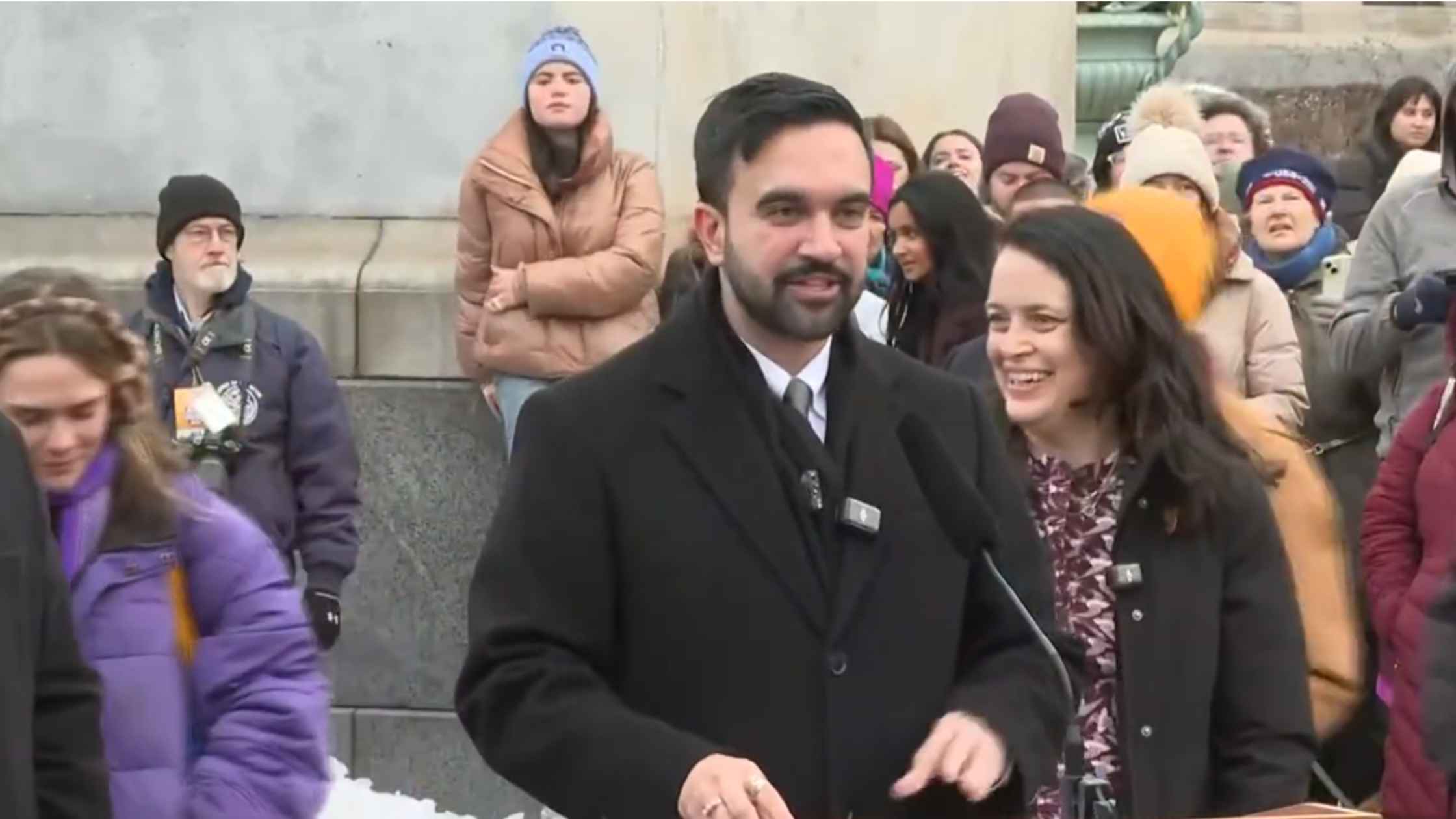
Okay. Good afternoon, everyone. One year ago, this month, hundreds of New Yorkers gather on a bright and bitterly cold Saturday morning right here at Grand Army Plaza. It was six months before the Democratic primary for mayor. We were in the low single digits in the polls at best. Every ounce of conventional wisdom said that our campaign was not supposed to work. Surely there was a better way to spend a Saturday than knocking on doors, talking to strangers and crossing the small but real distances that separate us from one another. And yet, New Yorkers showed up at a moment when so many people feel isolated from one another and distant from a political system that can feel closed or unresponsive. They made a deliberate choice, not to be bystanders, but to become participants. Their own politics and their own vision for New York City being the driving force behind what they were going to do.
(02:16)
And that meant knocking on doors of people who lived just blocks away, but whom they had never met. It meant asking questions instead of assuming answers. It meant listening instead of lecturing, finding common ground. And that experience taught us something simple and profound. Democracy works best when people are not treated as an audience, but as an active part of it. Governing demands the same. That is why we are here today. We are gathered at Grand Army Plaza, surrounded by powerful symbols of public life. The central branch of the Brooklyn Public Library, designed like an open book, a statement that knowledge should be shared and accessible to all. The Soldiers and Sailors Arch, a civil war monument honoring those who fought in a war waged for a new birth of freedom and the expansion of democracy itself. Prospect Park, public space built not to be exclusive or ornamental, but to be shared.
(03:32)
These are reminders of a belief that once guided this city, that public infrastructure should be generous, beautiful, and open. But a city is not held together by buildings alone. It is held together by trust and by whether people feel connected to the decisions that shape their life. That social infrastructure has been neglected for too long. Too often engagement is fragmented or symbolic. Too often people are asked for input, but never see how it shapes outcomes. Today, that changes. With the signing of this executive order, we will be establishing the Mayor's Office of Mass Engagement. A fundamental part of city government dedicated to rebuilding our social infrastructure at scale.
(04:25)
This office, combining and reorienting the existing community affairs unit, public engagement unit, and other initiatives, starts from a simple premise. Working New Yorkers know what they need to thrive. Our job is to make sure government listens consistently and with real consequence. The Office of Mass Engagement will organize participation across this city, proactively reach those that have been excluded and ensure that public feedback is embedded directly into how we design policies, deliver services, and make decisions. And to lead this work, I am proud to announce that Tascha Van Auken will serve as commissioner.
(05:19)
Since President Obama's first campaign in 2008 to her leadership in New York City DSA, Tascha has spent more than a decade organizing at scale, developing leadership, building trust, and helping working people turn priorities into action. On our campaign, she mobilized more than 100,000 volunteers who knocked on more than three million doors. Not just to win an election, but to build leadership and a real sense of community across the city. She also spent many years working at the Blue Man Group, which means she brings both organizing discipline and an unusual tolerance for chaos.
(06:09)
The Office of Mass Engagement reflects how we intend to govern with humility, openness, and a firm belief that democracy is strongest when it belongs to the people, not just in theory, but in practice. And we should be clear about how this work will be judged, not by how many meetings we hold or surveys we collect, but by whether people can see their voices reflected in the decisions that we make. Judge us by whether engagement changes outcomes. Just as past generations invested in the public spaces around us, this administration is investing in the civic fabric that holds our city together. And that same commitment to openness, participation, and rebuilding trust in our institutions guides how we approach every part of city government. That is why today I am also announcing that Ali Najmi will serve as chair of the Mayor's Advisory Committee on the Judiciary.
(07:13)
Under Ali's leadership, this committee will take on a more public and engaged role, reaching beyond City Hall to the wider legal community, demystifying the judicial selection process, expanding who participates in shaping our courts and ensuring that our city's judicial system applies the rule of law universally and does so without favor. This includes proactive engagement with legal services organizations, bar associations, and minority and affinity bars with the goal of widening the pipeline and strengthening confidence in our judiciary. Ali is a civil rights and election attorney with deep experience in our local courts, a longtime bar association leader who has helped diversify the judiciary in Queens and someone I've known and admired for more than a decade as a friend, an attorney, and a leader in this city. Tascha Van Auken, Ali, welcome to a new era in our city. I look forward to building it with you together.
Tascha Van Auken (08:28):
Thank you, Mr. Mayor. And thank you to everyone who's here today. As a kid growing up in Park Slope and later Flatbush, the Brooklyn Public Library, this branch was a constant in my life. Its soaring facade and open entrance felt like an invitation, a promise that knowledge, curiosity, and possibility belong to everyone. I spent hours inside of there researching school papers,
Tascha Van Auken (09:00):
Scrolling through microfilm, not to date myself here, but lots of time with microfilm, trying to make sense of the world and my place in it. I didn't know it then, but I was learning something essential that when public spaces are built with care and openness, they don't just serve cities, they help shape the people who move through them. That lesson deepened for me at Edward R. Murrow High School where I was profoundly influenced by the late principal Saul Bruckner. He believed fiercely in young people and in the role public institutions can play in helping them find their voice. He taught generations of students that they mattered and that participation wasn't reserved for someone else. And yet, despite that early confidence, I spent many years trying to figure out how to engage politically in a way that felt meaningful, something that went beyond a one-off protest or a single campaign, but built power over time. That clarity started during the first presidential campaign of Barack Obama. It was there that I learned the transformative power of relationships from learning alongside volunteer leaders to the simple but powerful act of canvassing a stranger. What I learned in 2008 stayed with me through organizing with the New York City Democratic Socialists of America and later serving in government as chief of staff to assembly woman Phara Souffrant Forrest. I kept returning to the same question. How do we build participation that lasts where people don't just show up once, but develop the confidence and the relationships to shape real outcomes? That question came into sharp focus this past year. In Mayor Mamdani's campaign, more than 100,000 volunteers knocked on over more than three million doors across the city, but those aren't abstract numbers. They represent millions of conversations between neighbors who might never otherwise have met. They represent relationships built, confidence gained, and civic capacity that will last beyond any single campaign. Many of those incredible volunteers and organizers are standing with us today.
(11:22)
You all changed New York City, and I'm so grateful to you. At a time when so many people feel cynical, overwhelmed or isolated, often alone with their phones, we found a way back to one another. Some of the most meaningful moments for me were when somebody would say, "I never thought of myself as political," and then describe the community and purpose that they found through this work. In many cases, it didn't just change how they saw politics, it changed how they saw themselves. That is what brings me to this role and to the work of the Office of Mass Engagement. The Office of Mass Engagement is about taking that ethos and making it part of how government works. It brings together public engagement efforts that have too often been siloed, streamlining them under a single coordinated office with the responsibility to make engagement meaningful across city hall.
(12:16)
It's about organizing participation at scale, strengthening feedback loops so public input shapes policy, and building the relationships and systems, human and digital, that make long-term co-governance possible. As commissioner, my commitment is simple and serious: to help build a government that works for all New Yorkers, invites them in and treats their participation as consequential. A government that doesn't just ask for input, but acts on it and one that helps New Yorkers see themselves not as spectators, but as co-creators of our shared future. I'm deeply honored to take on this responsibility. And I'm excited to build this work alongside the mayor, our partner agency, and most importantly, the people of this city. Thank you.
Speaker 5 (13:06):
[foreign language 00:13:20]. Good afternoon.
Crowd (13:20):
Good afternoon.
Speaker 5 (13:22):
Mr. Mayor, thank you for appointing me to be your chair of this advisory committee on the judiciary. As an attorney who has litigated in the courts of this city for 15 years, I know and have seen firsthand the power that judges have on people, regular people, working people, and attorneys. And it is this committee's directive to find and recruit the best judges in the city of New York, the most qualified, the ones who understand what it means for people to appear before them in criminal court, in family court. And it is the directive of this committee to reach out to the wider legal community and to the attorneys who have toiled for indigent legal services, for the attorneys who have represented families, who have represented parents and children in family court, who have dedicated their life to making this city and this state a more just place.
(14:14)
To those attorneys, I want to tell you that you have an opportunity to also become a judge and that this committee will reach out to every nook and cranny of this legal community to encourage that we have the best, most robust, diverse applicant pool for the judiciary. Mr. Mayor, thank you for entrusting me with this service.
Speaker 4 (14:41):
[inaudible 00:14:41].
(14:41)
All the way down in front.
(14:47)
Down in front, please.
(14:48)
All the way down.
(14:48)
Down in front.
(14:49)
Guys.
(14:50)
Down, down.
(14:51)
Everybody down.
(14:52)
[inaudible 00:14:54].
(14:54)
Excuse me, the fir hat.
(14:54)
All right, guys, get down. Everybody gets this shot.
(14:54)
Excuse me.
(14:54)
[inaudible 00:15:00] wants someone to squeeze in the middle here.
(14:54)
[inaudible 00:15:03] back down, please.
(14:54)
Guys, let's stay down for the TV please. Thank you.
(14:54)
Stills, everybody down.
(14:54)
Down.
(14:54)
Stills.
(14:54)
[inaudible 00:15:16].
(14:54)
Can everyone go down? [inaudible 00:15:18] please. Thank you.
(14:54)
[inaudible 00:15:23].
(14:54)
Thank you.
(14:54)
Stills.
(14:54)
[inaudible 00:15:59].
(14:54)
Sorry.
(14:54)
[inaudible 00:16:45].
(14:54)
[inaudible 00:17:14].
(14:54)
Take your time. [inaudible 00:17:33]. Stand up straight. All right.
(14:54)
Yeah. [inaudible 00:17:36].
(14:54)
You okay back there?
(17:52)
Yeah.
(17:52)
Matt, you want me to move back? Matt, talk to me.
(17:53)
[inaudible 00:17:58].
Speaker 4 (18:00):
[inaudible 00:18:00]. Guys, you need to step back, please. Thank you.
Speaker 6 (18:13):
Can you have him hold the paper, please?
Speaker 4 (18:13):
Yes. Yes.
Speaker 6 (18:13):
He's going to hold the paper. [inaudible 00:18:20].
Speaker 4 (18:13):
And let's just do one still picture in the middle [inaudible 00:18:27].
Speaker 6 (18:13):
Can you hold the legislation?
Speaker 7 (18:13):
Come here for one moment.
Speaker 4 (18:13):
For one still picture.
Speaker 6 (18:26):
Can you hold the legislation? Thank you. Here we go. [inaudible 00:18:31]. Thank you so much.
Speaker 7 (18:40):
Down the middle.
Speaker 6 (18:47):
For TVs in the back.
Speaker 4 (18:48):
Thank you. Great. Thank you, guys. All right. Now we're going to take questions. If everyone could take 10 steps back please. Thank you.
Speaker 6 (18:48):
Back everyone, please. Back, back, back. Behind the stanchion.
Speaker 4 (18:48):
Watch your back too. Don't sit [inaudible 00:18:59]. We're going to start with on-topic claims about the offices.
Speaker 6 (18:48):
Behind the stanchions, please.
Zohran Mamdani (19:07):
All right. Just before we start on-topics, if we can have one last round of applause for Tascha van Auken and Ali Najmi. And now we can begin with all the on-topic questions.
Speaker 8 (19:34):
Mr. Mayor, how are you doing?
Zohran Mamdani (19:34):
How's it going?
Speaker 8 (19:34):
Good.
Zohran Mamdani (19:34):
A little colder than I thought so I'm going to put the gloves on for a sec.
Speaker 8 (19:34):
I had two questions. Can I do an off-topic after I do an on-topic?
Speaker 4 (19:34):
Yeah. Go ahead.
Speaker 8 (19:35):
So the on-topic is about the new Engagement Office. Obviously, you work a lot on the campaign side and it's like that's separate from government. [inaudible 00:19:45]. Can you explain what are the legal differences from what you're going to do and what that [inaudible 00:19:53]? And I had a follow up.
Zohran Mamdani (19:56):
So I'll just speak a little bit to it and if you want to add anything, feel free. The work of civic engagement has existed before today. It has been a part of city government. However, it has often been siloed in different parts of city government infrastructure. Sometimes under different offices, sometimes for different initiatives. Part of the intent of this executive order is not just to create a new Office of Mass Engagement, but also to cohere all of the work that is already being done into one place, such so that we can ensure that it's not duplicative and it's actually fulfilling its intent. And then the other part of this is to transform what government deems to be acceptable when it comes to public engagement and outreach.
(20:36)
Oftentimes, the outreach and engagement of city government is done with an intention to justify a decision that's already been taken. The point of this office is however to make decisions with a large part being what the public actually thinks about those decisions. And I can think of no one better than this New Yorker to my left who fundamentally reshaped what so many across the city, including myself, thought was possible in terms of the engagement in a citywide race to bring more than 100,000 people out to knock on doors and make phone calls. Do you want to add anything? No. Sounds good.
Speaker 9 (21:16):
So what's the budget for this new office? And then also, I know today is just day two, but is this also a way to ensure that you're able to keep everybody engaged so you can get reelected again?
Zohran Mamdani (21:29):
I have to tell you, this is done with the intention of delivering for New Yorkers today, delivering for New Yorkers every single day. And I think what is so critical is that we have an opportunity in this moment where New Yorkers are allowing themselves to believe in the possibility of city government once again. That is not a belief that will sustain itself in the absence of action, in the absence of actually delivering for them. And so it is right now in a moment like this where we need to institute this kind of an office, this kind of an approach. And I would also say there is a through line between the actions taken to establish this new office and also the appointment of Ali Najmi in leading the recruitment and outreach efforts for our judicial system. Because too often the ability for a New Yorker to become a judge has been determined by who they know as opposed to the work that they do. And what Ali is going to bring forth is a newfound focus on ensuring that not only does our judicial system reflect the city that it serves, but also that it reflects a commitment to excellence and an application of the law in a universal manner.
Speaker 9 (22:39):
How many employees would they be civil service or will they be appointees?
Zohran Mamdani (22:39):
There are a number of employees within this office that are already working for the city within previously existing offices. And then the specifics of how it will expand beyond that is something that we will be sharing today later.
Speaker 9 (22:48):
[inaudible 00:22:49].
Speaker 10 (22:48):
I was talking to Sal Albanese this morning and he said one of your best qualities is you're a really good listener.
Zohran Mamdani (22:55):
That's very kind of him.
Speaker 10 (22:58):
So with respect to this new agency, can you give us an example of a time where you spoke to the public or a group of stakeholders and it made you change your mind on a certain policy or issue?
Zohran Mamdani (23:09):
A few years ago, I was an assembly member conducting a number of meetings on the MTA. My Chief of Staff, Elle Bisgaard-Church, and I were looking to put together a campaign in Albany that would look to fix the MTA. And so we had meetings with journalists, meetings with policy experts, meetings with MTA officials themselves. It was actually an MTA official who told me in one of those meetings that, "If you really cared about equity, you would focus more on the bus." And it was soon after in a meeting that I had with a friend of mine, Alicia Singh, who brought up the fact that in order to deliver not only in terms of economic relief, but also in terms of public safety, this would mean…
(23:53)
It's a pretty good song. This would mean also making buses free. And those are meetings that then informed our approach, not just to that legislative session, but then actually became a hallmark of the campaign that we ran.
Speaker 10 (24:11):
[inaudible 00:24:13] should do the same?
Zohran Mamdani (24:14):
Yes. And I think this comes back from a belief that too often in politics there is a temptation to pretend as if you have all the answers already, when in fact there is no New Yorker that has a monopoly on the answers that the city is asking questions towards. We need to have leadership and a city government that knows the answers to the most pressing questions, big and small in this city, could come from New Yorkers themselves. The answers to the very questions that are flummoxing so many in the highest levels of government could in fact be answered by those that we are currently walking past or overlooking or not even listening to.
(24:50)
And what I so love about Tascha and her work is that she sees within each person a potential to be that leader. She gives them not only the room to grow, but the belief that they can and they must grow. And that is also something that we have to deliver for New Yorkers at large.
Darla Miles (25:05):
Hi. Darla Miles, Channel Seven.
Zohran Mamdani (25:06):
Yes, how are you?
Darla Miles (25:07):
Congratulations, day one, Mayor Mamdani.
Zohran Mamdani (25:08):
Thank you very much. Good to see you.
Darla Miles (25:10):
This is, obviously, a massive undertaking, coalescing all of these individual agencies in such a large city government. On a granular level, what can you tell New Yorkers right now of what that process of streamlining that is going to look like? And then, you already have theses strategic initiatives, but when they should actually expect to see something, what a timeline might look like, what the infrastructure might look like right now, and then what that timeline might be where people can actually become involved and see some results.
Zohran Mamdani (25:39):
Absolutely. So I think, first and foremost, this has an immediate impact in terms of restructuring city government itself, where we are taking these existing initiatives and agencies, bringing them together, and that is something that will change from today. And then it will change in terms of what we expect of ourselves and how we start to engage with the public at large. And that's partially why I said we should not be measured on the number of meetings we hold or the number of surveys that are filled out. We should in fact be measured by the way in which we incorporate that feedback into the decisions that we make.
(26:09)
And that's something that I look forward to working with my Commissioner on to ensure that New Yorkers feel a difference in this era of New York City government as opposed to are just told about that difference.
Darla Miles (26:20):
Great. Thank you.
(26:21)
Thank you very much.
Speaker 4 (26:21):
off-topic as well. Yeah, Holly.
Holly (26:22):
And this one's still on top.
Speaker 4 (26:22):
Great. That's okay.
Holly (26:25):
I have a question for the Commissioner. So you're going to be getting feedback from New Yorkers to incorporate into city government, but the Mayor also has this huge agenda that's going to need support from other levels of government. And there's been discussion of using DSA and using this mass volunteer movement that you've built to pressure the Governor to support some of these initiatives like taxing the rich.
(26:50)
Is that going to be part of this office? And then I just re-up Bernadette's question about the budget and how much staff are you going to have?
Zohran Mamdani (26:57):
So I am going to demand the world from Tascha in her new position
Zohran Mamdani (27:00):
… position as the commissioner of the Office of Mass Engagement, and I'm also going to give her more than five minutes before she gets into the position, to have to answer some of the specifics around budget and personnel, though I do assure you that this is going to be an office that will have the backing of myself as the mayor of this city. And yesterday, I think it was yesterday, at the inauguration, I mentioned in my speech that let us not allow victory to become an invitation to turn off the news. We have seen sometimes in our politics a description of success as the ability for Americans to return back to their lives. We want to make clear that our successes will be achieved together with the New Yorkers who brought us to this point and all others that call this city their home.
(27:52)
So that means that our agenda is not one that is going to be fought for simply behind the closed doors of city and state government, but rather one that the very New Yorkers who are here today and those that are hard at work across the city will be a part of advocating for. Because it is those New Yorkers that actually determined this agenda in the first place, and it is those New Yorkers who will be alongside us as we not only fight for this, but win this.
Speaker 11 (28:20):
Hi. Mr. Najmi. Congratulations.
Speaker 5 (28:23):
Thank you.
Speaker 11 (28:25):
[inaudible 00:28:24] I would like to know what are you looking to do in this position that you couldn't do from the Queens Committee position?
Speaker 5 (28:36):
Thank you. Actually, I was never… In Queens and in other counties, there's an elective process, and here, with the Mayor's Committee, as chair, we will have the ability to recruit from people citywide and affect courts citywide, criminal court and family court. And what we will be able to do is have a system that's in place that will judge people on the merits of their experience, their qualifications, their commitment to public service, and we will be able to appoint many, many judges. And to have that breadth and that reach citywide is very different.
Speaker 11 (29:11):
What's the most broken about the system right now?
Speaker 5 (29:14):
Not enough people know about this system. Not enough people know about the Mayor's Advisory Committee on the judiciary, how to apply. And not enough people historically have had confidence that if you were not the well-connected or you were connected to a judge already, that you could be a judge. But in fact, in this administration, the people who never thought they could be a judge but deserve to be one will finally have that chance.
Speaker 12 (29:36):
[inaudible 00:29:37]
Speaker 13 (29:42):
Hi. Good afternoon, and [inaudible 00:29:42]
Zohran Mamdani (29:42):
Good afternoon.
Speaker 13 (29:42):
I'm John Tellez for the [inaudible 00:29:42] News.
Zohran Mamdani (29:49):
Can you say your name one more time, sir?
Speaker 13 (29:51):
John Tellez.
Zohran Mamdani (29:51):
John Tellez?
Speaker 13 (29:52):
Yes.
Zohran Mamdani (29:52):
Nice to meet you.
Speaker 13 (29:54):
What can the Latin community expect from mayor [inaudible 00:29:57]
Zohran Mamdani (29:57):
You know, I would not be standing here before you as the mayor of this city were it not for the Latino New Yorkers across the five boroughs. Latino New Yorkers, a majority of them supported us in the primary. We saw that only continue in the general, and what I've heard from so many Latino New Yorkers is a feeling that not only do they not see themselves within city government, but they don't also see their own struggles in city government, and the focuses of that government, and the priorities of that government. And what we are going to do is to deliver a city government that finally not only looks more like but is paying more attention to the actual struggles of day-to-day New Yorkers.
(30:39)
Latino New Yorkers face the highest levels of housing insecurity of any ethnic group in this city. When we are talking about the affordability crisis, it is hitting Latino New Yorkers at a disproportionate rate. And so when we talk about the necessity of freezing the rent for more than two million rent-stabilized tenants, when we talk about the urgency of making the slowest buses in America fast and free, and when we talk about the importance of transforming what is currently a $22,500-a-year expense to send a child to childcare, that is going to be critical in ensuring Latino New Yorkers can stay in this city. Because I have heard from far too many who still call themselves, they are Latino, they still call themselves New Yorkers, but they actually live in Pennsylvania now. They live in New Jersey now. And that is because we have pushed them out of the city. It's time for us to actually not only keep New Yorkers here, but start to make those who left feel like they can actually come home.
Speaker 12 (31:33):
Jacob, go ahead.
Speaker 14 (31:34):
Can I ask a two-part question? [inaudible 00:31:37]
Speaker 12 (31:36):
If you go quick, yeah.
Zohran Mamdani (31:38):
Yes.
Speaker 14 (31:39):
Would you address the criticism on the revoking [inaudible 00:31:44] How would you respond to that? And the second half is the IHRA definition on antisemitism. It's actually an issue that a lot of major Jewish groups oppose, and they support something else. Is there any measure that you would consider that would define what antisemitism is?
Zohran Mamdani (32:04):
So I was proud yesterday to sign a number of executive orders that will give my administration a clean slate to get to work on delivering a new era for New Yorkers, one where they can envision living an affordable and dignified life. And my administration will also be marked by a city government that will be relentless in its efforts to combat hate and division. And we will showcase that by fighting hate across the city, and that includes fighting the scourge of antisemitism, by actually funding hate crime prevention, by celebrating our neighbors, and by practicing a politics of universality.
(32:43)
And when we speak about the IHRA definition that you asked about, protecting Jewish New Yorkers is going to be a focus of my administration, and I also know that a number, as you said, of leading Jewish organizations have immense concerns around this definition. So what we will do is actually deliver on our commitment to protect Jewish New Yorkers in a manner that is able to actually fulfill that.
Speaker 12 (33:07):
Thank you guys so much.
Speaker 14 (33:08):
[inaudible 00:33:08]
Speaker 12 (33:08):
All right.
Zohran Mamdani (33:10):
Sorry, there was a second question.
Speaker 14 (33:11):
Would you say it wasn't intentional that this was on day one?
Zohran Mamdani (33:15):
In the first executive order, you, as the new mayor of a city, have to sign a continuation of all prior executive orders, or a revocation, or an amendment of all of them. So what we did was to sign an executive order that continued every executive order that predated the moment when our former mayor was indicted, a moment when many New Yorkers lost even more faith in New York City politics and the ability of city government to actually prioritize the needs of the public as opposed to the needs of the person. And what we will now do is showcase that new era to protect each and every New Yorker, and to deliver for those same New Yorkers in a manner that they have not seen under prior administrations.
Speaker 12 (33:58):
Thank you guys-
Zohran Mamdani (33:58):
Thank you so much.
Speaker 12 (33:59):
… so much. All right, we're going. [inaudible 00:34:04]
Crowd (34:04):
Woo!
Speaker 12 (34:04):
Yeah, if you have [inaudible 00:34:05]
Speaker X (34:04):
[inaudible 00:34:06]
Speaker 12 (34:04):
Guys, we have to keep a little bit of space, thank you.
Speaker X (34:04):
I'm sorry. [inaudible 00:34:12]
(34:04)
I hope we do better.
(34:04)
[inaudible 00:34:16]