Karoline Leavitt (00:00):
Hello everybody. Good morning.
Press (00:00):
Good morning.
Karoline Leavitt (11:43):
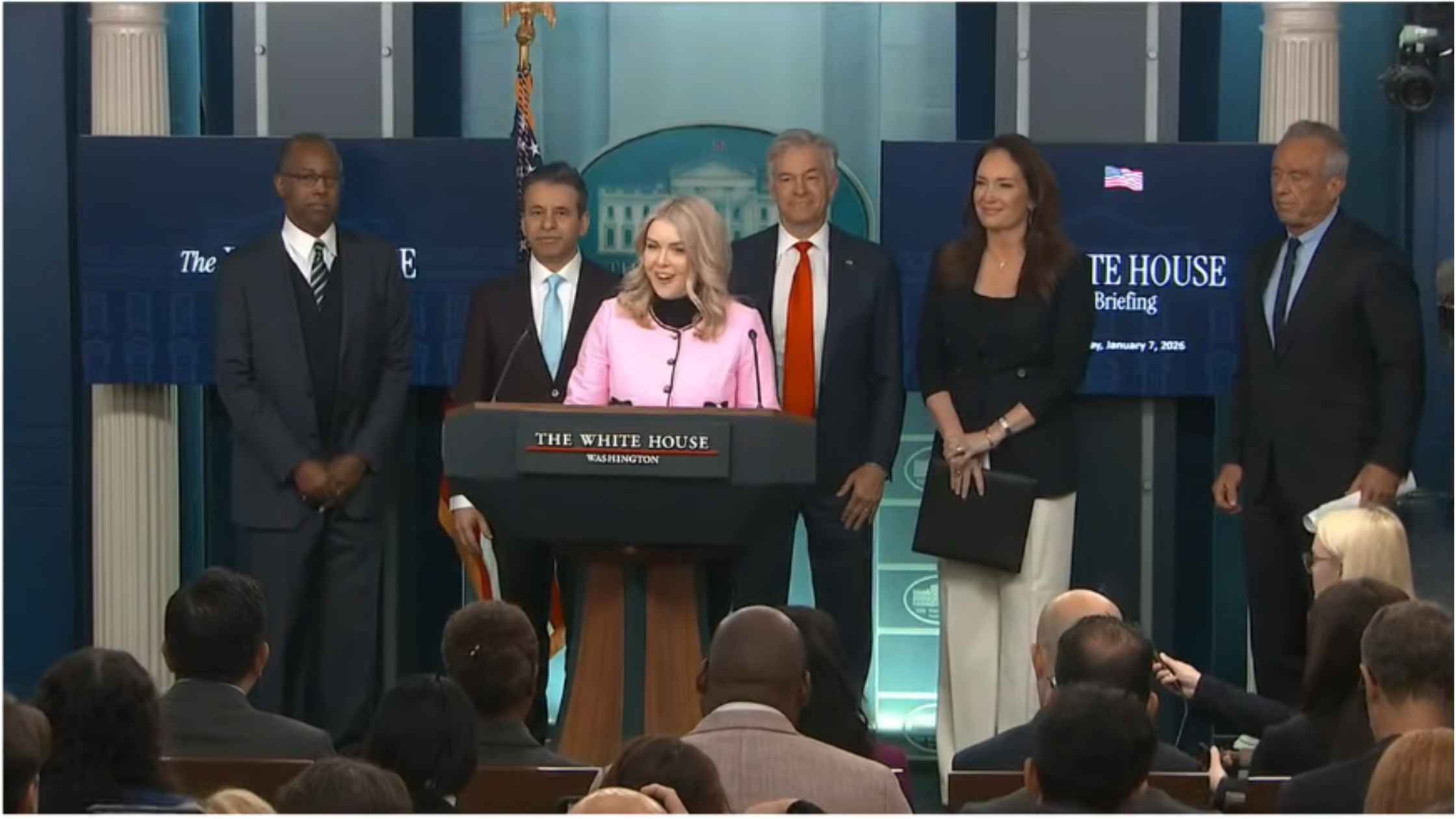
Yes. Come on up everyone. Lovely officials with me today. All right. Dr. Carson, come on up. Thank you so much. Good morning and happy new year everybody. It's great to see you. It's great to be with a very packed room. I'm sorry we kept you all very busy over the holiday break. And I know there is a lot of news out there today, both here at home and around the world. I will be happy to take all of your questions on all of that news. But first, I'm really honored to be standing up here today with esteemed members of the president's cabinets and his health team to make an important announcement with respect to the president's domestic promise to make America healthy again as we kick off the new year.
(12:22)
In less than a year in office, the president and his incredible MAHA team have made real progress on this front. Here are just a few of the significant MAHA achievements thus far. More than a dozen food manufacturers and trade associations have made commitments to remove artificial and petroleum based food dyes from their products. The Trump administration took strong action to bar hospitals from performing dangerous, irreversible, life-altering transgender procedures on children. The Trump administration announced funding awards to states through the Rural Health Transformation Program, an unprecedented $50 billion investment established under President Trump's One Big Beautiful Bill.
(13:07)
The Trump administration has also worked with 18 states across the country to ban junk food purchases using SNAP benefits starting this year. And thank you for leading that effort, Secretary Rollins. Additionally, President Trump took historic action to secure most favored nation drug pricing and secured deals with major pharmaceutical companies to massively lower the cost of prescription drugs. And those effects are being implemented as we speak. Americans are going to continue to see the result of these incredible deals the president cut. And I know President Trump and this team behind me worked incredibly hard to lower those drug costs for Americans.
(13:46)
On Monday, the CDC adopted common sense updates to America's childhood vaccination schedule based solely on the gold standard of science. This action empowers parents and physicians to make the best individualized decisions to protect our children while also restoring much needed confidence in our public health system. And as a MAHA mom myself, I'm very grateful for that. So thank you, Secretary Kennedy. To build on this progress, the Trump administration is now updating federal nutrition standards and guidelines to ensure that Americans have the most accurate, data-driven information supported by science and hard facts, not special interests or partisan ideology. President Trump has tasked two of the great individuals behind me, USDA Secretary Rollins and HHS Secretary Kennedy, with collaborating on this vitally important project. And today they are here to officially unveil the 2025 to 2030 dietary guidelines for America.
(14:46)
These new guidelines are informed by the best and most reliable research on health and nutrition, particularly as it relates to the role of our diets and the prevalence of chronic disease in the country. These guidelines are easy to read and understand so every American, young and old can access this information that literally has the power to change lives. But these are not just an updated guideline. These are the foundation to all federal food programs in our country. These new guidelines are going to update the food that is served to America's children in our public schools, to the plates that are served to our great men in uniform in our military, our veterans in the food that they are consuming at the VA. And these new guidelines are also going to impact nutritional programs for the needy in our country, such as WIC and Head Start.
(15:38)
Unfortunately, for decades, federal dollars has promoted low quality, highly processed foods that lead to scores of long-term health issues, which means Americans have gone broke because of these health issues. Faulty dietary guidelines of the past stacked the deck against healthy eating and food options for everyday American families, which has fueled the chronic disease epidemic and jacked up the healthcare costs of households across the country. This failed approach in our public health system ends today. When these guidelines are followed, Americans will be saving themselves thousands of dollars.
(16:15)
If we want to cut healthcare costs in our country, we must become a healthier country. According to the CEA, poor diet is the root cause of obesity, which accounts for $400 billion in medical spending each year. A healthier America will lead to a more affordable America. The new dietary guidelines from the Trump administration will ensure federal dollars go to real food to improve public health and therefore save the American people their hard-earned cash over the course of their lives. So with that, I am going to hand it over to Secretary Kennedy. The great people behind me will give remarks and then we'll get into Q&A. For the officials that are here on this specific topic, they will leave because they're all very busy people, and then I will open it up to Q&A with the rest of you on the rest of the news in the world. So thank you, and we'll start with Secretary Kennedy.
Robert F. Kennedy, Jr (17:04):
Thank you, Karoline.
Karoline Leavitt (17:05):
Thank you.
Robert F. Kennedy, Jr (17:10):
Today marks a decisive change in federal nutrition policy made possible by President Trump's leadership and the work of MAHA moms and public health advocates who demanded reform. Today, in accordance with President Trump's directive, Brooke and I will release the dietary guidelines for Americans 2025 to 2030, the most significant reset of federal nutrition policy in history. These guidelines replace corporate-driven assumptions with common sense goals and gold standard scientific integrity. These new guidelines will revolutionize our nation's food culture and make America healthy again. For decades, Americans have grown sicker while healthcare costs have soared. The reason is clear. The hard truth is that our government has been lying to us to protect corporate profit taking, telling us that these food-like substances were beneficial to public health. Federal policy promoted and subsidized highly processed foods and refined carbohydrates and turned a blind eye to the disastrous consequences. Today, the lies stop.
(18:27)
The new guidelines recognize that whole nutrient- dense food is the most effective path to better health and lower healthcare costs. Protein and healthy fats are essential and were wrongly discouraged in prior dietary guidelines. We are ending the war on saturated fats. Diets rich in vegetables and fruits reduce disease risk more effectively than many drugs. Whole grains outperform refined carbohydrates. Added sugars, especially sugar sweetened beverages, drive metabolic disease. And today, our government declares war on added sugar. Highly processed foods loaded with additives, added sugar, and excess salt damage health and should be avoided.
(19:17)
As Secretary of Health and Human Services, my message is clear, eat real food. Nothing matters more for healthcare outcomes, economic productivity, military readiness, and fiscal stability. Dietary guidelines shape dozens of federal feeding programs, including Head Start. These standards affect 45 million school lunches every day, meals for 1.3 million active duty service members, and food served to nine million veterans in VA hospitals. Today begins the work of aligning those programs with affordable, whole, nutrient-dense food.
Robert F. Kennedy, Jr (20:00):
Implementation requires coordination across the government. I'm working with many of my fellow cabinet secretaries to deliver results. I want to thank Bobby Mukkamala. Thank you very much, who is the president of the American Medical Association for committing to mobilize the medical community on nutrition. And I thank also the American Academy of Pediatrics for partnering on this effort. I also look forward to working with Dr. Jay Bhattacharya and Dr. Marty Makary to fund and prioritize rigorous nutrition research at the NIH and at the FDA. The stakes are measurable and severe. A Johns Hopkins analysis estimates that 48% of every federal taxpayer dollar now goes to healthcare. The CDC reports that 90% of healthcare spending treats chronic disease. That means that 40%, 40 cents of every dollar that taxpayers pay in this country is going to treat diseases that could be averted through good food. The United States has the highest obesity and type two diabetes rate in the developed world.
(21:17)
We spend three times more per capita than the European Union on healthcare yet our life's expectancy is five years lower, largely due to diet related chronic disease. Our childhood obesity rate is five times higher than countries like France. One third of US teens have prediabetes, over 35% are overweight or obese and 20% of young adults have non-alcoholic fatty liver disease. 77% of military aged Americans are ineligible for military service because of diet related conditions. If a foreign adversary sought to destroy the health of our children, to cripple our economy, to weaken our national security, there would be no better strategy than to addict us to ultra-processed foods. It's shocking that our own government helped to drive these cataclysmic changes in our diet. The damage is real. It is preventable and President Trump has ordered it to end. If the United States reduced obesity, type two diabetes, heart disease and Alzheimer's, the Japanese levels, we would save approximately $600 billion a year.
(22:38)
About 50% of Medicare's projected long-term deficit or $5,000 per family annually. Current policy worsens the problem. 42 million Americans rely on SNAP or common purchases include sugary drinks, candy, and chips. 78% of SNAP recipients are enrolled in Medicaid and 90% of Medicaid spending goes to chronic disease. These incentives raise healthcare costs and undermine health. This must change. A new framework centers on protein and healthy fats, vegetables, fruits, and whole grains, and you can see the food pyramid here.
(23:29)
It's upside down, a lot of you will say, but it was actually upside down before, and we just righted it. For the first time, the dietary guidelines directly address ultra-processed foods and set firm sugar limits and federal procurement, driving a significant reduction in added sugar in school meals. I want to thank President Trump for his leadership and the partners committed to ensuring that federal food dollars support real food and better health. Thank you.
(24:03)
And I want to introduce my partner and a friend, Brooke Rollins, who is an extraordinary collaborator on this.
Brooke Rollins (24:12):
Thank you. Well, good morning everyone. Happy New Year. What a honor to be here. I think this is Karoline's first press conference back and what a great way to start the new year, 2026. I want to thank Secretary Kennedy. Your commitment to the wellbeing of Americans is such a blessing to this nation. We have been working on these new dietary guidelines really since almost day one. Bobby and I were voted on on the same day and sworn in on the same day. So, I think the partnership from minute one has been real and extraordinary. As Secretary Kennedy mentioned, America is in the middle of the worst chronic health crisis in our nation's history. Over 40% of the roughly 73 million children in the United States have at least one chronic health condition, and nearly 90% of healthcare spending goes toward treating people with chronic disease.
(25:13)
Secretary Kennedy mentioned that, but it is really important to keep underscoring that fact. This crisis is unacceptable. It prevents Americans from living healthy and happy lives. And for decades, decades under both Republicans and Democrats, federal incentives have promoted low quality, highly processed foods and pharmaceutical interventions instead of prevention. As a result, nutrient dense, whole foods grown by America's farmers and ranchers have been increasingly displaced. The Trump administration is acutely aware of this danger, and today this announcement is making a major step in doing something about it. Thankfully, the solution is simple and should be non-controversial. Eat real food. This is the main message of the new dietary guidelines for Americans 2025 to 2030, which encourage households and schools to prioritize whole nutrient dense foods. That means more protein, more dairy, more healthy fats, more whole grains, more fruits and vegetables, whether they are fresh, frozen, canned, or dried.
(26:25)
We are finally putting real food back at the center of the American diet. Real food that nourishes the body, restores health, fuels energy, and builds strength. This pivot also leans into the abundant, affordable and healthy food supply already available from America's incredible farmers and ranchers. By making milk, raising cattle and growing wholesome fruits, vegetables, and grains, they hold the key to solving our national health crisis. And President Trump is mobilizing government to ensure families across America have greater access to these healthy foods. In the past 12 months, inflation has slowed and wages have risen for the first time in five years. Under President Trump's leadership, prices for everyday staples are declining and more help is on the way. Recent data show that fruits, vegetables, dairy, and proteins, including eggs, pork, and ground beef, are becoming even more affordable every day for our American people. American households enjoy the most affordable and abundant food in the world, and today's release only reinforces that reality.
(27:38)
A healthy meal is within reach for all American families. These new dietary guidelines are a framework which is meant to be customized to meet the needs, the preferences, and the financial status of all American families. For example, a meal including such items as pork or eggs or whole milk or cheese, tomatoes, other fresh and frozen fruits and vegetables, whole grain bread, corn tortilla can cost today right around $3 for that meal, $3. And soon, USDA will finalize our stocking standards, which means that those businesses in America that take the SNAP benefit, what they are required to stock in order to take that benefit… By the way, that's almost 250,000 retailers across America that very soon we will be finalizing that rule that will mandate all 250,000 retailers in America double the type of staple foods that they provide for America's SNAP households. This means healthier options will be in reach for all American families, regardless of circumstance at levels never seen before in our country.
(28:50)
These dietary guidelines are foundational to so many USDA programs and their introduction marks the first step in connecting America's schools and dinner plates to the best of American agriculture. Make no mistake, under President Trump's leadership, we are restoring common sense. We are restoring scientific integrity, and we are restoring accountability to federal food and health policy. The new guidelines are all about putting the wellbeing of Americans first, exactly where it should have been all along. This is the foundation that will make America healthy again, not just for those of us alive today, but for our children and our children's children and those coming behind. I want to end by saying God bless American families. God bless the American farmer and rancher, and God bless America. What an honor now to introduce another great partner in this incredible work, and that is Dr. Mehmet Oz. Thank you.
Mehmet Oz (29:49):
Congratulations to Secretary Rollins, Secretary Kennedy, and do want to express my appreciation for what the president has done overall to increase the affordability of healthcare. The biggest accomplishment perhaps for the health system, abilities to drop down prices last year was the most favored nation drug pricing that Karoline mentioned. These are incredibly effective at reducing the costs, for example, of what the president calls the fat shot, the Ozempic, GLP-1 category of medications. We dropped them dramatically, but the best way to reduce drug spend in America is to not need the drugs in the first place. What you're hearing today with these dietary guideline adjustments are going to be massively effective and not just dropping the need for us to buy these weight loss drugs, but buy these expensive drugs for autoimmune problems. We have evidence that food is medicine when it comes to conditions from various mental health issues from the Alzheimer's and depression to fundamental realities of how children's learn in school.
(30:49)
So, the question then becomes, what is this actually going to do in dollars and cents? And I had the group at CMS run some numbers for us to try to give you concrete assessments of how much this will drop the spend that the federal taxpayer must make for Medicare and Medicaid. And I'm more optimistic today than ever that we can address the critical, the fast rising rate of healthcare expenses in America because of movements like this. Right now, we're increasing health expenditures in America at roughly twice the rate of the GDP growth. We will correct that if we can get America to be healthier, because you can't be a wealthy nation without being a healthy nation. So, two numbers for you to remember. The first is $30 billion. Why? 30% of healthcare costs are directly attributable to obesity. I'm not talking about indirect associated expenses which are also present, but a very conservative number, 30% are directly attributed to obesity.
(31:40)
That's about $300 billion a year for just Medicare, just Medicare. If we were to affect obesity by 10%, which is an incredibly conservative and justifiable assumption that has been born out in evidence-based dietary experiments and trials, just that alone is $30 billion of reduction of expenses for Medicare. That's also obviously correlated with Medicaid reduction in spending. In Medicaid, it's a different opportunity because in Medicaid, we educate children. 53% of children in America are covered by Medicaid or CHIP. And we have programs to teach kids and their parents what to eat, how to eat, and how to make these dietary guidelines that Secretary Kennedy have crafted with their teams into practice. It will dramatically change the natural history of how children are able to participate in life. But let me give you one last number. If we're able to get the average American who today retires on average at age 61, get them just to work one year longer because they feel so vital, so strong, so bullish about their future because they're feeding their bodies nutrients that are essential to their high functioning productivity, we will increase the overall GDP of our nation by trillions of dollars. So we will reduce healthcare expenses at the same time we jazz up the US economy with trillions of dollars created by the productivity of American workers. God bless you both for making the DGA feasible and making it perhaps the wisest investment we could make in our communities. Marty Makary is one of my closest friends, the powerful leader of the FDA who's been taking brave steps along the line and has additional insights.
Marty Makary (33:17):
Thanks. Thank you, Dr. Oz. Today marks the beginning of the end of an era of medical dogma on nutrition. For decades, we've been fed a corrupt food pyramid that has had a myopic focus on demonizing natural, healthy, saturated fats, telling you not to eat eggs and steak and ignoring a giant blind spot. Refined carbohydrates, added sugars, ultra processed food. This study in JAMA now shows that 60% to 70% of kids are getting their calories from ultra-processed foods. That's an epidemic. We now have a generation of kids addicted to refined carbohydrates, low in protein. They are literally nitrogen negative because we've used old flawed studies that used urine nitrogen to estimate body protein metabolism, and they missed the mark. The old guidelines had such a low protein recommendation that we are increasing that by 50% to 100%. Kids need protein. The old protein guidelines were to prevent starvation and withering away.
(34:32)
These new protein guidelines are designed for American kids to thrive, and they're based on science, not on dogma. We have 40% of our kids now with a chronic disease. It is not their fault. This is something that is the result of bad advice from the government and a medical establishment that for decades pedaled research from a flawed 1960s model. Today, we are setting the record straight. This is not a willpower problem of our nation's kids. This is something adults have done to kids and we're going to fix it. And so, as Dr. Oz said, the best way to lower drug prices is for people to stop taking drugs they don't need. We are going to finally address the root causes of our broken healthcare system, insulin resistance and general body inflammation advanced by the protein poor, micronutrient poor, ultra- processed, refined carbohydrate diet that kids are addicted to today.
(35:34)
And so, on behalf of the Food and Drug Administration, we are proud to be a part of this. We are grateful to be contributing to this work. Thank you, Secretary Rollins. Thank you, Kyle Diamantas, the best deputy commissioner for food at the FDA the agency has ever had. This is a historic day in America. Thank you. Karoline.
Karoline Leavitt (35:59):
Thank you so much. Thank you. I hope everyone's inspired to go eat a salad for lunch after this briefing. If anybody has questions on this topic, we will take a few and then we'll get into the topic. We'll start with our new media seat. If you have a question on this topic today, Jayme Franklin, she comes from The Conservateur. Why don't you kick us off?
Jayme Franklin (36:15):
Yeah. First of all, Karoline, congratulations on your pregnancy. We're so excited for you.
Karoline Leavitt (36:19):
Thank you.
Jayme Franklin (36:20):
MAHA moms across the country, including myself, are just so excited by what this administration is doing to make our kids healthy again. But we do have concerns when it comes to these blue states pushing back on a lot of progress that we're making as an administration. And particularly, we're really excited that you guys revise and streamline this vaccine schedule. However, what we have seen is that these blue states, whether it be no tax on tips, no tax on overtime or pushing back on immigration, they continue to stop your guys' progress. So, what has been the response from these blue states? Because MAHA moms enrolling our kids in school, this is a big issue and we celebrate what you guys are doing, but we want to have it even in the blue states as well.
Robert F. Kennedy, Jr (37:02):
I mean, my hope is that we only released these earlier, two days earlier. I'm sorry.
Brooke Rollins (37:12):
Duck is also high in protein.
Karoline Leavitt (37:14):
That's an interesting…
Brooke Rollins (37:16):
Duck is a good thing to eat, everybody.
Robert F. Kennedy, Jr (37:18):
We only released the new vaccines schedule two days ago. The vaccine schedule, there's nothing compulsory in it. Everybody, I've always promised I'm not going to take people's vaccines away from them. People who want to get vaccines, everybody who wants them can get all of the vaccines that were on the old schedule. They will all be paid for by the Vaccines for Children program or for the insurance the same as before. We release guidelines that we think are optimal to public health. They're the same core vaccines that are required by the European community. And those nations all have much better health outcomes than we do. And they're based on their best science and also on their conviction that when you put too many vaccines on the program, it actually reduces compliance. It reduces uptake. And so we want to maximize the uptake of vaccines by making sure that Americans know that we are making recommendations that are science-based, that are common sense, that are grounded in science.
(38:31)
And right now, that's the best science that we have. And again, there's three categories of vaccine. One is the core schedule, which resembles the European countries. The second is for people who have vulnerabilities for high risk, and that doesn't change at all. And then the third is shared decision making, which any vaccine that was on the old schedule, you can continue to get. So, people will make their own choices, and that's what democracy is about.
Brooke Rollins (39:05):
I asked the boss, Karoline, for permission to add a little bit to this because I think it's really important. And by the way, Jayme, what a superstar you are. It's so fun to see you in this seat, Jayme Franklin. The blue state question is a really important one. And for those of us that are running agencies with these programs, I mean, I've talked to a lot of you already about how we have 22 blue states that won't give us their SNAP data so that we can figure out and ensure that those who really need these programs are actually getting these programs. Clearly, you all have been writing about Minnesota, California's next. We're looking at New York, some other states. The amount of fraud in all of these programs is absolutely stunning. And the challenge is, I mean, for Medicaid, et cetera, I know Dr. Oz, you've talked a lot about that.
(39:47)
This is a significant problem. And I think who's really harmed in all of this conversation and when these blue states aren't partnering with us to try to do this right is we say blue states and red states, but in those states, there
Brooke Rollins (40:00):
… are all kinds of our citizenry and that aren't all Democrat or aren't all Republican. We had a poll that just came out that had about 85% of all Americans believe that states should turn their data over on SNAP so that we can figure out where the fraud is and ensure these programs are going where they need to go. So my request of these blue states and these blue state governors is partner with us. Let us figure out how to do this better. Let us make sure that whether it's the vaccine schedule or the SNAP program or the Medicaid program or the childcare program, that we are doing everything we can to protect every tax dollar, but to also ensure those who need it the most, the most vulnerable in our society, are getting the programs they need versus those who A, are not even supposed to be here, or B, are cheating the system.
Karoline Leavitt (40:49):
Jeff.
Speaker 1 (40:50):
Thanks, Karoline. One of the changes that was made had to do with alcohol. Secretary Kennedy or Dr. Oz, could you explain the science behind the new language on not saying two drinks for men and one drink for a woman every day would be healthy, and whether or not the industry had an impact on the language of moderation versus just saying "alcohol is not healthy and you shouldn't drink it"?
Mehmet Oz (41:14):
So alcohol is a social lubricant that brings people together. In the best case scenario, I don't think you should drink alcohol, but it does allow people an excuse to bond and socialize. And there's probably nothing healthier than having a good time with friends in a safe way. If you look at the blue zones, for example, around the world where people live the longest, alcohol is sometimes part of their diet. Again, small amounts taken very judiciously and usually in a celebratory fashion. So there is alcohol on these dietary guidelines, but the implication is don't have it for breakfast. This should be something done in a small amount with hopefully some kind of an event that might have alcohol at it. But they general move away from two glasses of men, one glass to women. There was never really good data to support that quantity of alcohol consumption. That data was probably primarily confused with broader data about social connectedness.
Karoline Leavitt (42:07):
Take a couple more. John.
Speaker 2 (42:08):
Thanks a lot, Karoline. Secretary Rollins, I'm curious about with these guidelines, they're not mandates, they're guidelines. What are the practical effects of these guidelines on public schools all across the country?
Brooke Rollins (42:23):
Thank you, John. It's good to see you. Today begins the first day now in a recalibration of the rules, whether it's school lunches, whether it's the SNAP program, whether it's the… veterans were mentioned, our prison system, that now we begin the process of implementing and redrafting the rules to reflect what this new dietary guidelines for Americans actually is doing to our food system. So there is a lot of work to do. Nothing changes overnight. But as I think we've proven, this administration moves very, very quickly on all fronts, seven days a week, 365 days a year. And so you'll begin to see some real changes coming very soon.
(43:04)
As everyone is aware, for many of our most vulnerable in the margins in our communities, the school lunch is often the best place for our children to get the healthiest meal. Hopefully with stocking standards and reworking SNAP and the SNAP waivers we've done, that begins to change too. But right now, that is going to be the single most important, from my perspective, move forward is the school lunches and making sure that we're getting the right amount, the best amount and most nutrient-dense foods into the schools. Thank you.
Speaker 2 (43:36):
You also mentioned, Secretary Rollins, cost when you had your remarks a little bit earlier. Is eating healthier more cost-effective? Is it cheaper than just having a diet of processed foods?
Brooke Rollins (43:49):
I had a whole chart to show you, but left it in the back, unfortunately, that yes indeed that eating healthy for the most part, we've got a hundred simulations is actually less expensive. The challenge comes is the access to those healthy foods, especially in parts of America where they have food deserts. They don't have a H-E-B or a Kroger or a Central Market. These are all Texan grocery stores, but whatever's similar across the country. But that is why these stocking standards in SNAP are so important. So if you have a economically-challenged family and the only place they're getting their food is the 7-Eleven, we have a longer-term important policy priority, and that is getting grocery stores into these lower margin communities. But for now, requiring those retailers, those 250,000 retailers across America, to double their stocking of healthier foods, that will allow us to immediately get these better foods into all communities, but especially the most vulnerable. Thank you, John.
Robert F. Kennedy, Jr (44:55):
Let me just add something to that. Brooke and I are working on a program. Affordability is the priority for the president, and we know we have to make it easy and accessible for healthy foods for every American. And we believe we can do that. We think affordable food is within reach of every American family. We are working on a education and information program that will allow American families all over the country to come onto our website and find healthiest foods at the lowest cost for themselves. And also just add this, the idea that a cheap meal made of processed food is cheap is an illusion because you're paying for it on the back end. You're paying for it with diabetes, with obesity, with illness. And if you internalize that cost of the meal, it would be a tiny fraction of the long-term cost of eating bad food.
Karoline Leavitt (45:59):
We'll take one more, in the white blazer.
Speaker 3 (46:01):
Thank you, Karoline. Secretary Kennedy, you mentioned healthy fats, but also ending the war on saturated fats. Can you clarify how much saturated fats Americans should be consuming?
Robert F. Kennedy, Jr (46:14):
I'm going to let Marty take that since he wrote a book about it.
Marty Makary (46:19):
The old dogma in the 1960s when Eisenhower had his heart attack and Ancel Keys said it was the saturated fat, that's never been substantiated. And so that flawed research has become dogma over the years, and eventually the conversation was sidelined. In this new guidance, we are telling young people, kids, schools, you don't need to tiptoe around fat and dairy. You don't need to push low fat milk to kids. And we are maintaining the 10% of calories as saturated fat in the guidance. The real issue is protein, the fact that 60 to 70% of the calories of kids today in America is ultra-processed food. These are the issues that have become giant blind spots where we're now putting attention.
(47:04)
And we hope that there are conversations in every school board in America, in every church and synagogue and house of worship, every home in America will now have conversations. We've got to talk about school lunch programs, not just putting six-year-olds on Ozempic. Food can be curative. We've got to talk about the microbiome and fiber and healthy whole grains and the good soil that food comes from and the healthy, clean waters and good farming techniques. So that's the focus of this guidance. Thank you.
Karoline Leavitt (47:31):
Great. Some of you may be wondering why Dr. Carson is here. He is our national nutrition advisor working alongside Secretary Kennedy, and he's played a big role in this effort. So I want to thank you so much, Dr. Carson, for being here today. And thank all of you for being here today. I know you're all very busy people, and these people have a lot of questions on things other than diet, I'm sure. So I'm going to get to work and thank you guys so much for coming.
Brooke Rollins (47:55):
Thanks everybody.
Karoline Leavitt (47:59):
Thank you. [inaudible 00:48:00], please.
Brooke Rollins (47:59):
Okay. I got it.
Karoline Leavitt (48:01):
Thanks. Okay. Thanks. All righty. Great. Does anyone have any questions? Rachel, why don't you start?
Speaker 4 (48:10):
Thank you, Karoline. The president has been adamant that he is now in charge of Venezuela, but Delcy Rodriguez said the government of Venezuela runs her country, no one else, saying, quote, "There's no external agent governing Venezuela." So which one is it?
Karoline Leavitt (48:25):
Let me just be very clear. This is the first time that I've addressed Venezuela from the podium since being back and since the historic and incredibly successful military operation, law enforcement operation conducted by our United States military that you all saw and the world witnessed last week. The skill, the might of the United States military and our country under the leadership of this president is on full display to the rest of the world. And let's just set the record straight. There isn't another military in the world who could have pulled off this operation. There is not another president in the world or in our nation's history who had the courage to authorize such a mission. And I think the world has taken notice that America is truly back.
(49:06)
With respect to Venezuela, the Trump administration led by Secretary Rubio, the vice president and the president's entire national security team is in close correspondence with the interim authorities in Venezuela. We obviously have maximum leverage over the interim authorities in Venezuela right now, and the president has made it very clear that this is a country within the Western Hemisphere, close by the United States, that is no longer going to be sending illegal drugs to the United States of America. It's no longer going to be sending and trafficking illegal people and criminal cartels to kill American citizens as they have in the past. And the president is fully deploying his peace through strength foreign policy agenda. So we're continuing to be in close coordination with the interim authorities and their decisions are going to continue to be dictated by the United States of America.
Speaker 4 (49:58):
Just one follow up when you talk about that leverage there. Has the Venezuelan government fully committed to turning over its oil to the United States indefinitely, and what happens if they do not?
Karoline Leavitt (50:08):
Well, as you saw, the president announced last night, this was a deal. This was a deal made by the president and his team with the Venezuelan interim authorities. This will benefit both the American people and the Venezuelan people. And Secretary Wright and the Department of Energy are working with the interim authorities and also with the private oil industry to execute on this historic energy deal that's not only good for the United States, but it's also going to revive the prosperity, the safety, the security of both the United States and Venezuela as well. Ed.
Speaker 5 (50:36):
Following up on the oil part of this, 30 to 50 million barrels of oil, how exactly is that going to work? You're getting it out of Venezuela into the United States?
Karoline Leavitt (50:46):
Yes.
Speaker 5 (50:46):
And then what?
Karoline Leavitt (50:47):
That's exactly right. So as you know, Ed, as the president announced last night, this was the sanctioned oil that was basically just sitting in barrels, sitting on ships because of the effective quarantine of the United States of America. And the interim authorities have agreed to release that oil to the United States, so it will be arriving here at home very soon. The United States government has already begun marketing Venezuelan crude oil in the global marketplace for the benefit of the United States, engaged the world's leading commodity marketers, key banks to execute and provide financial support for these crude oil and crude product sales. All proceeds from the sale of Venezuelan crude oil and products will first settle in US controlled accounts at globally-recognized banks to guarantee the legitimacy and integrity of the ultimate distribution of proceeds and those funds will be dispersed for the benefit of the American people and the Venezuelan people at the discretion of the United States government.
Speaker 5 (51:40):
It sounds like it requires a lot of private sector engagement and agreement from the oil industry and the banking industry.
Karoline Leavitt (51:47):
That's right.
Speaker 5 (51:47):
Do you have that yet?
Karoline Leavitt (51:48):
There's a lot of private sector engagement that's happening right now. As you know, Secretary Wright, our energy secretary who's heading up this big project, is in Florida today meeting with some of these oil executives. And as we confirmed earlier, they will also be at the White House later this week. So they are absolutely eager to invest. They're eager about these opportunities. And Secretary Wright is a very well knowledgeable guy when it comes to oil and energy, and he's the perfect man for the job.
Speaker 5 (52:12):
Another corner of the world, real quick on Iran.
Karoline Leavitt (52:13):
Go ahead.
Speaker 6 (52:16):
So just to follow up on the oil, 30 to 50 million barrels is an initial tranche, if you will, and then what happens after that? What are the plans going forward?
Karoline Leavitt (52:26):
I won't get ahead of the plans that the president and his team are currently speaking with the interim authorities about, but rest assured, there is a long-term plan here. Secretary Rubio and the entire team are working diligently on it, and this is just sort of the first action that you all are seeing.
Reporters (52:40):
Karoline.
(52:41)
Karoline.
Karoline Leavitt (52:41):
Ed.
Speaker 7 (52:42):
So in order to get these oil companies to invest billions in Venezuela, how will the US reassure that their workers will be safe in Venezuela? Could there be troops involved?
Karoline Leavitt (52:52):
At this point in time, as you know, there are no troops on the ground in Venezuela. The president, of course, reserves the right to use the United States military if necessary. It's not something he wants to do. Diplomacy is always the first option. As you saw, he tried that with Nicolas Maduro, but unfortunately he was an illegitimate dictator and an unserious person. And so President Trump authorized this law enforcement operation, and now Nicolas Maduro is sitting in a prison cell in New York. So certainly the president is going to do what's in the best interest of the American people, and that includes workers from our energy and oil industry as well.
Speaker 7 (53:29):
With that meeting tomorrow, what is the message the president is going to give to the oil executives, and what does he want to hear?
Karoline Leavitt (53:29):
Well, the meeting is on Friday, and it's just a meeting to discuss obviously the immense opportunity that is before these oil companies right now.
Reporters (53:36):
Karoline. Karoline.
Karoline Leavitt (53:37):
Steven.
Speaker 8 (53:38):
Thank you, Karoline. And congratulations again.
Karoline Leavitt (53:40):
Thank you.
Speaker 8 (53:41):
The New Yorker had a story yesterday on the vice president, and it questioned his, quote, "notable absence on Venezuela." And the sub-headline asked, "Was the vice president's exclusion from the operation of Venezuela an expression of this anti-interventionist ideology or political calculation?" Would you be able to discuss the vice president's role in Venezuela policy?
Karoline Leavitt (54:03):
I did see that report in The New Yorker, and quite frankly, I laughed out loud because it's very clear it's a fake report that's trying to sow distrust and division amongst the president and his team. Let me just be very clear. The vice president has been involved in all policy. He is the right-hand man of the president on all policy matters, including Venezuela policy. He was of course read in and deeply involved in this operation from the very beginning, and he was present on the night of the operation via secure communication at a different location as to not damage the operational secrecy of this mission that was so incredibly important to ensure that this mission could be carried out successfully without endangering our troops.
Reporters (54:49):
Karoline.
(54:49)
Karoline.
Karoline Leavitt (54:49):
Sure.
Speaker 9 (54:50):
The US seized a tanker recently. Russia specifically asked the United States not to seize that tanker. Does this action risk a larger conflict with Russia?
Karoline Leavitt (55:03):
I believe you're referring to the Bella 1 tanker that was seized this morning. The Department of Justice and the Department of Homeland Security in coordination with the Department of War did announce that seizure this morning for violations of US sanctions. I've spoken about the enforcement of our sanctions policy at the podium prior to the new year, and this administration is going to fully enforce the sanction policy of the United States. The vessel this morning was seized in the North Atlantic pursuant to a warrant issued by a US federal court after being tracked, and this was a Venezuelan shadow fleet vessel that has transported sanctioned oil. And the United States of America under this president is not going to tolerate that. I would also just add the vessel had a judicial seizure order in the crew. So that means the crew is now subject to prosecution for any applicable violation of federal law, and they will be brought to the United States for such prosecution if necessary.
Reporters (55:57):
Karoline.
Karoline Leavitt (55:58):
Kelly.
Speaker 10 (55:58):
Karoline, happy new year to you.
Karoline Leavitt (55:59):
Thank you. You too.
Speaker 10 (56:01):
I'd like to talk to you about a couple of things real quickly. The first question about the Venezuelan people. As you know, there's some eight million Venezuelans here, some of them celebrating in the streets. There are Venezuelans on the ground who are concerned about their safety. What does the Trump administration… What is it doing to actually help people in Venezuela understand that they will be secure throughout this transition?
Karoline Leavitt (56:24):
I think the fact that this president actually followed through on the long-held promise of the United States of America, the bipartisan promise to take down the illegitimate Maduro regime, should give assurance to the Venezuelan people and also Venezuelan Americans who fled this communist regime for a better life here at home, that this is a president who is serious about taking down illegitimate regimes and who is also serious about securing the security of the United States of America, including the Venezuelan American people. And I would just add that this is something that not just Republicans and President Trump have talked about for a very long time, but it is also something that Democrats have advocated for.
(57:05)
In 2020, Chuck Schumer said that, at the time, President Trump had not brought an end to the Maduro regime, the Maduro regime is more powerful today and more entrenched today than it was when the president began. Now you hear Chuck Schumer out there saying, "This is reckless. The American people and the Venezuelan people should be in fear." But this is something that Chuck Schumer has long advocated for. Senator Chris Van Hollen, same thing, had said that the United States is going to use its leverage and influence to push for negotiations to transition to the truly elected leader. This was under President Biden. "We know Maduro and his cronies don't want to go quietly into the night. The US needs to work to ratchet up the pressure." Now, Senator Holland says it's an illegal act of war to get rid of Nicolas Maduro. So the hypocrisy is really astounding here, and thank you for giving me an opportunity to point it out. Kayla. I mean, sorry, go ahead. Yes.
Speaker 10 (57:58):
So there are reports that the administration is demanding that Venezuela cut ties with China, Russia, Iran, and Cuba. Can you confirm?
Karoline Leavitt (58:05):
I'm sorry?
Speaker 10 (58:06):
Reports that the administration has essentially demanded that Venezuela cut ties with China, Russia, Iran and Cuba, can you confirm that?
Karoline Leavitt (58:14):
Well, those alleged demands were made in a classified briefing by Secretary Rubio. And I know that there's a lot of leaks coming out of these classified briefings, so I'm not going to confirm or deny or get into what the secretary has said in classified settings to members of Congress. But I think that the administration has made it quite clear to the interim authorities in Venezuela that this is the Western hemisphere and American dominance is going to continue under this president.
Reporters (58:38):
Karoline. Karoline.
Speaker 10 (58:39):
[inaudible 00:58:40] ask, there have also been reports that the US could potentially buy Greenland as one potential option on the table. What would such an offer look like? Is there anything monetarily you could provide any details there?
Karoline Leavitt (58:52):
Well, that's something that's currently being actively discussed by the president and his national security team. And I would point out that the acquisition of Greenland by the United States is not a new idea. This is something that presidents dating back to the 1800s have said is advantageous for America's national security. The president has been very open and clear with all of you and with the world that he views it in the best interest of the United States to deter Russian and Chinese aggression in the Arctic region. And so that's why his team is currently talking about what a potential purchase would look like.
Reporters (59:25):
Karoline.
Karoline Leavitt (59:26):
Jackie.
Speaker 11 (59:26):
Thank you, Karoline. Following up on Greenland, why not rule out taking it by military force?
Karoline Leavitt (59:32):
I know that past presidents and past leaders have often ruled things out. They've often been very open about ruling things in and basically broadcasting their foreign policy strategy to the rest of the world, not just to our allies, but most egregiously, to our adversaries. That's not something this president does. All options are always on the table for President Trump as he examines what's in the best interest of the United States. But I will just say that
Karoline Leavitt (01:00:00):
… The president's first option always has been diplomacy. Again, look at Venezuela. He tried ardently to strike a good deal with Nicolás Maduro and he told him, "I will use the United States military and you will not like it if you don't take such a deal." And look at what happened. With respect to Iran, the president said the same thing, right? He tried to have serious interest in a deal with the Iranian regime with respect to their nuclear capabilities. They were not interested. And so Operation Midnight Hammer happened, which was another remarkable military success under the leadership of this commander in chief. So the president keeps his options open, but diplomacy is always the first.
Speaker 12 (01:00:40):
Very quickly, just one additional follow up on that. Does the president recognize Denmark's ownership as part of the kingdom? Because there have been some Republican senators questioning the claim that Denmark has to Greenland. Is the president in that camp with them questioning the legality of-
Karoline Leavitt (01:01:00):
I have not heard him question it personally, but you're welcome to ask him yourself next time you have the chance.
Speaker 12 (01:01:05):
[inaudible 01:01:05] being lifted for Venezuela. We got to lift some sanctions to let the oil come in. Can you talk about that just very briefly?
Karoline Leavitt (01:01:11):
Yeah. So the US is selectively rolling back sanctions to enable the transport and the sale of Venezuelan crude and oil products to the global markets. Yes.
Annie (01:01:19):
Karoline.
Karoline Leavitt (01:01:20):
Annie.
Annie (01:01:20):
Thank you. There are some reports from Venezuela that the country's leaders are cracking down on the population, specifically suppressing public expression of support from Maduro's ouster. Is that kind of behavior consistent with what the president wants to see? How the president wants to see the leaders to take on the population?
Karoline Leavitt (01:01:40):
It would not be consistent. And I'll let the president's national security team speak further on that. I know they are well aware in tracking. Kelly.
Kelly (01:01:48):
Two questions. One, on the seized vessels, the Bella, the Sophia, can you tell us where they're headed? What happens to any existing cargo? And you reference personnel potentially facing prosecution. That's one thing I'd like to follow on.
Karoline Leavitt (01:02:00):
Yes. On the bella.
Kelly (01:02:02):
Yes. Okay. And on Annie's question, if I could also ask, does the administration believe that the interim regime should release all political dissidents and prisoners and return detained Americans?
Karoline Leavitt (01:02:14):
That's not a question that I've personally spoken about to the president with. So I will let him answer that question. I don't want to make new policy at this podium today with respect to Venezuela. With respect to the two ships that you mentioned, I spoke with you about the Bella One. There was another vessel this morning, the Sophia, that in coordination with the Department of War, the Department of Homeland Security apprehended it. This is a stateless, sanctioned, dark fleet motor tanker, and this occurred without incident. This vessel was operating in international waters and conducting illicit activities in the Caribbean Sea. The US Coast Guard is escorting the Sophia to the United States for final disposition. To answer your question, Kelly, directly. This was through Operation Southern Spear. The Department of War is unwavering in its mission to crush illicit activity in the Western hemisphere. And as the president has repeatedly stated, we're going to defend our homeland and restore security and strength across the Americas. Dasha. Dasha, go ahead.
Dasha (01:03:14):
Karoline, thank you and happy new year.
Karoline Leavitt (01:03:15):
Thanks, you too.
Dasha (01:03:16):
Two questions, one on Venezuela, one on Greenland. You repeatedly at the podium called the current leadership in Venezuela, interim leadership. There are Republicans and Democrats alike that say they want to see elections in Venezuela. The president has said it's too soon to do that right now, but is there a timeline for elections in Venezuela? Is he committed to seeing that this year, for example?
Karoline Leavitt (01:03:35):
You just said the president has answered that question. So I will reiterate what the president has said a few times now to all of you, which is that it's too premature and too early to dictate a timetable for elections in Venezuela right now.
Dasha (01:03:47):
Karoline, you just talked to Jackie about diplomacy first, right? The Days have repeatedly said they are willing to collaborate on all of the concerns that the president has, whether it's more troops, mineral rights, intelligence sharing. Why does the president feel he needs to own Greenland and put out the threat of military action when this could be done through diplomacy?
Karoline Leavitt (01:04:08):
Well, who said diplomacy isn't taking place behind the scenes, Dasha? I mean, the president is interested in diplomacy. His national security team is as well. And of course, he's always willing to pick up the phone for everybody and hear out their concerns, but the president is the President of the United States of America and he's always going to be very clear about what he views as being in our nation's best interest. Reagan.
Reagan (01:04:29):
Thanks, Karoline. I have a question for you on Venezuela, and then I'd love to ask you about Minnesota and Tim Walz.
Karoline Leavitt (01:04:35):
Sure.
Reagan (01:04:35):
On Venezuela, I'm wondering, does the administration hope to start sending more Venezuelan migrants back home or have them self-deport if the situation in the country improves?
Karoline Leavitt (01:04:46):
As far as I'm concerned, the policies of the Trump administration and the Department of Homeland Security have not changed. All those illegally present in the country are subject to deportation. And I would just like to add how we got here. The president was very clear on the campaign to the American public, and it's one of the many reasons they resoundingly reelected him back to this office, that he was not only going to crush foreign drug cartels, but that he was not going to stand by and watch as the illegitimate Venezuelan regime was sending illegal criminals and gang members and rapists and murderers to our country, which happened to the tune of thousands under the previous administration and president. And so there could be nothing more America first than this operation that took place last week. And I would just remind all of you in this room that there were innocent Americans like who lost their lives at the hands of dangerous Venezuelan criminals who lost their lives at the hands of dangerous Venezuelan criminals who were sent here by the Maduro regime. And that has been the president's north star and guiding principle throughout his entire policy since January 20th.
Reagan (01:05:54):
Tim Walz in Minnesota, does the administration believe that Tim Walz potentially dropped out of the governor's race because he could be under criminal investigation?
Karoline Leavitt (01:06:04):
I don't know if there's a criminal investigation. If there was, I wouldn't be able to comment on it from up here, to be honest with you. But I think Tim Walz probably dropped out of the race because he realizes he no longer has the support of the people of his own state, which is a remarkable downfall considering he was the number two on the Democrat party's ticket just about a year ago. When it comes to Minnesota, the fraud that we have seen, the wide scale of fraud is really remarkable. It's egregious. I would encourage every single journalist in this room to go to Minnesota and to cover it yourselves. As for the Trump administration, we have officials who have been on the ground almost every day. Secretary Nome was there yesterday. Secretary Bessent will be traveling there later this week to talk about the fraud and to do a round table on this very topic.
(01:06:49)
And I would just like to leave you with an update. To date, the Department of Justice has charged 98 total defendants in several Medicaid fraud and related case programs. 64 were convicted and 85 of the 98 charged were of Somali dissent. The GOJ has also issued over 1,700 subpoenas executed over 130 search warrants and they have now added more attorneys to their office there to absorb the case flow. DHS is on the ground going door to door conducting large scale criminal and HSI investigations. They have also sent approximately 2,000 agents to Minneapolis to assist with law enforcement and immigration enforcement. As I said, Secretary Nome was on the ground yesterday. The Department of Health and Human Services has also begun requiring a justification and photo evidence for all childcare related payments nationwide, and they required Minnesota to conduct a full audit of all childcare centers.
(01:07:48)
They also froze $185 million in funding to Minnesota. And Dr. Oz, who was just here, also notified Governor Walz. They're going to begin auditing Medicaid recipients and deferring payments on claims based on waste, fraud, and abuse. The Department of Labor is also conducting a targeted review of Minnesota's unemployment program. Department of Agriculture requiring Minnesota to conduct recertification for SNAP recipients, and HUD has launched investigations into the public housing. SBA has also suspended nearly 7,000 borrowers amid suspected fraudulent activity. So with all of that, rest assured, this is an all hands on deck effort from the entire administration to get to the bottom of this and to ensure that the ripping off of taxpayers in the state of Minnesota, and it won't just be Minnesota. It'll be any state across this country where fraud has taken place and we are protecting law-abiding, taxpaying American citizens. Phil.
Phil (01:08:45):
Thank you, Karoline. Just to follow up on Greenland, there are treaties already on the books that give the United States access to the island. They can construct and maintain military bases there. We can house personnel on the island. The US has control of landings, takeoffs, anchorages, et cetera. So I'm curious if you could just spell out for the American public. What specifically would the US gain by taking control of Greenlight that the US doesn't already have access to right now?
Karoline Leavitt (01:09:16):
More control over the Arctic region and ensuring that China and Russia and our adversaries cannot continue their aggression in this very important and strategic region. And there would be many other benefits as well that again, the president and his national security team are currently talking about. Jeff. I'll give you another one.
Jeff (01:09:38):
That question on a foreign policy. Are you concerned about increasing tensions with Russia because of the tanker seizures? And how does the US action in Venezuela impact the ongoing relationship with China and the president's relationship with President Xi?
Karoline Leavitt (01:09:58):
I think the president has very open, honest, and good relationships with both President Putin of Russia and also President Xi of China. He has spoken with them numerous times, as you know, since coming to office about a year ago, and I believe that those personal relationships are going to continue. But as for the President and the United States, he's going to enforce our policy that's best for the United States of America. And with respect to these ship seizures, that means enforcing the embargo against all dark fleet vessels that are illegally transporting oil and only legitimate commerce, to answer your question much earlier, Rachel, determined by the United States is going to be permitted. And that's the policy of this administration and he's not afraid to implement it.
Jeff (01:10:39):
[inaudible 01:10:39]. Just one more standback. Last one. I remember asking the president at the very beginning of his term if he was committed to Article five and NATO and he said yes. Has his stance on NATO or his commitment to NATO changed?
Karoline Leavitt (01:10:53):
Did you see his statement earlier today? He said, "We will always be there for NATO even if they are not there for us." And I think that answers your question directly. Yes.
Jayme Franklin (01:11:02):
Just to follow up on what Jeff was saying there, will the president commit that if any NATO members are attacked, the United States would [inaudible 01:11:09]
Karoline Leavitt (01:11:09):
Again, the president addressed this directly himself this morning after seeing the coverage from all of you in this room on television and he made it very clear. We're always going to be there for NATO, even if they have not done right by the United States of America. And they have finally increased their defense spending at the request of this president, but it was only because of this president that they did that. Take a couple more. Michael, go ahead.
Michael (01:11:37):
Thank you, Karoline. Happy New Year. Congratulations.
Karoline Leavitt (01:11:37):
Thank you. You too.
Michael (01:11:38):
So two questions. One on healthcare, one on Mexico. On healthcare, president says he wants Republicans to be flexible on the Hyde Amendment in order to pass healthcare legislation. What is the White House's message to pro-life voters who say federal funding for abortion goes against their values?
Karoline Leavitt (01:11:53):
Well, the president did not change the administration's policy. It was President Trump who signed an executive order protecting the Hyde Amendment. It's the Trump administration that has taken multiple actions on various fronts to ensure that taxpayer dollars are not funding the practice of abortion. What the president was saying yesterday was Republicans and frankly, Democrats too, need to show a little bit more flexibility so we can actually get something done with respect to the issue of healthcare. Republicans have amazing ideas. The president himself, as we spoke about earlier, has launched this most favored nation drug pricing initiative, has cut good deals with big pharma. He wants to see Republicans and Democrats too, if they're willing, codify those executive orders into law so that these good deals can remain and these prices can continue to be lowered long after this president and this deal maker in chief is gone. President's talked a lot about health savings accounts and giving more money back to the healthcare consumer rather than to these giant insurance companies. And he's been very outspoken and tough on them too. And I think you'll see more and hear more from him directly on that issue. So he wants to see Congress get something done with respect to healthcare, and that was the point that he was driving home yesterday.
Michael (01:13:03):
Karoline, President Trump says the drug cartels are running Mexico. What action does he need to see Mexico's President, Claudia Sheinbaum take to prove that she's in control of that country, in control of those cartels? And does the White House believe she's able to do that without US intervention?
Karoline Leavitt (01:13:19):
Look, I think the president was speaking very candidly and frankly about the reality on the ground in Mexico. Haley.
Jayme Franklin (01:13:26):
Karoline, happy new year.
Karoline Leavitt (01:13:26):
Thanks, you too.
Jayme Franklin (01:13:27):
I wanted to ask you about the seized tanker, the Bella. There were reports before this that Russia had sent a submarine to assort it. Was there any engagement with that submarine? And then was the deconfliction aligned with Russia used ahead of boarding that?
Karoline Leavitt (01:13:40):
Again, this was a Venezuelan shadow fleet vessel that has transported sanctioned oil. The vessel was deemed stateless after flying a false flag and it had a judicial seizure order. And that's why the crew will be subject to prosecution. Mary.
Mary (01:14:01):
Thanks Karoline. On Columbia, the president talked in the week and suggested that he'd be open to an operation there. Should the president of Columbia be expecting Delta force anytime soon? And then I have another one for you on California.
Karoline Leavitt (01:14:09):
That would be a very unwise question for me to answer, to weigh into. What's your next question?
Mary (01:14:14):
On California, can you share any more about the fraud investigation? The president said that there was one. Who's being investigated and where is it starting?
Karoline Leavitt (01:14:22):
Again, this is going to be a all hands on deck government-wide effort. The president has directed all agencies across the board to look at federal spending programs in not just Minnesota, but also in the state of California to identify fraud and to prosecute to the fullest extent of the law, all those who have committed it. Take one more. Sure.
Speaker 13 (01:14:43):
Thank you. Karoline, yesterday was the five-year anniversary of January 6th. Democrats and mainstream media continued to push their big lie that it was an insurrection and that police officers died that day. The reality is that four Trump supporters died on January 6th and two women were killed by January 6th police. Everybody knows Ashli Babbitt was shot in cold blood by Capitol Police Officer Michael Byrd, but there was another woman. Her name was Rosanne Boyland from Georgia, and she was pepper balled, gassed, and ultimately truly beaten with a stick by January 6th police officer, Lila Morris. The Biden administration and mainstream media lied and told Americans Rosanne Boyland died of a drug overdose on Capitol steps. Her family is now asking for an investigation. Is the administration aware of the circumstances of her death and will there be an investigation finally?
Karoline Leavitt (01:15:28):
Well, for an investigation, I will have to defer you to either the FBI or the Department of Justice, and I'm sorry to have to do that. But with respect to all of the facts that you just laid out, the White House relished the opportunity yesterday to actually create a new website to share the facts with the American public, but also all those in this room. We knew the media would be covering January 6th quite a bit because they think it's something that the American people are still believing their lies on. They think it's something that still helps their case against this president, obviously not, or else he wouldn't have been reelected in an overwhelming fashion in November of last year. And so I would encourage everyone to take a look at that website. It's quite well done and thank you all very much. It's great to be back with you.
Phil (01:16:08):
Thank you.
Annie (01:16:08):
Thank you, Karoline.