


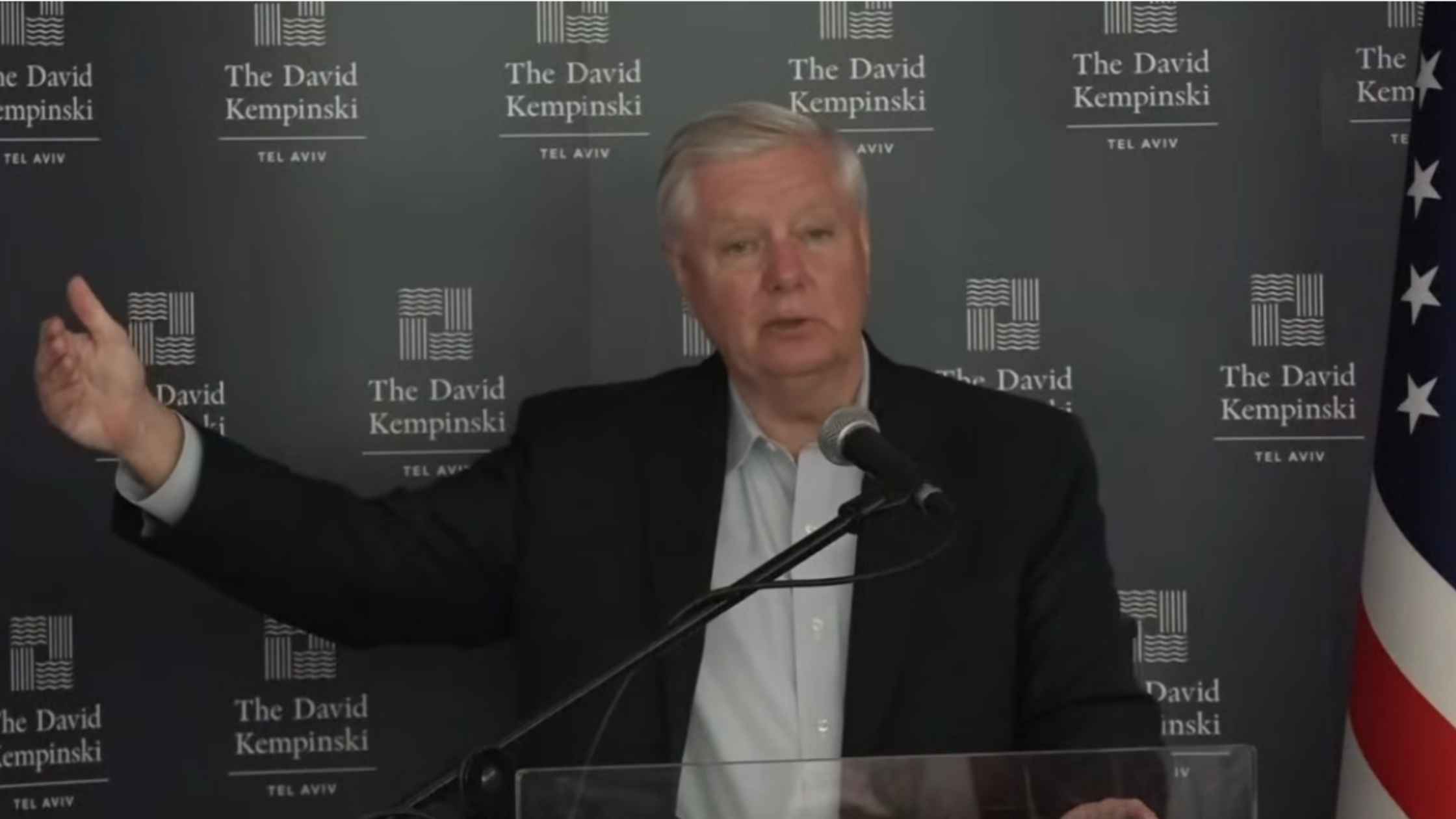
Senator Lindsey Graham (00:05):
It's been two weeks since I've been here. Are we ready? We have no light.
Crew (00:05):
It's okay.
Senator Lindsey Graham (00:05):
Can you see me?
Crew (00:05):
Yeah, of course.
Senator Lindsey Graham (00:05):
Can you hear me?
Crew (00:34):
Yeah, the guy in the first line, I see your head.
Senator Lindsey Graham (00:34):
Yeah, cut his head off. There we go.
Crew (00:34):
Great, thanks.
Senator Lindsey Graham (00:34):
Okay. Are you ready? Thumbs up back there?
Crew (00:43):
Thank you.
Senator Lindsey Graham (00:46):
Thumbs up from everybody, okay. Well, I'm Senator Lindsey Graham from South Carolina. I'm back. I come here every two weeks, where I need to or not. So when did I come this time to put a fine point of where we're at as the world regarding the Iranian regime. The Iranian Ayatollah and his murderous regime are at their weakest point since 1979. Their economy is in shambles. Their military has been degraded. There are Iranian people in the streets, demanding an end to oppression. All these forces are coming together. We must meet the moment. If this regime falls in the coming weeks or months, two things will attribute to it. October 7th. Without October 7th, I did not believe this regime would be as weak as it is today. What happened on October 7th was horrible. It was horrific, and it will be part of the people of Israel's history as long as they're the people of Israel. But your determination are the ashes of October 7th to give new meaning to never again, to go on the offensive, to weaken the Iranian regime and their proxies is paying dividends.
(02:06)
The response of Israel after October 7th to make sure never again was credible, has led to the weakest regime in Iran since 1979. The second event. The rise of the people. The people in Iran have gone to the streets without weapons. Maybe 30,000 or more have been killed to demand an end for their oppression. These two events, the bravery of the people of Iran who are saying, "I've had it. I want change." And the response of Israel after October the 7th have led to the potential demise of the Ayatollah. I can't think of a more satisfying event for me personally. Can see the good people of Iran to be able to get their country back, to live in a place where they didn't have to worry about their daughter being murdered because she didn't wear their headscarf right on the bus. Being able to be part of the world, not isolated from the world, being able to embrace the light and not be overshadowed by the darkness.
(03:08)
I look forward to today when Israel no longer has to fear an nuclear weapon being developed by the Iranian regime. The best answer to all the problems created by Iran is regime change. The best answer is for the people to take the place of the Ayatollah. I do not believe they're in the streets to build more nuclear weapons. I think they're in the streets to have a better life. I don't think they're in the streets to purify Islam and destroy Israel and come after us to praise Satan. They're in the streets, have normalcy in a life that's not normal. So my view is the risk of regime change is real. There are unknowns. But let me just say this. I'm willing to take that risk. I think the Iranian people have the potential to be a great ally of the United States, Israel, and the region. I think the Ayatollah, as long as he's alive and around, we'll be chained up to America and will be trying to enact a religious agenda of purify Islam and destroy Israel, come after us.
(04:14)
He's a religious Nazi. Hitler wanted a master race. The Ayatollah wants to master religion and we're not going to give it to him. We're going to fight back. To the brave people of Israel. I know you were hurt very hard, very wide and very deep on October 7th, here to tell you we're on the verge of eliminating the largest state-sponsored terrorism in the region. And with the fall of Iran comes the fall of Hezbollah, Hamas, the Houthis. The real effect is enormous. Normalization becomes far more likely. If the Ayatollah survives all this, God help the region. So my presence here today is to reassure the Israeli people. There is no light or gaps between President Trump and Bibi about what to do and how to do it. There are two lines in the water right now. One's a diplomatic line trying to find a way to end this regime diplomatically that will advance our national security interest.
(05:18)
The other line is the military option. I think President Trump is looking for which line can catch the biggest fish. The bottom line is we're in the weeks, not months in terms of decision-making. The Iranian people are hanging on. I attended a rally of 250,000 people in Munich. It's one of the most satisfying experiences of my professional life to have 250,000 people who wouldn't know who I was and appreciate what I was doing. Apparently I'm commonly referred to as Uncle Lindsey in Iran and apparently that's a good thing. But this hat, Make Iran Great Again, it says a lot in a very few words. By the way, the idea of making Iran great again hat came from Morgan Ortagus, who's not with us, but she thought this would be a good branding and she was right. And this hat one day would go to Tehran. I look forward to delivering it to the people of Tehran.
(06:16)
And President Trump, when asked about what this hat means and says, he said, "I think what Senator Graham was trying to say, is that the best way to make Iran great again is to the people, not the Ayatollah." I think that's right. So my hope is that in the coming weeks, if we can't find a diplomatic solution that we engage in a great endeavor supporting the people of Iran demanding their freedom and the end of their oppression. We have military capabilities second to none. There is no more clever nation on the planet than Israel. There's no more powerful nation on the planet than the United States. As to the Iranian regime, you're weak because of your ideas. You're weak because of the way you've treated your people. You're weak because you're evil. Eventually good will replace evil in Iran. To those who may participate in this endeavor. God bless you. God keep you safe, if that day does come.
(07:21)
Could our soldiers be hidden in the region? Absolutely they could. Can Iran respond if we have an all-out attack? Absolutely they can. I think the risk associated with that is far less and the risk associated with blinking and pulling the plug and not helping the people as you promised. We told them to go back in the street, keep protesting, help is on the way. We have to be good to our word. So this trip is a special trip for me. It's putting a fine point on something I've been working on for over two years. I leave from here to go to United Arab Emirates. Bibi wanted me to tell the press that he's amazed by the level of cooperation and the significance of the partnership of the United Arab Emirates with Israel. The MBZ has done everything asked and then some. That they've been a stalwart partner, reliable partner under difficult circumstances.
(08:19)
And I want to go there tomorrow and acknowledge MBZ's leadership and suggest that America improve its capability to defend the United Arab Emirates and the region. I will then go to Saudi Arabia. I believe that the Crown Prince still has the same vision for the region he did before October 7th, but October 7th has taken its toll. And at the end of the day, if the regime is still standing after all this bluster, October the 7th was a strategic win for Iran and radical Islam. If the regime falls as a result of the pressure put on the regime by Israel and the United States after October 7th, combined with the uprising of the people demanding a better life, then that would be the biggest change in the Mideast in a thousand years. I am leaving here confident of the capability of the United States and Israel if called upon to deliver a decisive blow to the Iranian regime. I'm hopeful that diplomacy may prevail yet. Either way, our date with history, our date with the new destiny for the Mideast is upon us. Questions.
Anna Barsky (09:48):
So Senator, Anna Barsky, Maariv newspaper. I have two question please. After your meeting with Prime Minister Netanyahu, are United States and Israel keeping their mind on the next steps regarding Iran?
Senator Lindsey Graham (09:53):
Yes.
Anna Barsky (09:53):
I have one more question.
Senator Lindsey Graham (09:54):
There is.
Anna Barsky (09:57):
President Trump has said he's given the talk one month. When the month ends if there is no full agreement, shouldn't a space shift to military presence?
Senator Lindsey Graham (10:09):
President Trump is very good at making sure people don't play him by giving them deadlines. He did that with Hamas. Did that with Iran. I think you may see that now again with Iran. Bottom line is, I don't mind diplomacy as long as it's done in a way to get the outcome you want. I know President Trump is allowing his diplomatic team to keep engaging, which I support, but he also has on the table another option. The Gerald Ford is steaming this way. I don't think they're just going for better weather. So time will tell what happens. President Trump has done a masterful job, I think, of weakening the regime without getting us the United States further entangled in bigger wars. Israel's done an incredible job after October 7th to give new meaning to the term, never again, by going after the enemies of Israel, wherever they reside in the most clever way and quite frankly, sometimes the most brutal way. That's what it takes to survive in this region.
Speaker 4 (11:13):
Yes, Senator Graham. Hello and thank you. These are [inaudible 00:11:17] two questions as well. One on Gaza please. We hear that the United States tends to take a step-by-step approach towards the disarmament of Hamas. Can you confirm that and how- [inaudible 00:11:33].
Senator Lindsey Graham (11:32):
I don't know. I know that the president has told me, president Trump, that if they don't disarm soon then they're playing a game. So I don't know if we put Hamas on a time limit, time clock. I wish we would disarm our elves in X amount of days. That seems to be the best way to get results around here. Do I think Hamas will disarm without being made to do so? No. Do I think there's a regional force in the region that could come in and disarm Hamas against their wishes? No. I think this is either going to take pressure to get Hamas to disarm from the region or Israel's going to have to go back in and wipe them out. The sooner we get an answer to those questions, the better. I don't see how you develop Gaza in a real meaningful way if you still have elements of Hamas armed within the area. And it's hard to sell a condo for, say, $3 million with a good ocean view, if right down the road there's a neighborhood controlled by Hamas. That's not an investment I would want to make.
Speaker 4 (12:40):
And the second question, if I may, the West Bank. So the government-
Senator Lindsey Graham (12:42):
The West Bank and Gaza will have to be part of any solution.
Speaker 4 (12:46):
I mean the annexation steps, the steps towards annexation that the Israeli government has taken- [inaudible 00:12:52]
Senator Lindsey Graham (12:52):
I'm hoping-
Speaker 4 (12:53):
How is it playing with the [inaudible 00:12:55].
Senator Lindsey Graham (12:54):
I'm hoping the plan was to get Hamas to disarm. That's been months ago. They're clearly not interested in disarming. The pace of this is slow. I get it. The Board of Peace, maybe it works. But I know that you'll never have a piece in the Mideast with Hamas under arms. You'll never have a solution to the problem of terrorism that Israel faces to Hamas, no more politically or militarily.
Joe Brown (13:18):
Joe Brown, i24NEWS. Thank you very much, Senator Graham. So you say that there's no light between what President Trump and Prime Minister Netanyahu want.
Senator Lindsey Graham (13:28):
That's what he told me.
Joe Brown (13:29):
Well, you say that President Trump wants, first of all to try and get any diplomatic solution to this. So from Netanyahu's side, as you've spoke to him today, what does he want to have [inaudible 00:13:41]?
Senator Lindsey Graham (13:41):
Well, they have been very clear about what a diplomatic solution would have to entail for Israel to believe it's a good deal. No deal will go through the process without coming to the Congress. I assure you, as a member of the Senate, I will fairly evaluate any deal, but I'm skeptical of any deal that would limit Iran's need for capability given their behavior. It's kind of late in the process and they're prone to cheat, but the Senate will have to say about whether or not it's a good deal or a bad deal. So that's the way the process works. I'm just telling you what Bibi told me. Okay. We'll get across.
Daniel Estrin (14:15):
Senator Graham, Daniel Estrin from NPR. Nice to see you here. Prime Minister Netanyahu has spoken about tapering off US military aid within 10 years.
Senator Lindsey Graham (14:25):
Yeah, we talked about that.
Daniel Estrin (14:26):
You've spoken about a bigger timetable. How quickly do you want to scale?
Senator Lindsey Graham (14:29):
Well, I think what his plan is to replace the money of three point something billion with an investment in new technology, rather than just writing you a check. The idea of he wants to create a partnership outside of the A number. I like that idea. The wars of the future are being planned here in Israel because if you're not one step ahead of the enemy, you suffer. The most clever creative military forces on the planet are here in Israel because they have to be to survive. So what we're looking at is that Israel is advancing down the road to do weaponry far beyond us, and it would be nice to have a process where we could be partners.
Speaker 7 (15:15):
Hi, Senator Graham. Thank you for being here [inaudible 00:15:18] from Channel 12. I'm trying to understand, based on your conversation with Prime Minister Netanyahu and President Trump. Are we closer to a deal with Iran or are we closer to going to war with Iran? And just what would be negotiated tomorrow? Because Iran keeps saying it's only it's nuclear program.
Senator Lindsey Graham (15:34):
Well, Israel's worried about ballistic missile program's support for regional terrorism and the nuclear program, worried about all three. And the track record of Iran is abysmal when it comes to keeping their word. You got to understand who you're dealing with. The Ayatollah wants to do three things. He wants to purify Islam, which means Saudi Arabia has to bend to his will as a ship. He wants to destroy the state of Israel because he thinks y'all are evil. That the Jews should not have a state. That God commands him to kill all the Jews. He wants to come after the United States, my country, because we're infidels. Well, I believe he believes all three. I believe if he had a nuclear weapon, he would use it to advance his religious cause. Israel can't afford to be wrong about this. So when I look at the Ayatollah, I take the man at his word. He's a religious Nazi. And the answer to controlling religion, no. The answer to insisting that the United States bend our will to that of the Ayatollah, no.
Speaker 8 (16:49):
Senator Graham, questions please. You mentioned you're going to Saudi Arabia. Are you concerned with what some Israeli officials and some US Jewish organizations have raised as anti-Semitic stance that Saudi Arabia has been adopting [inaudible 00:17:07]?
Senator Lindsey Graham (17:06):
I'm concerned about some of the rhetoric being directed toward the United Arab Emirates. The one takeaway from my visit to Israel is how the Israeli leadership and the military and the civilian side have such high opinions of MBZ as a leader and UAE as a country. Just everybody wanted me to know that these people and the United Arab Emirates and MBZ have been a trusted and great ally. I've gotten to know MBS pretty well. I think his vision for the region of integration and economic growth and AI dominance can only happen with a region not on perpetual fire. As long as the Ayatollah's around, he's up to no good. If the regime does collapse cost to the demand of the Iranian people, then I think this region will explode in a good way. If the Ayatollah's still standing, it will explode in a bad way. But if we do answer the call of the Iranian people to help them in their time of great stress and the regime falls, I think we have a tremendous opportunity nobody could even dreamed of a couple of years ago.
Speaker 8 (18:22):
And another question, president Trump recently called Israeli President Herzog disgraceful-
Senator Lindsey Graham (18:27):
What?
Speaker 8 (18:27):
... for not yet pardoning Prime Minister Netanyahu.
Senator Lindsey Graham (18:32):
Well, I'll leave that up to the President Herzog. I hope they can resolve that issue. But one thing that President Trump said Saturday, "Do you want regime change in Iran?" He said, "Well, it seems like that would be the best thing that could happen. For 47 years they've been talking and talking and talking, and in the meantime we've lost a lot of lives, so let's see what happens." I think that's a great description before we stand with Iran.
Speaker 8 (19:05):
Do you think the Prime Minister should be granted a pardon? Do you think the Prime Minister should be granted a pardon?
Senator Lindsey Graham (19:13):
I'll leave that up to the people here. Seems to me that all the attention, I don't know what your legal system's like, but for a defendant to have to go and talk for two years about a case is a bit odd.
Lahav Harkov (19:21):
I'm Lahav Harkov, Jewish Insider. Do you actually think that diplomacy with Iran could lead to the fall of the regime? Why would they be-
Senator Lindsey Graham (19:31):
I think I would support the idea of getting the right outcome in the diplomacy lines in the water. I think it would bear fruit. Well, based on the behavior of the regime in the past, no, but maybe this is a new time. We won't know till we try.
Daniel Estrin (19:44):
If diplomacy does not succeed, how do you bring about regime change? Is it taking out the Ayatollah?
Senator Lindsey Graham (19:51):
Well, I think the regime will collapse with sustained pressure. It's so weak. They fly F-14s. A lot's happened since Top Gun won. So their Air Force is... That's a great movie, but it's made in the '80s. So I don't like their chances in the sky. They have a lot of ballistic missiles, they could hurt us. They could do damage to Israel. But every day that goes by in the war, they get less capable. We get more because we have such a dominant advantage. There is risk associated with taking the regime down military, but the risk compared to the risk of doing nothing is small.
Joe Brown (20:34):
When you were in Munich, you were alongside [inaudible 00:20:37] of Iran. Do you think that he would be the right person to come in if there isn't [inaudible 00:20:42]?
Senator Lindsey Graham (20:42):
I think he'll be one of the right people, but the right person of the right groups would be chosen by the Iranian people. Everybody asks me what happens next? Well, I don't think the Iranians are in the street to say we'd like to be oppressed more. It seems to me they want less Ayatollah, not more Ayatollah. It doesn't seem to me that they are out in the streets to build a nuclear weapon to blow everybody up. It seems to me they're being out. They're out in the streets to just demand a better life, better food, better housing, better living conditions. Not living a country so wicked and sick, really. Nothing describes the darkness better than the Iranian regime under the Ayatollah. Nothing explains the light better than the protesters in Iran and the IDF and associated groups who've taken the fight to radical Islam after October 7th. They represent, I think, the best in humanity. Okay. Next question.
Speaker 7 (21:44):
Military option alone can honestly overthrow this regime. Do you honestly believe that the military option by itself can overthrow this regime?
Senator Lindsey Graham (21:46):
I think what will happen to the regime is it will lose his power to maintain its hold over the people. Now, how do you do that? You kill the people who do the killing. See if the next guy wants to volunteer knowing what happened to the one before. You decapitate the regime, you go after the infrastructure that allows them to torment the people. And you stay committed and you stay determined and the people are out in the streets, they're in their homes. I think we have a wonderful opportunity, a magical opportunity to end the terrorism caused by the Ayatollah's regime. Again, two things. The response of Israel after October 7th has gotten us to this point because they've been pounding the hell out of Iran. And the people now are in the streets demanding a better life. Those two things together I think are the best explanation as to why regime change is likely.
Speaker 4 (22:44):
Wouldn't it entail American troops on the ground in Iran.
Senator Lindsey Graham (22:47):
No, we don't need American troops on the ground in Iran, but we need America understanding the threats over here can come home. 19 hijackers in Saudi Arabia killed 3000 Americans. The only reason they didn't kill more is they couldn't find a way to kill more of us. So you got to have some of us over here, but we don't need boots on the ground in Iran. We need to partner with Israel if we do a military operation to make sure we get the highest and best benefit of our capabilities. To those who believe you should confront evil. You're right. To those who believe it doesn't exist. You're wrong. To those who wanted peace, it never works. We've got a chance here to stop this regime. History would judge us poorly if we let the Ayatollah off the hook. How many times could we have stopped Hitler? A bunch. Somebody probably asked in 1935, what would Germany look like if you killed Hitler? I wish somebody had tried successfully.
Daniel Estrin (23:42):
So you're saying by killing the Ayatollah?
Senator Lindsey Graham (23:45):
The Ayatollah represents evil incarnate to me.
Anna Barsky (23:49):
What do you think about reports that say President Trump has given the Prime Minister Netanyahu the green light to strike Iran [inaudible 00:23:55]? Isn't it a problem with [inaudible 00:23:58]?
Senator Lindsey Graham (24:00):
I think it's not lost upon anybody. We're sending military capability into the region, the United States, to supplement what our friends in Israel have if we have to use the military option. To anybody who believes that the Ayatollah can withstand all of this and stay in power and not affect the United States, you're wrong. If this band, the Ayatollah, and his regime survive all this bluster, then not only does Hamas, Hezbollah and the Houthis not go away, they come back stronger. The likelihood of normalization under those conditions is zero. The Arabs will go back into their corner, trying to get a better deal with Putin and Ukraine goes to zero. You'll see how we said one thing and did another in the Mideast and it will affect us in Russia, Ukraine. We'll make it more likely China will take Taiwan. The opposite is true too. If we follow through, if we have to, and we deliver a decisive blow working with the Iranian people to end this nightmare in Iran, then a new dawn breaks, something that nobody even envisioned two years ago becomes more likely than not. Thank you.
Anna Barsky (25:05):
Thank you.
Senator Lindsey Graham (25:05):
No, and I've said before, I don't think that explanation, I think it'll be a mighty flow to Israel before they try to annex the [inaudible 00:25:25].
Speaker 4 (25:05):
But that's what they thought.