


Speaker 1 (00:00):
(silence)
Bryan Bedford (00:00):
I think we just go out there. Going out there with you?
Sean Duffy (15:31):
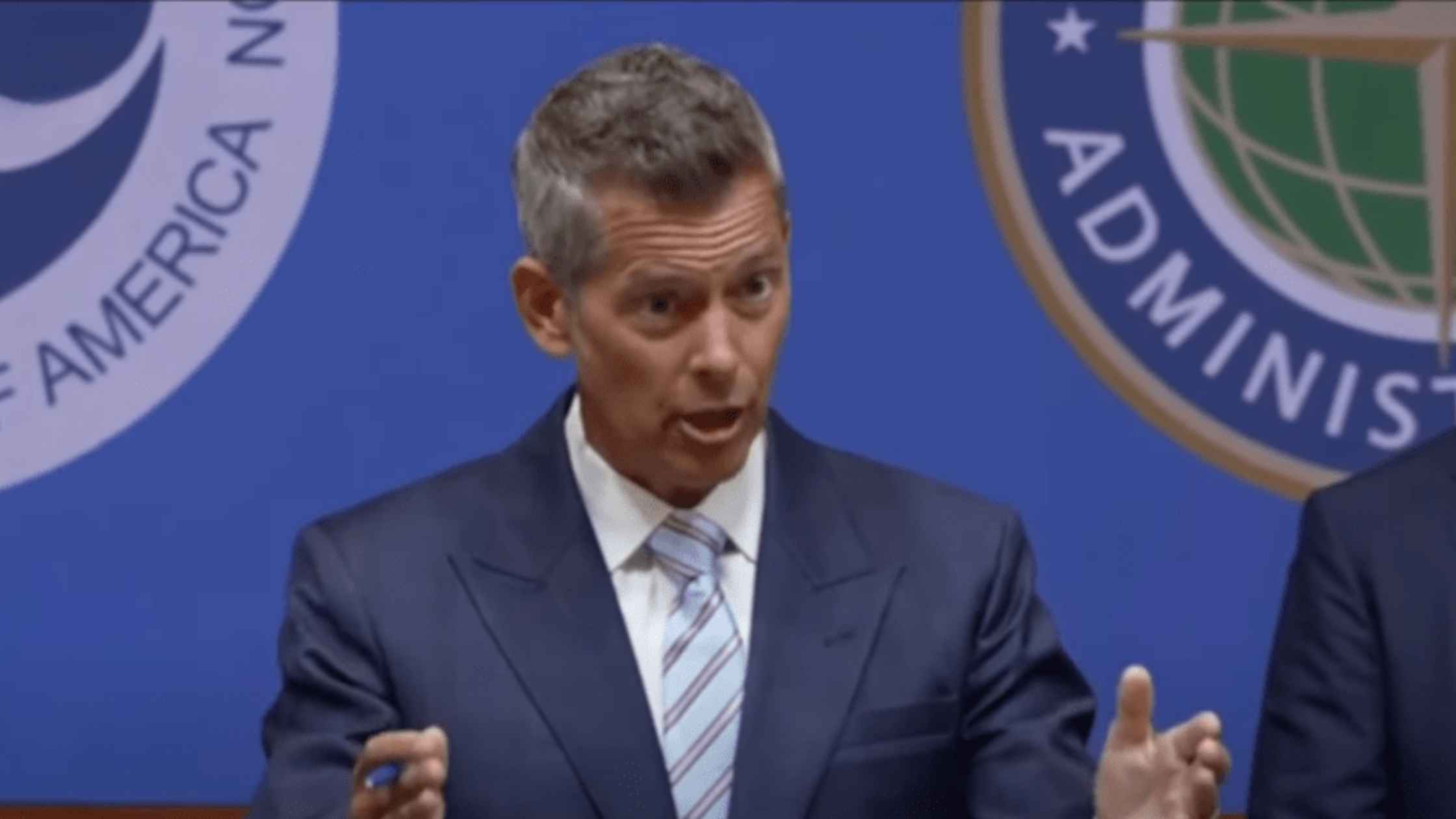
Yep. Come on out. So, good morning everybody. Thanks for coming out today. Just by way of introduction, I'm here with the FAA Administrator, Bryan Bedford. I'm also here with Lisa Ellman, CEO of the Commercial Drone Alliance, and Heather Lee, the COO of AUVSI. We're talking before we came out, how excited we are. They said that they've been waiting for years for this announcement. So, we're excited about what we're going to announce today.
(15:58)
We are going to unleash American drone dominance. So, President Trump not long ago introduced an executive order to make sure that the cabinet put this issue on the forefront to make sure that we lean in to our airspace when it relates to drone technology. And the problem we have is that, on the consumer drone market, China controls 90% of this market. And the problem with that is we're turning over our skies to one of our main adversaries. Huge problem. And it's going to happen no longer.
(16:37)
Now, the issue hasn't been that America just can't innovate, America can't create, America can't build amazing drone technology. It's that we've had a bureaucracy in place that makes it incredibly difficult for innovators to actually innovate, which is why we're here today. This department, along with the FAA, understands how important unmanned aircraft systems are for the 21st century. It's going to change the way that people and products move throughout our airspace.
(17:15)
And again, so you may change the way you get your Amazon package. You may get a Starbucks cup of coffee from a drone. The way you get your products will fundamentally change. But what's even more important than that is the impact that it's going to have on manufacturing, on farming, on energy production, filmmaking, medical delivery. Industry needs this rule to make sure they can use this technology that's going to allow them to do business more efficiently and effectively.
(17:49)
And I think it's only right that America lead, because we have led in aviation since the very beginning from the Wright Brothers to Chuck Yeager, Pan Am, TWA, the jet age, all American. We are now going to also lead in the drone space as well. And so, what we're here to announce today, and Administrator Bedford is going to go into some more details, but now we are announcing a new rule to normalize Beyond Visual Line of Sight or BVLOS as it's called.
(18:25)
Operators in the past would have to get individual waivers to operate these drones. Very complicated. They were issued on a case-by-case basis. And because of that complication, I don't think we saw the innovation that we should have in America. So, with this rule, we are going to eliminate that prior process, and the approval will be done in a far different way. The rules are going to completely change in the way that drone use is going to be approved. And what this is going to do is, again, allow our innovators and businesses to continue to create and innovate and change the way our industry works with the use of these drones.
(19:11)
And by the way, we're talking about the commercial use of these drones. Obviously, we look at the rest of the world and how drones are used in another capacity, also very important. But again, this is the commercial use of how these drones can change industry. And I would just note that we work very closely. We partner with our other allies in government on how do we do this the right way, how do we put safety first, the American people first? And so, those conversations have been had. But this new rule will enhance safety by requiring safe separation from other drones and unmanned aircraft, if you're going to get a license to fly these. It's going to require collision avoidance technology.
(19:58)
We're also partnering with TSA to ensure that operation supervisors and flight coordinators are properly vetted. We want to make sure the TSA looks at who is operating these, what kind of background do they have, and make sure we have the right people, the good people, operating these drones. And so, TSA has been a great partner.
(20:19)
We're excited about this announcement today. This has been a long time coming. This was not thought up in the last seven months. This has been going on for well over four or five years, this conversation under this president. We're not afraid to move and move fast, but also move safely.
(20:38)
And I just want to end, before I turn over to Administrator Bedford, I'm grateful for the president's leadership. He has been remarkable in seeing spaces that government has got in the way of innovation and business and clearing the deck to make sure that we get government out of the way. We still maintain our safety mission, but we allow the creativity of the American spirit to be unleashed. And that's what we're going to do today with the partnership of President Trump, with this new rule.
(21:10)
With that, I'm going to turn it over to Administrator Bedford.
Bryan Bedford (21:16):
Thank you, Secretary Duffy. And also, my thanks to President Trump for his leadership in this. As the secretary said, this rulemaking has been in process for well over five years now. A lot of thought, a lot of critical thinking has gone into the rulemaking process, but the rulemaking is not finished. We have another 60-day sprint for industry-wide comments, which we'll then take into consideration.
(21:39)
Also, as the secretary mentioned, this has been an inter-government process. We've had our friends, both in the TSA and Homeland Security, participate with us and making sure that we're thinking about all the potential threats, as well as the opportunities that go with the deployment of drones. As the secretary said, this is happening today. We have drones in operation in our skies. It's not as regulated perhaps as it should be. It's done on an exception basis, which makes it very, very difficult to manage. And it makes for an uneven playing field as well, which frankly is a headwind for innovation.
(22:16)
So, finalizing these rules, when the president two months ago issued an executive order to bring this to the front of our thinking at FAA, the team at FAA reacted, I think, very professionally, putting in a lot of late effort to bring this to the rule that we have today. So, again, my thanks to the team at FAA for all of their hard work.
(22:38)
Of course, we want to make sure that drones are integrated into the NAS safely. You have a fact sheet that you can take with you that really outlines a lot of the technology that will be involved and the rulemaking that will continue to provide safe separation of manned and unmanned vehicles within the national airspace. So, we feel very confident that we've got the rulemaking is anticipating the use of technology like ADS-B, that will allow drones to see and avoid manned aircraft in the NAS, and also how we're regulating the operators that we will allow into the NAS through the use of drones.
(23:18)
So, again, this levels the playing field, brings tremendous innovation capabilities to our US providers, less reliance on potentially the use of foreign products in our national airspace. Again, thrilled to be here today to share and answer questions with you on the BVLOS. And also, again, thank you to the president and to Secretary Duffy for their leadership.
(23:42)
Now, let me turn it over to Lisa Ellman. She's the CEO of the Commercial Drone Alliance.
Lisa Ellman (23:48):
Thank you so much. Thank you. Thank you. Good morning, everyone. I'm Lisa Ellman, the CEO of the Commercial Drone Alliance. We represent the leading innovators in the US commercial drone marketplace.
Lisa Ellman (24:00):
Thank you to Secretary Duffy, to Administrator Bedford for inviting us to join you in marking this historic moment. Our industry has been waiting for this day for quite a while now, and we couldn't be more excited. The government and industry leaders gathered here today share a common goal: to bring the incredible benefits of drones to communities across the country.
(24:23)
We all understand that pioneering these innovative aviation technologies is vital for our economy, for safety, for national security. Drones have become critical tools for so many Americans. Farmers save time and money spraying crops, line workers safely inspect infrastructure, police departments respond to emergencies more quickly, and patients gain easier access to medicines, all with today's drone technology. This industry is creating jobs and spurring economic growth for this country.
(24:57)
Yet while the technology has rapidly advanced over the last decade, our regulatory framework in the United States has failed to keep pace. Drone operators must navigate a labyrinth of ill-suited regulations designed for crude aircraft, placing an artificial ceiling on innovation and hampering progress. In the meantime, we've seen our global peers and adversaries surge ahead in the deployment of commercial drone technology. This is a threat to American security and aviation innovation, two areas where we have consistently led the world, and it underscores the urgent need for us to modernize our regulations, to regain our competitive edge and safeguard our national interests.
(25:41)
We're so grateful that the White House recognized these challenges in its recent executive orders on unleashing American drone dominance and restoring American airspace sovereignty. Today we take the next step together in establishing American leadership in drone technology. With today's proposal, the domestic drone marketplace gained certainty about what business success will look like in this new era. Investors who sat on the sidelines can now see proof that the federal government indeed supports the use of this critical technology, and American communities nationwide can start benefiting from the next generation of aviation.
(26:22)
The release of this proposal is a long-awaited milestone, but from the industry perspective, our collective work is just beginning. We will be working diligently over the next several weeks, the next 60 days to provide our perspective and feedback as part of the rulemaking process. Our hope is that the final rule will accelerate the expansion of commercial and public safety drone operations throughout the United States, while enhancing the safety and transparency of the national airspace.
(26:53)
Secretary Duffy, the Commercial Drone Alliance appreciates your leadership and prioritization of commercial drone integration efforts. We look forward to working with partners across the federal government and with all relevant stakeholders to restore our global leadership in this game-changing technology.
(27:10)
Thank you.
Heather Lee (27:17):
Good morning. Thank you to the Department of Transportation, FAA, TSA, and the White House for your leadership in delivering today's long-awaited draft rule and the broader effort to unleash American drone dominance. My name is Heather Lee and on behalf of AUVSI, I want to commend Secretary Sean Duffy, FAA Administrator Brian Bedford, FAA Deputy Administrator Chris Rocheleau, and Acting TSA Administrator Ha McNeill for their decisive work to advance this process. Their focus, leadership and grit has been essential in moving this rule forward.
(27:55)
Our president and CEO, Michael Robbins, regrettably couldn't be here today as he is currently serving our nation on Navy Reserve duty, but he joins me in applauding this major step forward for our industry and for American global leadership. This is a breathtaking moment. For too long, the United States has lacked a clear, scalable, regulatory path for advanced drone operations. Today's draft rule begins to change that, showcasing the way forward to unlock the safe integration of drones into the national airspace that enhance public safety, transform commercial services, and create high-quality jobs.
(28:37)
With this action, the US is taking a meaningful step to reassert global leadership in advanced aviation with timely finalization as set forth by both Congress in the FAA Reauthorization Act of 2024 and [inaudible 00:28:53] applications like infrastructure inspection, emergency response, precision agriculture and beyond, advancing public benefit and safety, and generating billions in positive economic impact. To help illustrate what this rule makes possible, our member company, Skydio, is conducting an indoor drone flight demonstration today, here at DOT, followed by a remote operation flight of a drone on the other side of the country, in San Francisco. These flights embody the very concept of beyond visual line of sight and show how policy directly enables innovation and advances safety.
(29:33)
Following the good work that we and many of our members did during the BVLOS ARC, AUVSI and the drone industry looks forward to reviewing the draft in full and submitting substantive industry feedback in the weeks ahead. We stand ready to support the next steps in the effort to finalize the Part 108 rule. Today signals a powerful commitment to safety, innovation and American drone dominance. Let's continue this moment.
(29:59)
Thank you.
Sean Duffy (30:01):
Thank you, Heather.
(30:03)
Before I take your questions, just want to make a quick point here. So often technology evolves in government, rules and regulations don't evolve with it. What you're seeing today is government coming up to speed with the evolution of this technology. And if we don't do that, there is no reason why we fall behind but for the fact that government can't respond in a timely fashion. Our industry can, we need our government to as well. I want to be clear, for us the backdrop of this is always safety, making sure our communities and our people are safe as the opportunity for drone technology evolves and is deployed.
(30:42)
I couldn't stand here and talk about drones in the airspace without talking about air traffic control, how important the modernization effort that's underway right now is to making sure that drones can be deployed, eVTOLs can be deployed. I want to thank the Congress and the president for the $12.5 billion downpayment they gave us to start this process. The total we need is $31.5 billion, but we can start the process.
(31:13)
What we are doing, Bryan and I have had a lot of conversations. We believe setting this up right is going to save us months and years in the back end. We are going through that process now, thinking through how we deploy, how we contract, how we engage with the private sector to make sure this is done at the speed of President Trump, the speed of the private sector, and do it with the safety and the reputation of safety from the FAA.
(31:43)
That is coming along very well. But again, all of this works together, it all flows together. Making sure these are deployed safely also relies on us re-envisioning all the other uses we're going to have in the [inaudible 00:31:57].
(31:57)
With that, we're happy to take any questions you may have for us. Yeah?
Sam (32:02):
Sam [inaudible 00:32:03], Politico, thanks for doing this. It mentions in the fact sheet certain aircraft could weigh up to 1,320 pounds. What's the certain aircraft part of this? Is that all drones?
Bryan Bedford (32:15):
It's simply trying to specify that there is a cap in terms of the total weight of both the aircraft and the payload. Some aircraft will obviously not hit that limit, but that is the upper end of the limit that can be certified under this rule.
Sam (32:31):
What's the current limit under the exemption process? Is it the same thing or is this higher?
Bryan Bedford (32:33):
It's just ad hoc. There's obviously seven different drone testing facilities around the country right now. I think we've added two more under FAA reauthorization that we're currently evaluating. But right now, it's a very ad hoc process.
Speaker 2 (32:50):
Hi. [inaudible 00:32:51] from Bloomberg. Also in the fact sheet, you talk about the drones being able to meet certain industry consensus standards rather than having to go through the normal certification process. Those standards, have they been set yet? If not, how soon do you think they would?
Bryan Bedford (33:09):
The standards are expressed in the rule itself, so that'll be transparent soon. Again, the idea is to level the playing field here. So, rather than policy by exemption, the policies, the policy and the industry will be able to innovate with certainty versus the uncertain process we have today.
Lauren Shan (33:30):
Hello, Lauren Shank, Fox Business. I had a question on setting up a nuclear reactor on the Moon. What challenges do you and the experts anticipate with that? And how critical is it that we beat China in winning the second space race?
Sean Duffy (33:43):
I didn't think the Moon was going to come up today. It wasn't prepared for that.
Bryan Bedford (33:46):
You are the acting NASA administrator.
Sean Duffy (33:48):
And it didn't come from Politico, so that's wonderful. This is not a new concept. This has been discussed under Trump One, under Biden. But we are in a race to the Moon, in a race with China to the Moon. To have a base on the Moon, we need energy. Some of the key locations on the Moon, we're going to get solar power. But this vision technology is critically important. We've spent hundreds of million dollars studying, Can We Do It?". We are now going to move beyond studying and we are going… We have given direction to go. Let's start to deploy our technology to move to actually make this a reality.
(34:32)
I think the stat we have is… It's a 100 kilowatt output. That's the same amount of energy a 2,000 square foot home uses every three and a half days. So, we're not talking about massive technology. We're not launching this live. If you have any questions about that, no, we're not launching it live. But again, energy is important. And if we're going to be able to sustain life on the Moon to then go to Mars, this technology is critically important. I would just note that we are behind. If we're going to engage in the race to the Moon and the race to Mars, we have to get our act together. We have to marshal all of our resources, all of our focus on going to the Moon, which is what we're going to do. Again, there's a lot of things that NASA does and a lot of people love a lot of the things that NASA does. But this is about space exploration, and this is about this next phase. A lot of people don't know even what Artemis is. Everyone knew what Apollo was. We all knew it, the whole world knew what Apollo was. We were going to the moon. Artemis is, we're going back.
(35:38)
In the first part of next year, we are going to send Artemis II out. Met the four astronauts, they're fantastic. We're going to go out, around the moon, and come back. Artemis III, we are going to go back to the moon. We're going to land. The longest time we've spent in the past was three days. We're going to stay for six days. And then after that, we're able to start shipping our assets to the
Sean Duffy (36:00):
… moon unmanned, and we'll have those assets there as our astronauts arrive and we're able to build a base. But this is critically important. There's a certain part of the moon that everyone knows is the best. We have ice there, we have sunlight there. We want to get there first and claim that for America. And to do this, this part of the fission technology is critically important to sustain life. Because solar won't do it, but it's just a lower amount of that fission technology that's going to allow human life to sustain. Do you have a follow up?
Lauren Shan (36:34):
I have a separate question too. So as far as AI and airline pricing, do you have any concerns about Delta and other airlines using AI to set pricing? And have they explained to you at all exactly how they're using it?
Sean Duffy (36:49):
So do I have a concern broadly about AI pricing? Yes, I do. Let's sell prices on seats for what they should go for. But to try to individualize pricing on seats based on how much you make or don't make, or who you are, I can guarantee you that we will investigate if anyone does that. Now the question was about Delta. Delta has clarified that they are not going to do that. I'll take them at face value in their clarification, but we would engage very strongly if any company tries to use AI to individually price their seating.
Speaker 3 (37:26):
Secretary W, it's Pete Martinez with CNN. I want to ask you about, what would you say to somebody who says the airspace is already so crowded? We've seen the midair over the Potomac River, we have seen near misses over and over again, there was a drone strike with a wildfire [inaudible 00:37:43] in California during the wildfires last year. So what would you say to somebody who says that this only introduces more things in the airspace when the warning signs are already there?
Sean Duffy (37:52):
You want to take it now?
Bryan Bedford (37:53):
Yeah, yeah.
Sean Duffy (37:53):
Go ahead.
Bryan Bedford (37:54):
I would argue the drone strike over the wildfires reason we need this regulation. The fact is we've got a little bit of the wild west out there right now. So regulating to a common standard, making sure the vehicles comply with our regulations, and then surveilling that, is a much better place than where we're at today. Not to say the least of which is allowing people to innovate within a set of rules that we can comply with. So I think clearly the regulations that we're talking about will not only enhance the innovation, but it'll enhance safety. So I'm very comfortable with that.
(38:29)
As it relates to the airspace, that's why we're modernizing. It's three pillars, right? It's getting the people right, getting our staffing where it needs to be. It's getting the technological equipment back from being 50 and 60 years old, getting that to where it needs to be today, and then designing the new NAS in a way that will allow the safe introduction of these new and emerging technologies, and allow industry to continue to add capacity that clearly consumers want. And it's what, six, 7% of GDP. So it's very critical that we get this right, and modernization is going to be the key to doing that.
Speaker 3 (39:04):
Let me ask just a quick follow up, because I think a lot of people see drones now in the headlines as tools of war in Ukraine with Russia. How critical is it for us to secure our own large infrastructure, big outdoor events from drones? I know the FAA has been doing a lot of testing, so how critical is it to a secure big events?
Bryan Bedford (39:22):
So as the rule will allow, there will be no ability to fly drones over large sporting events or media events. So we will cordon off airspace, geotagged airspace, so that it maintains unrestricted use of the airspace that we're okay with and restricted use where we don't want drones flying. So the regulation will deal with that as well. I'll tell you that the drones are happening and we do have partners in Homeland Security and TSA that are very well aware that bad actors could use drones in a bad way. And so I can assure you that government's focused on making sure that we get the technology right and we get the security right. So they go hand in glove.
Sean Duffy (40:10):
And Pete, you've done a good job reporting on the airspace and we appreciate that. But if we stop our innovation because we don't evolve our rules, and we can do it smartly, we understand the equities, we understand the risks, and we work to mitigate those risks. But if we don't update these rules and we allow our adversaries to evolve this technology, it's very dangerous to deploy someone else's commercial technology into our airspace. And the data that could be gleaned from that is a national security threat. And so we want this to be American technology, American innovation. And until we get our new air traffic control system deployed, which is going to make it easier to navigate all of the new uses of the airspace, we keep a keen eye on making sure that we can deploy drones and keep airplanes safe, and keep them separated, and make sure that, again, we allow the innovators to innovate. Because you go out 10 years, you can't innovate any longer and you're going to deploy someone else's drone technology into the US and that's a huge problem.
Speaker 3 (41:19):
Do you want to respond to the security question, just like, to keep drones from being a tool of terror? Because it just seems to come up more and more now.
Sean Duffy (41:22):
It does come up and that's why we work with all of our partners in government. And there's two different components here. We have licensing, we have rules around commercial drone use. There's a whole other component, and we've seen how drones have been used as tools of war. And again, we can say airplanes have the same capabilities, right? And how do we navigate aircraft? One's for war one's for commercial aviation? We can do that and we can do that in this space as well. But again, we have to recognize the new and rising threats that exist, and our partners at the DOD and Homeland are probably better suited to answer those questions specifically. But we have partnered with them, as we've looked at the commercial side of this and how important this is not just for innovators for our industry, but also to make sure it's American technology.
Speaker 4 (42:13):
[inaudible 00:42:13] one more guys.
Speaker 6 (42:14):
Thanks secretary. Brendan Collard, Sidney Gray Television. What do you think is a realistic timeline for an average American to be able to drone deliver a Door Dash? And then do you view the financial investment as the biggest hurdle or something else?
Sean Duffy (42:29):
What's happening right now in different communities across the country, you're getting a hot cup of coffee, you're getting a Door Dash, you're getting an Amazon package. It's happening in certain communities across the country. Listen, but I do think communities have to have a say in do they want drone use in their communities. You'll find that the technology around the noise, which usually is an irritant for people, is remarkable how quiet they… You don't even know they're there unless you look up. So I think with the evolution of the technology and the noise that comes from a drone, you're going to see a lot of communities that want this technology in their neighborhoods. Just think, if you take some Amazon trucks off the road, Door Dash delivery drivers off the road, that frees up our roadways. We see less congestion. There's a lot of benefits that come. Less fuel burn. A lot of really good things can happen with this technology, using the airspace in a different way. So, yeah. I'll do one more, thank you, and then we'll wrap it.
Speaker 5 (43:41):
Hi, Sarah Ploss with CBS News. I just wanted to ask really quickly about some of the issues and questions there have been about clean evacuations recently, and I'm wondering if you guys have any concerns with what you've seen. We saw people taking bags down a slide and things like that. Do we still think that the 90 second EVAC standard is realistic? And what concerns might you guys have about that?
Bryan Bedford (44:03):
Well, first we're very happy that there were no injuries or any adverse outcomes for the brake fire with the American Airlines aircraft. So I will say we were all disappointed that many of the passengers on board did not respond to the flight attendants' request to evacuate timely. Grabbing bags, that's just wrong. We need to, whether the flight attendants are telling you to keep your seat belts buckled to avoid turbulence injuries or whether they're asking you on these very, very rare, very rare occurrences that we have a situation like we saw in Denver, we need to listen to them. They are there for our safety, they're there for all passengers on board safety. We can't have somebody at the front of the line grabbing their overhead bags and keeping people in the back of the airplane from being able to safely evacuate. So we will be doing some education to make sure that it's clear that passengers on board not only have a obligation, but it's the right thing to do for everybody on board, is to listen to the flight attendants and obey their instructions.
Sean Duffy (45:07):
I'll double down on that. Again, everyone got off safely here, but I know Brian was incredibly disturbed, as was I, people grabbing their bags. In a different situation, in a different environment, grabbing your bag could cost someone their life. And so again, your belongings in your carry-on bag aren't worth it. Leave it, get off the plane and make sure everyone behind you can get off as well. Critically important. But also on the seatbelt front, again, maybe I'm a nerd, I don't think so, but unless I get up and go to the bathroom, I keep my seatbelt buckled when I fly, because you never know what's going to happen. And by the way, they're comfortable. I don't even know I have it on. I think we just have to double down on safety rules on our aircraft and make sure people pay attention.
(45:55)
And again, you never know what could come, and again, you're responsible for your safety, those flying with you, whether they're kids, but also everyone who might line up behind you. So again, leave your bags behind, keep your seatbelt buckled, and let's all fly safely. But the rules are in place for a reason. And again, I think we should all make sure that we follow them because the consequence could be much different than the American airline will well fire. So with that, listen, thank you all for coming out. We appreciate it. And we're still morning, so all have a good morning. Thank you.
Speaker 7 (46:33):
Thank you.
Speaker 9 (46:33):
[inaudible 00:46:35].
Speaker 8 (46:33):
Thank you.
Bryan Bedford (46:33):
All right, [inaudible 00:46:36].