

Announcer (03:39):
Please take your seats. Our program will resume momentarily. Please take your seats. Our program will resume momentarily.
Host (11:59):
Hope you all enjoyed lunch and we're ready to get started again. Please take your seats. Thank you. Have a great afternoon.
Announcer (12:10):
Please welcome back to the stage CAP President and CEO Neera Tanden.
Neera Tanden (12:25):
Good afternoon, everyone. How you doing? I am very excited for our next speaker and I have a little story to tell about it, which is almost a year ago at the Center for American Progress we hosted Beto O'Rourke from Texas and the governor, then Beto O'Rourke, was talking about what's happening in Texas. He actually previewed in Washington that he thought the Texas legislature would do a mid-decade redistrict.
(13:04)
A lot of people at the time thought it wouldn't happen, but it did happen, and the Center for American Progress and Center for American Progress Action Fund decided to go into the fight to really encourage blue states to respond with redistricting efforts. We thought that was important because when you have mid-decade redistricting, it could mean that the president would not be, President Trump would not be, held accountable for his actions. So we thought it was really crucial.
(13:36)
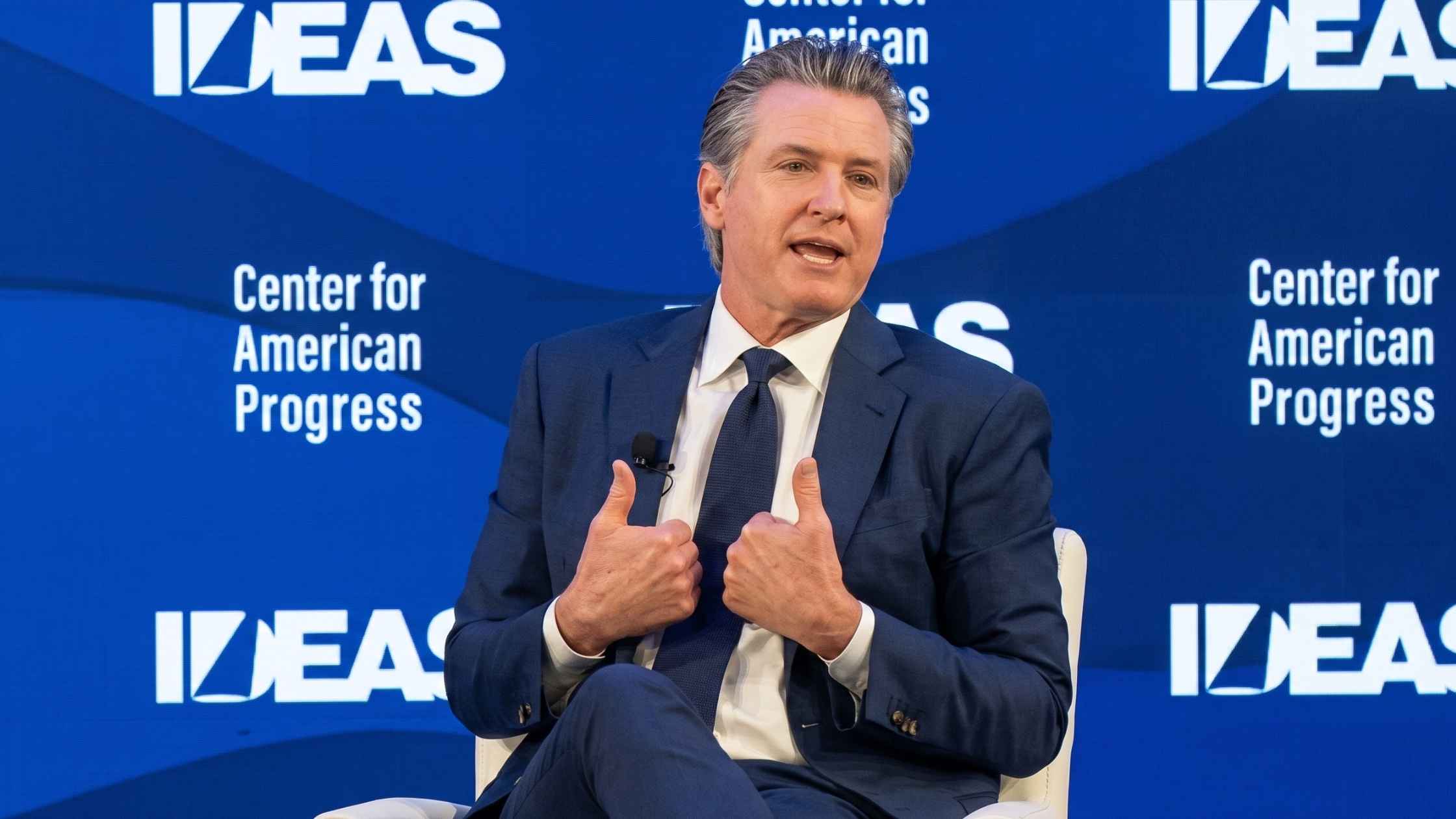
We called leaders we knew in California, a lot of people in power and a lot of people raised concerns about doing a ballot initiative because here's the thing about a ballot initiative. It could lose. So a lot of people were like, "Why take the risk? Why take the risk?" And we said, "Because we believe democracy is so important." Well, Governor Newsom decided to go to the public with a ballot initiative to respond to Texas and because he did that and campaigned for it, convinced the state and actually delivered, California's redistricting could mean the difference between accountability and no accountability for this administration. A lot of people talk about democracy, but it's important to take risks for democracy and it's important to fight for democracy and that is exactly what Governor Newsom did. So we are honored to have Governor Newsom from the great state of California to talk to us about what's happening in the country and how we can solve it.
(14:55)
Governor Newsom?
Gavin Newsom (15:00):
My one member of the family. How are you?
Neera Tanden (15:01):
Good, good.
Gavin Newsom (15:05):
Good to be with you.
Neera Tanden (15:06):
Great to be with you. Well, maybe we should just start fresh here.
Gavin Newsom (15:12):
Start fresh. Unbelievable. Redistricting is still fresh on my mind.
Neera Tanden (15:16):
Great.
Gavin Newsom (15:17):
Fresh on everybody's mind. It is remarkable what the Supreme Court just did. I mean, no other way to describe it except Jim Crow 2.0. What Governor Landry did was even more alarming in this respect. He declared an emergency and suspended an election that already had been conducted at least for 42,000 people overseas in the military, literally suspended the election so he can redistrict out African-American representation. That happened in 2026 in the United States of America.
(15:52)
What happened in Tennessee? What's going on in all of these other Southern states? So my state of mind is very much on this unfinished work that we have in front of us as it relates to redistricting, waking people up from this slumber, this sort of shock and awe, this overwhelm. Every day, being overwhelmed by another headline and another distraction, but what lies underneath in terms of what's holding up our democracy is in real peril right now.
Neera Tanden (16:21):
Speaking of peril, we just have the news just in last day or so that the Trump administration settled with itself. Essentially, Trump's treasury department negotiated with Trump himself over a $10 billion frivolous lawsuit to give a $1.8 billion taxpayer funded slush fund, I would just call it a slush fund, that will pay out to his allies who were involved in the insurrection. So just penny for your thoughts on that topic.
Gavin Newsom (17:09):
Well, it's exactly why our Founding Fathers lived and died. I mean, it's a hell of a thing in the 250th anniversary where literally this declaration was conceived to stop this kind of corruption, this waste, and this fraud. I mean, it's so alarming, 17, by the way, not 1.8. It's one seven, seven, six. Joke's on you, I guess, or on all of us. This is a corruption story, plain and simple. Trump administration's a corruption story. It's the great grift and it's taking shape on a daily basis in every way, shape, form.
(17:46)
You didn't even mention the $230 million at the DOJ that he's also trying to extract not just that $10 billion, now $1.8 billion settlement. We've talked a lot about the $400 million plan, which is not $400 million, it was the over $900 million in the Pentagon budget to retrofit the plan. We talk about the eight large scale projects he has in the Gulf and around the rest of the globe. The fact that he quite literally used the tariff regime in order to get those deals done, particularly the one in Vietnam.
(18:13)
We're talking about the kind of corruption at scale we've never seen in our lifetime, including what the Witkoff family's doing, what the Kushner family's doing, the Board of Peace, which is really about getting a piece of the Middle East. All of this happened in plain open sight, you saw it last week. And the fact that finally he's delivering on the cell phones, another part of the grift. The good old days when it was just about watches, $100,000, sneakers, $60 and cell phones, this is happening at a scale we've never experienced in our lifetime and it's just winding up.
(18:47)
And where's Congress? Where's Johnson? Where is Thune? Supine. Completely complicit in all of this graph and all this corruption. Where are the institutions? Also rolling over. Also selling out. With respect, as you know, and I know I've offend people, I've got a Patriot site, which in and of itself should be reasonably offended because it mirrors and mocks a little bit of what Trump's doing, but we sell knee pads. And by the way, the last ones sold out, new ones just got in, but they sold out because our universities, remember that, were selling out. Our law firms were selling out. Media's selling out. All those settlements.
(19:27)
And the corruption... What Brendan Carr is doing, what he's doing with the Tegna deal. Nexstar, $6.2 billion, going to get 80% penetration in our household markets. The cap was 39%. Brendan Carr saying he didn't like the war coverage and is considering now investigating certain media outlets. This is all happening on our watch. Society becomes how we behave. We have agency. We have a responsibility. It's just like the issue of redistricting. We could have decided to write an op-ed. We could have decided, hold hands, have a candlelight visual, win the argument. These guys are ruthless on the other side.
(20:15)
Trump's not screwing around and nor can we. Yeah, it's uncomfortable fighting fire with fire. Yes, we all want the better angels. Yes, we want the Sorkin sound and music, a little West Wing. I do, but we'll lose our country. We will lose our country. You saw today, what is the President of the United States spending all his time on? He had a big press conference about the new design for the ballroom, the ballroom that he promised would be private in terms of its contribution. Now he's asking a billion dollars of your taxpayer's money.
(20:45)
You saw what happened yesterday with Hegseth. It's the middle of a war, 80 days in the middle of a war, so what does the head of the Pentagon do? He goes out there and campaigns in a partisan campaign for someone that didn't do the bidding of the president. This is happening in real time. It's happening on our watch. Again, society becomes how we behave. For things to change, we need to change. You need to change. We all need to change and call this stuff out.
(21:15)
No, none of this normal. Don't allow it to be normalized. Do not allow this to be normalized. It's a corruption story. That's the Trump administration. Period. Full stop.
Neera Tanden (21:31):
One of the differences we see in our country versus other countries, if you look at Orbán's Hungary or Putin's Russia, we are seeing a public opposition. So when you talk about what people should do in this moment, what do you recommend to us?
Gavin Newsom (21:51):
Well, you don't give into the fear, cynicism, and anxiety, and fear. You realize that you're the antidote to all of that. Again, it's not conditions, it's decisions that shape our fate and future. You've seen that with the No Kings rallies. People are showing up. They're not falling [inaudible 00:22:06]. You've seen them showing up in State House races. Over 30 have flipped from red to blue, not one blue to red. We're winning. People are showing up. They're not giving up.
(22:16)
I showed up for Proposition 50. It was a 90-day campaign. We raised $118 million. We also raised the consciousness from that was when you did the introduction, I was thinking the reason people were reticent about that is polled at 48% when people were talking about it. We had to shape-shift things. Again, decisions, not conditions. So we got to turn it up. They're trying to rig the election. Donald Trump knows he's going to get crushed this November, that's why he made the phone call to Abbott saying he's "entitled to five seats." That should put a chill up your spine alone that he's entitled to the five seats.
(22:59)
He didn't expect how we'd respond, didn't expect how Virginia responded but again, we saw how the court responded. This is hard work. And we're seeing how they're responding, not just Landry, but we saw within hours how DeSantis responded with an exclusive on Fox News where the new maps were shown. Not the democratic process with the transparency of the people in Virginia, but an exclusive with Sean Hannity on Fox News. These guys are not screwing around. Ask folks down in Fulton County, is Trump screwing around? Trying to go after our voting rolls in California, he's not screwing around. Do you think in fair free election, do you think that's realistic? With Trump this November after all he did on January 6th and now the $1.8 billion to take care of ... What more evidence...? We're dumb as we want to be to think...
(23:55)
You saw what happened just on Prop, forgive me going back to Prop 50, but the day of the campaign in Los Angeles, Donald Trump, of course, sent out on Truth Social, the election was rigged. He sent out the Department of Justice to oversee all of the corruption. That morning, he sent out the Border Tac teams, these are the Border Patrol Tactical Unit Teams, these are the Apache helicopter guys all dressed up in front of Dodger Stadium for the morning news so that our diverse communities wouldn't show up for vote.
(24:25)
You think he's not going to do that again all across this country? Come on, what evidence, honestly, is there of what we're about to face? We've got to wake up to this new reality. So we have to be, dare I say it, I'm sorry, Democrats, that we have to be as ruthless as our opposition. We do. We have to win. It's all in the line. You just got to win. I'm done winning arguments with all due respect to the niceties. It feels good, but we're going to lose our republic. Again, the Founding Fathers did not live and die for this moment. I can't celebrate July 4th, the best of Roman republic and Greek democracy, co-equal branches, co-equal branches of government, popular sovereignty, the rule of law, not at the time where it's the rule of Don. And if it hasn't dawned on you, I remember spending 90 minutes with Trump in the Oval Office and I think he honestly thought everything was his. He was showing me the declaration, his declaration. It's a prize. What us? A corruption story happening on our watch.
Neera Tanden (25:44):
So speaking of fighting, President Trump fights with you a lot, as you might notice.
Gavin Newsom (25:51):
Yeah.
Neera Tanden (25:51):
He's also basically waged a 10-year war on blue states and blue cities. Now here at the Center for American Progress, we do care about facts and figures and we know that California has grown to have the fourth-largest economy in the world, that it is an engine of economic growth. But what do you say to people who worry about blue state governing?
Gavin Newsom (26:17):
Well, I don't know. I mean, we're the economic engine of the United States, blue metros. In the Biden administration, about 71% of the GDP in the United States of America emanated in blue metros. 71%. I mean, we're the tent pole of the American economy, blue states. Many of these red states are donor states. I mean, again, speaking of state of mind, there are also states with lower productivity, lower wages, higher death rates, higher depths of despair. The innovation index not even interesting compared to other states, and they're some of the highest tax states.
(26:57)
And I really want to make this point. The most regressive taxes in the United States of America are red states. They tax poor people more than they do the very rich. Think about that. Who's the high tax state? Florida or California. Texas or California? We have the highest tax rate. We don't have the highest taxes, but you fall prey to that. Many of you, the punditry, lazy punditry. [inaudible 00:27:24].
Neera Tanden (27:24):
We're very happy with other reporters that are here, [inaudible 00:27:28].
Gavin Newsom (27:28):
You do. You got to update your facts. By the way, we did update ours. Bloomberg just came out with a piece that should just disabuse everyone of this California derangement syndrome. The top performing economy of all the 49 others, the top performing economy of all developed nations since 2019, 40% GDP growth. We have no peers. We dominate in every category.
(27:53)
Dominic, you talk about manufacturing, you're talking about my home state. You talk to me about forestry jobs and hunting jobs, you're talking about my home state. You talk about venture capital. Come on. $106 billion record-breaking venture capital. You talk about every category, there's not a single category, large scale economic category, where California isn't the dominant state. We have more engineers, more researchers, more Nobel laureates than any other state in the nation. And we are the center of the universe. We're writing the rules of the future and this is why the right hates us. It's insecurity. It's not our trajectory.
(28:34)
You talk about fusion, you talk about quantum, talk about AI, you're talking about California. 32 of the 50 top market cap AI companies in our backyard, the state of California. So all of these areas, promise, peril, all of that is represented in all of what I just said, that mosaic that is California. The future happening in California often first, America's coming to traction, including the challenges of affordability. Housing crisis that appeared in our state decades before, it's now become not just a trendline, but a headline across the United States. The issues of homelessness, poverty, relationship to the cost of housing, the original sin in my state, so much of that now dominant in the consciousness and focus as we relate to the American system today.
Neera Tanden (29:25):
I will get to AI, but homelessness and particularly housing costs have been high. You've taken some actions on housing. We at CAP have been very focused on how to lower housing costs. We looked at a lot of your ideas, a lot of synergies there. Do you want to talk about what you've been doing on housing?
Gavin Newsom (29:42):
Well, we've seen a 59% increase in the number of new housing construction since 2019 and a 56% reduction in the time for permitting and it's still a low bar bar. It's a crisis. That said, we were aided and abetted by, he's here, Ezra, Klein. This abundance mindset, which is California. It's not a scarcity mindset. It's always at our best nation as well, an abundance mindset. We recognize we need the party that builds. Period. Full stop. The Democratic brand should be the party of building. Building. There's one word to define us.
(30:17)
There's destruction on the other side of institutions and allies and trust, truth on the other side. Ours is about building, liberalism that builds. And so that's our mindset and we were able to carry through with much more aggressive actions again. For things to change, you have to change, and so rather than the usual pace of reform that took shape in my state, including my first six years on housing where we made progress, we weren't making a difference, and that's when we decided to move these historic housing bills into the budget, which you don't do. And I threatened to veto the budget unless we got the housing bills done and we were successful in doing so.
(30:58)
It's the mindset we need to take into the future because at the end of the day, and you and I were briefly talking about this a moment ago, this system's broken. It's broken folks. 10% of people own two thirds the wealth. Same 10% or 93% of the value of the stock market. 30 year old is not doing better than his or her father for the first time in history. That is a five alarm fire. Doesn't work anymore. We can't tinker anymore. You can't play in the margins anymore.
(31:31)
There's a reason Donald Trump's in office, there's a reason Bernie fills stadiums. They're both right on the diagnosis. And we can't, with respect, fail more efficiently by managing more effectively the decline. Doesn't work anymore. System has to be re-imagined. It does. Can't play in the margins. Tax code is broken. I'm sorry. No it offense to any of you. It is. Inheritance codes, doesn't work anymore. It's why we're having billionaire wealth tax debates in my own state and all across the United States. The pitchforks, yeah, they're here. They're not just coming.
(32:09)
And we saw it with all the populism and authoritarianism that came from that because of our lousy trade deals and then when looking back we're all geniuses. But the last 30 years and the rise of these authoritarian tendencies in terms of governance, we didn't see nothing yet because now it's the blue collar worker that sounds a lot like 25 year old white collar workers that I see in San Francisco that are wondering why they're not getting a call back on a job interview. They're sounding the same. That's a different kind of coalition. The white collar and blue collar coalition.
(32:46)
A lot of people are a little frustrated on the stepped-up basis where you can just borrow, die, no tax. This is enough. This is not working. That's why I raised the minimum wage to $25 for healthcare workers, 20 for fast food workers. You still have 20 states at 7.25 an hour and you're subsidizing that. That's madness. And now with these trend lines, we've seen AI's going to detonate all of this. And it's happening in real time and we're not talking about that.
(33:17)
I know we're talking about hyperscale data centers and the utility, that's interesting, but we're missing, sorry, a memo from the West Coast, the world I'm living in absorbed by, consumed by. Something big is happening in the plumbing of the world and we still have systems that were designed in 1935 that are no longer viable in 1925. Unemployment insurance, you think that's going to work and hold up? That doesn't work for clerical workers anymore. You need employment insurance. Universal basic income. We don't need charity. We need ownership. It's universal basic capital. By the way, those are the creators telling you that, not just me. That's what Sam Altman, Dario and others are saying. They're the ones making that point and the voters are demanding it. Got to have an ownerships...
Gavin Newsom (34:00):
They're the ones making that point and the voters are demanding it. Got to have an ownership stake. You cannot save democracy unless we democratize the economy, period. It's just simply not going to hold up. It's the exact same fight. And so when I hear people saying, "Well, you know that Newsom guy, he's all about resistance. We need to focus on renewal." Sure, but I think it's the same damn fight. And so it's not just about populism, about realism. I don't begrudge other people's success. I admire it. Can't be pro-job and anti-business, but businesses can't thrive in a world that's failing and it's failing. I mean, you need GoFundMe page now if you have a major medical issue. Literally. I have a friend, God is my winner, Suleman yesterday, literally sent me a GoFundMe. Guy has two or three jobs and now GoFundMe. What the hell is that?
(34:51)
You have a healthcare system that's simply not viable. You know that. You may not like single payer. I don't even know how the hell to do it, in terms of how I get rid of all your private health insurance, but it seems something's got to give. This doesn't add up debt and entitlement. Seriously. Energy and climate change, come on. And democracy in this economy. So there's these tectonic plates and we've been slow to respond. All bargain no longer applies. My mom talked about 52 paychecks, and it required her 104. I feel like those are the good old days, 104 paychecks. So this is my mindset as I try to close out the last seven months of my administration. I'm now running the 90 yard dash, and I'm thinking about universal basic capital. I'm thinking about public equity funds and dividends. I'm thinking about ownership. I'm thinking about what you're seeing in places like Denmark that do 90% wage replacement over a two-year period and scale it down.
(35:51)
I'm thinking differently about the WARN Act and doing early-warning systems for displacement. I'm thinking about the fact that we're entitled to a transition. It's not just a severance and a LinkedIn post. I'm thinking very differently about all these things. And so we've got an executive order in this space. We've got a very aggressive effort, a series of efforts to pilot at scale some of these approaches to start to deal with some of these anxiety deal with the inevitable displacement.
Neera Tanden (36:27):
So just to zero in on AI, as you noted, California is the home base of AI. A lot of the AI companies in the United States right now, we have an administration that essentially for the most part is people are on their own. Then in some corners, people are basically saying, we should try to stop AI, which is impossible to do as a technology. So we're also seeing that attitudes towards AI are becoming much more negative in part because I think people think they're just going to be off on their own. You have, as I understand, you EO on impacts on the workforce.
Gavin Newsom (37:12):
Yeah. Well, look, we were the first to regulate large language model, frontier models, the first safety efforts in the United States. When people say no one's regulating, they're wrong. They haven't focused on what California did a few years ago, but Kathy Hochul, to her credit, just modeled the version of what we did in the state. But you're right. Trump has just let a rip. He has David Sacks no longer there, but I think by the way, they may have little regret. My sense is best than others are like, "Okay, hold on here." When Mathos came out, cybersecurity issues, we're in a different space here. It's not just about the clerical workers, which are geographically diffused. So it's really hard to look at white-collar displacement at the moment.
(37:59)
But now there's a growing, I think, consciousness that we need to, yes, accelerate vis-à-vis China. I get all that, but you've got to steer the technology, particularly large language models on the safety side, transparency. And that's what California is trying to lead on, has been leading on. Just as we're dealing across the board with digital contracts around your likeness, your voice, your writing and ownership in that space. We'll be very shortly doing 16 and younger on social media, separate but connected issue. But on the workforce side, we're just not... Look, if Dario's wrong at Anthropic who says that within the next four and a half years, 50% of the entry-level white-colla workers will be... Just think about it. If he's wrong by half, just consider the consequences of that. These are the guys writing the script and they're seeing into the future. There's a reason why Peter Thiel struggled for 17 seconds on a simple question around humanity surviving.
(39:06)
I mean, I don't want to be pessimist here. I think there'll be a lot of abundance, a lot of job creation. I think there'll be a lot of classes that jobs will be augmented. Nurses and others and designers will be profound and consequential. And I think businesses are going to make a fortune and that's why you cannot continue to have a payroll tax system that taxes jobs, and then subsidizes automation. And so part of the EO is on that side, we have tax credits for automation and then we burden everyone every time you hire someone with the damn payroll tax. Again, the whole system has to be reimagined. I don't think we're having those accelerator or advanced conversations right now. We're still discussing who's going to pay for my increased electricity because of the data center, which is a legit issue, but it's not the issue. And you're right, the tech genie is not going to go back in the bottle.
(40:01)
Just saying that you should not or cannot build a data center is not going to slow this technology down. What can be will be, nature of technology. And so we just have to steer it and not make the mistakes we made with social media, but we have to do a scale and scope that we are not prepared for in our national politics and that's why states matter. States are on the front lines of the rights battle, states are the front lines of these tectonic changes. And that's why governors matter, legislatures matter. That's why our party needs to be bottom up, not just top down.
(40:35)
That's why we got to get away from the guy or gal and the white horse to come save the day in 2028, and focus on 2026 and getting Speaker Jeffries the gavel and focus on accountability and trust and then turn the page on a compelling vision, a journey that we can go together in American people where everybody feels heard and included. Some respects that's the easier part of it as we continue to fight the situational battles of the corruption and the rot of our institutions and the decay that Donald Trump continues to promote on an hourly and daily basis.
Neera Tanden (41:14):
We're going to go to audience questions. So just type in your questions. We have some already. I'll just ask one last question. You're right that states are leading in many, many directions. One way states are leading is in fiscal responsibility. You just had a budget that actually balances your budget and addresses structural deficits, something we could do in the United States. I wonder what you'd say. Just talk to us about the kind of investments you've been able to make while balancing your budget, but also perhaps share some thoughts on the deficit at the federal level under Trump.
Gavin Newsom (41:56):
Well, look, I don't know. Maybe I'm an '80s kid or something, but I was a little alarmed when I saw the debt larger than GDP. Or maybe I'm a little old-fashioned. You start to do the math. I do math all the time. I spent two and a half hours in my budget presentation. We balance not just for this year, but next year, the year I'm gone. I believe you don't have to be profligate to be progressive, and I'm incredibly proud. No other state's done more in childcare, almost half a million subsidized slots. I mentioned the work we have done in terms of wages, not just the issues of cost, the work we did with $11 insulin, not subsidizing it, just lowering the costs, using our market power to be more competitive in the marketplace, which is a mindset. We have universal healthcare. We expanded it.
(42:39)
I know you don't have to support this, but I campaign on it and I believe in universal healthcare. And so we delivered it, not just on the basis of preexisting condition, ability to pay, but also on your immigration status. Otherwise, we pay for it in the back end in the emergency room. We were able to broadly deliver on that. We were able to also create a brand new grade pre-K for all. We created a hundred. I'm really proud of this. Now, it's 5.5 million child baby bonds. By the way, we didn't name them Newsom accounts. I was an idiot. Everyone's like, "Wow, Trump accounts. What a great idea." I'm like, "Jesus Christ." 5.5 million of these, up to $1,500. By the way, that's these things. And by the way, Cory Booker hats off and even Ted Cruz for being out there promoting. Those bonds will be, I think, incredibly critical in terms of the UBC framework and the universal basic capital and looking at compounding, looking at ownership.
(43:35)
I believe there is a structure there that should be celebrated despite the name which needs to change, but we should make sure we institutionalize that. But our whole point is we're forced to balance budgets, table stakes, but I'm also proud we are able to do it. We have a progressive tax system, which I embrace and I'll defend, I support, I promote it. And I think that's the approach this country needs to face. You and I were talking about these four or five major tax cuts in the Bush and Trump admin... Come on. You talk about debt. Look in the mirror. CBO is at 3.4 trillion, 10 years or 4.7, depends on which CBO report I read. I mean, it's madness. It's madness. We're spending more interest than we are national defense. So this is not sustainable. Entitlement issues. And again, you talk about displacement, white-collar workers and then start to look at the entitlement question.
(44:27)
So debt and entitlement, energy, climate change. I'm sorry, I know pulls at 2%. I'll keep talking about it. You can have a debate with a thermometer. I'm not going to. And it's financial risk, climate risk. It's uninsurable. You talk about housing, you need to talk about climate we're connected. So as we build all this back, build that scaffolding, you're right. States are on the front lines. I think it's why I'm very proud of CAP and the work you're doing and I'm proud that you continue to remind us that governing matters, delivering results matter. Visual results. Our biggest failure in California was the encampments.
(45:11)
We weren't producing visible results. Unsheltered homelessness down 9%, but you don't feel that. First time in two decades. Visible results. Results people can see and feel. Increased wages, lower costs, focus on mobility, housing, not just wages, and radically alter our system of taxation that simply is not sustainable. Our first trillionaires, they're coming soon to a headline near you. Likely in a few months with SpaceX, trillionaires. I mean, Plutarch reminded folks, was it? 2000 years ago, 50 AD, longer than that. "The imbalance between the rich and the poor is the oldest, and most fatal ailment of all republics." Businesses can't thrive in a world that's failing. And so we have to fundamentally address that structure problem.
Neera Tanden (46:18):
So we have a question. You've been talking about the corruption story of this administration, but how can we stop corruption in future administrations? How can you get political politicians to tie their own hands once they've seen what this administration can do?
Gavin Newsom (46:33):
Yeah. There's the old adage, once a mind is stretched, it never goes back to its original form. So I understand that. I mean, seeing this corruption at scale, it creates a permission structure and slip, but we just simply can't demand that. Our institutions need to function again. We need a functioning Department of Justice, a functioning IRS, a functioning FBI, not allow them to become power ministries for the dear leader, which they've become. We need to call all of this out. We need to hold ourselves to a higher level of accountability and expectation as well. And so all of these things will be at play as we move forward. And so it's about action. It's also about passion. I think it was Oliver Wendell Holmes said, "As life is action and passion, it's required all us to share the action and passion of our time at parallel being judged not to have lived." I think the fight matters.
(47:32)
A year ago, my sense was in this country that our path back as Democrats weak and ineffective of the two bubble words was through the center. I think there may be some truth to that, but I think increasingly I'd argue it's through the fight and people want fighters. People want people with conviction and clarity, not ideologues, open argument, interested in evidence. I don't think we are well served by tearing other people down, but calling out the villains on a tax code, calling out the villains as it relates to monopolization of capital and I'm sorry that's a real issue. I think we would do very well, talking as FDR talked in 1944 about a new social combat, talking about a floor where no one falls below. Talking to that blue-collar and white-colla worker that are both asking the same question, "What happens when I do fall? Will you be there to hold me up?" I think those fundamental truths and values will be part of the comeback for the Democratic Party, but that comeback starts with Speaker Jeffries this November.
Neera Tanden (48:50):
Hear, hear! And time for just one more question. In light of America's worsening global reputation, how should the United States work to rebuild trust with our allies and restore confidence in American leadership? I saw you at the Munich Security Conference where a lot of leaders were asking you or leaders from other countries were asking you those questions as well as I know your remarks at Davos.
Gavin Newsom (49:16):
Yeah, I was there because of that. America is not just situational leader. Trump's temporary. Trump's temporary. He is. I went there a little selfishly saying, "California is permanent," but we'll get through this and we'll be repairing the spirit of Father Causse, my great Jesuit priest and I revered. Isaiah, "We have to be repairers of the breach." Build truth and trust back by showing up. Open hand, not a closed fist. I think the bar is pretty low for the next president, next Secretary of State as relates to restoring our alliances. I know that back to once a mind is stretched, it never goes back to the original form, but Trump's an invasive species. I don't see Trumpism lasting beyond Trump, period. Full stop. It's a cult of personality. With all due respect, JD, you don't have it.
(50:16)
And so I just am a little damn more optimistic as long as we own up to our own complicity. We've been too timid. It's not about tinkering anymore. It's not about, I doubled the earned income tax credit. If I've given that speech, you're in trouble. It's not about retraining. This is something different. I'm sorry. I don't know. I'm not going all Elizabeth or Bernie on you or AOC. Maybe I am a little bit. In terms of understanding that we're all Trump and Trumpism understanding that. It is remarkable. And I'll end on this. I know we got to go.
(51:07)
The anxiety is manifesting and real despair for people. I mean, their pessimism is pretty profound and that's an AI, as I say, is going to detonate that. And so we have to fundamentally understand that. And that's why as Democrats, I'm not here for forgiveness, but I get why I was out there stumping for Biden and I revere that man and will have his back to my last breath. I do. And I'll never regret a day out there, but I was defending the economy's booming inflation's cooling. Best jobs market since 1960s, lowest unemployment for Black women and Hispanics and talking about industrial policy that's workers centered and the four big... But people weren't feeling it. And Trump's making the same damn mistake, and it's because they weren't experiencing it. We don't live in the aggregate. We don't. And so I'm out there trumping 40% GDP growth, the fourth-largest economy in the world. It's like...
Neera Tanden (52:21):
I mean, we just said it was really good.
Gavin Newsom (52:23):
Yeah. No, thank you. I appreciate that. So I think we started to buy our own story. We started taking the wrong lessons from Biden's first victory. We didn't learn it. And so I feel like we talk about forces of transformation versus the forces of restoration. Thank you, Brownstein, for coining that phrase. And that's really the dialectic. Trump wanting to bring us back to a pre 1960s world. That's what's happening in real-time. We saw it with LGBTQ rights, saw women's rights. Now we're seeing it with civil rights and voting rights. They want to bring us back to a pre-1960s world, censoring historical facts, rewriting history.
(53:06)
We need to be the party of transformation and we have to talk in those terms, but in a way that doesn't alarm people. And that's the balance because change is hard. Change not only has its enemies, but change, people right now, too much change. And so that's going to be, I think, the dance and that's the dance that I am here to celebrate with you because CAP is one holding that dance party and bringing the best and brightest together so we can figure out exactly what new ideas will animate a new and fresh conversation in this country.
(53:47)
Thank you.
Neera Tanden (53:47):
Thank you so much. Thank you so much, coming up-
Gavin Newsom (53:47):
Thank you.
Neera Tanden (53:47):
Thank you. Thank you.
Speaker 1 (54:48):
Please welcome CAPs Senior Vice President for National Security and International Policy, Damian Murphy.
Damian Murphy (55:00):
Good afternoon, folks. We're going to reconvene for the next panel here. My name is Damian Murphy and I lead CAP's national security team. We've been inspired all morning listening to visionary leaders outline plans for a brighter future. In the foreign policy community as well, there's a growing consensus that we need new solutions for a host of new international challenges. Around the world, tectonic plates are shifting in historic ways. A new era of great power competition is in full swing, and AI could change everything from the job market to how countries relate to each other. In response to these challenges, we need a bold foreign policy vision for a safer, more prosperous and healthier world guided by a core set of principles and values. At CAP, we are working to advance a new agenda, one that responsibly uses American power abroad to deliver real solutions for people here at home.
(56:04)
With deep experience across our government, our next panel is well-placed to help us think through some of those solutions. We are honored and excited to be joined by first, New Jersey Senator Andy Kim, a strong voice representing a new generation of national security leaders in the United States Senate. We're also joined by two leaders with deep experience across administrations. Former Secretary of State, Antony Blinken, who has navigated an array of challenging international issues for President Clinton, President Obama and President Biden. And finally, former ambassador to the United Nations, Linda Thomas-Greenfield, a revered diplomat who dedicated her career to protecting the American people. Moderating our panel will be MS NOW's Jen Psaki. Jen served as White House Press Secretary for President Biden, but for the purposes of this panel, we applaud her service as the State Department spokesperson and during her time under the Obama administration. So please join me in welcoming our panel to the stage. Thank you.
Jen Psaki (57:11):
Hi, everyone. First of all, we all recognize it is difficult to follow Governor Gavin Newsom in a conversation about slush funds that included the reference to knee pads, but we are going to do our best because these are very important topics too. And obviously there is so much going on in the world right now. We're going to try to cover a lot of it, but we also, the whole purpose of this forum is to talk about ideas and what to do in the future and how we move forward. So we're going to have a conversation about that too. But I wanted to start with China because I think this is a topic that is on a lot of people's minds. It is always on a lot of people's minds, but certainly after the president just got back from a trip to China last week, I wanted to start with you, Secretary Blinken.
(58:12)
You said you've done a lot of speeches. We looked at a lot of your speeches. You said, "If the United States is competing with China alone, we may well wind up on the losing side of the equation." Where do you think the relationship stands now? What is your assessment of that and what is your prescription on where it really needs to go from here?
Secretary Blinken (58:34):
Well, thanks very much, Jen. It's great to be with everyone, be with my friends and colleagues as well. Look, I think we have a president who divides the world up into what he sees as spheres of influence and the big countries get to do what they want in their part of the world and the smaller countries have to suffer what they will. And that includes China. And so other than some trade issues that may affect us, his inclination is to give them free rein over their region and maybe even a little bit beyond. And I think we saw that play out. The challenge is what happens within one sphere of influence almost never stays there and countries are always looking for more and China's an example of that as well. This is the one country that has the capacity as well as the intent to reshape the international system in a way that advances its interests and values and probably undermines ours.
(59:24)
I think, Jen, as we're looking at it, we have to resist trying to put it on a bumper sticker. There's no neat way of summing up what is probably the most complex and consequential relationship. We compete for sure. We contest where we really disagree, and we have to find ways to cooperate on issues that really are in the interest of both of our peoples. But from that perspective, you've got to approach it from a position of strength and that means making ourselves as strong as possible at home with the right investments, but it also means making ourselves as strong as possible around the world, aligning other countries, building conversions because to the point you made, if we're competing with China one-on-one, that's a game that we may lose. Their market's much bigger, their manufacturing's three times our manufacturing, purchasing power parities greater than ours, more papers, more patents, a bigger Navy. You can go down the list.
(01:00:21)
But when we're aligned with Europe, with Japan, with Korea, with India, with Australia, with Canada, we go from about 25% of world GDP to 50 or 60%, a lot harder for China to ignore. Unfortunately, where we are now is just as the President seems to be underwater on a lot of issues within the United States, we're underwater around the world. There was a poll out a couple of weeks ago, 130 countries and what it found was that China was seen as a more credible actor than the United States. Germany, 70% of people in one poll saw the United States as an adversary. So this means that our ability to align, to build convergence in ways that can deal with the challenges the China poses has been vastly diminished and that's a real challenge going forward.
Jen Psaki (01:01:15):
That's sort of a perfect setup for you, Ambassador. I mean, everybody knows who the Ambassador is, but she spent not just time living up in the apartment in New York engaging with other UN ambassadors, but also decades serving around the world in the foreign service. And one of the things about these trips is these countries, to your point, countries around the world are evaluating not just the United States, but also the strength of the leader that you're meeting with. I wonder if you're thinking about how President Xi and other potential partners and some current allies that Tony referenced look at this trip. How did they look at this trip and how do you kind of prepare these relationships and try to rebuild that type of coalition that he was referencing? Secretary Blinken, I'm sorry, I worked with him before. I'll keep calling him the secretary. Go ahead.
Ambassador Linda Thomas-Greenfield (01:02:03):
Am I on? I think the entire world was watching Trump's trip to China and they were watching holding their breaths because they knew that whatever came out of this trip would not be good for them. And so they were waiting to see... I mean, imagine the people of Taiwan and what they are thinking. All of our friends in Europe, what they were thinking. And I think even more than anybody, the Russians were watching this very closely because when we were in New York, Russia and China were friends without limits. They were the bros. They kept very close connections with each other. Now, China has played a very interesting game and Trump where now we are talking to the Chinese about things that the Russians might feel uncomfortable about. So we're seeing the pieces of the chessboard moving around in ways that has all the pawns feeling uncomfortable.
(01:03:19)
What is Africa? We're telling Africa, "You need to make some choices about what you want to see in your future." And they're being forced into making choices related to China because, again, I think they find China much more trustworthy as a partner than the United States. How this will boil down or what it will boil down to in the UN remains to be seen, but I think China's prowess, its power, its leadership on the multilateral stage is increasing.
Jen Psaki (01:04:00):
Senator, part of our objective today is to certainly talk about the path forward. And in terms of building strength here at home and building these relationships, it requires tough choices at home at times. There has been bipartisan support, for example, of something that the ambassador referenced, which is supporting Taiwan. We don't know where that stands exactly right now. What are the tough choices you think Congress, and other leaders need to make over the next couple of years in order to position this relationship in a more constructive way?
Andy Kim (01:04:30):
Well, one thing that I think was absolutely spot on is talking about strength, talking about credibility that the ambassador and secretary talked about. But I want to throw one more word into the mix here that I hear a lot from foreign leaders. I had this one leader of an Asian country call me and talk about just the challenges that they see when it comes to U.S.-China and just writ large with foreign policy. And they said to me, they just said, "I want you to know that when we talk about America, we ask this question, is America a reliable country?" And we know the answer to what that is. So I want to just really throw out that sense of reliability, how important that is and how much we are struggling with it and why we will continue to struggle as a country even after Trump is gone.
(01:05:19)
And this is something that we're going to have to rebuild. So when we're thinking through in Congress, how are we making these trade-offs? We also have to be thinking about the importance of credibility, of reliability in terms of what we're actually able to put forward. Even when we're talking about some of our strategic advantages, for instance, all of us agree that we need to be thinking closely about how our chip manufacturing, and other types of AI tools are so critical to the economy of the future. But how are we able to tell other countries what we think they should be doing when it comes to chips or manufacturing equipment if we don't even know what the White House is going to do when it comes to chips to China and elsewhere. When we're talking about all these different tools at our disposal, the problem is really whether or not we will be consistent with that and seeing over the course of my time in Congress how Republicans had one tune on China for the past few years and then all of a sudden are absolutely silent right now.
(01:06:21)
I mean, not a single one talking to me about anything that they were concerned about over the past few years. It really just shows how much Trump has captured the Republican Party on China and we're no longer able to talk about this with the strategy that is necessary for what is the most defining competition of our generation.
Jen Psaki (01:06:41):
Another area where there seems to have been some capturing, shall we say, is on the war with Iran, where there still has not been a war powers vote that has passed. It's come close. You've peeled off some people. But let me ask you, Secretary Blinken, right now I think everybody would like to see this war come to a close. You can certainly tell us how that's going to happen if you know, but what do you see as the impact of what we're looking at right now, both not just with Iran, but in the region and just kind of U.S.'s role in the world three years, five years, 10 years from now?
Secretary Blinken (01:07:15):
Well, I think, Jen, we have an example here with Iran of a war of choice that never should have happened and a war that really sends almost a split screen. You can have tactical success in individual areas and yet have a real strategic failure and that's where we are because at the end of the day when the dust settles, it's likely that Iran will retain some vestiges of its nuclear program. It will certainly retain a lot of missiles. Apparently they haven't in fact been destroyed. It will retain its regime and it will have gained this incredible leverage that it didn't have before in the Strait of Hormuz where it will one way or another more or less control what happens there because it will retain the ability to mess with shipping that's going through. And that means even in a small way, if one guy with a shoulder fired missile can-
Secretary Blinken (01:08:00):
If one guy with a shoulder fired missile can damage a ship, all of a sudden, the ships get scared, the insurers get scared, and you've got a real problem, which means they're going to be in on the deal going forward. That radically changes the region, and it's going to take time to work out from that. You're going to have to find ways over time to work around the hold that Iran will have on the straight by building more pipelines, not the best thing, but it's probably the necessary thing to do, especially by focusing on renewables and other ways so that people are not under the thumb of the Iranians and it really doesn't take much, but it's reshaped it in other ways, too.
(01:08:35)
We've alienated pretty much everyone in doing this. We've alienated the Europeans because we were kicking dirt in their face for two years over NATO, over Greenland, over Denmark, you name it. Didn't tell them about this. And then when the going got tough, we said, "Hey, we need you." And, all of a sudden, they weren't so eager to do it. Our partners in Asia, they're the ones who've been on the receiving end of the real brunt of this in terms of the immediate impacts of prices and availability.
(01:09:01)
And in a different way, our partners in the Gulf who, to Andy's point, have seen how unreliable we are. Unlike the Europeans, unlike our Asia Pacific partners, some of them would like the United States to "finish the job". That's not happening so they're frustrated. Others feel like they've now been subjected to Iran's wrath. Iran has fired more missiles and projectiles at the UAE than it's fired at Israel in this conflict. It's radically changed the equation. I think there is an off-ramp, but the president's going to have to decide whether he wants to take it.
(01:09:32)
And the off-ramp involves, guess what? Diplomacy and a compromise. The only two times the Iranians have made a deal in the past were to end the war with Iraq that went on for eight years, with 200,000 Iranian dead. The UN came in, offered them a way forward, got the Iraqi troops out of Iran. The only other time, the JCPOA, the Iran nuclear deal that President Obama negotiated, it took two and a half years to get it. They were given some things. We got a lot and we're in a much better place as a result.
(01:10:01)
I think right now, if the president's looking at this, you're going to have to have some arrangement that maybe down blends some of their highly enriched uranium, probably has a moratorium on enrichment for some period of time. That'd be a good thing. And on the Strait of Hormuz, there'll probably be some tolling system, which no one will want to call by its name, where the proceeds are used for reconstruction of countries in the area that have been damaged. That's a lot to swallow because so much damage done for so little gain.
Jen Psaki (01:10:34):
Is there a scenario, ambassador, where this war ends and the Iranians don't have some control over the Strait of Hormuz, some financial control? Do you think that's possible?
Ambassador Linda Thomas-Greenfield (01:10:45):
Honestly, I don't. It'll be difficult to get to. And part of the reason it will be difficult is, again, we're not negotiating with them. Why are we not negotiating with them? We don't have people to do it. We don't have Senate confirmed ambassadors in over a hundred countries. So who is going to negotiate with the Iranians? And I've heard over and over again, Tony, you've dealt with them that they are extraordinary negotiators.
(01:11:16)
We had extraordinary negotiators. We don't anymore. In Africa where maybe we want to get some support, 37 countries do not have ambassadors. So the administration is taking the power that it has and dumping it. And so it's in a position where it is not able to negotiate an agreement that would quickly end this war. I think the only thing that will do it, the president will declare victory, which means he has accepted defeat, and move out of the area, saying we've accomplished everything we've accomplished when we know that he has not.
Jen Psaki (01:12:08):
Senator Kim, when you just follow some of the headlines, you see war powers vote, war powers vote, war powers vote failing week after week. But there have been some individuals peeled off, I should say, who have voted with Democrats for War Powers Act, which hasn't happened, I should say, in quite a long time. Give us a sense of where you see things right now in that regard. Are there other ways that you think there is a bipartisan opportunity to hold people in this administration to account over this war?
Andy Kim (01:12:39):
Well, first of all, I want to say that even the war powers approach, this is the wrong approach that we should have been going down. This is not a situation where we should normalize the idea that a president can start a war on their own and then it's [inaudible 01:12:54]-
Jen Psaki (01:12:53):
Very important point. Yes.
Andy Kim (01:12:55):
And then it's up to Congress later to disapprove of it. So just from the outset, this is wrong. This is an illegal unconstitutional war. Now we are, unfortunately, in a situation where we do not have three functioning branches of government right now. We have one branch of government that is simply trying to dominate the other two branches of government. I often call Speaker Johnson, Secretary Johnson because he acts more like a cabinet secretary than he does as a leader of a separate branch of government.
(01:13:24)
So that's the world that we're in right now. So, yes, we're trying to operate with the tools that we can to shine light and draw attention to the American people who, by the way, fully see this for what it is. When I'm back home in Jersey, I mean across the political spectrum, nobody likes this war, and they understand just the cost that they are bearing, over $42 billion more that Americans have spent on gas and diesel since the beginning of this war. That's what we are trying to draw attention to, that drumbeat. So we have to make sure that we're not getting caught up on just the process between the different branches of government.
(01:14:03)
This is ultimately about the people and this is ultimately about the impacts that is having on them, and that this is a choice that this president made, not just to start a war or not, but whether to help American people or not. And that he has clearly made a decision to enrich himself, and his family, and his friends at the expense of the American people, and they see that so clearly when it comes to Iran.
Jen Psaki (01:14:27):
I'm so glad you took the question in that direction. It was spicy and good.
(01:14:32)
Ambassador, you have spent so much time working in so many parts of the world where there are high levels of corruption where human rights ... And that is a key talking point when you sit down with these leaders. Let's say in the future, when future ambassadors, future secretaries are going into meetings and they are looking at a past administration that financially benefited to the tune of $1.4 billion, not my numbers, numbers that have been widely reported, and more, what impact does that have on the conversations?
Ambassador Linda Thomas-Greenfield (01:15:07):
It makes us look like hypocrites. It is a very hard conversation to have with a foreign government where you know you're talking to them about corruption in their country, and they're going to talk back to you about what's happening in your country. I think the only thing that will get us through this, when there's a change of administration, that we hold those people accountable. If we hold them accountable, then we can go to other countries and say, "Yes, we had this problem, but accountability is important, and this is what we're doing to hold them accountable."
(01:15:48)
Now, will that happen? I don't know, but I would have a hard time having that conversation now with any country because I would feel like a hypocrite, even though I feel strongly that corruption in government is bad, but to try to tell a country that from this side of the Atlantic would be hard.
Jen Psaki (01:16:12):
I want to turn ... This is going to seem like a sharp turn, but I don't feel like there's nearly enough attention always on the war on Ukraine because of the war with Iran, because of corruption, because of all the other issues. And Secretary Blinken spent so much time as Secretary of State helping build coalitions, as did the ambassador, of course. If you were to strip away the headlines about Russia, about Ukraine, about military battles, what should people in this room or people watching really understand about the state of things we're now four years into this war?
Secretary Blinken (01:16:44):
So Jen, I think two things. First, it's always good to remember why we got into this in the first place, why we were so determined in our support for Ukraine, because, of course, it was an aggression against a country, and on big country aggressing a smaller country, no one likes to see that, and that tugs on the heartstrings, but there was something else going on. It was an aggression against the very principles at the heart of an international system, no matter how challenged, that really mattered and mattered in working to keep the peace, working to help countries advance and develop, and principles like sovereignty, like independence, like territorial integrity.
(01:17:17)
That was the goal of the Russian aggression as much as it was to erase Ukraine and subsume it into Russia. And that's why we were so invested in it. But right now, what we've seen is something quite remarkable, which is a country of amazing resilience, a country that now, even with the United States receding in the role that it was playing, is still holding its own. Now, Europe has stepped up in ways that are really, really important, including with funding that is so necessary, but you see the Ukrainians on the battlefield holding their own at horrific cost, horrific cost to them, to their civilians and citizens, also at horrific costs to the people that Putin continues to throw into this meat grinder of his own making, but they are holding on and more than holding on. They're actually taking the fight to Russia.
(01:18:05)
So I don't think that line is likely to move very much. They're holding their own economically, and they're building a new economy, again, with help from Europe and from others. And the interesting thing is with their defense industry and what they're doing with drones, they may well wind up at the heart of Europe's future defense industry. They have technology, and they have techniques that we don't have, and we see that being spread around the world. And then step by step, they continue to build their democracy, getting closer to Europe, strengthening the tools.
(01:18:37)
You've seen many people who are in high positions now being challenged on what we were just talking about, corruption. So I think right now, my hope is that the pressure on Putin is such it's finally catching up with him. He had a reprieve with Iran and being able to sell some oil in the higher prices, but everything else across the board in Russia is really turning, and he's built a war economy that worked for a while, but now is feeding on itself because basically everything that economy is producing with everything going into the defense sector is being eaten up, and it's not productive.
(01:19:15)
It's one thing if you build a weapon system that gets destroyed a few weeks later. It's another thing if you're investing in roads, and bridges, and technology. So I think we're in a place where if we can help in some fashion the Ukrainians to hang on, it'll get to a place where the line is more or less frozen, and the real measure of success is, can Ukraine stand on its own feet militarily, economically, democratically, they're demonstrating that they can do that.
Jen Psaki (01:19:41):
Let me ask you, senator, it's one of the secretary's points he just made. I mean, Ukraine, it's become a laboratory for intelligence, and drones, and a different way of warfare. Once we get to a point of past the Secretary of Maximum Lethality, as I'll just call him, and we're in a future point, what lessons do you think can be taken away from this war and what do you hope that Congress is applying?
Andy Kim (01:20:07):
Well, I'll take it in two directions. First and foremost, yes, absolutely. This is showing this new era of warfare that we're in right now. I'm somebody that grew up in the era where we were concerned about weapons of mass destruction. Now we are finding ourselves in a place where we are trying to navigate these weapons of mass production, this idea of what it is when you're able to produce such quantity, whether drones, ballistic missiles, when we have the proliferation of AI, what we see with mythos and other things like that that are going to completely transform, that is the future. And we do have to be thinking about it both in terms of the war fighter on our side, but also how do you defend against this?
(01:20:49)
And this is why I was also going over some of our efforts to make sure that we, as a nation, are ensuring that we are able to do our best to ensure that our adversaries and our competitors like China and Russia are not able to gain some of these tools, whether through AI chips or the means of production to be able to produce those chips. Those are the types of things that are going to really determine the stratification of warfare in that way.
(01:21:15)
The last thing I'll just say on this front is I've been very much pushing that we can't just be saying that we're opposed to this might makes right approach of foreign policy of Trump, but trying to devise what is our way forward. And I, for one, believe that that revolves around a singular word, which is resilience. I think we need to focus on an era of resilience in this age of crisis and to be able to mobilize ourselves to shore up our own vulnerabilities, whether that's critical minerals, or pharmaceuticals, or energy production, or any number of other issues while we are also trying to make sure that we are performing and fighting on the battlefields of our choosing, and be able to advance on our strengths.
(01:21:58)
So that's what I think we need to be pushing forward on when we see this incredibly rapidly changing ecosystem that we're in. There's no going back. We need that forward-looking vision and to be able to give a sense of what American credibility and reliability going forward will be based off of.
Jen Psaki (01:22:17):
Okay. We only have five minutes left, but we've covered a scope of issues I hope all of you cared a lot about. Let me go to you, ambassador. One of the things I would say broadly is if I were to give unofficial broad advice to anybody running for office or president, I would say sit down with really smart people and decide what you think about the really tough issues. So let me pose this question to you. What do you hope that people who are aspiring to be sitting in the Oval Office are sitting down and spending time mapping out plans, and ideas, and thoughts with very smart people with right now?
Ambassador Linda Thomas-Greenfield (01:22:52):
I hope that they are doing that, and I actually know, I expect that they're sitting down with smart people, but what they really need to do is sit down with the people. They need to get into communities, go into towns, go into capitals, and talk to the people because these, it's ordinary people in places like Louisiana who will be voting for them. And if those people are not hearing from them, nothing that smart people say to them will get them elected.
Jen Psaki (01:23:27):
What do you wish they would be talking about?
Ambassador Linda Thomas-Greenfield (01:23:29):
Talking about real issues, talking about pocketbook issues, talking about the price of gasoline, talking about their futures, whether their children will have jobs, whether their children will be educated, whether their school boards will be able to pull books like roots out of the library and stick with it. They want to hear those issues that touch them every day. They don't want to hear the esoteric issues about war and peace, even though those issues have an impact on them. They expect their leaders to know what to do on those issues, but they want their leaders to know what to do to make their lives better.
Jen Psaki (01:24:17):
Secretary Blinken, let me ask you a question in a different way because you have helped past people running for president think about issues and red team with them what they think, how to talk about it. What would be top of list for you if you were doing that with some candidates right now?
Secretary Blinken (01:24:36):
There's so much to think about to focus on. I guess I'd say a few things. One is, and it echoes what Andy's saying, and I think what Linda's saying, there's a lot of understandable nostalgia for the past because we had an American century. We had 80 years where, as a result of the work that previous generations did, we were at the front of the parade and shaping things, and those 80 years, with all of their imperfections, profound as they were, we passed that.
(01:25:07)
And the reality is you can't put the genie back in the bottle. You've got to shape a new bottle. And that's what these conversations have to all be about. We have the pace and scope of change that is moving at speeds unlike anything I ever experienced before in my 30 years in government. And just by way of one example, to get to 50 million users of the telephone back in the day, it took about 75 years. For radio, it took about 45 years. For TV, it took about 20 years. For Instagram, four years. For ChatGPT, four months. The challenge that anyone in governance has in dealing with that is acute.
(01:25:47)
We have inequalities among countries that have actually decreased, but within them, they've increased, and that has all sorts of repercussions. But finally, and this is what I want to get to, we have a new world order that's being shaped, and grappling with that is going to be the biggest test internationally for future presidents. We have all sorts of emerging actors who are powered, super empowered, by technology and by information, and as a result, can either advance or disrupt things in ways that they weren't able to before. And that means if you don't have them on the takeoff, you're probably going to have a crash landing.
(01:26:23)
So as I'm looking forward, and I'm thinking about, how do you advise a president on how to engage the world, of course, it starts with our democratic base, and you want strong democracies. I believe that one principle is enduring, and that is enlightened self-interest. The strength and success of others actually redounds to us. And that continues to be important. American engagement and leadership continues to be important. But as we're looking at the way the world is going to be designed, I think, increasingly, we're going to see alignments of not just countries, but companies and other actors that have a stake and a given issue coming together around that issue.
(01:27:01)
And it's what I used to call variable geometry, different coalitions of different shapes and sizes who are all brought together by a shared interest in a particular issue. Maybe it's dealing with opioids, maybe it's dealing with food security, maybe it's dealing with climate, maybe it's dealing with AI governance, and it won't be a neat autocracy democracy breakdown or east, west, or north, south. It'll be like-mindeds on a given issue willing to play by the same set of rules. I think a president has to look at that and think about how he or she organizes the country to engage in that.
(01:27:31)
But it starts with, as we've all been discussing, regaining our credibility, and that's going to be the first task.
Jen Psaki (01:27:39):
It's a perfect place to end. I'm very grateful that they are all thinking about these big difficult issues that I know are on the minds of lots of people here and people watching. Thank you all so much for this panel. Really enjoyed it.
Neera Tanden (01:28:45):
And I want to give a heartfelt thanks to Prime Minister Carney for joining this year's summit.
Speaker 2 (01:28:51):
Our age of anxiety, it can only be answered by positive action.
Neera Tanden (01:28:55):
Many of us gathered in Barcelona a few weeks ago.
Speaker 3 (01:28:57):
[foreign language 01:28:58].
Neera Tanden (01:29:02):
And before that. Last year, we gathered in London.
Speaker 4 (01:29:05):
The truth is we won't solve our problems if we don't also take on the root causes.
Neera Tanden (01:29:11):
To discuss not only our shared challenges, but our shared opportunities in new path forward.
Speaker 2 (01:29:19):
International rules-based order that we helped build together no longer works as it once claimed. We have to take the sign down and build anew.
Speaker 3 (01:29:28):
[foreign language 01:29:29].
Speaker 5 (01:29:39):
The Prime Minister of Hungary is no longer called Viktor Orbán. That's for the first time in 16 years.
Speaker 6 (01:29:44):
In times like these, progressives do not retreat. We show here the progressive forces of this world stand together and united.
Speaker 7 (01:29:55):
Progressives should make the reform of our democracy our number one priority.
Speaker 8 (01:30:00):
I'm just trying to purge our vocabulary of pretty much anything that starts with the prefix re, like restore, rebuild, most of all, return, because it's not going to be like that and it shouldn't.
Speaker 9 (01:30:11):
We have to deliver for our public. Our foreign policies have to serve the economic well-being of our countries.
Speaker 10 (01:30:18):
We're responsible for our own futures. As center left advocates, if we are delivering or not delivering, that is what matters.
Speaker 11 (01:30:28):
We met today for the first time, but you see that we are fighting for the same vision.
Speaker 12 (01:30:36):
No country can go it alone, and we know that when progressives are in power, multilateralism thrives and we can get big things done.
Neera Tanden (01:30:44):
The future is great when you have leaders who are focused on delivering, so thank you.
Speaker 13 (01:30:59):
Please welcome the New York Times, Ezra Klein, and MS NOW's Chris Hayes.
Chris Hayes (01:31:17):
Hello, everyone. I'm Chris. This is Ezra. We're going to be speaking about an incredibly overlooked bespoke topic today. It's called artificial intelligence, often abbreviated as AI. It is strange how ubiquitous the topic has become and how quickly ubiquitous it's become and the dynamics right now, I think, from the perspective of political economy and politics are both incredibly fascinating and incredibly fraught.
(01:31:48)
The polling suggests that people are ... There is a genuine backlash that's brewing. You're seeing it both in quantitative data in polling, but also in individual fights over data centers, particularly where this has been channeled. At the same time, a shocking percentage of US capital expenditure business investment and the driver of GDP growth is located in a relatively small few hands that are controlling what is the largest at this point percentage of GDP investment the country's probably ever seen, even surpassing the numbers to the railroad build out in the late 19th century, which was the previous record holder.
(01:32:26)
And amidst this, a real question about what the two parties, what the political coalitions, and what the political positions, both from a political standpoint and campaigning and from a governing standpoint, are calling for. And so we thought we would try to just solve all that in the next 28 minutes and 34 seconds.
(01:32:45)
I guess my first question to you is like, what's your ... I do think there's a real jump ball now. I saw Ron DeSantis today posted on X a poll that showed people overwhelmingly opposed to data centers, and he has been clearly making some noises around being a AI skeptic. How do you read the politics of it broadly?
Ezra Klein (01:33:07):
So I think the politics of it are bad on a bunch of different levels for everybody. I'm going to pull DeSantis to the side as I often try to do in life and just like start with one big principle, the main thing that I want to come here today and say, which is that what AI is, and whether it is good or bad, is not an intrinsic structure of the technology but is a set of political decisions. It is up to us.
(01:33:33)
And one of the things I mean by that is right now, I think particularly on the Democratic side, but also on the Republican side, there's a tremendous amount of correct concern about what I would call AI harm and a set of questions about how to create an agenda around AI harm. What about job displacement? What about algorithmic bias? And the way AI has not just been sold, but genuinely, I think, one of the possible futures it could represent, but the one that the heads of the labs talked about for a very long time, and that people listened to them was AI is a technology for taking away your job and maybe eventually displacing human sovereignty over our own future.
(01:34:12)
And now you've started to hear people in the AI lab say AI has a marketing problem, a branding problem. But if it does that, it's an actual problem. That's a bad, terrible vision. There needs to be a set of policies, and people are thinking hard about these, that are around preventing harms. There also need to be a set of policies that are around creating and harnessing goods. The things that are promised to us from AI that actually seem genuinely plausible to me, like for instance, a radical acceleration in the rate of useful molecules to test in drug discovery, are not going to lead to new drugs if we don't change how the drug discovery process works and change how the financing of it works so it can happen much, much, much faster.
(01:35:02)
This is true in energy. It is true in how the government uses AI. It would be trivial now for the IRS to have a large language model that does your taxes for you, and in a way, Direct File wasn't capable of doing, goes back and forth even on complex taxes, but then you have to actually make that happen. And so there needs to be, I think, both agenda to prevent AI harm, but an agenda to force and make possible AI goods. And the technology, what it means for society, back and forth, whether it is good or bad, it has been treated as if it is out of our hands, a non-political question, but it is a political question.
(01:35:41)
And if the only thing you do is try to prevent harms from these labs racing for profit as fast as it can, of course, you're not going to get a great outcome out of that. For AI to actually work for the public good, there will have to be an agenda in which the public decides what it wants and then shapes the market and shapes the rules and shapes the reality around that.
Chris Hayes (01:36:06):
Yeah. I 100% agree on that. Although I would say that I don't think the technology has an inherent valence necessarily, but I also think it's not neutral in this sense. One of the things I think a lot in comparing it to the internet, which we're always searching for analogs for it, but there's a few things about the internet that I think shaped particularly the first few decades of it, even if that's now vestigial.
(01:36:32)
One is that it was architecturally it was distributed. The whole point of it was to be distributed. And the whole point of that distribution of a distributed network, which comes out of ARPANET and resilience in the face of a nuclear attack or something like that, meant that the distributed nature of it as a set of open source protocols, as a set of ways that different people can interact with it gave a generative space for lots of different people to plug into it.
(01:37:01)
One of the things that really strikes me about AI right now from a political economy perspective is that inherent in the technology in the current way it's being developed is you need just an enormous raw amount of power and GPUs, that that necessarily right now and that it may change because we might get different models that don't work this way, that that necessarily depends on concentrated power and very deep pockets with a few firms. And so I do worry a little bit about the degree just from the political economy of this new technology where it feels whatever it benefits might be for people, the concentration feels baked into me.
(01:37:44)
It feels like a very non-distributed kind of thing. It feels ultimately also not that competitive ... Even though it's competitive among these three or four models, right? This sense that there's going to be a few winners that it's going to be dominated maybe by winner take all. And that's the thing that I keep coming back to about the regulatory question is how to think about the market structure in terms of what the government's doing if that's the inherent nature of the tech.
Ezra Klein (01:38:10):
Let me poke maybe or push on that in two ways. So one, again, I think that's a choice and sometimes reflects the way that even on the democratic side, there has been a real limitation in imagination of what the public can do. If you could have a public option for health insurance run by the government, there's no particular reason the government couldn't have GPU clusters.
Chris Hayes (01:38:36):
100%.
Ezra Klein (01:38:36):
And in other countries, they will. It is a reflection, I think, of the way we have severed ourselves off from having powerful public options in this country that we almost don't even think about it. It's like, well, it turns out we can run libraries. Bookstores don't just have to be private. Why couldn't we do that? And I bet you, in some cases, the military will. I mean, the one part of the government that is thinking more like this is a national security state.
(01:39:03)
The other thing here is that what you're saying about concentration of power might be true. And it is definitely the story the leading AI labs want us to believe because they want the investors to believe that, too. So the implicit story, sometimes explicit, told by Anthropic, told by OpenAI, told by Google Alphabet, is that we are in a limited period race to recursively self-improving super intelligence, and whoever wins that race is going to win everything. And maybe, I don't totally push that out as a, in my view, low probability event, but there's another view, which is that there's actually not much moat on this stuff at all.
(01:39:53)
How did Grok, whatever else you think about Elon Musk, come functionally out of nowhere to have not be the leading model on the market, but be a couple of months behind the leading models on the market when it didn't start anywhere near as early as OpenAI, as Google where the foundational research was done, as Meta, which had Yann LeCun, who was one of the founders. There are a lot of people I know in the VC world who think there's actually no moat on this stuff at all, that, in fact, we're getting really, really good at it. And the reason China is so close to us is you can distill the models pretty easily, which is only to say that I don't think it is baked in.
(01:40:31)
A lot of what is going to create concentrations of power if they happen, or one, I do take your point about GPUs and the amount of money you need to train, but we could approach that with public options and other things. But the other thing is the ability to switch between things and go to new players if we make entrance easier is pretty real there. So again, I keep wanting us to ... I don't mean to say the technology is neutral. I don't believe any technology is truly neutral.
(01:40:56)
They all have embedded ideas in them and embedded pathways in them, but I do think that there's been a tendency to treat the technology as almost self-directed as opposed to being genuinely amenable or shaped by political choices and public choices, which give us the public agency over it.
Chris Hayes (01:41:19):
Let's talk about two different ways of conceiving. I mean, there's a bunch of different layers at which you can imagine policy here. One is in this question about market structure, right? Whether that's competition policy or whether that's some public option. The other way that you could conceive of it is regulatory oversight. To the point that you were saying before about the way our imagination about the possibilities of the public sector and also public regulation have been cramped. When you take a step back and think about the enormous amount of technical capacity necessary for a central bank, or the FDA, or the FTC, or the SEC, and we can go down the line, or the Nuclear Regulatory Commission. In all these cases, you've got something that's very technically complex-
Chris Hayes (01:42:00):
In all these cases, you've got something that's very technically complex and sophisticated. It's possibly very dangerous, whether it's nuclear weapons or depressions. And you don't want to basically have a vote of Congress on interest rates and where to store the nukes. So you've got some kind of question where you want some level of democratic oversight and democratic accountability and also technical expertise and the creation of this enormous sort of ecology of the administrative state that grows up to deal with precisely this problem. And there's more of these than most people who've never worked in government even know. There's all sorts of three different railroad commissions that are appointed. And when you come into a new administration, there's a spreadsheet that has all these positions you have to fill and most people have never heard of a lot of these bodies. I mean, that seems to me like an obvious model for AI.
(01:42:53)
There's some sort of way that we could conceive of some balance between democratic accountability, technical expertise that says whether a model is safe or not, whether it could be released or not. We're so far from that conversation now, but that seems like one obvious place, again, this is at the highest level that you could at least conceptually think of what some approach would look like.
Ezra Klein (01:43:17):
I want to drop a layer beneath that. What do we want this technology to do? How do we want the future to be different than the present? That until we have some set of views on that, if what you hope AI does, there are people in my life who have currently incurable chronic diseases. One way artificial intelligence could make my life much better is accelerate cures for those diseases. What would need to happen, not just in the development of it, but in the financial incentives it has and then in the way we test and accelerate drugs to make that happen and happen quickly for as many diseases as possible? There are a lot of different things that technology, because it is a general purpose technology, can do or not do.
(01:44:09)
You were asking earlier about analogies. The internet is maybe one. I think energy is probably a better one. That energy is not like a railroad. We know we want there to be a railroad infrastructure. What the railroad is meant to do is pretty straightforward. Energy, we are sort of trying to wire energy into everything, but in order to make that useful, you have to wire things for energy. It's classic economic history now that it took a long time for the gains of electricity to actually show up in the economy because people didn't know how to use it. And so the very fact of it being in some way available doesn't matter if your factory's not built for electricity.
(01:44:52)
One of the things that I see happening right now when I go out to San Francisco and do this reporting, and Chris has been doing a great podcast series focused on AI as well, is I'm watching companies that are building themselves from the ground up to use this well. Their code bases are internally unified. Their Slack messages work in a very different way because they're making their entire organization legible to artificial intelligence so then the artificial intelligence can be more useful to the organization. If you want to go a step further than what they're attempting to do, which is accelerate their coding, if you want to make it more possible to do what Governor Newsom was saying on this stage a bit ago and build more things more effectively, more rapidly and new kinds of things in the real world, then you have to begin to wire the world. You have to begin to reconstruct how we build.
(01:45:40)
Right now we have trouble in a lot of places building homes. Homes are a solved technology. We're not lacking capacity. We're not lacking innovation here. If we want to create new things, that's even harder. And so I really want to hold on this question because I think there's a tendency in the democratic, the progressive, the liberal, the leftist mind to fit it into the fights we've been having, to fit it into competition policy. That's fine. I want competition and AI. At the moment, I broadly think we have it. To fit it into regulatory policy because I think we still think we failed on social media by not regulating the harms quickly enough.
(01:46:18)
That's good. I want to do all of that. I am genuinely worried about AI harms. I've been covering them for years now. But if we do not actually create a set of ideas about what we want to achieve, we're just not going to achieve them because all of the energy and all the investment, to your point about these companies who are having to pay back investors over time is going to go into what there's already a business model to do. And so the public has no view, what the public wants done is never going to happen.
Chris Hayes (01:46:46):
Right. But part of that is if we sort of go back to the experience people have had of the economy. I love the Keynes' essay about the economic prospects of our grandchildren and returned to a lot and wrote about it in my last book. And it's fun because there's a certain kind of utopian thinking. It's not utopian because he actually thinks there's going to be a lot of challenges. But when you go back to the Marx portion where he talks about how you can be like a fisher in the morning and a critic in the evening and a hunter in the afternoon and you're none of those things. Because in this era of plenty, when you've gotten rid of fundamentally, when you've gotten rid of limitations, which is the problem that he thought he was solving for and that Keynes thinks that 20th century capitalism will solve for, that no one has to work anymore.
(01:47:34)
And I think if you were to articulate a kind of pie in the sky vision, well, okay, what happens if the computers, they can do all the thinking and they can push out the productivity frontier big enough and we can get rocket growth, that money's going to flow somewhere and maybe we all get to be ... Who's the guy who says we all get to be lords? We all become essentially the kind of lordly class that used to exist in feudal systems when a very, very small percentage of people didn't have to do any work at all because all the work was being done for them. I think the problem is ... And maybe that's not the vision that you would articulate, but that's one vision, right?
Ezra Klein (01:48:14):
I'm not going for indolent lords.
Chris Hayes (01:48:18):
Maybe if there's some universe of sort of boundless abundance and boundless plenty and people don't have to work jobs they hate anymore, which an enormous percentage of people in our society do. I just think it just seems so impossible to conceive that even if you gave like a slightly less utopian curing diseases or things like that, it's hard to get your arms around what the bounty looks like because people just don't trust it will be allocated to them.
Ezra Klein (01:48:47):
This is why I really think that it is time for the AI discussion to get off of far future thought experiments. And look, I have participated in a lot of them in my time and I've talked about paperclip maximizing and boundless abundance and the whole lot of it. And when AI was a speculative technology, it was worth talking about, at least as a way to discipline your own intuitions about it. We are here. The technology is here. Its pace of improvement is unknown. I am not really of a belief that we're going to be in super intelligence in two years. We are not coming to boundless abundance anytime soon in my view. We are not going to be at mass job displacement anytime soon, if ever in my view. I mean, I think it's not going to happen for the same reason Keynes was wrong and that we will endlessly create new wants, new desires, new forms of social status competition, which doesn't mean we will not have some job displacement.
(01:49:42)
One of my views about AI, which is like a little bit weirder to be honest, is that in a way societally we will be better at dealing with 80 million people losing their jobs than eight million. Because if it was 80 million like COVID, we would do a society wide response. We would not blame people, but if it's eight million, we're going to blame them. We're going to say, "You, communications major. Well, look, most people, the communications major is still getting a job. It's just that unemployment in that major has gone up 3X, you should figure it out." And that's when we, I mean, we did this in the China shock, we've done this in a lot of cases and it actually worries me a lot more.
(01:50:17)
I think we have been so caught on these big though experiments. 50% of all entry level white collar jobs gone in two to three years that we're going to actually be caught unprepared by being faced again as we so often are with the same problems we always run into, which is bottlenecks for doing real things in the real world, which is some people getting richer and us not having an effective way to tax that capital, the buy, borrow, die dimension that Newsom and others, Ray Madoff on my show have talked about so well.
(01:50:50)
The difficulty of setting a public agenda as companies become very powerful. Right now Andreessen Horowitz is the biggest spender in the 2026 midterms. They spent, according to reporting I just saw on the Times, over $115 million, they've a very radically deregulatory accelerationist agenda for AI, crypto and other things. AI is not putting us in a place where none of the old constraints bite. It is putting us in a place where the bottlenecks of the real world and the questions of power in some ways bite more. And so I think in order to know how to solve or answer the questions that are coming immediately, we actually have to discipline more tightly what those questions are. I keep using drug development because I think it's at least a very concrete example. If we want AI to get us more drug discovery, then we have to ask what the next bottleneck is going to be if we get a much more rapid acceleration of molecules worth testing on human beings.
(01:51:52)
Right now it is very, very hard under the way we have built the system to find enough people to go into phase three trials. We could create interoperable electronic records that actually mean we know all the people in the country with a certain disease pattern and then we could tell them that there's a trial that could help them. We do this for a couple of things right now. It is radically accelerated drug development for some cancers, but we don't do it for most things. That's not like a super sexy fun AI thought experiment, but it could really matter. You could look at this for energy, you could look at this for building efficiency, you could look at this for how people interact with the government. My wife, Annie Lowrey, is releasing this book in a couple months called The Time Tax, the incredible difficulty of navigating the amount of time it takes to figure out what the government has to offer you and what it takes to qualify for it.
(01:52:40)
There's no actual reason that needs to be your time, that is a political choice we have made. It would be trivial. The IRS has the data on what your financial situation is. There could be not only an LLM that helps you with your taxes, but actually tells you what you qualify for all across the federal government or for that matter, state governments all at once. But in order to do that, we need to make the data talk to each other. We need to break down current privacy regulations that make that impossible. We are at the point where AI is material possibilities. If we treat it so speculatively, like in some ways I think that's buying in at this point to the game the labs are playing. I'm not saying none of that might ever happen, but I do think that it is probably a little bit more unlikely to happen than they want you to think and the best way to be able to deal with it then is to be good at dealing with the problems we're going to have with it now.
(01:53:31)
I want to turn a question on you though, because you've been doing this series on it. One of the things that I see happening, we're here at CAP is when I wrote a button, one of the big questions in it or the back half of with Derek Thompson was about how do you build a left? How do you build a relationship where the left doesn't just see technology as a social problem, but technology as a way to solve social problems. And my sense is AI has made this problem much, much worse. Affectively the relationship between the left and technology is like worse than it has ever been. I think-
Chris Hayes (01:54:04):
I agree with that.
Ezra Klein (01:54:04):
... climate change is beginning to ease this because there's a recognition we needed green energy to solve our problems and technological innovation and AI has made it much worse. Because it does present all these problems of power and concentration, how do you navigate that tension?
Chris Hayes (01:54:20):
Well, that's why I think you have to have some story of what's in it for people that is legible and plausible because right now the latest data, and I don't think is born of AI, I think it's born of a lot of things, has the lowest share of total income going to labor versus capital that we've ever seen. The way that the labs, again, sell investment into the models is that it's going to push that number even further, right? That's the whole point.
Ezra Klein (01:54:58):
The billboard right outside my office, it just says, stop hiring humans.
Chris Hayes (01:55:03):
Yes, yes.
Ezra Klein (01:55:03):
What a ghoul to create that.
Chris Hayes (01:55:04):
And so I think there's a sense in which unless there's some distributive story and I don't mean distributive in the sense of like, we're going to tax it and give you a check. I mean, literally what's in it for me? I just think it's a very tough sell. And I also don't think the skepticism doesn't seem at all crazy to me. It seems totally irrational. We're going to build this data center, maybe there's going to be some jobs here, but fundamentally a bunch of really rich people who fundamentally want to get rid of you or are going to use it to get rid of you is basically the story now.
(01:55:42)
And I think you're right to flip it on its head. It's like, well, what would we want? What would we want the technology to do? What if the LLMs could be good at doing your taxes? What if we could unblock all court sorts of new ways of getting drugs? But I guess what I'm saying is I don't think you could detach it from some distributive story about who has power and who's benefiting. And I think if you talk about things like in the abstract, what I think people are going to, particularly people on the left, but I think generally people's skepticism of this is as high anyway is going to think that they're going to be left out in the cold. And right now it's hard to see a lot of reasons why that's not the case. And again, to your point about it's not the future, it's now. The stock market's booming. There's going to be trillions of dollars of capital allocation to this. Lots of people use the technology, they like it, maybe it drives a few of them insane, but what the tangible benefits are for people outside, I think a relatively small group of people, I think, remains very abstract.
Ezra Klein (01:56:55):
And that's where I actually think the political system is failing. That of course that's not going to come from the corporations, right?
Chris Hayes (01:57:01):
Right.
Ezra Klein (01:57:02):
They're not going to tell a story about how they're going to become less powerful. They're not going to create a world. I mean, I remember the tour from OpenAI people some years ago about how much they wanted to be regulated and I look at what Leading the Future, the PAC partially funded by OpenAI co-founder Greg Brockman, how much it is spending against Alex Boris because in New York, because he has had the temerity to try to do-
Chris Hayes (01:57:22):
Exactly.
Ezra Klein (01:57:22):
... very modest, very modest safety oriented regulation of AI. And so this is what I mean that if the way the public relates to it is to just say developing this and deciding how it's used is entirely the private market's prerogative and we are just going to try to prevent harms around the edge, then there's no chance for that democratic vision you're talking about.
Chris Hayes (01:57:46):
And I do think, I mean, Saikat Chakrabarti, who's running in that Scott Wiener district in Pelosi District does have this kind of like public AI model campaign plank, which I think is interesting, that we should have a government administered LLM that our own lab that's working on this that hires the best talent. And I do thinking about some public stake or some public part in this is one first step in that. But I also think that like, I want to ask this question because we have a question from the audience and I think it sort of brings us to the data center fight because that's where the rubber hits the road on all this.
(01:58:24)
At some level, I'm extremely sympathetic to people fighting the data centers. At another level, there's part of me that's like, well, this is just the NIMBY gun pointed at another target. Usually I don't like the target they're pointing it at, but maybe this target's fine. And this question from the audience is, how would a system of government in the abundance model balance ensuring public sector decisions are both effective and democratic? We're seeing these fights over data centers. How would it resist capture by big corporations?
Ezra Klein (01:58:52):
I mean, it's a big question. To keep it on the data center point, the thing I have heard talking to a lot of governors, mayors, representatives involved in the data center fights, because to be blunt about this question, the way the American political system tries to balance this is that we elect people and they're supposed to be able to balance the various incentives and interests of society in a way that makes sense. And the thing that I think the people who are more forward looking on this are saying is, look, if you want all these data centers, what you have to do is not just pay for the electricity they're going to use, that's table stakes. This is a tremendous amount of investment, a railroads level of investment that is going to genuinely be either a huge strain or an opportunity for transformation of a lot of our infrastructure, particularly our energy infrastructure.
(01:59:43)
And so the data center build out has to be harnessed in their view to some public vision about how it is actually benefiting the communities it is part of. In this way, data centers are not like homes. When we argue that it should be easier to build homes, the reason it should be easier to build homes is it is good for people to live in communities.
Chris Hayes (02:00:00):
Yes, exactly. Yes.
Ezra Klein (02:00:04):
The idea is not omni-building, I don't want you to be able to build more coal power plants because those are bad for communities. And the question of whether a data center is good for the community it is in, there's questions about the broader state, about the broader country, there's questions about the AI race with China, but the question about whether it's good for a community is in, that is something we actually know how to at least try to think about balancing. Now you could at the state level create framework legislation about what kinds of investments in the grid, what kinds of investments in water, what kinds of investments in modernizing, like in creating modernization that is desperately needed in order to build big build outs you want to force. And then if you create a clear set of rules of the road, then there's certainty on how to invest and what you can get done.
(02:00:50)
But what all the people actually dealing with this at town hall meetings tell me, and I think they're right about, is that unless you can tell like a town what is in it for them, they don't want it and they're right that nothing is in it for them except a bit of tax revenue, but that's not impossible if there's all this money behind it, money is fungible. Money can do a lot of things and particularly as an opportunity to modernize our energy grid. This is maybe the biggest opportunities private capital to do that ever.
Chris Hayes (02:01:21):
And yes, modernize the grid, build out capacity, all that stuff. Well, you can mark down at 2:29:58 when we solved all this in your books. Ezra Klein, The New York Times.
Ezra Klein (02:01:33):
Thank you, Chris Hayes MS NOW.
Announcer (02:01:34):
Hey, everyone. We're going to take a quick 10-minute break. Please help yourself to refreshments in the foyer. And again, bathrooms are downstairs and we'll see you back in about 10 minutes or so. Thank you.
MUSIC (02:02:08):
(singing)
(02:02:08)
I just need somebody.
(02:02:08)
Hold me.
(02:02:08)
I just need somebody.
(02:02:08)
[inaudible 02:06:58]
(02:02:08)
Hold me.
(02:02:08)
Hold me.
Speaker 14 (02:15:17):
Please take your seats. Our program will resume momentarily.
Jared Bernstein (02:17:46):
Everyone, if you could, please return your seats. We're going to be starting the program back up shortly. Thanks again.
Speaker 15 (02:17:51):
Please take your seats. Our program will resume momentarily.
Tom Moore (02:20:20):
Since the Supreme Court shattered campaign finance law with its decision in Citizens United in 2010, Americans have been told that there are only two ways to stop corporate and dark money in politics, either amend the US Constitution or wait generations for a new Supreme Court. Turns out there's another way. Hi, my name is Tom Moore. I'm a senior fellow for democracy policy at CAP. Let me introduce you to CAP's Corporate Power Reset. The Corporate Power Reset is a new legal and legislative strategy developed by the Center for American Progress. Instead of trying to ban or restrict the corporate political spending that Citizens United opened up, this plan focuses on the legal powers granted to corporations by states. States create corporations and corporations have only the powers that states give them. And what the state gives, the state can take away by amending their corporate statutes to say that corporations no longer have the power to spend money in politics. It's not regulation, it's redefinition.
(02:21:07)
I've been working with folks on the ground in Montana for a year and a half on the Montana plan to help them get this on their ballot this fall. Last year, CAP's video and digital teams joined the effort, and once they started sharing this idea with the world, it spread like wildfire. In just days, the video we cut had over 6.7 million views across social media and tons and tons of comments. And the next videos reached even more people. State law makers started hearing from their constituents about it, and then they started reaching out to us about how they could do the Corporate Power Reset in their states. It's been the easiest sales job ever.
Speaker 16 (02:21:38):
And Hawaii will lead in the effort to end dark money in politics.
Speaker 22 (02:21:42):
I want to give you a great deal of credit, UNCAP. We can get rid of Citizens United.
Speaker 18 (02:21:47):
What?
Speaker 19 (02:21:47):
What?
Speaker 20 (02:21:48):
What?
Speaker 22 (02:21:48):