


Speaker 1 (00:00):
… family and blessed to be part of your family here today, so thank you so much.
President Adams (00:08):
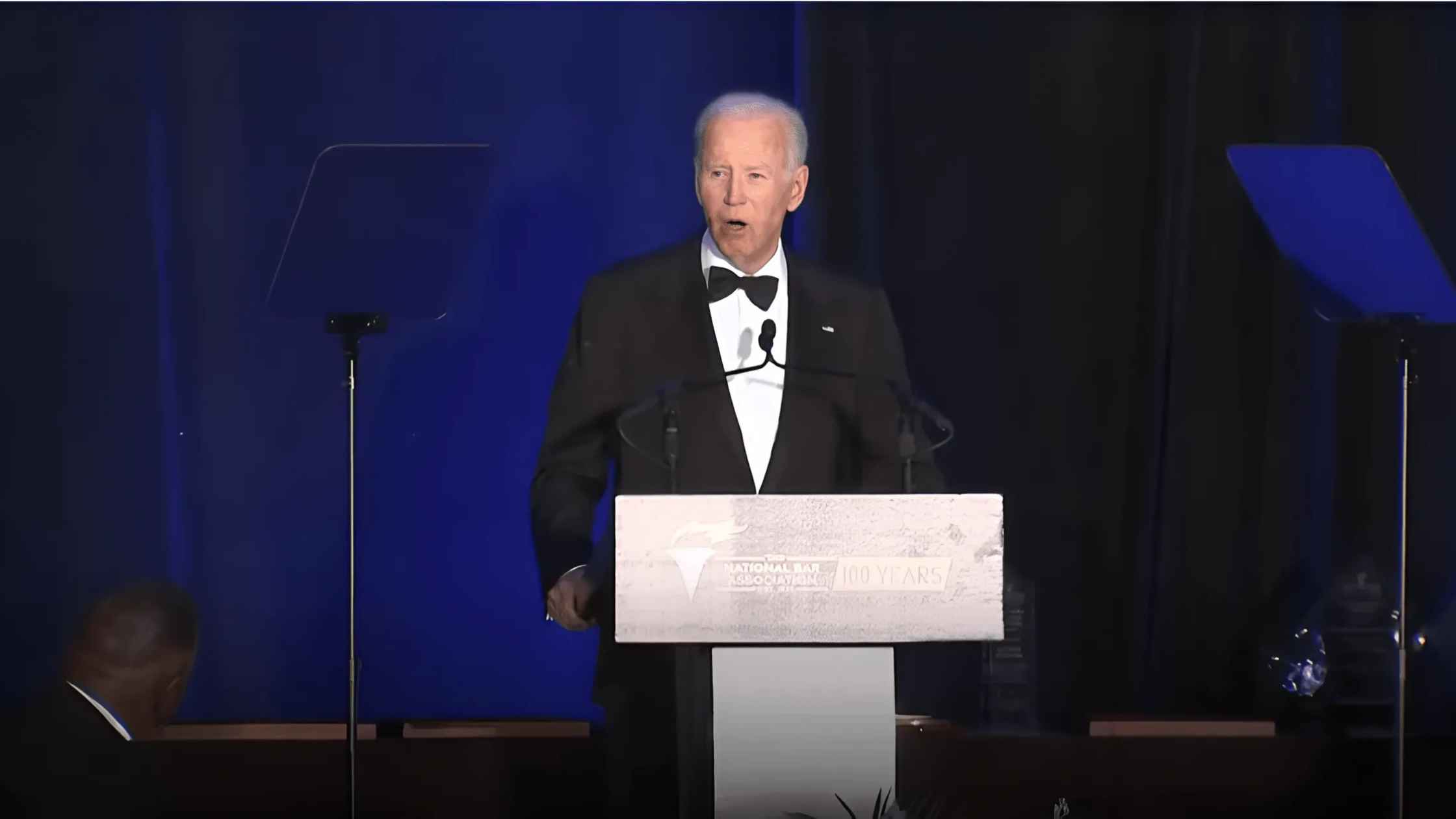
Without further ado, let's give a warm welcome to President Joe Biden.
President Joe Biden (00:11):
Please, sit down. As far as I'm concerned, you can start deep. What a great honor to be here. By the way, before I began I wanted to introduce you to the love of my life and the life of my love. My granddaughter and grad who went to Pen and got here to graduate school in art. Where are you sitting, babe? Over there. There's my granddaughter. She's all state in two sports and she's crazy about me.
(01:15)
President Adams, thank you for that introduction and President-elect Ashley Upkins, thank you for you're the next president. Congratulations to all the newly elected leadership, especially James Carter. Thanks James. Thanks. And Dominique Calhoun, Katsumi Calhoun, and all the other past presidents including my friend, Ben Crump. Thank you for doing all you do. You've always been there for me, Ben.
(01:45)
And thank you for honoring me with this award. It's a big deal. You're the reason you got me started, not a joke. I've been doing this in an elected office for 52 years now. I know I look like I'm 40, but I'm here for 52 years. And Mayor Brandon Johnson, thank you for the welcome back to the city. I've been here many times. It's great to be here among so many friends.
(02:16)
In 1929, a few short years after the National Bar Association was founded, one of its members, Lewis L. Reagan became the first Black lawyer admitted to the bar in my home state of Delaware. He also became a personal friend of mine and a truly influential mentor.
(02:34)
He cared deeply about the people of his community, regularly represented claims in two key Delaware cases that challenged the separate radical doctrine of Delaware public schools. These cases later joined 11 to become Brown versus the Board and Reagan worked on the legal team of a third-year marshal to win the landmark Supreme Court cases leading to the desegregation of American public schools.
(03:00)
And so as president, it was truly an honor to invite the family of the late Louis L. Reagan to the White House and award him posthumously the President's Citizens Medal. Folks, proper support of education was fundamentally the case about who we are as a nation. We're the only country in the world following an idea, an idea.
(03:30)
Every other country is based on geography, religion, ethnicity, but we're based on an idea. A sacred proposition rooted in scripture and the shrine of our Declaration of Independence that carved into our hearts. We hold these truths to be self-evident that all men and women are created equal and deserve to be treated equally throughout their lives.
(04:05)
Our Constitution is helping ensure that while we never fully ended up with that either, they never walk away from it either. Our Constitution guarantees a set of basic rights to every single American and sets up institutions to safeguard those rights.
(04:14)
Next year we'll celebrate the 250 years since the signing of the Declaration of Independence. But all that soaring rhetoric are just words on pages if we the people don't uphold the lawyers and judges, all of you in this room are the first and the last line of defense doing just that.
(04:41)
I need an informed and engaged bar willing to fight for and take risks to protect our basic rights. A bench prepared to recognize those rights and rule consistent with the Constitution. Our courts are meant to be a valid check on the excesses of other branches of government. Especially when Congress and our executive overreach and don't follow our constitutional institutions to safeguard as they are doing now.
(05:23)
For here, making a mark at 100 years since the National Bar Association was founded to support Black lawyers, men and women who were excluded from all professional organizations because of the color of their skin, which was flat-out unadulterated racism. Much of it has changed since then thanks to the work of the National Bar Association.
(05:47)
And so many of you have fought to make this country live up to its highest ideals because you believe like we do, in a simple truth. That the the soul of the nation, the soul of the nation is worth fighting for and the soul defines who we are.
(06:07)
I believe that is as true today as it was in 1925. But not since those tumultuous days in the 1960s has this fight been so existential to who we are as a nation with marginalized groups so dramatically under attack.
(06:28)
As a young man long before I understood the Civil Rights Movement in the political context, I understood it in a human context because of the friendships I made in the Black community. Being the only employee in the projects in my home city of Wilmington, Delaware, I made friends who became like family.
(06:48)
As I got older and more engaged, every Sunday I'd go to 7:30 mass in my own church and then I'd go to 10:00 AM mass at the church service at the A&E Church across town. And in time when I left for law school, when I came back to Wilmington to start my career working for a prestigious law firm. That was June of 1968 and as you all remember, Dr. Saint King was assassinated on April 4th of that same year.
(07:19)
Riots erupted in Wilmington, Delaware, my state which segregated by law. Riots erupted causing significant parts of our city to be literally burned to the ground. The governor kept Wilmington under National Guard occupation for 10 long months.
(07:40)
The National Guard was, and I mean this. If I remember on every damned corner a drawn bayonet, on every city corner an historic, it was the longest military operation in any US city since the Civil War. Again, my hometown, I went to Delaware where all this was happening. I didn't just see the hurt, I felt the pain because of my close friendships in the community.
(08:12)
Like many of you in this room, it caused me to get even more involved in the fight of civil rights and basic democracy. So I decided to leave the prestigious law firm I'd been hired by. I walked across the town square to become a public defender. I quit my job. I represented mostly Black clients in the East Side of Wilmington.
(08:26)
In 1970, I was convinced to run for the county council because no Democrat had ever won that seat. Unfortunately, I won. My sister ran my campaign and the Republicans saw something I didn't see. I was elected in the '70s for a four-year term and that reinforced me to a two-year term.
(08:56)
And since they couldn't find anybody to run for Senate, they asked me to do it. I ran for the United States Senate in '72. I championed, by championing legislation to protect civil rights and support marginalized communities. I was then proud to serve as vice president to our first Black president, Barack Obama.
(09:24)
I was proud to ask Kamala Harris to run with me, to be the first Black woman to serve as vice president in my term. It was important, as president, I made the cause of civil rights and equality the foundation of everything I did. For example, I promised an administration that looked like America, an appointed bench that looked like America. And I kept my promise.
(09:55)
I appointed the most democratic and diverse slate of judges ever in the history of the United States of America. [inaudible 00:10:09]. Ketanji Brown Jackson, the first Black woman on the United States Supreme Court.
(10:10)
Justice Jackson, as you witnessed earlier this week has true to herself to have the wisdom and the character that I saw in her when I nominated her. I appointed 13 Black women to the Courts of Appeals of the United States Federal Forward. More than any other president in Americas history combined.
(10:30)
There are other stories first as well for historic for Hispanic Americans, Asian Americans, Muslim Americans. And by the way, I didn't just appoint Ivy League judges. I appointed many HBCU graduates. How many of you have served under the greatest HBCU in America? Double mistake, right?
(10:49)
They got you started, man. 17, give me the honor before you call the courthouse man, I'm the Delaware state man. Look, my administration understood the importance of HBCUs. That's why as president, I invested more money in HBCUs than all other presidents in American history combined.
(11:36)
I appointed a record number of judges with backgrounds and experiences of law that were overlooked by the Federal Judiciary like public defenders, lawyers representing labor unions and the rights of immigrants. And by the way, I was the first president to give the National Bar Association a seat at the table in proposing candidates to the Federal Bank.
(12:05)
[inaudible 00:12:06]. I'm here. I need you. I still need you. So thanks everyone. No matter who these men and women were, or where they came from I'm sure that all my appointments are committed to the rule of law and are highly qualified. Because I know then what I know now. Judges matter, courts matter, the law matters and the Constitution matters.
(12:37)
I think a lot of Americans are starting to realize that under the pressure we're under now with this guy we have as president. Oh, get ready folks, this is just starting. I'm proud I've appointed judges doing their best to be independent, fair, partial, respecting the rule of law and upholding the Constitution.
(13:14)
I wish I could say the same for the executive branch who seem to doing it's best to dismantle the Constitution. Oh, I'm being deadly earnest, man. Which seems to be what's going on. They're doing it all too often with the help of a Congress that's just sitting in the sidelines and enabled by the highest court in the nation. The rulings they made. My God.
(13:48)
Folks, in our lives, the lives of our nation, there are moments so stark that they divide all that came before, from everything that followed. Moments that forces us to confront hard truths about ourselves, our institutions and democracy itself. We are in my view, at such a moment in American history.
(14:15)
Reflected in every cruel executive outreach, every role act of basic freedoms, every erosion of the law standing in the style of precedent, received the laws, the law firms bottling depression, bending to orders instead of staying rooted in justice and the law, including some of the largest newspapers in America.
(14:43)
We see apparent greed, some of our politicians express that while watching immigrants who are in this country legally torn from the arms of their family, dragged away in handcuffs from the only home they've ever known. My friends, we need to face the hard truths of this administration.
(15:07)
It has been to ease all the gains we've made in my administration. To erase history, to eradicate, to erase [inaudible 00:15:20], equality, to erase justice itself. And that's not hyperbole, that's a fact. Look, folks, you can't sugarcoat this. These are dark days, but you're all here for the same reason.
(15:33)
When I left that prestigious law firm in the public defender's office to go to the defender's office years ago. It's because our future is literally on the line. We must be unapologetic of fighting for the future. To paraphrase Senator Douglas, "There is no progress without struggle." And I would add there is no progress without courage. None.
(16:08)
Right in the Civil Rights Movement when Dr. King and Rosa Parks and John Lewis, another giant in our history needed a lawyer for the fight for freedom, they called on a guy named Fred Gray. Fred, I don't know where you are. Stand up, man.
(16:33)
Fred, one of the most important civil rights lawyers in our history ensured the legal privilege to segregate schools, secured the right to vote for so many. I was honored by Fred to invite Fred to the White House and bestow on him the nation's highest honor, the President's Medal of Freedom.
(16:58)
Folks, as a reminder that American history from its start has been a constant push and pull, it's a battle that's never over. As my late friend John Lewis used to say, "Democracy is a state not an act." Let's remember that in America, the power belongs to the people. And the way we show that power is by voting.
(17:30)
We need everybody to vote, we need everybody to count. So let's reach out to family and friends and neighbors. Let's help them register to vote and let's remind them without voting, nothing is possible. With voting, everything's possible.
(17:51)
Folks, let me close with this. When President Johnson signed the Civil Rights Act of 1964, he said the following, "This is a proud triumph that those who founded our country knew that freedom would be secure only, only if each generation fought to renew and embrace its meaning." It's literal.
(18:21)
I taught con law for 10 years in law school. I always say that. Every generation has an obligation to defend it, but I never, never, never, even though I was a city senator at the time, believe we'd get to this point. So let me say directly to the young lawyers in this room, it's time for you to renew and enlarge this name. It's time for you to lead the fight.
(18:48)
It is. As you hold the track on the National Bar's first 100 years and chart the course for the next century, it's not enough to honor the heroes that came before us. We need new heroes now. No, we do. We need heroes who follow in their footsteps.
(19:10)
When I was elected, I had the dubious distinction of being elected the youngest senator in American history and the oldest president in American history. It's hell turning 40 twice.
(19:34)
Look, some of you are potential candidates for office. And when I got elected as the youngest person, I got elected before I could be sworn in. Everybody, and I beat a really very popular guy, Nixon won my state with 60% of the vote. I won by a rousing 3,200 votes.
(19:56)
And they said, "What's your secret? What was your secret? Oh, it had to be some secret." And I always told the same thing. And I mean it from the bottom of my heart. The same thing. You got to know what's worth losing an election over. What are you willing to stand for? What are willing to fight for?
(20:19)
So let me tell you what that means to all of you here tonight. Those just starting out your careers and those of you who have been fighting a good fight all your lives. It means, take a client who can't write a big check that needs protecting their basic fundamental rights. It means sign out of that brief that may draw the eye of people in power, but you know it's the right thing to do.
(20:49)
It means stand firm against unconscionable actions designed to intimidate you. It means write the article, give the speech, lead the protests, defend the ideas your country was founded on to protect our institutions, to fight for the soul of the nation.
(21:09)
Some have the courage like all those others who did before you did, the people in this room to commit acts large and small, to bend the arc of all the universe toward justice. As Dr. King would say, "It needs a lot of bending folks." There's been nothing in the course of our country's history that we haven't been able to accomplish when we stood together, we set our minds to it.
(21:45)
We're the only nation in the world, a significant student in history, that has come out of every crisis we've got into stronger than we went in. We have to remember who the hell we are. We're the United States of America. There's nothing beyond our capacity. We do it together. God bless you all. May God bless the United States of America. We got a lot of work to do folks. Thank you, thank you, thank you.
President Adams (22:50):
Thank you, President Biden. And now by the power bestowed on me and joined by John Rogers Jr., I hereby confer upon you the C. Francis Stratford Award. Thank you for your service.
President Joe Biden (23:36):
Thank you very much. I'll proudly hang this on the [inaudible 00:23:37] library as you walk in the door. Thank you, thank you, thank you, thank you.