Senator Blackburn (00:16:19):
... sitting members of Congress, and even the President of the United States, it can and probably will happen to all Americans unless we stop it right here. This was the worst weaponization of government in American history, and I'm determined to ensure that Jack Smith is held accountable to prevent another Arctic Frost from happening again. The American people deserve nothing less.
(00:16:50):
And now I'll turn to the chairman of the full committee, Senator Durbin, for his opening.
Senator Durbin (00:16:56):
Thank you very much, Senator. Jack Smith, where could he possibly be hiding? What is this man doing to avoid coming before the American people under oath? Let me tell you, there's a different story that is the reality. October 30th of last year, I sent a letter to Chairman Grassley on this committee and said, "Let's bring Jack Smith before us under oath in public to answer these questions." He was ready. He'd volunteer to do it, but the chairman didn't take advantage of it.
(00:17:28):
So the question that's been raised by Senator Blackburn is what we need to do to bring Jack Smith before us under oath? What you need to do is to push the open door. He's already testified before the House Committee. First, they put him in private and then he brought it out in public under oath. Under penalty of perjury, he answered the questions, the same ones you're going to be posed with today. So he's not hiding. He's not avoiding this. He's ready to come and testify under oath. We've sent another letter to Chairman Grassley saying, "Bring him in. Let's ask him directly the answers to these questions."
(00:18:06):
For reasons that aren't clear to me at all, we're here today to discuss Jack Smith's role in a legal procedure. A procedure created by Congress and regularly deployed by federal prosecutors to collect the total records of people President Trump contacted in his efforts to overturn the election of 2020. As a reminder, in 2020, President Trump spent months spreading the big lie that the election was stolen. Never any proof whatsoever of that fact. He pressured state election officials and members of Congress to help overturn the results of the election.
(00:18:45):
Have you seen the contortions that these nominees have gone through when they're asked a basic question, who won the election in 2020? "Well, Joe Biden was sworn in as president." Well, who won the election? They won't answer it. They go through these painful contortions. They can't answer it because it's an article of faith. If you're loyal to Trump, you never accept the premise that he lost an election, and he did. He lost one in 2020.
(00:19:14):
He pressured state election officials and there were recordings of his pressure. This culminated in the January 6th attack on the Capitol, where President Trump's supporters tried to violently prevent the certification of the 2020 election. That same day, President Donald Trump was on the phone calling members of Congress to solicit their aid in blocking certification. Special Council Jack Smith investigated this criminal effort by President Trump to overturn the election. So it's not surprising that Mr. Smith subpoenaed the call records of those the President tried to enlist in his conspiracy.
(00:19:54):
To the extent the committee has questions about this, it should be former Special Counsel Smith testifying as a witness today before this committee. Not three telecom companies who responded to legally issued subpoenas. This morning, the committee's Democratic members sent another letter to Chairman Grassley. Renewing our request, the committee accepts special Council Smith's offer to testify in public under oath. Unlike this committee, the House Judiciary Committee has already deposed Mr. Smith and called him to testify. Listen to what he said under oath about his investigation. He could be here saying the same thing today, but here's what he said in the House. "Our investigation developed proof beyond a reasonable doubt that President Trump engaged in a criminal scheme to overturn the results of the 2020 election and to prevent the lawful transfer of power." What about those subpoenas for Republican Senators call records? Mr. Smith explained, " President Trump and his associates tried to call members of Congress in furtherance of their criminal scheme, urging them to further delay certification of the 2020 election. I did not choose those members. President Trump did." End of quote from Mr. Smith before the House.
(00:21:16):
Whitewashing President Trump's attempts to overturn the 2020 election and the January 6th attack do not address the single problem facing America, and it helps set the stage for Trump's efforts to interfere in this year's election. This is frankly an embarrassing use of the committee's limited time, and I urge my colleagues to turn their attention to the threats that President Trump currently poses to our democracy.
(00:21:41):
The Trump administration has been waging war against its own citizens in the streets of American cities. Federal immigration agents have become a paramilitary force, harassing, threatening, and on multiple, multiple occasions now, killing Americans who oppose the President's mass deportation campaign.
(00:22:02):
Last week, a top Trump ally, Steve Bannon, gave away the end game saying, "We're going to have ICE surround the polls. We'll never again allow an election to be stolen." Asked about these comments, the White House press secretary said she, "Can't guarantee" ICE agents won't be near the polls. The goal is clear, intimidate Americans so they won't exercise their constitutional right to vote in November, because otherwise the Trump forces are going to lose that election.
(00:22:35):
Indeed, history is repeating itself. We grow even closer to an election while President Trump is less popular than he has ever been. Instead of addressing the issues that American people really care about, the President is doubling down on his baseless claims of election fraud to justify interfering in another election.
(00:22:55):
Last month, the FBI seized truckloads of 2020 election materials from Fulton County, Georgia, with Tulsi Gabbard, the Director of National Intelligence inexplicably in toe on the president's direct orders. Attorney General Bondi in a letter to Minnesota Governor Tim Walz demanded that the state of Minnesota turn over its voter rolls as a condition for the withdrawal of ICE and CBP from Minnesota. An attorney for the state described it as "a ransom note." And now President Trump is calling for Republicans to quote, "Take over the voting." His plan to repeat his election subversion tactics could not be plainer.
(00:23:36):
I hope his disregard for Congress and the American people doesn't turn violent yet again, but instead of responding to this threat, Republicans here today show their undying fealty to the President's abnormal behavior and to his attempt to whitewash history and somehow make January 6th disappear. It won't work. We still have the videos.
Senator Blackburn (00:24:00):
Chairman Grassley, you're recognized for your opening.
Senator Grassley (00:24:03):
Before I speak, I'd like to rebut what you've just heard. It seems that my Democratic colleagues aren't listening, because I, as chairman and my Republican colleagues have already said that we'd bring Jack Smith in for a public hearing.
(00:24:22):
I'd also note that Jack Smith has failed to answer my preliminary questions that I sent him last year. For example, did he or his staff use non-government devices for government work? Smith has also misled the committee already by saying that he did everything by the book, and we know that's not true now.
(00:24:47):
So I thank Senator Blackburn for her leadership of this subcommittee and for this hearing. And I can't outdo the strong statement you already made, Senator Blackburn. Today is the first in a series of Arctic Frost hearings that I've authorized as chairman of the full committee. I started the Arctic Frost investigation July of 2022 based on credible whistleblower disclosures. Those whistleblowers disclosed partisan bias in the genesis of election case against Trump and related allegations. I've always said if you're going to open a politically charged investigation, it must be done in the right way.
(00:25:38):
That partisan bias started with then FBI special agent in charge, Thibault, and others, and it continued through Jack Smith's case. As I've shown through Thibault own social media and emails, he was out to get Trump and he violated the FBI rules along the way. He also violated the Hatch Act for political conduct at the FBI. Many years of investigation have resulted in thousands of records made public.
(00:26:23):
Let me emphasize that many of the records that I've made public at this Congress started in January 2025 with Patel's nomination hearing have come from brave whistleblowers. Other whistleblower disclosures to my office have helped this administration identify responsive records for the Congress, probably records that the executive branch didn't even know that they had. The New York Times has shamefully published a series of articles trying to undermine these whistleblowers. The Times has disgracefully accused them of violating the law while defending partisan agents and prosecutors who have been exposed for bad conduct.
(00:27:21):
During this investigation, Senator Johnson and I've uncovered how Jack Smith massively expanded the election case. And that's been a focus of our investigation, the improper expansion of Jack Smith's work. He didn't just target President Trump. Jack Smith issued hundreds of subpoenas targeting over 400 Republican organizations and individuals. Some of those subpoenas sought broad and extensive financial data from Republican groups, communications with the media and the legislative branch. Communications relating to media companies include CBS, Fox News, Fox Business, Newsmax, Sinclair, and others.
(00:28:16):
Now, I think it's a very worthy question. Why haven't these media companies condemned these actions? Financial data relating to Republican groups include the Republican National Committee, Turning Point USA, and hundreds of other organizations. These invasive efforts were spearheaded by partisan agents and prosecutors. Many have now been justifiably fired despite Democrats complaining about it. It's more than reasonable to question why Smith needed vast financial data, as well as what
Senator Grassley (00:29:00):
... what his partisan team would ultimately do with that data. It's worth noting that two of Jack Smith's partisan prosecutors, JP Cooney, and Molly Gaston, reportedly filed a complaint with the Department of Justice Inspector General. That complaint was in response to whistleblowers providing me the 197 subpoenas that targeted over 400 Republican groups and individuals. Cooney and Gaston, reportedly, wrongfully asserted. My whistleblowers broke the law in blowing the whistle. The dedication of my whistleblowers have to transparency far outweigh improper efforts to silence them by these two rogue prosecutors.
(00:29:57):
In light of Jack Smith and his team's partisan efforts to chill whistleblowers and aggressively seek sensitive information relating to Republican groups and individuals, their efforts to target Republican members tolling data is even more questionable. To that point, on December the 10th last year, I released several emails. Those emails showed that Smith's team was warned that subpoenaing congressional information could violate the speech and debate clause of the Constitution. They were warned that legislators may intervene and oppose that subpoena process.
(00:30:44):
But here, in this case, my colleagues couldn't intervene because Smith and his team successfully obtained non-disclosure orders keeping everything top secret. Smith and his team irresponsibly steamrolled ahead while intentionally hiding their activities from members of Congress. Since October 9th last year, this committee has sought information from phone companies about Jack Smith's effort to obtain congressional information. My and Senator Johnson's investigative teams have also provided the companies with additional search terms to get to the bottom of the matter. To date, T-Mobile has identified a subpoena for toll records from Senator Lee's personal phone. AT&T initially asserted it didn't provide information to Jack Smith relating to any member of Congress. Then in November of last year, AT&T amended its answer because it did respond to a subpoena relating to former Speaker of the House, Kevin McCarthy.
(00:31:56):
Regarding Verizon, two members targeted by Jack Smith were associated with the Senate Sergeant at Arms' phone lines. Notably on May 22, 2022, the Senate entered into a contract with Verizon. That contract created an affirmative notification requirement for Senate devices, which means under the contract, Verizon was required to notify the Senate Sergeant at Arms when members' offices was subject to a subpoena. According to the Senate Sergeant at Arms, these terms applied to May 25th, 2023 subpoena that included two Senate lines, one for Senator Crew, the other for Senator Graham. Verizon failed to perform that notification requirement. Under questioning by my staff, Verizon said they didn't have the infrastructure in place to know whether a congressional number was subpoenaed until February of last year. The federal statute also says that a carrier shall not be barred from providing notice to a Senate office about a subpoena. Today, Verizon AT&T and T-Mobile will have a chance to explain themselves.
(00:33:24):
To date, my and Senator Johnson's oversight of these companies has identified that Verizon, AT&T, and T-Mobile received at least 84 Arctic Frost or Jack Smith related subpoenas. At least 10 are related to 20 current or former Republican members of Congress. So, Smith's deceitful conduct was a substantial intrusion into the core constitutional activities of constitutional officers. If this happened to my Democratic colleagues, they'd be as rightly outraged as we Republicans are. My work will continue because transparency brings accountability. Thank you.
Madam Chairman (00:34:15):
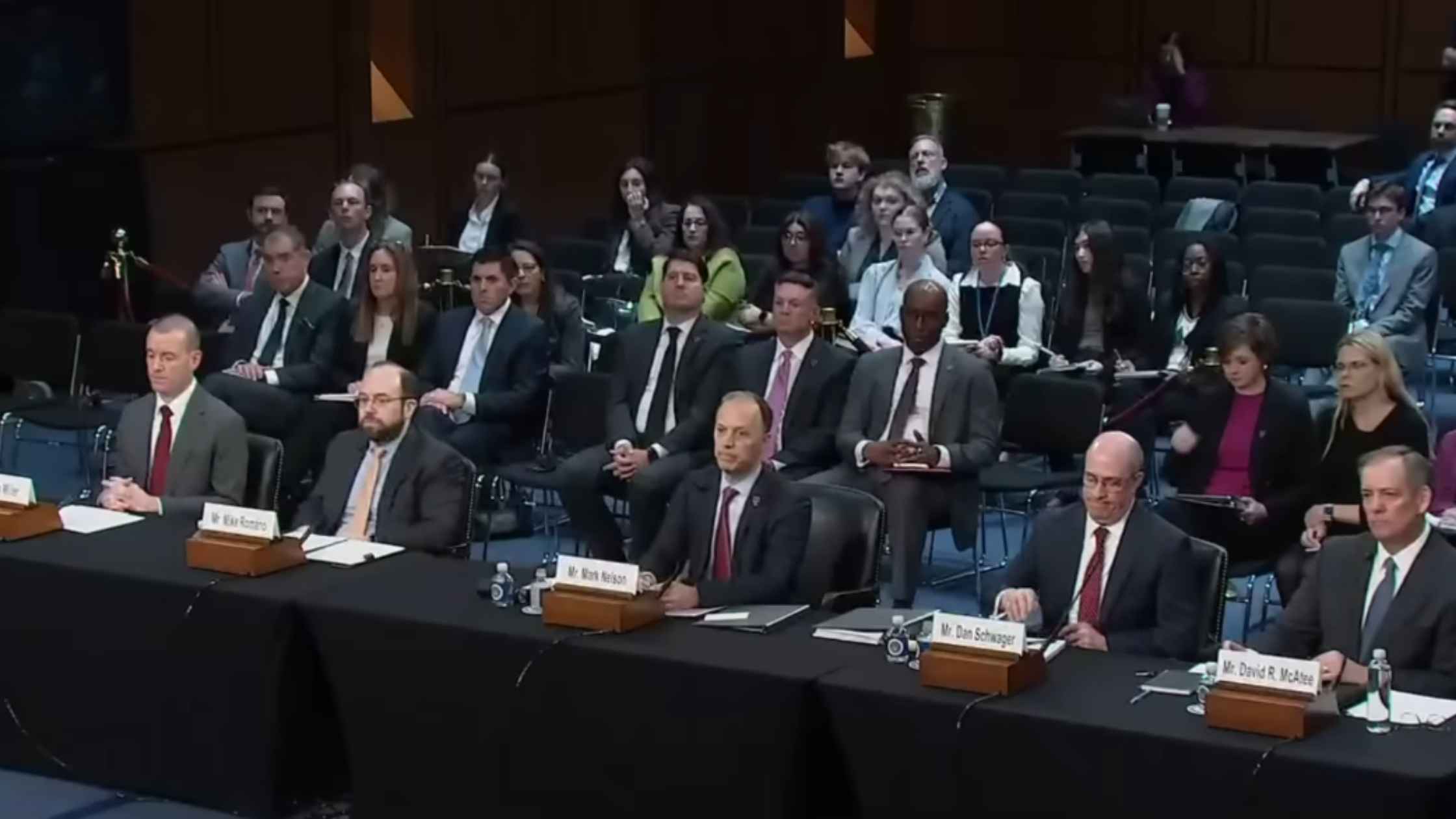
Thank you, Mr. Chairman, and I thank our witnesses for being here today. And for each of you, a brief introduction, and then we will get to your openings.
(00:34:27):
Mr. Chris Miller serves as Senior VP and General Counsel for Verizon, where he is responsible for the Verizon legal teams supporting supply chain and sourcing transactions, artificial intelligence, information technology, data and analytics, real estate deals, innovation, and emerging solutions. Prior to joining Verizon, he was a lawyer in private practice with Hogan & Hartson. He earned his bachelor's from Iowa State University, his JD from the University of Michigan.
(00:35:02):
Mr. Michael Romano was a Deputy Chief of the Capitol Siege Section in the US Attorney's Office for the District of Columbia. He resigned from the DOJ in March of 25. He now works in private practice. Mr. Romano received his law degree from Washington University in St. Louis, his bachelor's in political science from Notre Dame, and now teaches trial advocacy at American University.
(00:35:31):
Mr. Mark Nelson currently serves as the EVP and General Counsel at T-Mobile, overseeing legal and government affairs in leading the company's legal strategy team. He joined T-Mobile in '21 after more than 25 years at the law firm, Cleary Gottlieb, where he specialized in mergers and antitrust. He has been recognized as one of the nation's leading antitrust lawyers. He earned his bachelor's from Cornell, his law degree from Harvard, and is a member of the bar in Washington State, New York, and Washington, D.C.
(00:36:10):
Mr. Dan Schwager is currently of Counsel at Verdi & Ogletree PLLC. He was previously the Chief Counsel at American Oversight, and was general counsel to the Secretary of the Senate. From 2011 to '13, he was the chief counsel and staff director at the House Ethics Committee, and served as counsel with the Senate Ethics Committee from '09 to '11. He served as a trial attorney in the public integrity section from '03 to '09. He earned his JD from NYU School of Law, his BA in ethical theory from Bates College.
(00:36:53):
Mr. David McAtee is the Senior Executive VP and General Counsel at AT& T, where he is responsible for all legal matters at the company. He was appointed general counsel in 2015 after joining AT&T in 2012 as senior VP and assistant general counsel. Prior to AT&T, he was a partner at Haynes & Boone, specializing in complex litigation matters, antitrust government investigations. He earned his bachelor's from Duke and his JD from University of Texas School of Law.
(00:37:31):
I want to ask each of you to stand, raise your right hand, and be sworn in.
(00:37:38):
Do you swear or affirm that the testimony you're about to give to this committee is the truth, the whole truth, and nothing but the truth?
Everyone (00:37:47):
I do.
Madam Chairman (00:37:47):
All have affirmed their commitment. Mr. Miller, we will begin with you for your testimony.
Chris Miller (00:38:00):
Chairman Blackburn, Ranking Member Durbin, and members of the subcommittee. My name is Chris Miller. I'm the Senior Vice President and General Counsel of the Verizon Consumer Group. I appreciate the opportunity to be here today.
(00:38:13):
I want to begin by acknowledging the frustration and concerns raised by members and many of you here today over the subpoenas and non-disclosure orders that were issued in 2023, and the responses that we provided. We were compelled to provide this information under the law, and we complied. No matter who is the subject of a subpoena, Verizon cannot ignore a valid legal demand or a court order. But our processes could have been better suited to meet what was a new and unique set of circumstances for us and for other companies. We have put new processes in place to increase transparency to members whose information is sought by law enforcement. This allows the member to take the necessary actions to assert their rights and privileges.
(00:39:05):
We have been working closely with Congress and the administration for the past few months to address the important issues raised by this committee's inquiry. Let me provide some context and a timeline of events. I will then discuss the new procedures that we have put in place when law enforcement serves Verizon with legal process involving a member of Congress.
(00:39:28):
Congress has long recognized that telecom carriers have access to information that can help law enforcement. We respect valid law enforcement requests, and historically have not inquired about the substance of their investigations. Verizon processes over 300,000 legal demands and urgent inquiries from public safety officials each year. We are required to respond to these requests for information promptly, sometimes in real time. Beginning in late 2022, Verizon received multiple federal grand jury subpoenas from the former special counsel's office. Some of these subpoenas are related to the Arctic Frost investigation, and requested records associated with specific telephone numbers. One subpoena demanded subscriber information and call detail records for 12 telephone numbers between January 4 and January 7, 2021. That subpoena only listed telephone numbers, and did not include names or any other information identifying these numbers as belonging to members. And at that time, we did not have a process in place to identify and escalate numbers belonging to members before we responded.
(00:40:49):
We now know that some of those numbers were associated with members of Congress. These were personal lines, campaign lines, or official lines. A judge issued a non-disclosure order preventing us from disclosing this request to anyone, including those identified in the subpoena. As was our practice at the time, our response team reviewed the subpoena and non-disclosure order, and determined that they were valid and legal. As a result, we responded to the subpoena and produced call detail records for these lines. These were unprecedented circumstances, and while we fully complied with the law, we also acknowledge that we could have done better in terms of our process. One year ago, we began working with the Senate Sergeant at Arms on changes to the handling of legal demands for official Senate lines. And we have expanded those changes to include personal and campaign lines. Here's what we're doing.
(00:41:45):
First, for law enforcement requests related to members, we will ensure that Verizon's senior leadership is notified and consulted before any information is disclosed. This will allow for informed and thoughtful decision making at the highest levels of the company. Second, before producing records, Verizon will contact law enforcement officials to verify that they, in fact, intend to seek records for a member's telephone number. Third, we will notify the member of the law enforcement request to the fullest extent provided by the law. And if we receive a non-disclosure order preventing notice, we will challenge the order in court. This will require coordination with the House and Senate to ensure that we know which numbers are covered. We have also met with the White House Council's office, and are working with them on a similar process for the administration.
(00:42:41):
Verizon is committed to getting this right. We have worked closely with the congressional committees investigating these matters, and we will continue to cooperate with you as you examine these issues.
(00:42:52):
I look forward to your questions. Thank you.
Madam Chairman (00:42:56):
Mr. Romano, you're recognized.
Mike Romano (00:42:59):
Thank you. Good morning, Chairman Blackburn, Ranking Member Durbin, and members of the committee. Thank you for the opportunity to discuss the special counsel's election interference case code named Arctic Frost, and his office's collection of toll records. It's an honor to speak with you today.
(00:43:15):
My name is Michael Romano. I was an attorney in the Justice Department for almost 18 years. Immediately before my resignation, I was a Deputy Chief of the Capitol Siege Section here in Washington, D.C. It was a great privilege to serve the United States by prosecuting crimes committed during the violent riot at the US Capitol on January 6th.
(00:43:36):
When I first learned of this hearing, I was surprised. I was surprised because, from my perspective, as a long-serving federal prosecutor, there is nothing remotely scandalous or controversial about the collection of toll records. Toll records show that a phone number called another phone number, when the call was placed, and how long it lasted. They do not include content. They do not capture conversations, voicemails, or text messages. When the special counsel's office collected toll records, it did not gain access to anyone's thoughts or to any private discussions. Only to the fact that calls happened.
(00:44:15):
Subpoenas for toll records are routine in criminal investigations, especially when they involve conspiracy and obstruction of justice. Both of those crimes turn heavily on a person's intent, which makes communications especially important. In such cases, investigators and prosecutors often seek to understand who the target of the investigation spoke with, when, and for how long. Investigators and prosecutors may also seek to understand who other people spoke with, even if those others are not suspected of any criminal wrongdoing. Non-disclosure orders are also routine. It is often best practice for investigations to be conducted as covertly as possible, and that is especially important when there are concerns of tampering, witness intimidation, or attempts by key parties to get together and agree on a story, and which based on what I know of the election interference case was a real concern. After all, critical witnesses, which may have included some of you senators, and your colleagues and staff, did have their lives threatened on January 6th by supporters of the president.
(00:45:25):
This collection of toll records was not weaponization. It was not weaponization, period, much less the worst weaponization of the government in American history. It was not a witch hunt. It was not a pretext to harm political opponents. If it was any of those things, the special counsel would have used this information against you somehow. But as I understand it, that didn't happen. Based on what I know, his office followed department policy in the collection of evidence, safeguarded that evidence, and kept it confidential, just as I would expect any federal prosecutor to do. I understand that some of you had your toll records collected and are unhappy about that, and that's understandable. Nobody enjoys having the government collect their information. But apart from that unhappiness, you were not harmed.
(00:46:12):
Indeed, given the gravity of the crimes under investigation in the election interference case, the special counsel needed to investigate fulsomely. Remember what we were dealing with after January 6th. The Capitol had been ransacked by a violent mob. Throughout the grounds and the building, police officers were assaulted. They were punched, kicked, tackled, and spat on. They were battered with polls, they were hit with chairs, crushed in doors, blasted with pepper and bear spray, and shocked with stun guns. The rioters stormed the building, causing millions of dollars of damage to the seat of our government. They tried to overturn the results of the election, and by force, or threat of force, install their preferred candidate despite the outcome. And in the process, your lives, your staff members' lives, and the lives of the officers who protected you, were put in danger. There were no small crimes on January 6th, 2021.
(00:47:05):
I have heard the criticism that misdemeanor defendants accused of trespass offenses were treated true harshly, and I strongly disagree with it. The people who trespassed at the Capitol and committed disorderly behavior enabled the mob violence. Without the volume of people who stormed the Capitol, less violence would have been committed, less damage would have been done. As one judge observed commenting on these cases, every raindrop contributes to a flood. And based on the evidence I reviewed, many misdemeanor defendants understood exactly what the riot meant to accomplish, and they meant to achieve the same goals as the people who used violence.
(00:47:42):
The crimes committed on January 6th demanded to be investigated. Working as part of the Capitol Siege Section prosecuting rioters and having a role in leading the effort was the apex of my work at the Justice Department. It is the most righteous case, the most righteous effort I have ever been a part of with the finest team of investigators, prosecutors, and staff I have worked with. And yes, that includes people who would go on to serve the Special Counsel's office. And President Trump's role in the election interference case deserved to be investigated to-
Speaker 1 (00:48:13):
Madam Chairman, Madam Chairman.
Madam Chairman (00:48:14):
Time's expired.
Speaker 1 (00:48:15):
Could you ask the witnesses not to filibuster us into Friday, so we can get about answering questions?
Madam Chairman (00:48:22):
I gladly do so.
Speaker 1 (00:48:23):
Thank you.
Madam Chairman (00:48:24):
Mr. Nelson, you're recognized. Five minutes.
Mark Nelson (00:48:30):
Thank you, Senator. Chair Blackburn, Ranking Member Klobuchar and members of the subcommittee, thank you for the opportunity to appear here before you today. My name is Mark Nelson, and I'm the General Counsel of T-Mobile.
(00:48:43):
T-Mobile is headquartered in Bellevue, Washington, and is the second-largest provider of wireless communication services in the US. Over the years, we've transformed the wireless industry by delivering reliable coverage, focusing on our customers and challenging industry norms. Through our signature initiatives, we've eliminated annual service contracts, overage fees, and unpredictable international roaming charges, among tackling other customer pain points, all while delivering award-winning customer service. We are proud to connect communities large and small, urban and rural, across every region of the country. Our mission has remained constant. Replace complexity and limited options with transparency, flexibility, and meaningful customer benefits. As a provider of essential communication services, we understand the critical importance of data privacy, cybersecurity, and public safety. We invest heavily in these areas and maintain rigorous internal processes to ensure we meet all legal requirements and uphold the highest standards of integrity. When we receive valid demands from government entities, we respond as required by law, and with customer privacy top of mind. T-Mobile receives an enormous volume of law enforcement demands and legal process relating to subscriber records. In 2024 alone, T-Mobile responded to over 582,000 legal demands from government entities, including subpoenas for toll records, warrants, and pen register, and trap and trace orders. T-Mobile responds to these demands consistent with its legal obligations. We also make publicly available our annual transparency reports on the various types of legal demands for customer information that we receive. For all law enforcement demands, we comply following our standard legal review procedures consistent with our obligation to protect customer privacy, while satisfying our legal obligations under the Stored Communications Act and other relevant statutes and regulations.
(00:50:47):
For all carriers, by design, law enforcement does not provide information on the underlying investigations motivating their requests. And the overwhelming majority of law enforcement demands we receive do not provide target identifiers, just telephone numbers, which limits our ability to connect responsive records with specific individuals.
(00:51:07):
So when we receive subpoenas from Special Counsel Jack Smith's office, none of which sought records for Senate official business lines, the team treated them as we would any other subpoena, responding consistent with our obligations under the law. That said, T-Mobile has always opened to ways to improve our internal processes. And over the past year, we've been working closely with the Senate Sergeant at Arms to ensure that any applicable requirements are implemented efficiently and transparently. And T-Mobile's legal and emergency response team, under my direction, is continuing to evaluate and strengthen our internal processes to ensure legal compliance and adequate notice is provided.
(00:51:51):
I joined T-Mobile in 2021 because the company's mission, culture, and commitment to challenging the status quo reflect my own values. T-Mobile operates with the spirit of innovation and integrity, and I'm proud to be part of an organization that is shaping the future of connectivity while holding itself to the highest standards.
(00:52:10):
Thank you for the opportunity to provide this testimony today, and I look forward to your questions.
Madam Chairman (00:52:16):
Thank you. Mr. Schwager, you're recognized.
Dan Schwager (00:52:22):
Thank you, Chair Blackburn, Ranking Member Klobuchar, Ranking Member Durbin, members of the committee. Thank you for allowing me to speak with you today. My name is Dan Schwager, and I've been asked to testify about the use of non-content toll records and criminal investigations, including politically sensitive investigations, based on my experience and perspectives as a former corruption prosecutor. I'm not speaking on behalf of my current or any former employer.
(00:52:49):
Today, I hope to share my perspective regarding how common it is to obtain such records and non-disclosure orders regarding them in thorough investigations of complex matters. How obtaining such records and orders does not indicate something nefarious about either, the owner of the phone, or the investigators seeking the records. And how any investigation of political figures is at risk of being called political, but that regular and thorough investigative steps are not political actions themselves.
(00:53:20):
I've also been a fierce defender, nonpartisan defender of the prerogatives of the legislative branch, and its protection from a potentially abusive and retributive executive branch. I agree the speech or debate clause needs serious attention, debate, and maybe even more legislation. But my training and experience teach me that reasonable disagreements between the executive and legislative branches over interpreting law, are not evidence of improper motives or misconduct.
(00:53:50):
I went to law school for a passion about ethics and integrity in government, and on the flip side, countering corruption. I found that to be an absolutely nonpartisan concern. I've worked in the executive and legislative branches for and with both Republicans and Democrats of great integrity and ethical compass. And I have investigated and seen prosecuted public officials on both sides of the aisle who breached the public trust. An investigation of corruption or fraud should look roughly the same no matter who the target is. Unfortunately, political attacks on nonpartisan investigations often sound roughly the same as well. I've personally been described as a tool of the right, and a tool of the left, once even in the same case.
(00:54:40):
Throughout my career as a corruption prosecutor, I learned the value of what we called LUDS and tolls. Many investigations begin with subpoenas for the non-content phone records of both subjects and mere witnesses. Those records are scoured for relevant information to help fill out the understanding of the facts. They are sought regardless of whether they may be inculpatory or exculpatory, but to understand facts. In my career, toll records have led to the complete exoneration of a public official framed for serious corruption. These are very different from wiretaps, or other content searches, because both the Supreme Court and Congress have recognized that seeking non-content data such as toll records from third party processors is simply a lower Fourth Amendment concern than a wiretap or other forms of seeking the content of communications. Non-disclosure orders are also commonly warranted and sought. The basis for seeking them is not necessarily that the owner of the phone may jeopardize an investigation themselves, but that intimidation, destruction of evidence, or jeopardy may occur if the subpoena became public to others.
(00:55:50):
People brazen and dishonest enough to commit acts of significant corruption or fraud are often brazen enough to try to hide the evidence or intimidate witnesses. It should not be surprising then that credible allegations of serious misconduct might warrant a non-disclosure order. To be clear, the search for and seizure of information by the government implicates the constitutional rights of all people in the United States. When the legislative branches involved, additional important constitutional concerns and checks and balances are implicated. The interpretation of which have long been reasonably debated between the executive and the legislative branches, and only sometimes settled by the courts. But a reasonable disagreement does not equal improper conduct.
(00:56:39):
In summary, the tremendous weight of nonpartisan public evidence regarding the serious and violent events and alleged fraud surrounding January 6th called for a thorough and honest investigation in the interest of the American public. The evidence at issue in this hearing, the particular non-content phone records, might have been a tiny fraction of the vast picture of those events, but the use of telephone toll records and a non-disclosure order appear to me to be consistent with a typical nonpartisan, objective and thorough investigation. No person or investigation is perfect, but because of partisanship over normal investigative tactics, even with reasonable disagreements on the application of speech or debate, appear to me to be overstated and risk further needlessly exacerbating instead of mitigating partisan views of American law enforcement.
(00:57:28):
Thank you.
Madam Chairman (00:57:30):
Mr. McAtee, you're recognized.
David McAtee (00:57:33):
Thank you. Chair Blackburn, ranking member Klobuchar, Ranking Member Durbin, thank you for the opportunity to be here today and good morning. My name is David McAtee, and I am AT&T's General Counsel.
(00:57:45):
Every year, AT&T receives hundreds of thousands of legal demands. And with each, our professional team strives to act according to three important principles. We protect the privacy of our customers; we follow the law; we exercise
David McAtee (00:58:00):
... sound professional judgment.
(00:58:02):
Our processes are rooted in these principles and so is our culture. In my written testimony, I explained AT&T's processes. Now I'd like to spend my limited time focusing on how we believe our culture works hand in glove with our process to deliver better results for our customers.
(00:58:20):
At AT&T, it all starts with the customer, but we learned long ago that we serve customers better working together than we do in silos. To deliver best customer service, we must collaborate across departments, sharing information to make better informed decisions. We call it winning as one. I share this because it is the combination of process and culture that best explains how AT&T handled the grand jury subpoenas that we received from Jack Smith's Special Counsel office.
(00:58:51):
In late 2022, our global legal demand center began to receive grand jury subpoenas from that office. In each case, professionals reviewed the subpoena according to the process I outlined in my written testimony. In each case, the team determined that the subpoena was valid and compulsory, which meant that we were required by law to provide the information requested. In each case, the team also determined that the subpoena was subject to a non-disclosure order, which meant that we were legally obligated not to tell anyone about the subpoena.
(00:59:25):
Sitting here today, we know that our subpoena team was 100% correct in both determinations, but to the team's credit, they did more. After receiving and responding to several special counsel subpoenas as required by law, the subpoena team reached out to my lawyers to discuss what was clearly becoming a series of requests from the same office. In simple terms, the subpoena center did something that is central to our culture of collaboration. They raised their hand when they saw something out of the ordinary. And when they did, our legal team intervened using its best professional judgment in two important ways.
(01:00:06):
First, our lawyers instructed the Office of Special Counsel to direct all future subpoenas to the legal department, not the subpoena center. Second, when our lawyers received a subpoena that requested information on campaign accounts of two sitting members of Congress, they did what I believe is always fair game. They asked a question. My lawyer's email has been produced, but for the purposes here today, I'll share exactly what she wrote to the Office of Special Counsel.
(01:00:39):
First, she identified the potential constitutional issue saying "the users of the telephone numbers potentially implicate the protections of the Speech or Debate Clause." Then she asked the critical question, asking for special counsel's view of the potential constitutional implications " so that AT&T may document the special counsel's views and incorporate them as part of our analysis." Special counsel's office never responded to that email, at least not substantively. And ultimately, the office abandoned the subpoena and no records were produced.
(01:01:19):
At the end of the day, all telecommunication companies are subject to the same laws, and we're all comprised of human beings like me who can always do better. But in this case, as AT&T's general counsel, I'm pleased to share how our teams endeavored to combine process and culture to serve our customers better. I look forward to your questions.
Madam Chairman (01:01:43):
Thank you. We will begin our round of questioning. I will open. We're each going to have five minutes to question you. Mr. Miller, I want to come to you. Are you aware of the Speech or Debate Clause in Article I?
Chris Miller (01:02:02):
Yes.
Madam Chairman (01:02:02):
Okay. And are you aware of the DC Circuit case, US versus Rayburn, House Office Building?
Chris Miller (01:02:12):
Chairman Blackburn, I am not an expert on the Speech or Debate Clause, but I have heard of that case.
Madam Chairman (01:02:16):
You have heard of that case. Then you know that that case stands for the proposition that there is a documentary non-disclosure privilege for members of Congress. So do you think Jack Smith violated that Speech or Debate Clause protections?
Chris Miller (01:02:38):
Chairman Blackburn, I would defer to you and your colleagues about the scope and the application of the Speech or Debate Clause
Madam Chairman (01:02:45):
You're aware of the case?
Chris Miller (01:02:47):
I am, Chairman Blackburn.
Madam Chairman (01:02:48):
And you're aware of what the case found, that it establishes that proposition?
Chris Miller (01:02:54):
I am.
Madam Chairman (01:02:55):
You are. So do you think, in your opinion, did Jack Smith violate that Speech or Debate Clause?
Chris Miller (01:03:03):
Chairman Blackburn, I do not know. I'm unaware of any case that addresses whether the Speech or Debate Clause-
Madam Chairman (01:03:11):
Okay. So then why did you turn over the tolling data? If you're aware of the Article I Speech or Debate Clause and you're aware of the case, why did you do this?
Chris Miller (01:03:25):
I understand the frustration on this issue, Chairman Blackburn. We responded to this subpoena, principally the May 25th, 2023-
Madam Chairman (01:03:35):
Even though you knew it was wrong?
Chris Miller (01:03:38):
No, Chairman Blackburn. We did not know it was wrong.
Madam Chairman (01:03:40):
Okay, let me ask you this. I've got a question on something in your testimony and I'm going to quote you. "Our processes could have been better suited to meet what was a new and unique set of circumstances." So I'm glad that you all, it is heartening to hear that you realize you didn't have the right processes in place, but I want to make sure I'm understanding what you meant by that.
(01:04:07):
So what you're basically saying is it took Jack Smith issuing secret subpoenas for the records of duly elected members of Congress as part of a weaponized investigation of President Trump for Verizon to finally realize that it probably could have, and I quote "you better processes." Is that accurate?
Chris Miller (01:04:33):
Chairman Blackburn, we should have had a better process to address this situation.
Madam Chairman (01:04:38):
So in essence, what you're saying is that you had no process in place as of May 2023. And you had no way of identifying that something was a member of Congress records. Is that accurate?
Chris Miller (01:04:59):
That's correct, Chairman Blackburn, not at that time.
Madam Chairman (01:05:01):
That you had no process in place, and therefore you turned everything over. Okay. So no process, you turned it over. You're aware of the Speech or Debate Clause. You're aware of the US versus Rayburn House Office Building, but you didn't comply with that. So in Judge Boasberg's non-disclosure order that accompanied the subpoena, the May 2023 subpoena, he stated that there were reasonable grounds to conclude that notifying me or the other members of the subpoena would result in destruction of or tampering with evidence, intimidation of potential witnesses and serious jeopardy.
(01:05:53):
Are you aware of any facts and were you at the time aware of any facts that justify Judge Boasberg claiming that there were reasonable grounds that me or any of us would commit a federal crime by destroying evidence?
Chris Miller (01:06:13):
No, Chairman Blackburn. I have no reason to believe you or anyone else on this panel would do any of those things. When we evaluated this subpoena and this non-disclosure order, we were simply looking to determine if they were valid and legal. And in this case, they were.
Madam Chairman (01:06:28):
And it never caused you to ask I wonder what this is about or why they would do this?
Chris Miller (01:06:36):
Chairman-
Madam Chairman (01:06:36):
Why didn't you reach out like AT&T did?
Chris Miller (01:06:39):
Chairman Blackburn, I don't want to speak for my fellow panelists at AT&T. I would say that was a good catch.
Madam Chairman (01:06:47):
I didn't ask you to speak for them. I asked why you did not take an action and you did not. My time's expired. Senator Durbin, you're recognized for five minutes.
Senator Durbin (01:07:00):
I want to try to get some basics understood here. Mr. Nelson, you testified that there were 582,000 demands on your company, T-Mobile, by government for information similar to this situation?
Mr. Mark Nelson (01:07:19):
Over 582,000 in 2024, correct.
Senator Durbin (01:07:22):
Is the same thing true for AT&T?
Chris Miller (01:07:24):
Hundreds of thousands, yes.
Senator Durbin (01:07:26):
Mr. Miller?
Chris Miller (01:07:28):
Hundreds of thousands.
Senator Durbin (01:07:29):
And under this situation, as I understand it, Mr. Romano says, "Toll records show that a phone number called another phone number, when the call was placed, how long it lasted. They do not include content. They do not capture conversations, voicemails, or text messages." Is that statement accurate as far as you know, Mr. McAtee?
David McAtee (01:07:51):
Yes, it is, Your Honor.
Senator Durbin (01:07:52):
Mr. Nelson?
Mr. Mark Nelson (01:07:54):
Yes.
Senator Durbin (01:07:55):
Mr. Miller?
Chris Miller (01:07:56):
Yes.
Senator Durbin (01:07:57):
Could I ask you this? Who disclosed the names of the parties, the nine individuals who were associated with those telephone numbers? Did your company do any of that, Mr. Miller?
Chris Miller (01:08:09):
Senator, the subpoenas when they came in did not include the names associated with those telephone numbers. We have since disclosed those names to the committee.
Senator Durbin (01:08:20):
You disclosed them to whom?
Chris Miller (01:08:21):
To this committee, Senator.
Senator Durbin (01:08:23):
Mr. Nelson?
Mr. Mark Nelson (01:08:26):
The nine names that were in the original letter to us, none of those were T-Mobile customers.
Senator Durbin (01:08:31):
Mr. McAtee?
David McAtee (01:08:32):
Same answer with respect to AT&T, Senator.
Senator Durbin (01:08:36):
I hope you understand from our perspective as politicians and elected officials, that merely associating a name with an investigation raises a political concern. I share it with my colleagues. I value my privacy maybe more than most because I have so little privacy in public life, and I want to make sure that they're not overrun the few guardrails that still remain. So in this circumstance, I understand there was a meeting with representatives of Congress, maybe the Senate, to change this procedure in the future. Mr. Miller, were you party to that negotiation?
Chris Miller (01:09:16):
I am aware of those negotiations, Senator, when we do have a new process for something like this in the future.
Senator Durbin (01:09:22):
What's changed?
Chris Miller (01:09:24):
In the future, Senator, if we receive a subpoena for a member of Congress, we will do several things. We will escalate it internally, we will address that subpoena with the issuing law enforcement agency. And if there is an attached non-disclosure order, we will challenge that order in court.
Senator Durbin (01:09:43):
What is the nature of this change? Is it a change in the law? A change by way of agreement? How is it enforceable?
Chris Miller (01:09:51):
It's a change by way of agreement with the Senate Sergeant at Arms.
Senator Durbin (01:09:56):
But what you were doing in this case involving Attorney Smith was complying with an existing law at that time, correct?
Chris Miller (01:10:05):
Yes, Senator, that's correct.
Senator Durbin (01:10:06):
Mr. Nelson, were you party to that new arrangement?
Mr. Mark Nelson (01:10:09):
We have adjusted our processes. Congress had changed the law, that's been repealed and gone back. But I think on a voluntary basis, we're continuing to work with the Senate Sergeant at Arms to make similar changes to what you heard from my colleague from Verizon.
Senator Durbin (01:10:26):
Mr. McAtee?
David McAtee (01:10:27):
Yes. We have conversations, of course, with the Senate Sergeant at Arms regularly. We have that relationship. I'm not aware of the discussions that my competitors have had, but we will also always strive to improve our process.
Senator Durbin (01:10:39):
Mr. Romano, do you have any thoughts on the Speech or Debate Clause that was referred to earlier?
Mr. Mike Romano (01:10:45):
Well, I'm not, excuse me, specifically familiar with the case that Senator Blackburn raised. The idea that there's a protection in place for congressional documents seems to be different than the idea of toll records being protected by the Speech or Debate Clause. There may or may not be a specific case on point. I don't know.
Senator Durbin (01:11:07):
Mr. Schweiger, what was your role on January 6th?
Mr. Dan Schweiger (01:11:12):
On January 6th, I was the general counsel to the Secretary of the Senate.
Senator Durbin (01:11:17):
Were you engaged in any work that day relative to the demonstration at the Capitol?
Mr. Dan Schweiger (01:11:25):
Rank member Durbin, I'm a little hesitant to speak on behalf of my former employer as I haven't been authorized by the Senate or the Secretary of the Senate to do that. I can tell you that I was here with you all and I was doing my work on that day with you all in the Senate Chamber and in the House Chamber and in the buildings.
Senator Durbin (01:11:45):
Thank you, Madam Chairman.
Madam Chairman (01:11:47):
Senator Graham.
Senator Graham (01:11:49):
Thank you very much. Thank you for the hearing. Number one, an observation. If the shoe were on the other foot, it'd be front page news all over the world that Republicans went after sitting Democratic Senators' phone records. It'd be news all over the world that 490 Democratic or 30 Democratic organizations had 197 subpoenas issued by some right wing prosecutor. And the cavalier attitude that some of you have, well, nothing really bad here happened, I disagree. Fundamentally disagree. And if you ever had a doubt about where the media is at and where our friends on the other side are at, this should bring us all together. Apparently it will not. So I just want to let you know, I don't think I deserve what happened to me. Mr. Schweiger, were you there on January 6th?
Mr. Dan Schweiger (01:12:40):
I was with you all, sir.
Senator Graham (01:12:41):
Yeah. Did you hear my floor speech?
Mr. Dan Schweiger (01:12:42):
I don't recall if I was in the Chamber during your floor speech.
Senator Graham (01:12:43):
Well, you should read it because I said, let's end this thing. So to Verizon, you had a contract with the Senate, is that correct?
Chris Miller (01:12:55):
That's correct, Senator.
Senator Graham (01:12:56):
And that was in 2022.
Chris Miller (01:12:58):
We've had a contract with the Senate for Communication Services-
Senator Graham (01:13:00):
Okay. Well, the last one that I saw was 2022. How much money was that contract worth?
Chris Miller (01:13:07):
I don't know, Senator.
Senator Graham (01:13:08):
Would you say tens of millions of dollars?
Chris Miller (01:13:10):
It could be Senator. I just don't know.
Senator Graham (01:13:12):
Okay. That contract had a clause in it that if anybody comes after a Senator's phone records, you will tell us so we can defend ourself. Was that a contract obligation?
Chris Miller (01:13:23):
Senator, I'm aware of the-
Senator Graham (01:13:24):
It was, it was. So this is what you sent Jack Smith about my official account. It says United States Senate Sergeant in Arms account. So you should have been alerted that this was the Sergeant of Arms. You have a contract obligation to the Sergeant of Arms and to me through that. The other one is my campaign phone. My personal, my campaign phone and my official. This is Team Graham. Anyway, at the time of 2023, when they made their request about information regarding Team Graham and my official phone records, you were unable to find out that it was me. Is that your testimony? You didn't know it would involve me?
Chris Miller (01:14:27):
Senator, the analyst responding to that subpoena-
Senator Graham (01:14:31):
They didn't know it was me, is that fair to say?
Chris Miller (01:14:33):
I do not know, Senator.
Senator Graham (01:14:35):
Well, so you need to answer that because you got a contract to protect us and you don't have anything in place to find out if we're being asked by the executive branch. You got all that money and you did nothing to earn that money because... Will you agree the system failed me because I wasn't notified and you gave my information to the special counsel?
Chris Miller (01:15:03):
Senator, I would certainly agree we have frustrated you as a policymaker and a customer.
Senator Graham (01:15:06):
No, you failed me. You failed to honor the contract protecting all of us. Do you realize Section 2 USC 6628 says, "A Senate office shall not be barred through operation of any court order or any statutory provision from notifying the Senate of any legal process." Mr. McKee-
David McAtee (01:15:29):
McAtee.
Senator Graham (01:15:29):
McTeague, David.
David McAtee (01:15:30):
McAtee. Yes, sir.
Senator Graham (01:15:32):
You were familiar with that, right?
David McAtee (01:15:33):
Yes, sir.
Senator Graham (01:15:34):
And when you found out it was Senator Cruz, you went to bat for Senator Cruz.
David McAtee (01:15:38):
We asked that question I testified to earlier.
Senator Graham (01:15:40):
And they backed down and folded like a cheap suit. They never pushed. They never went into court, right?
David McAtee (01:15:46):
They never followed up.
Senator Graham (01:15:47):
Yeah, because they're on a fishing expedition. So if any of you had challenged these guys, they'd went away. So the Senate gave you probably tens of millions of dollars, and I've been a customer for a very long time. What about the 430 Republican groups? What about the 197 subpoenas? We're not going to give up on this. This is a major breakdown of constitutional checks and balances, a major breakdown of protecting people you have a contractual obligation to protect, and I think the biggest weaponization of the law, but that is yet to be determined.
(01:16:24):
So here's what I want you to know. If you contract for a service, you need to provide that service. And if you can't provide it, you let your customer down. The system gave you all the discretion you needed and you didn't use it. And if you'd used it, AT&T tells you what you got. How much more information do you need to know about me when it says Team Graham, Senate Sergeant in Arms? And finally to this subpoena, the subpoena language. This is beyond offensive. Mr. Miller, did I have control of Verizon records?
Chris Miller (01:17:06):
Senator-
Senator Graham (01:17:06):
Are they in my control?
Chris Miller (01:17:08):
Senator, at that time, we had a different view of the statutory provision.
Senator Graham (01:17:11):
The answer's no. I don't have my own records. You have it. How am I going to temper with evidence I don't have? This finding is offensive. What happened shall never happen again, and the only way we're ever going to get to the bottom of it is hold people accountable to fulfill their contractual obligations and use common sense to protect a republic that depends on separation of powers, which was obliterated here. Thank you.
Madam Chairman (01:17:38):
Senator Klobuchar, you have five minutes.
Senator Klobuchar (01:17:39):
Thank you. Thank you. We recently observed the fifth anniversary of the horrible events on January 6th. Rather than honoring those who protected our democracy, unfortunately, the White House released a website describing those who were convicted of crimes on January 6th as political prisoners. Mr. Romano, how would you respond to the president and its allies who claim that the work of law enforcement and your fellow prosecutors was a "diabolical weaponization of federal law enforcement?"
Mr. Mike Romano (01:18:10):
I think it's slanderous.
Senator Klobuchar (01:18:15):
Okay.
Mr. Mike Romano (01:18:15):
I think it's offensive, frankly. We worked hard. We were committed public servants who worked to protect the lives of police officers who were harmed. We worked to protect members of Congress and their staff whose lives were threatened. We did so in an impartisan manner in the same way that we prosecute and investigate federal cases throughout the country.
Senator Klobuchar (01:18:36):
Thank you. Mr. Schweiger, I was there January 6th. In fact, it was Senator, as you know, Senator Blunt and myself and Vice President Pence who were the last ones coming out of the Senate to go to the House to get the election certified at four in the morning. Special Council Smith was appointed to investigate the president's role in the assault and determine if he broke the law. Remind this subcommittee the purpose of Special Council Smith's investigation and the context in which he sought phone toll records of those contacted by the president and his allies that day.
Mr. Dan Schweiger (01:19:12):
It's my understanding from the public evidence that Special Council Smith was investigating serious allegations of the events on January 6th and of allegations of fraud that were surrounding and connected to January 6th.
Senator Klobuchar (01:19:28):
Okay, thank you. And for the telecom witnesses, so the record is crystal clear, did any of your companies receive a request from Jack Smith or his team for information that would've revealed the content of any phone call or text message?
David McAtee (01:19:46):
No, Senator.
Mr. Mark Nelson (01:19:46):
We did not.
Senator Klobuchar (01:19:47):
Okay.
Chris Miller (01:19:47):
No, Senator.
Senator Klobuchar (01:19:48):
Okay. And it is not possible for the special counsel's office to retroactively tap phone lines to access the content of the calls. Is that right?
David McAtee (01:19:57):
That's correct.
Mr. Mark Nelson (01:19:58):
True.
Senator Klobuchar (01:19:59):
Okay. All right. Thank you. Last, the White House website also faults Capitol Police for the violence that took place on January 6th, blaming them for turning a peaceful demonstration into chaos. Those are the words of the website. For Mr. Schweiger, you were on the Senate floor. Can you describe what the Capitol Police did that day?
Mr. Dan Schweiger (01:20:25):
The Capitol Police made me feel safe. They followed all the procedures we had always drilled on. They stood with all of you, and I was fortunate to be among all of you so that I received that protection as well. They were heroic. We saw them with bloodied faces still coming and speaking to you to serve you and to protect you. And I'm extremely grateful for their service that day.
Senator Klobuchar (01:21:00):
Thank you. Mr. Romano, as you know, Special Counsel Smith testified before the House Judiciary Committee last month. During that testimony, President Trump posted on social media that "hopefully the Attorney General is looking at what he's done, including some of the crooked and corrupt witnesses that he was attempting to use in his case against me." In your more than 15 years as a prosecutor at the Justice Department under presence of both parties, Democratic and Republican, have you ever seen a president express a desire for the Attorney General to investigate a prosecutor for doing their job?
Mr. Mike Romano (01:21:38):
I have never seen that.
Senator Klobuchar (01:21:40):
Do you believe it is appropriate for a sitting president to encourage the Attorney General to investigate a former prosecutor for doing his job?
Mr. Mike Romano (01:21:48):
Absolutely not.
Senator Klobuchar (01:21:50):
Thank you. Thank you.
Madam Chairman (01:21:56):
Without objection, I'd like to introduce into the record the letters Chairman Grassley and this committee have sent to the telecoms and the responses that have been received, so ordered.
(01:22:10):
Senator Cornyn, you're recognized.
Senator Cornyn (01:22:14):
Mr. Miller, you indicated that you could have appealed the non-disclosure order. Is that correct?
Chris Miller (01:22:23):
Senator, we could have challenged the non-disclosure order in court, but I'm unaware of the cases of-
Senator Cornyn (01:22:29):
Chose not to do so?
Chris Miller (01:22:31):
I'm sorry, what was the question?
Senator Cornyn (01:22:31):
You chose not to do so?
Chris Miller (01:22:34):
Correct, Senator. We did not have a process at that time to identify this subpoena.
Senator Cornyn (01:22:38):
And of course, the member of Congress who was the target, because they didn't know the subpoena had been issued or that you had responded and supplied the toll records, they had no way of challenging it, correct?
Chris Miller (01:22:55):
You're absolutely right, Senator, that a member of Congress could not have challenged a subpoena that they did not know about. That's why we have focused our process going forward on notice to the greatest extent we can to members.
Senator Cornyn (01:23:08):
Mr. McAtee, can you explain why, for example, the toll records of Speaker McCarthy and Senator Cruz were treated differently?
David McAtee (01:23:20):
Certainly. Certainly. In fact, Senator Graham's demonstratives, I think, capture the point rather well.
(01:23:25):
There are three categories of documents at issue here. Senator Graham pointed out two of them. One category is a Senate Sergeant at Arm's account, and you saw that invoice. None of the subpoenas that we received related to that sort, so we'll put that to the side. The second category that Senator Graham spoke to were campaign accounts and he showed his invoice. As I testified earlier, when we received a request for such a campaign account for two sitting members of Congress, we did what I told you we did earlier, and we exercised what I believe was reasonable diligence. You're asking appropriately about a third category. Third category being personal numbers, numbers that we would have no reason to know belong to a Senator or to a House of Representative member. And I'll make clear that that, with respect to both Mr. Speaker McCarthy's information as well as Representative Perry's information, those were the third and fourth subpoenas that we received respectively from Special Counsel's office.
(01:24:29):
In our database of customers, there are over 2,000 Kevin McCarthys in our system. In our database, there are over 1500 Scott Perry's in our system. So because it was not covered by 6628, which we've talked about, the folks in the subpoena center did their job and did not alert us that those could have been members of Congress. And looking back, I understand why, but now moving forward, we'll be creating that database that I talked about in my written testimony in which any member of Congress will be able to identify a phone number belonging to them to close that loophole to make sure that we're on top of it moving forward better today than we were yesterday.
Senator Cornyn (01:25:09):
I'm looking at an email dated June the 22nd, 2023. It looks like somebody named Molly had sent an email to Tad-
David McAtee (01:25:18):
That sounds familiar.
Senator Cornyn (01:25:19):
... and raising the issue of a state constitutional privilege. And interestingly quotes the 11th Circuit in a 1986 case that said that "the mere fact a communication was made with a particular person at a particular time might convey a confidential substantive message within the confines of an applicable privilege." So Molly, I guess it was, who raised the issue of whether there was a constitutional privilege that applied here, not to the content, but to the fact of the communication as reflected in the toll record, correct?
David McAtee (01:26:06):
Yes, Senator. That was part of our diligence. When we became aware of these subpoenas, in particular, as been publicly mentioned, the subpoena on Senator Cruz's campaign account, we began to research this very issue. And you can respect the fact that that email represents a whole lot of work behind it, not just internally at AT&T, but in consulting with experts as well. And that's how we were able to find the case citations. And we did what I think is always fair game, which is we asked a question. We didn't know the answer. I don't know the answer today, but we asked the question.
Senator Cornyn (01:26:38):
And Jack Smith did not respond to a inquiry as to whether they had considered whether the Speech or Debate Clause was implicated, correct?
David McAtee (01:26:48):
That's correct, Senator.
Senator Cornyn (01:26:49):
Well, I hope AT&T gives Molly a promotion or a bonus for doing what every good lawyer is supposed to do, which is to spot
Speaker 2 (01:27:00):
... issues and then to ask questions. Thank you, Madam Chairman.
Madam Chair (01:27:07):
Senator Padilla, you're recognized.
Senator Padilla (01:27:10):
Thank you, Madam Chair. Colleagues, let's be clear because as much as we've said it, as much as the country has seen it, there's some people who would like to forget that five years ago, insurrectionist stormed the Capitol in an unprecedented attempt to disrupt the peaceful transfer of power. They instigated and fueled a coordinated campaign of lies by President Trump to overturn the outcome of the 2020 presidential election. We all watched the violent attack on the Capitol and President Trump and his allies are attempting to whitewash history and say that the rioters were nothing but "peaceful protestors."
(01:27:55):
Mr. Schwager, you were on the Senate floor during the January 6th attack.
Mr. Schwager (01:28:03):
Yes, Senator.
Senator Padilla (01:28:04):
Can you describe what you witnessed that day as ... Would you describe what you witnessed that day as actions of "peaceful protestors"?
Mr. Schwager (01:28:14):
No Senator.
Senator Padilla (01:28:16):
After the Capitol was breached, were you concerned for your safety and the safety of other Senate employees? I was Senator. And how would you describe the response by the US Capitol Police?
Mr. Schwager (01:28:31):
Heroic, courageous, overwhelmed, but I'm just extremely grateful for their sacrifice and their service.
Senator Padilla (01:28:43):
And thankfully at the time and in the aftermath of that January 6th insurrection, there was still a willingness by the Senate as a body on a bipartisan basis to recognize that heroism, that bravery, and to honor, permanently honor, among other ways via a plaque that should have been installed a long time ago in the US Senate. So real history is real history. Truth is truth.
(01:29:13):
Mr. Romano, in your prior role, you supervised the prosecution of hundreds of crimes committed during the January 6th attack on the Capitol, including individuals who violently assaulted law enforcement. Based on that experience, would you describe the mob that descendant of the Capitol on January 6th as "peaceful"?
Mr. Mike Romano (01:29:35):
I would not. There were hundreds of crimes of violence committed by that mob.
Senator Padilla (01:29:39):
Right. Many of which were tried and many that led to convictions.
Mr. Mike Romano (01:29:44):
Yes. Almost every single case that we presented led to a conviction.
Senator Padilla (01:29:48):
Now, based on the hundreds of January 6th related prosecutions that you oversaw and the vast amount of evidence that you reviewed, did the January 6th writers understand that the purpose in attacking the Capitol was to prevent the certification of the 2020 election through violence?
Mr. Mike Romano (01:30:09):
Yes. Yes, many did understand that. Certainly many, in fact the overwhelming number, understood that the purpose was to stop the certification. People discussed that openly through phone records and social media records, which we obtained.
Senator Padilla (01:30:23):
Thank you. It's amazing how more than five years later, despite the evidence, despite the videos, despite not just the prosecutions, but convictions and sadly pardons, we still have to require to set the record straight and make sure history is accurate.
(01:30:43):
In my time remaining, I do want to talk about the sensitivity of data that's been discussed here. Last week, Congress repealed the provision that allowed for potential massive payouts to senators whose phone records are subject to a federal investigation. Those financial rewards should never have become law in the first place. But we need to make sure that Senate data and the legislative branch is protected against the Trump administration's ongoing weaponization of the executive branch against its political enemies.
(01:31:17):
Question for Mr. Miller, Mr. Nelson, and Mr. McAtee, do you agree that senators own their own data and that under federal statute and your contracts with the Senate, that you are required to notify senators of efforts to access their official data? Mr. Miller?
Chris Miller (01:31:35):
I do agree that senators have control of their data pursuant to Section 6628, Senator, and we have implemented procedures to address that.
Senator Padilla (01:31:44):
Okay. Mr. Nelson?
Mr. Nelson (01:31:46):
The same for T-Mobile.
Senator Padilla (01:31:47):
And Mr. McAtee?
David McAtee (01:31:48):
Senator, you are our customer. We protect your data. The section you're referring to, 6628 relates to those Senate accounts through the Senate Sergeant at Arms. But rest assured, we protect your data as our customer.
Senator Padilla (01:32:00):
Okay. And I do believe prior to my questioning, there's been a commitment on behalf of AT&T and Verizon to continue the work and strengthening of contracts with the Sergeant at Arms, but I want to make sure I afford T-Mobile the same opportunity for abundant clarity on that commitment.
Mr. Nelson (01:32:21):
Yes. We're following the same approach as both of the others.
Senator Padilla (01:32:25):
Same contract language, same protocols as your-
Mr. Nelson (01:32:28):
Yes. We're working on for Senate official lines, for sure. And we're working on a process for personal lines, campaign lines, so that people can be provided notice where the law allows.
Senator Padilla (01:32:43):
Okay. Thank you very much. Thank you, Madam Chair.
Madam Chair (01:32:45):
Senator Hawley.
Senator Hawley (01:32:48):
Thank you very much, Madam Chair. Thanks to the witnesses for being here. Mr. McAtee, let me just start with you. I just want to try to drill down and get clear on what happened here. When you got a subpoena from Jack Smith for Senator Cruz's records, you pushed back on this. How did you do that? I mean, how did you know it was Senator Cruz whose records were being requested?
David McAtee (01:33:07):
In that case, Senator, it was fairly obvious. The subscriber name was Ted Cruz for Senate, so we put it together.
Senator Hawley (01:33:16):
Yeah. Huh. So you thought to actually look at the number and match it up and maybe see if there might be a legal problem here. You asked a few questions. Is that fair to say?
David McAtee (01:33:25):
That's correct.
Senator Hawley (01:33:25):
And what happened next?
David McAtee (01:33:27):
What happened next was we did some research, as you would expect any legal department to do. As I mentioned earlier, we consulted with outside experts, we've talked among ourselves. And we determined that even though the subpoena was obligatory, that we were required to respond to it, we can always ask a question. And so we asked the question and we sent an email from my department that I read into the record earlier asking for special counsel's views on the potential constitutional implications under Article One.
Senator Hawley (01:33:54):
Did this subpoena include a non-disclosure order with it?
David McAtee (01:33:58):
It did. It did, Senator.
Senator Hawley (01:33:58):
But that didn't stop you from conducting a basic inquiry?
David McAtee (01:34:02):
No, it did not.
Senator Hawley (01:34:02):
Okay. Well, I'm glad you did the inquiry because as it turns out, the non-disclosure order was totally illegal. As we've covered now exhaustively in this hearing and in others, statutes in place on the books in 2020 require notification to sitting members of Congress if their information is subpoenaed in any way. Not to mention the contract that the Sergeant at Arms has with all three of the major telecoms, so I'm glad you did your job.
(01:34:27):
My question for you is, Mr. Miller, why didn't you do any of this?
Chris Miller (01:34:31):
Senator, at that time, and I recognize we should have had a better process here, but at that time, we did not train our subpoena analysts to do a searching inquiry into the subscriber associated with a particular company.
Senator Hawley (01:34:44):
What does that mean? What does that mean? You just didn't bother to try and associate the phone number with any name?
Chris Miller (01:34:49):
Senator, we respect the privacy of our customers and we did not want-
Senator Hawley (01:34:54):
Apparently not, because you turned over every piece of information from every senator sitting on this dais who got any illegal subpoena, you turned it over with no process at all. So let's skip that part. Just get to the part where you tell me why you didn't do anything that Mr. McAtee did.
Chris Miller (01:35:09):
Senator, the process we have in place now would largely-
Senator Hawley (01:35:12):
I'm not interested in that. I'm interested in why you didn't do any of the basic investigation, ask a question, you get a subpoena for all of these numbers. And your testimony is you just handed over the documents, you didn't do anything? Is that what happened?
Chris Miller (01:35:28):
Three reasons, Senator. So first, when we receive a subpoena, we do not know the nature of the investigation or the sensitivities involved. Second, as I mentioned, we train our subpoena analysts to respect the confidentiality and the privacy of our subscribers-
Senator Hawley (01:35:44):
So you don't look and match up the numbers? You're telling me you don't try to associate a number with a name. You don't do that?
Chris Miller (01:35:51):
No, Senator. We do now for members of Congress, but that was not the procedure at the time.
Senator Hawley (01:35:55):
Really? Because you testified to Senator Durbin not long ago that you disclosed all of the names to this committee of all of the people who are associated with the numbers, including mine. So clearly you had the ability to do it, you just didn't do it. Is that correct?
Chris Miller (01:36:09):
We had the ability to do it, yes. Senator.
Senator Hawley (01:36:11):
But you didn't do it.
Chris Miller (01:36:12):
And we thought we had good reasons for that, Senator.
Senator Hawley (01:36:15):
Why is that? You don't have any problem associating names with accounts when you go to bill people, which you do every month. I seem to recall getting a bill from you monthly. You had no problem associating my name with my number when you wanted money from me. But when it came to protecting the basic rights of your consumers, your subscribers, your customers, you couldn't be bothered?
Chris Miller (01:36:37):
No, Senator. I would not say that.
Senator Hawley (01:36:39):
I would. I think I just did.
Senator Kennedy (01:36:41):
I would too.
Chris Miller (01:36:44):
Senator-
Senator Hawley (01:36:45):
Why didn't you follow the contract that you have with the United States government? You've got a contract worth millions of dollars with the United States government, which obligates you to inform the Sergeant at Arms if you get any requests for process or information from a Senator or any number associated with that contract. That contract was in place and that language was in place when these subpoena requests came through and you didn't do any of it. Why is that?
Chris Miller (01:37:11):
Senator, I don't agree that we've-
Senator Hawley (01:37:13):
You don't agree with what?
Chris Miller (01:37:14):
That we violated the contract.
Senator Hawley (01:37:15):
Really? The contract says that you are obliged to inform the Senate when any records are demanded. And I'm quoting here from a letter not from Senator Graham, not from a Republican, it's from Senator Ron Wyden, who sent a dear colleague letter to every member of the United States Senate, May 21st, 2025, notifying us that these contract terms were being regularly violated by your company among others. So why didn't you follow the contract that you were making millions of dollars on? Why didn't you do that?
Chris Miller (01:37:42):
Senator, I get your frustration with this issue, but the contract-
Senator Hawley (01:37:47):
No, I just want the truth. I'm frustrated because we get the runaround constantly. We've gotten it all day from you. So why didn't you follow the contract?
Chris Miller (01:37:55):
Senator, the contract covers a definition of Senate data. At this time, we did not interpret the contract to apply to the-
Senator Hawley (01:38:05):
To phone lines?
Chris Miller (01:38:06):
... to the kind of records that Verizon generates as opposed to records of Senate [inaudible 01:38:10]-
Senator Hawley (01:38:10):
Oh for heaven's sake. This is just absurd. And I'll just say this, Madam Chair, we're talking here about members of Congress. If you are a normal person, if you are a working person out there, just think of the fact that these guys with one exception, Mr. McAtee's company, AT&T, all the other guys just handed over this data. They couldn't do it fast enough. They rushed to do it. They can find you, when they want to bill you they can find you in a heartbeat. When it comes time to protect your data, they're nowhere to be found. It is absolutely a disgrace.
(01:38:38):
And the fact that you testified earlier that you get hundreds of thousands of requests for personal information every year is chilling because what all your customers should know is you just turn it over willy-nilly. I would expect better from you, from all of you, frankly. I think what you've done here is outrageous, and I think the implications for the privacy of the American people are absolutely unbelievable. Thank you, Mr. McAtee, for protecting your customers. I wish these other guys would do the same. I tell you what, everybody ought to go to AT&T because Verizon and whoever you are, T-Mobile, you guys are terrible. Thank you, Madam Chair.
Madam Chair (01:39:12):
Thank you, Senator Hawley. I want to follow on with one question to each of the telecoms because Jack Smith in his hearing at the House said he could not recall how many members of Congress had had their privacy violated. So to each of the telecoms here this morning, I want to go down the line and ask you, are there additional members of Congress that you received request for their information? Mr. Miller?
Chris Miller (01:39:47):
Senator, we believe that either from the former special counsel's office or a predecessor law enforcement entity, we received subpoenas for a total of 15 members of Congress.
Madam Chair (01:39:59):
And that's it. Mr. Nelson?
Mr. Nelson (01:40:03):
One member of Congress.
Madam Chair (01:40:05):
Mr. McAtee?
David McAtee (01:40:05):
No additionals. The ones we discussed, four total.
Madam Chair (01:40:10):
Thank you. Senator Whitehouse, you're recognized.
Senator Whitehouse (01:40:14):
Thank you, Madam Chair. Let me start by rejecting the notion that the Department of Justice's investigation into the attack on the Capitol was worse than the attack on the Capitol. There's a real then and now problem here. Then Chair Blackburn said the attack on the Capitol was truly despicable and unacceptable. Senator Cruz called it a violent terrorist attack on the Capitol. Senator Cornyn called for those who planned and participated in the violence to be prosecuted to the fullest extent of the law. Senator Hawley said those who attacked police and broke the law must be prosecuted. I agree with Mr. Romano that this was a righteous prosecution, but Trump servants now requires amnesia.
(01:41:07):
I'd like to put into the record, Madam Chair, the December 2024 IG report, if it has not already been put into the record.
Madam Chair (01:41:13):
[inaudible 01:41:14]
Senator Whitehouse (01:41:14):
So this IG report reflects that the Trump Department of Justice in 2018 subpoenaed members of Congress, subpoenaed only Democrat members of Congress, also subpoenaed members of our congressional staff, and that the Trump Department of Justice in 2018 sought and obtained non-disclosure orders for those Democrat members of Congress whose toll records they had subpoenaed and for congressional staff as well. The non-disclosure orders were renewed in 2019 and were renewed again in 2020.
(01:42:06):
So through the Trump first term, Trump's Department of Justice was seeking and obtaining toll records from members of Congress of the other party.
(01:42:20):
Mr. Romano, is there any difference in the procedure that the Department of Justice would have followed in the Trump administration seeking and securing those toll records of Democratic members of Congress, then that was done by the special counsel?
Mr. Mike Romano (01:42:37):
Not that I'm aware of, Senator.
Senator Whitehouse (01:42:39):
Subpoena?
Mr. Mike Romano (01:42:41):
Right.
Senator Whitehouse (01:42:41):
Then seek a court order and using just the numbers of the folks involved.
Mr. Mike Romano (01:42:48):
That would be my assumption, yes.
Senator Whitehouse (01:42:49):
And I think the IG report bears that out. I'd also add that at various times, what took place here, the toll record search has been described wrongly as a wiretap, wrongly as providing text information and wrongly is providing geolocation data. Mr. Romano, Mr. Schwager, are any of those things available from a toll records request?
Mr. Mike Romano (01:43:18):
No, they are not.
Mr. Schwager (01:43:20):
No, Senator.
Senator Whitehouse (01:43:22):
And last, this question of the offense that some of my colleagues take by inferring an accusation that they would have been involved in the destruction of evidence, the intimidation of witnesses, or the tampering with the investigation. Does it make any sense to you, Mr. Romano? Is it customarily the subject of a toll records request who is the concern about tampering, intimidation or destruction, or is it the subject of the investigation?
Mr. Mike Romano (01:43:57):
Right. The concern is typically the target of the investigation, which here would have been President Trump. The concern would be that he would try to intimidate or corral people into deleting records or providing favorable testimony, which I think is borne out by his public actions leading up to the election.
Senator Whitehouse (01:44:15):
And as Jack Smith pointed out under oath in the House of Representatives in his testimony there, there was in fact an abundant record to give the prosecutor's concern that Trump and his co-conspirators, his Confederates, would do exactly that. Did you see Prosecutor Smith's testimony?
Mr. Schwager (01:44:36):
I didn't see it. I read about it after the fact.
Senator Whitehouse (01:44:37):
Okay. And do you agree?
Mr. Schwager (01:44:39):
I think the riot itself provides abundant evidence of concern that violent supporters of the President went to the Capitol to intimidate members of Congress. And these members
Senator Whitehouse (01:44:48):
Were selected because the President and members of his conspiracy had called those numbers.
Mr. Schwager (01:44:56):
Right.
Senator Whitehouse (01:44:57):
Thank you.
Madam Chair (01:45:00):
Senator Kennedy, you're recognized.
Senator Kennedy (01:45:06):
Mr. Miller, you're the general counsel of Verizon, is that right?
Chris Miller (01:45:11):
Of our consumer group, Senator.
Senator Kennedy (01:45:15):
Who is your CEO?
Chris Miller (01:45:17):
Dan Schulman is the CEO of Verizon-
Senator Kennedy (01:45:17):
Could you get close to the mic, please?
Chris Miller (01:45:22):
Dan Schulman is the CEO of-
Senator Kennedy (01:45:22):
Why isn't he here today?
Chris Miller (01:45:24):
Senator, I understood that you wanted a legal department representative.
Senator Kennedy (01:45:28):
No, we invited him. Why didn't he come?
Chris Miller (01:45:31):
Senator, that was my understanding is that you were looking for legal department testimony.
Senator Kennedy (01:45:36):
Well, does he know you're here?
Chris Miller (01:45:39):
Yes, Senator.
Senator Kennedy (01:45:41):
Is he too tired? I mean, is he too busy to come?
Chris Miller (01:45:45):
Absolutely not. Mr. Schulman is very focused on finding the right solutions for the committee-
Senator Kennedy (01:45:51):
Yeah, I can tell.
Chris Miller (01:45:51):
... we've been talking about that.
Senator Kennedy (01:45:52):
Does he not respect the United States Senate?
Chris Miller (01:45:56):
He absolutely respects the United States Senate.
Senator Kennedy (01:45:57):
Maybe he's tired. Could he be tired? I looked up his salary last year. He made $71 million. Maybe he's been up all night counting his money and he's tired. Could that be it?
Chris Miller (01:46:11):
No, Senator. Mr. Schulman has only recently been appointed the CEO of
Senator Kennedy (01:46:14):
Verizon. Were you general counsel when Verizon had to pay $93.5 million because it cheated the taxpayers of this country by overcharging on invoices to the GSA?
Chris Miller (01:46:34):
Senator, can you say a little bit more? I'm not-
Senator Kennedy (01:46:36):
You don't remember that?
Chris Miller (01:46:37):
No. I'm not familiar. I'm not very familiar with what you're talking about.
Senator Kennedy (01:46:42):
Were you CEO when the FCC fined Verizon $46.9 billion because you shared location data of your customers with third parties?
Chris Miller (01:46:56):
I am not now and have never been the CEO of Verizon, but I'm familiar-
Senator Kennedy (01:46:59):
I mean, were you general counsel?
Chris Miller (01:47:01):
I was not in my current role, but I'm familiar with the matter you're talking about.
Senator Kennedy (01:47:04):
Yeah. Were you general counsel of Verizon when Verizon had to pay $30 million in ERISA litigation for cheating or all employees?
Chris Miller (01:47:16):
Senator, I have some familiarity with that matter. I was not in my current role.
Senator Kennedy (01:47:20):
I thought you might. Were you general counsel of Verizon when you guys and gals implemented racial quotas in hiring?
Chris Miller (01:47:29):
Senator, I'm not quite sure what you're talking about. I do disagree with the suggestion that-
Senator Kennedy (01:47:35):
Yes, you do. Yes, you do. You know perfectly well what I'm talking about, counsel. Were you general counsel of Verizon when Verizon implemented quotas in hiring based on gender?
Chris Miller (01:47:47):
Senator, I'm not aware of Verizon ever implementing quotas in hiring [inaudible 01:47:51]-
Senator Kennedy (01:47:50):
Sure you are. That's illegal, isn't it? You know it breaks, it's illegal, don't you?
Chris Miller (01:47:54):
I understand it's illegal, Senator, and I'm not aware of Verizon ever having done that.
Senator Kennedy (01:47:58):
Yeah. Well, you took con law?
Chris Miller (01:48:00):
I did, Senator.
Senator Kennedy (01:48:01):
Okay. Were you in the quad playing Frisbee during the part about you can't discriminate against people on the basis of race and gender?
Chris Miller (01:48:09):
Senator, I'm well aware you cannot discriminate on the basis of race or gender.
Senator Kennedy (01:48:15):
Okay.
Chris Miller (01:48:15):
To my knowledge, Verizon has never done it.
Senator Kennedy (01:48:15):
Were you general counsel when you required all your employees to go to classes based on, to teach them about critical race theory, including "systemic racism, white fragility and intersectionality"?
Chris Miller (01:48:30):
Senator, that has never happened.
Senator Kennedy (01:48:32):
Yes, I did. You're under oath, counsel. All right. So you got this subpoena from Jack Smith for senator's records. Did you know who Jack Smith was?
Chris Miller (01:48:47):
I am aware of who Jack Smith was, Senator.
Senator Kennedy (01:48:49):
Yeah. You knew at the time that Jack Smith worked for President Biden and the Attorney General, President Biden's appointee hired Jack Smith to prosecute a former President of the United States, a former opponent of President Biden, and a current opponent of President Biden, and everybody associated with him. You were aware of that?
Chris Miller (01:49:14):
Senator, I'm aware of the nature of Mr. Smith's investigation.
Senator Kennedy (01:49:18):
Yeah, I thought you would be. And you get this order along with the names that the federal government wants you to divulge that says the people on this list we think might destroy evidence or tamper with witnesses, and it was signed by Judge Boasberg. Is that right?
Chris Miller (01:49:41):
We did receive a non-disclosure order signed by-
Senator Kennedy (01:49:43):
Yes. Did you know who Judge Boasberg was?
Chris Miller (01:49:47):
Senator, I was not involved in reviewing that non-disclosure board-
Senator Kennedy (01:49:50):
Is general counsel?
Chris Miller (01:49:52):
I'm aware of who Judge Boasberg is.
Senator Kennedy (01:49:53):
This was just a frivolous thing to you. Were you aware that Judge Boasberg hates Republicans like the devil hates holy water?
Chris Miller (01:50:01):
Senator, I do not know Judge Boasberger and I'm not aware-
Senator Kennedy (01:50:04):
Boasberg.
Chris Miller (01:50:05):
... who he hates.
Senator Kennedy (01:50:06):
Okay. Did you look up the names of the people being subpoenaed, whose records were subpoenaed?
Chris Miller (01:50:13):
In responding to the subpoena, Senator, we produced the subscriber names.
Senator Kennedy (01:50:18):
Did you look up the names to see who they were?
Chris Miller (01:50:21):
Personally, no.
Senator Kennedy (01:50:22):
Just give me one more minute, Madam Chair. So let me get this straight. You get a subpoena from Jack Smith, who's been on the front page of every paper, with an order signed by Judge Boasberg saying these guys might destroy records, and you didn't look up the names. Is that your testimony?
Chris Miller (01:50:46):
Senator, when our analysts responded to the subpoena-
Senator Kennedy (01:50:49):
Is that your testimony? Don't stall me.
Chris Miller (01:50:52):
No, I'm trying to answer your question, Senator.
Senator Kennedy (01:50:54):
No, you're not. You're trying to stall me. You know I'm out of time.
Chris Miller (01:50:57):
Senator, when our analysts responded to the subpoena, part of that response would have included the subscriber names associated with the accounts.
Senator Kennedy (01:51:05):
Give me one more minute, Madam Chair, please.
Madam Chair (01:51:06):
Without objection.
Senator Kennedy (01:51:19):
I beg you.
(01:51:19):
Did your board of directors know you guys were doing all this? On your board of directors, you got representatives from Starbucks, Coca-Cola, UPS, LongHorn Steakhouse, Olive Garden. Did they know you guys were doing all this?
Chris Miller (01:51:36):
Senator, can you help me understand what you mean by all of this?
Senator Kennedy (01:51:40):
You broke the law?
Chris Miller (01:51:42):
No, Senator. Verizon did not break the law.
Senator Kennedy (01:51:44):
For negligence, it's call malpractice. You just turned over the records. Did you appeal the order?
Chris Miller (01:51:52):
No, Senator. We did not.
Senator Kennedy (01:51:54):
Did you call the senators?
Chris Miller (01:51:56):
No, Senator.
Senator Kennedy (01:51:57):
Did you file a motion to quash?
Chris Miller (01:52:00):
No, Senator. We followed up-
Senator Kennedy (01:52:01):
You just accepted ... You just took the information that Jack Smith and Judge Boasberg gave you and sucked it up like a Hoover Deluxe, didn't you?
Chris Miller (01:52:11):
Senator, we followed the law and-
Senator Kennedy (01:52:13):
No, you didn't.
Chris Miller (01:52:14):
... produced the records.
Senator Kennedy (01:52:15):
Counselor, you ought to hide your head in a bag and this isn't over and all the rest of you should too.
Madam Chair (01:52:24):
Senator Schiff, and then we will follow with Senator Lee. There is a vote on the board. Senator Lee, you will serve as the chair while I run vote.
Senator Schiff (01:52:35):
Thank you, Madam Chair. Mr. Romano, what are the criteria for the government to seek a non-disclosure order, under what circumstances that appropriate?
Mr. Mike Romano (01:52:48):
As members have talked about or as senators have talked about, when there is a concern about disclosure of information related to the investigation, such as the risk of flight or witness tampering or the destruction of evidence.
Senator Schiff (01:53:02):
And that risk doesn't have to be the subject of the request for information. That is in this case where you had not a wiretap as some on this committee have alleged, but a request for toll records. The concern over witness intimidation or destruction of evidence doesn't have to pertain to the subject of that request for toll records, that is the elected officials in this case, but could be the target of the investigation. Is that right?
Mr. Mike Romano (01:53:30):
Right. The concern would be that the target of the investigation would try to intimidate witnesses or take other measures. Here, President Trump.
Senator Schiff (01:53:38):
And are you familiar with the indictment of President Trump in both the January 6th investigation as well as the sequestering of classified materials in Mar-a-Lago?
Mr. Mike Romano (01:53:50):
I am.
Senator Schiff (01:53:53):
In particular, if we focus on the Mar-a-Lago case, were there allegations that the President was involved in trying to intimidate witnesses or obstruct that investigation?
Mr. Mike Romano (01:54:01):
It's been a while since I've read the indictment, but that sounds right to me.
Senator Schiff (01:54:05):
Well, if there was evidence in the government's possession that President Trump was trying to intimidate witnesses against him, would that be a proper criteria for a non-disclosure order?
Mr. Mike Romano (01:54:15):
Absolutely.
Senator Schiff (01:54:16):
And if he was trying to obstruct the investigation by destroying evidence, other evidence, that would be among the most powerful reasons for a non-disclosure order, would it not?
Mr. Mike Romano (01:54:26):
Yes.
Senator Schiff (01:54:29):
Now, I don't know, are you familiar with Jack Smith's deposition before the House of Representatives?
Mr. Mike Romano (01:54:33):
I've read about it, but I didn't watch it.
Senator Schiff (01:54:36):
Well, in that deposition, Jack Smith testified, "In this particular case, there was a grave risk of obstruction of justice given the obstructive conduct of President Trump as it is set forth, for example, in the indictment in Florida. President Trump tried to obstruct that case in multiple ways. We had numerous instances of him attempting to, in our view, intimidate witnesses or keep them from cooperating."
(01:55:04):
If that was the case, that would certainly be a basis for a non-disclosure order, wouldn't it?
Mr. Mike Romano (01:55:08):
Yes. Absolutely.
Senator Schiff (01:55:11):
Now, I'm sure there is ample evidence within volume two of Jack Smith's report. That is the volume that deals with that obstruction of justice and retention of classified documents case in Florida. Ample evidence of what the prosecutors were particularly concerned about in terms of Trump and his willingness to obstruct justice, intimidate, destroy evidence. So if this committee were genuinely interested in finding out whether there was a legitimate basis for the government to seek an NDO, wouldn't it make sense for this committee to subpoena volume two of the report?
Mr. Mike Romano (01:55:51):
I think so.
Senator Schiff (01:55:53):
Now, I don't know if you've been tracking the litigation in Florida, but the appellate court in that case ordered
Senator Schiff (01:56:00):
...order Judge Cannon to make a determination before now as to whether it was justified to continue withholding that report, and she has still not released that report. Is that your understanding as well?
Mr. Romano (01:56:15):
I haven't been closely following that, but that sounds correct.
Senator Schiff (01:56:20):
Well, I don't know why, apart from being a judge that has made a lot of suspect rulings in favor of the president that have been criticized by legal scholars, I think across the board. I don't know why Judge Cannon continues to withhold this report, but this committee has the power to subpoena that report. This committee has the power to bring Jack Smith in here in a public hearing to ask him these questions. Instead of badgering all of you, we could go right to the source. We could question the prosecutor who led that investigation about what was it about the president's conduct that made him concerned that if they didn't get a non-disclosure order, that he may try to intimidate witnesses?
(01:57:07):
And look, it's not like any intimidation by this president is a mystery to people. We have seen this. Let's do something about it. Let's subpoena that report. Let's make sure the public sees it. Let's make sure that we see it. Instead of berating all of you, let's examine the basis for that concern about witness tampering. Let's bring the facts before the American people. And with that, Mr. Chairman, I yield back.
Senator Mike Lee (01:57:41):
Thank you.
Senator Ashley Moody (01:57:44):
Go ahead, you're good. Go ahead.
Senator Mike Lee (01:57:46):
I want to thank Senator Blackburn for putting together this hearing, along with Chairman Grassley. This hearing is covering an important topic. Law fear. The law fear that specifically that occurred under the Biden administration at unprecedented levels. I think every senator in this room ought to be able to recognize that simply being in contact with the President of the United States does not mean that one should be targeted by the US Department of Justice. And I think everyone in this room should be able to recognize the consequences of this sort of action. This is the kind of offense that occurs, a little bit like a hit, and run, but it's worse. With a hit, and run, you don't know who hit you. They ran over you, and then left. But at least with a hit, and run, you might have somebody, some eye witness, perhaps the victim, perhaps somebody else who might be able to describe the car.
(01:58:37):
Here, the victim doesn't even know what, or whether they've been hit, but they have been injured nonetheless in one way, or another. And the non-disclosure order made darn clear of that. And this is the sort of thing that occurred under President Biden's direction. Now, not only were Republican senators targeted in what appears to be the political weaponization of the Department of Justice under Special Counsel Jack Smith, but as we learned during the hearing held previously by Senator Cruz, Judge Bosberg went even further, went even further by granting these non-disclosure orders that prevented the targeted senators, myself included, from even learning about these for years. In fact, it's only been in recent days that I discovered that I was among them. It was only through Chairman Grassley's oversight, his dogged determination to look into this, that these actions came to light, otherwise we may never have known.
(01:59:35):
Now, look, this should not be a partisan issue because these doors, once they start swinging, they swing both ways. The Department of Justice must never be weaponized against members of the opposing party. It shouldn't happen. And here it was triggered by the fact that they had communicated with the President of the United States, something that all of us do on some regular occasions, on many regular occasions. Now, companies that failed to challenge, or more carefully scrutinize these actions do also bear some responsibility. And look, over the years, I've been customers of all three companies present here today, AT&T, and Verizon, and more recently, T-Mobile. This is a big issue. It's a serious issue where fundamental rights are at stake, and that's why I think we need to focus our efforts on the fact that things like this happened. Remember what happened with the church committee back in the '70s. Went through, and reviewed how these kinds of abuses have taken place over the years.
(02:00:48):
One of the findings that they reached was that in every presidential administration since Woodrow Wilson, up until the time of the church hearings in the 1970s, in every one of those administrations, some portion, or portions of our intelligence gathering, and law enforcement apparatus had been weaponized for political espionage against the president's perceived political enemies. Every single one of them. That's why this unleashed a raft of reforms, many of which remain in place to this day, but some of which apparently need updating to reflect changes in technology, and technique, and perhaps we've gotten rusty. One of those pieces of legislation that I think we need to focus on involves something with bipartisan support, something that Senator Coons, and I reintroduced recently called the Non-Disclosure Fairness Act. And it would mandate meaningful judicial review to ensure that non-disclosure orders meet certain constitutional standards requiring courts to issue written findings, justifying the lawfulness of those orders. Now, this bill would apply, not just to senators, not just to members of Congress, but it would protect the rights of all Americans who might be subject to such a non-disclosure order. Senators Blackburn, and Cruz have joined as co-sponsored, and I hope all senators will as well, regardless of which party they belong to. It should be important to everyone. We should also be concerned about other areas where these abuses might be taking place. There are too many to name here, but one of them that is particularly relevant in the coming weeks involves Section 702 of the Foreign Intelligence Surveillance Act. As the name implies, this is supposed to be about getting communications of foreign adversaries, not American citizens. But as with what we're covering here, these requests from telecommunications companies backed by a non-disclosure order, so too with FISA 702. Somebody can, metaphorically speaking, be run over without ever knowing what happened, without ever knowing that they were victimized, perhaps ever, perhaps not for months, or years after the fact, after the damage has been done after their privacy has been invaded, after their constitutional rights have been trampled.
(02:03:18):
That's why Congress has no business reauthorizing FISA 702 as it's being called upon to do in the coming months without a warrant requirement applicable to inquiries involving US citizens, and other US persons. The Fourth Amendment matters, and political warfare law fair is bad. We shouldn't weaponize these things, and we should put in place protections to make sure that the Fourth Amendment's protections fought for, for many centuries in this country, and that have a tradition that goes back centuries before we were even a country in England. These things matter, we have to make sure that they are not rendered dead letter, and I can tell you we're heading dangerously in that direction now. What we're discussing at this hearing, I fear, is only the tip of the iceberg. We must fix it. Thank you. Senator Moody, you're next.
Senator Ashley Moody (02:04:20):
Thank you so much, and I appreciate everyone's attention to this. Those that are here with us today for the subcommittee hearing, and the witnesses that were here to testify appreciate the subcommittee chairwoman calling this important hearing. And I was sad, and shocked at some of the testimony that we've already heard today. Certainly as a former federal prosecutor myself, I was very concerned with some of the statements that I heard from Mr. Romano. Every federal prosecutor who was given that enormous responsibility also should inherit with that an understanding of what power that is. And I was horrified to hear as a former federal prosecutor to hear some of the statements from Mr. Romano, and the flippant way he referred to some of the investigatory techniques, I felt like your testimony underpinned everything we, the people, feared about giving the government too much power, and why it's important that those that are members of the... Hired into our government understand that this is indeed a limited government, and we have a real need to respect the limitations of power.
(02:05:50):
In fact, our constitution, and laws put in place ways to do that, so that we ensure that we, the people, maintain control, and accountability of our own government. You said that you were surprised because as a former prosecutor, you thought there was nothing remotely scandalous, or controversial about the collection of toll records from United States senators. You said that the subpoenas were routine in criminal investigations, and that you understand that some of the senators are unhappy about that, but let me quote this exactly, that you know that the senators toll records were collected, and that they were unhappy about that, but that's understandable. In your words, "Nobody enjoys having the government collect their information", but apart from that unhappiness, you were not harmed. I'm sure Putin says the same thing. A statement like that shocked me to my core. The disregard that you showed for what many believe was an unlawful, or a disregard for the protection of privacy is unconscionable.
(02:07:07):
Our country is 250 years old. I think it's meaningful that we are having a hearing right now about this to tether us back to what our founding fathers feared. James Madison warned us in Federalist 51, "If men were angels, no government necessary. If angels were to govern men, there would be no need for internal external controls on government." Goldwater, one of the conservative movement's founders warned that absolute power corrupts. I believe that we're here 250 years after our founding to make sure the Jack Smith 2.0 never happens again, cannot happen again. Maybe it's this hearing exactly what we need to renew our vigor to fiercely protecting against an all powerful government because quite frankly, what we saw under Biden in that administration were not a lot of individuals that were too concerned with internal, or external controls that were meant to restrain an unfettered laser focused mission to get Trump, and anyone allied with him.
(02:08:26):
That's why we're here. Mr. Miller, I thank you for being here today. I know that you've faced some intense questioning about your company's response to subpoenas. Appreciate your candor, and the work that you're doing to protect against this in the future. Verizon is 26 years old, yes?
Chris Miller (02:08:47):
That's right, Senator.
Senator Ashley Moody (02:08:48):
And you believe the company was caught flatfooted here, that there weren't mechanisms in place where you could have seen this coming?
Chris Miller (02:08:57):
I believe we obeyed the law, but we could have had a better process in place.
Senator Ashley Moody (02:09:01):
Kind of like AT&T did? Although I'm wondering why Senator Cruz, it was stopped there, but others were released, but AT&T was able to catch that, correct?
Chris Miller (02:09:12):
It appears so, senator. Yes.
Senator Ashley Moody (02:09:14):
The policies that you have put in placement to protect against this in the future, do you believe they would have prevented this from taking place?
Chris Miller (02:09:22):
I believe they would have allowed for better notice to senators in a more timely fashion.
Senator Ashley Moody (02:09:28):
Better notice, or notice?
Chris Miller (02:09:31):
I don't know what would have happened if we could go back in time, senator, but I do believe we would have been in a better position, both Verizon, and the Senate.
Senator Ashley Moody (02:09:40):
Are there any recommended legal changes by your company that you believe Congress could adopt to make sure this doesn't happen again?
Chris Miller (02:09:49):
Senator, what we have been focused on is clarity of expectations. We are, as a provider, happy to follow whatever the rules are. We just want to know what the expectations are, and so that we have the right mindset, and that you have the right expectation about what we will, and will not do.
Senator Ashley Moody (02:10:09):
You're back. Thank you. Thank you.
Madam Chairman (02:10:12):
Thank you, Senator Moody. We've got one more member that is on their way. I've got a couple of questions. Mr. Romano, in one of your responses, you tagged, you made a comment, President Trump, and his co-conspirators. Were you referring to those of us that had our phone records seized as being co-conspirators?
Mr. Romano (02:10:40):
No, absolutely not. I was referring to the fact that the election interference indictment identifies several [inaudible 02:10:46] unnamed co-conspirators.
Madam Chairman (02:10:48):
...you're not indicting us as co-conspirators?
Mr. Romano (02:10:49):
No, of course not.
Madam Chairman (02:10:50):
Okay. Do you want to provide a written clarification for that remark?
Mr. Romano (02:10:54):
If the committee requests one, I certainly am happy to.
Madam Chairman (02:10:57):
It's requested.
Mr. Romano (02:10:57):
Okay.
Madam Chairman (02:11:00):
All right. I have a question for each of the telecoms. So, for Verizon, AT&T, and T-Mobile, have you all fired anyone involved in this debacle, Mr. Miller first?
Chris Miller (02:11:16):
Senator, no one has been fired. We do have new leadership over the organizations.
Madam Chairman (02:11:22):
But nobody lost their job?
Chris Miller (02:11:24):
We have new leadership. No one has been terminated, Senator.
Madam Chairman (02:11:27):
Okay. Mr. Nelson?
Mr. Nelson (02:11:29):
Nobody has been terminated.
Madam Chairman (02:11:31):
Okay.
Speaker 3 (02:11:32):
No one has been terminated at AT&T.
Madam Chairman (02:11:37):
Alrighty. We're looking at the Stored Communications Act, and we are working on some modifications, and updates to that, and doing some NDO reform legislation, particularly the NDO Fairness Act. And that's something that some of us on this day is are certainly co-sponsors of. So, we will ask each of you, would you support reforms to the Stored Communications Act to mandate meaningful judicial review to ensure that the NDOs meet the constitutional standards? So, Mr. Miller, for you first?
Chris Miller (02:12:26):
Yes, Your Honor. We'd be happy to work with you, and your office on that.
Madam Chairman (02:12:28):
Okay.
Mr. Nelson (02:12:31):
The same for us. We would support clarity on NDO requirements, and happy to work with your offices, and the committee.
Madam Chairman (02:12:39):
Okay.
Speaker 3 (02:12:40):
Agreed. We would support that kind of clarity.
Madam Chairman (02:12:42):
All right. Would you support that before issuing an NDO, there would be a requirement of the court that they should have a written determination that the statutory standard for issuing the NDO has been met, and has been based on specific facts?
Chris Miller (02:13:04):
Senator, that sounds like a reasonable expectation of the court. Be happy to discuss it.
Madam Chairman (02:13:09):
Okay.
Mr. Nelson (02:13:10):
The same here.
Madam Chairman (02:13:12):
All right.
Speaker 3 (02:13:12):
Senator, I know our team is looking at that. It sounds smart. We'll come back with a position once we analyze it.
Madam Chairman (02:13:18):
Okay. I have one more question from Mr. Miller, and then we've got one member. Do we know how close? On his way. Okay. Because I don't want to close the hearing until he gets here. All right. Jack Smith's deposition before the House Judiciary Committee, they talked about 6628, and we've discussed that some this morning. And specific question to him was whose responsibility it was to flag that an NDO had been placed on a senator's phone line. And here's what Jack Smith replied, and I quote, "My reading of that statute is that it's the job of the carrier. And to me, that makes the most sense because they're the ones who have the best, and most accurate information about whose phone lines are whose." End quote. So, Mr. Miller, basically what Jack Smith did was to throw the telecoms under the bus. And you all have mentioned Senator Graham asked you about this, and about who controlled those logs. You all control those logs. So, what is your response to Jack Smith?
Chris Miller (02:14:57):
Senator, I'm not sure the full context of what Mr. Smith was discussing, but I would think the prosecution, or the law enforcement entity is in the best position to determine whose records are being subpoenaed, and whether that individual is a sitting member of Congress. I'm unclear if Mr. Smith was implying that there was a violation of section 6628, which I would not agree with.
Madam Chairman (02:15:26):
You would not agree that there was a violation of 6628?
Chris Miller (02:15:31):
I would not agree that Verizon committed a violation of section 6628.
Madam Chairman (02:15:36):
Okay. Well, I think you've seen there's a difference of opinion on this dais. All right. Are we looking at one minute, two minutes?
Speaker 4 (02:15:49):
We still don't have a clear timeline, so.
Madam Chairman (02:15:59):
We don't... [inaudible 02:16:00] Okay. Okay. Let me see if he makes it here. We'll give him just a second.
Speaker 4 (02:16:28):
They're not even in the elevator yet, so I think we can close.
Madam Chairman (02:16:42):
Okay. What do we[inaudible 02:16:42].
Speaker 4 (02:16:42):
Senator [inaudible 02:16:42] the elevator's being slow.
Madam Chairman (02:16:44):
Oh, he's at the elevator? Okay. All right. We're going to wait another couple of minutes, and we will see if he makes it in. If not, we'll close out.
Speaker 4 (02:16:52):
It's going to be another five minutes, so I think we close out. Again we don't know. We'll have him submit for the record, because [inaudible 02:18:17]
Madam Chairman (02:16:52):
Okay. If he's not...
Speaker 4 (02:18:21):
I think we have to close.
Madam Chairman (02:18:22):
Yeah. Okay. If he's not here in the next 30 seconds, I'm going to have to close it.
Speaker 4 (02:18:31):
Yes, ma'am.
Madam Chairman (02:18:32):
Okay. All right. I guess we will close as we don't have our other member coming. For each of you, the record is going to remain open for seven days. There will be written questions that will come to you. I ask for a timely response. And those responses for the record, I want to thank each of you for taking the time to be here today for your testimony, and for coming before us. And with that, the subcommittee on privacy technology, and the law stands adjourned.