


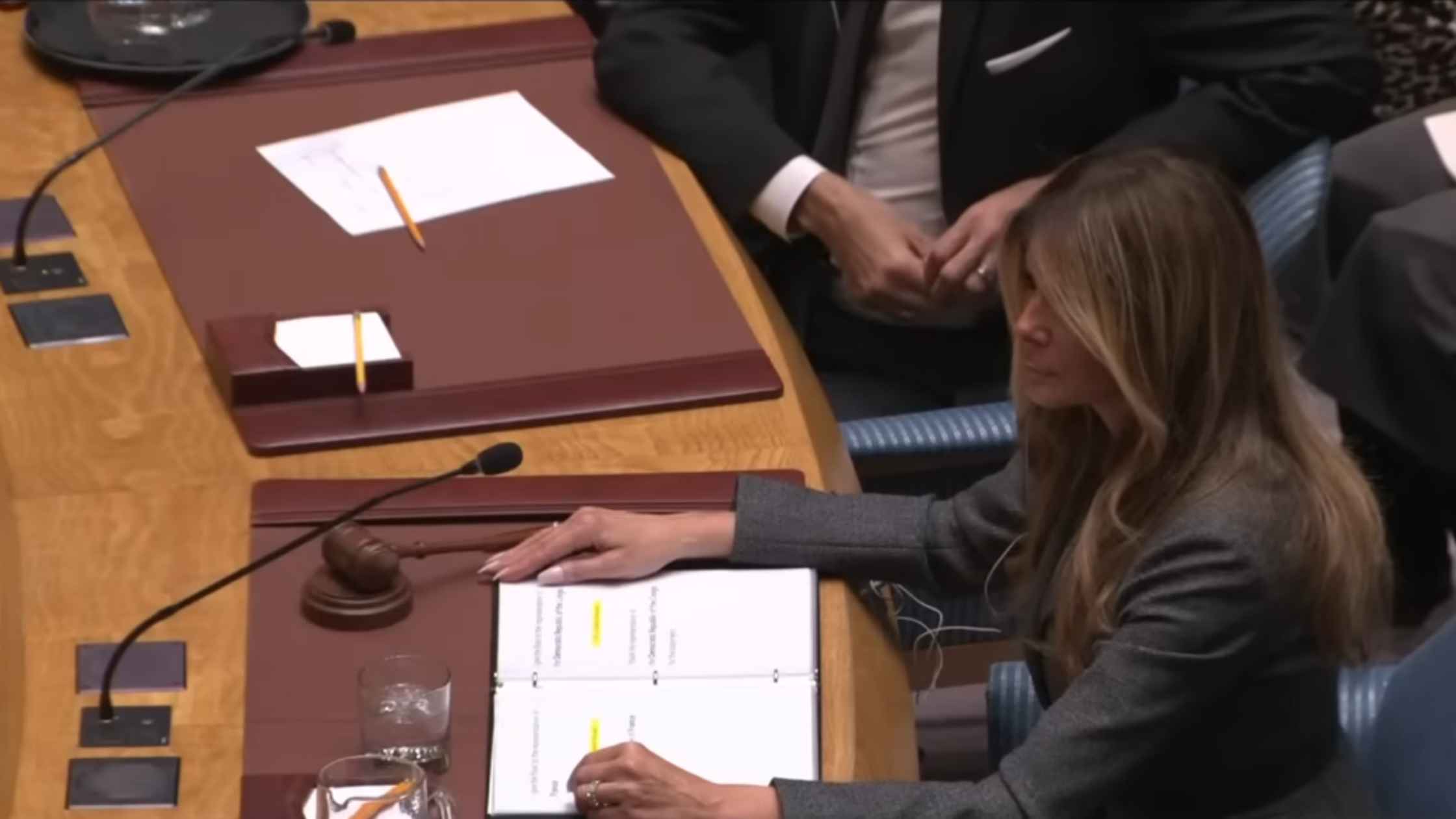
Speaker X (00:00):
[inaudible 00:00:01].
Speaker 3 (10:25):
Ma'am, can you stand back just a little bit for me? Thank you.
Speaker X (10:27):
[inaudible 00:10:28].
Melania Trump (10:28):
Nice to meet you. Nice to meet you. Nice to meet you. [inaudible 00:10:28]. Nice to meet you.
Speaker X (10:28):
[inaudible 00:10:28].
Speaker 5 (10:28):
Okay, everyone. Let's go to the side. All right, everyone. [inaudible 00:12:11].
Speaker X (10:28):
[inaudible 00:12:17].
Speaker 5 (10:28):
Thank you.
Speaker X (10:28):
[inaudible 00:12:21].
Melania Trump (10:28):
[inaudible 00:12:52]. Thank you.
Speaker 6 (10:28):
Thank you.
Speaker 7 (10:28):
Thank you.
Speaker 8 (10:48):
We love you, Melania.
Speaker 7 (10:48):
Bye.
Speaker X (10:48):
[inaudible 00:12:55].
Speaker 1 (25:53):
Testing, one, two, three. Test of the English channel. Testing one, two. Testing one, two. Can you hear us? Testing one, two, testing one, two. One, two. One, two. Andrew, can you hear us? Testing one, two, one, two. Testing, one, two. Can you hear us? Testing.
(26:10)
Hey, Lena, can you hear us? Hey, can you hear us? Testing one, two, one, two. Can you hear us? All clear. Okay. So, I'm getting a confirmation from CCC that it's clear. One, two, one, two. Let me call them. I'm so sorry. They gave us a hard time.
(26:39)
Testing one, two, three. Testing one, two, three English channel. English channel testing one, two. Testing one, two. Please ensure that the connector is fully in. Testing one, two.
Speaker X (26:49):
[inaudible 00:26:51].
Speaker 1 (27:27):
Test one, two, one, two. Test one, two. Please give me a thumbs up if you can hear us. Testing one, two, one, two. This is a test. Testing one, two, one, two. Testing one, two. Testing, one, two, three. Testing.
Speaker X (27:38):
[inaudible 00:27:39].
Speaker 1 (27:44):
Testing one, two, three. Testing, one, two, three. Testing one, two, one, two. Okay.
Speaker X (27:50):
[inaudible 00:27:55].
Speaker 1 (28:06):
Testing one, two, three. Testing, one, two, three. Testing, one, two, three. One, two, three. Please flip through the channels. Testing, one, two, three. One, two, three.
Speaker X (28:22):
[inaudible 00:28:27].
Speaker 2 (28:22):
Testing English channel one, two, three. Testing English channel one, two, three. One, two, three. English channel one, two, three. English channel one, two, three.
Speaker X (28:22):
[inaudible 00:30:37].
Speaker 4 (30:45):
One, two, three testing. One, two, three testing. English channel, one, two, three testing. Good.
Speaker X (30:54):
[inaudible 00:30:57].
Melania Trump (37:09):
Good afternoon. The 10113th meeting of the Security Council is called to order. I would like to take this opportunity to pay tribute on behalf of the council to the delegation of the United Kingdom for its service as president of the council for the month of February. I'm sure I speak for all members of the council in expressing deep appreciation to the entire United Kingdom team for the great diplomatic skill with which they conducted the council's business last month. The provisional agenda for this meeting is maintenance of international peace and security, children, technology, and education in conflict. The agenda is adopted. In accordance with the Rule 39 of the council's Provisional Rules of Procedure, I invite Ms. Rosemary DiCarlo, Under-Secretary-General of Political and Peacebuilding Affairs, to participate in this meeting. It is so decided. The Security Council will now begin its consideration of item two of the agenda. I now give the floor to Ms. Rosemary DiCarlo.
Rosemary DiCarlo (39:06):
Thank you, Madam President. On behalf of the Secretary General, I want to thank you for your leadership in organizing today's discussion. This debate comes at a moment of exceptional relevance. Today, we face the highest number of armed conflicts since the Second World War. The number of civilians killed in these conflicts is the highest in decades. Our reality is clear. When conflicts erupt, children are among those most severely affected. We have been reminded of this truth over the last two days. Schools in Israel, the United Arab Emirates, Qatar, Bahrain, and Oman have closed and moved to remote learning, owing to the ongoing military operations in the region. And we are aware of the reports from Iran about the death of possibly dozens of children, allegedly as the result of a strike that hit an elementary school in the town of Minab. United States authorities have announced they are looking into these reports.
(40:16)
Globally, one in every five children is living in or fleeing a conflict zone. This adds up to 473 million children. Grave violations against children verified by the United Nations increased by a staggering 25% from 2023 to 2024. Rape and other forms of sexual violence rose by 35%. These horrific figures should impel us to do more to protect children in conflict. I paid tribute to the First Lady of the United States for her work to give visibility to the issue of children in conflict, and particularly for her personal engagement to reunite Ukrainian children with their families. Madam President, when conflicts do not rob children of their life and physical security, they deprive them of the right to have a quality education and a future of opportunities. 234 million children in crisis in conflict situations currently need educational support. 85 million are completely out of school. In violent conflicts, schools can be one of the only safe spaces that protect children from recruitment, trafficking, and exploitation.
(41:41)
Schools can safeguard health and hygiene, provide psychosocial support, and connect families to essential services. Education in conflict zones is lifesaving and life-sustaining. And yet, schools, teachers, and education infrastructure continue to suffer violence. In 2024 alone, the United Nations verified a total of 2,374 attacks on schools and hospitals. Many more are unverified due to a lack of access. Most attacks in 2024 took place in Ukraine, Israel, the occupied Palestinian territory, and Haiti. In its Resolution 2601, the council urged all conflict parties to immediately cease attacks against schools, children, and teachers and noted that such attacks are in contravention of international humanitarian law.
(42:46)
It called on all parties to safeguard, protect, respect, and promote the right to education. The international legal framework is clear. We must act. Madam President, the challenges of providing quality education in conflict situations are tremendous. Infrastructure from electricity to classrooms to digital connectivity is often crumbling or at risk. Educators are few and far between. We face a shortage of 44 million teachers in conflict settings. Digital learning can offer access to education when schools are closed or inaccessible or when students are fleeing violence, and the UN has made a concerted investment in these approaches. Private-public partnerships, when grounded in strong ethical frameworks, can help us deliver and expand access to innovative education technologies. For example, UNICEF's Learning Passport, developed in partnership with Microsoft, offers 10 million children in 47 countries a mobile learning platform where they can have continuous access to quality education.
(44:03)
The Instant Network Schools Program, a joint project of the Vodafone Foundation and UNHCR, allows refugees and teachers to access digital educational content and the internet, improving the quality of education in some of the most marginalized communities in the Democratic Republic of the Congo and South Sudan. Technology allows education to reach the most vulnerable and those excluded from the formal educational system. In Afghanistan, to respond to the exclusion of 2.2 million girls from education, UNESCO is mobilizing digital technologies to bring learning directly into the homes and communities, reaching close to 9,000 school communities in the country. To ensure that opportunities provided by technology are realized, we must mitigate its risks. Children in conflict face heightened, unlike threats. Exploitation, trafficking, radicalization, digital recruitment into armed groups, and cyberbullying. Digital education must therefore actively promote child protection with risk assessments at every stage from conception to deployment.
(45:25)
We must strengthen legal and policy frameworks to protect the rights of the child in the digital space, in line with international human rights law. Technology companies have a particular role to play in providing safeguards to their users, especially children and young people. Unfortunately, funding for education in emergencies has dropped by 24%, even though needs are increasing. We call on member states to do more to meet funding gaps in education. Madam President, the most effective way to protect children from conflict is to prevent and end wars. Building peace is at the heart of what the United Nations does. We must all work together toward this goal. Thank you, Madam President.
Melania Trump (46:17):
Thank you. I thank Ms. DiCarlo for her briefing. I shall now make a statement in my capacity as First Lady of the United States. First, my heartfelt condolences to the families who have lost their heroes, who sacrificed their lives for freedom. Their bravery and dedication will always be remembered. I extend my earnest wishes for a swift and smooth recovery to all those who have been injured. You are in my thoughts and prayers during this challenging time. The U.S. stands with all of the children throughout the world. I hope soon peace will be yours. Ambassador Waltz, I am grateful for the distinguished honor to preside over the United Nations Security Council as the United States assumes its presidency. Under-Secretary-General DiCarlo, thank you for welcoming me here today. Your generosity reflects the dignity with which you hold your post.
(47:35)
Thank you for your warm welcome, United Kingdom, France, Russian Federation, China, Greece, the Democratic Republic of Congo, Denmark, Panama, Liberia, Somalia, Colombia, Pakistan, Bahrain, and Latvia. Collectively, your mission to maintain security while upholding the responsibility of preventing conflict during times of both war and peace is significant, must be applied evenly, and should never be carried out lightly. Peace does not need to be fragile. Enduring peace will be achieved when knowledge and understanding are fully valued within all societies. The value placed on education by a nation's leaders shapes the core of their country's belief system. A nation that makes learning sacred protects its books, its language, its science, and its mathematics. It protects its future. This leads to something powerful, to greater understanding, moral reasoning, and tolerance of others. Peace.
(49:03)
Children raised in a culture rooted in intelligence develop confidence, innovate, build, compete, and maintain a deep value system. Their knowledge fosters empathy for others, transcending geography, religion, race, gender, and even local norms. They become caring people. But children raised in a culture rooted in ignorance are surrounded by disorder and sometimes even conflict. These societies are filled with rigid thinkers who embrace prejudice and shun human dignity. When a nation restricts thought, it restricts its own future. Education is widely recognized as a fundamental human right. And yet today, so many children and young adults are banned from attending secondary schools and universities. The cost is not abstract. Imagine the loss of potential to our collective humanity, new medical breakthroughs, advancements in food security, groundbreaking technologies-- all gone. A society that excludes vast segments of its population can realize only a fraction of its potential. Societies ruled by knowledge and wisdom are, therefore, more peaceful.
(50:49)
We must cultivate a just, moral imagination for the next generation, for our children, building an infrastructure of understanding. Knowledge is a power. It shapes titans of industry and inspires courageous social pioneers. We must capture this positive energy and ignite it across continents to transform our world, throughout our digitally connected human race. Intellect blossoms humanity's fundamental needs: shelter, food security, clean water, and health care. And predictably, almost all communities will have access to knowledge within our lifetimes. The global community must facilitate complete access to technology so that every individual can reach their full potential through education. We must strive to achieve connectivity in the most remote locations and the furthest distances from our cities. This objective is entirely feasible and is already on the way. Today, roughly six billion individuals, about 70% of people on planet Earth, have a mobile device and use the internet. If our nations band together, we can close the technological divide, empowering all to reach their full potential.
(52:34)
From a solitary farmer on a remote Greek island to a quiet genius in Somalia or a dreamer in uptown Manhattan, anyone can read the vast treasury of human knowledge, created over centuries, which is now codified and accessible through artificial intelligence. Is a single digital nation- state inevitable? Perhaps this idea isn't so far-fetched since digital currency and payment systems via blockchain, plus AI's massive factual database is already revolutionizing media and financial markets. We are in the age of imagination, a period when technology can be free and unrestricted by land borders. Indeed, now is the time for our generation to elevate our children above ideology through access to wisdom.
(53:41)
AI is democratizing knowledge, which was once confined to university libraries. AI is creating a new reality for our children by disrupting the traditional academic path to information. Today, almost anyone, anywhere, can access a vast universe of data in the palm of their hand. Let's connect everyone to knowledge through AI, including those in the most remote geographic regions of our world. Look at what this truly means: in a matter of seconds, without travel, one can quickly learn about another's beliefs, religions, customs, and histories. We are open, and it is empowering. AI can provide us with an understanding of each other's needs and the needs of our children. AI is redefining who gets to participate in the global economy of ideas. I believe our shared intellectual future will prove to be a more secure, harmonious, advanced civilization. The path to peace depends on us taking responsibility to empower our children through education and technology.
(55:12)
Conflict arises from ignorance, but knowledge creates understanding, replacing fear with peace and unity. Security Council members, I encourage you to pledge to safeguard learning in our communities and promote access to heightened education for all. I implore you to build a future generation of leaders who embrace peace through education. Thank you.
(55:47)
I resume my function as president of the council. I give the floor to the representative of Greece.
Ambassador Aglaia Balta (55:57):
Thank you, Madam President. First Lady of the United States, Ms. Melania Trump, I would like to thank you for sharing this important meeting and for highlighting one of the most urgent challenges of our time. The growing intersection between children, technology, and education in situations of armed conflict. I would like also to thank you, USG DiCarlo, for her, as always, valuable insights. Madam President, today, in non-conflict, millions of children are affected daily, surrounded by violence and insecurity. Children are also deprived of the right to education, i.e., of their own very future. When schools are attacked, used for military purposes, or destroyed, children lose not only a safe place to learn but also a sense of stability, protection, and above all, a hope for a better tomorrow. Therefore, innovative solutions need to be found to mitigate the impact of safe education, disruption, and restore education as a protective framework and a space of effective learning.
(57:21)
In an era increasingly shaped by cutting-edge technological progress, education, technology, and innovation can form a powerful nexus to improve learning outcomes, foster peace, strengthen the resilience of societies, and protect children. Nevertheless, at the same time, technology can expose children to serious risks, especially in conflict situations. As children in armed conflict face increasing risk of online harm, including online recruitment, exploitation, and sexual abuse, the Security Council Children's and Armed Conflict framework has a duty to remain attentive to this evolving dynamics. Digital dimensions of recruitment, exploitation, and incitement are directly relevant to the protection mandate of this council. Monitoring and reporting mechanisms should, where appropriate, reflect these emerging risks. In order to facilitate effective teaching and learning everywhere and under any circumstances, a strategic shift needs to take place that will allow for any integrated digital transformation of educational systems. This transformation entails action-oriented national plans and policies, clearly articulated educational goals, and sustained funding.
(58:57)
Our guiding principle should always be to ensure the rights and best interests of the child, as well as the protection from online harm. Madam President, colleagues, the risks entailed by the use of digital technology are universal, even in time of peace. As stated recently in Geneva by the Greek Foreign Minister Giorgos Gerapetritis, the need to safeguard children's role and action in the future in view of technology's advancements through the vital contribution of education is of paramount importance. The digital environment as a public space must be safe, teaching children not just how to use technology, but crucially, how to protect themselves from it. In this endeavor, the potential of the private sector can also be utilized in collaboration with governments, civil society, and local communities, while adhering to relevant codes of conduct and human rights obligations. This partnership can contribute to the development of digital solutions of education that reflect our local reality and needs.
(01:00:16)
Ensure effective and flexible implementation, protect online safety, and help overcome barriers, including related to gender and disabilities. Madam President, the responsible use of technology and innovation can build bridges to safe education, dignity, and hope for children in armed conflict. It is our shared responsibility to ensure this access. Our ultimate objective is to cultivate a genuine global human rights culture by nurturing empathy in the next generation. If we can instill in a child the profound belief that human dignity is non- negotiable, that child will inevitably become a leader who champions peace. Ultimately, this deeply rooted culture is our most powerful defense against turmoil and armed conflict. Our engagement in the education of children is an investment in peace, and Greece, also through its work in the CAAC working group, will remain at the forefront of this discussion. I thank you.
Melania Trump (01:01:32):
I thank the representative of Greece for the statement. Thank you. I give the floor to the representative of France.
Ambassador Jérôme Bonnafont (01:01:44):
Thank you, Madam President. Madam President, First Lady of the United States, allow me to thank you, to wish you a welcome, and to assure the United States of our support on the beginning of the presidency of the Security Council, and to commend their decision to devote this first event to Children and Armed Conflict from the perspective of technology. France reaffirms its constant commitment to the protection of children and for the full respect of their fundamental rights, including in the digital space. And in this regard, we commend your personal efforts as First Lady with the launch of the Fostering the Future initiative, as well as the adoption of the TAKE IT DOWN Act, against the non-consensual circulation of personal images that all too often children fall victim to. France also would like to thank you for your mediation role that contributed to the return of several Ukrainian children that were forcibly transferred or deported to Russia.
(01:02:45)
We thank the Under-Secretary-General, Ms. Rosemary DiCarlo, for her edifying briefing. Madam President, the subject that brings us here today is at the heart of the work of the Security Council, and it requires greater coordination around the three pillars of our organization. First of all, this council must act to prevent and put an end to the use of new technologies against international peace and security. The malicious use of digital technologies is on the rise. It is increasing violence in armed conflict, and children are the primary victims of that. In Ukraine, the massive and repeated Russian drone attacks are killing, injuring, and also having a profound impact on the daily lives of children. At school, classes are being interrupted each day by air raid sirens, and at home, children spend part of their nights and their evenings in cold and damp shelters because of Russian attacks.
(01:03:44)
In other conflicts, social networks are being used to spread propaganda targeting minors to facilitate their recruitment by armed groups to exploit their vulnerability. The Security Council, in close coordination with all stakeholders, must continue its work, including within the Children and Armed Conflict and Youth, Peace and Security agendas that France is fully invested in. By bolstering child protection capacities in peacekeeping operations and special political missions and in supporting the monitoring and reporting mechanism established by Resolution 1612 of 2005, the council supports the gathering of information on the grave violations committed against children in armed conflict zones. This is an essential tool for strengthening prevention and combating impunity.
(01:04:41)
Next, we need to act for the sake of human rights, which is the second pillar of our organization. It is our collective responsibility to protect our young people by promoting a secure digital space that is in line with international law. In this regard, France has been a leader at the national and European levels, including with the adoption of a law aiming to secure and regulate the digital space in 2024. This is a law that strengthens child protection against online pornography. Like a growing number of partners, France decided to restrict the access of children under 15 to social networks to better protect them. Because the digital space knows no borders, in 2021, together with UNICEF, France launched a call to action to defend the rights of the child in the digital environment, and then in 2022 launched an online child protection lab to develop innovative solutions for the better protection of children online.
(01:05:37)
And lastly, we must act tangibly to ensure that all young people have access to new technologies, and that is the third pillar, the one related to development used with pedagogy. And in a regulated framework, the internet and artificial intelligence greatly facilitate universal access to education, as well as combating exclusion and shaping critical thinking. All of these, as you have said, are rampant bastions against hatred and help to prevent conflict in the future. France supports the tangible actions taken by the United Nations, in particular by UNESCO and UNICEF, to mobilize technologies for the protection of children via the anticipation of conflict risks and more accurate needs mapping, and also expanded access to healthcare services, among other things. France holds the presidency of the G7 this year and has made the protection of children one of its priorities.
(01:06:32)
Madam President, to conclude, the protection of children and young people affected by armed conflicts is of concern to all of us. The engagement of the United Nations, and in particular, that of the Security Council, remains essential in that regard. And your presence is an encouragement, as was the case for the contribution several decades ago, the contribution of another First Lady, Eleanor Roosevelt, in the drafting of the Universal Declaration of Human Rights. Thank you very much.
Melania Trump (01:06:59):
Thank you very much for your kind words, and thank you, representative of France, for the statement. Thank you. I give the floor to the representative of the Democratic Republic of the Congo.
Ambassador Zenon Ngay Mukongo (01:07:15):
Madam President. First of all, I would like to congratulate the United States of America on exceeding to the presidency of the council in this month of March 2026. And I would like to thank you for this meeting on such an important and decisive and crucial topic for my country, as well as for many other regions in the world who are impacted by war and armed conflict. In this regard, the Democratic Republic of the Congo welcomes the initiatives aimed at strengthening international mobilization so as to ensure the well-being and the future of the children in a digital age. We reaffirm our commitment to all multilateral efforts to protect children and to ensure
Ambassador Zenon Ngay Mukongo (01:08:00):
... their fundamental right to education. My country would like to pay tribute to you, First Lady of the United States, for your commitment to the integrity and dignity of children in the world. We also thank Madam Rosemary DiCarlo, Under-Secretary-General of the United Nations, for their statement. Madam President, guaranteeing an effective access to education and digital technologies for children in situation of the conflict is, for us, the Democratic Republic of the Congo, is an essential reality fact. For three decades, our country has been witnessing circles of repeated violence and armed conflicts, particularly in the Eastern part. The situation has prevailed for 30 years, and millions of children have been deprived of their fundamental right, access to education which is safe, inclusive, and of high quality.
(01:09:02)
Let me give you an example. Just in the South Kivu province, where with impunity, since the beginning of 2025, we have been witnessing the movement of M23 and the RDF, the Rwanda Defense Forces, in violation of national laws, the UN Charter, basic principles of international law, international humanitarian law, and therefore the impact of conflict and education has been as follows. First of all, the free of charge of schooling has been undermined, because the Rwandan Forces, M23 decided to impose schooling fees. Next, statistics are telling us that 8,419 schools, 1,768 schools, out of which 71 primary schools and 675 secondary schools today are no longer functioning. Out of them, 167 schools with 72,000 schoolchildren. Out of them, 36,000 children are at this point occupied by our groups.
(01:10:11)
Madam President, generally speaking, the Democratic Republic of the Congo has erected education into a central pillar of its policy of resilience and development. We are proud of our human capital of our young people. Therefore, education for my country is not just a fundamental right, but it also is a major pillar of our stability. The free schooling which was decreed by the president of the republic, his excellency Felix Antoine Tshisekedi Tshilombo, since he acceded to his high office in 2019, is a reflection of this view that we need to improve access to education and new technologies. In addition to this policy, we, in 2025, adopted the education and emergency training strategy, covering 2025 to 2029, which is there to build an education system which is resilient, inclusive, and is a measure of protection capable of ensuring the continuity of learning before, during, and after crises. This strategy is accompanied by the commitment of the DRC to reduce the digital gap, which is particularly impacting those areas which are in conflict.
(01:11:24)
Madam President, using digital technologies today is an essential means of mitigating the effect of conflicts of education. Digital platforms, mobile devices, remote learning tools can maintain a learning tool for those children which are internally displaced, those who live in enclaves or in displaced camps. Similarly, the advances of artificial intelligence can also help with education. They can accompany pedagogical efforts and provide psychosocial support to those children who are victims of trauma. Madam President, the Democratic Republic of the Congo is convinced that the respect and the protection of the human rights, in particular the rights of children of the international humanitarian law, must remain at the heart of all strategies that we are implementing, and this we're implementing to ensure peace and security in the world.
(01:12:23)
We have to work together to make sure that these dimensions very frequently lost in approach, analysis, and evaluation of conflict take pride of place. And that is why the Democratic Republic of the Congo calls for a strengthened international support for the development of digital infrastructures in fragile and post-conflict areas, for responsible partnership with the private sector, partnership based on transparency and accountability. Madam President, we are a large country, a very rich country, especially when it comes to minerals which are necessary for the current digital revolution. We think that technology should never be a factor of exclusion for our children to the country. It needs to become an instrument for resilience, reparations, and equality of opportunities.
(01:13:17)
To conclude, the Democratic Republic of the Congo would like to affirm its determination to work together with its partners, including through the platform Building Future Together, which is put forth by the distinguished First Lady Melania Trump, to protect children, to reform our education system, to progressively integrate into it numerical tools despite the security challenges, and to ensure that no child, even in a situation of conflict, be discriminated against, but rather that they should continue benefiting from their right to education, development, and the implementation of their legitimate dream to have a better future in the digital era. I thank you.
Melania Trump (01:14:02):
I thank the representative of the Democratic Republic of the Congo for the statement. I give the floor to the representative of Denmark.
Speaker 9 (01:14:13):
Thank you, Madam President. Denmark thanks the United States for highlighting this critical topic of the first day of the presidency, and we commend the First Lady of the United States for her presence here today, and for showing leadership on this issue. Let me also thank Under-Secretary-General DiCarlo for her sobering briefing. Madam President, as we've heard, more than 85 million children are out of school in crisis settings. From Sudan to the Sahel, from Afghanistan to Gaza, too often, too many school-aged children are prevented from learning. As members of this council, we have a common responsibility to protect education in conflict. I commend the efforts by the United Nations in this regard, noticeably UNICEF, UNESCO, and the Office of the Special Representative of the Secretary General for Children and Armed Conflict. For example, in Ukraine, the UNHR supports access to education from online learning for refugees to offline learning at underground schools near the frontline.
(01:15:20)
In Lebanon, UNICEF assists access to digital learning for Syrian refugees. And as we've heard from the USG, in Afghanistan, using UNESCO supports broadcasting of educational programs to reach learners in their homes. These are examples of innovative initiatives that make a difference for children and young people affected by conflict, but we can do even more to leverage the potential of technology for education. Madam President, I'll raise three points today. First, we must make even greater use of innovation and technology to support safe and protective access to education in conflict- affected situations. When conflict erupts and it becomes unsafe to go to school, digital tools can enable students to continue their education and connect with their peers, but it requires access to digital devices and often also access to the internet. Children in the poor spaces in the world, which count many conflict-affected contexts, are more likely to be excluded from access to the internet. In short, eliminating the digital divide will help broadening access to education to leave no child behind. We must keep this in mind as we seek to protect education during armed conflict in accordance with Security Council resolution 2601.
(01:16:44)
Second, Madam President, the digital space does not come risk-free. We know that it brings risks for children's safety. In context of conflict and instability, these risks can take many forms. Online platforms can be used to spread disinformation, and manipulated content could fuel polarization, instability, or lead to radicalization. Young peace builders could be targeted. Young human rights defenders may face reprisals or threats, both on and offline. Young women and girls may be targeted by technology-facilitated gender-based violence. Member states, along with tech companies, must prioritize protection in the digital space. While tech companies have great power in shaping children's digital experiences, they also have a great responsibility to protect children's rights. We support that the Office of the SRSG for Children and Armed Conflict engages with online platform operators on protection.
(01:17:46)
Third, Madam President, as an international community, we must collectively ensure that parties to conflict uphold international law, including international humanitarian law and international human rights law. Parties to conflict must commit to specific structured steps to end and prevent grave violations against children and uphold accountability. As we sat in connection with the Red Hand Day on education to prevent the recruitment of use of children just recently, Denmark believes that we need not just to reflect, but to recommit. Recommit to the children of Haiti, who should be able to enjoy a safe learning environment without fear of being recruited by gangs, to the children in Sudan, who are attacked, starved, and displaced, and to the children in Ukraine, who have suffered abductions and endless attacks on their schools and infrastructure during the four long years of Russia's full-scale invasion. Schools must be protected from attack. The international legal framework is clear in this.
(01:18:51)
Madam President, in closing, around this table, we must demand that safe and inclusive education is available to all children. We must support access to quality education. Where there's access is disrupted by conflict, we should safely leverage the potential of technology, because education is not only a fundamental right, it is a foundation for sustainable peace, stability, and development. Thank you.
Melania Trump (01:19:18):
Thank you, representative of Denmark. I give the floor to the representative of Panama.
Ambassador Jérôme Bonnafont (01:19:29):
Thank you, Madam President. Esteemed Madam and Mrs. Melania Trump, First Lady of the United States of America, Panama congratulates the delegation of the United States on assuming the presidency of the Security Council for the month of March, and we would like to wish you every success in this delicate undertaking. We would also like to thank Ms. Rosemary DiCarlo for her briefing, and the US delegation for convening this timely debate on the role of technology in guaranteeing access to education for children affected by armed conflict. This is a vision that is fully aligned with the priority agenda of the US First Lady as part of the Fostering the Future Together initiative. And by happy coincidence, just a few days ago, we had the privilege of convening an Arria-formula meeting to mark the International Day of the Red Hand, focused specifically on promoting safe, inclusive, and continual education as a tool for preventing the recruitment and use of children in armed conflict. That conversation left us with one clear conviction, and that is that education is not only a right, it is also a tool, a valuable tool, for prevention. When a child remains connected, plugged into their education process, be it in the classroom or through digital technologies, it significantly reduces their exposure to recruitment, exploitation, or manipulation. Today, millions of children continue to see their education interrupted due to attacks on schools, forced displacement, and the militarization of the civilian environment. In this context, technology has gone from being a complimentary, a supplementary tool, to become a lifesaver. Open platforms, remote learning, content broadcast over radio or television, and AI-supported solutions, when they are used responsibly, are useful in order to maintain the continuity of learning in some of the most complex environments in the world. Initiatives such as the global Digital Learning Gateway from UNESCO and UNICEF, or the development of AI skills frameworks for teachers, reflect a growing recognition that technology can help to reduce gaps, but only if it is accessible, inclusive, and ethical.
(01:22:46)
Experiences in the field confirm this. In Ukraine, according to data verified by UNICEF, the conflict has affected thousands of educational facilities, forcing more than a million students to depend today on hybrid or remote learning modalities in order to continue their education. The distribution of digital devices and teacher training has shown that connectivity combined with proper training can support education systems even when under fire. In Afghanistan, where more than two million girls remain excluded from secondary education, the use of digital community hubs and education programs over radio and television has made it possible to bring learning into the home, thus reducing risks and maintaining support networks. In Gaza, where a large part of the education system has been devastated, the launching of a virtual campus by UNESCO for higher education has offered thousands of students an opportunity to continue their studies from outside the conflict zone. In recent days, children in various countries in the Middle East have had to make use of virtual educational platforms, because their education has been affected by the impact of another armed conflict.
(01:24:21)
Madam President, this experience demonstrates the potential of technology as a tool for resilience. However, we have to recognize that the digital space is not neutral. Those same platforms that facilitate learning can also expose children, particularly those that are already experiencing trauma, to the risk of exploitation, radicalization, misinformation, or online violence. According to UNESCO data, one in three students around the world suffers school bullying. That is a reality that not only persists, but it may also grow worse in digital environments, which substantially take place in context of displacement and vulnerability. Therefore, Madam President, Panama would like to underscore a few fundamental principles. Technology must be a supplement to, but it cannot nor should it replace, in-person education. Schools continue to be essential spaces for the comprehensive development of, protection of, and the recovery of children. Public-private partnerships are necessary, but they have to be rooted in solid ethical frameworks that respect the rights of the child in the digital environment.
(01:25:50)
Moreover, we must make sure that this does not expand the digital divide. Without equitable access, technology could deepen inequalities that already exist. Madam President, our country considers that artificial intelligence can support teachers, but never replace them. Digital literacy, training for teachers, and the meaningful participation of young people themselves all need to be part and parcel of our response. Guaranteeing the continuity of education in conflict situations is not just a development issue, because depriving a generation of education at the end of the day means sowing the seeds of future crises. And in that regard, we reaffirm that safe, secure, inclusive, and equitable access to education, including its digital dimension, is an inalienable part of the protection of children in armed conflicts. Thank you very much.
Melania Trump (01:26:58):
I thank the representative of Panama for the statement. I give the floor to the representative of Liberia.
Speaker 10 (01:27:12):
Liberia thanks you, Madam First Lady, for bringing your important voice and distinguished office to the issues of children in conflict and their much needed access to education and technology. We also thank the United Kingdom for its effective stewardship of the Security Council during the month of February, and USG DiCarlo for her instructive briefing. We warmly welcome the United States as it assumes the presidency for March, and thank the United States delegation for convening this timely meeting. In today's world, the intersection of children, technology, and education defines not only individual futures, but, as rightly noted by you, Madam President, the trajectory of peace itself. In conflict settings, when classrooms fall silent and connectivity is severed, the loss is not only educational, it is generational. Efforts that restore learning, expand safe digital access, and protect children from technological exploitation are therefore investments in stability and human dignity.
(01:29:06)
Madam President, excellences, today, Liberia will speak from a past that taught us what conflict steals and what education restores. We remember all too well what it means to be the child the world sought to protect, the classroom without a roof, the generation told to wait for peace before being allowed to learn. 14 years of civil conflict destroyed our schools, dispersed our teachers, and recruited children before they were literate. From all of these, we learned a painful truth. When education collapses during conflict, the conflict does not end. It simply mutates. This is why Liberia approaches today's discussion not as a development debate, but as a matter of international security. Around the world, more than 224 million children living in crisis settings are currently out of school, according to global education partners. Many before me have quoted even grimmer statistics. This is not just an educational emergency, therefore. It is a security emergency, a protection emergency, and a generational emergency.
(01:31:03)
A child denied learning in a conflict zone is exposed not only to illiteracy, but to recruitment, manipulation, and exploitation disguised as survival. Similarly, a community deprived of education does not simply lose opportunity. It actually inherits instability. In this context, digital education is simply not a luxury. It is actually a stabilizer. It is prevention policy. Across West Africa, post-conflict recovery has shown us that the path from ceasefire to resilience actually runs through the classroom. Within ECOWAS, we have seen that rebuilding infrastructure alone is insufficient. Rebuilding human capital is what prevents relapses into conflict. Increasingly, this rebuilding must be digital. Africa is not waiting to be transformed by technology. We are trying to reshape technology under difficult constraints. We are developing low-bandwidth platforms, solar-powered systems, and community-driven learning models precisely because our circumstances demand innovation that is efficient, resilient, and inclusive. In my home country, Liberia, when national emergencies halted schooling, community radio delivered lessons across counties, while solar-powered learning centers reached communities far beyond the grid. Children shared devices, but more importantly, they shared knowledge. Our innovations did not emerge from abundance. They emerged from determination.
(01:33:41)
From these experiences, Liberia offers three proposals. First, the establishment of a post-conflict education digital recovery window within existing international financing mechanisms. Digital learning infrastructure, including connectivity, devices, teacher training, and child protection safeguards must be embedded in early recovery frameworks and not treated as a secondary priority. Second, we are developing a pilot network of solar-powered community digital learning hubs. These hubs function independently of unstable grids, deliver offline-capable curriculum, provide teacher training models, and offer safe digital access points for displaced and conflict-affected children. They are modular, scalable, and built for fragile settings. Third, Liberia calls for a voluntary coalition of governments, technologists, and educators to design low-bandwidth offline-first learning systems tailored specifically for conflict environments, not repurposed systems from stable countries, but tools engineered for fragility, which are grounded in child safety.
(01:35:34)
Madam President, innovation must never come at the expense of protection. We therefore support the development of standardized safeguards for all artificial intelligence tools used in humanitarian and emergency settings. No child's privacy, innocence, dignity, or safety should be compromised by the very systems meant to support their learning. Madam President, let's be clear about what is truly at stake. When learning is lost in conflict, instability travels, extremism travels, desperation travels, but resilience can travel as well. Investing in digital education in fragile contexts reduces the pool from which armed groups recruit. It strengthens girls' autonomy and narrows the space in which harmful ideologies take root. It builds communities that choose ballots over bullets. This therefore is not charity. Such an investment is strategic security policy. Liberia stands as evidence that recovery is possible when the world invests early and wisely. Our journey from hosting peacekeepers to contributing to peacekeeping was shaped by education and anchored in opportunity.
(01:37:45)
If we fail children in conflict today, we will debate the crisis of the society to be inherited tomorrow. But if we connect our children, if we power their classrooms with sunlight, if we equip them with safe digital tools, if we treat connectivity as protective infrastructure, we can change the trajectories of conflict and the trajectory of their lives. We can change recruitment patterns. We can change vulnerabilities. Certainly, we can change the inheritance that many of our children have of growing up in violence. Let us therefore commit to funding digital recovery as an integral component of peace building. Let us design technology even for the hardest-to-reach places, and not only for the most profitable markets. And let us ensure that the child in a village once scarred by war inherits not only peace, but a future. I thank you for your kind attention.
Melania Trump (01:39:19):
I thank the Representative of Liberia for the statement. I give the floor to the representative of United Kingdom.
Representative of United Kingdom (01:39:27):
Thank you, Madam President. Let me begin by welcoming you, First Lady, to the Security Council, and thanking you for your leadership on this important issue. I also congratulate the United States on assuming the presidency of the Council for the month of March. You have our full support. And I thank Under-Secretary-General DiCarlo for briefing us today. I will make three points. First, protecting children's right to safe, inclusive, quality education is critical. And yet, around the world, education systems are collapsing in conditions of conflict. In Gaza, 97% of schools have been damaged or destroyed, and over 650,000 children have been out of school for over two years. In Sudan, one in three schools has been damaged or destroyed, and eight million children are out of school. In Ukraine, 4.6 million children face barriers to learning as a result of Russia's illegal and unprovoked full-scale invasion.
(01:40:45)
The current conflict in the Middle East poses further risks. Children and civilian infrastructure, including schools, need to be protected. Parties to conflict must adhere to their obligations under international humanitarian law. The United Kingdom supports the implementation of the Safe Schools Declaration and urges other member states to commit to it. We are also proud to support global efforts to safeguard children's education in crises, including through our support for UNICEF and the Global Partnership for Education.
(01:41:27)
Second, emerging technologies can play a transformative role in sustaining learning for children impacted by conflict and displacement. One of the substitute for in-person schooling, digital tools, remote learning platforms, and AI-supported systems can help children keep learning when classrooms are destroyed or inaccessible, and to access psychosocial support, but we also need to manage the risks of technology for children in conflict.
Representative of United Kingdom (01:42:00):
... conflict. For example, in Columbia, armed groups are increasingly using online platforms to recruit children. The United Kingdom is committed to ensuring accountability for grave violations against children in conflict, including to our support for the UN monitoring and reporting mechanism. Technology companies and governments also have a key role to play in strengthening safeguards against such risks. Third, Madam President, conflict disproportionately impacts girls' education. Girls are more likely to be out of school than boys in conflict settings. And as a result, they face heightened risks, including risks of exploitation, child marriage, trafficking, and sexual, and gender-based violence.
(01:42:54)
The United Kingdom is proud to support girls' education in crises, including over seven million supported through the Education Cannot Wait Fund. And we call on the private sector, working with governments and civil society, to ensure technology meets the particular needs of girls whose education is impacted by conflict. I thank you.
Melania Trump (01:43:17):
Thank you, Representative of United Kingdom for your statement. I would like to give the floor to Representative of China.
Representative of China (01:43:28):
Thank you, Madam President. I welcome your presence, First Lady Melania Trump, as well as your presiding over today's meeting. I thank under Secretary General DiCarlo for her briefing. Children are the most vulnerable group in armed conflict and require the most protection. Incessant conflicts around the world today have led to rising cases of violation against children in recent years, which China finds deeply disturbing. The denial of children's right to education due to conflict not only affects the healthy development of children themselves, but also erodes the foundation of national stability and undermines development.
(01:44:19)
The international community must give priority attention to this issue, build consensus, and work together to improve access to education for children in conflict zones. I would like to make four points. First, strengthening child protection is the top priority. China strongly condemns more attacks that target children and urges all parties to conflicts to fulfill their obligations under international humanitarian law, protect children from the scourge of war, and uphold the most basic principles of human conscience. Attacks on schools are one of the six grave violations against children identified by the United Nations and shall be strongly condemned and resolutely opposed.
(01:45:07)
The international community should respond to incidents of harming children, and damaging schools with robust investigations, and accountability efforts, and work together to prevent more atrocities. Second, ending conflicts completely is the fundamental solution. China calls on all parties to the conflict to prioritize the interests, and wellbeing of the wider population, and hostilities, and violence as soon as possible, and resolve the differences through dialogue, and consultation. The Security Council should stay committed to political settlement of hospital issues and boaster conflict mediation.
(01:45:49)
The Gaza conflict has cast a dark shadow over an entire generation of Palestinian children. Israel must fully comply with the ceasefire agreement, completely lift restrictions to humanitarian access and the suffering of children in Gaza. Haitian gangs are forcibly recruiting large numbers of children, turning them into expandable tours of conflict. The international community should support Haiti in addressing both the symptoms and the root causes of the martial crisis confronting the country. Third, promoting sustainable development represents a long-term approach. Development is key to breaking the cycle of violence, addressing the root causes of conflict, and achieving lasting peace.
(01:46:34)
The international community should strengthen cooperation in education. And in particular, help conflict-affected countries improve their educational infrastructure, scale up education investment, expand the pool of well-trained teachers, build comprehensive teaching systems, and make education more inclusive and accessible. China supports the closed coordination and cooperation among UN humanitarian and development entities, to accelerate the implementation of the sustainable development agenda relating to children and education. And to effectively promote and protect children's rights through development.
(01:47:12)
Fourth, the proper application of technology constitutes a crucial means. Technology, such as remote teaching, online platforms, satellite networks, and mobile terminals can break through the spatial and temporal boundaries of traditional classrooms, making knowledge literally available at fingertips and significantly empowering children's education during conflicts. At the same time, the application of technology must be human-centric and guided by the principle of AI for good, with full respect for the sovereignty and ownership of the country's concerned, as well as respect for local cultural traditions. It should also be driven by the physical and psychological needs of children.
(01:48:02)
It is essential to expand the sharing of best practice to help countries concerned build up their digital capacity and bridge the digital divide. It is vital to ensure data security and prevent the risks of misuse and breach. It is imperative to adhere to the principles of humanity, and neutrality, and refrain from politicizing or weaponizing technology. Madam President, as home to one of the world's largest children and largest child populations, China highly values the important role of new technologies, such as artificial intelligence, in promoting children's education and protecting children's rights.
(01:48:38)
Under China's digital education strategy, digital and smart learning has been identified as key to China's future educational development. Guided by the vision of building a community with a shared future for mankind, China is committed to providing public goods and engaging in result-oriented cooperation in order for children worldwide to benefit from advancement in new technologies. China has been building, and renovating primary, and secondary schools in developing countries and providing them with teaching supplies.
(01:49:11)
We have also been working with partners such as UNICEF and UNESCO to implement digital projects in conflict-affected, and developing countries, and promote the digital transformation of education. China stays committed to working collectively with the international community to heal wounds with love and care, empower education with technology, and strive to ensure that no child will be left behind. Thank you, President.
Melania Trump (01:49:37):
Thank you, Representative of China, for the statement. I give the floor to the representative of Somalia.
Representative of Somalia (01:49:48):
Thank you, Madam President. Let me begin by thanking the United States for convening this meeting. And welcome you, Madam First Lady, and commend your leadership in presiding over today's timely and important discussion. I also thank USG DiCarlo for the insights, which remind us that the challenges before us are immense, but so too is the expertise, and commitment, and compassion around this table. We gather to confront a profound challenge, which is ensuring access to technology and education for children whose lives have been shattered by conflict. In today's world, digital opportunity can mean the difference between hope and despair. Yet, for millions of children affected by war, education remains out of reach. When schools are closed or destroyed, children lose not only their chance to learn, but also the protections and connections that help them recover and thrive.
(01:51:02)
In these moments, children become even more vulnerable to exploitation, trafficking, and instability. Nowhere is this more urgent than for the children of Gaza. Their resilience in the face of unimaginable loss and daily hardship inspires us all. We cannot allow them or any child living through conflict to be left behind. As we look ahead, I would like to propose the following: First, we must recognize technology as a lifeline for children in crisis. Even when disasters shuts down traditional classrooms, digital tools can keep education alive. Advances in artificial intelligence and robotics are transforming how children learn, equipping them for a fast changing world. Yet, with this promise comes responsibility. The very tools that open doors must not expose children to new dangers.
(01:52:10)
We must build safeguards, educate families, and teachers, and remain vigilant against those who would use technology to harm. Second, we must make the protection of schools and learning spaces an absolute priority, as reaffirmed by United Nations Security Council Resolution 2601. Schools must be safe havens and never be targeted. Attacks on educational facilities rob children of their right to learn and strip communities of hope and stability. We must reaffirm our commitment to upholding international law and ensuring that schools, teachers, and students are protected at all times, especially in conflict zones like Gaza, where more than 97% of the schools have been damaged or destroyed.
(01:53:12)
And 91.8% of all education facilities will require either full reconstruction or major rehabilitation to become functional again. Third, we must close the digital divide with creative context appropriate solutions. For millions, barriers like lack of devices, electricity, or internet are real and nowhere is this more urgent than for the developing world, in particular, in our continent, Africa. By working with technology innovators, educators, and local communities, we can tailor solutions to reach even the hardest impacted children. As we strive to deliver education and opportunity amid crises, we must also address the root causes of conflict, such as inequality, marginalization, and underdevelopment.
(01:54:19)
The best protection for children is to prevent conflict from erupting in the first place. Addressing the drivers of violence and instability through diplomacy, sustainable development and respect for human rights remain our most powerful tool to safeguard children's futures. Law can uphold perpetrators to account, but itself, it cannot prevent conflicts. True safety and protection of children is built on teaching the values of nurturing, care, and empathy in every society, while building communities committed to dignity, inclusion, and peace.
(01:55:09)
In conclusion, Madam President, my delegation is committed to working together to make the digital era a source of hope and possibility for every child. With commitment to conflict prevention and responsible use of technology, even in the darkest circumstances, we can ensure no child is left behind. I thank you.
Melania Trump (01:55:36):
Thank you, Representative of Somalia for the statement. I give the floor to Representative of Columbia.
Ambassador Jérôme Bonnafont (01:55:47):
Thank you, Madam President. Allow me to begin with special greetings for the First Lady of the United States, Mrs. Melania Trump. And I would like to recognize her leadership in promoting initiatives targeting the wellbeing of children, which is a subject of shared interest. I would also like to thank Ms. Rosemary DiCarlo for her valuable briefing. Colombia recognizes the potential of digital transformation for new generations. In conflict situations where schools have been destroyed, are inaccessible or aren't able to provide safe, secure conditions, technology can help guarantee access to education and the continuity of education, facilitating the provision of essential services such as psychosocial support. And will also help to expand the availability of good quality information, especially in marginalized populations, and populations that are facing multiple and intersecting forms of discrimination.
(01:56:59)
However, access alone is not enough. A truly inclusive digital transformation has to close the gaps that exist between countries and also within countries. That involves strengthening digital and technology infrastructure, guaranteeing connectivity, and promoting the transfer, development, and installation of capacities and knowledge. In contexts such as Haiti or Palestine, the destruction or limited availability of basic infrastructure, including digital connectivity, also affects the ability of humanitarian actors and agencies of the United Nations to guarantee the continuity of education and of fundamental services for children affected by conflict.
(01:58:06)
Equally, it is important to make progress with digital literacy that allows all people to critically, and safely use technological tools, and to transform them into learning opportunities. Otherwise, access to technological tools will lack real impact. This also involves addressing intersecting and structural factors that perpetuate inequality, factors such as poverty, social exclusion, and the persistent digital gender gap, which is made worse in conflict settings. In contexts such as Afghanistan, for example, restrictions on access, and on the participation of women, and girls in educational, and digital spaces shows how the gender gap, how gender gaps continue to limit opportunities and deepen vulnerabilities, especially when they are combined with social, economic, and cultural factors that exacerbate exclusion.
(01:59:20)
These situations highlight the fact that access to technology is closely linked to the provision of essential services, development, and stability, which are fundamental elements for international peace and security. Madam President, we must also understand that the digital environment has become a new space of vulnerability for children and young people. Armed groups and criminal networks are increasingly frequently using digital platforms to recruit, manipulate, and exploit minors. This is compounded by a phenomena such as the dissemination of hate speech and disinformation, which could exacerbate violence and increase risks for children, with a particular impact on girls that are exposed to digital gender-based violence.
(02:00:26)
This requires cooperation with the technology sector, as well as effective prevention, and response mechanisms, and a human rights-based approach. Moreover, the accelerated development of artificial intelligence provides new opportunities, but also poses risks that we cannot ignore. Artificial intelligence can...