
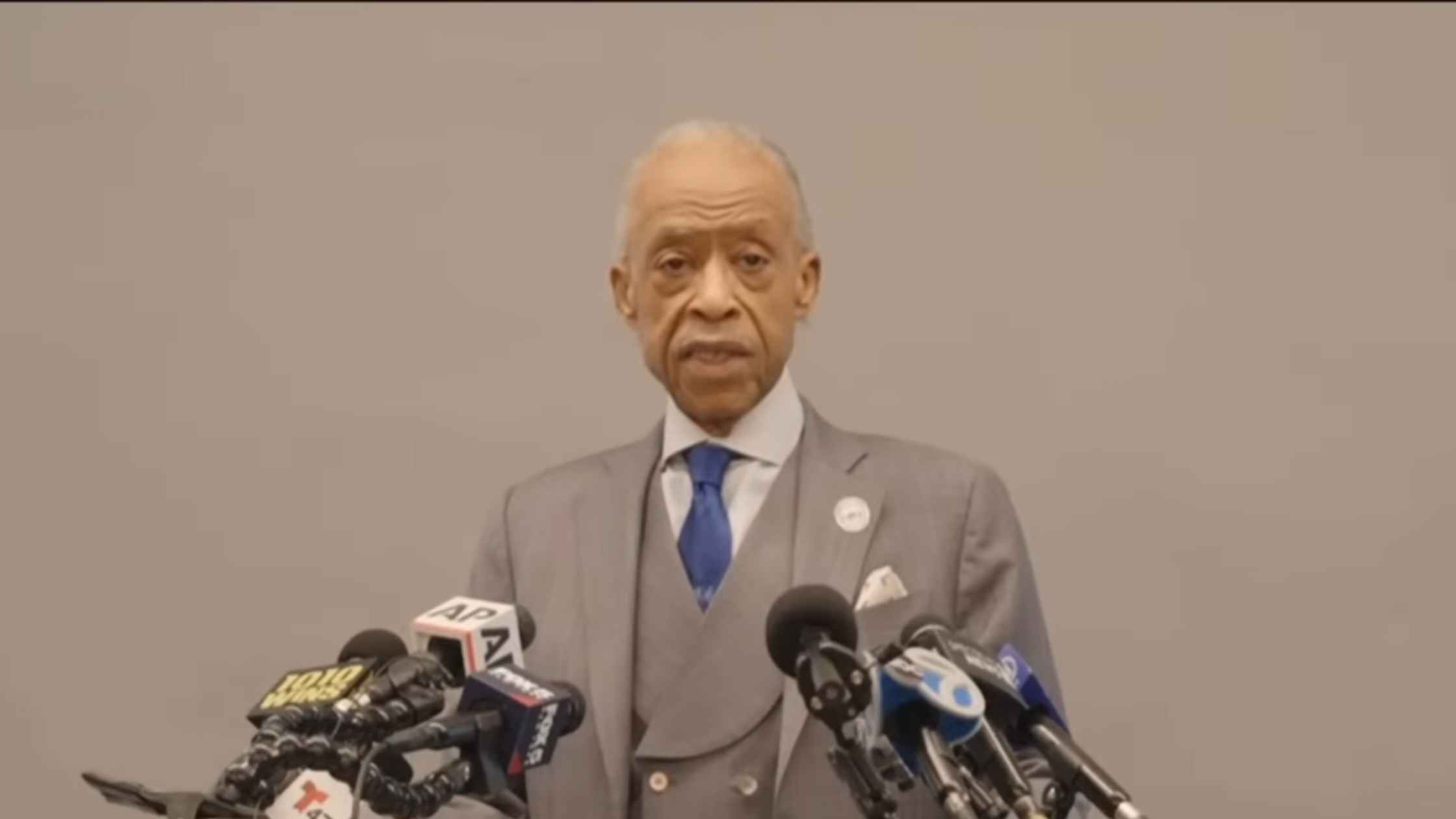
Reverend Al Sharpton (10:48):
Good morning. About 2:30 AM this morning, or around about 3:00, I received a text from Jesse Jackson Jr. that Reverend Jesse Jackson had passed, and a couple of hours later, Reverend Jackson's son Yusef called me and put me on speakerphone where I had prayer with the family as they stood around his bed before taking him out to the funeral home. So it has been a very sad day for me. Even though we knew he was very ill, when the moment comes, you're not prepared for it.
(11:31)
I first met Jesse Jackson when I was 12 years old. I was a boy preaching in the Pentecostal Church in Brooklyn, New York, Washington Temple Church of God in Christ, and I'd become enticed with what was going on in activism because I was watching Adam Clayton Powell on television. My mother brought me to Bishop Washington, our pastor, and he said, "No, I can put him with some ministers that's involved." He brought me to Reverend William Jones and they made me the youth director at 13 years old of Operation Breadbasket under the national director, Reverend Jesse Jackson.
(12:07)
Reverend Jackson was about 27. I was 13, and ever since then for 69 years, we have bonded. The last time he spoke in New York, he spoke at the House of Justice for us. I can't think of a time that we were not spending time together. Now, he was a hard taskmaster. He would always get on me about, "Why are you on this issue? You need to be more studied on this." But he was one who was more responsible than anyone for teaching me activism.
(12:42)
On a personal level, my family and I used to spend every Christmas at the Jacksons' house, and the last two Christmases I took my daughters, one who's with us today, to Chicago. We spent Christmas night at Reverend Jackson's house just five weeks ago and last Christmas. We would feed people at the House of Justice and then go to the airport in the afternoon and fly to be with him. So I would always be able to cherish that I spent his last Christmas with him and spent last days even when he could no longer speak well.
(13:21)
What I think on a broader level is, Jesse Jackson changed American politics. Jesse Jackson changed the Civil Rights Movement. He was a consequential and transformative figure, and he changed New York politics. Let me go in that order. One, it was when Dr. King died, was killed in '68, he was talking to Jesse Jackson and Ben Branch over the rail at the Lorraine Motel in Memphis, and Reverend Jackson was literally one of the two last people to speak to him.
(14:02)
I always wondered how much trauma that must have been for him to witness Reverend King's assassination. He never would talk about it too much, but it drove him. He kept saying, "We got to keep Dr. King's dream alive." He was 12 years younger than King, as I was 13 years younger than him, and he would always challenge me that, "Your generation's got to do what John Lewis and all of us that were younger than Dr. King did." He kept the movement going by keeping the economic boycotts of Operation Breadbasket going, by dealing with diversity, by fighting for affirmative action.
(14:45)
You must remember when the late seventies and eighties when Reaganism rose and there was this backlash on civil rights, Jesse Jackson took the front with John Lewis and others to restore what Dr. King had done. We romanticize the sixties like there were never challenges. They were challenges. We had to renew the Voting Rights Act every five years. We had to deal with state laws, and it was Reverend Jackson that did that into our era of having to deal with racial profiling and driving while black and all. We learned all that from him.
(15:22)
It was in 1984 when he ran for president that he changed the rules that primaries were governed by, where in pre-Jackson if you ran in New York, for example, and you got 104 delegates and your opponent got 100 delegates, your opponent got all 204 delegates. It was Jesse that made it be, no, you get your 100, they get 104. With him changing it to proportional delegate representation is how Barack Obama was made the nominee. Hillary Clinton won more big states, but he was able to accumulate more delegate votes.
(16:06)
So he literally changed the party in '84, and then in '86, the midterm elections changed because he had registered so many new voters that had not been calculated before that many of the states turned and the US Senate '86 became democratic control and maintain a lot of the things that we would've lost under the Reagan era because Jesse Jackson registered those voters. In '88, he ran again, got 7 million votes, won the city of New York. It was his '88 race where he won the city, he lost the state to the caucus, but he won the city of New York, which made us believe in '89 we could win, and we did by electing David Dinkins. David Dinkins was his coordinator for New York City in '88 and became the mayor in '89 off Jackson votes and the belief we could win it because Jesse Jackson, despite the controversies around him, won the city of New York in '88.
(17:13)
So I'm not talking about somebody that just is some removed figure in history. He literally changed American politics, New York politics, and kept the Civil Rights Movement going and then raised some of us that have been in the forefront in the first part of the 21st century to do what we do, and he's been there with us. When we did George Floyd, he was right there in the church with us when I did the eulogy. He was there with us with Trayvon Martin. He never stopped.
(17:44)
I once said to him, "You already in history, you've gotten all the honors. Why do you keep going?" He said, "I never learned how to retire." He said, "You got to remember how Dr. King was killed at 39 years old. Medgar Evers was killed at 39 years old. Malcolm
Reverend Al Sharpton (18:00):
... the metros killed at 39. We were never raised to be 40 years old. He said, "I woke up one day at 55. There's no retirement plan for us." And he kept going until this morning. So my whole life and the whole country and the world was changed. Don't forget, he went and got hostages from Iraq, hostages from Syria that no one else could get for this country. Never got the credit he was due. But he said to me that, " Those that need the credit don't deserve it. And those that deserve the credit don't need it." Well, I'm going to make sure as long as I'm alive, he gets the credit, Reverend Jesse Jackson.
(18:42)
On this Saturday, our regular Saturday action rally will be at the start Mother ME Zion Church. It is the church that Frederick Douglas spoke at. It's the church that Sojourner Truth at the altar, change her name from a slave name to Sojourner Truth. It's the church that Madam C. J. Walker's funeral was at, the church that Paul Robeson was a member of. His brother was one of the pastors.
(19:08)
So in Black History Month, we are going to dedicate the action rally of this week to Jesse Jackson, which was the last place, last organization he spoke for in the city in New York, last time to Harlem when he left the House of Justice. We took him to Sylvia's, and I'll never forget when he finished, we had to help with the fork. And he told, "Wheel me into the kitchen." He shook hands with all of the people in Sylvia's restaurant, shook hands with them in the kitchen. That's the last time he was here. So we are going to honor him, and we are asking all of our city officials to join us there. We are the organization that Dr. Jackson worked with, and we're going to honor him this Saturday. We want all of them to come and give their condolences and a New York salute to Reverend Jesse Jackson. Any questions?
Speaker 8 (20:07):
Yeah, Reverend Sharpton, what did he open your eyes to? What did he help you realize that you didn't know, or weren't aware of, or got better?
Reverend Al Sharpton (20:18):
He opened my eyes in two ways. He opened my eyes that we could make a difference, we could make change, that we could not be cynical. So by him running, has never had been an elected official, where most Black elected officials at that time not with him in '84. When he ran and did that, I believed that we could make a difference, we could change laws, and which is why I went from just being bitter to trying to be better, and be able to help change the system by not just fighting the system but fighting it inside and outside, the same time. What he did for me personally, I was born and raised in Brooklyn. My father left when I was 10. Unlike many of the ministers that I looked up to, I didn't come from a high pedigree, a nice family with my father and grandfather and great-grandfather preachers. My father left. Jesse was born out of wedlock. His slogan was, "I am somebody. It's not how you born, it's where you go with it." So he made me believe, even a kid on welfare, in Brownsville, Brooklyn could beat somebody because of Jesse Jackson taught me that. Look what he did, born out of wedlock in Greenville, South Carolina. If he could do it, I could do it. It's easy for preacher that's got PhD and his daddy was a big preacher and granddaddy. It's easy for him to do. It wasn't easy for Jesse, and he taught me that it didn't have to be easy for me, but I could make it anyway.
Speaker 9 (21:54):
Good Morning, Reverend Sharpton. I was just looking at some of the archival video this morning. One of them that just popped up was the March of 1995 against the social service cuts against the Governor Pataki. Take us back to that day, what you remember about how powerful that day was with Reverend Jackson?
Reverend Al Sharpton (22:17):
In 1995, they had cut the budget. Pataki had just been elected in '94, and I decided we were going to do a 10-day walk from New York to Albany. And we started at the King Baptist Church, where Wyatt Tee Walker was pastor then, Dr. King's Aid, and we'd walk a mile and a half a day. Reverend Jackson flew in and said, "I'm going to start the march with y'all and finish with y'all." And I said to him, "Oh, you're not doing all 10 days?" He said, "I'm not overweight, you need to walk." So we would laugh about that. And he met us in Albany, and we marched on George Pataki, and got a lot of the legislation restored. That's how much he had local impact. He worked a lot with 1199, he worked with National Action Network. But he would know, he would call me. We used to talk at six o'clock every morning. He would call me and say, "What are y'all doing about this referendum?" I said, "How do you know about that?" But he was constantly kept his hand on the pulse on what was going on around the country.
Speaker 10 (23:23):
Reverend Sharpton, can you speak to how he was a bridge between generations, Dr. King's generation, your generation, and the generations today, of the social justice movement?
Reverend Al Sharpton (23:34):
I think that Jesse Jackson was a bridge that was not given credit for. He was the youngest person on Dr. King's staff. So he was attractive to people like me, that was a generation behind him, because he was more hip. He used to wear Martin Luther King Medallion, that's where I got that from. And he used to wear a vest. I never saw him wear a suit and tie until about 1972. And he had big Afro. So he wasn't the style of the conservative preachers like Dr. King was.
(24:11)
And he then was able to understand our generation of saying, "No justice, no peace," rather than, "I am somebody." And he was the bridge that would say, "But let us get something done." And he would be there. So whether it was in the seventies and eighties, where we were fighting around the issues of Howard Beach and Yusef Hawkins, which he came in, and visited the funeral home with me at Yusef Hawkins. Or then later in the 21st century, it was Trayvon Martin. He came and stood with us. He would stand behind us as much as he would lead us, but he would stand behind us. I used to say he's leading from the back now, because he'd be there. And I think that he was never threatened by those older than him or younger than him. He just wanted us to keep our eyes on the crowd.
Speaker 10 (25:01):
And what about his commitment to peaceful protest and peaceful change at a time when there was a lot of violence?
Reverend Al Sharpton (25:07):
He was adamant that we always keep nonviolence, because he said, "You going to ..." First of all, he said, "You must have the moral standing that those we are fighting don't have. And if you become as immoral as them," not caring about life and the like, "then you are not fighting a cause. You are fighting for who can have more power." So he definitely would always say that. And he would always say to me if he heard I was getting ready to do something, "Al, make sure that there is no violence. Make sure that you don't step outside of Dr. King's principles." And I think he also would always reprimand us about language, not only violence in terms of physical, but your language must communicate justice, not revenge. He was very, very hard on me about that.
Speaker 11 (25:58):
Rev, good morning. What would you say to those media, elected officials, others who are efforting to define Jesse Jackson's legacy in death by criticism, controversies that he had during his life, as opposed to the lifetime of accomplishments that you talked about briefly?
Reverend Al Sharpton (26:17):
I think that there will be those that will raise the controversies, and they will raise some of the things that they would consider negative. But Reverend Jackson had a saying that he used to tell me that became something I lived by. He said, "Turn your scars into stars." And they can raise the controversy, but the fact that they've got to raise them at all means that he made his point. He made effect. Nobody thought a kid born out of wedlock on Haney Street in South Carolina would be where he was. So sometime when you climbing up steep mountains, you might slip and skid
Reverend Al Sharpton (27:00):
... Unique, but the story is he climbed that mountain.
Speaker 12 (27:03):
Thank you.
Speaker 13 (27:07):
Hi. Good morning. Thank you for having us. I wanted to ask if there was anything from the Reverend's legacy you hope the new generation and the Democratic Party, the Civil Rights Movement, he going forward.
Reverend Al Sharpton (27:20):
I think that what I would hope that he is, that we continue to protect the right to vote. That we protect the Voting Rights Act, and that we protect the economic movements of not having an imbalance where the super rich get richer at the expense of the poor. And that we remain a rainbow, multicultural. That we fight for immigration rights and civil rights. That we deal with policing and deal with vice. And I think that he represented that we cannot take the rainbow out of the movement. We cannot take the non-violence out, but we must protect the right to vote. Everything Dr. King and Reverend Jackson stood for is at risk right now. Supreme Court is weighing right now section two of the Voting Rights Act. Right now we're seeing what's going on with ICE and deportation. So we have the challenge not to mourn Jesse Jackson, but we need to use our mournings, which is what we're going to do Saturday, to say there must be a movement. He would not want us to have sanctimonious mournings if we weren't going to get up and do the work.
Speaker 14 (28:38):
Reverend Sharpton, so many speeches over the years. So many important quotes. Which one is the most significant to you or the most personal in terms of what you remember of Reverend Jackson?
Reverend Al Sharpton (28:49):
I think that his 84 Democratic Convention speech, our Time Has Come, was a classic because it gave us hope. I think that when he came back in 88, keep Hope Alive was a classic. There's so many, but Reverend Jackson, last time, he was at time before that, when he was at the House of Justice, he had a book of sermons that he had come out with and that's when I knew he was stumbling and had Parkinson's and I asked him to sign the book to me. He could only do the first J and I keep that book at home, a book of all of his sermons, but he couldn't even sign his name. But he still came to Harlem to do what he could do.
Speaker 10 (29:37):
Reverend Sharpton, one other questions in terms of his unfinished business around the economic justice issues like food insecurity, health care for people that he touched on at many points in his life, what do you say to that?
Reverend Al Sharpton (29:50):
I say that we've got to keep fighting. We cannot make mockery with just mourning him and letting it go. And DEI, diversity, equity, and inclusion, which has now been wiped out by this present administration, that was Jesse Jackson saying, "We've got to diversify boardrooms, diversify employment for blacks, for women, for browns, or for LGBTQ." So we are seeing at a stage where everything he fought for is at risk, and if we want to mourn him, we've got to preserve what he fought for.
Speaker 10 (30:29):
Thank you.
Speaker 15 (30:29):
So what is the plan of action to defend voting rights?
Reverend Al Sharpton (30:33):
Well, I think the plan has to be how do we get voting rights in the first place, and that is mobilizing, marching, nonviolent protest. But the thing we had that they didn't have in 65, we have enough people in the Senate in the House to relegislate if we come out and vote, if we come out in the right numbers, a member of National Action Network named Hakeem Jeffries would be the speaker of the house and can call the hearings and find out what's really going on in ICE. So every time it looked hard to me. I think about how hard it was for Jesse when he was a student leader in North Carolina, how hard it was with Dr. King. We don't have the right to complain. They turned the country upside down and they didn't even have social media. You know Dr. King didn't know what a cell phone was, didn't know what a TikTok is. We got all of these things to work with. Question is, are we going to work with them?
Speaker 12 (31:31):
Thank you.
Reverend Al Sharpton (31:31):
All right, thank you.
Speaker 17 (31:33):
Thank you so much.
Speaker 16 (31:33):
Thank you.
Reverend Al Sharpton (31:33):
This is Reverend Malcolm Byrd who pastors the church that we at on Sunday. He's also COO of National Action Network.
Speaker 17 (31:45):
Thank you Reverend. [inaudible 00:32:06].