

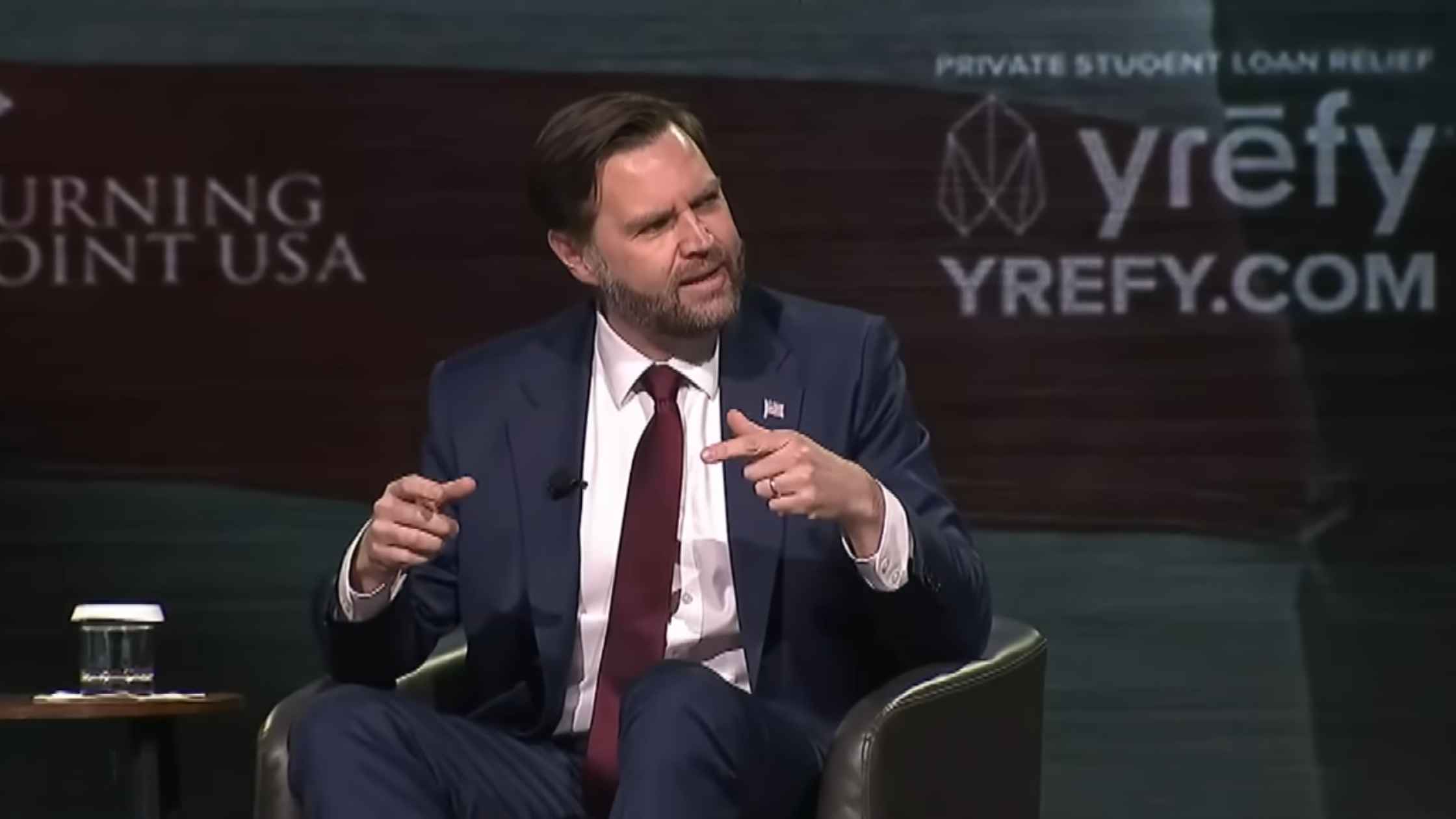
JD Vance (02:45):
Charlie wasn't effective just because he had opinions. Charlie was effective because he was courageous, because he worked very hard and because he made his vision a reality. Charlie wanted all of you, more than anything, to invest in the things that were worth having, to build a life that was worth building. We ought to have faith that the best way to make sure that the best idea wins is to actually just have a discussion.
Speaker 1 (03:15):
Please welcome Vice President JD Vince.
JD Vance (03:48):
Andrew.
Andrew (03:49):
What's up, man? Mr. Vice President, good to see you.
JD Vance (03:51):
Thank you all. What a welcome.
Andrew (03:55):
Hello, Athens. Yeah. I think that that's their thing. I like it.
JD Vance (04:07):
That is definitely their thing. So I've been to two SEC schools with Turning Point USA and my Ohio State brethren are ashamed of me because I've given you guys way more love than my own alma mater, but it's pretty good to be in SEC country, I have to say. It's great to be here.
Andrew (04:23):
We can help fix that. We can work on that.
(04:28)
So for those of you wondering why I don't have really flowing long blonde hair right now, so I'm going to address it right at the front. Mr. Vice President, I'm on stage here instead of our friend, Erica Kirk.
JD Vance (04:41):
That's right.
Andrew (04:43):
Because unfortunately, she has received some very serious threats in her direction, which is terrible. It's a terrible reflection on the state of reality and the state of the country, but it underscores a larger point that she has received a lot of attacks from surprising places, perhaps. Tell us what you think about that and some of the people that have made part-time jobs out of attacking Erica, and this is the net result.
JD Vance (05:14):
Sure. Well, first of all, I love Erica and I know that she did get some threats. About two hours ago, as you know, Andrew, I was a little worried that we were going to have to cancel the event because Erica was not going to come and she was very worried about it. I talked to the Secret Service and obviously these guys do a very good job. I said, "You know what? Let's let Erica do what she needs to do for herself and her family. I'm sure Andrew will fill in. Let's go and make this an amazing event with the Georgia Bulldogs in Athens, Georgia." So absolutely we're going to do this thing.
(05:49)
Look, I mean, in so many ways, when did Charlie die? It was mid-September, I believe.
Andrew (05:56):
September 10th.
JD Vance (05:58):
That's right, it was the day right before September 11th. In so many ways, the past six or so months have been two separate living hells for Erica Kirk. The first is, of course, that she lost her husband, she lost the father of her children. I'll never forget this because I mean, frankly, I think a lot about it because my wife is now pregnant with our fourth baby, is when we went and picked up ... Thank you.
(06:24)
When we went and picked up Charlie's body in Utah, and of course you were there with us, and I met Erica and I met the family. I mean, I met Charlie, his parents and his little sister. I just think about that moment and where she was so broken. Any of you know, anybody who's grieved before is you kind of go from just crestfallen and sad and then you want to remember the person that you just lost. There's just this constant flood of emotions, right? At one moment you're laughing about something they said two years ago and in another moment you're sobbing, because they're not there anymore.
(07:02)
I thought about that moment a lot because Erica told me, and that was the first time she had the first time she'd ever told me this. I guess I thought about it a lot in the context of my wife's pregnancy. She said, "I really wish that we had had more babies together." That kind of hit me like, "It's just it. He's gone." That was sort of one of the moments where I realized Charlie's not coming back here. You have this mom who's really sad about the fact that her two little kids may never have memories. I mean, you think about, as a father, I know most of you out there are too young to have kids, but one of the things that you think about as a father is I want my kids to remember this moment. I want my six-year-old to remember when I took him to the zoo. My six-year-old son was just baptized on Easter Sunday and I want him to remember that moment with me. Thank you.
(07:58)
Erica's struggling with this and, of course, that's terrible, unspeakable. Most of us cannot even put ourselves in her shoes while at the same time, she's trying to make sure that Charlie's legacy doesn't die. In that context, everybody is attacking her over everything and they're lying about her. It's one of the most disgraceful things that I've ever seen in public life, and I've seen a lot of crazy stuff in my life as a political leader. I will tell you that the people who tell you ... I was there with her, I was holding her hand, my wife was hugging her while we loaded Charlie's body onto Air Force 2 and said the Lord's prayer, the people telling you that Erica wasn't grieving her husband are full of shit. We need to be honest about that fact.
(08:49)
Excuse my language. My wife says I got to work on my language. She's been telling me that for 12 years, and it still hasn't taken. The thing is, look, when you become a public figure, the natural thing, and I've talked to Erica about this privately, is a ton of crazy people say a ton of things about you that simply aren't true. The thing that makes it so egregious with Erica is that she's a grieving person who's trying to carry on her husband's legacy. And look, we all do things that are wrong. If you want to criticize Turning Point USA for not taking this position, or having this political disagreement, or maybe it should do this or that, that's all above board. But to say that Erica Kirk wasn't grieving her husband on that day, to say that Erica Kirk was somehow complicit in it, is so preposterous and so disgusting, and it's one of the things that has broken, I think, the American public conversation over the last six months.
(09:45)
I mean, Andrew, we could talk about this for a long time. Charlie's absence, I've felt it so many times in so many different ways. There have been so many times where I've wanted to call Charlie and say, "Man, you've got to call this person," or, "Man, you've got to put this event together so we can help this candidate." Or just to bounce ideas off of, as a friend. There have been so many ways in which I felt that void, but one of the ways in which I felt that void is that it's like the response to Charlie Kirk dying. The response to Charlie Kirk getting assassinated by a left-wing furry lover is the response should have been, "Let's go after left-wing violence and terrorism. Let's defund the networks of left-wing violence and terrorism." That's what we've been doing in Washington DC and that's what we've been fighting for every single day.
(10:35)
Savannah Hernandez, of course, was assaulted in Minnesota a couple days ago. I talked to Cash Patel on the way down here and I said, "I assume that we're doing something here." He said, "Yes, we've had multiple agents on the ground. We've already talked to Savannah. We're going to use the video to try to go after the people who assaulted her, and then try to defund the networks that fund those radicals who are going around assaulting activists." That's what we should be doing.
(10:58)
I know that politics is hard, and I know that it's challenging, and I know that things aren't always easy and we're going to have disagreements even within our coalition, but if you're going after Erica Kirk, and not the people who are trying to destroy the United States of America, you're part of the problem, not part of the solution.
Andrew (11:21):
Yeah. Amen. I think that's really well said, Mr. Vice President. I always try and remember that Erica has to live with this constant reality that her kids are one parent away from being orphans. We take that extremely seriously. As you mentioned, what happened with Savannah, and I think it's just important that we remember that we're dealing with humans. These are human beings.
JD Vance (11:50):
Yeah. Exactly. I've heard some people say, "Well, Erica was smiling two days after Charlie Kirk died," or something like that. Most of us in this room have grieved somebody that we loved, maybe hopefully not a spouse who dies in the prime of their life, but when you deal with somebody who's grieving, it's always this weird combination of emotions. It's intense sadness, intense affection. You sort of love that person in that moment, maybe more than you ever have because you feel their absence. You think about all the happy moments that you had and you can't help but smile, and then you remember they're not there and you can't help but sob. That's what grief is like. Again, if your instinct is to go after, not the left-wing radicals who are assaulting Savannah or not the people who shot Charlie Kirk, but if your instinct is to go after a young mother because she's grieving in a way that you find wrong, well, why don't you stay in your lane and mind your own business?
Andrew (12:54):
Yeah. Amen.
JD Vance (12:54):
Grief is complicated. There's another angle of this, Andrew, which is just so absurd, which is that people will say that Erica, she's been doing this or she's been doing that and I would be doing something different. It's like, first of all, that's fine. If you want to criticize somebody because you have a disagreement ... Disagree with my politics, disagree with something that Erica or Andrew say on The Turning Point Podcast, but this desire to go after her for the way she's grieving her husband, that's the most preposterous thing I've seen in a very long time, and I've seen a lot of crazy stuff in politics.
Andrew (13:38):
Amen. Thank you for saying that, Mr. Vice President.
(13:42)
I think this segues very well into our next question here. You are a practicing Catholic. Despite your language, you're attempting to be a faithful Catholic.
JD Vance (13:53):
That's right. That's right.
Andrew (13:56):
I think it was well-placed if I may say.
JD Vance (13:58):
Thank you, I appreciate it.
Andrew (13:59):
I'm sure you've seen that the Vatican and the Pope and the president have been in the news lately. As a Catholic, what does it feel like to be in the middle of that?
JD Vance (14:12):
I thought I was going to get easy questions. This is kind of a tough question here.
Andrew (14:14):
Nope, no easy ones here.
JD Vance (14:15):
So here's the thing about this. First of all, you will sometimes hear people say, "Well, the Vatican, the church, whether it's the Protestant church, the Catholic Church, they should preach the gospel, they should ignore public policy." I actually don't agree with them. I actually think that it's a good thing when Christian leaders, whether they're Catholic or Protestant ... Part of preaching the gospel is talking about how the gospel applies to the issues of the day. I've never been one of these people who say that you should never have Christian leadership not talking about politics or frankly, political leaders not talking about their Christian faith. I do think that we have to remember that each of us has our own role. I'm the Vice President of the United States. The fundamental way I understand my role is that I'm trying to take the lessons, the moral truths that are rooted in Christianity, and I'm trying to apply them to a whole host of complicated, real-world scenarios.
(15:16)
Thank you.
(15:21)
My job is to apply moral truth to try to do the best thing for the American people. That's my job. That's the President of the United States' job, and of course, he's the person who leads our administration. The Pope's job is to preach the gospel. Again, I think that sometimes in the context, it doesn't bother me, even when I disagree with him. I have a lot of respect for the Pope. I like him. I admire him. I've gotten to know him a little bit. It doesn't bother me when he speaks on issues of the day, frankly, even when I disagree with how he's applying a particular principle. The most obvious example is it has frustrated me that some of the Catholic clergy have attacked, mercilessly, the Trump administration on immigration. It is a constant idea that somehow everything that the Trump administration does, when it comes to securing our borders, is inhumane. My constant response to that is, how is it humane to allow drug traffickers and sex traffickers to bring little kids across the southern border?
Andrew (16:21):
Amen.
JD Vance (16:21):
How is that humane?
(16:28)
But again, I'd almost rather have the conversation. Even when there's disagreement, I like it when the Pope comments on questions of immigration. I like it when the Pope talks about abortion. I like it when the Pope talks about matters of war and peace, because I think that, at the very least, it invites a conversation. I think some people, their reaction to this is to say, "Well, he shouldn't have said that. " Look, there are certainly things that the Pope has said in the last few months that I disagree with.
(16:56)
Let me just take one very concrete example related to this conflict in Iran. The Pope said something where he said, and I'm going to try to remember the exact quote, but he said that God is never on the side of those who wield the sword. God is never on the side of those who wield the sword. I'm pretty sure that he said that exact statement. Now, on the one hand, again, I like that the Pope is an advocate for peace, I think that's certainly one of his roles. On the other hand, how can you say that God is never on the side of those who wield the sword? Was God on the side of the Americans who liberated France from the Nazis? Was God on the side of the Americans who liberated Holocaust camps and liberated those innocent people from those who had survived the Holocaust?
Speaker 2 (17:46):
Jesus Christ does not support genocide.
JD Vance (17:48):
I certainly think the answer is yes. I agree. Jesus Christ does not ... I agree. Jesus Christ certainly does not support genocide, whoever yelled that out from the dark. He certainly does not. I think
JD Vance (18:00):
I think that's pretty easy. I think that's a pretty easy principle. [inaudible 00:18:06]. Okay. So here's a guy, let me just say this. This is a guy ... No, no, no, no, no, no, no, no, no, no. First of all, random dude who's shouting, can I finish my point and then I'll respond to what you just shouted? Is that okay? Okay, great.
Andrew (18:20):
Yeah. Can we give him one second to answer this?
JD Vance (18:23):
So let me just finish this question on the Pope and then I want to respond to what this guy said. So number one, when the Pope says that God is never on the side of those who wield the sword, there is more than a thousand-year tradition of just war theory. Okay? Now we can of course have disagreements about whether this or that conflict is just, but I think that it's important in the same way that it's important for the Vice President of the United States to be careful when I talk about matters of public policy, I think it's very, very important for the Pope to be careful when he talks about matters of theology.
(18:58)
And I think that one of these issues here is that there has been ... Again, hey, random dude screaming. I told you I'd respond to your point. I just want to respond to this question first. But I think one of the issues here is that if you're going to opine on matters of theology, you've got to be careful. You've got to make sure it's anchored in the truth. And that's one of the things that I try to do, and it's certainly something I would expect from the clergy, whether they're Catholic or Protestant.
(19:23)
Now, to respond to this guy here, I believe he said the administration supports a genocide in Gaza. And here's my response to that. When we came in, the humanitarian situation in Gaza was an absolute catastrophe. You know who's the person who got a peace agreement in Gaza? Donald J. Trump. So if you want to complain about what happened in Gaza ... So if you want, sir, to complain about what happened in Gaza, why don't you complain about Joe Biden and the last administration? We're the administration that solved that problem.
(20:08)
And by the way, not only was our administration the administration that solved the problem, but the president... [inaudible 00:20:19]. Excuse me, sir, right now, you see more humanitarian aid coming into Gaza than it has anytime in the past five years, because we have taken that situation seriously. And that's one of the things that I'm proud of about our administration is whether it's there or Thailand and Cambodia, we have consistently tried as much as we can to solve these problems, not just complain about them like the guy who just ran away angry.
Andrew (20:57):
You know, JD, I'll never forget your speech at Charlie's Memorial and you talked about how your faith in the wake of Charlie's assassination has become so central to you. You talk about it more and now you're even writing a book about it.
JD Vance (21:13):
Sure.
Andrew (21:13):
Tell us about it. And what's it called? It's called The Way... Finding... Yeah.
JD Vance (21:17):
Well, it's called Communion and I think the subtitle is Finding My Way Back to Faith.
Andrew (21:25):
Yes.
JD Vance (21:25):
And here's why I wanted to write this book, Andrew, because I think that like a lot of you, there was a point in my life... I mean, this is probably a much more Christian audience than maybe I was when I was a 22-year-old college student. I just got out of the Marine Corps and I realized that I was sort of winning this game of life in one sense and I was losing it in the way that mattered. I was raised in a Christian household. I was raised in a very sort of Pentecostal family. Our church had a really good music and amazing people. And one of the things I love about evangelical culture in the United States of America is just how welcoming it is of everybody. And you know that, you're an evangelical Christian.
(22:13)
And so the thing is, I hadn't been properly formed in my faith. And so I got to the Marine Corps and by the time I left the Marine Corps and was starting college, I called myself an atheist. And I kind of went through this period of being an angry atheist, and then I realized when I got to a point where I thought to myself, what actually matters in life? It's not getting into a law school, which I'd done. It's not making a lot of money. It's not credentials. It's not good jobs. It's being a good person.
(22:46)
I'd fallen in love with this ... Thank you. I'd fallen in love with a girl and that girl eventually became my wife and the mother to our now four children. And I remember thinking to myself, she doesn't care whether I make a certain amount of money. She wants me to be a good husband. She wants me to be a good father. She wants me to be a virtuous person. And I started to realize...
Andrew (23:10):
She wants a date night.
JD Vance (23:11):
Yes, she does want that, which is hard when you're Vice President of United States. But what I realized is that the philosophy of secular liberalism, it was achieve, achieve, achieve. Get as many credentials, make as much money as possible, and that left me feeling empty. And meanwhile, it was this faith that I had discarded as a kid, which actually provided a real sense of meaning and purpose.
(23:35)
And then I talked to a priest and this priest was like, "You know what? If you think that the Christian faith is right about all these moral questions, maybe it's right because there's a witness element to it. Maybe the fact that it's right about morality and about virtue and about sin, maybe that means it's also right about the fact that Jesus Christ was the son of God. Maybe it's also right that Jesus Christ died and rose from the dead on the third day. Maybe these things that appeal to you about the Christian faith come from the deeper truth of the Christian faith."
(24:15)
And that kind of got me down a pathway of where eventually I was baptized and became a very devout Christian. And at this point... Amen. Amen. Thank you.
Andrew (24:26):
Amen.
JD Vance (24:29):
But I thought, first of all, a lot of people have asked me about that journey and I thought what better way than to sit down and actually force myself to write it out. I actually started writing the book back in 2017, right after Usha had our first baby, my son Ewen, who's now eight years old, and so I've been kind of writing it off and on since then.
(24:51)
And a little bit Charlie's death, a little bit just being in the public eye, but mostly just I've been at this thing for 10 years and I was like, it's finally time to get it out there. And so I put the finishing touches on it, submitted to the publisher a couple of months ago and it's coming out in June. So buy the book, Communion.
Andrew (25:10):
I love that. Not that that wasn't also really riveting, but we're getting to the part of the interview that I'm really excited about. You are working on fraud. You're the fraud tsar.
JD Vance (25:21):
Yes.
Andrew (25:22):
How many bad guys...?
JD Vance (25:24):
Yes.
Andrew (25:25):
How many bad guys are we going to get? I mean, that's the way I ... There's a really nice framing of this question that I worked on. No, no. I want to know what's the progress? Tell us about it.
JD Vance (25:35):
Well, we've already gotten a lot of bad guys. And one of the things I'm very proud about is that people don't just want talk. They want action. They want us to actually go and arrest the people who committed fraud, and that's happened. We're starting to do that. And that's a good thing. And a lot more is going to be happening in the future.
(25:52)
But actually, you know what's been amazing on this is Dr. Oz. Mehmet Oz who runs the Center for Medicare and Medicaid Services because so much of the fraud in our system is people who are defrauding Medicare and Medicaid. Let me just give you a couple of examples. So we have in South Florida, we have entire companies that sell medical devices, they sell prosthetic knees and they sell prosthetic hips. And you know that they've received hundreds of millions, some of them billions of dollars in government funds and they've never shipped a single product. They're just set up by fraudsters and there's so many of them and many of them haven't ... There are like over a hundred of these companies that haven't shipped a single product. Okay?
(26:35)
I'll give you another example of fraud. So this ridiculous situation with Somali fraudsters in Minneapolis, in the Minneapolis area. So you have a program that exists to help autistic children get the resources they need to help their parents, find them a ride to school, or if they need afterschool support to make sure their parents have what they need. And that program has been defrauded by Somali fraudsters who will go in, who will say that we have three kids, every single one of them is autistic.
(27:05)
There's no verification from the state of Minnesota. So that family will receive tens of thousands of dollars from the taxpayer and then the autistic children in Minneapolis who actually do need those services, the money's not there anymore because it's been taken away by fraudsters. We've completely stopped the funding to that program. And we basically told the state of Minnesota, "You don't get any more of our money unless you verify that you're taking fraud seriously." So we just turned it off.
(27:36)
But what Dr. Oz working with some of the people in our Department of Justice found is that in Southern California, you had all these people who were engaged in massive fraud against the Medicare system. You had just tons and tons of people getting rich off fraud. And so we had our weekly fraud check-in call two weeks ago and Dr. Oz called in, but he's like, "Hey, I got to go because I'm about to hop on the bus and we're going to go arrest a bunch of fraudsters in Los Angeles." I was like, "That's exactly what I want you to do. By all means, get off the phone."
(28:07)
So we're doing a lot of that stuff. And I think one of the biggest things and the most important things we're doing on this, Andrew, is that there was sort of in the Biden administration, probably intentionally, but regardless, this attitude of if you were committing fraud of under a million dollars, you were committing fraud of under a million and a half dollars, we're just going to look the other way. And the approach that we've taken in the last couple of months is, no amount of fraud is too big or too small. If you're defrauding the taxpayer, you ought to go to prison and anybody who's helping you ought to go to prison too.
Andrew (28:38):
That's great. I mean, I think this is one of the absolute slam dunk issues. How many of you guys out in this audience care about American taxpayers getting ripped off? Right? This is like a 99-1 issue.
JD Vance (28:54):
The guy who was shouting at us earlier, he doesn't care at all about people getting ripped off by fraud.
Andrew (29:00):
But I think it underscores a bigger problem, right? Because there's a lot of young people in this room, a lot of you had some very formative years ripped off as well during COVID. You didn't get to do prom.
JD Vance (29:11):
Absolutely.
Andrew (29:12):
You didn't get graduation. There were so many things taken from you and you entered into the college years maybe with a really anemic workforce environment, inflation historic, life's expensive. What do you tell young people right now that even right now they're wondering, what's the future that I can get? What's the career I can get? Can I afford to have a family, kids, buy a home? What's your message to them right now that have big questions ahead of their future?
JD Vance (29:40):
I think my message to young people who are wondering whether they can afford a family, whether they can afford a home, whether they can afford kids in the American Dream is you guys have every right to demand more of your elected leadership, and my job is to make it as possible for the answer to that question to be yes. And fundamentally, the question you should ask your politicians is exactly that, are you pursuing policies that make it easier for me to afford a house, easier for me to get a good job, easier for me to get a good education, and easier for me to raise my family in safety and security and comfort? That is the fundamental issue.
(30:19)
And the thing that bothered me so much about the last administration, there are all these unique policies that I could sort of point to that were disastrous and a lot of them were absolutely terrible, but so much of it goes back to housing and immigration and the connection between the two. Under the four years that Joe Biden was president, housing literally doubled in value, meaning if you're a young person trying to buy a house, it costs twice as much as it did before. And you layer on top of that higher interest rates. That's just in four years.
(30:52)
Nobody can afford that kind of inflation in the housing market and one of the biggest drivers of it is the fact that we let in tens of millions of illegal aliens, people who shouldn't have been here, who are taking homes that ought by right go to you and your generation. And so what have we done in the Trump administration? We've shut the border. We've kicked a lot of those people who have come into the United States, we've kicked them out of our country. And importantly, we have actually instituted a ban on institutional investors buying up American homes because I don't want private equity firms, many of them backed by foreign money to buy American homes. I want you guys to be able to buy American homes.
(31:35)
And I will say, and I say this not to brag because I think you guys should be impatient, when a politician comes to you and tells you, "I've done all these things," you should be asking "Good, now go and do more." That's how I think of my job. I don't wake up and say, "Oh, we did something really good last week." I think to myself, we did something good last week, now let's go do more of it or let's go do something different.
(31:58)
Because maybe the statistic that I'm proudest of in the entire Trump administration is that over the last eight months, rents and home prices have come down, not stayed the same, they have come down. And what I think of as our ultimate ambition is that after another few years of this administration, of stopping private equity barons from buying up homes, from kicking out more illegal immigrants, from securing the border, what we're going to see is housing that is much more affordable and then we're going to keep on building on it year after year after year because the American Dream should not be sold to the highest foreign bidder. It belongs to you.
Andrew (32:34):
Yeah. That's so well said. And a lot of the people in this audience will know that this is one of the issues near and dear to Charlie's heart as well, to make sure that you guys could afford the American Dream, that we thought about you first as a country. And so thank you for saying it so well. Naturally, we have to ask about what's going on in Iran.
JD Vance (32:57):
Sure.
Andrew (32:58):
But I just want everybody, I want to give the vice president his due here because you have been to Europe in the last week and you flew back to the United States only to fly back across the globe to negotiate in Pakistan to come back and somehow we called and we're like, "Are you really going to come to Georgia?" And he's like, "I'll be there." So I want to give him a big round of applause.
JD Vance (33:20):
Thank you.
Andrew (33:23):
I mean, may I just say that's almost Trumpian level of endurance. So do you know what time zone you are and how many hours of sleep did you get?
JD Vance (33:33):
I have no idea what the hell time it is right now. And it's kind of good actually because you just run on coffee and then you sleep when you can, you wake up when you have to and you just drink a whole lot of coffee. And look, it's the job that I asked for, but yes, I will say, look, I think that ...
(33:49)
Let me just say US young people, and I want to make some observation because it made me think of something, which is that young people in the United States, but particularly young Americans in the conservative movement, I think that we have a tendency to get too blackpilled. And here's what I say by this. We have a tendency to get too cynical, too pessimistic. I'm sure that I've said mostly things that you agree with, and I'm sure that I've said some things you may not agree with, and you may not agree with everything that I say about the Iran negotiation, which I will get to answering your question.
(34:22)
But here's fundamentally the issue, when you see a politician or you see a political movement or you see an administration that isn't doing what you want it to do, I think you have two choices. You can say, "Oh to hell with those people," and check out of the process. Or you can say, "You know what? I'm going to get more involved. I'm going to make my voice heard even more. I'm going to pressure that administration to do exactly what I want them to do because they got my vote, they earned my vote, but they can't take it for granted."
(34:48)
And I've seen some of this on various issues. For example, I recognize that a lot of young voters don't love the policy that we have in the Middle East. Okay? I understand that. I also know that we've secured the border. We've lowered housing prices now for eight months in a row, and there's going to be more to come beyond that. We've made America energy dominant, which has lowered electricity costs and things like that. We've made it so that we have the lowest murder rate in 127 years. I'm not saying you have to agree with me on every issue.
(35:23)
I'm not saying you have to agree with me on every issue. What I'm saying is don't get disengaged because you disagree with the administration on one topic. Get more involved. Make your voice heard even more. That's how we ultimately take the country back. It's not by you... If you get five things you want and one thing you don't want, I see way too many people, especially in sort of the online conservative Twitter sphere who say, "Ah, there's no point." No, no, no, no.
(35:52)
Or let me give you another example, the SAVE Act, okay? A lot of people want the SAVE Act. I want the SAVE Act. I've been fighting for the SAVE Act literally
JD Vance (36:00):
... really since day one of the administration. And I've seen a lot of people saying, "What the hell's the point of voting for these guys if you've got three Republicans joining with the Democrats to prevent the SAVE Act from passing, or I guess four Republicans?" And here's my response to that. Yes, it is annoying to me that there are only 45 or 46 Republicans who will fight politically to get the SAVE Act passed. But you know what? 10 years ago, that number was 35. So the answer to frustration is engagement. Don't give up on this process, get more involved in this process and demand more from people like me. That's how we take our country back. I just think it's important to say that.
Andrew (36:42):
That's such a good point. How the Senate is such an example, as frustrating as it is, but you were part of that new wave of new thinking, of new energy, a new generation.
JD Vance (36:51):
Yes.
Andrew (36:52):
And there's so many new voices that are bringing real change to the Senate. I mean, we're one, two elections away from maybe having it all the way around.
JD Vance (36:59):
100%. 100%. And I understand people get frustrated at it. I get frustrated at it, but it's a lot better than it was 10 years ago. And frankly, 10 years ago, it was a lot better than it was 10 years before that.
(37:09)
But here's where we are on, fundamentally, the president set a policy. Iran cannot have a nuclear weapon. And right now we are negotiating to make sure that very thing happens. And what's interesting about this is ... What's interesting about this is that we have this ceasefire that's in place. I think it's six or seven days old. Right now, the ceasefire is holding. And what you're seeing is what the president wants to make, he doesn't want to make a small deal. He wants to make the grand bargain. And what he's basically offering to Iran is very simple. And frankly, it's something that no president has had the ability to offer.
(37:51)
He said that if you're willing to act like a normal country, we are willing to treat you economically like a normal country. He doesn't want a small deal. And that's one of the reasons why, one, I'd say in Pakistan, we made a ton of progress, but the reason why the deal is not yet done is because the president, he really wants a deal where Iran doesn't have a nuclear weapon. Iran is not state sponsoring terrorism, but also the people of Iran can thrive and prosper and join the world economy.
(38:21)
And that's the trade that he's offering. He's saying, "If you guys ..." He's saying, "If you guys commit to not having a nuclear weapon, we are going to make Iran thrive. We're going to make it economically prosperous and we're going to invite the Iranian people into the world economy in a way they haven't been in my entire life." And that's the kind of Trumpian grand bargain that the president has put on the table. Man, we're going to keep on negotiating and try to make it happen because it would be great for the world. It'd be great for our country. It'd be great for everybody. So I'm going to keep on fighting to make it happen.
Andrew (38:55):
Yeah. Just a few more and then we've got a few questions.
JD Vance (39:03):
Yeah, please. I know we have some questions for the audience too.
Andrew (39:04):
So my one question is when you looked across from these Iranian negotiators, what did you make of them? Did you get the sense that they really were the right people? I mean, I'm assuming you guys know this type of thing, but ...
JD Vance (39:15):
Yeah. I mean, look, you never know. The United States had never had meetings at that level with the Iranian government in 49 years. It's a meeting that had never before happened, not Democrat, not Republican. We had never had a meeting like that where you have the person who's effectively running the country in Iran, sitting across from the Vice President of the United States. That had never happened.
(39:41)
Look, honestly, after 49 years, there's a lot of course, mistrust between Iran and the United States of America. You're not going to solve that problem overnight. But yeah, I think the people we're sitting across from wanted to make a deal. And I know the President of the United States told us to go out there and negotiate in good faith. That's what we did. That's what we're going to keep on doing. So you never know though. Right?
(40:04)
I mean, I've sat across from United States senators that I thought I agreed with and you don't know what those people, right? I won't say who. You can guess. But I feel very good about where we are.
Andrew (40:17):
Right.
(40:18)
All right. So this is the last one from me. Now, a lot of people make a big deal about illegal immigration, and we should. It's terrible, right? And this administration has made historic progress on that issue. I think you don't get enough credit for it. And the problem with immigration, illegal immigration is once it's not a problem anymore, our memories are about six days long and we move on to the next thing. But what about legal immigration?
JD Vance (40:41):
Sure.
Andrew (40:41):
And reforming it, correcting it, addressing abuses? Because I look around here and I see a bunch of American students that want jobs, that want homes, that want a space in this country.
JD Vance (40:51):
Of course.
Andrew (40:52):
And I think reforming legal is so, so critical. Maybe talk about some of the reforms that this administration has done specifically on the legal front.
JD Vance (41:00):
So this is exactly right. And this is 100% I think one of the first pieces of legislation I sponsored in the United States Senate was effectively to get one rid of the H1B visa because I cared so much about this when I was in the Senate.
(41:14)
And yes, it is the case that Congress has not exactly come along. Again, to my point about the United States Senate, there are far more people who are sponsoring that legislation today than there were 10 years ago, but it's not nearly enough to get it through. But just through administrative action, I don't think people realize this. The number of new H1B visas is down about 90% in the United States of America. That's something that we accomplished purely through administrative action. And again, it's something I cared a lot about. It's something the president cared a lot about.
(41:49)
There are other things too. There are ways in which our visa system is taken completely advantage of. One of the biggest loopholes in American immigration, legal immigration policy, and I'll never forget my debate against Tim Walz where the moderator tried to fact check me because I said this person is an illegal immigrant. It's like, "No, actually they came in as an asylum claimant." And it's like, if you came in on a fraudulent asylum claim, you are an illegal immigrant whatever the hell somebody from CBS says that you are. And the asylum process was ... I mean, there were ... Guys, there were literally millions of people coming into the United States every single year on false asylum claims. We have those claims down something like north of 95%.
(42:35)
So there are all of these things that you can do, all these things that you can do purely through administrative action, but for us to really make this stick ... I mean, look, as much as I don't want this to happen, eventually, hopefully 20 years from now, you're going to have a Democratic president who tries to undo everything that we've done on immigration. That's why we need Congress to codify this stuff.
(42:57)
But right now, I'm very proud of what we've done in the Trump administration. Massive reductions in fraudulent visas, massive reductions in fraudulent number of asylum claims, massive reduction in H1B visas granted. We're making a lot of progress.
(43:10)
As I said to you, we want to make more. We are certainly going to make more over the remaining three years, but what that means fundamentally is you guys deserve to have good jobs. And I don't want ... When you graduate from this amazing university, and it hurts me to say that as an Ohio State fan, but this is an amazing university. When you graduate, when you ... I think the guy who was screaming earlier, he's clearly a Michigan guy. Just put it on the table. Oh no, we have another Michigan guy over here.
Andrew (43:45):
They did win the natty, so.
JD Vance (43:46):
Yes, that's right. That's right. But when you guys graduate from this university, I don't want you competing against a low wage foreigner for your first job. I want a company to have to pay you a fair wage for a fair day's work. It's like common sense. But to do that, you really have to do reform of the H1B and other ... It's not just the H1B, a number of the other visa systems. We made a lot of progress, but man, I would love a Congress. And you guys advocated. Ask yourself. I mean, you have a Senate primary going on right now. This is what I say about getting more involved. Every single one of you should ask those Senate candidates, "What do you think about the H1B visa? Would you co-sponsor the Vice President, former Senator's legislation to eliminate that program because it's basically just something that big tech companies take advantage of?"
(44:36)
These are the things that you guys have to do because I can't keep these politicians honest by myself. I need your help. It's a very big job.
Andrew (44:44):
Great stuff.
(44:47)
So thank you, Mr. Vice President. We have some questions. I believe we're ready for some questions for ... Yeah.
JD Vance (44:54):
Let's do some questions for the audience.
Andrew (44:56):
Oh, right here.
JD Vance (44:57):
Okay. There we are. Hello.
Hope (44:58):
Hi, my name is Hope. I have a serious question and then a fun question.
JD Vance (45:02):
Okay.
Hope (45:03):
So your serious question is when you were growing up, who was your voice/influencer that helped you see your conservative views? And then for now, who can we look at as an influencer or like a voice?
JD Vance (45:20):
Okay. So that's very interesting. When I was a kid and I was kind of developing my politics, there was actually a radio host, a guy who founded this organization called Focus on the Family, James Dobson, who was really influential to me. And he was a good Christian guy. He talked about the family. He talked about things I cared a lot about. And I came from a broken home. So when he talked about the ways in which a broken home had a negative effect on kids, it made sense to me because I was seeing it in my own life. And then here was a guy who was actually talking about it.
(45:55)
And what I liked about him is that he didn't talk about it in this judgmental way. He wasn't attacking a kid like me who didn't have everything handed to him. He was just explaining in a very real world with a fundamentally Christian underpinning, here's what happens when things are broken.
(46:12)
When you ask, who are some of the conservative influencers or the political influencers today? And there are a few people that I look to who I think have very, very smart and wise spiritual wisdom. I mean, I think Andrew and Blake and the podcast that they have at TPUSA is amazing. I listen to it all the time. I think it's great. I think if you want a good laugh, I love Theo Vaughn. He's one of my favorite. He's just incredible. And he's got one of these senses of humor where like 30% of the time it goes completely over my head and 70% of the time he's the funniest person imaginable. But I think Theo has a good heart and that's one of the reasons why I really like listening to his show. And then just in terms of like pure politics, of course you should be listening to the Vice President of these United States.
(46:57)
Thank you.
Hope (46:58):
And then my fun question is, if you could have a free day with zero responsibilities, what would your day look like?
JD Vance (47:07):
Oh, that's a good question. And honestly, I would add not just zero responsibilities, but total anonymity because the thing that I really ... I love this job. It's very cool. I'm very honored to have it. But what I really want to do, honestly, is take Usha and the three kids and just walk to a local cafe, eat a ton of pancakes, and then take the kids to the zoo without anybody knowing who the hell I am. That's what I would do if I had a day.
Hope (47:37):
Awesome.
JD Vance (47:37):
Thank you.
Hope (47:37):
Thank you.
Andrew (47:38):
Very nice question.
Jacob (47:42):
All right. Hi, JD. My name is Jacob and I'm also from Cincinnati, so I'm with you there on the zoo. That's pretty awesome.
JD Vance (47:49):
Yeah, appreciate that. Thank you.
Jacob (47:50):
Anyway, my question is that there's a lot of division within our country right now from right to left and everybody in between. And leading up to the 2024 election and Charlie's death, I found that Charlie was definitely the glue that held at least the conservative movement together. And since he has passed, there has been a lot of division within our conservative movement, and especially with the 2026 midterms and the 2028 election coming up, how do you think the conservative movement can be united? And if there is a who, who do you think that could be?
JD Vance (48:25):
Well, that's a very good question. And look, man, I agree with you. I think part of the division is Charlie's death because Charlie as Andrew knows well, and a lot of this was behind the scenes, Charlie was the guy who was talking to different segments of the movement, right? So I mean, just this Iran thing, Charlie would be the guy who was talking to the people who really wanted to go to war with Iran and the people who really didn't want to go to war with Iran. And he would try to find ways for those guys to work together, even if they disagreed over one issue. And so Charlie's absence is a huge thing. And my answer to your question is, who replaces Charlie Kirk? I think it's going to be a combination of people. I think Andrew's got a role, I've got a role, you guys have got a role.
(49:07)
And I think the most important thing to remember about how Charlie thought about this is he always recognized what was the goal and who was the real problem. The real problem is not a person who disagrees with you about this or that foreign policy or domestic policy issue. The real problem is the person who killed our friend and anybody who defended the people who killed our friend. And we got to keep our eye on the ball and recognize that those who want to kill conservatives because they have the wrong viewpoints, we need to defeat those people. We need to unite with each other and actually fight together to defeat the real enemy that's out there. That's the most important message.
(49:50)
And I'll also give you, one of the reasons why I'm optimistic about this is even when Charlie was alive, you saw some of these divisions starting to bubble to the surface. Okay? And I remember, I mean, Charlie died in September of 2025. I hadn't been Vice President. I mean, I'd been Vice President for all of eight months when Charlie lost his life to an assassin's gun. One thing that makes people in politics sort of divide against each other is just being in power, right? When you have control of the House, the Senate, the White House, and there's not an election around the horizon, it's very easy to forget what your goal is.
(50:29)
Well, starting in a few months, we're going to have primaries that are over. We're going to have candidates on the ballot and we're all going to need to get out there and work hard because the people who want to kill Donald Trump, the people who want to throw Donald Trump in prison, the people who murdered our friend, and then the people who celebrated it afterwards, those people who are trying to achieve political power. We cannot let them and we have to unite to make sure that doesn't happen.
Jacob (50:53):
Amen. Thank you, JD.
Dane Hoff (50:58):
Good evening, Mr. Vice President. Thank you for taking the time to come out here. My name is Dane Hoff. I'm originally from the great state of Arizona and proudly voted for you and Donald J Trump in November 2024.
JD Vance (51:08):
There we go.
Dane Hoff (51:09):
And my question is that many people believe the midterms are already gone for us. I disagree. So what is the game plan to win the midterms and what's the strategy to maintain the coalitions Trump won in '24?
JD Vance (51:24):
So number one is, I totally agree with you. The idea that midterms are gone is preposterous. And if you go back to 2018 and you look at the polling picture in 2018, that was Trump's first term. And what it showed is that Republicans were getting crushed in the generic ballot by 10, 11, 12 points. The worst polls right now, the worst polls, not all of them, the worst polls have us down by five or six points, okay? And what happened in 2018 is that as we got closer to the election, and again, the right kind of unified in the face of an election campaign, what happened is those margins narrowed and the Republican Party did much better than expected in 2018. It wasn't a great election by any means, but the idea that this is done now, it's ridiculous and frankly, it's cynical pessimistic garbage pushed by people who want us to completely give up.
(52:18)
Don't give up. We got to keep on fighting. That's the fundamental and most important thing is the people telling you to give up on the midterms are the people who want us to lose the midterms. Don't listen to them.
(52:28)
But what's the game plan? You asked what the game plan is. So I'll give you a little good news and a little bad news on that because the bad news and the good news about the modern Congress is whether you agree with this or not, the districts are so gerrymandered, there aren't that many battleground congressional districts left. If you go back to 2014 where I think Republicans won like 80 seats in the House, that's not going to happen. Elections like that don't happen anymore.
(52:55)
So what we got to fight is 20 or 30 districts where there's actually some real competition in those districts. We got to put a lot of resources. We got to knock on a lot of doors. We got to get out the marginal Trump voter 'cause one of the things we saw in 2024 is a lot of our voters, they're dedicated, they love the president, they don't show up in midterm elections. So we got to knock on as many doors and make sure those people get out and vote.
(53:19)
We have a game plan, but the House is going to be determined by 20 or 30 seats. We just got to win as many of those as possible. And yes, we can win the midterms in 2026.
Dane Hoff (53:29):
Thank you.
Andrew (53:31):
And we should say what's happening in Virginia.
JD Vance (53:34):
Exactly, exactly. And then this is the thing, Democrats always overreact, they always overreach, they always do crazy things. And look, there are districts where MSNBC will say, "Well, this district, Donald Trump won it by 20 points and then this guy only won it by 12 points. That means everything's terrible." You look in Virginia or look at some of these other places where Kamala Harris won it by four points and now Republicans are winning by a few points.
JD Vance (54:00):
Yes. There's a lot of reason to think that we have a good chance here. We just got to keep on working at it. Sorry, next question.
Andrew (54:05):
And the redistricting, make sure if you're watching in Virginia.
JD Vance (54:08):
Yes. Sorry. Virginia, vote against the Obama Spangberger redistricting plan.
Andrew (54:14):
Yep.
JD Vance (54:14):
Vote against it. And frankly, the polls are moving in our direction a little bit. We just got to get out there and defeat that ballot measure.
Speaker 3 (54:21):
Hi, Mr. vice president. Thank you so much for being here. It's truly incredible that you can come all across the world and then just be in Athens. So my question, not to sound pessimistic, but my question revolves around Congress.
JD Vance (54:37):
Sure.
Speaker 3 (54:38):
And many Americans feel discouraged, even somewhat dissatisfied. The executive sets out a plan. We know we want to do something, but Congress sometimes is just unable to deliver. And with the inability to keep the government open during shutdowns and all of that stuff, what are your thoughts? I know leaders such as Governor DeSantis have called on term limits for Congress members, balanced budget amendments and banning stock trading. But what do you think are just some practical measures that we can take to ensure Congress is delivering results to the American people?
JD Vance (55:13):
Yeah, so great question. And I remember during the State of the Union address, when the president talked about banning members of Congress from trading stocks, I looked over at Nancy Pelosi and she was sitting in her chair like... And if you watch the State of the Union, I start laughing hysterically. It's because I looked over and saw the look on Nancy Pelosi's face. Look, I think people don't have any idea how bad the corruption is in Washington DC. So yeah, I love the idea of term limits for Congress.
(55:43)
You know what I love more? I love the idea of term limits for bureaucrats. Nobody in Washington DC should be able to sit in a chair for 30 years, do your public service and go back home and do something productive. But look, so much of what's broken about Congress really does go down to corruption. So there's so many examples, let's say of a congressman who got a classified briefing on COVID. It's like, oh, there's this crazy Wuhan flu that's floating around Wuhan, China. And again, at that point, everybody called it the Wuhan Flu. And then you come out of that classified briefing and you buy a bunch of biotech stocks or you buy a bunch of pharmaceutical stocks. Or maybe you sell airline stocks because you know that the airlines aren't going to work that well if everybody's sort of sheltering in place and governments are shutting down the economy. That stuff should be illegal and you should go to prison for it. And if you just cut out the basic corruption, you'd solve a lot of the problem.
Speaker 3 (56:49):
Thank you so much.
Speaker 6 (56:53):
This will be the last question.
JD Vance (56:55):
Okay. Can we take two more? Because I like it. I like to answering questions. We'll take a couple more.
Speaker 4 (57:02):
Hi, Mr. vice president. Before I get to my question, I just want to, number one, thank you for your service to the United States military. And number two, welcome you to the greatest university in this country.
JD Vance (57:12):
Thank you.
Speaker 4 (57:17):
So my question is, as somebody whose parents adopted three children from the foster care system and coming from a broken household yourself, we have seen different sides of a somewhat similar narrative. How would you respond to somebody who says that the only way to succeed in this country is to come from a generationally wealthy family?
JD Vance (57:38):
That's a good question. Wow, I didn't expect that one. Well, first of all, it's just not true. And I think that one of the things that, a very powerful thing that somebody told me is that disadvantage and unfairness, it is true. Not everybody started at the exact same place. Some people were dealt a much worse hand than others, but what somebody, again, this person gave me a very good piece of advice and said, "No matter what hand you were dealt, you have the responsibility to play it as well as you can." And I think that for me at least, there was something empowering for me about recognizing that, yeah, my life wasn't as easy as most other kids. I wasn't born with money, I wasn't born with parents who had connections, but I still had a responsibility to God, I had a responsibility to myself to play that hand as well as I possibly could.
(58:34)
And that was very empowering to me. So I think first the message is look at the stories, look at Clarence Thomas, look at all the people in the United States who have come from very humble beginnings and achieved great things. You can believe, as I do, that we have to do a lot better job by the young people in this country while at the same time knowing that you are the master of your own destiny. Never give up on yourself and never believe that you're a victim of circumstances because when you believe that, you will be a victim of circumstances.
Speaker 4 (59:04):
Thank you so much and go dogs.
Andrew (59:08):
She's trolling you with that.
JD Vance (59:09):
I know. I know.
Esther (59:11):
Hi, Mr. vice president.
JD Vance (59:12):
Hello.
Esther (59:13):
My name's Esther. This is so cool. So I know the whole H-1B, thing you talked about, but I am also a daughter of a legal immigrant who came here on an H-1B visa. So my mom and my dad, we've been here for over 10 years. I was born here, well, more than over 10 years, I'm 20 years old. Sorry. Sorry, I'm a little nervous.
JD Vance (59:39):
That's okay. Take your time.
Esther (59:41):
But for people who have been here on H-1B visas, it's been really hard getting the green card based on everything with quotas and everything. Like my family, we're from India, the quotas are so bad and they're still open and they're taking the money. How do we fix the immigration system for people who have been waiting for the green cards for so long and they're not getting it in time because a lot of people don't know it. During the Biden administration to get a green card, it would've taken my family 150 years to get a green card.
JD Vance (01:00:19):
Sure.
Esther (01:00:19):
So how is the Trump administration trying to fix that for people who have been here, are paying taxes and doing a lot of stuff that citizens do, but they can't do a lot of things that citizens do. We're also looking for the American dream. Like my parents, they send me to private Catholic school, even though sometimes we used to live paycheck to paycheck. So how is the Trump administration going to fix that for people like that?
JD Vance (01:00:45):
Sure, sure. So let me just offer a couple observations there. So one, I appreciate the question. And two, what I would say is, you heard me talk about H-1B fraud, because I think there is a lot of fraud in the H-1B system. And I think you can believe on the one hand that there's a lot of fraud in the H-1B system while also believing that there are people who have come to the United States in the past who have enriched this country. And look, I'm married to the daughter of immigrants from India and I love my in laws and they're great people and they've been great contributors to the United States of America.
(01:01:19)
But I also think that when you become an American citizen, whether your family is nine generations of lineage in the United States or whether your family has zero generations of lineage in the United States, one of the responsibilities that we must expect of citizens, and I of course, it's always hard to talk in specifics about your situation because I don't know about it, but one of the obligations of citizens is that you have to think about the best interest of the country and not the country you came from beforehand and not of any group that you came from, you've got to think of yourself as an American.
(01:01:53)
The system only works if everybody thinks of themselves as an American. I remember having this conversation with my father-in-law, who's an amazing guy, and it was actually during a Senate event that I had done where I had somebody who came up to me, and I'm sure a great person, like a wonderful person who was a Ukrainian American in Cleveland, Ohio. I was campaigning for the Senate. There are a lot of Ukrainian Americans in Cleveland, Ohio. And this person got really agitated at me because I was saying we should stop funding the Ukraine War. And I still believe that obviously. And it's one of the things I'm proudest that we've done as administration, is we've told Europe that if you want to buy weapons, you can, but the United States is not buying weapons and sending them to Ukraine anymore. We're just out of that business.
(01:02:35)
It's a very good thing. But these Ukrainian American, again, a kind person, they probably didn't vote for me after this conversation, but he was kind of sticking his finger in my face saying, "You need to support my country. You need to support my country." And I said, "Sir, with all due respect, if you're an American, your country is the United States of America, not a place that you immigrated from whenever that was." And it occurred to me, and I know this is the last question, I'll try to be quick here, but it occurred to me that my father-in-law, who came from India, who moved to the United States, who got an education and became an American citizen, that never once, never once in my life has he ever said, "You have to do this, or you should do this because it's in the best interest of the country that I came from." And I think that attitude, to the extent that attitude dominates among the new generation of Americans, that makes Americans feel welcoming towards people because everybody, again, whether your family's been here for 300 years or one second, to be an American means to look out for Americans first, and that's the perspective we have to take to our immigration policy. Thank you.
Esther (01:03:47):
Thank you.
JD Vance (01:03:49):
Okay. Yeah. We'll do one more. Sorry, real quick. I love this, but I got to go.
Speaker 5 (01:03:55):
Thank you so much, Mr. vice president and coming to UGA and allowing us to express our freedom of speech. So thank you so much. The first lady said Epstein was not acting alone and had to be held accountable. She said and called for a congressional hearing, but President Trump multiple time called the files a hoax. The acting attorney general said Epstein shouldn't be a part of anything at the DOJ. If there are compromised government officials in those files, how can the public trust that this administration will hold anyone accountable when its own justice department is actively blocking the investigation? Given that, can you clearly articulate your stance on whether federal entities should have a formal investigation? Thank you.
JD Vance (01:04:49):
Yeah. So first of all, you said the associate attorney general something. I haven't seen that quote, but here's my view on the Epstein matter. Number one, the guy was clearly a scumbag, okay? Number two, he clearly had extraordinary connections both with intelligence services, both inside the United States and outside the United States, and also with a lot of very wealthy and powerful people. Okay? Number three, I have been a firm advocate and will continue to be a firm advocate of where we have something, and I'm probably more obsessed with this than most officials, okay? Probably more obsessed with this than most people even in this room, is when you see somebody who says something in an email that suggests... There's one email I read, and it's been a little while ago, but it was talking about one person sent an email to Jeffrey Epstein saying, "Oh, there was some really nice pizzas and grape sodas." Or something like that.
(01:05:50)
And I remember it sounded like the pizza gate conspiracy theory, but here it was in an email from a guy. And my reaction to that was we should absolutely investigate that person. And you remind me, I'm going to follow up on that to see whether we've investigated that person because we should. We absolutely should. When you see evidence of sexual assault, sexual misconduct, regardless of whether you're powerful or not, in fact, you should probably investigate it more if you're a powerful person, right? I don't want powerful people being involved in this disgusting behavior, but I have to defend the president on this because when he said that it was a hoax, what he was talking about was this democratic idea that he's connected to Epstein. If you look at those emails, it's like they were in the same... Everybody in Palm Beach knew everybody, okay?
(01:06:39)
The president has said he knew Jeffrey Epstein and he was a scumbag, but what you see in those emails is that Jeffrey Epstein hated Donald Trump and Donald Trump hated Jeffrey Epstein. In fact, one of the emails is about Donald Trump narcing on Jeffrey Epstein to the local sheriff saying, "This guy's a scumbag. You should go and pick him up." So when Donald Trump says, when the president says this is a hoax, he's not saying it's a hoax that Epstein was the scumbag. He's not saying that it's a hoax that Epstein was connected to powerful people. He's saying this democratic idea that somehow he was Epstein's best friend, that is a hoax. And if you look at the emails, it's obvious that Jeffrey Epstein hated Donald J. Trump. And by the way, one of the best signs for whether you're a good person or not, for whether you're a decent human being is if the worst people in the world hate your guts. The fact that Jeffrey Epstein hates Donald J. Trump is a pretty good thing for Donald J. Trump.
Andrew (01:07:34):
Yeah. I will say, by the way, just so you know, the DOJ, just before we got on stage, I guess I saw the news has unredacted fully the six million documents, made it available to your congressmen and women. So put pressure on them to go give you a report of what they fund.
JD Vance (01:07:50):
Awesome.
Andrew (01:07:51):
Mr. vice president, thank you so much.
JD Vance (01:07:53):
Thank you guys. Appreciate you.