Federal Reserve and FDIC Hearing

Federal Reserve and FDIC Hearing

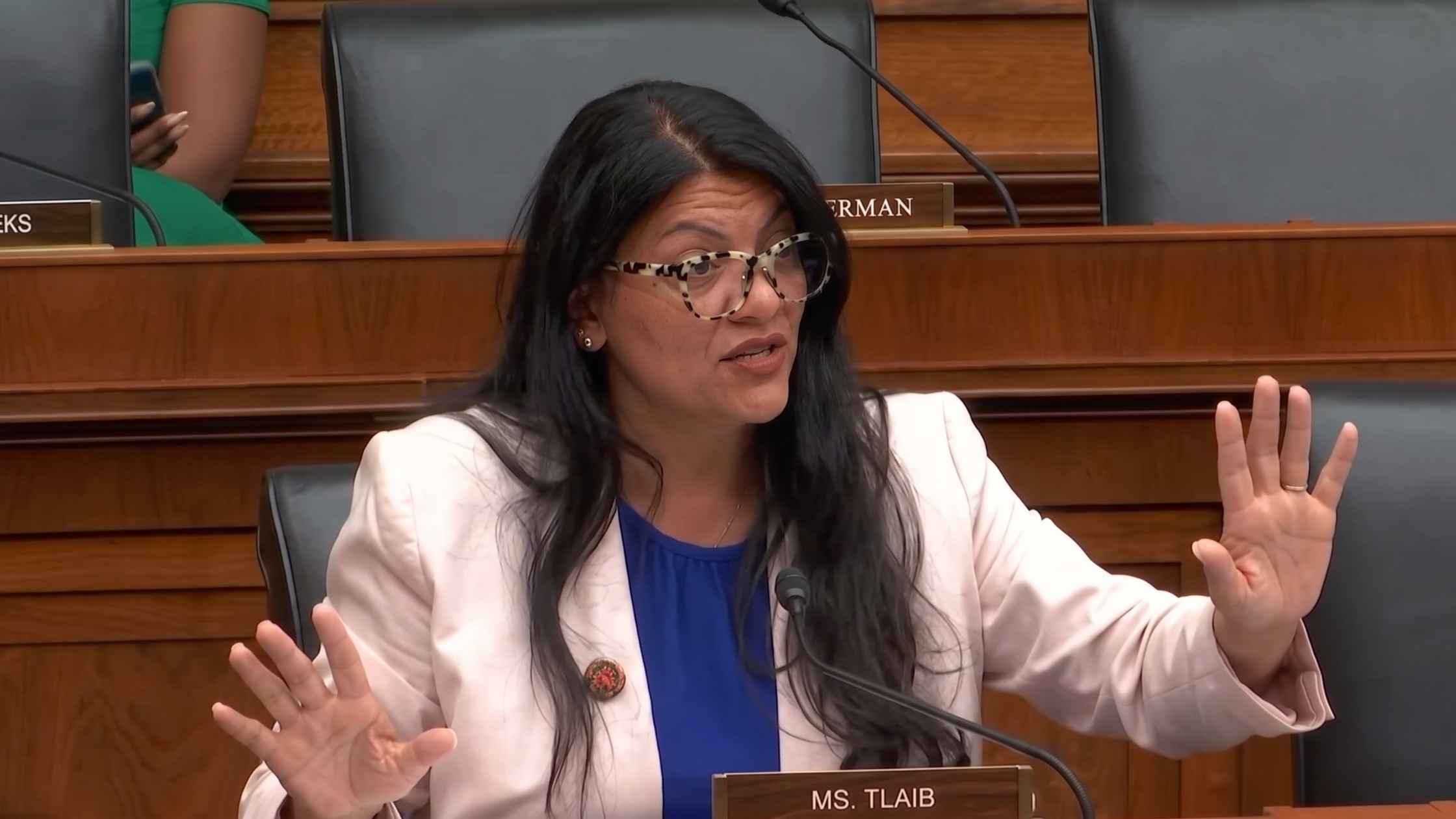
Federal Reserve and FDIC officials testify on financial regulation in a House hearing.

Rashida Tlaib speaks in House Hearing.
Hungry For More?

Luckily for you, we deliver. Subscribe to our blog today.

Thank You for Subscribing!

A confirmation email is on it’s way to your inbox.

Share this post
LinkedIn
Facebook
X logo
Pinterest
Reddit logo
Email

Copyright Disclaimer

Under Title 17 U.S.C. Section 107, allowance is made for "fair use" for purposes such as criticism, comment, news reporting, teaching, scholarship, and research. Fair use is permitted by copyright statute that might otherwise be infringing.

Mr. Hill (00:00):

... the committee at any time. Today's hearing is entitled Oversight of Our Prudential Regulators. Without objection, all members will have five legislative days within which to submit extraneous material to the chair for inclusion in the record.

(00:14)
I now recognize myself for four minutes for an opening statement. The Trump administration is returning prudential regulators to their core regulatory and supervisory mission of promoting safety and soundness in the financial system. Today's hearing will provide an opportunity to discuss how their recent actions, priorities, and policies align with their statutory mission entrusted to each of them by Congress.

(00:40)
We will also highlight the work of this committee to right size prudential regulations for institutions of all sizes, focus on the supervisory framework on material financial risks, and facilitate the formation of new depository institutions.

(00:57)
Prudential regulations should foster economic opportunity, support responsible lending, and encourage long-term growth while maintaining confidence across our banking system. A sound prudential framework must be transparent, appropriately tailored, and rules that are clear, efficient, and proportionate to the size, complexity, and risk profile of the institution.

(01:21)
In my view, a one-size-fits-all approach, by contrast, disproportionately harms community banks, credit unions, and our regional institutions. That's why this committee has held numerous hearings throughout the 119th Congress on our mission to make community banking great again, which has culminated in our proposed Main Street Capital Access Act.

(01:43)
Many of the reforms contained in this legislation directly track the actions being taken before us today by our supervisory agencies. We also will highlight the progress being made to reverse some damaging Biden-era regulations and guidance that increased compliance cost, constrained lending, and threatened access to credit for American families and small businesses without providing clear benefits to overall safety and soundness.

(02:12)
Among them was the original proposed Basel III Endgame, which would have significantly raised costs for home buyers, consumers, and financial institutions without meaningfully improving financial stability. The revised Basel III proposal and the corresponding changes to the standardized approach and the GSIB surcharge will better align capital with risk, address concerns about goal plating, and increase lending capacity while maintaining a very safe and sound banking system.

(02:43)
I'm also proud of the work that this committee has done to advance legislation to provide a functional regulatory framework for our emerging innovative digital asset ecosystem. The Trump administration has taken important steps to turn the page on the Biden approach to digital assets.

(03:03)
These steps, including withdrawing burdensome supervisory non-objection regimes, providing greater clarity for banks using blockchain technology, and implementing the GENIUS Act to establish a clear framework for payment stablecoins. The administration is demonstrating a commitment to supporting innovation while preserving consumer protection and orderly markets.

(03:27)
Clear predictable rules allow financial institutions to manage compliance, reduce unnecessary costs, and expand access to credit and invest in innovation as our financial system consistently evolves day after day, week after week. Policymakers must foster an environment that supports innovation while ensuring confidence in the strength and stability of our financial system.

(03:51)
I look forward to our panel today, our discussion among members on both sides of the aisle, and I yield back the balance of my time. I now recognize the ranking member of our full committee, Mrs. Waters, for four minutes for an opening statement.

Mrs. Waters (04:04):

Good morning. Trump's reckless and unlawful war in Iran has cost every American $450 more at the gas tank. In parts of my district, gas is nearly $7 a gallon. Yet, when asked about this, Trump's reply is, quote, "Couldn't care less." Well, Mr. Chairman, Democrats do care, and we urge this committee and the president to focus on affordability.

(04:33)
It's not just gas. Families are also being crushed by rising rents, higher utility bills, and skyrocketing grocery prices fueled by Trump's failed economic policy. But Trump doesn't care, and it shows.

(04:51)
When he's not ruining the economy, he's busy tearing down the White House to build a billion-dollar ballroom, promoting fight night on the South Lawn, and trying to slap his name and picture on everything as if he were an idol to be worshiped. At the same time, his administration is busy dismantling the agencies and safeguards that protect consumers, workers, and small businesses.

(05:19)
In fact, since returning to office, Trump has launched the most aggressive, the most irregulatory campaign we've ever seen. His administration has gutted the Consumer Financial Protection Bureau, undermined the independence of our central bank and handed Wall Street, big banks, fintech firms, AI companies, and crypto bros pardons and the freedom to take risk with Americans' money.

(05:49)
The consequences are already hitting working families. A recent report found that Trump's attacks on the CFPB alone have cost Americans nearly $19 billion in just one year. And while he has largely shut down the CFPB, Americans have filed more consumer complaints about predatory lending and other financial abuses in the past 14 months than the previous 14 years combined, and it does not stop there.

(06:22)
The prudential regulators here today have weakened mega-bank capital, stress testing, and other requirements designed to prevent another financial crisis. They are rubber stamping bank mergers, rolling back the civil rights laws, like the Community Reinvestment Act, and loosening guardrails for crypto and fintech businesses who act like banks but don't want to be regulated as such.

(06:49)
They have downplayed climate-related financial risk just in time for hurricane and wildfire season and gone easy on bank executives, and their pay skyrockets. Sadly, Republicans have stood by, stood by and enabled all of it. Instead of standing up for families, Republicans idolize Trump, doing little to push back when he weakens consumer protections and strips away the safeguards that prevent another financial crisis.

(07:21)
Instead of addressing the affordability crisis, they side with Wall Street, mega banks, and crypto bros. Committee Democrats are focused on lowering costs for working families and ensuring Americans can assess affordable mortgages, small business loans, and financial products.

(07:44)
We're fighting to support our community banks and credit unions and making sure consumers, not mega banks or other powerful corporations, come first. This is a difference between protecting the wealthy and the well connected and fighting for the American people and an economy that works for everyone.

(08:04)
Mr. Chairman and members, you all know what I just said is the truth, and I want to tell you-

Mr. Hill (08:10):

Gentlewoman's time has expired.

Mrs. Waters (08:10):

... we are fighting against all of this deregulation.

Mr. Hill (08:12):

Gentlewoman's time is expired.

Mrs. Waters (08:13):

Well, that's okay. For now, it has expired, but I want to tell you I'm honored-

Mr. Hill (08:14):

I recognize the chair of the Subcommittee on Financial Institutions, Mr. Barr, for one minute.

Mr. Barr (08:20):

Thank you, Mr. Chairman. Thank you to our witnesses also for joining us today. It's encouraging to see prudential regulators in this committee aligned in our work to return regulation and supervision back to their core mission of safety and soundness, to realize this gold banks and credit unions must be evaluated on objective, clear standards.

(08:39)
That's why I introduced the Firm Act, which prohibits consideration of reputational risk in the supervisory process, ensuring regulators focus on material financial risks rather than subjective or process-oriented concerns. The same commitment to transparency and objective decision making should extend to the merger approval process as well.

(08:57)
The Bank Failure Prevention Act increases clarity in the merger process by setting clear expectations and timelines for merger reviews to prevent prolonged reviews that unnecessarily consume time and resources. Ensuring a risk-focused regulatory system also requires tailoring requirements appropriately to the financial institution's size and risk profile.

(09:17)
I'm glad to see that the regulators listen to bipartisan calls from this committee and apply these principles in their agencies, including in recently Basel III re-proposal.

Mr. Hill (09:25):

Gentleman's time has expired.

Mr. Barr (09:27):

Thank you. I yield back.

Mr. Hill (09:29):

I now recognize the ranking member for the Subcommittee Financial Institutions, Dr. Foster of Illinois. You're recognized one minute for an opening statement.

Dr. Foster (09:35):

Thank you, Chairman Hill. America's banks and credit unions are operating during a time of unprecedented change in the financial system. Consumers and markets are moving faster than ever with improved access to information, 24-hour banking, and the reduced friction of modern payment systems and soon personal agentic AI financial agents.

(09:53)
Now, fintech partnerships promote innovation and competition, but come with unique risks. Banks and credit unions are also facing a wave of fraud driven by artificial intelligence and deep fakes while bad actors continue to exploit older banking tools, such as paper checks, for illicit purposes.

(10:09)
Our prudential regulatory agencies must be agile and well resourced to respond to these risks. Preparing for liquidity risks of internet-driven bank runs and cyber threats from emerging AI tools should be a top priority, and our regulatory bodies need to maintain the necessary technology and human resources to do so effectively.

(10:27)
This administration's move to cut supervision and staff across the Federal Reserve, FDIC, and OCC is a step in the wrong direction. Thank you again, Chairman Hill, and I yield back.

Mr. Hill (10:38):

Gentleman yields back. We're delighted today to welcome the testimony of our bank supervisory leaders, the Honorable Michelle Bowman, Vice Chairman of Supervision at the Board of Governors for the Federal Reserve System, the Honorable Jonathan Gould, our comptroller of the currency, the Honorable Kyle Hauptman, the chair of the National Credit Union Administration, and the Honorable Travis Hill, chairman of the Federal Deposit Insurance Corporation.

(11:02)
We thank all of you for participating with us today. Thanks for taking your time to be here. Each of you will be recognized for five minutes to give an oral presentation of your testimony without objection. Your written statements will be made part of the record.

(11:13)
Vice Chairman Bowman, you're now recognized for five minutes.

Michelle Bowman (11:17):

Thank you, Chairman Hill, Ranking Member Waters, and members of the committee. I want to thank you for the opportunity to provide an update on the Federal Reserve's supervisory and regulatory activities. Today, my testimony will cover --

Mr. Hill (11:32):

Vice chairman, could you move a little closer to the mic? Thank you so much.

Michelle Bowman (11:33):

Thank you. Today, my testimony will cover three areas, current banking conditions, regulatory and supervisory reforms implemented since the committee's last hearing, and our path forward as we continue to promote safety and soundness and the stability of the U.S. financial system.

(11:51)
The banking system remains sound and resilient. Banks continue to report strong capital ratios and significant liquidity buffers, which position them well to support the U.S. economy. Bank lending to households and businesses also continues to grow. The landscape for financial services has become more complex.

(12:12)
NBFI lending has increased raising competition for regulated banks without facing similar prudential standards. The financial system continues to adapt to advances in technology, including AI and cyber-related risks. The Fed is committed to working with banks as they navigate this complex threat environment.

(12:34)
Since I last appeared before the committee, we have made substantial progress to modernize the regulatory and supervisory framework. And of course, community banks remain a priority. These banks provide critical financial services to their communities, supporting families, businesses, and the local economy.

(12:53)
Earlier this year, bank regulators finalized a community bank leverage ratio framework. A broader range of qualifying banks can now use a simple leverage ratio to measure capital adequacy, instead of the complex risk-based capital framework, with the CBLR at 8% and an extended grace period from two to four quarters.

(13:15)
In March, the banking agencies published proposals to modernize the U.S. regulatory capital framework. The proposals clarify requirements, align them with actual risks, reduce overlaps, and support credit while also preserving strong capital levels.

(13:33)
Turning to supervision, we are using a risk-based, tailored approach that is calibrated to each bank's size, complexity, business model, and risk profile. Our supervision focuses on a bank's material financial risks and its overall strength. Earlier this year, we launched a comprehensive review of all outstanding matters requiring attention.

(13:57)
The findings showed that many MRAs cited deficiencies unrelated to bank safety and soundness, instead focusing on procedural or documentation shortcomings or departures from best practices that were designed for banks with very different business models and risk profiles. Often, these best practices originated from the largest and most complex banks that were applied industry-wide.

(14:25)
Under my leadership at the FFIEC, the agencies and state bank regulators proposed long overdue revisions to the CAMELS ratings framework, which was largely unchanged since 1979. The revisions include a more transparent, objective approach that better captures material risks to a bank's financial condition and its overall strength.

(14:49)
Innovation is essential to meeting customer expectations and maintaining a dynamic banking industry. The Fed is relying on a forward-looking approach that encourages innovation while maintaining appropriate safeguards. Additional work remains on multiple fronts. We are recalibrating thresholds across our regulatory framework to account for economic growth and inflation.

(15:14)
We are developing stablecoin issuer regulations as Congress directed in the GENIUS Act. We are also strengthening liquidity requirements to support banking system stability and to promote sound liquidity management.

(15:29)
Our work follows a single fundamental principle, appropriately calibrated regulations, strengthen banking conditions, financial stability, and economic growth while maintaining the robust safeguards the American people expect and deserve.

(15:49)
Thank you for the opportunity to appear before you this morning, and I look forward to answering your questions.

Mr. Hill (15:59):

Thank the gentlewoman. Mr. Gould, you're recognized for five minutes.

Jonathan Gould (16:02):

Chairman Hill, Ranking Member Waters, and members of the committee. Thank you for the opportunity to appear before you. It is an honor to discuss the Office of the Comptroller of the Currency's work, implementing the president's economic agenda by ensuring that America's federal banking system is safe and sound and remains the world's most trusted, dynamic, and resilient.

(16:22)
After the 2008 financial crisis, Washington too often sought to eliminate rather than manage risks, resulting in a less relevant and diverse banking system. This approach drove financial activities into less regulated and visible parts of our economy, making risks harder to monitor and mitigate.

(16:41)
The Dodd-Frank Act, far from ending too big to fail, created a moat around the largest banks and introduced too small to succeed. Unelected bureaucrats discouraged prudent risk-taking and reduced credit availability in many communities. In particular, community banks suffered from these misguided policies. The number of banks with less than one billion in total assets declined by 50%.

(17:04)
The OCC has introduced reforms to address this decline. We've removed fixed examination requirements, tailored examinations to actual risk, and imposed workday limits on examinations. We also created a supervision group focused on community banks. These actions, among others, represent a down payment on future reforms to promote a more relevant and diverse banking system.

(17:26)
Community banks are not the only casualty of the post Dodd-Frank banking system. In the years that followed, new bank formation in this country nearly ceased. From 1990 to 2008, the OCC received and approved over 1,000 de novo charter applications. After 2008, application volume and approvals fell by 90%, but the OCC is open for business again.

(17:50)
The agency received as many applications in 2025 alone as it did in the previous four years. For the first time in five years, a full-service national bank opened its doors, and we have conditionally approved 10 more banks this year. This is the result of us once again following the law and our publicly-stated procedures.

(18:10)
The OCC is also returning to risk-based supervision rooted in law and emphasizing examiner judgment, not arbitrary checklists. We are hard-wiring the foundations of supervision, such as the definition of unsafe and unsound practices, into regulation and are reviewing past supervisory criticisms and enforcement actions to ensure alignment with our standard for material financial risks.

(18:32)
But we, like the banking system itself, must always look towards the future. Our job is to facilitate not stymie responsible innovation. We are working to respond to comments on our GENIUS Act proposal and finalize it.

(18:45)
Just as the National Bank Act brought an end to the wildcat banking of the 1800s, the GENIUS Act and our rule will help ensure appropriate consumer protections for stablecoin users. In other words, our regulation will help ensure that all OCC institutions are able to satisfy their obligations, including both deposits and stablecoins.

(19:04)
The OCC is working to facilitate innovation outside the GENIUS Act as well. We, along with the other federal banking agencies, revised our model risk management guidance to avoid impeding bank's use of AI. We also plan to seek information from the public on what additional guidance would be helpful.

(19:21)
Our banking system will only remain relevant and trusted if it resists pressure to deny access based on political or religious beliefs or lawful business activity. We have made considerable progress in reviewing the activities of the largest national banks and are investigating complaints of alleged debanking consistent with the president's executive order.

(19:40)
We will continue to follow the evidence and report on our findings as appropriate. We have moved quickly to fix longstanding problems of agency management. The OCC too often relied on costly outside contractors for many core IT functions. Since I arrived, we have eliminated the need for 165 contractors, saving $75 million in the process.

(20:01)
Our bank examiners also lacked modern technology to do their jobs. This summer, we will begin replacing IT platforms from the early 2000s with modern tools. These efforts help fulfill our core mission while reducing assessment costs.

(20:15)
Since its creation during the Civil War, the OCC's nationwide banking markets created the economic union necessary to support the political union forged on the battlefields.

(20:27)
We at the OCC are proud of our role, particularly as we celebrate our country's 250th anniversary, but we take nothing for granted, and we work hard to support the growth and dynamism that have defined our federal banking system since its inception. Thank you.

Mr. Hill (20:42):

Thank you, Mr. Gould. Mr. Hauptman, you're recognized for five minutes, sir.

Kyle Hauptman (20:46):

Thank you, Chairman Hill, Ranking Member Waters, members of the committee. Thank you for the opportunity. As the current chair, I remain dedicated to serving in this role and no other until my successor is confirmed.

(20:57)
President Trump has nominated Mr. John Crews to the NCUA board. He's a seasoned, committed leader, track record of balancing innovation. In other words, he's well suited for the role. I'm confident Mr. Crews will strengthen the agency even further, and I wish him best as he goes through the Senate confirmation process.

(21:12)
Over the past year, NCUA has experienced significant changes. My primary goals as chairman have been to lead NCUA to be ready to embrace the future, supporting a robust and innovative credit union industry, and protect our share insurance fund through effective, appropriate supervision that is focused on material risks. I'm also proud we delivered cost savings averaging about $9,000 per federal credit union through our cost reductions. I pursued all of our goals by championing regulatory improvements, embracing innovations like stablecoins, and improving our customer service.

(21:46)
As digital currency and stablecoins reshape the global financial system, credit unions have an opportunity to embrace this transformation from a solid foundation of safety and soundness. Stablecoins can make payments faster, cheaper, and more inclusive.

(21:59)
On May 15th, we announced a proposed rulemaking for permitted payment stablecoin issuers, our second rulemaking required under the GENIUS Act. This rule puts credit unions on equal footing with banks. Credit unions are well poised to benefit from this long overdue update to America's payment system.

(22:16)
As stablecoins become more widely adopted, we Americans may no longer be made fun of for speaking of how many business days a payment will take to settle. Every day is a business day with stablecoins. All 365 days of the year and all 24 hours of the day are equal in terms of sending payments with stablecoins.

(22:36)
Our tax refunds may eventually arrive on Sundays or holidays. And if we ever have a repeat of COVID in March 2020, Americans should be able to receive stimulus funds in a much more timely and secure manner. Beyond the consumer benefits, the big-picture benefit of stablecoins is maintaining the U.S. dollar's status.

(22:55)
The GENIUS Act should stimulate demand for treasuries thereby lowering borrowing costs for both the U.S. government and consumers. Even repo rates on treasuries may fall, all else being equal, given that the GENIUS Act allows for investing in treasury verse repos, and treasuries are more attractive when they can be used to obtain cheap financing.

(23:12)
And for all the debate about the effect on deposits held at our domestic banks and credit unions, a large portion of the money is expected to flow into stablecoins from abroad. Over 80% of existing dollar stablecoin usage is outside the United States. When Americans use the phrase, dollar stablecoins, we tend to focus on the stablecoin part because stablecoins are a much better settlement token in dollars.

(23:35)
They're a bit like using poker chips in that the transactions are easier, but they only work if they are indeed stable and interchangeable with U.S. dollars. But for people abroad, it's the dollar part of the phrase, dollar stablecoin. That's what's important to them.

(23:49)
We as Americans may have gotten so used to the dollar's global dominance that we don't notice what an advantage we have, but just ask the British what it's like to lose reserve currency status. But the GENIUS Act and dollar-denominated stablecoins are ways of striking back against those in Beijing, Tehran, or Moscow who continually push for the U.S. dollar to be less important, less ubiquitous, and less useful. So I'm pleased to work with my colleagues here at the table to do our part in that effort.

(24:15)
Turning to financial literacy efforts, that's a big part of the administration's observance of America's 250th anniversary. Last month, I joined my colleagues at this table for a financial literacy event hosted by the OCC.

(24:26)
It was a wonderful opportunity to hear from banks and credit unions of all sizes, how they empower people and their communities by educating people of all ages, from the elderly all the way to kids in kindergarten. I want to note that my five-year-old has read both of these books, including The Berenstain Bears Visit the Credit Union.

(24:48)
I spoke about how financial security is essentially an amazing product and one that can be purchased on the open market via saving and investing. Today, approximately 4,300 credit unions serve over 145 million members and management and two trillion in assets. The industry is healthy and continues to balance innovation, access, and safety and soundness.

(25:06)
As of the end of last year, the aggregate net worth ratio, that's how credit unions refer to capital levels, was strong at 11.3%, slightly higher than the year before. Asset growth was a solid 5%, up from 2% growth. From a safety and soundness perspective, the system is in a good place.

(25:24)
And finally, given my successor has been announced and this is probably my last appearance before this committee, I want to make one final point. Regulation falls hardest on the smallest institutions, but we are a better, more prosperous country because of the unique American system that contains over 8,000 banks and credit unions. Many of them serve niche communities.

(25:43)
We don't want to be one of those countries with four or five big banks like Canada. We're best served with the system we have with every corner of this country, every industry being served by a bank or a credit union. Thank you, Mr. Chairman.

Mr. Hill (25:56):

Thank you, sir, and thank you for your service since 2020 at the NCUA. We appreciate that. Chairman Hill.

Travis Hill (26:03):

Chairman Hill, Ranking Member Waters, and members of the committee, thank you for the opportunity to testify today about the FDIC's ongoing work to strengthen our regulatory and supervisory framework while we continue to fulfill our core mission of ensuring deposits, promoting bank safety and soundness, and resolving failed institutions.

(26:21)
Over the past year and a half, we have advanced a number of key policy priorities, including reforming supervision to focus on material financial risks, modernizing capital standards, improving our resolution readiness, and implementing the GENIUS Act, among others.

(26:36)
Beginning with supervision reform, we issued a proposed role last fall with the OCC to define key terms related to supervisory criticisms, which we are working to finalize in the coming weeks. In parallel, we have been conducting a comprehensive lookback of all outstanding supervisory criticisms as we work to implement the new approach in a consistent manner.

(26:56)
We've also been working with our FFIC counterparts to modernize the CAMELS rating system, and we issued a proposal last month that would place greater emphasis on factors most critical to safety and soundness of institutions and better align the overall rating with the bank's true risk profile.

(27:14)
With respect to capital standards, we recently issued two proposals to modernize risk-based capital requirements. These proposals improve risk sensitivity, simplify core components of the framework, and provide more appropriate capital treatment across mortgage, retail, and business lending. In addition, we finalized revisions to the community bank leverage ratio framework to encourage broader adoption for community banks.

(27:38)
We also continue to strengthen our readiness to resolve failed banks. Among other things, we are working on changes to our resolution planning rule for insured depository institutions and have taken steps to enhance the competitiveness of our bidding process.

(27:52)
Relatedly, we are working to remove barriers for non-banks to provide capital in failed bank auctions, including rescinding a 2009 policy statement that imposed overly restrictive conditions on private capital investors and exploring potential changes to the shelf charter process to allow a non-bank entity to act quickly in the event of a sudden unexpected failure.

(28:14)
In the digital asset space, implementation of the GENIUS Act remains a top priority. We have issued proposed rules to establish an application framework, prudential requirements, and BSA and sanctions compliance for FDIC-supervised stablecoin issuers.

(28:29)
We are also advancing other important policy initiatives. These include modernizing BSA AML program requirements, updating our information disclosure rules, and revising model risk and third-party risk-management guidance to remove unnecessary barriers and encourage appropriate use of new technologies.

(28:46)
We are also reevaluating our bank merger review process to improve clarity, timeliness, and transparency and are working to make the de novo application process more efficient. Earlier this year, we finalized a rule removing reputation risk as a basis of supervisory criticism.

(29:04)
The rule makes clear that the FDIC will not require, instruct, or encourage an institution to close customer accounts or take other actions on the basis of a person's or entity's political, social, cultural, or religious views or beliefs, constitutionally protected speech, or solely on the basis of politically disfavored but lawful business activities perceived to present reputation risk.

(29:27)
Finally, the FDIC continues to make progress in improving workplace culture. We have taken significant steps to improve accountability, enhance reporting and response processes, and reinforce expectations for professional conduct across the organization.

(29:42)
I remain committed to ensuring that the FDIC maintains a culture grounded in professionalism, accountability, and respect to ensure that our workforce continues to fulfill our important mission. Thank you for the opportunity to testify today. I look forward to answering your questions.

Mr. Hill (29:58):

Gentleman yields back. Thank you all for your opening statements. We'll now turn to member questions. I recognize myself for five minutes for some questions.

(30:06)
I referenced in my opening statement that among our core work on improving bank supervision and echoing some of the good work you're doing in each of your agencies, that we've been advancing a series of bills under our Main Street Capital Access Act, which we hope to bring to the House floor in coming weeks.

(30:26)
And you've touched on it in your hearings that our banking sector has faced numerous challenges ranging from a drought in new bank formation, and thank you, Mr. Gould, for setting the record straight on what the OCC's been doing there, a post-crisis prudential framework that's pushed activity away from banks, and squeezed many of our community and mid-sized institutions from the rules that I think, again, are not effectively tailored and discriminate against home lending, for example, to the politicization that we all witnessed of bank supervision and regulation in recent years.

(31:02)
So now 15 years following the great financial crisis and the resulting Dodd-Frank Act, it warrants that we take careful assessment of what's happened in that past 15 years and how we need to propose changes, and I think that is at the heart of the work we've done on Main Street Capital Access.

(31:20)
So let me ask each of the witnesses, start with you, Vice Chairman Bowman, can you talk about how these principles in Main Street Capital Access mirror the work that's being done by the Federal Reserve and its supervisory process and how statutory changes can make that work durable and submit that effort to give the certainty to our financial institutions' depository institution management that they can count on that in the out years?

Michelle Bowman (31:51):

Well, thank you for that important question, Chairman Hill. As you know, as a former community banker, a former State Bank commissioner, I am very committed to the community bank model, and I appreciate your efforts to ensure that there's viability in this banking model going forward.

(32:08)
A number of the issues that are covered within your bill are things that we are working on at the Federal Reserve and working together in the interagency context. One of those, in particular, is ensuring that asset thresholds are appropriate moving forward and that are indexed for economic growth and inflation. So I'll stop here.

Mr. Hill (32:29):

Yeah. Thank you. Well, Chairman Barr and I have just worked so hard on this over many, many years, and we really appreciate the work at the agencies, but we're trying to put it into law. Our nation is best governed by laws agreed to by the Congress and not just on executive orders that very radically between different executive branches.

(32:52)
Recently, the White House issued an executive order promoting access to mortgage credit, which underscored how tackling housing affordability requires not just more housing supply, but also better access to the financing.

(33:05)
Let me stick with you, Vice Chairman. Do you agree that housing affordability depends not only on just whether homes can be built, but whether banks have the capacity funding and regulatory flexibility to undertake that one to four family construction?

(33:20)
And you've heard me say, and we've said in this committee many times, six out of 10 home construction loans on bank balance sheets are by banks under 10 billion, and many of our largest institutions are just out of that business.

(33:35)
So clearly, there's a regulatory mix in there that I think is at the heart in some of the post-crisis decisions. Can you reflect on that?

Michelle Bowman (33:43):

Yes. Thank you for that question. A few weeks ago, I made it, or actually several months ago now before we introduced the Basel capital proposal, I spoke in great detail about how a lot of the mortgage origination and servicing business has left the banking system. So as a part of that proposal, we have more appropriately calibrated risk weightings for mortgage and mortgage origination and mortgage-servicing activities so that banks will be not dis-incentivized to return to the mortgage market to serve their customers.

(34:20)
In support of that, the president's executive order also limits some of the complexity related to the origination of mortgages and the paperwork required. I think, in totality, those together will be very helpful for the banking system to return to that very critical traditional bread-and-butter activity of mortgage origination.

Mr. Hill (34:43):

Thank you. Well, I think it's very important. And it was in the Joe Biden last Council of Economic Advisors report, a whole chapter acknowledging that, saying those were important changes to make, and Ranking Member Waters and I have collaborated on our ROAD to 21st Century Housing Bill, which got 396 votes here on the House floor, but we believe that with that and with the tailoring-

Mr. Hill (35:00):

... votes here on the house floor, but we believe that with that and with the tailoring of community banking proposals in it, more needs to be done, and so I thank you for your comments. Let me recognize that ranking member from California of the full committee, Ms. Waters, for her five minutes of questions.

Mrs. Waters (35:16):

Thank you very much, Mr. Chairman. I am so focused on affordability, and what our constituents are saying about their ability to have a decent quality of life. Let me ask each of the members here, could you tell me what city you're from and how much the gasoline prices are in your city? Starting with Ms. Bowman, what city?

Michelle Bowman (35:44):

Congresswoman Waters, I live now in Arlington, Virginia, and gasoline is-

Mrs. Waters (35:48):

I'm sorry, I can't hear you. Did you say you will not answer that?

Michelle Bowman (35:52):

No, I'm sorry, I live in Arlington, Virginia. So, absolutely I'll answer that. Inflation affects both households and businesses-

Mrs. Waters (35:58):

What city are you from?

Michelle Bowman (36:00):

I'm originally from Council Grove, Kansas, which is a very small community.

Mrs. Waters (36:05):

How much is gasoline in whatever city you want to claim?

Michelle Bowman (36:08):

Well, in Arlington it's about $4.50 a gallon, which is comparable to during COVID.

Mrs. Waters (36:13):

Let me move on, Mr. Gould. What city are you from?

Jonathan Gould (36:16):

Well, I'm originally from Lynchburg, Virginia, but I can't-

Mrs. Waters (36:18):

And how much is gasoline there?

Jonathan Gould (36:20):

I haven't been there a while, I can't speak to the prices of gasoline there.

Mrs. Waters (36:23):

I'm sorry, I can't hear you.

Jonathan Gould (36:24):

I haven't been to Lynchburg, Virginia for a while where I grew up, so I can't speak to the prices of gasoline there.

Mrs. Waters (36:30):

Okay. Who's next on the list over there? What city are you from?

Speaker 1 (36:35):

I'm originally from Bar Harbor, Maine. I think it's about $4.

Mrs. Waters (36:37):

What's the price of gasoline?

Speaker 1 (36:38):

$4.25, $4.30 around there.

Mrs. Waters (36:44):

Mr. Hill?

Travis Hill (36:45):

Originally from New York, I don't know the exact price of gas, but I believe nationally it's around somewhere between four and $5 a gallon.

Mrs. Waters (36:52):

Do you know what it is in California? Between $6.30 and $7 a gasoline. Gasoline. $7 a gallon for gasoline. And I think it's important for us-

Mr. Hill (37:10):

Order, please.

Mrs. Waters (37:12):

I think it's important for us to know exactly what's going on in America with affordability. And so, that's why I'm asking you if you know and understand what your constituents are paying, even if you're here in Washington, where are you really from and where you're going back to and how much they're paying. And it appears that there is not a consensus here that you all know what the cost of gasoline is. Again, it can cost $6 or even $7 a gallon in California, and that's real money hitting family budgets, especially for those who need to drive to work. It has gotten so bad that one in ten American skipped a meal yesterday. Why? Because everything is too expensive, from putting gasoline in the car, to buying a home, to putting food on the table... Wages are not keeping up with affordability. Crisis fueled by Trump's reckless policies.

(38:12)
Last year, Americans were taking out loans and buying now, pay later products to buy groceries. Do you know what that is? Do you know what buy now, pay later is? Do you understand how that works? Raise your hand if you understand it and you know how it works.

Jonathan Gould (38:31):

Yes, I know what buy now, pay later loans are.

Mrs. Waters (38:34):

Mr. Gould, what did you say?

Jonathan Gould (38:36):

I said yes, I know what a buy now, pay later loan is.

Mrs. Waters (38:39):

Would you tell your constituents right now what it means?

Jonathan Gould (38:42):

Well, my constituents are the American public, I'm [inaudible 00:38:46] official.

Mrs. Waters (38:45):

That's right, it's the American public. What does that mean? Buy now, groceries, pay later, what does that mean?

Jonathan Gould (38:52):

Pardon me?

Mrs. Waters (38:57):

Okay. All right, we'll move on. And do you know who is doing well? Corporate executives, their compensation grew 20 times faster than working Americans last year. Did you know that, Ms. Bowman?

Michelle Bowman (39:11):

Yes.

Mrs. Waters (39:11):

Did you know that, Mr. Gould?

Jonathan Gould (39:13):

Not aware of the facts of what you're talking about, be happy to look into them.

Mrs. Waters (39:17):

Okay. Their compensation grew 20 times faster than working Americans last year. Who knows that and who understands that? Mr. Hill, did you know that?

Travis Hill (39:28):

Like the comptroller, we'd have to look into that, but happy to follow up.

Mrs. Waters (39:32):

Now we're not that far removed from a close call, we had to, a big financial crisis when Silicon Valley Bank and two other regional banks failed three years ago. Community banks and credit unions are having a tougher time to compete with the mega banks, but looking at your actions, you seem to be doing all you can to make life easier for the biggest banks and their executives. This includes the Trump administration's efforts to shut down the Consumer Financial Protection Bureau. As a result, there are no exams being done of mega banks to see if they're complying with consumer protection laws. Does anyone think the mega banks, which have paid hundreds of billions of dollars in fines for violating the law are now perfect angels? Are they doing okay?

Jonathan Gould (40:18):

Congresswoman, the CEO of the biggest bank in this country-

Mr. Hill (40:20):

Gentlemen, Gentlewoman, time has expired. Chair now recognizes our vice chairman of the full committee-

Michael Lawler (40:24):

Mr. Chairman. Mr. Chairman. Mr. Chairman.

(40:25)
Mr. Chairman, I have a point [inaudible 00:40:26]-

Mr. Hill (40:25):

Gentlemen from New York.

Michael Lawler (40:26):

I just wanted to submit for the record that California currently has the highest gas prices in the United States, averaging anywhere from 5.80 to $6.00 per gallon-

Mr. Hill (40:35):

Mr. Lawler that's not a point of order.

Michael Lawler (40:36):

... because prices are driven up by high excised taxes-

Mr. Hill (40:40):

Thank you, Mr. Lawler.

Michael Lawler (40:40):

... strict low emission fuel requirements, and limited in state-

Mr. Hill (40:40):

Thank you Mr. Lawler. The chair recognizes the vice chair of the full committee... Mr. Lawler, please.

Speaker 3 (40:44):

[inaudible 00:40:45].

Speaker 2 (40:45):

Mr. Chairman, I'd like to say that the prices of gasoline have skyrocketed-

Mrs. Waters (40:47):

Contributed by the war. Contributed by the war.

Speaker 2 (40:49):

... since President Trump has been in office.

Unknown (40:51):

Mr. Chairman.

Mr. Hill (40:51):

Gentlemen-

Speaker 2 (40:52):

If that's a point of order, I'd like to make the same point of order-

Mr. Hill (40:54):

Gentlemen, the committee will come to order.

Michael Lawler (40:55):

We just want to make sure that people understand-

Speaker 2 (40:56):

[inaudible 00:40:58].

Speaker 4 (40:57):

Point of order.

Mr. Hill (41:00):

The committee will come to order.

Mrs. Waters (41:00):

Contributed by the war.

Mr. Hill (41:01):

Mr. Lawler. Mr. Vargas.

Speaker 4 (41:01):

Mr. Chairman. Point of order.

Mrs. Waters (41:01):

Contributed by the war.

Speaker 4 (41:04):

Mr. Lawler is out of order, and I asked for a point of order-

Mr. Hill (41:07):

I've already ruled Mr. Lawler out of order, everyone is out of order.

Mrs. Waters (41:10):

Oh, we are in order when we're talking about the American families-

Mr. Hill (41:14):

The gentlewoman's time has expired. The gentleman-

Mrs. Waters (41:16):

I want more time, I need more time.

Mr. Hill (41:19):

I'll give you more time later.

Mrs. Waters (41:20):

All right, thank you.

Mr. Hill (41:21):

You have a friend that'll yield it to you, I know, I promise, I know. The vice chairman of the full committee who is patiently waiting, Mr. Haizanga of Michigan, you're recognized for five minutes. Thank you.

Bill Huizenga (41:33):

Well, thank you, Mr. Chairman, and not to add to the cacophony, but I bought gas at $3.93 a gallon at my local Sam's Club in Holland, Michigan on Saturday, and $3.99 was the predominant price, I too have my own understandings of why gas might be 50% more than that in California. But nonetheless, I'm going to start with you, Vice Chair Bowman. And I was going to ask before we launched into SVB, I was going to ask you, how's it going? But I think we see the state of how it's going all the way around. So, let's just get right to SVB. It's been more than three years since the failure of Silicon Valley Bank, which was regulated at the federal level by the Federal Reserve System. The Biden administration had a limited review regarding the failure, and it conducted by Fed staff, and hastily published only a week later, or weeks later. It was used to justify a slew of misguided regulatory proposals that not only punished all the rest of the banks that actually acted as sources of strength during the fallout, but also proposed to impose burdens on banks in ways that had nothing to do with SVB's failure. So, Vice Chairman Bowman, now that we have had the benefit of more time to reflect on the SVB failure, I understand and appreciate that you've been commissioned to do an independent review. So, are you addressing the aforementioned shortcomings in the independent review that we saw coming out of that staff-led Fed review? And are you seeking the cooperation of those who were in positions of responsibility at that time as you were exploring the reasons why that happened?

Michelle Bowman (43:19):

Congressman, thank you for that question. I think it's very important that as we had the most costly bank failure in history, of $42 billion at the cost to the DIF fund, that we understand exactly what the failures were in supervision and in bank management that led to the failures of that institution and several others soon thereafter. What's important is that we identify those actions that were taken by supervisors that kept us from understanding the condition of the bank in acting appropriately and in a timely way. So, it's my expectation that the group that's doing this independent review for us will engage with those who were responsible for overseeing supervision and the supervisory process during that time period.

Bill Huizenga (44:09):

And you felt it was necessary to do an additional independent review, not just rely on what had been hastily put together previously?

Michelle Bowman (44:17):

Yes, I committed to commissioning an external review during my confirmation process.

Bill Huizenga (44:22):

And who is leading that review?

Michelle Bowman (44:24):

It's a group called Starling.

Bill Huizenga (44:26):

Okay. And they have presumably experience in this.

Michelle Bowman (44:28):

They have experience with doing these types of activities, yes.

Bill Huizenga (44:33):

Excellent. Okay. Well, I appreciate your work on that because there are still lessons to be learned from that. And by the way, I echo the chairman's concern about the lack of involvement on local banks with mortgages. When I graduated with my oh so employable political science degree, I went into real estate full-time, and I sat at the closing table many a time with those local community banks who held those mortgages in their portfolio, and I believe it made their risk assessment and their decision making better, not worse. The other Chairman Hill, let me go to this, I've introduced legislation HR 3446, the FDIC Board Accountability Act to replace the CFPB director on the FDIC board, and instead require one FDIC board member to have actual experience with small banks of less than $10 billion.

(45:27)
I might actually nominate Miki Bowman to join that with her experience as a community banker and a state regulator. This bill was included in the Mainstream Act. How important is it for the FDIC board itself to include members with direct experience working with community banks, and could having that expertise at the board level lead to better informed policymaking?

Travis Hill (45:53):

Well, thank you, Congressman. As you know, the FDIC is the primary federal supervisor for the majority of community banks in America, and so I think having direct experience with community banks is vital and would be extremely valuable for the FDIC. We would certainly welcome Vice Chair Bowman if she wanted to join our board, though I think has more important things-

Bill Huizenga (46:15):

She's going to be the Marco Rubio of regulators, I think. Yeah, one more hat. Well, it just seems to me that while we have some colleagues calling this "reckless deregulation," it seems to me that most should actually call this common sense. When I look at a CFPB director who's politically appointed versus an actual practitioner, I side with the practitioner. So, with that, Mr. Chairman, unless apparently I could have the ranking member's extra time that she had been requested, I will yield back to the chair.

Mr. Hill (46:51):

Chair recognizes the ranking member of our subcommittee on capital markets. A gentlemen from California. Mr. Sherman, you're recognized for five minutes.

Brad Sherman (46:57):

First want to comment on the proposal to create a $250 bill. Now, most Democrats are concerned about the proposal as to whose picture will be on that bill, but the real question for me is who needs a $250 bill? Clearly, drug dealers in America face a major problem in dealing with large amounts of currency, and the issuance of such a bill would make their lives two and a half times better. There is no other reason for the creation of a $250 bill. Basel III, when you finally implement it, then your regulations is going to have some unintended consequences, and I look forward to each of the regulators providing for the record what mechanisms you have for future adjustments and recalibrations as you take your vehicle out on the road and test drive it.

(47:56)
Dodd-Frank kept America safe from 2008, it continues to keep America safe, and I see in this room the picture of Barney Frank, and appreciate all of the work that was done in this room to protect us from that meltdown. One hole in that bill was it left to the regulators how to deal with interest rate risk, and of course the regulators failed to deal with interest rate risk with regard to Silicon Valley Bank and others. This proposal moves us in the right direction in terms of mark to market for held for sale securities, but there needs to be a comprehensive review of interest rate risk looking not only at held to maturity securities, but even very long-term non-marketable securities. The proposals for [inaudible 00:48:58] III have had a number of improvements in the area of clean energy credits, some progress on private mortgage insurance, and a whole lot of progress in dealing with the capital markets and fee income so at least the regulators and your predecessors and you have listened to us.

(49:15)
Mr. Hampton, you talk about government payments in stablecoin, I can't think of a worse idea, it would sanctify an alternative to the US dollar, an alternative designed to facilitate a tax evasion economy. I would point out to all of our regulators here that the Genius Act requires that there be no interest paid on stablecoin, the smartest or at least the best paid lawyers in the country are being paid to try to evade that requirement, and I'm counting on you to write regulations that withstand that. Mr. Gould, thank you for talking about not debanking unpopular businesses. And I now have a question for Ms. Bowman.

(50:07)
We're supposed to account for economic growth in drafting these regulations, you use scoring methodology using a base year of 2019 rather than 2015, so you're not reflecting economic growth that occurred after the regulation process began. Is there any justification to explain why the proposal does not account for economic growth from 2015 to 2019, and does that put us at a disadvantage in competing with foreign banks?

Michelle Bowman (50:43):

Well, I appreciate that question. You're referring to the G-SIB surcharge calibration?

Brad Sherman (50:47):

Exactly.

Michelle Bowman (50:49):

I'll be honest with you, the reason that we started at 2019 was because in working with my board to understand how I could get support for moving this proposal forward, this was the compromise that we were able to strike.

Brad Sherman (51:03):

But what justifies not... Other than saying, well, we got together and we picked it, what justifies ignoring growth between 2015 and 2019?

Michelle Bowman (51:12):

Well, we also recognize that in 2019, many of my board members stated that the level of capital in the banking system was just about right. So, as I said, it was a compromise. We did discuss and review going back to 2015, it would have lowered the capital requirements to a level that some were uncomfortable with. So, we-

Brad Sherman (51:37):

Well, yes, the chairman commented that the capital levels were just about right in 2019, so then you go back to 2015. I'm surprised the only defense you have for this rule is, well, we got together and we discussed it, and some people wanted to do it, wanted to go in one direction or the other direction. I don't think there's any reason not to ignore the four years of economic growth. And I yield back.

Mr. Hill (52:03):

Gentleman's time has expired. Thank you for that, Mr. Sherman. Recognize the chair of our housing and insurance subcommittee, the gentleman from Nebraska, Mr. Flood, you're recognized for five minutes.

Mike Flood (52:13):

Thank you, Mr. Chairman. I'd like to focus my questions this morning on two subtopics. Number one, the rollout of the Basel III end game proposal and the implementation of the Genius Act for stablecoins. I sent a letter with Senator Ricketts back in February, requesting that you all address the cap on mortgage servicing assets as applied to the common equity tier one formula for banks across the country. This cap is a significant barrier particularly for smaller banks that have very little capacity to participate in mortgage servicing with the cap. I was very pleased to see that the current proposal removes the mortgage servicing deduction entirely, and I do believe that this change will make it easier for institutions both large and small to participate in mortgage servicing.

(52:56)
This question is for Vice Chair Bowman, Comptroller Gould, and Chairman Hill. Can you each address why you thought the cap should be removed on mortgage servicing assets in the proposal? And then can you also talk about any other changes that you'd like to highlight in the rulemaking that you feel will help get banks back in the mortgage business? We'll start with Ms. Bowman.

Michelle Bowman (53:16):

Thank you for the question. As I mentioned earlier, the mortgage servicing business and the mortgage origination business has been a very traditional banking activity, and is a primary source of relationship lending for community banks in particular. So, we wanted to find ways to incentivize and encourage banks to return to the mortgage business so that they could serve their customers. This was one way that we could do that.

Mike Flood (53:41):

Thank you very much. Mr. Gould.

Jonathan Gould (53:43):

Thank you. I would just note that we made a number of changes post-2008 that pushed some of these activities, including mortgages, outside of the banking system, I think to our detriment. If I could make a broader contextual point, if I may. Last week, Secretary Bessent gave a [inaudible 00:54:00] speech at the Reagan Economic Summit, some of you I think were there, entitled, While America Slept, and he linked specifically the connection between economic security and national security. A lot of what we are doing today, a lot of what I'm doing at the OCC is making sure that we are empowering banks and restoring them to their proper role of being able to promote economic growth in this country, which is essential to economic security. Which as Secretary Bessent has so eloquently linked it, is also essential to national security. So, that is a broader context in which I think you should view many of the actions that I, at least, at the OCC am taking.

Mike Flood (54:36):

Thank you, Chairman. Chairman Hill.

Travis Hill (54:38):

Yeah, I would just echo that I think removing some of the obstacles to banks engaging in the mortgage businesses is extremely important. One other piece of the Basel proposal that is also, I think, very important is the improved risk sensitivity for mortgages that are held on balance sheet by tying it to loan to value ratios, I think that will go a long way in encouraging banks to originate and retain more mortgages and reduce the amount of mortgages that are being funneled through the GSEs.

Mike Flood (55:13):

Thank you. Next, I'd like to talk about the implementation of the Genius Act. In April, the Department of Treasury issued an advanced notice of proposed rulemaking for determining whether an existing state level stablecoin regulatory regime is substantially similar to the federal regime pursuant to the Genius Act. This is the first step towards a process that will ultimately allow some stablecoin issuers to be regulated at the state level. I passed a bill to make Nebraska the second state in the nation to allow state charter banks to custody digital assets. Once these rules are finalized, an entity called the Stablecoin Certification Review Committee will review state laws to ensure they meet the criteria for Genius Act.

(55:53)
The committee will be the secretary of treasury, either the chair of the Federal Reserve, or the vice chair of supervision, and the chair of the Federal Deposit Corporation. Vice Chair Bowman, have you discussed this with Chairman Warsh, and do you know whether you'll be the representative from the Federal Reserve on the Stablecoin Certification Review Committee or if it will be Chairman Warsh?

Michelle Bowman (56:13):

Well, thank you for including the Federal Reserve in this initiative, we have not yet had the opportunity to discuss that, but it clearly is an important issue.

Mike Flood (56:23):

Thank you. It's important to me that we continue to keep this state and federal pathway in stablecoins. Served in the state legislature for 10 years, states are little laboratories for democracy, and there's a lot of innovation that's happening there. I guess with the remaining time I have, I would advise this committee that, thanks to Nebraska corn, gasoline is 40% cheaper if you use ethanol. And so, if we want to bring down gas prices, buy more ethanol, year round E-15, and go Huskers. I yield back.

Mr. Hill (56:59):

Gentlemen yields back. My pleasure to recognize the gentleman from New York, our ranking member of our House, Foreign Affairs Committee, Mr. Meeks, you're recognized for five minutes.

Gregory W. Meeks (57:07):

Thank you, Mr. Chairman, and just to that, let me just say, I think it's, just to get the record straight, since I am the ranking member on the House Foreign Affairs Committee, that since the president's war of choice in Iran, across America, Americans are paying more than 50%, between 40 and 50% more per gallon since the Iran war, that's according to the AAA. Just want that record to be clear that Americans are paying more across the country, including in Mr. Lawler's district, where it's about $4.50, if I recall correctly, because I'm in New York also. But let me ask this question, let me make this quote, folks. "The business of banking is built on trust and confidence. Competent bank supervision is a prerequisite to restoring that trust and confidence." Does that statement sound familiar to anybody? No? Well, I'll tell you where the statement came from. That statement was made by Mr. Gould back in 2023 in front of this body in a subcommittee hearing. Do you recall that, Mr. Gould?

Jonathan Gould (58:21):

I don't recall the exact quote, but it sure sounds like my words. Thank you, Congressman.

Gregory W. Meeks (58:27):

And would you stand by that today?

Jonathan Gould (58:29):

Yes, and specifically, I would note that we lacked competent bank supervision in the lead up to Silicon Valley Bank.

Gregory W. Meeks (58:35):

Okay, good. So, you would probably also agree that competent bank supervision requires holding everyone to the same standard regardless of who they are. Is that also correct? Yes or no, because I got-

Jonathan Gould (58:51):

Is that to me, Congressman?

Gregory W. Meeks (58:52):

Yes, to you.

Jonathan Gould (58:53):

Well, Congressman, I would note that we do tailor our regulation and supervision based on the nature of the bank and the complexity of the business.

Gregory W. Meeks (59:00):

Okay. Got you. So, I hear you. So let me give you an example then of what I believe equal standards should look like, and you tell me. There's a FinTech company called Wise, who doesn't seem to have any direct links with top officials in the administration, so they don't have any pull or anything of that nature. When its sponsor bank had AML problems, it was your agency who issued a consent order, and when Wise itself had AML problems, state regulators and the CFPB acted. So, I think that the OCC seems to have the tools necessary to conduct adequate oversight. I think that they do have that. Now, Mr. Gold, can an applicant obtain an OCC charter without demonstrating adequate BSA or AML compliance? Yes or no?

Jonathan Gould (01:00:09):

Well, Congressman, the OCC's guidelines are established by statute and are detailed in exquisite-

Gregory W. Meeks (01:00:15):

I just need to know, do they have to have BSA and/or AML compliance? Yes or no?

Jonathan Gould (01:00:22):

Well, Congressman, it's not as simple as a yes or no, and I think I'd be-

Gregory W. Meeks (01:00:26):

So, they could be out of compliance?

Jonathan Gould (01:00:27):

... I'd be doing a disservice to the members of this committee if I pretended that it was as simple as yes or no.

Gregory W. Meeks (01:00:31):

Okay. I'll just try this as a simple as-

Jonathan Gould (01:00:32):

When we're talking about a bank, [inaudible 01:00:35]-

Gregory W. Meeks (01:00:34):

Let me go this farther. Let me ask you this.

Jonathan Gould (01:00:36):

... they don't actually have [inaudible 01:00:37] compliance yet.

Gregory W. Meeks (01:00:37):

Let me ask you this. Let's talk about something else then. Let's talk about President Trump and his son's crypto company called World Liberty Financial. That company applied to the OCC for a federal banking license to issue their own digital dollar. And at the same time, a foreign government linked investor reportedly acquired nearly half of the company. And I'm sure you're aware that the crypto exchange finance, which holds nearly 90% of the digital dollar issued by the World Liberty Financial pleaded guilty in 2023 to sanctions and money laundering violations, and it doesn't stop there. That same exchange permitted more than $1 billion in cryptocurrency transactions to Iran and terrorist organizations, but that didn't stop the president and his sons from putting their flagship digital assets on the criminal exchange, and that same company directly involves and actively lines the pockets of the president's family today. So, let's not beat around the bush, Mr. Gould, because I'm going to ask a few questions that I know you may want a filibuster.

(01:01:44)
Will you commit today that you will do your job as a regulator and ensure that the World Liberty Financial is held to the same level of scrutiny as every other applicant, like Wise, before the OCC? And, because this has given you an opportunity, to prove if you are still working on behalf of the American people, or have you seeded your role to serve as a fixer for the Trump family? Which is it, Mr. Gould? Are you working for the American people, or are you working for the Trump family?

Mr. Hill (01:02:13):

Gentlemen, time has expired.

Mrs. Waters (01:02:14):

Let the gentleman answer.

Mr. Hill (01:02:15):

The gentleman can answer in writing, it's a good question, he'll answer it in writing.

Mrs. Waters (01:02:19):

Now.

Mr. Hill (01:02:20):

The chair recognizes the House Majority Whip, Mr. Emmer of Minnesota, four or five minutes.

Tom Emmer (01:02:26):

Thank you, Mr. Chair, and thank you all for being here today. I'd like to start by commending the agencies for the meaningful improvements that have been made to the original 2023 Basel III proposal. There's a significant amount of technical and highly complex work that went into developing this updated proposal, and we recognize that calibrating a modern capital framework requires careful judgment across a range of competing objectives. There is no hiding that the 2023 proposal caused serious heartburn across a broad spectrum of industries and political viewpoints, with criticism emerging from multiple sectors of the economy and spanning across party and ideological lines. Chief among those concerns was the why? US banks are some of the most resilient and well capitalized in the world, yet former Vice Chair Barr and the rest of the Biden era Prudential regulators believe that there needed to be higher capital requirements without adequately demonstrating the need for them through quantitative analysis.

(01:03:31)
Unfortunately, all of this was done at the expense of everyday Americans. Higher capital requirements, reduced credit availability, increasing borrowing costs, and limiting access to financing for first time home buyers and small businesses. That said, it's evident that those concerns were carefully considered, and I believe this updated proposal is in a much better place today than it was two and a half years ago. One of those improvements is the continued focus on tailoring, recognizing that not all institutions pose the same level of risk, and that regulatory frameworks should reflect difference in size, complexity, and business model. Vice Chair Bowman, as you move toward a final rule, how are you ensuring that the framework remains appropriately tailored and risk sensitive over time so firms are not inadvertently captured simply due to growth or broader economic changes?

Michelle Bowman (01:04:28):

Thank you for that question, I appreciate your praise I think on the new Basel III proposal. We-

Tom Emmer (01:04:35):

It was praise.

Michelle Bowman (01:04:36):

... worked very diligently to ensure that we were striking the right balance between capital and risk-waiting requirements. The way that we're working to ensure that we are capturing the right banks at the right levels is to ensure that there is an indexing for the requirements and responsibilities. We're using a nominal GDP as our index wait for that.

Tom Emmer (01:05:02):

Okay, great. I was also pleased, by the way, to see that the 2026 proposal excludes client-facing clear derivatives from credit valuation adjustment capital requirements. However, I noticed there isn't a full CVA exemption for end users with the proposal increasing capital on these transactions by 96%. Vice Chair Bowman, again, can you briefly walk us through your thinking on this as it's vitally important to allow our farmers and ag businesses to hedge risk in the most effective way possible?

Michelle Bowman (01:05:38):

I share your concern, this is a very important issue. Our comment period closes on June 18th, and we look forward to comments on this proposal to ensure that we've got the balance right in this particular area.

Tom Emmer (01:05:50):

Well, and I know you want to get this done as soon as possible, but would you be open to additional feedback even from us on this issue?

Michelle Bowman (01:05:58):

Absolutely, we look forward to your feedback and would be happy to visit with you about that.

Tom Emmer (01:06:03):

Separately, under the 2026 proposal, category three and four banks must now include accumulated other comprehensive income in common equity tier one capital. It's my understanding that this change is subject to a multi-year phase in, however, for banks that cross into category two, there would be an immediate inclusion. Vice Chair Bowman, how are you thinking about structuring the final rule to avoid unintended cliff effects so firms can make an orderly transition into a new category without disrupting credit availability or market functioning?

Michelle Bowman (01:06:39):

It's not necessarily addressed in the Basel proposal, but there are a number of considerations that we're taking in different forms that would address the categories and the delineations of those categories as we're thinking about asset thresholds more generally.

Tom Emmer (01:06:56):

Well, thank you, I see the time is running short. I may have some things that I'll follow up with separate from the hearing, and with that, Mr. Chairman, I yield back.

Mr. Hill (01:07:05):

Gentlemen yields back. We're going to suspend for a moment.

(01:07:07)
Who's next? Chair now recognizes the ranking member of our subcommittee on digital assets, Mr. Lynch of Massachusetts, you're recognized for five minutes.

Stephen Lynch (01:07:43):

Thank you, Mr. Chairman. At this time, I'd like to yield some time to the ranking member of the Foreign Affairs Committee, the gentleman from New York, Mr. Meeks.

Gregory W. Meeks (01:07:54):

Thank you, Mr. Lynch. I just want to go back to Mr. Gould because he didn't have the opportunity to answer the question of whether or not he is working for the American people or working as a Trump fixer. Which one is it?

Jonathan Gould (01:08:10):

Well, thank you for the opportunity to respond, you can recite unsubstantiated allegation after unsubstantiated allegation, and you can attempt to pressure me as your Democratic colleagues at the Senate have done, [inaudible 01:08:27]-

Gregory W. Meeks (01:08:26):

I'm not reciting anything, I'm just saying that-

Jonathan Gould (01:08:26):

... extraordinary extent.

Gregory W. Meeks (01:08:27):

I gave you two examples, Wise-

Jonathan Gould (01:08:28):

An unprecedented extent. But we at the OCC-

Gregory W. Meeks (01:08:28):

I gave you wise and I gave you Trump.

Jonathan Gould (01:08:29):

... do our jobs, and follow the law, and comply with all ethics laws.

Gregory W. Meeks (01:08:30):

Let me just ask you this. Let me just ask you this.

Jonathan Gould (01:08:32):

Thank you, sir.

Gregory W. Meeks (01:08:32):

Let me just ask you this, and I'm going to give Mr. Lynch back his time. So, if the LCC approves this application, will you commit that you will come back to this committee to personally, and personally, appear before this committee and explain your decision? Because we talk about transparency here, transparency for the American people.

Jonathan Gould (01:08:59):

Congressman.

Gregory W. Meeks (01:09:00):

Will you come back-

Jonathan Gould (01:09:01):

Your attempts to continue to pressure me-

Gregory W. Meeks (01:09:03):

If you... If you...

Jonathan Gould (01:09:04):

... are the only political pressure I have felt from anyone

Gregory W. Meeks (01:09:05):

You are acting as-

Jonathan Gould (01:09:07):

... other than your Senate colleagues.

Gregory W. Meeks (01:09:08):

Well-

Jonathan Gould (01:09:08):

That is very unfortunate, [inaudible 01:09:10].

Gregory W. Meeks (01:09:10):

I reclaim my time. I reclaim my time. I reclaim my time. Obviously, you will not come back, obviously, you do not want the American people to see transparency, obviously, you are Trump's fixer. I yield the time back.

Jonathan Gould (01:09:23):

What we will obviously do, Congressman, is our job under the statute and consistent with policies and procedures.

Stephen Lynch (01:09:28):

Reclaiming my time. Ms. Bowman, I've got an overriding concern about just generally the convergence of traditional banking, where we have a lot of safeguards and guardrails, and what's happening in crypto. As I'm sure you're aware, yes, we've been experiencing a so-called crypto crash recently, and I know that the Kraken was recently, well, a while back, was given a Federal Reserve master account, and...

Mr. Lynch (01:10:00):

Yeah. Federal Reserve master account, that was granted even before we had the framework set up. Are we looking closely at what's going on with Kraken and whether they're in full compliance given the nose dive that crypto has taken recently?

Michelle Bowman (01:10:21):

Thank you for that question. Congressman Lynch, the Federal Reserve has a process for approving applications, a tiered approach for approving applications for access to the payment system. Our approach for Kraken was for a limited purpose and for a limited period of time. The Kansas City Reserve Bank approved that limited purpose application, and the 12 months will lapse early next year. We look forward to understanding how that entity will be using its access, very limited access to the payment system to understand how other similar entities might use that, an account, as well.

Mr. Lynch (01:11:03):

Okay. That's fair. Thank you. I do want to comment, though. Each of the regulators has rescinded its earlier guidance. We go back a year and a half, two years ago, we had a standard guidance to banks just to use caution because crypto is a speculative asset, as we've seen recently. And yet all of the lessons we've learned, from going back to the Great Depression, the bank crisis, even as recently as 2008, was to try to create stability in the banks. Those missions seem to be in conflict, the speculative asset aspect of crypto. And yet the stability and safety and soundness of these banks seem to be in conflict.

(01:11:55)
And now we don't have the CFPB, so they're not a cop on the beat anymore. You've relinquished the one guidance that was out there that told banks, "Be careful. Be careful about investing in crypto." What are we doing now? What's out there that's going to protect depositors and retail investors and the banks themselves in terms of safety and soundness now that we're not giving them that type of guidance?

Michelle Bowman (01:12:27):

One of the concerns that we had about that guidance was that it was much more broad than the single issue that you're talking about. What we want to make sure is that our banking system is positioned to adopt innovation where it's necessary for them to meet the expectations of their customers and consumers and to be able to be positioned to support the US economy as it's growing and it's evolving to adopt some of these technologies. As we are looking at our supervision of banks under our purview at the Federal Reserve, we work closely with them to ensure that they're adopting innovation in a safe and sound manner, but that we're working together with them as we're working to develop our GENIUS Act responsibilities and introduce our frameworks.

Mr. Fitzgerald (01:13:14):

Gentlemen, time has expired.

Mr. Lynch (01:13:17):

Okay. Can I just ask, will there be a report at the end when Kraken, when that period expires? And would you offer that to the committee?

Michelle Bowman (01:13:26):

I don't have anything for you on that right now, but I'd be happy to talk to the Kansas City Reserve.

Mr. Lynch (01:13:31):

Okay.

Mr. Fitzgerald (01:13:31):

Gentleman's time has expired.

Mr. Lynch (01:13:32):

All right. Thank you. Yield back.

Mr. Fitzgerald (01:13:32):

Now recognize the gentleman from New York, Mr. Lawler, for five minutes.

Mr. Lawler (01:13:36):

Thank you, Mr. Chairman. I'd like to submit for the record an article from US News, a look at gas prices around the world, which explains why California has the highest gas prices in America.

Mr. Fitzgerald (01:13:47):

Without objection.

Mr. Lawler (01:13:48):

Thank you, Mr. Chairman. And thank you to our witnesses for your testimony today. I appreciate the work and leadership each of you has put into revising the original Basel III Proposal. I support the revised proposal. It represents a significant improvement. The new proposal attempts to address the overlap between risk-based capital and stress tests in the treatment of market and operational risk. While I appreciate the consideration behind the agency's approach, more comprehensive amendments to include stress testing would be needed to address this overlap fully. Vice Chair Bowman, how do you plan to more finally tune the requirements to optimize the balance between capital requirements and costs?

Michelle Bowman (01:14:32):

Well, the comment period on the Basel proposal and the other capital proposals ends on January... sorry, June 18th. And we look forward to reviewing all of the comments and would be happy to discuss any concerns that you have with you directly. On other issues and other matters, the stress testing proposal has not yet been finalized; it will be hopefully by the end of this year. And we're optimistic that we will address the overlaps that existed between the original stress testing framework and the Basel proposals as we're completing that work.

Mr. Lawler (01:15:07):

We've seen a dramatic rise in fraud, from AI generated impersonation scams to criminals exploiting gaps in the telecom and payments ecosystem. The reality is that fraudsters are innovating faster than the system built to stop them. And consumers and financial institutions are paying the price. Controller Gould, how can the government do more to help consumers and financial institutions prevent fraudsters from being successful?

Jonathan Gould (01:15:36):

Well, thank you very much for the question, Congressman. The agencies together did a RFI last year, and from that RFI, I think, or at least I learned a number of things, including the necessity of increasing data sharing around fraud so that more stakeholders have access to potential fraud actors. I think it was also a humbling experience because I believe that, at least again I learned that we, the OCC, are not alone, meaning we can't solve the problem on our own. This is something that transcends just the federal banking agencies and involves other aspects of the US government as well. And so as my colleague mentioned with the Fleck, we also work together on financial literacy across the board.

(01:16:19)
I would note here that financial literacy is at least potentially a part of the solution, and President Trump's accounts, I think, will be very valuable in that regard since it teaches financial literacy at a young age. I actually signed up my youngest son for it the other day, so I'm excited about that. Again, I think this is going to require a multifaceted approach across a number of government agencies to address. I recognize there are issues around who bears the burden of some of these fraud events, including just among and within banks across the industry. And I know there's been some tension between larger banks and smaller banks than the OCC has, given the fact that we supervise many of the largest banks, has been attempting to facilitate some of those disputes.

Mr. Lawler (01:17:02):

Last year, you said that the failure to innovate is itself a risk, and I agree, but innovation also brings new risks that must be understood and managed. And AI is going to be a defining feature of the future of banking, from fraud detection to underwriting to compliance. And the question is how we capture the benefits while guarding against bias, model drift, and operational vulnerabilities. Can you describe the approach you are taking to examine the use of AI and share your views on both the benefits and the risks associated with its development and deployment? And what issues do you believe we should be monitoring more closely as AI advances?

Jonathan Gould (01:17:41):

Well, I thank you very much for the question. And I think you hit the nail on the head in terms of striking the right balance between innovation and safety. Obviously the president's spoken to this issue recently with an EO that came out, I think just a couple of days ago. In terms of the OCC, we view AI as both a potential opportunity, both to improve how we manage our own agency as well as how we supervise banks, including larger banks where it is very hard for us to do enough statistical sampling and credit file reviews to get direct experience of the risks in those banks. AI is an opportunity.

(01:18:17)
On the other hand, of course, as we've read about more recently in the newspaper around things like mythos and other frontier models, we recognize they can also be used to identify vulnerabilities. I think we at the OCC working with Main Treasury, and of course our federal banking agency and credit union colleagues, want to make sure that frontier models in AI is also being used responsibly by banks of all sizes, as well as, importantly-

Mr. Fitzgerald (01:18:44):

Gentlemen.

Jonathan Gould (01:18:44):

... their service providers.

Mr. Fitzgerald (01:18:46):

Gentlemen, time has expired. We now recognize the ranking member of the subcommittee on oversight investigations, Mr. Green of Texas, for five minutes.

Mr. Green (01:18:57):

Thank you, Mr. Chairman. I thank the ranking member, thank the witnesses for appearing. I would like to ask Vice Chair Powell a question. Vice Chair Powell, do you agree that as a general rule to control high inflation the Fed will raise interest rates?

Michelle Bowman (01:19:22):

Congressman-

Mr. Fitzgerald (01:19:22):

Mr. Green, who is the question directed to?

Mr. Green (01:19:25):

Ms. Bowman, excuse me.

Mr. Fitzgerald (01:19:27):

Okay.

Michelle Bowman (01:19:28):

Thank you for the question, Congressman Green. We recognize that inflation has been well above 2%.

Mr. Green (01:19:34):

Could I do this please? Just as a general rule, if you have high inflation that you desire to control, do you raise interest rates as a general rule?

Michelle Bowman (01:19:45):

Well, Congressman, as you know, Congress gave us a dual mandate of maximum employment and price stability.

Mr. Green (01:19:50):

But I'm interested in the... I understand the dual mandate. Do you raise interest? Well, maybe you don't know. Do you know whether you would raise interest rates?

Michelle Bowman (01:19:57):

Well, I just discussed my framework for making decisions about monetary policy, which would include raising, lowering, or leaving [inaudible 01:20:04].

Mr. Green (01:20:04):

Okay. Would you raise interest rates if inflation is high-

Michelle Bowman (01:20:08):

It depends on-

Mr. Green (01:20:09):

... and you want to control it?

Michelle Bowman (01:20:10):

... the condition of the economy and all of the assets that [inaudible 01:20:12].

Mr. Green (01:20:12):

As a general rule, when inflation is high and you want to control it, would you raise interest rates?

Michelle Bowman (01:20:19):

In certain circumstances, yes, we would.

Mr. Green (01:20:23):

Okay. And as a general rule, what would happen if you lowered the interest rates when inflation is high?

Michelle Bowman (01:20:31):

Well, what we found during COVID when we had inflation in the excess of 9% by some measures, having low inflation, or low federal funds rate stimulated the economy.

Mr. Green (01:20:43):

And when you stimulate the economy, what happens if you have high inflation?

Michelle Bowman (01:20:48):

Inflation can continue to increase.

Mr. Green (01:20:49):

Inflation continues to go up, correct?

Michelle Bowman (01:20:52):

That's correct.

Mr. Green (01:20:53):

Okay. Well, if you have a president who desires to lower the interest rates for political purposes and the Fed believes that the interest rate should be raised, then you will have a president who is at odds and who would probably increase inflation. I mention this because I'm concerned about the independence of the Fed. And you have a president who wants control of that process. If the president can control that process, the president can do something that can be very harmful to the economy, especially this president who does things to benefit himself as opposed to the people who actually need the benefit, which is the American people.

(01:21:40)
I said Powell earlier; that's because I have such great respect for him. And I am absolutely a person who believes that he has done the right thing by standing up to this president. He has made a difference. He has shown us how one person who is bold enough to take a stand can make a difference for the American people. I believe so strongly in this that I will personally have a flag flown over the Capitol to support him and to acknowledge him for the courage that he has shown at a very difficult time in our country's history. He is no longer the chair. I trust that this chair will have the courage of chair power. And pardon me for initially starting with his name, but it was on my mind because I think so highly of him and I had planned to make these comments.

(01:22:32)
Now let's talk for just a moment about meme coins. Generally speaking, there's something that is known as the greater food theory. And this greater food theory depends upon someone who has made a purchase having another person pay more for that purchase than this someone that made the initial purchase. That's how you make your money. A meme coin is highly dependent on the greater fool theory, someone buying at a higher price than the person who bought initially. Is there anybody who differs with me on that? Good.

(01:23:14)
Because a meme coin means literally that you buy nothing when you make your purchase, but you do have the opportunity to either make money or lose money. Well, the president has found a way to manipulate meme coins, and he and his family, they've made hundreds of millions of dollars with the manipulation of these meme coins. I stand against it and I also stand against the crypto criminals who are making it possible for this to occur. At some point, people who invest in nothing will get what they are purchasing. I'm going to protect the American people as long as I have the opportunity to do so. Yes, I'm Al Green, unbought, unbought, liberated Democrat who's also unelected but is still fighting. Yield back.

Mr. Fitzgerald (01:24:03):

Gentleman's, time has expired. I'll now recognize myself for five minutes. Mr. Gould, in recent years, merger reviews have often been conducted using competitive effects analysis that treat insured depository institutions as if they operate in an isolated marketplace, even as fintech lenders, credit unions, farm credit institutions, and other non-bank financial firms now provide overlapping loan and deposit products at scale. As the OCC evaluates future transactions, how do you intend to incorporate the non-bank competitors into the assessment of the market concentration?

Jonathan Gould (01:24:47):

Thank you very much for the question. I mean, you're right that deposits are and can be a poor proxy of market power, particularly given the fact that many banks do compete with non-banks across a range of services, excuse me. And that is why back in 2020, when the then Justice Department was reevaluating their 1995 bank merger guidelines, the OCC submitted a letter to that effect making that very point that I've just made here today. We would, I think, continue to work with the DOJ and their Antitrust Team in terms of ensuring that when we evaluate mergers and we look to the DOJ for their advice on the competitiveness factors, that they are in fact reflecting the fact that the banking system and the members of it compete with a much broader range of entities than they did, say, back in 1995.

Mr. Fitzgerald (01:25:40):

Can you give me any idea on the analytical framework that you would think is most appropriate to ensure that the competition reviews reflect the full range of providers serving consumers?

Jonathan Gould (01:25:56):

Sir, I'd be happy to get back to you on that, but in general, the OCC looks to and receives guidance from the DOJ around that, so their Antitrust Department gives us advice on that.

Mr. Fitzgerald (01:26:07):

Very good. Thank you. Vice Chair Bowman, you previously noted that the banks now competitively compete directly with credit unions, which I'm well aware of, I've been in many meetings with bankers and credit unions, and fintech firms and other non-banks offering similar financial products. In the context of the bank merger reviews, would it be helpful for the Federal Reserve to update the competitive analysis to reflect the broader landscape including all of these different entities? Because it probably would give us a better snapshot on the concentration of findings that probably match the reality of the markets out there right now.

Michelle Bowman (01:26:54):

Thank you for that question, Congressman. Yes, it would be incredibly helpful for us to update that merger analysis, especially the competitive factors and the landscape of competition and how we weight each presence of different types of entities in that review.

Mr. Fitzgerald (01:27:12):

Very good. Mr. Gould, I'm going to go back to you. Under the prior administration, the OCC's merger posture largely ignored the reality that small and mid-size banks face escalating compliance burdens and competition from regulated institutions. We often hear that community banks say consolidation is no longer optional, but almost means of survival out there. Is a survival mechanism due to compliance costs and competitive asymmetrics? How do you view that kind of landscape right now?

Jonathan Gould (01:27:50):

Thank you for the question. And just to make sure I understand, are you talking about smaller banks or mid-size regionals or just the whole gamut?

Mr. Fitzgerald (01:27:57):

Yeah. I mean, when people come into my office and we visit with the banks, it's a myriad of discussion about what's developing regionally in a state or how might they better position themselves?

Jonathan Gould (01:28:11):

Well, I think it's definitely been the case, as the vice chairman noted, that some of the expectations, particularly supervisory expectations, have over time bled down since 2008 to smaller and smaller banks, requiring them to seek economies of scale so they can cover the cost of that additional supervision and compliance. We are and have been, and I think the other federal bank agencies as well have been keen to address this too, which is to reduce some of those regulatory and supervisory burdens, at least where we have discretion to do so, as authorized by Congress and statute to alleviate some of those pressures such that ultimately if banks want to merge or consolidate, that's a business decision for them. It's not solely driven by regulatory and supervisory considerations but the needs of their customers and the evolution of the markets that they purport to serve.

Mr. Fitzgerald (01:29:02):

Right. Very good. I will yield back. And now I recognize the ranking member of the subcommittee on housing and insurance, Mr. Cleaver of Missouri, for five minutes.

Mr. Cleaver (01:29:11):

Thank you, Mr. Chairman. Ms. Bowman, thank you and all of our witnesses for being here. Over the last year and a half, I think, some of us, Mike Flood, chair of the Housing Committee, myself, Chairman Hill, our ranking members, Maxine Waters, we've spent a rather large amount of time putting together the 21st Century Road to Housing Act. And amazingly, some would probably say magically, it passed the House 396 to 13, which is almost weird, but we did. And so I mentioned that only because I'm right now, and maybe most of my life, preoccupied with issues related to housing. And the US Commodities Future Trading Commission put out a report a couple of years ago, and in that report they essentially said climate change poses a major risk to the stability of the US financial system and to its ability to sustain the American economy. Climate change is already impacting every facet of our economy, including the infrastructure, including commercial and privately held property and agriculture. And in 2021, the Financial Stability Oversight Council identified climate change as an emerging and increasing threat to US financial stability.

(01:31:43)
Right now, some of us, and I wish the whole Congress would focus on this, are concerned about climate risk and trying to figure out right now, given the physical risk from severe weather events and transition risk associated with changing market technologies and policies continue to affect financial institutions, what specific steps can the Federal Reserve take, or any of us, to ensure that banks appropriately identify this issue and that they monitor and manage climate change related financial risk? And is the Federal Reserve committed to and involved in climate risk as it relates to financial world?

Michelle Bowman (01:32:51):

Thank you, Congressman Cleaver, for that question. The Federal Reserve does not have climate change in its remit, but we do recognize that there are risks to banks and to their bank balance sheets from weather events and other related natural disasters. We do require our banks to mitigate for those risk and to take those into account as they're doing underwriting activities, but we don't see climate as a bigger risk than other related risks like financial risks to the balance sheet, but we do require our banks to pay very close attention, especially as they're thinking about real estate where flooding often occurs or in agriculture contexts where bankers always have to understand the impacts of related events on a farmer's crops, for example.

Mr. Cleaver (01:33:42):

Well, let me ask any of the other members. How do you assess the United States' current supervisory approach to climate related financial risk compared to our international peers? Mr. Hill?

Travis Hill (01:33:59):

Yeah, thank for the question, Congressman. We look at things similarly to the Federal Reserve. We do expect banks to be prepared for risks in their operating environment, and that generally would include the potential for weather events. Historically, extreme weather events generally has not presented safety and soundness risk to banks. We have no evidence of banks failing as a result of weather events. That always could change in the future, and so again, we always want-

Mr. Cleaver (01:34:28):

Yes, that's the point.

Travis Hill (01:34:29):

... banks to be prepared. But we don't view this as a risk that deserves outsized attention compared to other risks.

Mr. Cleaver (01:34:35):

Okay. Thank you. Yeah, thank you. Thank you very much.

Mr. Haridopolos (01:34:40):

Thank you, sir. I'll now recognize myself for five minutes. I first like ask our Comptroller Gould on a question on the GENIUS Act, which we recently passed, of course, here in Congress. How is the OCC preparing to implement the GENIUS Act? What is the timeline? And what are the key rules that you'll put in place so that those folks who are in the stable core in business can have clear direction in which to move forward?

Jonathan Gould (01:35:04):

Thank you very much for the question, sir. As you probably know, we have proposed a pretty significant rulemaking. The comment period closed. I think we received over 300 comments. We're in the process of reviewing those comments as quickly as we can and making changes and responding to those comments as necessary to make sure that our final output is something we're proud of and something that appropriately balances both the potential as well as some of the risks that many have noted associated with payment stable coins separately.

(01:35:36)
And I would say, sir, we are very well aware of the statutory deadlines that Congress has imposed on us, and we are doing our utmost to meet those statutory deadlines without compromising hopefully the quality of the work product. Separately, there are efforts underway, other rulemakings that we're doing, including with main treasury on the BSAML side, which are very important as well, and so those are also going on too.

Mr. Haridopolos (01:36:01):

Well, you recognize the idea of the timeline. Do you feel you'll meet that congressional timeline?

Jonathan Gould (01:36:06):

Sir, I couldn't in good faith tell you right now whether we will or will not, but we are working very hard. Our teams have been working almost since before the law was signed into... excuse me, the bill was signed into law by the president. We've been working very, very hard.

Mr. Haridopolos (01:36:24):

I'd like to ask Ms. Bowman, if I could, a question. As we all recognize with the sharp rise in interest rates starting in 2022, banks like Silicon Valley Bank of course just simply failed. And I'd like to know from your perspective, what are we doing now to mitigate those risks moving forward on liquidity issues, capital balance sheets, you name it? What are we doing to make sure that that might happen? We all recognize the challenges with interest rates as they rose dramatically in the previous administration. And I know Chairman Powell's before us, in fact, he answered my question. I asked him the question, why did interest rates rise so quickly? His answer was pretty simple. He said the government was spending too much money. But that being said, on the interest rate question and effect of SVB bank, what are we doing to mitigate those risks moving forward?

Michelle Bowman (01:37:11):

Well, thank you for that question. A few things that we've already done and a few that are in train, the first is that we've just recently introduced our Basel Capital Proposals. And the comment period ends on those June 18th. We look forward to reviewing the feedback on that. That proposal includes a provision on market-to-market for AOCI. And that may have some impact on that. And we look forward to comments.

(01:37:41)
The other issue, as you mentioned, liquidity. Together, the regulators are working toward putting together a proposal to address liquidity weaknesses and requirements that we could look at going forward. The Federal Reserve is uniquely positioned in that we're both responsible for bank supervision but also for monetary policy. It seems as though these things, while unrelated, really are related, as we saw during the COVID period when we were increasing interest rates on such a rapid basis at such a large amount in increments. As the governor responsible for the smaller bank portfolio, we were watching carefully that impact as we were increasing rates so dramatically and so quickly on the smaller banks. And we recognized that there were issues that were arising. And we were working with our banks to, one, educate them about what our expectations would be going forward and, two, trying to understand fully what the implications would be and working to shock portfolios to understand the conditions that could arise that would be significantly detrimental to the banking industry.

(01:38:52)
I think it's important that we have people with banking experience that serve in these roles. I sit in the role on the Federal Reserve Board that's reserved for someone with community banking or state bank commission experience, and I think that allowed me to see and understand in a different way than some of my colleagues did at the time.

Mr. Haridopolos (01:39:12):

Thank you so much. I'll just close with this, as we've had this very kind comments about our former chair, Mr. Powell. Again, in this very committee earlier this year or maybe late last year, it was the recognition of the chairman that the reason why we had such high interest rates was just the out of control spending that took place in that time period. And that was his own testimony when I asked him in this committee. With that, the chair recognizes the ranking member of our Subcommittee on Financial Institutions, Dr. Foster, for five minutes.

Dr. Foster (01:39:41):

Thank you, Mr. Chair, and to our witnesses. Early last month, the Treasury Department convened an emergency briefing with the CEOs of America's GSIBs and other CEOs to discuss the cybersecurity risks of Anthropic's Mythos model, which excels at finding and exploiting cyber vulnerabilities at an alarming rate. To date, Anthropic claims that the model has been used to find more than 10,000 high and critical level security flaws in otherwise trusted software.

(01:40:09)
Anthropic has provided early access to Mythos to large companies, including USG SIBs, so that they may scrub their software for vulnerabilities. But I worry that smaller financial institutions have not received equivalent access in a timely manner. What's the policy here? Who exactly received access to Mythos on what timescale? And I guess I'll just go down the line here with Vice Chair Bowman.

Michelle Bowman (01:40:35):

Thank you, Congressman Foster. This is a very important issue, and one that we're working together on in the [inaudible 01:40:40].

Dr. Foster (01:40:39):

No, just what has happened so far? Which-

Michelle Bowman (01:40:42):

I can't disclose who has had access, but I can tell you that we're working both with service providers and within the banking industry to work together to understand what impacts we may need to have them mitigate and address. We have not ceased our cyber exams. In fact, we continue to work with our institutions to understand how they're planning to respond.

Dr. Foster (01:41:04):

Okay, but still, it's unquestionably true that small banks with their private systems have not been given the same level of cyber defense that the large ones have, which is not irrational. But it seems to me that you're going to need a very clear position on this. You're going to have to define the defensive perimeter and say, "This is a software stack that we're going to defend to the best of our abilities." And other institutions that are using different software stacks are going to have to just accept that they're a lesser priority.

(01:41:36)
And I think there's a lot to be done here. I think, first and foremost, frankly, to have the federal government define a software stack that we are going to defend. This is done on the cloud computing infrastructure. Even small banks use cloud-based systems. And at the heart of these cloud-based systems are open source software things that are communally defended and were some of the highest priorities in defending when Mythos hit.

(01:42:05)
And so I think that all the regulators should focus on defining the set of software that we are going to defend the same way that the cloud infrastructure stuff is defended as open source projects. I think that's the best, and really, the only way forward on this. I urge you to think about that. Yeah, Controller Gould, who's received what so far?

Jonathan Gould (01:42:31):

I'm sorry, sir?

Dr. Foster (01:42:31):

Yeah, who's got access to Mythos of everyone?

Jonathan Gould (01:42:35):

Sir, I also can't disclose that.

Dr. Foster (01:42:37):

In general terms.

Jonathan Gould (01:42:40):

Well, there has obviously been some reporting there.

Dr. Foster (01:42:41):

What fraction of all of the entities under your [inaudible 01:42:46]?

Jonathan Gould (01:42:46):

Well, I can't give you an answer on what fraction under our entities. But apropos of the conversation we had before the hearing started, sir, I, like you, I'm also concerned about the perception of a cyber mote, again, real or perceived, around the very largest banks. And I think particularly around the smaller banks as well as midsize and regionals, it's very important for us to focus on the service providers that support them. I think this is-

Dr. Foster (01:43:09):

Okay. Yeah, to that end, Mr. Hauptman, I've been working for years to have visibility into the back office providers for credit unions, which has so far not made it through Congress; and we're going to keep trying on that. But you, to your knowledge, have the back office of providers that so many credit unions depend on. Have they at least been given access to Mythos to defend themselves?

Mr. Hauptman (01:43:36):

I couldn't speak to who is using Mythos or not. I don't want to disclose any of that. But I will say this: Anthropic, like OpenAI, they're both in San Francisco. I think we should make sure that this country has a regulatory environment, that we don't take it for granted those are American companies, then you can easily convene a meeting like the one you discussed. That the is main thing is that-

Dr. Foster (01:43:58):

I agree. We need policy clarity and we need to have a well-defined defensive perimeter.

Mr. Hauptman (01:44:03):

The next Mythos may be in Beijing or Tehran or somewhere, and it's not going to work as well for us. We want to make sure that those companies at least are American. But to your exact question, I can't disclose who has access to Mythos or not.

Dr. Foster (01:44:14):

Okay. Yeah. Mr. Hill.

Travis Hill (01:44:18):

Yeah, consistent with my colleagues, can't disclose who has access to what, but we'll just say this is something we're all keenly focused on and recognize it's a vital issue for us to be focused on.

Dr. Foster (01:44:28):

Yeah. All right. And so I don't have much time left, but I just want to raise the point that I don't think that we are prepared for agentic AI bank run. That if you look at what happened in Silicon Valley and then ask yourself the question what would've happened in a world where agentic finance makes things happen not at the speed of internet gossip but the speed of agentic AI? that would've caused the run to take not 40 hours, but 40 minutes or 40 seconds. We are not ready for that, and you should come up with a plan to deal with that because we can have that hearing now or we can have it later. I'm out of time now and yield back.

Dr. Foster (01:45:00):

... that hearing now, or we can have it later. I'm out of time now and yield back.

Mike Haridopolos (01:45:03):

The gentleman yields. The chair recognized the gentleman from Florida, Mr. Donalds, for five minutes.

Byron Donalds (01:45:09):

Thank you, Chairman. Thank you guys for coming in. I appreciate it. Vice Chair Bowman, what's the Fed's current view of the interest rate yield curve and the bond market overall? It's still a force of habit from my time working in the industry, looking at the 10-year rate, seeing it around about 440, 445 basis points. What's the Fed's position and view of yield curve right now?

Michelle Bowman (01:45:34):

That yield curve is one of many things that we monitor and watch as we're monitoring economic activity in the United States for financial stability purposes and also to understand how the economy is performing.

Byron Donalds (01:45:49):

True. But do you think that there's work that can be done, whether it's here on Capitol Hill or even with the Fed itself to try to find ways to bring some of those rates down? Because obviously they directly correlate to borrowing rates, whether it's home mortgages, auto loans, etc.

Michelle Bowman (01:46:08):

I think there are many things that play into the yields that are paid on Treasury yields. I know that the Treasury secretary has been very focused on this issue in particular. It goes beyond the Federal Reserve's remit to affect the yields on Treasury bonds.

Byron Donalds (01:46:25):

Real quick, I know it's a priority. As you guys continue to prioritize community banking issues and tailoring our regulations, how would increasing the threshold for small bank holding companies free up capital for small business owners in the United States?

Michelle Bowman (01:46:40):

Well, we're very focused among our inter-agency colleagues on making sure that our requirements are appropriately tailored. This would include the small bank holding company statement. It could potentially free up massive amounts of capital which could be reinvested in the communities that those banks serve.

Byron Donalds (01:47:01):

Well, I'm glad you state that because it's been obviously in this committee, and, quite frankly, across America, there's always a lot of dialogue of how small companies can have more access to capital. My position has always been that the Dodd-Frank regulation, what it really did is it collapsed community banking in the United States, which is why small business owners, I don't really care what your politics are, but small business owners across the country have been really struggling to find ways to get more capital flow into their business. I think it's important for the members of this committee in particular, but for everybody on Capitol Hill, to really understand that heavy-handed financial regulation that has a major impact on community banks directly diminishes the ability for a small business to be able to get that loan or get that working capital line of credit to expand their enterprise. So I'm glad that the Fed is taking that matter very seriously.

(01:47:59)
Comptroller Gould, the OCC has been very active in reviewing fintech and digital asset related charters. What principles guide your evaluation of these non-traditional applicants?

Jonathan Gould (01:48:10):

Thank you for the question, sir. The principles that guide are the statutory criteria and are publicly disclosed and unchanged for years and years, Comptroller's Licensing Manual on charters. I would note that our licensing manual, including our procedures that do guide us, are publicly stated and have been unchanged for over five years. Unfortunately, over the last few years under the Biden administration, we just did not follow them, so we are now following our own publicly stated procedures again. I think you see the results. There is a lot of interest in new bank formation in this country. It is something we should celebrate, not be afraid of. It is what drives economic growth in your community, in your state, and across this country. As Secretary Bessent has says, it's critical to our economic security to have this economic growth.

Byron Donalds (01:48:54):

Well, to piggyback on that, obviously there was a lot of, I would say, issues in the Biden administration at the OCC and, quite frankly, creating reputational risk for the OCC. What actions have you guys taken to combat debanking efforts and to remove that reputational risk from supervisory programs?

Jonathan Gould (01:49:14):

Thank you, sir. One thing we did together with the FDIC was literally excise the use of reputation risk in our supervisory process. We excised it from our regulations. We have also been working on implementing the president's EO on debanking. We are into, what I would call, the transaction testing phase, where we are investigating the largest national banks and allegations of debanking to confirm whether or not they actually happened, what might be a legal theory of liability to address them. We are well advanced in that process, and as I noted in my testimony, we will follow the facts where they lead us.

Byron Donalds (01:49:56):

Well, I really appreciate that. Mr. Hill, sorry I wasn't able to get to you. Nice podium by the way. It is something that is critical. I think it's important for the American people to understand you do not want agencies of our government picking and choosing who gets to operate in our financial economy. It has major chilling effects on the future of our economy. We're the most stellar nation in the world. We need to remember the principles that got us there. Thank you guys for being here. I yield back.

Mike Haridopolos (01:50:22):

The gentlemen yields back. The chair recognized the ranking member of our Subcommittee on National Security, Ms. Beattie of Ohio, for five minutes. You're recognized.

Joyce Beatty (01:50:33):

Thank you, Mr. Chairman and Ranking Member, and thank you to all of our witnesses today. Let me start with you, Vice Chair Bowman. There have been reports about reduction in supervisory staffing and resources, which I find deeply concerning. How much has the Federal Reserve reduced its banking examination staff over, let's say, the past several years? What was the reason for those cuts? Budgetary, supervisory, strategies, etc.?

Michelle Bowman (01:51:08):

Congressman, thank you for that question, and I appreciate the opportunity to clarify. We have not reduced our examination staff at all. They are all resident within our Reserve Bank structure across our 12 Reserve Banks. We have about 4,000 staff that work within the 12 Reserve Banks. Where we have focused our-

Joyce Beatty (01:51:26):

Is that adequate?

Michelle Bowman (01:51:27):

Sorry?

Joyce Beatty (01:51:28):

Do you think that's adequate?

Michelle Bowman (01:51:29):

Oh, I think as we're looking at the expectations that we have across the banking system going forward, it may be too few. I don't expect that it's too many, certainly. We'll have a better understanding of that as we're moving forward and reviewing our footprint within the Reserve Banks.

Joyce Beatty (01:51:50):

Let me ask you that, if we think it leans towards certainly it's not too many, how are fair lending examinations being impacted by that number or staffing cuts?

Michelle Bowman (01:52:03):

We think at this point, because we have seen some consolidation and we have fewer banks that we oversee over time, I don't expect that we will reduce that number, certainly. We certainly will need to refocus some of the work that we do because of the complexity of some of the services that are being offered or will be offered in the future, including AI, cyber security, a number of different innovations that likely will begin to be offered within the banking system because of Congress passing the GENIUS Act and other actions. So I think more to come on that, but we're certainly looking at that very closely.

Joyce Beatty (01:52:43):

Okay, thank you. I'm going to move on. Mr. Hill, we'll go to you to make it worth you standing there. We want to make sure that we include you. Let me start, I want to talk about CRA, Community Reinvestment Act. As we're approaching 50 years from the inception of that, I am a big proponent, in full disclosure. Been around for a while. Prior to being in Congress, working with financial institutions to make sure that that is a standard. Because as you know, it includes the community in valuation, for lack of a better word, process to make sure that financial institutions are making an investment.

(01:53:27)
Chairman Hill, last July, the agencies released a proposal to repeal the Community Reinvestment Act rule that was finalized in 2023 to revert back to the 1995 regulations despite major changes in banking as we know over the last three decades that the 2023 rule addressed. Certainly, we know then-Chairman Powell was very supportive, and he was an advocate of modernization or modernizing the rule. I've had a lot of time of working with folks like you, your predecessors, and he on that. Your agency also said that you decided against undergoing a regulatory process to change the CRA regulations further. You want to talk about that in any way, Mr. Hill?

Travis Hill (01:54:29):

Thank you for the question, Congresswoman. As you know, the rule that was finalized in 2023 has never actually gone into effect. It was ruled by a federal court judge to have exceeded the statutory authorities. The proposal that was issued last summer would codify rescinding that rule and reverting back to the 1995 rule, which has been in effect throughout this period. We have been evaluating a range of possible options for next steps, which includes both finalizing the proposal from last summer but also considering other options for proactive reforms. That's something that we continue to consider and, I think, are likely to decide on a path in the near future.

Joyce Beatty (01:55:17):

Does that mean that I could assume that you're not in favor of keeping the regulations the same? I mean, come on, it's 2026, that we're going to stay with 1995? That can be a yes or no because my time's going to run out.

Travis Hill (01:55:31):

I think we recognize that there are a lot of flaws in the 1995 rule, and so considering options for a new approach are things worth considering.

Joyce Beatty (01:55:42):

Thank you, and thank you, Mr. Chairman. I yield back.

Mike Haridopolos (01:55:45):

The gentlewoman yields. The chair recognized the gentleman from North Carolina, Mr. Moore, for five minutes.

Timothy Moore (01:55:49):

Thank you, Mr. Chairman. In the last administration, prudential regulation drifted away from its core statutory mission of protecting safety and soundness towards objective judgments and political priorities. That shift has caused unnecessary or created, rather, unnecessary uncertainty and imposed disproportionate burdens on the community and mid-sized institutions that drive credit formation. We're now working to revive that principle of regulatory tailoring because requirements should match an institution's actual risk profile.

(01:56:21)
Comptroller Gould, the OCC has proposed reducing exam frequency for smaller banks. The House has also passed a bill that I sponsored, the TRUST Act, which would raise the consolidated asset threshold for well-managed community banks that qualify for an 18-month exam cycle from $3 billion to $6 billion. How do you think that will improve the capacity without compromising safety and soundness?

Jonathan Gould (01:56:48):

Well, sir, first, thank you for your efforts on the legislative front. Obviously, we can do what we can on the regulatory side to make some of these changes. You can make them permanent, so thank you for your willingness to push that. I think the reality is simply that, as we've seen, particularly post-2008, a lot of the burdens of the post-2008 crisis regulatory and supervisory framework fell disproportionately on smaller banks, really imperiling their business models. So anything we can do to alleviate that, and I think anything you can do through statute, would be well taken by those banks. The reality is that, I think, at least at the OCC, have not been allocating our examiner resources in all cases in a way that is proportionate to the risks presented by the actual banks, particularly smaller banks. Again, I'm not familiar with all the details of your bill, sir. I'm happy to look at it and get back to you. I think it sounds like what your bill would do would help us constrain that.

Timothy Moore (01:57:52):

Great. One-size-all regulation has really distorted competition and discouraged institutions from growing past these arbitrary thresholds. Recognizing this need, the committee also passed the TIER Act to update the statutory tailoring thresholds and require federal banking agencies to periodically review and adjust the non-statutory thresholds as well. Vice Chairman Bowman, you've emphasized the need to strengthen tailoring across Categories II, III, and IV. What specific changes is the Fed considering to ensure mid-sized and regional banks are not subjected to capital and liquidity requirements that exceed their actual risk?

Michelle Bowman (01:58:32):

Well, thank you very much for that question. As we very thoughtfully considered those thresholds within the capital rules that we introduced back in March, one, we're looking forward to comments to see if we've got the balance right on how we're applying the standardized approach to the non-G-SIBs throughout the banking system, but we're also approaching the way that we're thinking about applying applications beyond capital as we're looking at asset thresholds throughout the entirety of the banking system. That would include the larger banks as well as the smallest banks.

Timothy Moore (01:59:09):

Very good. Tailoring just isn't a bank issue. Chairman Hauptman, what steps is the NCUA taking to ensure regulatory tailoring for rapidly growing credit unions that may not resemble traditional models?

Kyle Hauptman (01:59:26):

Sorry. Just in about a year and a half, we've done a true top to bottom review of a lot of regulations, some of which were outdated, some of which were counter to each other or redundant. We know that even just complying with them doing the paperwork is an [inaudible 01:59:41]. But we definitely want different kinds of credit unions. As an insurer, you want a diversified portfolio. We want them to do different things. So that's something that has been a struggle. Trying to have our examiners aware that doing new things in a different way is positive as an insurer. We don't want credit unions to look like each other.

Timothy Moore (02:00:01):

Last November, committee Republicans sent a letter to the federal banking agencies to ask that you undertake rulemaking to index the regulatory thresholds for the application of enhanced prudential standards, which are based on four categories of institutions. The Senate Banking Committee sent a similar letter earlier this year. Back in 2019, your agencies indicated that they plan to reevaluate these thresholds periodically through the notice and comment process, but that hasn't happened since they were originally sent seven years ago, which underscores the need to index these thresholds moving forward.

(02:00:33)
Looking at how the scope of the new Basel III Proposal is limited to Category I and II institutions, it's clear the agencies will continue to rely on the EPS categories and other prudential regulations, which further highlights the need for indexing. Vice Chair Bowman, you've given many speeches and testified before this committee in support of adjusting these kinds of fixed thresholds and how in the absence of indexing, firms with stable growth and no change in risk profile can cross asset thresholds and become subject to increasingly complex regulatory requirements and supervisory expectations. I believe Chairman Hill actually asked you about this when you testified last October. Can you give us an update on timing for when you and the other agencies will go through rulemaking to index the EPS thresholds?

Michelle Bowman (02:01:18):

We're currently working on that. Hopefully in the near future.

Timothy Moore (02:01:22):

Any idea of a timeline?

Michelle Bowman (02:01:24):

I really don't want to commit to a timeline because I have a board that I have.

Mike Haridopolos (02:01:27):

The gentleman's time is expired.

Timothy Moore (02:01:29):

Understood. Thank you. With that, I yield back, Mr. Chair.

Mike Haridopolos (02:01:31):

Thank you. The chair recognized the ranking member of our Task Force on Monetary Policy, Mr. Vargas of California, for five minutes. You're recognized, sir.

Juan Vargas (02:01:39):

Thank you very much, Mr. Chairman, Ranking Member, and, of course, the witnesses. Thank you for being here. I think that earlier it was stated that Chairman Powell, during his testimony here, agreed that there was, quote, "out of control spending." Chairman Powell never said that, never agreed to that. What Chairman Powell said that federal spending was, quote, "on an unsustainable fiscal path." The reason I say that, I think that even though Chairman Powell's a Republican, even though I don't agree with him on many things, he's a very honorable and very good person. I hope we don't put words in his mouth that he didn't say, and we don't create this aura about him that he isn't. He's a very honorable guy. Again, I actually don't agree with him on many things, but he's a very honorable guy. I guess that's one of the things that I found disturbing here today. We hear from witnesses today here who are professionals who've been appointed, and they use terms like unelected bureaucrats. "The unelected bureaucrats do this." That's the jargon of politicians. In fact, I asked AI about that, and this is what AI said. "The term unelected bureaucrats refers to career civil servants and government administrators who implement and manage public policy but do not face voters at the ballot box. In modern political discourse, the phrase is frequently used as a pejorative shorthand to describe the perceived lack of democratic accountability and regulatory overreach."

(02:03:16)
Now, it's interesting, because I've been an elected official for almost 30 years. I've faced the ballot box a lot, including yesterday. Of course I did very well, and I thank the voters in my district. Thank you very much. But let's have some respect for the professionals that do their jobs, and let's not have politicians doing professionals' jobs. I think that's very, very problematic when you see ideologues placed in professional jobs. Now, for example, if I wanted to get an operation, I would want an unelected bureaucrat called a doctor to perform that, not an elected official like myself. Again, jargon matters here. Language matters. So I hope we have a little more respect for people who are professionals.

(02:04:08)
That being said, Vice Chair Bowman, I have great respect for you. Don't always agree with you either. I do want to ask you about private credit. I'd ask this. Banks have significantly increased their involvement in the non-bank private lending arena, which has led to some concern about spill-over contagion and risk posed by the strong interconnectedness within our economy. An analysis the Fed staff published in May of last year, they wrote, "The lack of transparency and understanding of the interconnectedness between private credit and the rest of the financial system makes it difficult to assess implications for systemic vulnerabilities." Now, could you comment on that? Because I do have some concern about that. There's some gap in data. What have you been able to do, or what are you looking at?

Michelle Bowman (02:04:55):

This is an important issue that we've been looking very deeply into and trying to work with our regulated financial institutions to get a better sense of what the bank investment is into the private credit space. Since it's quite opaque, it's difficult to know. We have seen a rise in the investment from banks into NBFIs, in particular, but it's been very difficult for us to have a clear understanding of where those funds have been flowing. Earlier this ... Actually, last month, we introduced a data collection to assist our ability at the Federal Reserve through our supervisory work to understand exactly where those investments are going outside of the banking system into the NBFI space that will allow us to better understand and see more transparently how bank funding is being used within the non-bank space, particularly private credit.

Juan Vargas (02:05:49):

Do we have concerns, though, of where it is today? Is this going to pose a problem? Because the numbers are big.

Michelle Bowman (02:05:55):

Right. Well, I gave a speech about this at Stanford a few weeks ago. It's a very small proportion of the lending categories within the banking system, but it is something that we need to know more about because it's very opaque, which is exactly why we're asking for more information from our regulated institutions.

Juan Vargas (02:06:14):

Thank you very much. Again, Mr. Chairman, I hope that, again, professionals use professional language instead of political language. Let the politicians be the politicians. You guys be the professionals. Thank you very much. With that, I yield back.

Timothy Moore (02:06:31):

The gentleman yields. The chair recognizes the chair of the House Republican Conference, Mrs. McClain of Michigan, for five minutes.

Lisa McClain (02:06:37):

Well, thank you. Thank you all for being here. Appreciate your time. I want to talk a little bit about debanking, which is very concerning for me. For years and years, we heard horror stories about how regulators have pressured banks into cutting off businesses with industries that liberals don't like. Let me give you a couple facts. First, it was Operation Check Point where Obama administration tried to pressure banks into not doing business with firearm dealers. Then the Biden administration launched Operation Check Point 2.0 where they pressured banks to pause services with cryptocurrency companies. Even the first lady and the president's own son got denied a bank account, extremely concerning for me. So what I'd like to understand is a little bit of history on how we got there. Ms. Bowman, can you explain how the guidelines encouraged banks to evaluate reputational risks, how that gave way to this issue of debanking?

Michelle Bowman (02:07:46):

Well, Congresswoman McClain, first of all, it's nice to see you again. We visited a few months ago about mortgages-

Lisa McClain (02:07:53):

Yeah, appreciate.

Michelle Bowman (02:07:54):

... which we made some progress on. On this issue, during the first operation Choke Point, I was actually a banker and was subject to scrutiny from the then-FDIC, sorry, Chairman Hill, about the activities that we had. It wasn't just limited to the activities that you mentioned. We were scrutinized based on check cashing services and standalone ATMs and other types of businesses that some of our customers were engaged in at the time. It is an inappropriate use of supervision to eliminate certain customers from the banking system. It's something that we feel very strongly about. Clearly, the president issued an executive order on this, and we are all working to-

Lisa McClain (02:08:38):

Thank you.

Michelle Bowman (02:08:38):

... ensure that that's no longer a part of our supervisory processes.

Lisa McClain (02:08:43):

That leads me into my second question, so thank you for that. I know this is a top priority of the president. What actual steps have been taken to put a stop to this?

Michelle Bowman (02:08:56):

If you'd like me to continue.

Lisa McClain (02:08:58):

Please.

Michelle Bowman (02:08:59):

Just last week, I believe, we finalized a regulation inter-agency to remove reputational risk from the work that we do at the Federal Reserve or across the banking agencies. At the Federal Reserve, we've also removed references to reputational risk from all of our guidances and our supervisory materials to ensure that that's not used as a basis for supervisory activities or criticisms going forward.

Lisa McClain (02:09:27):

Or discrimination-

Michelle Bowman (02:09:28):

Absolutely.

Lisa McClain (02:09:29):

... we'll say that. Let's look internally now. What do we as Congress need to do to make sure that this discrimination doesn't continue to happen? You again.

Michelle Bowman (02:09:42):

Well, I could keep going on that. I think it's important to recognize that putting people in roles that are responsible for supervision of banks need to have some experience within the banking system, either as a supervisor or as a banker, to ensure that we're not bringing ideology into the work that we do and that we're enforcing the law. There are already laws on the books about anti-discrimination. These are not activities that we should have been engaging in from a supervisory perspective.

Lisa McClain (02:10:16):

Thank you. I'm going to switch. Thank you. I'm going to switch to Mr. Hauptman. One of the concerns that I have is, instead of going through the formal rulemaking process, the Biden administration directed the NCUA to implement regulation by enforcement, which is very concerning to me. What is the NCUA doing to put a stop or an end to this?

Kyle Hauptman (02:10:46):

Regulation by enforcement to me is unethical.

Lisa McClain (02:10:48):

Amen.

Kyle Hauptman (02:10:49):

Nobody in this room would tolerate it in any other part of their life. You're familiar in a small town where they have a speed trap where you can tell the goal is to run up the tickets.

Lisa McClain (02:11:00):

Usually around the end of the month.

Kyle Hauptman (02:11:01):

Yes, exactly. None of us would tolerate it. It was rampant across a lot of regulators. Even in my current job at NCUA, I asked the CFPB about something that was brought to my attention, and we'll enforce whatever the CFPB says, and this is under Biden. He said, "Why don't you just send everybody that Wells Fargo settlement?" That's what we were asking about. He said, "The Wells Fargo settlement with CFPB, should we all follow what's in that now?" They're asking me, "What did they do? We have employees that are judged on that." I think it's unethical, and again, we wouldn't tolerate it. We have a policy up on our website. It is known. Regulation by enforcement is unethical at NCUA. It's unethical anywhere. But the main thing is that no enforcement ever sets policy.

Lisa McClain (02:11:44):

Amen, amen. I know I'm out of time, so thank you. One last thing I would like to say is I do think there needs to be consequences for people for their actions, and that might get some people's attention. Thank you all for your time. Yield back.

Timothy Moore (02:11:58):

The lady yields back. The chair recognizes the gentleman from Illinois, Mr. Casten for five minutes.

Sean Casten (02:12:03):

Thank you. I just want to correct something that was just said. A bank that refuses to lend to somebody who's gone through serial bankruptcies and has been convicted of financial fraud is not debanking. That's risk management. It's diligence. I appreciate you praising the Trump family, but that's not why they were debanked. I think we all know that.

(02:12:23)
Mr. Gould, 2025, the OCC issued a proposal that defined unsafe or unsound practices to focus on issues that cause material harm to financial conditions of institutions. In May of this year, President Trump issued an executive order saying that undocumented immigrants pose a structural credit risk. Has the OCC conducted any research establishing that extending credit to immigrants poses a material risk to institutions or the broader financial system?

Jonathan Gould (02:12:52):

Well, thank you very much for the question.

Sean Casten (02:12:54):

I'm just asking yes or no because I got a bunch of stuff I want to get through.

Jonathan Gould (02:12:56):

Well, Congressman, I'm not going to give you a yes or no because that doesn't [inaudible 02:12:59].

Sean Casten (02:12:59):

You either have or haven't done the research.

Jonathan Gould (02:13:01):

Congressman, you're conflating two things. You're talking about a proposed rule and then a directive from the president-

Sean Casten (02:13:08):

No-

Jonathan Gould (02:13:08):

... asking us to issue guidance. We issue guidance all the time on-

Sean Casten (02:13:11):

Look, I'm not-

Jonathan Gould (02:13:12):

... [inaudible 02:13:12].

Sean Casten (02:13:12):

You don't have to get angry at me. It's just a yes or no question.

Jonathan Gould (02:13:14):

Congressman, as I said, I'm not [inaudible 02:13:17].

Sean Casten (02:13:16):

Are you going to do that research in response to the executive order?

Jonathan Gould (02:13:19):

Congressman, on a regular basis, we assess safety and soundness risks, and we issue [inaudible 02:13:24].

Sean Casten (02:13:24):

Are you looking at the risks of debanking immigrants if there's a capital flight out of the banking system?

Jonathan Gould (02:13:28):

We have concerns about any amount of particularly levels of financial fraud in the banking system that we have seen in [inaudible 02:13:37].

Sean Casten (02:13:36):

But that's not the question.

Jonathan Gould (02:13:37):

It is. It is absolutely [inaudible 02:13:39].

Sean Casten (02:13:38):

Immigrants commit crime at a much lower rate than the native-born population. We're stipulating things because the president wants them to be true. You are responsible for the banking system. Are you doing the research?

Jonathan Gould (02:13:50):

Congressman, we are doing the research on a regular basis [inaudible 02:13:53]-

Sean Casten (02:13:53):

You provide that research to us?

Jonathan Gould (02:13:54):

... safety and soundness risk to the system, including risks of financial fraud.

Sean Casten (02:13:59):

Let me move along. I want to talk about the skinny master accounts that are ... Ms. Bowman, I want to get to you about some of this question, but I want to stay with Mr. Gould for a moment. Because historically the master accounts have required that we have a bank charter, whether they're Tier 1, Tier 2, Tier 3. A number of the people who have been preparing to apply for these master accounts have now been going through this OCC process for bank charters. I want to just clarify with you, Mr. Gould, because in your exchange with Mr. Meeks, if I understood you right, you said that trust charter applicants don't necessarily need to demonstrate compliance with anti-money laundering rules. I think you said it's not as simple as a yes or no, as you just did. But the OCC's chartering guidance specifically says that trust applicants must outline an AML compliance program. So do you want to correct what you said to Mr. Meeks, or are you suggesting that you can get an OCC charter without a robust [inaudible 02:14:56]?

Jonathan Gould (02:14:55):

Congressman, if you'll give me a moment to explain to you what's in our comptroller's licensing manual, we have a two-phase process to chartering a bank. Before a bank opens its doors for business, it obviously has to have an operational BSA/AML compliance program, but in the first phase, that is the phase where we determine whether or not we're going to issue a preliminary conditional approval or not at which it has not actually opened for business and is not ready to open for business. A bank does not, by definition, that's one that's in formation, need to have a BSA/AML compliance program. We give them that second phase to develop the policy [inaudible 02:15:32].

Sean Casten (02:15:31):

So here's the issue, and I want to get to Ms. Bowman. If you have to have a charter in order to get into a master account situation, the OCC charters don't require compliance with the CRA, don't require your parent companies to be subject to the Bank Holding Company Act. There are lower protections that are in there. If you've got access to these master accounts, skinny or otherwise, you can move money through the system much more quickly. The concern would be if you've got people who can move that money but don't otherwise have the kind of AML protections that we want to have in the system. Are we confident that this process, if it's too difficult for Mr. Gould to give a yes or no, do they have the same equivalent AML that other chartered banks will have? How are we protecting against making sure that people who get these skinny accounts can't use that as a way to bypass some of our AML protections?

Michelle Bowman (02:16:29):

Well, that's a good question. I do want to recognize that one of my colleagues, Chris Waller, is responsible for payments-

Sean Casten (02:16:37):

Understand.

Michelle Bowman (02:16:37):

... on the Federal Reserve Board. I do serve on the committee for payments as well. We did just issue a proposal, publish a proposal. It does require BSA/AML requirements as a part of that analysis, so it is not entirely accurate to say that there's no requirement for BSA/AML procedures. There's also not necessarily a requirement for a charter, a chartered entity to be able to qualify for a master account, especially for one of the limited purpose ones, as we call the skinny master accounts.

Sean Casten (02:17:11):

I'm out of time. I may want to follow up with you, but I understand [inaudible 02:17:14].

Michelle Bowman (02:17:13):

I'd be happy to follow up with you on that.

Sean Casten (02:17:14):

I yield back.

Timothy Moore (02:17:16):

The gentlemen yields back. The chair recognizes the gentleman from the great state of Iowa, Mr. Nunn, for five minutes.

Zachary Nunn (02:17:21):

Well, thank you, Chairman Moore. Appreciate that. Thank you very much for this panel being here today. I want to highlight folks back in Iowa right now, as a Midwestern gal yourself there, Ms. Bowman, community banks, credit unions, they provide the loans that keep us all farming. Small businesses are growing and family budgets on track. The work your panel specifically has done here in refocusing supervision on real risk, tailoring regulations to size and complexity, and ending Operation Choke Point 2.0 is exactly what our communities need. I appreciate you guys all leaning forward on this.

(02:17:52)
I spent most of my career as an intelligence officer, so I'll be very direct. AML modernization, long overdue. Every year, financial institutions file more than four million suspicious activities reports, or SARs, 20 million currency transaction reports. Yet, fewer than 1% of these SARs has led to an investigation, and only 5% of the CTRs are ever accessed by law enforcement. I think we all see the result of this. That is millions of reports, billions of compliance costs, and very little actionable intelligence to be able to go after.

(02:18:23)
I would offer we need to be shifting quantity for quality in this area. In April, a joint AML/ CFT proposed rule was a meaningful step forward, but real reform requires enforcement that evolves alongside the rules. Comptroller Gould, Chairman Hill, Chairman Hauptman, can you provide a commitment for basically helping us enforce this? I think we're all on the same page here. I just want to verbal here that we're all committed to making sure that that level of compliance goes forward. Chairman Gould.

Kyle Hauptman (02:18:54):

Yes, sir.

Jonathan Gould (02:18:56):

Yes, sir. Yes, we're happy to work with main Treasury and FinCEN.

Zachary Nunn (02:18:59):

Chairman?

Travis Hill (02:18:59):

Absolutely.

Zachary Nunn (02:19:00):

Good. Look, I think Chairman Gould, you highlighted here that this is a matter of national security as well as what we can do on economic security. The specific changes would allow a community institution to redirect compliance resources towards identifying genuine threats and bad actors. With that, I want to highlight something that my colleague across the aisle, Mr. Casten, raised a number of issues with you, Mr. Gould. I want to give you first an opportunity to respond, I think you got cut off there, and then also talk about what we're trying to do on the enforcement side moving forward. So I'd turn it over to you for any response.

Jonathan Gould (02:19:34):

Well, thank you very much. Obviously, before a bank actually opens for business, it has to have an operational BSA/AML compliance program that meets our standards. However, we have a two-phase program to how we charter a bank potentially. While a bank's in formation, it gets an early nod or not from us as to whether or not we think it has a reasonable chance of success. After it gets that nod or declination, as the case may be, then it does the hard work of building the policies and procedures, hiring the people, raising the capital-

Jonathan Gould (02:20:00):

... building the policies and procedures, hiring the people, raising the capital. This is just common sense and this is what we've always said we've done. We just haven't in all cases and practice historically lived up to our own stated procedures in the statutory criteria. Thank you.

Zachary Nunn (02:20:14):

I think that's very well said. And coming from the state of Iowa where we have some of the highest number of lenders is a percentage of capital in the country. Our guys understand and get this. I don't think that we need to confuse the issue. We need to be able to go after real AML modernization.

(02:20:29)
Vice Chairman Bowman, thank you first of all for hosting us, meeting with us one-on-one on a lot of these issues. Your board has done the revised work for Basel III proposal. The 2023 version would've squeezed credit to Iowa farmers, home buyers, and small businesses. The 2026 proposal corrects that overreach and a companion G-SIB surcharge adjustment delivers the kind of tailoring that this committee has long called for and you have long called for. Together, these proposals show what risk-based economically grounded capital reform looks like. Could you walk us through how a revised standard approach better captures actual risk profile, particularly for agriculture and mortgage lending?

Michelle Bowman (02:21:08):

This is one of the important areas that we identified in the original proposal from 2023. I can't remember when it was originally introduced. But we've learned a significant amount from the number of comments that were submitted from that proposal. One of them is this important issue with agriculture and commodities. We look forward to receiving comments through the comment process. That process ends June 18th and hopefully we've gotten the balance right in this proposal, but we look forward to understanding if it needs improvement or if we've aligned it correctly.

Zachary Nunn (02:21:42):

Very good. Thank you, Chairman.

Michelle Bowman (02:21:43):

Thanks.

Zachary Nunn (02:21:44):

Mr. Chair, I'd just like to take a brief moment of personal privilege in my last 30 seconds here to say that tragically I'm going to be losing one of our top staffers. Ms. Caroline Sayers is headed off to work for Ms. McClain. She has been a leader here in the committee on leading more bills than anyone else, other than you, Mr. Chair. And so we're thrilled that Ms. Sayers is going to stay with us on financial services, but Caroline, we wish you a lot of luck. Thank you for everything you've done for the folks of Iowa back home and good luck on your next mission. Team, thank you for being here today. Appreciate it.

Mr. Hill (02:22:14):

Gentleman yields back. Chair recognizes the gentleman from Michigan, Ms. Tlaib for five minutes.

Rashida Tlaib (02:22:19):

Thank you so much, Chairman. Vice Chair Bowman, Bloomberg and Reuters had reported in April that you met with big bank CEOs. Is that correct?

Michelle Bowman (02:22:32):

I'm sorry. I didn't understand what you said.

Rashida Tlaib (02:22:34):

Bloomberg and Reuters had reported in April that you met with big bank CEOs like, including JP Morgan Chase and Goldman Sachs to direct their commenting strategy with Basel Bank.

Michelle Bowman (02:22:45):

I frequently meet with CEOs of all sizes.

Rashida Tlaib (02:22:48):

But you met with them in April?

Michelle Bowman (02:22:49):

Yes, I meet with a number of institutions.

Rashida Tlaib (02:22:51):

Well, this is important because-

Michelle Bowman (02:22:53):

I did not direct anyone about their comments or the rule. Our comment process is open until-

Rashida Tlaib (02:22:57):

Reclaiming my time. One second. I'm trying to explain to the public that you meeting with them is actually, could be unlawful.

Michelle Bowman (02:23:07):

No.

Rashida Tlaib (02:23:07):

I would like to submit for the record-

Michelle Bowman (02:23:07):

Actually that's not accurate.

Rashida Tlaib (02:23:09):

... HBO versus FCC-

Michelle Bowman (02:23:09):

We're supervised institutions. We meet with them regularly.

Rashida Tlaib (02:23:13):

... court case into the record.

Mr. Hill (02:23:13):

Without objection.

Rashida Tlaib (02:23:14):

Thank you.

Michelle Bowman (02:23:14):

It's our responsibility to meet with CEO [inaudible 02:23:16] regulated institutions.

Rashida Tlaib (02:23:16):

Bank Capital is the cushion that... I know. But let me finish. Let me explain myself. I said, I think it could be unlawful, so I'm just going to explain myself. Okay. I know. I mean, if you were a resident of mine and you know that you met with the big banks and right now it was reported that it was around commenting strategy regarding Basel Bank, you can say no, that's fine.

(02:23:39)
Now public commenting process is to promote transparency to gather outside expertise and information. The purpose is not for regulators to increase their influence and manipulate the process. That's why HBO versus FCC is important here in the case law.

(02:23:54)
In there it says, quote, "1977 case, DC court ruled that once a proposed rule has been noticed," which it was, it was. Vice Chair Bowman, "An agency official who is or may reasonably be expected to be involved in the decision process should refuse to discuss matters relating to rulemaking proceedings with any interested private party."

(02:24:21)
So that's what I put into the record. I just want to notice that I believe there are some concerns in regards to that and I'll have you comment in a minute. Bloomberg again wrote, quote, "Bankers walked away from the exchange in the view that they should limit their public comments to constructive feedback." That's what they came out of that meeting with you with. Again, that was reported in April 23rd, 2006 and I would like to submit that for the record, the Bloomberg article [inaudible 02:24:51]

Mr. Hill (02:24:51):

Without objection.

Rashida Tlaib (02:24:52):

Thank you.

Michelle Bowman (02:24:52):

We consider all comments and constructive feedback.

Rashida Tlaib (02:24:54):

Will you commit releasing your calendar and meeting logs to the public, Vice Chair Bowman?

Michelle Bowman (02:25:01):

I'm sorry. Could you repeat that?

Rashida Tlaib (02:25:02):

Will you commit to releasing your calendar and meeting logs to the public?

Michelle Bowman (02:25:08):

We're responsive to FOIA requests.

Rashida Tlaib (02:25:10):

Oh, you want me to file FOIA? Would you like me to file FOIA?

Michelle Bowman (02:25:17):

If you'd like access to material from the Federal Reserve, that's the general process.

Rashida Tlaib (02:25:21):

So the meeting did happen, at least you acknowledge that?

Michelle Bowman (02:25:23):

I'm not sure what meeting you're referring to.

Rashida Tlaib (02:25:25):

I am referring to the meeting-

Michelle Bowman (02:25:26):

Like I said, I meet with bank CEOs all the time.

Rashida Tlaib (02:25:29):

I'm referring to the meeting in April, you met in April 2026. Did you meet with JP Morgan Chase and Goldman Sachs? Yes or no?

Michelle Bowman (02:25:39):

Most likely, yes.

Rashida Tlaib (02:25:39):

Yes, you did. You actually acknowledged earlier you did. I don't know if you realized that.

Michelle Bowman (02:25:43):

Well, I meet with bank CEOs-

Rashida Tlaib (02:25:44):

For the Fed official to say-

Michelle Bowman (02:25:45):

... on a regular basis.

Rashida Tlaib (02:25:46):

I know... I'm just trying to explain to the public and educate them that they're-

Michelle Bowman (02:25:48):

These are not inappropriate meetings.

Rashida Tlaib (02:25:50):

... that we have to follow the process, Vice-

Michelle Bowman (02:25:51):

It's my responsibility as the oversight.

Rashida Tlaib (02:25:53):

Vice Chair Bowman, I'm not the one who ran to Bloomberg and told him that somebody told them to have constructive feedback.

Michelle Bowman (02:25:59):

I think if you've ever read a Bloomberg article, you'd know that they're not always accurate.

Rashida Tlaib (02:26:02):

It doesn't matter.

Michelle Bowman (02:26:03):

In fact, rarely accurately.

Rashida Tlaib (02:26:04):

We'll look at the court record. Follow the law.

Michelle Bowman (02:26:05):

Particularly those orders-

Rashida Tlaib (02:26:07):

Vice Chair Bowman, turning to related concerns, Section 171 of the Dodd-Frank Act, also known as Collins Amendment, smile all you want, people don't trust that kind of stuff. Created minimal capital requirements, y'all. One is large banks face stronger requirements than smaller banks. Two, capital requirements cannot be weaker than those in place at the time of Dodd-Frank's enactment.

(02:26:27)
So serious questions here. Vice Chair Bowman or maybe Chair Hill, did your agency consider Collins Amendment? If so, why did you not disclose your legal analysis?

Michelle Bowman (02:26:39):

We're confident that our proposals are in compliance with the Collins Amendment, which requires that large bank capital is higher than that first smaller bank.

Rashida Tlaib (02:26:47):

Okay, great. If that's true, then will you commit to publishing the Federal Reserve's legal and qualitative analysis of the Collins Amendment compliance before issuing the final rule?

Michelle Bowman (02:26:57):

We're happy to be responsive to comments that are filed in the comment process for this rule.

Rashida Tlaib (02:27:02):

Will you release the analysis that you just said you guys looked at it? Can you release the analysis-

Michelle Bowman (02:27:07):

We look forward to reviewing this. If there's a comment, we'd be happy to be responsive to the-

Rashida Tlaib (02:27:11):

Oh, I'm asking you all, your agency, if you would disclose... It's okay. I'll file it for you. Will you repropose the rule with the complete legal analysis so that the public can provide feedback on your reasoning?

Mr. Hill (02:27:25):

Gentlewoman's time has expired. Appreciate the gentlewoman from Massachusetts. Chair now recognizes the gentlewoman from Florida. Ms. Salazar, you're recognized for five minutes.

Maria Salazar (02:27:34):

Thank you, Mr. Chairman, and thanks to all of you for being here and giving us your time and your expertise. My name is Maria Salazar. I represent the city of Miami. A city that is full of banks and one of the most prosperous and prettiest cities in the country, but also with a very large immigration or immigrant population living in the city of Miami.

(02:27:55)
You know that on May 19th, the White House issued an executive order that instructs treasury and the banking regulators to try to identify those people who are undocumented in the country and who use our banking system by opening up, first of all, a company, then getting a tax ID number, and then going to a banking institution and opening up a bank account.

(02:28:19)
I do not always agree with the White House immigration policies established by this administration, sometimes I do, sometimes I don't, but I believe that in this case, this new directive could be damaging to the average American citizen and that's one of the questions that I want to pose to you.

(02:28:41)
Republicans, we stand for less regulation, less paperwork, less hurdle to do business. So Mr. Gould, thank you for being here and for answering our questions. In other words, do you believe, and tell me what's your personal opinion that by having this directive coming from the White House, you may be then turning into a CVP agent, not only a banking regulators. What's your opinion on that?

Jonathan Gould (02:29:05):

Thank you for the question.

Maria Salazar (02:29:06):

Sure.

Jonathan Gould (02:29:08):

And with respect, I think your concerns are overblown.

Maria Salazar (02:29:13):

They're overblown?

Jonathan Gould (02:29:14):

Overblown. Yes, ma'am.

Maria Salazar (02:29:15):

Okay. And tell me why.

Jonathan Gould (02:29:16):

I'd be happy to tell you why. As a supervisor of the US banking system, I expect it not to be used to facilitate illegal activities, whether it be financial fraud or money laundering or anything of that nature. That is a longstanding obligation that we impose on banks. And I think it is an expectation that every American citizen has of its US banking system that it not be used for these things. As we've seen, fraud is so rampant in this country, particularly in certain states and local localities, the president actually had to convene a task force to address financial fraud.

Maria Salazar (02:29:49):

And I agree with you in that regard that the banking institution cannot be used by others who are not American, but then reality could be... Theory may not be practice. How can you make sure that the average American will not be affected by now establishing another layer of regulation?

Jonathan Gould (02:30:10):

Well, ma'am, a couple of things. Obviously, we at the OCC are certainly sensitive to regulatory burden in this area as we are in all other areas. The OCC and Financial Crimes Enforcement Network and the federal bank agencies more generally expect banks to know their customers, that is an existing and longstanding statutory and regulatory obligation. Banks have flexibility in the documentation that they use to establish the identities for their customers. So we look forward to working with banks of all sizes to make sure that they continue to have flexibility to know their customers for these purposes as well.

Maria Salazar (02:30:45):

But don't you think that that flexibility, that obviously the banking sector does not want any type of issues with the government, let's put it in... You guys want to follow or the banks want to follow what the new laws are. So if I ask you, how much money will this be costing you? How many more individuals or regulators you would have to be hiring or compliance agents, I should say, in order to satisfy the regulators' desires? It means more money. It's more paperwork. That's the bottom line. Am I right or wrong?

Jonathan Gould (02:31:20):

Well, again, I think it depends upon how banks are going to establish compliance with guidance that we have yet to even issue. So I think it's probably appropriate to withhold judgment until we've actually done the work working with Secretary Bessent and the other federal bank agencies to actually issue guidance pursuant to the EO.

Maria Salazar (02:31:36):

So what you're telling me is that you're not concerned with this new directive coming from the White House that this could create another burden, more paperwork, more money, more cost for the average banking credit union? That you're telling me, you're not concerned?

Jonathan Gould (02:31:50):

I think the president's EO is a common sense reaction to well understood and documented concerns that we are seeing in terms of a rise in financial fraud, money laundering, et cetera. And from my perspective, as a safety and soundness supervisor, I do want to make sure that the banks I supervise understand the nature of the financial risks that their customers may pose.

Maria Salazar (02:32:11):

But we do too, but then what is the difference between now and my time is... now and before, we were always in the business of making sure that El Chapo does not have access to our banking system, but what is the difference between now and before May 19th? And with that, I close.

Jonathan Gould (02:32:30):

Ma'am, I would just say that this EO focuses us on a well-known and understood issue and directs us to issue guidance directly addressing it. We customize-

Mr. Hill (02:32:40):

Gentlewoman's time has expired.

Maria Salazar (02:32:42):

Right. Thank you for your time.

Mr. Hill (02:32:45):

Chair recognize the gentleman from South Texas. Mr. Gonzalez, you're recognized for five minutes.

Tony Gonzales (02:32:49):

Thank you, Mr. Chairman. And I'd like to thank everyone for joining us this morning. My question is to Ms. Bowman. Ms. Bowman, the Merchant Banking Modernization Act reflects a bipartisan recognition that current merchant banking rules no longer align with today's economic realities. Under the existing framework, financial holding companies are generally required to divest merchant banking investments after 10 years. Even though many of these projects, particularly affordable housing and commercial revitalization and energy infrastructure often require longer timelines to become financially viable, rising interest rates, inflation, labor shortages, and supply chain disruptions have only extended development timelines further.

(02:33:39)
This legislation received bipartisan support in the House Financial Services Committee because members on both sides of isle believed providing greater certainty and the flexibility would help facilitate long-term investments in projects critical to economic growth and community development. Do you, ma'am, believe the Federal Reserve should consider providing more consistent flexibility around merchant banking holding periods rather than relying on a case by case extension to better support these long-term investments?

Michelle Bowman (02:34:12):

Well, thank you for bringing up this important issue. I appreciate your concerns and would be happy to take a closer look at your bill and perhaps have a conversation with you about ways that we could consider addressing your concerns.

Tony Gonzales (02:34:28):

Well, thank you. I would like to do that.

Michelle Bowman (02:34:30):

Thank you.

Tony Gonzales (02:34:33):

My next question is for Mr. Hauptman. Mr. Hauptman, thank you for joining us. I want to take a moment to highlight the critical role critical unions play in South Texas where they provide access to credit for veterans, small business owners, and working families who might otherwise be left behind as a traditional banking system.

(02:34:55)
As someone who has proudly championed this work, I'm honored to lead HR 507, the Veterans Member Business Loan Act, HR 1791, the Increasing Credit Union Lending for Business Growth Act and HR 7647 More Opportunities for Homeownership Act alongside my friend Congressman Brian Fitzpatrick. These bills are about empowering credit unions to responsibly support local economies while maintaining strong protections for their members.

(02:35:28)
My question would be, without asking you to weigh in on any specific legislation, do you believe carefully tailored lending flexibilities for groups like veteran first-time home buyers and small businesses can be implemented consistent with safety and soundness and can responsible, well underwritten community lending strengthen both credit unions and the local economies they serve?

Kyle Hauptman (02:35:52):

As a [inaudible 02:35:54], yes. Yes, that is true. We want to be a country that has every niche covered. I was probably well into my 30s before I realized how unique this country was with having so many small depository institutions that serve various niches, including veterans, including immigrant groups, including various industries.

(02:36:11)
We don't want to be like Australia, which has four banks for the whole country or Canada, which has six. We want to have all of these niches that are stable and I think we're a better, more prosperous country because we do have banks that know soybeans and credit unions that know the Broadway industry in New York, for example. So we want to have every nook and cranny of this country covered with a financial institution that meets its needs.

Tony Gonzales (02:36:34):

Thank you, and I agree with that. Thank you. And I yield back.

Mr. Hill (02:36:38):

Gentlemen, yields back. The chair recognizes the chairwoman who chairs our capital market subcommittee, Ms. Wagner. You're recognized for five minutes.

Ann Louise Wagner (02:36:45):

I thank you, Mr. Chairman. US banks play an essential role in our capital markets, not just as lenders, but as securities, underwriters, liquidity providers, and through other market making activities. These institutions keep capital flowing and help ensure that borrowing costs are stable for families and businesses across the country, including my home state of Missouri.

(02:37:18)
When the original 2023 Basel III end game proposal was released, many of us raised alarms that significant increases in capital requirements would have had drastic consequences for everyday Americans. Vice Chair Bowman, I have a question for you in that regard. But first, ma'am, I want to give you an opportunity to answer more fully a question that was posed by one of my Democrat colleagues regarding the process of your meeting with stakeholders in our industry. Ma'am, please.

Michelle Bowman (02:38:05):

It's entirely appropriate for people from the prudential regulators to meet with stakeholders even when a proposal has been introduced or published for comment. There is a disclosure process that's required to say that they're essentially a high level view.

Ann Louise Wagner (02:38:21):

A disclosure process is?

Michelle Bowman (02:38:24):

Yeah. It's just a reporting. Essentially, we say that there was a conversation with which stakeholders. It's entirely appropriate for us to do that.

Ann Louise Wagner (02:38:33):

I can't imagine anyone trying to impugn your integrity, ma'am.

Michelle Bowman (02:38:38):

Thank you.

Ann Louise Wagner (02:38:38):

We hold you in the highest regard. We also meet with such stakeholders and others in this industry as we do our thoughtful deliberations. So I wanted to give you an opportunity to respond to that.

Michelle Bowman (02:38:53):

Thank you. I appreciate that.

Ann Louise Wagner (02:38:53):

Now moving back to the new Basel III proposal. You've said the goal is to ensure that each requirement, quote, "Aligns with risk, achieves its intended purpose and avoids creating unintended outcomes." How does this revised proposal strike the right balance of ensuring the resilience of the banking system while also mitigating any negative impact on US capital markets?

Michelle Bowman (02:39:22):

Well, as you know, our proposal has been published. It was published in March and our comment period ends in June on the 18th. We look forward to feedback on whether or not we've struck the right balance, especially with respect to capital markets. They're critically important to the US economy and its functioning, and we want to make sure that nothing we do is impairing their ability to serve their customers and the US economy.

Ann Louise Wagner (02:39:50):

Great. Well, thank you very much.

Michelle Bowman (02:39:52):

Thank you.

Ann Louise Wagner (02:39:53):

One of the central arguments behind my bipartisan Invest Act is that capital for early stage companies is too concentrated in a handful of coastal cities. This leaves entrepreneurs in places like Missouri's second congressional district without access to the financing that they need to get off the ground and scale up. Bank lending to early stage companies commonly referred to as venture lending is an important piece of that puzzle.

(02:40:28)
For entrepreneurs in places like St. Louis, a venture loan from a local bank can be the difference between literally a company growing into a thriving business or not getting started at all. Comptroller Gould. Last December, your agency issued updated guidance on venture lending. This guidance states that the OCC's policy does not discourage banks from engaging in venture lending, but instead places responsibilities for those decisions with bank management rather than prescriptive agency standards.

(02:41:04)
Can you speak to what was wrong with the OCC's previous 2023 guidance on venture lending and why this update was necessary?

Jonathan Gould (02:41:13):

Yes, ma'am. So our prior guidance treated too often, so called venture loans as non-pass at origination, which means that are very few banks are going to make loans that are classified in that negative way at origination, which of course dried up the venture lending industry and the small businesses that depend upon them. So we rescinded that guidance to replace it with what I would view as more common sense approach.

Ann Louise Wagner (02:41:39):

I agree. Much more common sense approach. I thank you for your answer. My time is expiring and I yield back to the chair.

Mr. Hill (02:41:45):

Gentlewoman, yields back. The gentleman from New York. Mr. Torres, you're recognized for five minutes.

Ritchie Torres (02:41:50):

Thank you, Mr. Chair. On March 9th, 2023, Silicon Valley Bank saw $42 billion in withdrawals in a single day, one quarter of the bank's total deposits. In a world where deposits can flee a bank at the click of a button, the Fed's slow moving discount window can no longer keep pace with a fast moving financial system. A Federal Reserve without an effective discount window is a little like a hospital without an effective emergency room.

(02:42:16)
Imagine calling 911 and no one responding or imagine calling 911 and indefinitely being put on hold. That seems to be the experience of the Fed's discount window. Vice Chair Bowman, the Federal Reserve has 12 reserve banks each operating its own discount window. Do all 12 reserve banks have identical procedures?

Michelle Bowman (02:42:37):

They do not.

Ritchie Torres (02:42:39):

Do all 12 reserve banks maintain identical operating hours?

Michelle Bowman (02:42:43):

I'm not aware specifically, but it's up to the reserve bank to post their operating hours.

Ritchie Torres (02:42:49):

In the three years since the SVB collapse, has the Federal Reserve undertaken any effort to standardize discount window operations across the system?

Michelle Bowman (02:43:00):

I'm not aware of efforts to standardize the approach. I am aware of efforts to try to modernize the infrastructure.

Ritchie Torres (02:43:08):

And have those efforts succeeded?

Michelle Bowman (02:43:11):

I think we should probably ask the banking system whether they've succeeded.

Ritchie Torres (02:43:15):

My frustration is the greatest problem is not that the Fed is failing to modernize the discount window. The greatest problem as far as I can tell is that the Fed is not even trying. Do you have direct jurisdiction over...

Michelle Bowman (02:43:30):

I do not.

Ritchie Torres (02:43:30):

Okay. If you did, how long would it take you to fix it?

Michelle Bowman (02:43:33):

I think we have had conversations internally about how long it might take us to resolve that and we think it would be a period of months.

Ritchie Torres (02:43:40):

And yet it's been three years since SVB.

Michelle Bowman (02:43:43):

Correct.

Ritchie Torres (02:43:44):

So I think the American people have a right to be frustrated by the Fed's failure to modernize and standardize the discount window. In my view, in order for the Fed to be a lender of last resort, not only on paper, but in practice, it must be capable of responding rapidly to emergencies and rapidly injecting emergency liquidity. Is that a fair expectation?

Michelle Bowman (02:44:06):

I agree.

Ritchie Torres (02:44:08):

In April 2026, the Federal Reserve sent a letter to US banks inquiring about their financial exposure to the private credit market. Is the letter an admission that the Federal Reserve has insufficient visibility into the full extent of the banking system's exposure to private credit?

Michelle Bowman (02:44:25):

Yes. As I was discussing with your colleague earlier, there are a number of opacities that exist between bank involvement and where it essentially eventually lands in the non-bank financial space. We have just launched a new data collection that will provide some more transparency and some specificity to where bank lending eventually ends up within the private credit space and within the non-bank space. We hope that that will provide us with a much better view on where the vulnerabilities might lie.

Ritchie Torres (02:45:01):

And in your view, what is the nature of the challenge confronting private credit? Do you think of it as a problem with liquidity or is there evidence of a deeper problem with credit quality? How do you think about the nature of the problem?

Michelle Bowman (02:45:14):

Well, I think private credit is a very important service. I think unfortunately, since the financial crisis back in the 2008, 2009 period, some of the restrictions that were put in place on banking activity kept them from being able to directly fund activities that have now migrated outside of the regulated banking space and into a more opaque market of non-bank financial institutions.

(02:45:40)
So what we're trying to do with some of the capital rules, especially with Basel III, was to bring some of that activity back into the banking system so that we have a much better view and an ability to supervise that activity. We did see from some of the bankruptcies and challenges last fall with several private credit funds that there were poor collateral management, there was some fraud that was occurring and then others bankruptcies and a lack of clear disclosures, I think-

Ritchie Torres (02:46:09):

And I probably should nuance. If you have a private credit fund that has excessive exposure to software, the problem is not private credit. The problem is concentration in a single sector of the economy-

Michelle Bowman (02:46:22):

It can be.

Ritchie Torres (02:46:22):

... undergoing technological disruption and concentration is dangerous in both public and private markets. And so how should we think about the problem? Is it about private versus public or is it about concentration versus diversification?

Michelle Bowman (02:46:34):

I think generally it's about underwriting quality. And if you're looking at a particular industry that may be more vulnerable to shocks or erosion of its previous positioning, then you should take that into account as you're trying to understand how you should structure a loan.

Ritchie Torres (02:46:52):

I see my time has expired.

Michelle Bowman (02:46:55):

Thank you.

Mr. Hill (02:46:55):

Gentleman from New York yields back. The chair recognizes last but certainly not least the distinguished chair of our House Subcommittee on Financial Institutions, Mr. Barr of Kentucky. You're recognized for five minutes.

Mr. Barr (02:47:08):

Thank you, Mr. Chairman, and thanks to our witnesses today for the good work that all of you all are doing. And Vice Chair Bowman, let me start with you and I want to follow up the line of questioning from my colleague, the vice chair from Michigan, Mr. Huizenga, about the external review that you have commissioned and you commissioned that review of the supervisory and bank management failures that led to the 2023 collapse of Silicon Valley Bank and other institutions.

(02:47:36)
You cited the inadequacy of the Fed's previous internal review led by your predecessor, Michael Barr, which was overly focused on non-core issues. The question I have is, is the consultant that you hired to conduct that external independent review, are they receiving the cooperation that they are owed by the regulators at the Fed?

Michelle Bowman (02:48:02):

My understanding is that several people have refused to be interviewed.

Mr. Barr (02:48:06):

That's very troubling to me. Congress wants answers. We need in a bipartisan way, this committee deserves answers, objective answers about what were the true supervisory and bank management failures that led to the collapse of those institutions and the subsequent run on deposits. So just to confirm, you're telling me that regulators at the Fed have not been sufficiently responsive to the consultant's requests?

Michelle Bowman (02:48:41):

At this point as far as I know, yes.

Mr. Barr (02:48:44):

Okay. Well, let it be known at the Federal Reserve that Congress expects compliance with all requests from this consultant. That is our intention and we applaud you for commissioning an independent external review of the supervisory failures that led to the collapse of Silicon Valley Bank, especially at the San Francisco Fed.

(02:49:12)
Let me move on to the importance of tailoring regulations. Vice Chair Bowman, when you last testified before this committee, you emphasized that indexing thresholds is critical, especially for community banks. That concern is one of the reasons why I introduced the Community Bank Regulatory Tailoring Act earlier this year. That bill updates outdated regulatory thresholds for community banks to reflect nominal GDP growth preventing community banks and credit unions from facing higher regulatory burdens solely due to inflation and economic growth.

(02:49:44)
Chairman Hill likewise recognized the importance of this issue by including this community financial institution indexing in the Main Street Capital Access Act. Question, Vice Chair Bowman, do you agree that updating in statute these thresholds reflect inflation, economic growth is necessary to ensure community banks and credit unions are regulated based on their actual risk profiles while also allowing regulators to better target supervisory resources toward institutions and activities that pose the greatest risks to the financial system?

Michelle Bowman (02:50:15):

I think it would be very helpful to have a statute that indicated that there should be an increase in the thresholds as well as an ongoing indexing. Yes.

Mr. Barr (02:50:26):

And onto Basel III, the committee has welcomed the Fed's efforts to incorporate bipartisan feedback and move toward a more balanced bank capital framework. I think your re-proposal deserves a lot of credit for inviting banks back into mortgage lending and servicing. We do have an affordability crisis in housing in this country, but as the chairman pointed out in his opening statement, it's not just about inadequate supply. That's a problem with affordability, but it's also about mortgage lending and deployment of capital.

(02:50:59)
The proposal represents a significant improvement in this regard, ensuring that capital requirements are appropriately tailored to risk without unnecessarily restricting lending. In your view, why is it important that capital requirements be carefully calibrated to risk and what effect can an overly restricted capital standards have on the ability of Americans to access critical financing, especially in the housing market?

Michelle Bowman (02:51:25):

So what we saw from the original Dodd-Frank regulations or the regulations that were written to support Dodd-Frank, one, it improved capital in the banking system exponentially, but it also pushed a lot of activity outside of the banking system that was traditional safe and sound banking activity. So what we've done through our capital proposals is to try to bring that activity back inside the regulatory perimeter so that banks can engage in traditional banking activities in ways that are not.

Mr. Barr (02:51:55):

Really quickly to Comptroller Gould, the OCC's recent rulings on preemption are very important. You've said that preemption isn't a big bank versus small bank issue, that even community banks benefit because there's no longer limited by arbitrary geographies. Quickly, can you speak to how defending a uniform framework advances a competitive environment for banks?

Jonathan Gould (02:52:13):

Yes, sir. It allows more banks to compete with one another by creating nationwide markets in which they can compete on even terms.

Mr. Hill (02:52:19):

Mr. Barr, your time has expired.

Mr. Barr (02:52:21):

Thank you, Mr. Chairman.

Mr. Hill (02:52:22):

I want to thank our witnesses for their testimony today. We appreciate all of you being here and sharing your expertise with us, taking our questions. Without objection, all members will have five legislative days to submit additional written questions for the witnesses to the chair. Questions will be forwarded to the witnesses for their response and witnesses, we invite you to respond no later than July 9th. This hearing is adjourned.

Topics:
No items found.
Hungry For More?

Luckily for you, we deliver. Subscribe to our blog today.

Thank You for Subscribing!

A confirmation email is on it’s way to your inbox.

Share this post
LinkedIn
Facebook
X logo
Pinterest
Reddit logo
Email

Copyright Disclaimer

Under Title 17 U.S.C. Section 107, allowance is made for "fair use" for purposes such as criticism, comment, news reporting, teaching, scholarship, and research. Fair use is permitted by copyright statute that might otherwise be infringing.

Subscribe to The Rev Blog

Sign up to get Rev content delivered straight to your inbox.