Speaker 1 (00:00):
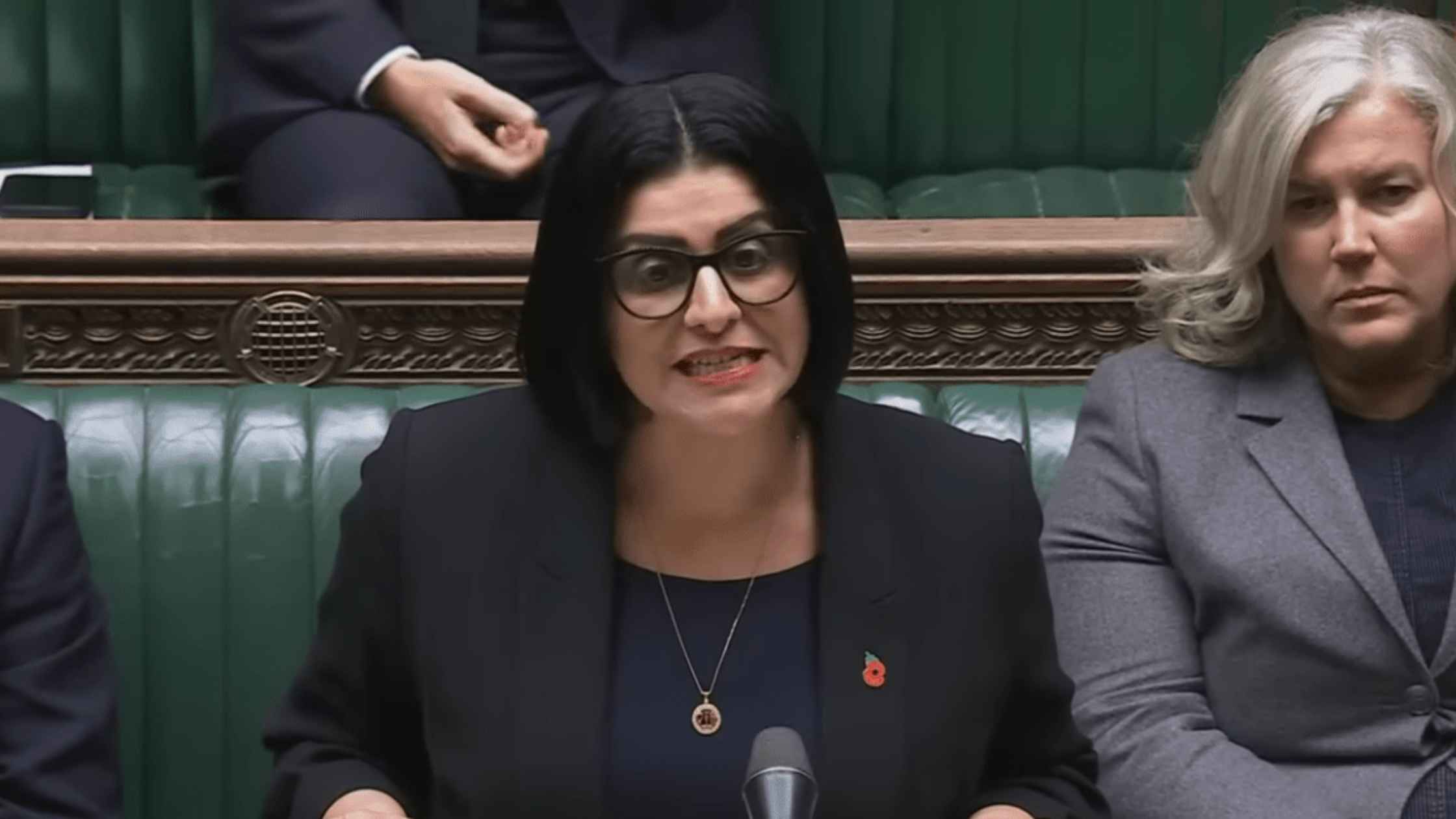
… three of those on the train itself, including the heroic acts of the passengers and train crew who intercepted the attacker. I would like to draw particular attention to one member of the onboard crew who ran towards danger, confronting the attacker for a sustained period of time, and stopped his advance through the train. He put himself in harm's way, suffered grievous injuries as a result, and remains in hospital today in a critical but stable condition. On Saturday, he went to work to do his job. Today, he is a hero and forever will be.
(00:46)
Mr. Speaker, there is now a live investigation into what happened on Saturday night, and the events that led up to it. I am therefore limited in what I can say today without putting successful prosecution at risk. And I'm sure that all here agree that there must be one priority right now, and that is bringing the person who committed this horrific crime to justice. However, I will share what facts I can.
(01:14)
At 7:42 PM on Saturday evening, police were contacted about an incident on a train traveling from Doncaster to London, with reports of several stabbings on board. The quick thinking of the driver saw the train diverted to Huntingdon Station. Within eight minutes of the first 999 call, police had boarded the train and brought the attack to an end. 10 people were taken to hospital by the ambulance services, eight of whom had life-threatening injuries, a further individual later self-presented at the hospital. Three people have now been discharged, whilst eight remain in hospital. I know that everyone in this House wishes them the swiftest and fullest recoveries possible. And I would like to thank the staff at Cambridge University Hospital for their life-saving care.
(02:11)
I can confirm, as was reported over the weekend, that Operation Plato, the National Police identifier for a terrorist attack was declared. However, it was rescinded once the incident had been contained. The British Transport Police remain the lead force in this investigation. They stated yesterday, that while counter-terrorism policing were initially involved, they have found, and I quote, "Nothing to suggest that this was a terrorist incident."
(02:43)
At the scene, the police made two arrests. Since then, one man has been released who we now know was not involved. As of this morning, the other, one Anthony Williams, has been charged. In relation to the events in Huntingdon, he has been charged with 10 counts of attempted murder, one count of possession of a knife, and one of actual bodily harm. He has also been charged with a further count of attempted murder, and possession of a bladed article, in relation to events on a Docklands Light Railway train in the early hours of Saturday morning, at London's Pontoon Dock. And Cambridgeshire police have, in the last few hours, reported additional earlier sightings and possible further offenses. As is standard practice in these cases, they have now referred themselves to the Independent Office of Police Conduct, the IOPC, for independent scrutiny of their handling of these reports.
(03:49)
For now, there is little I can say about this man and his past, beyond confirming that he's a British national and was born in this country, and that he was not known to the security services, counter-terror policing, or Prevent. I know this House and the public will have many unanswered questions today, about who this attacker was and about the events that led up to the attack. Those questions will be answered, but it will take time. The police and prosecutors must be allowed to do their work. Since Saturday's attack, the British Transport Police have increased their presence at key points in the transport network. Though it should be noted that their operational assessment of the risk posed on our trains has not changed as this was an isolated attack.
(04:45)
It was also, of course, a knife crime. This government is committed to halving knife crime within a decade and progress has been made. This year we have taken 60,000 knives off of our streets, banned zombie knives and ninja swords and seen a 5% fall in all knife crimes, including an 18% reduction in homicides by knife. I know that ideas have already been suggested about how policing should change in response to this event. Once the facts are known, we must examine what more might have been done to stop this horrific attack from ever occurring and whether there are measures that we must now take to better protect the public on our streets and on our trains. However, that must be done when all of the facts are available to us.
(05:36)
Madam Deputy Speaker, the thoughts of the whole House are today with the victims of this horrific crime, their families and their friends, and all affected by what happened on Saturday night. The sickening act of the man who committed this crime was the very worst of humanity, but the actions of those who responded who ran towards danger to save the lives of people they did not know was the very best of us. I know we all share in paying tribute to their extraordinary bravery today and I commend this statement to the House.
Speaker 2 (06:10):
Shadow Secretary of State Chris Philp.
Speaker 3 (06:12):
Thank you, Madam, Deputy Speaker. I thank the home secretary for advanced sight of her statement. Our thoughts are with the victims of this appalling attack and their families. As the home secretary quite rightly said, I join her in paying tribute to the emergency services who responded so fast and to the brave interventions by members of the public and the train staff that prevented an even worse tragedy from occurring. They are truly heroes. This attack has horrified and shocked the whole nation. People simply traveling by train were indiscriminately attacked. The horror the passengers experienced will likely stay with them forever.
(06:54)
Anthony Williams has now been charged. As the home secretary said he had been involved in previous incidents in Peterborough. And in the early hours of Saturday morning was also allegedly involved in an attack on the Docklands Light Railway in London. Will she confirm, as I've been told, that police in London knew Williams identity following that? And if so, were Cambridgeshire police informed, so they could track him down? In essence, I'm asking were there any opportunities to have prevented this from occurring?
(07:25)
The home secretary said that Williams was not previously known to the security services, counter-terrorism policing or Prevent. Can she also tell the House if Williams was previously known to the police more widely or to mental health services? Mr. Speaker, this all comes just weeks after a murderous Islamist terror attack on a Manchester synagogue and just days after the horrendous murder of Wayne Broadhurst by an Afghan asylum-seeker, both using knives.
(07:56)
Although homicide has thankfully fallen by about 15% since 2010 and as the home secretary said, knife crime has fallen in recent years, every homicide and every knife attack is one too many. I saw, together with the police minister, the grief this courses at the funeral of a 15-year-old girl Elianne Andam, murdered in Croydon just over two years ago. So, speaking in general, not in relation to this incident, does the home secretary agree that knife crime and knife homicide are still too high and we must do yet more? Does she agree that more knife crime offenders should go to jail? This is important because when offenders are in jail, they, of course, can't attack the public. Does she agree we need to ensure more people who carry knives, especially where they use them to threaten others are jailed?
(08:48)
I know of course there are pressure on prison places, but by deporting more of the 10,000 foreign nationals in prison, we could create more space. Madam Deputy Speaker, we also need to take more knives off our streets and that means we have to dramatically increase the use of stop and search. A study this year by Professor Lawrence Sherman, the Met's former chief scientific officer, found that raising stop and search levels in London to 2011 levels would lead to a one-third reduction in knife homicide. Some people complain that stop and search is used disproportionately in relation to some groups, but when measured in relation to the offending population, the disproportionality disappears, as set out by recent policy exchange study. So, Madam Deputy Speaker, we should triple the use of stop and search to get knives off our streets and introduce year-round surge policing in the top 5% of high-crime hotspots, which will, of course, include many train stations.
(09:48)
We also use technology more. There is work underway at the Home Office, which I know about, to develop technology to scan for knives at a distance, which it is hoped can distinguish knives from keys or mobile phones. And this, of course, could help police rapidly identify those carrying a knife in a public place. I wonder if the home secretary could provide an update [inaudible 00:10:11] either straight away or if you prefer perhaps in writing later because I really do think it could make a big difference.
(10:18)
Finally, Madam Deputy Speaker, retrospective and live facial recognition can also identify wanted criminals, including those involved in knife crime. In Croydon Town Centre, the borough which the police minister and I represent in Parliament, in the last couple of years around 200 wanted criminals, including two wanted rapists and others guilty of knife crime who would not otherwise have been caught were arrested using live facial recognition. And crime in Croydon Town Centre including knife crime has gone down as a result. The images of innocent passers-by are immediately and automatically deleted, addressing civil liberties concerns.
(10:57)
So, I really do hope the home secretary agrees and the police minister agrees that rolling out this technology nationally will have a dramatic impact on improving public safety and they'll certainly have my full support if they choose to do that. Madam Deputy Speaker, I know everyone in this House wants to see knife crime eradicated more today, I'm sure, than ever before. So, I hope the House will also support the tough steps needed to eradicate knife crime because we owe the victims of these appalling crimes actions as well as words.
Speaker 2 (11:31):
Madam Secretary.
Speaker 1 (11:33):
Thank you, Madam Deputy Speaker. And can I thank the Shadow Home Secretary for his remarks and in particular as he opened his response. I know that the bravery of all of those who face this attack on Saturday is something that has unanimous support across this House and I thank him for the spirit in which he reflected that. He will know, as I said in my opening statement, in relation to the events in Peterborough, they are now the subject of an IOPC investigation. It's important that I don't say anything that seeks to get ahead of that, but I'm sure all of those questions will be answered in the fullness of time and it is standard practice where there has been contact with police in the run-up to an event like this that those matters are referred to the IOPC to investigate and consider.
(12:22)
He'll also know that I can't say anything in relation to the suspect who's been charged at any prior history or indeed any mental health issues because that would also be facts that are material to any future court proceedings and it will be inappropriate for me or indeed anybody else in this House to comment or speculate on those matters today. And I would just ask that the words of this speaker at the opening of this part of our session are remembered as we pose questions today.
(12:57)
I agree with him that knife crime is far too high. This government is impatient to do everything it can to eliminate knife crime. It's why we've set ourselves an ambitious target and we are pleased to have made some progress. Though I agree with him that there is still much, much more to be done and I hope on knife crime in particular, instead of playing politics across this House where there is consensus, we are all able to work together in the spirit of trying to bring down the scourge of knife crime in our country. As I say, the numbers have gone in a positive direction and I hope he will welcome that and work with us as we seek to make more progress.
(13:35)
He referred to sentencing in particular. I do have to say, Madam Deputy Speaker, I think it's disappointing when members opposite do not reckon with the scale of the crisis in our prison system. This government inherited a prison system on the brink of collapse. It has meant difficult decisions ever since we have entered office in order to prevent this country from running out of prison places entirely. He will know that this government has deported more foreign national offenders since our term of office than was the record under the previous government. Despite deporting record numbers of foreign national offenders, the scale of crisis in the prison system means that there are still more prisoners coming into the system than there have been places and it is important therefore that the sentencing reforms are seen in that context.
(14:27)
He will know though that it is the case that those who are in possession of a knife and who have been using that in a threatening manner do attract the majority of those people do attract reasonably lengthy prison sentences. When we know more about the circumstances of this particular case, we will know if there are other lessons for us to draw and other areas of policy for us to consider. He referenced stop and search and he, I think, lamented the issues around disproportionality. I hope I'm not putting too much of a spin on his remarks. I would just gently remind him it was a former Tory home secretary in the first 2010 to '15 Parliament that started speaking about disproportional use of stop-and-search powers and changed the rules around stop-and-search to reflect the disproportionate use of that power back then. That has been the record of the previous government.
(15:21)
But I hope he will recognize that the police already have the power to use stop-and-search indiscriminately where the intelligence suggests that that is required. That is an operational decision for police chiefs. And of course, the decision as to whether to stop and search someone where there are reasonable grounds and suspicion is an individual operational decision for individual police officers. This is a well-used power. It is a well-understood power. It is an important power that is in our arsenal for tackling criminality and this government fully supports its lawful use.
(15:55)
Let me also say on live facial recognition, it's this government that will very soon be consulting on a new legal framework to underpin the use of live facial recognition. He will know that when his party was in power, it was left to individual police forces and I believe it was South Wales and the Met who first rolled live facial recognition out, faced lots of legal challenges as a result thereof. The government did not then change their policy, but this government will consult on a legal framework, so that all police forces across the country can use live facial recognition technology, confident that they will not find themselves defending those decisions in courts in the future. And I've also supported the rollout of 10 specific live facial recognition units across the country and will look to do more as well in the coming months.
(16:50)
In relation to scans for knives. Let me just say to him on tech more broadly, I think there is much more that we can do to use new and emerging technology in order to help us tackle this type of criminality and I'm happy to write to him about our current plans, but I'll be setting out more in terms of our broader position in the coming weeks.
(17:12)
Madam Deputy Speaker, knife crime is a terrible, terrible crime. It claims far too many lives in our country. It is important that we keep doing everything we can to bear down on the damage that knife crime causes and provide pathways for those who get caught up in the carrying of knives. That is an important bit of policy that we will carry on working on. But in relation to the attack that we are talking about primarily today, I do urge the House that before we draw broader policy conclusions, we wait until more of the facts are known.
Speaker 2 (17:44):
Select Committee Chair Ruth Cadbury.