
Speaker 1 (00:39):
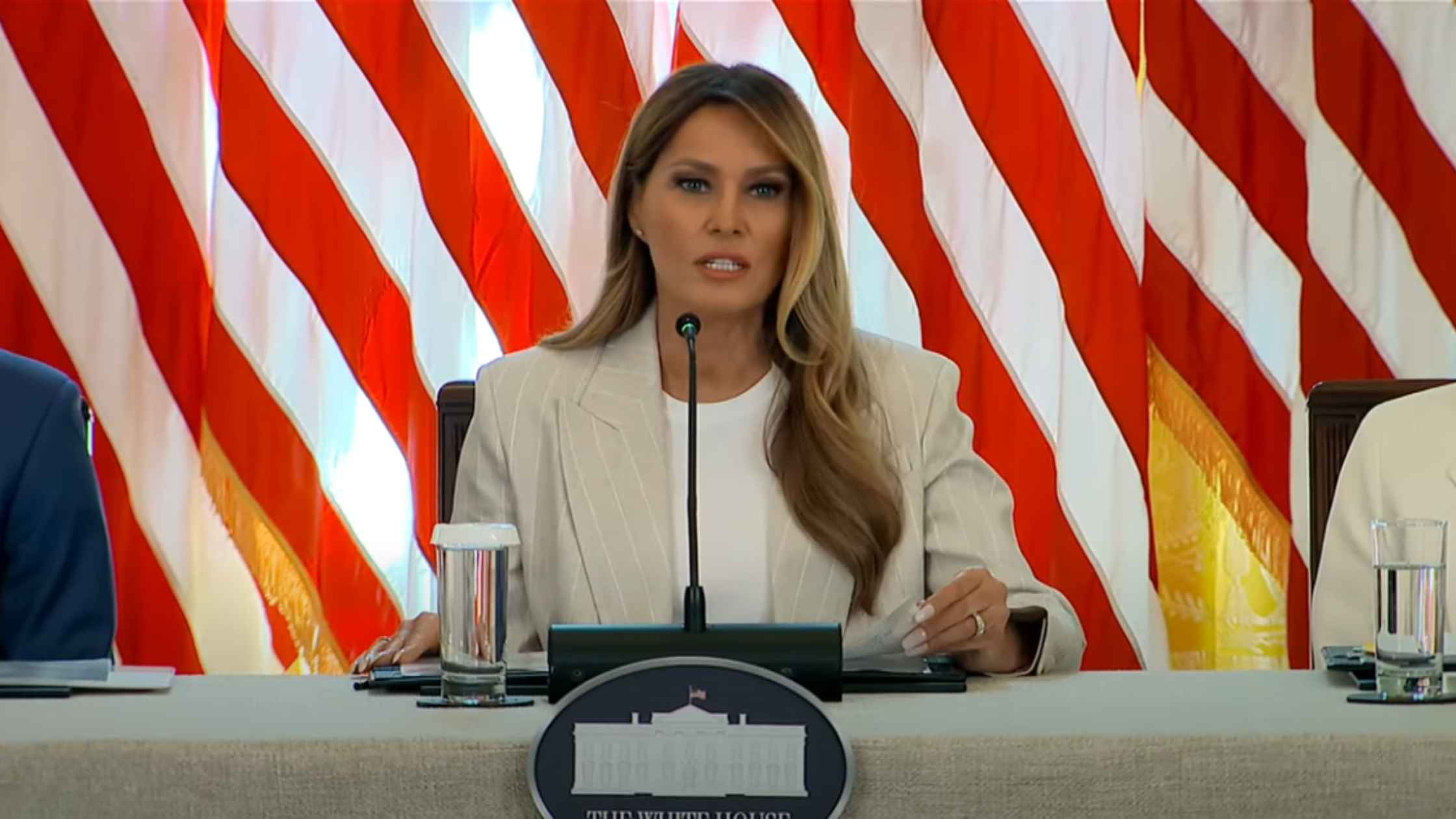
Ladies and gentlemen, the First Lady of the United States.
First Lady (01:11):
Good afternoon and welcome to the White House. It's a beautiful event today. So thank you for joining me to address this important issue, secretaries Wright, McMahon, Rollins, and Chavez-DeRemer. It's wonderful to be here today alongside private sector's leaders, like Mr. Pichai, Mr. Karishma, Mr. Wilson, and the many more visionaries from across industry. We are living in a moment of wonder and it is our responsibility to prepare children in America. Cars now steer themselves through our cities. Robots hold steady hands in the operating room, and drones are redefining the future of war. Innovations of first-generation humanoids, factory automation and autonomous vehicles have surged from private sector investment.
(02:20)
Every one of these advancements, it's powered by AI. The robots are here, our future is no longer science fiction. Data from the Bureau of Economic Analysis shows that AI innovation is clearly boosting America's GDP growth. Surely this is not a trend, for AI will serve as the underpinning of every business sector in our nation, including education, life sciences, finance, and design. In fact, I predict AI will represent the single largest growth category in our nation during this administration. And I won't be surprised if AI becomes known as the greatest engine of progress in the history of the United States of America. But as leaders and parents, we must manage AI's growth responsibly. During this primitive stage. It is our duty to treat AI as we would our own children, empowering, but with watchful guidance. Today in this room, it's filled with the brightest minds of our time. As such, I challenge you to focus on three strategic priorities of AI's ecosystem, so America can lead in shaping a new magnificent world, infrastructure and energy, national security, and of course, talent. We must ensure America's talent. Our workforce is prepared to sustain AI's progress. And the Presidential AI Challenge is our first major step to galvanize America's parents, educators, and students with this mission. English is a new coding language for many, and with it, creativity will flow from every corner of America, sparking new industries, careers and jobs.
(04:48)
By supporting the Presidential AI Challenge, you are investing in our youth America's next era builders. I would be remiss if I didn't thank our very determined director of the Office of Science and Technology Policy, Mr. Michael Kratsios. Michael's vision will have a profound effect on how emerging technology shapes our future. Thank you, Michael.
Michael Kratsios (05:20):
No, thank you, Madam First Lady, for your remarks and for hosting this second meeting of the White House Task Force on AI education. And thank you to all of my colleagues on the task force here, including Secretary McMahon, Secretary Rollins, secretary Chavez-DeRemer, Secretary Wright, and White House AI and Crypto Czar, David Sacks. We are thrilled also to welcome a new member of a task force today, Assistant to the President for the Office of the First Lady, Haley Harrison. Thank you for joining us. It is an honor to have the support and advice of the First Lady as we seek to implement the President's plans to give America's children the chance to learn how to navigate our ever-changing technological world.
(06:03)
As AI reshapes how people learn, work and communicate, President Trump is committed to ensuring that Americans are equipped to lead the world in harnessing this technology for increased productivity and prosperity. To further that end, in April, the President signed an executive order focusing on the formation and promotion of AI educational and workforce development programs, especially for America's young people. Familiarity with how these exciting new tools work will we hope, lay a very important foundation for a lifetime of innovation. That is why President Trump established this White House task force on AI education. And that is why this task force has helped put together the Presidential AI Challenge, which the First Lady launched just last week. And for that, thank you so much, Mrs. Trump.
(06:55)
We are here today, to talk about our future in the most real sense imaginable. How America's children can be prepared to build our country tomorrow with the cutting-edge tools of today. We are proud and grateful to announce new steps in fulfilling the mission of this task force and the President's vision for this AI challenge as we welcome leaders from business, nonprofit, and education who are putting America's future first by pledging their resources to support AI training for American students, educators, workers, and families. So all of you here who are participating in the pledge, thank you for your generous pledges.
(07:39)
The many contributors here today are committed to providing not only vital hardware, infrastructure and education technology for students, but professional development opportunities for workers, for teachers, and for parents. Resources being made available include interactive lessons, educational toolkits, classroom guides, certifications, courses, workshops, webinars, and so much, so much more. We are also honored to be joined by representatives of parent groups who we trust will continue to provide invaluable advice. We are humbled by the responsibility you share with us in educating America's children and very proud to seek your input and participation in every part of this effort.
(08:24)
And as a new father of an eight-week-old, this means more to me than probably anything else we're talking about today. No one loves this nation's children and students like you do as their parents who are each child's first teachers. Americans of all ages look forward to celebrating 250 years of US independence next year. And remembering our even longer national story of pilgrims, patriots, pioneers conquering new frontiers and building a future for their posterity. Today, we are grateful for this opportunity to invest in our children's future in turn, and to give this generation and generations of Americans to come the tools they need to master the frontiers of AI.
(09:10)
Thank you all. And now Secretary McMahon, would you like to say a few words?
Linda McMahon (09:16):
Well, thank you very much. And what an honor it is to share the dance today with our First Lady and my former cabinet members and colleagues here today. I think AI is certainly one of those technologies that we must embrace. Certainly because it is here, it is such a valuable tool, and we are certainly going to do our best to utilize it at the Department of Education. I think we are looking at our work in three AI areas. We are supporting current grantees, we are prioritizing future investments, and we're integrating AI in our own workforce at the department. So I am certainly, and maybe a little to the table later than some as an adapter, but clearly I certainly am now an adapter and utilizing some forms of AI, which I'm finding so incredibly helpful.
(10:08)
And I bet that Barron is helping you with a little bit of this as well and maybe charging you a little bit with that. I would think so. In supporting our current grantees, we've issued a "Dear Colleague" letter, telling anyone who has received an ED grant that AI tools and technologies are allowable use of federal education funds. Our goal is to empower states and schools to begin exploring AI integration in a way that works best for their communities. And I'm next week, actually going to go to the Alpha School in Austin, Texas to see AI in action in the school. So I'm be anxious to report back and see how that works.
(10:52)
We are prioritizing future investments, as I've now made AI one of my priorities
Linda McMahon (11:00):
… as secretary. This explicitly encourages the integration of AI and teaching, learning and school operations. Any grant applications that come into the department that utilize AI will be more strongly considered for their grants, might even get some bonus points for that. We want to integrate AI at ed. We're exploring ways to utilize AI in our processes across the department, not to replace human judgment and work, but to make us more efficient and effective, and I think that should be a goal everywhere. Ed is fully aligned with the presidential AI challenge and is encouraging students and educators to explore AI technologies with curiosity and with creativity.
(11:48)
It's not one of those things to be afraid of. Let's embrace it. Let's develop AI based solutions to real world problems and cultivate an AI-informed future-ready workforce. Ed strongly supports the Pledge to America's youth. We are thankful to the folks in the room today and many others who have made commitments to expand AI access and understanding across schools. Very important across all over the country. And as I am touring and visiting schools, all kinds of different schools around the country, I will be looking to see how AI is being utilized and totally impressed by what I'm seeing. We are helping schools prepare every school, every child, every student for the AI-driven world.
Speaker 2 (12:40):
Thank you. Secretary Rollins.
Brooke Rollins (12:42):
Well, first of all, I will turn my microphone on. First of all, I just want to say thank you all. I'm Brooke Rollins, and what a joy to be up here with my fellow cabinet members. Michael Kratsios, you are just a visionary. And I think back to the first term when we were able to work together, it's just incredible to see you lead and drive and cast a vision supported by so many incredible people here, and I know your team, but it's just a joy to see this incredible, perhaps one of the most important issues, if not the most, that we have to address and embrace and build as a culture, as a society, as America is just so great. And to our incredible First Lady, it goes without saying that you're strong and steady leadership and whatever you put your hand and your mind to is beyond what any of us could have hoped or imagined in terms of your leadership, your ability to move mountains for what you believe is important.
(13:47)
I saw it with your Be Best campaign in the first term, and now to see you put your intellect and your heart and your work behind this is just incredibly encouraging. And as your friend, I'm just so grateful. So thank you for your leadership and to all of our private sector partners in the room. I know we're going to get to hear from some of you, many of you again, we've worked together for some time, but this is the new Trump administration, this is [inaudible 00:14:16] most vexing challenges facing America. So for those of you that have made this a priority in the private sector, we're just so, so grateful for your leadership and your willingness to lean in. And realizing that sometimes in our country things can get fairly divisive, but your willingness to lean in and to be part of the universal approach to solving these massive problems is just so appreciated.
(14:50)
So thank you. I want to say that President Trump has been very clear. The United States will lead the world in artificial intelligence, period, full stop, not China, not any of our other foreign adversaries, but America. And with the First Lady's leadership and the AI challenge, we are making sure that our young people are ready to win that race. And I think that's why we're all here today. From my perspective as the Secretary of Agriculture and hyper focused on rural America and returning the golden age of prosperity to every corner of this great country. I would like to say that far too often for those living and working in our rural parts of our country, that often those are left behind and do not always have the same access to the most recent technological innovations that our urban counterparts across the country do. We cannot let that happen with AI.
(15:51)
The agricultural sector who feeds and fuels and close the country, who provides the national security in terms of feeding ourselves and fueling ourselves, has the potential for a seismic shift driven by the integration of cutting-edge technologies like AI. While AI has already made some inroads in our farming practices and with our farmers and ranchers its potential in agricultural education, and we're here to talk today about education is equally transformative. From personalized learning experiences to predictive analytics for curriculum design, AI is reshaping how agricultural knowledge is imparted and absorbed. This is why USDA will leverage partnerships with 4-H, the Cooperative Extension System and the National Future Farmers of America to bring the presidential AI challenge into the heart of rural America with potential to reach nearly six million youth through 4-H and then one million through FFA. The really is the limit to change the future of rural America.
(17:01)
Microsoft and FFA have already developed a partnership called FarmBeats for K through 12 students where they can work with environmental sensor systems to monitor soil moisture, and detect nutrient deficiencies. These changes will make our farmers more efficient and make our food supply more nutritious. In addition to amplifying the presidential AI challenge with our partners, USDA is well-prepared to support research extension and education activities that promote the use of artificial intelligence. In fact, USDA led the way in the first Trump administration through the creation of five AI research institutes at our amazing land grant institutions. This collaboration brought together government, academia, and industry, and over $100 million in investments and Trump won five, five, seven years ago to research the use of AI and agriculture. In addition to the cutting edge research being conducted, a key tenet of these institutes is education and workforce development.
(18:09)
We can point to many examples of this at USDA in supporting the training of an AI ready workforce. Last month we had an AI institute for Resilient Agriculture at Iowa State University holding a workshop for over 250 farmers to show how the AI tools they developed can assist in pest identification and management. Also embedding AI education and apprenticeships into many of our USDA grant programs. While there is more work to be done and the sky is truly the limit, examples like Texas State University creating a technology and leadership education network focused on AI. Providing apprenticeships courses and workshops to integrate precision agriculture. Training, youth and education about new agricultural technologies such as unmanned aerial systems at Tennessee State University. And over 600 high school students in Colorado being trained on advanced technologies for agriculture like robotics and automation.
(19:14)
As I wrap today, and before I hand it over to my amazing colleague, Lori Chavez-DeRemer, our Secretary of Labor, there is so much we can do and I want to again send my heartfelt thanks to Michael Kratsios, also to our incredible first lady and her wonderful team and everything that has been done to get us to this point today. With the commitment of First Lady, Mrs. Trump, and with the commitment of our industry partners who are sitting with us on the dais, but also in the audience, and of course with President Donald Trump's leadership, tomorrow's workforce will be ready and leading the way in innovation. America's future will be stronger, more secure, and second to no one. The American dream will thrive and prosper like never before, and at the heart of all of that will be the American worker. So at this point, I'd love to turn it over to Secretary Chavez-DeRemer to talk a little bit about that. Thank you all.
Lori Chavez-DeRemer (20:11):
Thank you, Brooke. Good afternoon. I'm Lori Chavez-DeRemer and it's really an honor to be here, Madam First Lady, thank you so much for what you're doing in the initiative. And on behalf of the American worker, we have a lot of exciting updates from the Department of Labor, and so I'll be brief. Under the direction of President Trump, the Department of Labor has taken on decisive action to make sure that we are promoting AI literacy and skills training. While the primary focus of this group is preparing our youth, the future youth, congratulations, we are also advancing proposals to ensure all American workers are ready to thrive in an AI-driven economy. As you know, the president set out a goal to make America skilled again by providing more flexibility to state and local governments, including for artificial intelligence programs. Last month, the Labor Department issued guidance to state and local workforce agencies encouraging the use of Workforce Innovation and Opportunity Act.
(21:11)
Some of you know it as WIOA funds to help develop those AI skills. This new guidance also clarified that states can use their governor's reserve funds for AI learning opportunities helping increase training across the public workforce system. To further promote AI training, we have developed a set of priorities to expand AI-related apprenticeship opportunities. It's part of a comprehensive workforce strategy that we just published with the Department of Commerce and Education titled America's Talent Strategy, Equipping American Workers for the Golden Age. On-the-job training programs will help fill the mortgage-paying jobs that AI will create. While also enhancing the unique skills required to succeed in various industries, expanding these opportunities is a
Lori Chavez-DeRemer (22:00):
… key component of our strategy to reach the president's goal of 1 million new active apprentices across the United States.
(22:08)
And finally, the Department of Labor has been very proactive and engaging with industry leaders to start the dialogue around what AI literacy looks like and how we can collaborate to help all American workers to succeed.
(22:20)
My team has held dozens of meetings with industry stakeholders as well as the governor's offices, state workforce agencies, and local workforce boards across the country. In the coming months, I will expect to have many more exciting announcements. We are working on developing the best practices for an effective AI literacy training, and on a potential public-private partnerships that could play an important role in making AI training accessible to all American workers.
(22:50)
I'd like to thank again the First Lady and everyone in this room for doing what you are all doing to prepare the American workforce for the jobs of the future. As I continue around my 50-state tour, and we've hit 32 states in the last five months, we'll continue to promote AI and its excellence. And it is going to be this initiative in this group and all of you out here in America to help us lead the way and tell those stories to the president. I look forward to the continuing collaboration and have confidence in this era of American AI dominance. Thank you.
Speaker 3 (23:23):
Secretary Wright, it's [inaudible 00:23:25] to you.
Secretary Wright (23:25):
Thank you all for being here today for this just really, really important movement. At its essence, artificial intelligence takes electricity and turns it into intelligence, empowering Americans.
(23:39)
At the Department of Energy, my biggest focus seven days a week is how to grow our supply of electricity. Over the last 20 years, the United States has more than doubled our natural gas production and tripled our oil production, but have seen very little growth in our electricity production. We will not win at AI if we don't massively grow our electricity production. So that's taking a ship that hasn't moved much in a while and getting it supercharged.
(24:07)
The other relevant activity we have at AI at the Department of Energy is through our national labs. We are working to take cancer from a death sentence for millions of Americans into manageable conditions across those by using the power of artificial intelligence. We're using artificial intelligence to harness fusion energy. Something I worked on 40 plus years ago. We're using it to understand the basic fabric of the universe, so these incredible scientific endeavors.
(24:37)
But perhaps the killer app, the most important use of AI is for education, and to fix one of the greatest American shortcomings, our K-12 education system. I'm so thankful and inspired by the First Lady to focus all of us. We've got to not leave our kids behind. We've been doing that for decades. We've got to fix our education system. AI is a transformative tool to do that. Michael Kratsios is here is taking that bull by the horn and pushing it forward. I could not be more thrilled to be part of this effort.
(25:11)
My wife and I have been in school, trying to fix the school system for 30 years through school choice, through school reform, through starting schools, through running camps, through doing everything we can. But with the leaders in this room and the leadership of the First Lady in Michael Kratsios, I think we can move the needle if we all dig deep in the next few years. God bless you, and thank you for being here.
Michael Kratsios (25:34):
David?
David (25:38):
All right. Thank you. Everyone's already been thanked, but I also want to add my thanks to the First Lady for championing the presidential AI challenge and your clear dedication to America's school children. So thank you, Madam First Lady. And also I want to thank our OSTP director, Michael Kratsios, for his tireless efforts leading this initiative as well and also helping to make sure the US dominates every part of the AI stack.
(26:03)
From his first days in office this year, President Trump has shown visionary and decisive leadership in this critical technology of AI. And we've made, I think, amazing progress over the last seven months. There's been too many wins to list all of them here, but I want to just mention a few. In the first week of his administration, President Trump rescinded hundreds of pages of unnecessary regulation, burdensome and unnecessary regulation, on our AI model companies and on our chip companies. And instead, in lieu of that, he initiated the development of an AI action plan that we just released a few weeks ago.
(26:37)
And at the action plans unveiling, this was on July 23rd, President Trump gave, I think, a momentous policy speech on AI, which is the most important speech that's been given on AI by any official. And he made the pillars of our AI policy being pro-innovation, pro-infrastructure, pro-export, and pro-worker. And he also signed three executive orders that day to help further this policy. So the first was to make it easier to build new data centers and energy infrastructure. And thanks to President Trump's leadership, he's already attracted hundreds of billions of dollars of investment into the United States for data centers and energy infrastructure. And as he likes to say, the US is the hottest country in the world right now. Thanks to his leadership.
(27:24)
The second executive order established the American AI Exports program to ensure American leadership across the world, we want to make sure that the American tech stack wins internationally as well.
(27:35)
And the third executive order banned the federal government from procuring ideologically biased or woke AI. We want to make sure that AI only pursues truth, fairness, and impartiality.
(27:48)
So I think those are just some of the amazing accomplishments that the administration has made over the last seven months. As we meet here to discuss AI education and empowering America's children, it's still the very early days of this incredible industry. And I'm reminded of what President Trump said during that AI speech, that he said that American AI is like a beautiful baby that's just been born. We have to grow that baby and let that baby thrive. And he's absolutely right about that. And we have to enable our children to thrive with it.
(28:20)
Let me acknowledge that when it comes to the topic of AI, there is a lot of fear out there. Some people think that AI is going to take all of our jobs. I really don't think that's going to happen. I think AI is going to unleash productivity boom like we've never seen. It's going to make all of us more productive. It's going to make our jobs more satisfying.
(28:37)
And there's an online quote that's been flying around that says, "You're not going to lose your job to AI, but you might lose your job to someone who uses AI better than you." And I think there is some truth to that, that AI is going to be the ultimate boost for our workers. And it is important that they learn from an early age how to use AI. And that's why it's critical that our school children learn AI. And that's why this program is so important to further AI education. And its important, I think, to further it school children in every part of America, every socioeconomic class or bracket, because this is really fundamental to a quality of opportunity for every child in the country.
(29:22)
And just finally, the last thing I want to say is just that I want to thank all of the companies that are here today who have made pledges to donate their resources to AI education. I think this is really important. President Trump in his AI speech called on our technology companies to promote a new spirit of patriotism and national loyalty. And that's what you're all doing here today. So I think that's fantastic.
(29:45)
And I think each of you, of your companies and the nonprofits you're here today, they've recognized the opportunity to serve your fellow citizens and help build a great American future. You're all in for America. We really appreciate that you're putting America first. And we look forward to hearing more about your contributions and I think we'll do that next. Thank you.
Michael Kratsios (30:05):
Yeah, thank you so much, David. I think now we'll briefly hear from three of our more than 135 generous pledge signers; Arvind Krishna from IBM, Cameron Wilson from Code.org, and Sundar Pichai from Google. Each say a few words about their contributions.
(30:21)
Sundar, Arvind, if you want to start?
Arvind (30:26):
Thank you. Good afternoon everyone. It's a privilege to be here and contribute to help build America's AI-ready workforce. Let me begin by first thanking the First Lady, Mrs. Melania Trump, for helping lead this effort and galvanize all of us into contributing, but also to President Trump for all of his efforts around AI as David just spoke about. Let me also thank the cabinet members who are here for all the efforts that they're putting into helping build America's AI-ready workforce.
(30:57)
Addressing the AI skills gap is going to be essential for us to achieve what we all want to with AI contributing to America's leadership, but also to America's productivity. The president's AI action plan shows us the way to that future by empowering American workers to lead in the AI economy.
(31:18)
As the plan highlights, US companies also have a central role to play in building this workforce. By partnering with government agencies, non-profit organizations, and communities as well as educators, we can deliver the training that meets the demands of the labor market. IBM has long embraced this collaborative approach, and we are fully committed to upholding this responsibility. We are proud to join the pledge by committing to train 2 million American workers in cutting edge AI skills over the next three years. We will do this through a groundbreaking program called IBM SkillsBuild, which we launched to help expand access to AI education, but also to create pathways for these high-demand technical roles.
(32:13)
A quick example, Zach Switzer is a high school teacher at the John Marshall School of IT in Cleveland. He used IBM SkillsBuild to acquire the foundation knowledge himself and then to give his students in turn that knowledge. These examples need to get multiplied a hundred and thousand-fold in order to bring these AI skills into the communities. Teachers like Zach in schools across the country can access AI learning through IBM SkillsBuild, adopt the modules into the classroom, and then help the students gain these valuable skills to take into the workforce and hopefully find a great-paying job.
(32:58)
This is only one of many success
Arvind (33:00):
… success stories. But when it comes to meeting the growing demand for AI, no organization can do it alone. This is why IBM is proud to be part of the president's program and part of his national AI education initiative with its emphasis on collaboration across the different sectors. We look forward to working with the administration and with all of our partners to achieve these goals. Thank you. With that Cameron Wilson of Code.org.
Cameron Wilson (33:29):
Thank you so much and I deeply appreciate the invite today so that Code.org can come speak to you about our nonprofit work that we're doing around AI education. So just a few months ago, 450 CEOs, many of whom are in this room today, came together and called on states to require computer science and AI education for every student. Only 12 states do this today. These leaders really recognize the moment that we're in, which is AI education is the global competitiveness issue that faces us today. And we really need to meet this moment with an education system that provides students with AI education, and specifically students really need to learn how AI works. They really need to understand the opportunities, the risks, the limits of AI and the underlying computer science that is driving this innovation forward.
(34:28)
Simply learning to use AI just won't be enough. We need to spark their curiosity and build their confidence so they can be agile as the workforce changes with AI or as AI changes itself. And we need to empower them so that they can envision and really express how they can shape a better future with AI. Steve Jobs had a great quote he used to have and it was why he loved to learn computer science because it taught him to think differently about problems. And that doesn't change in the age of AI. So both the presidential AI challenge and the AI executive order recognize the moment that we are in. They will catalyze state-led efforts to help modernize our education system. And I want to thank the White House and the First Lady's leadership on this because this is a priority we must place in our AI education system.
(35:20)
Ever since Hadi Partovi and myself began the work about 12 years ago with Code.org, we've helped change the global education system by bringing computer science education to 100 million students worldwide. And we've passed policy reform to embrace and prioritize computer science education for all 50 states. And now that changes with involving AI education with computer science. So we're the global leader that help brings together partners around students and teachers and administrators so that they can be part of this global education movement. And as part of the AI executive order, we're committing to evolving and expanding this movement by engaging 25 million learners, including students and teachers and parents in the hour of AI this year, this will be for this school year.
(36:11)
Our goal is to partner with 25 states over the next three years to help promote and build out AI pathways, AI standards, and the AI Education Act. We're developing and scaling a new free open source high school course focused on AI, AI Foundations, which we plan to have reach about 400,000 high school students in the US by school year '28. And we want to provide free open source computer science and AI learning for about 9 million students, K-8 students by school year '28. Those are the things that we're committing to do to really transform our education system so that students can thrive in the age of ai. But we've always acted at Code.org as community of partners, including teachers and administrators and parents and leaders across all levels of government from all different parties, and particularly with our lead partners, Microsoft, Google, and Amazon have always been a really unique contribution to our coalition and numerous other companies that are in this room.
(37:12)
Pulling together this broad coalition of leaders has been the unique strength that we've helped build this global movement. And with AI education, we have a chance to both reinvigorate and expand this movement so that we can fulfill our vision that every student has a chance to learn AI and computer science and modernize education. So we would love for any organization that wants to partner with us to help us bring computer science and AI to the next 100 million students over the next decade.
(37:42)
So thank you very much. And I want to turn it over to…
Sundar (37:47):
Mrs. Trump, Director Kratsios, esteemed cabinet officials, hello. And it's a real honor for me to be here to support the First Lady's Presidential AI Challenge. I think you're really inspiring young people to use technology in extraordinary ways. It's a deeply important issue for us as a company. At Google we see AI as the most profound way we'll deliver on our mission and transform knowledge and learning. We really imagine a future where every student, regardless of their background or location, can learn anything in the world in a way that works best for them. We've been really focused on this for decades. It's why we built Chromebooks for every classroom, why we have worked to make our AI model Gemini one of the best models for learning. It's why we are offering our Gemini for education to every high school in America. We are providing access to every high school student and every teacher with our best AI tools, including guided learning.
(38:46)
We recently committed $1 billion over the next three years to support education and job training programs in the US. And today I'm excited to share that 150 million of $1 billion will go towards grants to support AI education and digital well-being. This includes support to Code.org, to transform its curriculum and integrate new AI features. We are also providing support to the Flourish Fund to support non-profits, helping youth aging out of the foster care system with tools to succeed in the workplace.
(39:19)
For college students, our AI for Education Accelerator has expanded from 100 colleges and universities to 200, including the Texas A&M University system and Iowa's community colleges. And we have set up a centralized place for teachers and parents to get all our best AI training in one place. Something we've heard can be really helpful. This is all in the service of helping the next generation to solve problems, fuel innovation, and build an incredible future. These are all goals we all share. We are incredibly thankful for the partnership and the leadership from the First Lady, the President, and the administration, and for showing us the way. Thank you.
Michael Kratsios (40:00):
Thank you so much, Sundar, and thank you all to our distinguished guests as we work to invest in America's Children, America's future, we're really grateful for all of your support. For everyone out there if you go to AI.gov, all of the tremendous contributions and commitments that everyone has made can be seen there, and I think it's going to be a really, really special thing for all students, parents and educators this school year.
(40:23)
And lastly, my special thanks once again to the First Lady for being here with us today, thank you. So this concludes our White House Task Force on AI Education's second meeting, and we very much look forward to working with all of you again soon.