




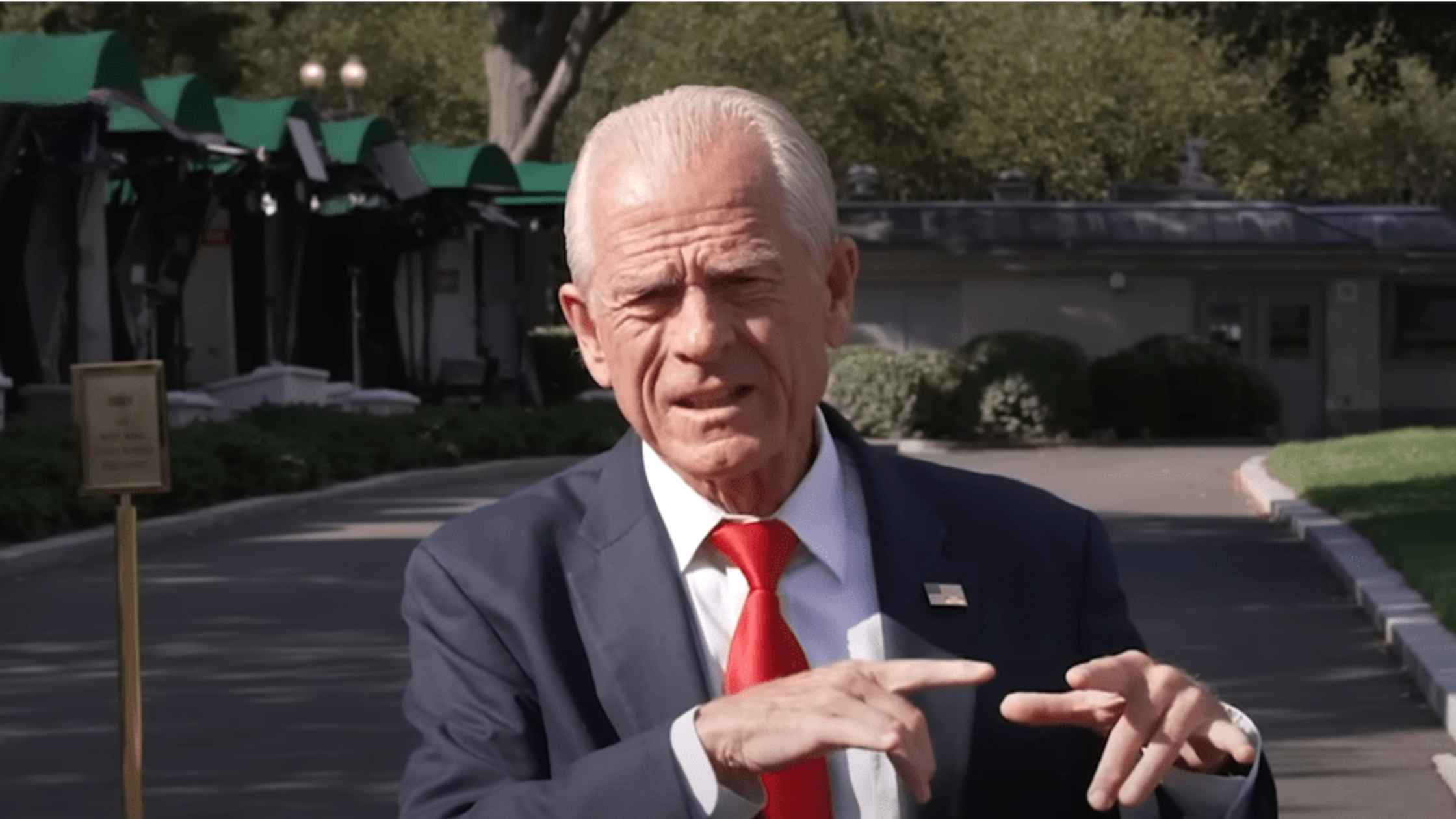


Peter Navarro (00:00):
Well, thank you all for laboring on Labor Day. You're really going the extra mile. I want to just wish the American people a happy Labor Day. It's actually my favorite holiday, because at the White House here, I'm the director of the Office of Trade Manufacturing Policy. And my job is actually to make sure blue collar America in particular is fully employed, and has their wages rising. So I just wanted to give you a little report card for President Trump in the first six or seven months of this administration. Glowing reviews here. Let's start with the amount of jobs we've created, 2.5 million jobs since President Trump took office, for American-born citizens. That's truly remarkable. One of the craziest things you saw during the Biden regime when we had the influx of illegal aliens is, we lost millions of jobs for Americans. And the job growth was primarily among the illegal alien population, as reported by the Department of Labor and Commerce.
(01:11)
It was truly stunning. We've reversed that trend. Now, one of the most important metrics for workers, and the one I follow the most closely, is whether real wages are rising, which is to say whether the wage growth is outpacing inflation. During the Biden regime, you had 26 straight months months where inflation rose faster than wages. That's just death knell for blue collar workers. So far, we're up 1.4% annually, second fastest in American history. And every single month, real wages have gone up in the Trump administration. Inflation is trending below 2%, so that's an incredibly stellar performance. What else can I tell you? Well, if you look at the Big Beautiful Bill, here's what's coming. We're going to have an average of $15,000 tax cuts for blue collar and middle America. That's a good deal. We're going to have $63 billion in benefits for no tax on overtime for seniors.
(02:24)
The no tax on tips, no tax on overtime, is going to mean $1,500 a year, more in the pockets of service workers. So that's a really big deal. And the last thing I'll tell you in terms of the statistics, $8 trillion have come into this country in terms of pledged investment. And why is that important? From an economist point of view, I can tell you that when you have investment, you have an increase in productivity. And productivity increases is the key to wage increases. So the future is very bright. Now, let's shift gears a little bit. I know you want to ask some questions about the court decision on Friday. I heard one of your colleagues talking about that to the world. This case is arguably the single most important economic case that has ever come before the Supreme Court.
(03:30)
If the lower court's ruling is upheld, President Trump has correctly said that will be the end of the United States, because it will be impossible to defend ourselves from the fentanyl poisoning, and all of the trade environment, which is hollowing out our supply chains and creating very dangerous problems for the American people. So let me break the case down for you a little bit. There's a piece in the Washington Times that's out online today. It'll be in print tomorrow. I urge you to read. Here's the top line. If you look at the politics, reporters are making much of the fact that it was seven to four majority. If you look deeper at the numbers, it breaks down to the exact same kind of partisan weaponization of the courts that we're seeing in other decisions with respect to illegal immigration and other kinds of things.
(04:30)
What you've got is six out of seven of the judges striking down the tariffs. Democrats, the one Republican was an H.W Bush free market Republican. So you can read absolutely nothing into that. And on top of that, there were 12 states that intervened and argued against the Trump tariffs. Guess what? Every single one of them, yep, Democrat, blue state, Democrat governor, Democrat controlled legislatures. And the most interesting thing, which you're not going to find widely reported in the press, but it tells a lot about the source of the lawsuit. Five small importers, mostly importing crap from China, had big law firms. And when you track at least some of that money, it's alleged to track back to donors like the Koch network, which are infamously anti-Trump, infamously free traders, who have supported the offshoring of American jobs and the influx of illegal aliens for decades. So that's the root source of that.
(05:47)
Now, with respect to the law, there were three big issues that are raised here, that the Supreme Court will have to contend with. As I said, the dissent provides a very useful road map. Let me walk through them quickly. The first is whether or not the fentanyl killing Americans constitutes a national emergency, whether the trade deficit constitutes a national emergency. Of course they do. It's unconscionable that Communist China, in league with the Mexican and Canadian drug cartels, are killing Americans with fentanyl, and now this new designer drug, it is called nitidine. By the end of the day, we'll lose another couple of hundred Americans. It's over a million since the fentanyl war against America started. And if that's not a national emergency, I don't know what is. And by the way, the tariffs have helped start to stem that flow, so they're working.
(06:53)
With respect to the trade deficits, it's $1.3 trillion a year. $18 trillion over wealth have been exported over the last several decades. That has had the effect of costing this country millions of jobs over a hundred thousand factories. But equally important from an economic and national security point of view, what countries around the world have done exploiting their mercantilism, is take apart key aspects of our supply chains, whether it's in pharmaceuticals, whether as you've seen recently with the rare earth magnets, ball bearings. There's all sorts of things that our defense industrial base and our manufacturing base simply can't produce anymore. We've got to get those back. And also, there's a lot of ways you can think about this. The trade deficit leads to budget deficits, and we're having to fund a lot of these deficits. That's eating into our ability to fund our own government.
(08:02)
We're exposed by that debt to blackmail from other countries, including Communist China, which holds a lot of our debt. So clearly on the first question, these unequivocally are national economic emergencies, and qualify under IEPA. The second point has to do with what is a semantical one. Basically, the question is whether tariffs constitute regulation of importation. Would it qualify as a form of regulating imports? And yes, of course it will. There's good case law. I go over this in my Washington Times article, that support that. And nothing rules out the use of tariffs. And I think we're on very solid ground there. There was a third issue raised, which I think was a clear red herring, which is the claim by the majority, the partisan Democrat majority, that because the tariffs were alleged to be permanent, that that isn't covered by IEPA. The claim is ridiculous. Neither Howard Lutnick, Jamieson Greer, Scott Bessent, myself, or the president himself ever said that these tariffs were permanent. If in fact, people stop dying from communist Chinese, Mexican and Canadian drug cartel fentanyl tomorrow, the tariffs would be lifted. We would have no reason to do it.
(09:36)
By the same token, as soon as our trade deficit went away tomorrow, tariffs would be lifted. And by the way, bury the lead, every single year we have to revisit these tariffs with Congress, so that argument doesn't hunt as well. So on all three of those grounds, I think we're in very good shape. Bottom line is, we're optimistic that the Supreme Court will rule on this. The tariffs will remain in place at least to October, and perhaps be on until the Supreme Court rules on this. And again, President Trump has said correctly, if the court does not uphold the Trump tariffs, it will be the end of this country. We will lose all sorts of bargaining power, and the rest of the world will continue to do what it has been doing, have its way with us. Okay.
Speaker 2 (10:36):
Mr. Navarro.
Peter Navarro (10:37):
I'll take some questions now. A couple of questions for you, ma'am.
Speaker 2 (10:38):
Are you concerned at all about the show of unity between Putin, Xi and Modi? And then the second follow up, we saw Trump Truth about India, saying that they're going to cut those tariffs to nothing. Can you fill us in on the status of where the trade is right now with India, the negotiations?
Peter Navarro (10:54):
Here's what I can tell you. And again, I'd refer you to the article I wrote in the Financial Times on this, which goes into it. Here's the problem with India. It's a two-pronged problem. There's 50% tariffs on India. 25% of them is the reciprocal tariff, because of unfair trade. 25% is the fact that India is buying oil from Russia. So start with the reciprocal trade tariffs. The problem is that India literally is the Maharaja of tariffs. It has the highest tariffs of any major country in the world. And it's in denial about that. It tries to tell everybody out there, but that's not true, and it is demonstrably true. So they should engage with us. They haven't done that, as Japan, Korea, the Philippines, Indonesia, the European Union has. They simply think they continue having their way with us. President Trump's not going to allow that.
(11:56)
Now, with respect to the 25% tariffs on India's buying oil from Russia, this is an incredible situation. Every one of you, when you report this story, should report the following fact. This is the first fact. India, for all practical purposes, did not buy any oil to speak of from Russia, before Russia invaded Ukraine in February 2022. How many of you knew that? Probably not many. The way this oil trade worked is, once Russia invaded and they were figuring out ways around to sell their oil, Russian refiners went to refiners in India, got in bed with them. Some of them actually help produce right in India now. Putin gives India a discount on crude. They refine it, sell at premium prices to Europe, Asia, and Africa. It's nothing but profiteering. India cannot stand on the thin reed that somehow they need this oil to run their cars or cool their homes. It's false, just simply false.
(13:16)
So here's how this works. This is the crazy math of this, for the American people. Listen to me carefully here. India charges the highest tariffs in the world, has the highest non-tariff barriers. So they export a bunch of stuff to us. We can't export to them. Our workers and our businesses get hammered by India. India then uses the money we give them, buying their exports, to buy Russian oil. The Russians use the money from the Russian oil to build more bombs, and weapons, and drones to kill Ukrainians. And then the Ukrainians come to us in Europe to ask for more money from our taxpayers to pay for that. That's crazy.
(14:09)
So the Road to peace, in many ways, runs at least partly through New Delhi. It's time for Modi to step up. I have great respect for Modi. I love the Indian people. It was a shame to see Modi getting in bed, as the leader of the biggest democracy in the world, with the two biggest authoritarian dictators in the world, in Putin and Xi Jinping. That doesn't make any sense. I'm not sure what he's thinking, particularly since India has been in a cold war and sometimes a hot war with China for decades. So we hope that the Indian leader comes around to seeing that he needs to be with us in Europe and Ukraine, and not with Russia on this. And he needs to stop buying the oil.
Speaker 3 (15:05):
So then why not impose those secondary sanctions on China, which is a massive purchaser of Russian oil?
Peter Navarro (15:10):
Well, that's a separate issue. I would just remind you that we have now 50% tariffs on India. How much do we have on China?
Speaker 3 (15:18):
Well, it's currently [inaudible 00:15:19] at 30%.
Peter Navarro (15:18):
How much do we have on China? What's that?
Speaker 3 (15:22):
30%.
Peter Navarro (15:23):
No, it's over 50% total on China.
Speaker 3 (15:26):
Well, okay, yeah. [inaudible 00:15:27], yeah.
Peter Navarro (15:26):
So the question is how much more can you do? And there's a lot of things going on there, so I think that this issue is complex. But at a minimum, India's got to stop doing. You had a follow up. Now, I'll go here.
Speaker 2 (15:44):
Well, back to my first question about [inaudible 00:15:46].
Peter Navarro (15:45):
Who are you with, by the way?
Speaker 2 (15:47):
I'm [inaudible 00:15:47] with the [inaudible 00:15:48] Today.
Peter Navarro (15:48):
Oh, got you.
Speaker 2 (15:48):
Yeah.
Peter Navarro (15:48):
Okay.
Speaker 2 (15:49):
I first asked about the show of unity between Xi, Putin and Modi.
Peter Navarro (15:54):
Yeah. Yeah.
Speaker 2 (15:54):
Are you concerned at all about them?
Peter Navarro (15:55):
Yeah, it's troublesome. It's troublesome. India is the biggest democracy in the world by population. Historically, India has been in a cold war with Communist China for decades. China has funded Pakistan's military China helped Pakistan develop its nuclear weapons. China has invaded India repeatedly, particularly a place called Aksai Chin. I don't know if you're aware of that area. And actually has taken territory from India, and still holds it. The Chinese patrol, now far into the Indian Ocean, and are challenging Indian sovereignty in the Indian Ocean. But at the same time, we're seeing China, and its entrepreneurs and oil refineries, getting into bed with Indian business people. And that relationship is toxic.
(17:02)
A lot of this dumping that occurs, China now is using India as a big trans-shipment hub, for all sorts of products, to avoid the Chinese tariffs. Let's see what happens. President Trump, every American should thank President Trump for flagging this issue, and calling India out on these issues. Because we don't want to be about the business of trying to defend Ukraine with funds, and weapons and things like that, when our money is going to somebody who's cheating us. And they're using that money to give them to the Russians, to buy weapons, kill Ukrainians, and then use our taxpayer money. All right. I'll take just a couple more. Sir?
Speaker 4 (17:49):
Understanding you say the significance of this potential Supreme Court decision is paramount to the country's future, in a scenario that they were to rule against the administration, what conversations has the White House been engaged in this summer about potential alternatives, whether it be federal trade law, or going to Congress?
Peter Navarro (18:06):
Yeah, that's something that we're going to divulge. Let's just say that this is a smart White House, and President Trump is the master chess player. There's certainly other authorities we can use, but the courts shouldn't use that fact to do the right thing in this case, because clearly this is well within the Article II powers of the President. He's demonstrated through the use of this power just how effective it can be. It's like the most incredibly effective negotiating tool that we've ever seen a president wield. So again, let's see what happens.
Speaker 4 (18:49):
Has Speaker Johnson and Leader [inaudible 00:18:51] been engaged?
Peter Navarro (18:52):
I have no insight on that. I'm sure that's the case. My job, apropos Labor Day, is to make sure I'm doing the best I can to help the boss create jobs for blue collar America. Yes, ma'am?
Hannah Brown (19:05):
Mr. Navarro?
Speaker 6 (19:05):
Mr. Peter, the de minimus rating-
Peter Navarro (19:05):
Yes, de minimus.
Speaker 6 (19:11):
The de minimus rating loophole has now been closed, and you have shippers from Asia and Europe who have canceled shipments to the US. So what is your message to Americans who see canceled orders, delayed shipments and higher prices?
Peter Navarro (19:20):
Well, you're assuming that all that's true. Look, the de minimus loophole is insane. No country in the world has an $800 limit where anything can come in below $800, you don't even look at it, and you don't collect tariffs on it. That's crazy stuff. The fact that Congress allowed that to happen to begin with under the heavy lobbying of the online brokers, like Amazon, and eBay, and Alibaba and stuff like that, that never should have happened. We closed that. Now, here's what Americans should be feeling now. Gratitude for President Trump, because this de minimus loophole has been one where counterfeits and pirated goods are coming in. It's the single highest source of narcotics and fentanyl being smuggled across the borders. If you understand how this works, it's like these small packages, they don't register them, they don't tell us what's in it. They just come in, nobody looks at them.
(20:26)
And guess what? I could fit enough fentanyl in the tip of my finger to kill all of you in about 10 seconds, okay? That's how powerful that stuff is. So this is a good deal. It's going to raise tens of billions of dollars every year, just closing that loophole. And congratulations to President Trump. It's just another way of celebrating the Labor Day, because it's like when I was in the first… I'll give you a little background. I was over there in my office right on the corner there. Mighty Mug came to me early in the administration, and it's an American company, and they're telling me about how they were trying to sell their Mighty Mugs. And they were having trouble, because China could send these things in. They'd steal a design, send them in, they'd send them in through de minimus. And the way de minimus interacted with our international postal system, they could send a mug for half the price, then Mighty Mug could send to the house next door, okay? That's how screwed up that is. So we fixed that. I'll take one more. You've been patient, ma'am.
Hannah Brown (21:42):
Yeah, thank you.
Peter Navarro (21:43):
And you're with?
Hannah Brown (21:43):
I'm with News Nation. Hannah Brown with News Nation.
Peter Navarro (21:45):
Okay. Great.
Hannah Brown (21:47):
Businesses have basically been saying for the start of this tariff discussion that uncertainty is the worst part for them. Are you afraid that these court indecision basically caused uncertainty?
Peter Navarro (21:56):
Well, they've been saying that, but they haven't been acting that. We've had a tremendous influx of investment. Here's the most important thing to understand about tariffs. There's three parties that can distribute the tariff burden, not two. The media likes to say, "Well, it's either going to be American consumers or American businesses that are going to bear the burden of the tariffs." But in fact, the third party is the one that actually does it. That's the foreigners who export to us. So what we observed in the first term, when people were saying the same thing about uncertainty and the inflation and all that, we observed very clearly that the countries that rely most heavily on us, the most export-dependent economies, like China, like India, like Europe, like Vietnam, like Indonesia, like Malaysia, like Thailand, all of these countries we run massive deficits with, they have no choice other than to lower their prices when we raise our tariffs.
(23:04)
So we don't see inflation coming in. So look, the best businesses are elated with the protection we're giving them across the board. And on Labor Day, let's celebrate the revival now of our steel and aluminum industries, which is a tariff itself.
Hannah Brown (23:24):
But-
Peter Navarro (23:24):
So you've all been patient.
Hannah Brown (23:25):
Sorry, don't you see that as a gamble the administration is taking, that the burden won't fall on businesses and American consumers?
Peter Navarro (23:31):
It's not a gamble. It's economics. And we know where the burden goes. The problem is when you asked me that question, if you were asking me the question in 2018 after we put the China tariffs in, I'd have to speculate as an economist. But the problem is now, for those who make that criticism was, we have the data. It just didn't happen. China ate the whole damn thing, and they're going to do it again, just like all these other countries are going to do it. And it's just a beautiful thing for the American people. America, we love you here at the White House. Happy Labor Day, and I'll be back tomorrow, the next day.
Speaker 2 (24:08):
Just quickly on the de minimus, do you see a scenario where that ever comes back?
Peter Navarro (24:12):
No.
Speaker 2 (24:12):
Or gone?
Peter Navarro (24:12):
No.