




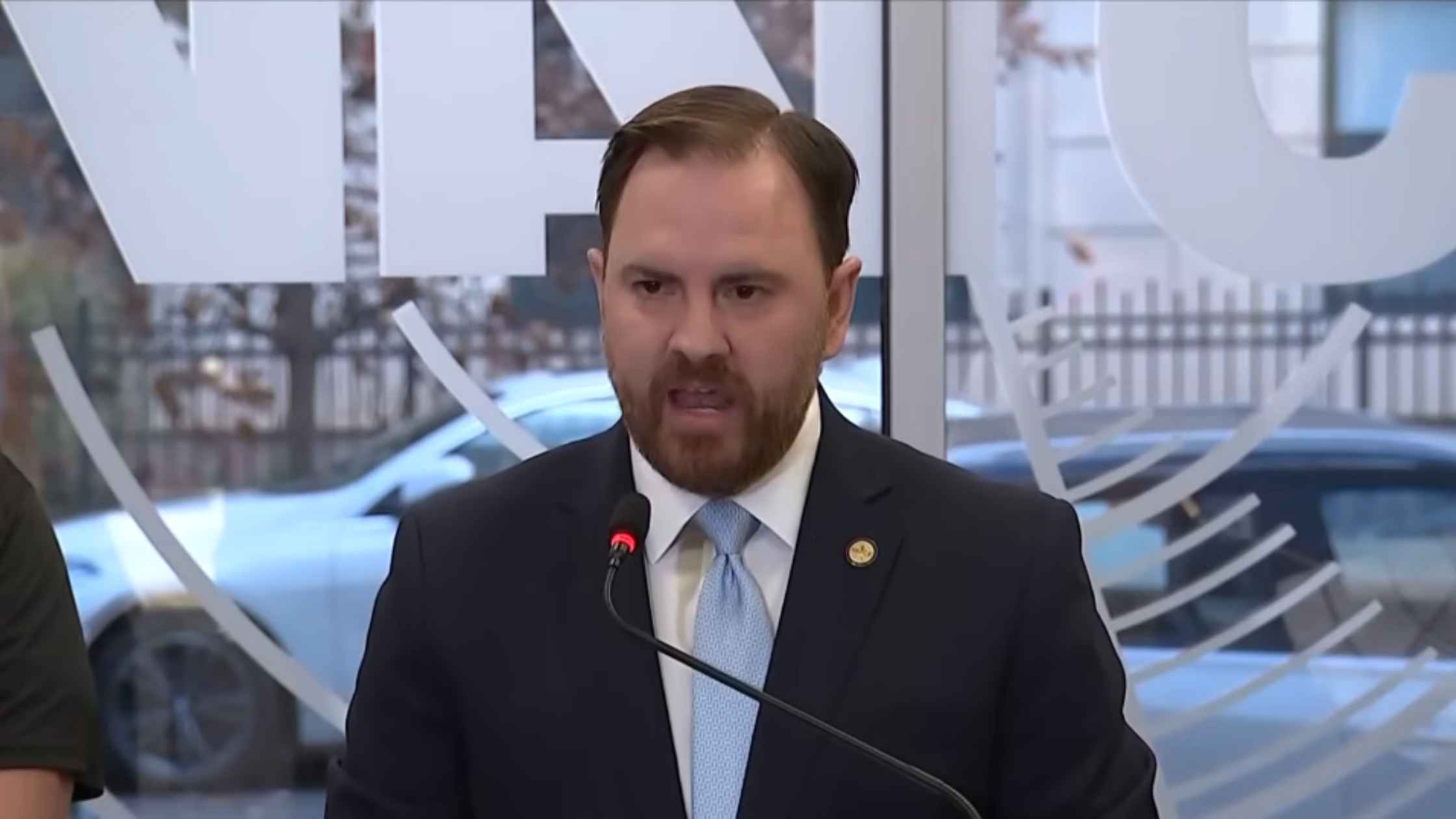


Nick (00:00):
Morning. Make sure the mic's working. Here we go. All right, all set?
Jonathan Misner (00:11):
All set.
Nick (00:12):
Okay. Thank you all for being here. So today marks the 41st day of a federal government shutdown. Now, the longest in American history. Today is also the 250th birthday of the United States Marine Corps and is the eve of Veterans Day. And on behalf of the National Air Traffic Controllers Association and someone who has proudly served five years in the United States Marine Corps, I want to personally thank our military veterans. And on behalf of a workforce comprised of approximately 30% veterans, we want to thank all of the men and women who are currently serving in our armed forces and who protect our freedom and keep us safe every day and deserve to be paid as well. Semper Fidelis to my Devil Dogs out there.
(01:02)
Now with me today is Amy Lark, who has served 18 years in the FAA and is a long-time certified professional controller as well as a traffic management specialist at Potomac Traycon. Also, Jonathan Misner, who has served 17 years in the FAA and is a controller at Manassas Tower. He is also a veteran and served five years in the United States Marine Corps and now as an air traffic controller. Happy birthday to Devil Dog.
Jonathan Misner (01:29):
Oohrah.
Nick (01:30):
So another title that I am honored to have earned is Air Traffic Controller. With 22 years of experience at both the FAA, Tower, and in route, our thoughts remain now with all of those affected by the tragic accident of UPS 2976. This pain is felt across every air traffic control in the land. The crew, the family, and the friends of those who were lost, we're with you and all of our controllers at Louisville Stanford Airport.
(02:04)
But today, it benchmarks the first time in history that air traffic controllers and other aviation safety professionals we represent have now received two $0 paychecks, 41 days without pay. Controllers continue to show up and step up. Despite working full-time during the shutdown and in many cases mandatory overtime, controllers continue to show up and step up for the American flying public and for each other.
(02:36)
On behalf of myself and your NACA leadership, we see you. We thank you for your tireless commitment to safety of our national airspace system, and the flying public. Your sacrifice and perseverance in the face of financial and emotional hardship are extraordinary. Now, air traffic control is one of the most mentally demanding and high consequence professions in the entire world. Every moment that we are at work, it requires everything we have: focus, judgment, decisiveness, perfect decision-making, thousands of times a shift. And what hangs in the balance is our responsibility to safety in order to prevent tragedy.
(03:27)
Air traffic controllers must show up day in and day out, fully prepared, and to handle the stress, pressure, and the weight of their responsibilities to the American flying public and their safety. For decades, air traffic controllers have held the line through staffing shortages, outdated equipment, hiring freezes, terrorist attacks on September 11th, pandemics, and every crisis that this country has lived through, they have kept their focus, their composure, and their commitment to safety. But now they must focus on child care instead of traffic flows, food for their families instead of runway separation.
(04:13)
This is not politics. This is not ideology. This is the erosion of the safety margin the flying public never sees, but America relies on every single day. The added stress leads to fatigue. The fatigue has led to the erosion of safety and the increased risk every day that this shutdown drags on. If you want to know what the real fallout of this shutdown is, it's not a budget line, it is the smallest and the most dangerous shift of all, when the most disciplined safety workforce in America is forced to think about survival instead of public safety.
(05:00)
This is the cost. This is not theoretical. It is happening now in real families, in real control rooms, in real time. Now history will remember who is responsible for the shutdown. The public and media will debate who won. But we all know who carried the weight of it and who has to pick up the pieces when it finally ends. It's us. The federal workforce that has been the rope in this game of tug of war.
(05:33)
Now let me be clear, not just air traffic controllers and aviation safety professionals or federal employees, no American should ever be forced to work without a paycheck. To not pay someone for the work that they have performed is un-American and failing to pay that workforce that keeps our sky safe is not acceptable and it is not sustainable. We embrace the responsibility we hold and the trust we are given. This past weekend, air traffic controllers insured that over 7.3 million passengers arrived safely and flying over 113,000 flights, and they all arrive safely at their destinations.
(06:24)
They did this despite continuing to operate with 3,800 fewer fully certified controllers than the system requires. And this is not a new issue. NACA has been advocating for increased controller staffing for more than a decade. Secretary of Transportation, Sean Duffy recognized this concern and implemented plans to supercharge controller hiring and modernize the air traffic control system. And we've shared the same vision. We also thank him for his outspoken support of air traffic controllers and for ending this shutdown.
(07:00)
The effects of this shutdown have real consequences for hard-working, patriotic, American workers. Last Friday, we delivered over 1,600 handwritten letters from our members to the congressional offices expressing the hardship that they are experiencing. These are not statistics. These are the lives of people who keep this country moving. One of our members recently moved from Alaska to Illinois and is in training at her new facility. Her husband of 20 years is a five-time combat veteran who has 45 documented explosions and seven direct hits in his service record. He returned from Iraq and Afghanistan with a traumatic brain injury diagnosis and 100% permanent and total service related disability.
(08:00)
Consequently, she is the single source of income for her family. Their son just graduated from Navy A school fourth in his class, but they could not afford to attend his graduation. She's plagued by financial insecurity and in addition to training at her new facility, she has sold plasma twice, started delivering for DoorDash and recently took a part-time job on her regularly scheduled days off or day off.
(08:32)
A NACA member in Nebraska pays a $2,800 copay for a specialty medication to treat his wife's autoimmune disorder and prevent it from becoming crippling. After a month without pay, he's unsure how he's going to pay for the basic living expenses and his wife's medical needs. We've heard from recent graduates of the air traffic control training in Oklahoma. They are resigning and cannot begin this challenging new career without a paycheck. We've heard from other air traffic controllers that are struggling to find ways to pay for gas and to get to and from work while others are struggling to pay for child care so they can go to work.
(09:20)
These are real people. They're real Americans. And they are facing real problems. They deserve better and they absolutely deserve their pay. The aviation safety professionals we represent are doing everything they can to continue to show up and deliver America's passengers and cargo safely to their destinations. Congress must act immediately and end the government shutdown and ensure that all individuals who have not been paid during this prolonged closure receive their compensation. Enough is enough. Now, thank you and I'll be happy to take your questions along with Amy and Jonathan. Go ahead.
Speaker 3 (10:08):
Even if Congress strikes a deal to end this government shut down, how soon do you think you'll have enough air traffic controllers back working to avoid the cancellations and delays that they're seeing?
Nick (10:17):
Well, air traffic controllers are showing up every day right now, day in and day out, doing an amazing job that they can. What we're going to have to find out is how many actually resigned, how many retired due to this shutdown, and truly start assessing all the different impacts this shutdown's had. Yes.
Speaker 4 (10:33):
Do you have a sense of how many recent graduates have resigned already?
Nick (10:38):
We only have reports. I've talked to Secretary Duffy. We knew over last week it was four to five that had already resigned and growing by the day. Go ahead.
Allie (10:47):
Hi, Allie from Bloomberg News here. I wanted to ask if the, obviously there's a deal right now that's being worked through Congress, hopefully it passes. But if that's passed, when's the soonest that controllers would get paid?
Nick (10:59):
We don't have the exact timetables because we don't know when the government will fully… Give him just a moment, make sure he's okay. All right. We don't know when the government fully opens up and what the pay schedules will look like. All's I can reference is what happened in 2019 and it took air traffic controllers approximately two to two and a half months to be able to be made whole from all of their compensation.
(11:21)
They'll receive some early on compensation based off of previous pay, but then going back and air traffic controllers then having to weed through paycheck after paycheck to see were they compensated for all the time that was missed. Yes, sir.
Sam (11:35):
Sam with Politico, Secretary Duffy yesterday said DOD had offered military air traffic controllers to use. He was unsure if he could use them for the civilian airspace. What's the status of this idea? What is NACA heard from DOD?
Nick (11:48):
We haven't directly engaged with it, but air traffic controllers across the country go through a rigorous training process. They're highly skilled, highly trained, and that would take quite some time to have anyone else control the airspace that FAA controllers do in a day in and day out.
Sam (12:00):
And is NACA's understanding that FAA ordered flight cuts to 40 airports will continue to be phased in and ramped up this week despite the deal in the Senate?
Nick (12:09):
Administrator Bedford and Secretary Duffy would be the ones to determine if that process is going to move forward. Yes, go ahead, sir.
Tom Costello (12:17):
Hi Nick. Tom Costello with NBC News. Assuming, assuming, and hopefully you all do receive a paycheck quickly, assuming that the shutdown ends, how long will it take for your workforce, for your controllers to feel like they've got their head clear that they're back in the game, that they're able to go in and not have that distraction? In other words, is there a residual lag time before your controllers truly are back feeling like they're back in the game and able to concentrate solely on the job?
Nick (12:47):
Yeah. This is one of the worlds where this shutdown isn't a light switch. It's not just on and it's not just off. Air traffic controllers have to go in and be perfect every single day and they know, based on what is in the current bill, that January 30th will loom around the corner. Being made whole and being able to be back up is knowing that every shutdown that you could possibly be the political pawn never puts controllers completely at ease, but getting them paid is the priority so they can live their lives and ensure that they have the proper compensation.
(13:19)
It's the right step in the right direction. Whatever it takes to open this government and pay our members is what's needed right now. And we'll have to continue dealing with the fall-outs and what the added stress and pressure that this has caused. Go ahead.
Dean Shepardson (13:32):
Nick, Dean Shepardson from Reuters. The secretary said that the safety data has been going in the wrong direction and suggested that controllers are making more mistakes, they're fatigued, with the runway separation, ground incursions, and so on. They also cited reports that pilots filed. Have you seen this data? Do you think that's accurate, that controllers are not performing as well as they did pre-shutdown?
Nick (13:53):
I haven't seen the data specifically, but I can tell you every day that this shutdown, it goes on, that an air traffic controller had to survive 41 days with financial insecurity. That leads to added stress, frustration, pressures where air traffic controllers cannot be 100% focused on their job. They're not a political pawn. They shouldn't be used as a rope in this game, and they know it. They feel it. And absolutely, every day that this drags on that we have to worry about the stress and the pressure on them.
(14:23)
For a workforce that has to go in and be 100%, 100% of the time, there is no world where it just operates the same and smoothly when people aren't receiving pay. So it's something that concerns us. It's something we've been speaking about and it's something that's been real since day one of this shutdown. Go ahead.
Speaker 9 (14:37):
[inaudible 00:14:39] with The New York Times. Can I ask two [inaudible 00:14:41]?
Nick (14:37):
Absolutely.
Speaker 9 (14:42):
Thank you. Okay. First one. There are obviously in the midst right now of ramping up these flight restrictions at the port airports. We don't know if that's going to continue on or not, but is something that's actually making an appreciable difference or would make an appreciable difference in a certain threshold for the controllers as Secretary Duffy has said, he's trying to do?
Nick (14:58):
Secretary Duffy and Administrator Bedford will have to review what each and every one of those restrictions does and what it looks like and are they getting the results? They see air traffic controllers show up to do our job day in and day out. One plane or every plane in the sky, we're going to do everything we can to ensure the safety of the American flying public. And the administration will have to determine what that looks like.
(15:19)
But I can say that we have made it very clear that every day that there shutdown was to go, that's going to be an increased risk in the system. When there's increased risk in a system, there's two ways that you can handle it. One is open the government and paying the air traffic controllers and aviation safety professionals. Two is you have to look at the capacity of the airspace and how many flights that air traffic controllers are handling every single day.
Speaker 9 (15:45):
And the second one is just, I know at the beginning of the shutdown you were very clear about warning members don't try to do any sort of organized action that would be illegal. There have been a couple of tower facilities that have had a very large number of people calling out at the same time. Secretary Duffy highlighted Atlanta yesterday between 22. We've seen that happen, Newark, Chicago, Los Angeles at times during this shutdown. What's your explanation for what's going on there? Are there small organized happening or is there another explanation for why we see these concentrations of a lot of controllers in one space not having absences [inaudible 00:16:18]?
Nick (16:18):
We absolutely do not condone any or support any level of a organized action. There are no organized actions going on. If there are issues in this system that are resulting from the shutdown, they have to be determined and discussed and addressed by the FAA every single time that something like this goes on. What our members are facing are issues, right? We use the term "call in sick" so loosely with the federal workforce that are the accept employees that have to show up, they're facing real issues.
(16:49)
We have letter after letter talking about the impacts this shutdown that is having on them that they can't pay for gas to get to work, that we have trainees that have moved hundreds if not thousands of miles across the country to the highest cost areas of living and now can't even afford to go to work or they can't afford the childcare to come into work. That is real. And it's not something that can be looked at or it's not something that can be diagnosed because it's going to be moving around the country, different people, different shifts, different issues in their life every single time.
(17:22)
And speaking about that, I did want to give Amy a chance to speak about just those pressures right there. She comes from a dual, both her and her husband work for the FAA and what that's kind of caused. So Amy, if you'd like to address that.
Amy Lark (17:37):
So my husband and I are both air traffic controllers. Now having missed two paychecks, that uncertainty, and that financial strain is becoming unbearable. It's now a dinnertime conversation with my kids on prioritizing bills. Yesterday my kids asked me how long we could stay in our house. Having to answer that question was heartbreaking, but it's not just us that's dealing with that. That stress, that uncertainty, that fear is being felt among thousands of air traffic control families across the nation.
Nick (18:09):
By all means. Thank you.
Speaker 11 (18:10):
Amy, can I just ask you while you're still there, can you speak a little bit more about the personal stress and what this is doing to you and to your family? You mentioned a little bit there, but just every single day going to work with this hanging over you. What have you had to juggle? Have you had to juggle, I don't know, going to the grocery store or putting gas in your car or diapers? Can you talk a little bit about that?
Amy Lark (18:33):
Absolutely. So we work in an environment that requires that 100% focus and presence and then having to have those conversations at home with your family, with your kids, explaining that, "Hey, Christmas might look a little bit different this year." Right? That's difficult on the family. That adds a stress that we've never had to deal with in the past. So when you walk into an operation and you know your coworkers have taken a second job, they're up till midnight driving Uber because they can't pay their bills. Everyone's questioning if they can pay their mortgage.
(19:01)
I have coworkers who cannot pay for childcare, so now they have to figure out how they're going to come into work. That uncertainty, that fear creates a distraction that no air traffic controller should have to carry when we're ensuring the safety of the flying public. But that being said, we are 100% committed to our jobs. Every flight that we handle is our number one priority and the safety of that flight. We just want to do the work that we love, continue serving the flying public, but not have to question how we're going to pay bills and make ends meet.
Nick (19:32):
Thank you. Did I miss somebody back here? Go ahead. I'll come right over here next.
Sarah Ploss (19:38):
Sarah Ploss with CBS News. You talked about this a couple different ways, but I'm just curious, as we are approaching the possibility of the government shutdown ending today, do you see a world in which we see less staffing triggers and staffing improves by the end of this week? Or do you think that is going to continue to carry on as this kind of peters out?
Nick (20:04):
I think we've seen a shutdown go longer than any time in history, and every single day it's presenting a new challenge. You can't predict what the issues are because again, if the shutdown is to end tomorrow, controllers still haven't been paid yet. They're still facing those issues. While the rest of America will get to go on and that will no longer be the headline or the news headline, it's still real for them. So we're going to have to continue working through the issues. And our focus is it's not ended. Even though that there is a new light at the end of the tunnel, we'll call it that, every single day an air traffic controller is still facing the issues that they had yesterday and they're getting worse every single day.
(20:50)
So we will continue to work with the administration, we'll continue to fight for it, and we'll continue showing up to work to ensure the safety of the American flying public. And we will do everything to get it back fully on track. But it should show that a government shutdown is not sustainable and in no way should air traffic controllers ever be used as a political pawn in the process.
Speaker 13 (21:11):
Reagan National, Friday had the most cancellations, according to the FAA, it was because of staffing. Just to clarify, is that just people calling out sick? Is that people can't afford to go to work? Is it in a way protest? Is it a combination of that?
Nick (21:25):
Just so everyone knows, before the shutdown, air traffic controllers got sick. During the shutdown, air traffic controllers get sick. After the shutdown ends, air traffic controllers will get sick. And DCA is an extremely low staff facility. Every day that they show up, they're already starting well below what they should. So one to two persons being gone, whether that they had to take medication for Benadryl for the allergy season that's going on, they can't work that day. They have a stringent requirement to show up to work fit and ready for duty. That could be the added stresses and pressures of it. Every person's dealing with a different level of financial stability or instability. So some of those issues may be real, but again, it just goes to show how fragile this system is and putting this additional stress and pressure on it. We're going to see that level of issues that we have to contend with.
Speaker 14 (22:20):
Do one more question. Could Jonathan say something also?
Nick (22:22):
Yeah, I'm going to, by all means, here in just a moment.
Speaker 15 (22:25):
I was just going to ask, kind of following up on that, in terms of what are you seeing as the most vulnerable areas in terms of where the staffing triggers are hitting the most? And are you seeing in the New York area, first of all, we're seeing a lot of these staffing triggers, is that because of the same reason as DC where they're already sort of short staff?
Nick (22:43):
This country is short-staffed right now. We're 3,800 certified professional controller short. 91% of our facilities do not have the proper staffing. Over 41% of our facilities work a mandatory six-day work week, 10 hour days. That is what you're getting to see day in and day out is how few controllers actually run the system to keep it moving at what they do. And they should be lauded for the work that has been done and now getting to see the disruptions that it causes to lose one or two, absolutely proves why the long-term commitment to the hiring and training of the next generation of air traffic controllers is needed now more than ever and why this shutdown has to end. Speaking about the recruitment, retention, the bringing in of new air traffic controllers, Jonathan has several trainees at his facility recently attended a career day affair as well, I'd like him to speak a little bit about that and the impacts of the shutdown. Johnathan.
Jonathan Misner (23:40):
Thank you. Yeah. The impacts of the shutdown are real. In my facility, we're a training facility, we send people to the bigger and larger facilities. We're an influx. They come in, they get out. And now we have guys who are, they're all Gen Z. They're 23, they're 24. They're living with their parents already. They can't afford to live on their own already. And this has just made the situation 10 times worse. I had a career fair three days ago, I've done it for years. It's high school students, 9th and 10th grade year olds coming to learn about air traffic. Were very popular. This was the first year I didn't have answers to their questions.
(24:10)
The kinds of things they were asking us, why we should do this job, what are we looking for in the future. Were things I didn't want to say. I told them how wonderful the job is, how great we are, how dedicated we are to the career field, how dedicated we are to our community, and how dedicated we are to each other. And that's what we're doing and that's why we're still here.
Tom Costello (24:24):
Hey, Nick, can I have real quick?
Nick (24:27):
Yeah.
Tom Costello (24:27):
So on Halloween we saw 80% of the controllers-
Nick (24:28):
Excuse me.
Tom Costello (24:28):
Yeah.
Nick (24:28):
Thank you, brother.
Tom Costello (24:31):
Nick, on Halloween we saw 80% of the controllers at New York's not show up and the administration said 20 to 40% of controllers at any given day are not showing up at the 30 largest airports. Do you think sort of the controllers hit a breaking point at that point? What do you think accounts for the significant increase in outages over the last say 10 days or whatever?
Nick (24:49):
Well, let's be clear, that statistic, I don't know it to be true, about 80%. When you only have four controllers and you have two of them that can't make it to work, you're at 50%. Some of our facilities have only three or four controllers on a shift day in and day out. You've seen the delays that are because of it, and now you're just getting to see it nationwide when people are missing it. The true issue is people not getting paid. That's the issue. And the only solution to it is ending the shutdown and ensuring that they receive the compensation and pay that they rightfully deserve.
(25:26)
There is no world that exists where you can't pay people and run the system the same. Issues are going to crop up. They're going to crop up across the country in the absence of one or two controllers, it's not a matter of breaking them, it's a matter of them being fit and ready for duty and being able to show up and do the amazing job that they do day in and day out to serve the American public. They are the unsung heroes. They are the American patriots that Secretary Duffy talks about, and they are doing everything they can to hold this system together and be out there serving the American public during these trying times. But 41 days without pay is unacceptable.
Speaker 16 (26:03):
Really quick, in the last two minutes, President Trump posted on Truth Social, very long, so I'll just read part of it, "All air traffic controllers must get back to work now. Anyone who doesn't will be substantially 'docked'. For those air traffic controllers who were great patriots and didn't take any time off for the Democrat shutdown folks, I'll be recommending a bonus of $10,000 for distinguished service to our country." Just came out any initial response to that.
Nick (26:29):
So I'll take anything that recognizes these hardworking men and women, but we'll work with the administration on any issues that are out there. Air traffic controllers have continued to show up during this shutdown. They've endured the longest shutdown in American history and every single day they absolutely not only deserve their pay, they deserve to be recognized for what's going on. So we'll work with the administration through it, we'll work through the issues that are going on and we want, just like the rest of the American people want, this shutdown to end. The frustrations that are out there are real and we share them because we're frustrated with the process as well. Again, air traffic controllers should not be the political pawn during a government shutdown.
Speaker 17 (27:10):
Okay, great. Thank you everybody for that. Some of you have requested pull-asides, let's discuss those and we'll take care of that. But thank you for that, that's the end of the press conference.
Nick (27:20):
Thank you. Appreciate it.