
Speaker 1 (00:36):
Please welcome to the stage Alex Hardy, CEO of MAHA Holdings.
Alex Hardy (00:59):
Hello everyone. Welcome, welcome. I am Alex Hardy, the CEO of MAHA Holdings. And we are so thrilled to have each of you here at the inaugural MAHA Summit. Finn Kennedy and I have been on nonstop calls for the past two months, working very hard to make today happen. So thank you so much to Finn and all of our incredible staff who have worked day and night to pull this event off. It is now my great honor to introduce the inspiration to this movement, the man deeply committed to making America healthy again, Secretary Robert F. Kennedy Jr.
Robert F. Kennedy Jr. (02:31):
Thank you.
Speaker 1 (02:31):
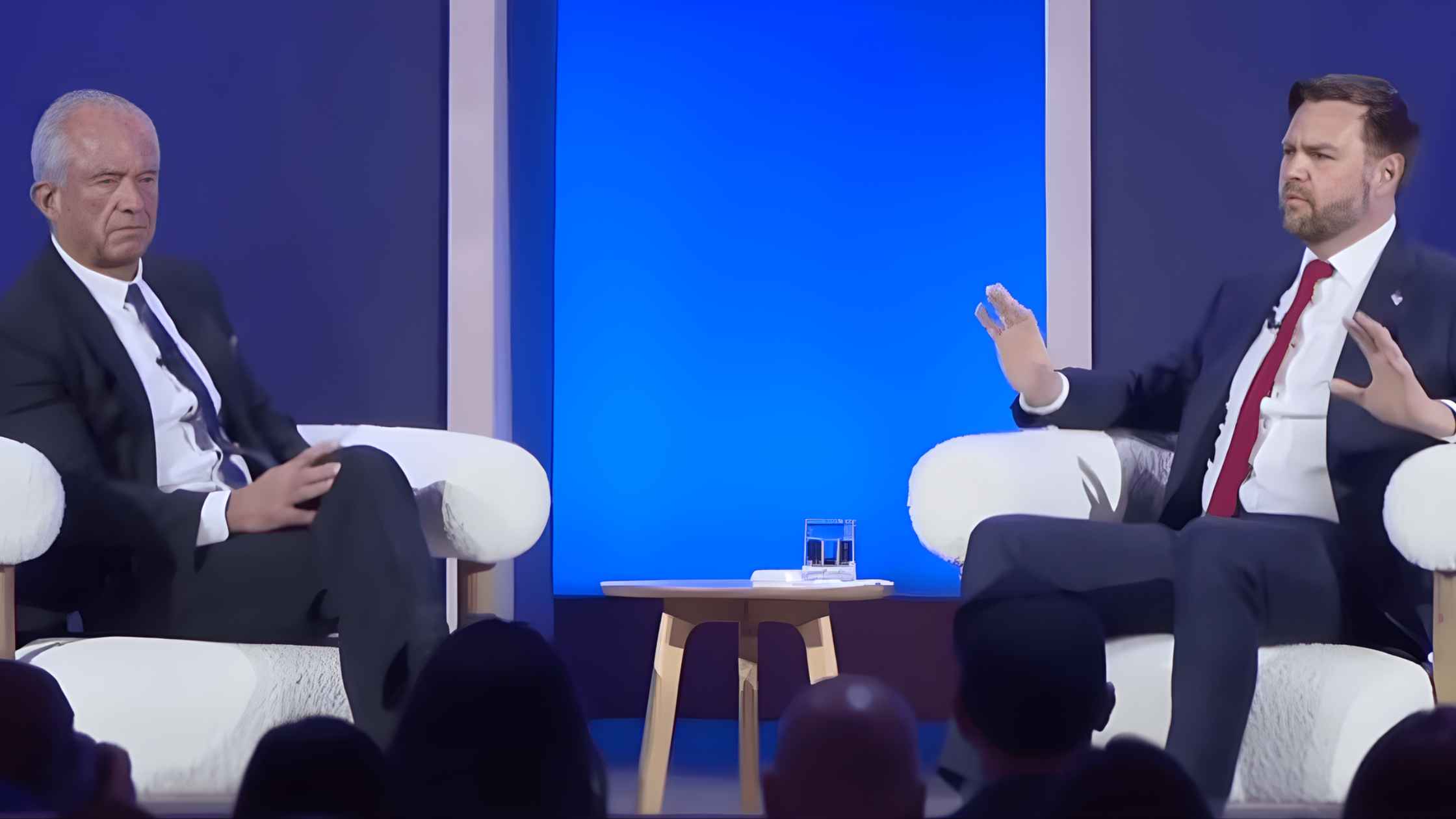
Please welcome the 50th Vice President of the United States, JD Vance.
JD Vance (03:00):
Thank you all.
Robert F. Kennedy Jr. (03:00):
Welcome Mr. Vice President. And I want to thank everybody here for taking this day to convene such an extraordinary group of people, a really unprecedented caliber of people who are in this room today. And one of the great things about working for President Trump is that we've been able to recruit people like Chris Klump and Marty Makary and Jay Bhattacharya and Mehmet Oz, and people at every level of the agency, many of who are stepping away from billion-dollar companies to come and work for us, not because they're looking for position or power or security, because they see this as a generational opportunity to change our country and put us on a better course. And a critical part of us achieving that goal is the partnership with private industry, with the entrepreneurs, the innovators who are trying to do the same thing. And you come out of that tradition. You really have an extraordinary life. But how do you see that in other parts of the government, this partnership that we've been able to make with private industry?
JD Vance (04:19):
Yeah. Well, first, Bobby, thanks. It's good to see you. And great to be with everybody. It's an amazing, I think not just a event, but really a movement that you put together. And it's been a critical part of our success in Washington. So thank you for having me here for just a little bit. When Bobby invited me to speak, I of course said that I was honored to come and happy to do it, but only if we did an interview as opposed to a speech. Because with a speech, you have to think about what you're going to say, where an interview, I just have to answer your questions. I don't have to think at all to do an interview. That's great. So one of the, just to answer that question, so obviously if you go back to the MFN stuff, meaning most-favored nation drug pricing, that really has happened because the President and Bobby and a number of members of the team have been actually working with private industry to lower the cost of prescription drugs for American citizens.
(05:11)
Now, it would be great if we could get congressional Democrats to actually do something meaningful with us. Because you would think, you think Democrats, they like to say that they're for the working people, against the big pharma companies, so you would think that legislatively they would want to work with us, but it's actually been hard to get them to work with us. So we've had to sort of go outside of the system and work with private industry to do some of this stuff. And I think you guys have done an incredible job with that. But if you look at a lot of our most important health initiatives, they've come through partnership with private industry in some form or another.
(05:43)
And I also think that there's a mindset shift where you mentioned some of the people like Marty, like Jay, who have been such a critical part of what you've been doing. The thing that I love about the team that Bobby has put together is yes, a lot of them have a sort of a private sector mindset. They just want to get things done. They don't care about the bureaucracy or they don't care about all the people saying no in government, because as Bobby and I have learned, there are a lot of people saying, no, you're not allowed to do that or no, you shouldn't do that. And we just have to punch through that in order to achieve results for the American people. But I also just love that Bobby has put together a team of people who are not terrified to think about things in new and interesting ways.
(06:20)
And if you think about what has been so broken about the public health bureaucracy in this country for years, for decades, generations even, it's that people think in incredibly conventional ways. And if you bring them a non-conventional idea, their automatic assumption is no, no, no, no, we're not allowed to talk about that, much less fund something related to that. And I think it's maybe the most important thing of all the specific initiatives that you guys have worked on effectively, the most important thing is that your team is willing to ask questions that people in government haven't been asking in a long time. And if you think about how unhealthy the American population has gotten over the past 20 or 30 years, you're not going to fix that problem unless you have people at the table who are asking different questions than the ones that were asked 20 years ago.
Robert F. Kennedy Jr. (07:07):
Yeah, I mean, that's one of the… Thank you. One of the interesting things about working with this president is that we're coming into these bureaucracies that have constructed these orthodoxies and it's just a series of very narrow Overton windows that you're not allowed to bring the conversation out of that or you get destroyed.
JD Vance (07:32):
That's right.
Robert F. Kennedy Jr. (07:33):
And now we're working for a president who just takes a bulldozer to Overton windows and shocks us every day. And then we go, okay, well…
JD Vance (07:46):
That's exactly right. That is a good summary of Donald J. Trump is that he takes a bulldozer to Overton windows every single day. But it had to happen. It just had to happen. And if you look at so many of the things that are happening on the public health side, I mean, one of the criticisms that Bobby will always get, and I always think it's such bullshit, excuse my language. I'm not sure if I'm allowed to say that. It's probably coming… I apologize to everybody who's watching live on Fox News. Hopefully they were able to bleep that out. But anyway, is sometimes there's this attack where people say, well, this or that conclusion is not supported by the science or this or that conclusion is a conspiracy theory. And science as practiced in its best form is that if you disagree with it, then you ought to criticize it and you ought to argue it against it. But you can't shut down the debate.
(08:40)
And that really is, if you look at all of the big public health debates that we've had in this country over the last 20 or 30 years, it doesn't bother me that they disagreed with something that I believed or disagreed with something you believed or any of you, it's that they tried to silence the people who were saying things that were outside the Overton window. And as we found out the hard way over the last few years, it was very often the people who were outside the Overton window who were actually right and all the experts were wrong.
Robert F. Kennedy Jr. (09:14):
I had a conversation with Marty Makary the other day, and he reminded me that over the Royal Society, the building, the [inaudible 00:09:22] for the Royal Society in London, which is the oldest scientific society in the world and the most prestigious.
JD Vance (09:27):
Of course.
Robert F. Kennedy Jr. (09:28):
It says question everything.
JD Vance (09:30):
Yes.
Robert F. Kennedy Jr. (09:31):
And that's what science is. It's recognizing that convention is often wrong and that the people who make advances on science, almost a hundred percent of the times are people who are willing to challenge orthodoxies and advance heterodoxies and talk about new ways of thinking. And that these very ossified bureaucracies that now make up the so-called medical establishment are fortified against that kind of change.
JD Vance (10:06):
That's absolutely right. And I mean, to put a slightly different spin on it, a lot of the times, the people who are discovering things interesting and new are a little weird. I mean, American society for a very long time had a willingness to accept unconventional, slightly odd people inside some of these industries, inside some of these bureaucracies. I mean, I've been reading a lot in the past couple of weeks about von Neumann, the Hungarian scientist who came to the United States and was very important in the Manhattan Project. And what I keep on finding myself thinking, I mean, this is a brilliant guy. This is one of the, I think it was Edward Teller or Oppenheimer or another of the Manhattan Institute people said about von Neumann that von Neumann was talking to his three-year-old, and then he realized that he used the same skill, von Neumann did, when talking to a three-year-old as he did with everybody else, because he was so far above everybody else in terms of brilliance.
(11:01)
But then you read about this guy, and I think to myself, half of the shit that this guy said would've gotten him canceled or would've gotten his career ruined or would've had his life ruined. There is no way that this country is going to advance unless we're comfortable with people who are willing to challenge orthodoxy. And that's what I think got so broken, not just about the scientific bureaucracy, but probably it was worse in the scientific area than in most other places, is we've got to be comfortable challenging some of these old orthodoxies. And part of that is welcoming people who are a little unusual, because unless you do that, you're not going to solve America's problems with McKinsey consultants who say everything the right way all the time. No offense. No offense to the McKinsey consultants because many of whom are very brilliant people. But you need the consultant mindset. You also need the person who is just thinking about an idea because it's interesting and it's fascinating and it's not being focused on enough in the right way.
Robert F. Kennedy Jr. (12:03):
You and I have talked a lot about Appalachia, and both of us come from families that are intertwined personally and politically in Appalachia. You're kind of a golden child of Appalachia. You came out, you went to Ohio State, Yale Law School, a uber successful business, a best-selling author, a US Senator, and now Vice President of the United States. But it's almost a kind of tragic reminder of the lost potential of almost everybody else at Appalachia, not only for poor health. It's got the worst health data of any region in the country, the highest cardiac disease, the highest obesity, the highest diabetes, the highest stroke rates, but also addiction, alcoholism, and suicide. It leads the nation for those things. And so I know it's something that you spent a lot of time thinking about, how do we… Because if we can solve problems in Appalachia, we can solve them for the whole country.
JD Vance (13:07):
Yeah, that's exactly right. And the public health stuff in particular is very bad. And if you look at where life expectancy has gotten the worst in the United States, Appalachia is sort of at the top of the list. And the way that I realized this actually, so my dad died of cancer a few years ago. And it was one of these sort of super aggressive cancers, came on very unexpectedly, and then all of a sudden he was gone a few months later. But I was talking with my wife, with Usha about this, and Usha, she was like, "Have you ever had a really important male figure in your life survive to the age of 70?" And I'm looking. Okay, my grandfather died at 67 from a very preventable illness, but 67 from a very preventable, very treatable illness. I think all of my aunts or all of my uncles, and not a single one of them that I could think of made it to 69. Maybe one of them made it to 70 or 71.
(14:04)
And it kind of hit me that if you grow up in Appalachia, you are used to losing the people that you love very, very early on. And you want to talk about populism and you want to talk about people being pissed off. Well, yeah, people are pissed off when they don't have good jobs, and people are pissed off when things disappear and move overseas, and people are pissed off when they feel like other countries are being prioritized over the United States of America. And all of that is part of the populist resentment of the past 20 or 30 years in American politics. You know, what really pisses people off, when they realize that their loved ones are dying much sooner than everybody else. And that is a big part of the story of what's going on in Appalachia and why I think so many people in Appalachia feel left behind.
(14:50)
I mean, my story, obviously, it's been, like you said, I'm like a golden boy. Things have just worked out for me in this really incredible way. I feel so lucky and so grateful for it. But I also feel a certain sense of guilt because there are a lot of people who grew up in families like mine who haven't had an easy life and who haven't had all this economic opportunity and who haven't had a person that they've fallen in love with and they've been able to sort of build a stable, nice family like me and Usha have been able to build. And that gives me a sense of purpose because I want those people to have the same opportunities that I've had. But it also gives me a great sense of anger because we never should have gotten to the point that we are today. And the reason that we have is because of failed leadership and it's failed leadership over generations.
(15:38)
And by the way, these are, you talk about Appalachia, you are talking about people who though they don't have much, would take the shirt off their back and give it to a complete stranger because that's what you do. If you go back to America's biggest wars, World War I, World War II, Vietnam, which are the counties that filled their draft quotas with volunteers instead of with draftees? It's very often the parts in deep Appalachia where you've got grinding poverty, but you've also got this incredible love of country. So if any place in this country deserves not to be left behind, it's Appalachia. But on the public health stuff in particular, the numbers don't look good. And it's one of the reasons why I'm such a big supporter of what you're doing, because these are people who deserve to live better, healthier lives, but they really have been left behind by this country's leadership.
Robert F. Kennedy Jr. (16:28):
Talk a little bit about how MAHA has affected you personally. My grandchildren go to school with your children. And MAHA I think has gotten a lot of people thinking about how they raise their kids, how they feed them, et cetera, how they go shopping. And then maybe to talk a little bit about the political impacts of MAHA.
JD Vance (16:52):
Yeah, so there are so many different ways I could talk about this. I mean, one, I just met Bobby's family backstage, or at least some of them. And I kept on shaking hands with various people, and I'm like, well, you are an Irish Catholic, so it makes sense that you've got a dozen or so people backstage. But I love that. I love big families. But my wife, she's probably one of the original MAHA people, though I don't think that she would've ever used that phrase. Because I remember our oldest son is eight years old, and babies typically eat solid food around six months of age. And I remember when he started eating solid foods and I'm like, "Awesome, let's give him some cupcakes and ice cream." And my wife was like, "No, let's give him carrots and applesauce here." So she was already thinking about health and nutrition in a way that was frankly kind of foreign to me and that I think is very common among the MAHA crowd.
(17:50)
Like you guys are asking the right questions. What are we putting into our bodies? Where was it sourced from? If we're eating animal-based protein, is it coming from a place where the animals are treated the right way? If we're putting medications into our body, are we actually confident that they're doing the thing that they're supposed to do, that they're safe and effective? I just think this whole thing is about asking very critical questions about what we're putting into our bodies, into the bodies of our kids. And it's really affected me in a very profound way and how I think about my own nutrition, about particularly how I think about what my kids are taking.
(18:27)
And I'm like one of these crazy people. The one way in which I'm more instinctively MAHA is that if I have a back sprain or I slept weird and I woke up with back pain, I don't want to take ibuprofen. I don't like taking medications. I don't like taking anything unless I absolutely have to. And I think that's another MAHA style attitude. It's not anti-medication, it's anti-useless medication. We should only be taking stuff, we should only be giving our kids stuff if it's actually necessary, safe, and effective. And I think that's an attitude that's really beneficial to the entire country. Because we do have, you've talked about this as eloquently as anybody, we do really have an obesity epidemic in the United States of America. I think a big part of that is not asking where our food comes from. We really do have medications that I don't think, maybe they're not solving the chronic disease epidemic, maybe hell, some of them are even causing the chronic disease epidemic. We've got to be asking more critical questions about what we're putting into the bodies of our kids. And I don't think we were doing that until this movement came along.
Robert F. Kennedy Jr. (19:33):
The job of the vice president has been called the worst job in the country. And I think-
JD Vance (19:39):
I think we're out of time, ladies and gentlemen.
Robert F. Kennedy Jr. (19:43):
I think for some vice presidents, that that's been true. And I know that President Johnson during my uncle's tenure felt that he'd been sidelined. And I think Spiro Agnew and Gerald Ford felt the same way with Nixon. But then you had presidents like, well, you had vice presidents like Dick Cheney who seemed to be actually running the country. And then you had these relationships with-
JD Vance (20:09):
Not very well it turns out.
Robert F. Kennedy Jr. (20:11):
… with Al Gore and Bill Clinton and Mondale and Carter who had close personal friendships. You have an amazing job because you have a president who clearly puts tremendous faith in you. He relies on you. He's given you an extraordinary retinue of responsibilities. Talk a little bit about how your relationship with the President has evolved.
JD Vance (20:43):
Yeah, that's a great question.
Robert F. Kennedy Jr. (20:44):
Has clear to all of us in the cabinet how much affection that he has for you and how much he relies on your wisdom.
JD Vance (20:50):
Well, it's interesting. You're exactly right that the job of vice president is incredibly contingent on the president that you're serving under. And you could have a president who effectively just passes off big swaths of responsibility. You could have a president who delegates. You could have a president who has no trust in their vice president, Kamala Harris, and so it doesn't go very well for that particular vice president. But I think there are two, so there are two ways that I try to think about my job with the President of United States. Number one, he requires honest counsel. In other words, if I have an opinion on something, whether I agree or disagree with the administration position, it's really, really important that I talk to the President about it. He doesn't want yes men. And I think it's one of the reasons why you guys have a great relationship is because you're always thinking about how can I actually give the President the best counsel?
(21:47)
But then the second thing is when the president makes a decision, your job is to execute. It's not to run to the papers and say, "Well, actually, I disagreed with this decision," or run to the Congress and bad mouth the administration. It's to execute. And I think the reason why the President has trust in me is because, yes, I absolutely tell the President what I think about a given issue. But I also recognize I'm the vice president, he's the president, and when the President of the United States makes a decision, it's time to go and get it done. And I think in part because I get things done. I mean, sometimes Congress doesn't cooperate, sometimes the private sector doesn't cooperate. I'm not saying any of us have a batting average of a hundred. But what I think all of us who've earned the President's trust do is that when the administration makes a decision, when he makes a decision, we actually go out and get it done.
(22:37)
And that's why this job has been so empowering for me, is because the President trusts me. He knows I'm going to give him on his counsel. He knows that if he asked me to go get something done, I'm going to try my best to actually go and do it. And that's why we have a good partnership. I think that's why the administration has been so effective this time around is because there are a lot of people with a very wide diversity of opinions, but we get out there and we try to do the best job for the American people and the President of the United States. And because of that, there's a lot of trust and there's a lot of affection in the cabinet. I mean, you've seen this, I've seen this. But when we're sitting in there and the cameras are off and we're just talking about an issue, there is a deep level of affection and trust between all the senior members of the team. I don't know how it's possible to do this job without it, but I know it's why we've been so successful the past 10 months.
Robert F. Kennedy Jr. (23:26):
Now we've come to the lightning round.
JD Vance (23:27):
Great.
Robert F. Kennedy Jr. (23:30):
Marine Corps workout or Pete and Bobby Challenge?
JD Vance (23:35):
That's tough, man. So it's…
Robert F. Kennedy Jr. (23:38):
You don't have to answer.
JD Vance (23:43):
So I would say Marine Corps workout, especially for me. The one thing, so I can do five dead hang pull-ups. I have longer arms. I'm a little fatter than I should be. And especially 10 years or so ago, I got a little out of shape. And so it's actually the Marine Corps physical fitness test has been an incredible guide post to me getting back in shape. And it's basically, you run three miles, you do a hundred crunches, or now instead of crunches, they do it's this weird planking exercise that's a core exercise and then pull-ups. But I felt like that's been a very good focus. The Pete and Bobby Challenge is for people who are in as good shape as Pete and Bobby, which is not yet me, but that's my goal. My goal is to get there.
Robert F. Kennedy Jr. (24:32):
Who's the funniest guy on the cabinet?
JD Vance (24:35):
Well, obviously the President of the United States. I mean, so beside him, I mean, look, we all have different views on this. My personal vote for funniest person outside the President is probably Marco.
Robert F. Kennedy Jr. (24:48):
Yeah, Marco.
JD Vance (24:49):
He has an incredible sense of humor. He's got great comedic timing.
Robert F. Kennedy Jr. (24:52):
Arrival.
JD Vance (24:53):
Yeah, that's right. That's right. Well, there are a couple others. Look, very good senses of humor on the cabinet.
Robert F. Kennedy Jr. (25:00):
There's a lot of funny people.
JD Vance (25:01):
There's a lot of funny people. I think Marco is the funniest outside the President.
Robert F. Kennedy Jr. (25:02):
He said something that makes everybody laugh.
JD Vance (25:02):
Correct.
Robert F. Kennedy Jr. (25:06):
He's funniest during the cabinet meetings.
JD Vance (25:06):
That's right. Well, I mean, I don't know if you saw this video circulating on social media, but the President met the president of Syria, al-Sharaa, in the Oval Office a couple of days ago, and he asked him, he's like, "Well, how many wives do you have?" And it's just like, oh, what an amazing question. Amazing comedic timing. There are layers to it. There's like a meta-humor to it. It's just, anyway. But we've got a lot of good humor in the cabinet.
Robert F. Kennedy Jr. (25:41):
One of the funniest moments in any cabinet meeting, President Trump had them bring in a full-size picture of himself with Putin and when they were in Hawaii. And he's very tall and Putin was very short. Putin came up to about here. And he said, "You know what I said to him?" He said, "I've had enough to hear with you."
JD Vance (26:08):
I remember that.
Robert F. Kennedy Jr. (26:11):
There were eight presidents from Ohio. How many can you name?
JD Vance (26:16):
Oh.
Robert F. Kennedy Jr. (26:16):
This is unfair.
JD Vance (26:17):
That is a totally unfair question. I regret coming to this event based on that question. Okay.
Robert F. Kennedy Jr. (26:23):
None of them, well, with one exception, none of them-
JD Vance (26:25):
Okay, so obviously U.S. Grant. I have a particular affinity for him. Both of us have beards. Rutherford B. Hayes.
Robert F. Kennedy Jr. (26:34):
Good.
JD Vance (26:35):
Was Cleveland Ohio or was it somebody else?
Robert F. Kennedy Jr. (26:37):
I don't think Cleveland was.
JD Vance (26:39):
Okay. The problem is a lot of the Ohio ones are frankly the range of presidents where nobody can name them.
Robert F. Kennedy Jr. (26:46):
Yeah. Except for Grant.
JD Vance (26:47):
Yeah. Most people can go up to Jackson and then they know there's sort of Lincoln and Grant, and then there's a black hole of presidents. Those are the Ohio presidents. Please don't judge my home state because it was a different time in the country. So the answer is apparently two.
Robert F. Kennedy Jr. (27:05):
Did you read Chernow's biography of Grant?
JD Vance (27:08):
I did. Incredible. One of my best friends actually gave it to me four or five years ago. Incredible book.
Robert F. Kennedy Jr. (27:14):
It is.
JD Vance (27:14):
And he was an incredible guy.
Robert F. Kennedy Jr. (27:16):
It makes you fall in love with Grant.
JD Vance (27:17):
Absolutely. And people, he was attacked after he died by a lot of his political opponents. A lot of what I learned in grade school and high school history about Ulysses S. Grant is actually fake. He was a great general. He was also a great president.
Robert F. Kennedy Jr. (27:32):
Thank you very much, Mr. Vice President.
JD Vance (27:34):
Thank you guys. Thanks, Bobby.
Robert F. Kennedy Jr. (27:34):
Thank you all for being here.
Speaker 1 (27:36):
Lunch and light refreshments are now available in the pre-function space. Please enjoy and kindly plan to be back in the ballroom as our next session will begin promptly at 1:30 PM.