



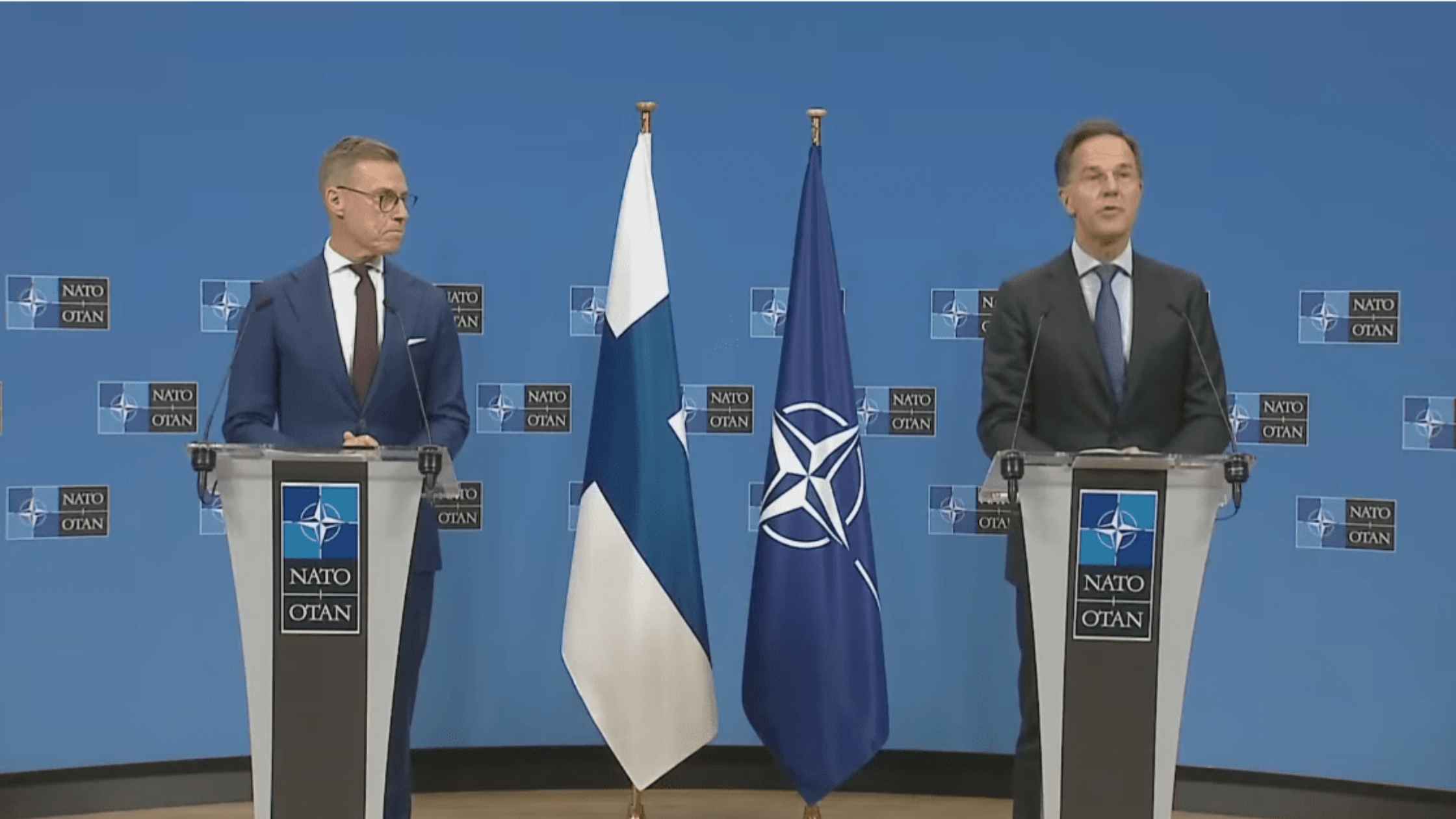


Mark Rutte (00:01):
Finland has always recognized the importance of security and you know what it takes to deliver it. You spent over 2.4% of GDP on defense last year and will spend over 2.7% this year. And together with Sweden, you are establishing a new NATO forward land force in Finland that will further reinforce NATO's posture. And of course, I welcome the new Multi-Corps Land Component Command in Mikkeli, which will plan, prepare, and run the activities of NATO land forces in Northern Europe.
(00:40)
Finland contributes to air policing over Iceland this February and Romania last year. And most recently, you deployed a counter drone detachment in support of Denmark. You also contribute to Baltic Sentry, which we launched in January in Helsinki to address threats to our critical undersea infrastructure. This effort has been remarkably effective and it is a valuable complement to the work that Finland and other allies around the Baltic undertake in their national capacities.
(01:15)
Finnish expertise in the High North is crucial. Last week, the Deputy Secretary-General joined the first Arctic Space Forum in Helsinki to advance work on space-based capabilities and strengthen deterrence, resilience and situational awareness in the Arctic.
(01:34)
Russia continues to wage a war of aggression against Ukraine. Ukraine continues to defend itself with courage. Allied support, Finland's support is making a difference. Since the start of Russia's full-scale invasion, you have provided roughly 3.8 billion euros in support, including more than 2.8 billion in military aid, artillery, armored vehicles, air defense and ammunition. And this year, you launched a three-year program to supply Ukraine with materiel from Finland's defense industry.
(02:12)
Along with Baltic and other Nordic allies, you helped start a new initiative to train and equip a Ukrainian brigade. And you recently committed 100 million euros to Prioritized Ukraine Requirements List, PURL, enabling the delivery of urgently needed military equipment from the United States to Ukraine. Economic pressure also matters. The latest European sanctions along with US and UK measured against Russia's largest oil companies will further constrain the Kremlin's war machine.
(02:51)
Deterrence and defense are the bedrock of our security. Together, we are demonstrating readiness and resolve. We are making sure that more capabilities are available whenever and wherever needed on land, at sea, and in the air. And we are working with industry to secure the technology systems and ammunition required to defend every inch of Allied territory. Our priorities are clear, to deliver on Allied defense spending, to boost defense industrial capacity and to maintain our unwavering support to Ukraine. So Alex, thank you for your friendship, your leadership, and for Finland's steadfast commitment to our common security. The floor is yours.
Alexander Stubb (03:44):
Thank you very much, Mark. Always nice to be here, albeit I think we message or call each other quite a few times a week, but it's always good to see you live. Today, we focused on two things. The first one was how to support Ukraine in defense of Russia's war of aggression. And the second one was how to strengthen our defense and deterrence of the alliance.
(04:10)
Of course, Russia continues to bomb civilian infrastructure and civilians and shows absolutely no signs of real willingness to come to the negotiating table. And that's why we firmly believe that we need to do two things right now. The first one of which is to increase sanctions, and the second one is to further support Ukraine militarily and economically.
(04:41)
Ukraine's urgent needs must be met, just like the Secretary General just said. We've sent 30 packages to Ukraine. On top of that, we have decided to join the Nordic Baltic PURL package with 100 million euros, which the Prime Minister and the government announced a few weeks back. We have also recently launched the Shelter Coalition to help protect Ukrainian civilians.
(05:14)
Russia, of course, believes that they can wear us down if they just keep on sending more and more troops to the front line, but I firmly believe that they are mistaken. The PURL mechanism and the scaling up of our defense industrial bases are proofs of that. Ukraine's financial needs for the coming years must also be tackled urgently.
(05:42)
It's obvious that Russia will remain a long-standing threat to security and stability of Europe, even after the war in Ukraine is over. NATO and Europe needs to continue to strengthen our defenses to respond to these threats. The defense spending commitment made in The Hague is an important part of this and we need greater European investment in defense, and Finland will of course play its part and we expect the same from our allies. As you will know, Finland does have one of the largest militaries in Europe.
(06:20)
Lately, Russia has tested the alliance's and the EU's unity and resolve by using means of hybrid warfare. We need to strengthen our societies and capabilities, but also keep our cool heads acting united. We can do this. And if I may humbly recommend that we all react to these things in the Finnish way, which means not only cool heads but also seesaw, which is grit and perseverance. So you don't need to overreact to anything that happens because this is unfortunately the new normal. And what Russia is trying to do is to destabilize our societies through information and other campaigns.
(07:08)
And as the Secretary-General mentioned, our integration to NATO is moving ahead according to plans, including the Land Component Command, which I visited in Mikkeli only a few weeks back, met some of the new staff from, for instance, Denmark and the United Kingdom there. And we also have started work on building FLF Finland and the work continues as planned. We will continue to contribute to the implementation of NATO's deterrence and defense in the North. Always nice to see you. Thank you very much.
Moderator (07:48):
All right, we'll start with some questions. The second row here, Ilta-Sanomat.
Ilta-Sanomat (07:52):
Thank you. First, Mr. Secretary-General, an explosion of some kind destroyed a railway track on Poland on Sunday. According to Poland, it was an act of sabotage. What is known about this, and was it sabotage? And secondly, our president, you said in the spring that we should mentally prepare for the fact that relations with Russia will be opened at some point. When could this become relevant? And has Russia given any signals regarding this? Thank you.
Mark Rutte (08:25):
On your first question, let me say that of course we are in close contact with the Polish authorities. NATO, Poland, intensely in contact on this. And of course, we now have to await the outcomes of the investigation.
Alexander Stubb (08:40):
On your questions on when to open the contacts. I think in diplomacy, timing is always of essence. Right now, the time is to increase the pressure on Russia, both militarily and financially. Usually, I'm a realistic optimist, but to be quite honest, I don't see an end to this conflict this year.
(09:03)
The earliest we can get into the negotiating table would be sometime in February, March, but that is for President Zelenskyy to decide. As far as contacts from European leaders is concerned, there should be no solo acts. That is exactly what Russia is trying to do. So if one European leader were to be in contact with his or her Russian counterpart, it would have to be closely coordinated.
Moderator (09:34):
Okay. We'll go to the second row. Reuters.
Lili Bayer (09:39):
Thank you so much. Lili Bayer from Reuters. I have a question for each of you. Secretary-General, over the past weeks, we've seen quite a few drone incidents in Belgium over airports, over sensitive installations. Is NATO providing any support to Belgium with these drone incidents? And what is your latest assessment in terms of attribution and risk of these particular incidents?
(10:06)
And then Mr. President, this morning, the commission president, Ursula von der Leyen sent a letter to leaders along with an options paper on financing Ukraine for the next two years. What is your message on these options? In particular, what is your message to the Belgian authorities since you're here in Brussels today? Thank you.
Mark Rutte (10:26):
On your first question, I was in contact with the Belgian defense minister and I know that many allies have provided support to Belgium, very concrete support. So that's typically a role of NATO to be in close contact with our allies to make sure that whatever help is needed will come to the country, and I have no news about attribution.
Alexander Stubb (10:53):
When it comes to funding Ukraine, it seems rather clear that there are three options. The first one is that EU member states or NATO member states, for that matter, pay directly either by taking more loans or using current reserves. The second option is the mutualization of debt on a European level as was done with Next Generation Europe and with SAFE. And the third option, of course, is the use of the immobilized assets.
(11:32)
We'll discuss these matters today with Belgium's prime minister. I think a lot of European leaders have understood the concerns that Belgium has in this situation both political and legal. And I hope that when leaders start moving towards the European Council of December, that solutions will be found because it is of utmost important that we continue to fund Ukraine in its fight for its existence and survival.
Moderator (12:07):
Okay. Coming to the third row, the woman in the beige jacket.
Kreeta Karvala (12:14):
Kreeta Karvala, Kauppalehti Finland. What is the most important military action Finland should take when the United States reduces its presence in Europe? And this question is for both of you.
Alexander Stubb (12:29):
Well, I think we will see a reassessment of the US troop posture in Europe. At this stage, I'm not excessively concerned. We'll have to wait for both the national security strategy of the US and their national defense strategy. I think it's in the interest of all of us that the United States retains a foothold in Europe. And I don't see any signs of radical changes on that front, but perhaps the Secretary-General of NATO knows better.
Mark Rutte (13:08):
No, no, I completely agree with that reaction. What we also see is Europe stepping up. The NATO Summit where European and Canadian NATO allies committed to the 5% defense spending, including 3.5 on core defense, which equalizes defense spending now all over NATO with what the US is spending.
(13:29)
We see the Europeans and Canada stepping up when it comes to military aid to Ukraine and we have seen Canada and European allies stepping up when it comes to the security guarantees in case a ceasefire/a peace deal would be done on Ukraine and all these issues and all these subjects. You see that basically allies are stepping up. At the same time, we have a strong US military presence in Europe. And on that, I completely agree with the reaction to the President.
Moderator (14:04):
Okay. Time for just a couple more questions. Let's see. In the center here, second row.
Rikhard Husu (14:13):
Thank you. Rikhard Husu, Finnish Broadcasting Company. Just a follow-up may be on the frozen assets and maybe also to the Secretary-General and then to the President as well. How confident are you that there could be a decision ahead of December in the upcoming few weeks? And how important would such a decision be as a signal for Ukraine ahead of a difficult winter? Thank you.
Mark Rutte (14:35):
Well, I mean on the mobilized assets, obviously, that's something for European allies, particularly those now part of European Council to discuss. I should not comment too much on that. For me, the absolute priority is to make sure that Ukraine has what it needs to stay in the fight, and to be prepared as strong as possible whenever any peace talks will start on a ceasefire long term or a full peace deal.
(15:00)
And for that, Ukraine needs financial support. For that, Ukraine needs, of course, military support. It's crucial that what America is providing paid for by allies will flow into Ukraine as it is currently. This is really crucial support to both lethal and non-lethal to Ukraine. So on all these issues, that's what I'm concentrating on. And as the president just listed the various options, European commission put forward. Yeah, it can be paid for the allies, jointly paid or through these mobilized assets. And then it's up to the European Union ultimately to decide on the best way forward.
Alexander Stubb (15:40):
Yeah, same. I mean, neither one of us participate in the European Council meetings. And on our side, it's the prime minister and the government that has had a lead in this important matter. And the way in which I see it is they've taken only correct decisions and I'm sure they'll continue to do that.
Moderator (15:58):
Okay. That's all we have time for today. Thank you so much.
Mark Rutte (16:01):
Thank you.
Alexander Stubb (16:01):
Thank you.