


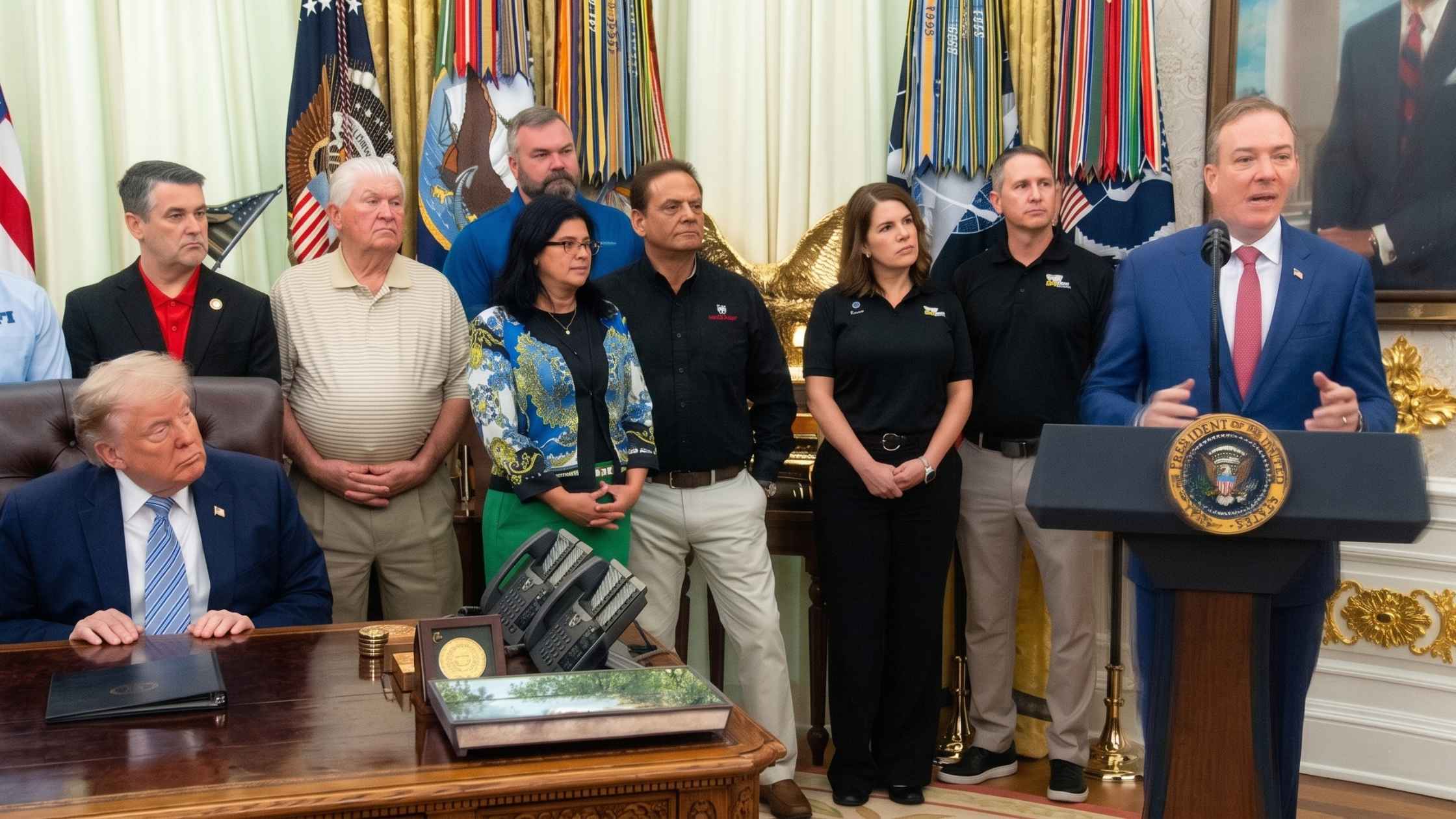
President Trump (00:04):
Okay. Thank you very much. It's a great honor. We have tremendous people behind me. You'll be hearing about that in a minute. Today it's my honor to be discussing the taking of a very historic action to substantially lower costs for consumers, protect 100s of 1000s of jobs and save Americans well over $2 billion a year by officially terminating the Biden administration's ridiculous regulations, imposing costly requirements on refrigerators and air conditioners. It's ridiculous, unnecessary and costly, and actually makes the machinery worse.
(00:47)
I want to thank EPA administrator, Lee Zeldin, Senator Jon Husted. Jon, thank you. I heard you're doing very well on your race. I hear. And Ashley, I know you're doing very well also, Ashley Moody, Florida. Great. As well as representatives, Stephanie Bice, Zach Nunn, and Craig Goldman. Thank you all.
Speaker 1 (01:07):
I love you, boss.
President Trump (01:08):
Thank you all. You look good. We're joined by Kroger, CEO. That's a big one. Kroger, that's a big... I see those stores all over the place. Greg Foran. Where's Greg? Greg, very good. You look like a central [inaudible 00:01:24], just like you're supposed to look. Fareway Stores, CEO Reynolds Cramer.
Reynolds Cramer (01:31):
Here I am Mr. President.
President Trump (01:33):
Okay. Hello, Reynolds.
Reynolds Cramer (01:34):
Hello there.
President Trump (01:35):
Maybe I won't look around every time. Y-Not Stop CEO and co-owner, Ann Gauthier? Ann?
Annie Gauthier (01:40):
Here.
President Trump (01:44):
Because it's Anne, I'm going to... Columbiana Foods, co-owner, Ron Graff Sr.
Ron Graff Sr. (01:51):
Right here. Right behind.
President Trump (01:54):
Hello, Ron. Neimann Foods, President Richard Neimann.
Richard Niemann (02:00):
Right here, sir.
President Trump (02:01):
Hi, Richard. Piggly Wiggly franchise owner. And that's a big company too. It's a cute name. Kevin McDaniel. Where's Kevin? How is that name playing, good?
Kevin McDaniel (02:17):
Piggly Wiggly, is doing great.
President Trump (02:18):
Piggly Wiggly, I've heard that actually. That's great. Franchise owner. Kevin, so you met Kevin. And Food Fresh owner, Michael Gay. Food Fresh.
Michael Gay (02:27):
How you, President?
President Trump (02:31):
Hi, Michael. How are you, Michael? And this is a representative group of very large-scale retailers. Under the Biden administration, the so called technology transition rule, which was crazy. Forced companies to adopt specific high-cost refrigerants, massively driving up the price of transporting and storing refrigerants and various goods. Many grocery stores and restaurants had no choice but to replace the refrigerators entirely. They went out of business, half of them. And these costs rose, Americans faced higher grocery prices and reduced access to critical medical supplies. It was a very catastrophic thing that they did.
(03:15)
At the same time, this rule also drove up the cost of living by forcing consumers to purchase higher-cost residential air conditioning units because they went up very substantially in cost. And also they were going to be obsolete very quickly. It created national security risk by adding additional hurdles to the already complicated process of manufacturing semiconductors. So it was a mess.
(03:42)
Likewise, the so called emissions rule imposed crippling leak repair requirements on virtually all existing large-scale refrigeration systems, hurting consumers and small businesses, making it almost impossible for many small businesses to even buy inferior before it, inferior equipment. And this is all across the country. The higher cost threatened 1000s of jobs and was passed on in the form of higher prices and higher taxes.
(04:12)
Today's reforms will deliver significant financial relief, saving American families and businesses more than $2.4 billion. Think of that, each year. Thanks to today's reforms, the American people have lower grocery prices, cheaper transportation of goods, lower cost of air conditioning, at no detriment at all to our country, zero, including environmental detriment.
(04:38)
My administration's historic deregulatory agendas already saved our country an estimated $1.2 trillion. That's been done over a relatively short period of time. $1.2 trillion with a T. We're committed to fixing and really completely ending Biden's disasters, regulatory policies, and delivering financial relief to each and every American, which is what we're doing.
(05:05)
This was a tremendous burden, a tremendous cost. These people had to live with it, not only refrigerants, but a lot more. And it was making the equipment unaffordable and the actual benefit was nothing. It just made it worse. It made life worse. And it made it worse and it drove up costs tremendously.
(05:24)
So now I'd like to ask Administrator Lee Zeldin, who's absolutely fantastic. He's doing an incredible job. We're proud of you. Lee, really the job you're doing is incredible. Followed by Greg, Kevin, and Michael. Is that okay? Lee, go ahead please.
Lee Zeldin (05:39):
Thank you, Mr. President. As you know, many Americans were expressing a lot of frustration and anger of this rushed, frantic, reckless sprint by the Biden administration to phase out reliable equipment for grocery stores, for restaurants and for homes. And the consequences, well, they've been devastating.
(06:04)
And once again, the Trump administration is answering the call, which will lower the cost of living for hardworking American families. Now look at this chart to your far right. Today's actions are saving over $2.4 billion for American families. It's safeguarding 350,000 jobs. Just at supermarkets alone, we're going to see a savings of $800 million, which Americans will be able to see when they go and buy their food.
(06:34)
The Biden EPA faceplanted when trying to jam through their restrictions. Americans who wanted to be able to fix their equipment were instead being required to buy far more costly new equipment and that just doesn't make any sense. Refrigeration trucks were being handed impossible restrictions to meet. And once again, here we are in the Oval Office, President Trump is righting another wrong. At the Trump EPA, we are proudly implementing President Trump's agenda every single day and delivering for the American people.
President Trump (07:13):
Thank you, Lee, very much. Thank you, please.
Greg Foran (07:15):
Thank you, Mr. President and thank you, Lee. Look, on behalf of the Kroger Company and we operate about 2,700 supermarkets, an orderly transition of equipment reduces both capital costs and operating costs. And at the end of the day, that's good for consumers because we're able to take that and put that into lowering prices, which is the key objectives that we have in our business. So thank you very much.
President Trump (07:45):
And you were able to save a lot of money and put it elsewhere by not having to do this ridiculous...
Greg Foran (07:49):
Exactly. So it allows us instead of having to outlay more capital at a faster rate and more operating cost to change that equipment.
President Trump (08:00):
Or to replace a refrigerator that's working perfectly, right?
Greg Foran (08:03):
Yeah. So that allows us... Obviously these things have a lifespan, but an orderly transition allows us to move through that in a way which keeps the price of groceries down and that's something that we're desperately focusing on, Mr. President.
President Trump (08:19):
Great. Thank you very much. Next.
Kevin McDaniel (08:27):
My name's Kevin McDaniel. We operate 14 Piggly Wiggly stores in North Florida, Alabama and Georgia. On behalf of the NGA, the Piggly Wiggly family, which operates, has about 250 stores in the Southeast. We want to thank President Trump for rolling this terrible Biden legislation back, because without it, there have been a lot of independents out of business.
(08:51)
And what people don't realize is it's just not a refrigerant change, it was a equipment change. And those equipment per store, you take a store, our stores run from 25 to 50,000 square feet. You could look for $800,000 to a million and a half dollars per store to do a change out. That would have done-
President Trump (09:09):
And the new equipment would not be as good as the old equipment.
Kevin McDaniel (09:12):
No, absolutely not.
President Trump (09:13):
It would be inferior equipment because you weren't able to use a refrigerant.
Kevin McDaniel (09:18):
It was thrown together too fast. The technology's not there yet. It's just way too fast. That's the problem. Good idea, but it's terrible. So you would have had all these independents go out of business. You'd had the independent side of business and you would have seen grocery prices soar. That's what would have happened if this would have went through. President Trump, thank you very much. On behalf of all every independent in United States, we cannot thank you enough for what you've done for us. Thank you so much.
President Trump (09:44):
Just, the bottom line is, so you have great equipment that works incredibly, takes care of your meats and foods and everything else, beautiful refrigeration systems. Take it out and replace it with stuff that barely works, costs a fortune and it's no good. Think of it. And everyone's going to go bankrupt because the equipment is much more expensive on top of everything else.
(10:08)
So the big thing now we're going to get rid of the law that was signed quite a while ago, and we have to get rid of that because ultimately we want to make it permanent. There's no negative impact by having a good system, but there's a tremendous impact... I think it's going to be bad, because a lot of people said the other stuff doesn't even... It doesn't cool your product.
Kevin McDaniel (10:29):
No, there's a problem with it.
President Trump (10:30):
It's so crazy. Please.
Michael Gay (10:32):
Michael Gay. I have a single store of Food Fresh in Claxton, Georgia. And exactly, to echo everyone up here, these refrigeration costs, I'm the only store in a county of 10,000. I literally, two years ago, put in equipment that should have about 20 more years of use of life and to replace literally every single piece of equipment in our store would have been unbelievably cost-prohibitive, driving up costs as we fight every day to try to keep them as low as we can. And if that cost gets too high, especially attached to your regulation, you have independent stores closed in neighborhoods that once I go away, you've created a food desert.
(11:10)
So it's very beneficial that this happened today. It's much more complicated than anyone thinks, and to try to rush this through was just the wrong way to go. So we are very appreciative of you today.
President Trump (11:20):
Thank you. I have one grocer as a friend of mine, he's pretty big and he said, "I'm going to go ahead of the schedule." And he actually replaced a lot of his equipment. He called me up, he said, "This crap doesn't work. It doesn't cool the food." So you know about that, right? What a shame. Okay. Would anybody, Kevin, would you like to say something?
Kevin (11:41):
Yeah, I'd just like to say, sir, that this is part of your overall regulatory agenda and the big number 1.2 trillion is the savings so far, but we're going to be hitting that every year and we're rolling back stuff that everywhere we look, there's stuff that's as awful as this. And I think that really one of the leaders has been Lee, because the EPA has been at a hold up for so many years, but Lee is just out there saving America's money. And right now, again, if you look at that number, it's $14,000 per family has been saved to reduce costs because of your deregulatory rules.
President Trump (12:14):
Do we agree that Lee is an MVP? MVP. No, he's done a great job and he sees what's good and he's a big environmentalist. He wants to make sure everything's good, but he also sees stupid things like this. Senator, would you like to each speak for this?
Senator (12:33):
Well, Mr. President, I'd like to thank you for this because this hits our goal of trying to keep prices low for working families in America, cost of food. I have the Graff family here, right behind it. They operate three grocery stores in Columbiana County. They had already upgraded their refrigeration systems a few years ago. This was going to cost them millions of more dollars in Columbiana County, which is not an affluent county. It has a grocery store in East Liverpool, Ohio, which is the hometown of the late great Lou Holtz. And these people not only...
Senator (13:00):
... of the late, great Lou Holtz. And these people, not only would it raise food costs, but it might force them to shut a grocery store down so that the town didn't even have a grocery store. So you're saving money for working families and their grocery prices. You're also saving grocery stores so that we don't have food deserts in rural places across our country.
President Trump (13:21):
Yeah, yeah.
Speaker 2 (13:22):
Mr. President, I think it is so important that the people see what you choose to hang right by your desk, which is the Declaration of Independence, which is a reminder that government at its core is supposed to function in a way that allows people the opportunity to pursue happiness and not work against them by coming up with regulations that just make it harder to live, more expensive to live.
(13:43)
And from day one, I remember standing with you with the same crew of folks. From day one, you have been digging into all of these regulations that are issued with no thought to how they affect real people and real small businesses and businesses trying to step up and provide jobs and lift up their communities.
(14:03)
Thank you for that. Thank you for getting back to the core of what government is supposed to be and that is working in the interests of the people.
President Trump (14:11):
Thank you. Thank you very much. Good job. Thank you everybody. So any questions, please?
Speaker 3 (14:16):
Yes.
President Trump (14:16):
Go ahead.
Speaker 3 (14:16):
Thank you, Mr. President. How much do you expect that this will save the average American family every week on groceries and do you expect this change to help Republicans?
President Trump (14:24):
Okay, very, very substantial. They're going to be a big saving. We're breaking it down. In fact, numbers are coming out this afternoon sometime, but the average family will save a lot of money and you're going to have stores. Nobody actually thought of it until it was mentioned this morning. You will have stores closing down in areas where they're not going to have a store anymore. And you really are being forced to spend money, much more money on much more expensive equipment that really doesn't work.
(14:54)
This friend of mine is a very savvy guy and big league stuff and he put some in because he wanted to see and he said the stuff doesn't work. It doesn't cool the food properly. That's why they call the thing that we're talking about a refrigerant for a research. It's a refrigerant. So that's it. Please, thank you very much.
Speaker 4 (15:13):
Yeah, thanks Mr.. President Trump, are there any assurances from the grocery chains that will pass these savings down to consumers?
President Trump (15:21):
Well, let's ask Kroger about that. Come on. That's a very good question. You have the biggest right here.
Greg Foran (15:27):
Yeah. We're actually right in the middle of doing that at the moment. So we're concerned about the cost of living. It makes a big difference when you get your pricing right and we certainly are interested in ensuring that all our customers right across the country are paying the right price.
President Trump (15:47):
If it were the right thing to do, it would be bad for the environment what they had. And I'm all for it. I'm all for that stuff. But when you're forced to put in very inferior equipment that's not going to work, you're going to be wasting a lot of food product 'cause it doesn't cool the food properly and it's actually a bad thing. The bad thing is more expensive than what they already have, and in many cases they just put it in. They just put in the other apparatus. And a lot of people have said they've spent money recently to do it, and then this rule came up out of nowhere and the stuff they just put in, they have to change. I'd be all for changing if it was good, even if it was a little bit good, but this is actually bad.
Speaker 4 (16:35):
You don't have any environmental concerns though with this?
President Trump (16:38):
No, there is no environmental concern. And Lee covered that really well. There's no environmental concern. It's not going to have any impact on the environment.
Speaker 5 (16:46):
Mr. President, with many Americans concerned about affordability ahead of the midterms, there is some backlash among the Senate Republicans to some of the other priorities, the ballroom and the anti-weaponization fund. You clearly still have a strong hold on the Republican Party. Your candidates did very well this week during the primaries, but are you losing control-
President Trump (17:11):
My candidates did well. Not all candidates did well.
Speaker 5 (17:12):
But are you in control of the Senate, sir? Are you losing control of the Senate, Senate Republicans?
President Trump (17:14):
I don't know. I really don't know. I can tell you I only do what's right. I don't need money for the ballroom. You know I'm making a gift of the ballroom. This is the biggest misreporting that I've ever seen. The ballroom is being built. It'll cost ... It was going to be 200 million. I've doubled the size of it 'cause we need it and it's being done in conjunction with the military and very much in conjunction with the military and Secret Service. We're on time, on budget, it's going beautifully. I have all the money I need. We're making a gift to the United States. They came along and they said, "We want to make it the White House overall more secure." And I understand that. Not for me because I'll be gone. I'll be gone and you'll have somebody else in for hopefully hundreds of years, but that's what they're doing it for.
(18:05)
The ballroom is paid for. It's a gift. I mean, I want to make it clear because so many people said, "I thought you were giving this away." And all of a sudden the money that they're spending is for security having to do maybe around the ballroom and other parts of the House. But this is not for the ballroom. The ballroom is being a tremendous amount of what's being done with respect to the ballroom is for national security, including as an example, a drone port on top, which was top secret until litigation made it less than top secret. But we have a drone port.
(18:39)
We have also, we have the glass that's four inches thick, bulletproof glass, we have bulletproof walls. You need a place like this. But this is being made as a gift from me and other people that are great patriots that spend a lot of money. We're building what will be the finest ballroom anywhere in the world. If they want to spend money on securing the White House, I think it would be very, very much a good expenditure, but the ballroom is being built.
Speaker 5 (19:07):
But what if Congress doesn't sign off on the security money, sir?
President Trump (19:10):
Then the White House won't be a very secure place.
Speaker 5 (19:14):
And then regarding Cuba, there was an aircraft carrier that just arrived there just this week, the Nimitz aircraft carrier. Are you sending that there to intimidate the Cuban government?
President Trump (19:24):
No, not at all. The Cuba, look, it's a failed country. Everybody knows it. They don't have electricity. They don't have money. They don't have really anything. They don't have food. And we're going to help them along. And we're going to help them because the people, 'cause number one, I want to help them on a humanitarian basis. But we have the Cuban American population, much of it living in Miami and Florida. That's a great group of people, amazing group of people, industrious, just they're great Americans. They've wanted this to happen. They want to go back to their country. They want to help their country. I hope they're going to stay here, but they want to go back. They want to invest in their country and see if they can bring it back.
(20:04)
Other presidents have looked at this for 50, 60 years doing something and it looks like I'll be the one that does it. So we'd be happy to do it. We want to open it up to Cuban Americans where they can go back and help.
Speaker 6 (20:17):
Mr. President, the DNC released a report this morning, a report on the last election on why you won and Democrats lost. One thing that it mentions is how they failed to reach middle America, southern Americans. Do you think they've learned lessons from that election and have you seen that report?
President Trump (20:33):
I think the elections are so rigged and we have to do something about it and we're going to do something about it, but we cannot continue to have ... And frankly, the Senate and the House, they ought to get together and they ought to pass the SAVE America Act so that you have voter ID. It's so important. You have proof of citizenship, little thing like proof of citizenship and also mail-in voting, which is so crooked. So in Maryland, as you probably saw, they had 500,000 mail-in votes that were corrupt. They were corrupt. They said the printer made a mistake, don't believe that. And they got caught with 500,000 mail-in ballots that were corrupt.
(21:12)
We got to stop it. We have a country that has a very corrupt ... We have more corrupt elections than third-world countries have and we ought to get smart. Pass the SAVE America Act. That'll be a long way. You have voter ID, voter identification. The Democrats don't want to pass.
(21:29)
Now, I'll tell you what, the Democrat voters do want to pass, 87%, but the Democrat politicians don't want to pass. And the reason is they'd never be elected again because with their policy of open borders, transgender for everyone, I call it transgender mutilization of your children for everybody, men playing in women's sports, all of the stuff that they do, high taxes. They want to tax high. They voted in favor of high taxes. They voted against a tax cut. They voted in favor of men playing in women's sports. I don't know what these people are thinking. The only way they can win is to cheat and that's what they want to do and we ought to pass the SAVE America Act.
(22:10)
Yeah, please.
Speaker 7 (22:11):
Yes, Mr. President. I have two questions for you, one of which you'll love. First about the ballroom and the second about Iran.
(22:17)
First, I'm curious, what is the stone that you're going to be using, and I asked that for a reason because I live in Stafford County and you know a lot about history and stuff like that. So you know the stone that was quarried for the Capitol and the White House is from Stafford County. They still have quarries, so hint-hint, down there.
President Trump (22:33):
We're using marbles and granites, mostly marbles and granites.
Speaker 7 (22:36):
All right, excellent.
(22:37)
And then my second question is, the Vice President mentioned the other day there would be accommodations, that we're willing to make accommodations with the Iranian deal. Could you kind of expand on those possible accommodations? Does that include ...
President Trump (22:49):
When you say combination of what?
Speaker 7 (22:51):
Accommodations. He's talking about accommodations as far as making a deal, making a deal going. Would that include the proxies?
President Trump (22:56):
I don't know. I can't tell you. Right now we're negotiating and we'll see, but either ... We're going to get it one way or the other. They're not going to have a nuclear weapon.
(23:04)
When people hear it, 'cause oftentimes they won't put up the second part of the sentence having to do with ... I'll say this is more important than anything that we have to talk about. And usually they'll cut it off, the fake news, I said because this is the nuclearization of a country that some people would say is somewhat crazy. And we cannot let Iran have a nuclear weapon. That's all it is. We can't let it. You will have a nuclear war in the Middle East and that war will come here, that war will go to Europe. We cannot let that happen. And it won't happen. It's not going to happen. That's more important than anything else.
(23:43)
I can think of nothing that's more important than the fact that we cannot let Iran have a nuclear weapon and we won't.
(23:49)
Yeah, Jeff.
Jeff (23:50):
Following up on that story, Iran is negotiating with Oman to set up a formalization of charging tolls in the Strait of Hormuz. Is that acceptable to you?
President Trump (23:59):
Well, we're looking at it. We hear about it. They've negotiated. They've had a relationship with them before. And we'll see. We have total control of the Strait of Hormuz, as you know, with our blockade. The blockade's been 100% effective. Nobody's been able to get through. It's like a steel wall. It's our Navy. We have the greatest military anywhere in the world. We wiped out their Navy. We wiped out their airplane. I think they're down to about, I would say we knocked out 85% of their missile capacity. It's very hard for them now to build missiles, to build drones.
(24:36)
We have great drone technology, anti-drone technology now that frankly we didn't have even two months ago. We have unbelievable drone technology, both for making them and also for knocking them down.
(24:49)
But look, we're going to either make sure they don't have a nuclear weapon or we're going to have to do something very drastic. And the people of the country, I believe when it's put to the people of our country, they will all agree that we cannot let Iran have a nuclear weapon.
(25:04)
Yes. Daniel?
Jeff (25:05):
Just let me, just one follow up on that. How do you want things to end up with the Strait of Hormuz though? Would you like them to have control of that?
President Trump (25:10):
Well, we want it open. We want it free. We don't want tolls. It's international. It's an international waterway. They're not charging tolls. Right now they are losing $500 million a day is what it's projected. I don't know. It sounds like a lot of money. But whether it's 500 or 200 or 300, they're losing a lot of money. There hasn't been a ship that's been able to get through without our approval. And the Navy has done an amazing job. And no ship is going to Iran, as you know, no ship is going to, or out of Iran without our approval.
Jeff (25:44):
Can they keep their highly enriched uranium?
President Trump (25:46):
No. No. We get the highly enriched. We will get it. We don't need it. We don't want it. We'll probably destroy it after we get it, but we're not going to let them have it. Okay?
Speaker 8 (25:57):
Mr. President, I have two questions. First on deregulation and the second on the Supreme Court. You coming from business, you've seen ...
Speaker 9 (26:00):
... Supreme Court. You coming from business, you've seen the effects of what unnecessary red tape would do to business. Do you believe that given the amount of deregulatory actions, taking them off of this, going back to endangerment finding, the [inaudible 00:26:15], the tax cuts and tariffs, do you believe that you've made the United States the most pro business pro investment country in the world?
President Trump (26:21):
Yeah. Thank you very much for that question because we are. For every one new regulation that we had, we're getting rid of 20 to 30 to 40 and now it's actually at even a number. My first term for every regulation that was added, we got rid of a minimum of 10. And I understand, Lee, that it's up to 43 or 44 right now. So if we add a regulation, we get rid of 43, 44. We're making it a much more pro business, pro people. Regulations are very costly for the people. They're bad for everybody. They're bad for jobs, bad for everybody. As of today, we have more people working in the United States than at any time in the history of our country.
(27:04)
To me, it's one of my favorite stats. But we have more people today working in the United States than at any time in the history. And this is with the Iran conflict. That'll end soon, very soon. And when it ends, your gasoline prices will go down lower than they were before. I left Iowa a few months ago and gasoline was at $1.85 a gallon. And we'll be hitting numbers like that again. But we'll be hitting them in a much nicer way, by the way. We will be hitting them and we will have a country that will not have a nuclear weapon. Yeah, Daniel.
Speaker 10 (27:38):
[inaudible 00:27:41].
President Trump (27:40):
Yeah, let me just finish with him.
Speaker 9 (27:41):
On the Supreme Court, sir, we're still waiting for the decision on birthrights.
President Trump (27:44):
Yeah, birth rights.
Speaker 9 (27:47):
You attended the oral arguments of that. Can you just explain what's at stake with that decision, sir?
President Trump (27:50):
It's a big decision that we're waiting for from the Supreme Court. We had a terrible tariff decision. They cost our country a fortune. They said do it a different way. We're doing it a different way, but we're going to most likely have to pay back $149 billion. All they had to do is put a little sentence in there, half a sentence saying that any monies paid don't have to be paid back. You know, you're talking about the people in many cases that hate our country. Give them back money. It was a terrible decision. And it's not going to affect because we do the tariffs a different way. The tariffs are what's bringing in all of this money. It's really made our country rich, modernly rich. Now we have another one coming up, which is birthright citizenship. And we're the only country in the world that has it.
(28:40)
You step into our country and you're all of a sudden a citizen, you come in a certain way. And this was not meant for Chinese millionaires to have their children become citizens of our country. This was meant... Or other rich people, poor people. This was meant for the babies of slaves. This was signed right after the Civil War. You look at the dates, the dates alone, immediately after this was having to do with the babies of slaves and people have used it. And if this is allowed to stand, it will be a disaster economically for our country. And you'll have 25% of the people coming into our country coming in through birthright citizenship and we won't have any control. This decision by the Supreme Court is a very big one.
(29:31)
They'll probably rule against me because they seem to like doing that. Frankly, I'm not happy with some of the decisions. Look at NIL. Look what they've done. Look what the courts have done to college sports. They're destroying college sports. They're destroying universities. But birthright citizens, a big deal. And literally if that's allowed to stand and again, this was a civil war. This was right after the Civil War and it has to do with the babies of slaves. It doesn't have to do with the babies of very rich people coming into the country. One of them came in with 57 children. 57 children. They're using the system and it's usually people that hate our country if you want to know the truth. A birthright citizen is done by no other country, no other country in the world the way we're doing it. We're a laughing stock.
(30:32)
And if the Supreme Court approves that decision, they have done a great disservice to the United States of America, just like they did a great disservice by costing us $149 billion on tariffs by saying do it a different way. Get the same result, do it a different way. We should have won that decision. We had a very strong, very powerful dissent. We had three dissents. So it wasn't like a unanimous decision by any means. We had very powerful dissents. When you read that dissent, people that read that dissent say, "You really should have won this case." We should have won that case on tariffs. That case cost our country $149 million. It goes to people that hate our country. So now we have another one coming up, birthright citizenship.
(31:17)
It would be a disgrace if the Supreme Court of the United States allows that to happen. Remember what I said, 20 to 25% of the people coming into our country will come in through birthright citizenship. They'll become citizens through birthright citizenship and it'll cost us numbers that are... I don't even think they're doable and it's all up to a couple of people and I hope they do what's right. Birthright citizenship is a disgrace. The fact that... Look at the people that are bringing the suit. Study the people that are bringing the suit. These are not people that love our country. I can tell you that.
Speaker 10 (32:02):
Why has today's executive order on AI being postponed?
President Trump (32:06):
Because I didn't like certain aspects of it. I postponed it. I think it gets in the way of... We're leading China, we're leading everybody and I don't want to do anything that's going to get in the way of that lead. We have a very substantial on AI. It's causing tremendous good and it's also bringing in a lot of jobs, tremendous numbers of jobs. Again, we have more people working right now than we've ever had. I really thought that could have been a blocker and I want to make sure that it's not.
Speaker 11 (32:35):
Mr. President. Mr. President, [inaudible 00:32:38].
President Trump (32:38):
Wait one second.
Speaker 10 (32:38):
With President Xi last week, did you discuss AI safeguards?
President Trump (32:42):
Who what?
Speaker 10 (32:43):
In China last week with President Xi, did you discuss AI safeguards?
President Trump (32:48):
I did. I discussed it and he acknowledges how well we're doing. We're doing well. It was the the two of us. The two countries are fighting for it. Other countries are way behind. Way, way behind. They're fighting for it. Everybody wants it, but they're way behind. But I didn't want to do it. I postponed that meeting. It was a signing actually because I didn't like what I was seeing.
Speaker 12 (33:11):
Mr. President, a few moments ago, the Commission of Fine Arts approved your design, redesign for your arch. Do you think you need Congressional approval for it?
President Trump (33:19):
Oh, that's good news. I finally get good news from you.
Speaker 12 (33:20):
Do you think you need Congressional approval for it, sir?
President Trump (33:22):
What was the vote? Do you know what the vote was? What was the vote?
Speaker 12 (33:26):
I'm just seeing the headline here. I don't have the exact vote.
President Trump (33:29):
So we're building what's called the Triumphal Arch right opposite the Arlington Memorial Bridge, right by Arlington Cemetery. It's beautiful. The Arctic Triumph would be the one that you would probably know in Paris. It's one of the most beautiful. It's a very similar size, slightly larger we're doing. We have to do slightly larger. It doesn't have to be a lot larger. Otherwise, you'd all be disappointed in me, but it's even far more beautiful. I think that the Arctic Triumph is beautiful. It's a couple of hundred years old, but I think it's beautiful.
(33:59)
And some archs go back over a thousand years and it's called a Triumphal Arch. It's usually done for victories and war and things. 59 of them in the world and some are really beautiful. And we're the only major... Washington DC, which should be number one. We're the only important and major city that doesn't have one. We don't have a triumphal arch. So it was meant to be built for many years. The circle going up to the bridge was... People pass that circle, they say, "Why isn't something built here?" And so that's very good. We just got approval from Fine Arts. That's fantastic.
Speaker 12 (34:38):
But do you need Congress to sign off on it?
President Trump (34:40):
No, we don't. No. We're doing it. The land is owned by Secretary... By the Interior Department. We don't need anything from Congress.
Speaker 12 (34:49):
Are you going to your son's wedding this weekend, by the way?
President Trump (34:53):
He'd like me to go, but it's going to be just a small little private affair and I'm going to try and make it. I'm in the midst... I said, "This is not good timing for me. I have a thing called Iran and other things." That's one I can't win on. If I do attend, I get killed. If I don't attend, I get killed, by the fake news, of course, I'm talking about. No, but he's got a very... Person who I've known for a long time and hopefully they're going to have a great marriage.
Speaker 13 (35:24):
Mr. President, actually to add to the arch, I just actually passed by it on my way here, with all the pink flags and there's just geese that are there all the time. So it's perfect. How long will that take? And also I have to say, I have to pass along something for my mother because she drove in with me. She was amazed by all the people she was seen on the streets here in DC. She doesn't get in here as much.
President Trump (35:44):
DC is hot again.
Speaker 13 (35:45):
She was noticing how clean and beautiful it was, so I'm passing it along.
President Trump (35:48):
That's right. Well, that's the way I do. Clean. Take a look at... We had broken path. It was so terrible coming into the White House. It was slate. Slate's a roofing material. It's not a walking material, but the slate was all broken and chipped and terrible. And I put down a new granite floor and paid for it myself, by the way. But I put down a nice new granite floor. It looks beautiful. It's actually getting rave reviews. It's beautiful. It's terrible having people walking up to the White House and they're walking over broken tiles and broken floors. So now we just finished. It's going to be finished when the moldings are put on, but you might take a look at it. I don't know if you've seen it, but it's beautiful.
Speaker 13 (36:27):
I thought it was very beautiful.
President Trump (36:29):
Other things we're doing while you're at it, we've fixed... We have 31 fountains in Washington. Of the 31, not one worked. Now we have 21 working and the others are going to be fixed and people are calling and saying, "It's amazing what's happened, the fountains." And they're working top level. And my most exciting is the reflecting pool between the Washington Monument and... The Washington Monument, Lincoln Memorial. It's 2,500 feet long by almost 200 feet wide. It's a massive structure if you think of it. It's taller than the tallest building in the world. If you sat the building down, the tallest building in the world would not reach the end of it. It's a very big thing. It hasn't worked properly since it was built in 1922. President Obama and Biden spent hundreds of millions of dollars trying to fix it. Of course, they couldn't do that. They didn't fix it. It was a mess. So mostly they turned it off, collecting garbage. It looked horrible.
(37:35)
And we are very close to getting it finished and when it's finished, it'll be beautiful. It'll be blue water, dark blue. We call it American flag blue because that's the name of the color that we chose. American Flag Blue, can't do better than that. It's a rich, dark blue and it'll be, I think, very reflective, very, very good. Big project. I decided to do a much bigger job. I was going to just get it open, but I said, "Let's do it right. Let's get it open and let's have it be good." Because President Obama, President Biden spent hundreds of millions of dollars, much more than a hundred million, but hundreds of millions. It never worked.
(38:15)
In fact, when they finished it was much worse than it was before. It leaked at a higher level. They would have to fill it up every single day with water. The whole thing was ridiculous so they ended up turning it off and it became like a garbage dump. Well, it's pretty close to finished. They had estimates of $350 million to fix it. I'll be doing it for a tiny fraction of that. A bigger job than... I originally thought I'd do it for two or three million dollars just to a base, but now we're fixing up the exterior of it. We're doing it so we'll probably be in there for less than $20 million and the estimate was going to be using a different method, 350. It was going to take four years-
President Trump (39:00):
What's going to take four years, 350 million, I'll be doing it in basically a couple of months for less than $20 million. That includes all of the exterior basal, which I never included in my original numbers. When I went there last week I saw the exterior was in very bad shape as well as the interior. So I said, "We're going to fix that too." The stone. It's going to be beautiful. When that's done, you might see it. It's probably three quarters done. We have rain delays. We get a lot of delays, but that will be something special. The reflecting pool in front of the Lincoln and Washington monuments, I think it's going to be incredible. It's largely done. If you want to go see it, you can see it before we put the water in. The key is to have it done before July 4th. We want to see if we can have it done before July 4th.
(39:54)
But we have about 20 or 21 of the water features in Washington Open. And I can say top of the line, they look better than they did the day they were built. Some of them have been closed for 25, 30 years. There's been no water for 25 or 30 years and they're really beautiful. Some of the fountains are as beautiful as I've ever seen and you probably see them. And in addition to that, you brought up something. Washington DC is now a safe city. We had a city that was at one of the most unsafe cities anywhere in the country, and now it's considered a very safe city. Restaurants are opening. Restaurants were closing.You couldn't go to a restaurant. The restaurants were closing all over because of the danger during the Biden administration. Now you have restaurants opening, it's thriving and it was very nice that you said that. I like this reporter.
(40:55)
No, it's nice. We have a vibrant city again. People are going out. I have a lot of people in the White House. Every time I see somebody, they thank me and I know immediately what. They thanked me for making the city safe. They walked to work now. Before that, they'd take Uber or something and they felt unsafe even in Uber. We moved over 5,000 people out of the city, career criminals that came in through the open borders and other reasons. And we moved over 5,000. An interesting statistic is that 2% of the population creates 91% of the crime. And the reason I like that is that you can handle 2% of the population. Mr. Kroeger, I see. Do you have sewers in Washington? You see a big difference?
Mr. Kroeger (41:44):
We do.
President Trump (41:45):
Boy, you said the right thing. That would have been the end of Kroeger. Okay. We'll do one or two more, please.
Speaker 15 (41:48):
Mr. President. Mr. President.
Speaker 14 (41:48):
Mr. President?
President Trump (41:48):
Yeah?
Speaker 14 (41:54):
Do you think Democrats are genuine in their focus on affordability, especially after the delivered 40 year high inflation last time they were in power?
President Trump (42:02):
Yeah.
Speaker 14 (42:03):
Or do you think they're using it or focusing on it as a means to try and win midterms and begin the impeachment process?
President Trump (42:09):
Yeah. The second. Look, the Democrats had the highest inflation in the history of our country. 48 years, they say, but the history of our contract. They had the highest inflation that we've ever had. When I inherited it, I inherited very high prices. And from day one they said, "Affordability." Affordability is their word, because they're good at that. They're good at words, but I'm good at words too. But they hit me with affordability. I'd just gotten there. They hit me with eggs. We had a news conference on my third day and they said, "Egg prices are through the roof." I said, "I just got here. Tell me about eggs." We got the prices down, way down, actually lower than it was four years before, but we've gotten everything.
(42:53)
The thing that we have now, the only thing that's really of great concern, two things, beef is coming down and the reason is they put restrictions on beef under the Biden administration and it takes a while to settle that, but prices are down. But the big thing is of course energy. We had the energy way down, but I had to do a journey to Iran. I had to say... We just hit the best markets. By the way, the stock market today is at the highest it's ever been. And we've had 59 of them, 59 days out of a very short period of time where the stock market hit all time high. So we have a all time high stock market. We have all time high job numbers. We have 401ks just hit the highest number they've ever been.
(43:38)
So many of you have 401ks. That means you're richer than you've ever been, and we're doing really well. But they came up with this word, affordability, but it's them that caused the problem. And they used that word, Senator, Senator. They used that word right from the beginning. I was in one day and I heard somebody on television say, "Affordability." And I inherited this mess from them, but we've got it in great shape. The country's doing well. We're respected all over the world. This country is respected. We're the hottest country. We're a dead country two years ago and now we're the hottest country anywhere in the world. So I think most of you appreciate that. Some of you don't. Yeah, please.
Kerry Pickett (44:23):
Hi. Kerry Pickett, Washington Times. If the Supreme Court doesn't rule in your favor on birthright citizenship, are there any other avenues that your administration has explored to remedies? And did you talk with President Xi about Chinese foreign nationals taking advantage of birth tourism here in this country and how he could have Well,
President Trump (44:42):
It's a great question. No, if the Supreme Court hurts our country by ruling against us on birthright citizenship, that would be just between that and tariffs, what damage they've done, what damage they've done. Again, they could have said, which they said, do the tariffs a different way, but they could have said the money taken in, hundreds of billions of dollars, 149 billion dollars we have to pay back. Kevin understands that better than anybody. All they had to do is say any money taken in... Because they agree, you could do it a different way. Any money, this is a better way, but the other way is a very secure way and maybe in many ways it's a stronger way.
(45:27)
They could have said, "Any money taken in thus far does not have to be paid back to," in many cases the enemy, ""people that don't like our country, or it was a half a sentence. The Supreme Court could have saved us 149 billion dollars with a half a sentence, but they chose not to do that. Now they have a ruling, which is a much bigger ruling actually, birthright citizenship. The cost, forgetting about the fact that it's wrong, the cost of birthright citizenship is barely not affordable by our country. It's going to cost hundreds of billions of dollars, and it's in their hands. What can I tell you? It's a common sense ruling. It's common sense. It was exact timing and it's about the babies of slaves. Thank you for that question.
Speaker 15 (46:20):
Mr. President, on Cuba, Mr. President. [inaudible 00:46:22].
President Trump (46:22):
Right, you, go ahead.
Speaker 16 (46:23):
Thank you, Mr. President. So do you think if Democrats were to take control of Congress again, they would immediately begin the impeachment process?
President Trump (46:28):
I think if Democrats took control of the Congress, and let's say took control of the country, I think that this country's finished. These people are sick. They suffer from Trump derangement syndrome, but really they have bad policy. They have horrible policy. They cheat on elections. They get elected by cheating on elections, but you would have two states added. They'll terminate the filibuster immediately. Republicans should do that. They'll terminate the filibuster. You'll have Washington DC and you'll have Puerto Rico as a state, which will be a disaster, which would be four Senate seats, tremendous numbers of electoral college votes.That's really bad, but you'll have the destruction of our country. They want to go to 21 Supreme Court judges. That's their perfect number. They talk about 13, but they want to go to 21, 21 Supreme Court judges. If they get in power, I think this country would be maybe finished.
(47:39)
If I didn't win the election... I'll say this. We've become the hottest country anywhere in the world. We were a dead country two years ago. If I didn't win this election, we would have been a country that was essentially would have been... I don't even know that we would have been a country any longer. They were destroying our country. They were letting hundreds of thousands, millions of people pour through our southern border, criminals, people from jails, people from mental institutions, drug dealers and drug addicts. They were sending everybody, countries were sending everybody that they didn't want by the millions, 25 million people. If I didn't win this election, I believe our country would have been finished. Thank you very much everyone. [inaudible 00:48:28].
Speaker 17 (48:29):
Thank you, press. Thank you, press.
President Trump (48:30):
Thank you.
Speaker 17 (48:30):
Thank you guys. Thank you guys. Keep moving. Thank you guys.
Speaker 18 (48:31):
Thank you guys.
Speaker 17 (48:32):
Keep going. Thank you guys. Press. Bye, guys. [inaudible 00:48:33].
Speaker 18 (48:32):
Thank you, thank you.
Speaker 17 (48:32):
Thank you.
Speaker 18 (48:32):
Take care. [inaudible 00:48:33].
Speaker 19 (48:32):
I got to get a wire.
Speaker 18 (48:32):
Thank you, Mr. President.
Speaker 19 (48:32):
Thank you, Mr. President.
President Trump (48:33):
Thank you. Thanks, guys.
Speaker 18 (48:33):
Thanks, guys.
Speaker 20 (48:33):
Don't worry. [inaudible 00:48:34].
Speaker 21 (48:33):
Still, it's tough. [inaudible 00:48:34].
President Trump (48:33):
You guys think this is real. [inaudible 00:49:16]