
Joe Segretto (00:01):
Mic check. [inaudible 00:00:03].
Sean Duffy (00:09):
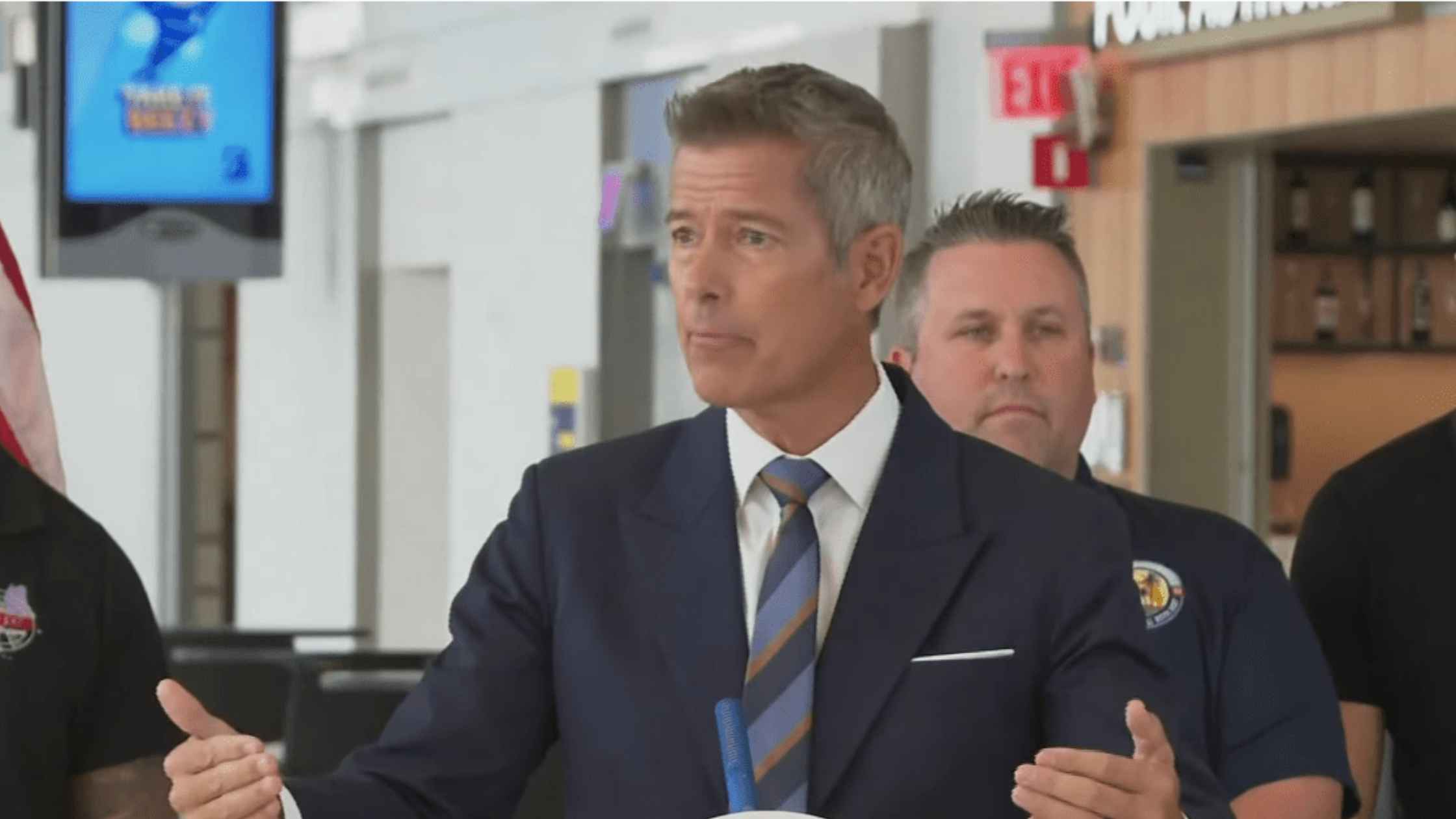
Hey, everybody. Thank you for coming out today. I'm here with Nick Daniels, the President of the Air Traffic Controllers Union. I have a few of our air traffic controllers with us today. Oftentimes, these guys are nameless and they're faceless, but they're the men and women who work in our towers to make sure that our flights are on time, that our flights aren't delayed, and your flights are safe, and so I wanted you to have a chance to see a few of the men and women who aren't getting paid today, the men and women who rely on the paychecks from the federal government to support their families to pay their car payments, to pay their rent, to pay for gas in their vehicles, to get into work that puts food in their table. Yesterday, I had a controller who talked to me about his nine-year-old, 10-year-old daughter who made the traveling volleyball team, and as many of us know, it's an honor when your child makes the traveling team, but with that comes a cost.
(01:11)
You have to pay to be part of that team. He had to talk to his nine-year-old daughter about her not being able to join that team because he had to preserve and reserve his money because he thought that this day would come, the fact that he wasn't going to get paid for his work as an air traffic controller. It's those stories that are happening throughout our community that are having real impact on these controllers' lives. I've been clear to our air traffic controllers, they need to show up for work. They do really important work for our country and they need to show up, but I'm not going to lie to anybody to not say that they're not feeling the stress, the fact that they are working. Oftentimes, they are head of households. They're the only income earners in their homes and they have families and the fact that they're having a hard time paying their bills.
(02:04)
This is day one, and day two gets harder, day three is harder after that as expenses continue to roll. Many of our controllers can make it without this first paycheck. They've been in the job for 10, 15, 20 years. They plan for days like this, but we have a lot of new controllers who are still in training that aren't at a high level in income and they can't handle what's happening to them today. Those are the very people who have now looked for side jobs. You've heard the stories of controllers working at an Uber or a DoorDash, a controller who might go to a food bank to help make ends meet from this point to the point where they're going to get that paycheck. But I'll tell you this, almost every controller can't make it two paychecks. They can't make it without two paychecks, and so I think the message is clear.
(03:03)
Again, I appreciate Nick and the controllers. They've sent a message. "Open up the government and the shutdown, figure out how you guys can negotiate, have a conversation, but pay us in the interim. Make sure we get paid for the work that we provide to the American people." I'll just note that in the Senate, a bill came up that said, "Okay, let the shutdown continue," but there's critical staff, critical workforce that come into work every single day like air traffic controllers, those workers who are coming to work, "Let's have a bill that pays them for the work they do." Democrats said no to that, so I think we're getting to the point of extremism, and it does beg the question for me, again, what are the Democrats fighting for? Let's fight for America. Let's not fight for healthcare for illegal immigrants and legal aliens. I think that's a wrong approach.
(04:04)
Listen, I spent almost 10 years in Congress. There are political differences. Those political differences are very real, and the way you resolve those differences is not taking hostages. It's actually opening up the government and having a conversation. What can we work out? What compromises can we make? But in shutdowns, there's no room for compromise, and so I think that message has been clear, controllers and those other critical employees need our government to be open and they need to be paid. I want to say one other thing, so get a question about this. Oftentimes, I'm asked, "Is the airspace safe? Is it safe to fly?" I would tell you that, yes, it's as safe today as it was two months ago. It's safe because we have great men and women who run our facilities, that if they don't have the right staffing levels or if there's distractions in towers, they will slow down the landings and departures in different airports across the country. What that means for the American people is that means more delays or that means more cancellations.
(05:18)
We want you to travel on time. We want you to flight to depart when scheduled and land when scheduled. We want that to happen, but the number one priority of the men and women who are with me here, or all men, no women, all men are with me today, but also the women in the towers, is they want you to be safe, and so if we have issues, we will slow it down. We will stop it. I don't want anyone to think that it's not safe, it's just that you may not be traveling on the schedule that you anticipated because of this government shutdown. Again, I couldn't be more honored to be here, who's become a very good friend, Nick Daniels, the President of NATCA. We work very closely together. We don't always see eye to eye on every issue, but there's a lot of issues that we agree on and we work really well together. Before I give it to Nick, I just want to say one last thing.
(06:13)
I'm grateful for our controllers. If you ever go into a tower and listen to the work that they do, the expertise that these men and women have to control our airspace, you would be amazed. We are lucky to have them. We have the safest airspace in the world, not because of the antiquated equipment that we have that runs our system. It's because we have the best air traffic controllers, the best trained, the smartest people in our airspace controlling it, and we're blessed to have them. That kind of work, that kind of dedication, that kind of expertise deserves a paycheck. With that, I'll turn it over to the NATCA President, Nick Daniels.
Nick Daniels (06:56):
Thank you, sir. Thank you. I am the President of the National Air Traffic Controls Association, Nick Daniels, and I proudly stand here, but at the same time, I'm here to tell the story. I normally have prepared remarks for you today, but today isn't a day for prepared remarks. Today's the day to speak on behalf of the men and women. As the secretary just said, they go in day in and day out and do the job of unsung heroes. They keep America safe, they keep America moving. But today, an air traffic controller showed up at their facility to see $0 in their paycheck. That air traffic controller just moved hundreds of miles from Oklahoma City after passing a grueling four months at Oklahoma City Academy, is at the lowest end of our pay scale, and has shown up to a job that pays them $0. They're trying to move in. They're trying to get set up on just even having a place of being able to put up for rent, and guess what's due in a few days? Rent for everybody.
(07:57)
It's not the gas that they have to put in the car, the food that they have to put on the table. It's the stress that they now wear. This job is stressful enough. We go to work day in and day out and make thousands of decisions, and we do it five days a week. Most of us actually do it six. Five is hard enough and we do it six and 10 hours a day. Now you add in the fact that we had a partial paycheck already and we missed a full paycheck today. America's air traffic controllers are now having to focus on how do they put gas in the car, how do they take care of their children, how do they pay for childcare. As the secretary said, that makes the system less safe, and then the only way to make it safe is to reduce the number of aircraft in it. Day in and day out, air traffic controllers have to have 100% of focus 100% of the time.
(08:50)
I'm watching air traffic controllers go into work. I'm getting the stories. They're worried about paying for medicine for their daughter. I got a message from the controller that said, "I'm running out of money, and if she doesn't get the medicine she needs, she dies. That's the end, so I'm going to either have to quit this job and take a different one instead of moving America's passengers through it or the cargo. Now, I'm going to have to choose my family and my daughter," and that is nothing a parent should ever have to deal with, especially the hardworking men and women that are federal employees across the entire system, but I could tell their stories all day. I could sit up here and tell you time and time again that they should never work a side job, that they should never get off a night shift and then go wait tables and then go move the commerce and people through this airspace, but you can hear it from an air traffic controller yourself. I'll give you Joe Segretto out of N90. Joe.
Joe Segretto (09:47):
Thank you, Secretary Duffy and Nick. I'm going to echo a lot of what those two just said, but the pressure is real. Speaking on behalf of the air traffic controllers in the New York area, the most congested complex airspace arguably in the NAS, the pressure is real. We have people trying to keep this airplane safe. We have trainees that are trying to learn a new job that is very fast-paced, very stressful, very complex now having to worry about how they're going to pay bills. Just a story that happened to me yesterday. Somebody came to me and said, "Joe, I have a question for you."
(10:18)
I said, "What's that?"
(10:18)
"I need your advice. What am I to do? Do I put gas in my car? Do I put food on the table? My wife is out making money. We don't have money for daycare. What do I do?"
(10:31)
I didn't have the answers. I said, "I will find out some resolve for you, but as of right now, I don't know what to tell you," but these are the real problems that air traffic controllers are dealing with on a daily basis.[inaudible 00:10:44].
Nick Daniels (10:45):
As you heard it, day in day out, that's now the life of an air traffic control. The people tasked with making the impossible possible are having it made impossible by not paying them again, so the message is simple. In the shutdown today, there is no excuse that these hardworking men and women are showing up to do this job and to not ever know when they're going to get paid again. We need America's help, we need you to stand up, and we need you to say "enough is enough" in this shutdown and ensure that we can move this forward, because we do not want to be up here telling you the sad stories. We want to be up here telling you how we're moving the system forward, how we're bringing in more air traffic controllers than ever, how we're modernizing this system to serve the American people. Again, I cannot stress enough. If you want to take action, contact your congressional representative and tell them in the shutdown today.
Sean Duffy (11:45):
We'll take your questions in just a second. I want to give you a few stats. This year, on average, the delays are associated with staffing triggers with air traffic controllers is 5%. On Sunday, 44% of the delays were because of staffing shortages. Yesterday, that number was 24%, so we're seeing the numbers move day by day and it's location to location. We saw in the last couple of days, LAX. We saw Atlanta. We've seen other airports as well. We are seeing those problems as we continue to evaluate the airspace. One last point before I open up to your questions is you do know that we have a shortage of air traffic controllers. We're about two to 3,000 controllers short, and we have a strategy together that we've worked on that is going to, I've used the term supercharged, but we are going to bring more of the best and brightest minds in America into our academy to get them through the academy, to get them into towers, to get them certified and trained up.
(12:53)
The problem we're now seeing is we have young people in the academy that they actually get a stipend, we pay them a small amount of money so they can go to school and they can make ends meet, that money's about to run out. We're seeing several of our students drop out of the academy, so instead of going in the right direction where you want me to bring you more air traffic controllers so they have less stress and pressure on them because they have more resources available, human resources available to them, this shutdown is making it harder for me to do the work that…
(13:30)
This is bipartisan work. Everybody wants this done. There's no one who disagrees with what we're trying to do here, but the shutdown is making it more difficult for me to accomplish those goals, and it's not just the government opens up and I'm able to put it all back together. This has months-long effects on our ability to fill that pipeline and get more young people into academies and become professional air traffic controllers. I want to let you know that, again, even where we're at today, you open it back up and you've created some longer term problems for me to make sure I deliver for what I promised to all of you, which is more air traffic controllers. With that, we're happy to take any of the questions you may have for us. Yes.
Speaker 5 (14:23):
Secretary Duffy… Sorry. I can just ask the question.
Sean Duffy (14:25):
Yes.
Speaker 5 (14:26):
Who made a concerted effort to recruit more air traffic controllers [inaudible 00:14:29]. Air traffic controllers working without pay could deter those efforts to recruit people. What are you telling people who you're trying to recruit?
Sean Duffy (14:41):
Instructors at the academy, they're not being paid, and the fact that our controllers in the academy may lose their stipend. We tried to plan for this. We tried to preserve as much money as possible. We have about a week left of dollars, but no, I am very concerned about what this does for our pipeline. The president has said, and I agree with President Trump, like we have here, I want the best and the brightest. I want the smartest people to come in and control our airspace, and if you see that… You pick a career where you may not be paid for a partial payment one paycheck, the next paycheck, you're not paid and maybe a third, that'll make you rethink, "Do I want to go into this profession?"
(15:20)
Not only that, when we have new controllers that are being trained up, they don't make a lot of money. It's a base pay that they get, and they're having a hard time making ends meet on the pay itself. You take that minimal pay away and they throw their hands up. They don't know how they're going to navigate it, so this truly can drive people, and we've seen a few times that it has, it drives people out of a professional, where we're trying to build more numbers as opposed to the shutdown taking numbers away from us. Yes. You just want to yell it at me, I don't… Oh, you-
Speaker 4 (15:54):
Hi, quick question.
Speaker 5 (15:54):
[inaudible 00:15:55].
Sean Duffy (15:55):
The strike.
Nick Daniels (16:04):
Oh, I'll happily answer that very directly. No, there will be no concerted effort for air traffic controllers to any way have a job action. It is illegal for us to do such thing, but I will tell you, is as you just heard Joe say, the problems are mounting daily. As the secretary is telling you, these are the real stories. They're not just stories. They're real people in real lives of issues that are going to mount every day. When you don't pay people, there's going to be a lot of issues that come with that.
Sean Duffy (16:32):
Every single American gets this story, if you have one family member that works and the other one who doesn't, you lose a paycheck. Every American knows how hard that is, and so that's exactly what the controllers are going through. Yes.
Speaker 4 (16:46):
Hi. Quick question. You said yesterday it was about 44% of delays were attributed to staffing shortages.
Sean Duffy (16:52):
That's on Sunday.
Speaker 4 (16:53):
I'm wondering, is that the highest percentage we've reached during the shutdown so far, and how does it compare to last shutdown?
Sean Duffy (16:59):
Sunday was 44, yesterday was 24% of delays. We've seen it in the mid-50s as a percent of delays from staffing shortages, and again, it's a moving number. I'm grateful, I've asked the controllers to show it to work and they have responded. I think this, we're seeing less problems in the airspace today than we have in prior shutdowns, but I don't have the exact numbers for you on that. Yes.
Speaker 6 (17:24):
[inaudible 00:17:25].
Sean Duffy (17:33):
This is a conversation that the Congress will have. Traditionally, they get their back pay not with interest, and there'll be probably a debate after the government opens, hopefully sooner rather than later. Those who have come to work will be paid. There's been a conversation. If you've been furloughed for the last 26 days, is there a pay that comes to those who have been furloughed? I left Congress so I can't tell you what they're going to do, but that's a debate they'll have.
Speaker 6 (18:00):
[inaudible 00:18:01].
Sean Duffy (18:06):
Again, so the New York area airports, we have seen staffing shortages, probably more at N90 than in our towers, but no, we've seen staffing shortages for sure.
Speaker 6 (18:17):
[inaudible 00:18:18]?
Sean Duffy (18:22):
It's resulted in delays. I wouldn't tell you significant. New York has not been like L.A. or Atlanta where we've had more significant delays. Yes.
Speaker 7 (18:33):
[inaudible 00:18:35].
Sean Duffy (18:41):
No, I'm going off the top of my head. I don't know if it's L.A. or Atlanta. The number they should have in the facility was 25, 11 called in sick. When that happens, again, we will slow the rates down, and that's where you'll get the delays. We can provide you more information in regard to what the numbers are in each facility, but again, our number one priority is safety, making sure that we don't have any incidents on our runways or in our skies. Anybody else? Yes.
Speaker 8 (19:14):
I was just wondering, is the [inaudible 00:19:17] to pay air traffic controllers depending on how long the shutdown goes on, or is there any sort of contingency plan?
Sean Duffy (19:29):
The question is is there contingency plans to pay air traffic controllers? I've looked at the FAA budget to see if we could find resources to pay our controllers, and it becomes really challenging in a shutdown to make that happen. You saw a donor gave, what, $130 million to pay our military men and women. There's not a lot of leeway that we have to get people paid. The answer is open up the government or say to Democrats, vote for the bill that pays the men and women who have to come to work every single day to keep America operational. Really simple solutions. I get there's differences in priorities and policies, but negotiate that when the government is open. Don't hold America hostage. Don't hold our skies hostage. That's what's happening right now. Again, this is the second-longest shutdown that we've seen. It would be great if Democrats would see this and vote to open and then it's a vote to negotiate.
Speaker 9 (20:28):
[inaudible 00:20:28] something on the politics today. Transportation historically sometimes has been a bipartisan issue. Do you think that the Gateway funding, Second Avenue subway here, air traffic controllers, that it's being used more as a pawn now [inaudible 00:20:43]?
Sean Duffy (20:44):
The question is transportation is traditionally bipartisan. I would say it still is bipartisan. I have great relationships with Democrats in the House and the Senate. I truly do talk to them frequently. We work on projects together, because transportation is not partisan. We all use it. Whether you're a Democrat, Republican, independent, far right, far left, this is for America, and that's why we all work together on these issues. You mentioned Gateway and Second Avenue, so specifically here to New York, we've telegraphed that we have concerns about how contracts are given for disadvantaged businesses, all in favor of disadvantaged businesses getting a piece of the pie in some of the work that we do, but it's unconstitutional to base that based solely on race and sex, and so we are in the process of doing a review on those two projects.
(21:39)
The problem is our staff has been furloughed. I have one person doing the reviews. I've talked to local senators who've expressed their concerns and I hear their concerns, but again, this is really easy. Open up the government, let my staff come back in, let's do the reviews, and if there's compliance, we're going to move forward without delay. Yes.
Speaker 10 (22:01):
To follow up on that, the MTA said that they will use the state portion funding for disadvantaged businesses and federal funding that will qualify your rules. Is that fine with you?
Sean Duffy (22:13):
We'll see. I want to look at the proposals. With MTA, I have some other concerns. I do think if you're a Democrat, you're a liberal, you don't like cars and you want people to ride public transportation, I think that's wonderful. Good for you. But if you want us all to ride public transportation, make it safe, make it clean, make it beautiful, and then you don't have to argue about your cars or your subways. Everyone wants to ride the subway because it's faster, and it's safer, and kids can get on it and families can ride without fear of life, and limb, and liberty.
(22:49)
I don't know why New York can't do that. It shouldn't be a big… I mean, I don't know why I have to convince the governor to actually get engaged and say we're going to make the subway safer and cleaner. I shouldn't have to. I think there should be an uprising in the city, that you all want to ride your subway as you pay for it and you should feel free from crime when you do it. Again, this shouldn't be complicated, but it seems like in the city, not by the people, but the leadership doesn't seem to get that. Yes.
Speaker 11 (23:21):
Hi. I have a question in regards to the Penn Station Access project. The MTA is delaying the railroad track for ultimately delaying the project by three years. Are you considering any actions to get that project back on track?
Sean Duffy (23:32):
Are we talking about the rebuild of Penn Station?
Speaker 11 (23:35):
Yeah.
Sean Duffy (23:39):
I love that. We are moving at the speed of President Donald Trump, which is a remarkable speed. We can't go any faster. I think you would've seen another decade, two, or three before MTA would be able to build the new Penn Station, and I think it would probably cost 10 times as much if you look at their track record, so we are going to build it fast and we are going to build it on budget. Again, I've looked at the past performance of MTA and I don't have a lot of confidence in what they've done and how they operate. One more question then we'll go.
Speaker 12 (24:21):
[inaudible 00:24:15]. He has a lot of power. What's going on behind him?
Sean Duffy (24:24):
The question is President Trump, he has a lot of power. He does, and you know President Trump very well in this media group. He loves to cut deals, he loves to negotiate. The problem is we have nothing to negotiate with. Republicans offered a clean CR, meaning the funding from September 30th should be the very same as October 1st. No changes, no modifications, no leverage points. It's Democrats who've now said, I want to shut the government down because I want to use this leverage, this shutdown, the pain of these controllers to get what I want. They're the only ones who put in additional requirements to open the government back up, as Republicans alone who've said, "Make it clean. Open it back up and let's negotiate. If Democrats have priorities they want to discuss, do it when the government's open," but there's nothing we have to negotiate with because it was a clean CR, and so I don't think you're going to see the president negotiate here because he has nothing to give up because he didn't put anything in the bill.
(25:31)
We're talking about air traffic controllers, really important, but SNAP benefits and subsidies for Obamacare, all are going to come to a close as we get to the 1st of November and real pain is going to be inflicted on the American people. I think that's a decision that Democrats are going to have to grapple with. How much pain are they willing to inflict? Think back when Barack Obama had the shutdown. He want to make it as painful as possible. We think back to D.C., many of you covered this story, we had open air monuments and memorials. He put gates around the open air monuments and memorials to make it more painful on a World War II vet or a Vietnam vet that came to see their memorials. He wanted it to be painful.
(26:14)
President Trump has done all he can to alleviate the pain on the American people, and I thank him for that. It shows that he cares about the American people. He doesn't want to see them go through pain of a shutdown, but the reality is there's not much we can do when Democrats want to put the interests of illegal immigrants and their healthcare over the American people. There's not a lot of room to negotiate. By the way, I think if you pulled this, Americans would say, "Put Americans first. Put us first. Put our air travel first. Put our great military first, and if you want to negotiate on healthcare, have that conversation when the government is open." I want to thank you all for coming out. I do, again, want to thank our great air traffic controllers. They don't probably have mine, but I know they wear American lapel pins on their chest, their patriots. I'm grateful for their service, and again, I would urge the Democrats to open the government back up, stop holding us hostage, and pay these great men and women. Thank you.
Speaker 13 (27:13):
Could we get the spelling of the controller?
Speaker 14 (27:13):
Appreciate it.