

Sen. McConnell (00:02):
Welcome everyone, the subcommittee will come to order. Secretary Hegseth, General Caine, welcome. Look forward to discussing the president's budget and we appreciate the opportunity to do that today. Obviously we have very good attendance. Today, the need for significant defense investments is as urgent and obvious as it is overdue. Quantity has a quality of its own and the sheer scale of our defense commitments sends a powerful signal. But what goes under the top line also matters, the way this budget request is structured matters. This is not a $1.5 trillion defense appropriation request. It's a request for 1.1 trillion in base appropriations and regretfully another 350 billion in reconciliation. The good news is the base request reflects real growth unlike the net cut in fiscal year '26 requests and very much unlike the Biden level CR in '25. But some of the most pressing items on the fiscal '27 to-do list are regularly downstream of missed opportunities in fiscal '26.
(01:46)
For example, like the failure to fully fund 28 billion in multi-year contracts for critical munitions, the subcommittee did what we could to increase munition purchases above the fiscal '26 request levels, but we couldn't do it all without the sufficient top line. This year, the fiscal '27 request such a higher top line, high enough one would think to build the department's highest priorities into the base budget requests instead of shunning them off into a one-time reconciliation request, which brings me to the bad news. The '27 request fails to make room in the base budget for some of the military's top priorities. The distinction between base and reconciliation really matters. Base funding is what creates budget stability for the services and sends consistent demand signals to industry and base funding is what gets extended by short term continuing resolutions when work on a full year appropriations is unfinished. As I said last year, reconciliation should be a supplement too, not a substitute for it.
(03:17)
Political realities will not always allow for party line budget reconciliation and if the department's top priorities aren't built into annual appropriations, we're actually taking a big risk. The department is right to make Golden Dome munitions and the F-35 program and drone dominance top priorities. But these key lines of effort only work if we put them on solid fiscal footing. So why is the department requesting funding for multi-year munitions contracts, which by definition requires steady year-on-year funding via a one-time reconciliation? And why risk some of the president's top priorities like Golden Dome by not firmly building them into the department's baseline? National missile defense will require sustained funding over many years, not a one-year expenditure. Other key platforms like the Second Destroyer and the E7 Medal Management aircraft aren't requested in base or reconciliation. So Mr. Secretary, you've been outspoken about the pace of America's armed forces as the most "powerful, most lethal and most prepared military on the planet."
(04:50)
I'm as committed as you are to sustaining that role, but that's precisely why I'm confused by the administration's failure to prioritize key systems in the year-on-year base budget spending. So I hope you'll explain the department's current approach to allies and partners. The stunning success of Operation Midnight Hammer and Operation Epic Fury illustrates the importance of the access basing and overflight granted by our allies in Europe and in the Gulf. I'm as frustrated as anybody about Spain, but they are the exception to the rule when it comes to European allies carrying more of the burden. Likewise, it's impossible to conceive of US power projection in Indo-Pac without the breach that comes from decades old alliance relationships. So I want to hear the department's view of the role of longtime allies in support of US interests across the globe because it's quite clear now that our expectation for European allies is no longer the focus of our own continent message that they received from your subordinates for most of the year.
(06:21)
Our adversaries are working together to undermine America and the West, strained relations with our partners who are making generational commitments to collective defense and driving investment into American made weapons and systems only serves our adversary's interest and limits our capacity and deterrent power globally. So I want to hear about the future of capacity building with committed allies and partners. From the Baltic States to Taiwan and the Philippines, I expect the European capacity building investments intended specifically for Ukraine reach their destination without further delay. Wars in Ukraine and the Middle East clearly show that we have things to learn from our friends. If we want drone dominance, it makes perfect sense to deepen cooperation with the world's most drone warfare experts. I want to underscore this is not charity. When our partners are capable, deterrence is stronger and the risk to our own service members is lower.
(07:40)
This is true in the Middle East today as it was in Europe and the Indo-Pacific. And I think it's noteworthy that our allies in the Pacific have an interest in Ukraine, have sent representatives to NATO meetings. They're hoping for and expecting that NATO will play a worldwide role in defending democratic countries against these adversaries that we're all challenged by. Our allies and partners have many of the interests and if we fail to take full advantage of it, we're only hurting ourselves. I'll end with one observation on the prospect of supplemental appropriations. The deficiencies of our critical munition stocks and industrial capacity actually existed long before the conflict with Iran and Russia's escalation in Ukraine. If the administration sends Congress the supplemental appropriation request, it'll be an important step towards fixing a longstanding problem and investing in future deterrence. It shouldn't be a referendum on the war in Iran. I supported a national security supplemental in 2004, even though I thought President Biden's approach to Russia and Iran was too weak, I did it not because supporting Ukraine is in our strategic interest, but because these funds helped replenish American stockpiles and restore our own defense industrial base. And in fact, jobs are created in 38 different states in this country, in our country, American jobs by a significant percentage of what that went for. Today, the need to expand munitions production and replace battlefield losses is actually even more urgent. So with that, I'll ask each of our witnesses after we hear from Senator Coons to make an opening statement and hopefully limit your remarks to five minutes. Chris?
Sen. Coons (10:04):
Thank you, Mr. Chairman. Thank you, Secretary Hegseth, General Caine, Chairman Caine, for appearing before us and for your testimony today. Let me just begin by expressing my gratitude to the service and sacrifice of the 2.8 million members of the joint force and the civilians who support them and in this urgent moment to focus on a few simple and clear questions. It bears repeating that the regime in Iran is a terrible regime that has the blood of thousands of American soldiers on their hands over decades and that they pose a sustained and real threat to the United States and the region. And it bears repeating that our allies are increasingly distanced from us as our adversaries are increasingly aligned. I agree with much of what the chairman said, including that we are in a moment of real contest and danger in no small part because Russia, China, DPRK, and Iran are partnering.
(11:01)
Russia and China are helping resupply Iran and the drones that they're using to contest and close the Strait of Hormuz to target and kill Americans and degrade our facilities. And so if our adversaries are increasingly aligned, I think a core question is, are we? We have so many questions, Mr. Secretary, about this budget proposal, this $1.5 trillion budget request. And at the core is going to be what's the cost of the war we're in in Iran? How long will it go? What damage has been done to our security and our strategic position? When will we get a supplemental request and of what scale? When will we be requested to authorize this war and when will the American people get a clear answer about our strategic goals and how we will achieve them? I share the chairman's concern that we have created real distance with our allies, most principally, our NATO allies who have stepped up and contributed tens of billions of dollars more to purchase the munitions for the defense of Ukraine and to dramatically increase their long overdue investments in our joint defense in Europe.
(12:16)
But unfortunately, the way that the move towards war was launched 74 days ago without consent, without consultation, has caused a real rift with our vital European allies. And again, as the chairman said, and I agree, there is also a critical and urgent need for us to recognize and embrace that in the most important test field, the battlefield in Ukraine, where the Ukrainians are fighting bravely and successfully against Russian aggression, they have innovated. They have delivered the most lethal and capable drone and counterdrone technologies in the world. What is bedeviling us in Iran right now? Their ability to use thousands of cheap, effective Shahed drones to hit our allies, their military facilities and their oil and gas production facilities and to target and hit civilian shipping. Who's the world's best at intercepting Shahed drones? Ukraine. Last year, the administration requested zero for Ukraine and zero for our key NATO allies in the Baltic States.
(13:24)
And on a bipartisan basis, this committee put in $400 million. When we met just about a month ago for the first time over at the Pentagon, and thank you for that conversation, we all emphasized the importance of coming to us with a spend plan for these $400 million. This is a $1.5 trillion request in front of us. Why am I taking your time on 400 million? Because I think it shows a key piece, a missing piece in strategic vision. We should not be standing aside from the war in Ukraine and saying eventually we want to be a part of some peace between Russia and Ukraine. We should be learning the lessons of Ukraine. Our allies in the Persian Gulf, they're buying their interceptor systems at scale. Some of our current and former leaders in our military were working very hard to learn the lessons of Ukraine.
(14:20)
I must say in a recent briefing for this subcommittee, I was very encouraged by two very senior members of the United States Army who are in Ukraine and have been helping our armed forces learn. But my heart fell when I left and was told that those two senior officers were being forced out. I am concerned that we have a distracted administration and a distracted department. From your written testimony, Mr. Secretary, it seems at times you're more passionate about fighting culture wars than winning the real war that we're in at banning books, at cleaning alleged DEI off of websites, at taking on an anti-vaccine position rather than continuing the longstanding public health policies and interfering with promotions. I'm stunned that you fired the 44-year chief of staff of the Army in the middle of a hot war and dismissed the Secretary of the Navy in the middle of a naval blockade.
(15:17)
As dozens of senior flag rank officers have been dismissed, I am worried about what that does to focus and morale. We have a president who seems more focused on a billion dollar ballroom and a victory arch rather than achieving actual victory and a piece, a small piece of the $1.5 trillion request in front of us is for a new Trump class of battleships, a so called golden fleet, which I think goes in the wrong direction. Let me come back to the basic point I was trying to make. The world of warfare is changing. Every major service can and should embrace smaller, lighter, faster, more distributed, lethal capabilities that will mostly be autonomous. This move towards a golden fleet towards a new battleship strikes me as moving in exactly the wrong direction, giving our adversaries a bigger target rather than a more capable platform. How do I explain to my constituents the cost, the cost of this war and the cost that we are looking together to invest in our national defense?
(16:20)
I share the chairman's concerns about reconciliation. Last year, $150 billion was provided to the department, but the mismatch between base year and one year between long-term and short-term caused tens of billions of dollars in errors, errors in how shipbuilding was handled, errors in how new munitions are being acquired and working together on a bipartisan basis, we fixed many of those problems. This year's budget proposal triples that request to $350 billion. I agree with you about the urgency of our national defense. In your written testimony, you lay out four key goals, defend the homeland, deter China, increase burden sharing with our allies and partners and supercharge the defense industrial base. As you've seen in the last Congress, I've worked with you and with Deputy Secretary Feinberg on multi-year munitions. I cheer the goal of finally passing an audit in 2028. I think we have critical investments to make in our defense industrial base, I think we are absolutely in the fight of our lives as a republic to win AI and quantum, space and surveillance and the capacity to fight drones and launch drones.
(17:39)
But I'm concerned that you, sir, and this department is distracted by issues that are not focused on the core thing we need to achieve. I could not agree more with what you said in your written testimony, for a generation, the United States was largely distracted by open-ended wars of regime change and nation building. And as you summarize this administration's approach, we will not send America's best to advance foolhardy or reckless adventures halfway around the world. Mr. Secretary, I agree that the Iranian regime is a terrible regime. I am grateful for the service and the sacrifice of the Americans who've been wounded or who've lost their lives in this current conflict, but I do not understand the strategy and as the average American is seeing the costs at the pump and at the grocery store and as this committee is being asked to approve the largest single year increase in defense spending in decades, I need to better understand the answers to the urgent questions I've put before you. Thank you, Mr. Chairman.
Gen. John D Caine (18:51):
Yes, sir. Chairman McConnell?
Sen. McConnell (19:01):
[inaudible 00:18:56] I have plenty of questions. Go ahead.
Gen. John D Caine (19:02):
Okay, sir. I'll try to keep it short. Ranking Member Coons, other members of this committee, thank you for being here. I'm honored to be here alongside the Honorable Pete Hegseth and the Honorable J Hurst to talk about this year's president's budget. I'm grateful for the opportunity today to speak with you about the foundation of America's strength, our 2.8 million members of our joint force and I'm continually inspired by the soldiers, sailors, airmen, marines, coastguardsmen, guardians, and civilians standing the watch. They all could choose to do something different, but they choose to come serve our nation and do something more important than themselves. I would also like to highlight the 40 members of the joint force who've passed on from operations, combat and training during my time as chairman, to include the 14 members who passed and were killed in action and Operation Epic Fury and also highlight our most recent loss, First Lieutenant Key from Africa who was out there TDY.
(20:06)
As Chairman, my duties to ensure civilian leadership has a comprehensive range of military options and the associated risks required to make our nation's most difficult and complex decisions. I owe the president, the secretary, and you, the Congress, the truth at every term and my blueprint for this role has always been General George C. Marshall. His firm commitment to civilian control to a nonpartisan military remains my constant standard. I strive to follow his example by working with you and providing clear and candid, strictly nonpartisan military advice and to present this committee and my civilian leadership the clearest possible assessment of risk, readiness, and executability and mindful today of the unclassified environment that we're in here.
(20:58)
We are, as you said, Chairman and Ranking Member, operating in a delicate and dangerous times. Global risk is scaling and the complexity of the modern battlefield demands constant adaptation and innovation. Your joint force is operational at its core, purpose built for the realities of a complex world. We're organized, trained, and equipped to execute the most demanding missions across the globe with unrivaled precision as demonstrated by the actions and activities over this past year. We are the most professional military on earth and we're able to do these things because of the deep enduring reservoir of training, professionalism and commitment. Our operational tempo is high, but we're designed to sustain it and rebuild quickly, but we need to rebuild faster.
(21:49)
We build readiness every day, we train professionals every day and we learn to sharpen our edge every day and we build continually on emerging technologies as the ranking member said like AI, quantum and others, an advance every day led by great people in our joint force like Commander Gary Wald or Wald, G, as we call him, who's out there working every day on our joint staff. Driving this pace of change requires timely, predictable capital and sustained investment and I look forward to discussing it today. The president's budget supports the department's goal of recharging the defense industrial base and the national industrial base. Those small Mom & Pop manufacturing companies that are out there in your districts that help us generate combat capability and combat capacity to ensure that we're globally integrated, properly armed and ready when and if our nation calls on us while always taking care of our most important treasure and that's our people.
(22:53)
I'm deeply humbled today to be joined by the senior enlisted advisor to the chairman, Fleet Master Chief Dave Isom, who represents the 1.8 million members of our enlisted joint force. They are the special sauce of America's military. We face dynamic and dangerous times, but I have incredible trust and confidence in the joint force today. I'm deeply grateful for those deployed members of the joint force that are out there right now doing our nation's work and I remain humbled by the gift of the ultimate sacrifice that those fallen have given us, not just for the 40 during my time in this job, but across the history of our great nation and their families who continue to soldier on. Thank you and I look forward to your questions.
Hon. Peter B Hegseth (23:45):
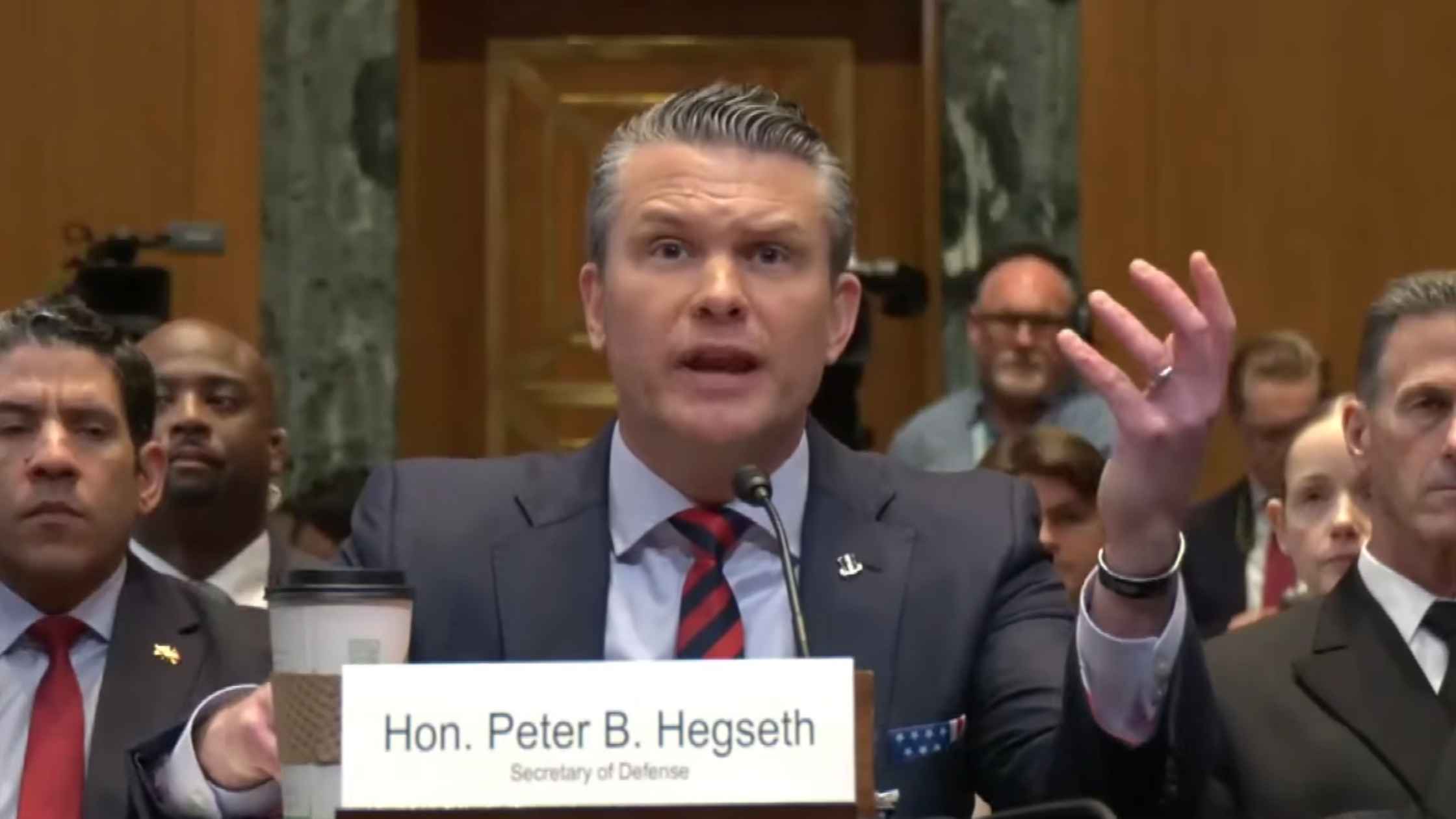
Thank you, Mr. Chairman, Ranking Member, members of the committee, thank you for the opportunity to testify in support of President Trump's historic $1.5 trillion 2027 budget for the Department of War. The president's budget request reflects the urgency of the moment addressing both the deferred maintenance of longstanding problems as well as positioning our forces for current and future fights. I'm honored to be joined alongside the chairman of the joint chiefs and J Hurst.
Speaker 1 (24:13):
This is war of attrition, the Iranian-American community is against this illegal war and if you approve this budget, you're complicit in the war crime of his administration.
Sen. McConnell (24:33):
If I may interject, I ask that we have order in the hearing room so we can proceed. I ask the witness to suspend until the room is cleared and it appears it's cleared. Go ahead, Mr. Secretary.
Hon. Peter B Hegseth (24:46):
Thank you. I'd like to start by thanking this committee and Congress for your partnership in securing the investments needed to maintain the most powerful military in the world. Our nation's ability to build, to innovate and support the critical needs of war fighters at speed and at scale is the foundation upon which our survival rests. When President Trump took office, he inherited a defense industrial base that had been hollowed out by years of America last policies, resulting in a diminished capacity to project strength, offshoring, outsourcing cost overruns and degraded capabilities. Under the leadership of President Trump, a builder in chief, we are reversing the systemic decay and putting our defense industrial base back on a wartime footing. Urgency informs everything that we do. We're rebuilding the military that the American people can be proud of, one that instills nothing less than unrelenting fear in our adversaries and confidence in our allies.
(25:43)
We fight to win in every scenario to include ensuring Iran never has a nuclear weapon. The $1.5 trillion FY27 budget put forward by the president will build upon the historic $1 trillion FY26 top line and will continue to reverse four years of underinvestment and mismanagement of the Biden administration. The $1.5 trillion budget will ensure that the United States continues to maintain the most capable military in the most complex of environments. Not to mention, however, that this budget also includes a historic troop pay increase, 7% that builds on the pay increases that Congress has given in previous years and the budget eliminates all poor or failing barracks. Quality of life for our troops is front and center in this budget. By supercharging our industrial capacity and transforming how the department does business, we are restoring American commercial dominance at a pace unseen in generations, transforming the defense industrial base from the broken, slow moving systems of the past.
(26:50)
We have flipped Pentagon acquisition processes from a bureaucratic model to a business model, decisively moving from an acquisitions environment paralyzed by bureaucratic red tape to an outcome driven organization focused on delivering the most for taxpayers. Over the past year through historic multi-year procurement agreements, smart business deals, we have sent an unambiguous demand signal to our industry partners, large and small, to build more and build faster. The result has been a surge, a revitalization of our great American factories and a massive reinvestment in the skilled American workers who serve as the industrial muscle behind our warriors. I'll provide a brief overview of what's been accomplished on that front in just a few months. These are announced new facilities and investments in support of American warfighters. The department has helped stimulate more than 250 private investment deals in 39 states, in 180 cities, in 150 companies, not just the big primes, worth more than $50 billion.
(27:59)
This has resulted in 280 new or expanded facilities and more than 18 million new square feet of American manufacturing, 70,000 new jobs. These 50 billion in investments, in new plants, new assembly lines, and new factories are private investments, not taxpayer dollars. By completely transforming our department's business model, American companies, private companies are investing in their own factories with their own money, historic demonstration of American manufacturing and defense revitalization all with their capital not Uncle Sam's. This has not been done before and is long overdue. It's from a bureaucratic model to a business model. These investments equal great things for American families and American workers and help ensure that we can defend the American dream, all American made. Together with the help of this Congress, we're turning the lights back on on the arsenal of freedom. We're firing up the American economic engine at every level of our defense industrial base.
(29:05)
Every policy we pursue, every budgetary item we request serves to ensure that this department remains laser focused on increasing the lethality and survivability of our fighting forces from the front lines to the factory floor. We truly believe this is a historic budget and at every level we have made it a fiscally responsible budget. This is also a war fighting budget. Under President Trump, we are restoring the unbreakable might of American manufacturing, which has to underwrite everything. We're providing for our war fighters and we are putting the people and interests of this country first. May Almighty God continue to watch over our troops and may he honor, may we honor the legacy of those brave Americans that we've lost. That is our sacred mission and that's what we'll continue to execute on. Thank you for this opportunity and we look forward to your questions.
Sen. McConnell (30:03):
Thank you, Mr. Secretary. I know we all understand you're going with the president to China. We all agree they're the greatest long-term military and economic challenge to US and our Western allies as well. Of course, Taiwan, Japan, and Philippines look to us, so can you reassure the countries out there in the Pacific that their security will not be on the table during the talks in Beijing? Is our strategy to preserve American primacy or simply to accommodate China's rise? And can you speak to our commitment to preserving freedom of navigation in places like the South China Sea?
Hon. Peter B Hegseth (31:01):
Well, thank you for the question, Senator. I would never purport to speak on behalf of the president or what he will say or how he'll approach these talks, but having an opportunity to watch him work, every aspect of what he pursues inside this relationship is to ensure that American interests are advanced. And our department underneath that, we've worked very hard in that region in the Indo-Pacific with Japan, with the Philippines and others to make that a priority, to ensure that America's security is amplified by burden sharing of partners who recognize the shared threats that we face and are willing to invest alongside us. And some of those things are known to the public, some of those things are not known to the public, but since the beginning of my time in this job, we've focused in that area of operations to ensure that Admiral Paparo has every option available to include with partners to create all the dilemmas necessary to give America every advantage possible, whether it's freedom of navigation,
Hon. Peter B Hegseth (32:00):
... access basic and overflight and ultimately put the president in a position where he's going into Beijing in a position of strength, which he will be.
Sen. McConnell (32:12):
So would you be a little more specific about navigation, particularly in the South China Sea?
Hon. Peter B Hegseth (32:21):
I think what you've seen from this administration is a commitment to freedom of navigation. Take, for example, the BAM and the Houthis, which under the Biden administration, they allowed American ships to get shot at without consequence.
(32:34)
And President Trump undertook that mission Operation Rough Rider for 50 days and the Houthis stopped shooting at our ships. It wasn't a nation building exercise, it was advancing of freedom and navigation and our interests. The same would pertain to any waterway in the South China Sea. American ships should sail freely, so should others in the international maritime sphere.
Sen. McConnell (33:04):
Army Secretary Driscoll has described Ukraine as the Silicon Valley of warfare as I suggested earlier. I think we all agree on that. And the outcome of the war really matters to American interests. Is there a policy preventing senior department officials from traveling to Ukraine? Do you support or oppose senior officials traveling there?
Hon. Peter B Hegseth (33:33):
Senator, we've had many senior officials travel there and we learn a great deal. In fact, I've personally approved additional personnel there to learn from that drone battlefield, both on offense and defense to ensure that we're learning every possible lesson from that conflict and incorporating it in real time into how we defend and we go on offense in an era where drone dominance is required. And that's why this budget spends so much on drone dominance. Take the lessons learned from Ukraine and other battlefields and ensure we're applying them throughout the fighting force as quickly as possible.
Sen. McConnell (34:06):
Well, I think what's not in dispute is that NATO is the most important military alliance in world history. Nobody's ever pulled something together like this and held it together to prevent the worst for a longer period of time.
(34:29)
Basically, it seems to me that a lot of the European countries think that we're reducing our influence there, that they're sort of on their own and somehow American leadership is not essential to NATO going forward.
(34:47)
I would argue that it's certainly essential for us to continue to be the leader and it's important to note the other countries that are looking to NATO, our allies in the Pacific, helping Ukraine interested in coming to NATO meetings, anxious for America to continue to defend the free world, not just in NATO but worldwide. It's a big job and they're looking to us. There's nobody else who can do that.
(35:21)
So what is the department's concise vision for the role of our allies and partners in defending America's global interests?
Hon. Peter B Hegseth (35:33):
Senator, our vision is to have real capable allies and partners. I think that's what we've seen in Epic Fury. Israel's Air Force and their ability will... and their capability is a demonstration to the world. There are other allies like that and we need more of them.
(35:51)
So flags are not the goal. The number of flags involved in an operation are not the goal. The goal is the number of capable formations. Who can actually fight alongside the American fighting man and woman so it's not just us all the time?
(36:04)
I saw that in Iraq. I saw that in Afghanistan. Our generation has experienced that. No administration has done more to ensure that our allies and partners realize they need to step up so that we can amplify our capabilities. That's what burden-sharing is all about. It's not just, "We carry the burden for other countries." It's, "Other countries are capable of coming alongside us as well."
Sen. McConnell (36:27):
But I also think Putin's invasion of Ukraine helped get their attention that they need to step up as well. And the president's been very clear about that. So they are headed in the right direction. What I'm worried about is which direction we're headed in.
Hon. Peter B Hegseth (36:45):
I think it's very encouraging that European countries have stepped up to ensure that Ukraine can defend itself. I think that's a very good development.
Sen. McConnell (36:54):
Senator Coons.
Sen. Coons (36:56):
Thank you, Mr. Chairman. So Mr. Secretary, in January, President Trump signed the fiscal year '26 defense appropriations bill. It provided $400 million specifically to aid Ukraine in their fight against Russia. This is at a time when our European allies and partners have stepped up to take on the overwhelming majority of the cost of any munitions or support for Ukraine.
(37:22)
So far, your department has not spent a dime of that $400 million despite repeated follow-up requests from the chairman and myself. In a call just last week, your staff indicated we will see a spend plan for those funds this week. Will you commit to spending those $400 million for weapons for Ukraine and when will we receive your department's spend plan?
Hon. Peter B Hegseth (37:48):
I appreciate that question. The 400 million for European capacity building has been released from the Secretary's War's office and we'll work with UCOM to make sure they spend it accordingly and properly, which we have all faith that they will.
Sen. Coons (38:02):
Mr. Secretary, when will this subcommittee get the associated spend plan for the $400 million?
Hon. Peter B Hegseth (38:10):
Yeah. I mean, we will work with your committee to make sure that the spend plan as allocated... I want to make sure UCOM is fully informed in how they want to spend this. They're the closest to the problem set. And so working with them to ensure that you have the spend plan will work with you.
Sen. Coons (38:23):
Mr. Secretary, thank you. But it's May and this has been the law since January and you or your representatives have been asked this repeatedly on a bipartisan basis by members of this committee. And I think dragging our feet on this small investment in Ukraine's defense sends exactly the wrong signal to Putin at a time when the contest for freedom has its front lines in Ukraine.
(38:49)
As you said, Europe has stepped up donating billions to buy US weapons to send to Ukraine to help them as they continue to take ground on the battlefield. But it seems not all the money donated by European allies is going to buy new weapons for Ukraine as they had understood.
(39:06)
The memo you released just last week prior to your testimony at Senate Armed Services indicated DOD has and will continue to divert some of these funds back into DOD accounts for our own use.
(39:19)
Will you commit, Mr. Secretary, to spend every dollar donated by our European allies for Ukraine on new weapons and capabilities for Ukraine?
Hon. Peter B Hegseth (39:30):
The Pearl Initiative, which you're referring to, which is instituted underneath this administration so that European countries are paying for American equipment to provide as they see fit, NATO allocates where it would like to allocate that. It can choose Ukraine if it'd like. That money, when it's paid for, that's where it goes. It goes to those efforts.
Sen. Coons (39:48):
Well, look, as the chairman raised and as I will repeat, I view NATO as the most successful mutual defense relationship we've ever had. And your comment about we need not flags but real and capable allies, and the foot-dragging on both Pearl and the investments in our Baltic allies and Ukraine causes me real concern.
(40:08)
As you know, a bipartisan group of us from the Senate and the House went to Denmark. To lay a wreath at the memorial to the 52 Danes who served, fought, and died alongside our troops in Afghanistan, those were not just flags. Those were real war fighters who fought and died at our request in a war that began by NATO's initiation, a service and sacrifice in Afghanistan. I just think we're sending the wrong signal by the president's announcement of the intention to withdraw 5,000 troops from Germany.
(40:44)
Could you help me understand what is the strategic reason for a drawdown of US troops from Western Europe?
Hon. Peter B Hegseth (40:51):
I would just like to clarify, Senator, it's never about the heroism of foreign troops. I fought alongside Great British and European and Australian allies in Afghanistan. It's the political caveats and the limitations that they come with. It's not the troops.
(41:06)
It's the capitals of those militaries that limit what they're able to do, where they're able to go, who they're able to fight, that create limits on our own. And anybody that's been in these formations knows that. So it's easy to talk about here. It's another thing to apply. And we need allies that are burden-sharing, not becoming a burden with-
Sen. Coons (41:22):
Is there any-
Hon. Peter B Hegseth (41:22):
... political limitations. I'm not talking about the troops.
Sen. Coons (41:25):
Thank you. Our president said in Europe that we never asked for and never received anything from our NATO allies. Was that your experience in Afghanistan serving and fighting alongside our NATO allies?
Hon. Peter B Hegseth (41:38):
I have written extensively about that and the vast majority of my experience was frustration with the limits of what those troops were able to do because of the political caveats, rules of engagement, and limits that came from their capitalists.
Sen. Coons (41:50):
But you don't doubt our question that about a third of all the combat casualties in our war in Afghanistan were our NATO partners and allies?
Hon. Peter B Hegseth (41:57):
I would have to go back and check that number, but I take your word for it.
Sen. Coons (41:59):
Let me just assert that hundreds and hundreds of service members from, as you put it, Australia and the United Kingdom, as well as many other of our allies serve, fought and died alongside us.
(42:09)
So I'm just going to simply say: in terms of our reliance on our partnerships, I'll agree with the chairman that at a moment when Russia and China, North Korea, and Iran are coming closer together and delivering a bedeviling lethality in this ongoing war in Iran for which we don't have a clear strategy or clear answers, our better strategy would be to partner more closely with Ukraine, dig in deeper with our real values-based allies, our treaty allies in the Western Pacific and in Europe, and together find a path out of this rather than berating them and bullying them for not coming along in a war they were not consulted about or briefed on before it began. I look forward to a second round. Thank you, Mr. Chairman.
Sen. McConnell (42:57):
Senator Collins.
Sen. Collins (42:58):
Thank you, Mr. Chairman. General Caine, when the Department of War was planning its operations in Iran, did you anticipate the closure of the Strait of Hormuz and the resulting impact on oil supplies for many countries, including here in the United States where we've seen gas, diesel, and home heating oil prices go up? I ask this question because there's historic precedent, obviously, during the Iraq Iran war, tankers were fired upon in the strait.
Gen. John D Caine (43:45):
Senator, thanks for the question. As always, we have an incredible staff over at the Pentagon and down at US CENTCOM, and we always look at the range of military branches and sequels. I won't comment on any particular one because that gets to whatever advice I may or may not have given to the president and I do that in private, but you should rest assured as should the American people that we cover and consider the full range of things all the time in our careful consideration of military actions and the advice and/or options that we present to our civilian leaders.
Sen. Collins (44:27):
It seems to me that there's been a different plan almost daily with dealing with this problem, which is why I ask. Mr. Secretary, let me start by thanking you for visiting Bath Iron Works in the state of Maine. The workers were very pleased to greet you and hear your encouragement and praise.
(44:55)
The Aegis destroyers play such a critical role in our national security from intercepting Iranian missiles to supporting combat operations around the globe. While visiting Bath Iron Works, you correctly described the DDG destroyers as the workhorse of the fleet and emphasized maxing out on DDGs sends a message to the world.
(45:26)
I was also delighted that you noted that Bath Built is Best Built, a slogan for which we're very proud. I fully agree with all those sentiments. That's why I was alarmed to see that this year's budget request only includes funding for just one DDG 51.
(45:49)
That's down from two in FY26 and three in FY25. That reduction to a single DDG 51 creates uncertainty for US surface combatant industrial base at a time when BIW is demonstrating huge progress in workforce retention, production stability, and faster throughput. So there needs to be a steady demand signal for DDGs in order to keep the yard operating at all phases, from cutting the initial steel to completing the ship.
(46:40)
So I'm puzzled by why only one DDG is requested and concerned about what that will mean as far as maintaining that workflow. I'm particularly puzzled by the decision in reconciliation to request 1.8 billion for foreign born surface combatants at the same time that there's the proposed cut for American built destroyers.
(47:16)
When providing a demand signal for US built DDGs from the department help the industry further increase the speed at which these ships are being produced, and I'm sure when you're at Bath they probably showed you the chart of the enormous progress that they are making.
Hon. Peter B Hegseth (47:41):
I appreciate the question, Senator, and it was a great visit and it's incredible what they do. To both your questions, the answer is ship-building capacity. And that's why we invest 65 billion in ship-building in our shipyards, is because the reason for our request of that number is the ability to build them and how quickly. And so as soon as that capacity is increased, which we anticipate this investment will do, then we look forward to ordering DDGs into the future because they are the backbone of our naval fleet.
Sen. Collins (48:13):
Thank you, Mr. Chairman.
Sen. McConnell (48:16):
Senator Durbin.
Sen. Durbin (48:17):
Thanks, Mr. Chairman. I associate myself with the remarks of Senator Coons earlier about the 400 million for Ukraine and I hope that it is allocated quickly. I'd like to ask a similar question about the 200 million in that same appropriation bill that was designated for the Baltic Security Initiative. Has that money been released?
Hon. Peter B Hegseth (48:44):
If it has not been, it should be. I don't know. Has it been released?
Hon. Jules W. Hurst III (48:47):
Senator, so I believe there was a mistake with how the appropriations bill was written. We're trying to rectify that through a reprogramming action to make sure we have sufficient funds in the DSCA account to execute BSI.
Sen. Durbin (48:59):
It's five months after that bill was signed into law. How long will this take?
Hon. Jules W. Hurst III (49:04):
I think it's contingent on the reprogramming action being improved by the committees of jurisdiction of the Department of War.
Sen. Durbin (49:10):
So you're suggesting it has to go back through Congress for the current appropriation?
Hon. Jules W. Hurst III (49:15):
I need to move money between DSEA accounts to execute BSI. That's right.
Sen. Durbin (49:18):
Well, I can tell you I would like to work with you to dispatch that money. It is needed for the Baltics in Poland and needed on a timely basis.
Hon. Jules W. Hurst III (49:27):
Absolutely.
Sen. Durbin (49:28):
I'd like to take a moment to reflect on the war in Iran, which you, Mr. Hurst, testified before Congress has cost us $25 billion, 14 US military personnel tragically killed, and a tenuous ceasefire in place.
(49:48)
As I look at the achievements Iran to date led now by an even more extreme Supreme leader, the global economy has held hostage to the standoff in the Strait of Hormuz. Our munition stockpiles are dangerously depleted and Iran is no further from a nuclear weapon than before our invasion.
(50:09)
General Caine, the president has claimed on several occasions over the past couple of months that the war is over, that the conflict has been concluded. What were the goals of the US conflict in Iran and have we achieved them?
Gen. John D Caine (50:23):
Well, sir, I'm going to be mindful of my need to maintain trust with a variety of stakeholders in the job that I'm in, which includes you, the American people, the joint force, and the president. And to that point, only our political and civilian leaders set the national military objectives.
(50:40)
Our military objectives have been clear the whole time around the targeting Iran's ballistic missile systems, preventing them from threatening US forces in their region, destroying the Iranian Navy, degrading its capacity and capability, and ensuring that they can't rebuild by focusing on their defense industrial base. I'll defer to the secretary and the president on other strategic objectives, but that's what we've been focused on, sir.
Sen. Durbin (51:08):
Do you feel that the situation in the Strait of Hormuz indicate a victory on our side?
Gen. John D Caine (51:15):
Sir, only political leaders decide victory or defeat and that I'll leave it to them to opine on that. They are the ones who invoke or stop the use of military force.
Sen. Durbin (51:28):
Well, then let me put it in strictly military terms. Can you explain to the American people who are facing these gasoline and diesel oil prices what is going on in the States of Hormuz where Iran, which was attacked by us seemingly as the Strait of Hormuz at a standstill with 1500 tankers waiting for either permission or peaceful circumstances to navigate?
Gen. John D Caine (51:52):
Sure. I think militarily it's a case where Iran is choosing to hold the world's economy hostage through their use of military power across their southern flank. And so I would encourage Iran to reconsider that and I would encourage those allies and partners who have an opportunity to come assist with that tactical problem to do so.
Sen. Durbin (52:17):
Could you explain to the American people why with the fast investment we've made in national defense and military, how Iran after they've been attacked by us is still capable of stopping the traffic in the Strait of Hormuz?
Gen. John D Caine (52:33):
Well, sir, it's a complex situation out there with a lot of different small boats that are out there and other capabilities. Some of this is on the commercial traffickers. Some of this is on, again, back to the main problem and that's Iran holding the global economy hostage through the straits. I would encourage them to think wisely about their next moves and to take the opportunity to open the straits. They have that choice to make.
Sen. Durbin (53:04):
They certainly do. I guess, the question in my mind is: as we talk about trillion dollar plus budgets for our military, it appears that a very small budget is holding us hostage in the Strait of Hormuz. Yield, Mr. Chairman.
Sen. Graham (53:24):
Thank you. I just want to start off with saying that these military operations against Iran have been spectacular. In a matter of months, we have degraded the largest state sponsor of terrorism beyond what I thought was possible, probably more to come. Mr. Secretary, 900 pounds of 60% enriched uranium, do we all agree that's what Iran has buried somewhere?
Hon. Peter B Hegseth (53:55):
In this format, some of that should be classified, so I wouldn't comment on the exact amount of anything.
Sen. Graham (54:00):
Okay. Well, it's just pretty well-known. They brag about it. Is it possible they could have 60% highly enriched uranium without them cheating in the past?
Hon. Peter B Hegseth (54:12):
We know in every context of what Iran has undertaken, they've lied and cheated.
Sen. Graham (54:16):
The answer is no. Everything that Obama and Biden did was designed to keep it to civilian nuclear program. There is no way in hell they can have 60% highly enriched uranium unless they cheat. So everything y'all did failed. And you want to criticize? You failed. You allowed Iran to be a threshold nuclear nation. Everything you did failed. Missiles, Diego Garcia. Did they shoot missiles at Diego Garcia, General Caine, the Iranians?
Gen. John D Caine (54:49):
Yes, sir. They shot a few.
Sen. Graham (54:50):
Under the protocols we had in place where they're supposed to be able to do that?
Gen. John D Caine (54:57):
Without reviewing the fine print, I believe the answer's no.
Sen. Graham (55:00):
No, they weren't. You failed there. You failed to stop Iran from being a nuclear threshold nation. You failed to stop Iran from having missiles that could go thousands of miles. Why should we listen to you? Bottom line here, China. Does China buy 90% of Iranian oil, Mr. Secretary?
Hon. Peter B Hegseth (55:27):
China buys a very large percentage of Iranian oil.
Sen. Graham (55:30):
Okay. 90% is pretty large. So does China buy... Are they largest purchaser of Russian oil and gas?
Hon. Peter B Hegseth (55:40):
I would imagine they're up there, Senator.
Sen. Graham (55:41):
They are. They're the largest. So President Trump, when you go to China, realize that the person you're talking to is propping up Russia and Iran. I appreciate what you've done in Iran. I appreciate what you're trying to do to end the Russian-Ukraine conflict. Do you agree with me, Mr. Secretary, that of all the countries on the planet, China could have the most influence of ending this war if they chose to?
Hon. Peter B Hegseth (56:08):
I think the most influences in President Trump's hands and what he decides to do and he'll set the terms about this-
Sen. Graham (56:13):
What if China stopped buying-
Hon. Peter B Hegseth (56:15):
But ultimately, China has a lot of leverage. You're right.
Sen. Graham (56:17):
Yeah, they do. What if they stop buying 90% of oil from Iran? That's not President Trump. That's up to China. Do you support putting tariffs on China if they continue to buy Russian oil and gas?
Hon. Peter B Hegseth (56:30):
Tariffs is not my lane but-
Sen. Graham (56:31):
I got you.
Hon. Peter B Hegseth (56:32):
... anything you can do to put pressure on people, I usually support.
Sen. Graham (56:34):
Well, do you believe that when we put pressure on India by a 25% tariff for buying Russian oil, they kind of backed off?
Hon. Peter B Hegseth (56:42):
I would say I've had a front row seat to the efficacy of tariff policy, yes.
Sen. Graham (56:45):
Yeah. I think it works, guys. And we're on the breakout here in a minute of having a bill that would give the president ability to tariff the largest purchasers of Russian oil and gas and I hope he will use it. So I just want to... Pakistan. Are you aware of reports that Pakistan are allowing their bases to be used to park Iranian aircraft, General Caine?
Gen. John D Caine (57:11):
Sir, I've seen one report on that.
Sen. Graham (57:16):
Well, is it accurate?
Gen. John D Caine (57:18):
Sir, I think based on the variety of classification matters I've seen-
Sen. Graham (57:24):
Let me just say, do you agree if it is accurate, that is sort of inconsistent with it being a peace mediator?
Gen. John D Caine (57:30):
Sir, I wouldn't want to comment on that based on the ongoing negotiations-
Sen. Graham (57:34):
I do-
Gen. John D Caine (57:34):
... in Pakistan tolls.
Sen. Graham (57:35):
Secretary Hegseth. If the mediator is allowing reconnaissance aircraft Iran to be parked in Pakistani air bases, do you think that's consistent with being a fair mediator?
Hon. Peter B Hegseth (57:50):
Again, I wouldn't want to get in the middle of these negotiations. I want maximum-
Sen. Graham (57:51):
Well, I do.
Hon. Peter B Hegseth (57:51):
... efficacy for our people.
Sen. Graham (57:53):
I want to get in the middle of these negotiations. I don't trust Pakistan as far as I can throw them. If they actually do have Iranian aircraft parked in Pakistan bases to protect Iranian military assets, that tells me we should be looking maybe for somebody else to mediate. No wonder this damn thing is going nowhere. So I appreciate all you've done. I'm very supportive of it, but when it comes to Pakistan and China, enough already. Thank you.
Sen. Reed (58:30):
Thank you very much, Mr. Chairman. Thank you, gentlemen, for being here today. Mr. Secretary, we have been trying to track down the expenditures in the Operation Epic Fury and Operation Freedom now and we've sent letters and we've got very few responses. We've been sending the letters since March 10th.
(58:54)
We did understand that it was released... that in the first six days, $11.3 billion was spent. And then recently we were told $25 billion was spent. Today, I think the number's $29 billion. Can you provide some details as to what consists of that 29 billion? Have we counted everything?
Hon. Jules W. Hurst III (59:22):
Yeah, Senator Reed. So I testified this morning to HAC D that between the joint staff and the comptroller staff, our operational cost estimate is now $29 billion. A lot of that increase comes from having a refined estimate on repair or replacement costs for equipment.
(59:36)
Our munitions costs are fairly fixed. We think they're very accurate and then there's some O&M costs there as well. We're not making an estimate for MILCON at this time. We don't know what our future posture is going to be. We don't know how those bases would be reconstructed and we don't know what percentage of our allies and partners will pay for that reconstruction.
Sen. Reed (59:54):
So you do not consider installations that have been damaged in the conflict, correct?
Hon. Jules W. Hurst III (01:00:01):
We just don't have a good estimate at this time.
Sen. Reed (01:00:03):
So it's not in the $29 billion.
Hon. Jules W. Hurst III (01:00:05):
That's correct.
Sen. Reed (01:00:06):
Expended weapons, are they totally included within the estimate?
Hon. Jules W. Hurst III (01:00:11):
Yes. To the best of my knowledge, we have a full account of the expended weapons.
Sen. Reed (01:00:14):
And weapons transferred to other countries in the region, are they counted in?
Hon. Jules W. Hurst III (01:00:20):
I would want to double check to make sure we have that accurately.
Sen. Reed (01:00:22):
Please. I mean, you're coming up and asking for another significant supplemental, et cetera, and before we can, I think, reasonably appropriate additional money, we have to find out how the existing appropriated dollars have been spent. So that's critically important. And I know also that the budget asked for another $350 billion in reconciliation. How essential is that to your budget?
Hon. Jules W. Hurst III (01:00:56):
I would say it's extremely essential to achieve the generational investment that the president is trying to make.
Sen. Reed (01:01:01):
But that would be on top of the $150 billion we received in the Big Beautiful Bill, which would be $500 billion, half a trillion dollars in two years. And again, we're not getting, I think, the detailed spend plan, the detailed obligation plan for this. And without it's very difficult to say, "Just take the money and run." We have a job to do too. Any comments, Mr. Secretary?
Hon. Peter B Hegseth (01:01:31):
We recognize that. In a perfect world, everything's part of your regular order. This is a dynamic place with a lot of dynamic factors. And so in order to get where we need to with the historic investment for this department, we think this is the best allocation in order to get there, Senator.
Sen. Reed (01:01:49):
Well, I think detailed analysis, detailed data that we receive will help us make more sensible judgments and we're just sort of... Vague generalities are not helping this committee make critical judgments and the tradeoffs are significant. Deficit is increasing dramatically. We have to be conscious of that.
(01:02:11)
We also have to be conscious to helping American families just get by. And inflation just hit 3.8% today, which is I think the biggest numbers is 2023 or something. So we're fighting all these forces that are not directly connected to your mission as secretary, but they are connected to our mission.
(01:02:34)
General Caine, your observations on the future course of action in Persian Gulf. We're in this tenuous ceasefire. What's your sense of the direction forward?
Gen. John D Caine (01:02:47):
Well, sir, I won't opine on a hypothetical. What I will assure you is that we retain and continue to hold a range of options for our civilian leaders. It would be inappropriate for me to opine on how it may go, but rest assured we still hold many, many options.
Sen. Reed (01:03:09):
Have you been surprised by the resistance of the Iranians?
Gen. John D Caine (01:03:18):
Sir, as a war fighter, I always assume an enemy's going to resist and the job of the joint force is to win at the time and place of our nation's choosing. So I always assume an enemy's going to fight and I find that's the best pathway.
Sen. Reed (01:03:32):
I think so too. And you communicated that to the president as you advised him and before the decision was made?
Gen. John D Caine (01:03:39):
Sir, as I've said respectfully before, I won't comment on my private conversations with the president in order to make sure that I maintain trust with him and with you and the American people and the joint force.
Sen. Reed (01:03:53):
That's a principled response. Thank you very much.
Gen. John D Caine (01:03:55):
Thank you, sir.
Sen. McConnell (01:03:56):
Senator Moran.
Sen. Moran (01:03:57):
Chairman, thank you. Secretary
Sen. Graham (01:04:00):
Hegseth, welcome. I just returned Friday from a visit to China, and one of the things that is seemingly clear to me is that Taiwan remains at the forefront of the Chinese efforts and next steps in what they want to accomplish. We have commitments, I guess, to defend Taiwan. You can explain that to me as you choose. What I would like to highlight is while Taiwan is still at the forefront, at least in the minds of the Chinese, the United States is seeing the Russian invasion of Ukraine in which we're yet to some degree still involved. We're having deterrence in the Indo-Pacific in regard to China. We're conducting operations in the Middle East.
(01:04:52)
All of that has drawn strategic capabilities from the joint force. One of the things I think we can do to augment our joint force is strong allied relationships, partnerships with others. Given the current threat environment that we are in and the scale of the global demands upon the United States, can you speak to how the department views the role of allies and partners in sustaining our global posture? And does the defense budget recognize, reflect the needs to strengthen allied integration and maintain credible unified deterrence?
Hon. Peter B Hegseth (01:05:30):
Senator, I appreciate the question, and I think foundational to it is a recognition that countries closest to the problem set should be most invested in ensuring that they can deter that adversary, which is why we want European capabilities to increase to deter Russian aggression. When you look at the Indo-Pacific, it's been a focus of our department since the day I showed up, whether it's ASEAN or Shangri-La, or traveling to the region, going to South Korea, going to Japan, going to the Philippines, having them to our building to build out those relationships in a very real operational way. It's not about what we can sign. It's about what contingencies and dilemmas can we create for adversaries who may seek to expand their sphere of influence, whether it's militarily or economically, or through pressure. And so I think while we've been involved in a lot of efforts around the world, through the president's leadership, we've reestablished deterrence.
(01:06:25)
The world knows that America's word means something. From Maduro to the Houthis, to Midnight Hammer, to Epic Fury, when the president says, "You can't have a nuclear weapon," he means it. When the president says, "You're an indicted individual," he means it. Everybody sees that, including in the Indo-Pacific. And when you do that plus build out your alliances, not based on talk, but based on capabilities, access, facing overflight training, interoperability in indiscreet ways, I think all the right people pay attention to that and see it. And that's been the focus in the Indo-Pacific for us for a while.
Sen. Graham (01:07:00):
And the budget request reflects that circumstance that you just described before-
Hon. Peter B Hegseth (01:07:06):
Very much so. I would say Admiral Paparo, his request, his line items, his input was front and center in the build of FY27 to ensure allies and partners are considered. Yes, sir.
Sen. Graham (01:07:16):
Secretary Hegseth, let me change the topic. I worked closely with Senator Cruz to introduce and secure the unanimous Senate passage of the ROTOR Act. That was an airplane that originated from Kansas that saw the death of 67 people near Reagan Airport. The department in December the 17th released a statement in support of the ROTOR Act, and yet when the House considered the ROTOR Act, the department released an additional statement and claimed that enactment would create significant unresolved budgetary burdens and operational security risks affecting national defense activities. Can you explain what happened between the first statement and the second statement that caused there to be a different reaction? And I ask this because it's still very important to me that the ROTOR Act or something very similar to the ROTOR Act is enacted into law, and apparently for it to be passed, it needs to be something that the Department of Defense is supportive of. So what is it that changed between the initial statement, the second statement, so that we can bring this legislative endeavor to fruition?
Hon. Peter B Hegseth (01:08:32):
Well, I appreciate your attention to what occurred there. We've taken it seriously from the beginning. We recognize the need for the requisite oversight. It was an earnest change. The department didn't think that the changes that we had asked for were incorporated properly into the bill, and as a result, we came out and opposed it, but we look forward to an iteration of that bill to get passed because we think it's important that it happened.
Sen. Graham (01:08:58):
So if I can paraphrase in my words so I understand what you're telling me, it isn't that something changed, it was that what you asked for didn't get enacted in the ROTOR Act before it passed the Senate?
Hon. Peter B Hegseth (01:09:09):
Correct. We think some changes that need to be made were not made to the bill and as a result, we changed our position, but we look forward to supporting something in the future. Yes.
Sen. Graham (01:09:18):
In my 15 seconds left, General Caine, could I ask you to visit with me momentarily after the hearing so that I can raise a topic with you and have you point me in the direction of where I can find an answer?
Gen. John D Caine (01:09:31):
Of course, sir.
Sen. Graham (01:09:31):
Thank you.
Sen. McConnell (01:09:34):
Senator Murray.
Sen. Murray (01:09:36):
Thank you very much, Mr. Chairman. Mr. Secretary, the war in Iran has not only cost 13 American service member lives, it is also costing American taxpayers dearly. Tens of billions of dollars and counting, and that's money that could be helping people, perhaps, get healthcare, but instead we're paying for bombs dropped in a war that American people overwhelmingly oppose. Now, earlier this morning, I know that your team testified Trump's war with Iran cost 29 billion so far. That is $29 billion blown on a war of choice and that's what it would have cost actually to save the ACA tax credits. But as my colleagues have already stated, what is concerning as well is it seems quite clear that cost estimate is suspiciously low. Now, your acting comptroller suggested that damage to US facilities was not factored into that figure. It is clear that there has been extensive damage to American military assets. New reporting from the Washington Post and others indicates that Iran has hit at least 228 structures or pieces of equipment at US military sites. Can you tell us what the cost of damage done to US facilities is because of this war?
Hon. Peter B Hegseth (01:10:54):
Well, I think Jay covered pretty clearly what we can or cannot share, but I would simply respond that, and I think it's an important point considering what the president is undertaking is what is the cost of Iran obtaining a nuclear weapon, and the fact that this president's been willing to make a historic and courageous choice to confront that, it comes with cost and we recognize that, and we honor that. But-
Sen. Murray (01:11:12):
I understand what your judgment is. We have a judgment as well, and I'm asking if you can tell us, and at what point you can tell us what the cost of damage done to US facilities is because of this war.
Jules W. Hurst III (01:11:22):
Yeah, ma'am, thanks for the question. So for future posture at least, we don't know what that's going to look like. We don't know how we're going to design these bases-
Sen. Murray (01:11:29):
The damage to date, you do not have any cost estimate on it at all.
Jules W. Hurst III (01:11:32):
For the military construction, I don't have a cost estimate to provide you at this time.
Sen. Murray (01:11:36):
Well, when will we get that?
Jules W. Hurst III (01:11:38):
Again, it depends on what the future posture is, how we decide to construct those bases.
Sen. Murray (01:11:42):
To date, you know what has happened to date. We can't get that number and that is a real concern to us. Our job is to appropriate dollars, and we're just told it's coming, it's coming, and we don't get it so it's very hard to do our budgets. And right now, Mr. Secretary, people are paying four or five, even six, $7 for gas, and American taxpayers are now on the hook as well for paying for this disastrous war. You're spending families hard-earned tax dollars on a war that many strongly oppose, and you're forcing people to pay more at the pump, and yet you're not even providing a real breakdown for the cost of this war so far. We have no real details, you have indicated that, and yet now you want Congress to send you one and a half trillion dollars more. To me, that is unacceptable, and I hope our Republican colleagues will join us in not only rejecting that absurd request, but in insisting that the American people get the actual answers on how much money their money we are spending on this.
(01:12:43)
Now let me turn and say, Secretary Hegseth, the president has called Medicaid, Medicare, and childcare little scams, and said, "We're fighting wars we cannot take care of daycare." I'm just trying to understand that. Is it your position since you're asking taxpayers for another half a trillion dollars for the war that American families should be forced to give up childcare and health coverage so that you can have one and a half trillion dollars for this budget?
Hon. Peter B Hegseth (01:13:13):
Senator, that's not my department. I certainly support this, and I also support the president's efforts to find and remove fraud wherever possible in general sense-
Sen. Murray (01:13:20):
Well, I'm not talking about fraud.
Hon. Peter B Hegseth (01:13:23):
... and we do that in our department as well at every step.
Sen. Murray (01:13:24):
I'm not talking about fraud. I actually asked whether an American family should lose their healthcare or their childcare to pay for this budget. That is literally what the president suggested.
Hon. Peter B Hegseth (01:13:38):
The president has proposed a historic $1.5 trillion budget that will defend the nation and confront threats like Iran, which previous presidents allowed to happen as Senator Graham pointed out. Previous administration said they wanted to take care of this problem-
Sen. Murray (01:13:50):
Your opinion-
Hon. Peter B Hegseth (01:13:50):
... and they did-
Sen. Murray (01:13:54):
The question-
Hon. Peter B Hegseth (01:13:54):
... not, and he's doing it.
Sen. Murray (01:13:55):
... from this committee, the question in front of the American people is what are they being asked to give up for this one and a half trillion dollars? That's what I was talking about. And lastly, Mr. Secretary, your budget request cuts through Trump's ramblings, and really to me makes the truth clear that you and the president don't value families as much as you value defense contractors. You want to increase the war budget.
Hon. Peter B Hegseth (01:14:17):
I mean, every-
Sen. Murray (01:14:17):
Let me finish.
Hon. Peter B Hegseth (01:14:18):
... family at Dover... Okay. Don't tell me we don't care about families. We sure do.
Sen. Murray (01:14:21):
Mr. Secretary-
Hon. Peter B Hegseth (01:14:22):
And we take care of them in every way we possibly can.
Sen. Murray (01:14:25):
I'm asking you about taxpayer dollars that everybody has. So when we've been to war before, we have asked people to do victory gardens. We've asked them to pay more. You are not doing that. You are asking for one and a half trillion dollars, which means something else has to be given up. That is what this committee is looking at. You want to increase the war budget for the next year by half a trillion dollars. That is taxpayer money that could be used to feed families or build new affordable homes, or wipe out some diseases completely, or increase child investments 20 times over. But you are asking us to blow it all on war, and that's not even counting the money that you have spent bombing Iran, or that you may still request in a separate supplemental. And to me, this budget wasn't even strategically crafted.
(01:15:10)
One and a half trillion dollars is like the president decided that was the number and you all filled in the blanks. So what I'm here today to say is you ask for a massive laundry list of unnecessary spending. It's a huge payday for defense contractors and you still don't even ask to give DOD civilian workers a pay raise. And to me, this is absurd. I know you do not care what I have to say. So let me quote you someone you might actually listen to, President Eisenhower.
(01:15:38)
He said, "Every gun that is made, every warship launched, every rocket fired signifies in the final sense a theft from those who hunger and are not fed, those who are cold and not clothed. This world in arms is not spending money alone. It is spending the sweat of its laborers, the genius of its scientists, the hopes of its children." That is what this budget proposal is asking. It's going to leave Americans cold and hungry to fund Trump's war and make defense contractors a fortune. So that is why I hope this committee throws that in that trash and comes together with a budget that works for all American families. Thank you, Mr. Secretary. Thank you, Mr. Chairman.
Sen. McConnell (01:16:20):
Senator Hoeven.
Senator Hoeven (01:16:23):
First, I want to thank you gentlemen and all of our men and women in uniform for the incredible defense of our nation, what we're seeing really around the globe, and certainly in the Gulf right now. The professionalism, the capability of our men and women in uniform is frankly beyond belief. It's just amazing, and we need to say thank you to those men and women, and their families every single day. It's really something. My first question is, Mr. Secretary and General, is there a way to secure the Strait of Hormuz before we fully resolve the conflict with Iran?
Hon. Peter B Hegseth (01:17:08):
Well, thank your statement upfront about the troops, and we certainly feel the same way. They're the best of American, deserve the best from all of us. As it pertains to... I actually didn't get a chance to reply to Senator Durbin who said that Iran was attacked by us. I would take issue with that. For 47 years, we've been attacked by Iran, and they've been lying to pursue a nuclear weapon and President Trump had the courage to do something about it. I don't think enough has been stated about the blockade and the power of the blockade, and the dilemma that our blockade creates for them. They can't move anything out of Iranian ports and over, I think it's 65 ships at this point have been turned around or disabled. The economic pressure that creates on them greatly outstrips the pressure on us, and we don't use the Strait of Hormuz anywhere near as much as the rest of the world does, or certainly they do.