
Clerk (00:00):
Mr. Schiff?
Senator Schiff (00:04):
No.
Chairman Grassley (00:04):
Aye.
Clerk (00:04):
Chairman Grassley?
Chairman Grassley (00:06):
The nomination?
Clerk (00:09):
On this vote, the ayes are 14. The nays are seven.
Chairman Grassley (00:10):
The nomination will be favorably reported. Now the last one is Antonio Pozos, Eastern District Pennsylvania. Clerk will call the roll.
Clerk (00:21):
Mr. Corning?
Senator Corning (00:22):
Aye.
Clerk (00:25):
Mr. Lee?
Senator Lee (00:25):
Aye.
Clerk (00:26):
Mr. Cruz?
Senator Cruz (00:27):
Aye.
Clerk (00:31):
Mr. Hawley?
Senator Hawley (00:31):
Aye.
Clerk (00:31):
Mr. Tillis?
Senator Tillis (00:31):
Aye.
Clerk (00:31):
Mr. Kennedy?
Senator Kennedy (00:31):
Aye.
Clerk (00:33):
Mrs. Blackburn?
Senator Blackburn (00:33):
Aye.
Clerk (00:33):
Mr. Schmitt?
Senator Schmitt (00:33):
Aye.
Clerk (00:33):
Mrs. Britt?
Senator Britt (00:33):
Aye.
Clerk (00:33):
Mrs. Moody?
Senator Moody (00:33):
Aye.
Clerk (00:40):
Mr. Durbin?
Senator Durbin (00:40):
Aye.
Clerk (00:41):
Mr. Whitehouse?
Senator Whitehouse (00:43):
No.
Clerk (00:43):
Ms. Klobuchar?
Senator Durbin (00:45):
No by proxy.
Clerk (00:47):
Mr. Coons?
Senator Durbin (00:55):
No By proxy.
Clerk (00:56):
Mr. Blumenthal?
Senator Durbin (00:57):
No by proxy.
Clerk (00:57):
Ms. Hirono?
Senator Hirono (00:57):
No.
Clerk (00:58):
Mr. Booker?
Senator Durbin (00:58):
No by proxy.
Clerk (00:59):
Mr. Padilla?
Senator Durbin (00:59):
No by proxy.
Clerk (00:59):
Mr. Welch?
Senator Durbin (00:59):
No, by proxy.
Clerk (00:59):
Mr. Schiff?
Senator Schiff (01:00):
No.
Clerk (01:01):
Chairman Grassley?
Chairman Grassley (01:04):
Aye.
Clerk (01:04):
On this vote, the ayes are 12, the nays are nine.
Chairman Grassley (01:08):
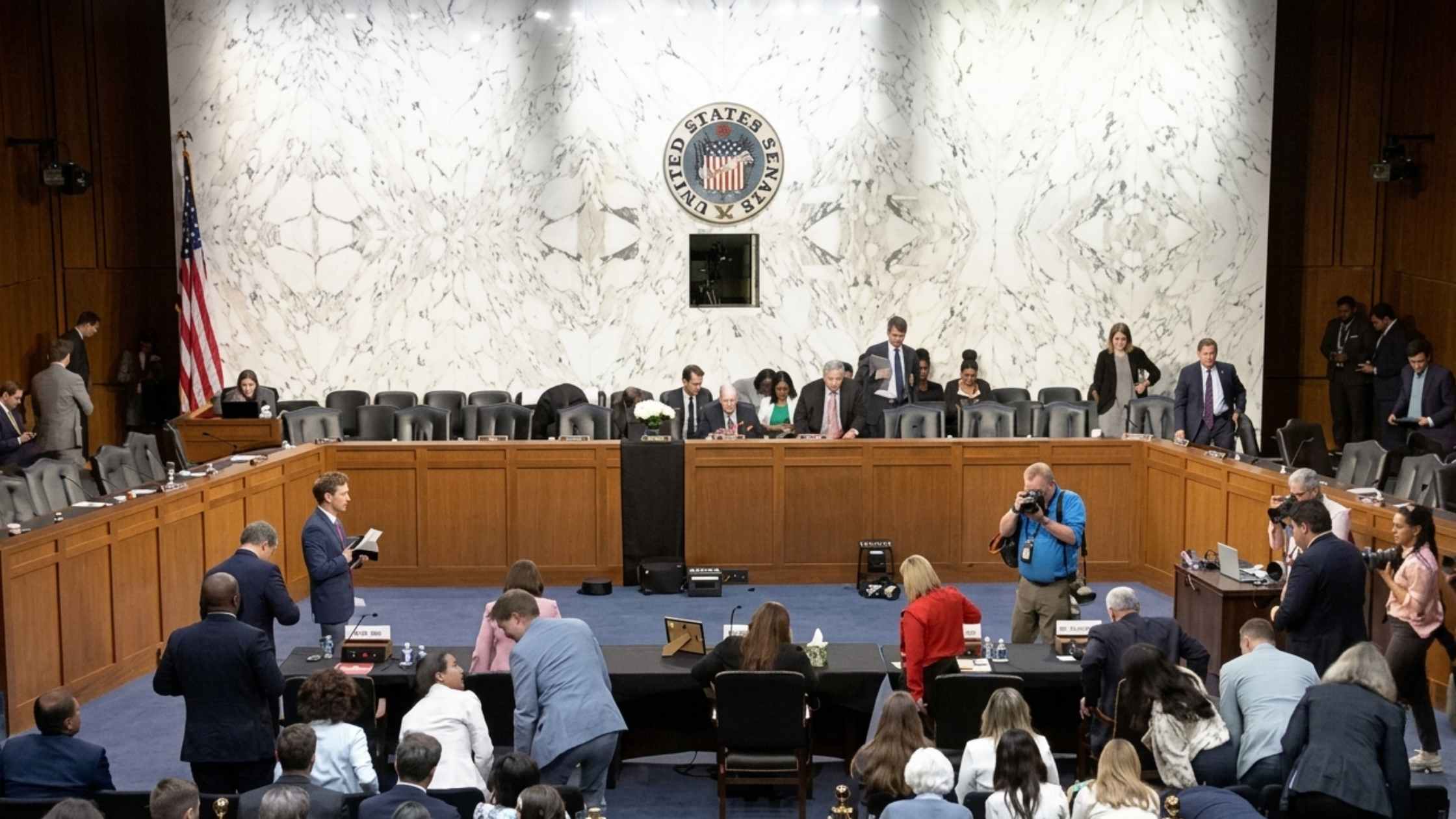
The nomination favorably voted on will be reported. This ends our business meeting. Now I call the hearing to order. I would like to have the witnesses. Would you please stand because we swear each in at every meeting? Do you swear that the testimony you're about to give before this committee will be the truth, the whole truth, and nothing but the truth so help you God?
Ms. Dani Bensky (01:59):
Yes.
Ms. Jennifer Bos (01:59):
Yes.
Ms. Elizabeth Oyer (01:59):
Yes.
Mr. Jon Adler (01:59):
I do.
Chairman Grassley (02:02):
They all answered affirmatively. Yeah. Okay.
Assistant (02:09):
Senator Durbin would like to give an opening.
Chairman Grassley (02:12):
Go ahead. You want to say something?
Senator Durbin (02:17):
[inaudible 00:02:17]. I'm done.
Chairman Grassley (02:17):
Okay. So welcome back, Senator Ashcroft. Will you please begin your testimony and then we'll go right down the list of people the way you're seated there.
Hon. Senator John Ashcroft (02:33):
Well, thank you, Chairman Grassley and Ranking Member Durbin. I'm grateful to you and please allow me just a moment to extend my condolences to the committee, the friends and colleagues of Senator Lindsey Graham. He had a vivid history of bringing out the best in people he worked with on both sides of the aisle and we enjoyed his friendship. And I take this moment to say my condolences and my sympathy also to Jennifer Bos, whose daughter was brutally murdered.
(03:10)
Allow me to thank you for your serious consideration and attention to the constitutional responsibility of confirming high ranking executive branch officials. It's an honor for me to participate with you today by my appearance. Testifying and sharing my profound support for the nomination of the Honorable Todd Blanche as Attorney General of the United States is something for which I am deeply grateful.
(03:37)
Justice is best served in the United States through a commitment to uphold the constitution and laws of this country. Integrity is an indispensable imperative for the rule of law. The rule of law is the best friend of constitutionally guarded liberty. For the highest quality administration of justice, law enforcement must never be diluted nor contaminated by personal bias or political preferences.
(04:06)
Todd Blanche's record of upholding the Constitution and enforcing the law, recommends him supremely to serve America as the 88th Attorney General of these United States. I know of no person, no person of a higher commitment to integrity. He has spoken the unvarnished truth to those he works for and to those he works with.
(04:29)
Todd's career stands as an outstanding record of public service. He is a consistently well-prepared, tough, but fair prosecutor, fundamentally focused on the Constitution. He understands that he has a profound responsibility in the Justice Department to seek justice, not merely to prosecute.
(04:51)
25 years ago, during my opportunity to serve as Attorney General, Todd worked as an individual in the Justice Department. And in his law school years, Todd worked with the Justice Department in that respect. Upon graduation from law school, he clerked for several judges, two of whom are now serving on the respected nationally focused Second Circuit Court of Appeals. So he had an understanding of the law from both the prosecutorial side and the side of the bench.
(05:28)
Following his clerkships, Todd became an Assistant United States Attorney as the US Attorney Office for Southern District of New York, a premier prosecutorial office of the United States. He spent roughly two years as the co-chief of the Violent Crimes Unit, supervising their nearly two dozen prosecutors. Then served as a co-chief of the office's White Plains Division where he presided over a wide span of work, public corruption, securities and bank and wire fraud, federal programs fraud, Medicare fraud, RICO and violent crime.
(06:09)
Today as Deputy Attorney General and Acting Attorney General, Todd energizes the roughly 115,000 employees from across main justice, the FBI, the DEA, the US Marshals Service, ATF, and 93 US Attorney's offices that span the United States. He's conducted the department's daily operations at full scale, demonstrating his readiness to manage the office in his own right.
(06:39)
Todd therefore brings to the Department of Justice a relevant reservoir of experience coupled with sound judgment on an array of different issues. They're all related to law enforcement and the administration of justice. He understands that the rule of law exists to secure this and safeguard the God-given rights of liberty and freedom in America.
(07:05)
In professional moments, both private and public, I have seen Todd's thoughtful, decisive, yet humble leadership. He's a careful and willing listener skilled at welcoming diverse viewpoints. He is adept at synthesizing and harmonizing different voices in complex situations. He is comfortable in being held to account and he will require those in the department to be similarly accessible and accountable.
(07:35)
Todd Blanche's record reflects a commitment to the rule of law and the Constitution. Our 250th anniversary properly reminds us that liberty is the core value of America. In fact, it's a core value of human existence. To safeguard this core cultural value, America needs an attorney general exclusively devoted to the rule of law and who unfailingly will honor his oath to the Constitution.
(08:06)
Todd Blanche is the right person for that responsibility. Mr. Chairman and committee members, thank you for what I consider to be a privilege to appear before this committee and communicate to you my unreserved endorsement of Todd Blanche for Attorney General of the United States. And I thank you for this opportunity.
Chairman Grassley (08:26):
Thank you, Mr. Ashcroft. Now, Ms. Bensky?
Ms. Dani Bensky (08:32):
Thank you. First, I'd like to thank you and the committee-
Senator Durbin (08:35):
Microphone.
Ms. Dani Bensky (08:36):
Oh, sorry.
Chairman Grassley (08:37):
Push the red button.
Ms. Dani Bensky (08:38):
There we go. Thank you. First, I'd like to thank you all and thank you to the committee for hearing survivor voices. I'd like to remind you of who you're hearing from today. At this time, can my survivor sisters and family please rise?
(08:56)
We may look like grown adults when you see us now, but we were children. Young girls at the time of our abuse. These are the photos of when our innocence, dreams, and lives were stolen. Please take these faces in as you think of us as your own family, daughters, nieces, sisters. Now look at our faces and remember the women and families of who the DOJ re-victimized. You guys can sit. Thank you so much.
(09:25)
I'm a teacher. In my school, if a student released a nude photo depicting a peer's sexual assault and abuse, they would almost certainly face expulsion. And yet this is what our Department of Justice did to crime victims. Today, Todd Blanche, well, Todd Blanche has been at the helm of the release of nude images of survivors, the outing of Jane Does, and the exposure of more than 100 victims' identifying information and documents describing horrific acts of abuse, including my own.
(09:59)
Instead of treating this release as its own violation and holding the man who led it accountable, you have a decision on whether you place him in the highest law enforcement position in this country.
(10:15)
In December, before the document release, our attorneys submitted 350 victims' names to the Department of Justice as victims' names to be redacted prior to the release. In that first release, I found my name in two places. In that next release in January, my name appeared again, but this time the redactions were so far worse.
(10:36)
The files displayed not only my name, but my phone number, my former addresses, where I worked, and other identifying information. When my name appeared in the third file release it became difficult to believe that this was not intentional. Despite my lawyer repeatedly contacting the DOJ seeking protection, my information continued to be exposed. And it's not just my name, it's the identifying information. These documents contain disturbing yet incomplete accounts of my abuse. They were available not only for the entire world to see, but my child, my students, my friends, my employers, my colleagues, and my family. It was humiliating.
(11:19)
Worse, my FBI 302 exposed a Jane Doe who had fought for decades to conceal her identity. It's been absolutely devastating. Outing survivors causes real and irrevocable harm. While coping with our emotional distress and psychological trauma, we also have lost our privacy and confidentiality, suffered reputational harm, lost jobs, and now fear for our personal safety.
(11:49)
We are not activists. We are crime victims. For us, this has never been about politics. It has been about getting justice for the crimes committed against us. And the redactions are not the only problem with Todd Blanche's nomination. Todd Blanche has never attempted to listen to us, the crime victims.
(12:11)
Survivors in this room repeatedly asked to meet with Todd Blanche through multiple channels. He never responded. Yesterday, he said he would meet with us with our attorneys if they were present. But let's be clear, that was the first time that that was ever communicated to us before yesterday. He simply ignored us for the last eight months. He's been radio silent and the silence was deafening.
(12:36)
Crime victims deserve better from the nation's highest level of law enforcement officials. We deserve to be heard directly, not dismissed and ignored. There are numerous investigative leads that must be followed despite Mr. Blanche's claim that there are none.
(12:54)
Epstein and Maxwell did not abuse women and children alone. They did not build their operation alone. Others enabled these crimes, exploited victims, and avoided accountability for decades. You do not have to take my word for it. Several weeks ago after examining the evidence, Chairman James Comer directed Todd Blanche to open investigations into two men connected to Epstein.
(13:20)
The Epstein files are not merely a collection of embarrassing names and politically damaging associations. They are records connected to the sexual exploitation and trafficking of girls and young women. They contain information about how Epstein's network worked, who assisted him, and whether additional crimes can still be investigated.
(13:44)
The Department of Justice should pursue every credible lead tirelessly, work tirelessly, not just to shut down the investigations. The survivors in this room know there are investigative leads because they are our stories. Mr. Blanche knows it too, yet he has chosen not to pursue them. Mr. Blanche's actions have destroyed survivor's trust.
(14:10)
According to public reporting, Mr. Blanche spent approximately nine hours meeting with Ghislaine Maxwell. He did not even spend nine minutes meeting with a survivor. Afterward, Maxwell was transferred to what many have described as a summer camp prison. We learned all of this through the news. Imagine what that feels like as a survivor to sit there if you were exploited by Ghislaine Maxwell and you're hearing this for the first time with no explanation, no outreach, and no transparency from your government. And to add insult to injury, the information that Todd Blanche gathered in the White House Situation Room last summer to curb the political fallout from the Epstein files was absolutely abhorrent.
(14:54)
Instead of following investigative leads, our government treated and continued to treat this as a political crisis that needs to be managed. In our nation, everyone deserves equal protection under the law. Todd Blanche has been unwilling to protect Epstein survivors' personal information and he has been resistant to investigate the people who helped Epstein and Maxwell commit those crimes.
(15:19)
We need an attorney general committed to ensuring that everyone who facilitated Epstein's crimes is held accountable. Please, I implore you. Please think carefully and think about the girls in these photos. Thank you.
Chairman Grassley (15:36):
Thank you, Ms. Bensky. Now, Ms. Bos.
Ms. Jennifer Bos (15:45):
Thank you, Chairman Grassley. Is it on? Thank you, Chairman Grassley and Ranking Member Durbin and members of the committee.
Chairman Grassley (15:54):
Thank you but-
Senator Durbin (15:55):
Can you move the microphone a little closer?
Ms. Jennifer Bos (15:55):
Here?
Chairman Grassley (15:55):
... can you pull it real close to you?
Ms. Jennifer Bos (15:56):
Pull it to there?
Chairman Grassley (15:59):
Yeah, I think that's right.
Senator Durbin (16:01):
There you go.
Ms. Jennifer Bos (16:03):
My name is Jennifer Bos. I live in Antioch, Illinois. I'm the mother of an angel named Megan Bos, and I'm here because my daughter's tragic and gruesome death has exposed catastrophic failures in immigration enforcement and drug trafficking policies.
(16:19)
The investigation into her death continues, but one truth is painfully clear. Dangerous gaps in our system allowed an illegal alien to exploit our laws and my daughter paid the ultimate price. Losing Megan and then being forced to navigate multiple broken systems while drowning in grief taught me that policies carrying life or death consequences cannot remain political talking points.
(16:47)
That's why I've tried, despite the most intense heartache anyone can ever experience, to speak locally and nationally about the four crisis that compounded our tragedy. Illegal immigration, sanctuary policies, the fentanyl crisis, and cashless bail. I'm so grateful that the whole of this administration with Todd Blanche leading the DOJ has prioritized all four of these issues.
(17:17)
I'm asking the committee not to wait until another mother is sitting where I am, confirm Todd Blanche. He is a leader who will uphold the law, honor victims, confront dangerous criminal organizations, and fight to give other American families the safety and lasting protection that came too late for mine.
(17:40)
I couldn't save my daughter, but Todd Blanche as Attorney General, he might save yours because next time it could be your child. It could be your family. It could be you. This can happen to anyone.
(17:58)
We must have leaders that are willing to act before the next life is taken. Leaders that are willing to confront the failures instead of explaining them away. Leaders like Todd Blanche. Megan was my firstborn. She was a mom and a sister and an aunt. Loyal friend. She was bubbly and funny. She loved to be silly. Sorry. She was extraordinarily creative and she was blessed with a spirit that just lit up the room. In February of 2025, Megan disappeared. For 51 days, our family lived in the most unbearable agony. Day after day, I did everything I could think of to search for her. Instead of bringing Megan home, our search ended with the most unbearable truth the mother could ever be forced to face.
(19:13)
We learned that Megan's life had been cut short and her body was concealed, stuffed upside down in a garbage can, filled with bleach by an illegal alien that had no right to be here. Again, she was stuffed upside down in a garbage can for 51 days soaking in bleach.
(19:54)
For seven weeks, this man walked past that garbage can on his way to the bakery he worked at every day under a fake name. And during those weeks, I couldn't breathe or eat or sleep. We searched his neighborhood. We knocked on his door. We left Megan, flyers with Megan's face on every surface we could find. And then I learned she was only a driveway distance away from us the whole time. Excuse me.
(20:38)
Not only was she killed, but her dignity was stolen in death. Had Megan not been identified by the tattoos that she loved so dearly, even the beautiful image of my daughter that I hold in my heart, my head, it would have been replaced forever by the unbearable image of what had been done to her.
(21:10)
Megan's daughter, she was only five years old when this happened. Her life with Megan and her right to know and make memories with her mom, it was stolen. This is Megan's bracelet. It's a charm bracelet we started when she was five and it has every memory on it from growing up. Every milestone, every place that we visit. Anything that was important to her, it's here and this is her story. And these are the stories that she should be telling her daughter. I have to hope I can remember them all. There's so many. My husband and I, we won't be retiring like we imagined, of course, because we have to pray that we live long enough to raise her little girl into adulthood. And this is because our laws that we already have aren't enforced. This is why victims don't care about partisan victories. We care whether the dangerous criminals and drug traffickers and cartels are stopped before another loved one is buried and another family's life is shattered.
(22:44)
Right now, governors and local officials enact sanctuary protections, cashless bail policies, and identification laws that undermine federal enforcement and create dangerous public safety loopholes. A criminal that's released under a reckless local policy does not remain inside that city or state. He can cross into yours. Megan's perpetrator was released the day after he was arrested. Do you want him as your neighbor?
(23:21)
Angel Families have told me how they've been entirely abandoned and ignored by the government. Our children and our families were politically inconvenient. Some of these Angel Families have been trying, asking for someone to listen to the stories and learn from what's happened to us for more than 25 years.
(23:49)
In this very room, the last Angel Mom that sat here was asked how come she was here and why did they have to sit through another hearing? That's beginning to change now under the current leadership of Todd Blanche. Angel Families finally are feeling hurt and respected and taken seriously.
(24:19)
There is a renewed focus on prosecuting immigration crimes and the transnational criminal organizations, drug trafficking and the like. So much work that's done by ICE and Homeland Security investigations goes unseen. It's not limited to detaining the individuals who escape detection at the border. Their work is life-protecting.
(24:46)
From the time that I've spent talking with Todd Blanche, I knew immediately that he makes victims a priority. Under his direction, the DOJ has engaged directly with the Angel Families and treated us not like political props, but as partners in preventing future tragedies. And that's all that we've ever asked for.
(25:12)
Justice can't bring our children home. Nothing can. So the justice that we're seeking now is the assurance that their deaths won't be ignored and they won't be in vain. And preventable tragedies from these laws not being enforced won't be repeated. I 100% believe Todd Blanche will be the one who can deliver that justice, saving lives of people who will never know it. Thank you.
Chairman Grassley (25:49):
Thank you. Thank you, Ms. Bos. Now, Ms. Oyer.
Ms. Elizabeth Oyer (25:53):
Thank you. Good morning, Chairman Grassley, Ranking Member Durbin, and members of this committee. I am here as a public servant, a former Justice Department employee, and a concerned American who cares deeply about the future of our country.
(26:11)
I had great hope that Todd Blanche would be an effective leader and a responsible steward of the Department of Justice, but he quickly proved me wrong. Two days after Mr. Blanche was confirmed as Deputy Attorney General, he fired me from my position as the department's career pardon attorney. I declined to rubber stamp a political favor for a friend of the president and it cost me my job.
(26:37)
Mr. Blanche's office had asked me to recommend restoring the gun ownership rights of a convicted domestic abuser. I raised concerns about public safety, but Mr. Blanche's staff pressured me to go along anyway. I did not. Domestic violence is the leading type of homicide among women.
(26:58)
When a domestic abuser is armed, his victim is five times more likely to be killed. But because this particular domestic abuser had a personal relationship with the president, Mr. Blanche's staff asked me to set aside my concerns. When I wouldn't, Mr. Blanche fired me within hours. He then took extraordinary measures to silence me. He sent US Marshals to my home in an effort to prevent me from speaking with members of Congress. I was shocked to hear Mr. Blanche's testimony about this yesterday. What he said about my firing is provably false. His claim that it had nothing to do with the concerns I raised is contradicted by documents and evidence. His claim that he tried to call me before sending marshals to my home is flat out false. His claim that it is normal for DOJ to use armed law enforcement officers to deliver mail to the homes of its former employees is preposterous.
(28:04)
The casual lies [inaudible 00:28:08] while sitting in this chair, testifying to this committee are emblematic of a much larger problem. Courts across the country have said they can no longer trust the Justice Department to uphold the law and tell the truth.
(28:27)
There are over 700 documented instances of DOJ violating judicial orders. There are nearly 100 cases in which judges appointed by both parties have found that DOJ presented false or misleading information in court. Earlier this week, a federal judge found that Mr. Blanche personally misled this Congress about the department's settlement agreement with President Trump.
(28:56)
To the American public, it looks like Mr. Blanche is running DOJ as Donald Trump's personal law firm. He is using law enforcement powers to pursue petty grudges harbored by the president. These pointless vendettas are wasting our scarce resources and destroying DOJ's credibility. Mr. Blanche has repeatedly placed President Trump's interests ahead of the interests of the country.
(29:26)
The collusive settlement agreement is a perfect example. It protects the entire Trump family and all of their businesses from any investigation or audit forever. It gives away nearly $2 billion of our money for no reason at all. It is a windfall for the president and his allies at the expense of the American people. A court found that signing this agreement was a betrayal of Mr. Blanche's duty to zealously represent the interests of the United States. That is the most basic obligation of the Attorney General.
(30:06)
Mr. Blanche said yesterday that the settlement fund is dead. It is not. That is contract law 101. Mr. Trump or his sons could seek to enforce it at any time. Mr. Blanche gave bizarre excuses for not meeting with Jeffrey Epstein's victims, yet he spent two days personally eliciting testimony from Ghislaine Maxwell, Epstein's partner in crime.
(30:33)
After this imprisoned sex trafficker made statements claiming to exonerate the president, she was moved to a minimum security camp. That is a grievous breach of DOJ policy. It is an abuse of Mr. Blanche's office. It is a terrible betrayal of Epstein and Maxwell's victims. Mr. Blanche's callous approach to the Epstein case matches his cavalier attitude toward re-arming domestic-
Ms. Elizabeth Oyer (31:00):
... matches his cavalier attitude toward re-arming domestic abusers. At the end of the day, the priority of this DOJ is protecting powerful men, even when it comes at the expense of vulnerable women.
(31:16)
What Mr. Blanche is doing is dangerous. Earlier this week, two Supreme Court justices sat here and testified about the terrifying threats that judges are facing in this country. Meanwhile, Mr. Blanche is fueling those threats by attacking judges who rule against the administration and declaring a war against the courts.
(31:39)
These are not partisan concerns. Americans across the political spectrum rely on DOJ to keep us safe and free. Mr. Blanche has shown that he is willing to put all of that at risk to serve a political agenda.
(31:55)
I beg the members of this committee to think about what this is costing our country. Please do not degrade our justice system further by promoting Mr. Blanche.
(32:06)
Thank you.
Mr. Grassley (32:06):
Thank you, Ms. Oyer.
(32:09)
Now Mr. Adler.
Mr. Jon Adler (32:13):
Good morning, Chairman Grassley, Ranking Member Durbin and distinguished members of the Senate Judiciary Committee.
(32:18)
My name is Jon Adler, and I appear before you today in my personal capacity to provide testimony in support of the nomination of the Honorable Todd Blanche to serve as the United States Attorney General. I respectfully offer my perspective, both as a former colleague of Acting Attorney General Blanche and as a national law enforcement organization leader.
(32:37)
My experience in law enforcement spans over 30 years, and I was honored to serve under 10 attorney generals as a federal law enforcement officer. Concurrent with my active duty law enforcement service, I also served as the national president of the Federal Law Enforcement Officers Association for two terms representing federal offices from 65 different agencies nationwide. As a volunteer law enforcement leader, I had and continue to have the privilege of serving with the leaders of the largest national law enforcement organizations, including the FOP, NAPO, NSA, IACP and others. I have dedicated my life towards making it safer for those who serve and supporting innovative approaches towards augmenting both officer and public safety, which are intertwined.
(33:20)
As a career tactical instructor, I emphasize marrying tactical proficiency with compassion and civility. Within a legal context, I am convinced that Acting Attorney General Blanche exudes this. When I joined the US Attorney's Office in April 2001, I met an incredibly intelligent and highly motivated paralegal by the name of Todd Blanche. My first impression of then Paralegal Blanche was that he moved like a football fullback carrying the federal criminal statutes book under his arm as he charged through the revolving doors.
(33:51)
It didn't take long for me to figure out why all the prosecutors were so friendly with Mr. Blanche. They all wanted him on their trial teams. It was clear from the beginning that Paralegal Blanche had a passion for prosecuting violent crimes.
(34:04)
He later became an Assistant US Attorney, and his amazing work ethic and passion for combating violent crime were unparalleled for a new AUSA. AUSA Blanche exuded the speak-softly-but-carry-overwhelming-evidence demeanor. It was no surprise to anyone at the office that AUSA Blanche ultimately became the co-chief of the Violent Crimes Unit. It was clear that Unit Chief Blanche was fully committed to litigating violent crime cases in furtherance of public safety.
(34:32)
For context, I want to emphasize that the Acting Attorney General began his paralegal and prosecutorial career in an office that was predominantly represented by AUSAs with different political views. What impressed me during my 16 years with the US Attorney's Office was the unified commitment to the rule of law irrespective of political affiliation. I am absolutely convinced that if confirmed as the Attorney General, Acting Attorney General Blanche will carry forward that spirit and unwavering commitment to the rule of law.
(35:03)
During the terrorist attacks on September 11, 2001, the US Attorney's Office in the Southern District of New York was located in the hot zone in New York City. While we often hear the Acting Attorney General speak of the extraordinary bravery of first responders who run forward into harm's way, he exuded that charge-forward spirit during the challenging days following 9/11. I have profound respect for his service-above-self spirit then, and it has only grown.
(35:29)
Moving forward to Deputy Attorney General Blanche's tenure as the Acting Attorney General, his outreach and engagement with law enforcement nationwide has been extraordinary. Same can be said for his 24/7 staff. In speaking with my fellow national law enforcement organization leaders, it is clear that they have great respect for the Acting Attorney General and appreciate his commitment to Backing the Blue. Acting Attorney General Blanche has demonstrated a strong commitment to officer safety and ensuring that all law enforcement officers have the same protection under the law.
(36:02)
According to the FBI's recent annual report, 90,000 law enforcement officers were assaulted in 2025. That represents a 10-year-high. Acting Attorney General has made clear that his department will stand by law enforcement and support the prosecution of anyone who assaults a law enforcement officer. Civility does not work when it's one-sided. He has earned the respect and admiration of officers nationwide.
(36:27)
In terms of civility, Acting Attorney General Blanche has distinguished himself during substantial time he spent with all the national law enforcement organizations during National Police Week. In particular, the time he spent with the concerns of police survivors, which are the survivors of our heroes killed in the line of duty, was heartfelt and riveting. Much like his powerful support for our Angel families, Acting Attorney General Blanche is equally supportive of the surviving family members of our fallen heroes. And I have no doubt he will continue that as he prioritizes the safety of all Americans.
(36:59)
As the father of beautiful teenage daughter, I worry about her safety every day. I expect our government leaders to do everything they can to support a safe and just quality of life for all our children. That should be an unbreakable priority. I sleep well knowing that my daughter's safety and all Americans are an unwavering priority for Acting Attorney General Blanche and his team. Under his leadership and through the dedication of all law enforcement officers, violent crime continues to be driven down. We must sustain these powerful results, and we need Acting Attorney General Blanche to be confirmed as our nation's chief law enforcement officer.
(37:34)
Throughout my law enforcement career, I wore and continue to wear a pendant that has John 15:13 inscribed. "Greater love have no one than this than to lay down one life's for a friend." I am absolutely convinced that the Acting Attorney General, Acting Attorney General Blanche, will exude that spirit of the scripture and do everything he can to protect the safety of all Americans by following the rule of law.
(37:57)
I, thereforefully respect that the committee set aside any political differences, demonstrate its unwavering commitment to both officer and public safety and vote to confirm Acting Attorney General Blanche as the next Attorney General. Thank you.
Mr. Grassley (38:11):
Thank you.
(38:12)
Ms. Bos, first of all, thank you for your courage coming forward. You know how important it is to have effective leadership in pursuing justice.
(38:25)
I think you've answered my question in your last two minutes of your testimony, but I'd like to give you an opportunity to say it once again, how you feel about Mr. Blanche and the prospects of his continued leadership at the Justice Department.
Ms. Jennifer Bos (38:44):
Thank you, Chairman.
(38:48)
I feel like we have already seen what has come out of the Justice Department as far as the prosecutions of the drug trafficking, the cartels. He is following up the hard work of the men and women that are in our, the ICE agents, CBP, and he's prosecuting those dangerous criminals, and that is making a difference.
Mr. Grassley (39:17):
Okay. Thank you very much.
(39:18)
Now, Ms. Oyer, we know the Biden administration was the most active pardoning administration in American history, 4,000 total acts of clemency.
(39:35)
I think you were the Pardon Attorney on January the 17th, 2025, when President Biden granted more communications in a single day than any prior president had over their entire presidency. Is that right?
Ms. Elizabeth Oyer (39:53):
I was the Pardon Attorney on that date, sir.
Mr. Grassley (39:55):
Okay. Were you also the Pardon Attorney on December 23rd, 2024, when President Biden commuted 37 of 40 inmates on federal death row?
Ms. Elizabeth Oyer (40:10):
Yes, sir. I was.
Mr. Grassley (40:12):
Thank you for that, and so I want to bring up some of these commutations.
(40:21)
Thomas Sanders, who killed a 12-year-old girl, Lexis Roberts. He shot Lexis four times and slit her throat after the girl had witnessed him murder her mother. Did you object to President Biden's commuting his sentence?
Ms. Elizabeth Oyer (40:41):
Sir, I'm not able to discuss the recommendations that I made to the president regarding acts of clemency.
Mr. Grassley (40:49):
Can you speak? Did you turn your microphone on?
Ms. Elizabeth Oyer (40:55):
I believe it's on, sir.
Mr. Grassley (40:58):
You were the Pardon Attorney. Yeah.
Ms. Elizabeth Oyer (41:00):
I was, yes. Yes, sir.
Mr. Grassley (41:01):
You recommended, you didn't object to the recommendation.
Ms. Elizabeth Oyer (41:04):
Sir, I'm not able to discuss the recommendations I provided to the president about clemency matters, which are considered to be covered by executive privilege.
Mr. Grassley (41:15):
Okay. I want you to know that I have read evidence that you made this recommendation. So are you telling me the evidence I read that I'm wrong? So did you make the recommendation? Are you the one... You're telling me you can't talk about it.
Ms. Elizabeth Oyer (41:31):
Sir, just like Mr. Blanche explained yesterday, I'm not free to discuss the recommendations that I provided to the White House because they are covered by executive privilege.
Mr. Grassley (41:42):
You can't even tell me if you contacted the victim's family? You can't say yes or no to that?
Ms. Elizabeth Oyer (41:50):
Sir, I cannot talk about the discussions I had. Unless the White House chooses to waive the executive privilege, I would be happy to come back and speak with you or other members of this committee.
Mr. Grassley (42:01):
And I think what I'm going to do is I'm going to tell you what I know.
(42:06)
So let's go to the case of Jorge Avila-Torrez, who stabbed to death eight-year-old Laura Hobbs and nine-year-old Krystal Tobias, who were riding their bicycles in Chicago suburb. He had also sexually assaulted at least one of them. And four years later, he strangled to death a 20-year-old Naval officer, Amanda Snell, in her barracks.
(42:39)
So you can't talk about this, but I have read the evidence that you made this recommendation, and you can't even tell me yes or no whether you made that recommendation.
Ms. Elizabeth Oyer (42:51):
Well, sir, what I can tell you is that President Biden did commute the sentences of 37 individuals, who are on death row, to sentences of life imprisonment, and all of those individuals will remain incarcerated for the rest of their lives, most likely in maximum security prisons.
Mr. Grassley (43:06):
Okay. Well, we know what the commentation did, but the fact is that they were taken off death row.
(43:14)
Then we have the case of Dylann Roof, shot up a church in South Carolina, that made national history for a long period of time in his trial. He murdered nine African Americans in a racially-motivated attack, and you're telling me you can't talk about that. But I have read evidence that you made this recommendation. And since you can't comment on it, I'm just going to have to tell you that you made that recommendation.
(43:47)
Robert Bowers murdered 11 people in Pittsburgh Tree of Life Synagogue in the deadliest attack on a local Jewish community in American history, and you're telling me you can't talk about the commutation of Robert Bowers. But I want to tell you that I have read evidence that you made this recommendation.
(44:12)
And then also Dzhokhar Tsarnaev planted bombs at the 2013 Boston Marathon, killing three and injuring hundreds in an act of terrorism, and you're telling me you can't talk about that. But I want you to know that I have read evidence that you made this recommendation, and it seemed pretty... I'm going to give you a chance to react to it, but it seems pretty obvious that you were fired because the current Justice Department leadership disagreed with how you handled the pardons last administration.
(44:50)
You want to respond?
Ms. Elizabeth Oyer (44:52):
Sir, regarding these cases, these are absolutely horrific cases, and every one of the individuals you mentioned will remain incarcerated for the rest of their lives, most likely in a maximum security prison facility.
(45:04)
As far as the reasons for my firing, I've been in litigation with the Justice Department for over a year about my firing, which was plainly illegal. And Mr. Blanche's comments in this room yesterday are the first time I have ever heard the explanation that I was fired because of recommendations I made to the prior administration about how to accomplish their clemency objectives.
(45:28)
Mr. Blanche's Justice Department submitted a pleading to the Merit Systems Protection Board that stated that the facts about my firing were not in dispute. The facts, as I have been saying for one year plus, are that I was fired within hours of declining to make a recommendation that I believed was very dangerous. And Mr. Blanche's statement yesterday that it was for another reason materialized out of thin air and has never been stated before.
Mr. Grassley (45:56):
Okay. Mr. Ashcroft, you served this nation with distinction during your tenure as Attorney General. You know what it takes to do the job and to do it well, based on Mr. Blanche's leadership of the Justice Department during this administration.
(46:11)
Do you believe he would serve as an effective and capable Attorney General?
Hon. Senator John Ashcroft (46:19):
Well, I think the statistics and the history tells a story here. Thank you for the question.
(46:23)
But Todd Blanche has a heritage and history of involvement in the Justice Department pursuing the rule of law and enforcing the rule of law. And that extended from his time as an assistant in the office, when I was Attorney General 25 years ago, to recent times when his aggressive approach in fighting crime has actually been a part of the effort that's driven down violent crime across the country, and particularly in cases where the department has been welcomed to assist and work with local officials. In my home jurisdiction in Southwest Missouri, they had Operation Spring Cleanup, and a number of very important prosecutions were begun at that time, and I think it's a credit to him.
(47:15)
I have no doubt that his commitment to maintaining the safety and security of Americans and their rights will be pursued in the pursuit of the rule of law and within the bounds of the Constitution of the United States, which is the framing that I think every American expects, that the Constitution and rule of law of the United States be followed and defended.
Mr. Grassley (47:39):
Mr. Durbin. I'm sorry, Senator Durbin.
Senator Durbin (47:43):
Thank you, Mr. Chairman.
(47:45)
Ms. Bos, breaks my heart to hear the story of you and your loss of your daughter. And I just want to say my heart goes out to you and to your husband. Carrying on for her with your granddaughter is the greatest tribute you can give her, I'm sure. I'm sorry you went through this terrible tragedy. I'm glad you're here today to tell that story.
(48:13)
Ms. Bensky, it's hard to imagine that this government kept publishing your personal information. Did anyone notify them of this breach of privacy?
Ms. Dani Bensky (48:26):
Yeah. I mean, we notified them immediately back in the first document release, and even before the document release happened after the Epstein Files Transparency Act passed. Like I said in my testimony, my lawyer teamed up with other lawyers and gave 350 names. And basically every batch that came forward all the way through basically, I believe it was April, but in the January batch, I was exposed.
Senator Durbin (48:54):
So did this happen to any of the others who were present here?
Ms. Dani Bensky (48:57):
Oh, yes. I think almost all. Yeah. Yes. There were hundreds of victims that were outed and Jane Does. And I do want to speak to just the damages for a moment.
(49:11)
We've been receiving threats, we've had loss of jobs, we've had loss of confidentiality and privacy. But there's another piece here, and it's that this idea of withholding information, we're trying to get justice. We have always been trying to seek justice. And we're seeing, if you just even look at New Mexico right now, that the AG, the New Mexico AG has attempted five times to get the files from Todd Blanche and from this DOJ, and it's obstruction. They are obstructing.
(49:42)
So for us, yes, of course, there are so many damages. There are so many things that we are mourning the loss of, including a lot of our innocence and who we were as these young girls.
(49:54)
But to still see it be obstructed after 30 years, and this is five administrations. We're not saying that this is just this administration. We've been at this fight for 30 years. So we just really hope that there's a huge impact as far as just releasing information and making sure that it's followed up on.
Senator Durbin (50:15):
I can't understand how this Attorney General can find 48 hours to visit with Ghislaine Maxwell, who has been prosecuted for sex trafficking, and can't find 30 minutes to meet with the survivors of that sexual predatory conduct.
Ms. Dani Bensky (50:34):
It's certainly not for lack of trying. We have tried in every way we know how to try. And then we did hear from him yesterday that he would sit with counsel. And I would say I think many of us in this room would be interested in meeting with him today, if we could.
Senator Durbin (50:49):
Many of the members of the committee will remember when we had the Olympic athletes in here, who had been sexually abused and the head of the FBI. The head of the FBI sat through their entire testimony to show his concern for what had happened to them and any wrongdoing by the Federal Bureau of Investigation. That to me was the right thing to do from both sides.
(51:14)
Why in the world would Mr. Blanche, at this point, say he doesn't have the time? I couldn't understand his argument yesterday. He couldn't see you because you had a lawyer, or he couldn't see you because you didn't have a lawyer?
Ms. Dani Bensky (51:26):
Yeah, I think it was because we had a lawyer. But I think as a career prosecutor, we talk so much about Todd Blanche's credentials in this room, and we've heard a lot about them, and that's great.
(51:37)
But I think as a career prosecutor, he should be salivating by this case, right? This case is, it's gold for somebody that wants to prosecute. There are six million files. There are thousands of victims.
(51:49)
And yet, all we've seen is one perpetrator that died in prison. The other perpetrator is now in a minimum security penitentiary. And Todd Blanche believes that there are zero investigations when he's already been told by members of the House that that is inaccurate.
Senator Durbin (52:04):
I'll just tell you point-blank, I don't think his name should be called on the floor of the United States Senate until he meets with you.
Ms. Dani Bensky (52:09):
Yep, I agree.
Senator Durbin (52:10):
It's not too much to ask. Set aside two hours, four hours, whatever it takes, so that there is clearly an effort by this government to get all the information, and make a judgment as to what to do with it.
(52:23)
But to shun you and to snub you at this point, there's something else going on here. There's got to be... Someone told me once in politics, there's always a good reason, and then there's always a real reason. What is the real reason why Todd Blanche does not want to meet with the survivors of Jeffrey Epstein?
Ms. Dani Bensky (52:42):
It appears from the outside reputational harm. And that is what I think is at the core of this, that he prioritizes the reputation of the administration over survivors of sexual abuse and of crime survivors in this country.
Senator Durbin (52:57):
Well, I hope the message goes out to all senators on both sides of the table.
Ms. Dani Bensky (53:01):
And I do want to say to that end, we've been saying that we're not political. I've asked everyone, we've met with a lot of your offices on both sides and every single conversation. Mr. Hawley, we had a great conversation with your office, right? It was amazing, and I feel so much hope leaving those spaces, actually.
(53:19)
And when we had those conversations, it just felt like you see us as human beings. You don't see us like... We have survivors on both sides of the aisle. We are not here to be political. These are just our stories. Like 17-year- old me, I promise you, not political. So when we have these very real interactions in your offices, we hope that you can put politics aside.
(53:39)
It was something so beautiful that we saw during the Epstein Files Transparency Act. There was a moment where Marjorie Taylor Greene went and sat right next to Melanie Stansbury. And that is a moment that will live in my memory forever because they crossed party lines for something that was really important. So I hope that you can all do that.
Senator Durbin (53:55):
Thank you, Mr. Chairman.
Mr. Grassley (53:56):
Senator Hawley.
Senator Hawley (53:58):
Thank you, Mr. Chairman.
(53:59)
Just on that note, Ms. Bensky-
Ms. Dani Bensky (54:00):
Please, yeah.
Senator Hawley (54:00):
... and for everybody who's here, all of the victims, thank you for being here. Thank you for standing up and telling your stories.
(54:06)
Ms. Bos, thank you for being here and for telling us about your daughter. I'm sorry for what all of you have been through. So I want to say thank you and honor your voices and honor what you're doing.
(54:15)
Ms. Oyer, if I could just turn to you, you were President Biden's Pardon Attorney. Is that correct?
Ms. Elizabeth Oyer (54:20):
I was the Justice Department's Pardon Attorney.
Senator Hawley (54:23):
You recommended, you made clemency recommendations to the White House whether or not to pardon inmates. Is that correct?
Ms. Elizabeth Oyer (54:28):
My job was to make clemency recommendations for clemency.
Senator Hawley (54:31):
And in that capacity, you recommended that the President of the United States, Joe Biden, grant clemency to all 40 federal death row inmates, all of them, clear them out. Correct?
Ms. Elizabeth Oyer (54:42):
Sir, as I told Chairman Grassley, I'm not free to discuss the recommendations I made to the president.
Senator Hawley (54:47):
Well, that's what your memo says. I mean, we have your memo.
(54:50)
Your memo of November 4th, 2024 says, and I quote, "Disparity and undue severity of sentence, which are present in many, if not all, of these cases, have been recognized as grounds for clemency."
(55:02)
And you went on to recommend in that memo and a series of other memos that are now recorded and public record that the President of the United States grant clemency to murderers, rapists, and the most horrible offenders, all of them, clear death row completely out. I'm amazed you've been called here today. I'm absolutely amazed by it.
(55:20)
But let's just talk about the people who you recommended. You talk about honoring victims. The people who you recommended get clemency and live at the expense and sufferance of taxpayers for the rest of their lives.
(55:31)
Let's start with Dylann Roof. Dylann was a neo-Nazi who murdered nine African American worshipers at a Bible study in Charleston, South Carolina, 2015. Do you remember this case?
Ms. Elizabeth Oyer (55:44):
I do remember it very well.
Senator Hawley (55:45):
I would hope you did. Here's his victims. Do you want to look at them? There they are. Nine of them at a Bible study in a church killed in cold blood.
(55:56)
The DOJ knew from day one that he had decided, I'm going to quote from the prosecutors, "decided to attack African Americans because of their race. He further decided to attack African American worshipers in a Black church in order to make his attack more notorious, more notorious."
(56:14)
And yet you recommended that he be granted clemency, live at the expense of taxpayers for the rest of his life, substitute your judgment for that of the American judicial system. Do you stand by that recommendation today?
Ms. Elizabeth Oyer (56:25):
Sir, I'm not going to comment on the recommendations that I made, but I can tell you that Mr. Roof is going to die in prison as [inaudible 00:56:32]-
Senator Hawley (56:32):
Oh, he's going to live in prison for a very long time because of you, because of your recommendations.
(56:37)
And here's what you said in your memo of October 30th, 2024. You said that actually Roof is not a compelling candidate for clemency, but you recommended it, anyway. Why? Because he suffered from anxiety, you said. Right? He suffered from anxiety.
(56:52)
Did it ever occur to you that maybe the families of his victims might suffer a little bit of anxiety because he marched into their church and murdered them in cold blood because he was an incredible racist and he wanted to get on TV?
Ms. Elizabeth Oyer (57:05):
Sir-
Senator Hawley (57:06):
Do you regret it?
Ms. Elizabeth Oyer (57:06):
... I'm not going to comment on the recommendations-
Senator Hawley (57:08):
Do you regret it?
Ms. Elizabeth Oyer (57:09):
... that I made to the President.
Senator Hawley (57:10):
Let's talk about Robert Bowers, a man who regularly spewed such vile hatred of Jews. It's unlike anything I've ever seen. He barged into a Pittsburgh synagogue in 2018, and he shot everybody he could find, killing 11 innocent people who were there to worship.
(57:27)
A federal jury in Pittsburgh unanimously recommended the death sentence after finding him guilty on 63 counts. Here they are. They're his victims. Take a good look. You recommended clemency for this person who went in and killed these people just because they're Jews.
(57:48)
The other guy killed people just because they're Black. This guy killed people just because they're Jews. A jury recommended that he be sentenced to death, and you substituted your judgment for theirs and now he's going to live. Are you proud of that?
Ms. Elizabeth Oyer (58:01):
Sir, what I am proud of is the fact that I took my job as Pardon Attorney extremely seriously.
Senator Hawley (58:09):
Apparently, not seriously enough. You certainly didn't take the victim seriously.
(58:12)
Then there's Jorge Avila-Torrez, who wasn't just a murderer. He was a serial killer and a rapist.
Ms. Elizabeth Oyer (58:19):
Sir-
Senator Hawley (58:19):
Here is who he assaulted and killed. He sexually assaulted and killed eight-year-old Laura Hobbs and nine-year-old Crystal Tobias in a Chicago suburb in 2005.
(58:33)
And then four years after that, he committed another murder. He slaughtered a fellow service member, Navy Petty Officer Amanda Snell in 2009, while she was in her barracks. That's what he did.
(58:45)
And you recommended clemency for this individual, and now he'll live his life at the expense of taxpayers because you substituted your judgment for that of the American judicial system, jury, judges, the whole lot. And yet you're here to tell us that you're somehow a victim?
(59:04)
I don't think so, Ms. Oyer. I think your judgment is astoundingly terrible. I'm amazed that this side of the aisle has called you. And I just asked my friends on this side of the aisle, do you agree with this? Is this what you want? Do you want these people to be pardoned and live at the expense of taxpayers for their whole lives? Do you want to excuse the murders of African American churchgoers? Do you want to excuse the murders of Jews in their synagogues? Do you want to excuse the murders of these children?
(59:33)
Because that's what she did. And now she's online hawking products to try to make money off of it. I see you've got your own website where you put your face on baseball caps and mugs, thelawyeroyer.com. You're trying to make money on this?
Ms. Elizabeth Oyer (59:48):
Sir-
Senator Hawley (59:48):
This is unbelievable, Ms. Oyer. And yet you say you're a victim? These are the victims and you helped victimize them. And what you're doing is wrong. I hope every member on this side of the aisle will repudiate what you have done and what you stand for.
(01:00:04)
Thank you, Mr. Chairman.
Ms. Elizabeth Oyer (01:00:04):
Sir, I assume that your questions directed at me were rhetorical and that you're giving a speech-
Senator Hawley (01:00:09):
They're not rhetorical at all. I asked you to respond, and you said you wouldn't. So what I did is I read to you what you have said. I quoted verbatim, and I'm happy to keep doing it.
(01:00:19)
In fact, I'd ask now, Mr. Chairman, that this report, Restoring and Strengthening the Federal Death Penalty Report, be entered into the record. It contains information regarding Ms. Oyer, her recommendations and the track record of all of it, the written records are here. I ask to be entered in the record.
Mr. Grassley (01:00:33):
It'll be. Ms. Hoyer, take a minute to respond, if you want to.
Ms. Elizabeth Oyer (01:00:43):
Thank you, Chairman Grassley.
(01:00:44)
I, under President Biden, just like under President Trump, had a job to do, which was to make recommendations to the president about how to best accomplish their clemency objectives.
(01:00:54)
I put the utmost effort into doing that in a way that was consistent with the interests of the justice system and all of its stakeholders, which includes crime victims as well as defendants, as well as family members, as well as judges, as well as prosecutors, all criminal justice system stakeholders. The process that I presided over was one that was beyond reproach.
(01:01:19)
What's happening now with clemency is an absolute disgrace. And I'm sorry that I can't answer the questions about the specific recommendations in this public setting, but I would be glad to meet with any members of this committee who have concerns privately to discuss, to the extent I can, what your concerns are.
Senator Hawley (01:01:35):
Privately. Why don't you meet with the victim's families? Here's the disgrace.
Mr. Grassley (01:01:38):
Senator Whitehouse.
Senator Whitehouse (01:01:43):
Thank you, Chairman.
(01:01:46)
Mr. Ashcroft, welcome back to the Senate. You knew Jim Comey?
Hon. Senator John Ashcroft (01:01:53):
Yes, indeed, I did. Pardon me. Yes, indeed, I did.
Mr. Grassley (01:01:58):
You trusted him?
Hon. Senator John Ashcroft (01:02:00):
He was the Deputy Attorney General, as well as the-
Hon. Senator John Ashcroft (01:02:00):
He was the Deputy Attorney General, as well as the US Attorney for the Southern District of New York.
Mr. Whitehouse (01:02:07):
You trusted him with the top job in your department?
Hon. Senator John Ashcroft (01:02:10):
I asked him to help administer justice at the Department of Justice.
Mr. Whitehouse (01:02:13):
Yeah. You respected him?
Hon. Senator John Ashcroft (01:02:15):
Yes, I did.
Mr. Whitehouse (01:02:19):
Can you vouch for this department's prosecution of him for lying to Congress or for the process that was performed?
Hon. Senator John Ashcroft (01:02:32):
I'm not in a position... I don't know all the facts. I'm not in a position to comment on pending investigations or prosecutions.
Mr. Whitehouse (01:02:42):
Can you vouch for this department's prosecution of him for posting a picture of the numbers 8647 or the process that led to that?
Hon. Senator John Ashcroft (01:02:56):
My response would certainly have to be the same as it is for any prosecution. I'm not a part of the department now. I'm not fully informed of its factual basis or for the considerations it's made in bringing prosecutions.
Mr. Whitehouse (01:03:12):
What are your views today of Mr. Comey's character and merits?
Hon. Senator John Ashcroft (01:03:24):
I'm not going to start to discuss the character and merits of individuals, especially those who are standing in a position of responding to charges from the Justice Department. I can respond to what I believed during the time I served as Attorney General and when he served with me and his service to me and I believe to the United States at that time was commendable and honorable.
Mr. Whitehouse (01:03:51):
What is OPR in the Department of Justice?
Hon. Senator John Ashcroft (01:03:57):
I believe it's Office of Professional Responsibility.
Mr. Whitehouse (01:03:59):
Yeah. And what is its role?
Hon. Senator John Ashcroft (01:04:03):
Its role is to encourage individuals in the department to act in compliance with and in conformity with the rules of ethics and responsibility.
Mr. Whitehouse (01:04:17):
And did you respect the role of the Office of Professional Responsibility when you were Attorney General?
Hon. Senator John Ashcroft (01:04:23):
I certainly did. I hope that they would advise me properly to keep me out of trouble.
Mr. Whitehouse (01:04:29):
If the Office of Professional Responsibility were functionally disabled by an administration in the Department of Justice, what message would that send to the line prosecutors?
Hon. Senator John Ashcroft (01:04:46):
I'm not in a position to comment on a hypothetical of disabling. And when you say functionally disabled, I think that requires an assumption of what does functionally disabled mean. I personally, it's a hypothetical to which I just am unable to respond.
Mr. Whitehouse (01:05:10):
But you do agree that OPR does an important job and has an important role and is important to the Department of Justice in the performance of its duties?
Hon. Senator John Ashcroft (01:05:19):