Chuck Grassley (00:00):
... everybody to this hearing when we consider Todd Blanche's nomination to serve as the 88th Attorney General of the United States. Congratulations, Mr. Blanche, on your appointment.
Todd Blanche (00:17):
Thank you, Chairman.
Chuck Grassley (00:21):
These are the ground rules for this meeting. I'll handle this hearing as our committee handled the nominations of Attorneys General Bondi and Garland. I want everyone to be able to watch without obstruction. If people block the view of those behind them or speak out of turn, it's not fair, it's not considerate, so officers will immediately remove that person or persons. I'm going to give my opening remarks, and then Ranking Member Durbin will give his remarks. Then I'll call on Senator Moody to introduce the nominee. Following that introduction, Mr. Blanche will provide his opening statement, and then we'll turn to questions. Each senator will have 10 minutes to ask questions. My standard approach has been that if you got one second left as a member of the committee, you can ask your question. But after the question's answered, I'm going to move on to the next member.
(01:53)
Mr. Blanche, thank you for being here. As I've said before, this is one of the most important offices in our country. You went through a rough Senate confirmation a little over a year ago, so you know all about it. I appreciate that you cooperated with this committee at every step and fulfilled your responsibilities in good faith, while simultaneously running the world's largest law office.
(02:26)
The Senate has already judged your fitness for high office and confirmed you as the department's second in command. Today, we consider you for a promotion, and we're not starting out from a blank slate. You have a track record. My Democrat colleagues have relentlessly attacked the department and your and President Trump's leadership. They've called the department " a disgrace", and suggest that the agency is broken. Their media allies and activist networks have echoed that message. Are these assertions correct? Let's put aside partisan criticism for a moment and address the evidence.
(03:26)
The department primary duty is to enforce our nation's laws and to keep Americans safe. So, how is the department stacking up? The answer is, for those who care to judge fairly, it's a record of success. The United States has the lowest murder rate since 1900. The FBI has captured eight of the top 10 most wanted fugitives. Violent crime arrests by the FBI are up 184%. More than 849 individuals have been disrupted from conducting terrorist attacks. The ATF has seized more than 44,000 illegal firearms. That is not a failure.
(04:27)
What about the department's record on illegal drugs? Since January of last year, the DEA has made more than 6,300 fentanyl arrests. It has seized more than 5,000 kilograms of fentanyl powder, 55 million fentanyl pills, 240,000 kilograms of methamphetamine, and one and two tenths million kilograms of cocaine. The fentanyl alone amounts to more than 428 million fatal seizures. That is not a failure.
(05:19)
And what about protecting children? Our committee has fought for years on a bipartisan basis to protect our nation's children from the horrors of exploitation. Ranking Member Durbin and I, in a bipartisan way, are leading landmark legislation, the James T. Woods Act, to tackle that very issue. And once again, our partners at the Justice Department have a record of success. The FBI has arrested 2,900 child predators and human traffickers, a 70% increase from 2024, and located more than 6,940 child victims. The US Marshals have recovered more than 1,182 missing children. That doesn't sound like failure to me. In contrast, the Biden administration diverted prosecutors from child sex crime cases on January 6th cases. That is unbelievable.
(06:34)
My Democrat colleagues have criticized the Justice Department for a lack of transparency. I've been critical as well, as I am with every administration, whoever occupies the Oval Office, when we don't get that cooperation. No one cares more about oversight than I do. In all my years of congressional oversight, this department has been the most responsive to my requests; that means every Republican or Democrat administration previous to this one. And the numbers back this up. Since January of last year, the department has produced approximately 43,000 pages of records in response to requests from the Senate and the House. To put that in perspective, that's approximately three times the number of records produced in equivalent time by the Biden Justice Department. The department has also released more than three and three-tenths million pages of additional records, with more coming every day. Their work is not done, and I expect continued responsiveness and, as well, the very important thing of declassification, but credit should be given where credit is due.
(08:06)
A few more successes. They've established the National Fraud Enforcement Division to address more than $5 billion in fraud against American taxpayers. They've reduced the immigration case log by more than 468,000. They've challenged and eliminated racist and unlawful discrimination in government and the private sector. They're exposing and readdressing the Biden era weaponization of the department against political opponents. They've captured and are prosecuting the dictator Nicolas Maduro for crimes related to narcoterrorism. The list goes on.
(08:53)
This department is keeping Americans safe, and the numbers back that up. Mr. Blanche, you should take pride in delivering the law enforcement promise the American people voted for in 2024. But at the hearing today, we might expect the opposite. My Democratic colleagues will talk about these... They won't talk about these successes. I expect the same playbook that we've seen for nearly every one of President Trump's nominees: pure partisan obstruction and partisan attack. This approach is the same one that we've seen over and over. In fact, it becomes such a pattern, that I'll just quote myself from a speech I delivered almost a year ago regarding another nominee.
(09:51)
Last July I said, "Since the very beginning of this Congress, Democrats have engaged in relentless obstruction campaign for nearly every one of President Trump's nominees. Their playbook has included maximum procedural obstruction, unfair media attacks, repeated attempts to allege misconduct, and demands for delayed consideration records and investigations. Like clockwork, just before a hearing or a vote, we get another breathless accusation that one of President Trump's nominees needs to be investigated." End of my quote of last January. So, here we are again, just like clockwork. The Democrats and their media allies and activist networks have launched the expected crusade against your nomination.
(10:47)
To be clear, there are fair questions for Mr. Blanche. I don't agree with how Mr. Blanche or the Justice Department has handled every matter, and I've demanded answers, and will continue to do so. But many of the criticisms aired in recent days just completely miss the mark. And I'll give one example. We've seen a coordinated campaign from former Justice Department employees opposing Mr. Blanche's nomination. My Democratic colleagues and the partisan media have publicized their letter, framing the signators as a group of nonpartisan "career civil servants."
(11:31)
Of course, they failed to mention in that letter was coordinated by the same group that engaged in partisan and misleading campaigns opposing Judge Bove's nomination. They also don't mention that the letter's signators include a who's who of partisan activists, including former Chicago Mayor Lori Lightfoot and Jack Smith's partisan prosecutors, J.P. Cooney, Molly Gaston, and David Rohde. And they certainly don't mention that Mr. Blanche has received letters of support from organizations representing more than 600,000 law enforcement officers, 23 state attorneys general, and scores of former Justice Department officials. So, from my vantage point, if the people who engaged in the worst partisan lawfare this country has ever seen have a problem with Todd Blanche, that's a good thing, in my book. As sure as sunrise, today some of my Democrat colleagues will tell us that Mr. Blanche has uniquely terrible nominee. Before they do so, however, I urge them to remember the boy who cried wolf, and take a long look in the mirror before lecturing anyone about partisanship at the Justice Department.
(13:10)
So, I have one more subject. I'd like to discuss developments in my and Senator Johnson's Jack Smith investigation. Smith team subpoenaed the National Archives June 2023. That subpoena sought text messages from cell phones connected to Trump's White House staffers. The date range for the records was October 1, 2020 to January 20th, 2021. The archive's then General Counsel Gary Stern emailed Thomas Windom, one of Smith's deputies, on August 21st, 2023 at 12:19 PM. That email said responsive records were ready. On August 21, the same day, 2023, just 20 seconds later, Windom had already downloaded the text, and shortly after that, other DOJ and FBI personnel involved in the case did as well. Whistleblowers told my office that Smith didn't pass these records to a filter team, and you can see in 20 minutes there wasn't time to go to a filter team. That filter team was already in place.
(14:42)
The Justice Department has confirmed that fact in a letter to the committee, "The Special Counsel's investigative team apparently bypassed the filter team and directly accessed these text messages." The DOJ letter to the committee also said, "The Special Counsel's office had previously been made aware of the risks that records relating to members'" meaning members of Congress "communications could raise constitutional questions, and might be privileged under the Speech and Debate Clause." That Speech and Debate Clause is a constitutional issue. Even if Smith's team had been instructed to look for congressional or other privileged information, it wouldn't matter because, in this example, it appears the filter team was entirely bypassed.
(15:41)
Based on the information provided to the committee, Smith's operation cut corners and blew through constitutional stop signs instead of respecting them and having been advised about the constitutional problems. The White House messages obtained and reviewed by Smith's team included communications with many senators and representatives. The communications included messages with members on this committee, including this senator. The subject matter of those members' communication included core constitutional responsibilities, such as congressional legislation resolutions and investigative work. It also included other information irrelevant to Jack Smith's case against then citizen Trump. Instead of that information being walled off, it was intentionally shared. This is another example how this misguided investigation wasn't normal and demands further investigation. Jack Smith's operation was a runaway political train that improperly obtained congressional information. I've requested Acting Attorney General Blanche to allow members to review these records. Senator Durbin.
Dick Durbin (17:05):
Thank you very much, Mr. Chairman. Mr. Blanche, thank you for coming by my office yesterday. I think we both knew, going into that meeting, that we had strongly held political beliefs on both sides of the table. And yet we had, I think, a respectful exchange, and I thank you for coming by.
Todd Blanche (17:23):
Thank you.
Dick Durbin (17:23):
I'm glad you brought your staffers with you. My staff was there as well. If there was any misunderstanding my representation of your remarks, you'll have a chance to correct the record in a few moments, but I'll do my best to stick by what I said, and as my staff has backed me up in my memory of it, yours may be different. But thank you-
Todd Blanche (17:43):
Thank you.
Dick Durbin (17:43):
... for meeting with me yesterday.
(17:45)
I want to acknowledge the obvious empty seat at the dais here next to the chairman. The committee is mourning the loss of our friend and colleague, Senator Lindsey Graham, former chairman and ranking member of this committee. I served on the committee with Senator Graham since he joined the Senate in 2003. I'm going to cherish my memories of both our fierce partisan battles and our landmark bipartisan agreements. He was a trusted friend. My friends and family back home can't believe it when I say these things. "You mean that Lindsey Graham?" Yes, I do. He was a good person, a valuable part of the Senate family, and an extremely valuable part of this committee. I'm glad that we're honoring him with this memorial today.
(18:33)
Let me say at the outset that the chairman spent several minutes talking about Jack Smith. I want to make one thing clear about Jack Smith, who was a special counsel. Months ago, perhaps six months ago, maybe longer, he volunteered to appear before this committee under oath and testify about what he did as special counsel, and to answer the questions of the committee. For reasons I cannot explain, the Republican majority does not want to bring Jack Smith before this committee and have him testify under oath. They continue, on regular basis, to take exception to things that he said or did or allegedly did, but will not bring him before this committee. I don't get it. If they have something they want to raise with Jack Smith, that place is where he should be sitting, under oath and answering any questions, and he's volunteered to do it, but they turned him down. Mr. Chairman, we're here today with the awesome responsibility of choosing the next attorney general of the United States of America. We're here because there's a vacancy in the office. The president decided to fire the predecessor of Mr. Blanche after just 14 months on the job, after courts and grand juries blocked her from prosecuting the president's political opponents. Seemingly, President Trump believes you, Mr. Blanche, will be more successful. When you were first nominated to be deputy attorney general, Democrats raised concerns about the president's personal attorney serving as the top attorney in the Justice Department.
(20:14)
The attorney general is the chief law enforcement officer of the United States of America. Since you were confirmed, the Department of Justice has literally violated dozens of court orders to advance the president's agenda. Last year, you declared that the Justice Department was "at war" with the federal judiciary. I brought that up to you yesterday. I believe all of us, both sides of the table, need to be more careful with our rhetoric when it comes to the judiciary. Yesterday, we had the testimony of Justices Kagan and Barrett, and they talked about the impact on them personally and on their families with the threats that have been increasing against them physically. Most of us on this side of the table know what they're talking about, we have a similar experience, but it is a responsibility of all of us, Democrats and Republicans, liberals and conservatives, in or out of the government, be careful with what we say about the judiciary. They are doing their job. We should never, ever countenance violence against anyone, on either side.
(21:24)
One of your first official actions as acting attorney general, Mr. Blanche, was to establish the $2 billion weaponization or slush fund to benefit January 6th cop beaters, while immunizing President Trump from IRS liability. You defended the slush fund by claiming, "People who hurt police get money all the time." Despite resounding bipartisan criticism, and admitting that it was a mistake, you've refused to rescind the order creating this fund. That order can still be found on the Department of Justice's website today. We talked about this yesterday in my office. I didn't quite understand your explanation. I'll give you a chance, of course, to explain it, but you said it was up to Congress to codify the elimination of this fund. This was a creation of the executive branch. It was not a creation of Congress. So, I hope you'll clarify that statement. Earlier this week, a federal judge characterized your explanation of the settlement that led to this fund, "at best misleading, and at worst, disingenuous." You told me yesterday that the opinion was "a hit piece" on you, another troubling attack on a judge for doing her job.
(22:43)
Then there's the coverup of the Epstein files, which former Attorney General Bondi herself said you were "in charge of". Under your leadership, more than 1,000 FBI personnel were pulled off of other priorities and directed to flag Epstein records for any mentions of President Trump. When scrutiny of the coverup intensified, you participated in meetings in the White House Situation Room to strategize about how to protect President Trump. Not Epstein survivors, the president. When Congress forced the administration to release the files, hundreds of survivors' personal information was unredacted, victimizing them again. Meanwhile, the names of powerful Epstein allies remained protected in clear violation of the Epstein Files Transparency Act. Your explanation? "It isn't a crime to party with Mr. Epstein." Mr. Blanche, these survivors deserve much better. I want to recognize many of them who are in the audience today. I thank them for their courage in speaking out. Tomorrow, we will hear one of them during our outside witness panel. I'd like to enter into the record six letters from Epstein survivors in opposition to the Blanche nomination.
Chuck Grassley (24:01):
Without objection, so ordered.
Dick Durbin (24:04):
I'm asking you, Mr. Blanche, today, before you leave this room, to agree to meet with these Epstein survivors personally, and to bring with you professionals from the Department of Justice to hear them out. They have the courage to tell their story and they should at least hear from their government that they take it seriously. After your interview with convicted sex trafficker Ghislaine Maxwell, an attempt I believe to exonerate President Trump, Ms. Maxwell was transferred to a minimum security camp. That is unheard of for offenders like her. You said it was for her own personal safety; I hope you'll explain that today.
(24:43)
You told me yesterday you want to be attorney general because you love the Department of Justice and you love prosecutors, but you have removed from the department some of the most effective prosecutors that have ever served our government. Done that for personal reasons, purging career law enforcement officials who won't prioritize President Trump's interests over their oath to the Constitution.
(25:07)
You fired the career pardon attorney because she wouldn't sign off on restoring gun rights to a convicted domestic abuser, Mel Gibson, personal friend of President Trump. You fired career immigration litigator Erez Reuveni for refusing to follow unethical orders from your former law partner Emil Beauvais and other senior DOJ officials to lie to a federal court. You bragged about firing career law enforcement professionals simply because they were assigned to investigate the president's criminal misconduct, including FBI agents who specialized in investigating threats from foreign adversaries like Iran. More than 1,200 former career DOJ employees, who worked for both Republican and Democratic administrations, sent this committee a letter opposing your nomination, because you have purged DOJ of thousands of experienced law enforcement officials, putting our nation's security at risk. I would like to enter this letter into the record with unanimous consent.
Chuck Grassley (26:09):
Without objection, so ordered.
Dick Durbin (26:12):
You testified under oath last year that as deputy attorney general, you would consult with career ethics officials to avoid conflicts of interest. A significant concern, since you received nearly $10 million as the president's personal attorney. But you've gutted the DOJ offices that handle ethics and professional responsibility. After the department's top career ethics lawyer advised you to recuse yourself from any matters relating to Trump in his personal capacity, that lawyer was fired.
(26:41)
Every smarmy, suspect deal in this administration has cryptocurrency behind the curtain. And again it has happened, when it comes to the billion dollar windfall that went to the president in his first year in office. Shortly after you were confirmed as deputy attorney general, you issued an order dismantling DOJ's crypto enforcement team and shutting down ongoing criminal investigations of the crypto industry. At the time, you owned at least $159,000 worth of crypto-related assets. While you eventually divested, those assets didn't go far. You simply transferred them to your children and grandchild. With the crypto enforcement unit out of the way, President Trump brought in $1.4 billion from his family's cryptocurrency business in 2025 alone.
(27:34)
Take one example of the dealing in the administration. In April 2024, the founder of the crypto company Binance was sentenced to prison and ordered to pay $50 million fine for a money laundering scheme. $50 million fine. He then brokered a deal to channel $2 billion into the Trump family's crypto business, World Liberty Finance, after which President Trump pardoned him. Binance accounts have funneled about $1.7 billion to Iranian entities linked to terrorism. The president's World Liberty Financial continues to partner with Binance, even with these facts that I've spelled out in this statement.
(28:21)
You recently claimed, quote, Mr. Blanche, that there's a "ton of evidence that the 2020 election was rigged". You should see what happens in this committee room when judicial nominees of this administration appear before this committee, raise their hands, take the oath, and then field the questions asked by members of the committee. You'll see some of the people, who are even judges today at state level, and have distinguished careers in law, start to avert their eyes, squirm, and then give a script which doesn't acknowledge the obvious: Donald Trump lost the 2020 election by seven million popular votes. Seven million votes, popular vote, and he lost by that number. That's a fact. Any eighth grader in America knows it and can repeat it for you. And yet when it comes down to asking Trump judicial nominees, "Who won the 2020 election?" You ought to see them squirm.
(29:20)
What's the reason? The president's big lie. He believes, in his heart of hearts, that he somehow won that election, though he can't produce any evidence of that fact. Well, we'll give you your chance. I hope that you produce the evidence to show, one way or the other, that the big lie is the truth or not the truth.
(29:39)
Your first indictment of former FBI Director Comey failed in a case brought by an unqualified and unlawfully appointed US Attorney Lindsay Halligan. So now, Mr. Comey is being prosecuted for taking pictures of seashells. This prosecution personally ordered by the president, who despises Mr. Comey for overseeing the investigation of Russian interference in the 2016 election.
(30:04)
You have also baselessly indicted the Southern Poverty Law Center, a civil rights organization that has worked tirelessly to expose violent extremists, like the Proud Boys and Oath Keepers, a group which we and the Senate know well for their January 6th escapade, the same people you gave a clean slate for their role in attacking this Capitol.
(30:27)
A federal judge recently singled out your "remarkable statements" targeting Kilmar Abrego Garcia as evidence that his criminal prosecution was "marked by a retaliatory taint" for successfully fighting his deportation.
(30:43)
And, despite my repeated request, you've yet to produce the DOJ memorandum concluding that it was legally permissible for the president of the United States to accept a gift of a luxury airliner from the royal family of Qatar, despite constitutional and statutory foreign gift prohibitions. Earlier this month, that jet was launched as Air Force One, despite credible reports of security vulnerability. Last weekend, the Department of Justice responded not by addressing these concerns, but by sending federal agents with subpoenas to the homes of the reporters who exposed these lapses.
(31:20)
In less than 18 months at the Department of Justice, you've shown you're still President Trump's personal attorney. Your tenure can be summed up in the four words you said, " I love you, sir," to President Trump. This was your response when you were asked what you would say to him. This nation deserves an attorney general who loves the Constitution more than any single president. An attorney general focused on keeping America safe and combating corruption, not satisfying the president's personal grievances or channeling crypto cash to the administration's MAGA faithful. Mr. President, Mr. Chairman, I yield.
Chuck Grassley (31:58):
Now we turn [inaudible 00:32:00].
Ashley Moody (32:03):
Thank you. Thank you, Mr. Chairman. And my goodness, I expect you'll be getting a lot of questions about how one person may influence every decision you make and unduly influence everything you do. And I hope you say, "You are absolutely right!" And it is that granddaughter sitting right behind you. She is the cutest thing I've ever seen.
(32:21)
Good morning, everyone. Thank you for being here. I have the distinct pleasure of introducing Acting Attorney General Todd Blanche. He serves, and has served, as our acting attorney general and our deputy attorney general. And, amongst all of the questioning today, most of which, I hope, is in good faith, sometimes it gets lost that he is a former prosecutor, and dedicated his life to prosecuting for this nation. The greatest testament to his good character and wise judgment is he is now a Floridian and my constituent, as the newest senator from the great state of Florida. But he has led a very distinguished career, with at...
Ashley Moody (33:00):
But he has led a very distinguished career within the realm of the Department of Justice, of which he now seeks to head as the permanent attorney general. And before I go more into that, I want to thank you, Mr. Blanche, for offering yourself not just first as Deputy Attorney General, but now as acting attorney general. Any one of us on either side of the aisle sitting here today knows what it means to serve and what comes with that, and what that takes every day, and certainly what that means for your families that stand beside and behind you, and sometimes hold you up throughout the process. We thank you and we thank your family that is here today.
(33:39)
Since President Trump took office and leadership, including you, entered the Department of Justice, as you heard our chairman say, you have worked to achieve the lowest murder rate since 1900. Violent crime arrests are up 184%. Over 2,400 gangs and criminal enterprises have been disrupted and dismantled. 2,900, almost 3,000 child predators and human traffickers have been arrested. That is an increase of 70% since 2024.
(34:08)
And when it comes to fighting for a fentanyl-free America, which we both appeared at a summit this week, you and the Department are excelling there, too. DOJ has made over 6,300 fentanyl arrests, seized more than 5,000 kilograms of fentanyl powder, 55 million fentanyl pills. That is fatal doses, enough to kill 428 million people. And just so that everybody understands what that means, that is more than the population of the United States of America.
(34:36)
That's just a few top-line numbers on core operations at the heart of DOJ's mission. The DOJ is, indeed, in the driver's seat of the war on fraud. And I hope members on both sides of the dais will give you time to talk about that today, not only for their consideration of your nomination, but also so the American people can hear about that. I know that you are in for a long process today, so I want to take my remaining time to talk about you, the person, your career, Todd Blanche.
(35:06)
Acting Attorney General Todd Blanche is a patriot who was raised in the Department of Justice. He spent nearly a decade in what is recognized as one of the best prosecuting offices in the country, the U.S. Attorney's Office for the Southern District of New York, where he prosecuted drug traffickers and violent criminals. In fact, this career dedicated to justice and the rule of law started even before that. He started at the Department of Justice as a paralegal.
(35:33)
I love that story, how you started there and you worked your way through the ranks. And it was always about hard work. Throughout time, he didn't just clock in and clock out. He did really good work, such good work that he was noticed routinely and honored for his commitment to excellence. In 2011, while he was at the U.S. Attorney's Office for the Southern District of New York, he received the Director's Award for Superior Performance as an Assistant US Attorney in the Criminal Division.
(35:57)
In 2013, he received the Federal Drug Agents Foundation's True American Hero Award. He received the New York City Police Department commendation three different years, he received the US Drug Enforcement Administration commendation two different years, and a commendation from the FBI two separate years. And to round out this collection, he received recognition from the ATF in three years.
(36:22)
I think this is emblematic of a career that was really spent doing the work of the people and trying to do it well. Keeping his head down without seeking recognition, but he couldn't help but get it because of the work and the superior performance that he was doing. And I really think that's an example for anyone watching today, anyone in this audience, any young person at home, any young lawyer, do good work, put your head down.
(36:45)
You are evidence of that. You do good work, you do a job well done, and you get noticed for that and opportunities will seek you out, commendations will seek you out more than networking, political connections, anything like that. It is that in which people will seek you out to serve. And it may be just that job well done that got you recognized by the President of the United States and completely changed your life.
(37:08)
Some members will try to hold that against you today. They will ignore that long career and every commendation that you received, before you ever met or served or acted as an attorney for the President. They'll ignore all those orders and they'll gnash their teeth because they don't like one man. And I believe that misses the mark. It completely ignores the fact that the reason you stepped up to serve is because you love this country. You dedicated your career to the Department of Justice.
(37:44)
And in fact, you lived out the motto in Latin. I will not say the Latin because no one will understand that, but I will say the motto of the Department of Justice is, "Who prosecutes on behalf of justice." Not who prosecutes on behalf of a political agenda or to target someone, "Who prosecutes on behalf of justice." And you stood up and took on that responsibility.
(38:10)
And so I hope today's questions will focus on allowing you to explain the legal positions of the Department that you've been a part of, or why you've made certain positions and cases or compliance with orders. All things that might go towards how you will perform on behalf of this great nation and the people you serve, how you will excel as an attorney general, but I suspect that nuance and good faith will be the price paid for clips and likes by some members in this room. I hope today is the exception.
(38:43)
Nonetheless, I thank you for stepping up to serve acting as the attorney general in this time, in which we are seeking for your formal nomination. I thank you for being willing to take on not only this nomination process, but the job itself. Because that will be an enormous responsibility, not only to the Department of Justice and the people that work there, but for the American citizens in this country moving forward. So I thank you very much. And with that, Mr. Chairman, I introduce Mr. Todd Blanche as President Trump's nominee.
Chuck Grassley (39:18):
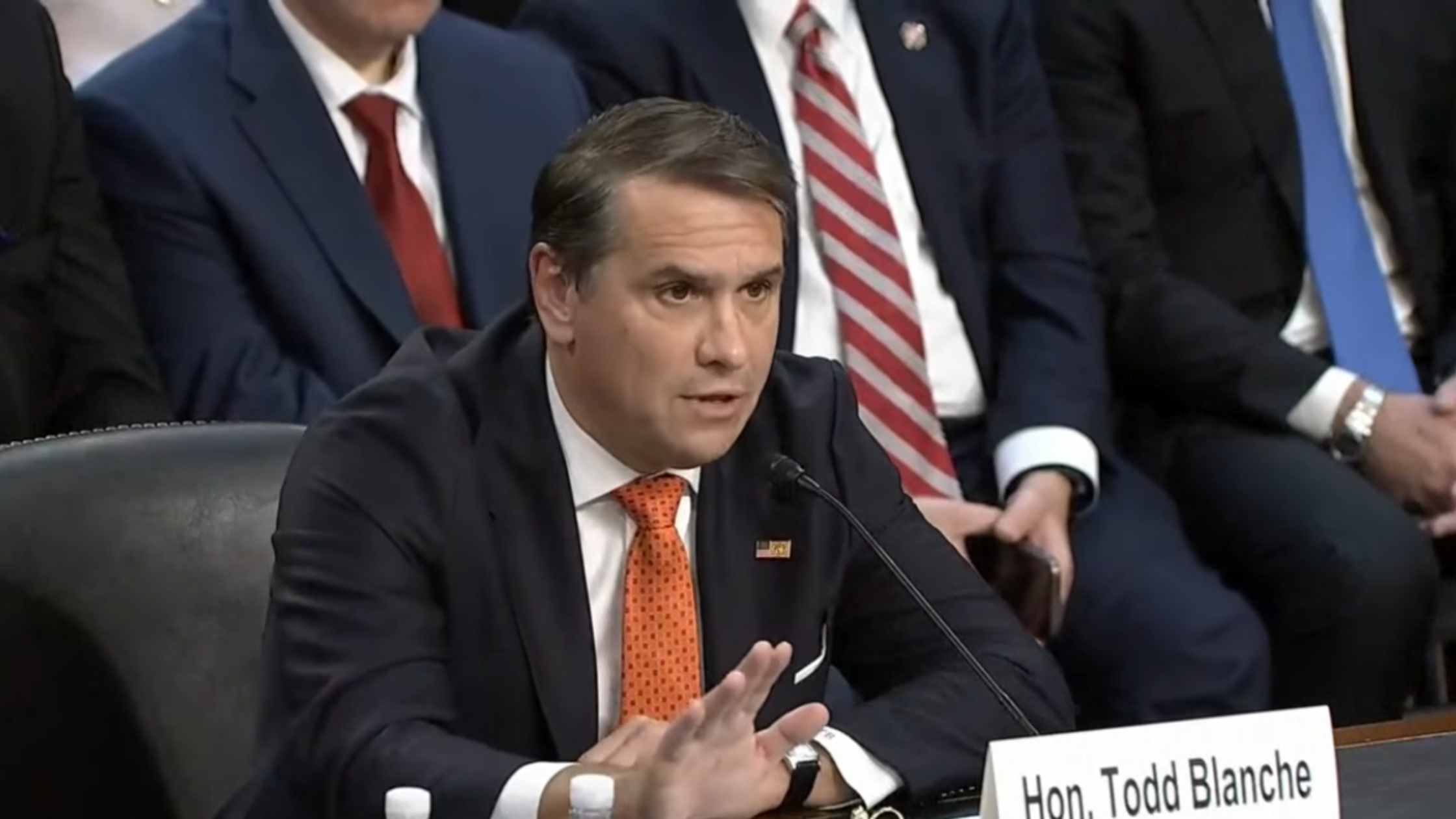
Thank you. Thank you, Senator Moody. Would you please stand at this point and respond to this oath? Do you swear or affirm that the testimony you're about to give before this committee will be the truth, the whole truth, and nothing but the truth, so help you God?
Hon. Todd Blanche (39:35):
[inaudible 00:39:38].
Chuck Grassley (39:37):
Thank you for your positive response. Now it's up to you to take what time you want to make a statement and introduce any people you have with you.
Hon. Todd Blanche (39:49):
Thank you. Thank you very much, Chairman Grassley, and thank you Senator for that introduction. I appreciate you and your friendship. Good morning, Chairman Grassley, Ranking Member Durbin and the other members of the committee. Thank you for having me. As Senator Durbin said a minute ago, I would like to offer each of you my condolences for the loss of your colleague, Senator Graham. He was a patriot and a friend to so many of us. It's a loss for the American people, and I think honoring him today, and as he's been honored for the past several days, is the right thing to do.
(40:32)
17 months ago, I sat at this table as the nominee to be the Deputy Attorney General. And I told you that serving in the Department of Justice was my American dream. Since then, I've helped lead it, first as deputy and now as acting attorney general. And I'm here today to earn your trust once more. I've lived the American dream. I waited tables to get through college, moved to New York with my wife and two young kids, went to law school at night, read textbooks on the late train home while I worked days as a paralegal at the U.S. Attorney's Office.
(41:15)
From that start, I became a prosecutor and spent nine years prosecuting violent gangs and drug dealers. I rose through the ranks of the Department of Justice as a line prosecutor, then a division chief, then as of last year, deputy attorney general and now acting attorney general. But I did not take that path for a title. I took it to make a difference for American families and the towns they call home. I am exceedingly grateful to President Trump for his trust, and to my family who have carried me through every long day and late night.
(41:55)
My wife, Christine, our wonderful children, Sydney and Justin, my granddaughter Blaine, who's here today. All of them are here today. My wonderful friends, many of whom are here today, are really what make this worth it and what gets me through my days. And so I want to thank them for not only being here today and supporting me, but also being with me every step of the way of the journey that we're on together.
(42:21)
My family's blessings should be available to all Americans. When a family can send their kids to school, walk their neighborhood after dark, and build a life without fear, every promise of the American dream is within reach. When they cannot, none of it is. That's my job, securing safety for every American. I'm pleased to testify again today to tell everybody here that we are doing just that, we are keeping America safe.
(42:54)
Since President Trump took office, it's been said a few times this morning already, but it bears repeating, murders are down roughly 20% nationwide. We have the lowest murder rate since 1900. Violent crime arrests are up nearly 114%. We've taken almost 5,000 child predators and human traffickers off the streets. And the Department of Justice has filed nearly 100,000 indictments and informations since January 20th, 2025. Additionally, in just the last four weeks, in just the last month, we've paid $96 million in claims through the Public Safety Officer's Benefits Program to eligible surviving families of fallen public safety officers, even while fewer law enforcement officers were killed in the line of duty than the prior years. And obviously, these are not just numbers. Each one is a family that still has its son or daughter, and an officer who came home for dinner.
(44:06)
If you look at Washington and Memphis as examples, where we have worked with federal, state and local partners, pulling thousands of criminals off the streets in those two cities, homicides in D.C. are down about 60% and overall crime in Memphis declined by more than 40%. We've seized thousands of illegal guns, brought more than 150 missing children home in those two cities, and cleaned up parks and spaces family once avoided so you can take your kids and loved ones there once again.
(44:42)
We are enforcing our borders. We are prosecuting the smugglers who profited from an open border, removing criminal aliens, and dismantling gangs like MS-13 and TdA. We're smashing the cartels and ending the scourge of drugs in our communities. We designated the major cartels as foreign terrorist organizations because that's exactly what they are. And we're using every tool that unlocked: narcoterrorism charges, forfeiture and extraditions.
(45:16)
Dozens of cartel leaders are now in American custody. Drug seizures are skyrocketing and overdose deaths are finally falling. We are protecting taxpayers. Last year, the Department brought the largest healthcare fraud take down in American history, more than $14 billion, and another $11 billion in total fraud in just the last three months.
(45:44)
That's money stolen from the fisc, stolen from Medicare, from seniors, working families, and we're clawing it back. We're doing all of this, I will add, through partnership. Federal agents, state troopers, county sheriffs, local officers, and state attorneys general in your home states all pulling in the same direction. That is what happens when we fight crime together, and I want to bring that model that we've done in a few towns to more communities in every state.
(46:17)
Above all, we are restoring American trust. In recent years, we watched the Justice Department turned against many of you and a former president, and it damaged the public's faith in justice. We are fixing that. Members of this committee on both sides have fair questions about the hard debates of the past year, and I welcome them. I'm proud of what we've done to help American families see safer streets and to have a fair shot at the life they're working to build.
(46:52)
None of this is a Republican or Democrat issue. Every senator here has constituents who just want to be safe. The men and women of this Department are the finest people I have ever worked with and leading them is the honor of my professional life. We are keeping America safe and we are just getting started. I love this country. I love the Department of Justice. Thank you very much, Chairman, for the opportunity to appear before this committee today, and I look forward to answering your questions. Thank you.
Chuck Grassley (47:30):
Thank you for that testimony. And we'll now have our 10-minute rounds of questioning. I'll start and then Senator from Illinois. I've long been concerned about concentration and anticompetitive conduct in healthcare technology, but particularly in agriculture. Family farmers deserve fair prices. I held a hearing on anticompetitive activities in this committee last October on the subject of agriculture.
(48:11)
As I recall, as a result of that hearing, the President issued an executive order and an investigation was started in your department. And I've sensed some pause in that right now, so if confirmed, do you have a commitment that the Justice Department will make antitrust enforcement a priority? And since I think there aren't too many people in the Justice Department know much about agriculture, with some concentration on agriculture?
Hon. Todd Blanche (48:45):
Chairman, absolutely. You're right. President Trump issued an executive order. I have worked already closely with Secretary Rollins on this very issue. We recently held a press conference announcing some of the work that we're doing to not only deal with the anticompetitive behavior that we've seen, but also to help ease prices in the cattle market around the country. So yes, Chairman, I commit to that.
Chuck Grassley (49:10):
Our committee has received a lot of outreach about the Department's litigation position in Louisiana versus FDA. The plaintiffs in this case challenged the relaxed regulation governing mail-order abortion drugs. Can you tell the committee about this case and explain what the Department's doing?
Hon. Todd Blanche (49:32):
Chairman, first, President Trump is the most pro-life president in history. And the work that this Department's doing in that space is something that hasn't been done for 10 years. For the first time in a decade, HHS and the FDA are actually taking a real look at what's happening with some of these abortion pills and whether they're actually safe or not.
(49:56)
As it relates to the litigation you referenced, it would be wrong for me to talk about any litigation strategy beyond what's in our briefs. But suffice to say, Chairman, that as we talk about in our briefs, we are not in any way defending what Biden and what his administration did with respect to that judge. But beyond that, I don't want to comment on the strategy about that litigation.
Chuck Grassley (50:25):
This committee has also received outreach concerning the Department's handling of the investigation and release of Epstein files and your role in it. Some allegations include problematic redactions, insufficient effort to follow investigative leads, a refusal to meet with victims and questions regarding the transfer of Maxwell to lower security prison. I want you to take the opportunity to respond to these allegations. What would you like this committee to know regarding these files?
Hon. Todd Blanche (51:08):
When President Trump signed the Epstein Transparency Act, the Department of Justice undertook a Herculean task to review millions and millions of potentially responsive files. We were required under the statute to do this expeditiously and very quickly. The Department of Justice did so. We reviewed over six million pages. Many of these pages were not responsive. And what I mean by that is we intentionally over-collected potentially responsive documents.
(51:39)
So for example, there was a case going on in Florida at the same time as the Jeffrey Epstein case involving another defendant named Epstein, having nothing to do with Jeffrey Epstein. When we collected materials, we collected everything involving Epstein, including the Epstein that had nothing to do with Jeffrey Epstein. So, the review of materials included non-responsive materials. The reviewers were qualified, experienced attorneys within the Department and the FBI. They took pains to apply appropriate redactions. There were mistakes that were made. And so, approximately 1% of the redactions had to be fixed after we released the Epstein files.
(52:24)
Chairman, we had dozens of lawyers on call 24/7. Whenever we learned that any victim's name had been improperly not redacted, we immediately took the document down and fixed it as soon as we could. That doesn't excuse the mistakes of which I take responsibility, but it does mean that we tried to fix them. We complied with the act. It required us complying with judges' rules in New York, which required us to redact certain victims' names. Even if the victim was also somebody who participated in criminal conduct, judges in New York did not allow us to unredact those names.
(53:08)
The other thing that we did, Chairman, is we made unredacted versions of the entire database available to everybody in this body. And we did that because of transparency. Remember for four years, there wasn't a pep about Jeffrey Epstein. The Biden administration did nothing to be transparent about the Epstein case. We have been extraordinarily transparent in not only producing the records, but letting the unredacted versions be available to anybody in this body. And if after reviewing unredacted materials a member had concerns about why something was redacted, they brought them to the Department's attention and we addressed that.
(53:47)
So, I want to make sure the American people know that this administration, when it comes to Jeffrey Epstein, has been more transparent than any past administration, than Biden was or anybody else. And what we did is we complied with the law. And if we learn a new material, we will most certainly review it and make it available. When it comes to the victims of this horrible man, we will never, never not talk to victims. We will never not do everything we can to prosecute anybody that committed any crimes against any of these women. So that narrative is false.
(54:31)
We have spoken with over 30 representatives of dozens and dozens of victims since this process started. Any victim, if they're here today, I would encourage them or their lawyers to meet with the FBI. We will 100% investigate. There are no closed investigations. If we learn today, if we learn next week, if we learn next month that there's an individual that we can investigate, indict and prosecute out of the Epstein files, you better believe it we will. And so we worked hard, the hardworking lawyers within the Department to do the right thing to comply with the act, and we did, and we'll continue to do so, Chairman.
Chuck Grassley (55:15):
Jack Smith and his team possessed it, reviewed congressional information and other sensitive materials when they shouldn't have and they were advised not to. Describe the steps you've taken to impose accountability so that this egregious and partisan misconduct never happens again.
Hon. Todd Blanche (55:35):
The biggest thing we can do, Chairman, is be transparent about what happened. And that requires us doing a check on ourselves and on the work that happened before us, and being transparent with this body and providing records to you. I think when the American people understand and learn what happened and the egregious abuses that happened, it will be a check on making sure it never happens again. We strive every day to not only move forward as a department doing the right thing, but to make sure that anything that happened in the past, whether it's releasing emails or admitting to things that we did and the Department did that we shouldn't have done, to being transparent with the American people about that. That's the best we can do and that's what we're doing.
Chuck Grassley (56:26):
I made messages public between Jack Smith's office that appeared to relate to the Trump classified document case. Those messages showed government personnel left open a classified facility and potentially mishandled classified information, causing a security violation. While defense counsels to Trump, did the government apprise you of these issues? And secondly, did the Biden Justice Administration do any investigation into this misconduct?
Hon. Todd Blanche (57:00):
We were never advised at that time when I was defense counsel to President Trump. And I'm not aware of any investigation that was started for that alleged conduct.
Chuck Grassley (57:11):
The Justice Department must do a full and complete investigation into this matter. This will probably have to be my last question. On March the 15th this year, I made public a signed and sworn statement from an FBI official. That statement says two important things. "Special Counsel Mueller's team lacked a legal basis to pursue a FISA renewal of the Walid Phares and investigate Thomas Tom Barrack, but did so anyway. What steps have you taken to investigate these very troubling criminal allegations? And if you haven't taken any action, why not?"
Hon. Todd Blanche (57:54):
We are investigating that, Chairman. And it would be inappropriate in this setting to get into the details of that investigation, but the sworn affidavit that we reviewed that you provided does raise serious allegations. Yes.
Chuck Grassley (58:09):
Thank you very much. Senator Durbin.
Dick Durbin (58:11):
Thank you very much, Mr. Chairman, Mr. Blanche. I have a few questions I'd like to ask you. Is it not true that Congress had to pass a law requiring the Trump administration to disclose the Epstein files? The Epstein Files Transparency Act passed by bipartisan roll calls in the House and Senate to finally get the files made public?
Hon. Todd Blanche (58:32):
President Trump signed that law. Yes.
Dick Durbin (58:34):
Yeah, of course he did after overwhelming numbers of House members and Senate members voted for it on a bipartisan basis because the administration would not voluntarily produce these documents. Now, I've mentioned-
Hon. Todd Blanche (58:47):
That's not true.
Dick Durbin (58:48):
Well, what part of it isn't true?
Hon. Todd Blanche (58:50):
We were prohibited by law from producing those documents. This is the judiciary committee. There are laws that did not allow us to produce those documents, which we made plain in numerous court filings. And President Trump had said from day one to release the files, even when he was running. And so yes, he signed it into law and we complied with it.
Dick Durbin (59:09):
I remember and everyone in the audience remembers the lengths that the administration went through to delay production of these documents, to the point where Congress did an extraordinary thing, discharge motion in the House to bring this matter before them and vote on a bipartisan basis to compel your administration to disclose those documents.
(59:31)
Let me talk to you for a moment about the survivors who are in the room. There are 10 individuals who were exploited and abused by Mr. Epstein. They are here today. None of them have had a chance to speak to anyone in the Department or FBI, though they've asked repeatedly. So can I get your word, under oath, that within the next 30 days, you will personally sit down with these 10 victims and hear their case in terms of what needs to be done by the Department of Justice?
Hon. Todd Blanche (59:59):
Chairman, I appreciate them being here today. I also have somebody from my office who's spent her entire career working on cases like Mr. Epstein's. She's in charge of our task force investigating human trafficking. She's available to talk to them as soon as today.
Dick Durbin (01:00:15):
She can sit right next to you. She can sit right next to you when you meet with these survivors.
Hon. Todd Blanche (01:00:19):
I have never said I will not meet with survivors. I am-
Dick Durbin (01:00:22):
Will you meet with these 10 survivors? I'm asking you, on the record.
Hon. Todd Blanche (01:00:25):
If they have lawyers, as you know, I'm prohibited from meeting directly with them. I have met with counsel for survivors, as has many people in the Department of Justice,-
Dick Durbin (01:00:34):
So you won't?
Hon. Todd Blanche (01:00:34):
... over 30. But if they are represented by counsel, we will work with their counsel. If they don't have a lawyer, I will certainly make arrangements to make sure the right people at the Department of Justice meet with them.
Dick Durbin (01:00:44):
Will you get it done?
Hon. Todd Blanche (01:00:45):
Absolutely.
Dick Durbin (01:00:45):
Will you get it done within the next 30 days, that each of these survivors-
Hon. Todd Blanche (01:00:48):
I will get it done today if that's necessary. My point is there's somebody here who can meet with them today, get their information and arrange to meet with them. Absolutely.
Dick Durbin (01:00:56):
I think you ought to be in the room.
Hon. Todd Blanche (01:00:58):
Pardon me?
Dick Durbin (01:00:58):
I think you ought to be in the room because you ought to hear this. You've had singular responsibility for these files. There's a delay in meeting the statutory requirement on disclosure. You were involved in that. I think you ought to be part of this in 30 days.
Hon. Todd Blanche (01:01:12):
I am definitely part of it, and I have been from day one.
Dick Durbin (01:01:15):
And it will be done within the next 30 days?
Hon. Todd Blanche (01:01:19):
I can keep on repeating myself, but I said it could get done as soon as today. It could have gotten done last week. We remain available to meet with any victim or their representative at any time.
Dick Durbin (01:01:29):
Will you notify the committee when you've done this?
Hon. Todd Blanche (01:01:33):
That would be prohibited by law if they're talking about an ongoing investigation.
Dick Durbin (01:01:37):
I'm asking you if you'll notify the committee that you met with survivors.
Hon. Todd Blanche (01:01:40):
It depends on what they said. I'm not sure I'm allowed to notify you if there's an ongoing investigation.
Dick Durbin (01:01:46):
Well, you're dancing on the head of a pin here.
Hon. Todd Blanche (01:01:49):
I'm not dancing on any pin at all.
Dick Durbin (01:01:51):
You have these survivors who have the courage to come before this committee, have the courage to tell their terrible stories, how they were exploited. Don't you think it's important that we have a prompt response by our government to these survivors?
Hon. Todd Blanche (01:02:04):
Absolutely. And there will be a prompt response. My heart breaks for every survivor, every victim of Mr. Epstein. Absolutely. And I would love to prosecute anybody that did any harm to these victims, so absolutely.
Dick Durbin (01:02:18):
Will you meet with them within the next 30 days? It's the last time I ask a question, you can say yes or no.
Hon. Todd Blanche (01:02:21):
I can keep on answering it the same way. I can meet with them. My staff will meet with them. We have a staff member here that specializes-
Dick Durbin (01:02:28):
If you can meet with them, will you meet with them?
Hon. Todd Blanche (01:02:31):
I'm not sure what you're looking for me to say. As I said-
Dick Durbin (01:02:33):
Yes, is what I'm looking for you-
Hon. Todd Blanche (01:02:36):
If they're represented by counsel, I'm not allowed to meet with them directly, as you know. I assure you the FBI, who are experts in this space, prosecutors who are experts in this space, and me, if necessary, will absolutely meet with them. I promise you this-
Dick Durbin (01:02:51):
I think it's necessary.
Hon. Todd Blanche (01:02:52):
... I will stay updated and know everything that's happening with any victim that has information about any other people that work with Epstein, that committed any crimes with Epstein. Absolutely.
Dick Durbin (01:03:03):
Well, if you're truly committed to extraordinary transparency and you're willing to meet with these victims, I hope you will do it immediately or we're going to hold you to it.
(01:03:14)
I want to ask you about the immunity provisions that you assigned relative to the responsibility and liability of the President and his family and their businesses when it comes to tax audits. Would you like to explain how we can give to the President and his family and businesses exemptions from complying with the tax laws of the United States?
Hon. Todd Blanche (01:03:40):
It's not an exemption to comply with the tax laws of the United States. As part of the settlement, it was an agreement that any past audits would end.
Dick Durbin (01:03:52):
Your signature, "The United States releases, waives, acquits, and forever discharges each of the plaintiffs when it comes to tax liability." That's how it reads. It's pretty sweeping. You don't believe that is a discharge forever from liability?
Hon. Todd Blanche (01:04:12):
Of any past filings, yes.
Dick Durbin (01:04:15):
All right. It is. How do you explain that to the American people? Everyone in this room, all of us on this side, we have to follow the tax laws of the United States. And if we don't, we can be held responsible for it, to the point of even criminal prosecution. Why did you decide that President Trump and his family and their businesses should be exempt from that same responsibility?
Hon. Todd Blanche (01:04:37):
As part of the settlement between the IRS and President Trump and some of his family, two of his sons and his organization, as is typical when there's a settlement between plaintiffs and the IRS, part of the settlement included release of any past audits.
(01:04:57)
It does not give any protection to the President, his family, or his organizations. For any taxes they file, if they filed it the day of that I signed that agreement or the day after, they have no protection.
Dick Durbin (01:05:08):
No matter what their liability, no matter what their violation of tax law, you signed a document that forever discharged them from any legal responsibility?
Hon. Todd Blanche (01:05:18):
As part of the settlement that we entered into, any past audits were ended.
Dick Durbin (01:05:22):
How often do you think that's been done in the history of the United States?
Hon. Todd Blanche (01:05:26):
Involving the President of the United States, I'm not sure it's ever been done, but this type of settlement is done regularly.
Dick Durbin (01:05:33):
So you're saying that when it comes to the President of the United States, his family and businesses have no responsibility under the tax laws for any wrongdoing prior to the signing of this document?
Hon. Todd Blanche (01:05:44):
No, I mean, I didn't say that at all. What I'm saying is that I think President Trump and his family are the first president that had their tax returns illegally taken illegally and made available to the public. So that is unique to President Trump, yes. But this type of settlement is not unique to the Department of Justice or the IRS.
Hon. Todd Blanche (01:06:00):
... of settlement is not unique to the Department of Justice or the IRS.
Dick Durbin (01:06:04):
It's hard to explain to the American people that no one is above the law when that type of document was signed by you for ever discharging that family and that president from any liability for violating the tax laws.
Hon. Todd Blanche (01:06:18):
Nobody is above the law. And when we enter into settlements like that, we do it with all kinds of people. It's not just President Trump. It doesn't make any of those individuals above the law.
Dick Durbin (01:06:28):
So let me ask you, since you don't believe anyone should be above the law, about the January 6th rioters pardon. We've taken a look at some of the people that the president pardoned on his first day in office, the ones who attacked this Capitol. And I'll use the word "attack" because I was here and I saw what happened. Anyone looking at the videos knows what happened on that day. Among those who were pardoned by the president are individuals who've gone on to commit serious crimes against innocent victims across the United States.
(01:06:57)
Do you think that blanket pardoned by the president of January 6th rioters was the right thing to do?
Hon. Todd Blanche (01:07:02):
I think that the Constitution gives the president the full power to pardon anybody for any reason he wants. And so I don't question President Trump's authority or his decision to do so on January 20th.
Dick Durbin (01:07:14):
You don't question his decision?
Hon. Todd Blanche (01:07:17):
As I said, President Trump, under our constitution, just like President Biden, has the authority to pardon anybody for any federal crime. And that's a privilege every president's afforded, including President Biden and President Trump.
Dick Durbin (01:07:33):
Well, I can tell you he may have had the authority to do it, but I think someone should have grabbed him by the arm and said, "Stop. You can't release all of those rioters." Some of them actually physically assaulted policemen in the Capitol. Some of them were guilty of crimes, serious crimes before that day. And for the president to give a blanket pardon to these individuals is something that I don't think you can explain to the American people. You certainly can't explain it to the policemen who almost lost their lives because of these attackers.
(01:08:04)
I'd yield, Mr. Chairman.
Chuck Grassley (01:08:05):
Before I go to Senator Cornyn, I'd like to enter in the record for supporting Mr. Blanche's nomination from former Attorney General John Ashcroft. And this is a quote from the letter, "This rule of law is the best friend of liberty to safeguard this core value. America needs an attorney general exclusively devoted to the rule of law and will honor his oath to the Constitution. Todd Blanche is the right person for that responsibility. His record and credentials undergird my wholehearted support for his nomination."
(01:08:52)
Without objection, that'll be entered into the record.
(01:08:56)
Senator Cornyn.
Senator Cornyn (01:08:58):
Good morning, Mr. Blanche. Congratulations on your nomination. There's a lot to admire about your record or service to our country and I respect the fact that you want to continue that service as the attorney general. As I told you in my office, I think the attorney general has the hardest job in Washington, DC, because you are at the same time a member of the president's cabinet subject to dismissal of whatever the president wants for any reason or no reason at all. But then you also have a duty as the chief law enforcement officer of the United States. And I think it's a very, very difficult balance.
(01:09:43)
And I want to ask you a little bit about that, particularly in connection with the settlement of the tax case. There's so much that's unusual about this. First of all, the fact that the tax returns were leaked by a IRS contractor, Charles Littlejohn, who was appropriately convicted of a crime for doing that. President Trump and his family were definitely victims of a crime there. But it happened back in 2020 and the lawsuit wasn't brought until 2026. So with the two-year statute of limitations, it seems to me that that was something I know that was a subject of pleading in the complaint and attempt to avoid the two-year statute of limitations, but that struck me as unusual.
(01:10:38)
But let's talk a little bit about the settlement agreement and the release. First of all, I believe you have said that the weaponization fund is a moot issue. Is that your position?
Hon. Todd Blanche (01:10:51):
Yes, it is a moot issue, meaning there is no weaponization fund. The weaponization fund is dead. It's not moving forward.
Senator Cornyn (01:10:59):
Well, I would refer you to the settlement agreement. Do you happen to have a copy of that in front of you?
Hon. Todd Blanche (01:11:06):
I do not, sir.
Senator Cornyn (01:11:07):
Okay. Well, you probably know what's in it.
Hon. Todd Blanche (01:11:09):
I'm familiar with it. Yes.
Senator Cornyn (01:11:10):
I'm sure you are. On page 4, "This settlement agreement may be modified only upon the written agreement of the parties."
(01:11:18)
Has there been a written agreement of the parties to modify the settlement fund?
Hon. Todd Blanche (01:11:22):
No. The settlement fund's just not moving forward. There's no modification. It never started. No money went from the treasury to any other account. There's no commissioners. It's not moving forward.
Senator Cornyn (01:11:34):
Well, so the settlement agreement remains as it was originally, but I hear what you're saying. Is the settlement agreement enforceable as a contract by the parties?
Hon. Todd Blanche (01:11:48):
Well, yes, it's an enforceable document. So I suppose if President Trump's counsel sought to enforce it, that they potentially could, but-
Senator Cornyn (01:11:59):
Including the weaponization fund?
Hon. Todd Blanche (01:12:01):
Well, they could try to enforce the contract. They can't force the Department of Justice to move forward with the weaponization fund. They could potentially say that, I suppose, that we breached by not moving forward. They haven't done that and I'm not aware that they're planning on doing that.
(01:12:16)
Like I said, Senator, and Senator Durbin talked about this, but I've talked extensively with you and other colleagues about potentially codifying so there's no weaponization fund, which is certainly something that could be done. And I wasn't meaning to insult this body, but just that in response to questions from senators about whether that could be done, we very much are okay with that.
Senator Cornyn (01:12:41):
But just to be clear, the president of the United States who was a plaintiff in this lawsuit has not agreed in writing to delete the weaponization fund. And there's no guarantee that he or one of the other plaintiffs might raise that issue by way of a lawsuit and a breach of contract lawsuit in the future.
Hon. Todd Blanche (01:13:02):
Well, Senator, the plaintiffs have no power over the fund. The fund was administered solely by the five commissioners and through the Department of Justice. So no, they don't have any power with respect to the fund at all. I suppose they could bring a lawsuit and then we would litigate it. But even if we were litigating it, there's no fund. So the results of such litigation, whatever it would be, wouldn't be revival of the fund.
Senator Cornyn (01:13:27):
I want to ask you about the release. And I know I'm guilty of what a lot of lawyers are guilty of and having a chart you can't read, but I know you're familiar with this document, which is the release that you signed on May the 19th, 2026. First of all, does this purport to release parties or people who were not parties to the lawsuit?
Hon. Todd Blanche (01:13:52):
No, Senator.
Senator Cornyn (01:13:54):
Well, it says here that " claims asserted by defendants or any of the plaintiffs or related or affiliated individuals, including without limitation, family or others filing jointly or parties including trust, parent, sister, or related companies, affiliates, or subsidiaries," they weren't a party to the lawsuit, were they?
Hon. Todd Blanche (01:14:17):
I didn't hear everything you just said, Senator, but the only parties that had any release as respect to any potential audits, even if they existed, were the plaintiffs in the lawsuit.
Senator Cornyn (01:14:31):
Did you talk to the president about the settlement? He originally sued for $10 billion and settled for an apology in this weaponization fund and then the release of future liability for tax audits. Did you discuss it with him?
Hon. Todd Blanche (01:14:47):
No, I did not. He had outside counsel. I did not discuss it with his outside counsel either. It was done by other people in the office.
Senator Cornyn (01:14:57):
And this was a lawsuit brought-
Hon. Todd Blanche (01:15:00):
Can I qualify that?
Senator Cornyn (01:15:01):
Sure.
Hon. Todd Blanche (01:15:03):
When we determined not to move forward, as the president has said, that's the only time that he and I had any conversations about this at all, was after when it was dead, when we said we're not moving forward.
Senator Cornyn (01:15:16):
And this lawsuit was brought against the IRS and Treasury, yet this release purports to apply to defendants or other agencies or departments. So does this release apply to, let's say, investigation by the Security and Exchange Commission or some other federal agency?
Hon. Todd Blanche (01:15:41):
No. That's the standard language that we use when we enter into settlements between plaintiffs and the IRS. But no, it doesn't bind. It's issued by me because statutes require and authorize me to do that as opposed to other cabinet members. And in this case, it binds only the IRS and, by extension, the treasury.
Senator Cornyn (01:16:04):
Well, I hear what you're saying, but I certainly don't read that in the agreement. But let me turn since I only have a few minutes left. Senator Grassley raised the issue of the mifepristone lawsuit. And just to be clear, you understand the difference between the morning after pill and mifepristone, don't you?
Hon. Todd Blanche (01:16:27):
Yes.
Senator Cornyn (01:16:28):
And so mifepristone is a chemical abortion that can be administered up to 10 weeks of gestation. The length of gestation should be, according to the medical literature, confirmed by ultrasound or clinical assessment by a healthcare provider. And it's generally safe and effective according to the literature when used under medical guidance. But the problem is that President Biden's administration changed the Trump policy and allowed the administration of this abortion, chemical abortion drug without any medical guidance whatsoever.
(01:17:11)
And as you know, I've written a letter. Senator Tillis and I sent a letter yesterday. And what I would appreciate, I understand you can't necessarily talk too much about your litigation strategy in the case of Louisiana against FDA, but I would appreciate it if you would respond to this letter for the record about the intentions of the administration. If President Trump is the most pro-life president, this ought to be a pretty easy call because women are hurt as a result of side effects, heavy bleeding, prolonged potentially infection or sepsis, incomplete abortion, other complications when this is being sold through the mail or through online prescription. Will you do that for me?
Hon. Todd Blanche (01:18:02):
Yes, Senator, I will.
Senator Cornyn (01:18:06):
Finally, let me just go back to the... In the 50 seconds I have, go back to this release. This purports to release lawfare or weaponization, and/or weaponization. Those aren't legal terms of art, are they?
Hon. Todd Blanche (01:18:29):
I think they are just legal terms of art. There's not any-
Senator Cornyn (01:18:32):
Have they been defined in any case or any statute?
Hon. Todd Blanche (01:18:35):
Not that I'm aware of, no.
Senator Cornyn (01:18:36):
So they're not a legal term of art?
Hon. Todd Blanche (01:18:40):
Well, I think that the terms have been used by the legal community and by people within government, but no, I'm not sure that they're in Black's Law Dictionary, Senator.
Senator Cornyn (01:18:51):
But we won't know what that covers?
Hon. Todd Blanche (01:18:53):
Well, I think it depends on the circumstances of the facts presented as to whether it covers. As to what it covers. Sorry.
Senator Cornyn (01:19:01):
Thank you. My time's up.
Chuck Grassley (01:19:02):
Klobuchar.
Amy Klobuchar (01:19:03):
Thank you very much, Mr. Chair.
(01:19:07)
Mr. Blanche, after both the assassination of Melissa Hortman, our former speaker of the House, and after the enunciation school shooting in which 20 people were gunned down through stained-glass windows, federal law enforcement, as you and I discussed in my office a few weeks ago, worked cooperatively with state and local. And we also know that they've worked together on the important work going on in the US Attorney's Office in Minnesota with regard to fraud and the ongoing fraud investigation. And I know we have your commitment to continue giving resources for that investigation. Is that correct?
Hon. Todd Blanche (01:19:47):
Yes, absolutely. Yes.
Amy Klobuchar (01:19:48):
Thank you. So we also discussed my concern about the lack of cooperation we saw after the horrific killings of Renee Good and Alex Pretti with the federal government refusing to cooperate with state law enforcement for months, blocking Minnesota investigators from accessing the scene of Alex's death, even though they had a judicial warrant. They also failed to secure, according to news reports, failed to secure and process the scene, failed to process Renee Good's car for evidence.
(01:20:24)
When we met a few weeks ago at length, I asked you to ensure full cooperation. And I appreciated that the department shared evidence with state investigators early this week. Will you commit to continued information sharing between federal and state investigators in these cases as well as with regard to the recent shootings in Texas and Maine?
Hon. Todd Blanche (01:20:51):
I expect that these investigations should be run as every investigation of similar kinds. And so that necessarily includes working with state and locals in the appropriate way. I think that the definition of full cooperation can be disputed, but I very much expect that whether it's the Inspector General or the US Attorney's Office or the FBI or who's ever on the federal side of the investigation where appropriate to work with state and locals. I think a lot of the news reporting that you referenced is actually not accurate with what has been happening since the unfortunate events some several months ago.
Amy Klobuchar (01:21:29):
Okay. But that aside, we've seen these recent shootings in Maine and the reactions of the communities understandably concerned as well as Texas. And I think that people are going to want accountability in these cases. And one of the things that doesn't get as much attention is the non-death cases. The Hmong elder pulled out of his house in Minnesota in his underwear and Crocs in 10 below zero weather.
(01:21:57)
And as the nation's chief law enforcement official, do you agree that it is unacceptable for federal agents to forcibly enter someone's home without a warrant and drag them onto the street without even checking that they have the right person?
Hon. Todd Blanche (01:22:11):
Well, it depends on the circumstances as you know. I mean, yes, obviously law enforcement agents need a warrant to enter a house except for limited exceptions to that. So yes, we very much believe in the constitutional protections afforded American citizens. The same protections are not afforded, people who are here illegally. So it's not a black and white answer where I can say yes or no. But yes, I very much expect the law to be followed by our law enforcement agents.
Amy Klobuchar (01:22:42):
So since the Civil War along those lines, federal law has made it clear that the president does not have the authority to deploy armed federal officials to election sites. Will you commit to following clear federal law and not deploying federal agents to polling locations?
Hon. Todd Blanche (01:23:00):
I will commit to following the law, Senator, of course. Yes.
Amy Klobuchar (01:23:02):
Okay. But does that include not deploying federal agents to polling places?
Hon. Todd Blanche (01:23:08):
I will absolutely follow the law no matter what it includes, so yes.
Amy Klobuchar (01:23:13):
Do you understand why voters, US citizens, are concerned about armed agents at polling places?
Hon. Todd Blanche (01:23:20):
I'm not aware of armed agents being at polling places.
Amy Klobuchar (01:23:24):
Thank you.
Hon. Todd Blanche (01:23:26):
I'm not aware of that concern, but I will tell you we will follow the law, Senator.
Amy Klobuchar (01:23:30):
All right. The DOJ has carried out a campaign to push states to turn over voters' sensitive and private data to the administration. 30 states, including Republican-led states like Georgia and West Virginia have refused. In doing so, the West Virginian Republican Secretary of State said, "I will not break the law, give up our state's rights, or compromise the privacy of our citizens." 15 federal courts in decisions from Democratic and Republican-appointed judges have all found that these actions to force the states to turn over this data is unlawful.
(01:24:12)
Could you discuss how cutting off anti-terrorism funding to states that refuse something that 15 federal courts have found to be illegal enhances our national security?
Hon. Todd Blanche (01:24:25):
So those cases are still being litigated. So I can't talk specifically about the cases that you mentioned, but overall what I will say, Senator, is that election integrity is extraordinarily important to this administration. It's important to this body. And so to the extent that the work that we're doing is to make sure that we have fair and honest elections, that the only people voting are the people who are eligible to vote and that they're only voting once. That's important.
Amy Klobuchar (01:24:53):
If secure election's important, how does stopping the longstanding practice of critical information sharing and scenario planning between the DOJ, other federal agencies and state and local election officials promote election security?
Hon. Todd Blanche (01:25:09):
We're not doing that.
Amy Klobuchar (01:25:11):
Because we have heard from our own Secretary of State, Steve Simon, that these standard briefings/trainings have not happened.
Hon. Todd Blanche (01:25:18):
We're not doing that. So I'm not sure what you're referring to, but-
Amy Klobuchar (01:25:22):
Okay. [inaudible 01:25:23] Okay. I'll.
Hon. Todd Blanche (01:25:22):
... I'm happy to follow up with your office about that.
Amy Klobuchar (01:25:25):
Thank you. Appreciate that. Appreciate that. So you and I talked about some of the antitrust concerns I have, the independence of the department. I was very concerned by the department's weak settlement of the monopolization suit against Live Nation/Ticketmaster. Do you believe that this settlement was good for consumers? And if so, then why didn't... There was another case, of course, that the State Attorney General's brought that it's going to result in much better protections for consumers. Why didn't the DOJ join them stay in that suit?
Hon. Todd Blanche (01:26:03):
I share your concerns. And yes, I do believe that settlement was good for consumers. The American people got a lot out of that settlement with Live Nation. And you talk about another case that's separate. That's ongoing litigation that could potentially take years to resolve. And so when we make a decision as a department to settle a case, we are only thinking about the American consumer and making sure that we're complying not only with the laws, but with what's right for-
Amy Klobuchar (01:26:31):
Did the White house have any involvement in that decision?
Hon. Todd Blanche (01:26:35):
In the decision regarding which case?
Amy Klobuchar (01:26:36):
To settle the Ticketmaster case.
Hon. Todd Blanche (01:26:39):
We work at times closely with White House counsel on certain issues. I wasn't directly part of discussions, so I can't speak to that, but I'm mostly not saying they were not part of it.
Amy Klobuchar (01:26:55):
Okay. Are you concerned that former Republican Principal Deputy Assistant Attorney General Roger Alford, who has appeared before this committee as a Republican witness in the past, has said that in your department, antitrust cases are being resolved based on political connections, not the legal merits?
Hon. Todd Blanche (01:27:15):
No. His words don't concern me because they're not true.
Amy Klobuchar (01:27:20):
Okay. Well, a lot of us disagree on that front. So I want to turn to some sort of number of issues involving security. So in the wake of the shooting last year, Annunciation Catholic School was approved to receive funding through the office for victims of crime, for mental health and other support services. And I appreciate that the department has worked closely with the Annunciation community on this issue, but the delays in the release of these funds are creating budget concerns. Could you commit to work with me on getting those funds to the school?
Hon. Todd Blanche (01:27:55):
Yes, absolutely.
Amy Klobuchar (01:27:56):
Thank you. The president's most recent budget reduces COPS office funding by nearly 500 million, eliminates a stop school violence program that I championed with Senator Hatch. He was the lead on it. Are you concerned that cutting this funding will impact school safety?
Hon. Todd Blanche (01:28:15):
No. I understand the question. I fully expect that the grants that ultimately are included in the budget that's passed will make sure that we're providing appropriate funds to our communities so that they can continue their good work.
Amy Klobuchar (01:28:32):
I have concerns, and I've heard this from several law enforcement and domestic violence groups, about the DOJ plan to consolidate the pop COPS program, HIDA program, office and violence against women. And why do you think this will be helpful? Because we believe that they have very different functions.
Hon. Todd Blanche (01:28:53):
I agree with you. That's not what we're doing. There will still be three separate functions. What we're doing is consolidating above them to one group so that the application process is smoother and easier for grantees to do their work. And also so that internally, some of the bureaucracy that was involved in having three separate bureaucratic streams doing the same work, even though you're right, the underlying programs serve different functions was not efficient. So we're making that efficient.
Amy Klobuchar (01:29:22):
And I'll follow up with you with some of the domestic violence grants. And also just want to mention the continued enforcement under the Take It Down Act that Senator Cruz and I passed and how important that is going forward.
Hon. Todd Blanche (01:29:34):
Thank you, Senator. Yes.
Chuck Grassley (01:29:36):
Before I go to Senator Kennedy, I'd like to read a letter supporting the nominee from the National Association of Police Organizations. More than 1,000 police organizations and 250,000 law enforcement officers nationwide represented by this letter.
(01:29:54)
"Mr. Blanche has proven his commitment to the rule of law and a fair and impartial justice system. As Deputy Attorney General and later acting Attorney General, he has built a strong partisanship with law enforcement community from supporting the Department of Justice Law Enforcement Assistance Grant programs to working to ensure accountability within the public safety officer's benefits program. He has consistently endeavored to meet the needs of state and local law enforcement officers and their families."
(01:30:39)
Without objection, it will be entered in.
(01:30:41)
Senator Kennedy.
Senator Kennedy (01:30:52):
General, I assume that you consider yourself to be qualified to be the permanent attorney general. Is that right?
Hon. Todd Blanche (01:31:02):
Yes, Senator.
Senator Kennedy (01:31:04):
I've read your resume. We all have. You don't need to comment on this, but it just seems to me that no fair-minded person could conclude that you're not qualified. You spent a long time with the department. You spent a long time in private practice. So the opposition of my democratic friends must be based on something else.
(01:31:34)
Are you and President Trump friends?
Hon. Todd Blanche (01:31:38):
I'm his lawyer, was his lawyer, and now I'm the Deputy Attorney General. So I met him as his criminal defense attorney. I'm not sure there's very many people who have ever had a criminal defense attorney who calls that person their friend. I now have a -
Senator Kennedy (01:31:54):
Well, let me put it this way. Are you enemies?
Hon. Todd Blanche (01:31:57):
No, we're not enemies at all. No.
Senator Kennedy (01:31:59):
Okay. Have you ever seen a president of the United States appoint an enemy to be attorney general?
Hon. Todd Blanche (01:32:12):
I have not.
Senator Kennedy (01:32:14):
Usually they appoint their qualified friends, don't they?
Hon. Todd Blanche (01:32:18):
Yes.
Senator Kennedy (01:32:20):
I mean, one president appointed his brother, right?
Hon. Todd Blanche (01:32:24):
He did, Senator.
Senator Kennedy (01:32:25):
And I can think of another president who appointed his former law partner. Is that right?
Hon. Todd Blanche (01:32:30):
It is correct.
Senator Kennedy (01:32:32):
Okay. Are you responsible for all the president's decisions?
Hon. Todd Blanche (01:32:43):
No, Senator, I'm not.
Senator Kennedy (01:32:45):
I mean, does the president get up in the morning and give you a call first thing and say, "Todd, tell me what I ought to do today?"
Hon. Todd Blanche (01:32:54):
He does not.
Senator Kennedy (01:32:56):
Okay. Does he ever ask your opinion on actions he should take?
Hon. Todd Blanche (01:33:02):
Yes.
Senator Kennedy (01:33:04):
Do you tell him the truth?
Hon. Todd Blanche (01:33:06):
Every time.
Senator Kennedy (01:33:08):
Have you ever disagreed with him?
Hon. Todd Blanche (01:33:11):
Yes.
Senator Kennedy (01:33:13):
And have you ever disagreed with him and he did it any way?
Hon. Todd Blanche (01:33:18):
Yes.
Senator Kennedy (01:33:20):
And did you go call a press conference and announce that the president made a bad decision?
Hon. Todd Blanche (01:33:28):
Absolutely not.
Senator Kennedy (01:33:29):
That's not what attorneys general do, is it?
Hon. Todd Blanche (01:33:33):
Correct.
Senator Kennedy (01:33:34):
Okay. Has he ever asked you to do anything illegal?
Hon. Todd Blanche (01:33:40):
No.
Senator Kennedy (01:33:41):
Would you do it if he asked you?
Hon. Todd Blanche (01:33:42):
Absolutely not.
Senator Kennedy (01:33:45):
Okay. How many pages of the so-called Epstein files has the department released?
Hon. Todd Blanche (01:34:03):
Nearly three million.
Senator Kennedy (01:34:06):
How many more pages are there?
Hon. Todd Blanche (01:34:10):
That are responsive? We're not aware of any.
Senator Kennedy (01:34:13):
How about that in the department's opinion are not responsive?
Hon. Todd Blanche (01:34:20):
Well, from what we collected, about three million that were just nothing to do with Jeffrey Epstein or the case at all.
Senator Kennedy (01:34:26):
Okay. Why don't you just release everything? Just let it rip.
Hon. Todd Blanche (01:34:31):
Well, that would be against the law because the only reason we could release the three million we did is because of the Epstein Transparency Act. There are federal laws that prohibit the release of case files, and the Epstein Transparency Act was very explicit and specific about what could be and should be released.
Senator Kennedy (01:34:50):
Other than to himself... Well, first, we can agree, can we not, that Mr. Epstein was a pig?
Hon. Todd Blanche (01:34:58):
Yes.
Senator Kennedy (01:35:02):
Other than to himself, who, if anyone else, did Mr. Epstein traffic young women to?
Hon. Todd Blanche (01:35:16):
From what we learned, from what we know, so when we know, I mean, what's in the FBI files and what's in the DOJ files, we did not identify evidence. And by we, I mean career prosecutors, not me, not my leadership, but career prosecutors in New York and career prosecutors in Florida who worked this case hard did identify other participants, some of whom as has been discussed, were also victims themselves of Mr. Epstein. But we did not have evidence as of now of other men that Epstein helped traffic. That does not mean it didn't happen. And I want to be clear about that. It just means that we have evidence that the FBI gathered and that the Department of Justice gathered and that's the body of work that we have to work with, which is why I said earlier, if there's anybody out there, victim or otherwise that has information, I beg them to come forward.
Senator Kennedy (01:36:23):
Okay. Did Jack Smith read my emails?
Hon. Todd Blanche (01:36:29):
I'm not sure, Senator. I don't know.
Senator Kennedy (01:36:31):
Would you check for me?
Hon. Todd Blanche (01:36:33):
We will check Senator. Yes.
Senator Kennedy (01:36:36):
I think he read Senator Grassley's emails. How can someone at the Department of Justice get Senator Grassley's emails without probable cause?
Hon. Todd Blanche (01:36:55):
There are checks in place that should make it extraordinarily difficult for a prosecutor to collect and review a senator's emails or a congressman's emails or a lawyer's emails or other folks that have privileged protections associated with their communications. And those checks and balances should always be used.
Senator Kennedy (01:37:16):
But Mr. Smith just ignored them?
Hon. Todd Blanche (01:37:19):
I cannot speak for Mr. Smith, Senator.
Senator Kennedy (01:37:24):
Would you check for me first if he read my emails?
Hon. Todd Blanche (01:37:29):
We will check.
Senator Kennedy (01:37:29):
Number two, how he got them. And number three, I don't mean to single out my friend Senator Grassley, but what emails did he get of Senator Grassley? And I mean, what were they limited to, if at all? Did he get emails of Senator Grassley talking about his corn harvest and all that? And who did he share them with? Do you know if Mr. Smith shared my emails with Attorney General Garland?
Hon. Todd Blanche (01:38:07):
I do not know.
Senator Kennedy (01:38:09):
Can you check for me?
Hon. Todd Blanche (01:38:10):
We are investigating that Senator, yes.
Senator Kennedy (01:38:12):
Yeah. I'd kind of like to know all that.
(01:38:17)
Now, Mayor Lori Lightfoot sent us, she sent the world a letter suggesting that we should not confirm you as attorney general. Who is Mayor Lori Lightfoot, just for the record?
Hon. Todd Blanche (01:38:36):
So she's the former mayor of Chicago. I believe she had a brief stint in the Department of Justice prior to her political life.
Senator Kennedy (01:38:45):
Right. And you had some conflicts with her?
Hon. Todd Blanche (01:38:54):
I do not believe she supports our administrative's efforts making America safe again.
Senator Kennedy (01:39:00):
Okay. Right. She thinks cops are a big-
Senator Kennedy (01:39:00):
Okay. Right. She thinks cops are a bigger problem than criminals, would that be a fair assessment?
Hon. Todd Blanche (01:39:09):
Her public rhetoric is not something that either myself or this administration supports, which is to always back our law enforcement.
Senator Kennedy (01:39:17):
She thinks if a cop shoots a criminal, it's automatically the cop's fault, but if a criminal shoots a cop, it's automatically the gun's fault. Would that be a fair assessment of the mayor's position?
Hon. Todd Blanche (01:39:30):
Her public statements suggest that.
Senator Kennedy (01:39:32):
Yeah. Would you put her even in charge of a ham sandwich?
Hon. Todd Blanche (01:39:41):
I don't believe she should be any part of this administration.
Senator Kennedy (01:39:45):
Well, the people in Chicago apparently agree, I think she ran for reelection and got 16% of the vote. Is that right, do you recall?
Hon. Todd Blanche (01:39:57):
I'm not sure what percentage she got, Senator.
Senator Kennedy (01:40:00):
Okay. Tell me a little bit, one of the things that, under your authority, the department has concentrated on, which I agree with, in addition to prosecuting crime, is the prosecution of white collar crime, fraud. Tell me a little bit about that.
Hon. Todd Blanche (01:40:28):
It's incredible, since COVID, the absolute thievery that's happened from the fisk by people in this country. And so, we have focused tremendous amount of efforts, not only in the new division, but at every US attorney's office, with every inspector general and their offices, the FBI, DHS, and HSI, to just root out this fraud. You have examples of individuals just stealing. So setting up entire centers for autism, when there are no patients, when there is no center, and taking millions of dollars of hard-earned taxpayers' money. And so, we are very focused on that, we've already, like I said earlier, billions and billions we've already collected in just the past couple of months. That effort is going to go forward for as long as I am in the position that I'm in now, no matter whether I'm confirmed or not, and it's extraordinarily important to every American that this doesn't happen.
(01:41:26)
Because we're not talking about whether someone agrees or disagrees with a policy, it's just outright theft by individuals. And unfortunately, many state governments, if they didn't absolutely know what was happening and just encourage it, they certainly stood idly by while it was happening, which is also a problem.
Senator Kennedy (01:41:45):
Okay. Don't forget to check on my emails for me.
Hon. Todd Blanche (01:41:49):
Senator, yes.
Senator Kennedy (01:41:49):
Thank you.
Chuck Grassley (01:41:51):
Senator Whitehouse.
Sheldon Whitehouse (01:41:53):
Morning, Mr. Blanche.
Hon. Todd Blanche (01:41:54):
Good morning.
Sheldon Whitehouse (01:41:55):
Why won't you tell us what became of the $50,000 in confidential money that the FBI reported that it gave to Tom Homan?
Hon. Todd Blanche (01:42:09):
I'm not aware of what you're speaking about. To the extent that there have been public reporting about an investigation, I know nothing about it.
Sheldon Whitehouse (01:42:17):
Well, the public reporting is that the FBI reported giving $50,000 in the nature of a bribe to Tom Homan, and there's been no report of what became of that $50,000. Will you answer that question? Not now, but will you answer that question? Because we've been asking it for a long time now, your department certainly knows what's happening.
Hon. Todd Blanche (01:42:36):
I'm not aware that that's true.
Sheldon Whitehouse (01:42:39):
Well, take a look at it, and it's publicly reported, and the FBI reported it, and you should answer the question. That's not the only one, here's a list of unanswered questions that I have just asked. I don't know how it is that the chairman thinks that you've cooperated with the committee or that you've been transparent with the committee, that is not my experience. You said earlier that you welcome our questions, great, answer our questions, that's the real point. Where we've failed to get answers to our oversight questions, we've actually had to revert to the Freedom of Information Act, the general law of government transparency to try to get answers from the Department of Justice. Here's how we did. Not well.
(01:43:36)
We have this stack of questions that you haven't answered in the nature of oversight, we have this stack of FOIA requests that you haven't answered, and I think it's important for us to believe that you actually take seriously your constitutional oversight responsibilities in order to confirm you, that you actually take seriously your obligations to this committee irrespective of party, majority or minority, in order to confirm you. So, I will ask before we get to a vote on this that you take a look at these and get us answers. Where we have had answers, Mr. Blanche, they have not been informative, they have been blow offs. So, let's move on to Trump versus IRS.
(01:44:33)
Our research indicates that senior DOJ officials have never in the history of the department before faced a judicial inquiry into a fraud on the court participated in by the Department of Justice. That was the inquiry opened in Florida, the question about fraud on the court committed by the Department of Justice remains open in the judge's decision. Here's what she did find. She found that the Department of Justice colluded with the Trump plaintiffs, that the Department of Justice violated DOJ policies in that collusion, that department attorneys were derelict in their responsibilities as DOJ attorneys, that the department failed to zealously advocate on behalf of the United States of America, its true client, and as I said, the fraud on the court question remains open, an unprecedented allegation about the department. As a result of that, the order was transmitted to the New York State Bar for potential disciplinary proceedings.
(01:45:57)
I would like to ask in addition, since this is new news, the decision was what, two days ago? I would like to ask you say to us that you will be willing to provide all of the documents and communications between the Department of Justice and the Trump plaintiffs in that matter.
Hon. Todd Blanche (01:46:17):
I'm not aware of any communications, I didn't have any. So, if you put a request in, we'll look at it, I mean, obviously that's active continued litigation in the Southern District of Florida. So, it depends on-
Sheldon Whitehouse (01:46:31):
Explain how it is active continued litigation in the District of Florida.
Hon. Todd Blanche (01:46:36):
Well, there's been several indications that the parties of... I never entered notice of appearance, but that the parties intend to appeal the judge's Monday, 56 page decision.
Sheldon Whitehouse (01:46:51):
Well, it'll be interesting. Do you intend to appeal the Department of Justice?
Hon. Todd Blanche (01:46:56):
We weren't really even part of that decision. So, to the extent there's something that we can appeal, I very vigorously will encourage the department to do so.
Sheldon Whitehouse (01:47:05):
Well, here's the tell. In that case, the Department of Justice filed no answer, filed no agreement with respect to the extension of time, filed no response to the case or controversy amici, filed nothing related to the withdrawal of the complaint, filed no settlement, and filed no response to the fraud on the court inquiry. To me, as a one-time litigator, that looks like really weird behavior. And when for the first time in history there's inquiry into fraud upon the court committed by the Department of Justice, the silence from the department in response to that is deafening, Mr. Blanche. Deafening. And it strikes me that the stratagem here was to file no pleadings to try to keep the department out of the authority of the court, when what the department knew to be a collusive and false enterprise was blown up in that court. Now, it didn't work because the court found collusion, and it takes two to collude.
(01:48:21)
And they also went on and made the other adverse findings about the department's conduct. And the problem here, Mr. Blanche, is that it's not just that one occasion between judges appointed by every president harshly criticizing the department's work in your tenure, grand juries rejecting indictments, judicial findings of outright misconduct, capable lawyers fleeing the stinking ship... This seems to be the most troubled Department of Justice in history. Here are some of the misconduct findings against your US attorneys. And I haven't put it up yet, here's a word cloud of the commentary by federal judges about the conduct of your DOJ.
(01:49:10)
These are red flag words that when I was a US attorney would have provoked at minimum an internal conversation about what the hell went wrong, and very likely a conversation with OPR and maybe OPR pursuit. Words like pretext mean a lot coming from a judge about a government argument, usually enjoying the presumption of regularity. We need answers, I need you to be able to tell me that this kind of misconduct is going to stop if you're confirmed as attorney general. Can you say that?
Hon. Todd Blanche (01:49:45):
The Department of Justice works hard, the prosecutors work hard every day, and I appreciate the handpicked words that you have behind you right now, but that's not reflective of the 100,000 indictments and informations that have been filed to do the work that I talked about earlier today. And so, while cherry-picking a few isolated words from district court or magistrate judges in certain districts is something that you're entitled to do, it's absolutely false to suggest that this Department of Justice is not executing as we should and doing the right thing every single day.
Sheldon Whitehouse (01:50:22):
I will tell you that you are wrong. That in the history of the department, this kind of criticism by federal judges is unprecedented, and it comes from judges of every different political persuasion. Let me ask about the FBI. How long do you intend to put up with that Kash Patel character? Are you good with his airplane jaunts? Are you confident he's not drinking on the job? Are you sure none of his travel is a pretext for vacation activities, like snorkeling, Olympics, and visiting girlfriends? Are you sure he knows what he's doing? Do you vouch for him? Are you willing to look at whether he lied to this committee?
Hon. Todd Blanche (01:51:05):
That's an extraordinarily obnoxious question, Senator, and I have full faith in Director Patel and the work that he's doing every day.
Sheldon Whitehouse (01:51:14):
Great.
Hon. Todd Blanche (01:51:14):
And-
Sheldon Whitehouse (01:51:14):
You get to own that. One last thing, if I may. You have refused to exclude January 6th rioters from your anti-weaponization fund, you have refused to put in writing that the slush fund is dead, indeed, you signal to allies that payouts are still on track. You have vacated seditious conspiracy convictions against members of the Proud Boys and Oath Keepers. You hired January 6th rider, Jared Wise, who had urged the mob to kill police officers. You scrubbed press releases about January 6th prosecutions, and called the releases, "Partisan propaganda." You denied that Trump encouraged any violence on January 6th. You've cleaned house of every attorney who worked on a case related to Trump, and you've bragged, "That bringing justice for violent rioters meant that every one of them was either pardoned or had their sentence commuted." I hope that our colleagues who are concerned about what happened in January 6th take that into account. Thank you.
Chuck Grassley (01:52:18):
Would you like to respond?
Hon. Todd Blanche (01:52:19):
I would. Almost everything the Senator just said, and he's protected, he's allowed to lie, but almost everything he just said was absolutely false. Starting with the fact that I have never, I have never said that any sort of violence against law enforcement is appropriate. I have never said that publicly, I have never said that in a speech, and I certainly do not believe it. I did not hire the person referenced, and that is again, something that just happens not to be true. When I talk about what happened with the convicted January 6th defendants, I talk about what President Trump did. He has the absolute right to pardon anybody for any reason he sees fit, and every one of them got pardoned or commuted. I am not celebrating that, it is a fact. And the fact that my department had to take action in response to those pardons by dismissing some cases is exactly what I have to do under the law, and it's what I did. So, the narrative that the senator just suggested and put on me as something I believe is absolutely not true.
Sheldon Whitehouse (01:53:25):
Since he accused me of lying personally, Mr. Chairman, let me ask that I put this series of concerns into a question for the record, and that you under oath, one by one, tell me where there's a lie. Okay?
Hon. Todd Blanche (01:53:41):
I'm happy to do that.
Sheldon Whitehouse (01:53:42):
We'll get that to you.
Hon. Todd Blanche (01:53:42):
I'm happy to do that. Absolutely.
Chuck Grassley (01:53:47):
Before I go to Senator Blackburn, since oversight was brought up in responsiveness of your department, I'd like to speak about how it was with the Biden Justice Department's non- responsiveness to my oversight letters. If the Biden Justice Department would have been remotely responsive, there wouldn't be such a backlog right now. So, let's not pretend for a minute the last administration was a benchmark of responsiveness, and this administration, to its credit, has been more responsive. I talked about in my opening statement, 43,000 pages of documents that you have released compared to a lot less in the previous administration. Senator Blackburn.
Marsha Blackburn (01:54:36):
Thank you, Mr. Chairman, thank you for being with us today. Before I get to my questions, I would like to make you aware that when Ranking Member Durbin was chairman in the last Congress, I tried repeatedly to subpoena the Epstein files so that we could get those banking records and those flight logs, and repeatedly that was blocked. So, the Democrats at that point didn't want to know what was in the Epstein files until they lost the majority, and then they were hell-bent to get that. I also want to make certain that we get on the record that you and that DOJ has met with the following list of attorneys who represent victims, including many who have claimed that they've never had a meeting with DOJ. Now, here is this list. Sigrid McCawley, Jordan Merson, Gloria Allred, Arick Fudali, Alan Goldfarb, Daniel Kaiser, Mariann Meier Wang, Glenn Nick, Adam Horowitz, Jack Scarola, Dennis Ardi, Kevin Mintzer, Jill Greenfield, Julie Kays, David H. Brodie, Robert Glassman, Kadell Doniger, Andrew Villacastin, Brittany Henderson, Brad Edwards, Avrin Robin, Neel Binder, David Flesick, Roberta Kaplan, Tasha Thompson, for the record.
(01:56:18)
I do want to talk with you a little bit about Memphis, and the Memphis Safe Task Force. We are so grateful. When you talk about a success, the work that has been done in Memphis in fighting crime, this is going to be a big part of President Trump's legacy and his commitment to Memphis. The commitment that has been made by his administration is something that Memphians and all West Tennesseans are incredibly grateful for. And this is something with President Trump, with Kash Patel, we started saying, "Please help us," and that call was answered. I brought the crime stats, we get the daily report from Memphis. 11,040 arrests have been made, and yesterday there were 40 arrests. These included someone charged with second degree murder, another with first degree murder, aggravated child abuse, attempted rape, and aggravated assault.
(01:57:29)
There have been nearly 2,000 firearms that have been seized, and there have been 155 children that have been recovered. The stats here tell the story. You, President, Director Patel, and the agencies that are there working with our governor, state agencies, the Memphis mayor, the Memphis police chief, this is the way to fight crime. And we are ever so grateful, and we want to be able to sustain and build on that. And I'd like for you to talk just a moment about Memphis, and what lies ahead for Memphis, and more broadly for other countries, other cities and counties that are focused on public safety.
Hon. Todd Blanche (01:58:23):
Thank you, Senator. What we have done, and by we, I don't mean the Department of Justice alone, I mean state and local partners, the National Guard, all of our federal agencies, DHS, in Memphis should be a poster child for a lot of cities in this country. You have a city that had skyrocketing crime, and restaurants that were out of business, storefronts that didn't exist, they were boarded up, and we came together. And you're right, it was President Trump, working with you, working with the governor, working with our partners, and said, "We're going to fix this. Just like we did in D.C., we're going to go into this city and we're going to arrest..." I mean, amazingly, a very small percentage of your Memphis' population was committing a very large percentage of the crimes. And so, if you can focus on that small percentage, you're actually able to bring the crime stats down remarkably, which is exactly what we did.
(01:59:18)
As far as what happens going forward, we keep on doing it. There's restaurants opening in Memphis, there's stores opening in Memphis, it's a new city compared to where it was one year ago, and that's something that we can't let up on. But again, I look at it as a poster child of what we should do in cities across this country.
Marsha Blackburn (01:59:38):
And we are pleased to know that you all are doing a model city program at DOJ in order to help with public safety in other areas.
Hon. Todd Blanche (01:59:48):
Yes, and that's not just for Memphis, but for several cities around the country where we are going to put money where our mouth is and put a lot of resources into the cities to help make sure that cities that need to be safer are safer. And if they're on the right track, that they have the resources they need to keep doing it.
Marsha Blackburn (02:00:06):
When you were in the office, we talked about my carjacking bill that would lower the intent standard to a general knowingly requirement, giving the prosecutors, federal prosecutors, more tools so that they could hold some of these violent carjackers accountable. We thought it was going to move with the NDAA, and Leader Schumer has blocked that, and we're disappointed. It's a bipartisan bill. But talk about the importance of lowering that statute so that we can prosecute these crimes.
Hon. Todd Blanche (02:00:47):
Yes. It needs to be done because they're carjacking not only in Tennessee, but at every city in this country has gotten out of hand, the criminals are better at it, they have tools that make it easier to get into cars, they're willing to exact violence. And so, the standard that exists now under the statute, but also because of certain cases, make it higher than a regular general intent crime. And law enforcement and prosecutors will do the right thing. So, we need to be empowered with tools to prosecute these cases, and if there's cases where somebody was in the car and didn't know, prosecutors are not going to move forward. They'll do the right thing, but it shouldn't be the law that puts the damper on that. And so, I'm hopeful that we can continue to work together on that because it is very important.
Marsha Blackburn (02:01:37):
There was a deeply disappointing decision from the court, in the Trump versus Barbara case, that it's clear that Congress, we are going to have to step up and do something about birthright citizenship. And this is our opening. We know that birthright tourism is something that is taking place in our country, we know that during the first Trump administration, there was a good bit of evidence on this. I've had a banned birthright tourism bill that would block these 33,000 births a year from people who are circumventing our laws and coming here simply for the purpose of giving birth. It's primarily the Chinese, and it is also the Russian oligarchs that are exploiting this. And my bill would make coming here to give birth inadmissible as a way to obtain a visa, and deportable, immediately deportable as an offense. And touch on why Congress needs to act and give the administration more tools to enforce this.
Hon. Todd Blanche (02:03:01):
Yes. So, the very day, or the day after the decision came out, the Department of Justice issued a directive to prosecutors to focus on the conduct you're describing using existing laws and tools that we have, which is mostly around false statements or fraudulent information in the visa application process. We're going to do that, and that's pretty much what we are limited in how we can prosecute folks that are coming here and lying about why they're coming here, and coming here just to give birth. And also the organizations that are facilitating that. Any congressional statutory adjustment, the Supreme Court opinions relied in part on the statutory part of this that would control, would give us more tools and would give the president more tools to keep out people who are absolutely not coming for the right reason, only coming to give birth.
Marsha Blackburn (02:03:51):
And you're doing a great job on fraud, and going after fraud that has been committed. The fraud task force seems to be working well. And from Tennesseans, I hear a good bit about this, they want the fraudulent activity to stop. It's taxpayer money, and they want their money to be used wisely. We have had legislation that would apply to individuals that have come into the country either illegally, or maybe they've been naturalized citizens, but the Fraud Accountability Act would push for that deportation and denaturalization if they have been found to be defrauding individuals or local, state or federal government. And I wish over time, and I'll ask you for this in writing since I'm over my time, but I'd like to hear from you why it is important to put more tools in that toolbox for you all to go after these individuals that are defrauding the US taxpayer. Thank you, Mr. Chairman.
Hon. Todd Blanche (02:05:07):
Thank you.
Chuck Grassley (02:05:08):
Before I call on Senator Coons, Senator Durbin would like to speak for a short time.
Dick Durbin (02:05:14):
Very short. Thank you, Mr. Chairman. Based on the statements just made by the Senator from Tennessee, we've checked the transcript of the committee. During the November 30th, 2023 Supreme Court ethics subpoena authorization markup, I chaired and attempted to recognize Senator Blackburn multiple times so that she could offer amendment regarding Epstein's flight logs, but her Republican colleagues prevented her from doing so by filibustering, and then invoking the Senate rule on two hours to end the markup. Many Epstein records, including flight logs, have been public for years. My staff subsequently reached out to Senator Blackburn to work to identify which records she actually wanted and still believes had not been made public. To this day, she's never responded.
Marsha Blackburn (02:05:59):
Mr. Chairman, since he mentioned my name, I have previously and will continue, there is video, there is a transcript, and Mr. Blanche, I'll be happy to forward that to you.
Chuck Grassley (02:06:16):
Senator Coons.
Chris Coons (02:06:17):
Thank you, Mr. Chairman, ranking member, acting Attorney General Blanche, thank you for your service and for appearing here. And thank you to your family, and to the men and women of the Department of Justice who work tirelessly to fight crime and to make our nation secure, I'm grateful for their service. I'm sorry that your schedule apparently didn't permit us to meet before this confirmation hearing, but I hope and expect we'll find time to meet soon after today.
Hon. Todd Blanche (02:06:41):
Absolutely.
Chris Coons (02:06:42):
Thank you. As I consider your nomination, like all other nominations to similar cabinet positions, I need to know you're qualified to serve, you demonstrably are, that you have the policy views to serve well, we will discuss that today, and most importantly in this role, that you have the independence to serve as the Attorney General for the American people. And that last question has troubled me the most. You're in charge of a Department of Justice I don't recognize, prosecuting the president's political enemies, firing rank and file prosecutors and FBI agents because of the cases they were assigned to, slashing grants for law enforcement and public safety. These are some actions that in your previous confirmation hearing before us, you said you would not take. Now, I appreciate your statement walking back the $1.8 billion weaponization fund that you created, but I question how it got that far, and we'll get into that.
(02:07:36)
You sat in an appropriations hearing earlier this year before me, and defended it at that time, in fact, if I remember correctly, you told me I was wrong for criticizing it. But following questions by Senators Durbin and Cornyn, I'm concerned it's not dead yet, and I think we should talk that through. Overall, this is not what I believe the American people expect or deserve from the Department of Justice. Having spent critical parts of January 6th in this room, taking shelter from the mob, I just wanted to open with some questions. How many people were convicted of assaulting law enforcement officers on January 6th?
Hon. Todd Blanche (02:08:13):
I believe around 120 approximately, but I could be off, a few more, a few-
Chris Coons (02:08:21):
You are, the answer is more than 200. And how many of those individuals had their sentences commuted or were pardoned by President Trump?
Hon. Todd Blanche (02:08:29):
President Trump either commuted or pardoned every defendant from the January 6th events.
Chris Coons (02:08:34):
That's correct. And in this room right now, and outside this room, are Capitol police officers protecting us in this hearing room. How many of them do you think might have friends or colleagues who were attacked by supporters of the president on January 6th?
Hon. Todd Blanche (02:08:50):
I don't know the numbers, but I'm sure many of the Capitol police officers who are here today either were working on January 6th or knew people who were.
Chris Coons (02:08:59):
I'll just say that I consider it a shameful slap in the face of the men and women of law enforcement for those convicted of assaulting police officers to have been pardoned. I know you were not serving as Deputy Attorney General when President Trump pardoned those folks, but you said just a few moments ago that you were not celebrating this decision by the president, he was exercising his constitutional power. But earlier this year in front of CPAC, a conservative event, I would say from the transcript, you actually trumpeted it as an achievement. And I quote, saying, " If you look at what happened to the men and women convicted because of January 6th, by 5:00 PM on January 20th, every one of them was either pardoned or had their sentence commuted by President Trump. So when folks say you've done nothing, I say you have a very short memory." Would you say that you are proud of President Trump's decision to pardon individuals who assaulted law enforcement?
Hon. Todd Blanche (02:09:51):
No, that's not what I was saying there at all, Senator. So, I was responding to inquiries around why more hadn't been done by the Department of Justice with respect to January 6th defendants. And so, my answer was that they, January 6th defendants and some of their lawyers, had a short memory because a lot had already been done, indeed, by the end of the day on January 20th, they had all been pardoned or commuted. So, I wasn't celebrating it, I was merely stating a fact, which is that the January 6th defendants did receive a very generous pardon or commutation from President Trump, every one of them, on January 20th.
Chris Coons (02:10:28):
A generous, and in my view, for those who had assaulted police officers, unwarranted, unjustified, ahistorical, and a terrible precedent. Let me move on to questions I've asked in previous hearings. Is President Trump, just as a simple matter of constitutional law, eligible to run for another term as president in 2028?
Hon. Todd Blanche (02:10:46):
I don't believe he is, no.
Chris Coons (02:10:49):
That is a correct, in my view, reading of the plain language of the 22nd Amendment. Why do you think several of the judicial nominees of this administration have refused repeatedly to answer that question simply and clearly as you just did when I put it to them?
Hon. Todd Blanche (02:11:04):
I have no idea why they answer questions or-
Chris Coons (02:11:06):
Me neither. I was confounded.
Hon. Todd Blanche (02:11:07):
I mean, you're asking me to speculate about something, I don't know.
Chris Coons (02:11:11):
Is the Department of Justice that you are running independent from the White House?
Hon. Todd Blanche (02:11:16):
The Department of Justice, like every single department in the executive is part of the executive. I mean, Article two of the Constitution gives the power of the executive to President Trump. So, we certainly operate with integrity, we certainly operate in the single mindset to serve the American people and do the right thing, but I am a member, if confirmed, I will be a member of the cabinet, I'm serving in the acting capacity that way now, just like the other cabinet members, President Trump can fire me whenever he wants.
Chris Coons (02:11:47):
Do you have a sense why he fired your predecessor?
Hon. Todd Blanche (02:11:50):
I have no idea. I mean, President Trump, we all serve at the pleasure of President Trump in this administration, and-
Chris Coons (02:11:56):
Did President Trump ever post on Truth Social directing your predecessor to get at it, to prosecute...
Chris Coons (02:12:00):
... your predecessor to get at it, to prosecute his perceived political enemies?
Hon. Todd Blanche (02:12:06):
I don't think those were his exact words, but he did-
Chris Coons (02:12:08):
Those were not his exact words, but clearly that was the intention. It is my impression, sir, that you are here rather than your predecessor because the president was unhappy with her failures to actually secure convictions of folks like Attorney General Tish James or former FBI Director Jim Comey. If you're confirmed and you're asked to take an action you believe to be illegal or unethical, would you resign?
Hon. Todd Blanche (02:12:32):
That will never happen. But yes, if it were to happen, I'm not going to violate my oath to the Constitution.
Chris Coons (02:12:37):
I appreciate that answer. You did answer a question by a colleague about input that you gave to the president. Did you ever say no to the president on the slush fund, the anti-weaponization fund? Did you advise him against this?
Hon. Todd Blanche (02:12:52):
I will not talk about communications I have with the president. I served as his lawyer for a couple years before he was elected. I'm the Deputy Attorney General and the Acting Attorney General. So I'm not going to talk about communications that I have with him. But, Senator, I will say that President Trump trusts me to give him counsel. Counsel does not mean "Yes, ma'am-"
Chris Coons (02:13:14):
I recognize that.
Hon. Todd Blanche (02:13:16):
And that's true in my case like it should be in any attorney's general's case.
Chris Coons (02:13:19):
Let me just for a minute bear down on the anti-weaponization fund. You've testified to the House, "We are not moving forward with that fund, period." But you've repeatedly refused to put that commitment in writing or to submit a declaration to the court. You're an officer of the court, a member of the bar. You should be able to make that assertion in a court filing or even in a letter submitted to this body. On May 19th, you testified before the Justice Appropriations Subcommittee, "Since the case had been dismissed, there was no judge and no mechanism for judicial review." But in an opinion this week, a federal judge wrote, and I'm quoting, that your testimony was "at best misleading and at worst disingenuous," explaining the court remained available to review this agreement had you sought relief. Why not seek review of the settlement agreement or submit some record, some writing, given that the president continues to publicly champion this weaponization fund, and given your previous answer to me in another hearing that you wouldn't say whether or not those who assaulted cops on January 6 would be eligible for multimillion-dollar payouts?
Hon. Todd Blanche (02:14:25):
So, there's a lot of questions there.
Chris Coons (02:14:26):
Indeed.
Hon. Todd Blanche (02:14:27):
First of all, we have put it in writing. It's in repeated court filings in EDVA and D.C. So, this narrative that "you won't put it in writing" happens not to be true. The reason why neither myself nor Secretary Bessent agreed to put a declaration in is because there's long-standing precedent that judges cannot ask cabinet secretaries or people like me to put in declarations. It has nothing to do with whether the fund is alive. I'm under oath today, and I've said it's dead repeatedly. I said it to the House Oversight Committee, and I am happy to say as many times as necessary. As far as what-
Chris Coons (02:15:06):
Thank you.
Hon. Todd Blanche (02:15:06):
... the judge said in Florida, just the last question you asked about Florida, that judge disagreed with what I said. I still believe that Eleventh Circuit precedent, which I've studied, I am right. So, we'll see.
Chris Coons (02:15:18):
Thank you. You did say earlier, "This is the most transparent Department of Justice in American history. We have nothing to hide." And you started by saying, "We're here to rebuild trust." Two decisions or two OLC opinions I'm very interested in. I'm the senior Democrat on defense and intelligence appropes. I'm the most senior member of the Foreign Relations Committee on my side who's currently serving on this committee. I'm curious as to why the most transparent department has refused to release the OLC opinion that justifies the 66 strikes the military has conducted on boats in the Caribbean, which have killed more than 220 people, either a redacted version or in a classified setting to me and others who are in relevant decision-making positions.
Hon. Todd Blanche (02:16:02):
Well, Senator, we made the head of OLC available on multiple occasions to explain that to you and other members of the committee, and that is extraordinarily transparent and unprecedented that we've done that. Whether an OLC opinion is released, there's a lot of process that goes into that. But the idea that we were not transparent about our legal basis there is absolutely not true.
Chris Coons (02:16:25):
Okay. Another chance to be transparent. The FISA Court in March certified your Section 702 proceedings but found compliance deficiencies. This is an important power of the federal government that will soon be up again for vote, and you have not declassified that opinion. Senators Cotton and Warner, Republican and Democrat leads on Intelligence, in April wrote the administration saying that they expected declassification of this March opinion within two weeks, yet it remains classified. You have a bipartisan request from the leadership of Intel. Will you declassify it or make it available to us?
Hon. Todd Blanche (02:17:02):
We'll continue to look at that. I agree with you that that's a very important issue, and we need 702 reauthorized.
Chris Coons (02:17:08):
Thank you. Last question, if I could. The Safer Supervision Act is co-sponsored by Senators Lee, Cornyn, Tillis, and Lankford, and it gives a path forward to making sure that federal probation and parole is more effective. We've discussed it before. Will you meet with me to talk about ways that this important criminal justice reform, supported by federal law enforcement, could move forward?
Hon. Todd Blanche (02:17:32):
I think that that-
Charles E. Grassley (02:17:33):
Please give a short answer to that.
Hon. Todd Blanche (02:17:35):
I think it's, yes... I very much agree with what you're trying to do there, Senator.
Chris Coons (02:17:39):
Thank you.
Charles E. Grassley (02:17:40):
Before I call on Senator Schmitt, and after Schmitt gets done questioning, we're going to take a 15-minute break, and that 15-minute break starts when you leave the chair and be back in at the 15th minute. Before then, I'd like to enter in the record for supporting your nomination from 382,000 members of the National Fraternal Order of Peace. The letter emphasized Mr. Blanche's distinguished record of public service and his commitment to work closely with law enforcement across the nation. The letter states, "We believe Mr. Blanche's leadership will help ensure that the Department of Justice remains focused on public safety, the rule of law, and providing unwavering support for the law enforcement professionals who risk their lives daily to protect our families." End of quote. Without objection, it will be entered. Senator Schmitt.
Eric Schmitt (02:18:47):
Thank you, Mr. Chairman. Mr. Blanche, welcome. You're entering this arena in this confirmation hearing as the nation's chief law enforcement officer at a very interesting time in our country's history, where the folks on the other side of the dais, the Democrats, in my view, have just taken an all-out assault on the men and women of this country who serve in a law enforcement capacity. We just, a couple of months ago, got through a government shutdown where I was on the Senate floor listening to things that I never heard certainly an elected official say in characterizing the men and women who serve this country to enforce its laws, calling them the Gestapo, President Trump's secret police, masked mercenaries. This is insane.
(02:19:38)
These calls to defund ICE, this hammer and sickle wave that came through New York just a few weeks ago that's now dominating the discussion on the other side of the aisle. The central plank, of course, is defunding the police, assaulting, overthrowing Western civilization. This is not your grandfather's Democrat Party, and you're fielding questions that I think are totally unfair. But it's all meant, I think, to undermine and demoralize. I saw it in my time as Attorney General in Missouri, where we had a Soros-funded prosecutor who refused to prosecute crime, and police officers, many retired early, fewer came into the ranks to protect and serve. And so you're coming at an important time. I think President Trump, like he has with the military, has inspired the men and women on the front lines to serve. You're helping, I think, restore that with your focus on violent crime, your focus on fraud.
(02:20:38)
I heard one of my colleagues say that this is the most troubled Department of Justice in history. I happened to live through the previous administration where you had a Department of Justice completely weaponized against political opponents. They tried to throw their chief political opponent in jail, ruin his family's lives. You were his lawyer to see some of that, and I was with you in a courtroom in New York to witness that defense in one of those cases, were aimed against Catholics in this country who happened to attend a traditional Catholic Latin mass, went after parents under the Patriot Act for showing up to school board meetings to object to critical race theory or the masking of their kids. We lived through Jack Smith, and the chairman has just revealed new revelations, of course, that he was reading text messages. By the way, Jack Smith testified under oath he didn't do that. He testified that they just had the phone logs. We know that's not true now. Jack Smith should be subject to prosecution for lying to Congress.
(02:21:48)
So, this weaponization, let's draw a distinction. When you go after your political opponents, that is a weaponization. When you hold people accountable who weaponize the justice system, that's not the same thing. So, you have a very important job. I want to highlight a few things that you've done in your time as Acting Attorney General. Hopefully, as Attorney General, you're confirmed. You created the National Fraud Enforcement Division. I think this is very, very important. I think it's the tip of the iceberg what we're seeing in Minneapolis, in California, and places that I think the work will continue. Carried out the largest healthcare fraud takedown in department history. Expanded the fight against Medicaid fraud after the $90 million Minnesota fraud takedown. You secured six fraud convictions involving more than 1.1 billion in less than three weeks, cleared the backlog of immigration cases, allowing for deportations, more deportations. You filed a historic number of denaturalization cases. You secured major anti-DEI wins against IBM and PayPal. You ended the EEOC's racist disparate impact regime. You secured 450 years of prison time for Antifa members involved in the terrorist attacks against ICE. You prosecuted the Southern Poverty Law Center for secretly funneling millions of dollars to the KKK and neo-Nazis. That's a hell of a record in 100 days. But more work continues.
(02:23:29)
I want to talk about a few things that I'd like to, and I'm going to allow you to answer, to focus on. First, I think we have to break this sanctuary city scam, the system. To the people watching or listening at home, what is a sanctuary jurisdiction? Here's what it means. It means that if you are a criminal child rapist and you're here illegally and you've been released from prison, they will not tell federal immigration authorities that that person is being released. They would rather have that individual, that monster, released into the community than be deported. That's how sick this regime is. And so, we were able to secure in the ICE funding, I was able to secure in the ICE funding $350 million to clean up this mess, to allow ICE in those sanctuary jurisdictions to actually carry out those deportations. Sanctuary cities be damned. Will you use every tool that you have in your toolbox to go after these sanctuary jurisdictions?
Hon. Todd Blanche (02:24:36):
I mean, absolutely. You just hit the nail on the head when you described one example, but there are thousands of examples of our law enforcement agents being put at risk, because instead of going into a jail to arrest somebody or take somebody who's here illegally, even with a final order of deportation, that individual gets released in the community, and it puts everybody in the community at risk. It puts law enforcement at risk. It's not consistent with the law. And so, yes, I definitely pledge to you that we will do everything that we can in the department to combat that.
Eric Schmitt (02:25:08):
The second one is to crush the machinery that converts illegal conduct into political power for the left. And I'm talking about the racial gerrymandering, the straw donations, foreign money, identity theft, fraudulent online contributions, the nonprofits that finance extremism while lying to their donors. Will you enforce the Constitution and Voting Rights Act against unlawful racial gerrymandering and investigate credible evidence of straw donations, foreign contributions, identity fraud, and other illegal activity through ActBlue or other fundraising platforms?
Hon. Todd Blanche (02:25:43):
Yes, of course, Senator. Yes.
Eric Schmitt (02:25:45):
Thank you. Third, protect free speech from the new censorship machine. Search engines determine what information Americans find. We're more and more reliant on these things. App stores determine which platforms can reach the public. AI systems increasingly determine which claims are treated as true, false, respectable, extreme, or beyond discussion. Will you enforce a zero-tolerance policy for federal officials who pressure technology companies to suppress lawful speech and work with Congress to expose communications between federal agencies and the companies controlling search, social media, app distribution and AI?
Hon. Todd Blanche (02:26:21):
Absolutely, yes, Senator.
Eric Schmitt (02:26:22):
Thank you. I want to just give, for the two-and-a half-minutes I have left with my time, I guess, give you an opportunity. You saw what happened to the Department of Justice under Merrick Garland and the dirtbag Jack Smith and under Joe Biden's regime. What lessons do you draw from that?
Hon. Todd Blanche (02:26:47):
The biggest one is that the Department of Justice belongs in the business of protecting our communities. And so, when I talked, during my opening statement, about bringing the violent crime rates down and combating fraud and going after the fentanyl crisis in this country, that's the lesson I learned, is that we do not need to be spending millions and millions of dollars bringing hundreds and hundreds, if not thousands, of prosecutors to D.C. to go after literally an entire administration. Yes, the president, yes, his family, but also anybody that knew him, anybody that worked with him. His gardener at Mar-a-Lago was targeted. We should not be doing that. We should be arresting bad guys. And that's what we're doing. So, we're empowering assistant U.S. attorneys around the country, FBI, ATF marshals, DEA, HSI agents to go out and make communities safe. And in my mind, where it comes to the federal government, that's combating drug dealing, combating illegal immigration, narcoterrorism, using our HSTF task forces. And above all, and just as importantly, is fraud and bringing money that is stolen from the American taxpayer and getting it back and putting the guys responsible in prison. That's what I've learned, is that we can just go out and do our jobs and we can do it. There'll be noise in D.C. Like I said, we prosecuted nearly 100,000 informations and indictments since January 20th. We're talking about three or four. And that's the message that I take to prosecutors around the country.
Eric Schmitt (02:28:24):
Thank you. And I also want to thank you early on with this administration in Kansas City, but specifically in St. Louis, working with the department, Kash Patel, others, St. Louis got the largest infusion of permanent FBI agents anywhere in the country, and they're helping clean up the streets. People feel safer. It's a great American turnaround as relates to crime. Those numbers hopefully will continue, and I look forward to working with you on those efforts as well.
Hon. Todd Blanche (02:28:49):
Thank you. We will. Thank you, Senator.
Eric Schmitt (02:28:49):
Thanks.
Charles E. Grassley (02:28:52):
Before we take this 15-minute break, I wanted to say that from 12:30 till 1:00, I'll be in the Capitol to vote. Another Republican will chair the meeting. So we're going to go on through the noon hour. And so we'll take a break now and we'll be back at 11:45. And Senator Blumenthal will be the first person to ask questions.
(02:29:54)
I'll ask Senator Blumenthal, is it quiet enough for you to proceed?
Richard Blumenthal (02:29:58):
Yes, sir.
Charles E. Grassley (02:30:00):
Proceed then.
Richard Blumenthal (02:30:03):
Thank you. Welcome back. Mr. Blanche, thank you for being here. Thank you to-
Hon. Todd Blanche (02:30:07):
Thank you.
Richard Blumenthal (02:30:08):
... your family. And I want to join in thanking the men and women of the Department of Justice for their service. I want to begin where maybe we have some common ground. You would agree that the Islamic Republic of Iran is well known to detain, torture, even kill political dissidents, including evangelical Christians, would you not?
Hon. Todd Blanche (02:30:42):
Yes, Senator, they have done that. Yes.
Richard Blumenthal (02:30:45):
And last week, the Iranian American Legal Defense Fund filed a lawsuit alleging that the Trump administration has adopted a policy of collaborating with the Islamic Republic of Iran to provide details about asylum applicants. This is the United States government providing information regularly and frequently to the Iranian government about Iranian nationals who are seeking asylum here in the United States. These are declarations made under oath before the court about high officials stationed here with Iran getting information from the United States government and then the American government deporting hundreds of individuals, including evangelical Christian, back to Iran, where they face torture, imprisonment, potential death. Were you or the Department of Justice consulted about this policy?
Hon. Todd Blanche (02:31:55):
Well, that's not our policy, Senator. We would never send somebody home to be tortured. That's not what the American people would expect of us. That's certainly not what President Trump does. So, I'm not familiar with the lawsuit you're talking about, but there's no such policy.
Richard Blumenthal (02:32:08):
Will you commit to investigate these allegations?
Hon. Todd Blanche (02:32:12):
I know nothing about the lawsuit. When you say commit to investigate allegations, we don't do that. But certainly if the lawsuit needs to be answered and part of that includes investigation, absolutely.
Richard Blumenthal (02:32:23):
Well, you do investigate allegations of illegality. This policy would clearly be not only illegal but-
Hon. Todd Blanche (02:32:30):
There is no such policy.
Richard Blumenthal (02:32:32):
... morally repugnant, would it not? You've agreed with me that it should not be the policy of the United States to do it.
Hon. Todd Blanche (02:32:37):
But in your question, you're suggesting there is such a policy. I'm telling you there is no such policy.
Richard Blumenthal (02:32:42):
Well, if there is no such policy, then I presume you would investigate it.
Hon. Todd Blanche (02:32:49):
When I see the lawsuit, I'm just not familiar with it, we will, of course, do what's appropriate.
Richard Blumenthal (02:32:53):
But you'd agree with me that it would be wrong?
Hon. Todd Blanche (02:32:57):
That it would be wrong, meaning it would be wrong to send somebody home to be tortured. Yes.
Richard Blumenthal (02:33:02):
Let me ask you about allegations in connection with David Gentile. I think we talked about these allegations when you visited me. Thank you for coming to my office. In May of 2025, David Gentile was sentenced to seven years in prison for his role in an almost $1.8 billion Ponzi-like scheme that defrauded over 10,000 investors, many of them middle-class retirees, of their hard-earned savings. And he was imprisoned. He boasted to fellow inmates and others that he was going to be released because he paid $2.5 million for clemency. Evidence collected by the Eastern District of New York supported those allegations and reportedly also included statements by Father Frank Mann that he spoke to the president about David Gentile. The Eastern District of New York was investigating these allegations and reportedly received a call from one of your top deputies instructing them about the concerns of the Department of Justice. The investigation was stopped by the Eastern District of New York. I wrote to you on June 23rd and United States Attorney Joseph Nocella about these allegations that an investigation into this impropriety was shut down at the request of your office. Did you have any involvement or knowledge about the commutation of Mr. Gentile's sentence?
Hon. Todd Blanche (02:35:03):
President Trump, as I've said a couple times today, has full authority to pardon or commute anybody convicted of federal crimes. So I-
Richard Blumenthal (02:35:11):
That's not my question.
Hon. Todd Blanche (02:35:12):
I'm answering your question, Senator.
Richard Blumenthal (02:35:13):
Did you know that?
Hon. Todd Blanche (02:35:14):
I'm answering your question. So, my communications with President Trump I will not talk about. He does not, nor should he, he has no obligation to discuss pardon or commutations decisions with me, and he has not. As far as what you just suggested about an investigation, I believe you're referring to a news article that was the results of apparent leaks. And I would caution that there's falsehoods in those news articles.
Richard Blumenthal (02:35:45):
I'm asking you whether you had any involvement in commuting that sentence or in stopping the investigation into the allegations of impropriety payment to, possibly payment, to Father Frank Mann.
Hon. Todd Blanche (02:36:02):
And I answered the first question. But when you say stopping an investigation, there's an assumption built into your question that I will not concede. We will not talk about whether investigations exist or don't exist. And certainly some leak about something that we supposedly did doesn't warrant an answer either.
Richard Blumenthal (02:36:17):
There was an investigation, correct?
Hon. Todd Blanche (02:36:21):
No, that's my whole point in saying, is that there's an assumption baked into your question that I don't think is true, meaning that we cannot comment on even the existence of investigations like that-
Richard Blumenthal (02:36:30):
You've commented this morning to Republican colleagues about several investigations.
Hon. Todd Blanche (02:36:35):
No, I haven't.
Richard Blumenthal (02:36:37):
Well, you commented in response to the chairman about the FISA investigation.
Hon. Todd Blanche (02:36:41):
About the what? Excuse me.
Richard Blumenthal (02:36:42):
The investigation that he asked you about.
Hon. Todd Blanche (02:36:45):
Senator, my point is that you're asking me questions about a news article, the source of which was apparently leaks. It would be inappropriate for me as the Acting Attorney General to comment on such leaks or news articles that you're referencing. But when it goes-
Richard Blumenthal (02:37:02):
Well, I accept that you're not going to answer my question, but I think there is a need for the Inspector General to look into the investigation that was apparently, according to these articles and other information, stopped as a result of your intervention.
(02:37:16)
Let me move on. In 2017, more than 10,000 9/11 victims filed suit against the Kingdom of Saudi Arabia. That lawsuit is heading to trial. Information was promised by President Trump in September of 2019. That information has not been provided. Will you commit to meet with those families and provide the information they need for their lawsuit?
Hon. Todd Blanche (02:37:50):
Folks from my office have met with the representatives of those families. We will commit to continuing to have communications, of course.
Richard Blumenthal (02:37:58):
And provide the information they're seeking?
Hon. Todd Blanche (02:38:00):
Well, you're saying... I don't know what the information is you're talking about. So, obviously, I can't just commit to providing the information.
Richard Blumenthal (02:38:05):
Well, let's talk about other information. Information about the Epstein abuses. Your predecessor apologized to the Epstein survivors with good reason, because, as you've said today, mistakes were made. I'm asking you today with Epstein survivors in this room to apologize to them.
Hon. Todd Blanche (02:38:32):
Well, so, my heart breaks for every victim of any sexual crime, whether it's involving Mr. Epstein or somebody else. And so, if you're asking me to apologize that this happened to them, of course, absolutely. This is a horrible thing, which is why this Department of Justice, this administration is focused very heavily on going after these predators. And so, yes, of course, that's part of my job, is being empathetic to the victims of crime-
Richard Blumenthal (02:39:00):
Will you apologize to them for the mishandling and mistakes that were made by the United States Department of Justice?
Hon. Todd Blanche (02:39:08):
I will absolutely say that any mistake that we made should not have been made. And I very much-
Richard Blumenthal (02:39:14):
So there in this-
Hon. Todd Blanche (02:39:16):
I can answer the question or you can just interrupt me, Senator, but I am answering your question. I very much... And I have said this to anybody that asked publicly before. Any mistake that was made is not appropriate. And so, yes, I am sorry that in about 1% of the documents, mistakes were made. But what I will say on top of that is we put tons of resources to rectifying those mistakes immediately, including pulling down documents within minutes of being informed that there were mistakes, potential mistakes made, and working 24/7 to rectify any mistakes. And that's what I would expect the victims would want us to do and their counsel and this body as well.
Richard Blumenthal (02:39:56):
And you'd agree with me, wouldn't you, that you can well meet with any of the survivors or victims with their counsel present? You said you can't meet with them, but you could meet with them if their counsel-
Hon. Todd Blanche (02:40:10):
I never said I can't meet with them. I said if they were represented, I had to meet through counsel. But, of course, I can meet with them. I'm the Acting Attorney General of the United States, so yes, I can. I very strongly believe that for these victims to tell their stories and the evidence that they have, they should meet, like any victim of a crime, with the FBI or a law enforcement agent, and that we will do everything we can to prosecute if we can.
Richard Blumenthal (02:40:34):
The judge in Florida referred your misconduct. She concluded that there was misconduct and misrepresentation and improper purpose in that legal action to the bar of New York for potential discipline, including losing your law license. I know you disagree with the result of the ruling. Has that kind of referral ever happened by a federal judge for an Attorney General of the United States?
Charles E. Grassley (02:41:08):
Can you give a-
Hon. Todd Blanche (02:41:09):
I don't know, but I'll tell you something. That judge never asked us to respond. She never gave us an opportunity to respond to anything. And she didn't refer me. She just asked that a copy of the order be provided the New York Bar because there's several activist groups that have filed complaints against me. So, listen, as I've said earlier, I think anybody on this committee, especially the lawyers that have practiced, can read that opinion and reach their own conclusions. But I very much disagree with the judge's insinuations about me, and we're going to do what we can to make that right.
Richard Blumenthal (02:41:42):
One last question. Would you agree with me that agents of the United States should not fire their weapons into cars unless there is an imminent threat?
Charles E. Grassley (02:41:53):
Give a short answer to that.
Hon. Todd Blanche (02:41:55):
There's a well established standard as to when an agent can discharge their firearm, and I think that that's something that should be followed in every case.
Richard Blumenthal (02:42:04):
And that includes not firing weapons into cars.
Katie Britt (02:42:09):
Mr. Chair-
Charles E. Grassley (02:42:10):
Before I... Well, do you want to respond to-
Hon. Todd Blanche (02:42:13):
I mean, there's not really a response. It requires federal agents to follow the rules.
Charles E. Grassley (02:42:18):
Then let's move on. Before I call on Senator Britt, I want to... another letter supporting the nominee from The American Border Story, a national organization representing 300 Angel families. Quoting from the letter, "The families we work with are not focused on politics. They want leaders who take crime seriously, who understand the national security implications of open border criminal networks, and who will prioritize victims over ideology. We believe Todd Blanche understands that responsibility and would approach the Office of Attorney General with seriousness it demands." End of quote. Without objection, that'll be entered in the record. Senator Britt.
Katie Britt (02:43:12):
Thank you, Mr. Chairman, and I think that's an excellent segue. I appreciate your commitment to all of the victims, the Epstein victims, your commitment to hear from them and fight for them. Thank you for saying that today. I only wish that my Democratic colleagues had that same level of conviction when it came to meeting with the families of those who have lost loved ones at the hands of illegal aliens. So, thank you for that letter. Thank you for your commitment. I can only hope that they will answer the call and meet with their own constituencies who, unfortunately, have lost ones that they hold dear.
(02:43:52)
Mr. Blanche, I want to applaud the work that you and DOJ have done to reduce crime and violent crime across the country. We've heard it a number of times here today, both in the chairman's opening to Senator Moody talking about it, to you talking about it. We currently have the lowest murder rate that we've had since 1900. When you're looking at violent crime arrest, we are up 184%. This is real results. This is what you're supposed to be doing, keeping Americans safe. We know that you've done that through a number of ways, task force and joint operations, inter-agency cooperation. We've seen the forces, those task forces successfully pursue numerous cases in our state related to major drug trafficking, related to firearms trafficking, all of which has been linked to, in many cases, broader criminal enterprises. So, we're glad that our children are safer and that our communities are safer. What I'd like to know from you... Because we've seen in Alabama this have tremendous results. We've even seen, in one case, a corrupt local law enforcement officer in the Southern-
Katie Britt (02:45:00):
... one case, a corrupt local law enforcement officer in the Southern District of Alabama who had engaged in a range of criminal activities in his capacity as an officer being held accountable through this work. Based on what I've seen in Alabama, I hope that you continue this all across the country. Can you speak to the work of these task forces and the success that you've seen and how you intend to build upon this work moving forward if and when confirmed?
Hon. Todd Blanche (02:45:30):
Yes. So the Homeland Security Task Force regime that we've set up in every single state and every single district in this country is designed to do just what you were describing. So, work not just with the federal government, not just DOJ, but to work with Department of Homeland Security, sheriffs, cops, local prosecutors, local law enforcement and assistant U.S. attorneys to go into that community and eradicate it of human trafficking, drug dealers, narcoterrorism.
(02:45:59)
And the results, it's been set up for almost a year in most places and the results are evident in the statistics that we show, but they're really more evident when I go out to U.S. Attorney's offices and meet with HSTF groups like I do all the time, to a person, they say, "This is what we needed forever. This is what works." Having law enforcement get together in a room and say, "We need to tackle this gang or this apartment building has a drug problem." Or even this individual needs to be targeted because he's a violent felon and he needs to go off the streets.
(02:46:33)
It's basic law enforcement that I've done for a long time, that President Trump echoes and trumpets and has done since January 20th. And I think that's why we're seeing the success that we're seeing and we're not slowing down. HSTFs are up and running full speed ahead and I hope that we continue to still see the results that we've seen over the past 10 months or so.
Katie Britt (02:46:57):
Thank you for your commitment to that and all the work that you've done. I want to take a brief moment. Our distinguishing late colleague Senator Graham was excited about your nomination. He was passionate about many things which we saw here in this committee just in amazing ways. One of the things that he was a champion of was the unborn and that is a deeply held conviction that we both have. And I want to talk to you and address the issue of the chemical abortion drug that we have seen just spread coast to coast. As you know, pursuant to a Biden era administration, administrative action, the FDA, there's no longer an in-person dispensing requirement in place for the drug for mifepristone. It allows it to literally be dispersed across state lines, all across the country. We are losing children and we are putting women in harm's way.
(02:48:14)
Look, it has no oversight, no safeguard. I got to hear the story of Jona Affholder, who's here with us today and I am so grateful for her willingness to be here, but I got to hear it firsthand yesterday. I know many people have read her story in recent news articles about her then boyfriend, now ex-boyfriend, a doctor no less, actually forcing a crushed abortion pill into her mouth in the middle of the night, then taking her keys, holding her hostage so that she could not go get help. This is sick and twisted and must stop. He used his ex-wife's information to buy those drugs online, to kill his own child and to endanger Jona's life. And sadly, her story is one of many. And so can you commit to me today that this administration and DOJ will prioritize taking meaningful and thoughtful action to address the dangers that occurred in the current status quo to women all over this country?
Hon. Todd Blanche (02:49:29):
Absolutely, Senator. And it's not only what the Department of Justice can do, but it's what the FDA is doing right now for the first time in a decade, actually doing real studies about the safety and the appropriateness of these drugs. And I've seen video myself of what appears to be pills coming even from overseas to young women. And doesn't matter who applies for it, anybody can get it. There's no instructions. They just come dumped out of a little plastic bag and it's wrong. And I very much commit our resources to stopping this.
Katie Britt (02:50:03):
Thank you very much. I want to turn to an issue that I also raised with former Attorney General Bondi, and that's illegal offshore gaming and the concern in the rise of illegal gaming amongst minors. In 2024, a study found that individuals who began gambling before the age of 18 are 50% more likely to develop an addiction to gambling. This has become a major issue among America's youth, in particular America's young men.
(02:50:32)
Just last year in the Northern District of Alabama, we saw a case where 10 men pleaded guilty to managing a sports betting operation and accepted over $2 billion in wagers via an offshore server located in Costa Rica. Senator Blumenthal and I have worked together on this issue and recently introduced the Game Act, which would prohibit social media companies and advertising websites from targeting minors with sports betting advertising online. We also sent a letter to DOJ encouraging the department to use its existing statutory authorities to pursue injunctive relief and to block illegal offshore gaming operations.
(02:51:11)
I want to tell you how much I appreciate the response. It was very substantive that I got to that letter, but can you also commit to me today that you're going to make this issue a priority and take robust action to combat the reach of illegal gaming operations within the United States and then in particular, the targeting of minors through this?
Hon. Todd Blanche (02:51:32):
Yes, Senator. Absolutely.
Katie Britt (02:51:33):
Thank you. The U.S. Census Bureau reported over a decade between 2010 and 2020 that the over 65 population in the United States experienced the largest ever, 10-year numeric gain and percentage point increase in terms of share of the overall population. In its annual report to Congress last December, the FTC noted that total fraud losses by older Americans defined as age of 60 and older increased almost fourfold from 2020 to 2024, shooting up from 600 million in 2020 to 2.4 billion in 2024. As our society ages, it will continue to be a problem that we must take robust action to address, particularly given technological advances and other ways that this fraud is occurring. I introduced the Guard Act with Senator Gillibrand and it would allow state and local law enforcement agencies to use certain federal grant funding to utilize blockchain for investigating financial fraud. It'd also permit federal law enforcement to assist state and local law enforcement with tracing tools for blockchain technology.
(02:52:47)
I'm thrilled it was reported out of this committee by voice vote earlier this year. I know that DOJ has programs in place like Elder Justice Initiative, but can you speak specifically to DOJ's efforts with respect to elder financial fraud and the extent to which we will work to continue to make this a priority under your leadership and the importance of collaboration with state and local law enforcement officers as we work to bring justice to these people who have been abused?
Hon. Todd Blanche (02:53:14):
Yes, Senator. We are very focused, not only at main justice, but at every U.S. Attorney's office on protecting our elderly who are absolutely victims of scams of any sort. And many of the scams are coming from overseas, from Burma and from these literally entire buildings filled with individuals cold calling our senior citizens trying to get them to give them money or send them money. And so, we've charged I think over 300 this year alone. We'll keep on doing that and it has been a priority, as it should be, and it will remain a priority of the department to target these criminals. Again, many of whom are not even in this country going after our senior citizens.
Katie Britt (02:53:59):
Thank you so much for your service and I look forward to supporting your nomination.
Hon. Todd Blanche (02:54:02):
Thank you, Senator.
Charles E. Grassley (02:54:03):
Before I call on Senator Hirono, I have another letter for the nominee supporting Mr. Blanche from the Americans United for Life, a pro-life organization. I quote, "Mr. Blanche's commitment to respecting human life is evident in his actions as acting attorney general. We at Americans United for Life are confident in Mr. Blanche's commitment to a fair and even application of law." Without objection, it'll be entered in the record. Senator Hirono.
Mazie Hirono (02:54:43):
Thank you Mr. Chairman. Welcome Mr. Blanche. To ensure the fitness to serve of all nominees who come before any of my committees, I ask the following two initial questions. Since you became a legal adult, have you ever made unwanted requests for sexual favors or committed any verbal or physical harassment or assault of a sexual nature?
Hon. Todd Blanche (02:55:08):
No, Senator.
Mazie Hirono (02:55:09):
Have you ever faced discipline or entered into a settlement relating to this kind of conduct?
Hon. Todd Blanche (02:55:15):
No, Senator.
Mazie Hirono (02:55:17):
Mr. Blanche, over the course of the past five months, the New Mexico Department of Justice has talked to your staff about getting access to information for its investigation into an alleged crime at Jeffrey Epstein's Zorro Ranch. Will you and your team continue to cooperate with the New Mexico Department of Justice and help it get the information it needs?
Hon. Todd Blanche (02:55:49):
Yes. We're continuing to work with them and yes. Yes, Senator.
Mazie Hirono (02:55:50):
Thank you. Mr. Blanche, at an April 8th press conference, a reporter asked you a question about President Trump's desire to see his perceived political enemies prosecuted. You answered, "That is his right and indeed, it is his duty to do that." To clarify, Mr. Blanche, do you believe it is the president's right and duty to order the investigation or prosecution of his perceived enemies? Yes or no?
Hon. Todd Blanche (02:56:22):
I can't answer that yes or no. That wasn't the question. And my answer was that as the President of the United States under Article two, he's in charge of the Department of Justice. And so, my answer reflects that idea, not that he has a right to go after his political enemies.
Mazie Hirono (02:56:37):
Reclaiming my time, I think that what the president meant was pretty clear and I just wanted to know whether you thought that that is indeed his right and duty to prosecute his perceived enemies. So let me get to that.
(02:56:53)
Investigations of the President's perceived enemies aren't theoretical. They are happening. For example, last August, President Trump posted on social media that George Soros should be charged with RICO. Weeks later, one of your deputies directed several U.S. attorney's offices to investigate Soros's charitable foundations for violating the RICO statute. Mr. Blanche, to confirm, were the U.S. Attorney's Offices asked to launch these investigations because of the President's post? Yes or no?
Hon. Todd Blanche (02:57:35):
I'm not even confirming that they were asked to, but most certainly not because of any-
Mazie Hirono (02:57:40):
Well, excuse me. The President definitely posted that Mr. Soros should be charged with RICO and lo and behold, several weeks later, that is exactly what your office sought to have done. Since last year, DOJ has sued 30 states seeking their voter lists. 14 of those lawsuits have been resolved by federal judges. Mr. Blanche, did any of those 14 federal court judges from across the country agree with DOJ's legal position? Again, yes or no?
Hon. Todd Blanche (02:58:20):
With some of the legal positions, yes.
Mazie Hirono (02:58:23):
Pardon?
Hon. Todd Blanche (02:58:25):
The answer to the question is yes. Some of the judges agreed with some-
Mazie Hirono (02:58:30):
The 14 judges?
Hon. Todd Blanche (02:58:30):
Agreed with some of our legal positions and most of those cases, Senator, are under appeal.
Mazie Hirono (02:58:37):
Actually, that's not correct. The answer is actually no. These 14 federal judges, some of them were Trump appointees, disagreed with DOJ's position in terms of getting access to these voter roles. It's all part of DOJ's attempt with the president's attempt at election interference. We know that federal judges are a problem for you, certainly a problem for President Trump because they actually care about facts and evidence. And that's why last fall, at a Federalist Society event, you called for young lawyers at that event to join you in fighting a war. And you said, "We need you because it's a war and it's something we will not win unless we keep on fighting." The war that you were talking about was against federal judges who were ruling against the administration, correct?
Hon. Todd Blanche (02:59:36):
No.
Mazie Hirono (02:59:39):
Well, then do you believe that judges should be impeached based on their rulings against this administration and the president? Yes or no?
Hon. Todd Blanche (02:59:52):
No. No, I don't believe that.
Mazie Hirono (02:59:56):
On that you disagree with the president because he believes judges should be impeached for disagreeing with them. President Trump sees DOJ not only as a tool to attack his enemies, but also, useful for helping his friends. To that end, on May 18th, you signed an attorney general order establishing funding and setting out requirements for the so-called anti-weaponization fund. Correct? You signed such an order?
Hon. Todd Blanche (03:00:28):
Yes, I did sign that document. Yes.
Mazie Hirono (03:00:30):
Have you rescinded that order?
Hon. Todd Blanche (03:00:32):
Yes. The order is no longer in effect. There is no weaponization fund. Correct.
Mazie Hirono (03:00:36):
Mr. Blanche, that not my question. My question is, did you rescind that order?
Hon. Todd Blanche (03:00:39):
Yes. I'm doing it under oath right now.
Mazie Hirono (03:00:41):
No, no, the fact-
Hon. Todd Blanche (03:00:41):
It does not exist.
Mazie Hirono (03:00:42):
When you answer that there's no fund, that is not rescinding the order because you can resurrect that order at any time. So actually, your answer is no, you have not rescinded that order.
(03:00:54)
Mr. Blanche, one of your first acts as a Deputy Attorney General was to issue a memo eviscerating DOJ's enforcement work against crypto criminals. Crypto crime surged in 2025. Mr. Blanche, are you aware that Americans reported over $11 billion in crypto fraud losses to the FBI last year?
Hon. Todd Blanche (03:01:19):
Our crypto enforcement is way up compared to a year and a half ago. So I didn't eviscerate anything, to the contrary actually. We empowered AUSAs around the country to go after criminals in the right circumstances and we are doing it.
Mazie Hirono (03:01:33):
Mr. Blanche.
Hon. Todd Blanche (03:01:33):
We continue to do it.
Mazie Hirono (03:01:37):
I take it you are not aware that there were reports of over $11 billion in crypto fraud reported to the FBI. That was my question. Are you aware or are you not aware?
Hon. Todd Blanche (03:01:49):
Are you talking about the fraud that we have prosecuted down 11 billion?
Mazie Hirono (03:01:52):
No, I'm talking about the $11 billion worth of crypto crime. This is a pretty simple question.
Hon. Todd Blanche (03:01:58):
I just don't understand the question. I'm sorry.
Mazie Hirono (03:01:59):
Are you or are you not aware? But it doesn't seem you're aware because you're making all kinds of excuses. The fact is that crypto enforcement, you eviscerated that work that your department is supposed to be doing. And so, anyway, Mr. Blanche, when you issued your memo ending crypto crime enforcement, you held significant amounts of cryptocurrency yourself. And I sent you several letters asking you about it and I am still awaiting your answer.
(03:02:33)
Mr. Blanche, it is clear to me that your leadership is going to be a continuation of what we have seen so far at the Trump Department of Justice or more likely, to be called the Department of Retribution and Corruption. You see nothing wrong with the President treating DOJ as his own personal law firm to use as a weapon against his perceived enemies and as a way of helping his friends and as a tool to interfere with the upcoming elections, the states run elections in this country, but you want to insert DOJ at every step of the process.
(03:03:12)
Suing the states with frivolous claims and sending threatening letters to secretaries of state. You want to suppress the votes of American citizens who will have a chance to resoundingly reject the president's corruption at the ballot box this November. You signed a memo eviscerating DOJ's cryptocurrency enforcement work leading to a surge in Americans being victimized by cryptocurrency fraud. You also championed a slush fund for the president's allies who attacked police officers on January 6th. From the beginning, we all knew that that's what this fund was for, but now, we have findings of fact from a federal judge concluding that the fund came out of a fake lawsuit filed solely to lend an air of legitimacy to the president's attempt to compensate his insurrectionist allies.
(03:04:09)
You played a key role in attempting to perpetuate this fraud on American taxpayers and you oversaw the botched release of the Epstein files denying justice once again to survivors who have been waiting so long for it. You have no business being the Attorney General of the United States of America. I certainly urge my colleagues to vote against your confirmation. Thank you, Mr. Chairman.
Hon. Todd Blanche (03:04:42):
Chairman, on the crypto point, our crypto prosecutions are way up and it is very true that crypto fraud is a thing and it's still happening. But getting rid of a task force of a bunch of lawyers in Washington DC did nothing more than empower AUSAs around the country to bring cases, which is what they've done. So, I'm proud of the work that we're doing in that space and we'll continue to do it.
Charles E. Grassley (03:05:10):
Before I call on Senator Tillis, we've been talking about political prosecutions. You've been criticized and the department's been criticized, but I wish you'd spare me the outrage. They cheered on Biden as he weaponized the Justice Department targeting President Trump, Congressional Republicans, parents, Catholics and conservative Americans nationwide. So, I think that the other party has zero credibility on this issue.
(03:05:48)
Moreover, let's look at some of the so-called political prosecutions underway. How about the Southern Poverty Law Center? The group's apparently been funding extremist groups like the Ku Klux Klan and the National Socialist Movement. How about Don Lemon and the ICE protesters? They stormed and intimidated folks in the middle of a church service. Those are not political prosecutions. Protecting the taxpayers and other First Amendment rights is a responsibility of the government and the Justice Department. Senator Tillis.
Thom Tillis (03:06:33):
Thank you, Mr. Chair. And I'm going to take up where you just left off. Thank you for being before the hearing. I think you're doing very well, Mr. Blanche. I'm going to ascend to the rarefied era of the moral high ground here for a minute. As I've heard some of the Democrats talking about this administration, it's almost as if they weren't here when the Biden Administration did the indictments against President Trump. We've already heard it talk about Jack Smith. We haven't talked about the way that they dealt with a family member who was being indicted and Hunter Biden. I don't remember them saying anything during those days in judiciary committee. I don't think I remember them ramping up the freedom of access to clinic entrances and trying to arrest pro-life people from the law that they decided to ratchet up in 1994. A couple of important cases there.
(03:07:33)
And then the January 6th Capitol riot prosecutions. The fact of the matter is, and I'll get to this in a minute, the part I don't like about it, but hundreds or thousands of people's lives were destroyed because they did something stupid that day. And there's a vast difference between doing something stupid and doing something that destroys your career and ruins you financially. And this administration, the Biden Administration tapped on the emotions of the time to over-prosecute and weaponize the DOJ and went after people that I believe deserved a pardon because they weren't the people that attacked police officers. They weren't the people who knowingly destroyed the Capitol. They weren't the people who proudly went in like the QAnon shaman and pretending like he'd taken the scenic route. They're the people that get me mad, which is why I'm not going to talk about them anymore.
(03:08:25)
But it's remarkable how it's almost as if that Men in Black, that device they use to erase their memories, it's remarkable that these people sat before this committee when all that was going on and not a whiff. I hate duplicity and I hate situational ethics. And I want to lay the groundwork to say I was against that and I'm also against some of the decisions of the president. Not you, Mr. Blanche. You work for somebody and you got to do what you're told to do. And I hope you stay within the ethical bounds of the law. You have to answer to the bars and everyone else. But it's just jarring to hear people criticize this administration when they can't look in the mirror and ask themselves why they weren't criticizing an administration when they happen to have a blue jersey.
(03:09:19)
Now, my criticism of the administration with the red jersey, January 6th, I have surged heaven and earth and I haven't found anything except a passing comment at a C-SPAN conference. So can you tell me definitively that you think that any Capitol police officer who was harmed on January the 6th was a victim of a heinous crime at the hands of the person who did it?
Hon. Todd Blanche (03:09:46):
Yes, and should have been prosecuted, and was.
Thom Tillis (03:09:49):
And they were. And so, just with the members, please, as long as you can prove you've been consistent, use those soundbites, but don't use them when you look the other way when fundamentally, at the abstract level, President Biden did everything that you're accusing President Trump of doing. And a part of what we've got to get rid of, Mr. Blanche, is this political physics going on. American people are an exceptional people and they always like to best each other. And what I've seen happening here is when we have a bad action of one administration, I'll be damned if we don't repeat it with the other one. I want leadership that says we're going to ratchet things down and not make the heinous mistakes that the Biden Administration did. Let's be better than them. Not better at prosecuting people that maybe we shouldn't or take a little bit more time before we indict them, but let's just be better than them.
(03:10:48)
Let's set an example and stop this spiraling or the next Congress that I will not be a part of will be talking about it again. Or in 2029, if a Democrat president comes in, they're going to up the ante and they're going to go right after the behavior of this administration as an example of why they should, because this administration has done the same thing to justify some of their behavior. I'm not criticizing you, but I'm trying to just cut through the rhetoric and let people all know that we are at this place today in part because of the actions of the Biden Administration and the weaponization that I even saw under Garland, who I generally supported. So let's just be real here people. If you're going to criticize one administration, look in the mirror before you do it.
(03:11:35)
Now, Mr. Blanche, I want to stick a fork in this turkey of the 1776 fund. And you've said that it's moot. I've had colleagues here, attorney. I'm not an attorney. I'm a business consultant. I see a problem, I want to solve it. This is a problem. It should never be paid out. You've said that it's moot. Others, these smart attorneys that I'm surrounded by, I think that the courts are probably going to deal with it. But why should we waste the court capacity on this issue if I could walk to the Senate floor with an agreed to piece of text coming from the administration that just renders this whole thing dead? Gone. I don't need a probes language. I don't need a statement from the
administration. All I need is language to say everybody around here said it's over. So why can't we agree to language that I could walk down to the Senate floor and get a UC and dare the Democrats to oppose ending this and dare a Republican to if the president supports it? Why is that a bad strategy?
Hon. Todd Blanche (03:12:38):
It's not. Certainly, the Department of Justice and the White House has worked with you and your colleagues to come up with language. We do not object that path or including it in some other-
Thom Tillis (03:12:49):
I want to make the distinction though, because I know that Senator Collins and the appropriations team are working on this language. I don't know if you've been paying attention to Congress. You've got your own job to do, but we're not necessarily getting along really well right now on the party lines. Schumer's already threatening a government shutdown. We haven't even had appropriations discussions except ongoing negotiations. He's already threatening a shutdown. So that language could be in a bill that's dead on arrival because nobody's going to do it. My question is, who on earth? Who in this Senate chamber would raise an objection if we were able to put something on the floor that ended this debate? The only reason I think that a Democrat would be opposed to it is they love milking this thing for what it is. I want to stick a fork in it. And can I get your commitment to maybe provide us with some technical assistance on what that language would look like?
Hon. Todd Blanche (03:13:42):
Absolutely.
Thom Tillis (03:13:43):
Thank you. Mr. Blanche, I did want to just echo and Mr. Chairman, I know I caught him off guard. If I can seek unanimous consent to put into the record the letter that Senator Cornyn and I sent to Mr. Blanche.
Charles E. Grassley (03:14:03):
Without objection.
Thom Tillis (03:14:05):
So that's the letter on the issue that Senator Britt most recently brought up. I think there's a way to solve that and I have confidence in your ability to do it, Mr. Blanche, but it is very important. And I guess for the purposes of back to the pardons, I get pretty emotional about that. I think we need to do a better job of looking through the pardons process. I've talked about the January 6th pardons, but in this administration, and I'm no fan of Ed Barton, that's exactly why he'll never get confirmed in the U.S. Senate as long as I'm here. That's only 172 days. Maybe he can come back next year. But I think the pardons process is something else we have to look at.
(03:15:05)
The Democrats are criticizing this administration for pardons. You take a look at the egregious list of pardons in the Biden Administration. Let's not forget that the Biden Administration also had prospective pardons, get out of jail free card. I heard people criticizing some of the get out of audit arguments for the agreement, 1776 agreement. Have they all forgotten that Biden in the 11th hour gave prospective pardons to people who hadn't even been charged with anything?
(03:15:34)
Again, the point that I'm trying to make folks is you're all victims of political physics. There was no criticism about that then. And now, we're trying to criticize this president for pardons that I've criticized. So the point here, and I do believe that in the Trump Administration, I have talked about the January 6th pardons, but I'm concerned that the Binance CEO got pardoned. I'm concerned that there was talk about a corporation getting a pardon. So, I'd be very curious if you're confirmed, if we could sit down and understand how that process goes and to what extent we can have visibility into these people getting pardons, starting with a lot of the pardons that came out of the Biden Administration. Can I get your commitment, if confirmed, to walk through that process?
Hon. Todd Blanche (03:16:23):
Of course. Yes, Senator.
Thom Tillis (03:16:25):
Thank you, Mr. Blanche. You've done a great job today.
Charles E. Grassley (03:16:29):
Senator Booker.
Cory Booker (03:16:37):
Good afternoon, Mr. Blanche.
Hon. Todd Blanche (03:16:39):
Good afternoon.
Cory Booker (03:16:39):
Our president has a very well-documented history of attempting to corruptly influence government officials to advance his own personal interest. He called the Republican Secretary of Georgia asking him to find enough votes to overturn the election. He withheld military aid to pressure Zelenskyy to investigate Joe Biden's son. For these things, he has been impeached. He's been criminally indicted in Georgia because he uses his power to unjustly influence people.
(03:17:11)
When a president routinely pressures public officials for his own personal benefit, the Department of Justice has to remain independent. This brings me really to you. And I think what has you at the center of so much concern is that you seek to lead the Department of Justice after being the president's personal lawyer. The American people are really entitled to know whether your allegiance to the rule of law is your focus or your allegiance to one man who clearly has an insatiable appetite for revenge, self-enrichment and the abuse of power.
(03:17:45)
So, I want to talk about your record. Under you, the department has prosecuted people that have caught folks on both sides of the political aisle by surprise. Jim Comey, Letitia James, my colleague Adam Schiff, Federal Reserve Governor, Lisa Cook. This-
Cory Booker (03:18:00):
... Federal Reserve Governor Lisa Cook, this cast a shadow over your ideas, any ideas of independence. You directed the arrest of Mayor Ras Baraka of my city of Newark. You weren't at Delaney Hall on May 9th, 2025 when he was arrested, but yes or no, did you have a conversation with Special Agent in Charge Ricky Patel ordering him to arrest Mayor Baraka?
Hon. Todd Blanche (03:18:29):
I had a conversation. I didn't order him to arrest. I authorized the arrest, which is my job.
Cory Booker (03:18:36):
So you were not there and we have body camera footage of him then moving and saying, "We are arresting the mayor right now per," this is his quote, "The Deputy Attorney General of the United States." I want to put that into the record, your comments there. And the district court assessing all of your conduct admonished the Department of Justice. This is the quote of the judge, the federal judge, " Your role is not to advance political agendas. Your allegiance is to the impartial application of the law and to uphold due process for all." But this is just one example cited by over 1,200 current and former Department of Justice officials appointed under presence of both parties who warned that you should not be in this position because of your inability to be independent from your personal allegiance to Donald Trump over the rule of law. I met yesterday with Epstein survivors. Some of them are here in the room today. Congress, in a bipartisan fashion, passed the Epstein Files Transparency Act because the American people were demanding justice. Yet you failed to abide by that law and release the files by the deadline established by the law. And when the files were finally released, you failed to protect the survivors that that law was intended to protect. Survivors' personal information, including names, phone numbers, home addresses and images were released. Powerful people were redacted. Survivors were subjected to re-traumatization. More than 1,200 victims, yet only two people have ever been prosecuted, Jeffrey Epstein and Ghislaine Maxwell. Now, I was stunned earlier by your conversation with one of my colleagues that you wouldn't even commit to meeting with the survivors, but you did meet with Ghislaine Maxwell. Your claim that you can't meet with these victims because they're represented by counsel is utter nonsense.
(03:20:41)
Counsel can be present or a client can waive their right to have counsel, but you're a lawyer. You know this. That was not truthful what you said to my colleague. You said that they should meet with the FBI. All of these women have reported their crimes decades ago, but yet you won't meet with them. What you will do is meet with Ghislaine Maxwell. Over a year ago, you sat with her and you publicly said you were seeking the truth. So let's talk about what that two-day meeting produced. Did your interview with Ms. Maxwell lead to a single additional person being charged, yes or no?
Hon. Todd Blanche (03:21:20):
No.
Cory Booker (03:21:21):
Did it lead to a single new investigation, yes or no?
Hon. Todd Blanche (03:21:28):
I can't talk about whether there's any investigations.
Cory Booker (03:21:31):
I'm not asking you about an ongoing or closed investigation. I'm just asking you about this unusual-
Hon. Todd Blanche (03:21:36):
I can't answer your question yes or no.
Cory Booker (03:21:38):
Did you or anyone else from the DOJ or associated with the president discuss a presidential pardon with Ghislaine Maxwell or her attorneys?
Hon. Todd Blanche (03:21:47):
No.
Cory Booker (03:21:48):
Did you discuss clemency, yes or no?
Hon. Todd Blanche (03:21:51):
No.
Cory Booker (03:21:52):
Did you discuss-
Hon. Todd Blanche (03:21:53):
She was convicted. What do you mean clemency?
Cory Booker (03:21:54):
Did you discuss her transfer to another institution, yes or no?
Hon. Todd Blanche (03:21:58):
No.
Cory Booker (03:21:59):
Well, just one week after your meeting, Ms. Maxwell was transferred from a low security federal institution to a minimum security prison camp. Were you involved with that transfer?
Hon. Todd Blanche (03:22:12):
As I've talked about before, in the time leading up to me going down to meet with her, we learned that she was receiving threats. It turned out when we-
Cory Booker (03:22:22):
I'm going to interrupt you for a matter of time because-
Hon. Todd Blanche (03:22:25):
Okay. Well, it's not a question I can answer apparently in the time you're giving me.
Cory Booker (03:22:28):
I'm going to tell you this because I deal with issues of criminal justice. When people are under threats in a Bureau of Prison facility, they're put into solitary confinement or protective. They're not moved to a camp.
Hon. Todd Blanche (03:22:41):
That's not always true. You're just wrong.
Cory Booker (03:22:43):
Well, what is true is someone that is accused of child sex trafficking under the Bureau of Prison's own policies is not put in a facility like this that seems clearly like a reward. The Department of Justice is also responsible that powerful corporations play by the same rules. Let's take a proposed merger between Paramount, Warner Brothers, and Discovery. This is no ordinary transaction. It was a proposed $111 billion merger involving two of the last remaining legacy Hollywood studios. As Deputy Attorney General and later acting Attorney General, you exercised oversight of the antitrust division. You approved the decision to close the department's investigation into that merger, yes or no?
Hon. Todd Blanche (03:23:32):
I was part of the decision. I don't know what-
Cory Booker (03:23:34):
Yes, you were involved in that.
Hon. Todd Blanche (03:23:36):
You don't even let me answer, man. That's incredible.
Cory Booker (03:23:37):
Did the career attorneys who-
Hon. Todd Blanche (03:23:39):
The answer-
Cory Booker (03:23:39):
Investigated that deal recommend closing that investigation?
Hon. Todd Blanche (03:23:43):
I didn't have a conversation with the career, but as I was saying earlier-
Cory Booker (03:23:46):
I didn't ask you that. I asked you, did the career attorneys who investigated the deal recommend closing the investigation?
Hon. Todd Blanche (03:23:52):
I have no idea what they-
Cory Booker (03:23:53):
You were in charge of that department, yet you have no idea. Well, this is-
Hon. Todd Blanche (03:23:56):
I didn't say I had no idea. It's no idea about the question you asked about what the career attorney's view was.
Cory Booker (03:24:01):
You do not know what the career attorney's view was.
Hon. Todd Blanche (03:24:03):
I'm not sure what the view was with respect to closing it or not closing it.
Cory Booker (03:24:06):
Well, let me tell you why ethics laws that bind you about the appearance of impropriety are so, so damning in this case. On the same day that Paramount shareholders voted to approve the merger, David Ellison, the head of the acquiring company, hosted a dinner that you attended honoring the President of the United States. While you were at that dinner, the DOJ was still investigating a merger. Did you speak with Mr. Ellison on that evening?
Hon. Todd Blanche (03:24:36):
No.
Cory Booker (03:24:38):
Did you discuss with anyone involved in that organization that evening the department's ongoing investigations?
Hon. Todd Blanche (03:24:45):
No.
Cory Booker (03:24:46):
Well, six weeks later after that dinner, that investigation was closed that you're stating you have no idea if the attorneys in charge even finished their investigation.
Hon. Todd Blanche (03:24:56):
That's not what I said.
Cory Booker (03:24:57):
What did you say?
Hon. Todd Blanche (03:24:58):
You asked me a question about whether the attorneys recommended that the investigation be closed and I said I wasn't sure. That's different than what you just threw back at me.
Cory Booker (03:25:08):
Well, do you believe that that creates an appearance of impropriety, that you were at a dinner?
Hon. Todd Blanche (03:25:11):
No.
Cory Booker (03:25:12):
Okay. The Justice Department ethics rules are very clear about avoiding the appearance of impropriety. In a case like this, I don't think that's appearance of impropriety. I think that's improper. That the connected and the powerful are getting a chance to rub shoulders. It would seem appropriate that you avoid those kind of appearances and dinners like that.
Hon. Todd Blanche (03:25:40):
Every appearance or dinner or speech that I give are cleared by ethics officials.
Cory Booker (03:25:45):
So your attendance at that dinner was cleared by ethics officials?
Hon. Todd Blanche (03:25:48):
Everything that I do-
Cory Booker (03:25:49):
I didn't ask you everything you do. Was your appearance at that dinner cleared?
Hon. Todd Blanche (03:25:54):
You can ask the questions, but you cannot control my answers. I'm under oath and I can answer the questions. I choose to answer them.
Cory Booker (03:25:59):
Were you approved-
Hon. Todd Blanche (03:26:03):
So what I will tell you is when I do things outside-
Cory Booker (03:26:04):
Yes or no? Were you approved by ethics-
Hon. Todd Blanche (03:26:04):
When I do things outside of the department, whether it's a speech, whether it's a dinner, whether it's an event, they are approved by ethics officials.
Cory Booker (03:26:13):
You did not answer whether that attendance was approved.
Hon. Todd Blanche (03:26:16):
Every time I go out, it's approved. Yes.
Cory Booker (03:26:20):
Lincoln, it was said about him that if you want to see the true character of a man, don't view him in adversity. Give him power. I believe you've had a lot of power. And so we don't have to speculate about what has been revealed with your time in that office. We don't need to worry about what kind of attorney general. You've already had that power. This isn't a job interview like usually. You've sat before this committee before. You've made promises time and time again before. You got the job actually to be the number two and the acting director. So this isn't a confirmation hearing. This is more of a performance review. And clearly when it comes to the treatment of Epstein victims, when it comes to politically motivated prosecutions, when it comes from avoiding appearance of impropriety with corporations, you failed.
(03:27:12)
You're asking this body for a promotion and you've spent today making a lot of promises, promises to follow the law, promises to be independent, promises to serve the American people and not the president. But we don't need your promises. We have your record. We have watched you exercise one of the greatest powers entrusted to any public servant. And what have you shown us? 1,200 victims waiting for justice. What have you shown us? There's two prosecutions. While the party, while the people involved, the victims are waiting for action, one of the people prosecuted gets the most cushy arrangement possible after you visit with her. Again and again, you seem to be favoring the interest of a president and the powerful. You've chosen Trump over truth. You've chosen corporations over the Constitution and you failed to meet the test. I'll say this in closing, this is why your nomination should fail.
(03:28:13)
The Attorney General's client is not the president, it's the American people. You've been protecting one man for most of your career, for years and years and years. He has demonstrated himself to put undue pressure. This is why he was impeached. This is why he was criminally indicted. If your record and your testimony today should show us anything, it should show you, in my opinion, that you should not be confirmed to this job.
Senator Mike Lee (03:28:41):
Thank you, Senator Booker. Before I commence with my questions, I've been asked by Chairman Grassley to enter something into the record. On behalf of Senator Grassley, I'd like to enter into the record a letter supporting Mr. Blanche's nomination. This is from the Newark Police Superior Officers Association, which represents the leaders of the Newark, New Jersey Police Department. The letter touts Mr. Blanche's experience, character, temperament and leadership. It goes on to state, "Mr. Blanche has consistently demonstrated an unwavering commitment to the rule of law, the fair administration of justice and the constitutional rights afforded to every citizen, including the due process rights of law enforcement officers. Throughout his distinguished legal career, he has earned a reputation for integrity, professionalism, sound judgment, and respect for the rule of law. These qualities are essential for the nation's chief law enforcement officer."
(03:29:37)
Without objection, I will enter this into the record. Mr. Blanche, at the outset, earlier you were asked by one of my colleagues about the settlement agreement and about the definition of some of the terms. Now, as I've been going through that, it seems to me that some of those terms were defined earlier in the agreement, albeit not in the section of the agreement that you were shown on the board. Is that correct?
Hon. Todd Blanche (03:30:09):
Yes, Senator.
Senator Mike Lee (03:30:11):
And those make a difference, do they not, to the nature of the question asked to you?
Hon. Todd Blanche (03:30:16):
Yes, of course. Yes.
Senator Mike Lee (03:30:18):
You have no reason to believe that the so-called weaponization fund will continue because of the settlement agreement. Is that correct?
Hon. Todd Blanche (03:30:25):
I am confident it will not.
Senator Mike Lee (03:30:26):
Great. During the previous administration, we saw an unprecedented and unfortunate weaponization of the US Department of Justice, an institution near and near, dear to my heart, as I know it is to yours, and an institution that's got a long historied reputation for impartiality. Public trust in law enforcement plummeted as a result. That should concern every member of this committee and indeed, every American. The Arctic Frost investigation swept up more than 400 Republican aligned groups and individuals with blanket investigations, fishing expeditions in some instances designed to intimidate and silence conservative voices or anyone deemed not favorable to President Biden and those who served with him. Investigators even violated the sanctity of Congress in a brazen move that tramples on all sorts of protections, including the fundamental separation of powers.
(03:31:27)
As Chairman Grassley's investigation continues, just yesterday, we learned that Jack Smith's team bypassed a required filter review and directly accessed the texts, not metadata, not information about who texted who and what time they did so, but the actual content, the substantive content of texts of 44 members of Congress, six of them on the Senate Judiciary Committee, all without notice in a baseless fishing expedition. This was on American and it comes uncomfortably close to spying on a co-equal coordinate branch of the US government. As you know, protecting individual liberty and our constitutional rights is a top priority of mine.
(03:32:10)
I appreciated your testimony in May before the CJS Appropriation Subcommittee in which you called the secret collection of phone records from a dozen members of Congress, "The worst form of abuse." I sponsored the bipartisan NDO legislation long before Arctic Frost, and I believe this must be fixed no matter who holds the presidency in a way that protects all Americans. In fact, this calls upon us, underscores the need to pass that NDO reform measure. What steps have you already taken in your capacity as Deputy Attorney General and now acting attorney general? And what reforms do you plan in the future to end these practices and this trend of weaponization within the department?
Hon. Todd Blanche (03:32:59):
Thank you, Senator. Well, there's a number of things we're doing. Most significantly, it's getting materials together and being transparent with this body and this committee like we did recently with the emails that you just referenced. Because one of the best ways that we can make sure we never do again what we did before is by exposing ourselves and letting the American people see what we did. We're also taking steps to right the wrongs. So that means again, going back and issuing reports and issuing findings and conclusions around not only what the Department of Justice did at times, but other agencies within the executive and calling ourselves, holding ourselves to account that we shouldn't do it again.
(03:33:42)
And the most important thing, and it's come up a lot today, but it is just having prosecutors prosecute bad guys. And so it's getting prosecutors out of D.C. and into US attorney's offices and unleashing them to do what they should be doing and what they should have been doing for the past four years as well, which is tackling the drug pandemic and epidemic we have in this country, going after the fraudsters. And that's the best way to make sure that the next Department of Justice continues doing the right thing and not the wrong thing.
Senator Mike Lee (03:34:11):
That's wonderful. Sometimes when you're doing the things that are not supposed to be done, you're not doing the things that are supposed to be done. I appreciate your efforts in that regard. On another topic, federal law prohibits non-citizens from voting in federal elections. Separately, a law called the National Voter Registration Act of 1993, sometimes known as the NVRA, requires, among other things, that the states keep their voter registration files clean, removing voters who have died, who have become ineligible, and to make those maintenance records available for public inspection. The Department of Justice has relied on that disclosure requirement to request state voter rolls and to confirm compliance with this mandate in the NVRA among the states. But a number of states have refused. And when the Department of Justice has sued in order to correct this problem, some federal courts have issued rulings indicating that the NVRA doesn't clearly authorize this kind of compelled production of the complete voter registration files.
(03:35:18)
So the department is thus left without a reliable, viable enforcement tool, even where non-compliance might be staring us in the face as it is in some jurisdictions. Put simply, non-citizens can't legally vote. But a number of these states, blue states more than others, are doing everything they can to prevent the Department of Justice from enforcing the law. In the meantime, we've got an interpretation of other provisions of the NVRA that have made it, in tandem with this other problem, virtually impossible to enforce the law prohibiting non-citizen voting in federal elections. In your view, would the SAVE America Act give the Department of Justice clear authority in its efforts to protect the sanctity and security of those elections?
Hon. Todd Blanche (03:36:06):
Yes, absolutely. Yes.
Senator Mike Lee (03:36:08):
Thank you. I appreciate that very much. This is a very important issue. Now under your leadership, the Department of Justice Fraud Enforcement has seen some real success. You've got a lot of success stories under your belt already. Can you describe how you're leading that effort in the department to combat citizen fraud, healthcare fraud, and fraud in taxpayer-funded programs and organizations?
Hon. Todd Blanche (03:36:31):
Yes, we're making it a high priority. We're working with the White House and the Anti-Fraud Task Force and unleashing, again, having prosecutors focus on fraud. And so that means working with Inspectors General. That means working with the FBI, DHS to get these cases, take them to prosecutors. The fraud division itself is being built up. We've already had tremendous success just in the past four weeks in recovering billions of dollars that had been stolen from the Fisk. And this is work that is just starting. We've always done fraud cases. This isn't a new thing for the Department of Justice to do, but the focus on these fraud cases and the focus on every US attorney having multiple prosecutors focused on going after fraud cases is something new. And it's something that is important to President Trump. And it should be important to everybody, not a Republican or Democrat issue at all. And that's why we're doing it.
Senator Mike Lee (03:37:24):
Shifting gears a little, tell us just very briefly about what the department's doing under your leadership to protect children from predators.
Hon. Todd Blanche (03:37:32):
Listen, there is no greater responsibility prosecutors have than protecting our most vulnerable. And so we recently stood up, I have a leader, she's here today running our task forces going after any sort of human trafficking or child predators. In those cases, making sure we're coordinated. We are again focusing AUSAs on going after these cases. We've seen multiple investigations leading to prosecutions and even multiple sentences at this point, starting since we first took office over a year ago. And again, this is about spending resources where they should be spent. So instead of spending time in D.C. working on cases that we really have no business working on, we are out in the field protecting our victims, protecting children and going after the predators that are in every community and putting them in federal prison.
Senator Mike Lee (03:38:21):
I'd like to turn now briefly to section 702 of the Foreign Intelligence Surveillance Act, FISA 702. And I want to address some of the repeated claims made by some of my colleagues that our intelligence collection under 702 would go dark when the statute lapsed as of midnight on June 12th. As you know, Section 702 operates under year-long certifications approved annually by the FISA court. Is that correct?
Hon. Todd Blanche (03:38:49):
Yes, that's correct.
Senator Mike Lee (03:38:51):
And the government most recently obtained approval of its 702 certifications in March of this year. Is that correct?
Hon. Todd Blanche (03:38:57):
It did, yes.
Senator Mike Lee (03:38:57):
So those certifications remain valid until they expire, right?
Hon. Todd Blanche (03:39:01):
Correct.
Senator Mike Lee (03:39:02):
And they don't expire until midnight on March 16th of 2027. Is that correct?
Hon. Todd Blanche (03:39:06):
That is correct.
Senator Mike Lee (03:39:07):
Okay. So in the event that the telecommunications providers don't comply, that FISA court can and would compel compliance and impose fines. Isn't that right?
Hon. Todd Blanche (03:39:17):
We would certainly try. Yes, we would.
Senator Mike Lee (03:39:19):
Thank you. I want to echo briefly what my colleague, Senator Coons has commented with regard to the Safer Supervision Act to ensure that supervised release is focused on those who need it, promoting both efficiency and public safety. So thanks for your comments on that. I really appreciated those. And then also some of my colleagues have mentioned a recent court order in the case regarding the leak of President Trump's tax returns and the ensuing settlement. Responding to that opinion, was there any improper coordination of any kind between the Department of Justice and the Trump team as to this settlement?
Hon. Todd Blanche (03:40:06):
No, not at all.
Senator Mike Lee (03:40:07):
Okay. So in fact, the case itself was settled based on an apology without any compensation being awarded, without the president receiving a penny. Isn't that right?
Hon. Todd Blanche (03:40:20):
Correct. And completely consistent with the Federal Rule of Civil Procedure 41, which absolutely allows what happened here to happen. It happens in hundreds, if not thousands of cases around the country every year.
Senator Mike Lee (03:40:31):
For any entity, whether it's the US government or otherwise that's been sued for $10 billion or any significant sum of money, that seems like a pretty darn good deal. I see my time's expired. I believe Senator Padilla is up next.
Alex Padilla (03:40:45):
Thank you, Mr. Chairman. Mr. Blanche, welcome. Do you believe every human life is sacred?
Hon. Todd Blanche (03:40:55):
Can you repeat that, Senator? Sorry.
Alex Padilla (03:40:56):
Do you believe that every human life is sacred?
Hon. Todd Blanche (03:40:59):
Yes.
Alex Padilla (03:41:01):
So do I. A lot of my colleagues have made remarks about our colleague who recently passed. This last week also seen Lorenzo Salgado Araujo fatally shot by an ICE agent during an enforcement operation in Houston. Earlier this week, Joan Sebastian Guerrero was killed in another fatal ICE-involved shooting in Maine. I'm not here to debate immigration policy or how immigration enforcement has been conducted by this administration. My questions are specific to law enforcement policy and best practices. Given that these are officer-involved shootings, federal officer-involved shootings, what role should the Department of Justice play in ensuring independent and transparent review and investigations over these incidents?
Hon. Todd Blanche (03:41:56):
It depends on the agency that the law enforcement officer was a member of. So if it's a FBI agent as opposed to an ICE agent or an HSI agent. And the role that we should play depends. It depends on the conduct. Normally, each agency has their own procedures for investigating any type of shooting and usually involves their inspector general or an internal office. At some point along the way, the DOJ [inaudible 03:42:21]-
Alex Padilla (03:42:20):
I don't want to cut you off too quickly here. I want to come back to that point.
Hon. Todd Blanche (03:42:23):
Sure.
Alex Padilla (03:42:23):
But first ask, should state and local law enforcement be involved in ensuring that there's an independent investigation of these incidents?
Hon. Todd Blanche (03:42:32):
I mean, it depends. I think there's a lot of times when state and locals should definitely be involved, but I don't, unequivocally state and local have to be involved for independence. Of course not.
Alex Padilla (03:42:41):
Here's the bottom line why I'm asking these two questions. Because in prior incidents, referenced Minnesota earlier in your testimony, Alex Pretti and Renee Good were also fatally shot. And as far as we can tell, it's been months and months, there's been no justice in these cases. As far as I can tell, those officers were not fired. They have not faced any charges. So it does undermine any confidence anybody should have in the Department of Homeland Security's ability through the Inspector General or otherwise to investigate its own. So I come back to the question, what should the role of the Department of Justice be when there's federally officer-involved shootings?
Hon. Todd Blanche (03:43:24):
Well, I very much disagree with the statement you just made. The mere passage of time between January and today doesn't mean there's no justice. It doesn't mean that no... So these investigations do take time. And as Senator Klobuchar talked about, and it's her state, we are, we meaning the federal government, have worked with the state and locals in that case.
Alex Padilla (03:43:46):
I do want to move on to other issues, but here's what I see, no justice, clear justice. And I get investigations take time, but no justice in those two cases. What we have seen is people continuing to die, not just in detention facilities, but on the streets of America. Next topic. Coming back to January 6th, there've been several of my colleagues who've asked about the "slush fund." Do you personally believe that someone who forcibly entered the US Capitol, assaulted law enforcement should be rewarded with taxpayer money, yes or no?
Hon. Todd Blanche (03:44:19):
I can't answer it yes or no, but if you want the answer, I think that the fund that doesn't exist anymore set up parameters where no, somebody that you just described would likely not recover from us.
Alex Padilla (03:44:30):
Which brings me to my other point because several members have asked, and I know Senator Tillis specifically focused on the weaponization slush fund and language versus declarations versus appropriations bills on how to undo this. I also need to be clear that January 6thers cannot, should not be able to seek payouts from other sources, including the Federal Tort Claims Act. Do you commit to vigorously defending taxpayer money from being paid out to January 6th riders, those who were convicted of their involvement with January 6th, regardless of the source of funding from the Department of Justice?
Hon. Todd Blanche (03:45:07):
You're talking about a statute that exists and it allows anybody to file a suit against the United States. So I can tell you we always vigorously defend our cases, but I can't speak to a particular case of filing the statute.
Alex Padilla (03:45:20):
This isn't a hypothetical. There's been at least four letters that I've signed on to along with Senators Durbin, Klobuchar and Whitehouse, who asked earlier about the status of January 6th riders seeking payouts from the department. When can we expect responses to those letters?
Hon. Todd Blanche (03:45:37):
When you say status, you mean those that have filed cases in court? I don't know what that means.
Alex Padilla (03:45:42):
Yeah. Status of their request for payouts being reviewed, approved or not.
Hon. Todd Blanche (03:45:48):
I think anybody, including January 6th defendants, can file a claim under the Federal Torts Claims Act, and I think some of them have. Those cases are ongoing. They're publicly available on ECF.
Alex Padilla (03:45:59):
And I know some people would suggest, "Well, they've all been pardoned for their crimes on January 6th and so this may be fair game." Are you aware that at least 97 January 6thers have been accused of new crimes since January 6th, 2021? Including violent crimes, by the way, child molestation, et cetera. That sounds like the worst of the worst to me.
Hon. Todd Blanche (03:46:23):
If anybody commits a crime, they should be investigated, arrested, and prosecuted. So if you're talking about people that committed federal crimes and they happen to have been pardoned before, they should be arrested and prosecuted. Yes.
Alex Padilla (03:46:35):
Well, I look forward to that as well and we'll follow up in questions for the record. Mr. Blanche, during our courtesy meeting a few weeks ago, you said that, "Independence of the department was a misnomer in the context of the Department of Justice because the president sets policies and priorities. And your view, the Department of Justice must enforce the law in a way that carries out the President's goals." Do you recall that conversation?
Hon. Todd Blanche (03:47:01):
Yeah, I definitely did not say that, but nice try.
Alex Padilla (03:47:05):
No, that's exactly what I recall from our conversation. So I want to be on the record saying I disagree.
Hon. Todd Blanche (03:47:08):
Well, I'm happy to tell you what I said to help your recollection.
Alex Padilla (03:47:11):
So the Department of Justice should be independent or not?
Hon. Todd Blanche (03:47:14):
I think as I said earlier, the Department of Justice is under the executive branch. If confirmed, I will be member of the President's Cabinet. So absolutely my obligation is the American people and the rule of law.
Alex Padilla (03:47:26):
So we'll talk about the-
Hon. Todd Blanche (03:47:27):
But that being said, I am a member of the Cabinet of the President of the United States.
Alex Padilla (03:47:30):
We'll talk about the if confirmed in a minute, but let me also point out the Department of Justice's own website states right on the homepage that what the department's core missions is independence and impartiality. So let me bring a specific example. Last fall, President Trump issued a statement for National Domestic Violence Awareness Month where he said, "I'm steadfastly devoted to uplifting survivors of domestic violence and ensuring they know they're never alone and that help and support are always within breach." Sounds like a statement that we'd all agree with, but the Office of Violence Against Women is a vital component of the Department of Justice that administers grants to organizations that provide services for victims of domestic violence, sexual assault, dating violence, and stalking. It provides critical resources to organizations that support victims. Yes or no, are you aware that the office is substantially delayed in notifying grant recipients of awards that were intended to begin October 1st of last year?
Hon. Todd Blanche (03:48:36):
We are rolling grants out on a rolling basis and we continue to do so. We will continue to do so. We didn't have the grants authorized until January of this year.
Alex Padilla (03:48:45):
And it's now July. It's been six months. Next yes or no question. Are you aware that a result of the delays, many organizations have been forced to lay off staff and reduce services for domestic violence victims, yes or no?
Hon. Todd Blanche (03:48:56):
I am not aware of that, no.
Alex Padilla (03:48:58):
Okay. I'm happy to provide you information and cases. Are you aware that many notices of funding opportunities for the fiscal year '26 have yet to be posted for grants that are supposed to begin on October 1st of this year?
Hon. Todd Blanche (03:49:15):
I know that we are posting that we are caught up from the last fiscal year. The budget wasn't approved until January of this year. We had to finish last year's first. We're putting them out every single day.
Alex Padilla (03:49:25):
Again, it's been six months. Are you aware that multiple congressional offices from both sides of the aisle, this is not partisan, on a bipartisan basis have reached out to the office about delays and have not been given any concrete timeline despite the real and substantial impact that these delays are having on domestic violence services?
Hon. Todd Blanche (03:49:42):
That's not true. I've testified publicly about it on multiple occasions and we have given a timeline. I just gave you the timeline today, which is that we're doing it every day on a rolling basis. We're caught up to last year's and moving forward-
Alex Padilla (03:49:56):
I'd like to see a more specific schedule so [inaudible 03:49:57]-
Hon. Todd Blanche (03:49:56):
And we anticipate having all of them done by the end of this fiscal year.
Alex Padilla (03:49:56):
Organizations in California and every other state for that matter can know when to expect their funding. I know my time is running out. Let me just end with this. Mr. Blanche, it's a duty of the Attorney General of the United States to, "Operate free from partisan consideration and protect citizens' rights to equal justice." But what I've heard today fails to inspire much confidence in your ability to carry out that duty or to put federal law before loyalty to the president. I add to that facts from the judiciary. District courts in 31 cases have recognized that the administration has violated court rulings. The solicitor general refuses to rule out refusing to abide by the circuit court rulings that they disagree with. In immigration cases alone, the administration has admitted violating court orders in the District of New Jersey alone more than 50 times. This does not sound like a Department of-
Alex Padilla (03:51:00):
This does not sound like a Department of Justice. The American people deserve better. And a lot of nominees come before us and say, "Well, if I'm fortunate enough to be confirmed, then this or that." I'm not buying that. I know you're not confirmed for the top spot, you're acting in the top spot. You were the number two from nearly the beginning of the term. Yes, a lot of this accountability falls on your shoulders. The American people deserve an attorney general who put the constitution above political retribution. I don't think you're fit for this job. Thank you, Mr. Chair.
Senator Mike Lee (03:51:35):
We'll go next to Senator Moody. Before we do that, I've been asked by Senator Grassley, the chairman, to enter into the record a letter supporting Mr. Blanche's nomination from the United Coalition of Public Safety, which represents many of the nation's largest law enforcement organizations and tens of thousands of law enforcement officers across the country. The letter highlights both Mr. Blanche's qualifications to serve as Attorney General and his unique approach to the criminal justice system. It states, "We believe Mr. Blanche will serve with honor, fairness, and a steadfast commitment to the rule of law. His leadership will undoubtedly enhance collaboration between law enforcement and the Department of Justice, ensuring that our communities remain safe while reinforcing public confidence in our own system. Without objection, this letter will be admitted into the record. And Senator Moody, you're recognized.
Ashley Moody (03:52:27):
Thank you, Mr. Chairman. Good to see you again and get to talk-
Senator Mike Lee (03:52:32):
You too.
Ashley Moody (03:52:32):
... With you about your nomination, Mr. Blanche. And everything that I warned about in my introduction seems to be proving true that good faith and nuance is just going to be thrown out the door as a price to be paid for clicks and tweets and promotion of some partisan agenda today because I can now quote from one of my colleagues. They said to you, "Protecting one man for most of your career." Would you define your career as protecting one man, Mr. Blanche? And if not, why not?
Hon. Todd Blanche (03:53:07):
Absolutely not. I am a prosecutor. I'm a career prosecutor. I started out as an intern down the street at the Department of Justice. I was a paralegal. I was a law clerk. When I was representing President Trump, I had other clients as well. So the fact that I represented President Trump for a period of time, under two years, does not define my career, nor does it define me. I should be defined by the work that I did as a prosecutor and by the work that I've done leading this department since March of last year.
Ashley Moody (03:53:38):
I think one of the true crises that we face as a nation right now, and you can pick the subject matter, I wish this would apply, but the American people who are supposed to be where the power lies in this country, it was how our government was set up, it was a government to serve them and first and foremost to protect their rights. And as part of that, even our founding father said, "In order to do that, you have to have a government that effectuates safety." And so I truly believe that your agency is one of the most important in our government structure for those reasons, because you have the responsibility of all of that. And the most serious challenge I see facing our nation right now is that the people don't trust that Washington is indeed working for them, or being accountable to them, or being... Serving their interests first.
(03:54:44)
And I just came from a hearing where you had Nick Shirley, James O'Keefe, really a partisan swath of witnesses testifying about fraud in this country. And I think this administration is making announcement after announcement. You yourself are making announcement after announcement, the extent of fraud that has been uncovered. And I commended Nick Shirley, and this is a young, he described himself as an independent journalist, but he started out disrupting young at like 15 weddings, I want to say. And I think that spirit of challenging the status quo or formality has really driven him to disrupt what I think the American people believe is a bureaucracy historically that has not only maybe because of its size, maybe because personnel and they aren't too quick to want to uncover, but has really been non-inclined, complacent, or is set up to not uncover and really go after some of this fraud.
(03:55:47)
And I've been astounded by the amount that this administration has uncovered. And I commend people like Nick Shirley and James O'Keefe that have been out there because they're American citizens and they believe that their government owes them accountability and stewardship of taxpayer money first and foremost. And he said, "I can't believe that for so long nobody paid attention to this." And we're seeing just fraud that is just something that we haven't imagined. And I'm really proud of this administration and the DOJ, specifically under your leadership, for setting up a specific division now to go after these things that are raised.
(03:56:37)
And the results speak for themselves. You've established a new national fraud enforcement division charged with bringing comprehensive approach to rooting out fraud. We just saw a 2026 national healthcare fraud take-down where you charged 455 defendants in connection with schemes involving more than $6.5 billion in fraud. I believe we brought together the most states and territories ever in the history of the department's existence in going after fraud. That was all under your leadership, and this administration. And I think that delivers a remarkable message, not only to the people out there committing this fraud against the American taxpayer, and really against the next generation that's going to inherit this. I'm a mother of a teenager right now. I feel terrible that they're going to inherit all of this, because before Biden ever pushed out swaths of money that went to corruption and fraud, an American taxpayer had to earn it, or we had to borrow it on the backs of our next generation.
(03:57:42)
And so I am proud of the department saying enough is enough. The free ride is over. We are digging in. Not only are we just going to talk about it, we're going to actually show you what we're doing and we're going to create an entire different division. I think it speaks volumes that you have the new head of your fraud division with you today in the audience. I think America should know that that didn't exist before you. I would like for you to tell the American people right now a little bit about that, because I have to tell you, when some of these states learned about this fraud going on, when Nick Shirley showed up and exposed some of this insane fraud that was happening right under state administration government's noses, the reaction from state leadership, the governor of Minnesota called Shirley far right delusional conspiracy theorist, maybe because he campaigned on these small businesses that were set up with that money so that the American people like, "We are growing small businesses. Make me your vice president."
(03:58:46)
Maybe that's why he had to knock Nick Shirley down a notch. Governor Newsom came out and said, "Slow Shirley is the fraud." He tried to ridicule and demean this 24 year old kid who's just uncovering fraud. And these are chief executives of states. So I'd like for you to explain what you're doing differently, because right now I just came from a hearing where not one Democrat was in the room to ask this bipartisan witness panel about the fraud that's happening or what we could do about it. Not one Democrat was in the room. And we've got elected officials around the state when people are trying to bring it to their attention, calling out the people bringing it to their attention. And not only that, trying to pass legislation to stop them uncovering it. In California, they have a Stop Nick Shirley Act, which should be called the Protect Fraudsters Act, I assume.
(03:59:51)
But tell us what you're doing different and how you're going to work to uncover and root out and go against criminals in these states where these elected officials are complicit, maybe aiding and abetting, because they're going after the people that are trying to raise the issues.
Hon. Todd Blanche (04:00:10):
Yes. So before we talk about California and Minnesota, it's worth talking about states that are working with us. So places like Florida, places like Ohio, where we're working closely with the local government, getting information about individuals who are committing fraud, applying for money from the federal governments where the state serves as a pass through. And what President Trump and the Vice President did last fall was said enough is enough. We need an all out government approach to combat fraud. And so part of that is our new fraud division. And the work that they're doing is exactly what you just described. And some of the stuff that Nick Shirley has uncovered has been incredible, but it's going into these states and identifying, at this point, just low hanging fruit. So fraudsters that have set up daycare centers, that have set up autism centers.
Ashley Moody (04:01:01):
And [inaudible 04:01:02] centers.
Hon. Todd Blanche (04:01:02):
Learning centers.
Ashley Moody (04:01:03):
[inaudible 04:01:04].
Hon. Todd Blanche (04:01:03):
Hearing centers, everything. And all they're doing, and there's no patience. They're just collecting money for off the backs of taxpayers. And then you have, it's true, the governor of Minnesota did nothing but obstruct our efforts month after month. And then when we did a take-down and we executed a law enforcement action on a given day, he hopped onto X and said he was happy to partner with us. He's not partnering with us. He's not working with us. And so that's very disappointing. The same thing with the governor of California where the amount of fraud that's being stolen out of the generosity of taxpayers around this country is in the billions of dollars. But listen, without talking about that, what we can say that it's extraordinarily positive is that we have arrested hundreds and hundreds of fraudsters just this year alone. And we've got a lot more to do between now and the end of the year.
(04:01:56)
And that's the work of, again, our federal agents, our inspector generals, DHS, HSI working with us, FBI, and then our prosecutors who are now have been given full authority and have been unleashed to tackle this problem. There is no fraud too small. Colin McDonald says it and it's right. If you commit $1,001 of fraud, you should expect to go to federal prison. And we're going after the biggest fraudsters and the smallest fraudsters because any dollar that's taken inappropriately is something that this Department of Justice won't tolerate. So it's a big effort and it's going to take a lot of work. We're hiring a lot of prosecutors. We're using a lot of [inaudible 04:02:36] around the country, but I expect that we'll continue to see the results that we're already seeing. So thank you very much for the work that you guys have done as well to help facilitate our success there.
Ashley Moody (04:02:45):
Thank you, Mr. Blanche.
Ms. Grassley (04:02:47):
Senator Welch.
Senator Welch (04:02:48):
Thank you very much, Mr. Chairman. Thank you very much, Deputy Attorney General. I want to talk to you a little bit about the anti-weaponization fund. Just by way of background, you've had a long-standing relationship, of course, with President Trump. Served as his personal criminal attorney, right?
Hon. Todd Blanche (04:03:07):
I met him for the first time a couple years ago.
Senator Welch (04:03:10):
Right. And in the course of your representation of the President, you earned over $9 million, correct?
Hon. Todd Blanche (04:03:18):
Well, my law firm was paid that much. I had six or seven lawyers.
Senator Welch (04:03:22):
Well, that was in your financial disclosures. I don't have a problem.
Hon. Todd Blanche (04:03:26):
Oh no, I did. I was paid it. Sorry. But I'm saying it went to my law firm. I had employees.
Senator Welch (04:03:31):
Right. It's been raised that you have a close relationship with the President, but you're entitled to that, and the President is entitled to appoint as Attorney General, a person in whom he has some trust. So that's not an issue for me. But on the anti-weaponization fund, there is the question of whether a President who is suing the taxpayers, the IRS for $10 billion, and where his formerly personal lawyer is representing the taxpayers, is there a conflict of interest? And my understanding is that before you actually got here, you did get ethics training after you were acting Deputy Attorney General, correct?
Hon. Todd Blanche (04:04:21):
Yes.
Senator Welch (04:04:22):
And my understanding is that you were advised that you should not be engaged in matters that affected President Trump in his individual capacity. Is that correct?
Hon. Todd Blanche (04:04:33):
No, I'm not sure what your understanding's based upon, but no. There's very clear ethics rules that I was required to follow that I do follow.
Senator Welch (04:04:41):
It's based on the letter from Mr. Terrell, and you received normal ethics training.
Hon. Todd Blanche (04:04:46):
Yes.
Senator Welch (04:04:46):
And normal ethics includes that you do not represent someone with whom you have been representing them before in a personal matter, right?
Hon. Todd Blanche (04:04:58):
I'm not trying to get uber technical, but there are very technical rules around the ethics requirements and I follow them.
Senator Welch (04:05:03):
All right. Well, maybe you could provide us with what the ethical materials [inaudible 04:05:08].
Hon. Todd Blanche (04:05:08):
I can tell you right now if you're interested.
Senator Welch (04:05:09):
What I'd like you to do is send us the materials. Let me go on. If you had an issue, there was a dispute involving say Paramount, would you have a lawyer from the Justice Department who owned $9 million in stock negotiate on behalf of the government with that company?
Hon. Todd Blanche (04:05:28):
It depends on the... As long as there's an ethical and no reason there was no conflict [inaudible 04:05:33].
Senator Welch (04:05:32):
So if I had $9 million in stock with Paramount, I'm representing the people, there's an adverse relationship, adversarial relationship, you'd let me negotiate on behalf of the people when the outcome of those negotiations would have an impact on my stock price?
Hon. Todd Blanche (04:05:48):
So I just want to understand your hypo. If a lawyer for the Department of Justice has $9 million in Paramount stock, they should not be on that case. I agree.
Senator Welch (04:05:58):
Right.
Hon. Todd Blanche (04:05:58):
Yes.
Senator Welch (04:05:58):
Okay. And what happened here with the President that's so mystifying to many of us, it would be analogous if the governor of Vermont sued the Department of Taxes for $10 billion. And we don't appoint attorney generals, but in New Hampshire they do, but let's say we did. And the governor's formerly personal attorney...
Hon. Todd Blanche (04:06:15):
There's no comparison between...
Senator Welch (04:06:16):
Let me finish my question. The governor sues the Department of Taxes for $10 billion. His former personal attorney, who's now he's appointed Attorney General, negotiates with the Department of Taxes and ends up settling by setting up a fund in the control essentially of the governor for $1.76 billion. That doesn't sound fishy to you?
Hon. Todd Blanche (04:06:39):
Well, the hypo you just described, I don't think it's appropriate to use the word fishy. It's either ethical or not ethical. And there's no...
Senator Welch (04:06:46):
Well, you know what? Vermonters would just say it stinks. That is truly bizarre that the Chief Executive gets his appointed person who was formerly his personal attorney to negotiate on his behalf where at the end of the day taxpayers are going to pay. So I'll just leave it at that.
Hon. Todd Blanche (04:07:03):
But the other thing I'll correct though is you use the word as if I negotiated. I wasn't part of the negotiation, which I've said before.
Senator Welch (04:07:10):
Your department is. You had to sign off on it.
Hon. Todd Blanche (04:07:12):
Yes, that's true.
Senator Welch (04:07:13):
That is your signature.
Hon. Todd Blanche (04:07:14):
Yes, that is my signature.
Senator Welch (04:07:16):
Look, you're at the top of the pile here.
Hon. Todd Blanche (04:07:18):
Yes.
Senator Welch (04:07:19):
So you don't get involved in all the phone calls and all the details. But at the end of the day, you have to do due diligence and satisfy yourself that you in good faith can sign off on the agreement.
Hon. Todd Blanche (04:07:28):
Correct.
Senator Welch (04:07:28):
And you did.
Hon. Todd Blanche (04:07:29):
Yes.
Senator Welch (04:07:29):
So that is your responsibility. And I'm sure you accept...
Hon. Todd Blanche (04:07:32):
Oh, I do have responsibility for it, I agree with that.
Senator Welch (04:07:34):
That's right.
Hon. Todd Blanche (04:07:34):
Yes.
Senator Welch (04:07:35):
All right. And let's talk about the pardons. I understand the President, any president has total authority to pardon anyone he or she wants. And that includes committing sentences and it includes restoration of gun rights.
Speaker 1 (04:07:53):
He never answered.
Senator Welch (04:07:54):
You know who Liz Oyer is?
Hon. Todd Blanche (04:07:57):
Yes.
Senator Welch (04:07:58):
And you know who Mel Gibson is?
Hon. Todd Blanche (04:07:59):
Yes. All
Senator Welch (04:08:00):
Right. Mel Gibson was convicted of domestic violence. What he did was he punched his then girlfriend in the teeth, threatened her with a gun while she had their infant in her arms. Now it's the President's decision, he can restore Mr. Gibson's gun rights. That's not your decision. But my understanding is you had a pardon attorney who when requests were made to restore gun rights to domestic abusers, they'd be vetted. Mental health issues, other issues. And that's because 500% increase in homicide rates of domestic abusers who have guns. You asked or one of your people asked Liz Oyer to provide a letter that basically said, " Okay, we can restore his gun rights." Is that correct?
Hon. Todd Blanche (04:09:07):
That happened the day I was starting.
Senator Welch (04:09:10):
It was two days.
Hon. Todd Blanche (04:09:11):
I know Ms. Oyer has claimed that that...
Senator Welch (04:09:12):
It was two days after.
Hon. Todd Blanche (04:09:13):
I know that Ms. Oyer has claimed that that had anything to do with her firing. I didn't even know of that. I had known nothing about Mel Gibson or that letter when I fired her. Nothing.
Senator Welch (04:09:24):
So why did you fire her?
Hon. Todd Blanche (04:09:26):
For a number of reasons. For one, her...
Senator Welch (04:09:28):
Were there two days?
Hon. Todd Blanche (04:09:30):
Yes, for a number of reasons. It had nothing to do with Mel Gibson. The decisions that she had made at pardon attorney in the weeks and months leading up to the end of President Biden's term were completely inconsistent with President Trump's authority, including recommending commuting every single individual on death row, which even President Biden didn't do.
Senator Welch (04:09:49):
Right. I'll let the Americans be the jury of whether that sounds right. But two days after-
Hon. Todd Blanche (04:09:56):
It is right.
Senator Welch (04:09:57):
... You were there, she got fired. She was told to do a letter that was basically going to validate the decision the President had made to restore gun rights to a man who smashed his girlfriend's mouth, threatened her with a gun, and did it with her holding their infant.
Hon. Todd Blanche (04:10:20):
And had nothing to do with why she was fired by the way. Nothing.
Senator Welch (04:10:23):
Now what also is documented is that she was going to testify here in Congress before a round table. And people were dispatched, federal marshals, to go to her home at night. It turns out she was not there. Her 11-year-old son was there alone. And fortunately, at the very last minute, that access to her house or the trip to her house was canceled.
Hon. Todd Blanche (04:10:52):
That's not true. If you want me to answer with the truth, I can.
Senator Welch (04:10:56):
What part of it is not true?
Hon. Todd Blanche (04:10:58):
When we learned that she was going to testify about privileged communications like we do anytime a former employee is going to violate their ethical duties, we drafted a letter. We tried to serve that letter on her via email. We tried to contact her. She would not answer her phone. So the way the Department of Justice serves people in every case is with Deputy United States Marshals. We endeavored to do that, and then she accepted service.
Senator Welch (04:11:23):
Oh, thank you. I'll go on. Kash Patel, I do want to go back to my colleague, Senator [inaudible 04:11:29] has some concern. I have concerns about him because of the reports about his drinking, about the incredibly bad morale there. But I'm not going to ask you on that. You are a supervisor, so obviously you have some responsibility to be reviewing this behavior.
Hon. Todd Blanche (04:11:42):
I don't think he has any issues drinking. He has no issues with morale.
Senator Welch (04:11:45):
All right. Here's what is very clear. He was at the White House for eight hours, and this is after a report came out in the New York Times that talked about the $400 million Qatari plane that was Air Force One not having certain deceptive defensive capabilities, and issued subpoenas to reporters demanding that they turn over their news sources. I happen to believe it's extremely important to protect the right of the press, to have confidential sources in order to get out information that is absolutely in the public interest. Do you support Mr. Patel's efforts to subpoena and get reporters under the grill to disclose who their confidential sources are?
Hon. Todd Blanche (04:12:36):
The Department of Justice requires that I authorize it, which I did. And those reporters, we're not targeting reporters. They're material witnesses, just like a reporter would be a material witness to a car crash. They are witness. And so...
Senator Welch (04:12:50):
And the question you want to ask them is who were their sources?
Hon. Todd Blanche (04:12:56):
No.
Senator Welch (04:12:56):
That goes to the heart of the First Amendment.
Hon. Todd Blanche (04:12:58):
No. The question we want to ask them is who provided them with classified national security information which everybody in this body should want to protect, I would hope.
Ms. Grassley (04:13:09):
Senator Hawley.
Senator Hawley (04:13:12):
Thank you very much, Mr. Chairman. Mr. Blanche, good to see you.
Hon. Todd Blanche (04:13:15):
You too, Senator.
Senator Hawley (04:13:15):
You're getting towards the end here. Are you still sure you want this job?
Hon. Todd Blanche (04:13:21):
I do, Senator.
Senator Hawley (04:13:22):
All right, good, good. Well, that was a rhetorical question, but I'm glad the answer is yes. I want to start with Jack Smith and the latest revelations of his illegalities, which seem to have no end. Listen, I've had my text messages, did have my text messages by him, scooped up, read. Who knows what he did with them. I've had my cell phone monitored. He tracked my incoming calls, my outgoing calls. He tracked my metadata, he tracked my location. Lord knows what else. The part that really offends me though is that he didn't just do it to me and members of Congress. He did it to ordinary Americans. I've had Missourians come to me and say, "I had FBI agents show up at my door, knock on my door and say, "Were you in Washington D.C. in January of 2021?"" These are people who did nothing wrong.
(04:14:03)
They weren't even here. They come to me and they said, "What is going on? What am I going to do? I can't afford an attorney." What really gets me at the end of the day is he lies about it. He has lied and lied about it. And I want to just make good that claim. Here is a record. I'm going to read it to you, a record of Jack Smith's responses under oath now. To members of Congress, he is asked, question, as it relates to members and their staffs and senators, it's just the toll records as far as you remember. Smith, that is my recollection. Question, did the records that you requested include the content of text messages? Smith, answer, no. Now, maybe there's some
nuance I'm missing here, but it sounds a lot to me like this guy didn't tell the truth. Have you though about investigating this guy for perjury?
Hon. Todd Blanche (04:14:57):
We take testimony in front of this body very seriously. Yes.
Senator Hawley (04:15:02):
Good. Well, I think he absolutely should be investigated. I think he absolutely should be prosecuted if at all possible. And based on his responses under oath, I think he should be. And I think it's time that we say that these people who did this, who engaged in this mass illegality, blatant violation of the separation of powers, blatant violation of the Constitution, we know what they did to President Trump. We know what they did to everyday innocent Americans. And that's before we even touched the issue of trying to recruit spies into Catholic parishes, sending members of the anti-terrorism division to go hound parents who went to school board meetings. It's unlike anything we've ever seen in American history. And my view is there needs to be accountability for it. I hope that you will investigate Jack Smith for perjury, and I hope that possibly you'll prosecute him.
Hon. Todd Blanche (04:15:44):
Yes, Senator.
Senator Hawley (04:15:46):
Let me switch gears and ask you about a Missouri specific issue. My state has a number of laws that protect the unborn. We're a very pro-life state in Missouri. And that includes laws that limit the use of the chemical abortion drug, the circumstances under which it can be prescribed, that you need to see a physician and so forth under Missouri law. Now, as you know, Joe Biden gutted all of those restrictions. He took away President Trump's safety restrictions on this chemical abortion drug. He instituted a mail order abortion policy. So my state went to court to try to defend our state's laws. A number of other states, Republican states did this. Now, of course, in the meantime, the president changed, thank goodness. And now we have President Trump, but that means that now, we have the state of Missouri, a Republican State, along with a number of other conservative Republican states, are in court against a Republican administration fighting over Joe Biden's abortion policy.
(04:16:45)
And by the way, while I'm on this subject, I just want to show you why it matters to Missouri. Here's what happened in Missouri after Joe Biden changed the rules and contravened our state laws. Look at the abortions. Dramatic increase. Dramatic increase. Because under Joe Biden's abortion rules, it doesn't matter what your state law is, doesn't matter what the voters in my state do. You can just mail in this abortion drug, no prescription, no follow-up visits for the mother, no medical support at all. You mentioned this earlier, I think. You can mail these in from overseas. From India for heaven's sake. And that's where many of them come from. Nationally, we see the same thing since Biden put his policy in place. Massive increases. Massive increases in the number of abortions. Here's what I want to get at with you. I just hate that we have these Republican state...
(04:17:36)
I hate this policy, first of all. But I hate it that we have these Republican states in court against a Republican administration. And it just seems to me there's got to be some solution to this. So I just want to ask you, what do you think that is? How do you think we can get to some solution here from all of this mess and find our way out of it? I turn it over to you.
Hon. Todd Blanche (04:17:59):
I share your concerns as does this entire administration. As you know, we have the most pro-life president in history, and you are one of the most pro-life senators in this body. And so that is a good thing. I don't want to talk about litigation strategy here. It's not appropriate, but I will say, as we've said in our briefing, we are not defending what Biden did, and will not. The FDA has a process that we're letting them go forward in. And this is again in our briefings. It takes a year. They've committed to do it significantly less time than a year. And we'll always. And when I say we, I'm not just saying the Department of Justice, I'm saying President Trump's administration in its entirety will protect the life of the unborn and work with states and obviously you to make sure that we do that in the best way. I want to get to a solution as well. I don't want to talk about litigation strategy here, I don't think that's the right forum, but I very much share your concerns, Senator.
Senator Hawley (04:19:03):
You mentioned just a second ago, I think this is an important point. I just want to make sure I drive this home. You're not defending this abortion policy, Biden's abortion policy, which changed President Trump's own rule, you're not defending that in court, right? You're not defending that on the merit.
Hon. Todd Blanche (04:19:18):
And it's in all of our pleadings that we are not. Correct.
Senator Hawley (04:19:19):
Yeah. And even the FDA commissioner said, I'm just going to quote him here, that Biden's rules, "As a legal matter lacked adequate consideration. The HHS secretary, Bobby Kennedy said that Biden's rules invite potential dangers by offering Mifepristone without sufficient medical support or supervision." So those are from your filings. So I want to be clear on this. You do not defend this policy on the merits-
Hon. Todd Blanche (04:19:42):
Correct.
Senator Hawley (04:19:43):
... Whatsoever? And presumably you have no issue with President Trump's earlier rule, which had common sense safety restrictions. You had to see a doctor, get a prescription. There had to be a follow-up visit to see if there was any hemorrhaging. Those were in place before Biden gutted them. Presumably, there's no issue with any of those?
Hon. Todd Blanche (04:20:03):
I anticipate the department would defend those rules. Yes.
Senator Hawley (04:20:07):
Okay. That leads me to this question. Why not while the FDA's doing its review, why not put President Trump's rules in place? They're good rules. Why not do that rather than leave in place these rules? Just explain that to me.
Hon. Todd Blanche (04:20:21):
Well, this gets to my original point when I don't think it's appropriate to talk about our strategy, litigation strategy here, except to say that we want to get to a good result consistent with President Trump's administrative directive and priorities. And we very much believe that the Biden rules were wrong. So we're continuing.
Senator Hawley (04:20:44):
Good. I'm glad to hear that. Do you have any thought about what a solution a good result might be? Do you have any... And I'm not asking you to discuss your litigation. Apart from that, how are we going to get out of the litigation? I want to be clear, I want to get out of the litigation.
Hon. Todd Blanche (04:20:57):
Understood.
Senator Hawley (04:20:57):
I hate the fact that we're... All of the these, again, all these Republican states are litigating against the Republican administration. We got to find some way to end that. So maybe you have a thought.
Hon. Todd Blanche (04:21:08):
I hope that the work the FDA is doing now, because remember, we have to have studies that we can defend in court. We have to be able to say to a judge, probably in this district, that our change was not arbitrary and capricious. So we're trying to let FDA, we meaning the Department of Justice, do their work so that we can continue to protect the lives of the unborn children, and frankly the state's laws like Missouri's, which is really what's being violated here at its core.
Senator Hawley (04:21:37):
Let me just ask you one other thing on this. I know that you've seen these stories, these news reports about women who are assaulted by their boyfriends or whomever. They get pregnant, the boyfriend doesn't want it. They take the drug, crush it up, lace it in their drink or what have you. One example, Rosalie Markovich. Rosalie, she got pregnant. She was excited, she did not want to have an abortion. She wanted to have her baby. Her boyfriend did not want that. So without telling her, certainly without her consent, he laced the drug into her drink. It caused her to begin to miscarry. He restrained her so she couldn't go to the hospital. This is assault.
(04:22:17)
Multiple states now have brought dozens of criminal charges against men who do this. My question to you is, have you thought about devoting resources at the Department of Justice, putting together an initiative that might bring resources from the criminal division, the civil division, and the US attorneys together, call it the Protecting Women and Children Initiative, that would work then with states to go after these coerced abortions, to protect these women, to help states enforce their laws, and to go after these criminals who are using Joe Biden's policies to commit assault left, right, and center?
Hon. Todd Blanche (04:22:58):
I very much commit to looking at that. I share your concerns. The story you mentioned, I'm aware of that story. It's horrible. I think a lot of that is not necessarily a federal crime, but the federal government can certainly help in that space.
Senator Hawley (04:23:12):
I think if you, and I'll end with this, Mr. Chairman, I think that if you stood up, as a former State Attorney General, I can just tell you that when you can get resources in investigation and prosecution, it's immensely helpful. You've had tremendous success with that already under your tenure and other criminal areas. I think that if you were to stand up a full-fledged initiative at DOJ, put somebody senior in charge of it, to go after these actors who are abusing the rules that Biden put in place, I think that would do a lot for women and children, their safety in this country.
Hon. Todd Blanche (04:23:42):
Thank you, Senator.
Senator Hawley (04:23:42):
Yeah, thank you.
Ms. Grassley (04:23:44):
Before I go to Senator Schiff, I'd like to enter another letter in the record. This supports the nominees from civil rights lawyers who litigated cases against the Justice Department across multiple presidential administrations.
Ms. Grassley (04:24:00):
... across multiple presidential administrations. The letter states that Mr. Blanche has "Gone a long way to restoring faith in the rule of law and has been especially encouraging to pro-life cause for which so long has been relegated to a second class status." Without objection, that'll be entered in the record. Senator Schiff.
US Senator Adam Schiff (04:24:27):
Thank you, Mr. Chairman. Mr. Blanche, you represented the president in at least three criminal cases, the hush money payment case in New York, the January 6th case, and the Mar-a-Lago classified documents case. You said when you appeared last before this committee, you would consult with ethics lawyers about that apparent conflict of interest in handling any case involving the president having been his personal counsel. Did you consult with Joseph Tirrell, a senior ethics lawyer at the department?
Hon. Todd Blanche (04:24:55):
I believe I met with Mr. Tirrell, yes.
US Senator Adam Schiff (04:24:57):
Did Mr. Tirrell tell you that ethics laws and policies required that you not be involved in cases involving your prior representation of the president?
Hon. Todd Blanche (04:25:11):
Yes.
US Senator Adam Schiff (04:25:12):
So in those three matters, the hush money payment case, the January 6th case, the Mar-a-Lago case, you were to recuse yourself?
Hon. Todd Blanche (04:25:18):
I'm recused, correct.
US Senator Adam Schiff (04:25:21):
so-
Hon. Todd Blanche (04:25:21):
Well, by the way, the cases are not ongoing, Senator, but to the extent there's any work around those cases, yes, I'm recused.
US Senator Adam Schiff (04:25:27):
So you said to CPAC a couple months ago, " The other things that are happening, there was not a single man or woman at the Department of Justice who had anything to do with those prosecutions," meaning the prosecution of the president. So you're saying that it's not a conflict of interest for you to be involved in the firing of prosecutors who prosecuted your client, your former client. There's no conflict there. Is that -
Hon. Todd Blanche (04:25:53):
No, there is. I wasn't involved. That would be a conflict.
US Senator Adam Schiff (04:25:54):
So at CPAC, you're taking credit for the firing of these Department of Justice lawyers, but you're not willing to take responsibility before this committee. Is that the case?
Hon. Todd Blanche (04:26:05):
No.
US Senator Adam Schiff (04:26:06):
Okay.
Hon. Todd Blanche (04:26:06):
That was a statement I gave at CPAC.
US Senator Adam Schiff (04:26:07):
You were bragging about this at CPAC, the firing of these prosecutors, the firing of the FBI agents, the getting rid of everyone who investigated your client, you were proud of that, speaking for the Department of Justice, but you don't think that's a conflict of interest.
(04:26:25)
You moved to vacate, I don't think you're going to deny involvement in this, you moved to vacate the convictions of 12 Proud Boys and oath keepers, which erased their convictions, restored their gun rights and these people were convicted in the January 6th investigation, which also involved the president who you represented. You were involved in dismissing those cases, were you not?
Hon. Todd Blanche (04:26:46):
I'm the acting attorney general. So yes, my department moved to dismiss. I was involved.
US Senator Adam Schiff (04:26:52):
So you didn't recuse yourself from that matter? You were willing?
Hon. Todd Blanche (04:26:57):
No, there's no reason to... From the Proud Boys matter?
US Senator Adam Schiff (04:27:00):
Yes. It was-
Hon. Todd Blanche (04:27:01):
I mean, you're a lawyer. You know the rules-
US Senator Adam Schiff (04:27:03):
Yes, there are rules-
Hon. Todd Blanche (04:27:04):
There are rules that say whether I have to recuse and that's not one of them.
US Senator Adam Schiff (04:27:05):
And there are rules. And when you're told to recuse yourself from investigations that you handle for the president-
Hon. Todd Blanche (04:27:10):
I always do.
US Senator Adam Schiff (04:27:11):
... you're supposed to recuse yourself.
Hon. Todd Blanche (04:27:12):
No, when I represented the president.
US Senator Adam Schiff (04:27:14):
You've also refused to release volume two of the special counsel's report. That was an investigation into the Mar-a-Lago documents case. How is that not an abundant conflict of interest? Refusing to release to the public an investigative report of an investigation into your client?
Hon. Todd Blanche (04:27:35):
I am not a judge. A federal judge has said it could not be released.
US Senator Adam Schiff (04:27:38):
No. No. No. No. No. The department's position under you, Mr. Blanche, the department's position under you, Mr. Blanche, was do not release the report.
Hon. Todd Blanche (04:27:47):
So that position-
US Senator Adam Schiff (04:27:48):
But if you went into court asking them to release it would be released by now. So how is that not a patent conflict of interest?
Hon. Todd Blanche (04:27:54):
What you're saying happens to not be true. I did not do that. What you're talking about happened before I became the deputy attorney general-
US Senator Adam Schiff (04:27:59):
So you support the release of volume two?
Hon. Todd Blanche (04:28:02):
No, I don't, but I'm recused and had nothing to do with that case. You can't accuse me of violating my ethical rules and then lie about what I did.
US Senator Adam Schiff (04:28:09):
So you had nothing to do with the decision to prohibit the release of the report. You had nothing to do with the department's decision?
Hon. Todd Blanche (04:28:16):
I wasn't in court. I wasn't the deputy-
US Senator Adam Schiff (04:28:18):
I wasn't asking whether you were in court-
Hon. Todd Blanche (04:28:18):
I was-
US Senator Adam Schiff (04:28:18):
I'm asking you whether anyone sought your opinion or used your guidance in refusing to release volume two. You say you had nothing to do with that decision?
Hon. Todd Blanche (04:28:25):
When that ligation was ongoing. I was a private citizen still representing the president of the United States. It was before March... Since March, to the extent there's been anything in front of that judge, I haven't been part of it.
US Senator Adam Schiff (04:28:38):
Mr. Blanche, I asked you in your last confirmation hearing whether you would release the report and your answer was no. Your answer was not, I will recuse myself. Your answer was, no, I will not release the report. That was your testimony last before this committee. You subsequently were advised by ethics lawyers not to be involved in these matters, but it appears you were involved in these matters. Let me ask you about another matter that you-
Hon. Todd Blanche (04:29:00):
I wasn't involved. You can't say it appears I was involved, but I said I wasn't.
US Senator Adam Schiff (04:29:03):
Let me ask you about another one you have your name on. Let me-
Hon. Todd Blanche (04:29:05):
I mean, geez, the truth has to matter at some point.
US Senator Adam Schiff (04:29:07):
Yeah, it does matter. We just don't hear much of it from you. But let me ask you about another matter you have your name on, I don't think you can deny responsibility here. And that is the IRS settlement agreement.
Hon. Todd Blanche (04:29:17):
Yes.
US Senator Adam Schiff (04:29:18):
So you put your name on this. That absolves the president of tax liabilities in the past. The president was convicted in the case you represented him in of falsifying business records in part for tax purposes. Does this settlement not absolve the present of any liability for tax crimes associated with what he's already been convicted of?
Hon. Todd Blanche (04:29:43):
That's not what he was convicted of and not having to do with for tax purposes.
US Senator Adam Schiff (04:29:46):
Well, I'm happy to read the statement of facts, "The participants took steps that mischaracterized for tax purposes the true nature of the payments made in furtherance of this scheme." So you know Mr. Blanche-
Hon. Todd Blanche (04:29:58):
The participant there was not the president. It was somebody else.
US Senator Adam Schiff (04:30:01):
Well, if the president is conspiring with others to falsify business records to help them cheat on taxes, he is also exposed to liability. You know that as well as I do and-
Hon. Todd Blanche (04:30:09):
He can't be audited for that.
US Senator Adam Schiff (04:30:11):
Of course he can be. Of course he can be. And he can be prosecuted for it. But the agreement you signed on behalf of your former client, on behalf of your current client in a staggering example of self-dealing prohibits that. Let me ask you this. Does this tax agreement, this addendum you signed also hold him harmless from any audit or tax liability with respect to the billions in crypto money he made in his first year as president?
Hon. Todd Blanche (04:30:40):
It's not forward-looking, so to the extent there are taxes filed by the president or his sons or the Trump organization after the date of that agreement, there's no protection.
US Senator Adam Schiff (04:30:50):
Well, but before that agreement. So any taxes-
Hon. Todd Blanche (04:30:52):
He hasn't filed taxes yet for money he made last year, so no.
US Senator Adam Schiff (04:30:55):
Yes. So if he-
Hon. Todd Blanche (04:30:58):
But no protection.
US Senator Adam Schiff (04:30:59):
If he filed tax returns this year for money he earned last year that his sons earned at his World Liberty Financial, all those people earned and defrauded taxpayers on it, he faces no liability under this agreement you signed?
Hon. Todd Blanche (04:31:12):
There's no evidence taxpayers were defrauded and he is not protected. He is not protected.
US Senator Adam Schiff (04:31:15):
But there is. There's evidence in this-
Hon. Todd Blanche (04:31:15):
Not protected.
US Senator Adam Schiff (04:31:17):
... agreement that you've absolved him of any liability over.
Hon. Todd Blanche (04:31:19):
No, I just said he's not absolved. So the question was-
US Senator Adam Schiff (04:31:23):
So this agreement doesn't apply to a tax return filed last year, or filed this year.
Hon. Todd Blanche (04:31:28):
To tax returns filed after the date of the agreement? No, it does not apply.
US Senator Adam Schiff (04:31:31):
No, before the agreement. A tax return filed in this calendar year before this agreement.
Hon. Todd Blanche (04:31:36):
Before the agreement it applies, not after it.
US Senator Adam Schiff (04:31:38):
Okay, so for a tax return filed this year for last year, for the billions he made, there's no tax liability even if he cheats on his taxes or his kids do or his business do. He is absolved of that further potential liability?
Hon. Todd Blanche (04:31:51):
No.
US Senator Adam Schiff (04:31:52):
Well, it's in the plain language of your agreement. Did you write this language, by the way?
Hon. Todd Blanche (04:31:56):
You have to use the facts though, that he hasn't filed-
US Senator Adam Schiff (04:31:58):
Did you-
Hon. Todd Blanche (04:31:59):
... taxes yet. So when he files taxes, there's no protection based upon this agreement.
US Senator Adam Schiff (04:32:04):
Did you write this language?
Hon. Todd Blanche (04:32:06):
Did I type it up myself? No.
US Senator Adam Schiff (04:32:08):
Did you write this language?
Hon. Todd Blanche (04:32:08):
No.
US Senator Adam Schiff (04:32:11):
But you put your name to it?
Hon. Todd Blanche (04:32:12):
I did.
US Senator Adam Schiff (04:32:12):
So who wrote this?
Hon. Todd Blanche (04:32:15):
I don't know the person that actually typed it. I don't know who it is. Someone within the Department of Justice.
US Senator Adam Schiff (04:32:19):
Was it one of the president's lawyers or was it someone from the Justice Department or IRS?
Hon. Todd Blanche (04:32:24):
This document-
US Senator Adam Schiff (04:32:24):
Yes.
Hon. Todd Blanche (04:32:25):
... would've been somebody within the Department of Justice.
US Senator Adam Schiff (04:32:26):
But you have no idea who that is?
Hon. Todd Blanche (04:32:28):
I don't know the name of the person that typed it up.
US Senator Adam Schiff (04:32:30):
And did you debate with them the statute of limitations, which clearly would preclude the president's claim, this $10 billion lawsuit?
Hon. Todd Blanche (04:32:39):
We had extensive discussions internally about the underlying litigation.
US Senator Adam Schiff (04:32:44):
And did you reject the statute of limitations defense?
Hon. Todd Blanche (04:32:48):
I'm not a judge. I don't reject things.
US Senator Adam Schiff (04:32:50):
But you signed an agreement for the US-
Hon. Todd Blanche (04:32:51):
There was discussion around the litigation.
US Senator Adam Schiff (04:32:54):
You signed an agreement for the US basically indicating that the Justice Department's position that the statute of limitations applies doesn't matter.
Hon. Todd Blanche (04:33:05):
That's not what I said. I didn't say that anywhere.
US Senator Adam Schiff (04:33:07):
Who rejected the 25 defenses the IRS had to this sham lawsuit? Who rejected them? Who said that, "These defenses, we're not going to accept, we're just going to go with the president's agreement and the slush fund in this immunity?"
Hon. Todd Blanche (04:33:20):
There was a lot of discussion internally about [inaudible 04:33:23]-
US Senator Adam Schiff (04:33:23):
But you made the decision.
Hon. Todd Blanche (04:33:25):
What's the decision? What do you mean?
US Senator Adam Schiff (04:33:27):
You made the decision to not defend the IRS and the Justice Department, you made the decision and said to sign this slush fund agreement for the president.
Hon. Todd Blanche (04:33:36):
We made the decision to settle the case, correct. Yeah.
US Senator Adam Schiff (04:33:39):
And in doing that, you basically decided that you were going to be the lawyer for the president and the lawyer for the IRS and the Justice Department-
Hon. Todd Blanche (04:33:52):
No.
US Senator Adam Schiff (04:33:53):
... as the court found in this case, there was no adversarial relationship.
Hon. Todd Blanche (04:33:57):
Yes, [inaudible 04:33:58].
US Senator Adam Schiff (04:33:57):
The court found it was a sham. It was a collusive relationship. And what I don't understand, Todd Blanche, what happened to the Todd Blanche who was a prosecutor in the Southern District of New York? What happened to the prosecutor people had respect for? What happened to the prosecutor who once respected the rule of law? What happened to the prosecutor who said that there wouldn't be a whiff of political partisanship and then prosecutes the president's enemies over seashells cases over making a video stating the plain law and constitution? What happened to the Todd Blanche of the Southern District of New York that could convert him into you? Someone willing to say the president has both the right and the duty to prosecute his political enemies.
Hon. Todd Blanche (04:34:39):
I never said that.
US Senator Adam Schiff (04:34:40):
I cannot imagine that Todd Blanche of the old days would have ever done that. What happened to you, Todd Blanche? I'll tell you this. I think Robert Carroll had it right when he said that power doesn't corrupt as much as it reveals. I suspect it has just revealed who you are and who you are is someone willing to sacrifice everything you once believed in for that title, for that position of attorney general. And it is a sad story that we have seen from Trump appointee after appointee after appointee, we have seen people compromise themselves little by little and then a lot by a lot until they're sitting before this committee and trying to justify the unjustifiable. I yield back.
Hon. Todd Blanche (04:35:26):
May I just briefly respond, Chairman?
Ms. Grassley (04:35:28):
Yes, you may.
Hon. Todd Blanche (04:35:29):
Very briefly. So you asked me what happened to Todd Blanche. I am still here. I am the same exact person I was when I was a federal prosecutor in the SDNY, which is do the right thing and do everything you can to keep communities safe. So when I was a line prosecutor, when I was a supervisor, when I was the head of a division, my motivation and my goal was the same thing with the people who worked with me and worked for me, which is do the right thing, enforce the laws and put bad guys in jail. And so you spend time talking about-
US Senator Adam Schiff (04:36:02):
That [inaudible 04:36:03] prosecutor would never have approved of a slush fund.
Hon. Todd Blanche (04:36:04):
I did not interrupt you. I did not interrupt you. A little courtesy would be appropriate. So when you ask me what has changed and you talk about a single document that I signed. And somebody had to sign that document when the president sued. So I tried to do the right thing. What I do every single day and what the prosecutors in this country do every single day and the nearly hundred thousand indictments and informations that have been filed since January 20th is exactly what everybody in this building should want the Department of Justice to do, which is to make our community safer, enforce the laws both civilly and criminally, and always do the right thing with integrity, which is exactly what I'm doing. So I am the same Todd Blanche I was when I was a federal prosecutor in the SDNY.
Ms. Grassley (04:36:49):
Before I call on the last senator to ask questions, I'd like to enter into record a letter supporting the nominee from Peter Forcelli, retired law enforcement officer. As the NYPD homicide detective and ATF special agent, Mr. Forcelli worked alongside Mr. Blanche when he was a prosecutor in the Southern District of New York. The letter states, "I know Todd Blanche to be a quiet, thoughtful, soft-spoken man, but make no mistake, beneath that measured demeanor is a tenacious, fair and deeply ethical federal prosecutor. He is the kind of lawyer who does not seek the spotlight, yet he consistently delivers results grounded in the law and justice." End of quote, without objection, it's entered in the record. Senator Cruz.
US Senator Ted Cruz (04:37:51):
Thank you, Mr. Chairman. Mr. Blanche, thank you for the job you are doing.
Ms. Grassley (04:37:54):
[inaudible 04:37:56].
US Senator Ted Cruz (04:37:55):
It is rich saying Senate Democrats complaining about weaponization and politicization of the Department of Justice after four years in which they were complicit in the greatest abuse we have ever seen of the Department of Justice.
(04:38:14)
I want to do something that was strikingly absent in much of the questioning from our Democrat colleagues, which is actually focus on facts instead of made up stories. And I want to compare where the department was under Joe Biden to where it is now under your leadership. During the Biden administration, the Justice Department devoted extraordinary resources to investigating and prosecuting President Trump and his supporters. Is that correct, Mr. Blanche?
Hon. Todd Blanche (04:38:48):
It is.
US Senator Ted Cruz (04:38:50):
The department authorized Operation Arctic Frost, which investigated members of Congress and other political figures. Is that correct?
Hon. Todd Blanche (04:38:58):
Yes, Senator.
US Senator Ted Cruz (04:39:00):
The department's senior leadership, Attorney General Merrick Garland, Deputy Attorney General Lisa Monaco, FBI Director Chris Wray, all personally approved the opening of this investigation, is that right?
Hon. Todd Blanche (04:39:10):
That's correct.
US Senator Ted Cruz (04:39:12):
This investigation involved nearly 200 subpoenas, targeted over 400 Republican-aligned groups and individuals. Is that right?
Hon. Todd Blanche (04:39:23):
Yes, Senator.
US Senator Ted Cruz (04:39:26):
And then the FBI obtained, without our knowledge, the cell phone data of 20% of the Republicans in the Senate, including me and many of my colleagues on this committee, as well as now FBI Director Kash Patel and now White House Chief of Staff Susie Wiles, is that correct?
Hon. Todd Blanche (04:39:45):
Yes, Senator.
US Senator Ted Cruz (04:39:47):
Just yesterday, Chairman Grassley revealed that even more senators' communications were targeted. Jack Smith's team obtained and reviewed the text messages of 44 members of Congress, including 19 Republican Senators. When the Department of Justice loses sight of criminals because it has turned into a partisan arm of the DNC, the American people pay the price. It also meant the Department of Justice was not doing its job, which is enforcing the law and putting criminals in jail. During the Biden administration, there were roughly 12 million encounters at the Southern border, is that correct?
Hon. Todd Blanche (04:40:35):
Yes.
US Senator Ted Cruz (04:40:36):
Approximately two million illegal aliens were known to have entered but were not apprehended the so-called got-aways. Is that right?
Hon. Todd Blanche (04:40:44):
Yes, that's correct.
US Senator Ted Cruz (04:40:46):
Fentanyl became the leading cause of death for Americans between the ages of 18 and 45. Is that right?
Hon. Todd Blanche (04:40:53):
That's correct.
US Senator Ted Cruz (04:40:54):
That was courtesy of the Democrats' open border policies of letting drug dealers and human traffickers flood into this country because they believed it would benefit them politically. Violent transnational criminal organizations, including the Sinaloa Cartel, the Jalisco New Generation Cartel, MS-13 and Tren de Aragua expanded their operations inside the United States. Is that right?
Hon. Todd Blanche (04:41:19):
It is absolutely correct.
US Senator Ted Cruz (04:41:22):
And then something we never hear from the Democrat side of the aisle, the victims. Jocelyn Nungaray, I've not heard one Democrat so much as utter her name. The little girl tragically raped and murdered by two Venezuelan gang members the Biden administration released. Laken Riley, again, the Democrats cannot even say her name. Rachel Morin, a mom, brutally raped and murdered by another illegal the Biden Justice Department released. These were daughters, these were students, these were mothers, and they would be alive if the Department of Justice had done its duty.
(04:42:07)
So let's compare the lawlessness, the partisanship, the abuse of power of the Biden Department of Justice to what has happened in the last 18 months. Mr. Blanche, objectively, the American people are safer today than they were 18 months ago, is that correct?
Hon. Todd Blanche (04:42:28):
There is no doubt.
US Senator Ted Cruz (04:42:30):
Now that's not simply empty rhetoric. Since President Trump took office, federal law enforcement has arrested approximately 29,000 violent gang members. Is that right?
Hon. Todd Blanche (04:42:42):
That's correct.
US Senator Ted Cruz (04:42:43):
The department has disrupted or dismantled approximately 2,700 gangs, a 365% increase over the comparable period of time in the previous administration. Is that right?
Hon. Todd Blanche (04:42:56):
That's correct.
US Senator Ted Cruz (04:42:58):
Arrests of Tren de Aragua members have increased by approximately 519%. Is that right?
Hon. Todd Blanche (04:43:04):
That's correct.
US Senator Ted Cruz (04:43:06):
In 2025, the United States saw the largest one year drop in violent crime and murder since 1937. Homicides across America's largest cities fell more than 19%. Is that right?
Hon. Todd Blanche (04:43:21):
That's correct.
US Senator Ted Cruz (04:43:23):
Robberies fell nearly 20%. Aggravated assaults fell nearly 10%. And that trend has continued into this year with homicides falling by yet another 17.7% and robberies by over 20% during the first quarter of 2026. Is that right?
Hon. Todd Blanche (04:43:41):
It is. Yes.
US Senator Ted Cruz (04:43:44):
The department has also made protecting America's children one of its highest priorities. Since the beginning of this administration, the FBI has located approximately 7,200 child victims. A 42% increase. Is that right?
Hon. Todd Blanche (04:43:59):
Yes.
US Senator Ted Cruz (04:44:01):
The FBI has arrested approximately 3,500 child predators and human traffickers, a 102% increase. Is that right?
Hon. Todd Blanche (04:44:09):
That's correct.
US Senator Ted Cruz (04:44:12):
In April alone, Operation Iron Pursuit located more than 200 child victims and arrested more than 350 alleged child sex abuse offenders. Is that right?
Hon. Todd Blanche (04:44:23):
That's right.
US Senator Ted Cruz (04:44:25):
And across my home state of Texas, Operation Soteria Shield rescued 89 children and resulted in 276 child exploitation arrests. Is that right?
Hon. Todd Blanche (04:44:36):
That's the correct stat.
US Senator Ted Cruz (04:44:40):
Mr. Blanche, after less than 18 months, would it be fair to say that the department is once again focused on protecting the American people and faithfully enacting the laws?
Hon. Todd Blanche (04:44:52):
That's exactly what we're focused on, Senator.
US Senator Ted Cruz (04:44:57):
And I will point out that one direct result of that also is deaths by drug overdoses have dropped 20%. There are literally thousands of Americans who are alive today because of the job you and your colleagues at the Department of Justice are doing. And I, for one, want to say thank you for focusing the department on saving people's lives and putting criminals in jail.
Hon. Todd Blanche (04:45:23):
We have great prosecutors, Senator, and great agents.
US Senator Ted Cruz (04:45:27):
Now I want to go to a topic that Senator Hawley asked you about, which is the Biden administration rule concerning the abortion pill. 18 USC Section 1461, the Comstock Act provides that every article or thing designed or adapted or intended for producing abortion is declared to be non-mailable. I have to admit that statutory text to me looks quite straightforward. It is not subtle. It is not difficult. It is straightforward. As you know, during the Biden administration, the Office of Legal Counsel issued an opinion concluding that those provisions generally do not prohibit mailing abortion drugs unless the sender intends them to be used unlawfully. Is that right?
Hon. Todd Blanche (04:46:20):
Yes, that's correct.
US Senator Ted Cruz (04:46:22):
Now, the Office of Legal Counsel opinions may be reconsidered when the Attorney General concludes they're inconsistent with the law. Is that right?
Hon. Todd Blanche (04:46:28):
That is right.
US Senator Ted Cruz (04:46:31):
Will you commit to carefully reviewing that opinion to ensure that it is faithfully reflects the actual statutory text that Congress enacted?
Hon. Todd Blanche (04:46:41):
Yes.
US Senator Ted Cruz (04:46:43):
Likewise, as Senator Hawley asked, Louisiana versus FDA remains pending before the Fifth Circuit. Without asking you to comment on the merits of that litigation, will you commit that the department will carefully evaluate every lawful action available to ensure the faithful enforcement of the Comstock Act and other federal pro-life acts?
Hon. Todd Blanche (04:47:06):
Yes.
US Senator Ted Cruz (04:47:09):
And I want to point out the real consequences of the Biden administration's lawless authorization of mail order abortions. According to FDA reporting, the abortion pill has taken more than 3.7 million unborn lives, caused 24 maternal deaths, moms are being killed and resulted in at least 4,195 adverse maternal reactions including hemorrhage, excruciating abdominal pain and severe life-threatening infections. The position of the Democrats now seem to be that women and teenage girls should be able to get mail order abortions without a doctor being involved at all. And I will tell you the death toll from that is horrific and it needs to stop.
(04:48:02)
Final question, will you commit as Attorney General to faithfully and vigorously defending the Second Amendment right to keep and bear arms?
Hon. Todd Blanche (04:48:11):
Yes, absolutely.
US Senator Ted Cruz (04:48:13):
Thank you.
Ms. Grassley (04:48:16):
Mr. Blanche, thank you for your testimony today. And to your family and friends who are here, I thank you all as well. You should be very proud of your performance today. I think you performed admirably, showed this entire country that you're eminently qualified to serve as attorney general. If confirmed, I'm very confident that you'll continue to do that superb job.
(04:48:51)
Now for everyone's information, written questions can be submitted for the record until 5:00 PM this Friday, July 17th. I hope as the nominee, when you receive those questions, please answer and return them to the committee as soon as possible. This hearing is adjourned, but I want to say we'll reconvene tomorrow here at 9:00 AM for an executive business meeting that hopefully that doesn't take very long. Immediately following that business meeting, we'll have a panel of outside witnesses on this nomination. Meeting adjourned.
Hon. Todd Blanche (04:49:38):
Thank you, sir.