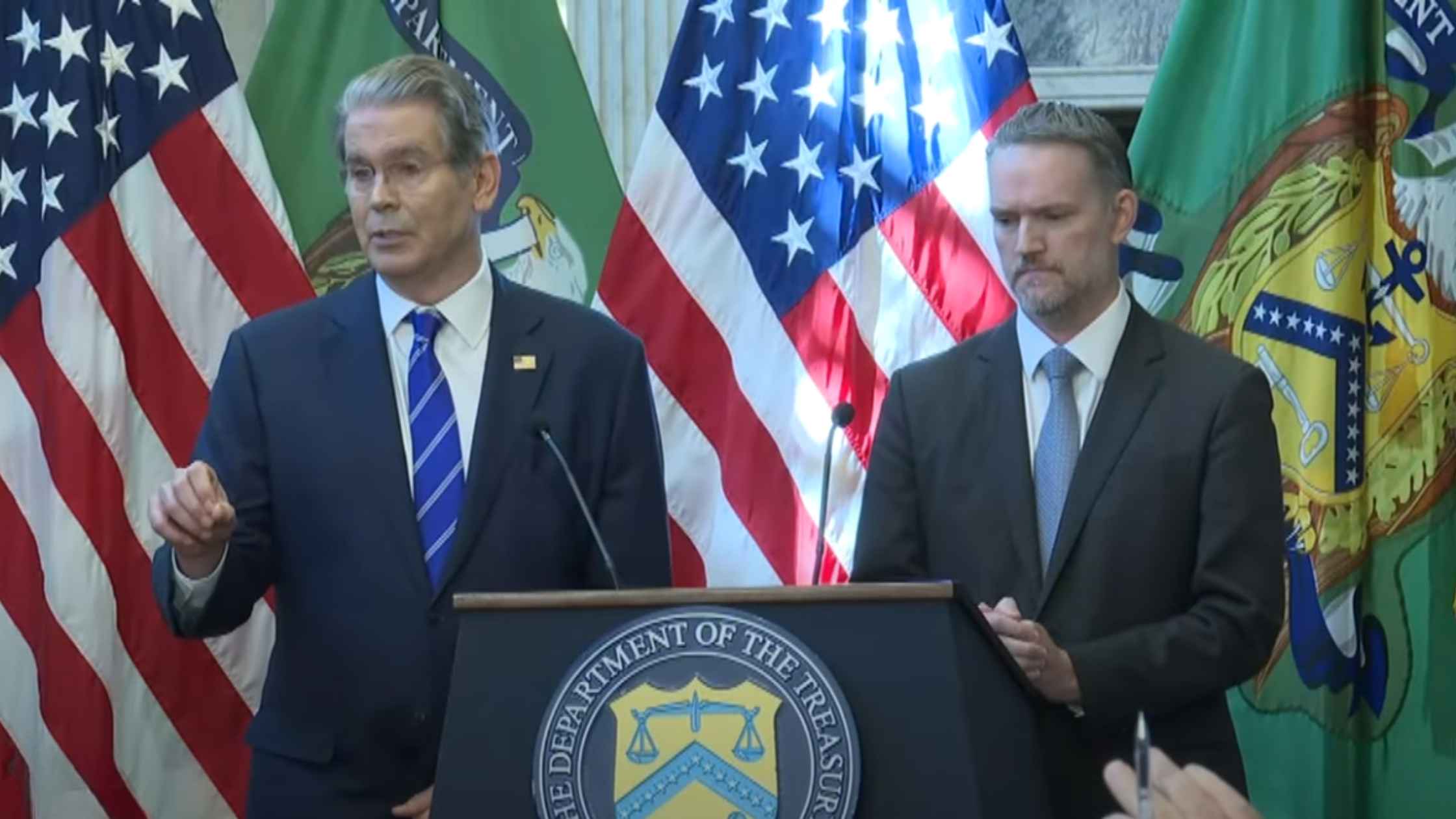
Jamieson Greer (00:00):
… as well as technologies related to batteries, vehicles, industrial diamonds, and superhard materials. To be clear, this is not just about the United States. These actions, if implemented, would apply to the entire world. China's announcement is nothing more than a global supply chain power grab. While China has taken a number of retaliatory trade actions against the United States, Europe, Canada, Australia, and others in recent years, this move is not proportional retaliation, it is an exercise in economic coercion on every country in the world.
(00:35)
At its core, China's new measures include a rule saying that any product of which more than 0.1% of minerals consist of minerals mined or processed in China, one must seek approval from the Chinese government before trading it. Since many important semiconductors, for example, have these critical minerals, and semiconductors are in nearly everything, this rule gives China control over basically the entire global economy and the technology supply chain. This will impact artificial intelligence systems and high-tech products, but even regular consumer items like cars, smartphones, and potentially even household appliances could be affected. It would also apply to many items that are necessary for defense purposes.
(01:16)
And again, it covers the whole world. For example, if a smartphone is made in Korea and sold to Australia, then the company would first need to get China's approval, since the phone contains semiconductors which may contain rare earths sourced from China. Or if a car is built in America and sold in Mexico, you would need to seek approval from China before making the sale, because of the chips in the car. Obviously, neither we nor our allies are going to go along with that kind of system.
(01:43)
Many are suggesting that China's action is simply posturing for leverage in negotiations with the United States. Now, while that may be one element of China's approach, it's obvious that these controls are part of a broader plan by China to control the world's supply chains, and these controls are wildly out of proportion to any targeted actions by the United States or its allies over the past few months. Others have suggested that the United States has violated a non-existent agreement with the Chinese regarding export controls or the implementation of measures. This is a false narrative deployed to justify these broad and unacceptable Chinese actions.
(02:20)
There is in fact a published agreement between the United States and China from earlier this year that the U.S. and China would suspend tariffs of over 100% on each other. China further agreed to effectively suspend elements of its rare earths export control regime by expeditiously approving licenses for U.S. companies seeking rare earths. Both countries agreed to this pause on tariffs and rare earth measures for 90 days while we pursued further negotiations, which have gone on quite successfully for the past six months. And there is a published agreement about this on official U.S. government and Chinese websites. This is the Geneva agreement. It's not a secret. It's out there. It's published. We keep our tariffs low, they keep the rare earths flowing. We have not imposed our reciprocal tariffs on the Chinese since that time, but now the Chinese have expanded their rare earth controls. We have complied; they have not.
(03:13)
And so in this context, this is how China has announced it's new and extremely expensive controls on rare earth materials just last week. It's a clear repudiation of everything we've been working toward for the last six months, which was a stable tariff situation and a continued flow of rare earths. The short story is that we've had compliance and the Chinese have escalated, and they've taken this opportunity to make a pretextual claim of non-compliance or other measures to justify this, but the United States won't stand for it. We're in close communication with our allies, who have expressed similar views, and who are similarly affected. The president has signaled some of the actions we are taking or may take if the Chinese implement this system of controls on the world. Mr. Secretary?
Scott Bessent (04:00):
Good. Thank you, Ambassador Greer. And again, thank you all for being here at Treasury today in the midst of this shutdown. We call on the moderate Democrats in the Senate to be heroes. Be heroes. Break away from the hive of radicalism and do something for the American people, because we are starting to cut into muscle here. We believe that the shutdown may start costing the U.S. economy up to $15 billion a day. And this is a decision the Democrats are making, and one of the reasons that they are not being held to task is because the mainstream media is not coming at them the way they would've if the Republicans were willing to keep the government closed.
(04:48)
It is a very simple decision. Mike Johnson passed a clean CR, Leader Thune has the clean CR, three Democrats have voted for it, and right here, right now, I'm calling for the moderate Democrats to be heroes, be heroes, and reopen the government for the American people. So, with that, I want to say thank you, good morning to all of you. It's a shame we can't have more people here, but I believe that the Democrats will come to their senses soon. Maybe it's after there's no kings, but no kings equal no paychecks.
(05:27)
Before we start on Q&A, I'd like to make a few points on China. As the president has said, we want to help China, not hurt it. If some in the Chinese government want to slow down the global economy through disappointing actions and through economic coercion, the Chinese economy will be hurt the most. And make no mistake, this is China versus the world. They have put these unacceptable export controls on the entire world. China is a command and control economy, and we and our allies will neither be commanded nor controlled. They are a state economy, and we are not going to let a group of bureaucrats in Beijing try to manage the global supply chains.
(06:19)
As Ambassador Greer said, we had a document and an agreement in Geneva, and magnets were flowing quite well. Some U.S. auto companies have called us in the past week and said that there had been a slowdown in magnets. So, when we asked the Chinese about this, they said, "Oh, it probably had something to do with the holiday. Had something to do with the holiday." So, they can't be trusted with the global supply chain. "Had something to do with the holiday." Moreover, this should be a clear sign to our allies that we must work together, and work together we will.
(07:01)
There will be series of meetings this week during World Bank IMF Week, and we are all on. Not only is China fueling Russia's war, but China's actions have once again demonstrated the risk of being dependent on them on rare earths, and for that matter, anything. If China wants to be an unreliable partner to the world, then the world will have to decouple. The world does not want to decouple, we want to de-risk, but signals like this are signs of decoupling, which we don't believe China wants. And again, we do not want to decouple. We should work together to de-risk and diversify our supply chains away from China as quickly as possible.
(07:50)
China says that these rare earths are used in military materials and that they want to maintain peace in the world. Again, it is the purchase of Russian oil by China that fuels the Russian war machine. China buys 60, 6-0% of Russian energy. They buy 90% of Iranian energy. So, who is fueling the Russian war machine? We will be producing photos soon, supplied to us by the Ukrainian government, that shows Chinese parts comprise substantial amounts of Ukrainian drones. So, President Trump is the leader of peace. We should work together to de-risk and diversify. China's highly provocative move comes after we've made significant efforts to de-escalate tensions. While there are substantial actions we could take, we'd rather not. I believe China's open to discussion, and I am optimistic that this can be de-escalated. Ultimately, we are confident in the strong relationship between President Trump and President Xi. We've had substantial communication with the Chinese over the past few days, and we believe that there will be more forthcoming this week. With that, we can now take your questions. Elliott?
Elliott (09:19):
Great, thank you. First question, Eamon Javers, CNBC.
Eamon Javers (09:24):
Thank you, Mr. Secretary. In your CNBC interview just now, you name-checked a Chinese negotiator, Li Chenggang I believe is how you pronounce his name, from the Ministry of Commerce as somebody who's particularly difficult to deal with. Is it your sense that there's a split politically withinside the Chinese negotiating team, or do you think you're dealing with sort of a strategic good cop, bad cop kind of a relationship on the other side of the table?
Scott Bessent (09:50):
It's very difficult to know what… Perhaps the vice minister who showed up here with very incendiary language on August 28th has gone rogue. Perhaps he's gone rogue. So, we don't know. But what we do know, what we do know is, as Ambassador Greer said, any back-filling that the Chinese are trying to do in terms of narrative, this was well-flagged. This individual was very disrespectful. And I'll tell you that we've had four rounds of talks, Geneva, London, Stockholm, and Madrid, and both sides approached them with great respect, and this individual did not. He showed up uninvited in Washington and said, quote, "China will cause global chaos if the port shipping fees go through." So, I don't believe that China wants to be an agent of chaos, and maybe they used to have the wolf warrior diplomats, so maybe he thinks he's a wolf warrior. We don't know.
Eamon Javers (11:13):
Do you want to see the Chinese delegation remove him from the negotiating table?
Scott Bessent (11:13):
That's up to them.
Elliott (11:16):
Thank you. Next question, we'll go to Christine with NBC.
Christine Romans (11:27):
Thank you for this. Christine Romans, NBC News. What do you need to see specifically from the Chinese to avoid putting more tariffs on Chinese goods as the president threatened on Friday? And are the two leaders still expected to meet in the next few weeks?
Scott Bessent (11:44):
I will say that I believe, as of last time I saw President Trump, which was last night, he is still expecting to see Party Chair Xi in Korea. And I'll let Jamieson, Ambassador Greer, answer the first part.
Jamieson Greer (12:00):
And the expectation is that this regulatory system is not implemented by the Chinese. They haven't implemented yet. They've put out a notice about it. Similarly, we've signaled our intent to raise tariffs if their system goes into effect. Our documents, doing a tariff raise and potentially taking other export controls, these are drafted or in draft, so this is quite real. But our expectation is that they won't implement this and that we'll be able to be back to where we were a week ago, where we had the tariff levels we've agreed to and we have the flow of rare earth magnets we agreed to.
Elliott (12:32):
… so much. Next question, we're going to go to Ed Lawrence with Fox.
Ed Lawrence (12:38):
Thanks for taking the questions. So, the Chinese have been pretty good at using this rare earth mineral trump card, for lack of a better term. So, we're not talking about opening the Chinese market to U.S. trade, we're not talking about protecting intellectual property. Can there be a sustainable framework, a substantial framework with China?
Jamieson Greer (12:58):
So, there is room for a positive economic relationship with China, there certainly is, and we would much rather be talking about that than constantly be talking about rare earths. To paraphrase the secretary, one of our recent meetings with the Chinese, this is the last time we want to be talking about rare earths with the Chinese. Fortunately, that is not the last time they want to be talking about it.
(13:18)
The reality is there are a lot of areas where we can trade with the Chinese. Our trade is wildly imbalanced, so it needs to be more balanced, and there's a lot of, as the secretary said, areas of risk. And so we need to be trading in areas that are low risk, that are low sensitivity. And there are a lot of areas where both the Chinese and us can frankly pick and choose sectors and goods that we should be trading, and services, for that matter. And that's where these talks should be focused. Instead, we're constantly focused on the Chinese chokehold on the world of rare earths and rare earth materials.
Scott Bessent (13:49):
And there's an article in the paper today, a large Chinese fashion retailer just opened on Fifth Avenue in New York. It's a competitor to Zara and H&M. We welcome that. We would also like to see more U.S. retailers on the ground in China, but Costco and Walmart have very big operations there. So again, our goal is not to decouple, it's to de-risk.
Ed Lawrence (14:15):
But it seems that China's not fazed by our tariffs. What levers then do we have left?
Scott Bessent (14:21):
I can guarantee you, when we were in Geneva and the tariffs were 145%, they were fazed.
Elliott (14:30):
Thank you, [inaudible 00:14:30]. John Necker, great.
John Necker (14:34):
Thank you. Thank you, Mr. Secretary, Ambassador Greer, really appreciate your taking the opportunity. I have a question for both of you about this upcoming case at the U.S. Supreme Court. It's an incredibly important case that could impact the constitutionality of the president's unilateral tariffs on America's trading partners. Really basic question for you just to begin with, I have two questions for you. Why are the president's tariffs not taxes on imported goods?
Scott Bessent (15:05):
That's easy; because tariffs are a surcharge, not a tax. They could be paid by the exporter, they could be paid by the country. When you go and get your driver's license, you pay a fee. Is that a tax? Is it a tax?
John Necker (15:26):
I'm asking you a question, sir, and I'd just appreciate an answer to it. Thank you.
Scott Bessent (15:26):
And if we… Well, I'm giving you an answer that maybe you don't like. The other thing is this case… And Ambassador Jamieson is a lawyer, I'm not.
John Necker (15:38):
As am I. Thank you.
Scott Bessent (15:42):
I won't tell you the one thing I agreed with Lenin on. So-
Jamieson Greer (15:46):
Wait.
Scott Bessent (15:51):
… I think that we see with this Chinese provocation why it is very important for the president to have emergency powers to implement tariffs, because he needs to be able to use this to push back against this Chinese overreach against the world. So, if it was not clear to anyone on the court before last week that the president needs emergency powers to protect the American people and the American economy, then it should be abundantly clear now.
John Necker (16:28):
So, my second question concerns that law that you just cited, that 1977 law. The question is about Brazil, the 50% tariffs on Brazil. Can you explain why they're being hit with 50% tariffs, and why it falls under the umbrella of the International Emergency Economic Powers Act?
Jamieson Greer (16:49):
Certainly happy to do that. Now, to be really specific about Brazil, there's actually two regimes at place right here. There's the reciprocal tariff rate of 10% on Brazil, which everyone in the world has, which we're trying to do to control the global trade deficit, which is a huge problem for us. Then on top of that, there's a 40% tariff on Brazil, and that's under a separate emergency. And this is related to extreme concerns with rule of law, censorship, and human rights in Brazil, where Brazilian judge has taken it upon himself to order U.S. companies to censor themselves, giving them secret orders to manage the flow of information, rule of law with respect to political opponents in Brazil. And so when the-
Scott Bessent (17:30):
And the unlawful detention of U.S. citizens who were in Brazil.
Jamieson Greer (17:35):
Correct. Now, the Treasury Department has often used IEEPA, which is the shorthand for the law you're talking about, to impose sanctions which will cut off countries or companies or persons entirely from the U.S. financial system and cut off trade entirely. If the president can cut off trade entirely, he can certainly impose a tariff, which is a lesser measure than a full sanction.
John Necker (17:55):
Thank you for those, appreciate it. Thank you.
Elliott (17:55):
Next question from James with Newsmax.
James Rosen (18:02):
Thank you. James Rosen with Newsmax. Thank you both for doing this. I have two questions for the secretary. One of them, I'll leave for a second, slightly historical in nature, and you are a historian. First, you mentioned in your opening remarks, quite apart from the expansion of the export controls, that China is singularly responsible for propping up the Russian war machine in Ukraine. We also know about the outsized Chinese role in the manufacture of the precursors for the fentanyl that is killing an estimated 100,000 Americans a year. So, quite apart from the export control slice of this, should not Beijing feel the full weight of American punishment just for those two other aspects, the fentanyl and the propping up of the war machine? And then one historical question.
Scott Bessent (18:54):
Great. So, a couple of things. The U.S. President Trump has instructed the ambassador and myself to tell our European allies that we would be in favor of… Whether you want to call it a Russian oil tariff on China or a Ukrainian victory tariff on China. But our European allies have to be willing to follow. We're sitting here during a government shutdown, when we can't get seven more Democratic senators across the line, but 85, 85 U.S. senators are willing to give President Trump the authority to put up to 500% tariffs on China for the purchase of Russian oil. We are told that the European Parliament will not pass a somewhere measure. So, all I hear from the Europeans is that Putin is coming to Warsaw. There are very few things in life I'm sure about: I'm sure he's not coming to Boston. So, we will respond if our European partners will join us.
(20:03)
The second, we do have the 20% of the tariff… We have a 20% fentanyl tariff on China. And again, they have all but admitted that they sell the precursor drugs. When we have the discussion, they said, "Take off the tariff and then we can fix it." We say, "Fix it and show us six months of persistence, and then we will take off the tariff." So again, back to the IEEPA, if 100,000, 200,000 Americans being killed every year by fentanyl, families ruined, is not an emergency, I'm not sure what is.
Jamieson Greer (20:47):
And by the way, if the Chinese can cut off rare earths and export control them, they certainly can control the precursors for fentanyl as well.
James Rosen (20:56):
Very quickly, Ambassadors, very quickly, when the history of this time is written, and historians are paying attention to President Trump's decision-making surrounding the global tariff program that he has initiated, can you tell us, to your knowledge, when it was, whether it was during the campaign or the preceding four years or during the transition or since he took office again, that he decided that he was going not only to rely more heavily on tariffs than he did in his first term, but to go as big on tariffs as he has, when was that decision taken?
Scott Bessent (21:28):
Oh, I think the decision was taken in the first term, and you would've seen President Trump saying that over the past, that since January 20th, that he would have had very successful tariff program on China in terms of rebalancing, in terms of purchases that they were supposed to make, which they haven't followed up on. But you've heard President Trump say that in his final year, so trade deals reached with China on January 20th, he was going to expand the tariffs to the world, and then COVID hit. And out of humanitarian necessity, it would not have been appropriate to start putting on tariffs during a period of such great economic disruption.
Elliott (22:12):
[inaudible 00:22:13] Secretary has to go to a meeting immediately after this. So, we have time for one question. I'm going to go do the print folks in the back. Demetri from the FT.
Demetri Sevastopulo (22:27):
Thank you. Demetri, Financial Times. Ambassador Greer, I think you said that you don't expect China to implement the rare earths' regime that it announced. Is that based on something that the Chinese said to you, or if not, what gives you that confidence?
(22:39)
And then secondly, if the Chinese were to say, "We will delay implementation by, let's say, six months or one year," would that be enough for you to delay implementation or imposition of 100% tariffs and other countermeasures? Thank you.
Jamieson Greer (22:54):
So, the Chinese obviously will decide what they're going to do, right? That's not up to me. I'm just outlining our expectation for this program. Obviously, at a minimum, they have to delay it. Our expectation is that this never goes into effect, because you can't… When you look at what happened with the rare earth magnets, they had a similar program that they implemented. And that program, the result was that they couldn't implement it, they didn't have enough people to organize it, separate and apart from it being just wrong entirely, they actually couldn't implement it. And it took months and months to get the flow of magnets to something that was barely tolerable, right?
(23:29)
Now, take that program, which was trying to deal with thousands of license applications, and multiply it by 1,000. That's what we're talking about, because we're not just talking about the rare earths themselves, we're talking about many downstream products that contain those rare earths. Remember, 0.1%, 0.1% of a product has a Chinese rare earth in it, it could be controlled by this. I mean, the scope and the scale is just unimaginable and it cannot be implemented.
Scott Bessent (23:55):
And Demetri, to follow up on that, right now, we are currently in a 90-day roll off on the tariffs. So, is it possible that we could go to a longer roll in return for a delay? Perhaps. But all that's going to be negotiated in the coming weeks before the leaders meet in Korea.
Elliott (24:20):
Thank you, everybody, with apologies again, they do have to get to another appointment right now. Thank you, Mr. Secretary. Thank you, Mr. Ambassador.
Jamieson Greer (24:26):
Thank you.
Elliott (24:26):
Thank you all.
(24:27)
Right, [inaudible 00:24:38] in the room, please feel free to hold here and you may file from this room. We do not have Wi-Fi in the US Treasury, but you may use your Wi-Fi cards if that works best for you.
All (24:46):
[inaudible 00:24:52].