
Effective Closing Statement Examples & Why They Work
See effective closing statement examples and learn how to tie evidence, burden of proof, and jury instructions into a persuasive final argument.


In a federal criminal trial, closing arguments typically follow a set order: the government argues, the defense responds, and the government gets the last word in rebuttal under Federal Rule of Criminal Procedure 29.1. By that point, the jury has heard every witness and seen every exhibit. What they haven’t heard yet is someone explaining how it all fits together.
That’s the job of a closing statement. Below, we’ll look at what makes a closing argument effective, walk through closing statement examples from real and sample trials, and break down why each one works. We’ll also cover how to write and practice your own.
What Is a Closing Statement?
A closing statement is the final argument each side makes to the jury (or the judge, in a bench trial) after all the evidence has been presented, explaining what the evidence proved and why it supports the verdict that side is asking for. It’s the first point in a trial where attorneys can openly argue: drawing inferences, connecting testimony to exhibits, and applying the law the judge will give the jury.
Opening Statement vs. Closing Argument
The main difference between an opening statement and a closing argument is that the opening statement previews what the evidence will show, and the closing argument tells the jury what the evidence did show and what it means.
In closing, argument is the point: you can characterize testimony, highlight contradictions, and tie the facts to the jury instructions. In the opening, you aren’t arguing per se; you are more setting the stage for what’s to come.
But that doesn’t mean the two aren’t connected. When drafting your closing statement, it’s a good idea to tie back to the statements and promises made in the opening. This both increases juror trust and strengthens your entire case, as jurors can better understand the through line of your case.
What Makes a Closing Argument Effective?
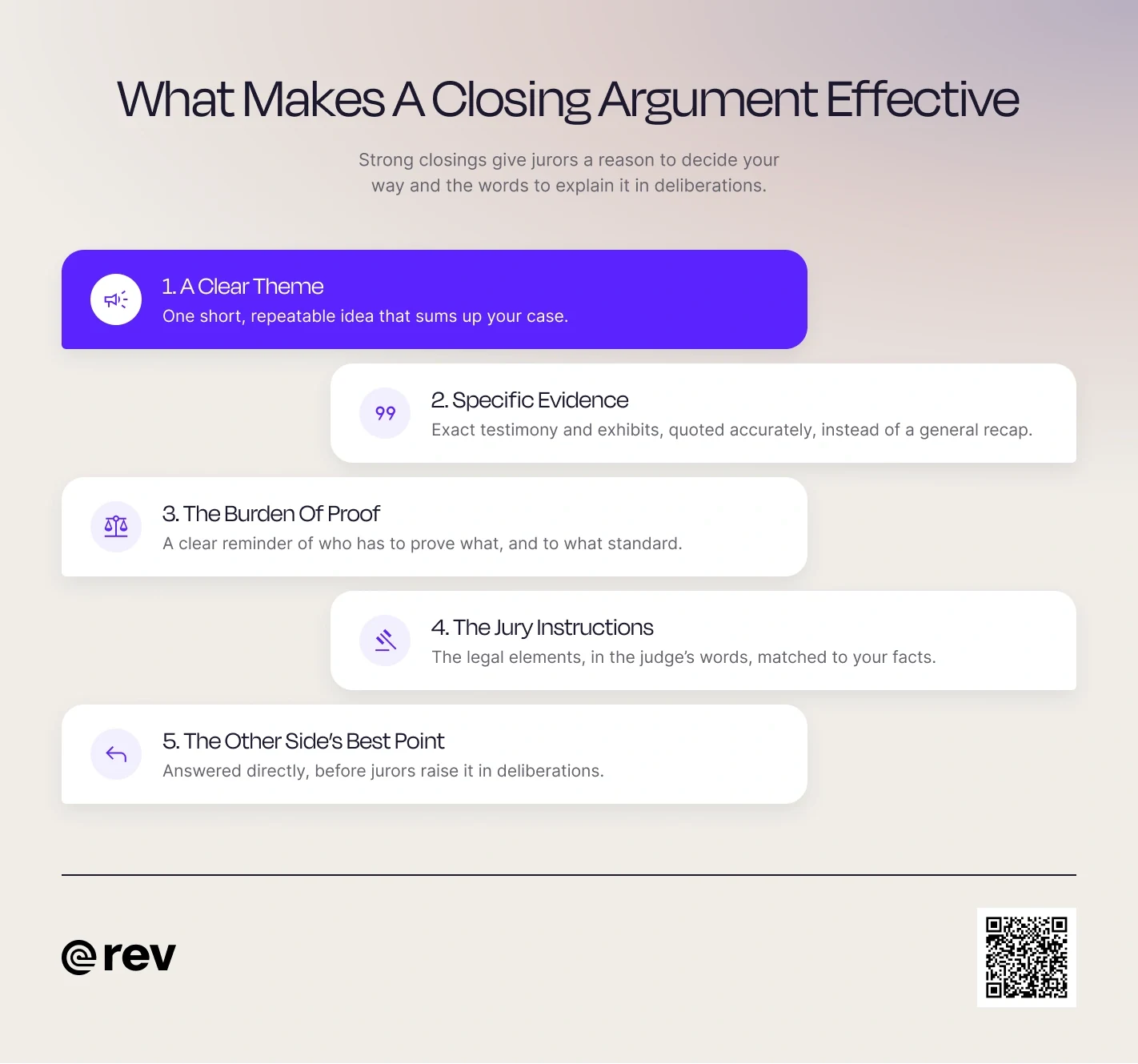
An effective closing argument gives jurors a reason to decide your way and the language to explain that decision to each other in deliberations. Strong closings tend to share a few building blocks:
- Theme
- One short, repeatable idea that sums up your case.
- Key Evidence
- Specific testimony and exhibits, quoted accurately, instead of a general recap.
- Burden of proof
- A clear reminder of who has to prove what. In criminal cases, due process requires “proof beyond a reasonable doubt of every fact necessary to constitute the crime,” per In re Winship.
- Jury instructions
- The legal elements, in the judge’s words, matched to your facts.
- The other side’s best point
- Answered directly, before jurors raise it in deliberations.
“Storytelling is essential,” John Moore, Director of Attorney Development at Angel Reyes & Associates, told Rev.
“You must capture the jurors’ attention and keep them engaged. I often use props or actual trial exhibits to illustrate my points. In one case, when I was a prosecutor, I scattered drug paraphernalia admitted into evidence throughout the courtroom to refute the defense’s claim that the possession charge arose from an isolated incident.”
Effective closings also stay inside ethical limits. The Supreme Court put it plainly for prosecutors in Berger v. United States: a prosecutor “may strike hard blows,” but “he is not at liberty to strike foul ones.” Arguing facts outside the record or misstating the law can draw an objection or worse (like a case dismissal).
Closing Statement Examples + Why They Work
The closing statement examples below include two real arguments from Rev’s transcript library and three samples written to show common techniques. Each closing argument example is short, but the structure behind it scales to a full summation.
1. The Theme Line
In the 2021 trial of Derek Chauvin, prosecutor Steve Schleicher distilled weeks of testimony into one line: “He knew better. He just didn’t do better.” Read the full transcript of the closing statement in the Chauvin trial for context.
Why it works: The line is short enough for jurors to repeat in deliberations, and it points back to evidence the prosecution had already presented about training and policy. A good theme gives the jury shorthand for your whole case.
“I like to display the prior statement on a projector during closing arguments and leave it visible for as long as possible,” said Moore. “I usually begin and end with it, repeating the statement as my final point and allowing it to linger in the jurors’ minds.”
2. The Burden of Proof Reminder
In the Kyle Rittenhouse trial, defense attorney Mark Richards told jurors, “They have the burden of proof. We don’t.” The Rittenhouse closing transcript shows how he returned to that idea throughout.
Why it works: This is a classic closing statement by defense counsel. It shifts the jury’s question from “what happened?” to “did the state prove it?” Pairing the line with the specific instruction jurors will receive makes it more than a slogan.
3. The Elements Walkthrough
In the Duane “Keffe D” Davis trial, prosecutor Binu Palal answered the defense’s corroboration argument with the jury instructions: “the one thing we have to prove without corroboration is that somebody was killed by the act of another.” The closing argument transcript in Tupac’s Murder trial shows how he tied that point to the instruction by number.
Why it works: Palal sets aside the standard the defense proposed and points jurors to what the law actually requires. Citing the instruction by number gives jurors something they can look up during deliberations.
4. The Prior Inconsistent Statement
Alex Murdaugh told investigators he wasn’t at the kennels the night of the murders, then admitted at trial that he lied. In closing, prosecutor Creighton Waters asked jurors, “Why would he lie about that, ladies and gentlemen?”
Why it works: The earlier statement and the trial testimony can’t both be true, and the question leaves jurors to work out why. Our guide to finding prior inconsistent statements covers how to locate these moments quickly.
5. The Timeline
In the Tomasz Kosowski murder trial, prosecutor Nathan Vonderheide walked through the clock: the phone was turned off at 8:08, Kosowski entered the law firm at 8:34, the victim followed three minutes later, and left his office at 9:50. You can follow the full sequence in the Kosowski closing argument transcript.
Why it works: A timeline turns scattered phone records and video into a sequence the fact-finder can picture. Short, time-stamped beats are easier to remember than a paragraph of narrative.
Famous Closing Arguments Worth Studying
Watching full closings shows you what a transcript can’t: pacing, pauses, and when an attorney turns from the jury to an exhibit. These famous closing arguments cover both sides of the courtroom:
- Steve Schleicher, Chauvin Trial
- The prosecution closing builds steadily toward its theme.
- Eric Nelson, Chauvin Trial
- The defense closing walks jurors through reasonable doubt and the instructions on an officer’s use of force.
- Mark Richards, Rittenhouse Trial
- The defense closing keeps returning to the state’s burden in a self-defense case.
- Commonwealth v. Lindsay Clancy
- The closing arguments offer a recent look at a defense closing in a high-profile Massachusetts murder trial.
- Tupac Shakur Murder Trial
- The prosecution closing opens with a one-sentence theory of the case: “this was a case about gang retaliation and revenge.”
You can read transcripts of these and other proceedings in Rev’s legal event transcript library. If you’re also preparing for jury selection, our list of voir dire questions pairs well with this guide.
How to Write a Closing Statement
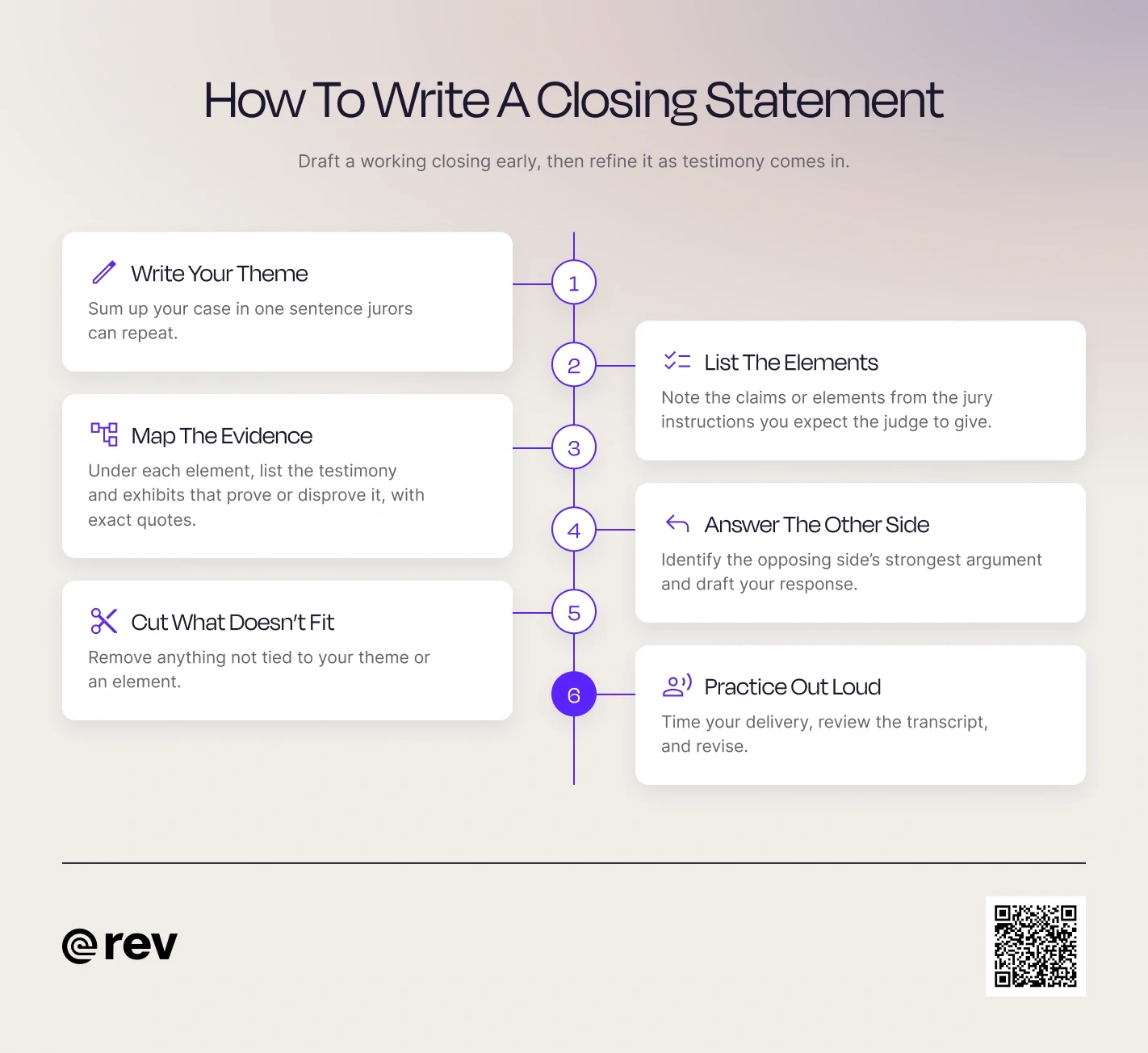
Learning how to write a closing argument starts long before the evidence closes. Many attorneys draft a working closing early, then revise it as testimony comes in. A simple process:
- Write your theme in one sentence.
- List the elements or claims from the jury instructions you expect the judge to give.
- Under each, note the testimony and exhibits that prove or disprove it, with exact quotes.
- Identify the other side’s strongest argument and draft your answer.
- Cut anything that isn’t tied to your theme or an element.
- Practice out loud, time it, and revise. Consider setting up a mock trial to practice it in front of others, if you have time.
In federal criminal cases, Rule 30(c) lets the court instruct the jury before closing arguments, after them, or both. Know which your judge prefers so you can reference the instructions accurately.
How Do I Start a Closing Statement?
Start a closing statement with your theme or a single concrete fact that captures your case, then tell jurors what you’re going to show them. Skip the long thank-you and the lecture on civic duty, and use your first minute on the point you most want remembered.
If you’re unsure how to make a closing statement land from the first line, look back at your opening: returning to an image or phrase you used then shows the jury the evidence delivered.
How Rev Helps You Prepare and Practice Your Closing
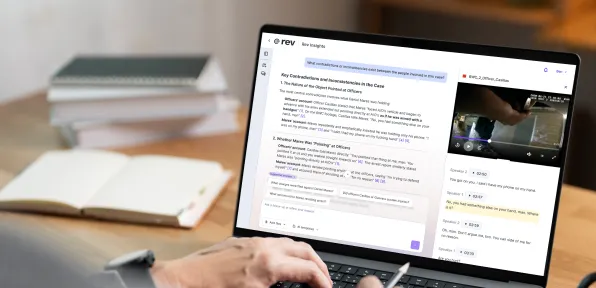
A strong closing depends on quoting the record accurately, and trial testimony moves fast. Rev turns hearing recordings, depositions, recorded statements, and other audio and video into searchable transcripts, so you can find a witness’s exact words and jump to that moment in the source file.
Search across multiple files at once to set trial testimony next to an earlier recorded statement, or pull every reference to a key date for your timeline. Before quoting anything to the jury, check it against the official transcript from the court reporter, which should always remain the record of the trial.
Close With The Record On Your Side
Your closing is the last time jurors hear from you before they decide. The most effective closing statement examples share one habit: every line points back to something the jury actually heard or saw. Rev helps you find those moments in the recordings and transcripts, and practice delivering them, so you walk into closing knowing the record cold.