

The Appellate Process From Judgment To Decision
Learn how the appellate process moves from judgment to decision, and how a better record-review workflow can save time without sacrificing accuracy.



A trial may end when the judge enters judgment. For the attorneys involved, though, that can be the moment another deadline clock starts ticking.
Suddenly, a record built over months or years must be viewed through a narrower lens. Which rulings are appealable? Where was the issue preserved? What did the witness say on page 842? Does the record support the argument you want to make?
That is what makes the appeal process so different from trial work. Here is how the appellate process generally moves from judgment to decision, and where a better record-review workflow can save attorneys hours along the way.
What Is An Appeal?
An appeal is a formal request to a higher court to review a lower court's judgment/record to determine if any error was made. The party seeking review is usually called the appellant, while the party defending the judgment is the appellee.
The path an appeal takes depends on where the case began. Federal cases generally move from a U.S. district court to a federal court of appeals, following the Federal Rules of Appellate Procedure. State cases usually go through their own state appellate courts, with separate rules and deadlines.
That distinction matters when you're looking up what to file and when. Even a state case involving constitutional rights doesn't automatically go straight to a federal appeals court. Federal review of state judgments is possible in certain circumstances, but it follows specific procedures. We'll use federal rules throughout this guide as examples, so be sure to check your state's requirements if you're handling a state appeal.
In federal court, appellate judges review the record and the parties' written arguments rather than retrying the case. The U.S. Court of Appeals for the Third Circuit, for example, explains that parties cannot introduce new testimony or evidence on appeal. Rather, the court examines the existing district court or agency record for error.
“On appeal, judges or justices are the audience, and they have their own tendencies, incentives, biases, and baggage,” explains Rajeh A. Saadeh, Attorney at The Law Office of Rajeh A. Saadeh.
“A legal argument on appeal that only identifies the legal errors under the correct standard of review is necessary, but not sufficient; the best appellate advocates persuade appellate courts to want to correct those mistakes.”
Types Of Appeals
There is no single type of appeal that fits every case. Jurisdiction, case type, and the order being challenged all affect the path forward.
Common types of appeals include:
- Appeals as of right: A party has a legal right to ask the appellate court to review an appealable judgment or order. In federal civil cases, either side may generally appeal a final judgment.
- Criminal appeals: A criminal defendant may appeal a conviction or sentence. Government appeal rights are more limited, including constitutional restrictions on appealing an acquittal.
- Interlocutory appeals: Some rulings can be reviewed before the entire case reaches final judgment, but only under specific statutes, rules, or doctrines.
- Cross-appeals: When one party appeals and another party also wants appellate review of part of the decision, the second party may file a cross-appeal. Federal Rule of Appellate Procedure 28.1 governs briefing in federal cross-appeals.
- Administrative and bankruptcy appeals: Decisions from agencies or bankruptcy courts can follow their own appellate paths.
How Appellate Courts Review Decisions
Even when a party has the right to appeal, winning is another matter. Appellate judges don't look at every alleged mistake the same way. The standard of review determines how much weight they give the trial court's decision, and it can make a big difference in which arguments are worth pursuing.
For questions of law, courts generally use de novo review. That means the appellate judges reach their own legal conclusions rather than deferring to the trial judge's interpretation of the law. They're not holding a second trial, though. The focus stays on the legal question and the existing record.
Factual findings are a tougher hurdle. Under clear-error review, appellate courts give considerable weight to facts found by the trial judge. It's not enough to say the evidence could have been read differently. The reviewing court generally must be firmly convinced that the finding was mistaken.
Other decisions, including many rulings about evidence and trial management, are reviewed for abuse of discretion. Trial judges have room to make judgment calls, so reversing one of those rulings generally requires showing that the judge used the wrong legal framework or went beyond the range of reasonable choices.
There's also plain-error review, which may come into play when an issue wasn't properly raised in the lower court. This isn't another name for clear error. The rules are demanding, and they don't give parties a free pass to raise arguments they missed at trial.
One appeal can involve several of these standards. Figuring out which applies to each issue early can help you focus the record review and build a more persuasive brief.
The right to appeal and the procedure for exercising it depend heavily on jurisdiction. Before taking action, check the governing statutes, appellate rules, local rules, and the specific order(s) for your case.
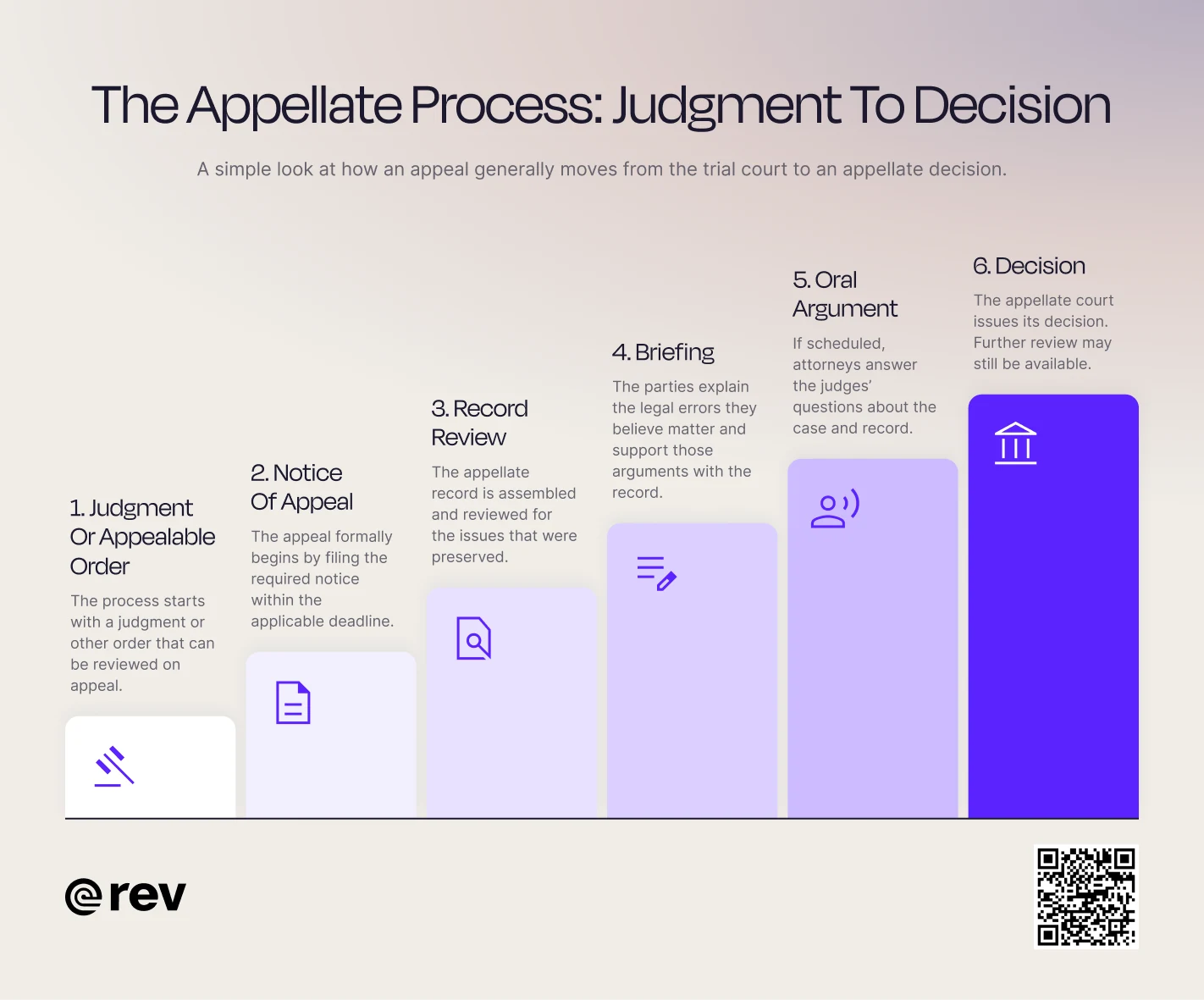
Filing For Appeal In 6 Steps
Although every jurisdiction has its own requirements, most appellate workflows follow a recognizable sequence.
1. Identify The Appealable Order And Calendar The Deadline
Start by determining exactly what is being appealed and whether appellate jurisdiction exists, then calendar the filing deadline immediately.
Under the Federal Rules of Appellate Procedure, a notice of appeal in many federal civil cases must be filed within 30 days after the judgment is handed down. However, different deadlines may apply when the United States is an involved party, if the case is criminal, or if certain post-judgment motions are made.
Because deadlines can depend on the case and procedural history, this is not a date to calculate from memory. Tools like our legal deadline calculator can help teams organize dates, but you and your trial team should always verify deadlines against your specific circumstances.
2. File The Notice Of Appeal
Next, you’ll need to file your appeal with the district clerk and notify the parties involved.
Federal Rule of Appellate Procedure 3 requires the notice to identify the appealing party, designate the judgment or appealing order being challenged, and name the court receiving the appeal. Once the appeal is docketed, additional forms, fees, disclosures, and scheduling requirements may follow.
3. Assemble And Review The Record
This is where the appellate process can become a document-review project.
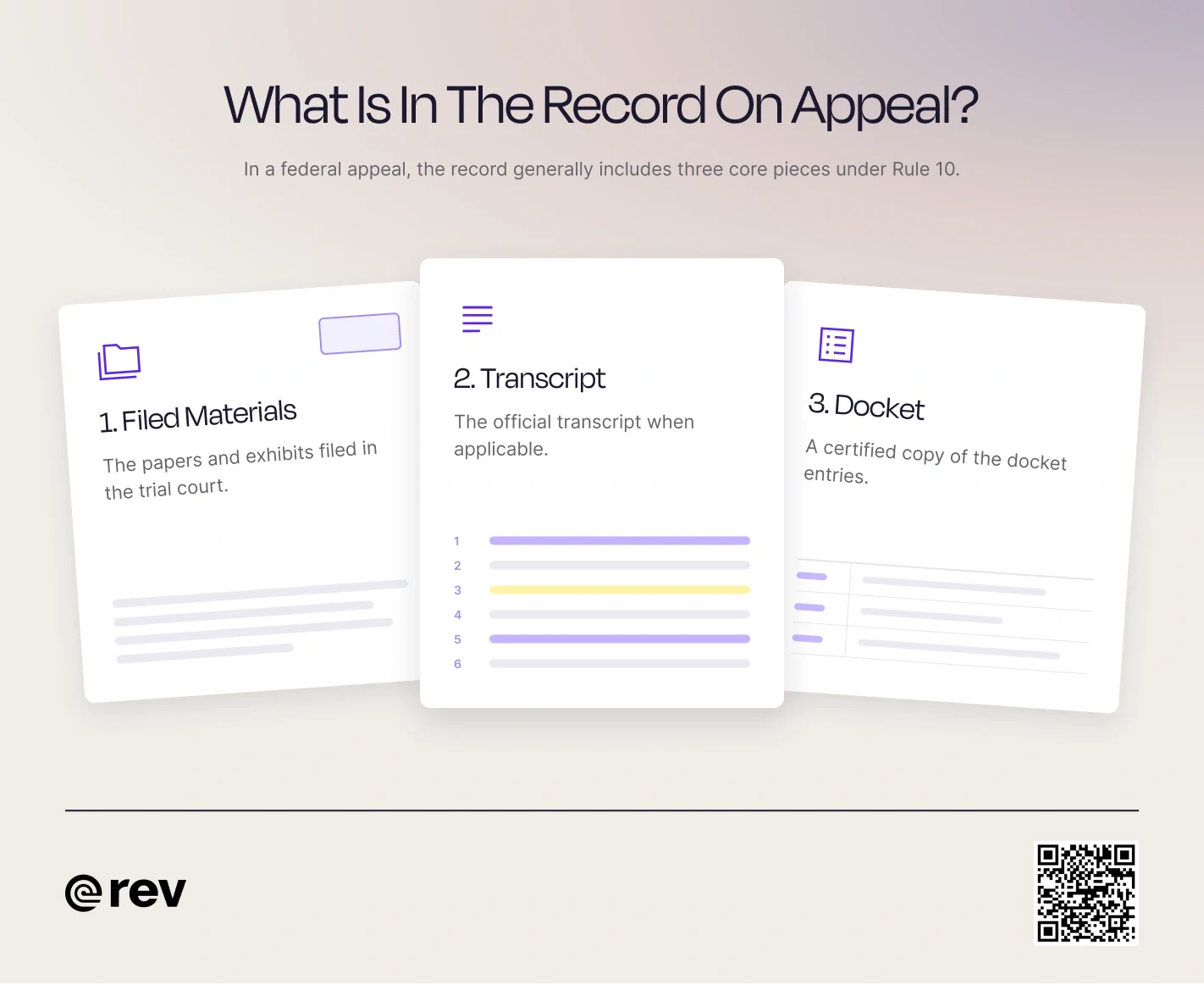
Under Federal Rule of Appellate Procedure 10, the record on appeal includes the papers and exhibits filed in district court, the court transcript of proceedings when applicable, and a certified copy of the docket entries.
This is where Rev can come in handy. Legal teams work the record faster by uploading all evidence, recordings, and transcript files into their Rev workspace. From there, locating testimony, comparing statements, building chronologies, and finding the moments that matter can be done in just a few keystrokes.
If your team is still gathering materials, check out our guides on how to get court transcripts and the different types of court hearings that may appear in a case history.
4. Research Issues And Draft Briefs
The briefs carry most of the argument on appeal.
Federal Rule of Appellate Procedure 28 lays out required components of an appellant's brief, including a jurisdictional statement, statement of the issues, statement of the case, summary of the argument, argument, and conclusion.
“A compelling appellate brief is one that not merely cites favorable cases, but also tells a compelling narrative about how the law favors the litigant’s point of view,” says Robert C. Bird, Professor of Business Law at the University of Connecticut.
“This means tying together concepts across the legal brief that are well supported by the facts. Do not overstate your arguments or exaggerate the facts. When a brief’s claims aren’t clearly supported by the record, it breaks the trust of the reader. If that happens, a court will question anything you write, and that’s not a good position to be in when arguing in a contested environment.”
Good appellate preparation starts before drafting paragraphs. Teams may need to trace an objection through hundreds of pages, determine exactly how a ruling developed, compare testimony from multiple proceedings, or reconstruct a sequence of events.
Searchable transcripts and multi-file analysis can shorten that first-pass review. Attorneys can find potential passages faster, then return to the official record to confirm wording and prepare proper record citations.
5. Prepare For A Possible Oral Argument
Not every appeal receives oral argument. Federal appellate rules allow cases to be decided without argument when a three-judge panel unanimously determines that argument is unnecessary under the standards in Rule 34.
However, when oral argument does occur, preparation is less about repeating the brief and more about being ready for the judges' questions.
That makes fast access to the record useful. Building a searchable bank of disputed testimony, rulings, dates, and record references can help attorneys pressure-test arguments and quickly verify details during preparation, or even during the argument itself. Think of it like a digital trial notebook, but specifically for the appellate process.
6. Receive The Decision And Evaluate What Comes Next
After reviewing the record, briefs, and hearing oral argument (if scheduled), the appellate court issues its decision.
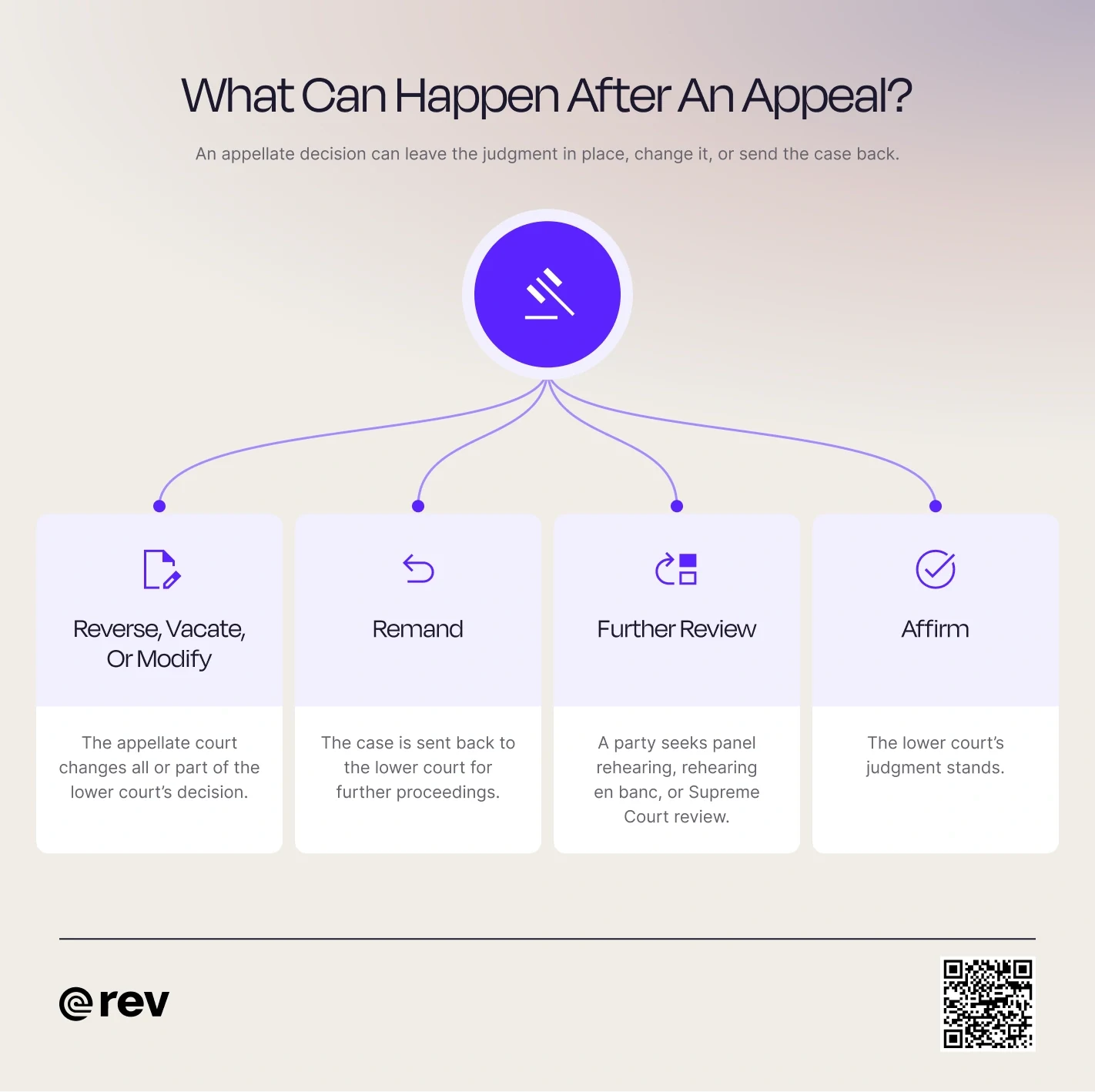
Depending on the case, the court may affirm the judgment, reverse it, vacate it, modify it, or send the case back to the lower court for further proceedings.
But just because a decision was issued, that doesn’t mean the process is over. A dissatisfied party can sometimes seek panel rehearing or rehearing en banc. A party may also ask the U.S. Supreme Court to review a qualifying case through a petition for a writ of certiorari, but keep in mind that the Supreme Court accepts less than 1% of the cases that are submitted every year.
Alternatives To The Appellate Process
An appeal is not the only way to address an unfavorable judgment or resolve the dispute. Depending on the case, possible alternatives or related procedures can include:
- Post-trial motions: In federal civil cases, Rule 59 permits motions for a new trial and motions to alter or amend a judgment under specified circumstances.
- Relief from a judgment: Rule 60 provides grounds for seeking relief from a federal civil judgment or order in circumstances such as mistake, newly discovered evidence, or fraud.
- Settlement or mediation: Parties can sometimes resolve a case while an appeal is pending. Several federal circuits operate appellate mediation programs.
- Extraordinary writs: In limited circumstances, a party may seek extraordinary relief rather than waiting for an ordinary appeal.
These procedures have different requirements and can affect appellate deadlines, so attorneys should evaluate them alongside the controlling rules for the case.
Using Tech To Streamline Appeal Filings
There’s no denying that appeals can be complicated, but the biggest hurdle with these types of cases is surprisingly simple: how do I find the right material needed to make my argument?
Legal research platforms such as Westlaw or LexisNexis can help with citing previous rulings. Case-management and docketing tools can keep assignments and deadlines organized.
Rev can tackle another part of the workflow: analyzing evidence. With multi-file analysis, a legal team can search proceedings for a phrase or topic, compare testimony across files, reconstruct a chronology, and narrow hours of material down to the passages that deserve closer review. And with every finding cited back to the evidence, verification is simple.
Easy verification is an important distinction from a lot of other evidence analysis tools on the market. Because, after all, appellate work is bound by the record. Technology is most useful when it helps attorneys find what is already there without blurring the line between an analysis tool and the official source.
Work The Appellate Record Faster
A strong appeal can flip on one objection, one ruling, or a few lines of testimony buried deep in the record. Finding those moments should not require starting at page one every time.
Rev helps legal teams search and analyze recorded proceedings and transcript files so they can spend less time hunting through material and more time building the argument. Keep the official record as your source of truth. Use Rev to get to the right part of it faster.