


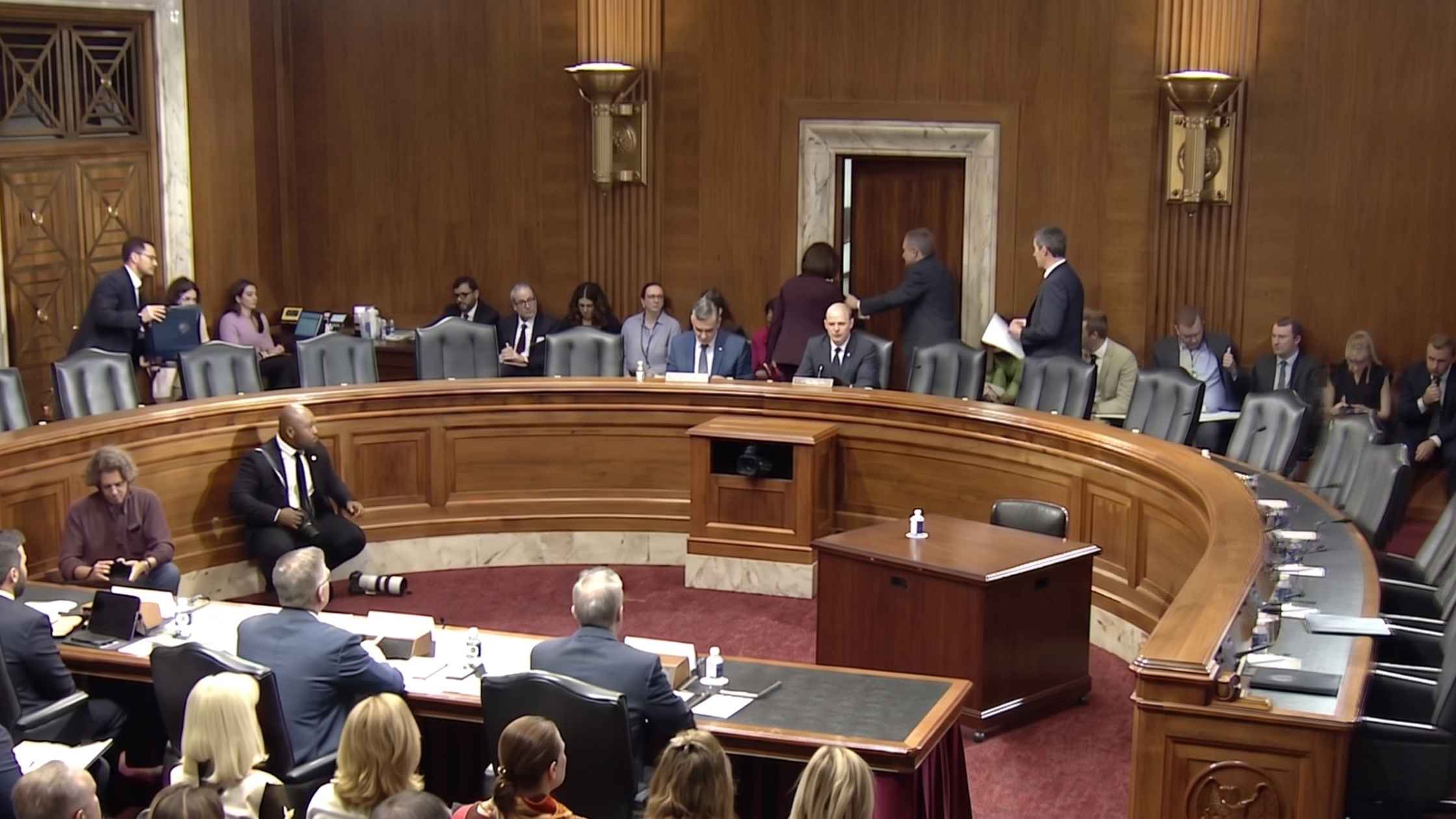
Senator Mike Lee (00:00):
... who are before this committee's jurisdiction for assistant secretary positions within two different departments. Two at the Department of the Interior and one at the Department of Energy. And today we're going to hear from those nominees. They are Mr. William Hague, to be the Assistant Secretary of the Interior for Insular International and Ocean Affairs, Mr. Kevin Lilly, to be the Assistant Secretary of the Interior for Fish and Wildlife and Parks at the Department of the Interior, and Mr. Kaveh Farzad to be the Assistant Secretary of Energy for International Affairs at the US Department of Energy. I thank President Trump for sending us these nominees. The nominations before us today reflect the breadth of the committee's jurisdiction. If confirmed, these nominees will be tasked with responsibilities that significantly affect how Americans access their national parks, how we work with our territories and how the United States advances its energy interests abroad.
(01:11)
The Assistant Secretary for Fish and Wildlife and Parks ... And yes, those are both ands are in there, not separated by a comma. I don't know who named these, but it was a hundred years ago or so when they created it. It was two ands. It's not a run-on sentence. It just is what it is. But it oversees the national park service, among other units, within interior. And that means decisions made in this office have an outsized impact on communities like the ones I represent. Communities of people that live, work, and build their economies, build their lives around federal land. For Utahans, our national parks are part of daily life. However, the Biden administration too often treated them like museum exhibits, things to be kept behind glass, seen but not touched. That kind of an approach proved problematic and failed to acknowledge that these are places where people happen to work and recreate and welcome visitors from around the world.
(02:14)
It's one reason time-to-entry policies have caused such serious headaches for communities surrounding our national parks. At Arches and at Zion, time-to-entry policies have been opposed by the counties, by the governor, and by Utah's entire congressional delegation. The policy keeps Utahans out of their own national parks. It limits visitor spending. It harms gateway communities. It imposes a reservation system that works best for people who have the time, money, and flexibility to plan months in advance. It may work much better for US government personnel than it does the American public at large. The promise of public ownership means nothing if the public is turned away at the gate. When Washington restricts access and drains visitor spending, all without consulting local leaders, it breaks faith with the people who have maintained these lands for generations.
(03:09)
The better path involves collaboration with the communities that know the places, know the parks best. One opportunity for collaboration can certainly be found at the Glen Canyon National Recreation Area, where I believe we can significantly improve the visitor experience. Accomplishing that will require roads, maps, utilities, concessions, and basic infrastructure that can be built within a reasonable time. Unfortunately, that will prove to be nearly impossible under our current permitting regime. At our recent hearing, witnesses made clear that one obstacle is Section 106 of the National Historic Preservation Act, which has in far too many cases become a procedural obstacle course for energy and other infrastructure projects, including improvements that would benefit visitors who come to see our national parks. Preserving our past is important, so is building the infrastructure America needs. The federal government should be able to do both without trapping every project in years or decades of red tape.
(04:18)
Mr. Lilly's nomination is particularly timely as Congress considers reauthorizing the Great American Outdoors Act, or GOA. Last week, this committee reported by voice vote a five-year reauthorization of the Legacy Restoration Fund. Our reauthorization included needed reforms to make the program work better and revenue raisers to make sure the LRF does not increase the national debt. But there's still more work to be done before this reauthorization makes its way successfully to the Senate floor. I trust Mr. Lilly will work with ranking member Heinrich, Senators King and Danes and me as we work to try to improve the bill and get it across the line.
(04:59)
And while the Interior Department has enormous responsibilities here at home, its work also reaches far beyond the continental United States. The Assistant Secretary for Insular and International Affairs plays a central role in how the department works with America's territories. One area where I hope to work closely with you is ensuring that this visa pathway for Chinese nationals to enter our territories is brought to an end. In 2024, the Biden administration through the Department of Homeland Security created the CNMI Economic Vitality and Security Travel Authorization Program. That program allows Chinese nationals to travel to the Northern Mariana Islands without a visa for up to 14 days.
(05:44)
Earlier this year, I joined with several of my colleagues in sending a letter to Secretaries Mullin and Burgum asking that this program be closed. The CNMI faces economic challenges, but opening a visa-free pathway for Chinese nationals into a strategically important American territory, not far from critical US military assets in Guam, is not a responsible answer. It has led to rampant birth tourism and drug trafficking. We should be working towards safer ways to support the CNMI's economy without creating unnecessary security risks.
(06:23)
The same security-minded approach is needed at the Department of Energy's Office of International Affairs. That office, of course, helps manage America's energy relationships abroad. Some of those relationships have proven really valuable. Some require caution. That is especially true when the work involves our national laboratories. America's national labs are among the most important scientific institutions in the entire world. Their research should not become an open target for China or any other adversary seeking to obtain American technology under the cover of collaboration, something this committee examined at length in a hearing last year.
(07:05)
Also, energy diplomacy is one of America's strengths. How we lead by example and enable our allies to achieve energy security is key. DOE's Office of International Affairs plays a leading role in this space. Each of the nominees under consideration today has important work ahead. I look forward to hearing how each of you would intend to address challenges that you face and your plans to execute President Trump's agenda to make America beautiful, secure and energy dominant.
(07:39)
The chair now recognizes my friend and colleague, the distinguished Senator from New Mexico, the ranking Democrat on the committee, Senator Heinrich, for his opening remarks.
Senator Martin Heinrich (07:49):
Thank you, Mr. Chairman. This morning's hearing is frankly long overdue. Each of the three offices the individuals before us today have been nominated to hold have been vacant since the beginning of the president's second term a year and a half ago. Let me be clear that responsibility for most of the delay lies with the president. He waited until mid-February of this year to nominate both Mr. Hague and Mr. Lilly and until March to nominate Mr. Farzad. Even after the president submitted their nominations, two of the nominees took an extended period of time to submit the questionnaire that the committee requires of all nominees. The committee's questionnaire is quite simple. It consists of only two dozen straightforward questions about the nominee's background. It should not take nominees four months to provide us with the required information. Meanwhile, these important offices have not been filled by someone confirmed by the Senate and that is a serious problem.
(08:54)
Under our constitution, the president may nominate, but the Senate must confirm the appointment of officials to these offices. The Supreme Court has said that Senate confirmation, quote, "Is more than a matter of etiquette or protocol. It is among the significant structural safeguards of the constitutional scheme." The advice and consent of the Senate, quote, "Serves both to curb executive abuses of the appointment power and to promote the appointment of qualified people to important offices." The Supreme Court has also acknowledged that, quote, "Presidential appointment and Senate confirmation can take time." Since the nation's founding, Congress has given president's limited authority to appoint acting officials to perform the functions of vacant offices on a temporary basis. But that authority, which is provided by the Vacancies Reform Act, is narrowly limited and frankly is being abused.
(09:58)
Both Mr. Hague and Mr. Lilly appear to be serving in the jobs for which they have been nominated prior to Senate confirmation in violation of the Vacancies Reform Act. Mr. Hague has been performing the functions, duties, and responsibilities of the Assistant Secretary for Insular and International Affairs since May of 2025. Mr. Lilly has been performing these functions, duties, and responsibilities of the Assistant Secretary for Fish, Wildlife, and Parks since August of 2025. I do not blame Mr. Hague or Mr. Lilly for doing the jobs that this administration has given them, but I do believe that this administration has abused its authority by delegating authorities that require Senate confirmation in violation of the Vacancies Reform Act.
(10:48)
And while I appreciate that Mr. Lilly has been accessible and responsive to me, I'm also concerned that neither he nor Mr. Hague appear to have background training or experience in the issue areas that they have been nominated to manage. They have both had very successful careers, but Mr. Hague does not seem to have had any experience with our insular areas or international affairs and Mr. Lilly does not seem to have had any experience with wildlife management or the national parks prior to Secretary Burgum delegating these portfolios to them.
(11:23)
The Vacancies Reform Act was not designed to provide a basis for on-the-job training. Mr. Farzad has at least worked for the State Department for two years and for the Department of Energy's Office of International Affairs for a year and a half. However, this is still far less experienced than previous DOE assistant secretaries for International Affairs have had before assuming the rule. All that said, we now have these nominations before us and I look forward to hearing from each of the nominees today.
Senator Mike Lee (11:58):
Thanks, Senator Heinrich. Our first witness today will be Mr. William Hague of the State of Washington, nominated to be the Assistant Secretary of the Interior for Insular International and Ocean Affairs. He currently serves as the principal deputy for Insular International and Ocean Affairs, a position that he's held since May of 2025. The Assistant Secretary for Insular International and Ocean Affairs oversees the US territories of American Samoa, Guam, the Commonwealth of the Northern Mariana Islands and the US Virgin Islands. It also oversees federal assistance to foreign nations and coordinates international programs to support US foreign policy. Mr. Hague has had a distinguished career in the private sector, including as an executive vice president at AT&T and most recently as CEO and vice chairman of Tillman Infrastructure. He was also a partner at the law firm of Stokes Lawrence. Earlier in his career, he served in the Peace Corps in Togo, Africa and as a law clerk to Judge Donald Voorhees of the US District Court for the Western District of Washington. He holds four degrees and is now pursuing a fifth.
(13:08)
Our second witness today will be Mr. Kevin Lilly of Texas, to be the Assistant Secretary of the Interior for Fish and Wildlife and Parks. He served in that role in an acting capacity since June 2025, overseeing the National Park Service with its 63 national parks covering 85 million acres. The assistant secretary also manages the US Fish and Wildlife Service, which is composed of over 850 million acres on land and water. Mr. Lilly has had a long career in both the public and private sectors. He served as a regent of the Texas State University system and as chairman of its finance board. In the private sector after working at Goldman Sachs and Morgan Stanley, he founded Avalon Advisors, the largest privately owned wealth management firm in Texas, and most recently was the vice chairman of Coriant. He also served in uniform, including in the Texas National Guard and the US Army Reserves, culminating as a colonel in the Texas National Guard. He's a graduate of the University of Texas and Southern Methodist University.
(14:17)
Our final witness today is Mr. Kaveh Farzad of Maryland, to be the Assistant Secretary of Energy for International Affairs at the Department of Energy. The assistant secretary leads the department's international energy portfolio, coordinating multilateral energy engagement and key aspects of our national laboratory's engagement with foreign partners, as well as supporting foreign market development for US energy technologies and commodities, along with the department's foreign investment reviews through the Committee on Foreign Investment in the United States, or CFIUS. He's currently a managing director of government and international affairs at FGS Global. Mr. Farzad began his career at the Pacific Council on International Relations in Los Angeles. He then joined the State Department serving as a presidential management fellow and public affairs specialist at the Bureau of Energy Resources. He then served as an attache at the US Embassy to the Holy See before joining FGS Global. He received his bachelor's degree from the University of La Verne and a master's degree from the London School of Economics.
(15:32)
Before the nominees begin their testimony, I will swear them in. If the witnesses would please stand and raise their right hand. Do you swear that the testimony you're about to give to the committee will be the truth, the whole truth, and nothing but the truth, so help you God? You may be seated. The record will reflect that each witness responded in the affirmative to that question. Also, it's the committee's practice to ask the following three questions of all the nominees who appear, including the three before us today. First, will you be able to appear before the committee and other congressional committees to represent the positions of your agency and respond to issues of concern to the Congress? Second, are you aware of any personal holdings, investments or interests that could constitute a conflict of interest or create the appearance of such conflict should you be confirmed and assume the office to which you've been nominated by the president of the United States? And third, are you involved or do you have any assets in a blind trust?
William Hague (16:41):
I do not.
Kevin Lilly (16:41):
I do not.
Kaveh Farzad (16:43):
I do not.
Senator Mike Lee (16:44):
Okay. Let the record reflect that all three of the nominees answered the first question in the affirmative and the second and third questions in the negative. With that, I'll now invite the nominees to provide their opening statements and to introduce any guests that they may have with them. Mr. Hague, we'll begin with you and then move over from there.
William Hague (17:04):
Thank you. Good morning, Chairman Lee, Ranking Member Heinrich and members of the committee. I want to begin with an expression of gratitude to all of you for your work and leadership on this committee. It is indeed my honor to appear before you today as the nominee for Assistant Secretary of Insular and International Affairs. I'm also grateful to President Trump and Secretary Burgum for this opportunity to serve our nation. I want to offer a special word of thanks to my parents and family who have long supported me and made sacrifices over the years to make it possible for me to be here today. This includes my father, now passed, but who remains my hero, and mother Jim and Mary Hague, my wife Vicki, whom I first met 52 years ago, my three children, one of whom is here today, my daughter Kendall First with her husband Brady First, and my three grandchildren. If I could introduce them, they're sitting behind me, my wife, my daughter, and my son-in-law. Thank you.
(18:13)
I grew up in the Midwest in Ohio and Michigan before settling on the West Coast in Washington State. For my youth, I've always had an interest in experience in diverse cultures. I studied German and French in school. I lived abroad in France. I joined the Peace Corps at the age of 22 where I served for three years, one year more than the standard two year term. I enjoyed it so much. Internationally, I have visited or worked in more than 75 countries. As an aside for the United States, I've also visited all 50 states, with Alabama being my last at the age of 50. During my service in the Peace Corps, I witnessed the challenges that face developing nations and the delicate balance that exists between culture and economic growth. To this day, I'm still passionate about serving those areas. Over the years, I've raised funds and used my own to build dozens of schools throughout the world. And I currently sponsor 22 young women in West Africa in their educational pursuits.
(19:22)
I began my career as a clerk in the US Federal District Court and later worked as a partner at Stokes and Lawrence. From there, I entered the telecommunications industry where I was one of the early founders at Western Wireless. There were six people when I started. It became one of the largest rural wireless providers in the United States. Eventually, I became executive vice president for AT&T's global access and managed all of our international fairs for AT&T's connectivity around the globe. From 2018 to 2025, I served as CEO and vice chairman of Tillman Infrastructure, one of the country's most prolific tower construction companies. Through my career at companies large and small, I learned valuable lessons about the importance of strong interpersonal relationships, the need for teamwork across groups, and the need to understand and measure what you're doing. I know that unleashing these free market principles in insular areas will help grow their prosperity.
(20:34)
The Assistant Secretary for Insular and International Affairs plays a vital role in assisting our partners and fellow Americans in the Pacific and Caribbean. If given the opportunity to serve as assistant secretary, my goal would be to strengthen our relationship with each community and grow the wealth and security of each. Mr. Chairman, our relationships with the insular areas are more important today than ever. The Department of Interior is instrumental in protecting our territories and freely associated state allies from malign influence and in securing US strategic interests. From addressing economic challenges to promoting democratic resilience, DOI works to ensure that US investments abroad will improve the livelihood of these communities for generations to come. In sum, should I be confirmed, I will work to remove the barriers to economic prosperity in our island communities, protect US national security and ensure that US taxpayer dollars are spent in a fiscally responsible manner. It will be my priority to increase financial accountability, expand economic opportunity and private sector development and improve energy affordability. It would be my honor and privilege to serve in the role-
William Hague (22:00):
It would be my honor and privilege to serve in the role to promoting prosperity and peace at home and abroad. I look forward to advancing the priorities of this administration should I be considered. Thank you, and I look forward to your questions.
Senator Mike Lee (22:17):
Thank you, Mr. Hague. Mr. Lilly, you're next.
Mr. Lilly (22:24):
Thank you, sir. Good morning, Chairman Lee, Ranking Member Heinrich, and members of the committee. I'm both honored and humbled that President Trump has nominated me, and for Secretary Burgum's trust in me to serve as Assistant Secretary for Fish and Wildlife and Parks at the Department of the Interior. I am also joined by family and friends, including my big sister, Patricia, my wife Leslie, my son James. I have another son who's on the way, but probably won't make it. And my daughter is currently raising our six-year-old grandson in Dayton, Ohio, and serving as a full-time mom and student. I'd also like to welcome Father Tim Cole, a friend and mentor who is a fellow veteran and also served honorably on two deployments as a Army Chaplain, who is here in attendance. I'm grateful for the unwavering support of my wife, Leslie. Throughout our many years together, her faith and resilience have always been my North Star.
(23:24)
I'm also proud to be the father of two Eagle Scouts and a remarkable daughter who has made us doting grandparents. Their commitment to service, leadership, and family has inspired me as much as I have tried to inspire them. Much of my life has been devoted to encouraging young people to grow in character and confidence. Whether through my work as an assistant scout master or as a youth baseball and softball coach, these experiences reinforced my belief in mentorship, responsibility and community. Our family's love of hunting, fishing, and camping has carried me across some of the most beautiful and diverse landscapes in our nation. Experiencing these places firsthand has deepened my appreciation for the public lands entrusted to us, and strengthened my desire to expand access to them so that more Americans can share in that same sense of wonder, peace, and connection to the land. My faith has always guided my respect for creation, grounding my belief that natural resources are gifts to be cared for with humility and gratitude.
(24:29)
The values that guide me today were shaped early in life growing up in federal housing. The youngest of five, taught me resilience, gratitude, and the importance of hard work. My maternal grandparents immigrated from Sicily in search of opportunity. My grandfather was poor and uneducated, found work as a street cleaner in New York City. My father, whose Irish ancestors immigrated to Boston, served in World War II, Korea, Vietnam, and as a police officer. My older brother served honorably in Vietnam before losing his life to the long-term effects of Agent Orange. These experiences gave me a deep understanding of hardship, strengthened my empathy for others, and instilled in me a profound respect for the strength of families and communities. These foundations have shaped my approach to service throughout my life, first as a commissioned U.S. Army Cavalry officer, and tank commander, and then as a Texas State Police Commissioner, and now in my work at the Department of the Interior.
(25:28)
Over the past year, serving as a steward of America's natural resources has been more than a professional opportunity. It's been a calling. My faith rooted in care, responsibility, and respect for creation aligns naturally with the work that protects public lands and wildlife. I carry into this mission a sense of purpose rooted in humility and gratitude, and I'm also very grateful for the dedicated career men and women who have faithfully served in the Fish and Wildlife Service and National Park Service. I'm inspired each day by their public service. I'm grateful the opportunity to work with our tribal, state, local, and external partners, as well as our gateway communities and hundreds of friends groups. As assistant secretary, my focus will be straightforward, keeping our national parkets open, safe, and properly staffed for the families who visit them, supporting the men and women of the Fish and Wildlife Service and their work to recover species and sustain healthy habitat and confronting the deferred maintenance backlog that affects both visitor safety and the conditions of these treasured places.
(26:36)
In closing, I wanted to share a moment that defines this vision. After this year's Artemis II mission, the first time Americans flew around the moon in more than 50 years, the mission commander, who by his own account was not a particularly religious man described being so overwhelmed by the experience of seeing the sun rising over the earth, that in his recovery on the recovery ship, he broke down in tears at the sight of a chaplain's cross. Recently while at Yosemite National Park, I woke to see the sun cresting above Half Dome and I was so overwhelmed with that same sense of awe and grace. It is that moment that I hope each American can in some way experience, that our nation's children can find comfort not in a virtual world, but in our creator's world.
(27:51)
Our national parks and wildlife refuges are the salvation of the American soul. I commit to you and the committee I'll remain an unwavering steward of the precious resources under my watch while ensuring Americans can enjoy public lands safely, responsibly and fully, today and for generations to come. Thank you again for the opportunity to appear before you, and I'm happy to answer your questions.
Senator Mike Lee (28:15):
Thank you, Mr. Lilly. Mr. Farzad.
Mr. Farzad (28:20):
Chairman Lee, Ranking Member Heinrich, and distinguished members of the committee. Thank you for considering my nomination to be Assistant Secretary of Energy for International Affairs. I am deeply honored to appear before this committee with its long record of bipartisan accomplishments. I would also like to extend my deepest gratitude to President Trump for this nomination, and Secretary Wright for his confidence and support. If confirmed, I will work tirelessly to ensure the Department of Energy is well represented on the world stage. I look forward to working with members of this committee as I carry out my roles and responsibilities. Please allow me to take a moment to introduce my family with me here today. It is only through their grace, love, and support that I find myself trusted with such responsibility. With me is my beautiful wife of 10 years, Michaeline. In addition to being a devoted Baltimore City public-school teacher, she is a remarkable mother to our three young sons, Oliver, Henry and Charlie. Boys, I'm very proud and very blessed to be your dad.
(29:15)
This is an especially meaningful day for our family for another reason. Today is Charlie's fourth birthday. Happy birthday, buddy. With us is also my dear mother, who flew here from California. I would also like to thank my friends and colleagues here today for their support. I was born and raised in the Inland Empire in Southern California. I am the son of Iranian immigrants, who fled a brutal and repressive theocratic regime to seek a better life in the greatest country in history. I grew up with an acute understanding of the importance of citizenship, service, and sacrifice, lessons I hope to impart on my sons as they make their way through the world. My career has largely been devoted to cutting through the noise to solve problems, build consensus, and get things done. After graduate school, I worked at a nonpartisan organization in Los Angeles dedicated to addressing international policy issues.
(30:02)
Then, fulfilling a lifelong ambition to serve my country. I was awarded a Presidential Management Fellowship. I moved my family to Washington, D.C., to join the State Department's Bureau of Energy Resources, where I focused on energy public diplomacy. In 2017, I began my work at the State Department just as the Trump administration moved decisively to strengthen the energy security of our European allies against Russian aggression. At the time, under President Trump's leadership, we consistently warned our partners in Europe to reject the Nord Stream 2 pipeline, which threatened to further compromise the sovereignty of nations dependent on unreliable Russian gas. Those warnings became a stark reality during the Biden administration when Russia launched its full-scale invasion of Ukraine and began weaponizing gas flows to hold the continent hostage. Fortunately, for our transatlantic allies, the U.S. shale revolution had already changed the global landscape. American liquefied natural gas, cleaner and more reliable than the Russian alternative, stepped in to fill the vacuum and keep Europe's lights on, homes warm, and provide its economies a stable environment during their most severe energy crisis in decades.
(31:05)
These lessons are prescient warning of the world we live in today. America wants its allies and partners to have access to affordable, reliable, secure, and abundant energy. If confirmed, I look forward to building on the good work already done by Secretary Wright and the DOE team in establishing long-term partnerships that encourage allies and partners to join the United States in building a secure energy future. Following a rewarding period of energy diplomacy at the State Department, I accepted a political appointment at the U.S. Embassy to the Holy See. Working closely with Ambassador Gingrich was a personally and professionally transformative experience, deepening my faith and my commitment to the betterment of humanity. Professionally, this role taught me that effective diplomacy requires engaging diverse stakeholders on the basis of shared values. These lessons informed by subsequent return to the civil service and the DOE's Office of International Affairs, where I led engagement with the Arabian Peninsula and West Africa.
(31:58)
Being a proud DOE/IA alumni, I know and appreciate the expertise and dedication across the ranks. The men and women in IA are among the best in the world at what they do, and if confirmed, it will be the honor of a lifetime to lead them in advancing President Trump's common-sense and human-centered energy priorities. I want to touch on three strategic priorities I hope to advance in this role if confirmed. First, I will work hard to implement President Trump's vision of American energy dominance as a global stabilizing force. Deploying America's energy exports bolsters our prosperity at home while strengthening global stability, lowering prices, and providing a reliable alternative for other countries to avoid adversarial energy sources. That is American energy dominance in action. This effort will include leveraging our 17 national labs to win the AI race and accelerate technology adoption across markets. Second, I will work with allies and partners to ensure we're acting in unity of effort.
(32:53)
DOE's Office of International Affairs plays a leading role in forums like the G7, G20, and the International Energy Agency, where Secretary Wright has already led the return of common sense and energy realism to the international discourse. If confirmed, I will endeavor to unite our allies behind unleashing economic prosperity through removing regulatory burdens, unlocking and securing supply chains for critical minerals, and advancing pro-innovation policies. Finally, I will work tirelessly to address the most urgent humanitarian need today of broadening energy access. As we meet here today, 700 million people have zero access to electricity, and nearly one-third of humanity lacks access to clean cooking fuels, contributing to two to three million annual deaths from indoor air pollution. Again, I would like to thank you for the opportunity to appear before you today. If confirmed, I look forward to working closely with this committee and the professional staff in advancing the international energy interests of the United States.
Senator Mike Lee (33:44):
Thank you very much, Mr. Farzad. Okay. We'll now begin five-minute rounds of questions. I will begin asking the first round, then we'll go to the Ranking Member Heinrich, and then we'll alternate between Republicans and Democrats in order of seniority subject to the early bird rule. Yeah, let's begin. Mr. Lilly, I'll start with you. Thanks for your work with me in trying to stop the timed-entry system and doing so with regard to Archers National Park. At Archers, and also at Zion, timed entry is opposed aggressively by the locals, by the county, the governor of Utah, the entirety of Utah's congressional delegation, specifically because it limits visitor spending and it keeps the people of Utah and the American people generally out of their national parks. Will you work with me to ensure that timed entry doesn't occur at Zion?
Mr. Lilly (34:45):
Yes, sir.
Senator Mike Lee (34:46):
Thank you. Mr. Hague, in 2024, the Department of Homeland Security created a new visa waiver subprogram under the CNMI Economic Vitality and Security Travel Authorization Program. This subprogram allows pre-screened nationals of the People's Republic of China to travel to the Northern Mariana Islands without a visa, and to remain there for up to 14 days provided they meet certain base minimum requirements. On April 22nd of this year of 2026, I, along with a few of my colleagues, sent a letter to Secretaries Mullin and Burgum asking that this program be closed. I reiterated in that point in last week's territories hearing, though I did note that CNMI's concern for the Northern Marianas tourism industry is legitimate and it's worth addressing, but it's also something that can be addressed without necessarily continuing the program. As assistant secretary, you'll have authority not to close the program yourself. That, of course, lies with Secretary Mullin, but you'll undoubtedly be consulted. Will you work with me to help get this program closed so that we can work towards a better, safer set of solutions to CNMI's tourism industry issues?
William Hague (36:10):
Senator, I believe that the birth tourism is a pernicious abuse of our laws and I will work with you to find the right solution there. As you pointed out, I am more of a consultant. It is ultimately with DHS, the decision.
Senator Mike Lee (36:25):
Right. But thank you. I appreciate your willingness to help with the consultative process, which is itself independently important. Mr. Farzad, if you're confirmed, you in that position and your office will be involved in bilateral energy dialogues with dozens and dozens of countries. Some of these may not necessarily be countries that one would consider our trusted allies. What are some of the guardrails that the Department of Energy ought to use to help protect these precious and sensitive assets that are national laboratories? We've got to protect our national laboratory research and technology while also preserving beneficial international collaboration. How will you help us do that?
Mr. Farzad (37:17):
Thank you, Mr. Chairman, for the question, and thank you for taking the time to meet with me. I really enjoyed our conversation. I completely share your concerns on this. I think safeguarding our taxpayer funded research in our 17 national labs from foreign exploitation and theft is of the highest priority and I can assure you this will be a very key area of my focus if confirmed. While I can't speak to current department progress on implementing some of the measures that the administration has been implementing since January of last year, I can say that this administration has taken substantive steps to tackle this problem and since last January, including by implementing robust monitoring, streamlining the transparency of foreign connections, disclosures and expanding entity of concern prohibitions. But, Mr. Chairman, I look forward to working with you on this subject and it'll have my focus.
Senator Mike Lee (38:14):
Thank you. Then, Mr. Lilly, thanks for chatting with me recently about the Glen Canyon National Recreation Area. As we discussed the other day, Lake Powell provides world-class recreation opportunities, and it's a place where Americans from all over the country, including a whole lot of Utahns, I would add, have enjoyed their summers, sometimes spring, sometimes fall, but definitely summers for many generations. And we hope that that'll be a resource that people continue to be able to enjoy for generations to come. But as we discussed, you have an opportunity to dramatically improve the visitor experience there and to make sure that access remains not only possible but achievable and not unduly burdensome. Can you speak about some of the ways that you plan to improve the visitor experience at Glen Canyon National Recreation Area and commit to working with me and with the state of Utah on that effort?
Mr. Lilly (39:21):
Yes, sir. Yes, sir. Mr. Chairman, I think that the approach to visitor service is one that involves innovation and thinking about things perhaps differently than we have in the past. As you said earlier, one of the principle executive orders of the president as well as secretarial orders of Secretary Burgum is to make our parks open and accessible to the American people. As I mentioned in your office when I first arrived, I requested and told that no one will refer to an American citizen as a guest in a national park. Our citizens own these parks. Consequently, they should have unfettered access to them and never be in a position whereby a working-class family making a four-hour trip or a five-hour trip could be turned away in reference to your earlier discussions on timed entry.
(40:18)
As it relates to the Lake Powell situation, I think that we can be more innovative in the way that we actually look at the structure of the lake itself, look at ingress and egress, and basically look at the utilization, which I think as we discussed, the majority is on the ends, and there is a vast and magnificent stretch of water in the middle of the lake that is basically unutilized because there is limited access, and indeed there has been access points which have been closed based upon regulations. So, Senator, I would work with you and any senator in your respective states in order to make sure that access is not burdened by regulation.
Senator Mike Lee (41:00):
Thank you very much. Chair now recognizes Ranking Member Senator Heinrich.
Senator Martin Heinrich (41:04):
Thank you, Chairman. Mr. Lilly, we now have 12 reported New World screwworm infestations in the continental United States. I frankly worry that there could be many more infestations in the wildlife populations as opposed to livestock that have not been detected and that the federal government is not adequately focusing on, in part due to the lack of staff on the ground in our public lands, parks, and wildlife refuges. What resources does Fish and Wildlife Service have to monitor for New World screwworm cases?
Mr. Lilly (41:44):
Thank you, Senator. And I think we may have touched on this earlier. The New World screwworms' phenomenon is not a new one. It has existed in this country for many years and it was eradicated, I believe in the 1960s through technology involving sterilized breeding. We basically thought that this was eradicated. However, most recently it came to my attention, I think earlier in the year that some cases had been found in Mexico approximately 300 miles. That has now, for various means, entered into the United States. So as this is a primarily Department of Agriculture issue, your mention of wildlife is one in which our job and our mission, sir, is to collaborate and utilize the technology that we have within the Fish and Wildlife, whether that be technological advancements, drones, algorithms, trying to determine particular locations of vulnerable species, and work closely with the Department of Agriculture to try to identify hotspots, locations, which will better enable us to use, I think, proactive mitigation efforts through science.
Senator Martin Heinrich (43:06):
There are a number of national wildlife refuges in South Texas.
Mr. Lilly (43:10):
Yes, sir.
Senator Martin Heinrich (43:10):
And I think it's important that we make sure that we're using those lands to be part of the detection infrastructure for New World screwworm. I want to shift real quickly to international conservation funding. Those accounts have been stalled. Secretary Burgum recently promised Senator Merkley during an Interior Appropriations hearing that international funding would move. I've raised this issue with you a number of times now. I understand that you have the authority to approve those accounts. What's the realistic timeline to get those funds?
Mr. Lilly (43:54):
Yes, sir. And thank you for our discussions last week, and my commitment to then is the same, is that we are moving in a positive direction-
Mr. Lilly (44:00):
... is the same is that we are moving in a positive direction and we will have a solution that you will be pleased with, I hope, by the end of the week, if not the end of next week.
Senator Martin Heinrich (44:10):
Fantastic. Feel free to reach out to me directly when you reach a conclusion on those.
Mr. Farzad (44:16):
Yes, sir.
Senator Martin Heinrich (44:17):
Mr. Hague, I also wanted to ask you a little bit about the Department of Interior's authorities and grants related to international conservation. What can you tell me about the implementation of CITES ESA Multinational Species Conservation Funds and the importance of that work to our international partners?
William Hague (44:47):
Thank you for your question. Thank you for the question, Senator. Again, I do manage the international part of DOI, which is making sure that the department stays consistent across the secretary's strategies. We're more procedural than substantive, and to that end, we do a lot of work like when they hold the massive CITES meetings that was held in Uzbekistan this year, getting the people there and getting them back. Consequently, again, in that role, I find myself consultative and supportive of getting the people over there and help them accomplish what they're doing.
Senator Martin Heinrich (45:26):
Yeah. I appreciate that. One of the things we've realized a number of the members who work in particular on the African continent have realized that natural resource management is actually national security. It is what provides the infrastructure that pushes back on many of the influences that we're concerned about on the continent. And so it's important that we meet our obligations because when we don't, we suffer in terms of national security. Mr. Lilly, last question. I'm concerned about the level of park service staffing with the recent reductions. We've seen another proposal to reduce staffing by as much as 25% in the current FY '27 budget. How do those reductions align with your stated support of the National Park Service and its mission?
Mr. Lilly (46:27):
Oh, that's a great question, Senator. Thank you. I think that as in all processes involving human relations, human capital, and proper staffing, there are multiple approaches that can be used to reach optimal levels of coverage and also different sources of employment that we have entered into. I think one of the areas that I think will greatly benefit the National Park Service as well as the communities that surround them as well as our tribal partners is local hiring, which you all authorized. And I am pleased to say that we are moving forward in this way to allow gateway communities, tribal partners to be part of the ecosystem around the national parks. I was recently at one of our parks and I asked the superintendent, "How many employees in this park live in the gateway community that is just outside the gate, literally?" And they said, "Zero." And I thought that was unacceptable as an answer.
(47:38)
It certainly was not their intent, but it is the cumbersome nature often found in some of the more arcane methods of seeking federal employment that we hope to minimize through our local hiring. In addition, sir, we have increased our number of seasonal hirings not only in numbers from 5,000 to 6,000, but also we've increased the duration from six months to nine months. So therefore parks that have a longer seasonal cycle will not be burdened by losing these very valuable seasonal employees.
Senator Martin Heinrich (48:16):
Senator Hoeven.
Senator Hoeven (48:17):
Thank you, Mr. Chair. Mr. Farzad, in North Dakota, we're working on a major initiative that I refer to as crack the code 2.0. We've been working with Secretary Wright and also with Under Secretary Haustveit. Right now we have $157 million large demonstration project partnership between Department of Energy, State of North Dakota, and private enterprise to basically develop taking CO2 from our coal-fired electric plants and using it for enhanced oil recovery. And this is a project at scale to demonstrate that we can do that. The whole point is to increase oil production from our oil fields. Right now we produce 1.1 million barrels a day and unfortunately that's put us a little bit behind the state of New Mexico. We're also behind Texas, so we're third, but we may not be able to catch Texas, but we're determined to catch New Mexico, and I know our ranking member's determined to stay ahead, but we think with EOR, we peaked at 1.5 million barrels a day.
(49:25)
We now have dropped down to 1.1 million barrels a day. We want to drive that number back up and also make sure our coal plants are around for the long term. So that's the whole concept. And of course, because of shale, which we've been at for about 20... The shale play in oil and gas, we've driven domestic production from about five million barrels a day in this country to about 14 million barrels of production per day now. I know you're in the international realm, but this is all about domestic energy, domestic security, not only oil and gas, but base load electricity. How are you going to help us with this major initiative, not only important for our state, but important for our country?
Mr. Farzad (50:07):
Well, Senator, thank you for the question. The advances in enhanced oil recovery are truly magnificent and I think they'll continue to accelerate, particularly under this administration that puts such a premium on making sure that we can bump up the percentages. I think it's about eight to 10% right now.
Senator Hoeven (50:24):
Yeah. It's about 10, and we want to double that.
Mr. Farzad (50:26):
Yeah, we want to double it. Exactly. And I think it's part of the reason I think Secretary Wright has been so clear when he's talking about the... And the discourse of our natural resources that we're not going to run out of oil anytime soon and that we have all these methods to increase the efficiencies. I think just looking internationally, once we've figured that out domestically, the opportunity to then export that know how and that knowledge to strengthen our allies and our partners to ensure that they have what they need. I mean, Argentina's shale play is really interesting to see and it's come such a long way so quickly. So there's opportunities for us as well after we figured out the domestic-
Senator Hoeven (51:06):
I want you to help us do it. I'm less concerned about the other guys.
Mr. Farzad (51:09):
Well, absolutely, Senator. And I think my primary focus will be to ensure that the United States has what it needs to increase efficiencies, enhance oil recovery and the technologies that we need. I think part of the way the Office of International Affairs can help on this, and I'm sure that they're working on this, is ensuring that the right kinds of investment and engagement with our international partners to support the overall research and development of these technologies continues at pace, and that's what I ensure to you that I will work on.
Senator Hoeven (51:40):
You're committed to help us in any way you can?
Mr. Farzad (51:42):
Absolutely, Senator.
Senator Hoeven (51:42):
Thank you very much. Appreciate it. Mr. Lilly, our state's in the flyway for waterfowl so we have a lot of easements. Matter of fact, I'm a hunter. I love to hunt. Maybe you do too, I don't know, but it's a really important area for waterfowl. So we appreciate all that, but we also have really good farm country up there and unfortunately, too often we hear from landowners and our farmers that they're very frustrated with Fish and Wildlife Services and they feel that there's inconsistent enforcement of the easements and a lot of time a real lack of common sense. And these guys own the land. How are you going to help us out?
Mr. Lilly (52:21):
Thank you, Senator. I know that is an issue to you as well as to Senator Kramer, and I had the opportunity earlier this year to meet with the North Dakota Corn Growers Association in which this was a primary topic of conversation. I am not a farmer, but I understand the setback issue and I understand how the tiles work to draw water away to maintain and nurture the soil itself. However, I also know that sometimes the nature of the setback can be an arbitrary and somewhat arcane formula and model. And so this easement issue I know is a very important issue not only to the people of North Dakota but elsewhere. And so, Senator, I can assure you that I have had numerous meetings with Director Nesvik on this topic as well as others within the Department of the Interior to come up with a reasonable solution for this issue that can be both beneficial...
(53:23)
I'm a duck hunter as well. My son's living near the Garwood Prairie of Texas, that's where we spend a lot of our weekends. And so I am very appreciative of the nature of major flyways. I'm also very sensitive and appreciative that we must maintain wetlands for our migratory birds. I'm also cognizant, however, that there has to be balance and that the farmers of North Dakota deserve a transparent interpretation of the setback laws that have been applied through the Fish and Wildlife Service.
Senator Hoeven (53:58):
Regulating in a common sense farmer friendly way is not only important for our farmers and ranchers, but it actually creates more and better opportunity for hunters because they can't hunt on that land unless farmers allow them to do so.
Mr. Lilly (54:12):
Yes, sir.
Senator Hoeven (54:12):
You'd agree with that?
Mr. Lilly (54:13):
I do 100%.
Senator Hoeven (54:14):
Thank you. Appreciate it. Thank you, Mr. Chair.
Senator Martin Heinrich (54:16):
Thank you. I'm impressed that you didn't use the word bison at any point.
Senator Hoeven (54:20):
I was trying to work it in there.
Senator Martin Heinrich (54:22):
It happens to all of us. Sometimes we can't work in the word bison. Senator Hirono, you're up next.
Senator Hirono (54:29):
Thank you, Mr. Chairman. To ensure the fitness to serve of all nominees who come before any of the committees on which I said, I ask the following two initial questions of the nominees, and we'll start with Mr. Hague, go right down the line. Since you became a legal adult, have you ever made unwanted requests for sexual favors or committed any verbal or physical harassment or assault of a sexual nature?
William Hague (54:56):
No, Ma'am.
Senator Hirono (54:59):
Mr. Lilly?
Mr. Lilly (55:00):
No, Ma'am.
Mr. Farzad (55:01):
No, Senator.
Senator Hirono (55:02):
Next question. Have you ever faced discipline or entered into a settlement relating to this kind of conduct? Mr. Hague?
William Hague (55:09):
No, Senator.
Mr. Lilly (55:11):
No, Ma'am, I have not.
Mr. Farzad (55:13):
No, Senator.
Senator Hirono (55:14):
For Mr. Hague, you will be responsible for overseeing the assistance and maintaining relationships with the territories and the freely associated states. And I know you're familiar with the fact that we completed our compacts with the freely associated states. Very important, and now we need to deliver on the provisions of the compacts. And I'm glad that you noted in your testimony how important these relationships are and the awareness of the responsibilities that we have with them. And I understand that you have visited each of the compact nations that would be Palau, Micronesia, and the Marshall Islands.
William Hague (55:59):
Yes, I have. I've visited every one twice so far.
Senator Hirono (56:03):
Now, we used to have field representatives in each of these nation states. Do we have them now?
William Hague (56:10):
Right now, we have a representative in FSM and none in RMI and none in Palau.
Senator Hirono (56:18):
Do you have a commitment to hire field representatives? It's very important that we have person presents on the ground in these nations.
William Hague (56:27):
Yes, Ma'am. We've reorganized the office and I'm beefing up not only the Hawaii office because frankly, it's a 20 to 24 hour trip from here, as you know, to get to those islands, but we will be putting representatives out in those and we're preparing the requests right now. It's the vicissitudes and Byzantine structure of the federal workforce that's slowed us up, but we're doing it. Thank you.
Senator Hirono (56:56):
Just so I understand that you are going to have field reps in each of these compact nations.
William Hague (57:04):
Yes, Ma'am. That's the plan.
Senator Hirono (57:05):
And what is the timeframe for such an appointment for these positions?
William Hague (57:10):
I hope in this year. It depends on how quickly they can get hired.
Senator Hirono (57:16):
We also know that there have been staffing cuts to your office and so I just want to reiterate how important it is to have people on the ground and to make certain that we are listening to the concerns of the compact nations. In fact, we had their leaders come and testify before this committee earlier, so they provided us with a lot of information, including their desire for more assistance with their economic development. Is that an area that you also pay attention to working with them? You also talked about the importance of partnerships with them, but the economic challenges that these island nations are facing is, are those areas that you will also concern yourself with?
William Hague (58:00):
That's probably the primary area and the focus will be on investments in health and education and infrastructure and a focus more on investment than just disbursement.
Senator Hirono (58:12):
I would welcome your keeping this committee apprised of how well you are doing in those areas. For Mr. Lilly, according to reports, as acting assistant secretary, you are responsible for clearing any National Park Service and Field and Wildlife Service grants totaling more than $ 50,000. How many grants are currently awaiting your review?
Mr. Lilly (58:36):
Senator, thank you for that question. I don't have a specific number, but I'm glad to get back.
Senator Hirono (58:41):
Well, it's a lot. My information is that there are over 1,400 grants and these are to community groups, et cetera, who help us maintain the parks. And as you say, our parks are national treasurers owned by the people and you talk about wanting local hires, et cetera, and yet you are going over all of these grants. These organizations are waiting. How much money do these backlog grants total?
Mr. Lilly (59:11):
Senator, I think that's a great question. My response is as follows. The opportunity to provide grants is something that we take very seriously. It is a very important feature.
Senator Hirono (59:25):
So what is the answer, please? I'm running out of time.
Mr. Lilly (59:28):
I don't have a specific answer for you, Ma'am.
Senator Hirono (59:31):
The information I have is that this is over $360 million in grants to various groups. And so how long are you going to take for this review process as these organizations are awaiting decisions?
Mr. Lilly (59:45):
I can assure you that in working in collaboration with our policy management budget group as well as other bureaus within the Department of the Interior, that we are going through a very judicious and thorough review of all of these grants to ensure that they are given appropriately and that they are consistent with the administration's priorities.
Senator Hirono (01:00:06):
My concern is that your review is taking a long time and there are lots of groups out there that are waiting. I'm going to want to follow up with you on this series of questions.
Mr. Lilly (01:00:17):
Yes, ma'am.
Senator Hirono (01:00:18):
Thank you, Mr. Chairman.
Senator Martin Heinrich (01:00:19):
Senator Daines.
Senator Daines (01:00:20):
Chairman Lee, Ranking Member Heinrich, thank you for holding this hearing. I want to congratulate the nominees for your willingness to serve, also to your families who are here for their willingness to serve along. So it is a team sport when you are involved in public service. So thanks to you all and to your families. Mr. Lilly, we had a great conversation prior to this hearing. I look forward to hearing more from you today about your priorities. Both the Fish and Wildlife Service and National Park Service have a large and lasting impact on the state of Montana. So I look forward to hearing how we'll be able to work together once confirmed. Last week, this committee advanced our bipartisan America the Beautiful Act to fund deferred maintenance projects on federal lands, including those managed by the Fish and Wildlife Services and the National Park Service. This is a big win for conservation for the American people.
(01:01:12)
I again want to thank Chairman Lee and ranking member Heinrich for your support. I'm grateful. We are close to getting this to the president's desk before the 4th of July. That is our goal. I hope the Senate can pass our bill even this week and we'll send it to the House for their action and get this to the president's desk as soon as possible. Mr. Lilly, after the America the Beautiful Act is passed into law, do you commit to working closely with the states and individual units to quickly and efficiently reduce the deferred maintenance backlog?
Mr. Lilly (01:01:44):
Absolutely.
Senator Daines (01:01:45):
Mr. Lilly, the Fish and Wildlife Service is currently reviewing the section 4D rule for grizzly bears. You knew I was going to talk about grizzly bears. Both the greater Yellowstone and Northern Continental Divide distinct population segments have been well over their recovery targets for some time now. Just to remind those who are playing at home today, the recovery target for the Greater Yellowstone ecosystem is 500 bears. Five, zero, zero. Our best science today says there are 1,030 bears currently in the Greater Yellowstone, over twice the recovery target. In the Northern Continental Divide, which is not too far from my great- great-great-grandmother homestead, and when she came from Norway to the United States a long time ago, that recovery target is 800 bears. Current best science tells us they're 1,138. I'm not sure why it's 1138 versus 37 or 39, but they tell me it's 1138. We need to celebrate the fact that this amazing species has recovered.
(01:02:57)
They're no longer endangered. Frankly, what is in danger out west are people and livestock. It is time to de-list the bears, celebrate their recovery, and return the management of that species back to the respective states. It's long past due. Mr. Lilly, do you support de-listing and transitioning grizzly bear management to the states if the review shows that these populations weren't de-listing? And as an engineer by degree, I'm all about numbers. I'm all about objective facts, what the data tells us. The data to me is very compelling. I'd like to get your opinion.
Mr. Lilly (01:03:39):
Yes, sir. As we discussed at length, I'm also a bit of a numbers guy, and I think that the tragedy in this entire story is that twice the Fish and Wildlife Service through enormous efforts involving literally hundreds of scientists, population modelers, fish and wildlife collaborators at the state level, lawyers, public opinion, and good science have twice determined that the grizzly bear was no longer threatened or endangered, and yet twice those decisions were vacated through the judicial system. And what I find in these processes is that the victims, this doesn't work to the benefit of the bear. It doesn't work to the benefit of the American people. These are lengthy litigious processes in which we've allowed the Endangered Species Act to be weaponized such that decisive and scientifically-based actions in which the numbers that you described, 500 to 1,000, 800 to 1,300 in which the bears are no longer and they are recovered.
(01:04:57)
And the thing that I find somewhat astonishing is that everyone should be celebrating when we de-list a species. It is a victory of the Endangered Species Act, and yet it seems that just the opposite occurs after going through this painstaking, meticulous process. And by the way, sir, I think that the estimates that I have heard, the cost to the American people for this litigious action is close to a quarter of a billion dollars that the American taxpayers have had to pay dealing with this listing, de-listing, listing, de-listing saga. And so yes, sir, I am very much supportive of working in any way that we can with the secretary through 4D rules, et cetera, in order to make this a reasonable process and a transparent one.
Senator Daines (01:05:50):
Thanks for that answer. I know I'm out of time. Just final as a comment, I spent a lot of time with a rifle on my shoulder in the fall and spring with spring bear hunting, as well as a lot of time backpacking fly rods up above 10,000 feet of Montana-
Senator Daines (01:06:00):
... as well as a lot of time backpacking, fly rods up above 10,000 feet in Montana. I can tell you anecdotally, having done this for a lifetime, I've never seen so many grizzly bears just out this spring and spring bear hunting. Truly, they're everywhere. It's an amazing species to see. And oh, by the way, when we return this responsibility to the states, the state of Montana, we'll have a very strict control in terms of how we would hunt them and so forth to control the populations. Here's the irony. Hunters will go after the big boars. The big boars are the number one predators of cubs. You will actually reduce grizzly bear mortality for cubs by killing the boars. You will see an increase in overall bear population for a time once we've turned this population control back to the state of Montana. Chairman, thank you.
Senator Mike Lee (01:06:51):
Thank you. Senator Padilla.
Alex Padilla (01:06:54):
Thank you, Mr. Chairman. I want to follow up on comments and questions that a couple of members have raised. I know Mr. Chairman raised a concern about timed entry into some of our national parks and the balance we strive for between zero controls, reservations or no reservations, et cetera. I think in the spirit of Senator Daines' recognition of the American the Beautiful Act, what we need to do to not just preserve and protect our national parks, but making sure that they are in the conditions and we have ample opportunities for the public to experience and enjoy. So it's in that spirit that I raised the following.
(01:07:38)
Now in response to longstanding challenges of overcrowding, vehicle congestion and long lines, Yosemite National Park implemented a reservation system during the past five summers and it seemed to work like a charm. This both greatly improved visitor experiences and supported visitation to the park by spreading visitation across the peak summer months.
(01:08:03)
In fact, in 2024, Mr. Chairman, the reservation system resulted in the fifth-highest visitation to Yosemite in the park's history. However, in February, just a few months ago, the Park Service decided to cancel this successful reservation system without providing any scientific justification or evidence of public stakeholder engagement. And in a Park Service press release, Mr. Lilly, you touted this decision. Can you share with me, with this committee, what scientific evaluation and/or stakeholder engagement was conducted to conclude that a reservation system wasn't necessary this year?
Mr. Lilly (01:08:45):
Yes, sir. Absolutely. With respect to engagement of communities, I have spent a great deal of time dealing with stakeholders, business owners, about the advantages and/or disadvantages of a timed entry system. I mentioned that while it is a philosophical belief of mine that limiting the American people access to their national parks to me just seems unsettling, but with respect to the data, sir, I'd like to share some information which you hopefully will be pleased with.
(01:09:17)
I've been working closely with Yosemite. As I mentioned, I was out there with the superintendent when we swore him in, Ray McPadden. Ray has done an extraordinary job in utilizing innovation in ingress and egress to the park, including making one-way roads, including using technology, working toward fast passes. And to that end, we decided that we wanted to do away with timed entry because we felt like that this would actually work to the benefit of the parks, that if we could use the type of technology and resources that it might actually benefit both the wait times as well as the tenants, which I'm glad to share these numbers with your office after this hearing, but the numbers have been extraordinary.
Alex Padilla (01:10:07):
Let me ask you to just pause right there.
Mr. Lilly (01:10:09):
Sure.
Alex Padilla (01:10:09):
Because I have some numbers of my own. You mentioned the numbers and the stats. As I mentioned a minute ago, 2024, with the reservation system, we saw the fifth-highest visitation to Yosemite in the park's history. To me, that's an indicator that it's worked. I'll tell you what the experience has been thus far without a reservation system because there's been some pretty damaging repercussions.
(01:10:33)
In March of 2026, just a couple months ago, a 45% increase in visitation compared to the same time last year. My constituents are reporting to me, appreciate you reaching out to some of the business community, as am I, but constituents are reporting to me bumper to bumper traffic around the valley floor, hiking trails backed up with people, and parking lots full in the early mornings, resulting in visitors illegally parking off roads in meadows. To me, that doesn't sound like metrics of huge success. This is problematic.
(01:11:09)
The administration's also dramatically reduced park staff, forcing the park's limited staff to be rerouted to support traffic, monitoring and park maintenance. So let me ask a follow-up question. Do you support moving Yosemite's limited resources to handle traffic management or visitor services at the expense of science and conservation?
Mr. Lilly (01:11:33):
So to answer your question, sir, as of Memorial Day, from March to Memorial Day, we were working on implementing the new program. As you know, any new process takes time. We had enormous success. In fact, the wait times that you referred to, no longer. In 2024, the wait lines were as long as three hours. The longest on Saturday was 48 minutes. And so we have actually greatly reduced the wait time, sir, and we have increased the attendance and also increased the revenue generated by the park in one of the busiest seasons. And in fact, last week during the holiday weekend, we had wait times as short as 12 minutes.
(01:12:19)
So I believe that the data is proving to be successful and I think that we can do the balance that you seek and I seek as well so that we can both provide access to the American people, that we can provide reasonable use of technology to get people into parks quicker, and to make sure that by building more parking lots and things like that to access and to allow our individuals to responsibly enjoy the park. And Yosemite, it is a national treasure, sir. I agree with you 100%.
Alex Padilla (01:12:51):
So let's end on a couple of things. Number one, we'll continue to talk. We'll continue to monitor because we have another big holiday coming up.
Mr. Lilly (01:13:00):
Yes, sir, that's right.
Alex Padilla (01:13:01):
So let's see what the numbers are looking like because the calls from constituents, including businesses, have not changed. They continue and they're expressing the same concern. Number two, I'm heartened by you talking about investing in infrastructure and capacity of the park service, but I'm trying to reconcile that with both the staffing cuts and the budget cuts that seem to be coming at the Park Service and specific parks like Yosemite.
(01:13:27)
A couple weeks ago we talked about the America the Beautiful Act and a fight that we have to wage to keep dollars, the revenue that comes in from visitors to Yosemite to stay in Yosemite for the needs of Yosemite, the dynamic that we see in parks across the country. So we'd certainly have a lot to follow up on.
(01:13:51)
Mr. Chairman, just in closing, not a question for Mr. Farzad, but a heads-up to him that in questions for the record, I'll be asking about the proposed regulation following my Fusion Energy Act of 2024 and consistency and alignment with partners globally, not just industry here in the United States. Thank you.
Senator Mike Lee (01:14:12):
Senator Barrasso.
Senator Hoeven (01:14:13):
Thanks so much, Mr. Chairman. Congratulations to all three of you. So grateful your willingness to serve our nation. Mr. Lilly, thanks so much for the time that you spent with me and coming in with your wife, Leslie, to talk about issues that we all face. I'm so glad for your commitment.
(01:14:27)
I did want to talk about a number of things and Senator Daines talked about the grizzly bear. As we know, the idea was to get it recovered to 500; now there are over a thousand. In Wyoming we're seeing devastation of wildlife as well as livestock as a result. I appreciated all of your answers and talking about the fact that judges came in and overturned decisions that were made on a scientific basis that said that totally recovered administrations, both Democrats and Republicans, have said it's fully recovered. I appreciated your comments about just how much public money has been spent and wasted, that I see wasted, as a result of these frivolous lawsuits and in all of this issue.
(01:15:10)
I also wanted to talk about the impact, because you started out with Senator Daines about that states will do it well. States can do it right. And I know that he can do it well in Montana. We can certainly do it well in Wyoming. So from the standpoint of the state of Wyoming, we know that the proper way to manage healthy wildlife populations is to manage healthy habitats as well. But can you talk just about your confidence in state folks like Wyoming and Montana in doing it right to make sure that species are protected as habitat is protected as well?
Mr. Lilly (01:15:45):
Well, Senator, I'm smiling because I'm a Texan and I believe very strongly in the strength of our state's abilities to manage the wildlife in their respective communities, and whether it is Texas fish and wildlife or whether it is Wyoming, which was very adequately run by our incredibly qualified director of the Fish and Wildlife Service, Brian Nesvik, who has spent an extraordinary amount, his entire life in fact, working to that end.
(01:16:17)
So I have great faith and I believe it's sort of a responsibility for us at the federal level because I spent most of my service career other than the military at the state level, and I sort of feel like state folks know how to do it pretty well and the strong arm of government coming down from Washington telling them how to run their states is not always well received. And so I concur with you, sir, that I think as it relates to 4D regulations, as it relates to ESA deregulations, as it relates to providing the individual states with the ability to use their own judgment to determine what is best for their citizens and their wildlife to me is just sound governance.
Senator Hoeven (01:17:03):
I appreciate that. I did want to get to another issue, which is housing through the National Park Service. And do you have solutions that you see to help address the housing issues that the Park Service is facing?
Mr. Lilly (01:17:14):
Yes, sir. Two answers to that question, I think. Number one, local hiring is a huge win for housing because often the benefit of local hiring is that individuals already reside in those communities and consequently, the burden of providing public housing to them is mitigated through that process. So one of the I think huge inspirations behind local hiring was the housing issue, number one.
(01:17:47)
I think number two, sir, if you look at the status of our housing, our federal housing, which as I said, I grew up in federal housing. My family could not have afforded to have a home had it not been for federal housing. And I think we owe the career civil servants that work for the National Park Service the best possible housing that we can afford. And the problem, Senator, is, as I mentioned in your office, the bulk of our housing was part of Mission 66, which was from 1956 to 1966.
(01:18:27)
So consequently, you have housing that is 60 years old, much of which is in disrepair. And so I think to the credit of Senator Lee, Senator Heinrich, Senator Barrasso, you and the entire committee, that the Great American Outdoor Act can do wonders toward deferred maintenance to improve our housing at our national parks.
Senator Hoeven (01:18:51):
Thank you. Mr. Farzad, if I could visit with you about coal and exporting coal and specifically Wyoming coal with kind of the Saudi Arabia of coal in Wyoming. Two weeks ago, President Trump made a historic announcement. He announced $75 million investment to support building the West Gateway Terminal Project in Oakland, California. It's going to expand America's ability to export coal, clean Wyoming coal, low sulfur coal, the best in the world. Could you talk a little bit about that and opportunities to increase coal exports to our Asian allies?
Mr. Farzad (01:19:26):
Yes, Senator, and thank you for the question. Coal's been the backbone of global electricity for 125 years and a fact that's not well appreciated, I feel like in public discourse is that we are a net coal exporter. American coal, clean, beautiful coal gets to 71 countries around the world to the tune of 14 to 15 billion in annual revenue.
(01:19:46)
Asia already accounts for about half of all US coal exports and India is our largest coal importing country, both in terms of thermal coal for electricity generation and metallurgical coal for steel production. Japan, South Korea, India, I think we've seen over the last few months with the supply crisis through the Strait of Hormuz, these countries are turning their attention back to coal and I think those markets are ripe for increased US supply. I think the constraint hasn't necessarily been the supply. The challenge has been the export pathways to get American coal to the partners who need it. And I applaud President Trump's actions to put real investments behind making sure that we can get our coal to partners.
Senator Hoeven (01:20:29):
Great. Thank you. Thank you, Mr. Chairman.
Senator Mike Lee (01:20:30):
We've got Hickenlooper coming in a second.
Senator Martin Heinrich (01:20:36):
Okay.
Senator Mike Lee (01:20:36):
That's my understanding anyway.
Speaker 1 (01:20:39):
He's on his way.
Senator Mike Lee (01:20:39):
He's on his way?
Speaker 1 (01:20:39):
Yes.
Senator Mike Lee (01:20:48):
Okay.
Senator Martin Heinrich (01:20:48):
[inaudible 01:20:49]
Senator Mike Lee (01:20:48):
I guess so. Maybe we can ask a question while we're going forward. Okay. We're waiting for ... We've got at least one more Senator, Senator Hickenlooper, who's en route. While we wait for him, maybe Senator Heinrich and I can ask you a question or two.
(01:21:12)
Mr. Hague, let's go to you. Under current law, the Northern Mariana Islands along with Guam and American Samoa would not have claim to the royalties or the revenues, any royalties or revenues generated from seabed mining and federal waters in those areas. Responsible development of seabed critical minerals could, if we had developed the right policy, provide a new source of revenue for local communities that have consistently stressed their need for federal funding to address local infrastructure needs and other needs that they have. In your role as Assistant Secretary for Insular, International and Ocean Affairs, if confirmed, would you engage with BOEM and US territories on creating some type of a deep sea mining revenue sharing agreement, perhaps one that's similar to that which was created for states to receive revenues from the oil and gas sales under the Gulf of Mexico Energy Security Act known as GOMESA?
William Hague (01:22:29):
Yes, I would. I think it's an excellent idea. I have spoken with all of the territories about the opportunity. Their representatives are preparing bills and presenting. Of course, I'm not a lobbyist for Congress, but for those types of matters. But you know, Senator, that for example, CNMI is experiencing some real revenue declines since COVID and the drop in tourism and trying to get it back and then just got hit by Typhoon Sinlaku, which virtually wiped out many parts of the island. And these offshore deep sea mining opportunities could produce real royalties for them. I think the basis of what already exists and works in the Gulf States would form the basis for working with those territories.
Senator Mike Lee (01:23:23):
Okay. Thank you. Senator Heinrich, you got anything you want to-
Senator Martin Heinrich (01:23:27):
Mr. Hague, how important is territorial support before any deep sea mining actually proceeds?
William Hague (01:23:37):
Right now I've visited all the territories and had some meetings on this. For example, I was in Samoa and met with the head of the Senate and the head of the House as well as the governor of Samoa and people who work for me have done the same in CNMI and Guam, and then I've met with both governors. I think you have to find a balance. Right now in most of those places there are concerns about what deep sea mining might do to the oceans, and you have to balance that with the economic benefit of going into the oceans. Deep sea mining is not very well known at this point, so there's a lot to learn both about the economic benefit and what disturbance, if any, it could have.
Senator Martin Heinrich (01:24:24):
We had a hearing last week where we heard from a number of territories, a serious concern about this. I would just caution that local support is critical if you're going to actually be successful. I mean, that's something this committee has learned time and time again is that if you're going to successfully develop a resource, local support is key and I don't think we should lose sight of that.
(01:24:52)
In fiscal year 2026, Congress provided $1.6 million in funding to the Office of Insular Affairs in part just to strengthen the department's presence in the territories in the COFA countries. We understand that some of this funding may have been instead directed towards travel and other administrative expenses and I'd like to better understand how those expenditures align with the priorities that Congress set. Mr. Hague, can you provide an accounting of how the additional funding has been spent, including how much has gone towards personnel, grants travel, and other administrative expenses?
William Hague (01:25:33):
Senator, I can get back with you on that. I could not provide anything on it now. I'm not fully versed on the topic that you're discussing.
Senator Martin Heinrich (01:25:42):
Do you understand why the funding was not used to fill positions in the territories in the COFA countries?
William Hague (01:25:51):
No, sir. We are filling positions in the territory. It's just taken a long time with government shutdowns and hiring freezes and moving through those things. We've got positions listed. Some of them are posted now, not yet the specific ones in the islands. I personally would like to start with some of the senior leaders and then get their input on who they hire and work my way down. That's why I said earlier to the senator that I hope by the end of the year to fill that.
Senator Martin Heinrich (01:26:22):
So listed but not filled.
William Hague (01:26:25):
Working through the PDs, the description of the job.
Senator Martin Heinrich (01:26:29):
Okay. Anything else? All right, so, yeah, thank you.
Senator Mike Lee (01:26:33):
Yeah. All right. Our colleague who we thought might be joining us is tied up at another hearing. So we're going to go ahead and wrap up. That'll conclude today's hearing. I want to thank the witnesses for coming to testify and also for their willingness to serve.
(01:26:49)
Questions for the record of today's hearing are due by 6:00 PM today. That is Tuesday, June 23rd. The record of the hearing will remain open for statements until 6:00 PM on Tuesday, June 30th.
(01:27:03)
I want to thank Ranking Member Heinrich and the members of the committee. On behalf of the committee, I'm pleased to congratulate each of these nominees and look forward to working closely with each of you. I hope every senator on the committee will work with me to encourage leadership on both sides of the aisle to bring the nominations to the floor and get them reported and voted on as soon as possible.
(01:27:24)
The committee stands adjourned.