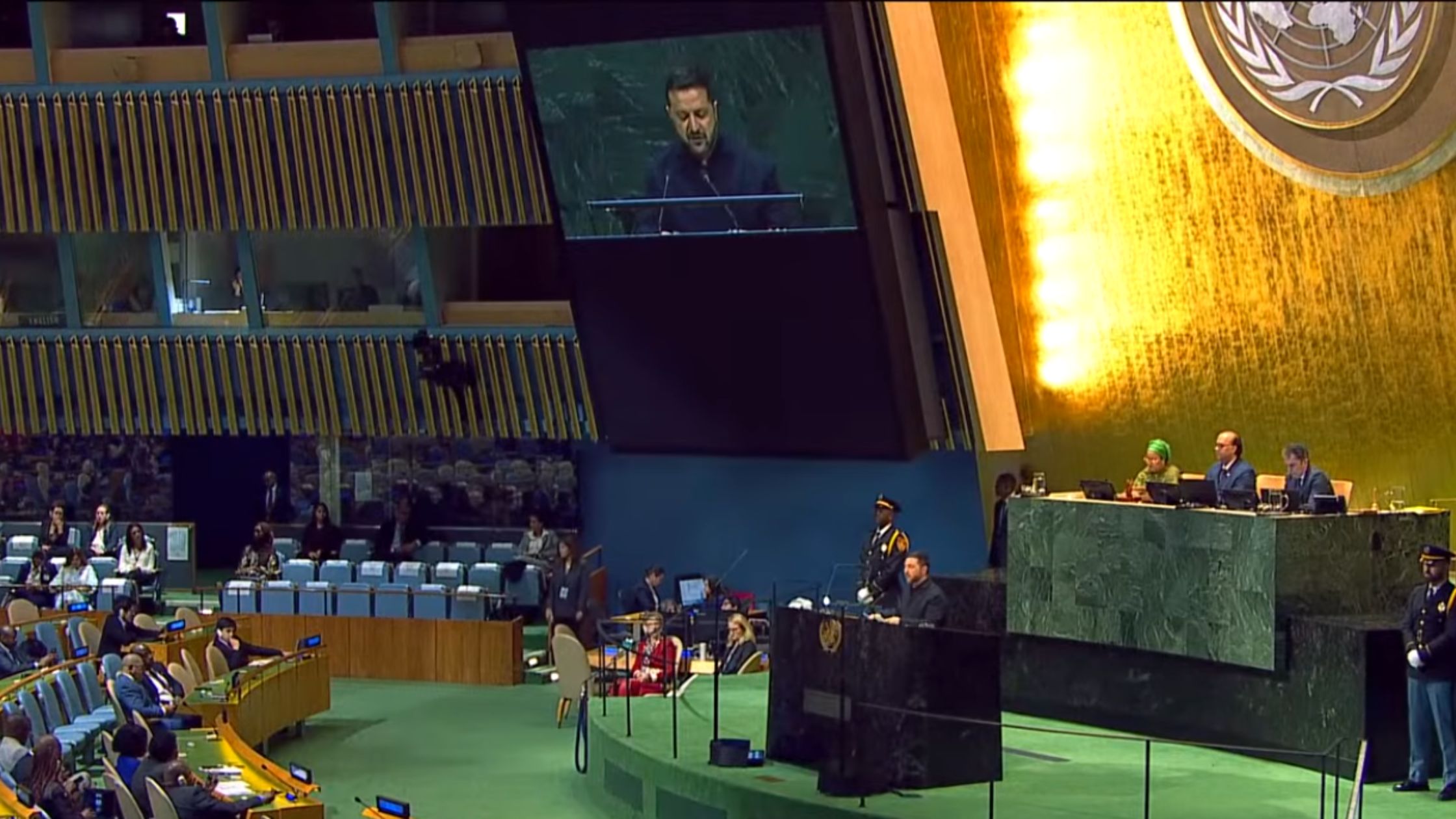
Ahmed al-Sharaa (00:00):
... and is usurped. When sanctity is violated, people suffer and people pay the price. Falsehood forces people to confront evil. Many wars were waged over history. Unfortunately, our region has seen many of these wars. Sometimes the truth prevails, sometimes the truth does not. Not all peace is just. Wars has taught us that injustice does not continue forever.
(00:47)
Your Excellency, Khalilur Rahman, President of the General Assembly, Your Excellency, Antonio Guterres, Secretary-General of the United Nations, Your Majesties, Your Highnesses, Your Excellencies. May the peace, mercy, and blessings of God be upon you.
(00:58)
A year ago, I stood before you representing my people. For the first time in 60 years, I recalled the victory of our people and stressed that this is a victory for the world as a whole. Today, I convey to you the facts, the achievements, to go through the breakthrough we have achieved.
(01:19)
Last year, I mentioned that Syria came back. Today, I say that Syria is rising. Ladies and gentlemen, in our journey, in the struggle between good and evil, the bloodshed was stopped, destruction was stopped. Syria started the journey of reconstruction, of recovery.
(01:42)
The country was united. We controlled arms. We rebuilt military and civilian institutions. Sanctions were lifted. Projects for reconstructions have continued. We've combated drug trafficking and we focused on transitional justice. We have ascertained the fate of the missing. We turned our vision into practical action.
(02:07)
We have forged partnerships, and we focused mainly on the future and on the welfare of our people. We focused on reconstruction. We relied on the free will of our people and our independence. This national vision relied on diplomatic efforts. Since liberation, more than 100 states started communicating with us through 4,000 communications.
(02:37)
Our capital has hosted more than 60 diplomatic missions. Syria has restored its status in the international community. It has been a transit for the world. We also built diplomatic bridges, and in parallel, we proved to the world that the security of the region has to start in Damascus.
(03:09)
With seven states, we started a group, the Breath of Freedom, to destroy the chemical weapons file. We have been working with the OPCW, and we are working with the IAEA with transparency, as we believe that collective security is our duty. The strict implementation of our treaties spares our world the horrors of chemical weapons and nuclear weapons.
(03:40)
We combated transnational crime. We have seized large amounts of Captagon and we combated the smuggling in people and organized crime. Stability and security has been established. We are no longer isolated. The Caesar Act was repealed. Also, sanctions were lifted and culminated in cooperation with the European Union. Also, we are no longer part of the list of states of sponsors of terrorism.
(04:25)
We have started production. We have more than 5,000 production line. We have seen an increase in agriculture production to ensure self-sufficiency. We also enhanced the service sector. The housing sector have been focused on. 3.5 million refugees and IDPs, have returned in a safe and decent way. Syria turned from a crisis to an opportunity.
(04:59)
For many countries, we believe in human resources. Any development planning for the region that ignores Syria would be flawed and the price would be heavy. Ladies and gentlemen, these initiatives focus on the recovery of citizens in Syria. This is why we focused on safe and dignified return.
(05:33)
We launched the initiative, Syria Without Refugee Camps, to end this area. We have reconstructed universities and schools to maintain educational services to all Syrian citizens, and we have consolidated our values. We have consolidated the rule of law. Any attempts that violate our sovereignty, violate international law will be stopped.
(06:03)
Golan will remain Syrian territories. Any other attempts will be thwarted, according to Security Council Resolution 497. I thank all of those who abided by the international law, and I thank those who refrain from me interpreting Resolution 497. This resolution is clear, and I ask our partners to abide by international law and by this resolution.
(06:35)
The world is joyed about our return, but Israel is launching attacks against Syria. There have been 500 air strikes, more than 1,200 incursions, and 300 detentions. This is at odds with the orientation we're seeing at the global level. It is reminiscent of a era that we though it was long gone.
(07:06)
We are committed to the 1974 agreement. We call for the withdrawal of Israeli forces to the lines of the 8th of December 2024, for we reject Israeli attempts to impose a fait accompli. We reject their aggressions, which undermines peace and security. The opportunity for peace and security is available to those who wish to live in peace, and a just peace that maintains the rights of all.
(07:31)
In conclusion, the war has taught us that truth is strong and that falsehood is weak. Syria will continue its reconstruction, will continue to restore its dignity. From this rostrum, I recited the verse in the Qur'an, "Truth has come and falsehood has vanished." Indeed, falsehood is bound to vanish. We will continue to serve our people. We will work to serve God. God will always reward you for your actions.
(08:04)
We have generated momentum with those who supported us. We appreciate all countries that raised their flags in Damascus. We thank the international organizations that believed in partnership with us, that worked with us. We came to you at the 80th session to announce that we are back, and at the 81st session, we came to you to provide our achievements.
(08:29)
And at the 82nd session, we'll come together again to gain the fruit of strategic partnerships, partnerships that made Syria an international actor that builds prosperity, a model to lead stability, a vital part that is open to a bright future. May the peace, mercy, and blessings of God be upon you.
Khalilur Rahman (08:56):
On behalf of the Assembly, I wish to thank the President of the Syrian Arab Republic. The Assembly will now hear an address by His Excellency, Edgars Rinkēvičs, President of the Republic of Latvia. I request protocol to escort His Excellency and invite him to address the Assembly.
Edgars Rinkēvičs (09:37):
Mr. President, Excellencies, distinguished delegates, allow me to begin by congratulating you, Dr. Rahman, on your election as President of the General Assembly. You can count on Latvia's support. I am looking forward to working together for a stronger United Nations and a safer world.
(10:06)
Excellencies, for the past year, we have heard it again and again: the world order is breaking down. The rules-based order that brought stability is undergrowing strain. Something new is taking shape. What comes next is not certain, but one thing is certain. The world has changed. International trade, mobility, technology, what happens far away is no longer far away. Instability travels, conflicts cross borders. What happens in Ukraine does not stay in Ukraine. What happens in the Middle East, in the Red Sea, in Sudan does not stay there.
(11:09)
The same is true of other global threats. Technology has made distance matter even less. Artificial intelligence offers enormous opportunities, but in the wrong hands, it can also become a powerful tool for deception, disruption, and conflict. And nature respects no borders either. Heat waves do not stop by checkpoints. Rising seas threaten to raise island nations. That threat means that those island nations may disappear from the face of the earth.
(11:54)
And far from the ocean, the danger is just as real. In the mountains, a river can turn into a deadly flood. It may happen in seconds. These floods sweep away homes, roads, and lives. We just witnessed catastrophic flood wave in Nepal, where also 33 Latvian citizens disappeared. Global climate change does not have borders or citizenship. Different threats, the same lesson. None of us can face them alone. We are in the same boat.
(12:38)
Perhaps Noah's Ark is no longer just a biblical story, different nations, different realities, but increasingly a shared faith. And when we share the same boat, we need something that holds us together, and we already have it: the United Nations Charter and its principles. Sovereignty, territorial integrity, the peaceful settlement of disputes, respect for human rights, the rejection of aggression.
(13:16)
These principles were not written for an easy world, quite the opposite. They emerged from the devastation of a war and from the determination not to repeat it. International peace and security. These words are at heart of the Charter. They appear 32 times, and that is no coincidence. Peace was its purpose then. Peace remains our responsibility today and peace will be relevant tomorrow.
(13:56)
Ladies and gentlemen, for Latvia, these principles are written into our history. Latvia and its people know what it means to lose sovereignty, what it means to lose freedom. For 50 years, our independence was denied, but Latvia's right to sovereignty endured. We restored our independence. We restored it through the courage and determination of our people, and we did not stand alone. We had friends who never accepted Soviet occupation as legitimate. That history stays with us.
(14:39)
Sovereignty and territorial integrity are the foundation of our freedom and our security, and the same is true for every country represented in this hall. When one state believes it can withdraw the borders of another by force, every border on every continent becomes negotiable. These principles now are being tested in Ukraine. Russia's war against Ukraine strikes at the very heart of the United Nations Charter. Borders changed by force, territory seized by force, children taken by force, Ukrainian civilians targeted by Russia, schools, hospitals, homes, markets, energy infrastructure.
(15:36)
Russia's attacks reach far beyond the battlefield. They are directed against the people of Ukraine and their foundations of daily lives. Drones are used to hunt civilians. Human lives are treated like targets in a safari. These are not policy disagreements. These are grave violations of international law. And where crimes are committed, there must be accountability. Let us not look away.
(16:15)
Russia is a permanent member of Security Council. With that comes a special responsibility for international peace and security. Instead, Russia is violating the very principles it is entrusted to uphold. Russia started this brutal war. Russia can end it. It can stop its attacks. It can withdraw its forces. It can leave Ukraine's sovereign territory. Latvia continues to call for an immediate and full ceasefire. Ukraine deserves just peace. Members of the United Nations, not every attack on the international order looks like war. Drones carrying explosives at airports, drones crashing into homes, airspace violated, critical infrastructure damaged, power stations suddenly in flames, cyber attacks. We sometimes call them hybrid threats, but it sounds as innocent as hybrid cars. In reality, those threats to international peace and security are as dangerous as conventional wars.
(17:42)
Guarding the eastern border of NATO and the European Union, Latvia faces these threats every day. Illegal migrants are deliberately exploited and pushed towards our border with Belarus. Cyber attacks target our critical networks. Acts of sabotage seek to create fear and instability in our societies. Russia's shadow fleet exploits legal gray zones and puts our security and environment at risk. Even in this very building at the Security Council table, we have heard Russia spread blatant lies and make threats against Latvia and other free and democratic countries.
(18:38)
Distinguished delegates, that brings us back to fundamental question. What is the United Nations' role if its members are threatened and if its principles are violated? The United Nations cannot take its relevance for granted. It must earn it day by day. Not through the number of meetings we hold, not through the number of resolutions we adopt, but through real and tangible results. The United Nations must prove that it can still make a difference when it matters most. That requires institutions that work.
(19:27)
Latvia supports the Secretary-General's UN80 Initiative. Reform is not about weakening the United Nations. It is about making it stronger, more focused, and better able to deliver on its mandate. That must include also the Security Council. Its composition must better reflect the world of today, not the world of 1945. Latvia supports an expanded and more representative Security Council.
(20:04)
Excellencies, reform is also about leadership. This year, we will select the next Secretary-General. The choice matters. The next Secretary-General must defend the Charter with conviction. He must, or she must, uphold international law. That is what true leadership means. To speak up for the weak against the powerful, that what true leadership means.
(20:39)
Dear colleagues, Latvia now serves as an elected member of the Security Council, and we will hold our presidency in November. Latvia came to the Council with a simple promise: to stand up for international order, to speak clearly when it is violated, and to make the voices of smaller nations heard. That reflects who Latvia is and that reflects what Latvia believes in.
(21:10)
At the core are your people. That is why Latvia will continue to do everything possible to help return Ukrainian children deported to Russia. Those children have been taken from their families, their communities, and their country. We know such stories from the darkest charters of history. Today, those things are happening again.
(21:43)
We support every genuine effort to secure the return of Ukrainian children. We are very grateful to the First Lady of the United States, Melania Trump, and her efforts to help bring those children home. These children need to come home now. The most vulnerable must be protected, and this includes conflict-related sexual violence. Survivors need justice. They don't need silence. These priorities underpin Latvia's bid for a seat on the Human Rights Council at 2028 elections.
(22:26)
Mr. President, Excellencies, we need a place where every state, large or small, has a voice, where threats to peace can be confronted together, where disputes can be resolved through dialogue, not force, where international law protects the strong and the weak alike. That was the promise of the United Nations 81 year ago. It remains our responsibility today.
(23:06)
It is not a Christmas wish for this year. We must stand by our principles always. The world has changed, the threats have changed, but our fundamental purpose has not. And the fundamental purpose is to maintain international peace and security. That purpose is worth defending, and this organization is worth reforming so that this organization can deliver. Let us make the United Nations work for peace, for security, and for all of us. Thank you very much.
Khalilur Rahman (23:55):
On behalf of the assembly, I wish to thank the President of the Republic of Latvia. The Assembly will now hear an address by His Excellency, Nicușor Daniel Dan, President of Romania. I request protocol to escort His Excellency and invite him to address the assembly.
Nicușor Daniel Dan (24:32):
Mr. President, Mr. Secretary [inaudible 00:24:44] pleasure to do so here in the United States, a country with which Romania share a long history of friendship. A nation towards which Romanians look with respect and gratitude, including for its essential contribution to the fall of the Iron Curtain and the opening of my country's path towards democracy and freedom.
(25:20)
We are at the United Nations, and I will speak about relation between nations, but let me first draw your attention to a threat to our democracies that I do not believe it's receiving the interest it deserves: manipulation via social media.
(25:42)
The fundamental principle of democracy is one person, one voice, one vote. But if thousands of fake accounts speak in a coordinating manner, the individual voice is no longer heard and freedom of speech is denied. And if thousands of fake accounts launch a coordinated attack on the ideas expressed by an individual, they discourage others from joining that person's cause, and freedom of association is denied. I will [inaudible 00:26:30]. [foreign language 00:26:38]. The same principles that underpin under national law, human rights, the rule of law, and democratic governance, are the principles that helped transform my country. Romania's evolution over the past 37 years proves the crucial importance of upholding these principles.
(27:06)
But millions of Romanians known from their personal experience the difference between a communist system that oppressed them and stifled their initiative and freedom of choice, and a democracy that rewards work, innovation, and personal responsibility.
(27:28)
This choice has turned Romania into one of Europe's most dynamic destinations in Europe for investment and industrial development. Romania has aligned itself with the standards of the OECD. Leading global companies have established manufacturing, engineering, technology, and service centers in my country, attracted by our conducive business environment and highly skilled workforce.
(27:58)
Our most important strategic asset is our people. Romanian scientists, engineers, physicians, and technology specialists are shaping the industries of the future: artificial intelligence, cybersecurity, defense technologies, advanced manufacturing and robotics.
(28:22)
Moreover, Romania is strengthening Europe's resilience. We are developing significant reserves of natural gas, critical minerals, and other strategic resources essential for securing supply chains and reducing dependence on unpredictable energy sources. Next year, we will begin extracting, exploiting 100 billion cubic meters of natural gas in the Black Sea.
(28:53)
Romania is a gateway between Europe and the rest of the world, located at the intersection of the Danube, the Black Sea, and major trade corridors. My country serves as strategic hub for trade, energy, and transport. Economic growth is all the stronger when it is based on partnership. Our message is simple: Romania is open to business and innovation. We are a credible and reliable partner ready to contribute to shared prosperity.
(29:35)
Ladies and gentlemen, we have entered the fifth year of the illegal, unprovoked, and unjustified full-scale war of aggression against Ukraine waged by a permanent member of the Security Council. This member, entrusted by the entire UN community with the responsibility of maintaining international peace and security, has deliberately disavowed its fundamental obligation and is pursuing a revisionist agenda.
(30:14)
As the EU member states sharing the longest border with Ukraine, Romania has felt the effects of this war directly through repeated violations of our airspace. A few months back, a drone crashed onto a residential building on our territory, injuring people and causing material damage. It was one episode in an ongoing series of such incidents. We have said it before and we will say it again: Romania will stand with Ukraine and its people as they exercise their legitimate right to self-defense for as long as necessary.
(30:58)
Moreover, Romania is acting responsibly to stabilize the region. We provided assistance to refugees from Ukraine. In response to Russia's attacks on ports and grain infrastructure, which disrupted global food supply chains and deepened food insecurity for millions of people, Romania has coordinated with Ukraine on the transit of grain through Romania by rail and by waterway.
(31:33)
In response to the disruption of freedom of navigation in the Black Sea, together with Bulgaria and Türkiye, Romania is part of the Mine Countermeasures Task Group in the Black Sea. Through mine detection and mine neutralization missions, and the protection of critical undersea infrastructure, this initiative safeguards freedom of navigation and the region's energy security. And in order to enhance security in the Black Sea area, Romania places particular emphasis on the EU's strategic approach. Accordingly, together with Bulgaria, we are establishing a maritime security hub aimed at strengthening situational awareness.
(32:22)
Finally, in response to these disruptions to energy [inaudible 00:32:26] freedom of navigation and the region's energy security. And in order to enhance security in the Black Sea area, Romania places particular emphasis on the EU's strategic approach. Accordingly, together with Bulgaria, we are establishing a maritime security hub aimed at strengthening situational awareness.
(32:53)
Finally, in response to disruptions to energy suppliers in the region, Romania has expanded its energy interconnections with Ukraine and the Republic of Moldova. Romania will continue to support the resilience of our neighbor, the Republic of Moldova, the second most affected country by this war. It is facing the economic shock caused by Russia's aggression and a sustained hybrid campaign consisting of disseminating this information, energy pressure, and attempts to destabilize its democratic institutions.
(33:36)
Romania is a staunch supporter of the Republic of Moldova in the face of these challenges. Romania also remains the Republic of Moldova's strongest advocate within the European Union, sharing our own experience of accession and providing political, technical, and diplomatic support for its European path. The threat posed by the Russian Federation is not only limited...
Interpreter (34:00):
The threat posed by the Russian Federation is not only limited to Ukraine. Europe is the target of a hybrid war involving cyber attacks. Disinformation campaigns sabotage and disruptions to critical infrastructure with the aim of undermining citizens' trust in democratic institutions and discouraging support for Ukraine. We must deter the Russian threat, and unfortunately we can only do that by increasing military spending. Romania supports balancing military expenditure and the target of 5% of GDP, reaching this year 3.7%. Distinguished audience, we are equally concerned about the proliferation of conflicts worldwide.
(34:59)
It is essential to advance the implementation of the peace plan for Gaza in accordance with Security Council Resolution 2803 and to address with no delay the humanitarian situation on the ground. Within the Board of Peace Initiative, Romania has offered its support and has so far contributed to the medical evacuation of numerous patients, especially children. Disarming Hamas remains a prerequisite condition for lasting stability in Gaza. President Trump's peace plan represents the most credible path towards peace and prosperity in the region, and Romania supports its full implementation.
(35:43)
At the same time, recent developments in the West Bank are a genuine reason for concern and risk undermining the peace that this plan seeks to promote. Regarding Iran, our position is clear. Iran must not possess a nuclear weapon. Iran must comply with the nuclear non-proliferation treaty, the safeguards of the International Atomic Energy Agency, and restore full transparency regarding its nuclear program. Diplomacy must be the first option towards a comprehensive, verifiable and lasting agreement that would pave the way towards a more stable Middle East.
(36:29)
Romania will continue to promote maritime security and unrestricted freedom of navigation in the Strait of Hormuz, as well as in the Black Sea area and elsewhere. It is a shared responsibility and a priority to my country. Specialized bodies such as the International Maritime Organization can make a contribution to this effort. The suspension of the Black Sea Grain Initiative following Russia's unilateral withdrawal in 2023 reminds us that agreements only matter when the parties honor their commitments.
Speaker 1 (37:07):
[foreign language 00:37:13]
Interpreter (37:16):
Lasting peace in South Sudan, the Democratic Republic of the Congo, Somalia, Libya, in the Sahel, and in all regions of Africa affected by conflict. Romania is contributing to conflict prevention, mediation, peace building, and economic recovery while stressing the importance of African solutions and in full respect of the charter. Prevention and mediation must play a greater role. Peacekeeping operations must have a clear mandate, produce measurable results, ensure responsible financing and equitably distribute responsibilities.
(38:06)
Since 1991, Romania has contributed to United Nations peacekeeping missions through political support, troop and equipment contributions, as well as through training blue helmets and close protection officers. Romania also attaches great importance to the role of the International Organization of La Francophonie in promoting peace and security. With the majority of its 90 members located in Africa, the OIF supports mediation, electoral monitoring and peace building in fragile context. Romania presented a candidate for the post of the secretary general of the OIF, a former prime minister and a prominent experience figure in international affairs.
(39:08)
This candidature reflects Romania's will to put its experience to the service of La Francophonie, making it more strong and more efficient. We count on your support. Ladies and gentlemen, allow me to conclude by welcoming the initiatives of the first ladies and first gentlemen concerning children and education, innovation, digital education and children's safety. Romania has joined the initiatives launched by Melania Trump, Emine Erdogan and Olena Zelenska. By building accessible education and creating a more innovative and safer environment for our children, we are building a better future for our societies. Thank you.
Speaker 2 (40:06):
On behalf of the assembly, I wish to thank the president of Romania. The assembly will hear and address by his excellency, Évariste Ndayishimiye, president of the Republic of Burundi. I request protocol to escort his excellency and invite him to address the assembly.
Évariste Ndayishimiye (40:36):
[foreign language 00:40:51]
Interpreter (40:54):
In the name of God, the all powerful, most merciful, distinguished president of the General Assembly, Mr. Secretary General, excellencies, heads of state and government. Ladies and gentlemen, as president of the Republic of Burundi and the current chairperson of the African Union, allow me to first on behalf of the people of Burundi and of Africa and congratulate his excellency, Dr. Khalilur Rahman, president of the General Assembly of the United Nations on his election and wish him every success in the fulfillment of his mandate.
(41:46)
I would like to take this opportunity to extend my warmest congratulations and express my deepest gratitude to his excellency, Mr. António Guterres, Secretary General of the United Nations, for the unwavering commitment and dedication he has demonstrated throughout his tenure in the service of peace, security, and sustainable development around the world. His good offices exercised with wisdom, humility and determination have helped bridge the widest divergences of opinion and provided invaluable support to nations, particularly those in the global south in their quest for stability and prosperity.
(42:40)
Burundi, which has always been able to count on the United Nations generous support, wishes to commend his leadership and his unwavering commitment to the principles of multilateralism. As he prepares to turn this important page of his life, I wish him on my own behalf and on behalf of the entire Burundian people, every success in his new endeavors, as well as good health and a future filled with serenity and prosperity. Excellencies, ladies and gentlemen.
(43:26)
The theme of this 81st session, Restoring trust, managing transformation: a United Nations that delivers for all, comes at a time when our world faces multiple crises, aggression against states, internal armed conflict fueled from outside, and expansionist conflicts that are breeding mistrust among states and rendering the international community unable to resolve these crises through peaceful means. In this context, a fundamental question arises. How can we restore trust in multilateralism and ensure that international institutions truly meet the expectations of all peoples? Our answer is clear.
(44:28)
We must strengthen multilateralism, reform global governance, and place human dignity at the heart of our collective action. Excellency is peace first. Peace is the source of all good, peace in our hearts, peace in our societies, peace in our countries. Let us begin by restoring peace within our own community. Let us consolidate peace in our respective countries. Let us rebuild trust among our peoples and restore the image of humanity in our midst. This year when Burundi holds the rotating chairmanship of the African Union, we are keenly aware of the responsibility that falls to us.
(45:23)
As the African Union champion for the Youth Peace and Security Agenda, I have this year once again convened a continental youth dialogue coupled with the Women Peace and Security Agenda. During this dialogue, I sense the enthusiasm of young people and women to build a community with a shared future in the spirit of Ubuntu. In these young people, I sense the desire to connect with one another and to live together side by side, but unfortunately, there are still states that prevent their citizens from living together with other peoples as brothers and sisters. They cultivate and perpetuate xenophobia and intolerance.
(46:17)
They sow division by failing to implement preventive and corrective measures by highlighting disparities in development, labeling some as rich and others as poor, and thereby creating a divide among peoples based on wealth and material possessions. And on that basis, they have come to regard themselves as saints while reproaching others for being inferior. How then can we build trust among nations without first starting with building connection and cohesion among our peoples? We, the leaders, must rekindle the spirit of Ubuntu within ourselves, the Ubuntu with which God created us. Indeed, God did not create a man who was selfish.
(47:15)
He created a man of Ubuntu, the Ubuntu that I see in you and that you'll find in me. Ubuntu is the common denominator that must restore trust among all human beings. Excellency is as an African and a voice for Africa at this time and I hold the rotating chairmanship of the African Union. I must also state the following. We are here to convey a conviction. Africa must be listened to more. It must be better represented and more closely involved in the decisions that shape the future of our planet. This is what must build trust between Africa and other continents as well as with international institutions.
(48:07)
We no longer wish to see the Human Rights Council become a forum for oppressing countries that are deliberately singled out because they defend and fight for the interests of their peoples. We want to see this council working for justice and equity for all states without distinction. International human rights law must apply without exception to all states of the world, both in its corrective function as well as in its regulatory function. The Human Rights Council cannot be instrumentalized by other countries to the detriment of others given that all member states of the United Nations enjoy a status of sovereign equality.
(49:04)
Burundi wishes to reiterate once again its opposition to the imposition of a special rapporteur in the situation of human rights in Burundi, who was appointed without any prior dialogue or consultation. Burundi is a responsible country that respects human rights. It has fought impunity for decades. It upholds the rights and freedoms of all and ensures security as well as the guarantee that crimes it has experienced in the past will not be repeated. Mr. President, Africa intends to be a full-fledged actor and not a mere observer called upon to applaud decisions in whose preparation it played no part. Africa is not seeking any privileges. It is demanding justice, equity and representation.
(50:12)
We therefore strongly reaffirm the need for reform of the United Nations Security Council in order to allow for permanent African representation and more equitable participation by the continent in the international community's decision-making mechanisms. In this regard, Burundi believes that discussions on reform must also address the financial viability of the United Nations system by strengthening the predictability, transparency and sustainability of its financing. It would not be coherent to entrust the organization with ever greater responsibilities without guaranteeing it the resources necessary for their implementation.
(51:07)
We therefore call on member states, particularly the wealthiest to demonstrate responsibility and solidarity in order to preserve the organization's financial stability. President, excellencies, ladies and gentlemen. As part of this process of reform, strengthening and consolidation of our organization, Burundi also wishes to contribute to the debate on the selection process for the next Secretary General of the United Nations. In the current international context marked by deep geopolitical divisions and growing challenges to multilateralism, this process must be conducted in a spirit of transparency, openness and collective responsibility.
(51:59)
Burundi believes that this process must be based above all on qualifications, experience, integrity, independence of judgment, diplomatic skill, and the ability to bring together the positions of all member states. We need a true bridge builder, a leader capable of engaging in dialogue with all parties of bringing positions closer together even when divergences appear insurmountable, but also showing firmness, courage, and independence when it comes to defending the principles of the United Nations charter and ensuring that the collective interest prevails. Mr. President, excellencies, ladies and gentlemen, peace remains the primary condition for development.
(52:56)
The African Union is deeply concerned by the persistence of conflicts and crises that continue to cause massive population displacement, destroy infrastructure, and deprive millions of children of their right to education and to a better future. We are paying particular attention to the situation in the Great Lakes region in Sudan, in the Sahel and Somalia, and in all regions facing violence and instability. We reaffirm our commitment to seeking African solutions to African problems in accordance with international law and the United Nations charter. We therefore called for a strengthened partnership between the African Union and the United Nations in the prevention, mediation and peaceful settlement of conflicts.
(53:59)
Burundi, drawing on its experience, will continue to contribute to peace efforts on the continent, but we must go even further. As decided in Luanda at the 21st extraordinary session of the African Union Assembly of Heads of State and Government, Africa must not only learn to manage conflicts, it must strengthen its capacity to prevent them. We also call on the international community to lend greater support to African peace and security mechanisms, in particular through predictable and sustainable financing for African-led peace operations. Mr. President, excellencies, ladies and gentlemen. I would be remiss if I were to address this August Assembly without raising the issue of water. The African Union has designated 2026 as the year of assuring sustainable water availability and safe sanitation systems to achieve the goals of agenda 2063. This choice is particularly significant because water is life, water is health, water is food security, water is energy, and water is also in certain regions a matter of peace and stability. We therefore call for stronger international mobilization in favor of universal access to safe drinking water and sanitation, particularly in rural areas and in the most vulnerable communities. We invite our partners to view water not merely as a natural resource, but as strategic investment in peace, health and sustainable development.
(56:02)
Excellencies with regard to socioeconomic development, achieving the sustainable development goals and those of agenda 2063 requires financial means that are commensurate with our ambitions, yet many developing countries face considerable budgetary constraints, high financing costs, and a heavy debt burden. We therefore call for a reform of the international financial architecture to make it more equitable, more inclusive, and better adapted to the realities of developing countries. Such a reform must, in particular, provide access to predictable, affordable, sustainable financing, which is essential for accelerating the implementation of the SDGs and agenda 2063. We must also empower Africa to play a more active role. Africa with its 55 states of more than 1,400 million inhabitants cannot remain on the margins of the bodies that shape the roles of global trade. On behalf of the African Union, I reiterate our continent's call for full and equitable representation within the World Trade Organization. This is not a favor we are seeking. It is a demand for justice. It is also a guarantee of progress for the entire multilateral trading system. With the African continental free trade area, our continent has already demonstrated its capacity to develop rules and to integrate markets. It is now up to global trade governance to draw on this.
(58:08)
But in order to succeed, we must be more resilient in order to preserve an environment favorable to agriculture, a source of life and food security. Indeed, Mr. President, climate change strikes the most vulnerable populations particularly hard. Africa has contributed little to historical greenhouse gas emissions, yet it is already suffering severe consequences. We therefore call for stronger international solidarity on adaptation, climate financing and technology transfer. Food security must become a strategic priority because no sustainable development is possible when millions of families lack sufficient and nutritious food.
(59:06)
In closing, I would like to raise the question of youth, the most precious asset on which the entire international community can and must rely. I speak today not only as a committed friend of young people, but also on the basis of a clear observation. Our intellectual youth has become the target of sustained, deliberate and organized pursuit by most of the wealthiest nations, even though our youth's first calling should be to serve their parents, their loved ones, and their homeland who have invested so much in their education. Many African states devote considerable resources to education, vocational training, entrepreneurship, science, digital technology, and innovation.
(01:00:06)
Yet, while our African nations such as Burundi make these major sacrifices to build their future, these young talents are prematurely lured away by actors who offer better material and financial conditions without having needed to make any prior investment in their training. Let us be clear, it is imperative to establish a fair partnership so that our countries receive a fair return on the investments made in the education of our youth. The other actions we must all take also include giving young people a real voice in decision-making, peace, and development processes. Youth should not be regarded solely as beneficiaries of public policy.
(01:01:10)
They must be integrated both upstream and downstream in the design and implementation of these policies. This is what would make it possible to create a secure future and restore hope to these young people. This emerged from the discussions at the fifth continental dialogue on youth, peace and security held in Bujumbura from August 10th to 12th, 2026, a dialogue that highlighted the link between water, peace, conflict prevention and inclusive leadership by young people and women. The discussions at this dialogue made it clear that there can be no lasting peace in Africa without the full effective and institutionalized participation of its youth.
(01:02:08)
For too long, we have spoken of youth as a generation called upon to take the reins tomorrow, but African youth is not only the future of our continent, it must also be its present. We therefore call for strengthening the continental youth peace and security agenda and providing it with resources commensurate with its ambitions. We have a duty to create more opportunities for young people to contribute to conflict prevention, mediation, reconciliation and peace building. As the current chairperson of the African Union and the champion of the Youth Peace and Security Agenda, I intend to continue championing this ambition. Finally, excellencies, ladies and gentlemen. Turning to Burundi, we are pleased to continue its economic and social transformation within the framework of its vision Burundi 2040-2060. We are determined to transform our agriculture, develop our infrastructure, improve access to energy and water, strengthen education and health, and promote a dynamic private sector. Our ambition is for Burundi to be an emerging country by 2040 and a developed country by 2060. We invite our partners to support this transformation, not only through multifaceted assistance, but also through investment, technology transfer, capacity building, and the development of mutually beneficial partnerships.
(01:03:57)
Vision 2040-2060 Has now become a central framework for national development planning. The African Union and the United Nations share a particular responsibility in building a more peaceful and more just world. We must strengthen our partnership in the areas of peace and security, sustainable development, health, climate, youth, and global governance. The AU/UN partnership must be founded on mutual respect, complementarity, and greater African ownership of solutions to the continent's challenges. Africa wants to be a strategic partner and a full-fledged actor in multilateralism, not merely an area of intervention for the international community. As Burundi assumes the chairmanship of the African Union, it is choosing unity, solidarity, and action. We are choosing an Africa at peace, an Africa that is integrated, an Africa that feeds itself, and an Africa that transforms its resources. An Africa that empowers its youth to create and innovate, an Africa that is master of its own destiny. And we are choosing a renewed multilateralism in which every region, every people, and every nation counts. For Africa, we want a United Nations that is more representative, more effective, and closer to the peoples. We want an Africa that is better represented within global decision-making bodies.
(01:05:54)
We want a global partnership founded not on dependency, but on solidarity, shared responsibility, and investment in the future. On behalf of the people of Burundi, and in our capacity as the chairperson of the African Union, we call on all our partners. Let us make this period of transformation an opportunity to build a more just world, a stronger Africa, and a better future for generations to come. Burundi and the African Union express the hope that the high level debate of this 81st session of the United Nations General Assembly will mark a new beginning for a consolidated multilateralism, a United Nations in which every state and every region counts. Thank you.
Speaker 3 (01:06:52):
[foreign language 01:06:53]
Interpreter (01:06:52):
On behalf of the General Assembly, I wish to thank the president of the Republic of Burundi.
Speaker 3 (01:07:09):
[foreign language 01:07:22]
Interpreter (01:07:23):
The Assembly will hear an address by his excellency, Masoud Pezeshkian, president of the Islamic Republic of Iran. I request protocol to escort his excellency and invite him to address the assembly.
Masoud Pezeshkian, (01:07:40):
[foreign language 01:07:57]
Interpreter (01:07:57):
In the name of God, the most compassionate, the most merciful, Mr. President...
Masoud Pezeshkian (01:08:00):
The name of God, the most compassionate, the most merciful. Mr. President, Mr. Secretary General. Excellencies, ladies and gentlemen. I had prepared a speech to present to you yesterday. The United States president described us as terrorists. We have been the victims of terrorism. I come from an Iran in which our esteemed supreme leader was assassinated without any legal framework or reason. I come from an Iran where in truth, they bombed a school. You see these children? These children perished under bombs with weapons used by the United States and Israel. They were innocent, had committed no crimes.
(01:09:17)
Lamerd, one of the small cities in a province in Iran. A sports hall where children were busy playing. The United States, by using weapons with multiple warheads, targeted that sports hall. They martyred, assassinated our scientists, our men, women, and children. Innocent children whom in truth had committed no crimes, no sins. Those who are terrorists and train and protect terrorists describe us as such. We have only defended ourselves. We are not terrorists. Our innocent people have been the targets of cowardly attacks and aggressions imposed upon our country. And we defended ourselves with utmost strength. America and Israel attacked us, equipped with the latest technology and weapon systems, and our people stood steadfast. Yes, they did hit us, but we did not bend the knee. We did not bow our head. We responded, but we did not hit civilian populations. They came into surrounding territories and targeted our universities, our healthcare centers, our schools, our hospitals, our infrastructures, all of it against international law.
(01:10:58)
When I took over the responsibilities as president, they assassinated Ismail Haniyeh in Iran on the day of my inauguration. Israel targets any neighborhood in any city, in any province, commits assassinations like a true terrorist. In Gaza, over 80,000 innocent civilians have been murdered, brutally murdered. Hundreds of thousands have been displaced. They are committing genocide by using the so-called technologies that they have at their disposal. Then they label others as terrorists. Are we the sources of instability? We only seek to live independently. We are the ones who cause instability. Those who are committing terrorism and committing crimes, are they the protectors of peace and stability?
(01:11:53)
None of the international laws have been adhered to by them. This is what we're facing. We don't want anything. We have received our response. We need strength because a people which is unable to defend itself will be trampled upon in today's world. We live in a world in which the powerful, instead of thinking about humanity, justice, fairness, and democracy, they seem to be the protectors and creators of instability and destruction. Whomever they wish to discredit, they label them as terrorists. 200 years, for the past two centuries, Iran has not attacked any country or any territory, but we've always defended ourselves steadfastly. But now we're being accused of being source of instability in the region. We're labeled terrorists, and this has made it so that the path that we have chosen for ourselves requires power to defend ourselves. We do not seek power in order to attack or commit aggression.
(01:13:09)
We seek energy for progress, not to threaten societies with weapons. And we wish to cooperate and collaborate for security. The people of Iran, in the past seven months, our people have been in the streets every night demonstrating in support of their land, of their homeland, so as to not allow those who were equipped and trained and armed by Israel and America to cause disruption in the security of their country. For seven months, day and night, they've been present in the streets. They are our source of power and our support, and that's why we stand fast. Iran must be powerful so as to avoid being threatened, to avoid its future being threatened. We do not wish to use our power for hegemony and we do not seek our security and the insecurity of others.
(01:14:14)
Vis-a-vis Iran's defense, our defensive systems have been built so that no one can think that bombing of Iranian cities will go unanswered. That is why we have the military power we do for defense. But we say it clearly, in order to defend our country, we do not seek anyone's permission or approval. We seek energy for progress. For years, they have labeled centrifuges, international sanctions, other labels when it comes to our nuclear technology. But for our country, peaceful nuclear technology is part of our inherent progress. For our sick people, it's cure and treatment. For the agricultural sector, it's food security. For industries, advancement and progress and supply of electrical energy, Iran does not accept for nuclear technology to be at the exclusive disposal of some, of a handful.
(01:15:20)
We will not bow our head and give up the right that is inherently ours. We say it clearly, no nuclear weapons and no limitations to peaceful nuclear technology. Our peace will not come in the field of battle, but they must give the needed security to the people and nation of Iran. We seek cooperation in order to have security. We live in a region in which warfare knows no borders. Crisis in one land will spill into the surrounding nations. That's why Iran does not see her neighbors as security rivals. We want to have strong neighbors in waters in the Strait of Hormuz.
(01:16:25)
We cannot let some have free access and gain their interest from a waterway while at the same time using that waterway to impose their aggressions upon us, to impose insecurity upon us, to forbid us access to our own waterways. They close access for us to our own waterway, yet they keep supplying missiles and deadly military technologies to bring insecurity to all of the lands surrounding that waterway. We will not succumb to that. The expansion of warfare will not result in security. One cannot create chaos for the coastal countries seeking naval security. Excellencies vis-a-vis Palestine. Palestine remains an open wound on the conscience of the international community and Gaza remains a symbol of the failure of international mechanisms to prevent civilian suffering.
(01:17:37)
For decades, resolutions have been adopted, yet occupation and violence have continued. We cannot speak of peace while ignoring Palestine. Lasting peace in West Asia is impossible without justice for Palestine. As long as occupation, aggression and injustice persist in the world, resistance will continue. If it is weakened in one form, it will reemerge in others, perhaps stronger still.
(01:18:21)
Gaza, despite relentless killing and widespread devastation, has strengthened the people's faith in resistance and resistance cannot be destroyed by bombs and siege. This is human nature. If a human being is driven from his or her land, they will resist. If their homes are subjected to bombings and aggression and attacks, they will resist. What other choice do they have? Succumb to bullying to be driven from their homes, from their lands and remain silent in the face of these threats and dangers. And when they defend themselves, they're labeled as terrorists. The language makes it unfortunately clear the type of world that we're living in today. Our regional issues must be resolved in the region at the hands of the countries in the region without becoming a toy in the hands of outside aggressors. No relationship with the foreign power can become the tools of threatening neighboring countries in the region.
(01:19:39)
And now a few words with those who are responsible for having planned and carried out aggressions against our country. And our people have experienced firsthand the result of their deadly aggression and they have tested the strength and the steadfastness of Iran and they have learned that Iran cannot be made to surrender. Iran has never, ever been an aggressor, has never started a war and has always shown her commitment to the negotiating table. They imposed the war on us, but we have proven that we're not afraid of fighting of war, a war that is defensive in nature and we will stand in defense of our beloved Iran, our homeland until our last breath. Ladies and gentlemen, the topic of this gathering is mutual trust. That cannot be achieved through words only, but by abstaining from using double standards, atomic and nuclear bombs are in the hands of the Israeli regime, but the inspectors are requested to come to Iran.
(01:21:01)
Israel has murdered savagely over 70,000 innocents in Gaza, but Iran, while behind the table of negotiation, was bombed. Israel has the bombs, has weapons of mass destruction. Not a member of the non-proliferation treaty during her shameful life has not allowed a single inspection, but they are rewarded by all the means necessary for them to be able to bomb any capital in the region at will. I will repeat, the nuclear weapon is in Israel, but the inspectors in Iran. Israel kills, but Iran is subject to sanctions. This is a true tragedy which would make anyone hearing it laugh at best. They kill. We are sanctioned. We are punished. Those who are ill, innocent people, the poor, the least privileged in our society are the targets of these sanctions. And this is what the United States seeks to do with all countries to sacrifice the population of a country in order to achieve her illegitimate goals.
(01:22:16)
If we seek true peace and stability, we must apply a single standard for all. Iran does not seek special treatment. We seek equal rights. We assume the responsibility except the responsibility that comes with it, but Iran during her prideful history has learned the following lesson. A world without power is dangerous, but a world that only understands the language of war and bullyism will not be safe. When we seek to have agendas to implement that only adhere to the benefits of a few privileged, we will have a world in disarray, but we see that this will become a world much more dangerous for all of us. We must not allow the 21st century to go back to an era of only the powerful and the bullying powers and the hegemons. We must not build a world in which military power replaces legitimacy, terrorism, replaces politics and negotiations, and war replaces dialogue and diplomacy.
(01:23:38)
Iran extends her hand towards the world. We invite the world, we call the world, not out of weakness, but out of a deep belief in our own power and steadfastness to cooperate and collaborate because of a deep belief that no one in this region will have security alone. Either we will build it together or we will have to live under insecurity together. We seek to think about a worthy future in which security, fairness, justice, human dignity will become unalienable rights for all people, for all humans, a future in which no people are driven to the sidelines. No voice is lost in the chaos of power and no power will have the right to determine the future of a people other than those people themselves. If we truly seek to have an order based on international law and standards, it must be based in justice, common human will, uplifting human dignity because a peace that does not encompass all is no peace and fairness and justice that does not embrace all is not worthy of being called justice and fairness.
(01:25:05)
But going back to the words of the president of the United States yesterday shows those who are experts in international law and dialogue and diplomacy and basic human standards that everything uttered about our country goes against the very essence and charter and the spirit of the United Nations. He must know that the resistance of the Iranian people will only increase in the face of sanctions, increased pressure, increased bullying. We will never bow our head or bend at the knee.
(01:25:46)
Iran must be understood by Mr. Trump and those who seek to bully us that we are ready for dialogue and diplomacy and negotiations without accepting the language of force. I truly appreciate your time and presence here. May God bless you all.
Marcelo Scappini (01:26:08):
On behalf of the assembly, I wish to thank the president of the Islamic Republic of Iran. The assembly will now hear and address by his excellency, Santiago Peña Palacios, president of the Republic of Paraguay. I request protocol to escort his excellency and invite him to address the assembly.
Santiago Peña Palacios (01:26:48):
President of the General Assembly, Marcelo Scappini, my dear Paraguayan compatriot, distinguished ministers, distinguished ladies and gentlemen. The slogan for this assembly challenges us to restore trust, manage transformation, and ensure that the United Nations delivers for all. It's a good slogan. It's one that I wholeheartedly endorse. But let's be frank, dear friends, people don't want slogans anymore. Our people want solutions to their problems. That is why I have not come to this rostrum to recite beautiful phrases full of grandiose words that do nothing to improve the lives of our citizens. I've come to speak about concrete problems and to suggest solutions. I've come to speak on behalf of a country that rose from the most devastating war in the Western Hemisphere, the War of the Triple Alliance, which brought mourning to no fewer than four sister nations. One of those, the country that I represent, is one of the fastest growing countries in the world nowadays.
(01:28:09)
Paraguay's contribution is not merely theoretical, it is based on experience. Facts have taught us that war is abhorrent, that peace is the only objective to pursue, and that we must stop watching from the sidelines, stop talking and start acting. Paraguay comes before the community of nations with one non-negotiable conviction. The dignity of the human person must be at the heart of every decision. For this reason, we defend freedom, democracy, the sovereignty of states, respect for human rights, and the peaceful settlement of disputes.
(01:28:51)
For this reason, we uphold human life from conception and we recognize the family as the fundamental unit of our society because when human dignity is forgotten, humanity itself disappears. Human dignity from conception until the end of life is the foundation of our presence on this earth. There is an increasingly visible gap between the commitments we make and the results we achieve. And as that gap widens, trust erodes, people no longer believe us and that trust will not be restored through mere statements or beautiful slogans. It will be restored by confronting problems without fear, proposing solutions and delivering results.
(01:29:50)
The first issue that I wish to address here is one that is in my own neighborhood in Latin America. Everyone's aware of it. Its name is Venezuela. Before coming to New York, I visited Caracas despite the fact that the diplomatic relations between Paraguay and Venezuela have been suspended. My decision to visit the Caribbean country therefore surprised many and many people have questioned sometimes harshly my decision. I therefore like to use this forum to say it loudly and clearly. I didn't go to Venezuela to legitimize a regime. I did not go there to legitimize or validate absolute anything whatsoever. No, ladies and gentlemen, quite the opposite. Paraguay cherishes democracy and we believe that the Venezuelan people also deserve democracy. The reason I went to Venezuela is because for 25 years, South American leaders have issued fine lyrical rhetoric, resounding statements and countless slogans on Venezuela. For 25 years, we watched, we waited, and we condemned from the comfort of this distance without doing anything for the Venezuelan people.
(01:31:16)
We watched, we talked, but we didn't act. We did nothing. In the meantime, our Venezuelan brothers and sisters suffered. That is why I went to Venezuela a few days ago to take a second step following the first difficult but extremely important step that was represented by the fall of the dictator Maduro, because Paraguay can play a useful role in the second step, Venezuela's transition towards a pluralistic democracy.
(01:31:51)
Venezuela is now facing a new reality. Defending our values cannot mean standing indifferent to that reality. That is why Paraguay has opened a channel of dialogue with the Venezuelan authorities and is already taking action towards a Venezuela in which power resides with its one true sovereign, the Venezuelan people. Dialogue doesn't mean abandoning our principles or forgetting the past. It means having the courage to look ahead and to act. We cannot wait for the United States or some northern power to resolve our problems. We have to resolve them ourselves. Venezuela, what I want is what my own country achieved after 35 years of dictatorship in 1989, a real lasting democratic transition. I don't want a photo opportunity. I don't want to communicate. I want, we want a transition with institutions, with security, with an economy and with a people that are once again integrated into the international community and in our region integrated into MERCOSUR.
(01:33:13)
Paraguayan leadership doesn't confuse dialogue with indifference. Dialogue talking is one way of standing with the Venezuelan people. It's also a way of jointly combating transnational crime, which knows no borders and which harms our entire region. Today I call on all my Latin American brothers and sisters, but also on these United Nations. Let us come together to help Venezuela, this beautiful country to reintegrate into the world and achieve a democratic government that respects human rights.
(01:33:52)
To borrow the words of the Latin poet Publius, "I am human: nothing human is alien to me." The suffering of the Venezuelan people is also the suffering of the Paraguayan people. It is the suffering of us all. And what applies to Venezuela applies perhaps even more so to Nicaragua, Cuba and Haiti, countries that have lived for far too long in the darkness of authoritarianism, violence and sorrow. Let us bring light to these sister nations for where there are free elections, there is hope. But we mustn't stop at words. We must act. Let us do so. Let us do so together.
(01:34:43)
Of course, problems are not confined to my region. There are problems all around the world. Paraguay is noting with deep concern what is happening in the Persian Gulf when the Strait of Hormuz is closed. It is not the great powers or the wealthiest who pay the price. It is the least protected who pay the price, the most vulnerable among our citizens. The food and energy security of millions of people depends on keeping that passage open. Therefore, today I make an urgent appeal for the immediate cessation of attacks, for the full reopening of and freedom of navigation through the Straits of Hormuz and Bab el-Mandeb and a return to negotiations. Human dignity, dear friends, does not change when we move from one continent to another. It is always the same, and it is that human dignity that must guide not only our words, but also our actions.
(01:35:49)
Hormuz is the problem we face today, but I wish to tell you here that tomorrow's problem could be far worse, infinitely worse. I'm referring to the ominous clouds gathering over the Indo-Pacific, particularly over the Taiwan Strait. What happens there is not merely a regional matter. No, ladies and gentlemen, it affects Japan, the whole of East and Southeast Asia, and above all, it affects the global economy. It affects the microchips that power industry defense and artificial intelligence. Anyone pretending that this is far off or too distant to matter simply has not understood the 21st century. If oil was the fuel of the 20th century, microchips are the fuel of the 21st.
(01:36:53)
Conflict could scarcely be higher. The very future of humanity is at stake, and I want to make one thing clear here. Paraguay is not neutral on this issue. Paraguay stands, and I say this loud and clear with Taiwan, not out of expediency, quite the opposite. We stand with Taiwan because of the profound values we share, democracy, the rule of law, human rights, and peace. 70 years of uninterrupted diplomatic relations are not merely a number or the product of a mere calculation. They are a testament to the real friendship between our peoples. That is why today I reaffirm our support for the full and meaningful participation of the Republic of China Taiwan in the United Nations and its specialized agencies. Taiwan has concrete contributions to make to peace, development and human rights. Excluding it, it doesn't serve to strengthen the system. It deprives the system of capacities that could benefit us all, and it is a stain on the United Nations.
(01:38:11)
But let's make no mistake. The problem is not Taiwan alone. What's happening there in that part of the world is simply too dangerous for us all. Dear friends, let us not stop at words or slogans. Let us move to concrete action. I assure you that at this negotiating table, at the table for peace and concord, Paraguay will be on the front row ready to help.
(01:38:41)
But the world's problems do not end in a single region or place. They go to the very heart of the international system. The United Nations, and I am neither the first or the last to say so, needs renewal. It needs fresh impetus. And the admirable theme of this assembly calls for a United Nations for all. An admirable theme, certainly, but I fear that it's not enough. So I ask you today, respectfully, but firmly, how can we have a United Nations for all when it is led by a security council of the few? Worse still, this is a council that was designed 80 years ago for another era, for another scenario, another entire set of circumstances, one that all too often demonstrates it is simply unable to address today's problems. That original design, a product of its time, has achieved much without any doubt. And today I recognize and celebrate those achievements.
(01:39:51)
We all should. Nonetheless, as the great noble laureate Bob Dylan would say, things have changed and the organization, dear friends, has to change too. Different problems need different solutions. Otherwise, this magnificent idea, the United Nations, will simply be overtaken by events and will be reduced to a forum for beautiful speeches with very little action for ordinary people. Some have concluded from all of this that multilateralism has failed. Paraguay reaches a different conclusion. The United Nations remains indispensable. It is the only system that enables all the countries of the world to coexist, but it must become more effective at preventing conflict, protecting people and ensuring respect for the rules that states themselves have agreed upon. Our commitment to peace is summed up in the words of a distinguished Paraguayan Manuel Gondra.
(01:40:57)
Since we cannot ensure that the just are always strong, we must strive to ensure that the strong are always just. Paraguay wishes to shoulder greater responsibilities within the system, but this system as it stands simply isn't working. That is why we believe that the selection of the next secretary general will be a fundamental decision. The time has come for that leadership to come from Latin America and the Caribbean. Our region has a vocation for peace, dialogue, and multilateralism, and it has candidates that are capable of taking up that responsibility. We need a secretary general who restores the organization's political leadership, one that strengthens preventive diplomacy, acts before crises become irreversible, and one that listens to the states and the peoples whom this organization serves. In short, the security council must cease to be a pretty snapshot of the world as it was in-
Santiago Peña (01:42:00):
... A pretty snapshot of the world as it was in 1945. It must listen more closely to this assembly and must not remain paralyzed when peace is threatened. We need a UN for 2026 or for 2050, not one for 1945. Only then will the United Nations be able to truly deliver for all of its members. This assembly also calls on us to manage transformation. No one here needs me to tell them what the great transformation of our age is. Every great era in human history has had its driving force. Steam powered the industrial revolution. The transistor powered the digital age. No force in our time is as profound as artificial intelligence. We can already see its power in warfare, in the economy and in our everyday lives. Unlike tools that merely transmitted what we said, these systems are part and parcel of the decisions that we make. The potential is immense.
(01:43:11)
Paraguay today feeds 100 million people. And with this tool, it could feed one billion. It could enable us to cover in years distances that once took generations. This transformation cannot be held back and no one should be left out of it. However, we're not blind to the risks, but we cannot allow fear to guide us. Like a child, artificial intelligence repeats what it has learned from those who trained it. If it has learned to deny freedom, then that lesson will not arrive in the form of a law that we can debate. It will arrive covert in some minor task, in some action that no one regards as a decision. Democracy endures provided that the decisions that govern us can be traced back to the will of those who must live with their consequences. When that thread is severed, the will of the people risks being replaced without ever having been defeated.
(01:44:15)
Protecting that delicate thread doesn't mean foregoing the benefits. It means refusing to ignore the risk that truly matters. Artificial intelligence must serve human dignity and not replace it. As his Holiness, the Pope reminds us in the recent encyclical Magnifica Humanitas, the values embedded in these systems are not a technical constraint. They are a choice made by those who train them. The future demands the choice be freedom, democracy and equality before the law, and that those who make that choice be held accountable for it. It may seem that so far I have only talked about an endless series of problems and challenges. Might seem that this is a pessimistic speech to many of you. No, dear friends, not at all. I'm simply convinced that the only way to change reality and to build a better world is firstly, to acknowledge the reality that we face, to confront the problems in front of us, not to sweep them under the carpet or hide them in our speeches.
(01:45:26)
That is why I've come here with an optimistic message. Things can change. The world can be better. Peace is not a chimera. It is a real possibility. And my country, Paraguay, is entitled to say so because we know all too well the harsh truth of the words of Erasmus of Rotterdam, "War is sweet only to those who have never experienced it." Paraguay has experienced it all too painfully and directly. We know what happens when multilateralism fails. People die. The earth becomes stained with blood and the price is paid, not only today, but for generations to come. That is why my country knows that multilateralism and dialogue are the only alternative. Today I have come here to defend these ideas firmly so that they become a reality. Extremism in the defense of multilateralism is no vice. It is a virtue. Let us be extremists, dear friends.
(01:46:33)
Extremists in defense of multilateralism, concord and peace. Just as Paraguay rose from a bloody war, the world can do so too. The Paraguay that after the military catastrophe became a true open air graveyard is today a very different country. Paraguay has risen up and it is ready to take its place in the world. We rose up through hard work, through openness to the world and through the stubborn determination of a people that did not choose its democracy, but did choose their own destiny. Today, Paraguay is experiencing one of the finest economic periods in its history and it has become an example to other countries of macroeconomic stability, sustained growth and poverty reduction. As a result of this, in December 2025, Standard & Poor's awarded us our second investment grade rating, making Paraguay the first country in more than a decade to achieve that distinction.
(01:47:33)
In the final quarter of that year, unemployment fell to 3.6%. This is the lowest level in our records. Growth only matters if it is felt at home. Decent employment is one of the best social policies a state can provide. And that's not all. Paraguay has reduced poverty to levels never seen before. In less than 20 years, we have brought the poverty rate down from 58% to 16%, faster than any other country in the region because people matter to us. Moreover, the future is bright, not only because our electricity supply is abundant, stable, and 100% renewable, but also because our region possesses land, energy, critical minerals, and most importantly, its extraordinary people. Mr. President, as I come to the end of my statement, I wish to return to the idea with which I began. People no longer want slogans alone.
(01:48:36)
They want solutions to their problems, and above all, they want peace. They want freedom, security, democracy, prosperity and opportunities for their children. And those of us who are entrusted with the responsibility of leading our countries must rise to those expectations. Paraguay knows that the road ahead is difficult, but we also know that it is not impossible. We believe it is possible to build a world in which corporation delivers results, a world where democracy is not an empty promise, a world where technology serves humanity, a world in which development reaches those who need it most. And we believe that Paraguay has much to contribute to that future. We are a country that did not choose its geography, but we are a country that chose our destiny. A country that has confronted adversity and chose to rise again.
(01:49:34)
A country with energy, resources, talent, and above all, an unbreakable determination to progress. We are a country that has stopped asking what we lack and has begun asking how far can we go? This is the Paraguay, the Paraguay of great ambitions, a Paraguay that is engaged with the world that opens its door to opportunity that defends its sovereignty, that embraces peace, freedom, and democracy, a Paraguay that seeks to grow without leaving anyone behind. And that Paraguay has a message for the world today. We have come to show what we are capable of. Today, once again, we choose dialogue over confrontation, cooperation over isolation, democracy over authoritarianism, peace over war, and development over resignation. The United Nations will not restore trust simply because we declare it so in this hall.
(01:50:34)
We must be firm and unequivocal in our defense of multilateralism, democracy, peace, and above all, human dignity. And before this assembly, I wish to say this with absolute clarity. Paraguay is ready to play its part because our history has taught us to resist and our future calls on us to build beyond words like actions. Dear brothers and sisters from around the world, I conclude with a request, an exaltation, almost a prayer. Let us be extremists in the defense of multilateralism, democracy, peace, and above all, human dignity. Only then will future generations be able to look back and say that we fulfilled our mission, that we restored trust in humanity, that we managed transformation for the better, and that we built a United Nations that delivers for all. Thank you very much.
Presiding Officer (01:51:37):
On behalf of the General Assembly, I wish to thank the President of the Republic of Paraguay Santiago Peña Palacios. The assembly will now hear and address by his excellency Petr Pavel, President of the Czech Republic. I request protocol to escort his excellency and invite him to address the assembly.
Petr Pavel (01:52:37):
Mr. President, excellencies, ladies and gentlemen. It is a grand honor for me to once again return to this hall to address the 81st session of the General Assembly on behalf of the Czech Republic. Restoring trust, managing transformation is a fitting theme for this year's session. It reflects both the scale of the changes our world is undergoing, and the need to navigate them peacefully. After the Second World War, a robust multilateral system based on rules and global cooperation was built, spending security, human rights and economic development. For decades, shifts in global power unfolded within this largely predictable framework. Power has always been unevenly distributed. Today, however, we are witnessing profound changes that are reshaping the post-war system. The task of the international order is not to resist these changes, but to manage them peacefully.
(01:53:41)
Our shared ambition should be to draw inspiration from the founders of the United Nations. Our goal should be to prevent war and destruction and to build a predictable international order capable of adapting to change while providing fairness and stability. This is precisely why we need forums like this, places where dialogue can prevail and diplomacy can work. This is why we need rules, not because all states are equally powerful, but precisely because they are not. Rules have value only if they bind everyone, especially those powerful enough to break them. When rules are cast aside, raw power fills the vacuum. A world dominated by great power competition is a volatile world, less able to address the most pressing challenges of our time. It is a world where a single spark can ignite a fire.
(01:54:41)
Instead, we should insist that with greater power comes greater responsibility. Responsibility in the use of force, responsibility to exercise restraint. But also responsibility to use one's influence to prevent force from becoming necessary in the first place. This applies particularly to permanent members of the UN Security Council. China has the power, influence and responsibility to help prevent conflicts, to escalate tensions and contribute to ending wars. This includes using its influence to help bring Russia's aggression against Ukraine to an end. That aggression was launched and continues to be waged by another permanent member of the UN Security Council, Russia, in violation of the UN charter and fundamental principles of international law.
(01:55:36)
Russia's aggression continues to inflict enormous suffering on the Ukrainian people. Civilians and civilian infrastructure continue to be attacked indiscriminately and the risks are growing day by day. Russia's aggressive posture poses a direct threat to European security as a whole. The immediacy of that threat was starkly illustrated by the recent attempted Russian drone attack on Leipzig/Halle airport in Germany, only 150 kilometers from the borders of Czech Republic. The consequences of aggression reach far beyond Europe. Russia's war has undermined global food security, disrupting agricultural production, exports and supply chains. Its effects are felt in my country, but even more acutely in parts of Africa and elsewhere, particularly in countries that depend on stable and affordable food supplies.
(01:56:38)
While we need to raise costs of war for Russia, we must give serious diplomatic efforts a genuine chance. Diplomacy matters most, not between friends, but between adversaries. That is where the United Nation remains indispensable as a forum for dialogue even when agreement seems very distant. The UN was founded on principles. These principles matter in Ukraine, they matter in the South China Sea and across the Taiwan Strait, and they also matter in the Middle East, in Sudan or DRC. The current developments in Yemen and Saudi Arabia demonstrate what happens when rules give way to force and coercion, when might replaces right and how a regional conflict can in an instant have consequences for the entire world. Ladies and gentlemen, as Secretary General António Guterres nears the end of his mandate, we command his efforts to reform and modernize the United Nations.
(01:57:45)
The next Secretary General will face a defining task, adapting the United Nations to a world of growing geopolitical rivalry and fragmentation. We expect her or him to carry forward the UN80 Agenda and turn reforms into results. The success of UN reforms will be judged not by new structures or new language, but by whether the multinational system can deliver, uphold international law and make its rules matter. The future legitimacy of the United Nations will depend on it. Nowhere is this more important than in peace and security. The international community must become better at preventing crises, protecting civilians and defending the rules it has agreed to uphold. The Czech Republic is ready to do its part. Let me reiterate that we are seeking a non-permanent seat in the United Nations Security Council for the period 2032, 2033.
(01:58:53)
If elected, we will contribute actively to its work and shoulder our share of responsibility. We will continue to help preventing and resolving conflicts through political engagement, humanitarian assistance, and practical cooperation. We will stand for the protection of civilians and critical infrastructure and for accountability when international law is seriously violated, and we will remain a strong advocate for human rights and democracy. We will support independent human rights mechanisms, peaceful assembly, and free and fair elections. And we will work to ensure that new technologies strengthen our societies rather than weaken them. Mr. President, this is also the moment to confront the extraordinary pace of advances in artificial intelligence. In recent days, the debate has acquired a new sense of urgency and gravity.
(01:59:57)
The message from the UN's independent international scientific panel on AI, researchers in leading AI companies and independent experts is increasingly clear. Our ability to govern this technology is not keeping pace with its development. AI can bring enormous benefits to humanity, but without effective safeguards, it can also cause immense harm. We must therefore hold on to a basic principle. Human beings must remain in control of technology, not become a subject to it. Technology should advance our common goals and no system should ever operate beyond human responsibility and accountability. Nor we can allow an unchecked race for technological dominance to determine the future of AI with the pressure to move first, pushing safety, oversight and responsibility aside. More than 80 years ago, the Manhattan Project showed how rapidly a scientific breakthrough can transform the balance of power and how difficult it is for politics and international rules to catch up.
(02:01:14)
Artificial intelligence confronts us with a different technology and different risks, but with a similar lesson. Governance that comes only after the fact, may come too late. If AI is to serve humanity, it must develop within a framework of international rules. No country and no company can meet this challenge alone. We need common standards, meaningful public oversight, and clear mechanisms of accountability. The choice is not between innovation and rules. It is between innovation governed by rules and innovation governed by the logic of the race. Ladies and gentlemen, artificial intelligence is not the only challenge that no country can manage alone. The same is true of climate change. This year has once again reminded us of the growing impacts of extreme weather affecting people and communities across the globe.
(02:02:18)
In many regions, climate related challenges are threatening homes and livelihoods. They are putting pressure on public health, food and water security, increasing living costs, and in some cases contributing to instability and conflicts. The most vulnerable are often hit hardest. The Czech Republic has offered its support and stance with those working to rebuild their communities, but support after disaster is not enough. We need concerted global action, both to limit further damage and to adapt to changes that are already affecting our lives and will shape the lives of future generations. Mr. President, let me finish with a message that has not changed over the past year. Most of the challenges we face are global. No nation can meet them alone. That is why we need more dialogue, more cooperation, and more collective action. And that is why we must make multilateralism work. It is our common goal. Thank you.
Presiding Officer (02:03:31):
On behalf of the assembly, I wish to thank the President of the Czech Republic. The assembly will now hear an address by his excellency, Javier Gerardo Milei, President of the Argentine Republic. I request protocol to escort his excellency and invite him to address the assembly.
Javier Gerardo Milei (02:04:28):
Mr. President, heads of state, representatives of the peoples of the world. Today I address you for the third time as president of all Argentines. When we took office of a country in ruins on the brink of the worst crisis in its history, one thing was clear to us from the outset. We had to confront our problems with absolute honesty. Lying to ourselves in order to feel better was going to get us nowhere. It's always preferable to tell an uncomfortable truth than a comforting lie. So believe me when I say that I know what I'm talking about when in a constructive spirit, I point to the problems facing this organization which purports to guide states and arbitrate between them. In that regard, I want to talk about three issues today. First, what this body should have done and failed to do. Second, what it should not have done but did anyway. And third, its position in the face of the advent of artificial intelligence.
(02:05:32)
78 years ago, this house declared that all human beings are born free and equal in dignity and rights. Noble words whose spirit I fully share. To that end, it undertook to uphold international law, defend the sovereignty of nations, and provide a forum in which conflicts could be resolved through cooperation, rather than immediately through the force of arms. That was the original purpose, the contract that we all signed. But today, regrettably, it is time to acknowledge that in practice, that sacred covenant has been broken. That's to say it's become a useless organization whose only purpose is to sustain a cast of fatally arrogant parasites masquerading as well-intentioned bureaucrats. I would remind them of what Mises said, "Good people do not think about controlling the lives of their fellow human beings." Those who were supposed to guarantee collective security and human rights failed in their task. Instead, they allowed chaos, violence, and international terrorism to flourish.
(02:06:39)
The alleged defenders of human rights have sheltered bloodthirsty dictatorships and regimes that stone women in the streets. They have systematically voted against Israel while remaining silent in the face of Islamic terrorism and the genocide of Christians in Africa. And as if that were not enough, an organization established to defend the territorial sovereignty of its members decided to look the other way with regard to the situation of the Malvinas Islands, South Georgia Islands and South Sandwich Islands and the surrounding maritime areas. For us, the Malvinas are a national cause, I repeat. The Malvinas for us are a national cause. They are also a test of the gulf that can exist between the words of international institutions and the reality upon which they purport to act. 50 years ago, this very assembly adopted resolution 3149, which calls on parties to refrain from introducing unilateral modifications while the dispute remains unresolved.
(02:07:43)
50 years on, the situation has not changed, yet unilateral modifications continue. Today, the Sea Lion Project is moving towards oil extraction on the Argentine Continental Shelf in the North Malvinas Basin under British licenses that Argentina rejects as illegal and illegitimate. Any such activity not authorized by the Argentine Republic in this regard constitutes an unlawful act under both international law, including the UN Convention on the Law of the Sea and Argentine Domestic Law. That is why I wish to ask a question. What use is a resolution if for decades the other party can act in direct contravention of it while that resolution remains intact in the archives, but powerless in the face of reality? There's no shortage of words or resolutions. What is lacking is consequences because an institution that cannot ensure that its words carry weight in the real world loses the most important thing of all, its authority.
(02:08:49)
In these circumstances, those who follow the rules receive no reward for doing so, while those who break them suffer no repercussions whatsoever. That's why the Malvinas are not merely an issue between Argentina and the United Kingdom. They also raise a question regarding the ability of this organization to enforce its own resolutions. Argentina has taken note of that reality and in the face of the unauthorized exploitation of our resources in the disputed area, we've acted. We've submitted formal notes of protest. We've availed ourselves of the legal remedies at our disposal. We've imposed sanctions on the companies involved and their suppliers, and we've submitted a national sovereignty defense bill to Congress. For far too long, Argentine governments opted for a rhetorical defense. We have chosen a peaceful, practical, and effective defense.
(02:09:41)
I repeat, we have chosen a peaceful, practical and effective defense. I also wish to reiterate our position regarding the population of the islands. As this very assembly is determined in numerous resolutions, the principle of self-determination does not apply in this case since the population was implanted by the occupying power on a territory whose sovereignty is in dispute. That principle exists to liberate colonized people, not to legitimize situations arising from colonization. If the United Kingdom maintains a selective interpretation of the principle of self-determination with regard to the Malvinas Islands, it must also explain how it reconciles that position with the debates on self-determination taking place within its own territory. Once again, we call on the United Kingdom to resume negotiations with a view to finding a peaceful solution to the sovereignty dispute as required by international law.
(02:10:42)
We also reiterate our invitation to proceed without delay to an exchange of views with a view to resolving the issue concerning the aforementioned dispute over the exploitation of our natural resources. And I want to say something more to the global energy sector. Vaca Muerta
represents a historic opportunity with the potential to become one of the major players in the energy sector in the decades ahead. Come, invest, develop it with us, but there's a limit to this invitation. We will not remain indifferent to those who exploit resources under illegal foreign occupation. Argentina's position is clear. Today I've come to tell you that Argentina is not going to sit around waiting for the UN and the international community to live up to their own mandate. We're going to take matters into our own hands. For far too long, Argentina managed its own decline. We managed poverty. We managed isolation. We managed irrelevance.
(02:11:40)
We grew accustomed to debating how to divide up what remained rather than asking ourselves how we could grow again, how we could rebuild what we had lost. That's over. We've already lost too much. We do not want to lose it again. That's why we've embraced free enterprise capitalism. We're opening our economy up to trade and investment. We're advancing in the development of our strategic resources. We've embraced the technological revolution and we are rebuilding our military capabilities after decades of neglect. We've also made a geopolitical choice. We have unequivocally aligned ourselves with the West, with the United States and with Israel, countries with which we share a deep affinity of values and strategic complementarity. That is why we condemn the attacks by the Iranian regime against the state of Israel.
(02:12:29)
We have designated the Iranian Revolution Regard as a terrorist organization and continue to seek justice for the two terrorist attacks perpetrated on Argentine soil in 1992 and 1994. We have decided to cooperate with the world, but to do so standing tall in the understanding that only a nation that is politically relevant, economically influential and militarily respected can truly be a master of its own destiny. Mr. President, just as I have shown you how the UN failed to do what it was supposed to do, now I want to tell you how it has excelled at what no one asked it to do and what it should never have been doing, because alongside that failure, they have built a bureaucratic Leviathan devoted to deciding how the peoples of the world and their citizens should live. This amounts to a curious mixture of anarchy and tyranny.
(02:13:23)
Impotence in the face of those who break the most basic rules such as bloodthirsty dictatorships and terrorist organizations, coupled with Orwellian control and impositions on liberal democracies that abide by the rules. We saw this with the millennium agenda. We saw it with the 2030 agenda, with economic regulation, gender agendas, environmental extremism and unchecked immigration. And every time they failed, rather than reviewing the model or apologizing, they doubled down as they are already doing with the 2045 agenda, which I say now, will fail. But perhaps the most serious example, the one that forever should shame this organization is quite another. That is how they manage the pandemic. During the pandemic, bodies under the auspices of this house put themselves before scientific evidence and the sovereignty of nations and promoted forced lockdown policies throughout the world that ruined jobs, that ruined the education of entire generation of children and cost the lives of millions of people who died alone without basic medical care.
(02:14:29)
Where some allege a public health policy error, we see a global experiment in social control disguised as science. And when a state wearing public health blinkers deprives its population of the right to work, to receive an education and to bid farewell to their dead, this results in millions of unavoidable deaths. There is a word for it, genocide. That happens in many countries, including Argentina, which boasted of being the World Health Organization's star pupil. And that is why we decided to leave the World Health Organization. Added to that is something more subtle, but equally damaging, the psychological terror instilled by the state. For years, citizens around the world were told that they should be afraid. Afraid of their neighbors, of the air they breathed, of leaving their homes. That fear wasn't a mere side effect. It was the chosen instrument of their government.
(02:15:23)
The problem is that emergencies eventually pass, fear passes, generations move on, but the institutions and powers created on the pretext of those alleged emergencies remain. And if for a moment we allow ourselves to believe that the lesson had been learned after so many failures, the arrival of artificial intelligence demonstrates quite something else. The printing press, the steam engine, electricity, the internet, every great technological revolution has been accompanied by fears about what it would destroy, particularly jobs. There is no doubt that this is one of the most effective ways of instilling fear in human beings, given the role of work as a means of-
Speaker 4 (02:16:00):
... human beings, given the role of work as a means of subsistence. Take the industrial revolution as an example. When it began, the world was home to some 800 million human beings. If, in keeping with the Luddites and the perennial pessimists, employment had at best remained constant, then given that the world's population has since increased more than tenfold, the global employment rate today would be at 90%.
(02:16:33)
That is absurd. Something that few seem to have stopped to consider, except perhaps those of us with a passion for reading Borges, who love his approach for testing an idea by taking it to its logical extreme. Ultimately, these technological advances have not only failed to produce any of the catastrophes, but in addition, all of these ended up bringing an end to what human beings were able to do.
(02:17:01)
Today, we have built machines that are able to carry out tasks that only a few months ago seemed out of our reach. Where many see a threat, we see a new frontier. Artificial intelligence, or super intelligence, as Donald Trump said, can double our productivity in a way that we do not yet comprehend.
(02:17:23)
To invoke Adam Smith, artificial intelligence will be the pin factory of the 21st century, and much more besides. It can transform our economies, our medicine, our education, even the way we govern. That calls for prudence, yes, but prudence doesn't mean fear. Moreover, under no circumstances should fear automatically translate into obedience. Indeed, the dystopian scenarios commonly invoked to instill fear and justify state control make no sense from an economic standpoint. The answer lies with Adam Smith. Artificial intelligence, like the division of labor in the case of the pin factory, is an accelerator of productivity growth. Smith noted, however, that the division of labor is limited by the extent of the market. Growth will therefore be constrained by its counterpart in genuine demand, without fiscal deficits or spurious money creation.
(02:18:25)
But that's not all. Those projects must also be financed, and that should be done with the resources of human beings, that is, their initial endowments and level of wealth which correspond to the side of the market. Moreover, the purpose of producing more is to achieve a higher level of consumption, yet the satisfaction generated by consumption increases at a decreasing rate, while the loss of satisfaction involved in surrendering leisure in order to produce more rises disproportionately. Consequently, the point at which the gain from greater consumption is equal to the loss of leisure brings the system to an equilibrium, leaving no room for dystopian terror.
(02:19:06)
That is why when we hear that the state should control artificial intelligence, we should remember something basic. The state is not an abstract creature. It is made up of people, officials, and bureaucrats. Granting it control over innovation means granting some people in the best, and most naive of cases, the power to limit what everyone else can create.
(02:19:28)
History gives us reason to scrutinize such power carefully. For centuries, fear over tomorrow has been used as an argument for restricting freedoms today, always with the same promise. "Give us a part of your freedom, and we will protect you from this new threat." We will apply a different principle. In the face of uncertainty, we propose determination. In the face of fear, courage, in the face of decline, ambition, and in the face of resignation, we propose optimism.
(02:19:58)
That is why I tell you that when it comes to artificial intelligence, Argentina will stand at the forefront of freedom. We have the critical minerals, the energy, the talent, and the capacity to compete at every link in that value chain, and we want to become the most competitive place in the world in which to develop it, with a cutting edge legal framework, a commitment not to regulate preemptively, a commitment not to regulate preemptively, limited liability for companies operating with AI agents and tax incentives.
(02:20:32)
Because artificial intelligence is not geopolitically neutral, the West must lead the development of this technology to ensure that it is consistent with our fundamental libertarian values, namely respect for life, liberty, private property, and the notion of human dignity. In that regard, we fully share President Trump's vision.
(02:20:55)
Mr. President, we are living through one of those strange moments in history when one world begins to disappear before the next has finished being born. These are dangerous times, but they are also extraordinary times, because during long periods of stability, nations manage the world they have inherited.
(02:21:16)
During periods of transformation, some have the opportunity to build the world that is to come. Argentina wants to be one of them. We will continue to participate in multilateral fora in good faith, because some problems mean that we need to work together, but we mustn't confuse cooperation with subordination. We believe in alliances, and above all, in nations.
(02:21:38)
Argentina speaks from the experience of a country that knows its own mistakes. We know the cost of isolation. We know the cost of destroying a currency. We know the cost of turning the state into a permanent obstacle to human initiative. For a century, we tried almost every conceivable way of preventing our own greatness, and we survived, not unscathed, but we survived. Perhaps that is why today we understand something that other nations may forget. Decline is not destiny. It is the result of repeated decisions, and if a course can be chosen, it can also be changed. That is what Argentina is trying to do. We have the energy that the world will need. We have food, we have critical minerals, we have human talent, we have the South Atlantic, and we are a natural gateway to Antarctica. We have something that for far too long we lacked, the will to transform our potential international power.
(02:22:35)
We want an Argentina that is prosperous, influential, and powerful, not to subjugate others, but to be free, not to conquer others, but so that our destiny may be decided by Argentines themselves. That is why I say to the free men and women of the world, to scientists, entrepreneurs and creators, to those who have dreamed of a land where they can make a new beginning, "Look south." There you will find a vast land of fertile fields, oil, minerals, and human talent. A land that has welcomed millions who crossed oceans in the hope that their children would live better lives than they had, and who built one of the most prosperous nations on earth. We have a responsibility to live up to that legacy.
(02:23:20)
We do not know exactly what the world now being born will look like, but we do know what kind of nation we want to be when it arrives. A free nation, a prosperous nation, a sovereign one, a nation capable of defending what is its own, and open to the world. A nation unafraid, once again, to utter a word that for far too long seemed forbidden, greatness.
(02:23:41)
No nation is guaranteed a place in history. It is built generation after generation through work, through freedom, and through the determination of a people who refuse to accept that their best days are behind them. We believe that Argentina still has a great story ahead of it, and we have decided to go out and claim it. May God bless all peoples of the world. May God bless the Argentine Republic. May the forces of heaven be with us, and long live freedom, damn it.
(02:24:21)
On behalf of the Assembly, I wish to thank the president of the Argentine Republic. The Assembly will now hear an address by his excellency, Mr. Alar Karis, president of the Republic of Estonia. I request protocol to escort his excellency and invite him to address the assembly.
Alar Karis (02:25:01):
Mr. President, excellencies, ladies and gentlemen. Last year, speaking from this podium, I described the United Nations as an idea of a better world. It is a carefully crafted agreement to safeguard peace and security, promote development and uphold human rights. I still believe in that promise, enshrined in the United Nations charter, but the world around us is changing, and not for the better.
(02:25:34)
Over the past year in particular, it has become increasingly clear that the multilateral world order with the United Nations and the charter in its core, is at a profound turning point. Blatant disregard for international law and the principles of the charter, reinforced by the sense of impunity too often dominates over adherence to the rule of law, and cooperation between countries for a better future.
(02:26:03)
Mutual dependence has come to be treated as a critical vulnerability. Aggression, wars and conflicts risk becoming the new normal. Millions of people are suffering in Ukraine, Gaza, Sudan, Haiti, Myanmar. Sometimes we tend to forget that behind the numbers there are always human beings, families separated, children affected, homes destroyed, and lives disrupted by conflict.
(02:26:39)
Over the past three years, more than 1,000 humanitarian workers have lost their lives, and beyond ongoing wars and conflicts, there is a looming crisis brought on by climate change, one at which time is running out for us to act. Indeed, the time to act is now.
(02:26:59)
Estonia, for example, is contributing its share. We have reduced our emissions by 66% over the past 35 years, while transforming our energy system. Yes, the world is on fire, troubles and problems are mounting before our eyes. The cooperative spirit in international relations that emerged after San Francisco, and thus was clearly present after the end of the Cold War, is fading away. The UN is suffering because of it.
(02:27:30)
But it is also true that the United Nations requires profound reforms to be able to tackle the challenges of the 21st century. As such, the question really is, do we let the United Nations, together with its aims and founding principles, just slowly fall apart? Or do we start facing these challenges with a sense of common responsibility, and genuinely try to reform the UN, and start to use the only global framework we have in a responsible and sensible way?
(02:28:09)
The stakes are high, the choice is ours. For Estonia, and I believe for the great majority on UN member states, upholding the principles of the UN charter is of vital interest, but we are also conscious that in order for those principles to remain valid and respected, we need to invest in them as much with our words as with our actions.
(02:28:40)
Ladies and gentlemen, one of the biggest tests for the UN's relevance is Russia's aggression against Ukraine. For more than 12 years ago, since the illegal election of Crimea, and occupation of Eastern Ukraine in 2014, a permanent member of the Security Council, the Russian Federation, has been perpetrating a war of aggression at the very heart of Europe. But aggression disregards the principles of United Nations Charter to its very core. It violates respect of sovereignty and territorial integrity of states, and prohibition of use of force against another state.
(02:29:24)
The consequence of Russia's aggression, however, extend beyond Ukraine and Europe. For example, by increasingly targeting Ukraine's Black Sea ports, commercial shipping, crane infrastructure, and alternative export routes, Russia is putting global food security at grave risk. As such, this is a concern for all of us, and rightly so. Russia's actions have been condemned by a large majority of this assembly, but condemnation is not enough. We need to collectively force Russia into peace in Ukraine, to force into a negotiation table by raising the cost of its aggression.
(02:30:09)
For this, we can, and should use the diverse instruments at our disposal, be they economic, diplomatic or political. I strongly encourage more of my fellow heads of state and government to use this occasion to call on Russia to seize its aggression. Those of you who have done so already, be it the global south or north, you have my appreciation.
(02:30:38)
The principles of the UN charter cannot be trampled on. It is our collective task to stand up for men. We should not support the efforts of international mechanisms to document the war crimes, ensure accountability, and provide assistance to those rights have been violated. Estonia is doing its part. We have completed all national procedures, and taken the lead in discussions in Strasbourg to establish the special tribunal as soon as possible.
(02:31:10)
A UN member state whose armed forces have been repeatedly cited in the UN secretary's report for grave violations against children, and conflict related sexual violence should have been no place in UN peacekeeping operations. This is a matter of ensuring that perpetrators' actions have consequences, but it is equally a matter of training trust in, and the integrity of UN peacekeeping.
(02:31:41)
I further call on the UN to stop reflecting, and instead take appropriate actions immediately. Ukraine requires assistance in defending itself, but also in rebuilding the country. Estonia, together with its partners, have worked closely to support Ukraine's cybersecurity and resilience in responding to evolving threats through Tallinn Mechanism, and the IT coalition.
(02:32:10)
Estonia is also proud to be hosting the Ukraine Recovery Conference in 2027, organized in cooperation with our closest friends in the Nordic Baltic region. Building on the outcomes of early conferences, next year's event will be advancing its practical terms, long-term international support for Ukraine and its recovery. As such, it will be a multilateral effort, and example of true cooperation for international peace and security.
(02:32:44)
My fellow leaders, while in situation Ukraine, and Ukraine security, that affects Estonia most directly, we are neither indifferent to, nor unaffected by the impact of other wars, threats and conflicts. The situation in the West Bank and Gaza remains of great concern. Innocent civilians and children must not bear the devastating human cost of war.
(02:33:13)
Estonia has consistently called for upholding international humanitarian law and ensuring safe, rapid and unhindered access of humanitarian aid for those in need. We remain a stable donor in UNRA, and are committed to a credible political process leading to a negotiated two-state solution, with Israel and Palestine living side by side in peace, security, and dignity. We have provided food aid to hospitals in Gaza, and stand ready to offer our digital transition expertise in its future reconstruction. Estonia has consistently condemned the attack by Iran against our close partners, the Gulf States, and has shown its readiness to contribute to ensuring freedom of navigation in the region. This is an issue that affects us all.
(02:34:12)
We also see instrumentalization of migration as a means of exerting pressure on countries, whether on the European Union, Eastern and Southern borders, or elsewhere. Irregular immigration is increasingly becoming a security issue, and it requires a coordinated international response.
(02:34:36)
Ladies and gentlemen, if we want a United Nations that is more effective in terms of decision making, more efficient in managing available resources, and up to date on technological developments, we adopt at its shared task to readjust the structure of United Nations around the three pillars, and well as reassess how the United Nations operates.
(02:35:05)
Estonia supports the system-wide reform of a UN80 and humanitarian reset, which are both well underway, and have already delivered some encouraging results. Now it's time to build on this momentum, and to move decisively forward with reforms. We need ambition. For example, the humanitarian sector, alongside stronger data harmonization, could move towards a shared interoperability model that allows many systems to coexist, while quickly and safely exchanging data.
(02:35:50)
Estonian humanitarian organizations are already testing these solutions from Palestine to Sudan. We also need determination. Above all, we need action. Action that strengthens the UN as a main actor responsible for multilateral cooperation, and prepares it for future challenges.
(02:36:13)
This year, the United Nations is set to make arguably one of its most [inaudible 02:36:19] decisions, the selection and appointment of its next secretary general. As an active member of the Accountability, Coherence and Transparency group, Estonia has stood for transparent, fair, and inclusive process. At this challenging time for the organization, we need a strong and principled leader, with an impeccable track record in championing and upholding international law, human rights, and the principles of the charter. Estonia also feels that after 81 years, it is time for organization to be led by a woman.
(02:37:02)
Allow me to take this opportunity to commend and express our gratitude to our current secretary general, Mr. Antonio Guterres, for his steadfast commitment to the principles of the UN charter, including his support for a just and lasting peace in Ukraine.
(02:37:21)
With regard to the Security Council, it must be said that its inability to take timely and decisive decisions on some of the worst crisis we are seeing today risks rendering the United Nations irrelevant. We have not seen unified and decisive council action on Ukraine, Sudan, or in Myanmar. The use of the veto, and the threat of its use continue to loom over the council, and paralyze any of its attempts to take action. Estonia has strongly advocated for permanent members to refrain from vetoing resolutions aimed at ending mass atrocities in line with the France, Mexico proposal, and the ACT code of conduct.
(02:38:12)
It is also important to call on the Security Council members to start fully implementing Article 27(3) of the charter once again, and to abstain in cases where members of the council are a party to a dispute. The General Assembly Resolution, United for Peace, gives the most representative and democratic body of the United Nation a toolbox to act on matters related to international peace and security when the council is unable to deliver. In concert, we must reinforce the role of a general assembly when it comes to peace and security, and this will help us in collectively finding solutions that the council is powerless. Ladies and gentlemen, Estonia firmly believes with respect of human rights is a prerequisite for peace, security and prosperity. We stand firmly behind the United Nations human rights system, and will continue to defend and strengthen it. As one of the first supporters of a Global Alliance for Human Rights, Estonia feels that human rights should once again be at the center of a world we choose to build.
(02:39:33)
Estonia is a member of the United Nations Human Rights Council for period from 2026 to 2028, and is currently serving as vice president of the council. As a country ranked among the world's top three for press freedom, we are committed to promoting media freedom, protecting journalists, and enhancing media literacy. We will continue our strong commitment to women's rights and gender equality, including sexual and reproductive health and rights. Together with New Zealand and Columbia, Estonia is leading negotiations on the Human Rights Council on the resolution on preventing maternal mortality and mobility. Maternal survivor is a question of justice, and human rights, not only healthcare.
(02:40:26)
Estonia stands firmly for ending all forms of violence against children. One of the greatest aspects of Russia's war against Ukraine is a mass deportation and forced transfer of Ukrainian children, which is systematic and deliberate attempt to erase their Ukrainian identity. It is a war crime, and a crime against humanity.
(02:40:48)
We therefore reiterate the call of the General Assembly resolution adopted on the 3rd of December, 2025 and demand that the Russian Federation ensure a safe, immediate and unconditional return of all forcibly transferred and deported Ukrainian children. We thank all of our international partners working to reunite the children with their families. In particular, US First Lady Melania Trump for a remarkable humanitarian initiative.
(02:41:21)
Ladies and gentlemen, artificial intelligence is here to stay and to be used to assist us, as has been the case with every major technology throughout human history. Like any new technology, AI poses risks and bring challenges, but with knowledge, wisdom and unity, we can put it use in the service of humanity. As a co-chair of the first UN Global Dialogue on AI Governance, alongside with El Salvador, Estonia has proudly brought its knowledge and experience in service of the UN and its member states.
(02:42:01)
Personally, I had an honor to becoming one of the commissioners of AI for Good Global Commission this summer. For me, this role means both trust and responsibility to help ensure that AI serves people, that its use is secure and reliable, and that its benefits reach as many countries and communities as possible.
(02:42:25)
As a current president of a UNICEF Executive Board, Estonia has been paying particular attention to the topic of innovation in education, notably how to advance in a responsible way, safe, inclusive, and child-centered learning with the support of AI. In Estonia, we have introduced a massive education innovation program we call the AI Leap, whose aim is to assist schools, students, and teachers alike to adapt to the age of AI, and foster meaningful learning.
(02:42:58)
Artificial intelligence should empower teaching and learning, rather than replace them. Under the auspices of the United Nation, notably through close cooperation with UNICEF, we are bringing our experience and best practice to the global scene, ensuring that AI creates equal opportunities for all humanity.
(02:43:19)
We know for certain that digitalization, which has now been reinforced by AI, has abled our small country to grow, innovate, and connect globally. This is why we have shared our experience with around 150 other countries worldwide, and this is also why Estonia has nominated a candidate for the position of director of the ITU Development Bureau. You can trust us to work to turn connectivity into lasting capability, and to assure that no country is left behind in the digital transformation. We hope to count on your valuable support.
(02:44:03)
Ladies and gentlemen, the very fact that we are gathered here today should give us hope that we still share a commitment to the United Nation Charter, and to multilateral cooperation. Otherwise, why would we keep coming to New York year after year? Let us preserve what matters, adapt where we must, and design the future together. We have a choice to shape change, or to be shaped by it, and we can only shape it if we stand together. Thank you very much for your attention.
Speaker 4 (02:44:49):
On behalf of the assembly, I wish to thank the president of the Republic of Estonia. The assembly will now hear an address by his excellency, Jose Ramos-Horta, President of the Democratic Republic of Timor-Leste. I request protocol to escort his excellency and invite him to address the assembly.
Speaker 5 (02:45:38):
Mr. President, esteemed Secretary General Antonio Guterres, I'm going to speak to Antonio Guterres. On a winter morning on January 1st, 2017, you entered your office on the 38th floor of the Secretariat building, fully prepared to undertake the most demanding mission of your long and distinguished career. Throughout this remarkable journey, you have remained true to yourself, a compassionate and enlightened leader, tireless, humble, and approachable, neither dazzled by the promise of your office, nor daunted by the immense weight of an unrelenting agenda 24 hours a day, seven days a week. You brought to the office neither an ego in constant need of reassurance, nor a vanity requiring daily attention. You have remained humble, honest, and steadfast in your principles, never losing sight of the millions of women and children who have been abandoned and forgotten, caught in the turmoil of wars, unleashed by warlords.
(02:46:55)
As these wars drag on and their human and material costs become ever more unbearable, the firefighters are blamed for failing to extinguish the very fires set by the arsonists themselves. Antonio Guterres, when you leave this building on December 31st, 2026, you will take your place among the great secretaries general, whose legacies will continue to inspire young people around the world to follow your example of service to those most in need.
Jose Ramos-Horta (02:47:31):
... General Assembly, I congratulate you on your election to preside over the 81st session of the General Assembly. You bring to this house the wisdom of five billion people, 60% of the world's population, representing some of the world's oldest, and most sophisticated civilizations.
(02:47:51)
Excellencies, at one time in history, waking up from the horrors of World War II, we were intoxicated with the dreams of the United Nations promising a new done for humanity. After the unimaginable World War II, started by Christian civilized Europe, we could not have hoped for anything less, but it seems that human beings can never really have enough wars, and never really learn lessons of history, never really care.
(02:48:23)
After the Holocaust came to the glorious birth of the state of Israel, but then came the Palestinian Nakba, 1948. Over the following years, we read about the wars of partition, families in South Asia, Korean War, onslaught in Cambodia, Laos, Vietnam, the infamous Khmer Rouge genocide, later the Bosnian genocide, Rwanda genocide, and so many other wars.
(02:48:51)
Then came the end of Cold War, bringing us euphoria, celebration, new promise of peace. The Berlin Wall collapsed, apartheid ended, but the seeds of future wars were sown, just as NATO and Gorbachev ink the post-Cold War arrangements. The ink had not even dried, and NATO began its fast eastbound expansion.
(02:49:15)
As expected, for more than four years, we have had this devastating war in Ukraine, a war that now has backfired into Russia. Excellencies, we are gathering in this hall of nations, countries, large and small, some insanely rich, too many shockingly poor, but all enjoying equal voting rights. Yet, we know equality is an illusion. Some possess non-threatening antiquated guns, while few others have perfected their nuclear arsenals, now 100 times more destructive than the ones dropped on Hiroshima and Nagasaki in 1945. As primitive as they were then, these experimental bombs incinerated two-
Speaker 6 (02:50:00):
Then these experimental bombs incinerated two cities, almost all living beings in them. Those unfortunate ones who survived the blast died long, painful deaths.
(02:50:12)
Russia, US, China, France, the UK, all members of the NPT were joined by four countries, not members of NPT, Israel, India, Pakistan, North Korea. Yes, North Korea had nuclear arsenal estimated to be around 100.
(02:50:28)
And North Korean leaders seem to have learned lessons from Libya, Ukraine, and the ongoing Iran-Israel years war. Dismantle your nuclear capabilities, and you lose the only deterrence you have against a nuclear power deciding to bomb you into submission.
(02:50:47)
On June 30th, 2019, President Trump traveled to DMZ in the Korean Peninsula. The mysterious Swiss-educated leader of North Korea, half the age of the American president, walked halfway and the two leaders engaged in and embrace that promised peace.
(02:51:08)
This is what leaders do to advance peace. They show courage, audacity. President Trump, you did the right thing. Friends of friends, we cherish and embrace our friends, never ignoring them or excluding them from the table.
(02:51:23)
But we talk to adversaries so that we don't become enemies. We talk to enemies to prevent wars, and perhaps we become partners in peace.
(02:51:33)
Those countries amassing nuclear weapons keep us all living near imminent catastrophe. One day, any day by accident, miscalculation, computer error, madness or foolish strategic design, we could become the last human generation.
(02:51:53)
All the while, the brandishing of these weapons reinforces adversity and fear, which create a high barrier to achieving rational cooperation necessary to fulfill our responsibility to future generation. Trillions of dollars are invested in perfecting forms of death. Instead, we invest in a fraction of these trillions in clean water, food, schools, clinics.
(02:52:17)
No thought was given to the tens of millions of fellow human beings pushed back to extreme deprivation by COVID-19, Ukraine-Russia War, and as if innocent bystanders on the periphery had not suffered enough, we are presented with another catastrophe, the Iran War and disruption of vital waterways for trade.
(02:52:39)
We know the madness of Iranian leader seek a regional supremacy, pouring fuel into the fire of religious extremists in neighboring countries to destabilize wealthy stable monarchies. Iranian leader launched unwarrant attacks against neighbors, destroying civilian industries, infrastructures.
(02:52:57)
Iran's rationale for this attack is that those countries host American bases. So is Iran going to launch waves of drones and missile against US bases in Europe? Can we change course? Can we stop sleepwalking into wider wars?
(02:53:13)
My invitation to President Trump, be audacious, be unpredictable, be visionary. Invite all nuclear powers and all major conventional military powers and industries, without exception, to a summit somewhere, maybe a town in Portugal, to talk on no first strike, enhance regular communication between leaders of the nuclear powers, commitment on reduction of nuclear weapon towards total deactivation and destruction of nuclear arsenals over a decade. Be yourself, be President Trump, be audacious, be unpredictable. Do the unthinkable, and you will gain worldwide gratitude and respect.
(02:53:58)
The humanitarian situation in Cuba is heartbreaking. We understand that the US has provide a hundred million in emergency monetary assistance to Cuba through Caritas. In keeping with the US humanitarian tradition towards creating an environment conducive to normal long-term Cuba-US relations, trade relation between Cuba and the US and the rest of the world could be improved.
(02:54:22)
Regarding the situation Israeli-occupied territories, Gaza and West Bank, Timor-Leste joined with the vast majority of UN member states to reaffirm our belief that the two-state solution is the only viable solution for Israelis to live in peace with themselves and with the Palestinians, and for the Palestinians to live in peace with themselves and with the Israelis.
(02:54:46)
The risks are too high to continue an unstable status quo, the opportunity to better sit before us, and the choice is an international order falling to pieces or rising to peace. Regarding Western Sahara, we will count the Moroccan proposal and the recent Security Council resolution as an opportunity for dialogue. As with any situation of this nature, the people directly interested must be consulted on the future status. We hope that a just comprehensive settlement is reached between Moroccan authorities and the Polisario Front.
(02:55:21)
Excellencies, please take some time to look at situation in Sudan, the worst humanitarian crisis in the world today. Look at situation in South Sudan, Democratic Republic of Congo, Afghanistan, Myanmar, Yemen. These are not abstract. They are people, they are women, they are children, youth in their best years. They are parent, they are grandparents, and they are a grand jury of humanity indicting us all, leaders and business of death. For you are celebrating the tens of billions of dollars in profit from wars and death that you are accomplices, too.
(02:55:57)
How is that we can scroll past the end of the wall before finishing our coffee? How is it a child pulling pieces of his family from the rubble has become a headline so we quickly skip a notification we silence a Tuesday.
(02:56:20)
Behind each of the dead is not a statistic. It is a mother who will spend the rest of her life searching for a face in a crowd that will never appear. It is a boy hiding in silence, learning before he can read that the wall outside his door wants him dead. It is a girl pregnant by the man who came to destroyed her home, carrying inside her both the violence done to her and a life she never chose.
(02:56:49)
We tell ourselves we would never look away if we truly saw it, and yet we saw Rwanda and Bosnia happen right under UN watch. We see it every day life in our pockets in vivid color and still somehow life goes on normally. We finish our meetings, we plan our weekends, we grow inured to the killings of Palestinians.
(02:57:16)
This is not a lack of information. We are drowning in information. We can live stream as it all happens.
(02:57:27)
This is a lack of feeling and numbness we have allowed to settle over us like dust. All this happened before our eyes, but from the power that can make the difference between life and death, there is no response.
(02:57:43)
And worse, we witness diplomatic acrobatics to brush off the bombing of a school or a hospital, saying that it does not really violate international law because the terrorists, quote unquote, may be hiding in the basement of the building. I'm worried, worried that we have started treating a catastrophe as something we can simply coexist with. Worried that the killing of civilians is casually being justified. Worried that total force now sound more viable than diplomacy.
(02:58:19)
This very institution was founded on a promise. All through the archives here, resolution say a ceasefire must halt. A border must not be crossed. A civilian must not be a target. Many of those promises remain unmet, raising concern that the phrase, never again, has lost meaning.
(02:58:42)
I do not have a plan that will end a war by tonight, but I know this, numbness is not neutral. Silence is not safety. Every time we let the suffering of people become background noise, we let ourselves forget how small the distance really is, how little separate your daughter, granddaughter, niece from the girl in the refugee camp you saw on the news last night, how many children right now are learning that a world at war is normality.
(02:59:21)
The more we linger in this fog, the harder it becomes for the hiding child to believe the world is not his enemy. These tragedies are not somebody else's tragedy. They are what we allowed, what we still allow and what we will answer for. There is a painful cry for a better world order, as we witness the weakening into irrelevance of multilateral institutions. No country, regardless of size or power, can address today's interconnected challenges alone.
(02:59:57)
Excellencies, leadership is not merely discovering the angriest instinct of the electorate and amplifying it. Leadership is sometimes telling our own supporters that they are wrong. It is explaining complexity when a slogan would be easier. It is asking people to consider tomorrow when they're angry about today. It is persuading citizens that humanity of others who may worship differently, speak another language or vote for another party does not diminish their own freedoms.
(03:00:36)
The statesmanship requires patience, persuasion, courage to compromise, and above all, it requires an understanding that power brings responsibility, not exemption. The Charter of United Nation was not written to make the strong weak. It was written to prevent the strong from making the world unlivable.
(03:00:57)
Soon, we will elect a new secretary general. The regional rotation president must be preserved. Africa had an unprecedented continuous three term, Boutros Boutros-Ghali 1992-1996, Kofi Annan 1997-2006. Now the Security Council will elect a Latin American as our secretary general for '27-2032.
(03:01:24)
And after more than 80 years of men at the helm of our organization, needless to say, we ought to have enough wisdom and elect a woman with unquestionable integrity, unblemished record, and in defense of human rights, a strong advocacy of gender equality and inclusion, rule of law, democracy, solid experience in senior management in national and multilateral institution.
(03:01:52)
Mr. President, Excellencies for developing countries, particularly small island development states and least developed countries, efficiency must translate into stronger delivery on the ground, not reduce essential support. Timor-Leste urges comprehensive reform, expansion in both the permanent and non-permanent categories so that developing countries and historically underrepresented regions have a stronger voice in decisions concerning international peace and security. The veto is inconsistent with the sovereign equality of member states.
(03:02:26)
President, Timor-Leste reaffirm the principles of climate justice, common but differentiated responsibilities and respective capabilities in the light of different national circumstances. Greater climate ambition must be accompanied by accessible, predictable finance, adaptation support, technology transfer and capacity building.
(03:02:51)
Artificial intelligence and other emerging technologies reshape our societies. Developing countries must actively participate in their governance and development.
(03:03:02)
The Science for Development Summit 2026 was held in Dili, August 2026 under the theme, Science in Service of Life. This was an initiative of myself and my brother, the Prime Minister of Timor-Leste, Excellency Kay Rala Xanana Gusmao. We brought into Timor-Leste more than 20 Nobel Laureates, scientists from around the world, leading thinkers to explore how science, technology and innovation can be placed at the service of humanity and the sustainable development.
(03:03:39)
The same spirit of using knowledge, education and human potential in the service of peace will also guide the Chess for Peace Tournament playing for Dili, Timor-Leste in January 2027. Jointly sponsored by my office and Mr. Kirsan, former president of FIDE International Chess Federation, it will bring together young people with over 100 chess masters from around the globe using chess as a tool to promote education, dialogue, friendship, peace among generation.
(03:04:10)
Mr. President, our accession to ASEAN 26 October '25 was a historic moment for our country, making the culmination of 14-year process that began in Timor-Leste formally applied for membership in March 2011.
(03:04:29)
Fellow ASEAN leaders provided us generally technical assistance, capacity building and practical guidance, and they continue to do so. What is required of us strong institutions, capable public servants, effective implementation of ASEAN commitments across political security, economic and social culture communities.
(03:04:52)
Our foreign policy seeks friendship with all, and the hostilities none. We aim to maintain balanced constructive relation with all our major powers development partners. Timor-Leste also brings the energy aspiration of young population. Our young people are increasingly connected to the region and eager to learn, work and contribute.
(03:05:14)
As ASEAN work towards community vision 2045, Timor-Leste will support a united people center and resilient ASEAN. We will also support ASEAN centrality and constructive relations with all external partners. We are small island developing state, a least developed country and a nation whose history demonstrates both the necessity and the possibilities of multilateralism.
(03:05:42)
Last but not least, in parting, I want to share selected message from children and youth, who responded to my invitation a few days ago to write a few words expressing their hopes and dreams so that they are here and they are listening back home in Timor-Leste.
(03:06:01)
I selected 10 sentence for peace for the United Nation General Assembly, giving them a voice. And I begin, and I quote, "From a country that has learned from war, Timor-Leste sends a message to the world. That is, peace is not just a dream, but a decision that we all have to choose," by Olgitan, 16 years old.
(03:06:27)
"We may look different, speak different languages and come from different places, but we all bleed the same color. So why should our difference divide us?" by Elizabeth, 16 years old.
(03:06:39)
"May we build a wall where no child learned the sound of war before the sound of laughter, and where no dream is buried because someone else has hatred," by Emily, 16.
(03:06:51)
"Why should we choose hate and war when love is a choice?" by Irabella, 12 years old.
(03:06:58)
" My voice may be small, but my request is simple. Let children grow up knowing the sound of peace, not the sound of war. Let them inherit schools, homes and opportunities, not fear, destruction and hatred. Let the leaders of today give the children of tomorrow a reason to believe in peace," by Victoria, 12 years old.
(03:07:23)
"Let our difference be bridges between hearts, not walls between nations, so that every child can grow knowing the sound of laughter, instead of the sound of war," Natalia, 17.
(03:07:34)
"Let every weapon fall silent so every child can grow up knowing the sound of peace," by Christian, 16.
(03:07:42)
"I only think that peace in the world begins within us when we learn to love each other unconditionally, forgive sincerely and respect each other despite our differences. The world will become a place full of peace, hope and love," by Meltivido, 12 years old.
(03:08:02)
"Peace is not merely the silence after conflict. Rather, it means we overcome everything peacefully. Let peace be the victory we seek and create a unity for humanity," by Clarissa, 14.
(03:08:14)
"Peace never exists on its own, but begins with us," by Francisco, 14.
(03:08:19)
"For all the people who rule the world, children should not have to learn about all the wars in our history class. We should learn about the names of the stars, the names of peacemakers and how to reach planet Mars with deep, deep respect," Solomon.
(03:08:39)
Excellencies, [foreign language 03:08:42]-
(03:08:44)
Excellencies, and the margins of the United Nations General Assembly, many of us, including heads of states and Nobel Peace Prize Laureates, came together to launch the Global Declaration of Compassion. The Prime Minister of Bhutan and I were among the declaration's first signatories joining its call for shared moral responsibility and greater accountability in global governance.
(03:09:09)
As my friend and fellow Nobel Peace Prize laureate Kailash Satyarthi has said, "We have globalized markets and technology. The time has now come to globalize compassion."
(03:09:24)
... but as a powerful force to reach justice and peace for all. I thank you and God bless us all.
Dr. Khalilur Rahman (03:09:50):
On behalf of the General Assembly, I wish to thank the president of Timor-Leste. The assembly will hear and address by His Excellency, Mr. Mohammed Yunis Menfi, President of the Presidential Council of the State of Libya. I request protocol to escort His Excellency and invite him to address the assembly.
Mohamed Yunus al-Menfi (03:10:48):
Your Excellency, Dr. Khalilur Rahman, President of the General Assembly of the United Nations. Your Excellency, Mr. Antonio Guterres, Secretary General of the United Nations, ladies and gentlemen, we meet today as the world undergoes a profound transformation, not only in the balance of power, but in the very concept of power and the ethics of its use. This transformation is reshaping the meaning of security, the nature of alliances, and the capacity of the international order to uphold the foundations and principles upon which and for which it was established.
(03:11:39)
At the heart of these transformations lies a question that transcends the borders of states and continents. How can we build an international order in which the rule of law is an equal right, not a privilege of the most powerful, and how can we make operation a genuine partnership among nations, rather than a carving up of spheres of influence?
(03:12:08)
We in the Arab and Islamic world and on our African continent do not approach this question as observers for we live its consequences every day. That reality unfolds before us at every moment in Palestine, whose delegation we regret has not been able to participate with us in this session.
(03:12:38)
There, the plight of the Palestinian people continues to worsen after decades of occupation, repression, and the alteration of their identity, yet they remain steadfast in their adherence to their right to life and to self-determination. These are rights guaranteed without discrimination by international law and international humanitarian law. All of humanity yearns for international instruments and resolutions to move from texts and promises to a reality and for the right of the Palestinian people to their state to be realized in accordance with international law.
(03:13:20)
The continued undermining of these prospects for its establishment not only squanders opportunities for peace, it also drives the region towards a widening cycle of conflict, the spread of extremism and the search for alternatives amid major expansionist projects that extend beyond occupied Palestine to Syria and Lebanon.
(03:13:49)
Neither the Islamic and Christian holy sites, nor civilians and civilian infrastructure in Palestine have been spared the ravages of this conflict. Its repercussions have extended to the Arabian Gulf, most recently in the attack against the Kingdom of Saudi Arabia. We affirm our full solidarity with the Kingdom of Saudi Arabia in safeguarding its security, its territorial integrity, its citizens and its holy sites. And we reject any targeting that threatens it or endangers Islamic holy sites.
(03:14:24)
The security of the Kingdom and the Gulf, given their Arab and Islamic weight, is not a national matter, but it is a pillar of the security and stability of our region.
(03:14:37)
The ongoing armed conflict in the Sudan, our brotherly neighbor, has made its people the victims of a devastating war for which they are paying a hefty price. In that war, interests and interventions collide, and its effects extend beyond the borders of Sudan, endangering the security and stability of the region and the unity of its states.
(03:15:02)
The instability in the Sahel region represents an existential threat to the integrity of the states. That threat stems from the nexus of terrorism, organized crime, poverty, climate change, displacement and migration and from the widening of the cycle of armed conflict in the region. It is no longer acceptable for the world to regard the Sahel merely as a source of resources and arena for international competition, or a footnote in global decision-making.
(03:15:37)
Africa, whose journey we have followed since the founding of the African Union is not the margin of the world. It is one of the centers of the world to come. Libya does not lie on the edge of Africa. Libya is of Africa, of its history, of its security and of its future.
(03:15:58)
Decades ago, an African will emerged from the Libyan city of Sirte that contributed to the establishment of the African Union. That fact reminds us that Libya has never been merely a bridge between Africa and the Mediterranean, but a partner in shaping the African project itself. We, therefore, view the security of the Sahel region as part of Libya's own security and stability. We view the security and stability of the states, of the region and all our African neighbors, near and far, together with developing Africa all as investment in the common security of Africa and its European neighborhood.
(03:16:44)
This is not assistance provided by one party to another, nor is it a responsibility borne by one party alone. Likewise, we view the Mediterranean Basin not as a barrier between Africa and Europe, but as a shared space for connection. Relations among its countries should move from beyond merely managing migration and crises towards making the Mediterranean a bridge for development, trade, energy transition, investment and common security.
(03:17:14)
Ladies and gentlemen, geographically and politically, Libya stands at the meeting point of these worlds. It is Arab in its identity and language, African in its geography, destiny and belonging, Mediterranean in an intrinsic part of its culture, interests and partnerships and Islamic in its civilizational values which incline towards peace, security and building bridges with its neighbors. The multiplicity of these circles is not a contradiction, but a source of strength, responsibility and opportunity.
(03:17:54)
From this geopolitical vantage point in particular, we have learned a harsh lesson in recent years. When the state weakens, the vacuum does not remain empty. Competing interests fill it. Armed groups become active within it. Criminal and smuggling networks spread, illicit funds seep in, and institutions themselves become arenas of struggle for influence.
(03:18:26)
At that point, the state does not merely lose part of its security. Its national decision-making begins to lose its independence. This brings us to the essence of what sovereignty means to us.
(03:18:43)
Sovereignty is not merely a flag raised or borders drawn on maps, nor is it slogans repeated while judicial and oversight institutions fail to exercise the roles independently and responsibly. Sovereignty means that national decision-making is free. It also means that our cooperation and integration with United Nations bodies are based on transparency, seriousness and impartiality, free from selectivity and double standards.
(03:19:19)
Sovereignty means protecting the rights and dignity of the Libyan people from violations, whoever the perpetrator, and ensuring that no one is above the law, and no one escapes accountability.
(03:19:35)
Sovereignty means that state institutions are stronger than individuals and groups, and that weapons are subject to the law. It also means that the country's wealth remains the property of the people, not spoils to be divided among parties, networks of interest or dubious partnerships that exercise some sort of custodianship over the state. Sovereignty means preventing corrupt money from buying influence. It means preventing influence from becoming an immunity that shields corrupt money. If that cycle becomes entrenched, it weakens the state from within and threatens the survival of its institutions.
(03:20:17)
In this context, we call upon the Security Council to discharge its responsibilities and to follow up on the United Nations reports submitted to it. This includes the report of the panel of experts on violations and cases of non-compliance. We call upon the council to give serious consideration to the panel's recommendations and to take the necessary action within its established mandates.
(03:20:41)
The purpose is to ensure the effective implementation of the council resolutions and the relevant sanctions measures without selectivity or double standards. Documented violations should not become mere recurring facts in reports, nor should accountability end at documentation. The authority of international law and the credibility of its institutions are measured by their ability to move from monitoring violations to holding perpetrators accountable, and from resolution to implementation for all without exception.
(03:21:20)
Sovereignty also means that the state's foreign relations are an extension of its national interests, not an extension of others' conflicts within it. Mr. President, Libya paid a heavy price when regional and international balances of power were transformed into balances within its own territory. Accordingly, our vision for Libya's external relations is clear.
(03:21:48)
We do not seek to replace one influence with another, one access with another, or one dependency with another. We want strong relations with our Arab surroundings, especially our neighboring countries. We want Libya to regain its natural role within its African continent. We want balanced strategic partnerships with our Mediterranean neighbors and our regional international sphere based on a single principle, namely common interests, mutual respect, non-interference, and respect for national sovereignty.
(03:22:26)
Libya's true ally is not one who seeks out the strongest party within it. The true ally is one who wants a strong Libyan state. The true partner is not one whose interests are tied to the continuation of division. The true partner is one whose shared interest with us grows as Libya becomes more united, stable, and prosperous. We want states to compete in Libya on investment, reconstruction, energy, technology and development, not for influence within its institutions.
(03:23:03)
Ladies and gentlemen, after years of political division and polarization that have drained the state and society, Libya no longer needs more crisis management, but rather, the will to end the crisis. Our goal is clear, and if [inaudible 03:23:21] derive their legitimacy from the will of its people, the path to that goal is a return to the people through constitutional and legal mechanisms, referendums and free and fair elections.
(03:23:36)
The people are the source of legitimacy, and it is they who can give institutions their unity and stability. Temporary deals cannot do so, nor can fragile settlements that collapse whenever the balance of power shifts or loyalties change. Here, we welcome the effort and intention of every state sincerely seeking to end the political and institutional division. We also appreciate the-
Translator 1 (03:24:00):
To end the political and institutional division, we also appreciate the role entrusted to the United Nations Support Mission in Libya and its responsibility for facilitating the political process.
(03:24:13)
Nevertheless, past experience obliges us to be clear. Any sustainable political process must not violate four governing principles. First, respect for legitimacy and for the constitutional and legal frameworks in force, without circumventing them or creating political arrangements outside established frameworks and procedures.
(03:24:38)
Second, the principle of national ownership is a red line. International mediation must not turn into custodianship or into solutions crafted from abroad. The will of Libyans is the foundation, and the inclusion of all the different parties without exclusion or imposition is the true guarantee of the sustainability of any solution.
(03:25:03)
Third, ensuring equal opportunities for all parties, as well as rejecting the use of force, influence, or effect [inaudible 03:25:12] to impose predetermined political outcomes.
(03:25:15)
Fourth, commitment to transparency in understandings and agreements. This requires defining the phases of implementation, their timelines, and the entities responsible for them. It also requires establishing clear mechanisms for oversight and accountability, so as to ensure outcomes that are implementable, legally sound and capable of producing legitimate and stable institutions.
(03:25:42)
Experience has taught us that fragile settlements can begin to unravel as soon as the balance of power shifts or their outcomes emerge. Any arrangements that disregard national legal frameworks expose themselves to challenge and dispute. They reproduce the crisis rather than end it. Sustainable legitimacy and legality are not created by a fait accompli, nor are they protected by shifting balances of power. They are created by the will of the people and protected by the law.
(03:26:15)
In translating these principles into national responsibility and concrete action, we announce from this rostrum the launch of work on a national committee for deescalation and confidence building. The committee will draw on national and local initiatives. It will aim to prevent not conflicts, contain escalation, and prevent its recurrence. This is in addition to supporting reconciliation and creating a safe environment for the political and electoral process. Here, we call upon all Libyan parties to engage in this framework. We also call upon the UN and Libya's partners to support and facilitate it with full respect for sovereignty and national ownership.
(03:27:00)
Ladies and gentlemen, a Libya that regains its sovereignty and the unity of its institutions will not be a gain for Libyans alone. It will be a force for stability in the Arab world, a source of strategic depth for security and development in Africa, a responsible partner in the Mediterranean, and a bridge for cooperation between North and South. From this roster, Libya announces its candidacy for the membership of the Security Council for the term 2028- 2029 for the African seat. Its campaign is conducted under the slogan Consolidating Justice for Security and Peace, Libya, A Bridge Among Nations. Libya looks forward to the confidence and support of the member states in this endeavor.
(03:27:46)
This candidacy is not merely a diplomatic ambition. It embodies a national will for Libya to regain its natural role in the international arena and to shoulder its responsibility for the maintenance of international peace and security. It stems from a firm conviction that peace is built on not merely on the absence of conflict, but on establishing justice, and addressing the causes of injustice and instability.
(03:28:17)
Libya does not seek a seat merely to occupy a position. Rather. It seeks to contribute to building a more equitable international order and to serve as a bridge among nations, a voice for consensus, and an active partner in peacemaking. Hence, our message to our friends and partners is not that they should abandon their interest in Libya, but that they should build those interests with us on a firmer foundation, namely that their interests lie in Libya's stability, not in the fragility of institutions, and in partnership with Libya, not in influence within it. We Libyans bear the responsibility, the primary responsibility. Patriotism is not only the defense of sovereignty against negative foreign interference. It also is the protection of the state from corruption within, the safeguarding of public funds, the upholding of the rule of law, and the placing the nation above power and self-interest. Libya today has an opportunity to leave behind the cycle of transitional phases and to enter the era of the state. It has an opportunity to regain the role befitting its history, its position and its standing among nations. Libya does not want to be an arena on whose soil the interests of others are balanced, but a state that shapes its own balance by its own will. It does not want others to compete for influence within it, but to compete for partnership with it.
(03:29:46)
That is the path we choose for Libya, a state sovereign in its decisions, unified in its institutions, just among its citizens, and a partner for peace and stability in its region and the world. That is the right of our people, our responsibility towards them, and our trust to future generations. May the peace and mercy and blessings of Allah be upon you.
Translator 2 (03:30:21):
On behalf of the General Assembly, I wish to thank the President of the Presidential Council of the State of Libya. The assembly will now hear an address by his excellency, Surangel Whipps, President of the Republic of Palau. I request protocol to escort his excellency, and I invite him to address this August assembly.
President Surangel Whipps (03:31:04):
Mr. President, congratulations on your successful election as president of the 81st session of the UN General Assembly. Secretary General excellencies, ladies and gentlemen, alii, and warm greetings from the people of Palau.
(03:31:28)
Secretary General Antonio Gutierrez, thank you for your leadership and service to the United Nations. Your climate leadership, steadfast defense of multilateralism, international law, human dignity, and the voices of the vulnerable carries a special meaning for small island developing states.
(03:31:56)
I stand before this assembly for a people whose future depends on a healthy ocean, and a stable climate, and the sovereign right to determine their own path. For us, sovereignty is lived in our ability to feed our people from healthy oceans, power our homes independently from distant fuel markets, and protect our shorelines from rising seas and chart our own path. It is a responsibility that grows more urgent each day, especially as UNEP's latest findings make clear that the world is now certain to exceed 1.5. This reality must strengthen our resolve to deliver what we have promised, prepare our communities for the impacts science tells us are inevitable.
(03:33:04)
Small island states, young people, scientists, civil society, indigenous communities, and responsible partners have already raised climate ambition, exhilarated the shift to renewable energy, and exposed the true cost of inaction. We have called for ambition that matches science, demonstrated that ocean stewardship can protect while supporting livelihoods, and insisted on a stronger voice for small island states in decisions that shape our future.
(03:33:45)
Pacific leaders have charted a practical roadmap through the Unlocking Blue Pacific Prosperity, UBPP. Launched at COP28 and reinforced by the Pacific leaders' Ocean statement adopted in Palau, UBPP unites 22 Pacific countries and territories to mobilize accessible, catalytic investment for 100% sustainable ocean management, robust food systems, and resilience livelihoods, advancing our shared 30 by 30 commitment. We continue to seek and expand investment to the UBPP to meet its goals and deliver lasting resilience for our communities. Palau is translating that UBPP vision into national action. We have launched our Sustainable Ocean Policy that commits 100% effective, science-based, and adaptive management of our ocean, balancing protection with production to deliver the optimal benefits for our people.
(03:35:05)
In line with this effort, with support from partners like Japan, we are working to develop fishing ports and other critical infrastructure to truly capture the value of resources harvested in our waters. As Chair of the Pacific Island Forum and AOSIS and through Palau's leadership on the high level panel for sustainable ocean economy, we continue to call for an ocean agenda that meets the scale of this challenge.
(03:35:42)
But Mr. President, the task now is delivery. We need financing that reaches communities without adding debt, adaptation finance that is accessible to countries already bearing the cost of the problems they did not create, and full support of the loss and damage and the special circumstances of SIDS. This means grant-based and concessional finance, grid readiness and storage, productive energy use, and support that respects our circumstances while enabling delivery at scale. Those who contributed the least to this climate crisis yet confront the worst threats of rising sea levels must not be burdened with debt simply to purchase a life jacket for their survival. International financial institutions must look beyond income and account for vulnerabilities of SIDS.
(03:36:57)
Climate exposure, remoteness, narrow economies, and limited access to affordable finance must be considered. The Antigua and Barbuda agenda for SIDS provides a strong roadmap for resilience, but requires urgent, predictable, and scaled up support. The Pacific Resilience Facility is one practical answer, the PRF. Endorsed by the Pacific leaders, the PRF is the first Pacific led, owned and managed regional financing facility dedicated to climate and disaster resilience, and the first international financial institution collectively owned by the Pacific focused on turning resources into real community level resilience. The PRF reflects the kind of capital the world should support. Resilience is also about safeguarding public health. And I commend Palau's First Lady for advancing efforts to combat tobacco and nicotine use with a focus on our youth. Her efforts led to the formal request to the UN Secretary General to initiate a WHO review of nicotine as a psychotropic substance. Globally, nicotine claims over seven million lives annually, and more than a billion trapped in addiction. Protecting our future requires expanding prevention, enhancing cessation support, and enacting strong policies to diminish the appeal and affordability of these harmful products. No country should have to choose between health of its children and the commercial interest of an industry that is built on addiction. We call for stronger international cooperation to protect young people from nicotine dependence and to put public health before profit.
(03:39:12)
Resilience must also transform into how we power our homes, move our people, and connect our islands. Energy security is climate security and national security. Through the Mana Bara Call to Action, the Pacific have reaffirmed a shared vision of 100% renewable energy and a just, inclusive, and equitable transition away from fossil fuels. This is not about reducing emissions. It is about reducing vulnerability to imported fuel, external shocks, and prices we do not control. Palau is carrying that regional commitment into national action. Our latest commitment targets a 44% reduction in fossil fuel use by 2035, supported by renewable energy generation and practical policies that make the transition affordable and reliable.
(03:40:26)
Our energy future reflects a larger truth. Resilience requires partnership shaped by our priorities and respects our sovereignty. How we protect our ocean, confront climate change and power our islands leads directly to how the world engages with us. Partnership must never become before, must never become pressure, and assistance must never come at the cost of the nation's values, institutions or the freedom to choose.
(03:41:10)
Sovereignty is not isolation. It is the freedom to cooperate through mutual respect, transparency, accountability, dialogue, and international law. This principle matters because we have seen what can happen when tensions build, when concerns are ignored and when channels for dialogue are left too narrow for the challenges before us.
(03:41:39)
The Russia-Ukraine war is a painful reminder of the tragic human toll that occurs when diplomacy gives way to conflict, and how challenging it is to deescalate tensions once violence erupts. The Strait of Hormuz situation demonstrates how quickly disruption in an important waterway threatens international stability, energy security, and trade worldwide. Reaffirming the primary responsibility of the UN Charter to maintain global peace and security, we uphold the sovereignty of Bahrain, Jordan, Kuwait, Oman, Qatar, Saudi Arabia, and the UAE, and condemn the actions that of Iran to jeopardize maritime security and aim to obstruct, close and interfere with international navigation through the Strait.
(03:42:38)
At our Pacific leaders meeting in Palau, leaders expressed deep concern that China's ballistic missile test overflew several Pacific nations without adequate notice. Let me remind you, our region must never be treated as an empty expanse for strategic competition or test of military power. The Pacific is home to peoples, communities, cultures, fisheries and ecosystems. It is the foundation of our security and the source of our nourishment and lifeline for the global community.
(03:43:20)
In the face of these risks, the Pacific way is to address tensions before they become crisis, make room for dialogue before disagreement becomes conflict, seek inclusion rather than isolation, and uphold respect, restraint and international law. The Pacific is our home, not a theater for geopolitical competition. It must remain an ocean of peace where nations meet in cooperation, international law is respected, and the security of the Pacific peoples is never compromised.
(03:43:59)
In Palau, we say we are a friend to all. We choose our partners based on our shared values of democracy, human rights, and a rules-based international order, principles that underpin our friendship with Taiwan, a trusted partner that can contribute even more fully if given the space to do so. The UN Charter begins with the commitment, we the peoples, yet the UN marginalizes Taiwan's 23 million people, disregarding that foundational purpose. We stand with like-minded partners in calling for the reversal of misrepresenterpretations of the rules and procedures that have constrained Taiwan's meaningful participation in this body. Under the UN Charter, small states are sovereign states with the right to determine their own future, choose their partners and pursue development that serves their people. We urge all parties to preserve peace and stability, resolve differences peacefully, and choose dialogue over escalation.
(03:45:24)
Beyond politics and policy, one truth should unite us. Our children and their children deserve a world that is safe, healthy and clean. For that reason, our discussions here and beyond must lead to action, action that protects the conditions in which every child can live, grow, and thrive. We acknowledge while not yet at the scale required, that the architecture is being built, political momentum is growing, and resources are beginning to mobilize, even amidst a complex geopolitical landscape.
(03:46:14)
Our traditional wisdom reminds us, [foreign language 03:46:19]. Be strong and do not give up, the shore is near. The promise of multilateralism is that even the smallest can be heard and that the many voices shaped by different histories and experiences can move toward a common shore. In Palau, we also say, [foreign language 03:46:43]. Knowledge is like ocean waves. It comes in many forms and sizes, yet no wave overpowers another, and they ultimately reach the same shore.
(03:46:58)
Let us leave this assembly committed to multilateralism that honors every voice, values every form of knowledge, and carries us toward a safer, healthier and more peaceful world. Mesulang, and I thank you.
Translator 2 (03:47:25):
On behalf of the assembly, I wish to thank the President of the Republic of Palau. The assembly will hear and address by his excellency, Nikos Christodoulides, President of the Republic of Cyprus. I request protocol to please escort his excellency and invite him to address the assembly.
President Nikos Christodoulides (03:48:12):
Mr. President, excellencies. As the UN Secretary General reminded us a few years ago, the United Nations is a product of hope. 81 years after its birth, that hope is being tested.
(03:48:33)
Technology, including artificial intelligence, is advancing at rapid speed. Climate change is reshaping our societies. The international landscape is becoming more complex, more congested, and more unpredictable. The international order is not simply changing. It is being tested in unprecedented manner, but it is in such times of uncertainty that the foundational values of multilateralists must be protected. International law, the UN Charter, respect for sovereignty and territorial integrity, the peaceful settlement of disputes, respect for human rights, the equality of states. All these are not principles of the past. There are principles that transcend time, the essential ingredient for the present and for the future.
(03:49:49)
The challenge before us is therefore, clear. As the world changes, our institutions must be able to respond to new realities and threats, while guided by the painful lessons of history and the vision of the founding fathers of this organization. And this is the essence of the theme of the 81st General Assembly. Restoring trust, managing transformation, a United Nations that delivers for all.
(03:50:26)
Ladies and gentlemen, transformation is inevitable. What must remain constant is the UN Charter is our compass. It directs all of us irrespective of power, size and leverage. For small size countries, the principle of equality of states is fundamental, and it has formed the abiding trust between us. We rely on an international system in which sovereignty and territorial integrity are respected. We expect international law, including the UN Convention on the Law of the Sea to be applied consistently. We believe in the peaceful resolution of disputes, and we demand that the rights of every state be protected. These are the integral elements of our collective trust, and this is the code of conduct of Cyprus's diplomatic engagement. And in a rapidly changing goal, small size states must seek synergies while continuing to pursue strategic autonomy.
(03:51:49)
Preserving trust also requires institutions capable of responding to the world as it is today. The United Nations must therefore continue to evolve. The UNAT initiative is an important part of this effort. The pact for the future and the 2030 agenda and its sustainable development goals are also part of the effort to ensure that multilateral corporation can respond to the needs of our time.
(03:52:25)
This moment of reform also comes as the UN Secretary General approaches the completion of a decade leading this organization. Cyprus wishes to acknowledge his leadership during a period of extraordinary global development, his steadfast commitment to multilateralism, and his effort to strengthen and reform the UN. But reforming our structural setup is only part of the answer. What is also needed is a genuine willingness of member states to contribute and protect the multilateral system. After all, states bring different capabilities, experiences and perspectives.
(03:53:18)
Great powers have scale, smaller states must have persuasion. We cannot compel, but we can coalesce. We cannot dictate outcomes, but together, we can help shape them. There is no doubt that the challenges of today require cooperation and partnerships based on the knowledge of regions and of the realities, and the Republic of Cyprus has consistently sought to do exactly that. And of course, it has built the capabilities for it.
(03:53:55)
Our geographical position at the crossroads of Europe, Asia and Africa, place us close to some of the most complex dynamics of our world. At the same time, it give us the opportunity to actively contribute, to address them. Following the Hamas 2023 terrorist attack and the devastating humanitarian situation in Gaza, Cyprus has put forward the Amalthea Maritime Humanitarian Corridor. Cyprus could offer something specific. Its geographical position, its infrastructure, its excellent relationship with all countries in the region, and the will to engage with international partners through cooperation, including with the UN 2720 Mechanism. That idea became a proposal and evolve into a functioning humanitarian route, one that keeps delivering as we speak.
(03:54:58)
Cyprus has also played a constructive role in times of emergency. When third country nationals needed to be evacuated from our neighborhood, my country has said time and time again, it's a safe harbor. Our infrastructure and our resources have been made available in order to facilitate safe passage for people in danger. In the last three years alone, we help evacuate thousands of citizens from 70 different countries. And through Cyprus aid, we have provided humanitarian assistance to countries facing natural disasters. Cyprus was among the first responders following the catastrophic earthquake in Venezuela and the flash floods in Nepal. The devastating humanitarian situation in Sudan and the wider Sahel region have also been a priority for my country, with a large percentage of our resources directed to the region.
(03:56:04)
Ladies and gentlemen, rising temperatures, water scarcity and extreme weather affect us all, transcending borders and politics. In the Eastern Mediterranean and the Middle East, the interwoven and political realities that we're facing are further amplified by the climate crisis. Cooperation is therefore the only answer. This is the purpose of Cyprus' regional initiative on climate change. To bring together countries of the region, the strengthening our collective capacity for adaptation, mitigation, and resilience.
(03:56:49)
Another manifestation of this is the Cyprus Regional Aerial Firefighting Station hosted at Paphos Air Base and supported by the European Union. It offers an operational hub for aerial firefighting and rapid response, and a center of excellence for training, interoperability, and capacity building. Reflecting its emphasis on regional ownership, it brings together partners from the Middle East, North Africa, and the Gulf.
(03:57:25)
This commitment to regional cooperation, regional engagement is also demonstrated through the Cyprus Center for Land, Open Seas and Port Security, jointly created with the United States. In this four year of operation, it has provided specialized training to thousands of government officials from more than 50 countries from the Middle East, Africa, and Europe.
(03:57:56)
Excellencies, the ability to bring different interests together was also at the heart of the Cyprus-
President Nikos Christodoulides (03:58:00):
... different interests together was also at the heart of the Cyprus Presidency of the Council of the European Union during the first half of this year. For six months, a country of fewer than one million people assumed the responsibility of steering the work of a union of 450 million citizens. For Cyprus, this was both a responsibility and an opportunity to listen, to negotiate, to build consensus, and to help the European Union and its member states move forward on common priorities. Our size did not diminish the responsibility to lead, nor did it diminish our ability to fulfill it. Our position is clear: In an era of polycrisis, isolation is the antithesis of responsibility and a luxury we cannot afford. Cyprus proved to be an active and responsible party of the international community, a contributor in crisis management, an actor in humanitarian assistance, a proponent of regional synergies, and a defender of the protection of human rights and multilateralism.
(03:59:29)
Esteemed Delegates, in this time of transformation, the credibility of the UN must be safeguarded. And credibility requires consistency in the application of international law. For my country, for Cyprus, this is not an abstract principle. It is a painful existential reality. 52 years have passed since the illegal Turkish invasion of Cyprus, an act of aggression violating the core principles of the UN Charter. An ongoing, flagrant violation of international law, with more than a third of the territory of Cyprus remaining under Turkish occupation.
(04:00:21)
For 52 years, the tens of thousands of displaced and their descendants are prevented from returning to their homes. For 52 years, Varosha remains sealed off, with Turkey still in defiance of its clear and very specific obligations set out in the relevant UN resolutions.
(04:00:46)
For 52 years, we are experiencing violations of fundamental human rights, the destruction of religious and cultural heritage, and the organized transfer of settlers amounting to demographic change. Pain and immense suffering are the daily reality of the relatives of the missing persons, that to this day are demanding answers as to the fate of their loved ones.
(04:01:17)
And for 52 years, the principles at stake have remained the same. Respect for sovereignty and territorial integrity are not rhetorical vehicles, nor are they to be applied selectively depending on who the perpetrator is. These principles do not become less important with the passage of time, nor do the resolutions of this organization. UN resolutions cannot be upheld in one case and disregarded, fully disregarded, in another. And the sovereignty and territorial integrity of a state cannot depend on its size, its power, or the passage of the time. And this is not only a question for Cyprus, it goes to the credibility of the international system itself. If we ask states to believe in multilateralism, if we expect them to be active contributors, then they must be able to trust that the principles and decisions of our institutions will be upheld without exception.
(04:02:39)
Ladies and gentlemen, I listened very carefully to the speech of President Erdogan yesterday: references to international law, to the respect for the sovereignty and territorial integrity of all states, to illegal occupation, to the drama of refugees. Yet, in relation to my country, in relation to Cyprus, Turkey is doing exactly the opposite. Hypocrisy of the highest form. President Erdogan yesterday also quoted extensively from the UN Charter, but politicians are judged not by their words, but by their deeds. And if Mr. Erdogan wants to quote from the Charter, he must first apply the Charter.
(04:03:36)
The UN Security Council has established the framework for the solution of the Cyprus problem. That framework of a Bizonal Bicommunal Federation with political equality remains the only basis on which a comprehensive settlement must be reached. And I remain fully committed to achieving a functional and viable solution. I'm ready to resume negotiations from where they left off, building on the substantial work already achieved.
(04:04:11)
The common ground is there: the relevant UN Security Council Resolutions, international law, and the law, values and principles of the European Union. What is now required is political will by all parties. And genuine willingness to return to meaningful negotiations, to engage seriously, to build on the body of work already achieved, and to reach a settlement that reunifies our country and our people. A settlement that allows Greek and Turkish Cypriots, Maronites, Armenians and Latins to live together in peace, security and prosperity.
(04:04:59)
On my side, let me repeat it, I'm fully committed. Because, ladies and gentlemen, division will not be accepted. This cannot and will not be the future for my country and my people, ever. Our determination to reunify our island is firm. I therefore call on my Turkish Cypriot compatriots to perceive our future together as the opportunity for prosperity. And of course, I call on President Erdogan to give the green light for substantive negotiations within the UN-agreed framework.
(04:05:45)
Excellencies, I mentioned several times how change is inevitable. But the choices we make in response to change are ours. For countries like Cyprus, the answer must be cooperation with purpose. Partnerships that deliver when they are needed, formed by the belief that in times of need, we must act together. This is the choice to make. We can allow divisions to weaken the institutions we build together or we can choose to strengthen them. We can allow differences in power to determine whose voice matters or we can reaffirm the principles on which this organization was founded.
(04:06:38)
For Cyprus, there is no such dilemma. We believe in a United Nations that protects the principle of its Charter and has the capacity to act upon them. We believe in a multilateral system in which every state has both rights and responsibilities. And we believe that small-sized states have a particular role to play, not on the margins of international affairs, but as active participants in shaping our common future.
(04:07:17)
And for the Republic of Cyprus, that means defending the principles on which we depend, contributing to the institutions in which we believe, building partnerships for the common good, taking initiatives to create useful synergies, and acting responsibly when we can affect change.
(04:07:41)
Your Excellencies, despite the challenges because of the Turkish occupation, we remain resilient and steadfast in our faith in the multilateral system. Because in the end, the strength of multilateralism is measured by whether every member state believes that its voice matters, its rights are protected, and its contribution has value. That is how we restore trust. That is how we manage transformation. And that is how we build a United Nations that truly delivers for all. Thank you very much.
Chair (04:08:30):
On behalf of the Assembly, I thank the president of the Republic of Cyprus.
(04:08:43)
The Assembly will now hear an address by his excellency, Luis Rodolfo Abinader Corona, president of the Dominican Republic. I request protocol to please escort his excellency and invite him to address the Assembly.
President Luis Abinader (04:09:20):
Excellency Khalilur Rahman, president of the 81st Session of the United Nations General Assembly. Your Excellency Mr. Antonio Guterres, United Nations Secretary-General. Heads of State and Government, Distinguished Heads of Delegation, ladies and gentlemen.
(04:09:41)
At the outset, on behalf of the Dominican people, I wish to congratulate you, Mr. President, upon your election, and express to Secretary-General Guterres, in his last GA session at the helm of this organization, our gratitude to him for his commitment to peace. You have brought us together to restore trust and manage transformation. To achieve this, we now require serenity, clarity, and unity.
(04:10:15)
Serenity, because the international order is going through a profound transition. Clarity, because this organization faces an unprecedented financial situation, armed conflicts that are ongoing, and a technological revolution that is progressing quicker than our ability to govern it. And unity, because none of these challenges can be addressed by one country acting alone.
(04:10:42)
As a developing island country, the Dominican Republic is well aware of vulnerability. Situations that happen far away from our coasts can directly impact the dinner tables of our families. The wars in Europe and the Middle East have caused the prices of food and energy to skyrocket. My country imports all of the fuel that it consumes. We are not the ones that set the prices, however, the prices impact us without us being able to control them. And this is why we advocate deescalation, freedom of navigation, and for a diplomatic solution that prevents nuclear proliferation in the region.
(04:11:25)
Mr. President, for countries like ours, a rules- based order is a condition for our security and a guarantee that it is the norms agreed on by everyone, and not force that resolve disputes between nations. It's for this reason that it's necessary to restore trust in this organization. And three things are necessary in this regard to achieve it: renewing representation, renewing peacekeeping operations, and renewing support for developing countries.
(04:11:58)
We support the UN80 initiative with a sense of conviction. However, there is no reform that can be successful without resources behind it, and that's why the Dominican Republic is complying and playing a role. This year, we were one of the first countries to fully pay our contribution to the regular budget.
(04:12:18)
Renewing representation requires a Security Council that looks more like the multipolar world of the present, and it also requires thinking about who will lead this organization next. This year, I affirmed from this very same rostrum that it was the turn of Latin America and the Caribbean to provide renewed leadership. And that the time had come for a woman to be Secretary-General of this organization. The candidates that are running confirm this. In more than 80 years, no woman has led this organization. We trust that the Security Council and the General Assembly will rise to this moment.
(04:13:01)
Ladies and gentlemen, renewing peacekeeping operations, without a shadow of a doubt, is our most urgent task. Today, transnational criminal networks control territories, they traffic arms and people, and they recruit children. Haiti, our neighbor, is the clearest example of this. Since 2021, the Dominican Republic has warned in each and every forum that this crisis is a threat to the peace and security of the region, and particularly for my country. A year ago, from this same rostrum, I called upon the Council to act without delay. Six days later, the Council adopted Resolution 2793 that authorized a Gang Suppression Force with a strong mandate, and with the support of a United Nations support office. I thank the United States and Panama for their leadership, as well as Canada and other donors for their support, Kenya for their commitment, and the commitment of all of the countries who today have their men and women serving in Haiti.
(04:14:08)
However, the reality does not allow us to wait. One month ago, in the Haitian community of Kenscoff, in just one night, gangs murdered no less than 47 people, including five children. Close to a million and a half of Haitians have been displaced from their homes. Half of them are children. This Assembly cannot resign to seeing massacres become the norm for the long-suffering Haitian people.
(04:14:43)
What the Council approved, now requires the means to implement it. First, the deployment of the force that today is only funded up to a fifth and only has up to a fifth of the troops authorized. Second, fulfilling the arms embargo, and sanctioning those who are financing and protecting gangs. And thirdly, strengthening the police, the armed forces, and the Haitian justice system, so that the security can be sustained. The mandate of the force expires on the 30th of September. It's for the council now to renew it and for the international community to contribute troops and the resources that are required. Renewing it without completing it would be prolonging a promise that's not fulfilled. None of this requires a new decision.
(04:15:45)
The Dominican Republic has played its role. We will not practice a diplomacy of mere declarations, but rather a diplomacy of solutions. We will contribute to building the consensus that made a resolution possible. And we are committing our financial contributions that's proportional for the trust fund to the force, and facilitating from our country transit logistics and a UN support office. We are cooperating with the sanctions regime, and supporting the personnel of the mission in our hospitals.
(04:16:19)
We are doing this because this is above all a question of national security for our country. And we must repeat this as clearly as possible: there is no Dominican solution to the Haitian crisis and no state or organization can impose on our country to do it in their place. We will continue to protect our borders, to implement our migratory laws, and strengthen and equip our armed forces in exercise of sovereign equality that the United Nations recognizes for each state. And all of this fully respecting the international obligations that we freely assumed. The solution to Haiti lies in Haiti itself. And the obligation of the international community is to make it possible there in their country for children to be able to go back to school, and for Haitian youth to be able to have a future in their own country. And as soon as the conditions allow it, for the Haitians to be able to vote for the first time in a decade.
(04:17:21)
Mr. President, the Dominican Republic has worked to fulfill the essential commitments for our people and we have been able to show results. We've reduced monetary poverty from 25.8% in 2019 to 14.6% in the first six months of this year. And just two months ago, the FAO confirmed that my country was taken off the Hunger Map, being the fifth country in Latin America to achieve this. We have committed to achieving the Zero Hunger goal by 2028, but we managed to achieve this before that. For four consecutive years, we've received more than $4 billion per year in foreign direct investment. And in 2025, for the first time, more than $5 billion. And we are forecasting to receive more this year. Our exports reached a record of close to $16 billion. These results are a reflection of our legal certainty, institutional stability and trust-inspired, the trust that different actors have in the Dominican Republic. Peace, investment in new infrastructure, as well as the hospitality of our people, have led us to receive 7.5 million visitors in 2019. And this year it's predicted to exceed 12 million. And this figure is only rivaled by Mexico in Latin America.
(04:18:53)
However, progress in a country should not mean that a country is penalized. Middle-income countries host three in every four people on the planet and two in every three people in extreme poverty. And nevertheless, GDP continues to be used exclusively for concessional financing. So we're calling for a process, like the one that was initiated in the Pact for the Future, to achieve a common framework to measure progress beyond GDP, and for international financial institutions to incorporate these criteria in the Multidimensional Vulnerability Index. Because what can't be measured and what isn't measured, doesn't influence decisions. And what doesn't influence decisions does not receive attention.
(04:19:53)
For a small island country, climate change is not an abstract matter, ladies and gentlemen. Our vulnerability is not a statistical category. It's the reality that we're experiencing and that's why we welcome that this Assembly has committed to adopting a declaration on sea-level rise, guaranteeing stability in maritime areas. The declaration also includes sargassum, which is a scourge that afflicts the Caribbean coast every year, affecting tourism. Following an initiative by the Dominican Republic, the UN General Assembly and the Assembly for the Environment have adopted the first global resolution on sargassum, which is a regional problem recognized as a global challenge. We will not tire in calling for climate change to be delivered as quickly as storms strike the Caribbean. In this vein, we have moved to ratify the BBNJ Agreement on biodiversity beyond national jurisdiction, and in March we laid down our ratification instrument. The ocean is an important source of life and is our most extensive border, and that's why protecting it is a state obligation.
(04:21:09)
President, serenity, clarity, and unity. With these concepts, we should be able to build a more representative United Nations, that are more efficient and able to fulfill the demands of the people that we serve. For the whole of humanity who are watching us, it will not be enough to just adopt resolutions. Rather, the resolutions that matter will be the ones that we duly implement.
(04:21:41)
Ladies and gentlemen, the urgency before us is imposed by the nature of these new times. The future is no longer a distant prospect. We are living it alongside the present. As changes in the conditions of human existence occur with such speed that we no longer need to wait decades before they become part of history, many of our peoples run the risk of living through this era without benefiting from the great advances humanity is achieving. Let us act now and work together for the wellbeing of our peoples.
(04:22:19)
Thank you very much, and may God protect all of us.
Chair (04:22:30):
On behalf of the Assembly, I thank the president of the Dominican Republic.
(04:22:51)
The Assembly will now hear an address by His Excellency Duma Gideon Boko.
President Duma Boko (04:22:59):
... General Assembly, we assure you of our full support as you shoulder this important responsibility. We also commend the outgoing president for a distinguished stewardship. Her tenure reminds us of an unfinished chapter in the history of this organization. Eight decades later, the United Nations has yet to be led by a woman as Secretary-General. Mr. President, the theme of this session, Restoring trust, managing transformation: A United Nations that delivers for all, aptly captures the central challenge before us. Restoring trust requires fidelity to the UN Charter and international law. Managing transformation requires institutions capable of adapting to a rapidly changing world. And delivering for all, requires us to move beyond declarations towards tangible improvements in the lives and livelihoods of our peoples. Ultimately, our declarations, communiques, and resolutions must travel the difficult road from this Assembly hall to the daily lives of the peoples we represent.
(04:24:26)
Persistent conflicts, geopolitical tensions, and growing divisions have tested trust between nations. Concurrently, our world is undergoing transformation driven by technology, climate change, demographic shifts, and changing patterns of economic power. The pertinent question is how we strengthen multilateralism so that the United Nations can deliver meaningful results for all member states. Humanity has traveled far enough to know that on the great challenges of our age, none of us can go it alone. Whether a nation of a billion people, or like Botswana with just over two and a half million people, we share one fragile planet, and one imperfect but irreplaceable United Nations. The choices we make will determine whether multilateralism restores trust, manages transformation, and delivers for all, or becomes a cautionary tale of promises made and forgotten.
(04:25:38)
Botswana comes to this podium with the power and weight of genuine conviction. When Botswana gained independence in 1966, we carried a founding belief that our security and prosperity would come from disciplined integration into a community of nations governed by rules that all had agreed to honor. We honored our treaty obligations and opened our economy in accordance with the norms of this organization. We regarded compliance with international law as one of Botswana's strongest protections. That is the tradition I bring to this podium, representing a nation staking its existence on the promise that shared rules, faithfully observed, remain humanity's best instrument for peace and prosperity. That tradition tests whether trust between nations, large and small, can be restored.
(04:26:37)
Mr. President, restoring trust must begin with restoring respect. Respect for sovereignty, territorial integrity, and equal dignity of every nation regardless of its size, wealth or military power. For smaller states, such as Botswana, a rule-based international order is an essential safeguard. It assures us that international relations will be governed by the strength of agreed principles.
(04:27:10)
Botswana believes that rules that bind only the weak are not rules, and principles applied selectively, soon cease to command respect. That is why Botswana calls on this General Assembly, the Security Council, and every organ of the United Nations to recommit to dialogue as the first instrument of diplomacy. Botswana has sought to live by this principle as a host to the Southern African Development Community, SADC Secretariat, through our contributions to regional mediation and election observation, and through our consistent commitment to the peaceful settlement of disputes.
(04:27:53)
Mr. President, even as we work to restore trust, our world is transforming. Climate change is no longer tomorrow's warning. It is today's drought in Africa, floods in Asia, rising seas in the Pacific, and wildfires in Europe and the Americas. For Botswana, custodian of the Okavango Delta, a UNESCO World Heritage Site, and the Kgalagadi ecosystem, climate change directly affects livelihoods, water security, and biodiversity. Botswana remains committed to the 30 by 30 Target, and the sustainable management of our natural capital.
(04:28:38)
Mr. President, Africa has the youngest population on earth. That is an extraordinary asset if we invest in it. But what is a demographic dividend today, can become a demographic crisis tomorrow, if opportunity does not keep pace with aspiration. Youth unemployment remains one of the most urgent challenges of our time. Managing it is a shared responsibility. Botswana calls upon the United Nations Development Program, the International Labor Organization, and all relevant multilateral institutions to make technology transfer, skills development and capacity-building, funded priorities. As we will all agree, the credibility of our multilateral commitments will be properly tested in development finance.
(04:29:33)
When countries have the means to invest in their people, and when international institutions respond effectively to shared threats, trust is strengthened. But when commitments remain out of reach for those who need the most confidence in the system, weakens. Getting these fundamentals right is central to restoring trust, managing transformation, and building a United Nations that delivers for all.
(04:30:03)
The global financial architecture must therefore evolve to reflect the economic realities of the 21st century, including financing demands created by climate change, technological transformation, and the imperative for sustainable development. Developing countries frequently face borrowing costs several times higher than those of wealthier nations. Because the system was not designed with the circumstances of the Global South in mind. Debt sustainability is a question of development and fairness. When nations spend more to service debt than invest in education, job creation or provision of healthcare, trust in the system erodes.
(04:30:52)
Botswana calls upon this Assembly and the international financial institutions to pursue reform of global financial governance. This would give developing countries a meaningful voice, and provide fair and predictable access to concessional finance. We call upon the United Nations and its financial partners to mobilize private capital through innovative and blended financing agreements that de-risk productive investment in developing economies. This is enlightened fairness and sound economics. Capital should help create opportunity where its impact can be found.
(04:31:35)
Mr. President, health is where the promise of international solidarity is tested most directly, and Botswana speaks from hard-earned experience. Three decades ago, our country faced an HIV/AIDS pandemic of such severity that some questioned our long-term resilience. Through determined national leadership, bold public investment, and sustainable global partnership, Botswana built...
Speaker 7 (04:32:00):
... investment and sustainable global partnership, Botswana built one of the world's most comprehensive HIV/AIDS treatment programs. We achieved the UNAIDS 95-95-95 targets ahead of schedule, and we became the first African country to achieve World Health Organization silver tier status for the elimination of mother to child transmission of HIV.
(04:32:26)
Our experience demonstrates that when national ownership and international solidarity converge, seemingly impossible challenges can be overcome. This kind of practical solidarity restores confidence in multilateralism. We stand ready to share the lessons of this experience through South-South and Triangular Cooperation.
(04:32:50)
Botswana attaches particular importance to preserving UNAIDS, an indispensable partner in our national response through evidence- based policymaking, technical assistance, resource mobilization, and global advocacy. That partnership helps to mitigate an epidemic by means of one of the world's most successful national responses and placed Botswana firmly on the path towards ending HIV/AIDS as a public health threat by 2030.
(04:33:25)
Mr. President, Botswana supports reforms that strengthen the effectiveness, coherence, and responsiveness of the United Nations system. We also believe that efficiency gains should be redeployed to strengthen the capacity of the organization to prevent conflict, address emerging security threats, and deliver meaningful results in program countries in line with the UN80 vision.
(04:33:51)
It is in this spirit that Botswana accords the highest priority to its partnerships with the United Nations Office of Counter-Terrorism, UN Habitat, the International Trade Center, the International Organization for Migration among others. We particularly recognize UNOCT's leadership role in strengthening the United Nations's collective efforts to prevent and counter terrorism and violent extremism and in translating international commitments into practical support for member states.
(04:34:28)
Botswana remains committed to further deepening its cooperation with UNOCT and the wider United Nations system through capacity building, technical assistance, knowledge sharing, and the exchange of good practices. Such partnerships demonstrate that a responsive United Nations can build trust, strengthen national capacity, and foster peace and security.
(04:34:58)
Mr. President, no reform agenda, including UN80, is complete without addressing the longstanding inequities within the Security Council. In this regard, Botswana reaffirms its support for comprehensive security council reform and aligns itself with a common African position as articulated in the Ezulwini Consensus and the Sirte Declaration. We believe that a Security Council that continues to exclude Africa and Latin America from permanent membership cannot credibly claim to reflect contemporary geopolitical realities.
(04:35:39)
We also call on the United Nations to continue to explore the creation of an inclusive international framework on emerging technologies, including artificial intelligence. We recognize technology as a bridge that narrows global inequality, and this extends to critical minerals, rare earths, and energy resources that power the technological revolution, many of which come from developing countries. Therefore, developing countries must have a meaningful voice in setting the standards and safeguards that will govern these technologies, ensuring that they expand opportunities, support decent work, and strengthen public services while protecting human dignity, rights, and security.
(04:36:37)
Mr. President, I wish to reaffirm Botswana's commitment to multilateralism. We believe that shared challenges require shared solutions. We also believe that implementing the pact for the future, together with the UN80 Initiative, offers an opportunity to translate our shared commitments into practical improvements in the functioning of the United Nations.
(04:37:05)
In conclusion, Mr. President, I reemphasize that restoring trust, managing transformation, and delivering for all are interconnected. We restore trust when we uphold our commitments, respect the UN charter, and apply international law consistently. We manage transformation when change creates opportunity rather than deepens inequality, when developing countries have a meaningful voice in shaping the systems that affect their future, and when technological and economic progress serve humanity as a whole, and we deliver for all when our decisions translate into tangible improvements in peace, security, development, health, and human dignity. The difference our decisions make in the lives and livelihoods of people is the standard against which the credibility of the United Nations must be measured.
(04:38:13)
Botswana is ready to work with all member states. We may be small in size, but we are steady in principle. We offer partnership in governance that delivers experience in health innovation, responsible stewardship of natural and mineral resources, and enduring preference for dialogue. Let us ensure that history remembers this 81st session for the trust we built, the promises kept, and the future created. I thank you.
Speaker 8 (04:38:48):
[foreign language 04:38:57].
Speaker 9 (04:38:48):
[inaudible 04:39:09].
Speaker 8 (04:38:48):
[foreign language 04:39:14].
Speaker 10 (04:38:48):
[inaudible 04:39:33].
Speaker 11 (04:38:48):
[foreign language 04:40:52].
Speaker 8 (04:38:48):
[foreign language 04:49:16].
Speaker 12 (04:38:48):
[inaudible 04:49:42].
Volodymyr Zelenskyy (04:43:26):
Thanks so much. Thank you very much. Thanks so much. Ladies and gentlemen, this Monday, on my way to New York, somewhere in the sky over the big and beautiful Atlantic Ocean, I read President Trump's post on Truth Social. The president wrote that, Russia has lost control of its diesel oil industry due to its war with Ukraine.
(04:50:43)
It is hard to imagine a more humiliating loss for a country that has a permanent seat on the UN Security Council and takes so much pride in its oil exports. I quote, "A large number of their diesel refineries have been blown up and are at least temporarily out of commission," end of quote. And this is true. Russia messed up.
(04:51:18)
And the conclusion of the post is also right. This ridiculous and never-ending war with Ukraine must be ended. I do not know a single world leader who would say otherwise. I do not know anyone who is openly for this war except one man.
(04:51:41)
Ladies and gentlemen, for almost five years now, Russian generals have been trying to carry out Putin's crazy order to seize our eastern land, the Donetsk region. And just this year, from January through August, the Russian army lost 248,964 people on the battlefield in Ukraine. In eight months, 248,000 killed and badly wounded. 21 countries in the world have smaller population than the number of Russian troops lost in just eight months. We have video confirmation for every one of these losses.
(04:52:37)
And these are not just statistics. It's about people. We have an archive of drone videos, videos showing thousands and thousands of Russians losing their lives in kill zones. It's madness, but they still keep going there to die because that is what Putin wants.
(04:53:05)
After losing so many people, Russia managed to capture just over 1,000 square kilometers of our land this year, and we have already liberated a significant part of it. Russia is a country that already has 17 million square kilometers of its own land without any Ukrainian territory, by the way. So to add another thousand square kilometers, Putin is paying with 248 people for every kilometer. Does anyone still think that he's reasonable and moderate?
(04:53:48)
His comrade, the leader of North Korea, sent his troops to Russia to support the weak points of the Russian army. The North Koreans also suffered losses, heavy losses. You probably saw the broadcast from Pyongyang, when they honored those who were killed. And this is madness, too. Why should Koreans give their lives in a war against Ukraine?
(04:54:20)
Kim Jong Un uses them like currency, and he gets something in return. And North Korea's neighbors and countries across Asia have probably already noticed its improved ballistic missiles and Pyongyang's much greater drone capabilities. So a war that was not prevented in time, was not stopped in time, and for which Russia was not punished in time, keeps spreading and spreads evil with it.
(04:54:59)
Recently, we sent two North Korean prisoners of war to the Republic of Korea. These guys are not easy to capture alive. One of them, when he realized he was going to be taken prisoner, tried to kill himself. And he was shocked that fate didn't let him die.
(04:55:25)
And this is how they raise people in the north. It's reality. They take away their freedom. They take away their right to choose and they drill into them that they must die no matter what. Do we really want to give such a force more time to learn how to wage war?
(04:55:49)
This has already been going on for five years. And we know that Putin recently once again promised representatives from the American president that he would seize our Donetsk region, and he said he needs just a few more months.
(04:56:12)
This is probably the 17th or 18th time in five years that he has made this promise. It's always the same, just a few, a few more months. And then he moves ... The deadline moves again. Putin will fail this time, too.
(04:56:34)
But after that, he will once again make it clear to the world that even our Donetsk region is not enough for him. He wants more of our cities, Odesa and Kharkiv, Dnipro, and others. Someone in the Kremlin even put up a picture with the words, "On to Kyiv."
(04:56:59)
Russia has claims against our neighbor, Moldova. It constantly threatens Poland and the Baltic states. Russia shows no respect for the statehood of the countries, of the South Caucasus and Central Asia. And, sadly, sadly people in Syria and across Africa also know very well what Russian killers are.
(04:57:26)
Something always seems to stop Putin from simply saying, "That's it. Enough. Peace." Something always stops him from admitting that 17 million, 17 million square kilometers of his own territory, internationally recognized by all of you, should be enough for this man.
(04:57:52)
Putin is always looking for someone who can help him kill more, kill more people for every kilometer of land, take more territory and take another country instead of simply stopping and running his own country. After all of this, can you even imagine him without war?
(04:58:14)
He is patient zero, the one from whom this idea of war keeps spreading further, and wherever it spreads, it brings only pain, instability, new risks, and of course new crisis. The more freedom Putin has to act, the more dangerous the world becomes for everyone else. That is why patient zero must be stopped. He must be denied the space to act and the space to spread this evil further.
(04:58:51)
Ladies and gentlemen, last year, speaking here, I said that we are living in a time when weapons decide who survives. And I've said if a nation wants peace, it must work on strong weapons. Ukraine is doing exactly that. And this is why, for the first time in Russia's history, we now hear that its pride, its oil industry is running off fumes.
(04:59:23)
But oil itself is not Ukraine's target. Not our target. Not gasoline or diesel. Not factories or ports as such. Our target is Russia's ability to finance this war, to drag it out, to make it more brutal and more destructive. Russia's finances and Russia's production are what must be stopped if Putin is to be stopped.
(04:59:57)
And our great soldiers and our weapons are working for this, only for this. The world's support for Ukraine helps us do it. And I'm grateful to everyone, to every country that stands with us, stands with Ukraine and helps our people.
(05:00:16)
Sanctions, support packages, our joint weapon production, all of these matters, of course matters. All of this makes us stronger. When someone gives Russia more money through trade, they give this war more time. That is exactly why we insist on limiting trade with the aggressor and why we are burning Russia's revenues ourselves.
(05:00:44)
Many of you here, many of you here, have seen more than once how the abuse of the veto at the UN weakens the world and pushes peace further away. When Russia has money, it always says no, no to diplomacy. And this is also a kind of veto on peace. Not an official right, but real. When someone in the world weakens sanctions, weakens sanctions against Russian oligarchs, it may make life more comfortable for rich Russians, but it also gives the war more time, more time for Putin to send poor people into the kill zone.
(05:01:31)
So Russia's revenues must remain a target. Russia's budget deficit is now bigger than in any other year. And most Russian regions are already bankrupt. Russia planned major operation on the front this summer. All of them failed. Russia's bet on cruise missiles and Shaheds didn't work the way Putin planned. They still caused damage, but they didn't break us. We built our defense.
(05:02:07)
What is truly difficult for us now is Russian ballistic missiles and their new jet-powered Shaheds, Iranian technologies. Just imagine this. Since the beginning of this year, Russia has already used more than 2,100 missiles of different types against us, against Ukraine, our people, and our children. More than 950 of them were ballistic missiles.
(05:02:38)
In eight months of this year, Russia used 63,000 attack drones of different types against Ukraine, our people. And more than 7,700 of them were jet-powered Shaheds. Truly destructive and very dangerous weapons. Just think about it.
(05:03:02)
The Russians launch jet-powered Shaheds every hour, every hour, against our cities, our economy, our infrastructure. Our combat aircraft are fighting them 24/7. And this is part of Russia's strategy to create a near threat every hour, to make life harder for the economy, and to disrupt people's lives and to stop children from being able to study, just to study at school.
(05:03:34)
Would your country survive if, God forbid, you had to face something like this? Ukraine has. Our soldiers have already successfully tested for new jet-powered interceptor drones against Russian jet-powered Shaheds. So we are scaling up production and we will build ... Of course we will build protection against the threat, too.
(05:03:58)
We have also launched an anti-ballistic program, Freyja, together with our partners. 10 countries are already part of it. Ukraine, Norway, Sweden, Denmark, Germany, France, Italy, the United Kingdom, Spain, and the Netherlands. Last week, I invited Poland to join, and we are also in consultations with a couple of other allied governments who want to join Freyja. And we remain open to every country that can contribute to building protection against ballistic missiles.
(05:04:33)
Our Freyja program does not replace proven and effective systems like, for example, Patriot systems or upgraded anti-ballistic SAMP/T systems. We want to build a system that can be produced on a much larger scale and at a lower cost, a system that can become an integrated part of Ukraine's defense and Europe's defense, one that can help any freedom-loving nation.
(05:05:03)
The global waiting list for anti-ballistic systems is very long. There are more and more ballistic threats, and the industrial capacity of those who choose war is very large. So we need to produce enough protection so that every person sitting in this hall can say, "My people are truly protected."
(05:05:27)
That is our approach to security. Today, even the richest countries in the world can't find enough missile interceptors. Current production is simply not enough. And even those who spent years building up interceptor stocks have already used a large part of them.
(05:05:45)
Unfortunately, this is the reality, even in the Gulf where countries really worked to build strong anti-ballistic system, anti-ballistic defense. So we need a new program. We need Freyja. Join these common efforts. And, yes, sometimes it may seem ...
Volodymyr Zelenskyy (05:06:00):
... join these common efforts. And yes, sometimes it may seem that Ukraine is focused only on war because we speak about weapons, we speak about defense and sanctions against the aggressor, but Ukrainians did not choose this war. We choose not to die, not to lose our country, our families, not to lose our independence, our freedom. And we are defending ourselves. And these matters not only for us. I'm sure most of you here are like Ukraine was before this war, you are peaceful nations and you do not think about war every second. But that does not mean you are weak and those who may wish you harm should not make that mistake. Most of you do not have nuclear weapons. You do not a have a habit of attacking your neighbors. And you may not have the money to finance years of war, but that does not mean you have no chance to stay safe, to deter those who may threaten you, to make anyone who may threaten you think twice and to protect your life and of course protect your people.
(05:07:23)
Ukraine has proven that even against a much bigger enemy, you can stand and survive. And we also have the drone deal format. This is not simply about selling drones. None, of course. It is cooperation with other countries to build a modern integrated defense system against drone threats in the air, at sea and on land. And this is not only about protecting the sky. Drones help us control our borders, it's important, mountain areas and of course roads. And without them, this would simply be impossible. And it is also about protecting infrastructure, critical infrastructure, about resilience, about organizing resources and defense forces so that critical infrastructure and transport can keep working even in the most difficult conditions. This is also part of the deals we offer. These are ready-made security formats that we adapt to each specific country and each specific region.
(05:08:29)
We are already working with partners in the Gulf, the South Caucasus and across Europe through drone deals. Today I signed a drone deal, serious drone deal with Finland and this is significant. Also, today I signed security agreement with Australia and drones are part of it too. And we are preparing drone deals with Canada and with other countries as well. When Russia started this war, it could never have imagined that Ukrainian long-range drones would one day reach its factories, its military factories somewhere in Siberia and on the Yamal Peninsula, thousands of kilometers from our borders, thousands. No Russian admiral expected that we would be able to sink Russia's pride cruisers that were supposed to dominate the sea, but could not survive our naval drones.
(05:09:32)
And along with different types of drones, we also produce a wide range of conventional weapons quickly at lower cost than in many other countries and tested in modern war. Ukraine is building its security so that we reinforce our role of a real provider of security and help others get the protection that has already worked for us and that can truly reduce the space for starting and spreading wars in the world. Peace through protection.
(05:10:06)
Ladies and gentlemen, just think about it. No Russian official ever imagined that Army General Winter, which had fought on Russia's side for centuries, would want to switch sides and support those defending themselves from Russia. We will make that happen this winter if Russia continues to target our energy system and our heating. Ukrainians understand that this winter could be very harsh for us, but in response we will have no choice but to make it painful for Russia too. And that's exactly why we say that these collation steps are important, are needed before winter. Now, we need diplomacy and we need strengths and step by step we are closing the gaps in both.
(05:11:04)
Yesterday we met with the President of the United States and this is exactly what we discussed. Unfortunately, we have not had a chance to speak directly with the leader of China who is in America today but not here. And he's someone who can influence Russia too, more than many others can, and we would like him to want peace as much as we do in Ukraine. We believe the world have the power to make this happen. We are sure the world needs this. And this is about energy, about critical infrastructure. This is about food security. This is about the lives of many, many people in many countries. And this is about finally slowing down the rapid development of weapons for killing, a process that has continued throughout this war and has already become a global threat. We need to slow it down before we reach the next stage because as early as next year, there is already a real possibility that AI, not only people will begin decide what happens on the battlefield and we need peace before we reach that point.
(05:12:26)
Ladies and gentlemen, Russia's leader, patient zero, the man from whom this war began and spread into the world becoming the largest war in Europe since World War II will inevitably leave this world. But the longer Putin is able to wage war, the more evil he will live behind in this world. Today, nothing in war works the same way it did, by the way, in 2022, except the courage of people. Everything has changed and who knows whether courage will still work the same way in the future. If you listen to some of the biggest believers in the development of AI, they say today AI still remains mostly digital, but one day AI will move from the digital world to shaping atoms. And when that happens, we have better be at peace. We certainly need to end the wars that already exist. Ukraine deserves security, just as all of you do, every country and every nation.
(05:13:37)
And one more thing, for weeks now, Europeans have warned that Russia may go further into Europe, even into NATO territory. Leaders have intelligence showing Russian intentions. And right now, I want to speak not to Europe, I want to speak to those countries whose people Russia may try to use in another absolutely brutal campaign. We have had more than just North Korean POWs. We know that Russia uses citizens of 47 countries in its war, in this war, Ghana, Nepal, Tajikistan, India, Yemen, Kenya, Zimbabwe, Cuba, Belarus, Sudan, South Africa, many, many other. And from time to time, we receive requests to send particular POWs back home. And through the videos from our drones, we also see people dying on the battlefield who are not Russians, people from your countries, 47 countries, who ended up in Russia through deception and tricks.
(05:15:00)
So I want to speak directly to every representative of these 47 countries. You know what Russia is doing with your people, your citizens. Take care of them and do not let them end up on another front. Do not let Putin drag you into this war. Do not let Russia put out its fires, cover up its shame and pay for its madness with the lives of your people. Limit his room to act, limit his money, limit his war. And please, everyone here, do not be the last to join those who defend life. Be the first to say, "We guaranteed security." Thank you everyone who helps and thank you to everyone who stands with us, with our people, with our children, with Ukraine. [foreign language 05:16:01]
Speaker 13 (05:15:59):
[French 05:16:14]
Iliana Iotova (05:15:59):
[French 05:17:03]
Speaker 13 (05:15:59):
[French 05:33:44]
Faustin-Archange Touadéra (05:15:59):
[French 05:34:41]
Translator (05:38:00):
My own country have been forced to cut back their patrols, shut down bases and suspend local dialogue initiatives. Each budget cut adopted in New York or in some faraway capital is an opportunity for armed groups on the ground. The trap is an insidious one. A fragile country needs security to develop. It needs development for stability. When healthcare, education, roads, energy and youth employment are placed on the back burner, it is not only the SDGs that move out of reach, it is peace itself that is jeopardized. I'd like to emphasize that abandoning fragile countries will not lead to savings. It's simply putting off a bill that will have to be paid with interest.
(05:39:05)
The CAR understands this trap and it also knows how to escape it. It has undergone trials that remain fresh in our memory and has learned a lesson. Peace cannot be decreed. It must be built day after day through dialogue, justice, and shared development. No peace imposed by force can be lasting. Only a negotiated peace that is just and inclusive can truly restore trust between nations. That is why we made the difficult and often criticized choice of an inclusive political dialogue, negotiated disarmament, a national reconciliation instead of a military response alone. This olive branch-
Faustin-Archange Touadera (05:40:00):
... military response alone. This olive branch policy has led to tangible results that I'd like to share with this assembly. Out of the 14 armed groups that signed the political agreement for peace and reconciliation, 11 have already voluntarily disbanded as part of the disarmament, demobilization, reintegration, and repatriation program. The last two groups involved in this process are continuing the process of disbandment in accordance with the N'Djamena Accord. I say this with the conviction of lived experience, holding out one's hand to yesterday's opponent is not a sign of weakness, it is often the safest path toward a lasting peace. And that is why I renew the proposal that the CAAR has been making for several sessions now to establish a global conflict prevention and mediation mechanism with predictable financing, and that is managed with complete transparency.
(05:41:10)
Mr. President, we cannot restore trust without tackling climate change with the same resolve. There cannot be lasting security without climate security. There cannot be climate security without climate justice. My country will bring three demands to the 31st conference of the parties in Antalya, Turkey, that the Loss and Damage Fund become fully operational and accessible, that adaptation financing should no longer be the forgotten stepchild of climate finance, and that the countries of the Congo Basin, the second-largest lung of the planet, should finally be justly compensated for the services they provide to humanity by protecting their ecosystems. This demand for justice also applies to global health. We call for equitable access to vaccines and healthcare technologies and for strengthening health systems in the most vulnerable countries.
(05:42:22)
Restoring trust, Mr. President, is not limited to interstate relations. First and foremost, it is built within our own borders between the state and its citizens. This is the goal of our national development plan 2024, 2028, which has five pillars, security and governance, human capital, resilient infrastructure, economic production, and environmental sustainability. These pillars are not only a planning framework, but are also a renewed social contract with our population. At the heart of this ambition lies our youth. Our youth is our greatest asset, our greatest responsibility. A well-trained and employed youth involved in decision-making is the best guarantee against recruitment by armed groups. The same is true for women whose role in peace-building is not a bonus, but a prerequisite.
(05:43:36)
Mr. President, my country, like so many others, is experiencing the impact of crises surrounding it from refugee movements to pressure on our borders. The war in neighboring Sudan has pushed more than 27,000 refugees to settle around the city of Birao alone. Population of Birao has more than doubled, exerting intolerable pressure on water resources and on already strained services. The town of Am Dafok, last June, experienced an escalation of violence that put more than 11,000 of our compatriots on the street, while the arrival of Sudanese livestock farmers fleeing with their flocks has inflamed new tensions with our rural populations over access to water and land, tensions that armed groups eagerly exploit.
(05:44:37)
My country, with its legendary hospitality, is not complaining. We are asking for regional and international solidarity to be commensurate with the challenges we are facing. The CAR, like all sovereign nations, aspires to take full charge of its own security. And I say this with the same gravity, any drawdown of MINUSCA ought to be gradual, based upon objective and agreed criteria and not be based on an arbitrary timeline untethered from realities on the ground.
(05:45:19)
Mr. President, the transformation that is the theme of this session is what we want, but we refuse to allow it to take place without Africa or while exploiting Africa. This transformation first requires a bold security council reform. We cannot claim to represent the world of 2026 with the proportions of 1945. A continent of more than 1.3 billion inhabitants, whose crises make up a large portion of the council's work, ought to have at least one permanent seat in it. The pact for the future has opened a window, but two years after its adoption, negotiations on security council reform are still ongoing. The decision so urgently needed has yet to be made. The African position represented for years now by the Ezulwini Consensus and the Sirte Declaration is not a favor we're asking, it is a demand for justice and effectiveness. Transformation next requires peacekeeping operations with realistic mandates and predictable financing. We support strengthening the UN-African Union partnership, including through predictable financing for African-led operations. Lastly, the transformation requires an international financial architecture that stops penalizing fragile countries. These reforms are not favors. They are investments in the world's stability. The UN must benefit all of its members. Mr. President, digital transformation and the rise of artificial intelligence are rightly considered to be one of the great promises of our time. The Global Digital Compact must become a reality, affordable connectivity, skills transfer, data protection, and a governance of AI in which developing countries decide, instead of simply being users. The transformation also requires facing history with lucidity. The wounds left behind by colonization are still being felt in our continent. Reparations are not simply reopening a feud of the past, they are demand for justice for the future, recognition of the wrongs committed, restitution of cultural goods and archives, equitable cooperation, debt relief. There are many possible paths.
(05:48:32)
The African Union has prioritized this, and the CAR fully supports these efforts. Transformation calls for real respect for the sovereignty of states. Sanctions and restrictions must be tools for peace, and must be adjusted in accordance with the progress made. They must not be retaliatory measures serving geopolitical interests.
(05:49:03)
Mr. President, we are at a crossroads. We have our diagnoses. It is now time for decision, that is why the CAR calls upon the UN to act. Saving the world is not a task for one nation or one continent, it is our collective will to action that this 81st session be one in which we stop taking stock and begin taking action. Thank you for your kind attention.
Speaker 14 (05:49:47):
On behalf of the assembly, I wish to thank the head of state of the Central African Republic. The assembly will now hear an address by his excellency, Jose Raul Mulino Quintero, president to the Republic of Panama. I request protocol to escort his excellency, and invite him to address the assembly.
Jose Raul Mulino (05:50:47):
A very good afternoon everybody. Mr. President, distinguished heads of state and government, distinguished delegates. I am appearing once again before this assembly on behalf of the Republic of Panama, a nation whose own geography defined its destiny. It's the bridge of the world, and connects continents, cultures, and markets. At a time in history in which geopolitical fractures threaten to polarize us in a dangerous manner, Panama reaffirms its historic vocation to bring people together and seek common understandings. I must say that polarization is coupled with a large mass of people who feel that international organizations have forgotten the values and priorities of the majority of citizens.
(05:51:55)
I'm referring to those who wish to progress in peace, to be able to work and return home safely, also, those who defend the institution of the family that has its own credo and a culture forged throughout the centuries that today is being called into question. The majority feel under pressure due to the actions of progressive multiculturalism that a large part of society is not prepared to accept almost under coercion. I'm a president that comes from a great nation, a crystal of different cultural heritages that forged a society that's open to the world with a strong belief in peace. This was all achieved over many years without any imposition, so this means that it happens naturally. I'm convinced that the United Nations has immense potential in a world with so much volatility and such strong asymmetries, but it needs to take up again its leadership in order to engage in preventive actions and corrective actions. I am a person who believes in and defends multilateralism. And I'm convinced that peace and prosperity of nations must be grounded in international law as a guiding principle of relationships between nations. And these theoretical arguments must also be expressed with palpable results. We must recognize now that citizens do not believe that these types of meetings are that beneficial for them. And herein lies one of the reasons why we must restore trust. I want to give you a concrete example just to illustrate what I'm saying.
(05:54:09)
Since 2021, this organization has been working on recommendations, and calling out illegal migration across the Darien and established a basis of humanitarian aids and looked like more of a concentration camp in the midst of the 21st century. However, in practical terms, the transit of people increased in 2022 and even more in 2023 and in the first six months of 2024. So it went from being uncontrolled migration and turned into huge illegal migration. People trafficking, organizations linked to drug trafficking, used and abused this space to transport more families, and the result of it was women and children ending up orphaned in one of the worst social disasters that my country can remember.
(05:55:14)
In addition to this, we must add the ecological damage caused in a biodiversity reserve, the Darien Gap reserve, and this has still not recovered. There's a situation where there's more than a million people transiting across it. And since the first day, I knew that we needed to resolve this issue individually like I did because this organization wasn't able to do it. And it's for this reason that at the beginning of my term, I signed a Memorandum of Understanding with the government of the United States. This, at the end of the day, is a border issue for the United States also, but it was taking place in Panama.
(05:56:12)
And so in the second six months of 2024, with colossal effort being made by my country, we managed to oversee a 50% drop compared to the first six months of the year. In 2025, when restrictive measures were implemented in the United States and we worked in better coordination with one another, we saw a 99% drop. So this means halting one of the worst humanitarian disgraces that Panama has ever seen in its history, putting an end to family separation, and also we stopped criminals profiting. This description is something that should not be seen as an isolated criticism, but rather as an inflection point to understand the increasingly widening gap between what citizens expect and what they are able to obtain from this organization on issues such as illegal migration, for example.
(05:57:19)
Ladies and gentlemen, in order to recover trust, we must make headway together on the key issues that benefit our citizens. World trade, without a shadow of a doubt, is one of the best expressions of the freedom to produce transport and trade products from one nation to another. We're proud of being a country that connects the world through trade. Having the canal that unites two oceans, that transports goods from all countries of the world without any distinction, that is an icon of integration. This strategic canal for the free world, once again, is suffering the consequences of climate change. This is something that is a real paradox because we are a carbon-negative country and one of the very few carbon-negative countries in the world, but this does not mean that we don't have to face strong droughts followed by heavy rain that causes flooding. This leads us to a reflection that is, there's a lot of support for nations that assume the objective of decarbonization, but the fact is that we don't benefit from any type of economic aid despite the fact that we remove more carbon from the worlds than we produce. So it will be the Panama Canal itself that grew under Panamanian hands and that saw billions of dollars of investments to build the Rio Indio Project. This is going to be a reservoir of water to ensure that the canal can continue to be used and provide more predictability to international trade and water supply to hundreds of thousands of citizens. This is an endeavor of the United Nations to support responsible projects, both socially and environmentally that represent real progress for our countries. It's fundamental not to give in to pressure from organizations that seek extortion under the coverage of social struggles, and seek cover in international organizations such as the ILO, for example.
(05:59:55)
Distinguished delegates. Panama is a global leader in the conservation of biodiversity and cultural legacy as a basis for our sustainable development. We are a country that protects 33% of our territory and 54% of our seas. Last year we announced here our Pact for Nature and the Natural Panama Fund, which are initiatives that we're already progressing on.
(06:00:27)
Today, I am announcing that Panama will lead, internationally, an effort to recognize the universal rights of nature. And I ask all of you to support us in this initiative as head of state.
(06:00:47)
Thank you very much. As heads of state, we know all too well that trust is not something that can be decreed through resolutions. Confidence and trust is won on the ground when institutions fulfill their promises, when international law is applied without selectivity, and when peoples see that the multilateral system delivers concrete actions and results. Just an anecdote, in 1992, when I was a young man, minister in our country at that time, I participated in Indonesia, in Bali, in the first post-transformation meeting of the non-aligned movement. And at that time, everything was very vague and difficult, and the world had no better organization for a group of countries like that, like ours. We were fighting against apartheid, against colonialism, neo-colonialism, disputes in the Middle East.
(06:02:04)
At the end of the day, we were fighting against problems across the world, and Panama was in the final stages of completing the sovereign canal of our country. And the ambassador, Dr. Cesar Kuera here at the United Nations, he was here. And then what happened? Well, there was a very frank and short response, "Support us in international public law." And here we are today, many years later, here we are again talking about the same thing. We firmly believe in useful multilateralism that is not an end into itself, but rather an effective tool to grow the development of peoples and to preserve peace. If we take a look now at the Strait of Hormuz, this clearly shows shortcomings in the implementation of international law. We see clearly the impossibility of providing solutions when crises first arise, and this is a crisis that is leading to global repercussions. It would be very easy for me not to speak about this issue because the Panama Canal has benefited as a result of this situation. But I have never been guided by selfishness or speculation in a matter that is so sensitive for the entire world. The reality is harmful, not just as a result of the attacks on innocent people, such as crews or vessels, but also for millions of people who are running out of food or having to pay more for food and fertilizers, and workers who are having to pay more for fuel as a result of the inflation, which is the most regressive phenomenon that exists.
(06:04:20)
I feel indignation as a Panamanian, we are staunch defenders of sovereignty after all, and we also have a treaty of neutrality for the canal, which is in our constitution and which, ultimately, is the guarantee of free trade and the equality for this passage for all nations of the world. As you can therefore see, Panama believes in these principles and actively works to ensure that this happens in practice. Next December, our country will finish its mandate as a non-permanent member of the Security Council. As we took on this high lofty task, our premise was clear. We didn't come to the council to choose sides. We came to the council to defend principles, sovereignty, territorial integrity, the peaceful settlement of disputes, and the protection of civilians. They are the rules that protect the very existence of states, particularly the smallest states.
(06:05:36)
I wish to reiterate to this general assembly the need for Latin America and the Caribbean to have places with greater decision-making power in the Security Council, specifically a permanent seat, a permanent member of the Security Council of this organization. We are a region that plays a protagonist role in food, minerals, biodiversity, and a deep-seated belief in peace and integration. Our contribution is without doubt. The world doesn't need less UN. It needs a United Nations that works better, that acts with preventive diplomacy, and that can yield positive results in the short term.
(06:06:38)
We are at a turning point in our history. The election of the next Secretary General will be of paramount importance to determine the next agenda, to ensure robust lasting trust, of course, in the understanding of the new global balance, if you can call it that. That is why we believe that the war in Ukraine must end through dialogue and formal diplomacy. In the Middle East, we will also seek lasting peace that can pave the way for nations to live in harmony. At the regional level, we reiterate the request to strengthen participatory democracy throughout Latin America and the Caribbean, while also respecting free, open, transparent elections in all countries in our region.
(06:07:53)
In terms of security, we will continue to work together with our allies to combat drug trafficking, which is a source of violence and social breakdown. We also staunchly support the government of Columbia in their measures to reduce the production of cocaine, which also affects Panama as a transit country.
(06:08:25)
Ladies and gentlemen, in a world marked by a strategic competition between the great powers, Panama, as a result of our history and beliefs, chooses to remain the meeting point where humanity can build a future of peace and shared development. We are a nation that hosts people from different cultures, that hosts birds, whales, and vessels from the entire world. Panama hosts the world. And we would like to invite all three nations who wish to see prosperity for their peoples and who wish to be more global in trade, but also more autonomous in decisions on their own traditions to work together.
(06:09:21)
We also host investment with a new stage of national development to improve global logistics through the Panama Canal, and also five high quality global ports, including two of the largest in our region. In addition to the expansion of the services that we offer in terms of transporting hydrocarbons between the oceans, this is a center that has recently been entirely acquired by the Panamanian state. As I have made clear in this statement in terms of global trade and also investment in combating drug trafficking and terrorism, respecting sovereignty and peace. In all of these matters, all members of the United Nations can continue to count on Panama in this endeavor. Thank you very much.
Speaker 15 (06:10:28):
[inaudible 06:10:29]. On behalf of the assembly, I wish to thank the president of the Republic of Panama. The assembly will hear the address of his excellency, Taye Atske Selassie Made, President of the Federal Democratic Republic of Ethiopia. I request protocol to escort his excellency and invite him to address the assembly.
Taye Atske Selassie (06:11:34):
Excellency, Khalilur Rahman, President of the 81st session of the United General Assembly. Excellency, Antnnio Guterres, Secretary-General of the United Nations. Excellencies, ladies and gentlemen. On behalf of Ethiopia, I wish to congratulate you, Mr. President, on your election as president of the 81st session of the United Nations General Assembly. I also wish to express my sincere of appreciation to your predecessor, her excellency, Ms. Annalena Baerbock, for her leadership during our 80th session.
(06:12:21)
Mr. President, we assemble at a historic moment for humanity. 63 years ago, in 1963, Emperor Haile Selassie famously questioned this global community by stating, "Lasting peace can be achieved only when nations recognize that the true strength lies, not in the domination of others, but in cooperation anchored upon a genuine equality." As a founding member of the United Nations, Ethiopia bears both the scars of historical betrayal and the unyielding conviction of a survivor. When the League of Nations abandoned our appeal against fascist aggression in the 1930s, we didn't surrender to despair and dissolution. We resolutely stood firm as champions of collective security, helping the birth of the very organization in which we stand for. Today, we call upon the community of nations to summon that same foundational courage to actively reinforce the very ideals that help prevent global conflict and the scourge of war. The question, therefore, is how much longer shall we wait before the pillars of collective security fractured beyond repair? This is exactly what drives the significance of militarism, not as a diplomatic...
President Taye Atskeselassie Amde (06:14:00):
Significance of militarism, not as a diplomatic convenience, but as a living shield rooted in sovereign equality to address the shifting types of power politics. Mr. President, I would like to thank the Secretary General for placing before us the defining imperatives of our era, namely artificial intelligence, the climate crisis, and deepening global inequalities. These are not only policy choices, they are the pivots upon which human destiny is determined. The United Nation has achieved remarkable victories against extreme poverty, but it has never been enough. While wealth accumulates in the hands of the few, billions endure the downside of structural deprivation. However, we believe that we are capable of charting the blueprint, the resources, and the wisdom to bridge this divide. What the global community lack is not the means of implementation, but the moral courage to keep the promise we made eight decades ago. Poverty and systemic inequality also fuel ecological and environmental crisis.
(06:15:23)
Excessive consumption of the fuel drives the emission that is currently choking our planet, yet delayed promise add a brutal toll in the loss of lives and the devastation of infrastructures. If we are to survive this crisis, we must act now, and act fast. Speaking of actions, my country, Ethiopia, will proudly host COP32 in November 2027. Ethiopia will help organize a vibrant and inclusive platform for the private sector and international stakeholders to pioneer tangible solution to climate action. In this connection, I sincerely invite all world leaders to come to Ethiopia and leave their footprints at this important global climate summit. With regard to the digital revolution and artificial intelligence, Africa is compelled to ask a very defining question. Will the age of the AI become another instrument of global inequality, or will it be a catalyst for our collective growth? We must ensure that the Global South leads this technological revolution rather than remain a helpless spectator.
(06:16:50)
Nevertheless, some of the initiative we see from the Global South give a big enough hope that we indeed can attain technological advancement through foresight and leadership. A case in point is Ethiopia's initiative of 5 Million Coders Program, and the soon to be commissioned University of Artificial Intelligence reaffirms that our continent is ready to build the future. Mr. President, Ethiopia remains steadfast, and it is believed that the United Nation must be fundamentally reformed to best address the shifting global challenge. The UN reform must reflect our highest aspiration to witness an organization anchored in true equality and justice. Africa has waited for too long in the shadow of global decision-making. Now it is demanding immediate justice through the comprehensive reform of the United Nation Security Council with genuine political goodwill. How can a world with the right conscience justify the denial of 1.6 billion Africans the right to equal representation?
(06:18:10)
That indeed is a generational quest for truth and for morality. Mr. President, Ethiopia has diligently worked to promote cooperation and regional integration through infrastructure development, trade, and people-to-people relationship in the Horn of Africa. We have achieved notable progress with several of our neighbors in spite of attempts by reckless external actors who are habitually engaged in fuming instability. Despite continued interference in our internal affairs by adversarial elements, we have exercised immense restraint and remained by the firm conviction of becoming one of the most prosperous and dynamic development engines in the Africa. Our message to forces of destruction and mayhem is loud and clear. We urge them to respect the sacred right of the people of the whole of Africa to live in peace and prosperity. Turning to the wider region, Ethiopia has consistently supported efforts by sub-regional and regional organization to bring durable and lasting peace in Sudan.
(06:19:26)
We firmly believe that a peaceful resolution can only be achieved through a Sudanese-led and Sudanese-owned peace process that reflects the true will and aspiration of the Sudanese people. Mr. President, Ethiopia will continue to commit to the realization of our overarching goal of building a democratic and prosperous country. The progress we have achieved so far on various facets of government, reflects this firm and strong result. We recently held a democratic election that laid a strong foundation for a free, fair, and transparent political dispensation. Equally, in our relative pursuit of building national consensus, the National Dialogue Commission has convened the first historical summit where citizens from every corner of the country, and from all walks of life deliberate on critical issues of national importance. It has now opened a glorious new chapter in our political history that helps strengthen our democratic institutions. A significant leap has also been achieved in attaining food security.
(06:20:48)
As part of fulfilling our commitment to enhance resilience to climate shock, we were able to produce an improved climate resilient wheat variety seed. In a very short period, we have transitioned from a wheat importer to one of the largest wheat producer in Africa. At a time where food provision has become a political battleground, and the global food supply hangs precariously in the balance, we send a clear message that Africa can feed itself. Since the launch of the Green Legacy Initiative in 2019, we were able to plant 56 billion trees, which is not only expanding our forest coverage, but significantly restoring our ecosystem. At this stage, this initiative is expected to sequestering approximately 1.2 billion metric tons of carbon dioxide annually. As one of the powerhouse of clean energy, with the total potential of 60,000 megawatts, Ethiopia targets to generate 13,000 megawatt by 2030, aiming also to scale up our energy supply across East African Power Pool and beyond.
(06:22:14)
In this regard, the Grand Ethiopian Renaissance Dam stands as a monumental Pan-African clean energy project, providing that our shared waters and resources can generate progress and development for collective regional prosperity. Moreover, adding to Ethiopia's growing portfolio mega projects executions, the government is investing in an international airport was 12.5 billion U.S. dollars, which will handle 110 million passengers and about four million tons of cargo annually. This project will play a catalytic role in the African Continental Free Trade Area. To sustain and scale up the success we have achieved in renewable energy, connectivity, food security, manufacturing and urban development, Ethiopia calls for a genuine and sustained regional and international cooperation. Despite this tremendous achievement, Mr. President, we have come to recognize that our efforts to build a strong economy cannot generate a sustained development without reliable and dependable access to the sea. We believe that maritime access can be managed for the common benefit and progress of all countries in the region.
(06:23:43)
It is upon this unwavering aspiration that we are pursuing all possible diplomatic avenues to secure access to and from the sea to ensure Ethiopia's integration into a global trading system. Mr. President, as we attend this August Assembly, we are reminded not only by the ideals and values of our organization, but of the imperatives we must uphold as enshrined in the charter. We stand a better chance of surviving and succeeding if we continuously and collectively shape our collaboration. This will certainly revive multilateralism to meet the demands of the current and future generations. In conclusion, Mr. President, I give you my reassurance that Ethiopia remains steadfast as it has always been in its historic commitment in upholding human dignity, justice, and unyielding solidarity of all free peoples. I thank you, Mr. President.
Speaker 16 (06:24:58):
On behalf of the assembly, I wish to thank the President of the Federal Democratic Republic of Ethiopia. We have heard the last speaker in the general debate for this meeting, but the next plenary meeting to continue with the general debate will be held immediately following the adjournment of this meeting. So the meeting is adjourned. And now the eighth plenary meeting of the General Assembly is called to order. And the Assembly will hear the address of His Excellency, Karol Navrotsky, President of the Republic of Poland. I request the protocol to escort His Excellency and invite him to address the assembly.
President Karol Navrotsky (06:26:03):
Distinguished Mr. President, I'm absolutely delighted that we are here today. Thank you so much for your hard work for the United Nations Organization and for the Republic of Poland. Distinguished excellencies, distinguished guests, the 81st session of the UN General Assembly begins at one of the most difficult, in my view, moments since the organization's funding. Poland was in fact a founding member of the United Nations. From the very beginning of the UN's existence, we have been faced with a question about the foundations of the international order that we are shaping within our organization. Despite many achievements, we must not forget that at the very root of its creation, lies a fundamental flaw, an original flaw that continues to undermine the system's credibility to this day. The UN was established in response to the greatest tragedy in human history, World War II, but it was not funded on a simple and fundamental principle that every wrongdoing must be met with accountability, and sometimes with just punishment.
(06:27:15)
For Poland, this is not an abstract issue. At the very moment, the foundations of the UN were being laid. My nation, a victim of two totalitarian regimes, was under the domination of one of them, Soviet Russia. And after several years of devastating occupation of the other, Germany. Thousands of Polish heroes who fought for the freedom of Europe and the entire world were at that time imprisoned, tortured, and sentenced to death. The UN already existed at that time. At the same time, the state responsible for those crimes had a say in shaping the post-war order as a permanent member of the Security Council. Poland has never received redress for that period and those wrongs.
(06:28:06)
The failure to hold anyone accountable for these crimes was not merely historical oversight. It sent a signal that violations of international law, aggression, and imperialist policies could go unpunished in reality. It is precisely this lack of justice, this sort of original scene of the post-war order that creates space for the return of old aggressive ambitions and methods of operation. The aggressive policies of certain states today is therefore not a phenomenon detached from history. These policies are a direct consequence of it. A state that has not been held accountable for its actions is more likely to resort to the same tools again. That is why it is so important that today, as the international community, what is told the full meaning of the principle of accountability, without it, there will not be a lasting peace, and international law will remain nothing more than a declaration devoid of real power.
(06:29:11)
Ladies and gentlemen, today we must show courage while remembering that sometimes courage alone is not enough, that without prudence, courage can lead to disaster. True leadership requires both. Prudence in this case means not only knowing what we want, it also is about pursuit of goal, while calling aggression by its name and also condemning those who disrupt the world order without turning a blind eye when they violate the rules. Ladies and gentlemen, for many years, representatives of my country have been trying in this chamber and in the Security Council to point out that a situation in which a permanent member of the council, Russia, attempts unsuccessfully, but with ruthless persistence to concur a neighboring state and destabilize the entire region is a violation of the principles we all uphold as signatories to the Charter of the United Nations. Russia is destabilizing the situation in Europe through open aggression, hybrid operations, acts of subversion, and sabotage, and by ignoring successive resolutions of this assembly. It displays the same imperial arrogance that in the past led to unimaginable suffering and the tragedies of two world wars. Contempt for international law must not become the norm. It is not too late to restore the primacy of international law and strengthen the foundations of a system in which principles matter, and in which the international community acting jointly and in solidarity opposes aggression, which is prohibited by the Charter of the United Nations. Ladies and gentlemen, the Russian Federation guided by an imperial and neocolonial vision of the world is attempting to impose its will on others. In doing so, it is effectively challenging the right of every nation and to determine its own destiny. Neo-imperial and neo-colonial policies are in essence an attempt to return to a world in which the borders, security, and future of states and nations would be decided not by the states and nations themselves, but by other states that consider themselves stronger and predestined to dominate, and there, might would replace law.
(06:31:42)
It is an attempt to return to the concert of powers. This cannot be accepted. It is the force of law that should decide, not the law of force. Poland is particularly aware of the consequences of Russian colonialism and imperialism. History has taught us that freedom and sovereignty cannot defend themselves. That is why we are determined to counter the threats that the Kremlin's aggressive policies are posing to us with increasing audacity. As a representative of a country neighboring Russia, I want to make it clear we are not the ones seeking confrontation. We're strengthening our alliances, developing our military and modernizing its equipment not to wage war, but to prevent it. Our goal is deterrence and defense, the defense of two values that also form the foundation of the United Nations Charter, freedom and sovereignty. We continue to view the North Atlantic Alliance as the guarantor of European security. NATO remains united in the overarching goal of defending our community on both sides of the Atlantic, in Europe and America on its eastern flank and along its northern border.
(06:33:04)
We therefore welcome with satisfaction the strengthening of security in the Arctic region, which is now becoming a reality, thanks to the agreement signed yesterday between our allies. Ladies and gentlemen, we must however make it clear modern security threats are not limited to classical military actions. Russia is carrying out actions aimed at undermining the foundations of international stability, striking a global food security through attacks on ports and ships transporting grain, as well as by deliberately provoking crises that affect millions of people outside of Europe. At the same time, a large scale hybrid war is being waged involving sabotage, cyber attacks and destabilization operations on an unprecedented scale, including an artificially induced migration crisis. These are planned, coordinated and consistently executed actions. Their goal is to weaken states, undermine public trust and shatter the unity of the international community. We are not dealing with isolated incidents, but with a sustained well-thought-out strategy, and that is precisely why the response to these actions cannot be ad hoc or halfhearted. It must be firm, consistent, and it must also be united.
(06:34:36)
For if aggression, whether military or hybrid in nature is not met with an adequate response, it becomes an invitation to repeat it. Ladies and gentlemen, even if today we have reservations about the effectiveness of the Security Council, we respect the achievements of the United Nations in maintaining and building peace in many parts of the world. The role of UN peacekeeping operations in preventing the resurgence of conflict is undeniable. Poland advocates for its table funding of peacekeeping missions and for granting them more transparent mandates, that also take into account tasks related to the protection of the population and support for the reconstruction of state institutions. Poland also fulfills its commitments to global security through its participation in UN peacekeeping operations as well. Polish Blue Helmet soldiers are currently serving in Lebanon, carrying out their duties with dignity despite the difficult security situation throughout the region. We will support efforts to de-escalate conflicts, protect civilians, and uphold international humanitarian law, and work toward the implementation of a two-State solution, ensuring the peaceful coexistence of Israel and Palestine.
(06:36:09)
Ladies and gentlemen, this is precisely why the response to contemporary threats cannot be limited solely to reacting to crises. It must be based on clear principles and reliable partnerships. Poland has no colonial past. Our historical experience is different, marked by the struggle for our own freedom and resistance to domination imposed by force. In international relations, we advocate an approach based on mutual respect, sovereignty, and equality of states. Poland does not seek an advantage over others. On the contrary, it builds cooperation that strengthens all participants. In a world of growing geopolitical rivalry, we need more partnerships that create real value rather than deepening dependencies. That is why Poland consistently works toward a model of international cooperation that gives countries room to develop, strengthens their resilience and allows them to make sovereign decisions. This approach is reflected both in our own regional policy and in our global engagement.
(06:37:23)
We propose partnership instead of dependence. It is in this spirit that we view our role in the global economy and our engagement in international initiatives. Ladies and gentlemen, today Poland is the world's 20th largest economy. Our path to becoming a developed nation was not a matter of chance, but the result of consistent reforms including the fight against corruption, responsible policies and the efforts of the entire society. We view this experience not as a reason for complacency, but as a commitment to share with others. As we engage in the work of the G20, we view this forum as key to rebuilding trust in international relations and developing responses to the most important challenges of the modern world, from economic security through supply chain resilience to the stability of the trading system. In this context, an important step toward a more representative governance structure was the decision to expand this format so that every region could be represented.
(06:38:39)
In 2023, the African Union was admitted to the G20. This was a good decision. It has strengthened the voice of the African continent and it better reflects the actual processes taking place in the global economy. Now, it is the time for the voice of Central Europe, which has been absent from this forum until now to be heard in the G20 as well. This is a region that is developing dynamically and has a slightly different perspective and set of experiences compared to its Western partners and friends. Poland will be the voice of this region as a country that understands both the challenges of development, and the importance of stable rules of the game in the international economy. Central Europe, a co-founder of the Three Seas Initiative, is not merely a region catching up with the more developed parts of the continent. It is a region of dynamic growth, rising innovation, and exceptional drive.
(06:39:42)
It is one of the most promising areas for economic development in the world. The foundation of
this dynamism is cooperation, including the areas of infrastructure and energy, strengthening transportation links, developing north-south corridors, and investing in security, and diversification of energy sources. All of this is translating directly to building the resilience of our economies. Energy sovereignty, including the one based on nuclear energy, is not a choice today. It is a prerequisite for security and political independence. The experiences of recent years have clearly shown that countries capable of making themselves independent from energy pressure are also more resilient to blackmail and destabilization. That is why we view the development of regional cooperation as an essential contribution to building a more stable and predictable global economic order. We believe that we must respond jointly to the challenges of the 21st century. For us, natural partners in this effort also include countries in Africa, Asia, and Latin America with whom we share the experience of development, the ambition to modernize, and the drive to strengthen sovereignty.
(06:41:06)
I believe that everyone will benefit from Poland's membership in the G20. This year, we are participating in the group's works at the invitation of the current presidency, the United States. I would like to thank President Donald Trump very much for inviting us to the G20 summit. We are actively participating in preparations for this event, which will take place in Miami this December. At the same time, we must be aware that sustainable economic development and international stability are not possible without addressing the structural challenges that affect many regions of the world today. One of these is the demographic crisis. This is not merely a matter of statistics, but a challenge to civilization itself, aging societies, falling birth rates, and the erosion of social bonds are undermining the foundations of our nations. The response cannot consist solely of economic measures. We also need to rebuild our institutions and culture.
(06:42:16)
We need to protect and value the family, and strengthen the social significance of parenthood. Yes, the family, mother and father, and an appreciation for their roles are the first steps toward overcoming that demographic crisis. Without enduring communities and strong families, there will neither be stable development nor long-term security. Let us do everything we can to ensure that culture and the mass media promote having children, not aborting them. I believe that the UN can be an organization where we can work together to develop ways to gradually overcome the demographic crisis, as well as other related challenges, such as illegal migration, which often takes the form of human trafficking. However, an answer to demographic challenges cannot be illegal migration in itself, for it breeds misery, tensions, and unrest. This is not the way forward. Ladies and gentlemen, Polish aid embodies global solidarity with those in need. That is why for years we have consistently supported international efforts to resolve the crisis in the Middle East.
(06:43:35)
We are committed to providing humanitarian aid in this region and to development initiatives for Palestine and Lebanon, which are priority countries for Polish aid. We focus on areas critical to sustainable development. In Palestine, we continue to support the operation of mobile clinics providing medical care in the West Bank and strengthening employment and professional skills, particularly among women in Lebanon. Poland is developing the operational capabilities of the Lebanese civil defense units in the area of disaster and natural disaster response. Ladies and gentlemen, strengthening the resilience of nations and building stability, however, cannot overlook one more dimension of responsibility, the responsibility for the world we will leave to future generations. It is our duty to future generations to leave them a clean, safe environment. Poland supports environmental protection efforts, recognizing their impact on security, including food security. Caring for the natural environment is undoubtedly our duty, but fulfilling this duty must not lead to the weakening of our economies or that shifting of problems beyond our borders.
(06:44:54)
Pushing for ambitious environmental policies without considering their global consequences may result in deindustrialization, longer supply chains, and the relocation of production to countries that do not apply comparable standards. This path does not lead to genuine climate protection. It merely leads to the export of emissions to other parts of the same globe, accompanied by job losses in the country of origin and the erosion of production capacity. We need solutions that combine environmental responsibility with economic competitiveness and economic security. In this period, it is worth recalling the message of Saint Francis of Assisi, who saw nature not as a resource to be exploited, but as a gift and trusted to humankind, our common home for which we are responsible as its guardians and stewards. Just put it short, ladies and gentlemen, we cannot give away the protection of our environment to fanatics. Careful nature is much older than the left-wing concepts. It stems from an ethic that took shape long before the emergence of post-Marxist ideols. For concern for creation and concern for humanity are inextricably linked. That is why in the center of a reflection about the future of the world, what must remain is human and their dignity. Ladies and gentlemen, human rights are not an afterthought to international politics. They are its foundation and also stem from ethical principles older than our organization. Violating them always leads to violence, destabilization and conflict. History, including the history of my country, teaches us this lesson in a very clear way, that social movement that led to the fall of the communist government imposed on Poland was called solidarity. It was an expression of the courage of people who, despite repression and the lack of freedom, refused to live under a system based on lies and violence.
(06:47:13)
We may differ in our assessments of the extent to which the crimes of the communist system have been addressed. This debate is still ongoing in my country, but this is precisely why we should pay tribute to all those people, especially the workers, thanks to whom we have a free world today, and who do not boast of their wealth and status gained of the expense of others, but remain faithful to their values and commitments. They're the ones who showed that freedom begins with courage, always. Ladies and gentlemen, too many people around the world still face persecution because of their faith. This applies to many different religious communities, but today we must speak in particular about the plight of Christians in regions affected by conflict and persecution, and-
Karol Nawrocki (06:48:00):
... In regions affected by conflict and persecution. Until recently, Christian communities were a natural part of social life there. Prisoned for 2000 years, helping to shape the cultural language and identity of entire regions. Today, in many places, their numbers have dwindled dramatically. Sometimes only traces of their former prisons remain. Along with these people, a living tradition is disappearing, the heritage of the first centuries of Christianity. This legacy has been stopped in many places and perhaps even lost. Attacks on places of worship, discrimination, violence, and even loss of life. This is a reality that cannot go unanswered by the international community. Ladies and gentlemen, threats to human dignity no longer belong exclusively to the physical world. They are increasingly emerging in places where until recently, neither the law nor accountability extended in the digital realm shaped by the development of new technologies. New technologies such as artificial intelligence or super intelligence should always serve humanity as they develop rather than exploit people or their weaknesses.
(06:49:21)
This raises the question of whether in a world of advancing artificial intelligence, humans will remain subjects or become merely objects of algorithmic influence. I'm fully aware that groundbreaking technologies bring not only enormous opportunities, but also certain risks. As early as in the 1980s, an eminent Polish writer, Stanisław Lem in his novel Fiasco, warned that the moment would teach machines to think, we will face questions not only about their capabilities, but also about their ambitions. For if they begin to imitate humans in their thinking, a natural consequence may be the drive to surpass them. Today, this challenge takes on a special dimension. It is precisely the development of technology that is playing a decisive role in co-shaping the realities of the 21st century. That is why we need a serious conversation about the limits of artificial intelligence development. We need rules that will actually be enforced and that clearly define where innovation ends and a threat to humanity begins.
(06:50:32)
Artificial intelligence must not be used as a tool for destabilization, manipulation or undermining the international order. Technology must serve humanity and the truth, not chaos and manipulation. Ladies and gentlemen, Poland's priority is order based on truth enshrined in our constitution and resulting from our historical experience. That is why we view the United Nations not merely as a forum for discussion, but as an institution that must be capable of taking action. The world is changing. The UN must change as well. We need an organization that can respond to violations of law, enforce principles and prevent impunity. UN reform cannot be reduced to mere declarations. It must mean real effectiveness and accountability, including in the face of new challenges such as the demographic crisis or the development of artificial intelligence, which is outpacing existing rules and testing the limits of our responsibility. We are at a turning point.
(06:51:45)
On the one hand, the logic of force and impunity is making a comeback. On the other, there are technologies that can either reinforce this logic or stop it. It depends on our decisions whether the law will prevail over force and whether humanity will remain more important than the tools it has created. Poland, and I want to convince you about that ladies and gentlemen, will always stand on the side of the law, responsibility, humanity and freedom. Thank you.
Mr. Chairman (06:52:25):
[foreign language 06:52:24]. On behalf of the assembly, I wish to thank the president of the Republic of Poland. And the assembly will hear now and address by her excellency, Netumbo Nandi-Ndaitwah, the president of the Republic of Namibia. I request the protocol to escort her excellency and invite her to address the assembly.
Netumbo Nandi-Ndaitwah (06:53:20):
Your excellency president of the General Assembly. I congratulate you Mr. President on your election as the president of the 81st session of the General Assembly. I also thank the President of the 8th Session of the General Assembly for her commendable leadership. Mr. President, confidence in the international system is increasingly declining. International organizations are grappling with reduced capacity. Political and economic impunity is being entrenched. The UN Charter underscores resolving international dispute through peaceful means and the obligation of state to pursue diplomatic solution before resorting to escalation or the use of force. Not withstanding, we continue to be intended with image of suffering of innocent civilians such as in Sudan and Eastern DRC, larger scale internal displacement, cross-border migration and humanitarian crisis across the world. Those conflicts continue to undermine international mechanism and the structures established to maintain international peace and security.
(06:55:05)
Hence, we commend you Mr. President for the timely and befitting theme of the 81st session of the UN General Assembly, namely restoring trust, managing transformation, a united nation that delivers for all. Namibia's independence was born out of international solidarity and is renowned as a UN success story. This is a testimony to the effectiveness of the UN. Therefore, we shall not be passive observers to the efforts aimed at dismantling or weakening the international system that had served us over eight years, a bit with some shortcomings. In this regard, we shall continue to call for peace over conflict, dialogue over confrontation, and peaceful coexistence over tension. In restoring trust, we need to manage transformation of the United Nation Security Council based on equitable representation in its decision making process to reflect contemporary geopolitical realities. The common African position is articulated in The Ezulwini Consensus and The Sirte Declaration has also been reaffirmed in the peg for the future, which recognize Africa as a special case.
(06:57:02)
The time has come for us to recognize that we have been negotiating for too long and it's because of that problems that are rude trust in the United Nations. This fairness and justice should extend to the participation of women in decision making, including in the prevention and resolution of conflict, poster conflict reconstruction and peace building in line with the UN Secret Council resolution 1325 on women, peace and security. The women peace and security agenda has contributed positively to the rehabilitation, reconciliation and the reintegration efforts in conflict affected regions, serving as a core framework for stabilizing post-conflict situations. This is a positive undertaking which should be emulated by other international and regional organizations and non-government organizations that are involved in peace support operation and peace building efforts. Mr. President, any system needs constant transformation to be effective. As we forge ahead with the SDGs, reform of the united international financial architecture is critical to a more equitable and inclusive global economic order.
(06:59:14)
Such reforms should create greater policy space and access to financing to enable countries to expand their economies through value addition to their natural resources, including critical mind roles for our people to have full benefit of our resources. This will accelerate sustainable development, address inequality, create jobs for our youth and lift our population out of poverty. In this context, we welcome the creation of the African Credit Rating Agency to be launched in Mauritius in October this year. This development is a building block of Africa taking ownership of her development and prosperity agenda. It demonstrates progress in Africa's ambitions to drive impetus for the reform of the international financial architecture in order to ensure a level playing field. Middle income countries continue to face a high borrowing costs, limited fiscal space, debt vulnerabilities, climate related shocks and persistent inequality. Namibia reaffirms the Sevilla commitment as an important step towards reforming the international financial architecture and strengthening the global partnership for sustainable development.
(07:01:19)
The system must thus become more inclusive, equitable and responsive to the realities of the middle income countries. Mr. President, the world is experiencing increasing devastating floods, heat waves, frequent hurricanes and prolonged period of drought. At times, it feels that we are at a war with mother nature. At this point, Namibia reiterate it is solidarity where the government and people of Nepal following the recent flood in that country. Namibia continues to face significant climatic changes as a result of climate change, including recurring droughts, rising temperatures and growing pressure on agriculture and water resources. Yet Namibia contributes less than 0.01% of the global greenhouse gas emission and it bears disproportionate share of the impact of climate change like other developing countries. In the speed of climate justice, we call for a greater responsibility by those have contributed the most to the global greenhouse gas emission, including through increased support for countries that are most vulnerable to climate impact.
(07:03:20)
It is through sustainable climate financing that will be able to achieve sustainable development goal 13 to combat climate change. Against this back drop, it's very important to focus on water in 2026, particularly as climate change intensifies drought, floods desertification and land degradation across Africa. As an arid country, Namibia continue to promote the product use and conservation of water, integrated water resource management, groundwater recharge, and greater investment in sustainable water infrastructure. We also underscore the importance of the implementation of the Namibia Declaration adopted at COP 11 in Windhoek as part of our collective response to desertification and land degradation and drought. In this regard, we are pleased to inform that Namibia is a host to the Global Water Partnership headquarters, first a time to be located in the global south. In our capacity as co-chair with Senegal of the AU International High Level Panel on the African Water Investment Program, on Monday we convened a high level side event on water investment for Africa and the globe.
(07:05:20)
We believe its outcome is a meaningful contribution to the 2026 UN Water Conference to be held later in the year and advance strong global partnership, investment and action for sustainable water security. Mr. President, the pack for the future, which was co-facilitated by Namibia and Germany provides an ambitious framework for transforming global governancy and addressing contemporary and emerging challenges. While the PAC gives due consideration for the interest and the needs of the future generation, its implementation has not been as effective as we had wished. For Namibia, effective implementation of the key commitment of the PAC for the future would be beneficial in accomplishing Namibia's national priorities, namely agriculture, sports, youth empowerment, quality education and training, creative industry, health and social welfare, land, housing and sanitation. I wish to edge all member states to consider the implementation of the PAC for the future. It's a crucial international priority for development.
(07:07:12)
As part of our developmental agenda, we are preparing our young people for the emerging industries in Namibia, such as oil and gas, renewable energy and green hydrogen among others. Subsequently, this year we have introduced 100% subsidized registration and tuition fees for Namibian students entering universities and vocational training centers and encourage them to take up appropriate courses. The government of Namibia has established the National Youth Development Fund last year. As a result of this fund, young people have set up their own medical practice, law firms, milling plants, portal business to mention a few. That's contributing to job creation and poverty eradication. Namibia also takes cognizant of the rapid advancement artificial intelligence in advancing human progress in line with the global digital compact. However, we call for ethical, responsible, inclusive and human centered development and use of artificial intelligence with appropriate safeguard to ensure that technological advancement complements and enhance human capability rather than undermine it.
(07:09:11)
A United Nations that delivers for all must be inclusive. I reaffirm Namibia's unwavering solidarity with the people denied their right to self-determination. This position is fairly rooted in Namibia's historical experience of the brutality and colonialism apartheid and occupation. This is not a position born out of antagonism, but rather one grounded in Namibia's long-standing commitment to justice, solidarity and the rights of the peoples to determine their own destiny in accordance with the UN General Assembly Resolution 1514 of 1960. The United Nations has a responsibility to advance a just and lasting resolution of the question of Western Sahara, constant with the chapter of the United Nations and the relevant resolution on decolonization and self-determination. We support minerals mandate and the holding of a UN-backed referendum in Western Sahara for the Western Sahara people to finally excise their right to self-determination. We therefore call upon the full implementation of the UN Secret Council resolution 2797 of October 2025, which reaffirmed the need for a mutual, agreeable, lasting political solution between the Polisario and the Kingdom of Morocco.
(07:11:26)
Namibia calls for the Palestine's people's right to self-determination, freedom and state hold. We further call for an end to the atrocities being committed in Gaza. The establishment of an independent Palestine state living side by side with Israel in peace and security remains a vital goal that we must collectively pursue. We call for the lifting of the unjustified economic embargo against Cuba, which had far-reaching consequences for the Cuban economy and the wellbeing of people, including access to essential goods and services. We call for the end to the [inaudible 07:12:23] on Cuba and her removal from the unilateral list of state allegedly sponsoring terrorism from off-going and in the sprint of the charter for a united nation that deliver for all, the UN has a responsibility to protect and facilitate the participation of all its members and observers in its work. Mr. President, the adoption of the United Nation resolution on the transatlantic slave trade in March 2026 is the beginning of a journey, a journey towards truth, acknowledgement, healing and justice for millions of Africans and people of African descent whose lives were forever changed by slavery, colonialism and other historical injustice.
(07:13:37)
As we commemorate the 25th anniversary of the Durban Declaration and Program of Action, we are reminded that racial discrimination must not have a place in our societies and that restorative remedies, including reparation, must be put in place to address those historic injustice. Mr. President, Namibia congratulate the outgoing Secretary General, Mr. António Guterres. As he nears the end of his tenure, we commend him for overseeing the largest part of the implementation of the United Nations sustainable development goals that have energized international support, including the actions in the pack for the future. Namibia stand ready to work with the incoming secretary general. However, let me point out to that since the establishment of the United Nations in 1945, no woman has served a secretary general of the organization. The leadership of the organization has yet to reflect the principle of gender equality which is being promoted across the international system.
(07:15:18)
Namibia therefore believes that it's time that a woman is elected as secretary general of our organization. Mr. President, the United Nation is the only platform through which all nations can collectively advance shared aspiration, achieve common goals and address global challenges. Namibia will remain a constructive partner in strengthening multilateralism corporation in restoring trust in the United Nations. Let us therefore continue to defend our organization. Let us collectively place human dignity at the center of the United Nations so as to restore trust, effectively manage transformation and deliver for all. I thank you.
Mr. Chairman (07:16:35):
On behalf of the assembly, I wish to thank the President of the Republic of Namibia. The assembly will hear and address by his excellency, Peter Pellegrini, the President of the Slovak Republic. I request the protocol to escort his excellency and invite him to address the assembly.
Peter Pellegrini (07:17:21):
Mr. Chairman, excellencies, ladies and gentlemen. Every country that enters this hole brings its own concerns. For some, security means protecting borders. For others, it means food, water, energy, or the future of their children. And many countries face all of these challenges at once. That is why a world ruled mainly by power rather than by rules would be dangerous for everyone. For smaller countries such as Slovakia, this is especially clear. But no country, large or small, is truly safe in a world where international law is ignored and institutions are weakened. Sadly, we no longer need to imagine such a world. We can already see parts of it around us. Trade is becoming less predictable, security cooperation is more fragmented. The idea that every country should have a voice is under pressure. And when rules are weakened, when cooperation is replaced by confrontation, all of us become more vulnerable.
(07:18:42)
But we still have a choice. The international system we have built is not perfect. It can be slow. It can be frustrating. At times, it does not deliver as quickly as people need, but the solution is not to destroy it. The solution is to make it work better. Slovakia is firmly anchored in the United Nations, NATO, and the European Union. We believe in cooperation, but we also believe that institutions must produce real results. Over the past year, Slovakia has hosted several international meetings and offered space for dialogue. Where we can be useful, we are ready to help bring parties together and to support diplomacy within the UN framework. Because when diplomacy stops, confrontation fills the space. That is why when we speak about the United Nations, I believe in evolution rather than revolution. The world has changed and the United Nations must change with it.
(07:20:01)
The Security Council should better reflect today's realities and give a stronger voice to countries and regions that are still underrepresented. Countries from the region often understand a crisis best. Giving them a stronger voice can help us act earlier and prevent escalation. Slovakia sees its engagement in UN reform as a part of its responsibility to this organization, including through UN80 and the implementation of the PACT for the future. Our responsibility to the wider international order is also reflected in our candidacy for the Security Council for 2028 and 2029. We would be, of course, grateful for your trust and support. If elected, Slovakia will focus on four priorities, international law and the UN charter, accountable security institutions, the protection of strategic resources and critical infrastructure, and the security challenges linked to digitalization and artificial intelligence. I fully share the concern of the United Nations about the inequalities that can be created by an equal access to artificial intelligence. It is in our common interest that innovation benefits all of humanity, not only the strongest economies or the biggest companies. If AI is available only to a few, new divisions will appear. Entire communities may be left behind. The growing use of AI powered weapons and autonomous systems also requires urgent attention. One principle must remain clear. Machines should...
Peter Pellegrini (07:22:00):
One principle must remain clear. Machines should never be allowed to make life or death decisions on their own. Just as the international community developed rules for nuclear, chemical, and biological weapons, we also need strong international frameworks for these new technologies. The United Nations can and should play a leading role in this effort. AI is not only a potential threat on the battlefield. It is already having a negative impact on society, especially in education. An entire generation of young people is being affected. Recent assessments show declining test scores across the vast majority of countries. This is a concerning trend that deserves open and serious discussion on international platforms such as the United Nations.
(07:23:06)
At the same time, we should not see AI only as a risk. It can be also a tool for peace. It can help us analyze information, identify patterns, and overcome language barriers in real time. It can support better decisions, faster responses, and more effective prevention. With responsible use, proper human oversight, and good governance, we can move this technology away from the battlefield and towards diplomacy, mediation, and conflict prevention. And prevention matters. Every conflict we prevent saves lives. It protects development. It preserves human dignity. Once violence begins, every solution becomes harder, more costly, and more painful. There is no need to reinvent the wheel when we reform international institutions. AI may be revolutionary, but we did not need to reinvent the personal computer in order to build it. The same is true in global politics. We should improve what already exists, not start again from zero.
(07:24:25)
But let's ask ourselves a simple question. What if we as world leaders would start again following the UN Charter? Would reform even matter if we finally did our best for global peace? Too many conflicts are still driven by the belief that political problems can be solved by force, by changing borders, violating sovereignty, and ignoring international rules. We need to reject this logic. Leadership is not shown by the willingness to escalate. It requires the courage to deescalate. International rules may sound abstract in this hall, but on the ground, they are very real. They can mean the difference between life and death. When these rules are ignored, civilians suffer, communities are destroyed, millions are displaced, supply chains are disrupted, prosperity is lost, and there is even a deeper danger. If violence becomes normal for the next generation, diplomacy itself will become harder. What is difficult to solve today may become impossible tomorrow. That is why our most urgent task must be clear. Stop the violence, keep diplomacy alive, and prevent today's conflicts from becoming tomorrow's normal.
(07:26:04)
The war in Ukraine, now in its fifth year, continues to bring destruction close to Slovakia's borders. Attacks on civilian areas and critical infrastructure remain unacceptable. A ceasefire is still distant and lasting peace even further away. We should support every serious diplomatic effort that can help end Russia's war against Ukraine and build a safe future for our neighbor. Our commitment to international law and human dignity cannot stop at Europe's borders. The same basic principles must guide us in the Middle East. International humanitarian law must be respected. Civilians must be protected. Humanitarian aid must reach those who need it, including in Gaza. There can be no justification for terrorism, antisemitism, anti-Muslim hatred, or calls to violence. Israelis and Palestinians both deserve to live in security and dignity. And Slovakia continues to support and negotiated two-state solution with Israel and independent Palestinian state living side by side in peace and security. Other conflicts that are currently out of the spotlight must not escape our attention and our efforts to solve them. Take, for example, the civil war in Sudan that has triggered the world's largest humanitarian crisis.
(07:27:50)
Excellencies, the first words of our Charter are, "We, the peoples of the United Nations." Today, we need that sense of shared responsibility again. Armed conflicts have reached levels we have not seen since the Second World War. Civilians continue to pay an unacceptable price. We already have institutions. We already have rules. We already have knowledge, but what we need now is the will to use them. This year, the United Nations will choose its next Secretary-General. Slovakia supports a transparent and inclusive process based on merit with due regard to regional diversity and gender balance. And I would also like to thank Secretary-General Antonio Guterres for his dedicated service and leadership during these difficult years. The next Secretary-General will inherit an organization under serious security, geopolitical, institutional, and financial pressure. But the future of the United Nations will not depend on one person alone. It depends on all of us, on our will, courage, and determination. We, the peoples of the United Nations, should not leave the next generation a world where violence is normal and diplomacy is the exception. Thank you very much for your attention.
Speaker 17 (07:29:34):
On behalf of the Assembly, I wish to thank the president of the Slovak Republic. And the Assembly will hear an address by His Excellency William Samoei Ruto, President of the Republic of Kenya and the Commander-in-Chief of Defence Forces. I request protocol to escort his excellency and invite him to address the Assembly.
William Samoei Ruto (07:30:19):
Mr. President of the General Assembly, Mr. Secretary-General, excellencies, ladies and gentlemen. 81 years ago, the nations gathered in San Francisco, spoke from the ruins of war. They resolved to save succeeding generations from its scourge. They reaffirmed faith in human dignity and in the equal rights of nations, large and small, and they pledged social progress, better standards of life, and the economic and social advancement of all peoples. These were not mere words. They were the foundations of a new global order, peace over war, law of a force, sovereign equality over dependency, cooperation of a division, and human dignity over ambitions of power.
(07:31:40)
On 16th December 1963, four days after our independence, Kenya took its seat in this Assembly. We arrived with one vote and the same sovereign rights as every other state. The promise made in San Francisco now belonged to us as well, and that promise changed the world. When the United Nations was founded, some 750 million people lived under colonial rule. At San Francisco, only four African countries were represented while most of our continent remained under colonial rule. Decolonization transformed the map of the world, replacing colonial subjugation with self-determination as peoples, once governed from afar, took their place in this Assembly as sovereign equals.
(07:32:55)
The United Nations also made a difference where peace had been broken. It helped Namibia achieve independence, supported Cambodia's transition from conflict, disarmed combatants in Sierra Leone and Liberia, and helped Timor take its place among sovereign nations. More than two million peacekeepers have served under the UN flag, proving that peace can be built, protected, and sustained. Its impact reached further into the lives of ordinary people. The United Nations system helped eradicate smallpox, vaccinated generations of children, fight hunger and disease, expand access to education, and bring clean water and humanitarian assistance to communities across the world. Since the year 2000, deaths among children under five have fallen by more than half.
(07:34:08)
These achievements matter. They changed borders, ended wars, defeated disease, and transformed lives. They tell us that multilateralism works when nations summon the will to make it work. The United Nations has not fulfilled every promise of its Charter, but without it, our world would have been poorer, more dangerous, and less free. That is why Kenya speaks today, not from despair in this institution, but from conviction in its possibilities. Yet conviction in what this institution can be requires us to confront what this institution has become.
(07:35:14)
Distinguished delegates, last year, the world recorded 65 state-based armed conflicts, the highest number of documented incidences in eight digits of global conflict data. 13 reached the scale of war. Nearly a quarter of a million people were killed in organized violence. Interstate conflicts doubled for the second consecutive year. Their number quadrupled from two to eight. One-sided violence against civilians reached levels not witnessed since 1994, the year of genocide in Rwanda. From Europe to the Middle East, from Sahel to the Horn of Africa, civilians are paying the ultimate price. Cities are destroyed, families are displaced, hunger deepens. Supply chains are disrupted, driving up the cost of food, fuel, and essential goods far beyond the battlefield. Children inherit wars they did not begin and cannot understand. Too many disputes are no longer being settled. They are being frozen, deferred, or decided by force.
(07:36:54)
This is precisely what the Charter was created to prevent. It did not ask the United Nations merely to describe war or count victims or organize relief after diplomacy has failed. It gave this organization, the United Nations, a duty to prevent conflict, defend peace, and make collective security real. It also charged it to advance the economic and social wellbeing of all peoples. Peace and prosperity were never two mandates. They were one promise. Today, both sides of that promise are under strain. The crisis of multilateralism is not a shortage of commitments, institutions, or rules. It is the widening distance between the equality this system proclaims and the inequality that is inherent in its structures. That is precisely why we cannot accept its present limitations.
(07:38:22)
On peace and security, the contradiction is increasingly difficult to ignore. Every nation in this hall has one vote. Every nation is sovereign and equal under the Charter. Yet, on the gravest question of war and peace, five nations possess a permanent power that the other 188 do not. The equality proclaimed in this Assembly ends at the doors of the Security Council. That imbalance might have reflected the world of 1945. It does not reflect the world that we know today. Africa has 54 member states, more than a quarter of this Assembly, yet no permanent voice in the body entrusted with a primary responsibility of international peace and security. We are frequently the subject of its decisions, permanently discussed, yet permanently excluded.
(07:39:56)
The problem is not that the world lacks law, it is that confidence in its consistent application is weakening. International law cannot be invoked loudly in one crisis, cautiously in another crisis, and disregarded when convenient. Every perceived double standard carries a price, and that price is trust. Trust cannot be restored by declaration. It must be earned by consistent application. But the cost of failure is measured in more than lost trust. It is measured in children driven from their classrooms, children who go to sleep hungry, children who learn the sound of gunfire before they know the safety of peace. When collective security breaks down, schools close, hospitals collapse, families flee, and economies are consumed by war.
(07:41:22)
Peace is not separate from development. It is its first condition. When the institutions entrusted with peace fail, it is too often the youngest who inherit the consequences. Excellencies, Africa exposes this contradiction most clearly. In 1945, most of our continent could not speak for itself at San Francisco because it remained under colonial rule. Only four African states were represented. The architecture of collective security was therefore designed at a moment when most Africans had neither a nation at the table nor a voice in shaping the institutions that it would govern the peace.
(07:42:21)
The world, ladies and gentlemen, has since transformed. The Security Council has not. We cannot manage transformation with institutions that refuse to transform themselves. The test of equality does not end with the institutions that govern peace. It extends to the institutions that shape prosperity. The same question confronts us there. Does the international financial system give every nation a fair opportunity to secure the wellbeing of its citizens? The Charter did not conceive development as charity. It pledged social progress, better standards of life, and economic and social advancement for all people. Yet, for too many countries, the resources required to fulfill that promise are being consumed before they can reach their people.
(07:43:42)
Global public debt reached a record $102 trillion in 2024. Developing countries accounted for less than a third of that debt, yet paid about a trillion dollars in interest on debt in that year alone. Put it differently, 46 developing countries now spend more on interest on debt than on classrooms and medicine. Behind these numbers lies a simple reality. The hospital competes with the creditor. The classroom competes with debt service, and too often, the creditor, debt service is paid first. And it is our children who inherit the consequences. Today, 251 million children and young people remain out of school. Millions more enter classrooms without teachers, books, meals, and facilities they need to learn. When debt service displaces investment in education, we are not merely balancing budgets. We are transferring the cost of today's financial burden to the next generation of citizens.
(07:45:29)
Kenya has chosen to invest in the next generation. Over the last four years, we have spent an additional $5.3 billion in education, recruited 100,000 additional teachers, build more than 23,000 new classrooms, and we are developing another 1,600 laboratories while expanding support for universities and technical institutions. We do this because education is not consumption. It is the infrastructure of opportunity, productivity, and national transformation that supports global advancement. But national effort can only go so far when the international financial system makes development more expensive. The countries that most need capital frequently pay the highest price to obtain it. Developing countries have recently borrowed at rates two to four times higher on average than developed nations. The question, therefore, is not simply whether finance is available. It is who can access it, at what price, for how long, and under whose assessment of risk.
(07:47:08)
Africa knows the cost of that assessment. Sovereign credit rating shapes perceptions of risk, the interest countries pay, and even the volume of finance available to them. UNDP estimates that subjectivities in credit ratings have cost African countries approximately $75 billion through excessive interest and forgone lending. Risk, ladies and gentlemen, must be measured, but it must also be measured fairly. We cannot build a fair global economy if the nations with the greatest development needs face the highest cost of development finance. A road that is commercially viable should not become unviable merely because it crosses an African border. A power project should not cost more simply because of the passport of the country it is building. Capital must price risk. It must not price prejudice.
(07:48:39)
The reform of the international financial architecture must therefore begin with a cost and availability of capital. The UN Charter envisaged multilateral development banks that lend more, lend longer, and mobilize private capital at scale. It further contemplated guarantees and risk sharing instruments that reduce the cost of viable investments, and we need greater access to long-term and local currency finance so that countries are not forced to build long-term infrastructure with short-term expensive money. And by the way, this is not an argument against responsibility. Governments must also do their part to manage debt prudently, strengthen institutions, prepare pipelines of credible projects, deepen domestic capital markets, honor contracts, and confront corruption without equivocation. A fairer international system requires responsibility on both sides. Reform abroad cannot substitute for accountability at home.
(07:50:14)
Distinguished delegates, Africa does not come to plead. We come with a proposal. Our continent holds, first, mineral wealth, immense agricultural potential, extraordinary renewable energy resources, and the world's youngest population. We are a market of more than 1.5 billion people, increasingly connected through the African Continental Free Trade Area. These are not merely African assets. Properly developed, they are part of the answer to the world's search for food security, clean energy, resilient supply chains, and a new source of growth. Africa's resources must become the beginning of African industry, not the end of Africa's contribution to the value chain. Extraction defined too much of our past. Investment must underpin our future. This transition is already taking shape. Cocoa-producing nations are moving from bean to brand. Cotton producers are building garment value chains and Africa has made its position clear.
(07:51:46)
The clean energy transition must not become another extractive transition. The African Continental Free Trade Area must be more than a market for what Africa already produces. It must become the platform on which Africa makes more of what it now imports. Kenya intends to be part of that transformation. In the next one week, we expect to break ground on the East African Refinery in Lamu, a refinery capable of producing 700,000 barrels of oil a day, an investment of approximately $16 billion. Its significance extends beyond one project or one country. It represents the Africa we seek to build, adding value at home, creating jobs for our people, and building industries capable of serving continents and global markets. That transformation should be financed using foreign and domestic resources. And that is what we intend to do, including the more than $4 trillion in domestic capital across pension funds, insurance assets, sovereign wealth funds, banks, and other institutions in Africa. The task is to mobilize more of that capital for productive investment while building the safeguards, credible projects, and financial instruments that long-term investors require.
(07:53:38)
The imbalance is not only about money. It is also about voice. Africa's 54 nations are home to nearly one in every five people on earth, yet our influence on the institutions that govern global finance remain disproportionately small. We cannot carry substantial obligations under a system while remaining marginal in shaping its rules. If Africa has a stake in the burden of debt, Africa must have a share in the decisions on how that debt is acquired. This is not a plea for special treatment. It is a proposition for shared prosperity. A more industrialized Africa expands global demand. A more food secure Africa strengthens global stability. A better connected Africa diversifies global supply chains, and an Africa able to finance more of its own development becomes a stronger partner for the world.
(07:54:58)
Excellencies, this brings us back to the central question before this Assembly, whether in the Security Council or in the international financial system, institutions built for another age are being asked to govern a completely different world that we live in today. Restoring trust requires more than defending those institutions. It requires having the courage to reform them. This is not a conversation we are beginning today. For decades, member states have debated how to make the Security Council more representative, legitimate, and effective. In 2008, after years of discussion, this General Assembly moved Security Council reform into intergovernmental negotiations. Those negotiations began the following year. 17 years later, we are still negotiating.
William Ruto (07:56:00):
... later, we are still negotiating. The central question remain before us, membership, the veto, regional representation, the size and working methods of the Security Council, and its relationship with this General Assembly. The world has not stood still while we have been debating these issues. In the pact for the future, member states agreed that redressing the historical injustice against Africa must be a priority in the Security Council reform. We should not accept that reform is impossible because it is difficult. This organization has changed its architecture before. In 1963, this General Assembly adopted amendments to enlarge the Security Council. The Council grew from 11 members to 15 because member states recognized that the institution had to respond to a changing membership.
(07:57:18)
What was possible then, ladies and gentlemen, is possible today. Reform must deliver equitable and permanent representation with all the prerogatives and privileges of permanent membership to Africa and other deserving regions. Political reform and financial reform are not separate projects. They ask the same fundamental question, whether the institutions that govern our common future will reflect the sovereign equality they proclaim or preserve inequalities inherited from another age. More than half a century ago, this General Assembly called for a new international economic order founded on sovereign equality, interdependence, and cooperation among states. We need not recreate the debates of another era, but we must ask the question they left unfinished. What does equality among nations require in the world of today?
(07:58:35)
It requires a world in which no continent is permanently excluded from the highest decisions on peace and security, a world in which international law does not change with the identity of the state to which it is applied, a world in which a nation's prospects are not determined by how expensive the world has decided its capital to be. It requires that no child lose a classroom because debt service came first, that no mother finds an empty clinic because essential investment became unaffordable, and that the resources of developing countries became foundations for their prosperity rather than pathways for extraction.
(07:59:25)
Mr. Secretary General, as you approach the conclusion of your stewardship of this great organization, Africa recognizes your steadfast advocacy for a fairer international financial architecture, greater African representation, and a stronger voice for the Global South. You have reminded the world that dignity, equality and representation are not favors, but principles to be upheld. And perhaps the greatest tribute to your stewardship will be to turn the reforms you championed into reality. Distinguished delegates, 81 years ago, the founders of this organization looked upon a broken world and chose not to preserve the order that had failed them. They built a new order. Our responsibility is no less consequential today. We must not wait for another catastrophe to reform this institution whose weaknesses we can already see. We must not ask our children to inherit wars that we can prevent or deaths that we can make sustainable, inequalities we can correct and institutions we know no longer reflect the world we live in.
(08:00:56)
If we are serious about restoring trust, and I'm sure we are, then rules must apply consistently. If we are serious about managing transformation as it is and as has been stated, then our institutions must themselves reform and transform. And if we seek a United Nations that delivers for all, then all must have a meaningful voice, a fair opportunity and a stake in the system. Let ours be the generation that completes the unfinished work of San Francisco, that makes sovereign equality real in our institutions, makes international law consistent in its application, makes capital serve development and makes cooperation stronger than division. Not a United Nations of some nations, not a system in which power determines whose voice matter, but a United Nations worthy of its name where every nation has a voice, every people have a stake and every child has a future. That is the United Nations Kenya believes in. That is multilateralism Africa is ready to build and that is the promise of our generation that we must keep. I thank you for your attention. Thank you very much.
Speaker 18 (08:02:39):
On behalf of the Assembly, I wish to thank the president of the Republic of Kenya and commander in chief of the Defense Forces. The Assembly will hear an address by his excellency, Aleksandar Vucic, president of the Republic of Serbia. I request protocol to escort his excellency and I invite him to address the Assembly.
Aleksandar Vucic (08:03:33):
Mr. President of the General Assembly, Excellencies, ladies and gentlemen. The theme of this year's session, Restoring Trust, Managing Transformation: A United Nations That Delivers for All, captures at least in part the moment in which we find ourselves. I agree that we need to restore trust in the United Nations, but I'm less certain about the extent to which we can manage a transformation that has in many respects already taken place. International system as we knew it has collapsed. It no longer exists. Today we are witnessing the emergence of a new order increasingly structured around two principal centers of power alongside a growing number of strong regional actors with considerable political, economic, military and technological capabilities seeking to shape their own environments and influence broader global developments on their own terms. We are therefore entering a period marked by a more complex and less predictable distribution of power in which the risk of potential conflict is greater than it has been for decades.
(08:04:50)
There is no longer confined to conventional armed conflicts between states. Confrontations are increasingly taking the form of economic pressure, technological restrictions, competition for resources and market cyber attacks, disinformation and attempts to influence other societies. Cultural and identity-based divisions are also becoming more pronounced, increasingly exploited for political purposes and further deepening mistrust among peoples. The boundary between peace and conflict is becoming ever less distinct while the consequences of confrontation among global and regional powers increasingly affect even those countries that are not directly involved. For small and medium-sized countries, just like the Republic of Serbia, such an environment represents an enormous challenge. The space for independent decision making is narrowing while pressure on states to choose sides is steadily increasing. At the same time, disagreements among the most powerful actors are increasingly paralyzing the very institutions that should be protecting all countries equally. The traditional system of international justice is seriously undermined whenever interests prevail over law and the same rules do not apply to everyone.
(08:06:09)
The greatest problem of today is not a lack of rules or political principles, but the fact that they were not respected in the past or now. You will notice, dear friends, that today with the exception of a few countries, everyone speaks of and invokes the UN Charter, the spirit of the Charter, and the principles on which the world order that was enforced until recently was based on. It is as though they want to tell us, nevermind, it doesn't count, that the fact that in the past we tore down and violated that Charter by which we opened the Pandora's box, which is impossible to be closed and today we would like without consequences to return to the future. They would like to revitalize the observance of the very same principles that powerful and great countries trampled so brutally. How many times over the past two days from this rostrum have you heard calls and appeals for observance of the principles of international public law, particularly when it comes to the conflict in Ukraine, while the majority of those same countries shamelessly and recklessly remain silent about the fact that they themselves participated in trampling the Charter and destroying the foundations of the international public law system. And today they would at any cost like to return to those principles now that they see that more powerful and stronger ones have resulted to the very same violations that they themselves carried out when they were the most powerful and the strongest.
(08:07:43)
Here I'm referring to all the countries that recognize the unilaterally declared independence of the so-called Kosovo and without any basis whatsoever in international legal documents attempted to seize 14% of the territory of the Republic of Serbia. To many of you, this may sound like a distant past, but the wounds inflicted on international public law are becoming ever deeper and more severe. To be completely precise, the order based on respect for the UN Charter and the law founded upon it no longer exists. It was destroyed by those who tore apart the territories of other countries for the sake of their own political and economic interests. They did so unscrupulously, recklessly and shamelessly. Do you know, esteemed friends, what was in fact the reason, the sole official and formal reason for the attack on the territory of the Republic of Serbia and the Federal Republic of Yugoslavia carried out by 19 NATO countries? You will not believe it. They told us that they had attacked a sovereign, free and independent country in order to prevent a potential humanitarian disaster. The humanitarian disaster did not occur, and I have still not managed to hear or see where a similar example has occurred anywhere in the world. The attack against the small yet free and freedom loving country, Serbia, of which I am the proud president was carried out with the intention of finally destroying the UN order established after the World War II and of formally and informally confirming the dominance of at that time unison Western world of United States of America and Europe.
(08:09:27)
Do you know which countries, dear friends, took part in decision making in the UN Security Council to bomb an independent and sovereign country that had attacked no other country? Just to add, not a single soldier, not a single police officer from Serbia had set foot on the territory of any other country and yet the decision was made. I'm certain that most of you, dear friends, who are among those best informed about world politics no longer remember much of these either and especially not the fact of who in the UNSC voted for that decision, or perhaps in the General Assembly. Do not even try because it is impossible for you to remember. Why? Because such a decision was never made in the first place and to make things even worse, no one ever even attempted to make such a decision.
(08:10:18)
They were so arrogant and so powerful that they trampled everything in their path from the Clinton administration to the administration of numerous European countries. That is precisely why Serbia supports the actions of the administration of President Donald Trump and sees in his work an opportunity for establishing a more just order in the world and more responsible attitude towards Serbia as a close American ally from both world wars. And what they did not know or understand at the time was this, they trampled Serbia, but they did not defeat it. Serbia rose like a phoenix from the ashes and today through its example, it shows everyone in the world how the international public order is preserved and how international public law is protected.
(08:11:05)
Nevertheless, the consequences of that brutal attack against Serbia are enormous and particularly visible here in the UN General Assembly. Admittedly, they're even more visible on the numerous battlefields around the world. Why? Well, because the principles of any kind no longer exist. Those who once trampled them have no moral right to speak about them and to make the situation even worse and the hypocrisy even more visible, it is precisely those very people in those very countries who have assumed the position of supreme teacher of morale and every kind of protection of the values of the modern world. The most difficult thing for us in Serbia is when we see in our surroundings the resurgence of Nazism elevated to the position of social prominence, especially in the Republic of Croatia, which is proud of its Nazi past and of the use of Nazi slogans and symbols today.
(08:12:01)
The Serbian people, as people who suffer the most from Nazi hands, cannot accept the revival of the most terrible ghosts from the past, responsible for the death of hundreds of thousands of Serbs, Jews and Roma in monstrous concentration camps like Jasenovac. That is precisely why moral lectures coming from such are completely unacceptable to the Serbian people in Serbia. In addition, for four and a half years now, I have been listening to lectures how many in the West remain last beacon of democracy in the world, the protectors, not of Ukraine's, but of the rules and principles of international law.
(08:12:41)
And when they raise their voices thinking that they are being highly moral and that their positions are the only right ones, we simply smile and ask ourselves, "And how did you treat Kosovo and Metohija and the territorial integrity of Serbia, which is guaranteed by the UN Charter and the resolution of the UNSC 1244?" To that, either there is no answer or they supposedly give us some well-intentioned advice and tell us not to look to the past, but to the future. When we ask them, "Do we also say to Ukraine that the territories they're fighting for are not important?" We end the pointless conversation and move onto another subject. And I want to warn all of you, all of you here who belong to the Global South, pay the utmost attention while signing all the agreements with great powers. That is how we signed the famous Brussels Agreement in 2013, wishing to resolve problems between Serbs and Albanians in Kosovo and Metohija by compromise.
(08:13:41)
All the obligations that were to be met by Serbia have been met, and the only one that was to be met by Albanians, the one about the establishment of the community of Serb municipalities has not been met to this day. It is interesting that the agreement was accepted not only in the presence of the EU, but it was also confirmed with a signature of the EU, but it meant actually nothing. As the president of Serbia, for 10 years, I have been facing all possible tricks and pressures to give up on full implementation of what was signed. It is a lesson to us, Serbs, but also to all others in the world who want to protect their country. In spite of everything, Serbia will defend its country, its territorial integrity, the UN Charter, the UN Security Council Resolution 1244. I wish to thank individually every of 107 countries, states that has not recognized the unilaterally declared independence of the so-called Kosovo.
(08:14:43)
We know that many of you, that many of those states have been subjected to pressure and we know that maintaining a principled position is sometimes far more difficult than it appears from the outside. Thank you for being consistent in not recognizing the independence of a part of Serbia's territory. Excellencies, Serbia is on its European path and it will have to do many more things in order to become a full-fledged member of the EU. We are grateful to the European Union and in particular to the president of the European Commission, Ursula von der Leyen and to the president of the European Council, Antonio Costa, for every kind of assistance they have provided to our country. Although full-fledged membership to the European Union remains a strategic priority, we cannot ignore the prolonged enlargement fatigue both amongst certain EU member states and among the candidate countries themselves. Serbia's European path is a clear illustration of the length and complexity of this process.
(08:15:46)
We obtained candidates titles in 2012 and opened accession negotiations in 2014, more than 12 years ago. The citizens of Serbia therefore rightly expect a clear perspective and more tangible results from a process in which our country has participated for more than a decade. At a time when the next enlargement of the European Union does not appear likely in the near future, we have sought to remain constructive and to propose practical ways of overcoming the current impasse. We have therefore proposed that the Western Balkans be gradually integrated into the EU single market and granted access to the Schengen area even before attaining full membership in the EU. This would neither serve as a substitute for membership nor diminish our ambitions. Rather, it would provide a concrete and pragmatic way forward, enable the citizens and economies of the region to experience the tangible benefits of European integration and help overcome the deadlock in which the enlargement process has remained for far too long.
(08:16:47)
However, a stable and integrated Europe of which Serbia is a part and our European path do not mean renouncing the traditional friendship thanks to which Belgrade is one of the few European capitals from which one can fly directly to the United States of America, the People's Republic of China and the Russian Federation. I owe special gratitude for the support during COVID pandemics, as well as for a paramount investment in Serbia to the president of the People's Republic of China, Xi Jinping, hoping that his talks with the President Trump will be productive and that they will contribute to the stabilization of the developments in the world. At the same time, we nurture ties with traditional friends and partners in Africa, Asia, and Latin America with whom we recently marked in Belgrade the 65th anniversary of the first conference of non-aligned countries held in our capital in 1961.
(08:17:43)
Our openness reflects our development strategy, our history and our understanding of the world. Serbia believes that states can have a clear course and interest of their own without closing the door to those with whom they do not agree on everything. After all, a world in which we speak only to those who think as we do would have little need for diplomacy. Freedom and independence in making decisions are the highest value for Serbia. We must anticipate the consequences of a world in which force is once again being presented ever more openly as the most reliable instrument of policy, in which military budgets are growing, conflicts are multiplying, arms control mechanisms are weakening, and channels of communication are disappearing precisely when they are needed most. We must therefore ask the essential question, where is the United Nations in such a world? The Security Council is often blocked precisely in the crisis in which it should be most active.
(08:18:45)
Other parts of the UN system face financial pressures, overlapping mandates, bureaucratization, and the justified demand of member states to see more concrete results. These are real problems and there is no benefit in gloating over them. Yet it by no means follows that we need the United Nations less. We may need it more than ever. It simply must be more effective, more focused and more prepared to address the issues for which it was created. Over the past eight decades, states have not come to this building because they shared the same interests, but because they understood that the cost of settling disagreements by force of arms was too high. That is why multilateralism came into being and why we are here today. Serbia supports the United Nations in reform of the UN system so that the organization may become more effective and better adapted to today's realities.
(08:19:36)
We advocate a more representative UNSC through greater representation of developing countries, particularly those from the African continent as well as more inclusive regional representation and the addition of another seat for the Eastern European group. However, without a genuine return to the principles on which we have already agreed, I do not expect progress in terms of this organization's concrete results. Excellencies, peace is not the only test of our ability to manage change. We are in the midst of a technological transformation whose full reach we are only beginning to understand. Artificial intelligence is already changing the economy, education, medicine, security, the labor market and the way states function. It can bring enormous benefits to humanity. It can also deepen existing inequalities, enable new forms of manipulation and create security risks that we could not even have imagined only a few years ago.
(08:20:37)
During our leadership cycle in the Global Partnership of Artificial Intelligence, which Serbia chaired in 2025, one of our priorities was to ensure that technological progress remained connected with security, human rights, the rule of law, accountability, and bridging the digital divide. The Belgrade Ministerial Declaration received the support of 44 member states and the European Union and affirmed the need for safe, sustainable and human-centered artificial intelligence. The more powerful technology becomes, the more responsible those who manage it must be. We may have cutting edge algorithms, quantum computers, unmanned systems and artificial intelligence capable of processing in a matter of seconds, what once took us years, but if at the same time we allow the fundamental rules of the international order to be applied selectively, technological progress will not make the world safer.
(08:21:34)
It will merely make us more technologically advanced in a world that is becoming politically less predictable. If we wish to manage the coming transformation responsibly, we must first reinforce the foundation on which the international order rests. Those foundations are simple. The sovereign equality of states, respectful territorial integrity, the prohibition of the use of force, except in the cases expressly provided for in the UN Charter and the obligation not to change the rules from one case to another. Esteemed colleagues, to those of you who know Serbia and our region, as well as those less familiar with this part of the world, I wish to express my gratitude to all who have honored Serbia by confirming their participation in the Specialized Exhibition Expo 2027 to be held next year in Belgrade under the theme, Play for Humanity: Sport and Music for All.
(08:22:29)
Culture, science, sport, technology, business and young people from all parts of the world will come together in Belgrade and I look forward to our hosting a large number of the states represented in this call today. At the outset, I spoke about trust and responsibility, and that is where I wish to conclude. We will not restore trust through grand declarations if we then continue to act as before. Each of us must begin with our own decisions. Serbia endeavors to do so by preserving peace in its neighborhood, participating in peacekeeping missions far from its borders, assisting others when they are in danger, speaking even with those with whom it disagrees and fulfilling the commitments it undertakes. What will restore trust in international law and in the United Nations is more actions such as those. At the end, I thank you ladies and gentlemen.
Speaker 18 (08:23:35):
On behalf of the Assembly, I wish to thank the president of the Republic of Serbia.
(08:23:50)
The Assembly will now hear an address by his excellency, Daniel Francisco Chapo, president of the Republic of Mozambique. I request protocol to escort his excellency and invite him to address the Assembly.
Daniel Francisco Chapo (08:24:07):
[foreign language 08:24:35]
Speaker 19 (08:31:15):
Until the deadline, millions of people remain deprived of basic opportunities, water, energy, infrastructure and others. Thus, it's important to accelerate the implementation of the commitment made under the SDGs, which requires predictable, accessible and sustainable financing. It is also requires a fair international financial architecture, more fair sustainable debt relief, greater transfer of technology, international trade that is more balanced and investments that can transform the potential into prosperity as well as adhere to the principle of common responsibility, but differentiated responsibilities. Similarly, in the field of human rights, it's also important to promote a balanced and impartial and coherent approach based on the principles of universality and equal treatment between the states. Promoting these rights should prioritize constructive dialogue, cooperation, and the strengthening of our institutions. Mr. President, in Mozambique, we are committed to consolidating peace, strengthening democratic institutions, and conducting an inclusive national dialogue led by the Mozambicans initiatives that are genuinely Mozambicans to deepen reconciliation, national unity, the peace, and the reforms that are necessary with the support of our partners, international partners, while respecting the national ownership.
(08:36:35)
In Cabo Delgado, we have made progress in fighting terrorism and strengthening security. Thanks to the efforts of the defense and security and the support of Sadek, the European Union, Rwanda, and Tanzania. However, the stabilization remains incomplete and requires a concentrated response and a greater international cooperation for the fight against terrorism. We are grateful for the solidarity we have received and we call for a more predictable and coordinated international support to consolidate security, stabilization, reconstruction and development in the affected areas where the local force is still doing the work in the fight against terrorism. Within the framework of the national development plan 2025 to 2034, Mozambique is committed to transforming its potential into shared prosperity for the people through the volumization of resources and investing in human capital, especially in the youth and women, which are the majority. We also want to increase value to the natural resources.
(08:38:05)
We also want to modernize our agriculture, promote industrialization, develop tourism, expand access to energy, invest in infrastructures, education, health, science, and technology, digitalization, and in the economy in general. Natural resources should contribute to the economic diversification of our economy, the mobilization of income and investment in our biggest asset, which is the talent of the Mozambican people and the talent of the African people. Our location in the Indian Ocean, our logistic corridors and our agricultural potential, energy and mineral make Mozambique a strategic platform for the investment and regional integration. We therefore seek partnerships that build national capacity, promote local content, respect the environment and generate employment, especially for the young people and women. Mozambique will continue to diversify its partnership in a sovereign way, transparent and mutual beneficial manner, working with all the parties in the light of the national priorities. This is also the Africa's ambition to be the architect of their own destiny, to participate in setting the rules and to fully benefit from the wealth it helps to create. Africa faces however a paradox. It is rich in resources yet retains little of the value that it generates. Therefore, investment must involve and from simple extraction to the transformation, creation of value chain at the local level, moving from transactions to partnerships, from [inaudible 08:40:30] to capacity building and from exportation of resources to the construction of value chains, both national, regional and international. In this context, the regional integration takes a strategic importance as it amplifies markets, creates economies, integrates productive challenges, attracts investment and stimulate innovation and also transforming the economic potential into concrete opportunities, especially for its people and young people in particular. In Mozambique, this vision translates into progress on electricity interconnectors with neighboring countries as well as in one stop borders, crossing points that we are building. The integration is built through roads that bring people closer with energy that crosses borders, infrastructures that transform neighboring communities into single communities, a transformation that requires fair and sustainable financing conditions.
(08:41:47)
Your excellencies, with less than four years remaining for the achievement of the 23rd agenda, the developing country continue to face high financing costs, rising debt and limited access to resources to invest in their own development. We continue to advocate for a fair international architecture, more predictable and accessible financing and sustainable to sustainable solutions for the debt. It is also necessary that the access to concessional financing take into account the country's vulnerabilities beyond just the income that we also want to make sure that developed countries can fully fulfill their commitment to development and financial action for Mozambique as one of the countries that is more vulnerable in the world. Climate change, they translate into losses in life, displaced families, destroyed crops and damaged infrastructures cyclically. The cyclones demonstrate that resilience is now an environmental, economic and food security social food development issue and increasingly one of peace and security in all the world.
(08:43:21)
We therefore reiterate the need to increase funding for adaptation, facilitate access to climate funds, operationalize the loss and damage mechanisms and invest in early warning systems and resilient infrastructure. Mozambique remains highly vulnerable to extreme weather events, floods, inundations, cyclones, and we are concerned with the El Nino that might have potential severe impact in the central and southern parts of the country, especially when it comes to drought, food insecurity and livelihood. The preparedness and international cooperation will be essential to mitigate these impacts in a context where humanitarian needs are already facing a severe funding shortfall in the whole world.
(08:44:26)
Mr. President, digital transformation remains or demands the same solidarity that we are talking about because Africa must not limit itself to supplying the minerals that fuels the world innovation hubs. We need to have investment in connectivity, computing capacity, scientific research, training of young people in Africa, technology transfer, governance, ethics for AI in the spirit of partnership that build capacity and promotes autonomy of our sovereignty states. Thus, Mozambique reiterates a support for the objectives of the UN Aid initiative to make this organization more effective, coherent, inclusive, representative and suited to the challenges of our time. Reform must be embraced as political commitment focused on concrete results. Reforms must also correct imbalances in representation of global governance. In this regard, Africa cannot continue to be in a center of the Security Council agenda while remaining absent from its rank of permanent members. Africa must be a permanent member of the Security Council of the UN.
(08:46:07)
We therefore reaffirm the common African position related to the reform of the United National Security Council based on the Ezulwini Consensus and the search declaration under which no fewer than two permanent seats with all prerogatives and privileges, including the veto as long as it exists and five non-permanent seats are allocated to Africa. The contribution that Mozambique wishes to make to the debate on this assembly has the objective of restoring trust through peace, manage transformation through inclusion and produce result through a coherent actions at the national, regional and global levels. To this, it's important to strengthen international cooperation and equip the UN with greater capacity to address the challenges of the present and make sure that the future generations can have a strong organization that one we have received an organization equal to the challenges of our time, capable of serving the people with dignity, protecting the planet and promoting a shared prosperity at international level.
(08:47:34)
Your excellencies. 81 years ago, the founders of this organization entrusted humanity with a promise of peace, cooperation and dignity and most of all, hope. Today, that responsibility falls to us and the path remains very clear. Dialogue, cooperation, partnership, innovation, solidarity and continued strengthening to the role of the United Nations and never the use of force in order to impose decisions. This organization is the most comprehensive expression of our collective responsibility and our commitment to multilateralism to the service of the humanity. Mr. President, allow me to conclude by returning to the opening words of our Magna Carta or charter, we the people. Those words do not belong to the past, but their commitment to a future which the United Nations remain the expression of our shared responsibility towards unity in the humanity. Thank you so much for your kind attention.
Speaker 20 (08:49:12):
On behalf of the assembly, I wish to thank the president of the Republic of Mozambique. The assembly will hear and address by his excellency, Mamady Doumbouya, president of the Republic of Guinea. I request protocol to accept, to escort his excellency and invite him to address the assembly.
Mamady Doumbouya (08:49:54):
Mister-
Speaker 21 (08:50:09):
Mr. President of the 81st session of the General Assembly of the United Nations, Mr. Secretary General of the United Nations. Excellencies, ladies and gentlemen, heads of state and government. Excellencies, ladies and gentlemen, heads of delegation. Ladies and gentlemen. Mr. President, at the outset-