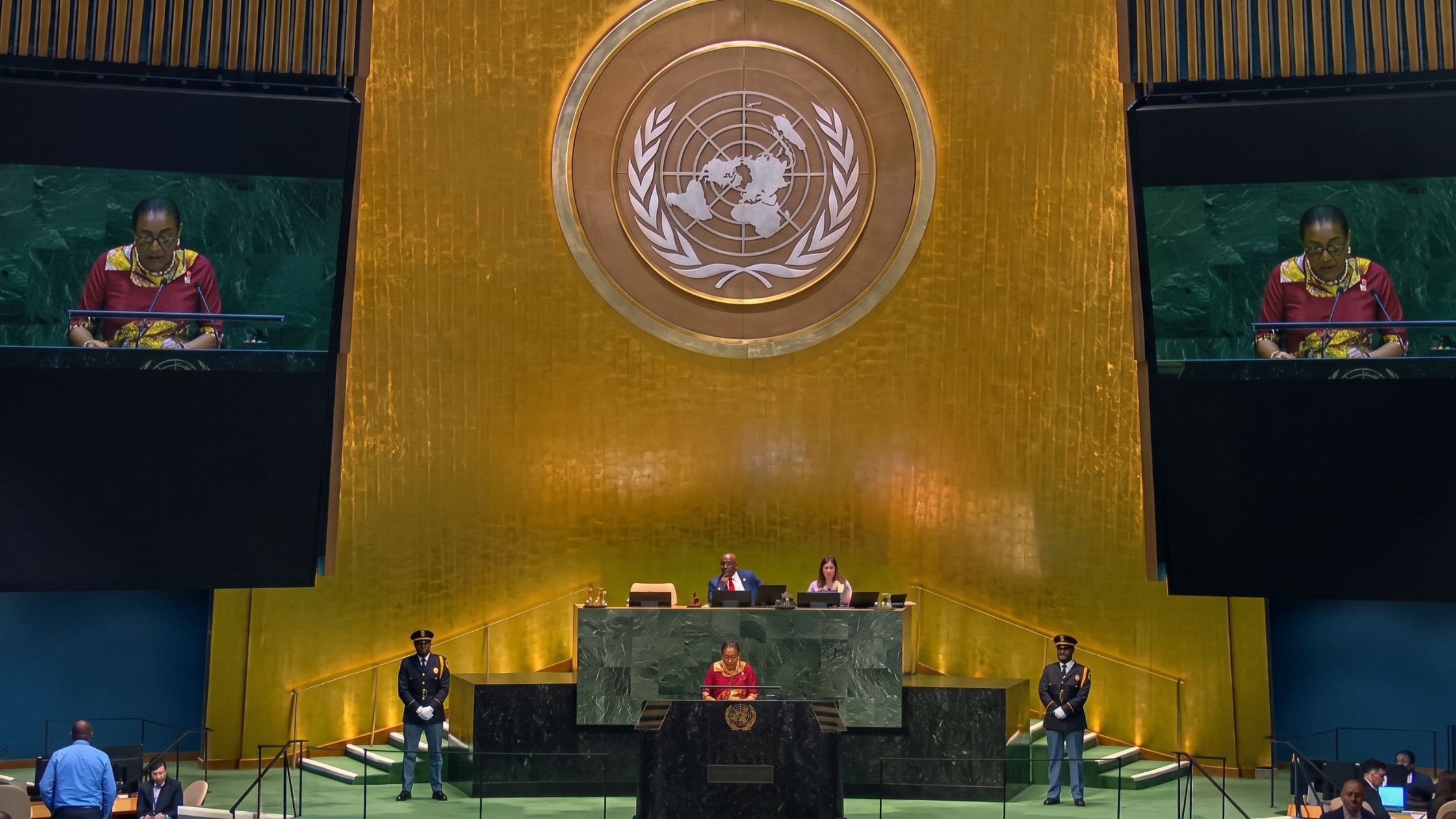
Secretary General (00:03):
A 21st century security council without permanent African seats is unjust and indefensible. This must change. Excellencies. [foreign language 00:00:23]. Excellencies, no discussion of inequality can ignore its most universal form. The inequality between women and men, everywhere. Everywhere, women and girls continue to face discrimination, violence, exclusion, and abuse. Around the world their rights are being rolled back. Their voice is silenced. Their bodies turned into battlegrounds and their freedoms treated as bargaining chips. This is an outrage and a profound waste for humanity. Peace is more durable when women are at the table. Economies are more dynamic when women have equal opportunity. Societies are more resilient when girls can learn, live and live free from fear. And the institutions are more effective when power is shared equally.
(03:56)
Over the last decade, we achieved an enormous milestone. I'm proud to report to you today that United Nations achieved gender parity for the first time in history across all senior leadership, all headquarters and all professional staff. It happened because we removed barriers. We challenged assumptions and refused to accept that power must look as it always was. At every step, we have never compromised on quality and competence. Equality is not a dream, it is a decision. If the United Nations can change, so can governments, so can parliaments, so can businesses, so can peace processes, and so can this general assembly.
(04:53)
Excellencies. The third great power test is the climate crisis. In many ways, it's the most profound intergenerational power imbalance of all. One generation consuming the future of the next, one group profiting while those least responsible suffer first and worst. Three years ago in the mountains of Nepal, I sounded the alarm on accelerating glacier melts, warning that the rooftops of the world are caving in. Some dismissed it all as overstating dangers, but as tragic events even have shown, impacts are arriving sooner, hitting harder and spreading further than many anticipated. Now we face a near certain breach of 1.5 degree limit with a supersized El Nino speeding straight for humanity. The dangers are real, but so is the hope.
(05:56)
The last decade has fueled one of the most promising shifts in power of our time, the rise of clean energy. The sun belongs to no one. The wind cannot be embargoed. Innovation can come from everywhere. And this is a profound rebalancing of power relations. Renewables are now the cheapest source of new electricity in most of the world, and the most viable path to energy security, independence and sustainable growth.
(06:29)
Excellencies, a future beyond fossil fuels is in sight. The question is how? Will it be a just and orderly transition built on international cooperation or chaotic and costly leaving people and countries behind? Today I call on every government to adopt a national plan to transition away from fossil fuels aligned with 1.5 degrees with clear timelines and protection for affected workers and communities. We know that fossil fuel interests won't step aside on their own. For decades, big oil has treated the atmosphere as an open sewer and cashed in on the consequences. Since Russian's invasion of Ukraine, five major Western oil companies have pocketed nearly half a trillion dollars in profits. Compare that with just $34 billion in international public adaptation finance for developing countries in the latest year reported.
(07:36)
Meanwhile, every day people are paying more for energy, food and insurance. And we have seen this kind of abusive power before. When the harvest of Big Tobacco became undeniable, governments acted. And the climate crisis demands the same determination. Those who polluted the most and profited the most must do far more to repair the damage they've caused. Polluters must pay. And to the leaders, cities, civil society and citizens working to hold them accountable, I say you are on the right side of history, keep going and governments must keep going on all fronts.
(08:33)
To end deforestation, invest in grids and storage, cut methane emissions. But these actions are not enough. We need climate justice with a focus on adaptation and finance. Developed countries must respect their commitments. They must triple adaptation finance and make the loss and damage fund work at scale. The present funds available in the loss and damage funds are ridiculously small. We must also ensure that the mining of critical minerals does not dig deeper into the inequalities of the past. Producing countries and affected communities must retain a far greater share of the value created from their resources. No more plundering, no more exploitation.
(09:26)
Excellencies, the force power test is technology and above all artificial intelligence. For centuries, power came from territory, then industry, then finance. Today, power increasingly comes from data, computing capacity and algorithms. And this new power is highly concentrated and it's advancing at extraordinary speed and racing ahead of our ability to understand its full consequences.
(09:56)
In 2017, AI was barely on the world's radar. Yet in my first address to the opening of the General Assembly, I warned and I quote, "Artificial intelligence is a game changer that can boost development and transform lives in spectacular fashion, but it may also have a dramatic impact on labor markets and indeed on global security and the very fabric of societies." Here we are almost a decade later and it is indeed a game changer with enormous promise to advance medicine, accelerate scientific discovery, expand opportunity and improve lives. But make no mistake, the danger is not technology. The danger is technology without accountability, capability without oversight, decision-making without transparency, and that danger can be minimized. The very developers building these systems are now pulling the alarm.
(11:05)
Excellencies, the first duty of governments is to protect their people. Governments must assume their responsibilities. And governments with the greatest AI capabilities have the greatest responsibilities to humanity, to establish channels for dialogue, transparency, trust and cooperation, not despite geopolitic rivalry, but precisely because of it. At a pivotal moment during the Cold War, strategic rivals came to recognize the need to manage shared existential risks. They built mechanisms to reduce misunderstanding, manage escalation and prevent catastrophe. At that time, it was the nuclear armament. Today, artificial intelligence demands the same clarity of purpose and sense of urgency. Those countries leading this technological revolution must share information on emerging safety risks, cooperate on testing and evaluation and work towards common safeguards that protect us all. But because this affects us all, global coordination is indispensable. And there is only one place where every country has a voice in shaping our common future, and that place is the United Nations. Through the Global Digital Compact, you agreed for the first time on universal principles for AI governance. So the global dialogue on AI governance, we created a platform for governments, scientists, industry, leaders and civil society to work together. Through the Independent International Scientific Panel on AI, we have brought together global expertise to ensure that policy is guided by evidence.
(12:59)
Just yesterday, the AI scientific panel released a thematic brief on AI safety and risks from loss of human control. Building on these efforts, we must take the next steps, first to advance the conditions for the responsible pacing of AI and the additional safeguards needed to address risks. Second, to work towards a multilateral AI risk management framework supported by credible and independent oversight. In all our efforts, we must ensure no country is left behind. Artificial intelligence must be shaped by humanity, with humanity, and for all humanity.
(13:45)
And as we confront the challenges ahead, let us not retreat from two fundamental principles. Let's say with one voice, children must never become the test subjects for unregulated systems. And let us resolve that life and death decisions must never be surrendered to machines. Killer robots must have no place in our future. Excellencies, [foreign language 00:15:02].
(15:07)
Excellencies, across all four tests, the decisive issue is power. Power over force, money, energy, technology, rules and the future. And that is why the UN Charter and the work of the United Nations matter more than ever. United Nations exists because power requires rules, and humanity needs a place where power answers to principle. And the Charter leaves no room for selective reading. The Charter created an organization rooted in three pillars, peace, development and human rights. And these are not competing agendas, they are one reality. There is no peace without development, no development without peace, and no peace and development without human rights.
(15:59)
To pretend that peace can be separated from dignity, opportunity and rights is an unacceptable illusion. But defending these truths does not mean defending the status quo. The pact for the future and UNA initiatives always respected the principle of equality of the three pillars of the United Nations, are about making the UN more responsive, more effective, more coherent, more transparent, more focused on results, more disciplined on resources and more presence where people need us. The world does not need the weaker United Nations, it needs the UN strong enough to face the world as it is and determined enough to build the world as it should be.
(16:52)
Excellencies. After 10 years, I hold one conviction even more strongly than when I have arrived. The greatest power is not the power to dominate, it's the power to build a future that works for everyone. Our shared future will be forged by whether humanity can govern power wisely, by upholding the law before impunity becomes normalized, by ending wars before they consume generations, by tackling inequality before society's fracture, by accelerating climate action before tipping points across, and by governing artificial intelligence before it governs us. This is the challenge before this General Assembly, the United Nations and humanity itself.
(17:40)
Excellencies, in the face of global catastrophe more than eight years ago, the United Nations was created as an active defiance, the defiance of people who refuse to surrender the future to fear, the defiance against the self-defeating notion that might makes rights, the defiance of countries that now our futures are bound together, the defiance of hope.
(18:09)
I will carry that spirit of resolve and determination through which of the 100 days I have left in office. But commitment to values and principles of United Nations does not begin with a mandate, and it does not end with one. They are greater than an office and they endure beyond any life. So on January the 1st, when I'm no longer Secretary General, be sure of this, wherever I will be, whatever I will be doing, I will keep championing the conviction that peace is possible, that human dignity is universal, that the power of law must prevail over the law of power, that our common future is worth fighting for. I will continue to stand up for the values of the United Nations Charter and I will never ever give up. Thank you.
President of Gneral Assembly (20:09):
I thank you, Mr. Secretary General. The assembly will now turn to agenda item eight and titled General Debate. I will now make a statement as the President of the General Assembly. Excellencies, Mr. Secretary General, former presidents of the General Assembly, ladies and gentlemen. 40 years ago, I stood in this very hall as a newly minted member of the cabinet of the 41st President of the General Assembly, Mr. Humayan Rasheed Choudhury. At that time, he said, and I quote, "In recent years, there appears to have been a crisis of confidence in the United Nations itself. There is a general feeling that the United Nations today needs revitalizing in a number of aspects in order to bring it into line with the priorities of a changing world." That was 40 years ago. Questions about multilateralism and the effectiveness of the United Nations therefore are not new. They have been part of this place since the first stone was laid, yet through it all, the United Nations has persevered, not because it is perfect, but because it is irreplaceable and because the alternative is simply unfathomable. The world of 1945 was imperial. The Second World War, the colossal devastation brought by it and the Holocaust left humanity bankrupt morally and fiscally. Something had to change and this place was that change. It ushered in a long era of diplomacy, which continues, member states coming together to work through their problems because they knew that the alternative, guns blazing and bombs dropping simply was not an option. Perhaps the clearest evidence of its achievements is here in this very hall. In 1945, 50 nations participated in the San Francisco conference. Today, eight decades later, the organization has 193 member states. The UN has brought together humanity under one roof. This is unprecedented in human history. The core promise of this institution is [foreign language 00:22:59], was and remains to prevent the unimaginable, a third world war. The fact that we have avoided such calamity is among the greatest achievements this institution could ever deliver.
(23:15)
But survival alone cannot be our sole measure of success. Outside these walls, people are not asking whether the United Nations still exists, they are asking whether it works. Yes, there have been wars and conflicts that we could not prevent and issues we could not resolve. The Palestinian issue continues unresolved for decades as the secretary general just alluded to. Wars and conflict, and their aftermath, are ravaging Sudan, Gaza, Ukraine, Myanmar, and the Middle East. But even as those wars raged, the United Nations stayed and served. I have seen it up close in my own country, Bangladesh, where the United Nations country team in Cox's Bazar is striving to... Schools, electricity stations and water treatment plants. And right now in Haiti, the entire United Nations family is delivering immense security and governance challenges. These stories rarely make headlines, but we should never lose sight of what it is that is working. At the same time, let us not turn a blind eye to where we have fallen short, particularly in a world where challenges seem to multiply by the day, and newer challenges appear every day. The war in Gaza has left over 70,000 people dead, including 1000s of children. Humanitarian support has been a fraction of what is needed. The ongoing wars across Middle East and Europe have consequences far beyond their front lines. And the heartbreaking natural disaster in Nepal and China was not just an isolated event, but yet another horrible climax to our collectively insufficient response to climate change.
(25:41)
The circumstances and the politics of this crisis differ, but our commitment under the United Nations Charter do not. The principles of multilateralism, international law, international humanitarian law, the protection of civilians and humanitarian access cannot be applied selectively, not if we want the world to trust us. It is precisely at such times that we must honestly confront our setbacks of however profound, not with blame, cynicism or blind hope, but with action, sober reflection, clear-eyed realism and pragmatism. This is how we charge these turbulent waters, and this is what we need to rebuild trust in this institution, the central focus of this session and my state.
(26:34)
So how do we build back trust? Trust is not given, it is earned. And we earn trust, I believe, in three ways. First, by being unapologetically realistic about where we are falling behind. Second, by taking a foundational look at the reforms of the United Nations to deliver better. And third, by making our work inclusive and engaging all relevant stakeholders from all parts of our society.
(27:05)
Let me elaborate. On my first point, we must be frank about where the challenges lie and what needs to be fixed, even when the necessary changes may prove painful. Consider peace and security one of the pillars of the organizations. Under the UN Charter the Security Council bears primary responsibility for the maintenance of international peace and security. Yet when the council is unable to act, member states turn to the General Assembly. We saw this as early as 1950 with Uniting for Peace Resolution, and we have seen it more recently through the Assembly's Veto Initiative. These two principle organs of our organization are complimentary, not competing. The Charter provides for an appropriate balance between them. Both chambers must do their respective part.
(27:59)
To be fair, the Security Council, when it acts, proves its strength and effectiveness. It helped liberate Kuwait, ended civil war in El Salvador, supported Namibia's independence, led rebuilding of Colombia, Cambodia, and stabilized conflict-affected countries through peacekeeping. Yet, when the council is unable to act on important matters, the effectiveness of our organization as a whole is called into question. In 1945, humanity placed its trust in the council in good faith, giving it the extraordinary responsibility of maintaining international peace and security. The council accepted that responsibility and entered into a compact. It must now hold up its end of the bargain. This is what the people of the world expect, and in their eyes, when the Security Council works, the United Nations works.
(28:58)
The promise of 1945 still binds us today. I call on the Security Council and all of its members to step up, to lead as we need it to lead, and to act when we need it to act. Linked to this is the question of Security Council reform. I will support General Assembly-led intergovernmental negotiations in its work to make the council more representative, transparent, and reflective of the geopolitical realities of our time. Ensuring fair representation for underrepresented regions must remain a priority.
(29:35)
As the Secretary General has said, nowhere is this more important right now than in Africa. After eight decades, the largest region by number of member states and a key focus of UN peacekeeping remains underrepresented on the Security Council. Africa needs to be at the table, not on the menu. Africa cannot be asked to wait indefinitely for the rightful place on the council. Ending Africa's under-representation now is a question of fairness, justice, and ultimately the credibility of this organization.
(30:10)
Turning to the development pillar, and particularly the sustainable development goals, we are right to focus on the challenges. Last year, OECD donors spent about $175 billion on development assistance, a whopping 23% drop year-on-year. And yet military expenditures approached $3 trillion, capping 11 straight years of growth. All the while, progress on the SDGs stalled at just over a third of targets, and developing countries are now paying the price for supply chain disruptions they did not cause and cannot cure. The contrasts could not be more stark. We must better prioritize on how we spend our resources by augmenting development assistance, addressing debt burdens, reforming the international financial architecture, fulfilling our Syria and Paris commitments, and implementing the programs of actions for least developed countries, landlocked developing countries and small island developing states, as well as African Unions Agenda 2063.
(31:22)
Because where we have done so, the results are clear. Over the past decade, nearly one billion people have gained access to safely managed drinking water. Electricity now reaches 92% of world's population, very close to universality. And internet access has risen from 40% to 74%. Behind these numbers are healthier children, more resilient communities, greater opportunities for women and girls, and renewed hope. These gains show that accelerating the SDGs is possible when developing countries and the development partners work in concert, and this is indeed a shared responsibility.
(32:09)
Developing countries must also intensify their own efforts through domestic resource mobilization and plug any leakage or corruption, including capital flight, a plague that until recently undermined development in my own country under a repressive and authoritarian regime. Turning to human rights, we should acknowledge that these are central to the other two pillars. They can promote peace. There cannot be peace without rights and advanced sustainable development.
(32:43)
And we recognize one of the most urgent assaults on human dignity today, hate speech that incites violence. It is a growing threat to regional and global peace and it is on the rise. Hateful narratives are spreading like wildfire across borders and into homes at unprecedented speed and scale. They target women and girls, minorities, migrants, refugees, and persons with disabilities, often for political gain. New and emerging technologies are used to amplify lies, manipulate public debate, spread hatred, and give incitement to violence faster and farther than ever before. We must choose dialogue and tolerance and foster a culture in which human rights are respected, not only in law, but in our daily interactions. And we must stop cherry-picking of those rights that fit our respective cultures or politics of the day, whether it is Islamophobia, antisemitism, homophobia, misogyny, it's all the same. Hatred, repackaged and relabeled. Let us use the tools of our age not to deepen fear, but to widen understanding and advance human dignity for everyone everywhere.
(34:06)
My second point, making the United Nations fit for the future, which requires a more foundational approach to reform. The UN80 initiative is a constructive start. Thank you Mr. Secretary for this, but it is only a start. Moving positions on a budget sheet may deliver savings. Margin or renaming bodies may reduce duplication. Streamlining structures may improve efficiency. These steps are important and often essential for good housekeeping, but they're not enough. We need to dig deeper to address the problems beneath the super structure because the United Nations reform challenges are chronic and fundamental. On 24 November 1949, barely four years after the founding of the United Nations, this assembly adopted resolution 310, IV, and titled Problem...
President of Gneral Assembly (35:01):
... 10 (IV) entitled Problem of Proliferation and Overlapping of Programs of the United Nations and of the specialized agencies. It urged member states, and I quote, "To refrain from initiating new projects other than those which are urgently required, and which can be effectively carried out." Yet, we have not paid sufficient attention to our own decision. We have since created thousands of mandates of which 4,000 are still active, irrespective of whether they were required, or could be effectively carried out. We cannot continue treating a chronic ailment with temporary painkillers when what we need is a deeper diagnosis, and a more profound plan for transformation, even if that plan proves painful.
(35:50)
And here, I must be fully candid, this will happen only if member states take charge. Time and again, we say that United Nations reforms must be member-led, which looks like a tacit admission that they are not. Too often, we member states fail to take the wheel. Passive ownership is not enough. If we do not claim proactive ownership of this place, we cannot expect it to self-heal. So let us engage, let us take charge, fix our own house, respect sovereignty of member states, and together deliver the transformation we need. As we decide what must change, we must also recognize what already works. Again and again, member states tell us that the United Nations works well at the country level, emergency situations, and in keeping and building peace. We should build on that success. We should strengthen the United Nations' work in these areas, and draw increasingly on local capacity, including qualified national institutions and individuals, including women and young people. We should ensure that all activities at the country level from development support to peacekeeping are properly integrated, and produce the highest synergy.
(37:12)
We should ensure avoidance of [inaudible 00:37:16] battles among different parts of the UN, and exercise care to select the leaders at the country level that are fit to lead. We want to have full value for money. Let's remember, the organization's financial viability remains a chronic concern. We must ensure that it receives sufficient resources on a sustained basis, and that all countries paid their dues on time, and without conditions. We should also recognize that dues to the United Nations come from hardworking place all around the world. Every penny must therefore be properly accounted for. Every penny must be invested to achieve impact on the ground for the people we serve.
(38:07)
The role of the member states supported, by the secretariat, is essential to delivering our work, but not sufficient. This brings me to my third point, building a more open and inclusive United Nations. We know that the United Nations of today, and the world it serves are profoundly different from those of 1945. Nowhere the pace of change is more evident today than in artificial intelligence. AI can be a powerful accelerator of human progress. Therefore, we must not close the door to innovation. At the same time, we must address AI's potential harms, including job losses, and widening of the digital divide. We cannot also rule out the possibility that AI, particularly artificial general intelligence, or AGI, could affect the very human survival.
(39:01)
That demands prudent and reliable guardrails, based on scientific evidence to safeguard the global public interest, while allowing innovation to go forward. Governments must remain at the heart of this endeavor, but governments do not have a monopoly on expertise, capital, technology, innovation, or influence. Much of that experience and capacity already lies with businesses, innovators, civil society, and others. We need to keep the doors of United Nations unlocked to those developing and using AI, not someday, now. And we are falling farther as we are falling farther behind each day.
(39:45)
AI differs from earlier proliferation challenges in one critical respect, it is already embedded in nearly every facet of our lives, in our water systems, electricity grids, economies, and militaries. We cannot allow an arms race for control of AI to carry us over the precipice. There is clear precedent for the United Nations' engagement with world changing developments. We did so on nuclear non-proliferation through the Montreal Protocol to protect the ozone layer, and with the United Nations' Declaration on Human Cloning in 2005. We need experts, innovators, industry leaders, scientists, civil society, and academia, all working together with member states on these issues of our times.
(40:36)
Excellencies, ladies and gentlemen, we have an opportunity in this session to show that we have learned from what works, that we are prepared to confront what does not, and that we can build a United Nations capable not simply of surviving change, but of shaping change. To seize that opportunity, we must be realistic enough to confront hard truths, bold enough to reform, and inclusive enough to bring the right people to the table. That is how, in my view, we will renew trust in our organization, and make it fit for future. The task is not easy, nor can it be done overnight. Then we must persist over the long haul. 81 years ago, President Truman expressed the hope that the United Nations would endure for nine decades. Here we are at the beginning of the event's ninth decade. Let us dedicate ourselves to the task of rebuilding trust and confidence in the United Nations, so that it leaves up to the incredible potential for many decades to come. I thank you.
(41:40)
Before giving the floor to the first speaker of this morning, I would like to remind members that the list of speakers for the general debate has been established on the aggregate basis that statements should not be longer than 15 minutes. Within this timeframe, I would like to appeal to speakers to deliver their statements at a reasonable pace so that interpretation into the other official languages may be provided properly. I would also like to draw your attention to the decision taken by the assembly at previous sessions, namely that the practice of expressing congratulations inside the assembly hall after a speech has been delivered is strongly discouraged. After delivering their statements from the rostrum, speakers are invited to exit the hall through room GA200, located behind the podium, before returning to their seats. May I take it that this assembly agrees to proceed in this manner? It is so decided.
(43:23)
Finally, I should like to draw the attention of members that during the general debate, official photographs of all the speakers are taken by the United Nations' Department of Global Communications. Members interested in obtaining these photographs are requested to contact the Photo Library of the United Nations. The assembly will now hear and address by His Excellency, Luiz Inacio Lula da Silva, President of the Federative Republic of Brazil. I request protocol to escort His Excellency, and invite him to address the assembly.
Translator (47:02):
I'm no stranger to the realities of power, but concessions to the law of the stronger have surpassed all limits. This is not idealism, but pure realism. War is not the continuation of politics by other means, it's the complete breakdown of politics. In an interdependent world, leading is to reconcile the interest of the nation with those of humanity. This is the observation of someone who represents a nation that loves peace and freedom, someone who fought against a military dictatorship, and defended their country against a coup d'etat.
(47:45)
It is the conviction of a plant worker who was elected president three times, and who removed Brazil from the hunger map. This general assembly recently corrected a historical distortion in the world map. It recognized the trafficking of enslaved Africans as the gravest crime against humanity. It proves a more accurate representation of the world map. Now, it needs to focus on issues crucial for the future of humanity. We are called to choose between multilateralism or unilateralism, democracy or extremism, sovereignty or subordination. These choices require courage, political will, and clarity of objectives. This is what we expect from a statesman.
(48:50)
Yasser Arafat and Yitzhak Rabin were statesmen. They challenged the past to envision a future of peace. They were defeated by hatred. Generations of Palestinians will carry the pain and trauma left by the genocide of women and children perpetrated by Netanyahu government in Gaza. Israeli civilians pay the price for radicalism and intolerance of Hamas terrorist acts. Persecuted International Criminal Court and its members encourages these crimes to go unpunished. The UN Special Rapporteur, Francesca Albanese, must not be silenced for telling the truth. Illegal settlements in the West Bank are making the two-state solution increasing unviable, essential for Israelis and Palestinians to live in safety.
(49:56)
Threatening civilizations with extinction will not bring stability to the Middle East. The Strait of Hormuz has become a battleground, when it should have remained a vital passage for international trade. Families around the world are paying for the rising... The price of fuel, fertilizers, and food. The war between Russia and Ukraine has dragged on for five years in a humanitarian drama that continues to claim lives. We all know that there will be no winners on the battlefield. Diplomacy is the only option. Initiatives such as the Friends of Peace group created by Brazil and China reveal that there are forces in the international community willing to work towards dialogue.
(50:53)
In Latin America and the Caribbean region, geographical proximity to the world's greatest military power is inescapable, especially in the context of renewed hegemonic temptations. Brazil does not fit in anyone's backyard. We need partners with a positive agenda that fosters development. Ideological differences should not hinder higher integration amongst neighbors. The countries in the region have experienced the horrors of authoritarian regimes. We have come a long way to restore popular will. Democracy is once again under threat. We witness, once more, interference in electoral processes, dividing the world into zones of influence, and new colonial incursions for strategic resources are anachronistic gestures. The Venezuelan people deserve to define their own destiny. Nicaragua will not solve its problems by preventing the opposition from running in the elections. The crisis in Haiti continues to test the limits of the international community's indifference. In Cuba, the world watches in horror as collective punishment is imposed on 10 million people by illegal economic and energy embargo. Mr. President, Brazil does not underestimate the challenge represented by organized crime. We are ready to face the criminal organization that terrorize our local communities. Workers are robbed, mothers lose their children, police officers do not make it back home. People are tired of violence, but we will not outsource the responsibility of defending its borders, and guaranteeing our population the right to live without fear. We do not need aircraft carriers guarding our waters. We need cooperation to block the flow of weapons and money that feeds organized crime. That's the spirit of the proposal that I personally handed to the U.S. president. We want to fight money laundering carried out by Brazilian criminals abroad. For a long time, Brazilian states acted each in their own way. Crime made the most of the lack of coordination, but this is changing.
(53:40)
In Manaus, city of the Amazon state, we created the Amazon International Police Cooperation Center, bringing together public safety authorities from nine Amazon region countries. In 2025, we carried out the biggest operation against organized crime in Brazil's history. We broke records of drug seizures, as well as unlawful assets and resources. We are facing all levels of crime, including the crime tycoons. The Anti-Faction Bill that we just have passed established heavier sentences for organized crime than those carried by terrorism. Organized crime and corruption walk hand in hand. The fight against corruption shall remain relentless, no matter who it hurts. No one is above the law.
(54:35)
Ladies and gentlemen, the pillars of multilateralism are being eroded. The World Trade Organization is being kept on life support. When governments capsulate, vis-a-vis those who use tariffs as weapons of coercion and blackmail, consequences are harmful. In the age of misinformation, obscurities resist the evidence of science. We will never forget the millions of lives lost due to the negligence in the fight against COVID-19. Anti-vaccine campaigns are bringing back diseases we thought were eradicated. Weakening the World Health Organization makes everyone more vulnerable. Until recently, the response to climate change was firmly established at the center of the international agenda this year. However, the topic disappeared from the debates of the G7 and G20 forums that bring together the largest carbon emitters. It is time to resume the offensive and inflict the defeat on denialism. Nature reminds us every day that we live on one planet. The glaciers in the Himalayas are melting. The super [inaudible 00:55:59] may cause torrential rains, droughts, and forest fires in different parts of the globe. Its effects will hit the most vulnerable the hardest.
(56:18)
Brazil has been demonstrating that it is possible to combine economic growth with reduced emissions. We have achieved our self-sufficiency in oil, and will continue to explore the potential of new reserves, such as those in the equatorial margin, but we will not abandon the environmental agenda. We will move forward with a roadmap for the decarbonization of the Brazilian economy, the Tropical Forest Forever Facility launched at COP30 in the city of Belem shows that it is possible to change old paradigms. The forest is worth more standing than destroyed. We will continue to reduce redeforestation, which has been cut in half in the Amazon, and reaching its lowest level in 11 years. We have the moral authority to reject protectionist measures disguised as commitment to the environmental cause. Brazil is a global reference in green energy. We have the critical minerals and the rare earths that the world needs to make the energy transition. Our natural wealth belongs to the Brazilian people, and it is in their benefit that it will be exploited. Access to our minerals will be contingent upon mandatory value-generation in our territory, technology transfer, and the supply of strategic national sectors.
(57:55)
Mr. President, we are living through unprecedented technological revolution, with great risks and opportunities. It would be an unforgivable historical omission not to address the challenge of regulating the big techs and artificial intelligence. A hands full of technical oligarchs want to resurrect a version of digital ultra liberalism without rules or transparency. They are promoting a race with no ethical boundaries, bypassing the United Nations and the Scientific Panel on Artificial Intelligence. As Pope Leo XIII warned, decisions about technology, "Should never be separated from awareness and responsibility." Companies that are aware of the risks of their products are transferring the impossible task of confronting algorithm to the families. The billion-dollar betting industry turns addiction into profit. Its exponential dissemination is increasing debt levels, and destroying homes.
(59:07)
Brazil will not tolerate this business model. We passed one of the most advanced pieces of legislations in the world to protect children, adolescents, and women in the digital environment. We will ensure fair compensation for artists, musicians, and other visual content creators. We will not give into pressure from multinationals that want to privatize our Pix, a free public payment infrastructure that has made financial inclusion a reality for millions of Brazilians.
(59:47)
Ladies and gentlemen, the sustainment development goals are currently under attack from reactionary forces that wish to normalize injustices, inequality, and under development are the result of political choices. It is possible to include the poor in the budget, and make the rich pay their share. It is necessary to cut privileges, and invest in free quality education and healthcare. There is a legitimate desire for change throughout the world, but change is not the same as going backwards. It's not about taking away rights. It's not about reviving theories of racial supremacy or female subjugation. It's not about recolonizing the Global South. Change means moving towards a more participatory future, and more achievements. It is about creating and sharing effective public solutions to development challenge through a democratic, strong, efficient, and capable state. It's about betting on the spirit of solidarity and cooperation with Africa, Asia, Latin America, and the Caribbean region.
(01:00:58)
Initiatives such as the Global Alliance Against Hunger and Poverty launched by Brazil, and the UN Intergovernmental Panel on Inequality launched by South Africa's team from this political will. Brazil is in a hurry to become a developed and socially fair nation. We have adopted an economic model based on income distribution, job creation, and wage increases. We are invested in improving productivity, expanding credit, and building a robust social safety net. Brazil has returned to sustainable growth. We are the third-largest destination of foreign direct investment. Despite the high tariffs imposed against our economy, this year we shall break a new record in our exports. There's still much to be done.
(01:01:53)
The world of work is undergoing a transformation. Older people want to stay active. Young people want to become entrepreneurs. Workers need time to rest, improve their skills, and spend time with their families in Brazil. Achieving this goal requires ending the so-called 6 X 1 working schedule to guarantee workers two days off per week. This change is crucial to alleviate the domestic burden that still falls on women. We are building a Brazil where women don't need permission to occupy positions of power, or enter the job market, a country free from femicide, where no woman inside or outside their home lives under the threat of violence, where once again, no woman inside or outside their home lives under the threat of violence. This is a cause that the whole world needs to embrace.
(01:03:06)
Mr. President, when he was awarded the Nobel Peace Prize, Dr. Martha Luther King stated, "What self-centered men have torn down, other centered men can build up." The UN was born under the sign of hope. Over eight decades, it has contributed to the decolonization, promoted human rights, and supported sustainable development. It has protected migrants and refugees, condemned racism, antisemitism, and religious intolerance. These were achievements of leaders who took up to this podium, driven by indignation at the injustices of their time. Men and women who refused to accept war as a destiny, colonialism as a right, apartheid as a legitimate system, it was from this ability to say no to inequalities that some of the greatest transformations we have experienced were born. Faced with the paralysis of the United Nations, we need to rediscover the political will so that it may once again become a tempo of peace.
(01:04:28)
I want to conclude with a message from my country to everyone who is listening. On October the 4th, millions of Brazilians will go to the polls to define their destiny. They're not just voting for president of the republic, state governors, and representatives of the legislative branch, they will decide between democracy and denialism, if Brazil will move towards a future with more opportunities, or go back to a past of exclusion. We shall have competitive and transparent elections where every candidate benefits from the broadest freedom of speech.
(01:05:17)
We know that some abuse of this freedom to associate themselves with foreign interests against the country. We do not underestimate the challenge of misinformation networks that aim to distort public debate during the campaign, but we have a modern and robust election system. Under the watchful eye of a pluralistic citizenry and a free press, we will not allow the enemies of democracy, whether domestic or foreign, to undermine popular will. Brazilian democracy belongs to Brazilians. Brazil continues to be a sovereign country. Nobody, nobody will turn us away from this path. May God bless us all. And thank you very much.
President of Gneral Assembly (01:06:26):
On behalf of the assembly, I would wish to thank President of the Federative Republic of Brazil. The assembly will hear an address by His Excellency, Donald Trump, President of the United States of America. I request protocol to escort His Excellency, and invite him to address the assembly.
Donald Trump (01:09:57):
Thank you very much. Mr. President, Mr. Secretary General, First Lady of the...
Donald Trump (01:10:00):
... Mr. Secretary General, First Lady of the United States, distinguished delegates, ambassadors, and fellow leaders, it's my great honor to welcome the world to America as we celebrate 250 years of glorious freedom and independence. Two and a half centuries after the Cause of Liberty found its home on this continent, I can report to you with pride that America is back and our country is stronger today than ever before. Our economy is the envy of the world. Our military is the most powerful on Earth. Our technology is second to none, and we are leading in virtually everything. Our energy is fueling the planet. America is rising. Our nation is growing. Our power is expanding. Our country is doing better than ever before, and our future is very, very bright. Since I took office, we have created more than 1 million new private sector jobs, and more Americans are working today by far than ever before.
(01:11:16)
Last week, it was announced that the poverty rate has reached its lowest level in American history. We lifted 1.5 million Americans out of poverty last year alone, another record. The African American and Hispanic American poverty rates are at all time lows. Real household incomes for Americans have soared to the highest level in history, 87,000 on average, surpassing the prior record that I set in my first term. From day one, my administration has worked to remove every single unnecessary regulation and obstacle to doing business in America. We passed the largest tax cuts in American history, and as a result, more money is being invested in the United States right now than has ever been invested in any nation anywhere in the world. US stock markets have set 80 all time records, and that's just in the last 12 months. We've secured commitments for $21 trillion in new investments from all over the planet, compared to less than $1 trillion in four years in the previous administration.
(01:12:35)
Two years ago, our country was dead, and now, we have the hottest country anywhere in the world. Before I took office, we had the worst and most dangerous border on Earth, and now we have the most secure border in American history. Nobody comes in unless they're invited, unless they have permission. In the past 16 months, zero illegal aliens have been admitted to the United States, and that's done by some very sophisticated people. It's not done by the Trump administration. Zero. As a result, last year, we achieved the largest drop in violent crime ever recorded. The murder rate has plummeted to its lowest level in 125 years since the year 1900. I sent our crime busters into Memphis, Tennessee and New Orleans, Louisiana, and crime in each place went down over 80% and it'll go down still further. More importantly, when I arrived on January 20th of last year in Washington, D.C., it was riddled with crime and now crime is down 87% and we're going for 100.
(01:13:48)
If you take a look, and I guess a lot of you have been there, tourism is thriving. Restaurants are bustling, and people are proud of our nation's capital. They're proud like never before. We've invested more money in the United States military in the past 12 months than ever before. And this term, it'll be $1.5 trillion. We inherited a dark age of America from the previous administration and we turned it into the golden age of America. The entire world is being lifted by the wealth, strength, spirit, and momentum of a newly energized and a very powerful United States of America. And just as we moved quickly to address problems we inherited at home, we have acted with decisiveness and speed to reshape the world stage and solve problems that have plagued us for far too long. Every leader in this room, and your great leaders, many great leaders, I know all of you very well, but they know that given only a short time to make this world better, safer, and more prosperous for our children, for the people on Earth, we have to take advantage of it.
(01:15:04)
As president of the most extraordinary nation in history, I have no interest in leaving dangers to grow for another day. I do not believe in letting problems fester. They only become harder to solve. So while others have talked, I have acted. While others have spoken of peace, I have made peace. While others have ignored threats, I have confronted them. While others have talked of courage, America has shown it. While others have promised strength, I have used it to make America the most powerful country in the world. Working with many nations in this room, we are solving decades of intractable challenges and we are settling years of unfinished business and we're doing it well. There is no better example of a danger that was allowed to gather strength at the world's peril than the number one sponsor of terror, the Islamic Republic of Iran. For 51 years, the fanatical Iranian regime has ruled by bloodshed and mass murder, spreading death and carnage and chaos across the entire Middle East and beyond.
(01:16:23)
They were the bully of the Middle East, but they are the bully no more. From the first day I entered the political arena, I've been unwavering. I will never allow Iran to have a nuclear weapon. Upon taking office last year, I immediately opened negotiations with Iran and offered them full economic cooperation in exchange for ending their nuclear program and support for terror, but they refused. They absolutely refused. That was a big mistake. Then in Operation Midnight Hammer, the US military obliterated their nuclear program beneath mountains of rubble. And again, I urged Iran to make a deal, and again, they refused. The regime continued building a vast missile and drone stockpile that threatened the security of every American service member in the region and everyone else in the region. They also made a missile that was capable of hitting Europe and they were very proud of it.
(01:17:22)
I hope the Europeans realize that. Iran's goal was to complete their mad dash to a nuclear bomb from behind this conventional ballistic missile shield. If they had succeeded, that wicked regime would've been free to spread terror and death forever, knowing that any attempt to stop them would face an arsenal of nuclear annihilation. In America, we just marked the 25th anniversary of the worst terror attack in history, September 11th, which killed 3,000 people just a few miles from here. It was an unbelievably terrible time. In two weeks, we will mark the third anniversary of the October 7th attack in Israel where terrorists funded by Iran, tortured, mutilated and killed 1,200 very innocent civilians, including dozens of Americans and many babies, babies, little, tiny, beautiful babies. Iran's supreme leader celebrated that massacre and called it a service to humanity. The same regime slaughtered over 72,000 of its citizens this year. Recently, 10,000 were killed for protesting. Just imagine such a vile regime were ever empowered to carry out large scale terror attacks from behind a nuclear shield. This was the reality, we had to confront a reality that far too many preferred to ignore. They all ignored it. Many presidents and many others just wanted to ignore it. They were unwilling to do anything about it, but they knew the problem. After giving Iran every chance for a deal, I took action to ensure that neither the United States nor any nation in this all would ever have to face such a nightmare, such a catastrophic problem. As a result of Operation Epic Fury, all 159 ships of their navy are now lying at the bottom of the sea. Likewise, their air force is gone. Their radar is gone. Their anti-aircraft equipment is gone. Their missiles and drone manufacturing capacity is almost gone. Their economy is gone.
(01:19:42)
The only thing that isn't gone is inflation, which is destroying their country and is now well over 300%. Yet even after we agreed to a ceasefire for nuclear discussions, Iran promptly violated it with brazen acts of terrorism against civilian ships from other countries. I want to thank the UN Security Council for voting overwhelmingly to pass a resolution condemning Iran's despicable terrorist attacks on commercial shipping. Thank you very much. That resolution, I'm pleased to say, received more co-sponsors from UN member nations than any security council resolution in history. That's something. Now, we must be equally united in maintaining pressure. The United States Navy has recently escorted more than 1 billion barrels of oil out of the Strait of Hormuz, and more oil is flowing than at any point since the start of the war. We're taking 22, 25, 30, 32, and 37 ships out respectively every single day, every single night.
(01:20:55)
But I have a big decision to make. Will a deal be made with Iran that lets them rebuild and create a far greater country than it ever was before, maybe one of the greatest in the Middle East or even the world? Or do I annihilate the Islamic Republic and do it quickly, never giving them a chance to kill and destroy people and countries again? Do I drive them into hell with no chance of survival and no hope of future greatness or generations? But I believe we'll make a deal right after the election because it doesn't make sense for them not to. They're waiting to see how I do in the midterm election.
(01:21:44)
What they don't realize is that I'm not running. I did that already and won in a landslide. We won in a giant landslide and I'll be here for two and a half years. The Republican Party is running and I'll be helping them, but I am not running. I gave absolutely no credence and will not give credence to the election when it comes to Iran. It doesn't even enter my mind. The only thing that does is that Iran will never have a nuclear weapon. The cowards and traitors... Thank you. Thank you.
(01:22:29)
The cowards and traitors would love to say, "The United States is low on munitions." But that's not true. We have more munitions than we could ever possibly even think of using, and we're building them at levels that we have never done before. We are adding to our stockpiles faster than we have ever been able to do before, top of the line stuff. In addition, in the very near future, massive munition plants will be opening. There are 18 of them being built by the greatest defense companies in the world right now, 18 under construction. Some of them very quickly will be completed. They're almost there. And that rapid construction will be leading to very rapid deployment of missiles of every type and ammunition of every type, and we'll be able to supply our allies at a much faster rate than we're doing right now.
(01:23:28)
I call on all nations to join us in enforcing the complete economic isolation of Iran until they stop their attacks on commercial shipping, relinquish their nuclear ambitions, and cease their support of terror. The terrorist regime is behaving badly, not because they are strong and confident, but because they are weak and desperate. If we stand united, we will soon see a world free of the last 51-year menace of Iranian terror, and oil prices will come plummeting down even lower than they were at the start of the conflict. And they were very low. In the United States, they were really low. With courage and resolve, anything is possible. Big changes can happen and happen fast.
(01:24:21)
One year ago when I addressed the great leaders, this hall, the war in Gaza was still raging brutally. The hostages were still deep in Hamas tunnels and there was no end in sight. It was never going to be resolved. But here on the sidelines of the General Assembly, we took the first steps. It changed everything. A few weeks later, we ended the war in Gaza, saving untold thousands of lives. We also brought home all remaining hostages, both living and dead, every single one of them. Thank you. Thank you.
(01:25:02)
Everyone thought it was a miracle that we were able to do so and people celebrated in the streets. I want to express my gratitude to the United Nations Security Council for their unanimous endorsement of our 20-point Gaza Peace Plan and for officially approving the Board of Peace. Going to be a very significant group of people. Nearly 30 countries have joined the board, which I am honored to chair, and we're thankful to many of those member nations for contributing billions and billions of dollars to relief, and it goes right to the rebuilding and relief of Morocco, Bahrain. These are the countries that gave Qatar, Kuwait, Kazakhstan, Saudi Arabia, Turkey, Uzbekistan, and many more. That money goes right to the source, right where they need it. And they desperately need it. Those countries have been very generous and others also are stepping up at numbers that nobody would even believe because they want to see people live. They want to see the humanitarian thing happen properly. They've been fantastic.
(01:26:14)
I also want to thank those who have committed troops, police, and training to help stabilize Gaza, including Indonesia, Morocco, Albania, Kosovo, Kazakhstan, Egypt, Jordan, and more. Since I took office, it has been my great honor to settle eight wars, and in so doing, become friendly with the leaders of many of those countries. It was a great honor to do it. Numerous of these wars have gone on for many years and even decades. The reason I was able to make these settlements was the use of my relationships, very special relationships to this day, very, very special. Trade, the use of tariffs and the threat of tariffs, and various other reasons depending on the country. Among them, terms of settlement, Cambodia and Thailand, Kosovo and Serbia, the Democratic Republic of the Congo and Rwanda, Pakistan and India, Armenia and Azerbaijan, and of course the war in Gaza, which as I stated previously, includes the return of all hostages, both living and dead.
(01:27:36)
Almost every one of these countries wrote me a letter of thank you. The prime minister of Pakistan, terrific man, said that, "Donald Trump was responsible for saving 30 million lives and probably many more than that." The president of Azerbaijan said, "President Trump in six months did a miracle. It was an absolute miracle that nobody thought could be done." The prime minister of Armenia said, "This breakthrough would simply not have been possible without President Trump's personal engagement and his resolute commitment to peace." The president of Cambodia stated, "President Trump's extraordinary statesmanship marked by his commitment to resolving conflicts and preventing catastrophic wars through visionary, innovative diplomacy was most recently demonstrated in his decisive role in brokering an immediate and unconditional ceasefire and peace. This timely intervention, which averted a potentially devastating conflict, was vital in preventing a great loss of lives and paved the way towards the restoration of peace." The president of Rwanda said, "When President Trump saw the opportunity to contribute to peace, he immediately took it."
(01:28:55)
This conflict has lasted for 32 years. Millions and millions of people have died. We got it settled. We've seen countless mediations and efforts, but none has succeeded in resolving the underlying issues. President Donald Trump issued a new and effective statement that really has brought great peace and space through really a breakthrough that we thought was impossible. We're working very closely with the leaders of Russia and Ukraine and we will get that one done. It's going to happen, I think, more quickly than people understand. They've had it. 25,000 young people, mostly soldiers a month are dying, 25,000 a month. And I look at those battlefield pictures and I really don't want to see them anymore. It's so horrible to see. 25,000 a month, both sides.
(01:29:56)
In addition, the United States and Iran will definitely get it done. We will get it done one way or the other. It's going to be done. It's going to be done fast. A lot has happened since we last gathered here one year ago. In January, at my direction, the United States military conducted a massive military operation penetrating deep into the Venezuelan capital, Caracas, descended on a heavily defended and fortified military base, one that was supposed to be flawless against attack, and arrested the outlaw dictator, real criminal, Nicolas Maduro. Since that day, hundreds of Venezuelan political prisoners have been freed. They've let them out of jails. And we're working closely with the leaders of Venezuela to forge a much better future for the Venezuelan people. Last month, we signed the largest oil deal in history, covering 65 billion barrels of oil, which will benefit both Venezuela and the United States enormously and help drive down the cost of energy all over the world, and that is starting to perk right now. It's coming out. The biggest oil companies in the world are going in and the numbers are absolutely incredible.
(01:31:18)
When you add the United States and Venezuela together, we have more than 60% of the oil in the world. So it's perhaps the biggest deal. It was a war, but it's perhaps the biggest deal ever made. To the victor belong the spoils. You've all heard that. Our actions in Venezuela are proof that the United States will no longer permit threats to America to gain a foothold anywhere in the Western Hemisphere, and if necessary, we will use our unmatched military might to secure the vital national interests of the United States. As you know, Venezuela had the finest equipment in the world from other countries, and guess what? It didn't work, didn't even come close to working. For decades, other administrations allowed much of this region to be dominated by vicious gangs and bloodthirsty drug cartels destabilized by uncontrolled migration and infiltrated by hostile foreign adversaries, foreign, sick, demented adversaries.
(01:32:27)
But not anymore. We're reasserting American power, including American military power where necessary in our region and around the world to create a safer future for all of us. It's happening and it's happening quickly. Upon taking office, I designated the drug cartels as foreign terrorist organizations and unleashed the United States armed forces to eliminate them. The cartels are the ISIS of the Western Hemisphere, not good people. They're enemies at war with civilization, using murder, rape, torture, and extortion as instruments of terror. Like ISIS, they should be killed, exiled, or detained as enemy combatants without the possibility of release, which is what we're doing. To that end, the United States has carried out dozens of strikes and cartel drug boats, destroying 97% of the drugs coming into the ocean and sea. You've seen it. They disappear very quickly and we're down 90%. They're down 97%. Nobody thought that was possible. It was a big source of delivery.
(01:33:44)
And three months ago, we terminated the leader of the Venezuelan gang, Tren De Aragua. Mexico is the epicenter of the cartel violence, unfortunately. It's unacceptable for the United States to share a 2,000-mile border with a territory controlled by enemy cartels. So Mexico must reclaim control of its soil from the enemies of humanity. My administration is also seeking a fundamental change in the situation in Cuba where the communist regime is under great pressure, the biggest pressure they've ever been under. It's an absolutely failed state. It's failing like never before and it will fall. Marco Rubio is handling a negotiation. He's deep into negotiations with Cuba. Let's see what happens. Will not allow a haven for foreign adversaries to threaten America on our own doorstep. It's right at our doorstep. The Cuban regime has also spent decades coordinating with the left-wing radicals and communist networks here in the United States.
(01:34:52)
As our state department has detailed, they've cultivated ties to subversive and radical groups such as the Communist Party USA, Antifa, and the Democrat Socialists of America. Communism will never be coming to America, but freedom will be coming to Cuba, and safety and security will be coming to Mexico. I'm very proud to tell you we have a very good relationship with the Mexican government. We've made great strides, very great strides with Mexico. They don't want the cartels either. And when that day comes, this entire region will be a better, safer, and more beautiful place in which to live and thrive. As I announced just days ago, the United States has also reached an unprecedented agreement regarding the northern frontier of North America, the large and strategically vital piece of land known as Greenland. This agreement made with the Kingdom of Denmark, an incredible, beautiful country, and the Greenland people itself gives the United States permanent control over security and all other needs on that territory.
(01:36:03)
We will have the complete ability to do what is necessary to defend the American continent and also Europe and other places. No US adversary will ever be permitted to establish a military presence in Greenland anymore or make sensitive investments there without our express written approval. We will immediately begin the process of developing a large military presence in the appropriate locations. We'll be building two very major military bases. This agreement will be signed later today, and I look forward to working with the wonderful people of Denmark and Greenland. It's been a great experience, amazing experience that we've really formed a bond in doing it. By expanding America's footprint in the Arctic and North Atlantic, this deal also protects Europe in addition to America, and greatly protects them. It also very much enhances NATO with who has a great leader in Mark. I know you're in the audience and you are indeed a great leader, Mark Rutte, which is now growing stronger than ever before.
(01:37:17)
NATO is doing things that nobody thought they would be able to do, including raising their number to 5% from 2% number that's a protection that's going to be much greater protection for them. We continue to seek and end the disastrous war between Russia and Ukraine, which is killing, as I said, thousands and thousands of people every month. Last week, in honor of Senator Lindsey Graham, I signed a powerful new law passed by Congress providing me with enormous new tariff authorities, and if necessary, I will have to use them. It's time to stop the killing. I also want to recognize the extraordinary work of our great first lady who has secured the safe return of many displaced Ukrainian and Russian children back home to their families, so many. Thank you very much, First Lady. Thank you very much. Where is our first lady? Where is she? She's around here someplace. Can you imagine? I can't see the first lady. Thank you very much, First Lady. Great job. She worked so hard on it.
(01:38:26)
This year, she also became the only first lady in history to preside over a meeting of the UN Security Council, and she did it very well. And today, she's hosting a gathering of Fostering the Future Together, which has nearly 60 members to help improve the lives of young people all over the world. So Melania, thank you very much. Great job. Great job you're doing. Led by Ambassador Michael Waltz here at the United Nations, we have also worked with many countries in this room to implement the most sweeping UN reforms in history. We cut the UN budget for the first time ever, slashing it by 15% in 2026 and eliminating more than 4,000 positions from the UN bureaucracy. The United Nations has great, great potential. I've said that for many years, but it must stop imposing the far left agenda of globalist bureaucrats who nobody ever elected.
(01:39:26)
Last year, my administration was forced to intervene to stop and obscure UN body, the International Maritime Organization, from secretly establishing a first ever global carbon tax, very expensive tax, to raise international shipping costs by 10 to 20% and maybe more than that. There is no global government. And while I'm president, there will be no global taxes. The United States is equally opposed to the out of control... Thank you. Thank you very much.
(01:40:04)
The United States is equally opposed to the out of control institution known as the International Criminal Court. We will never allow US service members or anyone else to be investigated or given show trials by an anti-American tribunal with no jurisdiction over us. They're an evil group of people. I call on all nations that are members of the ICC to officially resign from this rogue institution immediately. It is equally unacceptable that with all the genuine atrocities in the world, the UN's top human rights officials spend their time criticizing the United States for protecting our children from transgender mutilization and transgender insanity and enforcing our immigration laws. What they do is unbelievable, what they do. It's transgender mutilization of our children. The craven hypocrites of Human Rights Council have little to say about the persecution of Christians. I mean, Christians are being persecuted all over the world. It's not even believable. I never thought I'd say it, but it's been happening for a long time.
(01:41:17)
So this is persecution of Christians who are the crimes of the world's most repressive regimes, yet they want America to open up our borders to gangs and criminals from world's most dangerous places. They want the worst people to come in from the worst places on Earth and we don't do it anymore. We did do it, but we don't do that anymore. It is deeply ironic that the United Nations has an entire institution, the UNESCO group of people and countries devoted to protecting cultural heritage, yet with their ceaseless promotion of mass migration, these globalists are actively destroying the greatest cultures and most extraordinary heritage in all of history. There is no human right to illegal immigration, but there is a right to remain a sovereign nation and we want to remain a sovereign nation and so should you.
(01:42:13)
The United States also totally rejects any attempt to construct a globalist scheme to control for the artificial intelligence being spoken of so much now, herein after officially called super intelligence, changing the name and that the use of the word artificial makes intelligence fake. It makes it sound fake and it is not fake. It's actually amazing, but we have to be careful. In fact, it is exactly the opposite of what it purports. From this point forward, all of United States documents and hopefully the world's will be changed to use the much more accurate term super as opposed to artificial. So it's super intelligence. In other words, welcome to the new world of super intelligence-SI. SI. Let's see if that goes. It sounds much better. It is much better and it's much more accurate. Let's see if I have any power. Maybe I do and maybe I don't. We're going to find out pretty soon.
(01:43:20)
Super intelligence, every major new technology brings challenges and super intelligence is no exception. Yet the very same people who said we'll all be dead in 12 years because of global warming. A name since reborn to climate change because the planet was cooling, not warming and nobody was dead. These are the same people that are now saying that AI is going to kill us all, that robots are going to attack us and that everything is going to be a total disaster. Same group of people. This is the group that came up with the Russia, Russia, Russia hoax, the Ukraine, Ukraine, Ukraine hoax, climate change, open borders. Whoever wins AI, you have to remember this, and now I say whoever wins SI, whoever wins super intelligent wins. That's the group that wins. And we're leading now over China by a lot and everyone else and we're going to keep it that way.
(01:44:26)
We're going to keep it very, very straight and very strong. I'm not going to stifle growth of something that will be bigger than the Industrial Revolution. Many say bigger than the Industrial Revolution or the internet itself. And we will be very careful and that's why we have a Department of Justice that we've already used it having to do with this very subject and used it very powerfully. Everything worked out very well and very quickly. And other law enforcement bodies that will rein things in if we have to do that, but we will only encourage super intelligence. We're going to...
Donald Trump (01:45:00):
We'll only encourage super intelligence. We're going to encourage it, not reign it in. We're going to watch it closely through the Department of Justice. The United States leads the world in super intelligence and will continue to do so safely and responsibly. Americans have never been a nation that retreats from a frontier or shrinks from a challenge, no matter how great or how daunting that challenge may be. Freedom was not a gift that Americans won easily after 250 years, and it is not one that we will ever, ever, ever surrender. It was right here in New York City that George Washington ordered the Declaration of Independence read to his troops in 1776.
(01:45:47)
As they listened to those immortal words, for the first time the patriots could see across the waters of New York Harbor to a British invasion fleet, more than 100 ships strong, which had just arrived to crush the chorus of liberty. Thousands of soldiers getting off those ships. Nobody stood a chance, but we won and we won decisively. Those first Americans knew that it is not enough merely to believe in great principles. We must also have the will and the courage and the strength to defend them. As we gather in this same city two and a half centuries later to discuss the great events of our time, that is the challenge for every nation in this room.
(01:46:35)
If we go forward strong and united against the enemies of all humanity, if we reject the voices who would have us give in to fear and doubt, if we refuse to shrink from our duties to our people, then together through bold action, we will make this world far safer and a far better place. We will leave our nations far stronger, we will grow our economies far bigger, and we will not just speak of peace, prosperity, and justice here at the United Nations. We will stand for them all over the world. Together, we will build a future for our people that is brighter, more hopeful and more magnificent than ever before. Thank you. God bless the nations of the world and God bless America. Thank you very much everybody.
Khalilur Rahman (01:47:34):
On behalf of the assembly, I wish to thank the President of the United States. Excellencies, ladies and gentlemen, I invite you to take your seats. The assembly will now hear an address by his majesty, Abdullah II Bin Al-Hussein, King of the Hashemite Kingdom of Jordan. I request protocol to escort his majesty and invite him to address the assembly.
Abdullah II Bin Al-Hussein (01:55:20):
[foreign language 01:55:21], Mr. President, Mr. Secretary General, your excellencies, every generation believes the challenges they face are unmatched. Perhaps for us that is true. We are at a unique moment in history. The scale of knowledge and the speed of change are unprecedented. Every day brings another crisis, another tragedy, another emergency demanding our attention. One study shows that average screen attention has fallen from 2.5 minutes in 2004 to just 47 seconds today. Of course, a screen is not the world, but that says something about our world today, that attention has become a scarce asset and where we choose to direct it has never mattered more. And in this chamber, attention is more than a cognitive resource. It is a geopolitical one.
(01:56:51)
It determines which conflicts receive sustained diplomacy and which fade from the agenda. Whether a ceasefire holds after the cameras leave, whether humanitarian suffering remains intolerable or becomes familiar, and whether the world steps up or scrolls and strolls away. History rarely catches us entirely by surprise. More often, it catches us focused elsewhere. Economic disparity, food insecurity, climate change disasters. None of these challenge emerged overnight. The warning signs have been there. The question is whether our attention lasts long enough to act and what we neglect has a habit of shaping our future.
(01:57:59)
Your excellencies, we see the cost of that neglect every day. In my region from Lebanon to Yemen to Sudan, protracted conflict is deepening humanitarian suffering. And if anyone had any doubt that a crisis in our part of the world stays there, just look at the energy and grocery bills of ordinary families from Mumbai to Madrid to Minnesota. The Iran war has shown how quickly instability can disrupt trade, investment and lives beyond the region. And then there is Gaza. For decades, I've stood before this assembly and warned of the dangers of leaving the Palestinian-Israeli conflict unresolved. But the international community chose to manage the conflict, not confront it.
(01:59:07)
And every new Israeli violation was treated as temporary, diverting attention from the reality being created on the ground until temporary became permanent and permanent became policy. Of course, this is not the world's only injustice, but one of the world's longest running occupations, forces a basic question. If international law can be ignored for decades, then what exactly is that law worth and how can we enforce it if we won't even call out its violations? In Gaza, the evidence is overwhelming. In the first 300 days of the so-called ceasefire, at least 300 Palestinian children were killed. Jordan's field hospitals have also been targeted. President Trump has pushed hard for peace and a path to end this war.
(02:00:22)
But this Israeli government keeps moving the goalposts, continuing its attacks and destruction of civilian infrastructure, refusing to withdraw and squeezing Palestinians into barely a third of Gaza. This can no longer be dismissed as temporary military measures or a consequence of war. Accountability begins when we call things for what they are, an attempt to erase Palestinian life and impose a new territorial reality in Gaza. And while the world has been focused on Gaza, something extraordinary dangerous is unfolding in the West Bank. Some may think we have seen this before. Settlements, violence, displacement, more of the same, but it is not, nor is it simply an escalation.
(02:01:28)
[inaudible 02:01:29] has exploded into something far more aggressive. Settler violence is rampant. Palestinians are being beaten, shot and terrorized. Homes torched, property destroyed, families driven from their land. And Israel is tightening its grip on more of the West Bank, seizing land, expanding settlements, and pushing the Palestinians out. It is time to see what is happening for what it really is, because when the language is sanitized, the actions become normalized. Demolishing Palestinian homes to expand illegal settlements is not law enforcement. It is forcible transfer.
(02:02:29)
Appropriating occupied land is not land registration. It is defacto annexation. A choking network of checkpoints and barriers is not security infrastructure. It is a system of subjugation. Systematic attacks on Palestinian communities are not settler unrest. The Israeli government criticizes the violence before the international audiences. They call those responsible a handful of rioters. They assure us that Israel is a country governed by law, yet what's happening on the ground says otherwise. Israeli soldiers stand by as settlers attack Palestinians, often protecting the attackers or joining them. They have blocked ambulances from reaching the injured. They have targeted international journalists who are trying to say the truth.
(02:03:41)
And when soldiers watch, enable and sometimes even participate in violence against civilians, this is no longer about a handful of rioters. And the question is no longer whether a few extremists are breaking the law. The question is is this the behavior of a democratic state governed by law? What is unfolding across the West Bank is not a series of isolated acts. It is elements of a single policy to compel an entire population to leave their land. And there is a name for that, forced displacement, and that is a war crime.
(02:04:40)
Your excellencies, if we are to resolve the Palestinian-Israeli conflict, the world must abandon some illusions. The first is that Gaza and the West Bank are separate stories. They are not. They are two fronts of the same Israeli strategy. In both, Palestinians are being killed. In both, the reality on the ground is being remade. Gaza through destruction, the West Bank through de facto annexation. The objective is the same, to make a viable Palestinian state impossible. Another illusion is that this Israeli leadership's rejection of Palestinian statehood is a position that might yet change. It is not. It is cemented on the ground.
(02:05:52)
This government has been accelerating settlements and land seizures, but it began long before. Since Oslo, the map has changed piece by piece, settlement by settlement, and the most dangerous illusion that the Arab world never sought peace. The Arab Peace Initiative of 2002 offered Israel normalization with 57 Arab and Muslim states, including Iran and Iraq at the time in exchange for peace and Palestinian statehood. For over 20 years, that offer has stood. The obstacle hasn't been the absence of a partner for peace, but the absence of an Israeli government willing to accept it. This Israeli government... This Israeli government understands the power of attention, and lately it has not liked the attention it's been getting.
(02:07:19)
When confronted with evidence of wrongdoing, rather than change the course, it opts for distraction, discrediting its critics. It has also tried to cast this conflict as a war of religions, Islam on one side, Judaism and Christianity on the other. It is not. This is about whether Palestinians, Muslims and Christians are entitled to the same rights as everyone else. Distractions will not fly anymore. People across the world are paying attention. The question now is, will we act? Because the world's political inaction is not for lack of options. So let's call it for what it is, a choice. We have tools, sanctions, asset freezers, embargoes, diplomatic isolation, and we have a record of using them elsewhere. Yet with Israel, resolutions end where they began, on paper.
(02:08:52)
This result is a state without restraint. This government's sense of impunity has reached terrifying levels. It no longer feels compelled to ask, "Can we get away with this?" It already knows the answer, and that is precisely why no one in this assembly should assume its ambition stop at Palestine. This Israeli government's expansionist appetite is now a regional threat. And today, Syria is the warning the international community is choosing not to see. Repeated incursions, creeping territorial expansion, new facts imposed on the ground, including around vital water resources. Step by calculated step, Israel is testing how far it can go. And every time the international community looks away, Israel learns that it can go even further across borderlines and legal limits.
(02:10:10)
For Jordan, there is no ambiguity. Any threat to our northern border or our water security is a threat to our national security. Jordan will not look away. We will protect our security, our water, and the interests of our people. And the question here is, if Israel continues its antagonistic approach in Southern Syria, will the international community stand by and let that happen? Your excellencies, some things demand our immediate attention, others demand sustained attention. Injustice demands both. Jordan understands this all too well. We know what it means to live in a region where one crisis arrives before the last one has receded. And we know that we cannot choose between responding to the emergency before us and building the future beyond it.
(02:11:28)
So we're doing both. We are strengthening connections from the Gulf to the Mediterranean as a hub for trade, industry and technology while responding to humanitarian crises. We are confronting terrorism in the region and beyond while developing our own defenses and remaining a front line against threats like narcotics. We are protecting Christianity in its communities and heritage in its native and historic land while promoting the true image of Islam against the voices of hate.
(02:12:16)
And through it all, we will not abandon our commitment to a just peace. We will continue to support Palestinian resilience. We will continue supporting UNRWA and we will continue to uphold the Hashemite custodianship and historic and legal status quo at Muslim and Christian holy sites in Jerusalem. Most importantly, Jordan is striving to build a different model, principled, open and steady at a time when certainty is rare and politics can shift by the day, a country the world can count on, true to our principles, true to our word, ready to talk to everyone and ready to work with anyone seeking peace.
(02:13:19)
However, our bias towards diplomacy will never supersede our commitment to human values and should not be taken for granted or mistaken for weakness. My friends, whether in Gaza, Sudan, Ukraine or anywhere people live with war, displacement and fear. Whether crisis began weeks ago or has endured for decades, our principles cannot change with the world's attention. Military force cannot deliver meaningful solutions. It cannot feed the hungry, return the displaced or build peace, nor can it repair our planet, manage mass migration or guide technological progress.
(02:14:18)
That requires institutions that command legitimacy and it requires trust, trust between nations, trust in agreements, trust that rules will actually be enforced. Destroy that trust and every challenge becomes harder. Preserve it and cooperation becomes possible. And in a world competing for our attention, we must be deliberate about where we direct it and vigilant about what seeks to distract it. The future is shaped not only by what we do, but what we choose to ignore. Thank you.
Speaker 1 (02:15:11):
On behalf of the assembly, I wish to thank the king of the Hashemite Kingdom of Jordan. Yes? Ready? The assembly will hear an address by his excellency, Recep Tayyip Erdogan, President of the Republic of Turkiye. I request the protocol to escort his excellency and invite him to address the assembly.
Recep Tayyip Erdogan (02:16:31):
Mr. President, excellencies heads of state and government. Mr. Secretary General, esteemed delegates. I greet you with my warmest regards on behalf of myself and my nation. And I'm deeply pleased to address you once again from this podium. I pray to Almighty God that the 81st session of the UN General Assembly will be a blessing for all of humanity, particularly for the oppressed. I wish to express my sincere appreciation to Ms. Baerbock for her past term as the President of the General Assembly. And I extend my best wishes to Mr. Rahman as he assumes the presidency of the General Assembly. I would like to extend my congratulations and gratitude to my esteemed friend, Mr. Guterres, who has served as Secretary General of the UN for nearly 10 years with impartiality and above all with courage and integrity.
(02:17:43)
First and foremost, I would like to express my sadness over a matter. The State of Palestine is officially recognized by the overwhelming majority of member states here, but his excellence in Mahmoud Abbas, the esteemed President of the State of Palestine has been unable to attend these sessions for two consecutive years now. This injustice against our Palestinian brothers and sisters deeply offends the conscience of humanity. Let it be known that although President Abbas is unable to be with us here in person, we will, as we did last year, continue to be the voice of a free and sovereign State of Palestine. And from this rostrum, from this podium, we'll continue to make the Palestinian people's fight heard throughout the world. On this occasion, I once again call upon all countries who have not yet recognized the State of Palestine to reconsider their position.
(02:18:57)
Mr. President, distinguished members. When the UN charter was signed on the 26th of June 1945, the member states declared the following with a lot of hope. "We, the peoples of the United Nations, determined to save succeeding generations from the scourge of war, which twice in our lifetime has brought untold sorrow to mankind and to reaffirm faith in fundamental human rights and the dignity and worth of the human person and to establish conditions under which justice and respect for the obligations arising from treaties can be maintained, to live together in peace with one another as good neighbors, and to unite our strength to maintain international peace and security"...
Recep Tayyip Erdogan (02:20:00):
...maintain international peace and security [inaudible 02:20:06] they declared at the time. But although it's been 81 years since signing of the treaty, humanity is still eagerly waiting for the day for the strong determination of that time to actually come to life. There's no need to look too far. It's just enough to look at the picture that has unfolded over the last one-year period. Consider this. The past 12 months have gone down in history as one of the bloodiest periods of the last 30 years, marked by more than 60 conflicts and wars. From Gaza to Ukraine and Russia, from Myanmar to Darfur, from Iran to Lebanon, 250,000 people have lost their lives. And far more number of people have endured indescribable suffering. Hundreds of thousands of people have been forced to leave the lands where they were born and raised.
(02:21:18)
In Gaza alone, over the past three years, we have lost 74,000 of our brothers and sisters, most of them women and children, mind you. We lost them to what we regard as acts of state terror by Israel. The people of Gaza are still searching for their loved ones beneath the rubble. They are recovering the bodies of their spouses, their children, or parents. Innocent children who have lost their arms and legs in Israeli attacks are trying to return to school. They are trying to hold on to life with prosthetic legs made of wood. In Gaza's hospitals, more than 70% of power generators are currently out of service due to fuel shortages. Personally, as a father and as a grandfather who cherishes his children and grandchildren, I have to say the following from this podium with a heavy heart.
(02:22:29)
Today, Gaza is not only the world's largest graveyard for children. It is also the place with the highest rate of child amputations in the world. Gaza has become the most inhumane and shameful concentration camp of our time. In fact, a ceasefire was reached thanks to President Trump's efforts and with contributions of countries, including my country, Turkey. But even after the ceasefire, the number of Gazans killed exceeded 1,500. Although the Palestinian resistance movement has agreed to move to the second stage of the peace plan, the Israeli government refuses to stop the occupation. Meanwhile, the West Bank is witnessing the most severe period of what we regard as settler violence and terror. In Jerusalem, Muslims and Christians are being denied access to holy sites.
(02:23:47)
There is an attempt to destroy UNRWA, which is our collective initiative. Now, esteemed friends, today, once again, I will speak from the heart with complete sincerity and without reservation, and I'll state straight some facts plainly. Please don't be offended or upset. I'm sorry, but this is not Tayyip Erdogan's personal matter. This is a humanitarian issue. It is a matter of conscience for all of us. We are faced with a genocidal mindset that can never get enough of killing. We are faced with an extremely serious situation. No one with a sense of humanity, mercy, or compassion, no one guided by justice and conscience can possibly remain indifferent to this picture. This picture must be a shocking one for all of us, and what it tells us is clear. The United Nations established 81 years ago to maintain international peace and security is no longer able to fulfill this mission, or more precisely, it has been rendered unable to do so. The UN continues to be weakened. Those in Palestine, in Lebanon, Sudan, and in other crisis zones who have tied their hopes to the UN are deeply disappointed. But let me remind you that one day everyone will have to seek refuge in the collective conscience of humanity. Today, we may feel safe. We may feel prosperous and at peace.
(02:25:58)
Today, we may live in comfort, far away from conflict zones and from crisis areas, but none of us knows what tomorrow will bring or what might happen to us. It is for this reason that I think that this year's general assembly theme is particularly timely and pertinent because it focuses on restoring trust in the international system. We support the sincere efforts of the Secretary General in this regard, including efforts around the UN80 Initiative. We expect this commitment to reform to continue in the same direction during the next secretary general's term. Of course, I also want to clearly state the following here. If we are truly committed to restoring confidence in the UN, the steps that must be taken are actually clear.
(02:27:09)
Children in Gaza must be safe. When Palestinian children look up at the sky, they will see kites flying freely, not fighter jets, UAVs, or drones. Children in Lebanon will not wake up in the middle of the night to the sound of bombings. The labor of Asian workers will not be exploited by ruthless capitalists. Our African brothers and sisters will look to their future with as much confidence and hope as the citizens of prosperous countries. Now, only in this way can trust in the UN possibly be restored. We must acknowledge that a system in which the will of more than 190 countries is subject to the whim of just five countries is not a fair system and it is not capable of fully inspiring or establishing trust either. The Security Council must absolutely be reformed in accordance with the principle that the world is bigger than five.
(02:28:28)
Dear friends, while we must keep pace with rapidly advancing technology, we also have the demanding but noble responsibility of building a more equitable international order. At this point, I want to share with you some basic principles. First and foremost, we are compelled to change the current mindset where international law is applied differently to the strong versus to the weak. Let us not forget that an international system where wrongdoers get away with it, and to make it worse, where impunity has become the norm, such an international system, let's face it, is doomed to decay.
(02:29:24)
Secondly, whenever international efforts fall short in resolving crises, we must harness regional ownership as an effective means of addressing those issues. As Turkey, whenever we have acted upon this principle, as in the case of the Black Sea grain corridor, we have achieved results and we have contributed to both regional and to global security. Third, we must absolutely reestablish an approach that places cooperation and open diplomacy at the core, at the center of relations among states. History has shown us time and again through bitter experiences that there is no winner in a political approach which is built on mistrust.
(02:30:24)
Fourth, we must jointly build a new paradigm that offers solutions to the increasingly deepening income inequalities around the world. We believe that the path to this lies in joint development, solidarity, and connectivity. Societies connected to one another through roads, trade. With energy networks and joint production will eventually be united in peace and stability as well. And lastly, by promoting a human-centered approach to technology, we must prevent new barriers from being built between those who possess technology and those who do not. It must be understood that technopolarization and digital hegemony serve neither the interests of the UN-centered system nor the interests of those of the states that constitute the United Nations core. Esteem delegates, Turkey does not confine itself to just articulating these principles. With every step we take, we seek a more equitable and more humane international system.
(02:31:58)
Through the Defense Alliance we have established recently with Pakistan and Saudi Arabia based on the principle of regional ownership, we are now both strengthening solidarity among us and aiming to generate solutions to the problems in our region from within the region itself. We are maintaining our efforts with the relevant actors to bring an end to the climate of conflict and to the climate of war that has been ignited in the Gulf. [inaudible 02:32:34] strongly underline that any dangerous attempt to spread these conflicts, these clashes, to neighboring regions serves no one's interests. As for Gaza, we remain committed to following through on the agreement we signed in Sharm El-Sheikh one year ago. Now we must begin the reconstruction of Gaza as soon as possible. In this regard, I call upon you to exert greater pressure, more pressure on Israel. Let everyone now understand and accept the following. Attempts to strangle the State of Palestine will fail.
(02:33:25)
God willing, we shall see those good days when an independent State of Palestine based on the 1967 borders with territorial integrity and with East Jerusalem as its capital will be established. Dear friends, after 14 years of oppression, Syria initiated a new path with a December 8th revolution. Under the leadership of President Sharaa, we are witnessing Syria now moving toward its goal of becoming a safe and peaceful country in spite of all forms of internal and external provocations. We'll continue to stand by the brotherly Syrian people on this journey. In Iraq, another neighboring country, we fully support efforts to strengthen state authority and consolidate stability. We are working with Iraq on strategic transportation and energy projects that will enhance the welfare of our region. Particularly among these projects
important is the Development Road project. As for the Russia-Ukraine war, it is our sincere hope that it comes to an end with Ukraine's sovereignty and territorial integrity being upheld.
(02:35:03)
We continue our contacts with the parties with a view to restoring safety of navigation in the Black Sea, ensuring food security and preventing the war from spreading to a wider region. I would like to particularly emphasize that recent attacks against commercial ships in the Black Sea, regardless of who carries them out, are unacceptable. We believe that freedom of navigation in the Strait of Hormuz must be maintained. In the Aegean Sea and the Eastern Mediterranean region, we wish to see existing issues resolved on the basis of good neighborly relations in accordance with international law. Our proposal for an Eastern Mediterranean conference will contribute to establishing common ground. On this occasion, I once again will repeat the call I had made numerous times in previous UNGA sessions. The sovereign equality and equal international status of the Turkish Cypriot people must be recognized and inhumane isolation to which they have been subjected must finally come to an end.
(02:36:34)
I call upon the international community to recognize the Turkish Republic of Northern Cyprus and to establish political, diplomatic, and economic relations with them. Esteemed delegates, Turkey, thanks to its growing defense industry and thanks to its resilient economy, continues to be an island of stability in the middle of conflicts in its vicinity. As an integral part of Europe, our country plays a significant role in ensuring the welfare and security of the European continent. The NATO Ankara Summit, which we successfully hosted in July, was a concrete manifestation of our commitment to our common security. A Europe that excludes Turkey from its security architecture cannot, and let me say this clearly, it cannot possibly be stronger or safer. We are shaping our future with the European Union precisely through this strategic vision, and we expect the same vision from the European Union as well. The Balkans is a region with which we have strong historical, cultural, and human ties. Within the Balkans Peace Platform, we are taking joint steps to deepen our cooperation with them.
(02:38:22)
And our position on the South Caucuses is also quite clear. Namely, we hope for the establishment of lasting peace between Azerbaijan and Armenia. We commend and support the commitment to a solution demonstrated by President Aliyev and Prime Minister Pashinyan. We are also advancing with determination the normalization process between our country and Armenia. I would also like to express with pleasure the following. The Organization of Turkic States has become an exemplary model of regional cooperation that is growing in strength year by year. The 13th Leader Summit to be held in Ankara on the 13th of October will, we hope, open new doors and new horizons for the organization. The fourth Turkey-Africa Partnership Summit, which we will organize in Libya in December, symbolizes the institutional partnership we have been building for more than two decades now. In South Asia, it is important that all disputes, including the Kashmir issue, be addressed through dialogue within the framework of the United Nations charter and of relevant resolutions. Provided that constructive action is taken, all issues can possibly be resolved, and the same applies to tensions on the African continent also.
(02:40:11)
We fully support efforts for a ceasefire and for lasting peace in Sudan, as well as efforts to strengthen security, development, and institutional capacity in Somalia. Meanwhile, maintaining stability and tranquility in Libya is our priority. It is imperative that the ongoing reconciliation process is led and owned by Libyans themselves. As Turkey, we continue to support the success of this process. Now, also through our Asia ANU initiative, we continue to strengthen our relations with our partners in the Asia-Pacific region. We regard the elevation of our relations with ASEAN to the level of dialogue partnership as a concrete outcome of this approach. Likewise, we are developing our relations with the countries of Latin America and the Caribbean on the basis of mutual respect, partnership, and a win-win approach. Distinguished members, we all drive our livelihood and the source of our life from nature, but our world stands on the threshold of serious environmental and climate-related threats.
(02:41:48)
Air, water, and soil, and also many living species are being affected by climate change. While developing countries and the Pacific region are experiencing the climate crisis to their very core, they unfortunately face serious difficulties in accessing the funding they need. This November, we'll host the COP 31 summit in Antalya province of Turkey. At the summit, we'll ensure that climate justice is given particular prominence. With the partnership we have developed with Australia, we aim to make COP 31 an implementation COP where financial commitments are fulfilled, technology transfer is accelerated, and promises are actually translated into concrete steps. So COP 31 will be made a point of uniting us all. And taking this opportunity, I invite you to the COP 31 Leaders' Summit.
(02:43:14)
In 2017, my wife, Mrs. Emine Erdogan, initiated the Zero Waste movement with the slogan, "The world is our common home." And this initiative has now evolved into a global campaign to raise awareness. It is a fact that there are for sure many ways to tackle the climate crisis. The Zero Waste movement is the strongest bridge where all these paths meet. I believe that with your support, this bridge will become even stronger. I would also like to draw your attention to the following fact. Another threat, as serious as climate change, is the spread of a culture of waste fueled by an incredible desire for consumption. Every year, 5.8 trillion plates or servings of food end up in the garbage bin worldwide, meaning that more than two billion tons of food are being wasted. We cannot speak of justice in a world where tons of food are thrown into the garbage on one side, while hundreds of millions of people collect food from garbage containers on the other.
(02:44:35)
As Turkey, we are ready to make every possible contribution, both to preventing waste and to ensuring global food security. So with this understanding in mind, we have nominated Dr. Mehmet Mehdi Eker for the position of Director General of the Food and Agriculture Organization of the UN. I'm confident that you will not withhold your support for our candidate. Now, it is also worth noting the following. As the world changes fast, humanity has concurrently begun to face new social threats. Islamophobia, which is spreading like a plague in the West, is at the forefront of these issues. In particular, Muslim women and girls have been subjected to greater discrimination in recent years.
(02:45:37)
We regard the headscarf bans introduced in schools by certain countries as an attack on women's most fundamental rights. Rising xenophobia, cultural racism, and anti-Semitism are also toxic trends that must be combated with determination. Global gender-neutralization policies have also turned into a siege targeting innocent children and targeting the institution of family. We can break the siege only by protecting the family consisting of women and men. Turkey will continue to take initiatives in protecting families and children in spite of attacks from certain lobby groups. Another threat that undermines social peace is the spread of disinformation on social media. Standing up for the truth has become more important today than ever before.
(02:46:53)
We are also facing the same risk with artificial intelligence, AI, which is becoming increasingly difficult to control. It is long overdue now to establish a common international legal framework for AI. It is crucial to accelerate the work which is already being carried out to draft and bring into force the UN International Convention on Artificial Intelligence. Distinguished delegates, the realities I've spoken of here today with an open heart will for sure upset some people, will for sure disrupt their comfort and unmask their lies. I also know well that they will resort to all kinds of perception management operations in an attempt to silence our voice.
(02:47:56)
A late poet said the following, quote, " They think that if we remain silent, the issue will disappear, but even if we remain silent, history will not. Even if history remains silent, the truth will not. They believe that if they get rid of us, the problem will be solved. Yet, even if they get rid of us, they'll not be able to escape the pangs of their own conscience. Even if they escape the pangs of their conscience, they will not be able to escape the pangs of history. Even if they escape the pangs of history, they will not be able to escape the punishment of God." End quote.
(02:48:53)
As Tayyip Erdogan, as the president of a great nation guided by its conscience, its history and its compassion, God willing for as long as God grants me life, I shall continue from this podium here to defend the rights of the oppressed, the rights of the aggrieved and the voiceless, and I'll continue to be their voice to speak on their behalf and to fight for them.
(02:49:19)
If necessary, we'll endure hardship. If necessary, we'll pay the price, but we'll not remain silent in the face of injustice and will never consent to oppression. Now, when we look at the course of the world today, we can see that there are two paths before us. Either we'll deepen uncertainty through fear, through conflict, and isolation. Or we'll build the future together through justice, solidarity, and common wealth. Of course, it is easy to punch darkness. What is difficult is to light a candle that will dispel that darkness. Turkey has chosen the second path and hopefully will follow it with patience. May God ease our way and be our guide and helper, I pray. I invite our friends listening to us in this very hall today and from every corner of the world to embrace this shared vision of the future. I greet you all with the warmest of regards on my own behalf, on behalf of my people. Until we meet again, I salute you all once with respect.
Speaker 1 (02:50:48):
On behalf of the assembly, I wish to thank the President of the Republic of Turkey. Yeah. [inaudible 02:51:15]. The assembly will hear and address by his excellency, Sadir Zaparov, President of the Kyrgyz Republic. I request protocol to escort his excellency and invite him to address the assembly.
Sadyr Japarov (02:52:15):
Mr. President, Mr. Secretary General, distinguished heads of delegations, ladies and gentlemen, at the outset of my speech, I would like to sincerely congratulate Mr. Khalilur Rahman on being elected as the president of the 81st session of the United Nations General Assembly and wish him further success. As you are all aware, last year the international community marked the 80th anniversary of the United Nations. For 80 years, this uni-global organization has been standing at the forefront of safeguarding peace, security, and development. Although our organization brings together all countries of the world and serves as the principal platform for international cooperation, wars and tensions still persist in various regions.
(02:53:10)
Armed conflicts and humanitarian crises in different parts of the world, including Ukraine, Iran, Sudan, and Palestine, demonstrate the complexity of the current international environment and require all of us to work together to strengthen peace, security, and sustainable development. Kyrgyzstan is a country that believes in the power of dialect and the peaceful settlement of conflicts. Our country stands ready to serve as a mediator in addressing complex and contentious issues. In recent years, Central Asia has clearly demonstrated to the world its ability to resolve complex interstate issues peacefully. Today, Central Asia is becoming an example of constructive interstate cooperation as well as economic infrastructural and technological development. In this regard, we are ready to share the experience we have accumulated along this path. Distinguished heads of delegations, for the first time in its history, Kyrgyzstan has been elected as a member of the United Nations Security Council for the 2027-2028 term.
(02:54:33)
Taking this opportunity, I would like to express my profound gratitude to all countries that supported our candidacy. The support of 142 member states not only confirms Kyrgyzstan's readiness to contribute to international affairs, but also demonstrates the growing role of the Central Asian region in international relations. This achievement is clear evidence that even small states can make a meaningful contribution to addressing global challenges.
Sadyr Japarov (02:55:00):
Get meaningful contribution to addressing global challenges. We fully understand that membership in the Security Council is not a privilege or reward. It is a great responsibility. One year ago, standing at this stage, I started with confident that Kyrgyzstan is among those states whose experience enables them to put forward substantive issues for a consideration by the Security Council. We do not forget the promises we have made and will make every effort to implement them fully. Therefore, I would like to reiterate, Kyrgyzstan firmly adheres to international law justice and the protection of human rights and supports their multilateral system based on mutual respect, balance of interest, and responsibility toward future generations. We intend to work closely with every country and remain committed to productive cooperation. Distinguished colleagues. As you all may know, since the establishment of the United Nations in 1945, its member states and leaders have attempted to undertake systematic reforms.
(02:56:13)
Reforms have ranged from expanding the membership of the Security Council to modernizing mechanisms of governance, peacekeeping, and the protection of human rights. These initiatives continue to be actively discussed at the international level. However, despite numerous efforts and years of discussion, the institutional structure of our organization continues to face various challenges. Therefore, I believe that expanding the membership of the Security Council is one of the reforms that the international community expects. I consider it fair to grant two permanencies to the African continent with population of more than one billion people and one permanency to Latin America. Today, the world has changed. At the same time, a number of developed countries have also expressed their aspiration to become members of the Security Council. I believe that the request of this country should be also considered. Another issue, in my view, the weakness of effective mechanisms for ensuring the implementation of the decisions of the organization.
(02:57:26)
The systematic failure to implement the organization's decisions undermines the legitimacy of multilateralism concept, creates the impression that international law is not binding and encourages disregard for international obligations. Therefore, we must expand and strengthen the authority of the United Nations. In this regard, we propose to develop the United Nations mechanism for the implementation of decisions and accountability. First, it is necessary to establish within the framework of the general assembly the permanent public registry of the implementation of resolutions and obligations by member states. This registry could include the following information and ensure the implementation of such mechanisms as.
(02:58:22)
First, systematically record and verify the level of implementation of adopted decisions. Second, establish the obligation for member states to regularly submit report in accordance with the agreed standards. Third, provide analytical reviews on sectors and regions. Fourth, ensure transparency and equal access to information for all states. The registry could be administered by the United Nations Secretariat with the support of independent experts. If decisions of the organization are systematically not implemented, I propose the gradual response mechanisms. The first stage, an official notification to the concerned state followed by consultations with the relevant bodies of the organization. The second stage, development of a monitoring mission to the country concerned to assess the objective obstacles preventing the implementation of the decision and to prepare recommendations. The third stage, consideration of the case right here at the plenary meeting of the general assembly to determine the status of the concerned state in terms of its systematic implementation or non-implementation of United Nations decisions.
(02:59:44)
The fourth stage, the initiation of appropriate procedures under the charter of the United Nations with regard to states that failed to comply with the requirements. In particular, the meta could be referred to the United Nations Security Council for consideration of restrictive measures provide for the international law, including, the first, temporary restriction on participation in United Nations programs. The second, recommendations to review existing formats of cooperation and other diplomatic measures where appropriate. Distinguished colleagues, I believe that when cases of systematic non-implementation of United Nations decisions are considered, the permanent members of the Security Council should voluntarily refrain from using the veto. If a mechanism designed to ensure the implementation of the organization's decisions is systematically blocked by permanent members through the use of the veto, such practice would no longer be consistent with the spirit of the UN charter and the principle of equal responsibility of member states.
(03:00:54)
Therefore, we should once again consider the possibility of voluntarily restraining to use the veto in matters related to the implementation of the organization's decisions. This approach could promote universality, the equality of all states regardless of their size, the promise of diplomacy and avoid the double standards. In order to implement this initiative, I propose establishing to open a working group with the general assembly with the participation of the interested member states. The working group could conduct intergovernmental consultations and prepare a report on possible models for the proposed mechanism. Following these consultations, the general assembly and the Security Council should consider adopting the relevant resolutions and decisions. The strategic objective of this initiative is to ensure that the decisions of the organization are treated not merely as political recommendations, but as genuine international obligations. Improvement of their implementation would strengthen the rule of international law and reinforce confidence in the United Nations.
(03:02:07)
Kyrgyzstan is ready to initiate interstate discussions on the development of such a mechanism. Starting from the first January 2027 as a member of the United Nations Security Council, we intend to formally submit all these proposals to the relevant committee. Distinguished colleagues, I would like to address separately the issues of sanctions. As we have all observed, today's sanctions are in some cases used by individual countries as an instrument to interference to the international affairs of sovereign states. The negative consequences of unjustified unilateral sanctions also affect small countries such as ours, which are at the stage of formation and development. In some cases, such practices led to interference into the internal affairs of independent states and contradicted the fundamental principles of international law. Some major states in pursuit of their own interest put pressure on smaller countries such as Kyrgyzstan, attempting to force them to bargain over certain matters and issuing ultimatums.
(03:03:21)
In this context, I would like to take this opportunity to know that the decision made by the President of the United States, his excellency, Mr. Donald Trump, after taking office hold funding of non-governmental organizations around the world. As a result, interference by NGOs in the internal affairs and policies of the developing countries has practically seized. President Trump's decisions have created conditions for strengthening the sovereignty of states and enabling them to independently choose their own path of development. Therefore, taking this opportunity, I would like to express my appreciation to Mr. Trump for ending the founding of the NGOs. Distinguished colleagues, decisions to impose sanctions should be taken in accordance with the UN Charter and exclusively within the mandate of the Security Council. We believe that the mandate to impose sanctions against the state should belong exclusively to the United Nations. In my view, this is the only possible way to improve the international sanctions' system. First and foremost, we should introduce mandatory mechanisms under which all sanction and measures are reviewed in advance by organization. The prior review of sanction would help ensure that their potential humanitarian, economic, and social consequences are taken into account.
(03:04:51)
An important element of the proposed mechanism should be the enhanced transparency and accountability. States initiating sanctions should clearly indicate the legal basis for such measures, explain their necessity and objectives and define clear criteria and conditions for their eventual removal. I believe it would be appropriate to establish under the auspice of the United Nations the unified international mechanism for monitoring sanctions and reviewing them on a regular basis. Only then can the central role of the United Nations in maintaining international peace and security be strengthened and its mandate enhanced. This would also help eliminate the risk that sanctions being used arbitrarily by one country against another for political or economic gain. No state should act arbitrarily. The United Nations must be strong. Every country should tremble than the United Nations intents to impose sanctions only then the strict international order can be established in the world. Otherwise, some decisions of the United Nations may no longer be taken seriously while states simply act according to their own discretion.
(03:06:09)
Every decision of the United Nations should be implemented without delay. If a state fails to implement such decisions and other countries sees cooperation with it, the effectiveness of sanctions will increase. Only then where decision will be implemented promptly and the United Nations will become a strong and respected organization. Otherwise, existing sanction will become sort of children's toy. Dear friends, as you know, climate change has become a global challenge. The average temperature of our planet and the number of climate related emergencies are rising rapidly while the negative impact on energy, agriculture, food security, and the economy as a whole has reached a significant scale. Kyrgyzstan is a mountainous country. We are particularly vulnerable to effect of melting glaciers and this is not an abstract threat. It is an environmental challenge of the regional significance. I believe it is extremely important and necessary to unite international efforts in addressing climate challenges and the problems facing mountainous regions.
(03:07:16)
In this regard, 21st, 23rd October 2027, Bishkek will host the second Global Mountain Summit, Bishkek+25. Taking this opportunity, I invite all of you to participate in the summit. The summit will serve as the concluding event for the five years of action for the development of mountain regions for 2023, 2027 term. During my meeting with United Nations Secretary General, Mr. Antonio Guterres Bishkek on 31st August 2026, I proposed organizing this summit jointly with the organization. These efforts demonstrate our country's leading role among mountain states and its commitment to unite international efforts to address their challenges. Therefore, Kyrgyzstan stands fully ready to serve with the United Nations as the voice of small and developing countries in addressing the climate related challenges affect mountainous regions. Distinguished heads of delegations, continuing the topic of climate change, I would like to draw your attention to another environmental challenge. As we all know, global problems and disasters often have their origins at the local level.
(03:08:37)
The issue concerns the unique high altitude Lake Issyk-Kul, which is the part of the UNESCO Biosphere Reserve and is included among wetlands of international importance under the Ramsar framework. Today, this invaluable natural water reservoir is under severe climatic stress. Over the past 170 years, the water level has fallen by almost 14 meters while over the past five years the rate of decline has reached approximately seven centimeters per year. 101 rivers historically flowed into the lake, but today only 30 flow throughout the entire year. The main source of water for Lake Issyk-Kul is the glacier of the Tianshan Mountains. Over the past 70 years, more than 30% of the region mountain glaciers have melted. Nearly 20% of this reduction has occurred within the just past seven to 10 years. This process poses a direct threat to the biodiversity of the region and economic stability of hundreds of thousands of people.
(03:09:45)
As part of our efforts to preserve Lake Issyk-Kul, Kyrgyzstan is mobilizing all available domestic resources. In particular, the state concept for the sustainable development of the Issyk-Kul ecological and economic system until 2030 is being implemented. Strict environmental restrictions have been introduced and pilot projects have been launched to monitor the depths of the lake using the underwater robotic technologies. Large scale efforts to clean the lake bed and its waters are continuing on a regular basis. The scale and speed of climate change exceed the capacity of any individual mountain country and require consolidated international action. The loss of Lake Issyk- Kul would not be merely a local tragedy. It would become an irreversible environmental loss for the entire region. In order to understand the potential scale of this environmental challenge and the coast association with preventing, it is important to look at the fate of the RLC and Lake Chad, both of which have suffered severely over recent decades.
(03:10:54)
Please take a look at... Not so long ago, the RLC and Lake Chad, just like Issyk-Kul today, were full and reservoir was full of water. Today they have largely dried up. For us, this example must serve as a clear warning. Taking this opportunity, I officially call upon the United Nations international financial institutions and donor countries to support our initiative to establish under the auspice of the organization the special joint trust fund for the preservation of Lake Issyk-Kul. In order to demonstrate our commitments through concrete actions, we are prepared to contribute 10 million U.S. Dollars from the state budget to this fund. In our culture, there is a concept known as Amanat. It means the duty to carefully preserve what our ancestors have entrusted to us and to pass it on to future generations. In this sense, it would be fair to state that Lake Issyk-Kul is our shared climate Amanat. We are not asking for help. We are proposing a joint global partnership to preserve this unique natural resource for the earth. Before it is too late, let us unite our efforts and resources within the framework of this trust fund.
(03:12:19)
Distinguished participants, ladies and gentlemen, the challenges before us are shared. Therefore, our response to them must be also collective. We stand at the threshold of a new era of change. Safe, just, and sustainable future can be built only through collective action. The destiny of our planet and future generations is the responsibility of each and every one of us. This year, Kyrgyzstan celebrates the 31st anniversary of its independence. Throughout this period, our country has faced many different challenges. Since then, we chose cooperation over confrontation, creation over destruction, and embark upon the path of sustainable development. There is one thing we must all remember. Peace does not come about by itself. Therefore, let us turn our words into action, concrete steps that improve people's lives and protect nature. Let us build together a world which dialect is stronger than weapons, mutual respect is stronger than fear, and cooperation among nations delivers tangible results for all humanity. Thank you very much for your attention.
Speaker 1 (03:13:44):
On behalf of the assembly, I wish to thank the president of the Kyrgyz Republic. The assembly will hear an address by His Highness Sheikh Tamim bin Hamad Al-Thani, Emir of the State of Qatar. I request protocol to escort his highness and invite him to address the assembly.
Sheikh Tamim bin Hamad Al-Thani (03:14:21):
In the name of God, the most gracious, the most merciful, your excellency president of the General Assembly, your excellency Secretary General, ladies and gentlemen, may the peace, mercy, and blessings of God be upon you. I extend my congratulations to his excellency, Mr. Khalil Rahman, on his assumption of the presidency of this session and wish him every success. I also thank her excellency, Ms. Annalena Baerbock, for her efforts in presiding over the work of the previous session. I would also like to commend the efforts and endeavors of his excellency, Mr. Antonio Guterres, the secretary general throughout his term of office. I would also like to express our appreciation to the staff of the United Nations system for their efforts amid difficult and complex circumstances. I stand before you today at a time when our region is going through one of its most dangerous phases. You are all aware of the dimensions of the crisis in the Gulf and its repercussions on the entire world.
(03:15:38)
The crisis we are currently facing should come as no surprise to anyone. It is the cumulative result of years of postponing crisis management through temporary solutions and unrealistic policies. Our perspective has always been that the way to resolve disputes is through dialogue and negotiations to reach just fair solutions grounded in international law, grounded in respect for the sovereignty of states and the rights of peoples. This remains our position in the aftermath of the wars we've been witnessing. The State of Qatar, through its role as a trusted mediator and peace facilitators, has consistently warned that time does not resolve lingering conflicts in the absence of a just settlement. Rather, it doubles their costs. Ladies and gentlemen, at the heart of the dangerous situation we're witnessing lies the absence of a regional system of collective security, one that respects the sovereignty, security, and territorial integrity of states, one that promotes the peaceful settlement of disputes and the non-interference in the internal affairs of states.
(03:16:54)
We have previously called from this very podium for the establishment of such a system, and we reiterate that call after recent events have demonstrated the urgent need for it. In the absence of such a system, it has become possible for a war to erupt, owing to considerations unrelated to the interests of the countries of the region. It has become possible for one party to drag its neighbors into a war that is not theirs, targeting their vital assets and installations despite their strenuous efforts to avert escalation. It has become possible for an international waterway through which nearly a quarter of the world's energy trade passes to be closed. It has also become possible for the lifelines of the global economy to be turned into tools of pressure and bargaining with people on every continent bearing the cost, despite being far removed from the causes of the conflict.
(03:17:56)
This is a crisis that drives up the prices of food and medicine and affects the livelihoods of peoples who have nothing to do with any of this. Despite all those developments which could have been avoided, we remain deeply convinced and our conviction is based on realistic considerations, convinced that the crisis in the Gulf can be resolved through diplomatic means by reopening the Strait of Hormuz to maritime navigation and returning to negotiations in order to avert war, paving the way toward a lasting solution that ensures security and stability for the entire region, including Iran, while opening prospects for cooperation across various fields and ensuring non-interference in the internal affairs of states. The opportunity for a peaceful diplomatic solution, which we believe is both possible and realistic must not be missed. Your excellencies. While we're doing everything within our power to address the situation through diplomatic effort, we have strengthened our steadfastness to defend our sovereignty, our territory and our people and the foundations of normalcy.
(03:19:07)
We have devised resilient, flexible economic plans and remained committed to our development projects despite the severe adverse impact of the war and the heavy price it has exacted. At every juncture and in every crisis, we have chosen to combine resilience with flexibility and to place the interests of our nation, our people, and those residing on our soil above all else. Our values are not mere slogans we proclaim, but a reality we live by. They are values that we put into practice. At their core is the conviction that the dignity of the nation cannot be compromised and that wisdom and firmness are two sides of the same coin. This approach is firmly anchored in our nation. This approach has been championed by the leaders of Qatar from the founder Sheikh Jassim bin Mohammad bin Thani to His Highness Sheikh Hamad bin Khalifa Al Thani, our Emir from 1995 to 2013, may Allah have mercy on his soul.
(03:20:10)
He passed away this year and was mourned with profound affection and gratitude by his people and all peace loving nations and people across the region and around the world. On this occasion, I would like to thank the United Nations General Assembly for convening a special session in honor of his memory and in recognition of his legacy. The experiences and challenges we have confronted have demonstrated that resilience is the outcome of prior planning, preparedness, and investment in people and national capabilities accordingly. Over the years, we have worked on assessing risks, securing supply chains, strengthening the capabilities of our national institutions, developing strategic reserves and forging trusted international partnerships. Recognizing the nexus of peace, security, development, human rights, and the rule of law, the State of Qatar maintains its investment in development, education, health, security, and economic diversification in conformity with the Qatar National Vision 2030.
(03:21:18)
Your excellencies, there can be no talk of a just international order as long as Palestine remains a blind spot within it. What has transpired in Gaza is genocide in every sense of the word and a stain of shame on the conscience of humanity as a whole. Future generations will be astonished by the enormous gap between the scale of the catastrophe and the level of the international response to stop it, yet the catastrophe persists and Israeli leaders have now begun to openly proclaim that the most appropriate solution is to displace the population, which they call migration. When the extent of global public revulsion at the practices of the Israeli occupation becomes evident, instead of looking in the mirror, they resort to hurling accusations indiscriminately in all directions, at times invoking accusations of antisemitism and at others resorting to conspiracy theories and accusing other powers and states of being responsible for creating their negative image.
(03:22:28)
It's as though there were no means of communication, as though Israeli soldiers had not boasted through both sound and visuals of their crimes and as though images of the crimes against humanity committed in Gaza had not been circulated by an entire generation of young people across the world, east and west. From the very first day, the State of Qatar has done its utmost as a mediator to stem the bloodshed, to alleviate the suffering of civilians and to release the prisoners and detainees until a ceasefire was achieved. Today, we continue our efforts to consolidate it and to move towards lasting peace. As Palestinian factions agreed to arrangements for the collection of weapons as stipulated in the agreement, Israel for its part must fully honor its commitments in their entirety, a definitive cessation of operations, withdrawal from the strip, lifting of the blockade, and the unconditional delivery of humanitarian assistance.
(03:23:36)
We fear that those who regard displacement as the solution will obstruct anything that could ease the lives of the population because this would strengthen their resilience on their land. The international community bears a direct responsibility to press for implementation and to ensure that the agreement's implementation does not remain contingent upon the calculations of a party accustomed to reneging on its commitments whenever circumstances allow it to act with impunity on the ground. The continued persecution, apartheid, and settler terrorism in the occupied West Bank and the desecration of Islamic and Christian holy sites, foremost among them, the blessed Al-Aqsa Mosque denying the Palestinian people their rights, most notably their inalienable rights to establish their independent state with East Jerusalem as its capital. All this remains an open wound. Israeli aggression marked by arrogance and hubris has expanded to encompass neighboring countries affected the security of the region as a whole.
(03:24:43)
Israel continues its blatant attacks against Syria and is occupying more Syrian territories and adding them to the Golan Heights, which it has occupied since 1967 without even bothering to provide any justification other than its own assessment of the nature of the political system that emerged there in Syria after the removal of the previous regime. As though it maintains tutelage over the countries of the region, it publicly declares that it is not bound by its understandings with Lebanon. It insists on continuing its occupation of Lebanese territories and seeks to assume a policing role there. Its destruction of entire villages in Southern Lebanon in broad daylight is reminiscent of its history in Palestine. Dealing with Israel, putting an end to the harm it causes and restraining its unlawful conduct constitute the true tests of the international community's seriousness in upholding values and the rule of law. The law must apply equally to all.
(03:25:53)
When it binds the vulnerable but spares the powerful, it loses its meaning. Ladies and gentlemen, your excellencies, in our Arab region, we reaffirm that comprehensive development and the establishment of state institutions are two fundamental pillars for realizing the aspirations of peoples and achieving security and stability in the region. The vestiges of civil conflicts in some countries and the presence of armed forces operating outside the control of the state must be eliminated. The state's monopoly over legitimate arms is among the most important foundations of the state and it is what guarantees the ability to legislate and enforce the rule of law. Concerning brotherly Syria, we stand with its people during the phase of recovery and reconstruction. We support its state institution's sovereignty, independence, and national and territorial integrity to fulfill the aspirations of the Syrian people to stability, development, and dignity based on equal citizenship. In brotherly Sudan, we call for an inclusive dialogue that leads to sustainable peace and that maintains the unity and sovereignty of the state in brotherly Libya.
(03:27:07)
We support the political process, reconciliation efforts and the unification of state institutions. In brotherly Somalia, we reiterate our firm support for its sovereignty, unity, and territorial integrity. In brotherly Lebanon, we support its state institutions and its sovereignty over its entire territory. We condemn the Israeli attacks against Lebanon and we stress the need to uphold the ceasefire and to uphold Security Council Resolution 1701. In brotherly Yemen, we support United Nations efforts aimed at reaching a comprehensive political settlement based on the outcomes of the national dialogue facilitated by the United Nations in a manner that preserves Yemen's unity and sovereignty and achieve security and stability. Your excellencies, ladies and gentlemen, the State of Qatar goes beyond serving as a mediator and facilitating dialogue among parties in conflict in pursuit of peaceful solutions. We also make efforts to address the humanitarian suffering of people caused by wars and natural disasters while supporting human development in numerous countries across our region and beyond.
(03:28:22)
This combination of safeguarding our vital interests, pursuing our proven, valued, and internationally recognized role in mediation and humanitarian action and upholding principled positions consistent with international law and international legitimacy constitutes the foundation of our foreign policy. With these four elements as its essential components, Qatar will remain an open realm for dialogue and cultural interaction among peoples. And for the exchange of views and experiences, we continue to contribute to international initiatives that bring peoples together and support development in the spirit. Doha is preparing to host the fourth Global Disability Summit in 2028, reaffirming our commitment to empowering persons with disabilities and building inclusive societies. Qatar will also host the 2027 FIBA Basketball World Cup in recognition of the role of sports in building bridges of communication and bringing people closer together.
(03:29:32)
The expansion of the United Nations House in Doha marks a continuation of our longstanding partnership with the international organization. It enhances its capacity to fulfill its mission of serving peace, development and human rights. Peaceful coexistence and dialogue are not merely one option among many. They are the only path that leaves neither a victor nor a vanquished. For this reason, we renew our commitment to the charter of the...
Tamim bin Hamad Al Thani (03:30:00):
For this reason, we renew our commitment to the Charter of the United Nations and its purposes. We affirm that the state of Qatar will always strive for peace and facilitates its achievement. Thank you. May the peace, mercy, and blessings of God be upon you.
Speaker 1 (03:30:17):
On behalf of the Assembly, I wish to thank the Emir of the state of Qatar.
Speaker 2 (03:30:35):
No, this is terrible.
Speaker 1 (03:30:36):
Yeah. The Assembly will hear an address by His Excellency, Gitanas Nauseda, President of the Republic of Lithuania. I request protocol to escort His Excellency and invite him to address the Assembly.
Speaker 2 (03:30:55):
[inaudible 03:31:12].
Speaker 1 (03:31:13):
Oh, yes.
Gitanas Nauseda (03:31:15):
Your Excellency, Madam President, Excellencies, ladies and gentlemen. 35 years ago, Lithuania returned to its rightful place in the global community of sovereign states. By joining the United Nations, we reaffirmed our strong commitment to the global order based on international law, territorial integrity, state sovereignty, and human dignity. It was a glorious moment for a nation well-taught by historical experience that freedom and independence cannot be taken for granted. They must be constantly and consistently defended. Today, I am standing here to speak for the same dream that inspired Lithuania in 1991, the vision of the more just, secure, and peaceful world. Today, I am backing up the principles of the United Nations, which sadly are being put under increasing pressure. Recent years have brought us numerous high intensity and far-reaching conflicts that dominate the global affairs on a scale not seen in decades. We witness geopolitical instability in Europe, the Middle East, and elsewhere.
(03:32:49)
It is made worse by growing nuclear ambitions in the Middle East and Asia, as well as the irresponsible transfer of military-related goods, dual-use items, and sensitive technologies. In recent months, Iran has continued attacking neighboring countries, often through its proxies, while actively impairing the freedom of navigation in the Strait of Hormuz. These actions constitute a serious threat to regional and international peace and security. We reaffirm our full solidarity with the Gulf Cooperation Council countries and Jordan. We call on Iran to halt its nuclear and missile programs as well as its collaboration with armed groups across the Middle East. Lithuania commends all efforts to find a solution ensuring freedom of navigation. We will contribute with our demining capabilities to the international maritime missions in the Strait of Hormuz. As regards the situation in the Gaza Strip, my country supports international efforts to maintain and consolidate the ceasefire.
(03:34:17)
The comprehensive plan to end the Gaza conflict, including the deployment of the temporary international civilization force, provides the guidelines to follow. Lithuania reiterates the importance of full demilitarization of non-state armed groups. Humanitarian aid must also be allowed to reach those in need safely and without obstruction. To this day, the two-state solution remains the only way towards the comprehensive, just and lasting peace. In this slide, it is crucially important to abstain from any further actions incompatible with a credible political process. Ladies and gentlemen, the one conflict that poses the greatest threat to the world order is Russia's war of aggression against Ukraine, supported by its proxies. In the 12 years since the illegal occupation of Crimea, Russia has escalated from clandestine operations and limited warfare in Eastern Ukraine to massive military operations, mass killings, and ultimately the largest drone attacks against civilian infrastructure the world has ever seen.
(03:35:49)
The current stage of the war, which began with the full scale invasion in February 2022, has already lasted longer than the First World War. In the last 55 months, Russia has suffered one and a half million military casualties. In the last year, it has gained 0.3% of Ukraine's territory at the cost of over 400,000 soldiers killed and wounded. Yet all these enormous efforts, all that blood and tears basically came to nothing. Ukraine is still standing proudly as an independent state. The Ukrainian language culture and national identity are alive and thriving. In all but name, Russia has already lost the war, yet its leadership does not allow itself to admit defeat, fearing international legal accountability and possible revenge from its own people. As inevitable approaches, the stakes get higher and the Kremlin regime increasingly find itself cornered. How much more Ukraine and civilian lives will be sacrificed on Russia's war altar?
(03:37:21)
How many people will be tortured, sexually assaulted, thrown into dark dungeons, never to see the sunlight again? How many children will be illegally separated from their parents and sent to Russia to suffer indoctrination? We do not know the answers, yet we must all feel the deep pain brought by this brutal and pointless war. And we all should join our forces to draw Ukraine's victory closer. For it is only Ukraine's final victory, safeguarding its sovereignty, independence and territorial integrity that could ensure the global peace, security and credibility of the United Nations Charter. What we can not allow is a brute force prevailing over international law. We cannot tolerate any longer Moscow's colonial aspirations which undermine global food security and driving up food prices. Russia's imperial ambitions reach far into Europe, Africa, and Asia. No country should consider itself immune from this threat. Naturally, Lithuania witnesses many dangers up close.
(03:38:47)
In recent months, Russia's war of aggression has led to numerous violations of our airspace by combat drones. Russia has also intensified hybrid attacks, disinformation and sabotage efforts. Where Russia advances opening Pandora's box of new techniques for destabilization, other hostile actors follow learning new skills and ideas. Ladies and gentlemen, attacks on information integrity pose an especially troubling challenge to every society. This information, foreign information manipulation and interference and the falsification of history erode trust, restrict civic space and target journalists and human rights defenders. As a result, human rights, democracy and security suffer. This risk is further enhanced by the development of artificial intelligence. As we all know, AI has a huge potential for transformation, especially in the field of economy. Whole sectors, including those related to defense and security might get radically changed or destroyed almost overnight. As any instrument, AI is also increasingly used by those seeking to cause harm and destruction.
(03:40:23)
My country, Lithuania, strongly believes that the future of AI must not be determined by authoritarian control, technological coercion, or the malicious use of data. We are therefore investing in trusted AI capabilities, promoting responsible AI deployment and advancing the Vilnius Convention, the world's first legally binding international treaty on artificial intelligence. By demonstrating how shared principles can be translated into concrete legal commitments, we hope to contribute significantly to the United Nations global dialogue on AI governance. Lithuania invites the international community to unite in addressing significant legal, ethical, and strategic challenges posed by artificial intelligence. With even major technology companies sending warning signals that control of AI might slip out of humanity's hands, the time is ripe for collective action. Together, we must ensure that AI serves human dignity, sustainable development and international security rather than becoming a new instrument of inequality, manipulation or conflict. At any cost, human accountability, international law and the peace and security must be safeguarded. Ladies and gentlemen, the credibility of the United Nations depends on its ability to respond firmly to aggression, unlawful conquest, forced deportations and crimes against humanity, and also to coordinate the global response to the growth of AI. I'm grateful to the Secretary-General, His Excellency Antonio Guterres for his long- lasting service and his focus on reforming the United Nations into a more effective, modern and responsive organization. This is the correct path to follow. There is no other way. No nation can confront today's challenges alone. Aggression cannot win. It is only through multilateralism, solidarity, and the unity of all member states that we can uphold peace, security and the rules-based international order. It is also important to learn from the many lessons of history. Today, too many seem unwilling to recognize and confront the past crimes committed by totalitarian regimes, including Soviet crimes. This is a fundamental flaw.
(03:43:27)
We must remember the past so as not to repeat it. That is why Lithuania is promoting the concept of historical remembrance. My personal wish is to see the Pan-European Memorial to all victims of 20th century totalitarian regimes unveiled in Brussels as soon as possible. This one lesson Lithuania having survived and overcome numerous occupations and the waves of repression can share with international community. Freedom can be delayed, but it cannot be extinguished. Justice can be challenged, but it cannot be defeated. This, I believe, this is a message that goes far beyond an experience of the single person or the nation. It speaks to the whole humankind united in our shared dignity. At a time of growing global uncertainty and power politics, we need even more multilateralism grounded in international law, the UN Charter and universal human rights. We need to resist the law of the strongest collectively, in order not to fall under the yoke separately. The time to act is now, and I believe, I want to believe that we have what it takes to make the world a more just, secure, peaceful place to live. Thank you.
Speaker 1 (03:45:15):
On behalf of the Assembly, I wish to thank the President of the Republic of Lithuania. The Assembly will now hear an address by Her Excellency, Keiko Sophia Fujimori Higuchi, President of the Republic of Peru. I request protocol to escort Her Excellency and invite her to address the Assembly.
Keiko Sofía Fujimori Higuch (03:46:15):
President of the General Assembly, Secretary-General, ladies and gentlemen, Heads of State and Government, distinguished delegates. I am taking the floor to address you at this global rostrum, bringing the greetings to you of an age-old civilization. We have civilizations that date back more than 5,000 years. I come from a land in which history was carved into stone and in which geographical challenges were transformed into opportunities for civilizations to meet. Centuries ago, the Incas built Qhapaq Nan, a majestic network of roads that was built to meet the peoples, to bring together diverse realities, and to ensure that no corner of the empire was left isolated and forgotten. This same spirit, this spirit that seeks to bring together is the spirit that brings us here today. I am appearing at the General Assembly of the United Nations today for the first time.
(03:47:53)
Only 57 days ago, I had the honor of assuming the presidency of the Republic of Peru. Mine is a proud and resilient people, and we are a founding member state of this organization. Peru comes to this Assembly reaffirming its ironclad commitment to the United Nations Charter and its fundamental principles, peace and security, development and human rights, the three pillars of the United Nations. I come from a country which is all too well aware of the high price of peace. We conquered terrorism, but regrettably today still after 34 years, those who took up that mantle continue to be judged and tried despite the fact that they have demonstrated that due process was violated. Peru, as other Latin American countries, has seen agendas imposed upon us that have divided us as a society. Politics have been instrumentalized, democracy has been eroded, and the institution of the family has been weakened, an institution that is so crucial for the Peruvian people. The United Nations must continue to stand as the meeting place par excellence for our peoples, a meeting place which respects diverse realities and traditions, always within the framework of peace, development and human rights. Consequently, we express our hope that we will seek to rebuild trust and we hope that in that endeavor, the United Nations will act independently, impartially and show that it has a true vocation for dialogue. The United Nations must show us that it can forge paths, including and even when understanding seems possible to achieve. Let us seek to grow stronger and fly the flag of the very raison d'etre of this organization. That is to find common ground on common issues, including when we hold different opinions.
(03:50:48)
After more than three decades in my country's policies, I can bear witness to how the Peruvian people have endured periods or rather experienced periods of intense hope in which trust in democratic institutions and governments has actually grown stronger. We have forged ahead because in addition to defeating terrorism, we have proven able to almost triple in real terms our GDP. We have multiplied 15 fold the value of our exports and we have ensured that our currency is now among the most stable in the world. Despite this progress, the most recent governments were not capable of addressing new challenges or of closing the social divides which continue to remain in Peru. We continue to have structural problems that need to be resolved, problems that stymie more uniform development, divides and problems which erode citizens' trust in democratic institutions and authorities.
(03:52:12)
Allow me to share with you, ladies and gentlemen, some of the most pressing challenges that Peru is currently facing. The first major challenge we face is the frontal assault we must wage on organized crime and petty crime. Peru is located on a continent in which there are no wars between nations. However, we are faced with another type of war that is that declared by transnational criminal organizations, organizations that have sowed terror among our people. In this war, there are no battlegrounds, no fronts. Indeed, no fronts have been defined. There are no international rules governing these conflicts. The enemy does not wear a uniform. The enemy hides among our people. There is no possibility to see surrender or to sign peace treaties. In this context, confronting this war as an isolated problem to be dealt with by each nation alone is not only mistaken thinking and a mistake that we've been making, rather it is an act of giving the advantage to transnational organized crime.
(03:53:41)
To make that mistake allows them to grow stronger. They have huge economic and warmongering power and they get that through crimes and illegal businesses that range from smuggling, illegal mining, drug trafficking, human trafficking, extortion and killing. Consequently, the first thing we must do is isolate or pinpoint and identify the enemy. These organizations, these enemies are terrorist groups and they must be tackled for as what they are. They are enemies of a democratic state and of fine upstanding citizens. Clearly defining who the enemy is and establishing a normative framework will allow the armed forces supporting the national police to act with resolve and tackle the threat to the domestic order posed by these organizations. Moreover, in addition to actively participating in the regional Santiago Pact, Peru recently joined the Shield of the Americas. That was a demonstration of its decisive commitment to working together and in concert with our partners in this challenge, which is of the utmost priority for Peru. In Peru, we will pursue crime and prosecute it. We'll go after the man that commits the crimes and go after the network that supports him.
(03:55:32)
We will not waver in the face of those that attempt to impose terror over and above the law. Suppressing, repressing these organizations will do that with the full force of the law. But doing that is not enough if, at the same time, we do not tackle the challenge that is developing a better educational system. There need to be effective opportunities for learning for our children and young people. It's only through providing those that young people and adults can enter the labor markets instead of being recruited by criminal groups. Consequently, our second challenge will be that of making education a tool for social transformation and a tool for the prevention of violence and crime. The quality of education and the depth of learning enjoyed by our children and young people is a predictor of a higher quality of life because such education make it possible to develop higher income, better health habits, and that serves the cause of social mobility.
(03:56:53)
On the other hand, we've noted that shortcomings and weak points in our education system combine with other factors to predict crime and indeed fuel crime. With that in mind, my government has launched a wholesale reform of the Peruvian education system. This reform will strengthen educational infrastructure. It will increase the provision of digital learning and the provision of educational material. We will also bolster the resources given to teachers to teach. At the heart of our reform will be the creation of a head teacher training school. The goal is to equip head teachers with the tools and skills they need to lead their schools independently so that schools can become inspiring models that promote the participation of parents in this mission that is that of making every child a citizen that stands in solidarity with others, respects them and a citizen proud of their country.
(03:58:12)
I must recognize that an ideological cultural agenda that is not in line with our reality and the imposition of it has sowed confusion and disorder of such magnitude that today teachers in our schools are not able to keep order in the classroom. They cannot discipline their classes because they cower under the threat of being reported. We need to reestablish the principle of respect for authority. We will make our classrooms safe spaces in which children go to learn and teachers go to teach without fear. This is our agenda. It is not that of anyone else being imposed. The role of a state is to withdraw unfair barriers, barriers that stymie people's development. We intend to provide people with the conditions they need to thrive, effort, talent and freedom as shown by everybody should then do the rest. Our third major challenge is that of strengthening our institutions and our democracy.
(03:59:39)
In Peru, we believe in the freedom of individuals. We believe in the family as an irreplaceable pillar of our society. We believe in respecting tradition. We believe in equality before the law and human dignity. And of course, we believe in the new name of peace. That is justice. The fact is that in our quest to ensure that freedom can be fully exercised by all, we have to underscore the overriding need for a judiciary which imposes the law in full respect of due process and individual freedoms. Consequently, Peru is of the view that genuine democracy is achieved with respect for the independence and autonomy of powers. Firm justice, ironclad justice, which is truly impartial and committed to due process. The defense of human rights must not ultimately turn victims into those in the dock and torturers into those we protect. The rights of citizens must begin when impunity of the torturer comes to an end.
(04:01:12)
As such, it is up to the international community to act with the same resolve in the face of any and all violations when we are at our most vulnerable. Peruvians don't always find a place within the international community or the empathy that they need or loyalty to the principles that gave rise to this General Assembly. The fact is that the international community really acquires true logic and meaning when it manages to be present at the most critical difficult junctures. The international community must act within its own limits and ensure there is a community of sovereign nations.
(04:01:58)
Supporting a country does not mean replacing its institutions or overriding the decisions that it is up to its citizens to make within the democratic order. We can share universal principles and at the same time recognize that every people has its own story, its own history, its own culture, its own traditions, and the legitimate right to democratically define its own path. We hope to see independent, transparent action, which does not make ideological calculations and without those calculations manages to respect and ensure all human rights, the rights of peasants, children, women, the rights of police forces and members of the military that are on the front line in the defense of life and freedom. This forum has before it the historic duty to be a space for the meeting, the coming together of equals, a place for genuine cooperation, free of external diktats and attempts to standardize and homogenize thought.
(04:03:18)
Those of us that come from nations that are constantly having to recover and get back on their feet, we come here today absolutely sure of the fact that we can share great principles without ever turning our back on what we are. We do not need to all think in the same way to have deep mutual respect for one another. The world does not require identical democracies. It requires legitimate democracies. It does not demand nations that are all the same. It does not need cookie-cutter nations. It needs truly free peoples. Thank you.
Speaker 3 (04:04:03):
[inaudible 04:04:02]. On behalf of the Assembly, I wish to thank the president of the Republic of Peru. The Assembly will hear an address by His Excellency, Jose Antonio Kast, President of the Republic of Chile. I request protocol to escort His Excellency and invite him to address the Assembly.
Jose Antonio Kast (04:04:44):
A very, very good afternoon to you all. Secretary-General, President of the General Assembly, Heads of State and Government, distinguished delegates, particular greetings to the delegation that has traveled with me from Chile. I-
Keiko Sofía Fujimori Higuch (04:05:00):
... the delegation that has traveled with me from Chile. I wish to greet our Minister for Foreign Affairs, our Minister for the Environment, for Development and the Family, our ambassadors, our senators and members of parliament.
(04:05:14)
And I wish to greet each and every Chilean person. Greetings and a warm embrace to you all.
(04:05:22)
64 years ago in this same forum, the then president of Chile, Jorge Alessandri, described our country, Chile, as a large, narrow nation between the Andes and the Pacific, extending from there till the moving expanse of the Antarctic.
(04:05:43)
The land remains where it is, what has changed is the world around it. What has changed, first and foremost, is Chile.
(04:05:48)
For the vast swathes of the '90s and until the beginning of the 2000s, Chile was a success story and a model for many regions and nations. Our country implemented economic policies that prioritized economic stability, openness to trade and private investment.
(04:06:07)
In the Latin American context in which many nations were facing inflation crises and external debt, Chile distinguished itself because it continued to show fiscal responsibility, display high rates of growth and poverty reduction.
(04:06:25)
What happened then? Chile ground to a halt. Things stagnated. It took bad decisions. Public policies were implemented that increased taxation, regulation and obstacles to entrepreneurship. We also weathered a very difficult juncture in October 2019. Chile then fell to its knees. In our streets, for months, there was an outbreak of violence, chaos reigned and disorder prevailed.
(04:06:58)
All of that brought consequences with it, investment plummeted, employment ground to a standstill and homicide levels rose to an extent that Chile had never seen in modern history as a result of the rising tide of organized crime. And that all happened until very recently, until now.
(04:07:18)
Distinguished, I've come to this forum to tell you that Chile is back. And that is no slogan, it is the very reality of a country that, today, begins to stride towards development. Our government took office with one conviction: order does not run counter to freedom, order is one of the preconditions of freedom, the freedom to walk home worry-free and to not be a victim of crime, the freedom to run a business and not be stymied by the action of the state, the freedom to invest and not find yourselves in a situation where the rules of the game are continually changing.
(04:08:00)
We have been in government for six years and we're getting our house in order. Today, Chile is a safer, more competitive country and a nation with far less red tape. Chile is a safer country. In Chile, in the first six months of this year, the rate of homicides decreased to the tune of 11.5% and we are now approaching pre-pandemic homicide levels.
(04:08:25)
Our borders are under better control. We have our Border Shield plan and that has made it possible to induce irregular entry by 86%. And we have deported 50% more people than we did last year. People do not come in through the window, they come in through their ports with all their documents in order.
(04:08:51)
In the same vein, we have the Santiago Accord. And here, I thank our Minister for Foreign Affairs who was the person who spearheaded that initiative. And this is a security initiative, many South American nations have exceeded to it so that we can coordinate to effectively combat transnational organized crime.
(04:09:09)
Our work is not yet done, it has only just started. A safer country is a country with more trust. And where there is trust, there is more growth, employment and investment.
(04:09:21)
We are also, today, a more competitive nation. Only a few weeks ago, Chile adopted the most significant economic reform of recent decades. We approved a reduction to business tax, it's now gone from 27 to 23%. This tax had only been on the increase since 1990, it had never decreased.
(04:09:49)
We have also temporarily reduced housing purchase tax. And we have launched an initiative for capital repatriation.
(04:10:03)
There's better tax stability too. We now have less red tape. We are also dismantling what we call this ideology of always having to issue permits. This is, if you like, a sort of hidden bureaucracy which stops business projects from forging ahead.
(04:10:19)
In the last six months, we've had requests to invest more than $44 billion in our economy. And these investment projects applications are being assessed by our environmental evaluation systems. More than $33 billion have been approved for projects that had been in the wings for years. We have unleashed $17 billion for environmental projects.
(04:10:50)
We are taking tangible actions that are changing the very course of Chile and bringing us closer to development. The economy is not yet taking off and unemployment is still plunging thousands of families into anguish, but unemployment is hard and high, but it will change. Change will come.
(04:11:10)
Results are slow to materialize, but structural reforms are underway. We know where we're going. And we're not simply reacting without having any clear course in mind. After storms, the sun always comes out. After winter, spring always arrives. And after years of deadlock, Chile is back.
(04:11:29)
There are many reasons that can explain how we got to where we are, but there's only one path that we need to follow for Chile to once again take off, spread its wings and fly, that is the path of unity, unity between all of those that defend freedom and want to see Chile's people thrive.
(04:11:46)
There are many things that might separate the right and the left in Chile, but we are united by our desires to see Chile grow once more and become a safer nation.
(04:11:57)
Delegates, people from the investment world are listening to us and I say to you, choose Chile to invest. You will find clear rules that do not change day-to-day. You will find courts that function, contracts that are abided by and a state ready to facilitate investment.
(04:12:14)
Chile understands that in a multipolar world, institutional stability is not a luxury. It is a need. For example, we are a pioneer in the energy transition. Chile possesses around a quarter of global lithium reserves and we are the largest productor of copper on the planet. Chile has a lot of sunlight, the heat of the sun, a long Pacific coast, lakes, rivers, volcanoes that can create vast stores of energy. Chile also has the strait of Magellan, a crucial alternative route for global trade. Our nation will become the bridge and the port for the bio-oceanic corridors that will unite America with Asia.
(04:13:09)
This richness, this wealth is not only fortune that we have in our coffers, it brings with it responsibility to you. Chile will never renounce its sovereignty, neither will it cease to exploit its own minerals.
(04:13:28)
We have our sovereignty, of course, but at the same time, we say that the energy of the future must serve humankind and energy must not be held hostage by monopolies or actors that do not abide by the rules.
(04:13:41)
Please make no mistake here, it is possible to reconcile growth and sustainability. The two are inseparable. Chile understands that environmental protection and economic progress form part of one single development strategy, one in which investment and innovation are linchpins when it comes to improving the quality of life of our people.
(04:14:03)
Sustainable development requires robust institutions, clear rules, timely decisions and effective administration able to turn commitments and diagnoses into tangible results for both people and the environment.
(04:14:17)
Present, I now wish to turn to a discussion of our continent, Latin America, because I sincerely believe that the coming decade can be ours. For the first time in a long time, Latin American governments are really, truly uniting and working together, not by simply issuing communiques, but getting to know each other and speaking to each other to really come up with common plans against transnational organized crime, migration control and coming together to forge joint development opportunities.
(04:14:48)
Latin America is the continent of the future and those of us that lead the continent today are ready to give momentum to that change.
(04:14:58)
Relations with our neighbors, Peru, Bolivia and Argentina are in fine fettle. We are resuming relations with Venezuela under a new leadership. We've opened doors that were closed for years.
(04:15:12)
Some people will say to us that we don't or they don't understand this change, or that they don't understand this move on our part. Others will say that we're simply new unthinking allies of this country, but we're neither one or the other.
(04:15:32)
We recognize the reality for what it is. We value change where it exists. And we offer support. We are of the view that Venezuela has before it a historic opportunity to reconcile with its best democratic traditions, with its institutions and with the millions of its children that are now scattered across our continent that want to return. This path will be a demanding one, Chile is ready and willing to provide the help necessary. After two decades of tensions, Latin America wants this history to have a happy conclusion.
(04:16:05)
Delegates, this assembly cannot remain indifferent to the wars and conflicts that are raging around the world. These open conflicts do not only threaten the stability of many regions, rather, they damage the entire world.
(04:16:18)
Chile, like many countries represented in this chamber, imports almost all of the oil it consumes and has been directly affected by manifold wars. I'm not talking here about abstract geopolitics, the impact is expressed in the cost of bread, transport and harvest, inflation that refuses to hold still, taxes that do not decrease, investment delayed and jobs that don't arrive.
(04:16:49)
Entire countries that were really taking off and triumphing have once again ground to a halt and seen stagnation settle in through wars that they didn't start and that they can't stop. Therefore, our appeal to you is direct, wars must stop. Wars do not only drain the blood of those that fight them, they plunge people into poverty, indeed, they do that for the whole world. We all lose with wars and we've lost too much.
(04:17:14)
The United Nations has a role to play and it must do so with the character and the dynamism that it has not yet shown.
(04:17:22)
Delegates, here is the most uncomfortable thing I came to say, the hardest pill to swallow in my speech, this organization has not been commensurate with the challenges of our times. It's not only a leadership problem, one of the present or the future, but rather, a problem in terms of action.
(04:17:39)
For decades and for several reasons, the United Nations has not been part of the solution to the problems I've outlined. We cannot simply continue to play by the same rules of an order that was established in 1945 in 2026. What we've seen is the development of a UN architecture that holds too many discussions and is too quick to act, a Security Council that reflects the political arena of 1945 and not the reality of 2026. We have red tape that continues to proliferate as is true for, indeed, many countries.
(04:18:12)
We're seeing agendas that, however noble they might appear, have ultimately postponed what this organization committed to do with its founding charter that is maintain peace, protect life and defend the freedom of its peoples.
(04:18:27)
We believe in the United Nations and believing in the United Nations means ensuring that the organization discharges its mandate.
(04:18:34)
I propose three things, reducing bureaucracy and focusing resources where there are lives at stake. We must suspend agendas that are not priorities to return the spotlight to those that really are priorities. We must reform the Security Council, not as a symbolic gesture, but as a vital prerequisite to ensure that the council's decisions are once again respected and upheld. Chile signed the San Francisco Charter and has been present, ready and willing to defend all of its causes. We are committed to the High Seas Agreement known as the BBNJ, and we proposed Valparaiso as the headquarters of its executive secretariat. That means that we now have the first UN body to ever have had headquarters in Latin America. And this is an agreement which brings together many different sectors in Chile to play this role.
(04:19:41)
This housing of this headquarters is an expression of the multilateralism that we believe in a tangible, ambitious and able to prove and to yield results. There needs to be a multilateralism that is effective and efficient.
(04:19:54)
And allow me to say that the reforms I talked about cannot wait. While we discuss how to modernize institutions created in 1945, we're seeing the emergence of the most powerful technology that humankind has ever known and no one's governing it. Artificial intelligence is not only a technical matter that we can delegate to experts, it is an ethical challenge and it's a geopolitical issue.
(04:20:17)
We reject the false dilemma between innovation and responsibility. We don't believe that going quicker is always better and neither are we going to turn our back on opportunities as a result of fear.
(04:20:29)
For our country, AI can amount to and mean growth of between 10% and 20%. As such, we are choosing the path that we call responsible, one of responsible pace. That means making progress as quickly as our ability to administer progress allows. We have regulations that make things possible, that do not hamper progress. We have investment in talent and in energy and we have rigorous assessments of everything that's happening.
(04:21:01)
We want to lead from a position of knowledge and not fear. And I say this in this room for one reason, the United Nations must be able to bring humankind together to discuss a technology that will decide the fate of this century. Nothing can simply be resolved by an algorithm.
(04:21:19)
Mr. President, allow me to go back to the beginning. The president that I talked about that spoke here 74 years ago spoke on behalf of his people and discarded ideological differences. He said that Chile will continue working fervently and with deep belief in the principles of the UN Charter and the fact that they must be tangibly expressed.
(04:21:40)
We believe in human rights. And at that time, in 1945, we had seven million inhabitants, today, we have 20 million. The world has changed and we have two, but what he said remains relevant.
(04:21:53)
And once again, I say before you that Chile has come back to establish order. With order, freedom returns, trust returns, and it has done. Investment has returned and investment brings work.
(04:22:07)
Chile is getting back on its feet as quickly as it fell and it's come to say to the world that a country can recover and a country recovers with votes, agreements, laws and results.
(04:22:22)
But I have one more thing to say, that is that a future can be built without being held hostage by others' decisions. Latin America can be the continent of the coming decade, not because someone gives it permission to be just that, but because we have the desire and the ability to be that country and that continent. We want to lead the path to that goal. Chile is back.
(04:22:42)
Thank you.
Speaker 3 (04:22:48):
On behalf of the Assembly, I wish to thank the president of the Republic of Chile.
(04:22:56)
The Assembly will hear an address by his excellency, Alexander Stubb, president of the Republic of Finland.
(04:23:03)
I request Protocol to escort His Excellency and invite him to address the Assembly.
President Alexander Stubb (04:23:21):
Madam President, Excellencies, ladies and gentlemen, let me just begin by paying tribute to the lady that is sitting right behind me, Ambassador Elina Kalkku. She's the Finnish UN Representative. And she has had an absolutely wonderful 44-year career in the Finnish Diplomatic Service. And she will retire in the month of October. And I would like to thank her for her services.
(04:23:53)
And of course, with her president speaking here, you never know whether this will be the low point or the high point of her career. Be that as it may, former Secretary General Kofi Annan once said, and I quote, "Whatever our differences, we stand or fall together." When we forget this wisdom of Kofi Annan, disorder is what happens.
(04:24:19)
Last year, from this very podium, I stated that foreign policy is based on three pillars: values, interests and power. This year, I come with something much simpler, a choice, a choice between cooperation or conflict.
(04:24:41)
In today's world, cooperation is undermined by a lack of trust, disregard for rules and the weakening of institutions. And we've heard that in so many speeches here today. Conflicts are spreading, bringing suffering, violence and injustice. According to some accounts, there are currently 65 active armed conflicts more than at any time since the end of the Cold War.
(04:25:10)
Now, competition will always be there. Nations compete now harder than they did a generation ago. This doesn't worry me, what does is that more and more of them now compete against the rules on which the international order rests.
(04:25:28)
So this speech defends these rules and it calls for cooperation. It calls for multilateralism. Small nations need it to survive and large nations need it to be great. Upholding the most basic rules, values, and institutions is our best option to ensure that competition does not escalate into conflict and that cooperation gains ground.
(04:25:57)
Now, I want to begin by analyzing how the world is changing today. And as a pragmatic Finn, I will always try to deal with the world as it is because it often helps in building a world that I wish we would have, in other words, a world which we can build together. I will then make a few suggestions about what we should do next.
(04:26:23)
So here we go. I think we should all be steadfast defenders of multilateralism. As Strobe Talbott reportedly remarked, "Multilateralism is hell and can be a real pain in the neck, but it is the best option for humanity as a whole."
(04:26:42)
We need multilateralism in order to address our shared agenda, ranging from conflicts and climate change to sustainable development and artificial intelligence.
(04:26:54)
Currently, however, we seem to be going the other way, more towards a non-cooperative and multipolar world order. This order, as it turns out, is based on zero-sum deals, transactions, and unrestrained power. This is a shortsighted approach.
(04:27:13)
Tempting as it may be for some, such a multipolar order will ultimately lead to conflict. It will turn against us, whether you represent a great power, a middle power, or a small state like Finland.
(04:27:28)
Between these two approaches, there's, of course, a third option, plurillateralism. It means building ad hoc coalitions when global cooperation is unattainable.
(04:27:38)
And this is my first observation today, the emergence of flexible forms of cooperation around different themes and interests, be it in the economy, climate, defense, or technology.
(04:27:52)
Coalition building can be a force of good, but with one condition, it should not challenge multilateralism, but build on it. It should support the UN system, not substitute it.
(04:28:05)
The Coalition of the Willing for Ukraine is particularly close to my heart. It's a group of countries working to end Russia's war of aggression. The war is unlawful, unjustified, and unprovoked. Its solution will have far-reaching consequences for Ukraine and beyond. It is really about upholding international rules.
(04:28:27)
The Coalition works for a just and lasting peace in Ukraine in accordance with the UN Charter. It seeks to uphold the basic tenants of the international order.
(04:28:38)
My second observation is that everywhere I travel around the world, I hear the word realignment. Realignment, whether it is in Europe, Africa, the Middle East, Asia, or the Americans, nations are seeking new alliances and partnerships. This is a logical consequence in times of uncertainty and transformation. You seek security where you can get it.
(04:29:03)
We're seeing an intensification of regional integration akin to what we saw in the immediate aftermath of World War II. Regional organizations like the African Union, Gulf Corporation Council, Mercosur, ASEAN, or the EU build trust. When integration is not feasible, other forms of cooperation can prove essential.
(04:29:27)
We Finns are happy to point out the historic signing of the Helsinki Final Act in 1975, it brought together 35 nations in the midst of the Cold War and laid the foundations for what would later become The Organization for Security and Co-operation in Europe.
(04:29:44)
Why do I give this example? Because at the time, there was no trust, there were deep disagreements and outright hostility, yet there was room for a process that reduced tensions and built common ground. I believe regions such as the Middle East, where conflicts are raging today, may consider something similar.
(04:30:08)
Even in the face of conflict and grievance, a region may be able to agree on principles that foster cooperation and prevent further conflict.
(04:30:18)
My third observation is that a new economic world order is taking shape. Instruments once used for economic integration, such as trade, technology, energy, investment and supply chains have become instruments of geopolitical competition.
(04:30:38)
There was perhaps a time, at times, a naive belief that interdependence would bring about stability and peace. Now, the focus on opportunities has been replaced by the focus on threats.
(04:30:52)
We've entered a world of coercion where dependencies are vulnerabilities. Countries seek choke points that can be weaponized to pressure others.
(04:31:04)
But dependencies are complex. No nation, not even the biggest ones can go it alone. All coercive actions come at a cost. And even if a mightier state dominates in the one domain, a smaller state can respond in another.
(04:31:21)
In the new geopolitical environment, the economic order of the post-World War II era is seeking new forms. A new order must be based on a realistic understanding of the power balance in the world. We in the West must acknowledge that the Global South and East are an expanding economic and political force. Many nations around the world have made remarkable advances in competence and know-how. We should put this collective expertise to work for the global common good.
(04:31:57)
Countries are right to be wary of dangerous dependencies, but our focus on the threats should not lead us to abandon cooperation. We should strive for an economic world order built on institutions and agreements. Multilateralism is also needed in the global economy.
(04:32:17)
Now, this was the first part. It's all good and well to diagnose the problem, in other words, too many nations now compete at the expense of basic rules and that is why the world has slipped into disorder, but it matters more to find a prescription which would bring us back to order, stability and cooperation. Thus, I will offer you three remedies for a world in disorder.
(04:32:44)
To begin with, we need to go back to the basics of international law. On my recent visit to India, I came across a quote from Mahatma Gandhi and I quote, "The breach of one rule inevitably leads to the breach of other rules." These words resonate all too strongly today, so there is a kick-on effect of breaking the rules.
(04:33:13)
We've moved back to a world defined by raw power and self-interest. Rules and values seem to be taking a backseat. Some are ready to throw in the towel, prepared to accept the defeat of the international rules-based order. That is an exaggeration. International law has been questioned and challenged before. It has never been a perfect system, but we must admit that we are at a critical juncture. Fundamental norms are being questioned in a way that erodes confidence in the entire multilateral system.
(04:33:52)
Therefore, the first remedy for a world in disorder is rule of law. Today, international norms are often presented as an obstacle to the pursuit of national interest, this is both wrong and dangerous.
(04:34:06)
International law has never been merely an effort to achieve universal justice, but neither can it be reduced to a mere instrument of domination. It is not only about values nor about interest, but about both.
(04:34:21)
Despite the rhetoric, no major power is likely to give up its ability to shape the rules, that's why we see major power still engaged here in the United Nations. Even when actors claim to abandon the rules, they rather seek to replace existing rules with ones more to their liking.
(04:34:40)
Therefore, we will not face a world without rules, but we could be facing a world with less predictability, less restraint, a world based on rules that are more permissive for the powerful.
(04:34:56)
For the collective benefit of the nations in this hall, we should continue to defend the rule of law and uphold its most fundamental principles. They include independence, sovereignty, and territorial integrity of nations, freedom of navigation at sea, and accountability for the most serious international crimes.
(04:35:20)
The second remedy is about humanitarian principles, many of which have been mentioned in the speeches here today. The world today has an unprecedented capacity to meet humanity's most pressing needs.
(04:35:35)
Since the establishment of the United Nations, poverty has declined, access to basic education has expanded, literacy has increased, and child mortality has fallen.
(04:35:48)
Yet, we're witnessing tyranny, disregard for the vulnerable, and violence against civilians in many parts of the world.
(04:35:57)
Poverty and distress are still widespread. For example, Sudan is devastated by war. Millions have been displaced and many face famine.
(04:36:08)
For example, Gaza continues to be one of the world's most acute humanitarian emergencies marked by mass displacement, the destruction of infrastructure, and the lack of essential services.
(04:36:23)
For example, Haiti struggles with armed violence and extreme weather events, causing a displacement crisis, hunger crisis, and a health crisis.
(04:36:35)
We must not grow indifferent to wars and human suffering, but instead channel our efforts into preventing conflicts, upholding human rights, and strengthening sustainable economies. Our growing material prosperity should not come at the expense of our ethical responsibilities.
(04:36:56)
Now, the third and final remedy is about language, in other words, how we treat each other. Unfortunately, there's no shortage of examples of those who use dismissive language to describe others and entire groups of people.
(04:37:14)
Too often, those with the most provocative rhetoric receive the greatest visibility. Provocation is rewarded with attention. Excess is misinterpreted as courage and exaggeration as truth. Language can foster cooperation, but can also break the trust and turn competition into conflict.
(04:37:37)
The recipe is simple but necessary: avoid polarization, strengthen trust, and listen to others. We need a dignified foreign policy, and that starts here in the United Nations.
(04:37:53)
Now, ladies and gentlemen, let me conclude with the following remarks. I would like to thank Secretary General Gutierrez for his service and his dedication to reforming and rationalizing the UN system. This work must continue. Every secretary general is shaped both by their era and by their own actions.
(04:38:16)
And I was reminded of this when I recently read the biographies of two former secretaries general, U Thant and Kofi Annan, both highly influential leaders who navigated an era of great power tensions.
(04:38:32)
Let me put forward a few suggestions for the new secretary general's consideration, whoever she may be, and for the international community at large.
(04:38:50)
Now, since my first speech here two years ago, I've consistently called for a reformed Security Council. The world has changed and so should the UN. There should be at least two new permanent seats for Africa, two for Asia Pacific, and one for Latin America. No single state should have veto power, and if a member of the Security Council violates the UN Charter, its voting rights should be suspended.
(04:39:18)
The world needs a functioning UN Security Council. To move forward, we need to break the impasse and be open for creative solutions.
(04:39:28)
The need for reform also extends to the global economic architecture, it must be updated to reflect today's power balance. We have to make sure that international economic corporation continues to be rules-based, legitimate, and representative. Multilateral solutions are needed in an increasingly multipolar world.
(04:39:54)
We must also bring the United Nations back to peace mediation. The Secretary General, as mediator-in-chief, will have a key role. The UN-
President Alexander Stubb (04:40:00):
Mediator-in-chief will have a key role. The UN's legitimacy as a mediator is unique. Together, the UN and its member states can accomplish what neither can achieve alone. The UN needs to be at the center of rulemaking and institution-building. Regional integration and thematic coalitions can and should support it.
(04:40:24)
Now let me finish by saying that artificial intelligence is the most consequential technology in the history of mankind. It will impact science, the economy, politics, security, and the very essence of our humanity. Humans can and should be in the driver's seat. We have a choice. We can compete, cooperate, or slow down. For me, cooperation is the best way forward. This is why Norway and Finland have, together with leaders from nations around the world, launched a call for companies, governments, regional organizations, and the UN to develop mechanisms to control frontier AI models. And I would really like for as many UN member states as possible to join this initiative.
(04:41:16)
My country, Finland, wants the United Nations to succeed and will remain strongly engaged in its work. Therefore, we are standing for an election to the Security Council from 2029 to 2030. We're motivated by our belief in the UN Charter and the values it stands for. We will prioritize peace, people, and partnerships. We are willing to take on the responsibility of the council membership at a time that calls for more peace. We want people and nations to thrive. We believe in dialogue and cooperation.
(04:41:53)
Finally, let me make a procedural proposal. The foundations of the United States were built in San Francisco over 80 years ago. Today, we must restore balance to the world order. We must recommit to the fundamental principles of the international order and we must embrace cooperation over conflict. What the world needs now is a new San Francisco moment, a moment where the world leaders come together to chart a way forward. A process to achieve this should start with a new secretary general. Thank you very much.
Speaker 3 (04:42:36):
On behalf of the Assembly, I wish to thank the President of the Republic of Finland. The Assembly will hear an address by His Royal Highness, Grand Duke Guillaume of Luxembourg. I request protocol to escort His Royal Highness and invite him to address the Assembly.
Grand Duke Guillaume (04:43:14):
Madam President, excellencies, first and foremost, allow me to extend my warmest congratulations to His Excellency, Dr. Khalilur Rahman, on his election as president of the General Assembly. He can certainly count on Luxembourg's full support throughout his tenure.
(04:43:37)
Madam President, the theme that has been chosen for this general debate can hardly be more timely. When I try to paint an honest picture of the world we live in, one thing strikes me in particular: trust is under growing strain. Trust between nations, trust between people, and perhaps most importantly, trust in our ability to work together. And yet, I believe that trust is precisely where we should begin, not because trust is easy, but because every lasting achievement of the international community has begun with a decision to trust.
(04:44:26)
This is my first address to this Assembly as Head of State of the Grand Duchy of Luxembourg. I assumed office less than a year ago. It is therefore a particular honor to stand before you today and to reaffirm from this podium the importance Luxembourg attaches to the United Nations and to a rule-based international order grounded in the rule of law. But this moment also makes me reflect on what the United Nations means from the perspective of my own generation. As a relatively young man who has had the privilege of traveling the world, I have been fortunate to meet people from very different cultures, backgrounds, and traditions. These experiences have left me with a simple and lasting conviction, we can learn a lot from each other, and I remain convinced that it is only by working together that we can overcome the many challenges our world is facing today.
(04:45:42)
This conviction is not naive. I am fully aware of the difficulties confronting us, but precisely because the world is becoming more difficult, I believe we must resist the temptation to give up on cooperation. There has never been a time when communication between people in different parts of the world was so easy. Millions of young people have virtual friends and acquaintances across continents, through social media, gaming, and countless other forms of connection. We have never been so connected, and yet we seem increasingly unable to trust one another. This should make us reflect. Is it still possible to build a world order in which respect and the willingness to work towards common goals can prevail over the pursuit of self-interest and power? I believe it is, but it will require determination, dialogue, and a willingness to look beyond immediate interest, and this is why the United Nations matters.
(04:47:06)
Madam President, Luxembourg has believed in this principle from the very beginning. 81 years ago, still deeply marked by the horrors of the Second World War, Luxembourg was among the 51 founding members that came together in San Francisco to lay the foundations of a new international order. At the time, we were the smallest country represented. We have prospered in the peace that Europe enjoyed for decades after 1945, and we have never forgotten that the peace could not be taken for granted. It was built generation after generation by those who chose cooperation over confrontation. Today, that peace is being challenged once again. Russia's war of aggression against Ukraine has brought war back to our continent. It is a stark reminder that peace requires constant commitment and that the principles on which our international order was built must be defended.
(04:48:20)
The United Nations itself was born from that choice. Its Charter called upon us to unite our strength to maintain international peace and security, and above all, to save succeeding generations from the scourge of war. 81 years later, that promise is under considerable pressure, but it has not failed. Multilateralism may be imperfect, but disenchantment should lead us to reform, not to dismissal. The question is therefore not whether we still need multilateralism. The question is whether we have the courage to make it better.
(04:49:13)
Madam President, this brings me to a question that is very dear to my heart. What kind of world do we want to bequeath to future generations? We often talk about young people as if they came from the future. Truth be told, they are already shaping the present. Therefore, it is incumbent upon us to ask ourselves if we're really preparing a future that is going to earn their trust. My personal experience has done nothing but reinforce this conviction.
(04:49:47)
This year, I had the privilege of succeeding His Majesty, King Carl Gustaf of Sweden, as honorary chair of the World Scout Foundation. My longstanding commitment to the Scout movement has taught me a great deal about the power of intergenerational dialogue, solidarity, and the values of the Scout movement. It's also taught me something absolutely fundamental: placing our trust in young people means giving them responsibilities, allowing them to take action. They're growing up in a world in which there are extraordinary possibilities, but it's also a world where uncertainty runs deep.
(04:50:30)
Artificial intelligence and other emerging technologies are already transforming our way of life and the way in which we work. The enthusiasm they give rise to also goes hand in hand with very real concerns. The current debates about the most extreme risks of AI remind us that technological progress cannot be divorced from responsibility. As we confront these transformations, we should endow our young people with the means to develop their critical thinking skills and their creativity, and this is exactly what education is supposed to do, transmit knowledge and competencies, but also to teach young people to call things into question, to open up to others, and to shoulder your responsibilities.
(04:51:25)
Against this backdrop, I believe that we should have one guiding principle: human beings should be at the heart of all of our decision-making. We must protect the rights, security, and the wellbeing of all. We should also listen to young people, ask them what we can build working hand in hand. Through different cultures and generations, I saw for myself everything that young people are capable of accomplishing when we give them our trust, we give them responsibilities and the necessary space to take action, as well as when we encourage them to work together. This is why Luxembourg supports the UN's Youth Delegate Programme as well as the United Nations Youth Office. It is also why our commitment to education, science and culture remains so important, in particular, through our term on the executive board of UNESCO for the period 2025- 2029. It is precisely these qualities which allow trust to flourish.
(04:52:39)
Madam President, Luxembourg's commitment to the United Nations is underpinned by all three pillars: peace and security, human rights and development. Solidarity must be translated into deeds. We continue to allocate 1% of our national income to development corporation. We're also building long-term partnerships with vulnerable countries. We remain committed to the multilateral humanitarian system as well as to all those who are providing assistance where it is most needed. The same level of responsibility applies to peace and security. Conflicts affect all human beings, women, children, older persons, persons with disabilities, as well as people who are already vulnerable. Protecting civilians and defending human rights cannot take a backseat to other considerations.
(04:53:48)
Luxembourg has unstintingly worked to contribute to this effort through peacekeeping operations, humanitarian interventions, protecting children affected by armed conflict, the woman peace and security agenda, as well as the mine clearance humanitarian activities in Ukraine. The experience we gained as an elected member of the Security Council in 2013 and 2014 showed us that elected members can make a real difference, especially when the permanent members of the Security Council are divided.
(04:54:25)
It is for this reason that Luxembourg is asking for member states to place their trust in it as it seeks a security council seat for the 2031-2032 period. We do this humbly, but firm in our conviction, a conviction that a small country can offer up a different perspective, can bring different positions closer together, and help find common ground when this is particularly difficult. It is the same conviction which guides our commitment to human rights. At a time when respect for human rights is being subjected to growing pressures, we must resist the temptation to see it as something that's up for discussion. Human rights are neither a privilege reserved for the few nor the expression of one culture, of one political system. They are the very bedrock of human dignity. Our commitment is also concrete. As a member of the Human Rights Council for the period 2022-2024, Luxembourg took the full measure of just how important it is to defend human rights through multilateralism. We continue to support the Office of the High Commissioner for Human Rights as well as efforts aimed at clarifying the fate of persons who disappeared in Syria.
(04:56:01)
Madam President, restoring trust also means making our institutions worthy of that trust. The Security Council must become more representative, more effective and more accountable to the entire membership of the United Nations. Africa in particular, and it was said many times today, should have a stronger voice. When the Security Council is paralyzed, the General Assembly must be able to play its rightful role. The United Nations must reform so that it can deliver more effectively, particularly when resources are constrained. But reform must never become an end in itself. The purpose of institutions is to serve people.
(04:57:03)
Ultimately, the test of multilateralism is not how many resolutions we adopt or how many meetings we hold. It's whether a child is safer because of our decisions, whether a young person can receive an education, whether a family can live in dignity, whether a small country can believe that international law will protect it when power alone cannot. This is why trust matters, and this is why Luxembourg will continue to defend multilateralism, because we know what happens when it fails.
(04:57:50)
Madam President, climate change reminds us perhaps more clearly than any other challenge that we cannot solve global problems by acting alone. It rescinds borders and generations. Small-island developing states already experiences consequences that threaten their very existence. Luxembourg may be landlocked, but we are deeply committed to this common effort, including by drawing on the expertise of our financial center in green finance. Our interests may differ, but our future is shared.
(04:58:35)
Madam President, the world is becoming more fragmented. The international order is on the strain. We need to recognize this reality, but we should not mistake a world of competing centers of power for a more just or stable international order. For Luxembourg, the answer is clear. Our experience has taught us that international law and multilateral institutions give countries, whatever their size, a voice and place at the table. It is not about resisting a changing world, but to make multilateralism fit for that world.
(04:59:22)
I believe this is ultimately what the United Nations asks of us, not that we agree on everything, not that we abandon our national interests, but that we recognize that there are challenges for which no nation, however powerful, can find lasting solutions alone. We can look at the imperfections of multilateralism and conclude that it no longer works, or we can reform it fairly, strengthen it and make it worthy of the trust that future generations will place in us. I know which choice I want to make because this is a world I want to leave to my children, a world where dialogue is stronger than confrontation, where respect between nations allows differences to become sources of strength rather than division, where international law protects the weak as well as the strong.
(05:00:33)
If we restore trust, if we listen to the next generation, and if we have the courage to act together, the United Nations can continue to be more than a reflection of the world as it is. It can remain an instrument for building the world we want to leave behind, a world worthy of the trust of those who will inherit it. Young people do not expect us to solve every challenge, but they do expect us to try. They expect us to act with responsibility, and above all, they expect us not to lose faith in our ability to shape a better future, and that is the promise we should make to the next generation. Thank you.
Speaker 3 (05:01:36):
On behalf of the Assembly, I wish to thank the Grand Duke of Luxembourg. The Assembly will hear an address by His Excellency, Emmanuel Macron, President of the French Republic. I request protocol to escort His Excellency and invite him to address the Assembly.
Emmanual Macron (05:02:19):
Madam President, Deputy Secretary-General, Majesties, Heads of State and Government, Ministers, Ambassadors, distinguished Delegates, dear friends. Since this morning, we've heard a number of speeches from this rostrum about the state of the world, and I fear I will not be very original in my description. Every speaker has described the return of imperialism, of arrogance, the return of unrestrained force which knows no rules, a world in which we see power concentrated in the hands of the few, a world in which some believe that they can undermine the international order so as to push their borders outwards, those that believe that people's sovereignty can be toppled over, that they could use that sovereignty, people who believe that they can decide the fate of the planet, whether that be as regards to the climate or AI. The question we must answer is very simple. The question is, do we want to live under this state of affairs with a return to the law of the jungle, or do we want to live in a civilized international society?
(05:03:59)
Our duty, today more than ever, is to hold firm here at the United Nations in order to make decisions to further our common interests so that people can choose their fate freely, their development model, choose their future, to refuse their sovereignty, being taken hostage by unjust forces, unjust forces by fear. Therefore, the very raison d'etre of this organization is to bring together free people on an equal footing. It is our Charter that prevents the power wielded by some from making decisions for others. This is what compels us to work together to demonstrate our commitment and our capacity to act, and usefully so. You know just how committed France is to the United Nations and its ability to shoulder the responsibilities conferred upon it by the Charter. I wish to reassert our commitment to take action hand in hand with each and every one of you so as to revive multilateralism and to demonstrate that we are stronger, more effective, more capable of tackling common challenges if we do this together.
(05:05:24)
Today's challenges, future challenges, ones we do not know about yet, challenges we haven't yet tackled, they talked about the climate. It also applies to war and peace, new technologies and development. Across all of these areas, wherever might is right is being imposed, we must defend justice and our common interests, and it is in the interests of each and every one of us as well because our Charter affords us the protection, the right to live together. Given the sorry state of the world, given what we're seeing today, and that is a growing number of wars we haven't solved, multiplying myriad crises and contemporary challenges which are weighing on new generations in new ways, I believe we are duty-bound not to yield.
(05:06:22)
At the end of the day, the message I wish to convey to you today, as I've been doing over the last nine years, is a message of determination, optimism through action. What I'm trying to tell you is that we will not yield to fatalism, to defeatism, which are very much in vogue. According to this rhetoric, there's not much point coming here to deliver speeches. They say might is right, we can impose a different kind of peace. That is what they say, but we will not give in to that kind of rhetoric, even less so today. We will not yield across five areas. The first is fatalism in the face of war and suffering. We must recommit to finding concrete solutions to building peace. International law never claimed to describe reality. It talked about the limits which sovereign nations themselves set, and in order to ensure when there's a disagreement, force is not the only recourse we have as an option on the table. We must learn the lessons of the 20th century. Those who've forgotten those lessons are committing both a moral error and a political mistake.
(05:07:42)
That is the reality of the situation in the Middle East, in Ukraine, in Africa. War crimes have been industrialized. We've seen the destruction of civilian infrastructure, human rights violations. It's a new era of barbaric acts. The Geneva Conventions offered a protective framework, but it is being dismantled. Al Fashir, Bukavu, Gaza, the list goes on. Together with Jordan and the ICRC, France is going to continue undertaking efforts to ensure the international effort that aims to uphold international humanitarian law, which over 116 states have already rallied behind, will help us to keep our commitments. We must mobilize time and time again to defend international law and international humanitarian law at this time of war. As we've often said, there cannot be peace without justice, and that is why France continues to support politically and operationally the international mechanism aimed at collecting evidence and ensuring justice, in particular to fact-finding missions.
(05:08:55)
We will continue lending our support to the International Court of Justice and supporting the central role it plays. We cannot simply accept this new order of impunity, which some are trying to erect. This is why at the Security Council, France supports reforms aimed at bolstering its effectiveness. We must open up to new members, new regions, first and foremost Africa, but in terms of the substance, the Security Council must be able to take action in the face of mass violations of international law, who can accept a procedural deadlock when we see barbaric acts being committed. The Franco-Mexican Initiative on regulating the veto in the case of mass atrocity being committed is needed more than ever, and I'm delighted that it now has the support of 128 member states. The campaign will continue, and we are seeking to secure the commitment of each and every permanent member of the Security Council for this initiative.
(05:10:09)
But it's not enough invoking the law, invoking our values in order to uphold the obligations we all signed up to when we joined the United Nations. We're duty-bound to act, and France stands ready, working in concert with all those who wish to act in defense of the principles enshrined in the Charter, all those who do not wish to remain powerless. The coalition of the willing on Ukraine together with the UK and Germany, a coalition which brings together everyone who stands ready to guarantee peace and stability in the very heart of Europe, the very place where two world wars began. Something no one can ignore, and many in the room today know better than anyone what a return of war to Europe could mean. We will not yield an inch. The coalition of the willing will continue fighting.
(05:11:03)
We also have an independent multinational coalition aimed at restoring the freedom of navigation in the Hormuz Strait. This should not be used for blackmail. It's a cardinal principle of international law and it is in the interest of all of us for vessels to be able to transit through the strait, securely so, and for the energy interest of all of our countries to be secured. The reopening of the Hormuz Strait is a priority. Respect for international law is also a priority. It is in everyone's interests, and France is committed to it.
(05:11:36)
Moving on to Africa, we shoulder a collective responsibility for the crises which are piling up without any answers, without any responses. Peace operations must be more effective, and to this end, they must be endowed with adequate funding and better coordinated with the United States as well as host nations. Back in 2018, I already mentioned the role played by regional organizations and better coordination between these regional bodies and the UN. At the Africa Forward meeting in Nairobi with over 30 African heads of state and in Addis Ababa, the headquarters of the African Union, together with the UN, we stated clearly that the African Union and regional organizations should be fully equipped to play their role as regards peace and security on the African continent. In Paris in November, we will hold a meeting aimed at replenishing the African Union Peace Fund that will be on the sidelines of the Paris Peace Forum. I call on all potential funders to make robust and concrete pledges.
(05:12:48)
In the face of war, we must recommit and seek solutions that are in keeping with the spirit of the Charter. Second, we must not give in to the permanent temptation to espouse double standards. This is what is dividing our problem. Our planet, it is undermining the credibility of our organization and the Charter. How many times have we heard that people's sovereignty has value in Europe, but if we look at the least at Africa, it is less valuable? No, that is unacceptable. We must defend the same principles across the board. In the spirit of the Charter, support the sovereignty of all peoples. We cannot substitute for their decisions. Every time some states wish to run roughshod of the will of certain peoples to change a system to topple a regime, every time this resulted in ever greater chaos.
(05:13:56)
No double standards. A life is a life. Peace and security are indivisible, and everyone has a right to them. In Ukraine, for almost five years now, Russia has been waging a cruel war on civilians. It's been occupying the territory of a sovereign state. France will continue providing unstinting support for the legitimate aspirations of the Ukrainian people to peace, security, and to a future. At the same time, we will spend no effort to ensure that useful negotiations between Russia and
Ukraine begin as swiftly as possible. We must defend Ukrainians more than ever as winter is coming. We must defend them on the energy front. We must give them more interceptors. We must protect the civilian population. This is why we'd like to express our support. A double moratorium, a moratorium on strikes on energy and civilian infrastructure, that's first, and a Black Sea moratorium, which would allow us to...
Emmanual Macron (05:15:00):
That's first, and a Black Sea Moratorium, which would allow us to release grain shipments. Addressing food security concerns, food security being so important for many emerging economies, for many developing nations. This double moratorium is a necessity. Let's put it on the table and let's confront Russia with this reality. In the Middle East, we are also seeking peace and security for all. This is what we defend. Respect for sovereignty in Lebanon, displaced Lebanese people. Their villages are being razed in the south. Only a fully sovereign Lebanon will be able to disarm Hezbollah and restore security for all Lebanese and their neighbors. Sovereignty for Lebanon and its people. Sovereignty for Palestinians. They're very basic. Their most basic rights are once again being violated.
(05:16:10)
One year ago in this very chamber, several dozen states recognized Palestine. I understand that some are very cynical. You recognized it on paper. Look at the reality of the situation. But what is our credibility worth if we remain inactive on Gaza? Some claim that peace has been achieved, but this has not opened up humanitarian deliveries. The spectacle, the spectacle. It is shameful. Shame on all of us. Look, just look at what's happening in the West Bank where day in, day out, we are seeing violations. And in the name of what? Hamas was never very active in the West Bank. What we need is respect for the legitimate rights of the Palestinian people, their legitimate right to exist. This is a prerequisite for security today and tomorrow.
(05:17:16)
For the people of Israel, their security, their very existence to which we're very committed, but all those who claim that Israel's security requires the violation of the sovereignty of all of its neighboring states are making very fateful error. They are weakening Israel's security today and going forward. They are threatening Israel's security, in fact. Sovereignty for Syria as well. The revolution should not turn into a disappointment. A few months ago in Damascus, I lent France's support to building a free Syria, and we must continue these efforts, allowing Syria to fully reassert its sovereignty and unity. France is committed across all of these fronts, just like we're committed with Italy, with the help of Jordan and other friends of Lebanon. We've been committed for 50 years to [inaudible 05:18:20], to all Lebanese, so no double standards. Sovereignty for all peoples across the board.
(05:18:29)
My third conviction is that we must not yield to a divided world. Many describe this rift, many talk about this rift between the north and the south. We won't be able to tackle any of the challenges our planet faces if we give in to this rift. And it is fueled by double standards, this rift. However, we need the north and the south to reconcile so that they can tackle climate, health, development challenges. And that's why over the last few years we've launched many more initiatives. For instance, the COVAX initiative in response to COVID in partnership with the WHO and the African Union. When it came to shoring up economies together with the International Monetary Fund to reform special drawing rights and make progress for African economies, and we held our word, $100 billion in special drawing rights allocated to helping African countries.
(05:19:35)
We must stay the course ensuring that we remain united without pitting anyone against anyone else. That is why it's important that the global health infrastructure must remain intact. We will continue reforming that architecture, but we will never weaken the WHO. We must put the finishing touches on the pandemics treaty and CDC Africa and the WHO should be in a position to combat Ebola ever more effectively. We must be clear sighted as we reform our official development assistance, ODA. We must ensure that our investments exhibit greater solidarity, that they're more effective. This is what we did with the Paris Pact for People and Planet in 2023. Also at the Africa Forward Summit in Nairobi, we also agreed to build a new consensus around investment that stands in solidarity with other states.
(05:20:36)
Countries are allocating funds and yet the needs of the countries of the global south are growing as well. We need to go faster and go further to help the IMF and the World Bank to be more effective. We must bolster the effectiveness of the instruments at their disposal so that we can mobilize the private sector better, creating guarantee mechanisms to ensure that in emerging economies, middle income countries and developing countries, a more effective response can be mounted to the problems they face. This is the kind of new partnership we must forge in order to ensure that there is no gap, no division between the north and the south. In a similar vein, this north-south partnership requires and will require us to wield our capacity to reopen a dialogue about our common history, our cultural relationships.
(05:21:27)
And remember, this is what France has tried to do over the last few years, working on the basis of joint scientific works. We've instituted a number of bills to ensure that we restitute cultural artifacts in a way forging a partnership in the name of culture, history and remembrance. And this with a number of countries of the south, for instance, with Ghana and together with all interested parties, all interested partners, we will work on restorative justice, reparations. This is a matter of respect and it is on this respect that the partnership between the north and the south will be built.
(05:22:19)
Moving on, global trade. It needs to be more effective and more equitable. This is what we sought to achieve at the G7 meeting France convened, bringing together countries of the south, ensuring that there is common ground, a dialogue going beyond the G7 with China, India, Brazil, South Korea, Kenya, the list goes on, so that we can improve our collective organization, ensure that we work on rare earth minerals, rare earth metals, critical minerals, as well as other areas. At the end of the day, we must shoulder this responsibility, ensuring that there is no rift between these two blocks. And in a similar fashion, we must not yield on the climate and biodiversity. We've done a great deal over the last few years ever since the Paris Agreement, 11 years ago.
(05:23:25)
The principles are still valid today and must be defended. We must stay the course. But I understand the doubts some harbor on this front, let us not seed. If we are to defend our planet, defend the climate, defend biodiversity, we need proactive multilateralism. And this is what we tried to achieve at the One Planet Summit. It's what we also tried to do acting together. And we did it. Just look at the oceans. A few years ago, everybody said it was impossible to craft agreements so as to protect marine areas, protect the oceans. Just look at what we've done over the last few years, protecting 20 years of our landmass and our seas. We've crafted this agreement and implementation is improving year in, year out.
(05:24:25)
Some also told us that we wouldn't be able to conserve two-thirds of our oceans, the High Seas. We undertook those negotiations working hand in hand with the great powers. That's the BBNJ Agreement. And in a matter of months, we achieved over 60 ratifications, which means that the treaty has now entered into force that agreement. The Nice Treaty, the United Nations Ocean Conference, the third oceans conference last year helped us to accelerate that work and the first oceans COP will be held in a few months' time in January. This is tremendous evidence of our ability to achieve concrete results when we mobilize, when we act in concert.
(05:25:25)
So let's not give in to fatalism. Let's defend what we've achieved, but also our principles, we must defend free and independent science. Let's protect the IPCC, IPBES. We need scientists who measure, who analyze, who assess. Let's uphold our commitment to the Paris Agreement, to our decarbonization pathways, to our 2050 carbon neutrality target. Let's shoulder our share of responsibility. We need to innovate, cooperate, restart work on biodiversity credits and achieve our objectives on forests and oceans. We have many decisions to take. We cannot give into fatalism. We are already the victims of climate change. We must do it for them and even more so for our children.
(05:26:17)
Last but not least, we must hold fast and not yield on artificial intelligence. There are some who wish to make us believe that only two powers, the U.S. And China, will be taking the decisions. They want us to believe that just a few economic actors will make all the decisions, the kinds of economic innovations that will be implemented, whether they want to take a break or not, the kinds of innovations that happen. Some of these technological developments might attack the security of our states, our hospitals, of banks. They say that just a few will decide what kind of society we live in. No, no. Starting in 2008 at the G7 with our Canadian friends, we launched the Global Partnership for Artificial Intelligence under the auspices of the OECD to kickstart discussions on the need for regulation.
(05:27:19)
At the AI Summit in 2025, the AI Governance Summit, the next edition will be held in Switzerland next year, there was also the Indian edition, we advocated for two very simple things, for everyone in the world to have their own LLM model capabilities, calculation capabilities, AI capabilities, so that we can craft a way of auditing these models instead of being reliant on just a few private actors. And in fact, Europe was the first with the AI Act to take forward these principles, to take forward these models, and we must continue down that path. Therefore, I wish to emphasize a particular point, our young people and our children. For far too long, we've spent far too long not protecting our young people and adolescents, and as a result, we're living with the consequence.
(05:28:19)
Their capacity to learn is in decline. We're seeing mental health problems. The facts are stuck and the correlation is clear cut. That's why we've kickstarted a large scale initiative aimed at protecting our young people, our adolescents, to stop them accessing social networks before the age of 15, underway in various countries. And I wish to commend our Australian colleagues, the first to take legislation on this front. We must continue down this path and see it through, but let's not wait for the consequences to come raining down on AI. We must act now to protect our children and our young people. Look at the impact chatbots have on our children. This is why together with Kenya, Spain, Australia, we've built a coalition on children's rights in the era of AI.
(05:29:19)
We are mobilizing already this afternoon and also at the Paris Peace Forum on the 10th and 11th of November of this year. Governments, organizations, public and private actors, academics, private companies, everyone will be rallying behind this agenda. So I hope to see you on the 10th and 11th of November in Paris. Going beyond that, we can clearly see the race that is underway in cutting edge models. We must all be investing and France is proud to have a competitive frontier model, and [inaudible 05:30:03], we will continue supporting them, so that we can have this kind of model, but we must also forge new kinds of cooperation. And I very much hope and wish for all sovereign states committed to their independence, Indian, Brazilian, African, Gulf States, Singapore, the list goes on.
(05:30:27)
This independent coalition, which I mentioned earlier, I don't want anyone to become the vessel of one of the great powers. Rather, we must come together to build an open source frontier model, a cutting edge model using all of the calculation capabilities you have, pooling them. Our investment capabilities must be pooled to build a cutting edge open source AI model, which we will share. We should not depend on somebody else. This is the agenda we must take forward and this through cooperation. Furthermore, there are other areas where we must set new rules, AI in outer space, AI and defense and cybersecurity. This has very serious consequences, which affect the very heart of our national security.
(05:31:25)
In Evian at the G7, many of us lent our support for the call launched by our Finnish and Norwegian friends, and we want to continue within the framework of the G7, but also working closely with our UK colleagues who will hold the chairmanship of the G20 next year. We want to set a cooperation agenda on AI so as to protect the most sensitive components thereof, which affect our national security. We are coming to an agreement to build a new international architecture. We did this on chemical weapons. We did this when it came to other risks, and we must do the same when it comes to outer space, defense, cybersecurity, issues on which we must take control and we need very specific kinds of cooperation, a specific framework for cooperation between member states in these areas so as to be able to take this corporation forward within a specific framework. We must not yield on this either.
(05:32:33)
These are the five key areas. I could have been more exhaustive in my comments, but I'll leave it there. This is what France will be defending across these five areas. My message is to stand firm. Do not yield to the situation which is developing. The world is slowly becoming more divided. The rhetoric of defeat that is giving way to empires abusing their powers, threatening the sovereignty of some nations, abuse of power by some who are monopolizing productive capacity, those who are monopolizing the ability to make calculations, abuses of power by those who wish to concentrate wealth in their own hands. In the face of such abuses of power, we must go back to the very spirit of this organization, which is multilateralism, the defense of common interests, of justice for all.
(05:33:45)
Something that through unity, justice and cooperation is the way to take effective action, the way to restore just and lasting peace in all of our nations, a way to once again achieve unity between the north and the south, a way of crafting an agenda for taking proactive measures on technology, on the climate. We will not yield today more than ever. We need the United Nations as we elect a new secretary general, and I'd like to pay tribute to the efforts of António Guterres over all these years under such testing conditions, he never gave in. We must address old crises, tackle new challenges against this backdrop. We must continue taking action today more than ever. We must be courageous in our optimism. We must mobilize to take useful steps, not to yield for the benefit of each and every one of us. Long live the United Nations. I thank you.
Speaker 3 (05:35:13):
On behalf of the assembly, I wish to thank the President of the French Republic. The assembly will hear an address by his excellency, João Manuel Gonçalves Lourenço, President of the Republic of Angola. I request protocol to escort his excellency and invite him to address the assembly.
João Manuel Gonçalves Lourenço (05:36:00):
Your excellency António Guterres, the UN Secretary General, your excellency Khalilur Rahman, the President of the 81st General Assembly, your excellencies, head of states and government, distinguished delegates, ladies and gentlemen. Allow me to congratulate his excellency Khalilur Rahman on his election as President of the 81st session of the United Nation General Assembly in the hope that with his vast experience and profound knowledge of our organization, he will render a valuable service to the United Nations, which is facing complex challenges that must be overcome in order to retake its key role in addressing the major issues of contemporary international relations.
(05:37:02)
I also congratulate Ms. Annalena Baerbock, who preceded him in the discharge of these noble duties who did not spare efforts in her term that she carried out with undeniable competence to preserve the role of United Nations in addressing the issues that most concern the international community today. I would like also to congratulate his excellency Secretary General António Guterres who has been working tirelessly and devoted himself with persistent dedication to the great global causes building bridges for dialogue in the search for peaceful solutions to the problems facing humanity today. We highlight his exemplary contribution as a man of dialogue, an advocate of the United Nation Charter and the International Law, a tireless advocate of the need to protect the planet from harmful effects of climate change and a champion of the global debate on global governance of artificial intelligence.
(05:38:18)
Mr. President, your excellencies. The United Nations General Assembly is always held in the month of September. This year's session, however, takes place 25 years after the terrorist attack that destroyed the Twin Towers in New York and struck other targets on the American territory, causing thousands of civilian deaths, injuries, some of whom continue to bear physical and emotional scars to this day. I'd like to take this opportunity to once again to condemn terrorism in all its forms wherever it occurs. In addition to terrorism, which remains active in some countries, particularly in Africa, the situation of global peace and security has been worsening year after year, bringing us to the present moment in which we note with deep concern that the world has taken a course that brings it alarmingly close to a global conflict.
(05:39:36)
Over the years, Angola has sought to make its contribution to building and consolidation of peace in Africa and the world, but the current situation in no way reflects the aspirations of people for harmony and understanding amongst nations. Among these contributions to peace are several initiatives undertaken in Africa of which I highlight the 21st Extraordinary Summit of Head of State of the African Union on the strengthening of conflict prevention and resolution mechanism in Africa recently held in Luanda, which opened serious and sound prospect for resolving the problems affecting peace and stability on the African continent.
(05:40:29)
Also worthy of particular attention is the holding in July of this year in Luanda in partnership with the United Nations Alliance of Civilization, the third edition of the initiative Call for Peace, the End of Wars, and Respect for International Law. In these same context, Angola will host next October the Pan-African Forum for the Culture of Peace and Nonviolence, the so- called Luanda Biennale. My country takes seriously the issues relating to peace and resolution conflict through dialogue, respect for norms governing international relations and defense of international law sparing no efforts to bringing the conflicting parties closer and build consensus in Africa. We remain available to render our attention and contribution to resolving the conflicts that persist on the continent. Our paradigm for peace building initiatives is based on the search for realistic and sustainable solutions within the principle of African solutions to conflicts in Africa. We call for effective implementation of the Security Council Resolution 2719, which must ensure predictable, adequate, and sustainable financing for African Union-led peace support operation authorized by the United Nations Security Council because investing in Africa's capacity to prevent and resolve conflicts is also an investment in international peace and security.
(05:42:35)
Your excellencies, ladies and gentlemen, this session of the General Assembly is of particular significance to my country as it takes place in the year in which we celebrate the 50th anniversary of the Republic of Angola's admission as full member of the United Nations Organization, which took place in December 1976. At that time, it was a historical achievement for the Angolan people who waited more than 12 months from the date of proclamation of their national independence for the country to be accepted as a full-fledged member of the international community. That event of great significance for the history of my country took place in a global context in which Angola became a victim of confrontation between world powers in the struggle for control of sphere of influence within the spirit of Cold War.
(05:43:42)
Our entire journey towards the attainment of peace in 2002 was closely linked to dispute of that period, which hampered the fulfillment of the dreams of Angolans and their plans to building a prosperous nation committed to its own development. These facts belong to the past, but have left us with a wealth of experience and lessons that we have drawn upon to build peace, understanding and reconciliation among all Angolans and to chart the course of our foreign policy. Peace and national reconciliation is now a reality as shown through concrete gestures, including the holding of award ceremonies to owner the main political leaders of national liberation struggle and representatives of all segments of civil society within the framework of the 50th anniversary of national independence.
(05:44:53)
Still within this framework, a monument in memory of all victim of the political conflict that occurred in Angola from the proclamation of national independence until achievement of peace in April 2002 will be inaugurated in October this year. Mr. President, excellencies, nowadays, we are witnessing a downgrading and violation of the rules governing international relations with the logic of force, intimidation, and imposition of values stemming from unilateral vision by certain countries in defense of their exclusive interests. Instability being experienced in various region of our continent is a direct consequence of that stance, as it can be seen in the conflicts currently unfolding in Europe, in the Middle East, in the Persian Gulf, and in Africa, while tensions is mounting in the Asia Pacific region.
(05:46:05)
From what we have observed, we do not discern encouraging signs regarding the likelihood of reaching any peace agreement in the near future in the wars between Russia and Ukraine, in the Israeli-Palestinian conflict in the Middle East and in the Persian Gulf. We condemned the genocide against defenseless population, the elderly, women, children, bedridden patients, health professionals, journalists, and workers of international humanitarian organizations who are often deprived of access to most basic human rights and to essential goods for life such as water, food, and medicines.
(05:46:53)
The expulsion of Palestinians from their homes and lands through expansion of Jewish settlements in West Bank must elicit the strongest international outrage and condemnation. Attempts to dominate entire countries and regions of the globe by force of arms are leading the world towards a catastrophe. The food security and energy and humanitarian situation of countries and the world in general has deteriorated considerably following the outbreak of wars against Ukraine and more recently against Iran. The toll of these wars is disastrous, judging by the consequences arising from the strangulation of freedom of maritime navigation through the Strait of Hormuz and Bab al-Mandab, a situation that has created serious risk of disruption to logistic supply chains in general and to food and energy supply chains in particular with devastating effects on the most vulnerable countries.
(05:48:07)
Today, we live in an environment of global anarchy in which the use of force prevails over the force of reason and law, in blatant opposition to the norms governing international relations. In view of these, there's every need for profound reflection within the United Nations, the only institutions on the planet which has legitimacy and which brings together all nations of the world in order to find the better solution for achieving global peace. Our appeal is for us to act with wisdom and courage to restore the central role of the United Nations in its responsibility and irreplaceable mission in maintaining global peace.
(05:49:03)
Ladies and gentlemen, we are concerned by the unjust manner and indicative of great human insensitivity in which Cuba has been treated over decades as a victim of an embargo that continues and worsens the living conditions of the Cuban people. Cuba is not a terrorist state. It neither produces nor possesses nuclear weapons, chemical or biological weapons that could constitute an imminent or real threat to the national security of other countries, including the neighboring countries. On the contrary, Cuba contributed to the fall of South Africa's racist and [inaudible 05:50:03]...
João Manuel Gonçalves Lourenço (05:50:00):
To the fall of South Africa's racist and segregationist apartheid regime, a regime broadly and unanimously condemned by the international community, and consequently became one of the signatories to the quadripartite agreement of New York of 22 December 1988. As the embargo is chiefly responsible for the climatic situation in which Cuba and the Cuban people find themselves, and since it is inhumane, unfair, and violates all the principles and norms of international law, we once again call for the end to the embargo against Cuba.
(05:50:49)
Ladies and gentlemen, today we are witnessing to the direct involvement of certain permanent members of the United Nations Security Council in the bloodiest and most destructive conflicts in our time in Europe and the Persian Gulf, which constitutes a cause for concern and a bad example for the rest of the world. Those countries rendered a great service when they freed humanity from the horrors of Nazism, fascism and the Holocaust, and should therefore preserve that capital and legacy as liberators.
(05:51:35)
At a time when good governance of countries is widely advocated, the governance of the world likewise calls for a new, more democratic and just world order, one that is not only based on the power of the restrict club of victors of a war that took place eight decades ago. Since then, the world has come to know a different reality. New countries have emerged, which at that time were colonies and which today are stoned economies with significant advances in science and technology. It is therefore becoming increasingly pressing and urgent to undertake a profound reform of the United Nation Security Council in which Africa, Latin America and Asia should adequately be represented as permanent members with all the powers inherent therein.
(05:52:48)
In this context, the Republic of Angola reaffirms its full support to the common African position enshrined in the Ezulwini Consensus and the certain declaration. The voice of Africans must be heard in all circumstances at all times in strategic decision making processes on issues of peace, global security, financing for development, as well as climate issues and global governance of artificial intelligence. Mr. President, Your Excellencies, peace and development are inseparable, which compels us to consider strategies that can help accelerate the implementation of the 2030 agenda.
(05:53:49)
The important decisions adopted under the pact for the future and the severe commitment can help advance development programs in Africa. However, in order to achieve concrete results in these areas, it is essential to ensure affordable financing, debt relief, technology transfer, capacity building and a greater participation of international financial institutions. African countries spend far more resources on the exorbitant cost of debt servicing than they are able to invest in health, education, infrastructure development programs. This situation obviously limits productive investment, deepens inequalities and economic disparities and threatens economic and social stability.
(05:54:54)
In view of this, it is imperative to correct these distortions and I therefore reiterate the call for the immediate reform of the international financial architecture in order to make it fairer, more equitable, democratic and geared towards the progress and wellbeing of humankind. These challenges are inherently complex and further exacerbated by climate change, which has a severe impact on Africa with severe and prolonged droughts, floods, desertification, food insecurity and population displacement. This situation clearly illustrates the need to establish predictable, affordable and additional climate financing without further aggravating the debt of developing countries.
(05:55:58)
Today, peoples and nations have an opportunity to make a qualitative leap in their overall living conditions through fair financing mechanism for development and tools provided by artificial intelligence in order to improve education, health, agriculture, public service, scientific research and economic productivity. In this regard, I consider that the Global Digital Compact opens new prospects for corporation to bridge the digital divide, expand digital public infrastructure, promote training and innovation, strengthen cybersecurity and build more inclusive, secure and human-centered governance of artificial intelligence. To that end, I believe there's a need to strengthen North South, South South and triangular cooperation in order to make the digital revolution an instrument of inclusion, sovereignty and development rather than a source of dependence and inequality.
(05:57:23)
Excellencies, we are drawing close to the end of the tenure of the current secretary general and the appointment of the next one, an act of greater importance given that the person chosen must possess the qualities of independence, integrity, competence and courage to build consensus, uphold the charter, promote conflict prevention, lead the necessary reforms and seek solutions to address the organization's financial crisis. The Republic of Angola reaffirms its commitment to the United Nations, convinced that only at the level of this institution will it be possible to safeguard the achievements of the recent decades in terms of respect for international law. Only within the framework of the United Nations can we make progress in seeking peaceful solutions to the conflicts ravaging the world within a framework in which multilateralism serves as the mechanism for bringing together ideas, political wills and initiatives conducive to global peace.
(05:58:51)
We, political leaders and rulers of today will be judged in the future by our ability to replace confrontation with dialogue, predatory competition with cooperation, exclusion with solidarity and the force of arms with the force of law. Only in this way will we build a more just, peaceful and inclusive international order capable of ensuring progress and wellbeing of humankind leaving no one behind. No weapon is more powerful than diplomacy since all others are used only to destroy lives, infrastructures, dreams and life plans, whereas diplomacy is the only weapon that exists to unite, repair, build and save lives, peoples, nations and humanity itself.
(06:00:02)
For this reason, the United Nations Organization must equip itself with the appropriate tools and means to fulfill the theme of this 81st session of its general assembly, namely restoring trust, managing transformation, empowering it to become an organization that delivers for all. Thank you very much for your kind attention.
Speaker 4 (06:00:47):
On behalf of this assembly, I wish to thank the president of Angola. We have heard the last speaker in the general debate for this meeting. The next plenary meeting to continue with the general debate will be held immediately following the adjournment of this meeting. The meeting is adjourned. The sixth plenary meeting of the general assembly is called to order. The assembly will hear an address by His Excellency, Khurelsukh Ukhnaa, president of Mongolia. I request protocol to escort his excellency and invite him to address the assembly.
President Khurelsukh Ukhnaa (06:02:02):
Mr. President, Mr. Secretary General, distinguished delegates, ladies and gentlemen. At the outset, I wish to extend my sincere congratulations to Mr. Khalilur Rahman on assuming the important role of the president of the 81st session of the United Nations General Assembly and to convey my best wishes for the successful session. This session of the General Assembly is convening on the eve of the 65th anniversary of Mongolia's full-fledged membership in the United Nations. In 1961, Mongolia made history by raising its national flag with the golden Soyombo at the United Nations and becoming the 101st member of the United Nations, the guarantor of global peace and security and the beacon of hope and trust for the world's nations.
(06:02:57)
Mongolia welcomes the convening of the 81st session of the United Nations General Assembly under the theme, "Restoring Trust, Managing Transformation: a United Nations that Delivers For All", reaffirming its belief in the central role of the United Nations in fostering mutual trust, mutual respect and cooperation among the nations and peoples of the world. Mongols say, if you do your best, faith will do the rest. The United Nations is an organization based on the trust and commitment of each member state and the UN is strengthened by their dedication and sustained efforts. Therefore, it is incumbent upon us member states to uphold the mission of the United Nations with a sincere heart. Rather than simply expecting support and assistance, we must remain deeply conscious of our own responsibilities and duties and dedicate our wholehearted efforts to strengthening the United Nations.
(06:03:53)
It is through trust and hope, dedication and commitment and engagement and participation of every member state that we can strengthen the United Nations. A stronger United Nations in turn will deliver more efficiently towards global peace, security and sustainable development, thereby creating conditions for all member states to benefit. As the conflicts and confrontations flash across the world, the walls of distrust rise higher and the chasm of misunderstanding grows deeper. It is becoming crucial to shape and develop international relations, not through a form of multipolarity that risks driving the world toward division, but through a multi-pillared principle that respects the pluralism inherent in each nation's history, culture, civilization, core national interests and chosen path of development.
(06:04:44)
Eight centuries ago, our ancestors established the great Pax Mongolica, promoting for the first time the idea to the world that nations could mutually recognize one another's values and that peoples of diverse civilizations and faiths could coexist. This historic contribution of the Mongols to the advancement of humankind continues to be recognized by the international community. Let us strengthen multilateral cooperation through the multi-pillar principle inspired by the ideas of Pax Mongolica so that we may restore our trust and hope through shared responsibility, reform the United Nations with a common purpose and build a better, more peaceful world through the strength of our collective action.
(06:05:29)
Mr. President, despite the remarkable heights of development and progress humanity has reached, our planet is currently confronted with more than 90 armed conflicts, around 30 of which are international, demonstrating that global peace and security remain unstable and that geopolitical and just strategic competition continues to intensify. This results in the disruption of global economic supply chains arise in the prices of energy, fuel, raw materials and food as well as economic strains on nations around the world. All of this is weakening the international order established since the Second World War, changing the universally recognized norms of international law and undermining the stability of multilateral relations and cooperation.
(06:06:23)
Mongolia shares the view expressed by United Nations Secretary General Antonio Guterres in his annual report on the work of the organization that in a world marked by turbulence, division and uncertainty, the United Nations is more necessary than ever. Hence, Mongolia underscores the tangible progress made under Secretary General's UN80 initiative to improve the effectiveness and efficiency of the United Nations in response to the challenges of our time and reaffirms its active support for this initiative. The effectiveness of the United Nations, the decisiveness of its actions and the ability of nations to unite their efforts will ultimately depend upon us, the member states.
(06:07:22)
Mongolia is confident that the soon to be appointed Secretary General will steadfastly uphold the principles and purposes of the United Nations and international law, ensure that the voices and positions of all member states are equally heard and reflected and provides strong leadership in restoring trust and managing transformation within the UN. Believing that reform of the Security Council should be at the core of broader United Nations reform, Mongolia maintains its principle position in support of expanding the number of both permanent and non-permanent members of the Security Council, ensuring equitable representation of developing countries in the council and promoting greater openness and transparency in its work.
(06:08:05)
Mongolia is one of the 58 countries that have never served as a non-permanent member of the United Nations Security Council. Therefore, Mongolia aspires to actively participate in the work of the Security Council and contribute to finding collective solutions to the problems and challenges facing the international community. In manifestation of this aspiration, I officially announce from this rostrum today that Mongolia is representing its candidature for a non-permanent seat of the UN Security Council for the term 2048-2049. Mr. President, on behalf of the people of Mongolia, I extend my heartfelt gratitude to the United Nations and its system organizations for their valuable contributions to our country's development and progress in their longstanding constructive cooperation over the 65 years since Mongolia's accession to the United Nations as a full-fledged member. Mongolia has been contributing with honor to the efforts on strengthening international peace and security, advancing social and economic development and protecting human rights, the core pillars of the United Nations. For instance, more than three decades ago, in pursuit of its foreign policy to ensure national security through political and diplomatic means, Mongolia declared its territory nuclear weapon free. Since then, Mongolia has consistently pursued policies and taken actions to verify the status legally. In this period, the United Nations General Assembly adopts on a biennial basis the resolution entitled Mongolia's International Security and Nuclear Weapon Free Status initiated by Mongolia in 1998.
(06:09:53)
Furthermore, Mongolia has made tangible contributions to global efforts to maintain international peace and security through its active participation in the United Nations peacekeeping operations and other international missions having deployed more than 23,000 military and police personnel to hotspots around the world since 2002. Even today, our troops are serving in the gang suppression force, multinational police and military mission deployed to Haiti. Mongolia has been actively advancing the implementation of United Nations Security Council Resolution 1325 Women Peace and Security and has become one of the few countries to have reached 15% women's participation and representation among its military personnel serving in UNPKOs.
(06:10:47)
Since 2006, when Mongolia deployed its first female peacekeeper to the UN mission in Western Sahara, Mongolian women have made valuable contributions to global peace over the past two decades through their courage, resilience and ingenuity. In this connection, Mongolia plans to host the second international conference on women's participation in UN peacekeeping operations in Ulaanbaatar in 2027. I am pleased to highlight Mongolia's active leadership within the United Nations in advancing the interests of landlocked developing countries, drawing greater international attention to their special needs and unique circumstances and cooperating with these countries to ensure that their voices are heard on the global stage.
(06:11:43)
Mongolia has launched several important initiatives in this regard, including serving as one of the founding members of the group of landlocked developing countries at the United Nations and the establishment of the international think tank for landlocked developing countries in Ulaanbaatar. To translate the VASA program of action into tangible outcomes, it is essential for landlocked developing countries to align the program with their national development agendas and make full use of available resources and opportunities to accelerate regional integration and cooperation. We also call upon the international community, banks, financial institutions and development partners to provide credible assistance to landlocked developing countries through their support and collaboration.
(06:12:27)
Mr. President, as the deadline for the 2030 agenda for sustainable development approaches, the SDG report 2026 shows that only 36% of the sustainable development goals are on track or making moderate progress while 15% are regressing. It is deeply regrettable that according to the latest report of the Stockholm International Peace Research Institute released at this critical time, global military expenditure has reached an all time high of $2.9 trillion. It is time for all of us to ponder and reflect with common sense on what progress could have been achieved in the development of human society if this huge budget and funds had been spent on tackling pressing issues such as combating global warming and climate change and improving education, health, food security, and advancement of women and children. According to the SDG report 2026, Mongolia has achieved 68.8% of the SDGs reflecting the tangible results of our efforts and the progress we have made in recent years. As a country experiencing the adverse impacts of climate change firsthand, Mongolia has remained steadfast in contributing to global collective efforts to protect and preserve our natural environment. In this regard, Mongolia is successfully implementing a series of national policies and initiatives, including the billion trees, food revolution, white gold, blue gold, and healthy Mongolian aimed at restoring degraded land, expanding forest resources, protecting soil, water and pasture land, ensuring food supply and security and supporting sustainable rural development.
(06:14:29)
Mongolia's Billion Trees National Movement goes far beyond tree planting and afforestation. It is a comprehensive nationwide initiative aimed at combating desertification and land degradation, scaling up land restoration, expanding forest resources, protecting soil fertility, water resources and biodiversity, mitigating the adverse impacts of climate change, improving food supply and creating employment opportunities. Furthermore, the United Nations General Assembly Resolution initiated by Mongolia, proclaiming 2026 as the international year of rangelands and pastoralists provides new opportunity to raise global awareness of the importance of rangeland ecosystems, support the livelihoods of pastoralists, strengthen sustainable food systems, conserve biodiversity, and preserve the cultural heritage of nomadic peoples.
(06:15:20)
In this regard, Mongolia, with its millennia old tradition of nomadic pastoralism, took the initiative to convene the global pastoralist gathering and conference in Ulaanbaatar. The gathering brought together around 400 herders from 57 countries whose opinions and fruitful discussion of challenges and solutions culminated in the adoption of the Ulaanbaatar Declaration. Moreover, in August, Mongolia successfully hosted the 17th session of the conference of the parties to the United Nations Convention to Combat Desertification in Ulaanbaatar under the theme, "Restoring Land, Restoring Hope." Restoring Mother Nature to its pristine state and creating conditions for future generations to live in a healthy environment with confidence and contentment must be a noble duty of humanity.
(06:16:08)
Mother Nature and healthy soil are the guarantee of humanities existence and the foundation of food and water resources, livelihood and sustainable development. Healthy soil means healthy food and healthy food means healthy people. Therefore, desertification, land degradation and drought should not be viewed merely as environmental issues, but should be addressed holistically in connection with food supply and security, water resources, livelihood, sustainable development, and global peace and security.
(06:16:42)
In this period, as the presidency of UNCCD COP17, Mongolia has advanced the step action agenda built upon three interconnected flagship initiatives, the Rangelands Flagship Initiative, the Waterland Nexus Initiative, and the Nature-Based Solutions for Sustainable Infrastructure Initiative. Particularly, we regard the Rangelands Flagship Initiative as a landmark global movement that opens a new chapter in the history of rangeland conservation. This initiative is special in raising global awareness that the protection, sustainable management and restoration of rangelands are of strategic importance for building resilience to climate change, ensuring food security and maintaining balanced ecosystems.
(06:17:33)
The nomadic way of life that we Mongols have inherited and carried forward over thousands of years embodies a comprehensive set of values and wisdom for living in harmony with nature and preserving it in its pristine state. Today, we Mongols aim to share with the world our cultural heritage and the traditional knowledge and experiences gained from living in harmony with nature, thereby contributing to enhanced adaptation and resilience to climate change.
(06:18:04)
Mr. President, Mongolia consistently adheres to the principle of resolving any conflicts through diplomacy and multilateral dialogue while maintaining longstanding friendly relations with the countries of the region. Building on this distinctive advantage, Mongolia held the 11th International Conference of the Ulaanbaatar Dialogue on Northeast Asian Security this year. The Ulaanbaatar Dialogue has evolved into a unique platform for strengthening trust and confidence building across Northeast Asia, facilitating multilateral discussions among government delegates and scholars, not only on traditional security challenges such as political and disarmament matters, but also on a broad range of issues including energy, infrastructure connectivity, green development, and humanitarian cooperation.
(06:18:59)
Furthermore, as an active member of the United Nations, Mongolia has contributed to international cooperation to advance gender equality, strengthen women's political participation and leadership, and increase their representation at decision-making levels. In recent years, Mongolia has established the tradition of hosting international events dedicated to women in our country, including the International Conference on Strengthening the Role of Women in Peacekeeping in 2022, the Female Foreign Ministers Meeting in 2023, and the World Women's Forum in 2024 in collaboration with the United Nations and the World Women Entrepreneurs Forum in 2025.
(06:19:48)
Hence, I am confident that the World Women Parliamentarians Forum to be held in Ulaanbaatar on October 12 to 13 this year will substantially contribute to strengthening women's political leadership and inter-parliamentary cooperation, thereby advancing gender equality and accelerating progress towards achieving the sustainable development goals. I cordially invite you to participate in this important event at a high level and with broad representation. Mongolia will continue to serve as a solid bridge for partnership, cooperation, and solidarity in advancing women's social and political leadership and participation at all levels.
(06:20:32)
Mr. President, Mongolia has consistently championed and supported numerous initiatives within the international community aimed at preserving and promoting cultural heritage, traditional knowledge, and the shared values of humanity. For instance, in 2025 at Mongolia's initiative, a United Nations General Assembly resolution proclaiming World Horse Day was adopted, which recognizes the invaluable contribution of horses to the history, civilization, and socioeconomic development of peoples around the world.
(06:21:04)
Moreover, last July, the cemetery complexes of the Xiongnu nobility, Mongolia's first statehood were inscribed on the UNESCO World Heritage list reflecting international recognition of the historical and cultural significance. It is my pleasure to underline that Mongolia is serving for the first time as a member of the UNESCO World Heritage Committee for the term 2026-2029. Moreover, this year marks the 820th anniversary of the great Mongol Empire founded by great Chinggis Khan, man of the millennium, king of kings.
(06:21:39)
The United Nations General Assembly Resolution adopted on the occasion of the 800 years of Mongolian statehood highly values and emphasizes the contribution of Mongols to the history of humankind by recognizing the richness of nomadic civilization and its important contribution to promoting dialogue and interconnection among all forms of civilization. And that nomadic civilization influenced, inter alia, societies across Asia and Europe, and in turn absorbed influences from both East and West and a true interchange of human values, the important role in the development of extensive trade networks and the creation of large administrative, cultural, religious, and commercial centers.
(06:22:20)
This demonstrates that these historical contributions embodied progressive ideas that could serve as a foundation for today's collective efforts to safeguard peace and stability. For example, the renowned Mongolist Vladislav Kotvich, in his work, Mongols are the promoters of the idea of global peace from the early 14th century, noted that [inaudible 06:22:43] of the Mongol Empire in his letter sent to King Phillip IV of France in 1305, eloquently underscored the value of harmonious relations among nations and peoples in the thoughtful words, "What could be better than true concord?" History is the foundation upon which we reflect on the past, shape the present and build the future and is the memory of our statehood. Scholars advised that studying the establishment of Pax Mongolica by great Chinggis Khan and his successors, as well as the history of its foreign policy and diplomacy offers good practices and enduring lessons. Hence, with the Mongol people who are guarding the sacred heart of the great Mongol Empire wish to call upon from this mighty rostrum of the United Nations that if the nations of the world can bring together their efforts, it is possible to establish a Pax Globalica, a global peace embodying the vision of the Pax Mongolica, which eight centuries ago laid the foundation for nations to coexist in peace and humanity to flourish.
(06:23:55)
The role and contribution of the United Nations in further strengthening mutual understanding, military trust and mutual respect among world nations and in fostering a peaceful world free from war and conflict where all can prosper together are becoming increasingly critical than ever. Therefore, let us work together to empower the United Nations, the guarantor of world peace and security and a source of hope and trust for the nations of the world into a strong and respected organization capable of bringing Pax Globalica. May the eternal blue sky bless humankind forever with peace across the world. Thank you for your attention.
Speaker 4 (06:24:48):
On behalf of the assembly, I wish to thank the president of Mongolia.
Speaker 4 (06:25:09):
Go ahead. The assembly will hear and address by his excellency, Lee Jae Myung, the president of the Republic of Korea. I request protocol to escort his excellency and invite him to address the assembly.
Lee Jae Myung (06:25:43):
I would like to begin by expressing my gratitude and respect to all member states of the United Nations and the staff of the UN Secretariat for their dedication to our prosperous future for all of humanity. I extend my sincere congratulations to his excellency, Dr. Khalilur Rahman, on assuming the presidency of the 81st session of the UN General Assembly.
(06:26:04)
I also express my gratitude and pay tribute to Secretary General Antonio Gutierrez, for his tireless service over the past decade. Mr. President, Mr. Secretary General, and distinguished delegates, the United Nations, which has a history of upholding human dignity and pioneering the way for future generations, now stands at a grave crossroads.
(06:26:27)
The glacial flooding in Nepal that claimed many lives and destroyed the foundations of people's livelihoods evidence that the climate crisis is a reality of today, not tomorrow. Persistent armed conflicts around the world, including those in Ukraine and the Middle East, continue to threaten the survival of humanity. Emerging technologies such as drones are rapidly transforming warfare and posing serious challenges to human rights and the international law-based order. Tensions surrounding the Strait of Hormuz are undermining the fundamental principles of free and safe navigation and heightening the vulnerability of energy supply chains.
(06:27:09)
"The United Nations was not created in order to bring us to heaven, but in order to save us from hell." These words of the second Secretary General of the UN, Dag Hammarskjöld, compel us to ask ourselves. Is the United Nations today capable of saving humanity from war, poverty, and disaster? Is the United Nations living up to its promise of restoring peace and achieving sustainable development?
(06:27:45)
Ironically, the geopolitical crisis brought on by the turbulence in international order has reminded us of the cherished value of multilateral cooperation and international norms. In an era of fragmentation marked by fierce competition for immediate survival, values such as cooperation, mutual prosperity, and solidarity can sound like hollow outcries. However, like the founders who having witnessed the ravages of war conceived the United Nations, the deeper the crisis, the more we need to return to the basic principles of the UN.
(06:28:26)
Last year, I proudly announced from this podium that the Republic of Korea, which will be a beacon of life for global citizens, has returned to the international community. Today, I stand here to make clear the Republic of Korea's bold resolve to lead the effort to restore the spirit of the United Nations and reconnect the world as a nation that has risen through the solidarity of the international community.
(06:28:55)
The worldwide popularity of K-culture serves as an example, demonstrating that universal empathy is possible, showcasing the potential of global connection. The stories and content that grew out of Korea's unique experience have become a language of solidarity that crosses borders. Justice culture has connected people across borders, so to can nations reunite in the face of common problems.
(06:29:29)
The Republic of Korea will build on the power of empathy and solidarity that culture has brought to light. We will harness that power to address the common challenges facing all of humanity. To that end, allow me to set out the three visions of the K initiative toward fulfilling this commitment.
(06:29:48)
First, the Global AI Universal Basic Society. The artificial intelligence revolution is both a massive opportunity and a crisis for humanity. While it can be a core driver of new prosperity and sustainable development, it will only deepen inequality and imbalance unless we are properly prepared for it. Younger people around the world in particular are facing growing anxiety about their employment and their future as the pace of change becomes increasingly difficult to keep up with. This boils down to a clear direction for the new era we seek to build. It is the AI Universal Basic Society where everyone can benefit from technological progress.
(06:30:32)
The Republic of Korea is pursuing an AI transformation that will ensure stronger protection of human fundamental rights across fields, such as social security, labor, housing, and culture, beginning with our AI Universal Basic Health program. And I believe this resonates with the core principle of the UN sustainable development goals, which prioritizes the guiding principle of leaving no one behind.
(06:30:59)
It also harnesses the AI revolution as a new driver to accelerate the realization of economic, social, and cultural rights. The Republic of Korea will build the global AI hub platform to share this vision with the international community in collaboration with international organizations, multilateral development banks, the business sector and academia. The Republic of Korea envisions a global AI Universal Basic Society where no country or individual is left out from access to the basic benefits of AI development.
(06:31:35)
We will take the lead in shaping AI into a tool for solving the shared challenges we face, such as the climate crisis, public health, food insecurity and refugee issues.
(06:31:47)
Second, the Green Transformation. The climate crisis is often referred to as a global group project shared by all eight billion people on earth. A single country cannot tackle this challenge alone. At the same time, abandoning growth cannot bring everyone on board. The Republic of Korea announced its 2030 nationally determined contributions as part of its active participation in the Paris Agreement and UN-centered climate action.
(06:32:23)
The Korea Green Transformation strategy aims to convert our industrial structure, creating a virtual cycle in which carbon neutrality leads to new growth engines and decent jobs. We are ready to share our experience and best practices with the international community. Co-hosting the fourth UN Ocean Conference with Chile in 2028 reflects our commitment to leading discussions on the sustainable development of our oceans.
(06:32:56)
Third, the Coalition for Global Energy Supply Chains. Recently, there have been repeated blockades of sea roots in the Strait of Hormuz and the Red Sea. This has underscored the stark reality that the weaponization of key energy and logistics supply routes can send severe shock waves to the lives of ordinary people around the world. Freedom of navigation and safe passage through international streets is a right grounded in international law and serves as a bedrock of the global economy.
(06:33:28)
Attacks on merchant vessels and threats to the lives and safety of crew members cannot be justified under any circumstances. While making greater use of existing frameworks such as the International Energy Agency, the Republic of Korea will build a more robust framework of cooperation for energy supply chains to prevent the supply chain crisis from escalating into a broader threat to the global economy and people's livelihoods.
(06:33:57)
By nature, these problems cannot be resolved by any one of us alone. At the same time, we cannot afford to sit idly by and wait for all nations to arrive at a single solution. The most urgent and realistic path is for countries with the capacity and willingness to supply global public goods to join hands and broaden the scope of cooperation.
(06:34:24)
I would like to call this a partnership of constructive contributors. I am not seeking to propose a new organization nor an exclusive grouping. The idea is to respect the functions of the existing international order and the UN, work together in a flexible and open manner in areas where each country has particular strength and expand our ties of cooperation into new areas.
(06:34:53)
By continuing to build on the achievements of collaborating separately yet together, we can move beyond geopolitical rivalry, deadlock and fragmentation and rebuild trust in multilateralism.
(06:35:09)
The United Nations must evolve with the times. Agreements reached at the negotiating table must translate into real change on the ground so that people around the world can feel their impact in their daily lives. We must reduce duplication across organizations and programs, accelerate decision making and direct limited resources where they are needed most. In this spirit, the Republic of Korea supports the UN80 initiative, which will improve efficiency, prioritize field operations and deliver greater results.
(06:35:47)
We also support the reform of the UN Security Council so that it operates in a more effective democratic and accountable manner. The Republic of Korea will live up to its responsibility and position to deliver results that can be vividly felt by people around the world across the UN's three pillars of peace, development and human rights. Through the Busan Global Partnership Forum, we will continue to support inclusive growth, share Korea's development experiences such as the Saemaul Undong and continue to make sustainable and innovative investments.
(06:36:28)
Mr. President, Mr. Secretary General and distinguished delegates. When it comes to peace on the Korean peninsula, the Republic of Korea knows firsthand the change that the United Nations has brought about. 35 years ago, the two Koreas were admitted to the UN as members on this very stage. It was a crucial turning point that laid the foundation for peaceful coexistence, freeing us from the relentless rivalry and confrontation that followed our division. One year ago, I stated from this stage that the Republic of Korea would begin a new journey toward peaceful coexistence and shared growth on the Korean Peninsula.
(06:37:13)
Today, as we set out on this new journey, I would like to present to the international community the three blueprints for the road to peaceful coexistence on the Korean Peninsula. First is inclusive peaceful coexistence built on mutual respect. Based on the respect for each other's systems and acknowledgement of our differences, we will explore ways for shared growth through cooperation. We will continue to respect the north on the international stage and seek cooperation wherever possible. We hope that opportunities will emerge for us to work together in the international community in areas such as public health, disaster response, and the climate crisis.
(06:37:57)
Second, a stable peaceful coexistence that renders conflict unnecessary. We will work to institute mechanisms for preventing crisis and managing conflicts. Reestablishing basic channels of communication and building trust will be the first step toward a stable, peaceful coexistence.
(06:38:21)
Third, is responsible peaceful coexistence contributing to world peace. We will go beyond building a Korean peninsula free from war and nuclear weapons to promoting stability and cooperation in Northeast Asia while actively contributing to global efforts to build the world free from war and conflict.
(06:38:42)
The most critical task is to bring an end to this decades old war on the Korean Peninsula and establish a lasting peace regime. For decades the two Koreas along with key countries such as the US and China have recognized the need for a peace regime on the Korean Peninsula and discussed ways to achieve it.
(06:39:04)
Fortunately, President Trump's resolve has recently created a hard won opportunity for change. I hope the long suspended dialogue between North Korea and the US can resume without delay. We will lay the groundwork for this to develop into a dialogue among the parties aimed at ending the war on the Korean Peninsula and transitioning to a peace regime.
(06:39:28)
I am confident that the dialogue for establishing a peace regime on the Korean Peninsula can provide a valuable framework, not only for normalizing relations among the parties concerned, but also for fostering shared growth through multilateral cooperation and promoting stability and cooperation in Northeast Asia.
(06:39:46)
In this process, we will begin with a stop to further advances in North Korea's nuclear and missile capabilities followed by their reductions in the medium term moving toward the Korean peninsula free from nuclear weapons over the long term. I hope that the United Nations, which created a pivotal moment for peaceful coexistence on the Korean Peninsula 35 years ago, and the Security Council which has safeguarded the peace and stability of the international community will once again play a responsible and constructive role.
(06:40:19)
As a direct party to peace on the Korean peninsula and as a pacemaker, my government will exert every effort to open and sustain the path toward dialogue. Mr. President, Mr. Secretary General and distinguished delegates, the true performance of UN does not lie solely in the figures and charts of the reports or in the declarations made in conference rooms. The resonates of UN will be proven only when children's laughter replaces gunfire, when young people can enjoy the opportunity to learn, work and take on new challenges and when anyone anywhere can choose to live the life they want. In 2015, the international community adopted the sustainable development goals as our shared commitments for a bright future. As we approach the 2030 deadline, now is the time to chart a new path forward for the next generation. It is imperative for young people, our future generation to define problems together, formulate solutions and become co-designers who can lead the action. We need to bring more youth voices into international decision making by widening opportunities for participation and communication as well as making bold investments in the potential of the next generation.
(06:41:46)
The Republic of Korea can testify more vividly than anyone else to the noble power of solidarity embodied by the United Nations. Our own experience of achieving industrialization and democratization in the wake of war stands as proof of how the world can bring about miraculous changes with one mind and one heart of the international community. We are ready to repay that solidarity with greater responsibility and contribution.
(06:42:16)
We will reconnect the divided world, build a future that leaves no one behind and chart a course for the next generation to dream of a better tomorrow. The Republic of Korea stands ready to lead the way toward a peaceful coexistence on the Korean peninsula and toward the United Nations that delivers for all of us. Thank you for your attention.
Speaker 4 (06:42:49):
On behalf of the assembly, I wish to thank the president of the Republic of Korea.
(06:42:54)
The assembly will hear an address by her excellency, Jennifer Geerlings-Simons, President of the Republic of Suriname. I request the protocol to escort her excellency and invite her to address the assembly.
Jennifer Geerlings-Simons (06:43:53):
Mr. President, Secretary General, excellencies, distinguished delegates, ladies and gentlemen. Mr. President, let me congratulate you on the assumption of the high office of president of the 81st session of the General Assembly of the United Nations, expressing appreciation to your predecessor for her stewardship of the 80th session of the General Assembly, and I wish her every success in her future endeavors.
(06:44:35)
Secretary General, as you approach the conclusion of your tenure, the Republic of Suriname commends the dedicated service to humanity showcased while in office. We also remember with warmth your visit to Suriname expressing the importance of the United Nations engagement with our country and the Caribbean region. We wish you well in the path before you.
(06:45:05)
Mr. President, standing before this assembly, I am reminded that while some efforts have been made from this rostrum over the past year, these have not yet matched the scale of the challenges confronting our world. We will have to increase and strengthen efforts and commitment to the process of transformation and strengthening of the UN in order to restore trust that our organization will really be capable of delivering peace, inclusion and development in the world.
(06:45:47)
Suriname is firmly committed to the upholding of international law as we depend on a rule-based international order without which, like many other vulnerable nations, we simply cannot exist as sovereign countries. The consistent application of international law and the strengthening of its institutions is also essential to maintain international peace and security, protect human rights, and ensure sustainable development for all.
(06:46:24)
Mr. President, as mentioned before, the international community is experiencing profound uncertainty, including energy and food security crisis, leading to intensified displacement of many people globally. Armed conflict continues to claim innocent lives while geopolitical tensions escalate. Children are living through unimaginable horrors. The United Nations has not been able to prevent this or to end the continuation, and we have to ponder on that.
(06:47:05)
Other developments, for example, in the Strait of Hormuz, demonstrate how quickly wars can affect energy markets, suddenly and steeply increasing the cost of energy, adversely impacting economic and social development in our countries. Common people suffer when food and energy prices arise, so the quality of life of our people is directly threatened, even by wars in the regions far from their homes. And we as government, we have to make sure that we try to protect them.
(06:47:47)
Suriname therefore calls for a renewed commitment to the purposes and principles of the UN charter, namely the peaceful resolution of disputes. Dialogue is paramount for safeguarding a solid and proven UN system. The people of Cuba, a Caribbean country, are adversely affected by the current situation in their country. Suriname calls on the parties involved to remain committed to dialogue and negotiation to end the economic commercial and financial embargo. We plead for continuing of negotiations in order to prevent further escalation and to reach a resolution that will benefit the people of Cuba.
(06:48:42)
We also call for sustained international support for Haiti to restore security, constitutional order and democratic governance. Suriname supports solutions that place the Haitian people at the center. The UN80 process rightly emphasizes mandate rationalization, institutional coherence and efficiency. Reform must protect and improve the United Nations capacity to deliver and also make the system easier to navigate. It should not reduce support where it is most needed.
(06:49:21)
Equally important is the overdue reform of the Security Council, hence Suriname reiterates its call for making it more representative, more accountable, and more capable of acting. Africa, the Republic of Suriname supports your demand for just permanent representation. Likewise, we underscore the relevance of a dedicated representation for small island states and low-lying coastal developing states.
(06:49:55)
Mr. President, regional and international partnerships remain indispensable to achieve our economic and social objectives as Suriname continues to actively engage in various regional bodies and mechanisms, including CARICOM, CELAC, ACTO, and the Brasilia consensus.
(06:50:21)
As Suriname prepares to be the chair of the Caribbean community, CARICOM, in 2027, we are also committed to further strengthen our partnership globally in different areas of shared interest. Our regional priorities are practical, food and energy security, climate resilience, improved connectivity and movement of skilled people, transportation of goods and services. These are essential to economic integration and our ability to withstand external shocks.
(06:51:02)
Mr. President, the pursuit of restorative justice gained new momentum with the adoption of the resolution on slavery and transatlantic trafficking of enslaved Africans in this hall in March of this year. This development is relevant for Suriname and equally important for the countries of the Caribbean region. The discussion is no longer about whether slavery and colonialism have caused lasting consequences, negative consequences. We know we are living them. We increasingly must focus on how to overcome these effects and on the question of what form reparation should take to achieve that.
(06:51:55)
How countries that have benefited from slavery and colonialism will compensate the effect. That is the important issue now. It is therefore that the CARICOM 10 point plan for restorative justice is now of eminent importance. Mr. President, Suriname occupies a unique position. We are carbon negative and remain the world's most forested country with over 90% forest coverage. High forested and low deforestation countries like Suriname should not first have to lose forests before climate finance institution recognize the value of protecting them. Conservation costs cannot be born only by the country's protecting ecosystems whose benefits are shared globally.
(06:52:56)
So I will continue my plea for just and effective climate finance because our forests are under even more pressure than when I addressed this meeting last year. I stated that the forest faces competition of rich national resources like gold, diamonds and other precious minerals. We are now confronted, however, with a new threat of people who also want to clear parts of our rainforest for large scale agriculture. We will need to prevent that and we can use every assistance.
(06:53:39)
At this very moment, my government is introducing legal and institutional measures to better protect our forests and the immediate living environment of indigenous people and tribal communities. Their knowledge and participation are important at all stages of development. Last year at this rostrum, I noted that Suriname is diversity, and at the time when diversity is too often manipulated as a source of division, Suriname has chosen the path to recognize the distinct histories of its people while strengthening their unity and their shared responsibility for the future. Our experience affirms that diversity when grounded in equality, mutual respect and meaningful participation is not an adversity. It is a source of national resilience and prosperity.
(06:54:45)
Last month, the Republic of Suriname observed its first heritage month under the theme, [foreign language 06:54:58]. Meaning as much as however, we came here, united, we moved forward. This initiative was conceived not merely to celebrate our culture and the diversity in it, but as a deliberate national undertaking centered on growing inclusion, mutual respect, and unity. And this process is also relevant for the global community.
(06:55:28)
Mr. President, the development of Suriname's offshore natural resources, including oil and gas, will present significant opportunities to accelerate national development and improve the wellbeing of our people. Yet, we are equally conscious that oil and gas cannot and should not become the only foundation of our economy.
(06:55:57)
Our approach is therefore clear. We must transform temporary resource wealth into lasting national prosperity, using resource revenues strategically to strengthen our economy and make it more resilient through diversification. Additionally, we will need to improve our energy security. And although we are preparing for gas to shore and gas to energy, renewable energy will be part of our national energy mix. Mr. President, beside the expected economic and energy transition, we must also prepare for the transformation driven by artificial intelligence. But only if we can implement AI responsibly and controlled. Suriname will be able to benefit from the opportunities of this technology and mitigate its risks. So we are preparing for that.
(06:57:06)
Coming back to the United Nations, with only four years left to achieve the sustainable development goals, we may question whether we were too ambitious or if we should have done much more. Political will, international peace, and accelerated implementation are required, supported by financing, technology and partnerships that produce measurable results. Equally important is to have a mechanism in place for global commitments after 2030.
(06:57:51)
Mr. President, excellencies, distinguished delegates. Finally, as the United Nations approaches change in its highest leadership, current realities and approved mandates require the next secretary general to portray strong commitment to multilateralism, dialogue, and the rule of law. Many capable candidates, including women leaders, who have taken up the challenge have been put forward.
(06:58:23)
And for the first time in history, we have a female candidate from the Caribbean. CARICOM endorses this candidate. We are at that time in history where trust in the United Nations must urgently be restored. We make efforts, Suriname is that, to protect our forest. We use our natural wealth responsibly. We want to strengthen the Caribbean community and promote dialogue. We, Suriname, will do what we can and we call on the more influential members of the United Nations to help maintain peace, to make sure that there is peace in the world because only a United Nations capable of safeguarding international peace and security will deliver for all.
(06:59:28)
I thank you. [foreign language 06:59:30]. May God bless you.
Speaker 4 (06:59:31):
On behalf of the assembly, I will thank the president of Republic of Suriname.
(06:59:46)
The assembly-
Speaker 4 (07:00:03):
The assembly will hear and address by his excellency, Julius Maada Bio, President of the Republic of Sierra Leone. I request protocol to escort his excellency and invite him to address the assembly.
Julius Maada Bio (07:00:39):
Mr. President of the General Assembly, Mr. Secretary General, excellencies, distinguished ladies and gentlemen. I congratulate his excellency Khalilur Rahman on his election as president of the 81st session of the General Assembly. President Rahman assumes this responsibility at the moment that demand's principled and steady leadership. He has Sierra Leone's full support. I pay tribute to his excellency, Secretary General Antonio Guterres, who is in the closing months of his mandate. He has served this organization with steadfastness, moral clarity, and the courage to speak difficult truths. I also commend her excellency, Amina J. Mohammed, the deputy secretary general, for her exemplary service and distinguished representation of Africa on the global stage.
(07:02:06)
Mr. President, nearly 25 years ago, Sierra Leone completed disarmament and formally declared its civil war over. The former declaration matters of course, but peace became real in more practical ways in the families that returned home, in the communities that learned to live together again, and the citizens who chose the ballot and in institutions that slowly returned back to confidence. The United Nations stood with us through disarmament, election, and the long walk of peace building. So we know what international corporation can make possible because we have lived it. The experience taught us that trust cannot be commanded by declaration. Trust grows when promises are honored, when the law protects everyone, when institutions serve their people, and when citizens can see a future for themselves.
(07:03:40)
Sierra Leone brings that lesson to this assembly at a moment when trust between nations, in institutions, and in multilateral corporation is under profound strain. In this year's theme, restoring trust, managing transformation, a united nation that delivers for all, the worlds for all carry its defining moral weight. The worlds for all ask not only whether United Nations can act, but also its actions where they reach, whose voices shape them and whose dignity they protect. An institution may act quickly and still fail those it was meant to serve. Delivery worthy of the UN charter must reach those fathers from power and recognize the equal wealth of every nation and every human life.
(07:04:59)
This is the standard by which the world will charge us all. Mr. President, that standard begins with trust. Trust is the currency of multilateralism. Trust is gained when the law protects the vulnerable as family, as it restrains the powerful. International law must not change with geography or bend according to the identity of the accused. In the Middle East, the UN charter and international law must guide us. Civilians must be protected. Humanitarian access ensured, aggression and occupation ended and freedom of navigation safeguarded. The inalienable right of the Palestinian people to self-determination must be realized through a viable State of Palestine living alongside the state of Israel in peace and insecurity. That same commitment to peace requires progress on nuclear disarmament and non-proliferation through diplomacy. In Sudan, civilians continue to endure atrocities and displacement, underscoring the cost of delayed action. Sierra Leone calls for their protection on hindered humanitarian access, accountability, and a Sudanese led political process that safeguards the country's sovereignty, unity and territorial integrity.
(07:07:05)
In the Eastern Democratic Republic of the Congo, agreements have not yet silenced the guns or allowed millions to return home. Across West Africa and the Sahel, terrorism feeds on poverty, exclusion, unemployment and weak institutions. These conflicts differ in origin and circumstance, but they carry a common warning. Military action may contain a threat, but it cannot by itself build lasting peace. When hunger, exclusion and despair deepen insecurity takes root. The connection between peace and development must therefore move from our resolutions into our budgets. In 2025, global military expenditure reached about 2.9 trillion United States dollars, the 11th consecutive annual increase.
(07:08:21)
Of course, nations have legitimate security needs, but the speed with which the world finds resources for war compared to prevention and development reveals a grave disorder in our priorities. The credibility of international law also depends on who has the voice in applying it. The credibility weakens when institutions entrusted with the law preserve an unequal distribution of power. The Security Council still reflects the world of 1945. Africa, home to more than 1.6 billion people and the subject of most of the council's work still has no permanent seat. That's not fair. Africa seeks its rightful place because the council cannot be fully legitimate or effective while an entire continent remains permanently absent from its highest level of decision making. No durable global solution on peace, climate, food, energy or technology can be built without African leadership.
(07:09:59)
The common African position espoused in Ezulwini Consensus and such declaration calls for no fewer than two permanent seats with all the rights and privileges of permanent membership, including the veto if it is retained and five non-permanent seats. As coordinator of the African Union Committee of 10, Sierra Leone will continue to advance that position. Years of intergovernmental negotiation without realizing the reform has tested the credibility of the process. Before this session concludes, member states should have a consolidated model which we committed to in the pact for the future. Sierra Leone speaks with the authority of service. During our time on the Security Council in 2024, 2025, we worked as a voice of reason and a bridge across division. We convened the Security Council's first high level debate on redressing historical injustice against Africa, placed conflict related food insecurity at the center of its agenda and with Guyana co-drafted unanimously adopted resolution 2807 on youth, peace and security, strengthening young people's role in conflict prevention and peace building.
(07:11:53)
Mr. President, representation becomes meaningful when it changes decisions and improves lives. The imbalance within the Security Council is also present in international financial institutions whose structures still bear the imprint of an earlier age. Developing countries need fairer voting power, stronger representation and increased capital within these institutions together with affordable finance, concessional resources and fairer debt treatment. They must also participate equally in shaping the rules of international taxation. Sierra Leone therefore supports a UN framework convention on international tax corporation. Through ECOSOC, Sierra Leone will champion a development system that responds more effectively to Africa's priorities. Mr. President, restoring trust and delivering for all must also embrace the unfinished cause of reparatory justice.
(07:13:20)
In March, this assembly adopted a resolution led by Ghana and supported by the African Union and Caribbean community, recognizing the trafficking and racialized charter enslavement of Africans as the gravest crime against humanity. For Sierra Leone, this history is neither abstract nor distant. From Bunce Island in our own river estuary, thousands of Africans we are forcibly transported across the Atlantic into enslavement. Freetown, our capital, would later become a home for formerly enslaved and liberated Africans. This history is woven into our national identity. However, the consequences did not end with abolition. Their legacy continues to be reflected in enduring disparities in wealth, power, and opportunity across our world.
(07:14:42)
Reparatory justice is therefore not a plea for charity. It is a call for acknowledgement, former apology, the return of cultural heritage, fear redress and guarantee of non-repetition. Sierra Leone stands with Africa, the Caribbean, and the wider African diaspora in advancing this course, not to remain captive to the past, but to build a more just and equitable future. Mr. President, the same principle of fairness applies to Africa's critical minerals. Critical minerals are indispensable to the global energy transition, yet too much value is still added elsewhere. Processing at source, fair value chain, technology transfer and local industry would turn natural wealth into skilled work, stronger economies and hope for our young people. The green transition must not reproduce the extractive time of the past.
(07:16:06)
For the youth, this is immediate. A young person without work, opportunity or a stake in the future becomes vulnerable to the recruiter, the smuggler, and the dangerous journey across the Mediterranean. Jobs, skills and dignity are therefore part of any serious policy for peace and development. Mr. President, Sierra Leone does not ask the world what it does not demand of itself. We carry these same principles into our work at home. Through feeds alone, we are increasing domestic food production and threatening food security. Through free quality education, we are widening the path for the circumstances of a child's birth, from a child's birth to the future that awaits that child. In 2024, we enacted the prohibition of Child Marriage Act and subsequently championed the acclamation of 27 November as the international day for the elimination of child early and forced marriage. A girl in Sierra Leone is no more or less precious than a girl anywhere else in our beautiful world, protecting her childhood, education and freedom is part of what development is supposed to mean. A girl's future, like the future of every young person will be shaped by forces already remaking our world, climate change, artificial intelligence, and the energy transition. The meaning of for all becomes more urgent as we decide how these transformations will be governed. Artificial intelligence can improve, of course, education, health, agriculture and public administration. It can also widen the inequality if infrastructure, knowledge and rulemaking remains concentrated in a few countries. Developing nations must help shape the standards that will govern technologies affecting their people. Climate change presents the same moral question in harsher form.
(07:18:49)
Who benefits, who decides, and who pays? In Shenge, on Sierra Leone's southern coast, families watch the sea take their land, fishing grounds and the graze of their ancestors. For them, climate change is the disappearance of home in the present. Those who contributed least to the climate crisis are bearing some of its greatest, greatest cost. Accessible and predictable climate finance, support for adaptation, and effective arrangement for loss and damage are obligations of justice. There are also investment in global stability. Fiance in transformation depends on the institutions that govern it. Sierra Leone therefore supports the UNH initiative and wider reforms that make this organization more effective, accountable, and responsive. Efficiency matters and reform must preserve the capacity to act. Mr. President, the choice of the next secretary general offers another test of institutional effectiveness and equality. In 80 years, every secretary general has been a man. The women put forward for this office have placed their competence beyond dispute. What remains is the wheel of the organization to live by the quality, equality it acts of others and entrust a woman with its highest office. Mr. President, our insistence on a capable United Nations comes from experience. For Sierra Leone, this organization is part of our living history. It stood with us when our country was broken and helped us make peace durable. In this hall, a small state has the same vote as a great power. Imperfect as it is, that quality remains one of humanity's boldest promises. Sierra Leone will continue to contribute passionate to United Nations peace operations, uphold international law, support mediation and peace building, defend the right of women and girls, and serve as a bridge wherever member states seek one. We will also continue to support the institutions of international justice.
(07:21:58)
In this regard, Sierra Leone has nominated Professor Charles Jalloh, a distinguished international jurist, and has been endorsed by the African Union and ECHOAS for election as a judge of the International Court of Justice. We respectfully seek member state support on the 3rd of November. Mr. President, the United Nation was created in a world of unequal power, yet it rests on a radical idea. Nations differ in size and strength, but their people do not differ in human worth. A United Nation that delivers for all makes that quality felt beyond this whole. Nearly 25 years ago, Sierra Leone placed their trust in peace because they believed tomorrow could be different. People around the world are asking something similar of us now. They need reason to believe that corporation still works, that law still matters, and that promises made here will be honored in their lives. Let this session give them that reason. The words for all should not remain at the end of this year's theme. They must become the measure of our work. I thank you all.
Speaker 4 (07:23:54):
On behalf of the assembly, I wish to thank the president of the Republic of Sierra Leone. The assembly will hear and address by his excellency, Denis Bećirović, chairman of the president of Bosnia and Herzegovina. I request protocol to escort his excellency and invite him to address the assembly.
Denis Bećirović (07:24:56):
Dear President of the United Nations General Assembly, respected Secretary General of the United Nations, excellencies. Ladies and gentlemen, it is an honor and a pleasure to address the 81st session of the UN General Assembly on behalf of Bosnia and Herzegovina. We are a symbol of a nation that has survived severe trials but has not lost its path towards a better future. In the period from 1992 to 1995, my country was subjected to aggression, joint criminal enterprises, genocide against Bosniaks, crimes against humanity and other war crimes. Following the end of the aggression in 1995, destructive forces have sought through blockades, obstruction and other means to hold the progress of Bosnia and Herzegovina.
(07:26:06)
They are slowing down our path towards a modern European state, but they cannot stop it. Today, Bosnia and Herzegovina stands at the doorstep of the European Union and the NATO. These are our strategic foreign policy objectives unanimously defined by the state authorities of Bosnia and Herzegovina. Unfortunately, there are still those seeking to realize greater state projects at the expense of the territory of Bosnia and Herzegovina. During the aggression, they attack our country by military means. Today, they do so by political, diplomatic and other means. It is very important that the UN courts have established the nature of the war waged against the Republic of Bosnia and Herzegovina. Final judgments, including those concerning joint criminal enterprises, have established that this was an international armed conflict.
(07:27:20)
Judgements of the highest UN courts have established that genocide was committed against Bosniaks. They also stand as judgements on the greater state policies that through a joint criminal enterprise sought to divide and destroy Bosnia and Herzegovina as an independent, sovereign, indivisible, and internationally recognized state. Ladies and gentlemen, we live in a world of injustice, insecurity and intolerance. The strengthening of authoritarian populism, the aggression against Ukraine, the suffering in Gaza, the war in the Gulf region, the catastrophic situation in Sudan, and other flashpoints have brought humanity into a profound crisis marked by great uncertainty and fear. We must not remain silent in the face of injustice. The world did not respond adequately to the aggression against Ukraine and the genocide against Palestinians in Gaza, just as it did not during the aggression against Bosnia and Herzegovina.
(07:28:42)
The aggression of the Russian Federation against Ukraine is a flagrant example of a violation of the UN charter and international law, while Gaza is humanity's greatest defeat in the 21st century. The greatest global crisis are directly interconnected and have the same root, the erosion of international law. Disrespect for international law cannot lead the world towards prosperity and a better future. Ladies and gentlemen, without identifying the causes of the crisis facing contemporary humanity, we cannot solve its problems. The politics of force cannot bring progress to humanity. Instead of force, we need respect and the strengthening of the existing international norms, rules and institutions that we have built over more than 80 years. The multilateral system today faces a serious challenge, a crisis of institutional trust. Trust is weakening because some actors in the international community Undermine the values enshrined in the UN charter.
(07:30:04)
The future of humanity does not lie in policies of violence and the human rights violations. Conflicts and wars are not the purpose of our civilization. Let us build a culture of dialogue, cooperation, and peace. In this context, I believe it is of utmost importance to reaffirm the importance of the UN charter. Revitalize the role of the UN as the global center for coordination and cooperation. Support the reform process and strengthen the credibility of the United Nations. Consistently implement the sustainable development goals. Build mutual trust, inclusiveness, and democratic vision of leadership and strengthen preventive diplomacy at the time of numerous tensions and conflicts. Let respect for international law, peace, solidarity, sustainable development and justice be the path that we follow together.
(07:31:14)
Ladies and gentlemen, we in Bosnia and Herzegovina call upon all UN member states to focus on reaffirming relations between states on the basis of international law, ensuring respect for human rights and fundamental freedoms, promoting peace and social progress, combating hate speech and all forms of discrimination, strengthening policies for the prevention of genocide, crimes against humanity and other war crimes. Advancing the rights of women and children and strengthening gender equality, better healthcare and education. The world must return to the fundamental principles upon which the UN is founded. Respect for human dignity, the sovereign equality of states, the peaceful settlement of disputes, respect for international law. These are not unrealistic propositions. They are the only possible foundations of a stable world. Bosnia and Herzegovina is a reliable and responsible member of the United Nations.
(07:32:32)
Among other things, I would like to remind that Bosnia and Herzegovina is aware of climate change and committed to contributing to global efforts, committed to the transition towards renewable energy sources and the reduction of harmful gas emissions and determined to combat all forms of terrorism. We in Bosnia and Herzegovina know that peace cannot be taken for granted. Peace must be safeguarded every day. It requires responsibility of political leaders, respect for the law and readiness for dialogue. There must not be one standard for large states and another for small states. If we want to preserve trust in the international order, the rules we establish together must be applied equally. Ladies and gentlemen, Bosnia and Herzegovina is the only country in Europe where genocide was committed after the Second World War.
(07:33:42)
In May 2024, the UN General Assembly adopted the resolution designating 11 July as the International Day of Reflection and commemoration of the 1995 genocide in Srebrenica. This resolution represents a profoundly moral and civilizational act by the UN General Assembly. The adopted resolution is equally important for the UN and for Bosnia and Herzegovina. It is particularly dangerous that the leadership of the Republic of Serbia glorifies the convicted war criminal Ratko Mladić. The monster Ratko Mladić is not a hero, but a convicted war criminal. The institutional glorification of this war criminal is an anti-civilizational and unacceptable act. It amounts to identifying Serbia state leadership with one of the worst butchers in European history. It is an indication that Serbia has not abandoned the ideology and policies that lead to aggression and genocide. It is a direct-
Denis Bećirović (07:35:00):
... To aggression and genocide, it is a direct assault on the values of the United Nations whose court delivered a final judgment against this war criminal. Let me remind you that Serbia is the only state in the world that has been found by a UN court to have violated the UN convention on the prevention and punishment of the crime of genocide. I call on the United Nations and European Union and other international actors to clearly condemn this conduct and take concrete measures against those who institutionally glorify convicted war criminals.
(07:35:46)
Unfortunately, the ideology and policies that led to genocide against Bosniacs continue to threaten Bosnia and Herzegovina. From the podium of the UN General Assembly, I wish to publicly warn the international public that the current leadership of the Bosnian entity, Republika Srpska, continues to threaten the peace and security of Bosnia Herzegovina and the region. We must stop this destructive policy together.
(07:36:18)
The victims of the genocide and the employees of the Memorial Center Serbernitza are facing unacceptable pressures from the police of the Republika Srpska. We must not allow that the police and other institutions of Republika Srpska which committed the genocide against Bosniacs today threaten the survivors and those that are preserving the memory on the victims of the genocide. Those seeking to destroy the Dayton Peace Agreement are attempting to create the conditions for the succession of the Bosnian entity, Republika Srpska. In the period ahead, they will intensify their activities primarily with the aim of weakening and abolishing the mandate of the higher representative of the international community. Which is also envisaged by the Dayton Peace Agreement, weakening the institution of the constitutional court of Bosnia and Herzegovina. And seizing the state property of Bosnia and Herzegovina, contrary to the national and international law. Ladies and gentlemen, Bosnia and Herzegovina is an unconquerable state. There is not a single map of Southeast Europe from the past 1000 years on which Bosnia or Bosnia and Herzegovina does not appear. Bosnia and Herzegovina is home to people who love freedom more than their own lives. Finally, as the chairman of the presidency of Bosnia and Herzegovina, I wish to emphasize that I'm proud of the brave people of Bosnia and Herzegovina.
(07:38:07)
These are people who have suffered injustice, yet they continue to fight for justice. These are people who have been victims of lies, yet they continue to fight for the truth. These are people who support the struggle for justice, freedom, and human dignity throughout the world. These are the honorable and proud people of my homeland, Bosnia and Herzegovina. Thank you for your attention.
Speaker 4 (07:38:46):
On behalf of the assembly, I wish thank the chairman of the presidency of Bosnia and Herzegovina. The assembly will hear in address by her excellency Sylvanie Burton, president of the Commonwealth of Dominica. I request protocol to escort her excellency and invite her to address the assembly.
Sylvanie Burton (07:39:43):
Mr. President, excellencies, distinguished delegates. Mabrika, good afternoon. I bring greetings to this assembly from the people and government of the Commonwealth of Dominica. I congratulate you, Mr. President, on your election on the theme and on the theme chosen for this 81st session of the General Assembly. Restoring trust, managing transformation, a United Nations that delivers for all.
(07:40:20)
This theme speaks directly to the defining challenges of our time. We are living through an age of profound transformation. Technology is changing how we work, communicate, and understand the world. Climate change is reshaping economies, communities, and the entire ecosystems. Conflicts are destroying lives and displacing families. Economic uncertainty is deepening inequality while progress towards achieving the sustainable development goals has stalled. These challenges are not unfolding in isolation. They are interconnected global in scale, and beyond the capacity of any one nation to address alone. They demand stronger cooperation and renewed confidence in multilateralism. Yet excellencies, at the very moment when collective action is most urgently needed, this organization stands at a crossroads. The question before us, therefore, is whether we possess the courage, solidarity and political will to shape that change and guide our world towards peace, justice, and shared prosperity.
(07:41:54)
I strongly believe that most right-thinking individuals would agree that the UN system has substantially delivered for all countries over the several decades of its existence. For more than 80 years, this organization has embodied humanity's highest collective aspiration. That countries, large and small, rich and poor, can work together to prevent conflict, protect human dignity, and improve the lives of their people.
(07:42:32)
The United Nations provides shelter and protection to people enduring conflict, displacement and natural disaster. It supports education, healthcare, peacekeeping, elections and development in communities that might otherwise be forgotten. These achievements matter and must never be dismissed or diminished. What the United Nation does not currently do enough is deliver at the transformative level. Too often, humanity and the institutions we have created to serve us have had to concentrate on managing one crisis after another. Without giving enough attention to the conditions that allow them to persist. Excellencies, there is no question that managing crisis is necessary. It brings relief, restores hope and saves lives. But we cannot stop there. Our responsibility must also be to address the root causes of these problems and build systems that are fairer, stronger and better able to serve our people. The true test of this organization therefore is not only how well we respond after people have suffered, it is also whether we can work together to prevent that suffering in the first place. This is not to dismiss what has already been achieved. It is a call for us to build on that progress, strengthen our cooperation and deliver the meaningful change that our people expect from us.
(07:44:34)
A fundamental question that one must ask is, can the international system still deliver? For Dominica, this is not an abstract question. When a hurricane destroys our infrastructure, when international energy prices rise, when access to capital becomes more expensive. When global markets change, or when climate finance remains beyond our reach, the consequences are felt immediately in our homes, in our businesses, in our schools and hospitals, and in the very lives of our people.
(07:45:20)
Yet, Mr. President, I do not come before this assembly to speak only of vulnerability. I wish to speak of transformation and resilience. Dominica has made a choice. We have chosen not only to rebuild after disaster, but to build differently, build better, build stronger. We have chosen not only to adapt to climate change, but to demonstrate what a climate resilient economy and country can look like. And we have chosen to move from dependence to greater resilience.
(07:46:07)
Mr. President, in 2017, category five Hurricane Maria demonstrated with devastating force the vulnerability of small island states like Dominica. The economic and human consequences were enormous. Hurricane Maria, however, also taught us an important lesson. Resilience should never begin after the disaster. Resilience must begin before disasters. The international community must therefore move from a model that primarily finances reconstruction after catastrophe, to one that invests systematically in resilience before disaster strikes.
(07:47:04)
For Dominica, this means resilient roads and bridges, resilient buildings, reliable communications, modern water systems, strengthened health infrastructure and disaster ready communities. But resilience is not only physical. A resilient country must have resilient institutions. It must have resilient public finances. It must have resilient energy systems and must have resilient food systems. Above all, a resilient nation must have people who possess the skills and confidence to withstand shocks and move forward. That is the Dominica that we are building.
(07:48:03)
Excellencies, Dominica has begun the transition from imported fossil fuels to renewable energy. Our geothermal power plant is now in commercial operation, and increasing the renewable share of our electricity generation to approximately 84%. We are well on our way to achieving 100% renewable energy by 2030.
(07:48:35)
This is more than an energy project. It is economic transformation. It demonstrates that small states can lead in the transition to clean energy. Every barrel of oil that we no longer need to import strengthens our resilience to international price shocks. Every unit of clean electricity we produce strengthens our energy security. Affordable, reliable, renewable energy can become a foundation for new industries, new investment, new employment and greater competitiveness.
(07:49:25)
The lesson is important beyond Dominica. We need international finance that recognizes the transformative nature of renewable energy investment in vulnerable countries. We need financing mechanisms that allow countries such as Dominica to move faster. And we need partnerships that allow the energy transition to become an engine of economic development and growth. Our ambition is not merely to generate clean electricity. Our ambition is to use clean energy to transform our economy.
(07:50:15)
Mr. President, the international community has become very good at recognizing vulnerability. We have become less successful at financing the transformation that vulnerability requires. Too often, the cycle is predictable. A disaster occurs, infrastructure is destroyed and economic activity collapses. We then mobilize resources to rebuild what was lost. Often through borrowing that substantially increases debt to rebuild what we could have made more resilient from the outset. This is not an efficient financial model.
(07:51:07)
The best time to build resilience is before disaster. The best time to finance transformation is before crisis. And the value of resilience should be measured not only by what we build, but by what we prevent from being destroyed. Mr. President, Dominica does not come to the United Nations asking to be treated as a victim of vulnerability. We come asking to be recognized as a partner in transformation. We must finance potential, not merely manage vulnerability.
(07:51:52)
And this is not only about Dominica. It is about whether the global financial system is capable of recognizing a different development model. A model in which resilience is an investment, nature is an asset, connectivity is productive infrastructure. Clean energy is economic opportunity. And prevention is financially smarter than reconstruction. That is the proposition we placed before this assembly. It is time that the international financial architecture evolves.
(07:52:36)
Dominica joins its voice with those countries that continue to advocate for the use of multidimensional vulnerability as a practical and fair basis in determining access to development finance. We call for greater and easier access to concessional financing and grants for adaptation. We call for stronger disaster clauses in sovereign debt instruments. We call for financing mechanisms that can be activated rapidly when disasters strike. And we call for a fundamental shift in the way the international community views investment in resilience.
(07:53:29)
Every dollar spent preventing the destruction of a road, a hospital, a school or a water system is an investment in future development. Dominica is prepared to serve as a demonstration country for this approach. We are prepared to work with international partners to show what happens when finance is designed around transformation rather than vulnerability.
(07:54:04)
Mr. President, Dominica has long spoken of becoming the world's first climate resilient nation. Today, I wish to take that ambition further. We invite the international community to partner with us in making Dominica a living laboratory for climate resilience and sustainable development. Bring us the technology, bring us the research, bring us the investment, bring us the innovation. And together, let us demonstrate what a resilient small island economy can look like. Resilient housing, smart and renewable energy systems, climate smart agriculture, modern water management, digital public services, resilient infrastructure, nature based adaptation and new industries powered by clean energy.
(07:55:16)
This should not be a relationship based simply on donor and recipient. It should be a relationship based on partnership, innovation and shared learning. Dominica has lessons to learn from the world, but we also have lessons to offer the world. Mr. President, transformation is ultimately about people. A resilient economy must create opportunity for young people. Young people want to inherit a country that is not merely protected from disasters. But one in which they can build businesses, work in new industries, participate in the global economy and build meaningful lives at home. That is why our investment in energy, connectivity, digital transformation, tourism, agriculture, and resilience must ultimately converge around one objective, creating opportunities.
(07:56:28)
Excellencies, the challenges before us extend beyond climate and finance. We meet at a time when war continues to devastate communities and ruin lives. When humanitarian crises are multiplying. When international law is under pressure. When trust between nations is strained. We cannot speak about development without speaking about peace. Without peace, development is tenuous.
(07:57:04)
We believe in the principles of the United Nations charter. We believe in respecting the sovereignty and territorial integrity of states. We believe in the peaceful settlement of international disputes. We believe in dialogue. And we believe that international law must apply equally to all nations and must be applied consistently.
(07:57:33)
Small states must never become collateral damage in the competition among larger powers. The security of a small nation is no less important than the security of a large one. The credibility of multilateralism depends on fairness, but it also depends on delivery. The true test of multilateralism is not whether we can agree in this room, it is whether our agreements can transform lives outside of this room.
(07:58:12)
That is why I welcome the central challenge of this 81st General Assembly, restoring trust. Excellencies, the world does not need another generation of promises that remain unfulfilled. It needs delivery. It needs institutions that respond faster. It needs financing that reaches vulnerable countries more efficiently. It needs partnerships that produce measurable results, and it needs a multilateral system that people can believe in again.
(07:58:56)
For Dominica, restoring trust means closing the gap between international commitments and the lived experience of our people. It means ensuring that when the world says it supports climate resilience, resources actually reach the communities that need them. It means ensuring that when we call for sustainable development, financing mechanisms do not make sustainability harder to achieve. And it means recognizing that the challenges confronting small island states are not marginal issues. They are an early warning of the challenges that the wider world will increasingly face.
(07:59:46)
The United Nations must remain a place where every country, large or small, can believe that its voice matters, but the United Nations must also remain a place where ambition can become action. Mr. President, we must also confront the serious challenges facing the sustainable development goals. The SDGs represented a promise that by 2030, we would make meaningful progress in ending poverty and hunger, improving health and education, advancing equality, protecting our planet and building more peaceful and inclusive societies.
(08:00:33)
Today, that promise is at risk. Conflict, climate change, debt distress, inflation, and persistent inequality have pushed the goals further out of reach for many developing countries. But this is not the time to abandon the 2030 agenda. It is the time to renew our commitment and concentrate on delivering results that people can see and feel in their daily lives.
(08:01:08)
For Dominica, we have incorporated the SDGs as priorities in our national resilience development strategy 2030. Our climate resilience and recovery plan, and our wider development agenda. We see sustainability and sustainable development in the homes we have built for vulnerable families. In our investment in geothermal energy as cleaner, more affordable and reliable energy. We see it in our efforts to strengthen education, expand technical and vocational training, and better prepare our young people for the world of work. We see it in our support for farmers, entrepreneurs, agro-processors, and tourism operators who are creating jobs and building stronger local industries.
(08:02:07)
We also see it in our work to protect our forest, marine resources, and natural environment. For Dominica, these resources are part of our identity, but they are also essential to our food security, our tourism product and the livelihoods of our people.
(08:02:29)
Excellencies, the challenges before us cannot be overcome by any one country acting alone. They require a strong and effective United Nations, renewed international cooperation and a firm commitment to multilateralism. We need a United Nations that does more than respond to crisis after lives have been lost and communities destroyed. We need an organization that works with determination to prevent conflict, advance sustainable development, confront justice, and protect those who are most vulnerable.
(08:03:09)
We need a system in which every country, regardless of its size, wealth or influence, has a voice and a meaningful place at the table. We need multilateralism that is not selective in its concern, or even in its response. But fair, effective, and responsive to the needs of all people. Our development must include young people, women and girls, indigenous peoples, persons with disabilities, the elderly, and communities that have too often been left behind.
(08:03:53)
If the United Nations is to deliver for all, it must first see, hear and include all. Multilateralism is our best hope for addressing challenges that cross borders, threaten our shared future and demand collective action. We therefore remain committed to peace, climate action, sustainable development, and the dignity of every human being. We remain ready to work with all nations in a spirit of mutual respect and shared responsibility to build a fairer, safer and more resilient world.
(08:04:40)
Mr. President, let this 81st session be remembered as the moment when we collectively renewed our faith in cooperation and matched our words with action. Let this 81st session be remembered as the moment when vulnerability was met with solidarity, promises were honored, and trust was rebuilt through meaningful delivery.
(08:05:12)
Above all, let this 81st session be remembered as the moment when this family of nations found the courage to act together. And recommitted ourselves to ensuring that no country, no community, and no person was left behind. Ayahora, thank you. I thank you for the courtesy of your attention.
Speaker 5 (08:05:50):
On behalf of the assembly, I wish to thank the president of the Commonwealth of Dominica. The assembly will now hear an address by his excellency, Guy Parmelin, president of the Swiss Confederation. I request protocol to escort his excellency and invite him to address the assembly.
Guy Parmelin (08:06:19):
[French 08:06:34].
Translator (08:06:35):
President of the General Assembly, United Nations Secretary General, heads of state and government, your excellencies, ladies and gentlemen. Switzerland is a country of mountains, valleys, and different languages. Part of our history therefore meant learning to live with what divides us. We didn't make the mountains disappear. First we learned to climb them, then to cross them. To do so, we built roads, bridges, and tunnels. And we realized that a natural boundary is not necessarily a dividing line. It can also be a pathway that connects us.
(08:07:19)
This very simple experience seems to me to have something to teach us about the world in which we live, because we are going through a time of upheaval. The international order established in the aftermath of the Second World War is under severe constraints. Conflicts are multiplying and becoming deadlocked. The most fundamental principles of the United Nations charter, the prohibition of the use of force and respect for sovereignty and territorial integrity are being openly violated.
(08:07:51)
Added to this are transformations that are reshaping our societies. Climate change and the increase in the number of disasters, humanitarian crises, inequalities, and also technological upheaval...