Dr. Khalilur Rahman (00:05):
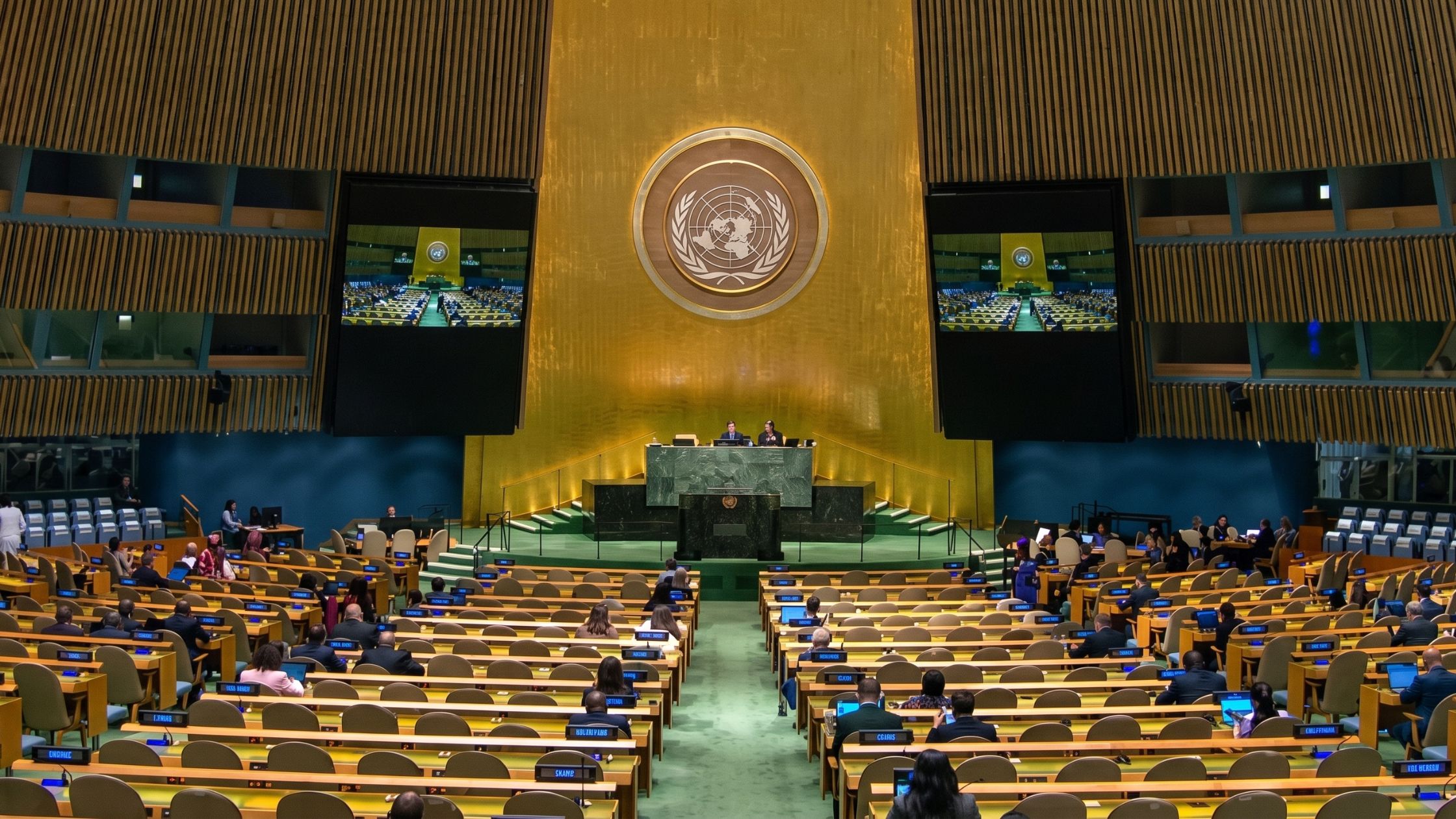
The 11th plenary meeting of the General Assembly is called to order. The assembly will hear an address by his excellency, Teneti Maamau, President and Minister for Foreign Affairs and immigration of the Republic of Kiribati. I request protocol to escort his excellency and invite him to address the assembly.
President Teneti Maamau (01:36):
Mr. President, Mr. Secretary General, excellencies, distinguished heads of states and governments, ladies and gentlemen, in the name of Almighty God in whom we place our trust [foreign language 00:01:47]. On behalf of the government and the people of Kiribati, I extend our warmest congratulations to you, Mr. President, on your election to preside and lead this 81st session of the United Nations General Assembly. Kiribati assures you of our full support and cooperation as you undertake this important responsibility. Mr. President, we meet today at a difficult moment. Conflicts continue to claim lives and displace communities, human rights continue to be violated. Humanitarian crisis persist. Development gains are being reversed in many parts of the world. Inequality remains entrenched while climate change places additional pressure on the communities already confronting significant development challenges, it is therefore fitting that the theme of this 81st session is Restoring Trust, Managing Transformation, a United Nations that Delivers for All.
(03:16)
This theme is both timely and relevant. Trust cannot be restored by words alone, it must be strengthened through implementation, accountability and results that improve the lives of our people. For Kiribati, the theme reaffirms our shared duty to strengthen the United Nations and ensure it serves everyone. Mr. President, Kiribati is an ocean nation, we are a big ocean sustainable state. Our economy, food security, livelihoods, culture, and the way of life depend on healthy, sustainable marine resources. Sustainable management is essential to our long term developments, and we call for increased efforts and partnerships to have agreeable progress towards SDG 14, which is to conserve and sustainably use the oceans, seas and marine resources for sustainable development. The 2026 Sustainable Development Goals Reports reminds us that our oceans and fisheries continue to face mounting pressures from overfishing, illegal and reported and unregulated fishing, pollution, warming, and acidification. The entry into force of the biodiversity beyond national jurisdiction agreements marks an important step towards stronger and more equitable ocean governance.
(05:11)
Kiribati is proud to have signed and ratified these agreements and calls on member states to recognize the vital importance of our shared oceans and to work collectively to translate the agreement's historic ambition into meaningful global action. Mr. President, the sustainability of our ocean and fisheries is closely linked to the changing climate and the pressures we face on our marine resources are increasingly compounded by its impacts. Climate remains one of the most pressing challenges to our development and the way of life. Sea level rise, coastal erosion, salt water intrusion and extreme weather events continue to place pressure on our communities, infrastructure, water security and livelihoods. The Intercontinental Panel on Climate Change six assessment reports reinforces the urgency of these challenges, and particularly the risk faced by small island states. Through our long-term national development vision, the Kiribati vision for 20 years, our national priorities and the national policies, we continue to invest in resilience infrastructure, water security, coastal protection, disaster preparedness, renewable energy and community-based adaptation.
(06:56)
Our objective is clear, to continue building a wealthy, healthy and peaceful Kiribati, where our people can live with dignity, in peace and with opportunities. Renewable energy is increasingly important to Kiribati developments and energy access. We therefore see greater investment in renewable energy as an important opportunity to reduce our reliance on imported fossil fuels and strengthen the resilience and sustainability of our energy sector. But national action must be matched by international action. We call for great ambition, stronger support for adaptation and climate finance that is adequate, predictable and accessible, particularly for small island developing states. Kiribati recognizes the importance of international law in addressing climate change. The International Court of Justice advisory opinion on climate change advances climate justice by affirming that all states have binding duties to protect the climate system and achieve deep, rapid and sustained greenhouse gas reductions consistence with limiting warming to 1.5 degrees Celsius. We welcome growing recognition that climate resilience must be locally owned and driven. The Pacific Resilience Facility is a Pacific owned mechanism that strengthens the region's capacity to finance climate and disaster resilience. The Pacific's co-hosting of COP31 with Türkiye later this year further demonstrates the value of local action. These initiatives also show their strong, genuine partnerships can sustain locally led development. Mr. President, partnership continues to shape international cooperation as we believe that we are stronger when we work together. At a time when multilateralism faces growing challenges, partnership remains one of our most powerful affirmations of what we can achieve collectively. Kiribati reaffirms his support for frameworks that embody the spirit of partnership, including the Antigua and Barbuda agenda for SIDS (ABAS) and the specifics for the future, which provide important foundations for strengthened international cooperation, solidarity and collective action. As the 2030 agenda enters its final years, partnership must remain central to accelerating SDG progress.
(10:12)
Kiribati recently presented its second Voluntary National Review, VNR, reaffirming our commitment to the 2030 agenda. We value our longstanding diplomatic relations with traditional partners and welcome countries seeking new partnerships based on mutual respect, shared interest, transparency, sovereign equality and respect for our national priorities. This year, following the submission of our second VNR, my government convinced its first development partners forum on Christmas Island or Christmas Island, which we highly value as the world's largest coral atoll and the first island to see each new day's sunrise. This forum strengthened partnerships between Kiribati and its development partners and showcase two flagship projects critical to accelerating economic growth and sustainable development. Participants included Australia, the People's Republic of China, the European Union, New Zealand, Japan, the United States of America, the World Bank, the Asian Development Bank, and the UN agencies. We thank our partners and look forward to advancing our shared interests under the forum's outcome documents we call the Christmas Partnership Accord 2026.
(11:58)
Mr. President, ultimately development depends on people, our most valuable resource, making education a vital investment. Kiribati is committed to expanding access to quality, inclusive relevant education while strengthening skills, development skills development, vocational training, digital learning and opportunities for young people. Health is equally fundamental. We continue to strengthen our health systems across our widely dispersed and remote islands, improve access to essential services and address both communicable and non-communicable diseases. Healthy and educated population is the foundation upon which every other national priority rests. Mr. President, we cannot speak about development without speaking about women and youth. Kiribati remains committed to gender equality and empowering women and girls. Our election earlier this year to the Commission on the Status of Women, the first time Kiribati has secured a seat on this UN body, is a significant milestone reflecting our determination to advance women's rights nationally and globally. We will expand opportunities, prevent violence and promote women's economic empowerment and leadership.
(13:42)
Our youth meanwhile represent not simply the future of Kiribati, we must provide them with education, employment, skills, technology, leadership opportunities and spaces where they can contribute, and one of those spaces is sports. Kiribati will host the 2030 Micronesian games, which we intend to use to leave a lasting legacy for our young people. We invite our regional and international partners to join us in this endeavor.
(14:22)
For Kiribati on peace and security, Mr. President, Kiribati is a peaceful nation, yet distance does not make a difference to the suffering caused by war and conflicts elsewhere. The people of every nation deserve peace. We reaffirm their disputes must be resolved peacefully in accordance with the international law and the principles of the United Nations charter. For island nations such as Kiribati, respect for international law is fundamental to our security, sovereignty and stability of the international system. Kiribati is proud to contribute in our own way to international peace and security to the service of our police officers under the United Nations flag. For Kiribati, this is an expression of our belief that even the smallest country can contribute to global peace. For Pacific people, the consequences of nuclear weapons are not merely historical, our region bears the human and environmental legacy of nuclear testing. As state parties to the Treaty on the Prohibition of Nuclear Weapons, we remain committed to advancing the treaties and humanitarian objectives and establishing an international trust fund for nuclear weapons victims.
(16:05)
As co-chairs with Kazakhstan of the recent international meeting on victim assistance and environmental remediation, we thank the secretary general for convening this important meeting and for keeping the needs of affected communities at the center of our collective efforts. Peace and security must also keep pace with emerging threats in the digital domain. The East Micronesian Cable landed in Tarawa last year, connecting Kiribati with Nauru and the Federated State of Micronesia, transforming our connectivity and digital environment. However, it also creates vulnerabilities with limited redundancy and technical capacity, island states face threats including cyber crime, critical infrastructure attacks and ransomware and non-line arms that can undermine security and development. Your excellencies, Kiribati comes to this assembly not simply to speak of the challenges we face, we come to speak of the future we choose. Allow me to close Mr. President by bestowing upon the United Nations and all its members and all its staff, our traditional blessings of the Maori, [foreign language 00:17:41], meaning abundant health, peace and prosperity. I thank you.
Dr. Khalilur Rahman (17:57):
On behalf of the assembly, I wish to thank the President and Minister of Foreign Affairs and immigration of the Republic of Kiribati. We shall now continue the general debate. The assembly will hear an address by his excellency, Hussain Mohamed Latheef, Vice President of the Republic of Maldives. I request protocol to escort his excellency and invite him to address the assembly.
Vice President Hussain Mohamed Latheef (18:57):
Mr. President, Mr. Secretary General, excellencies, ladies and gentlemen, [foreign language 00:19:08]. I congratulate you Mr. President on your election as president of the 81st session. You can count on the full support of the Maldives as you lead this assembly. I also thank former president of the General Assembly, Her Excellency, Annalena Baerbock, for her leadership of the 80th session. This year's theme, Restoring Trust, Managing Transformation: A United Nations that delivers for all, captures the task before us. Trust will not be restored by wars alone, it will be restored by what this organization delivers for every country, large or small. 37 years ago, the Maldives asked this assembly to face a simple truth, that small state can be highly vulnerable to external threats and acts of influence.
(20:16)
In response, this assembly adopted resolution 4451, an initiative led by the Maldives, informing the importance of protecting the sovereignty and territory integrity of small states. That was true then, and it is true even today, but the threats have evolved. Insecurity now travels through sea lanes, supply chains, financial markets, digital networks and new technologies. Today, sovereignty can be weakened without a single border being crossed, it can be undermined when external powers limit a state's freedom to choose. This is why the Maldives comes before this assembly with a clear message, "Every state, large or small, must have the freedom and capacity to shape its own future, a sovereign future, and that future begins with peace."
(21:25)
The Indian Ocean must remain peaceful. It must remain as a region where trade can flow and where states can prosper. Regional competition among major powers must not limit the choices of smaller states. Conflict does not have to reach our shores to affect us. In today's interconnected world, a crisis far away can quickly become a crisis at home. Interruption to maritime traffic through the Strait of Hormuz raises fuel prices, it affects food supplies and air travel. The consequences of this are felt across tourism and public finances in the Maldives. The Maldives therefore condemns the closure of the Strait of Hormuz. The strait must remain open and safe.
(22:29)
The Maldives further condemns the attacks on Saudi Arabia, United Arab Emirates, Bahrain, Qatar, Kuwait, Oman, and Jordan. The Maldives appreciates the diplomatic efforts of Oman, Pakistan and Qatar to deescalate the crisis and bring the parties together. The right to a sovereign future must belong to all, and nowhere is that right more brutally denied than in Palestine. If this genocide and war crimes against Palestinian continue and their actions are not confined to Gaza, its military attacks across the region have violated the sovereignty of other states. Security cannot be built by exporting insecurity, nor can any country demand respect for its sovereignty while violating the sovereignty of others.
(23:34)
No state should be shielded from accountability by its power or political alliances, but condemnation alone is not enough. Every member of state must ask, "What have we done to end this violence?" The United Nations must ask itself the same question. The problem is not a lack of law, the rules are clear. What is absent is equal application. Humanitarians, international law cannot bind the weak and bend for the powerful. The same rules, the same standard, no exception. Israel's genocide in Gaza must end. Israel's illegal occupation of Palestine and other Arab land must end. Illegal settlements must end.
(24:36)
Humanitarian assistance must reach Palestinians safely, rapidly and at scale. International courts and the resolution of this organization must be respected and implemented. For the Palestinian people, a sovereign future means freedom, dignity, self-determination, and the right to live their security in their own state. The Maldives will always stand with Palestinian people and their inalienable right for their future. This is why I reiterate our call for the recognition of independent and sovereign State of Palestine based on the pre-1967 borders with East Jerusalem as its capital. And if this organization is restored trust and deliver for all, Palestine must become a full member of the United Nations.
(25:43)
Conflict is not the only threat to sovereignty. Forces beyond our borders can also limit a state's freedom to shape its own future. For seeds like the Maldives, none is more consequential than climate change. For seeds, climate change is altering the very physical foundations of our nations. Sea level rise is therefore not simply an environmental concern, it is a matter of national planning and national security, it is a matter of sovereignty, let there be no doubt. Rising seas may alter our shores, but they will not erase our statehood. They will not reduce our rights, they will not weaken our maritime entitlements and they will not diminish our national agency.
(26:39)
Our response must be to adapt, innovate and build, but resilience demands the means to act, that means finance must reach those who need it at the scale, at the speed, and on the terms needed to build resilience. This is why COP31 in Antalya must be a COP of delivery. Implementation must be the measure of commitment. We must move faster, we must speed up 2030 agenda and we must turn ABAS into measurable progress for seeds. For island nations, that progress cannot be separated from a healthy and sustainably managed ocean, therefore, the first conference of the parties to the BBNJ agreement must deliver from day one.
(27:45)
Ultimately, global commitments matter only when they enable progress at home. His excellency, President Dr. Mohammad Muizzu has set a clear ambition for the Maldives to become a developed country by 2040. We are pursuing that goal by rising productivity, divesting our economy, building resilient infrastructure, expanding renewable energy and investing in our people. Our future will be built by Maldivians, but the international system can widen or narrow our choices. Technology transfer, resilient supply chains, and accessible finance, expand choice. Technological dependence, external shocks and unsustainable debt limits it, this is why reform of the international financial architecture matters.
(28:48)
We must implement the Sevilla Commitment and deliver on its promises on finance, debt and reform. Earlier this year, the Maldives joined other developing countries in launching the BROWAS platform. It must become a lasting mechanism that gives developing countries not just a place in the financial system, but a voice in shaping it. But for states, great agency, also depends on progress at home. We must build our institutions, improve stability and attract responsible investment and meaningful partnerships and these partnerships must build national capacity and support national ambitions. Partnerships must solve national needs, strengthen what we have and leave us more capable than before. Our shared challenges can become shared opportunities. This is the spirit of President Dr. Mohammad Muizzu's Maldives First policy.
(29:55)
Partnership built around respect, national interest, and mutual contribution, and the same principle must guide the technological transformation before us. Artificial intelligence offers significant opportunities. For small states, AI can close distance, it can help overcome scale, and it can put better healthcare, education, and public services within reach, but these opportunities must be shared. Every country must have a voice in shaping the global rules for AI. The digital future should strengthen our ability to serve our people better, not create new forms of dependence, and as the world transform, so must the United Nations. The UN AI initiative is an opportunity to reduce duplication, improve accountability, and focus resources on results, but efficiency must not be measured simply by what we got, it must be measured by what we deliver and the United Nation must not retreat from the countries that need it most in the name of efficiency.
(31:18)
Reform must preserve a meaningful UN presence on the ground, particularly in seats. The UN development system must respond to the needs of programmed countries and remain guided by relevant international frameworks. The reform process must be member state-led. It must be inclusive and transparent. This is how reform will restore trust by bring the United Nations closer to the people and the countries it serves. Reform must also confront one of this organization oldest weaknesses, unequal representation. The Security Council cannot reflect the world of 1945 while deciding for the world of today. It must be expanded in both permanent and non-permanent categories.
(32:17)
States must have a rotating seat. Africa must receive the representation long denied to it and the veto must be abolished, after all, representation is not merely symbolic. Who sits at the table shapes what the table sees. Small states understand how closely climate, finance, trade, supply chains and security are connected. We also know that international law is our strongest safeguard against unequal power. That principle must remain at the heart of the international system. The Maldives will take its seat on the Economic and Social Council for the 2027 to 2029 term. We are seeking election to the Human Rights Council for the 2028 to 2030 term, and we seek the support of member states for a seat on the UN Security Council for the 2033 to 2034 term. We do so because small states must be decision makers, not decision takers. Representation matters not only within the bodies of this organization, but also in its leadership.
(33:53)
As Secretary General Gutierrez approached the end of a decade of service, the Maldives thank him for his leadership and commitment to international cooperation.
Vice President Hussain Mohamed Latheef (34:00):
His leadership and commitment to international cooperation. The process to choose his successor must be transparent and based on merit. It must draw from the full breadth of talent available to this organization. For more than eight decades, every secretary general has been a man. It is time for a woman to lead this organization. A leader who will defend the charter without exception, who can turn reform into delivery, and who will listen to all member states, including smallest. The task ahead is immense. The choice we make must meet it. So what should this assembly do? The Maldives proposes a simple test for a sovereign future. When we act on conflict, climate, finance, technology, or institutional reform, let us ask: does this decision expand a state's freedom to choose? Does it build national capacity and reduce dependence? Does it protect sovereignty and independent decision making? If the answer is no, we must change course. And we must hold every state to the same standard. Let this be the measure of international corporation, not what we promise, but what we make possible.
(35:37)
This is the measure of a United Nations that delivers for all. In 1989, the Maldives asked this assembly to protect small states from external threats. Today, we ask it to protect something just as fundamental: every state's freedom to choose its own future. A future chosen by its people, a future grounded in international law, a sovereign future for every state. I thank you.
Dr. Khalilur Rahman (36:23):
On behalf of the assembly, I wish to thank the Vice President of the Republic of Maldives. The assembly will now hear an address by His Excellency, Ali Faleh Al-Zaidi, Prime Minister of the Republic of Iraq. I request protocol to escort his excellency and invite him to address the assembly.
H.E. Ali Faleh Al-Zaidi (37:19):
In the name of Allah, the Most Gracious, the Most Merciful, Mr. President of The United Nations General Assembly, Your Excellency the Secretary General of the United Nations, your excellencies, esteemed ladies and gentlemen, peace be upon you and God's mercy and blessings. It is a with great honor and pride that I stand before this international forum representing the Republic of Iraq, The home of the first civilizations, and where writing and law were born, and one of the founding members of the United Nations. I stand here to renew my country's commitment to the United Nations charter and principles and to present Iraq's vision for its future, its region, and the world at this critical juncture. Iraq, perhaps more than others, has experienced wars and the damage they cause. We have lived through the conditions they create, along with the siege and terrorism imposed on us. Our people have paid a hefty price and lost the lives of their children, their resources, and their development opportunities.
(39:11)
Despite these difficulties that have made our country, over several decades, an arena of war and conflict, today we are confidently presenting our vision for the future. Iraq aspires to exercise its influence and have an impact as an effective economic power in the region and as a bridge for dialogue and cooperation among the peoples of the region. Ladies and gentlemen, our vision at this stage is based on our national will to restore the sanctity of the law, enhance state institutions, and strengthen citizens' trust in them. These are our governing priorities. We are striving to ensure that the state is the ultimate decision maker in matters of peace and war, and that weapons and tools of power remain in the hands of its constitutional institutions. This is so that the law is the final authority and national interest is the compass. Our implementation measures in this field are moving on track, as they represent the basis for building a state based on institutions, protecting sovereignty, ensuring stability, and creating the environment necessary for development and investment.
(41:28)
With the end of the International Coalition's mission in Iraq, we are moving our relationship with our strategic partners to a new phase, moving from military cooperation to economic and development cooperation in service of our common interests. In this manner, we add to Iraqi's victory over terrorism at a double determination and momentum to finish building our military and security capacities in order to protect our country, our people, and our sovereignty. In order to sustain integration with our international friends, we call on all partners to exercise border control, address gaps, and remain constantly vigilant in order to prevent the formation of an environment conducive to extremism.
(42:47)
Ladies and gentlemen, in the context of institutional reform, our government is fighting a battle against corruption and for the protection of public funds. We are moving forward with sustainable core solutions in order to increase performance efficiency and improve providing services. We aim to build a strong state and a diversified and modern economy that keeps pace with global technological and digital transformations, and accordingly, we are working to employ all successful expertise and innovative experiences in the world of economics, finance, and business in service of a renaissance of economic and financial reform for my country. We also do this to provide a safe environment for national and foreign investment.
(44:10)
This Vision is based on the great potential Iraq possesses in terms of resources and investment opportunities in the fields of energy, industry, agriculture, transport, and technology. Not to mention Iraq's exceptional geographical location, which connects its economy to the world. In this context, our vision aims to move Iraq to a stage where it can be an effective production partner in the region by gradually reducing the role of the rentier economy, strengthening open market policies, developing production and export capacities, and investing in infrastructure and services. On this basis, we have developed the appropriate roadmap to support the private sector, provide the necessary legal, tax, and customs facilities and guarantees for the growth of business and foreign trade, and build effective partnerships with the global market to accelerate achieving sustainable development.
(46:05)
In the field of global energy, Iraq's influence is prominent, as our government is adopting an ambitious program to increase the production of crude oil in a manner consistent with the size of our proven reserves. Our government is also working to develop gas fields and expand refining capacities and our capacities to produce derivatives, and we are also working to improve our petrochemical industry capacities. Our ambition is for Iraq to be a global hub for energy production and to leverage its potential to promote regional and international security and stability in a sustainable manner. Nevertheless, we express concern regarding developments concerned with freedom of transport and maritime navigation and the crisis this has caused in terms of the rise of global energy prices. In order to contain the subsequent risks and the consequences on our peoples, we are working to diversify our oil export ports and develop energy lines and corridors linking Iraq, Turkey, Jordan, and Syria in order to reach global markets, with the aim of contributing to energy security and diversifying supply routes. Excellencies, economic diversification on the basis of genuine partnerships is a central strategic objective of our economic policy, therefore, our government has set among its priorities the goal of promoting economic and industrial development in all fields. The development road project comes as Iraq's comprehensive vision for regional complementarity, integration, and stability.
(48:45)
It represents a vital gateway and a strategic corridor for trade, investment, industry and energy connecting the east with the west, starting from the Grand Al Faw Port to Turkey, and from there onto Europe. We want for this project to be open to partnership with all our neighbors and friends because we believe that economic interests create prosperity. When the countries of the region are connected through ports, railways, power lines, trade and investments, they have a greater interest in preserving stability. Here from the United Nations, we say to the world, invest with Iraq. Iraq has resources, markets, a good location, and the necessary will to build a new economy.
(50:10)
Our government is hard at work to develop mutually beneficial partnerships, create employment opportunities, transfer technology and knowledge, and develop Iraq's productive capabilities. Ladies and gentlemen, the security of states and the maintenance of peace are a shared responsibility as per the charter of the United Nations. True stability is not built through wars, but through common interests that make cooperation more feasible than conflict. Iraq's vision is based on contributing to the region's transition from conflict to integration, from competition to cooperation, from resource depletion to investment in development. On this occasion, we extend our hands to everyone on the basis of respect for sovereignty, non-interference, good neighborliness, strengthening mutual interests, and adopting dialogue as a means to address differences.
(51:42)
Based on these principles, Iraq renews its position in support of dialogue and diplomacy to diffuse any crises. We also call for support for efforts for the passage of trade through Iraqi territory with great facilities in order to provide alternatives to complex trade corridors. Ladies and gentlemen, Iraq believes that our responsibility towards the people's, their security, and stability requires working to end conflicts through negotiation in order to secure a safe future and prevent future wars. Here at the United Nations headquarters, there is a replica of the Stele of the Babylonian King Hammurabi. It has an inscription which reads, "Laws are made to prevent the strong from oppressing the weak." In today's world, we find the weak being oppressed because it is the law of the powerful that governs, not the power of the law, therefore, the question of Palestine remains central to any discussion of stability in the region.
(53:44)
There will be no room for security in the Middle East without a just solution for this issue and without establishing the right of the Palestinian people to their land, to self-determination, and to establishing their sovereign state. We stress here the paramount importance of facilitating humanitarian access and the protection of civilians. Ladies and gentlemen, the security we seek is not limited to halting conflicts, but rather includes confronting climate change, the effects of desertification, and water scarcity. These are challenges that Iraq faces that affect its food security, therefore, we affirm that we hold steadfastly onto our just and legitimate water rights, and we call for the joint management of water resources in accordance with the principles of cooperation and international law. In terms of risks, we continue to confront organized crime by cooperating with all friends to repel the dangers of organized crime and to abort the cross-border drug trade. We call for more information sharing and international coordination to ward off this danger that threatens societies.
(55:36)
Amid these challenges, the wellbeing of the Iraqi people remains our ultimate objective and the focus of all of our efforts. Given the high proportion of young people in our society, we seek to make them a true driving force of the future economy through education, the diversification of employment opportunities, support for entrepreneurship, and the advancement of digital economy. At the same time, we remain committed in accordance with the Constitution to protecting human rights and freedoms, promoting women's participation, ensuring child welfare, and preserving the ethnic, religious, and cultural diversity of our country. Ladies and gentlemen, we confidently call upon you to engage more openly with Iraq, as it is a genuine partner capable of contributing to the promotion of security, the strengthening of stability, and the acceleration of development across all sectors.
(57:06)
Today we say Iraq has never been on the margins. Rather, it is the heart of history beating in the modern world. Iraq is a nation worthy of partnership as we move toward the future. In conclusion, we reaffirm our support for the United Nations' role and express our appreciation for its efforts, which have embodied collective action in support of Iraq through the United Nations Assistance Mission for Iraq (UNAMI) and we underscore our commitment to fostering productive cooperation with the organization and wish its success in its endeavors to mitigate the effects of wars and the consequences of conflict around the world. May God's peace, mercy, and blessings be upon you all.
Speaker 1 (58:11):
On behalf of the Assembly, I wish to thank the Prime Minister of the Republic of Iraq. The Assembly will hear an address by His Excellency Nawaf Salam, President of the Council of Ministers of the Lebanese Republic. I request protocol to escort his excellency and invite him to address the assembly.
H.E. Nawaf Salam (58:53):
Mr. President, Mr. Secretary General, the more I reflect on the theme of this session of the gender assembly, restoring trust, and managing transformation, a United Nations that delivers for all, the more convinced I become of the wisdom of that choice. Without mutual trust, peace and security cannot take root among states, nor can cooperation among them flourish. More than 80 years ago, the United Nations was founded on the promise that the force of law would replace the law of force, yet we still live in a world of multiplying wars and conflicts, a world that spends more on armaments than on development. Civilians remain the primary victims while millions face displacement, hunger, and deprivation.
(59:54)
The problem is not the absence of rules, it is their selective application, if not their outright non-application. The sovereignty of states cannot be untouchable in one place and negotiable in another, nor can the rules of international law apply to some but not to others. Restoring trust requires respect for international law. It requires investment in preventing conflicts before they erupt and in development before poverty and deprivation become a source of violence, extremism, and terrorism. Development too is a matter of peace. There can be no sustainable peace in a world of widening economic disparities where some states spend more on servicing their debt than on the health of their citizens and education of their children. This does not absolve developing countries of the responsibility to undertake reform, combat corruption, and build institutions, but those efforts require a fairer and more equitable international economic order, one that offers them genuine opportunities to advance.
(01:01:15)
Mr. President, our shared responsibility is equally evident in the face of the profound transformations our world is undergoing. Climate change threatens the lives and livelihoods of millions. Those countries that have contributed least to it bear its gravest consequences. This calls for equitable adaptation, finance, and technology transfer. At the same time, the artificial intelligence revolution is opening unprecedented horizons for progress across every sphere of life, yet it also raises challenges for the future of work and for human rights and fundamental freedoms. This calls for international governance that places the human being with his or her freedom and privacy at the heart of this transformation. Above all, we must not allow an artificial intelligence divide to emerge on top of the existing gaps in wealth and development.
(01:02:22)
Restoring trust requires that every individual feel that the law protects them, that development do not exclude them, and that progress leaves no one behind. Mr. President, if restoring trust is a challenge facing our world today, for Lebanon, it is not a mere slogan, just as managing transformation is not an option up for debate. Together, they constitute the very essence of the mission we pledged before our people, before our Arab brothers, and before the entire world on the day I was entrusted with leading the government of Lebanon. We assumed this responsibility at a time when our country faced three existential challenges. The first was to regain the trust of its people after the financial collapse and the Beirut Port explosion and the tragedies and wounds they left behind. The second was to reclaim its national decision making so that no authority stands above that of the state, no weapons exist outside its armed forces, and no decision on war and peace is taken outside its constitutional institutions. The third was to recover all of its territory from Israeli occupation and to extend its sovereignty over the entirety of its national soil through its own forces in implementation of the Taif Agreement and insincere respect for the relevant international resolutions on Lebanon.
(01:03:55)
Foremost among these is Resolution 1701, which remains to This day, a fundamental point of reference governing relations between Lebanon and Israel. Trust rebuilt, decision making reclaimed, land liberated, that is the equation for Lebanon's recovery. These are not three separate challenges, they are three facets of a single cause. Restoring a state that its citizens trust, that is master of its own decisions, and that exercises sovereignty over the whole of its territory.
(01:04:36)
Mr. President, first, the trust we seek to restore is not trust in words. It is trust in institutions that protect rights and a judiciary that guarantees justice and an economy that restores prosperity to the people and gives young people the opportunity of a better future. We cannot speak of restoring trust without recalling the Beirut Port explosion. The wound of the 4th of August remains open. It cannot heal without truth, justice, and accountability, and these will inevitably come. Some may feel that our government has not yet fulfilled all of its commitments. We do not claim that the task is complete, but fairness demands that we not overlook the scale of legacy we inherited. Paralyzed institutions, a public administration of diminished effectiveness, an economy stripped of the foundations of growth, and a state weakened by compounding crises and by decades of external interference.
(01:05:51)
Even though we have not used the difficulty of our circumstances as a pretext to retreat from our commitments, and we will not retreat. Lebanon has launched reforms on several fronts, namely revitalizing the public administration, strengthening the independence of the judiciary, modernizing the media law, and abolishing the death penalty. It is also advancing towards the completion of financial reforms aimed at restoring order to the financial system and recovering depositors funds. These reforms should pave the way for an agreement with the IMF. Such an agreement is an indispensable tool for restoring international confidence in Lebanon and a gateway to securing the financing needed from all our regional and international partners for economic recovery and reconstruction. Our aim in pursuing reform is not to ask our people to renew their trust in the state, rather, through reform, we seek to rebuild a state worthy of its people's trust.
(01:07:05)
Second, a state does not regain the trust of its citizens through reform alone, but also by reclaiming its national decision making. In that spirit, we did not merely affirm the principle that weapons must be exclusively in the hands of the state and that decisions on war and peace rest solely with its constitutional institutions. We translated that commitment into decisions taken by the council of ministers, notably in August and September of last year, and again in March of this year. That was after Lebanon found itself in a war that it did not choose. It was imposed upon us despite our repeated warnings, again, repeated warnings of the dangers of being drawn into it. Has the war in the region widened and initiatives to end it multiply...
H.E. Nawaf Salam (01:08:00):
... region widened and initiatives to end it multiplied. We held fast to a non-negotiable principle: No one speaks for Lebanon and no one negotiates on its behalf, except the Lebanese state through its constitutional institutions.
(01:08:20)
It is true that Lebanon is affected by developments in its surroundings. It is true that Lebanon is affected by developments in its surroundings. That does not mean, however, that we accept its becoming, once again, an arena for the conflicts of others or a bargaining chip in their hands.
(01:08:46)
Lebanon's future will not be decided on its behalf, nor may its security and stability become the price of settlements concluded in its absence.
(01:08:57)
Third, our position on the war has been clear from the outset, we want it to end. We want the ceasefire consolidated. We want Israel to withdraw from all Lebanese territory up to our internationally recognized borders in accordance with the 1949 general Armistice Agreement and as affirmed by Resolution 1701. We want the release of all our detainees, the safe and dignified return of our people to their villages and towns and the reconstruction of what the war has destroyed.
(01:09:31)
It was in that spirit that the Lebanese state entered into negotiations with Israel under the kind auspices of the United States of America and its president, for which we are grateful, with a view to reaching arrangements that ensure an end to the war and the restoration of Lebanon's full sovereignty.
(01:09:53)
The sovereignty to which we are committed is indivisible. It requires Israel's withdrawal from all Lebanese territory. It equally requires extension of the authority of the Lebanese state through its own forces over the entirety of its territory with weapons held by the state alone.
(01:10:11)
It is on these two principles and on the basis of reciprocity and phased implementation that the tripartite framework reached in the negotiations rest.
(01:10:23)
However, the success of any agreement is measured, not by declared intentions, but by fulfillment of commitments. What is required today, therefore, is to complete the translation of this framework into practical steps within a clear timetable and with a verification mechanism that ensures the implementation of all its provisions.
(01:10:52)
Mr. President, in this context, I must pay tribute to the role played by the United Nations Interim Force in Lebanon, UNIFIL, and to the courage of its leadership, personnel and staff, and their sacrifices in preserving stability, supporting the Lebanese armed forces and implementing Resolution 1701.
(01:11:17)
To all the countries that have contributed troops to this force, Lebanon extends its profound thanks and appreciation.
(01:11:25)
We have taken note of Security Council Resolution 2790 of 2025, which decided to terminate UNIFIL's operations at the end of this year and to begin its gradual withdrawal and requested the Secretary-General to explore available options for the continued implementation of Resolution 1701.
(01:11:48)
What we wish to stress here and today is the need to avert the vacuum that UNIFIL's withdrawal could create were it to take place without agreement on a new international force to replace it. Such a force should ensure the continuation of monitoring, reporting and liaison functions and its role should compliment the requirements for implementing the tripartite framework.
(01:12:20)
Mr. President, recovering the land does not mean only the withdrawal of occupying forces. It also means the return of its inhabitants and the revival of life in their villages and towns.
(01:12:35)
The war has left behind a vast humanitarian crisis in Lebanon. It has caused extensive destruction to housing, public facilities, infrastructure and productive sectors and has deprived large numbers of Lebanese of their homes and livelihoods.
(01:12:55)
While we thank the United Nations entities and our international partners for their humanitarian contributions, we call, at the same time, for continued funding to meet the basic needs of those affected, particularly the displaced, in parallel with the requirements of early recovery as well as reconstruction and development.
(01:13:21)
The reconstruction of the south is not merely the rebuilding of stone, it is the rebuilding of people's lives, the restoration of their livelihoods and affirmation of the right to live in safety and dignity on their land.
(01:13:38)
Mr. President, the Lebanon that stands before you today does not shirk its responsibilities, nor does it ask others to do what it is duty-bound to do itself. We are shouldering our responsibility for reform and for extending the authority of the state over the entirety of our territory. But we are entitled to ask the international community to shoulder, in turn, its responsibility to ensure respect for Lebanon's sovereignty and the implementation of resolutions of international legitimacy.
(01:14:14)
Mr. President, there can be no lasting stability in Lebanon without lasting stability in our region. And there can be no stability in the region as long as this organization remains unable to enable the Palestinian people to exercise their inalienable right to self-determination like all other peoples of the world, no less and no more.
(01:14:50)
This is despite the dozens of resolutions adopted by this assembly and by the Security Council that lay clear foundations for that right, not to mention the Arab Peace Initiative.
(01:15:07)
As for the tragedy of wounded Gaza, it has put the conscience of the world and the inability of its institutions to a test from which there can be no escape.
(01:15:20)
I must stress here that cutting of funding to UNRWA or undermining its mandate does not end the rights of Palestinian refugees even if that's what some seek. On the contrary, it compounds their suffering, jeopardizes the prospects for a just and lasting solution to their cause and increases the burden on host countries, foremost among them, Lebanon.
(01:15:47)
With regard to the security situation in the region, Lebanon wishes to renew its solidarity with the states of the Arab Gulf and with Jordan in the face of Iranian attacks that threaten regional security and the freedom and safety of maritime navigation.
(01:16:05)
The effects of these attacks are not confined to theaters of confrontation, they extend to supply chains, to the prices of goods, particularly food and energy, and to inflation rates.
(01:16:21)
Mr. President, allow me to conclude by returning once more to the theme of this session of the General Assembly: Restoring Trust and Managing Transformation for United Nations that Delivers for All.
(01:16:43)
The truth is that we cannot call on the states of the world to change their conduct while failing to make the necessary changes within our own organization so that it delivers the results expected of it and regains the trust of the peoples of the world.
(01:17:03)
The reality is that the world has changed profoundly since 1945. The membership of the United Nations has grown nearly fourfold. Colonialism has ended. Africa has risen. Asia has been transformed and new powers have emerged. The balance of the global economy has shifted, yet the basic composition of the Security Council remains captive to a historical moment dating back to the end of the Second World War.
(01:17:39)
Africa and the Arab world cannot remain without permanent representation on the Council, nor can small and medium-sized states remain mere spectators to decisions that concern their security and their future. We know that Security Council reform is a complex matter, but the difficulty of reform is no argument against its necessity.
(01:18:05)
Indeed, reform of the United Nations must begin here with the Security Council, for it is the Security Council that bears primary responsibility for the maintenance of international peace and security. Therefore, once again, add Lebanon's voice to that of the majority of the members of our organization in calling for an expansion of the Security Council that achieves more inclusive and equitable representation.
(01:18:35)
Being realists, we do not call for the abolition of the veto, rather, we call for restraint in its use in cases of genocide, war crimes, crimes against humanity and serious violations of international humanitarian law.
(01:18:57)
We insist on reform of the United Nations only because we want it to be a more representative, more democratic and more effective organization. We want an organization true to the purposes and principles of its charter yet ever renewed so that it may rise to the challenges of our rapidly changing world and meet the aspirations of our peoples and their new generations.
(01:19:28)
I thank you.
Speaker 1 (01:19:37):
On behalf of the Assembly, I wish to thank the president of the Council of Ministers of the Lebanese Republic.
(01:19:49)
The Assembly will hear an address by His Excellency, Christophe Mirmand, Minister of State, Head of Government of the Principality of Monaco.
(01:19:58)
I request Protocol to escort His Excellency, and invite him to address the Assembly.
His Excellency, Christophe Mirmand (01:20:17):
President of the General Assembly, Secretary-General, heads of state, heads of government, delegates, your excellencies, ladies and gentlemen. I am addressing you as the representative of the smallest member state of this organization in terms of its land mass and one of the smallest in terms of its population, barely two squared kilometers bordering the Mediterranean.
(01:20:48)
And yet, in this forum, there are no small or large states. Here, every one of the 193 members has a voice, one alone and of the same weight. Here, the Charter only recognizes states equal in sovereignty, equal in rights, but also, and I wish to stress this point, equal in terms of responsibility because the equality that our organization bestows upon us is not a privilege that we enjoy, it is a responsibility that we bear.
(01:21:24)
This responsibility is our shared unique duty to uphold the law and multilateralism shared because no state, regardless of how powerful it is, can preserve peace alone or address global threats alone.
(01:21:40)
Unique because everybody must shoulder it without leaving it to others to honor the promise of San Francisco.
(01:21:49)
It is this message that His Serene Highness, Prince Albert II, the Prince of Monaco, charged me with bringing to this rostrum, with his greetings of trust and friendship.
(01:22:02)
President, the Principality of Monaco wishes sincerely to congratulate you upon your election to the presidency of this 81st session for which you have chosen the topic: Restoring Trust, Managing Transformation: A UN that Delivers for All. You can count on the full support of my country.
(01:22:27)
And I also wish to warmly thank the Secretary-General, Antonio Guterres, who is finishing his second mandate amidst particularly grave circumstances.
(01:22:42)
Why does a state such as mine believe so strongly in international law? The answer goes for all: when might makes right, it is the smallest states who are the first to be threatened. When force is regulated by the law, all of humanity is protected.
(01:23:03)
Sovereign equality between states, honoring commitments, peacefully settling disputes are therefore not abstract concepts, they are our front line of protection and yours too, with the balance as is set out by the Charter between the three pillars, peace and security, development, and human rights.
(01:23:24)
Nevertheless, this protection is today under assault. Rearmament is accelerating throughout the world. We are seeing the use of force once again as being another political tool for some. Trade is breaking down. And we're seeing a race to capture critical resources.
(01:23:45)
The private sector is also part of these power relations. We are now in the era of the geoeconomy. And this is fertile ground for disinformation, which undermines people's trust in their institutions and leads them to question verifiable facts.
(01:24:03)
Our belief has never been tried to such an extent since 1945. In Ukraine, the Middle East, Sudan, the Sahel, in many other places out of the media spotlight, civilians are paying the price for conflicts which have discarded the most basic rules of humanity.
(01:24:23)
And never since 1945 has the very legitimacy of states and multilateral bodies such as the UN being called into question to such an extent. Given this danger, let us recall our mission in the words of Dag Hammarskjöld, the second Secretary-General of the UN, "The UN was not created to take mankind to heaven, but to save humanity from hell." That is the exact scope of our task, and that is why we do not have the right to give up.
(01:24:55)
First, in Ukraine. For almost five years, a permanent member of the Security Council has been waging a war of aggression against the sovereign state in flagrant violation of the Charter.
(01:25:10)
From the very outset, Monaco condemned this aggression unambiguously and unreservedly. We voted in favor of all of the General Assembly's resolutions calling and demanding for Russian forces to withdraw. We took all restrictive measures aligned with EU measures. And we also provided our humanitarian supports to the Ukrainian people and hosted people displaced by the war. Our support is unwavering and it will remain so.
(01:25:42)
Monaco will never recognize any annexation of territory obtained through force. Allowing this for one state would be tantamount to allowing it for all.
(01:25:53)
the Principality welcomes the ongoing diplomatic efforts and hopes that they will lead to fair, comprehensive, lasting peace, respecting Ukraine's sovereignty and territorial integrity.
(01:26:08)
Next, to the Middle East. Monaco was greatly relieved by the ceasefire which entered into force in Gaza and the fact that the hostages were freed. Nothing can ever justify the acts of terror of the 7th of October, but nor can anything justify the price paid by the civilians in Gaza.
(01:26:29)
the Principality calls on all parties to strengthen the fragile ceasefire and to respect every stage of it, ensuring full, safe, unhindered humanitarian access. We support efforts to rebuild Gaza.
(01:26:47)
And we are concerned about the ongoing violence in the West Bank in the occupied territories, which ride rough shot over human rights and dishonor democratic values. Our belief remains the same: the only viable option is the two-state solution, Israel and Palestine living side by side in peace and security within safe and recognized borders. Any policy that makes that scenario less likely through settlement building or sowing terror makes peace less likely too.
(01:27:26)
In Lebanon too, Monaco supports deescalation efforts and calls on all parties to fulfill their commitments. First and foremost, Security Council Resolution 1701. The people of Lebanon have the right to a fully sovereign state in peace throughout its territory.
(01:27:47)
In the Persian Gulf, finally, tensions around Iran remain a source of deep concern. Monaco pays tributes to all the civilian victims of the conflict and reiterates its solidarity with the countries of the Gulf who have been affected by the attacks.
(01:28:03)
Here again, only negotiations can lead to a global agreement on the Iranian nuclear program and will prevent further escalation.
(01:28:12)
Above and beyond these crises, Monaco will continue to contribute to international corporation focused on the least developed countries through its supports to the International Committee for the Red Cross, the High Commissioner for Refugees, and the World Food Program through development aid geared towards the health, education, and empowerment of women and girls.
(01:28:39)
Restoring trust also means changing the organization itself. Monaco supports the UN80 Initiative to make the organization more streamlined, more understandable, more efficient and closer to people on the ground.
(01:28:55)
Still, the UN needs resources to function. My country fulfills its financial contributions in full and on time, and we call on all other states to do likewise.
(01:29:07)
But this necessary step is not enough in the light of the changes that have to be undertaken. That is why Monaco calls on the real leaders of the United Nations to rethink the architecture of our system from 2030, bringing on board the public and private sector, civil society, and educational and cultural hubs, streamlining processes, preventing mandate duplication, consolidating specialized agencies, regional centers, and the secretariat, and guaranteeing small states genuine inclusivity. There is plenty of work to do. The time of the law is patient, but this patience should not be confused with inertia.
(01:29:56)
In the same vein, the Principality is in favor of a reform of the Security Council to make it more representative to today's realities while also preserving its ability to act.
(01:30:11)
And we're also in favor of the revitalization of this general assembly, the house of equality between states.
(01:30:18)
This session will also see the election of the next Secretary-General of the organization. Monaco calls for a transparent, inclusive and rigorous process. After 80 years, the Principality hopes that women candidates will be seriously considered. The organization would do well to demonstrate, at its helm, the equality for which it stands.
(01:30:45)
Ladies and gentlemen, there is one area where multilateral trust has recently produced tangible results, and it is dear to the heart of His Serene Highness, Prince Albert II, and that is to say the ocean.
(01:30:57)
The entry into force of the agreement on marine biodiversity of areas beyond national jurisdiction, which Monaco was one of the first countries to sign and ratify, is a victory of the law over seizure, of cooperation over predation.
(01:31:15)
We now need to translate these commitments into acts to protect 30% of the ocean by 2030, to finally agree on an ambitious and binding agreement on plastics pollution and exercise extreme caution with regards to deep seabed mining.
(01:31:35)
The ocean is nobody's property, it is everyone's responsibility. Monaco will continue to do its part in this vital task, relying on science, which is the only universal compass.
(01:31:50)
And what goes for the ocean also goes for the climate. The Paris Agreement remains our common framework. Monaco will honor its commitments by reducing greenhouse gas emissions by 67.5% by 2030 and by achieving carbon neutrality by 2050.
(01:32:09)
the Principality calls on all countries to show more ambition in their national contributions and not to abandon island and coastal states, which are the most vulnerable because the climate crisis is no longer a distant threat, heat waves, fires and floods are multiplying. And the Mediterranean, which my country borders, experienced, last year, its second-highest surface temperature ever recorded.
(01:32:40)
And because science is being questioned, let us recall, as the prince did in COP30 in Belem, that science has never been as certain, as accessible, and as clear.
(01:32:53)
Four years before the 2030 deadline, the Sustainable Development agenda must not become the symbol of our broken promises. Let us be candid as we take stock. States alone cannot make progress. We need to have a renewed framework for cooperation with those who create wealth and shape innovation, businesses first and foremost, and civil society.
(01:33:22)
Lastly, preparing for the future and ensuring it benefits everyone means mastering technological changes. Artificial intelligence is creating enormous opportunities for human development, but it also entails genuine risks. The global dialogue on AI governance, which was held this year in Geneva, confirmed this. These technologies must remain at the service of humanity and the United Nations cannot remain a spectator.
(01:33:52)
Monaco supports the implementation of the Global Digital Compact and a new normative framework on AI based on law and shared ethical principles, respecting human rights and being accessible to all states.
(01:34:13)
Finally, the Principality calls for strengthened corporation to deal with cyber threats and for inclusive transitions, both within states and within societies.
(01:34:27)
President, when he received the Nobel Prize in literature, the great French writer, Albert Camus, defined the task of his generation thus, not to reform the world, but perhaps even greater, to prevent the world from destroying itself.
(01:34:48)
Today, that is our task, preventing the world from destroying itself, preventing law being destroyed by force, preventing trust being destroyed by mistrust, and preventing the planet from being destroyed under the weight of our negligence.
(01:35:08)
Trust is not decreed, it is won through deeds and through promises kept. That is the overarching principle that a state such as mine aims to fulfill, being consistent, keeping our word.
(01:35:25)
Ladies and gentlemen, on behalf of His Serene Highness, Prince Albert II, I wish to reiterate the commitment of Monaco to the United Nations, to its charter, and to the ideal that led to its establishment, saving future generations from the scourge of war and building together a common house where even the smallest states can take their rightful place, because here, the law protects them all. This pledge will only be fulfilled through the might of the law and not through might makes right.
(01:36:01)
Thank you.
Speaker 1 (01:36:08):
On behalf of the Assembly, I wish to thank the Minister of State, Head of Government of the Principality of Monaco.
(01:36:20)
The Assembly will hear an address by Her Excellency, Hilda Heine, President of the Republic of the Marshall Islands. I request Protocol to escort Her Excellency, and invite her to address the Assembly.
Her Excellency, Hilda Heine (01:37:03):
Mr. President. Mr. Secretary-General. Excellencies.
(01:37:11)
I ask every nation here, are we still willing to work together? The principles in the UN Charter affirmed by each one of us taking our sit in this hall are now tested, not by argument, but by neglect or ill-intention. The credibility and effectiveness of multilateral institution is imperative for small nations. It is past time to better turn the urgency expressed in political declarations and resolutions into results, not repetition.
(01:37:53)
We speak from our own experience when we underscore the importance of acting together. An institution that takes decisions collectively must also be accountable collectively.
(01:38:10)
Mr. President, the United Nations is long overdue to reflect and renew the same spirit with which our Marshallese people first came to the United Nation, by delivering an apology and acknowledgement of the harm caused by impacts from the 67 nuclear weapons tested on our islands during our time as a UN Strategic Trust territory between 1946 and 1958.
(01:38:43)
The sacred trust of the UN Trusteeship to ensure our wellbeing was jeopardized by these tests and the lack of due acknowledgement remains a moral failing.
(01:38:57)
For generations, our families have testified to displacement, illness, contamination, and loss. All of them, impacts to our core human rights.
(01:39:09)
As our survivors would say, and I quote, "This is a song that has been sung far too many times."
(01:39:18)
It was in the same building that the UN Trusteeship Council sat in session and voted on resolutions 1082 and 1493 in 1954 and 1956 respectively to effectively authorize further nuclear testing over the demands of our local leaders and many citizens.
(01:39:43)
The United Nations ultimately allowed the testing to continue, but the shock and tragedy of nuclear exposure in the Marshall Islands was a profound driver of the 1963 global ban on atmospheric testing of nuclear weapons.
(01:40:02)
We acknowledge the ongoing actions, dialogues, and complex legacy of the UN's administering authority, the United States, but the role of the United Nations cannot pass without comment.
(01:40:17)
For us and for fellow member states, this apology is an opportunity to reflect upon the past, to bring healing and closure to the Marshallese people. We carry no larger agenda other than to ensure that the United Nations will do better.
(01:40:40)
Mr. President, as we face a world in which scientists tell us overshooting the 1.5 degree temperature limit that we agreed in Paris is increasingly likely, we all need to wake up and act. Our focus now must be on preventing or minimizing the overshoot, shortening the time we spend above 1.5 and doing everything possible to fight our way back.
(01:41:10)
As we gather in Tuvalu, Fiji and Türkiye for this year's climate Pre-COP and COP, our response to the threat of overshoot must be overwhelming. A much accelerated transition away from fossil fuels is the only logical response. Continued investment in fossil fuels is not only immoral, but irrational.
(01:41:36)
Technologies exist which provides secure, stable, zero-emissions energy. We are employing them in my own country where, in the next 18 months, renewable energy will cut fossil fuel use in our remote outer islands by 88%, giving many access to electricity for the first time. We must do everything in our power to accelerate-
Her Excellency, Hilda Heine (01:42:00):
We must do everything in our power to accelerate the deployment of renewables and to reduce fossil fuel production and consumption with equal speed. This includes shipping, where we have the opportunity at the International Maritime Organization to adopt binding regulations that will place international shipping on a clear path to net zero by 2050 and generate the revenue required to ensure a just and equitable transition. Mr. President, the denials and delays that have slowed the transition away from fossil fuels mean that countries like mine are already experiencing grave challenges. We have developed our national adaptation plan, working across ministries and with our people to determine how to make a safe future. Adapting is costly and takes time. Even as we've seen schools destroyed by rising seas, salt water poisoning our wells, and disease outbreaks linked to environmental change, this injustice must be addressed. Our communities deserve restitution. The Marshall Islands and vulnerable people everywhere need sufficient, timely, and accessible finance for adaptation and loss and damage.
(01:43:36)
Those who we have profited to the detriment of the many must pay. We have created homegrown institutions that are ready and willing to respond, like the Pacific Resilience Facility, a regionally managed platform, and the Marshall Islands Adaptation and Resilient Trust Fund, designed to enable donors to support our adaptation efforts. Mr. President, the crisis has the power to divide us or to prove that we all remain willing to achieve common goals. This week, the Marshall Islands convened the High Ambition Coalition, a diverse group of countries committed to a rigorous response to the climate crisis. We are united in the view that the best available science must lead the decisions we make, the importance of a 1.5-degree Celsius temperature limit, an urgent transition away from fossil fuels, and the need for adequate and accessible climate finance, especially for adaptation and loss and damage. Mr. President, as a low-lying atoll nation with no higher ground, sea level rise is an immediate and stark reality.
(01:45:02)
This week's UN high-level meeting on sea level rise has helped achieve new understanding in international law. It is the seas that are rising around us and not our islands which are sinking. Our boundaries and baselines of today, the political footprint on the map, will endure in the face of aggressive sea level rise scenarios. Our collective stability and security as specific islands forum members and as a UN member state will be now better addressed. As an atoll nation, our tide gauge is proof enough that far more action is needed, and we are acting. Confronted with rising seas on our most vulnerable shorelines, we completed the Ebeye Seawall and Footpath last week, 1.8 kilometers of ocean-side protection built with support from the World Bank, the Green Climate Fund, and our own resources. Engineered by rising seas, it now protects 8,400 people. And critical energy infrastructure reduces annual coastal flooding losses and anchors resilient future development on Ebeye, including schools, housing, and the proposed new hospital while providing a safe public space that strengthens community wellbeing.
(01:46:39)
It costs $75 million, took 70,000 tons of rocks, took more than it [inaudible 01:46:47] to do, and it is just one island of over a thousand. We are taking action and we urgently need strengthened partnership to better protect our islands before sea level rise overtakes us. Mr. President, my nation underscores the importance of the law of the sea as a key legal pillar of our future. Even before we were a UN member, we fought closely both to participate in UN Law of the Sea negotiations and to secure these rights in our constitution. Pacific Island leadership and that of all small island developing states has defined every multilateral milestone for oceans and fisheries, and we will continue to do so. As an ocean people, the consequences of getting it wrong are not from distant impacts, but adjacent to our waters, particularly in the North Pacific, both within the International Seabed Authority and unilateral actions.
(01:48:02)
Collectively, the people and voices of Micronesia must be heard. We are joined by Guam, Northern Marianas, Federated States of Micronesia and Palau in expressing our alarm at seabed mining actions where the decisions are made before impacts are well-understood and where adequate safeguard remain undefined. The Marshall Islands joined 45 nations seeking a moratorium on seabed mining. Responsible and science-driven regulations need to be in place. Going on guesswork for global oceans is beyond dangerous. There are no do-overs. The Marshall Islands look forward to the first Conference of Parties to the Biodiversity Beyond National Jurisdiction to work across silos to advance IC's protection. We urge wide ratification of the agreement. The Marshall Islands look forward to supporting its secretariat in a host nation committed to upholding the law of the sea as a matter of both principle and law in words and in actions. Mr. President, too often, the word, geopolitics, is considered to refer only to the whims of superpowers and not the reality of our fragile place between them.
(01:49:36)
As a region of vulnerable island nations, we rightly define our own security priorities, and this deeply cut across every sector, placing a safe future for our youngest generation beyond grasp. As fuel and energy costs are rising beyond our ability to respond, impacts from bigger power plays heavily around the world, are amplified tenfold in small remote economies. The international community is not listening closely to small island developing states, and it is not responding fast enough. Too often the purported solutions for island nations don't seem to know the problem. Mr. President, the Marshall Islands faces complex challenges in tackling the SDGs, but we committed with all of our efforts to ensure no one is left behind. Our national planning is now formally linked to SDG goals and targets, and our actions proves our commitment. We have developed direct assistance to vulnerable groups, including mothers and early childhood development, and we are also reaching out to our entire in-country population with quarterly supplemental income and improved access to digital finance tools.
(01:51:11)
Our aspirations must be better-match by partnership, and island-scale investment, and policy innovation. I must underscore the direct need for data capacity support to measure progress and effectiveness for small islands' developing states. If we can assess the SDGs, we can correct course. Mr. President, the Marshall Islands affirms the region Pacific Islands forum communique position regarding West Papua, including the 2018 invitation by Indonesia to the UN Human Rights Commissioner. Further, the Marshall Islands strongly welcomes recent calls for a ministerial summit between ASEAN and the Pacific Islands Forum to take forward our 2023 agreement. Our two regions can stand united as neighbors and close friends.
(01:52:19)
The Marshall Islands affirms its longstanding support for Japan and its G4 partners to achieve permanent membership on the UN Security Council. Mr. President, the Marshall Islands expresses its grave concern over increase efforts to spread dangerous disinformation in these halls. Taiwan and its 23 million people are an objective reality, and only its democratically-elected government can represent it. Appropriate ways must be found for Taiwan's substantive participation in UN meetings if the UN is to be truly inclusive and effective. In years to come, every nation in this hall may be told that a question or coercion upon Taiwan is an internal matter, somehow justified by an ancient UN seating charter resolution, a resolution which doesn't even reference Taiwan. In years to come, we may all be told that it's futile for small nations to resist a larger one and that [inaudible 01:53:35] right regardless of the rule book.
(01:53:37)
We all will experience pressure to accept a false narrative that UN General Assembly Resolution 2758 somehow serves as a legal pretext under the UN Charter for coercion or war, impairing freedom of navigation in one of the world's busiest shipping lanes. We will be asked politely and impolitely to turn a blind eye and look away. It is vital that every nation here, including our close partners in our own region, know that the appeasement never satisfies an aggressor's wider agenda and one taste is never enough. How the UN addresses this very real security dilemma will be a test of its strength and relevance. Excellencies, the Marshall Islands stands firm in investing ourselves in this multilateral institution with clear sight of its frustrations and grave errors.
(01:54:43)
Two years ago, I concluded my statement by reciting an old Marshallese proverb [Marshallese 01:54:53] It describes the coral reef where different species of fish congregate to feed and seek shelter. Today, we are not only being call upon to revitalize this 81-year-old institution created from the ashes of global conflict, but we are being challenged to address the complexities of a rapidly changing world. The United Nations must continue to serve as our primary [Marshallese 01:55:27] to ensure that no one is left behind. Thank you. [foreign language 01:55:40]
Speaker 1 (01:55:41):
On behalf of the assembly, I wish to thank the President of the Republic of the Marshall Islands. The Assembly will hear an address by His Excellency Robert Abela, Prime Minister of the Republic of Malta. I request protocol to escort His Excellency and invite him to address the Assembly.
Robert Abela (01:56:21):
Mr. President, excellencies, distinguished delegates, dear friends, the chosen theme for this year's general assembly is restoring trust, managing transformation. I don't think that there could be a more appropriate framing for our discussions of this week. Trust, or more properly, the lack thereof, is the greatest challenge currently facing our world. The erosion of trust that has gripped our societies runs deep, where once people embraced trust, now people are gripped by suspicion, suspicion of governments, suspicion of institutions, suspicion of businesses, even, all too often, suspicion of each other.
(01:57:34)
I am talking about suspicion, not skepticism. Skepticism, the legitimate questioning of those who hold power over people's lives, is the lifeblood of a democratic society. Suspicion, however, the assumption that others are automatically looking out for their interests and not those of the common good is poison to any democratic society. No community can succeed if we blindly believe that our neighbors are out to do us down, just as no country can succeed if it blindly believes that its neighbors, even though it may long have considered and seen as friends, are out to get it. Which means restoring trust, rebuilding alliances, remaking friendships must be the central mission for all of us here at home and abroad.
(01:58:47)
It must also be the central mission of the remaking of this United Nations. To change, you have to believe. We know we need to change how the United Nations works, how it takes decisions, and how it delivers on the ground. But we can only make that change, achieve that transformation if we believe that change is possible. Nobody ever successfully renovated house without the faith that however hard they work, however many setbacks faced along the way, the end result would be a real improvement on what went before. So we need to show faith that however hard the work, however many setbacks faced along the way, the end result of transforming this house, this home of all the nations, will be a real step forward. And as this United Nations embarks on its ninth decade of service, the need for a step change in how the international community works together, solves problems together, is arguably needed more acutely now than ever before.
(02:00:12)
That erosion of trust is leading to the corrosion of the international order, not the improvement of the international order, but the destruction of the international order, an international order that, for all its flaws and failures, has seen more children escape hunger, more families live in peace, and more children grow into old age than any era before it. To destroy the international settlement without any idea of what comes next would be an act of wanton destruction that would rightly never be forgiven or forgotten by the tens of millions whose future it would betray. So let us be bold and let us say it loud and clear. Let us be utterly unequivocal. Now more than ever is a moment for more cooperation, not less, more dialogue, not less, more trust, not less. That is the only way that we will manage to find paths to progress on the all too intractable conflicts blighting our world today. In Malta, the smallest member state of the European Union, we have always been a bridge between Europe and the Middle East. So allow me to focus on two of those conflicts on our doorstep.
(02:01:58)
Firstly, Ukraine. It is all too easy [inaudible 02:02:02] to create a mistake for us to fall in the trap that repelling the invasion of Ukraine becomes another never ending conflict, a grinding tragedy on the corner of our continent about which we can do nothing. Malta will never accept that despair. Europe must never accept that despair. The world must never turn its head away in despair. Malta remains as adamant in our condemnation of that invasion today as we were on day one in February 2022. And Malta is equally as adamant that a just and lasting peace must guarantee Ukraine's sovereignty within its internationally recognized borders. That will only come about through a diplomatic process that the Ukrainian people can have full trust in.
(02:03:14)
They will only have such trust if the process follows a full and unconditional ceasefire and the full participation of Ukraine and its people in the subsequent peace talks. Rightly, the Ukrainian people will never have trust in any search for a settlement which involves their government being frog-marched to the table, one arm tied behind its back whilst the guns still blaze. The issue of trust is clearly also central to the very worrying situation in Gaza. The people of Israel need to have trust that Hamas will be disarmed and that they will play no future role in the governance or security structures of Gaza, but the people of Gaza need to have trust that there is a path to a just peace. It is impossible to build that trust with a humanitarian situation as acute as that being experienced in Gaza right now. Malta's voice remains unwaveringly with the global calls for safe, sustained, and unhindered humanitarian access throughout Gaza in accordance with international law.
(02:04:52)
We firmly believe that the Gaza Peace Plan provides the best path towards ending the conflict and advancing credible political progress. To achieve that progress, all parties, and I emphasize, all parties must fully respect and implement the objectives and commitments set out in the plan. And naturally, no progress can be made if there is any question of the forced displacement of any of the Palestinian population. Indeed, it is incumbent on each and every one of us in the international community to rebuild the trust needed to underpin the conditions where genuine progress can be made towards a negotiated and lasting two-state solution. That is the only solution. Nobody, however, is under any illusion how out of reach, unfortunately, that seems at the moment, but not is this the moment to shy away or run away from the only goal that will guarantee the people of Israel and Palestine living side-by-side with the peace, prosperity, and stability that they both deserve.
(02:06:25)
Sadly, any progress towards a long-term solution is being endangered by the situation in the West Bank. Settlement expansion running directly counter to the resolutions of this general assembly and designed to undermine the Palestinian territorial integrity must stop, and stop now. So too must the violent settler attacks on Palestinian communities increasing at an alarming rate. Behold it, they must behold it. These are all essential preconditions to adjust and lasting peace as is a credible and reformed Palestinian authority that can demonstrate to citizens of both Palestine and Israel that it has the transparency, the accountability, the institutional effectiveness, and above all, the democratic legitimacy to be a truly effective partner for peace.
(02:07:37)
Malta stands ready to play its part in building the capacity of both a renewed democratic Palestinian authority and the robust civil society that must underpin it, not just in Ukraine, Gaza, and Israel, but across the world, be it the conflict in Sudan, the ongoing violence in Myanmar, or the instability across the Sahel. It is evident that diminished trust means diminished chances of finding solutions. You could put it as starkly as no trust equals no peace. Of course, no matter the conflict, each with its own individual and particular circumstances, there is no easy way of building trust. But equally, there is no easy way of avoiding the need to build trust. We all know from our lives as much as from the experiences of our own countries, just how hard it is to rebuild trust when it has evaporated, yet we also know the consequences if we give up trying and the rewards that can come if, however slowly and however tentatively, we can start.
(02:09:05)
If it is hard enough to build trust human-to-human, face-to-face, it can be, of course, infinitely harder to build trust of machines, of the technology shaping all our lives, yet the challenge of how we can manage to trust that technology and the organizations behind it is rapidly becoming the most pressing challenge of our age. The sheer spread, and the sheer power, the sheer speed of artificial intelligence is mind-blowing. It appears to be moving far too fast for anybody, let alone governments to manage to keep pace. It can seem, whether from the perspective of a leader, consumer, or parent, to be overwhelming. There is no escaping that this is the biggest change and the biggest challenge that any of us will experience in our lifetime, so much so that we barely have the words to describe how monumental a disruption it is proving to be.
(02:10:20)
The usual phrases, step change, paradigm shift, just don't seem to capture the scale. And we should also be under no illusion that the currently existing rules, the traditional models of governance are in any way or manner up to grappling with the revolution that we are living through, which is why if we stand any chance of helping to build citizens' trust in these advanced technologies, we need to begin by being honest and transparent that governments, just as individuals, we are still finding our way, that we don't have all the answers. What we do have, what we must have, is the will and determination to act, and the right values to underpin those actions. And of course, it almost goes without saying that no state, however micro or mighty, has any chance of getting a grip if they try to go it alone. We only stand a chance as humanity on getting a grip on technology that seeks to ape our humanity if we collectively work together, acknowledging that the rules need to be set globally and they need to be stuck to even as they develop, as the tech develops.
(02:11:48)
If we are to stand any chance of securing public confidence that AI can enhance and not destroy humanity, we need a set of international rules that reflect international law. So, Malta, my country, wholeheartedly supports the implementation of the Global Digital Compact and wider UN efforts to strengthen international digital cooperation. To fragment is to fail. And that applies equally to fighting the new threats from the new frontline in global conflict and disruption. Cyber attacks, attacks on critical infrastructure, disinformation, the cutting of the underwater cables that connect us all to each other. These are not theoretical threats. They are constant and existential threats. For a small nation like Malta, a small island in the Mediterranean, that relies on our connections to the rest of the world. They are, yes, existential threats. Tackling them must be a priority, the priority for this United Nations. We need to embrace every emerging technology that can help us fend off those threats and build our digital resilience.
(02:13:18)
Today, the guardians of our democracy, of our freedoms are just as likely to be found coding at a keyboard as marching in uniform. Both must work in lockstep together. Security will always, of course, be physical, yes. But now it must also be digital. That change must then be reflected in the way we work together to achieve our different and common goals. I know that I am preaching to true believers, Mr. President and Mr. Secretary-General, when I say that there must be no let-up, no slowing down in the relentless drive for reform of how this United Nations and its agencies does its business and delivers its services. To take our foot off the gas would be to let down the millions who need this United Nations to do better, be better at tackling the problems that blight their lives.
(02:14:29)
That is why the goal of this general assembly, a United Nations that delivers for all, is so important and so urgent. If we are to have any hope of renewing the trust of the citizens we serve in global institutions and the global order, we have to show that those institutions, this institution can indeed deliver, deliver in ways that change, tangibly, lives for the better. We must never lose sight and never lose faith in the values that brought us together in the first place as nations united. Malta is and always, of course, will be a passionate advocate and promoter of
and passionately committed to multilateralism. At the core of all we do must be the code and conscience of the founding charter of this United Nations. But the implementation of those values, the way we turn those fine words into fine actions must always be a process of constant evolution. We can never stand still if we are to keep cooperation alive. So Malta remains thoroughly committed to the implementation of the pact for the future and all of its associated actions. Reforms must, yes, remain member- state-driven and firmly anchored in the inter-government-
Robert Abela (02:16:00):
Members stay driven and firmly anchored in the intergovernmental process. And efficiency must not come at the expense of effectiveness on the ground. Malta solidly backs a strong and effective resident coordinator system as the key anchor of UN action at a country level. And I can't reiterate often enough or restate strongly enough, that the only effective antidote to the cancer of cynicism and suspicion is effective and concerted action to tackle the greatest threat to our people and our planet. And alongside spreading conflict and the dangers of uncontrolled technology, the greatest threat to us all and especially island nations like Malta, is manmade climate change. I say, and I express this to all of you, just look at the weather extremes we have been experiencing in Europe, particularly during these last weeks. To do nothing, to stand by and just wash our hands off it, would be immoral and practical betrayal of the citizens, of the millions of citizens, who put their faith in us, that we won't flinch from the biggest problems and the toughest solutions and decisions needed to tackle them.
(02:17:39)
So, we must not stand by. We must stand firm. Stand firm against the torrent of disinformation that fuels the deniers. Stand firm against the vested interests that seek to block effective actions. Stand firm against the naysayers who say, that because all don't choose to act, nobody should. To those cynics, I want to point out an instance that shows how hope can triumph over defeatism. And I go back to 1967. When representing the then geographically smallest member state of the United Nations, a member state that had been a member of the United Nations for less than three years, Arvid Pardo spoke up in this general assembly. In a stirring speech, Malta's permanent representative made a passionate plea to the world's common humanity. He may have been speaking on behalf of a very small nation, but he had a very ambitious vision. Pardo called for the world to treat the resources of the oceans beyond their own borders as the common heritage of mankind.
(02:19:06)
His demand for a law of the sea was prescient, but to achieve it took persistence. In fact, it took 27 years before UNCLOS came into being. What motivated Malta's action then, is what motivates Malta's demands now. Doing nothing but leaving the world's oceans to the mercy of the world's biggest, strongest and richest nations. Taking action showed that, and I quote, "They belonged to all of humanity, those living and those who still had to be born." That spirit was evident when in 1988, right at the start of the concern about global warming, Malta proposed the United Nations General Assembly Resolution that recognized climate change as a global problem requiring collective and global solutions. Suspicion of collective action won't be counteracted by retreat, it will only be overcome by the strength to turn convictions into action. The phrase, dare to dream, has become perhaps the world's most common motivational phrase, imploring us that all we have to do is, have the courage to dream and those dreams will almost automatically become reality.
(02:20:47)
And yes, we should all indeed dare to dream, to inspire ourselves, to turn hope into achievement. But to turn initial aspirations into sustainable attainment, takes something more than just dreams. It takes trust. Trust that by working together, we achieve more than we could ever achieve alone. It is that belief in the power of trust, which underpins the values that brought me into public life. It is that belief and the power of trust, even now when it can seem a commodity in all too short supply, that convinces me that ultimately it, trust, will prevail. That ultimately, we as a world will find the courage to dial down the disbelief and crank up the confidence. If we don't, if we don't realize that mutual suspicion can only lead to mutual destruction, if we don't realize that closing our minds to those who don't share our worldview limits, our chances of solving the world's biggest problems, if we don't realize that limiting dialogue only to those who are like-minded, in reality can only drive us further apart, we face a very bleak future indeed.
(02:22:19)
I refuse. Malta refuses to believe that such a future is any more inevitable than it is desirable. There is only one simple antidote to the destructive power of suspicion. It is one that may not as of yet have appeared on many motivational bumper stickers, but it is one that must be our lodestar. So I say to my fellow leaders, as much as I say to my fellow citizens of this planet, let us dare to trust. Dare to realize that even those who we disagree with the most, must become a part of the solution and not a prolonger of pain. Thank you very much.
Speaker 1 (02:23:30):
On behalf of the assembly, I wish to thank the Prime Minister of the Republic of Malta. The assembly will hear an address by His Excellency, Samuel Ntsokoane Matekane, Prime Minister and Minister of Defense and National Security of the Kingdom of Lesotho. I request protocol to escort His Excellency and invite him to address the assembly.
Samuel Ntsokoane Matekane (02:24:20):
Mr. President, Excellencies. At the outset, allow me to extend my warm and heartfelt congratulations to you on your election as president of the 81st session of the General Assembly. Your election reflects the confidence of member states in your steadfast commitment to multilateral system and your vision for a United Nations that is responsive, effective and capable of delivering for humanity. As you embark on this important journey, my delegation reaffirms its unwavering commitment to working closely with you and all member states to ensure a productive and successful session. I also pay tribute to your predecessor, Her Excellency, Ms. Baerbock, president of the 80th session of the General Assembly, with whom my delegation had the honor to serve as vice president. Her dedicated leadership, skill and tenacity of purpose in strengthening multilateral cooperation during a period of profound global uncertainty, gave us hope that the future of this organization can be secured when all nations work together for the common goal of leaving no one behind.
(02:26:06)
To the Secretary General, Mr. Antonio Guterres, whose tenure is approaching an end, my delegation commends his exemplary leadership and commitment to the ideals of the United Nations. During his term, the well-confronted, unprecedented challenges, from the COVID-19 pandemic to the eruption of new conflicts, the catastrophic effects of climate change and unstable trade regimes, throughout this crisis, he remained the moral force and steady anchor of the organization. We salute him for his distinguished service and will fondly cherish his historic visit to the mountain kingdom in December 2024, during which he witnessed firsthand of the dividends of the UN's contribution to Lesotho.
(02:27:13)
Mr. President, the theme for this session, restoring trust, managing transformation, a United Nations that delivers for all, resonate deeply with Lesotho's aspirations for a more inclusive, transparent and result orientated multilateral system, capable of advancing respect for international law, maintaining global peace and security, accelerating sustainable development, protecting human rights, driving climate action and implementing long overdue institutional reforms. Lesotho has restored national peace and security following successive episodes of political and security unrest. With the support of the United Nations, the African Union, SAARC and other friendly nations, we have reclaimed our rightful place among the comity of nations as a stable and peaceful country. We therefore attest that preventative diplomacy remains the most effective means of abating conflict and ensuring sustainable peace.
(02:28:38)
To create an environment conducive to inclusive growth and development, we continue to advance constitutional reforms aimed at strengthening democratic governance and the rule of law. We remain committed to accountability, professionalism and respect for human rights for all sectors of society. We recognize that culture of peace requires strong institutions that negate violence in all its forms, an independent judiciary capable of delivering justice impartially and efficiently to restore public trust. Mr. President, we must acknowledge that climate change is no longer a future threat, but the present reality. Lesotho is increasingly experiencing severe floods and droughts resulting in unparalleled land degradation and extensive damage to critical infrastructure.
(02:29:50)
Despite contributing minimally to global greenhouse gas emissions, least developed countries like Lesotho bear a heavy brand of climate impact. Global warming and rising sea levels pose terrible threats, particularly to small islands developing states. We stand in solidarity with these nations and call for greater global action. To cope with these climate related challenges, we call upon developed countries to honor their commitments by providing new, adequate, predictable and accessible climate finance. Further, we urge developed countries to transfer environmentally sound technology and to strengthen capacity of developing countries to effectively mitigate and adapt to the adverse effects of climate change.
(02:30:52)
Climate justice demands nothing less. Just energy transition is therefore an imperative if humanity is to be spared from the terrible threat of climate change. Under the visionary leadership of His Majesty, King Letsie III, Lesotho has launched the His Majesty King Letsie III Just Energy Transition Fund, designed not only to decarbonize our economy, but to transform it from one historically reliant on migrant labor to one rooted in renewable energy exports. The fund seeks to attract investment to build new energy generation capacity, unlock energy independence and lay a new foundation for national prosperity that benefits every Mosotho. We therefore call for partnerships to mobilize the requisite resources for clean energy projects, which can create significant employment opportunities for our youth and women.
(02:32:08)
As the first member state to pilot the UN blueprint for national AI and data strategies from design into national implementation, Lesotho stands ready to share the lessons of that journey with fellow developing countries, particularly across Africa and among least developed and landlocked developing countries. Charting similar paths towards digital sovereignty, central to that experience has been the value of the United Nations system acting as one, coordinated around priorities that we ourselves defined, rather than delivered through separate and coordinated channels. This is what the United Nations that delivers for all looks like in practice and we commend this model to the organization as it advances the UN80 initiative. We further stand ready to contribute our experience to emerging instruments such as the proposed global fund for AI capacity building, so that the compromise of artificial intelligence may be governed responsibly and shared equitably among all nations. We are grateful for the UN's continued support in this digital transformation journey.
(02:33:42)
Mr. President, the Kingdom of Lesotho remains committed to the 2030 agenda. We have accelerated reforms in business development, trade facilitation, public financial management, youth empowerment and renewable energy. Yet challenges persist. Economic diversification remains limited. Youth unemployment stands at 38% and climate related shocks and equality continue to constrain inclusive transformation. With only three years remaining until 2030, we appeal to the international community to honor their official development assistance commitments, which is an essential step in restoring trust.
(02:34:38)
We further call for reform of the international financial architecture to make it more equitable, fit for purpose and responsive to the needs of developing countries, as agreed at the Fourth summit for Financing for Development, FfD4, held in Seville, Spain last year. We also ask full implementation of the outcomes of the Fed Summit of landlocked developing countries held in Awaza, Turkmenistan in August 2025. The implementation of these outcomes without further delay, together with the pact of the future, will undoubtedly help restore eroded trust. Mr. President, universal health coverage remains central to our development agenda. While investment have been made, we continue to face serious public health challenges, including a high burden of communicable and non-commutable disease and equalities in access to health. Lesotho is undertaking reforms to strengthen our healthcare system and invite partnerships to ensure universal access to quality, primary health medicines, vaccines, diagnostics and robust disease surveillance and pandemic preparedness.
(02:36:16)
The social and economic cost of cancer are profound. With support from the International Atomic Energy Agency, Lesotho is developing its first radiotherapy and nuclear medicine facility to provide domestic oncology services. We therefore call for enhanced cooperation in technology sharing, capacity building and sustainable health financing to build resilient health systems capable of responding to current and emerging challenges. Mr. President, migration is not an abstract concept for the people of Lesotho. It is a daily lived reality. It is woven into our social fabric, as human ambition rooted dignity, opportunity and aspiration. Migration benefits countries of origin, transit countries and destination countries contributing to skills development, cultural exchange and shared economic growth. We must therefore strengthen international cooperation to ensure migration contributes meaningfully to deeper human understanding and sustainable development. Guided by the Universal Declaration of Human Rights, we must guarantee the full enjoyment of human rights by migrants regardless of status.
(02:37:49)
Protecting their dignity and fundamental freedoms is not only a legal obligation, it is a moral imperative. Mr. President, we welcome progress under the UN80 initiative and appreciate efforts to enhance efficiency, effectiveness and coherence within the UN system. As deliberations continue, reforms must remain guided by intergovernmental agreed mandates and member states priorities. Any missions undertaken should preserve the UN's capacity to deliver across all pillars of its work and maintain meaningful impact on the ground. Mr. President, as we contemplate the future of community of nations, we must renew our collective commitment to a United Nations that is more inclusive, effective and responsive to modern times' global challenges and one in which developing countries, particularly African nations, have a stronger voice in global decision making. We reiterate our support for comprehensive reform of the Security Council in line with the Ezulwini Consensus to make it more representative, equitable and reflective of our current geopolitical realities.
(02:39:26)
The Kingdom of Lesotho reaffirms its unwavering commitment to the charter of the United Nations multilateral system and the rule of law. International law remains the cornerstone of sovereign equality, peace, coexistence and sustainable development. Mr. President, the rise in regional conflict is cause for deep concern. We call for effective diplomatic solutions to secure lasting peace in Ukraine, the Middle East, Sudan and Eastern DRC. We welcome the ceasefire framework and stabilization arrangement in Gaza and call for sustained engagement to achieve a lasting solution based on the 1967 borders, where Israelis and Palestinians coexist in peace and harmony. Regarding the broader conflict in the Gulf, we urge all parties to intensify efforts towards a speedy resolution as its economic impact is dire and devastating, for humanity cannot continue to bear the high cost of these wars.
(02:40:47)
We should draw inspiration from the wisdom of Chief Mohlomi, one of our renowned diplomats who advised Morena Moshoeshoe I, the founding father of the Basotho nation, that "It is better to thrash corn than sharpen the spear." As the United Nation, we must continue investing in conflict prevention and building strong democratic institutions grounded in good governance, peace and respect for international law. Mr. President, my delegation continues to call for the lifting of longstanding sanctions on Cuba and Zimbabwe. These missions deprive innocent civilians of their right to development.
(02:41:41)
In conclusion, Lesotho firmly believes that cooperation, solidarity and shared responsibility are the only viable path towards a peaceful, prosperous and sustainable future. Let us recommit ourselves to a multilateral system that delivers tangible results for humanity, protects our planet, promote peace and international security and ensures that no one is left behind. I thank you.
Speaker 1 (02:42:23):
On behalf of the assembly, I wish to thank the Prime Minister and Minister of Defense and National Security of the Kingdom of Lesotho. The assembly will hear an address by His Excellency Feleti Teo, Prime Minister of Tuvalu. I request protocol to escort His Excellency and invite him to address the assembly.
Feleti Teo (02:43:19):
Mr. President, Excellencies, distinguished delegates. It is an honor once again to address this August assembly on behalf of the government and people of Tuvalu. I congratulate His Excellency Khalilur Rahman of Bangladesh on assuming the role of the president of the 81st session. President Rahman, you can count on the full support of Tuvalu. I also congratulate the outgoing president, Excellency Annalena Baerbock of Germany, for exceptional and exemplary leadership. Mr. President, Tuvalu extends its deepest sympathy and condolences to all communities worldwide that are affected by ongoing armed conflicts and recent natural disasters, including the devastating floods in Nepal and Myanmar, the earthquake in Colombia, and the tragic loss of lives at sea in Vanuatu. Tuvalu reiterates its hope for peace, stability, and the unimpeded humanitarian relief and reaffirms its solidarity with all those facing violence, insecurity and lost.
(02:44:49)
Mr. President, in less than a week, Tuvalu will celebrate its 48th anniversary of independence, a significant milestone as Tuvalu approaches its golden jubilee of independence. On this month, Tuvalu also celebrates its 26th anniversary of UN membership. Tuvalu reaffirms its strong commitment to the values and the principle of the UN charter and to international law and to a multilateral system that protects the dignity and security of all people. This year also marks the historical and first deployment of Tuvalu police officers to serve in the UN mission in South Sudan, a deployment that confirms that even the smallest member of the UN can contribute meaningfully to international peace and security. Mr. President, the theme for this session, restoring trust, managing transformation, a United Nations that delivers for all, resonates well with the moment of time we find ourself in right now. There is no denying that the architecture of multilateralism and international law founded on the UN charter is under enormous stress. And restoring that trust in that architecture is critical, particularly for small island developing states like Tuvalu, whose sovereignty and future are anchored in that very architecture.
(02:46:37)
Tuvalu therefore stands in solidarity with fellow member states in contributing to the restoration of their trust and advancing the necessary reforms and transformation that will enable the United Nation to deliver for all. Mr. President, Tuvalu, like other countries, is being challenged by various enforced transformations that threaten our land, values, knowledge, and cultures. Climate change is transforming our physical environment. Technology is transforming how we communicate, govern, and preserve knowledge. Artificial intelligence is changing the way economies and society function. The challenge is not to stop transformation, rather the challenge is to manage transformation in a manner that protect people, preserve what is valuable, and give every country the capacity to determine its own future. In response to the transformation to Tuvalu's physical environment caused by rising seas, the Tuvalu Coastal Adaptation Project, TCAP, has already reclaimed on the capital island of Funafuti, 15.3 hectares of elevated and flood-free land as part of the reinforcement of the island's coastal areas.
(02:48:14)
A further 10 hectares is being reclaimed, which is significant adjustment for a country with only 26 square kilometers of land area. While we work to protect our physical territory, we are also contemplating preserving the intangible foundations of our nation, our traditional values, knowledge, and cultures. In that regard, we have two digital initiatives. The first is the Tuvalu Digital Nation Initiative that utilizes digital technologies to sustain our sovereignty, institutions, and our capacity to deliver services, to enhance, to ensure that our national identity is not lost in the transformation. The second is the Tuvalu Digital Ark Initiative, which seeks to preserve Tuvalu's culture and historical heritage in digital form.
(02:49:17)
Mr. President, less than 24 hours ago, member states endorsed in this very building, the landmark United Nation Political Declaration on sea level rise, a monumental and gratifying achievement for Tuvalu, because Tuvalu was at the forefront of global efforts demanding such a declaration. For Tuvalu, sea level rise is not a future threat, it is a present reality. Tuvalu is therefore overwhelmed with joy and warmly welcome the commitments that declaration entails. Namely, firstly, it affirms the continuity of statehood and sovereignty...
Feleti Teo (02:50:00):
Firstly, it affirms the continuity of statehood and sovereignty despite sea level rise. Secondly, it safeguards the permanence of maritime zones and rights established under the UN Convention on the Law of the Sea. Thirdly, it recognizes and protects the right, dignity, culture, identity, and heritage of affected people. Fourthly, it commits to strengthened adaptation and resilience. Fifthly, it calls for accessible, predictable, and needs-based climate finance. And sixthly, and it supports science, technology, data, and knowledge systems that enable informed decision-making and long-term planning for vulnerable countries. The declaration affirms that Tuvalu's nationhood is not negotiable, that our maritime rights are not erasable, and that our people should never be forced to choose between their homeland and their future.
(02:51:11)
Mr. President, for the sustainable development goals, SDG, Tuvalu is seriously concerned that the world is not on track to achieve them because the consequences of such shortfall will be acutely felt by a small island developing state. Of the SDGs, Tuvalu underscores the urgent need to accelerate progress on SDG 14, Life Below Water, which is the least funded and least progressed, yet it is the most fundamental to the survival and prosperity of small island developing state. Tuvalu calls on member state to expedite implementation of the commitments of the third United Nation Ocean Conference and to build momentum towards the fourth conference in the Republic of Korea in 2028.
(02:52:11)
Mr. President, climate change is and remains the single greatest existential threat to Tuvalu survival, security and sustainable development. Tuvalu acknowledges the efforts of the international community to address the climate crisis, but the pace and scale of global actions remain insufficient. With a temporary overshoot of the 1.5 degree Celsius target now inevitable, a fast, fair, just and orderly transition away from fossil fuel is even more urgent and require serious attention. Although the science may be clear that methane mitigation is the only scalable near-term solution capable of rapidly slowing global temperature rise and buying time for long-term CO2 decarbonization strategies to take effect, Tuvalu will insist that CO2 mitigation must also remain a top priority and that both methane mitigation and CO2 mitigation should be vigorously pursued simultaneously. Therefore, the [inaudible 02:53:32] call for a fossil fuel-free Pacific and the Funafuti call for climate justice and climate actions are critical Pacific-led instrument championing Pacific regional survival and global climate actions.
(02:53:49)
Towards that objective, Tuvalu is determined to play its part in driving greater ambition, including the hosting of the leader segment event of the Pre-COP 31 next month and co-hosting with ILN and Tuvalu next year, the second conference on transitioning away from fossil fuel. Tuvalu reminds states of their legal obligation to take appropriate action to protect the climate system from greenhouse gas emissions as failure to do so constitute an internationally wrongful act as confirmed by the ICJ Advisory Opinion. Tuvalu welcomes the operationalization of the loss and damage fund and call on countries to honor their pledges and commitment. Adequate, predictable and timely financing is essential to ensure the fund can fully deliver on its mandate and provide meaningful support to those most vulnerable to climate-related loss and damage, including non-economic loss and damage. Finance therefore must be provided as grant at the scale required to address the climate impacts already unavoidable and the increasing loss and damage cost by further warming.
(02:55:20)
Tuvalu stands ready to work with all nations to advance climate ambitions, strengthen resilience and ensure that no country is left behind. Tuvalu's message is clear. The world must act now and decisively, collectively and with urgency to protect the future for generations to come. Mr. President, the ocean is central to Tuvalu's identity and sustainable development. The ocean has sustained Tuvalu for generations and remains at the heart of our existence, our future and our resilience. Tuvalu may have only 26 square kilometers of land, but we are custodians of some 750,000 square kilometers of ocean, which makes Tuvalu a large ocean state. This year, Tuvalu soft launched its first ever National Ocean Policy, a comprehensive framework to strengthen our stewardship of marine resources, affirm the permanence of our maritime zones, protect biodiversity and place the ocean at the center of our resilience and sustainable development. We thank all of our partners whose invaluable support helped turn this national vision into reality.
(02:56:53)
For Tuvalu, ocean governance is not simply an environmental policy. It is also an issue of economic security, food security and climate security. Tuvalu has ratified the BBNJ agreement and look forward to contributing to the first conference of the parties of the agreement next year. Tuvalu's objective towards the implementation of the BBNJ is simple in that the ocean areas beyond national jurisdictions belong to our shared future and must be governed responsibly based on science, equity, the precautionary approach and effective international cooperation. Mr. President, Tuvalu, like other small island developing states, is highly vulnerable to climate and economic shocks, but the international financing architecture is ill-equipped to respond effectively to those shocks. Earlier this year, Tuvalu declared a national state of emergency due to prolonged electrical power disruptions caused by fuel shortages, escalating energy costs and infrastructural deficiency.
(02:58:11)
Although Tuvalu did receive with gratitude external assistance, the timing and scale of those responses were slow and inefficient, and this is why access to rapid disbursement and crisis response financing is essential for the stability and resilience of small island developing state. Tuvalu therefore continues to urge the international community to adopt financial approaches that match the urgency of the crisis with simpler and faster access to climate finance, scaled up adaptation funding, accessible loss and damage finance and rapid disbursement crisis mechanism. Mr. President in the Pacific, Pacific leaders have adopted the Pacific Resilience Facility, a regional financing mechanism to help our communities respond effectively to the growing impact of climate change. Tuvalu calls on the international community and our development partners to support the full capitalization of the Pacific Resilience Facility to enable Pacific-led and Pacific-owned solutions to build resilience where it matters most.
(02:59:32)
Mr. President, adaptation and building resilience against the impact of climate change will reduce the severity of climate change but will not eliminate all consequences of climate change. One of those consequences is people deciding to migrate and set up home elsewhere. Although relocation is not part of Tuvalu's climate change strategy, it is inevitable that some Tuvaluan may decide to migrate and it is incumbent on the government to ensure that they do so with dignity. Tuvalu has therefore endorse the global principle for climate mobility, which are rights based, people centered and grounded in international law. We invite all member state and partner to join us in advancing this framework of cooperation and common ambition.
(03:00:33)
Mr. President, as we call for a multilateral system that delivers for all nations, we must also uphold the principles of dignity, inclusion and equality for all the people. Yet too many communities remain outside the structures designed to serve all humanity. Tuvalu therefore calls for arrangements that enable the meaningful participation of the 23.3 million people of Taiwan in the United Nation and its specialized agencies and mechanism. Taiwan has consistently demonstrated that it is an able, trustworthy and a constructive partner in addressing global challenges and its exclusion undermines both the spirit and effectiveness of multilateral cooperation.
(03:01:31)
Tuvalu is also gravely concerned by the escalating military activities around Taiwan, which threatens ability across the Taiwan strait, disrupt international transportation and trade and jeopardize peace and security in the Pacific and beyond. We commend Taiwan for its calm and principled adherence to the values of the UN charter, and we urge all member state to uphold the same principles. At the same time, Tuvalu remains troubled by the longstanding unilateral economic measures imposed on Cuba. These restrictions continue to inflict hardship on the Cuban people, contravene the human rights commitment of the UN and run counter to the cooperative spirit of the 2030 agenda for sustainable development. The continuation of those economic sanctions deprive Cuba of essential development partnership and support needed for recovery and future progress and we call for the lifting of those sanctions. Tuvalu also support the call for necessary reform of the UN Security Council to ensure that it is more representative, inclusive, transparent and accountable and better aligned with the reality of the 21st geopolitical landscape.
(03:03:03)
Mr. President, to conclude, I wish to assure this assembly that Tuvalu stands in solidarity with the rest of the member state to play its part in restoring trust and managing transformation to ensure the United Nation delivers for all. Tuvalu has shown that small nations can lead in climate adaptation and resilience, ocean stewardship, digital innovation, mobility with dignity and the advancement of international law. Tuvalu's ability to lead is not determined by the extent of our vulnerability, but national leadership cannot substitute for global responsibility. The United Nation and its charter are the bedrock of international cooperation and multilationalism and they must be guarded with all seriousness and integrity. Tuvalu will continue to stand firm in its effort to safeguard its sovereignty, the health of the ocean and the integrity of its people despite climate change and other global transformation because they are worth fighting for. And Tuvalu invite this assembly to stand with us in that fight. Tuvalu thanks the outgoing secretary general for his exceptional and exemplary leadership and wish him well in his retirement and other future endeavors. I thank you and [foreign language 03:04:32] Tuvalu for God. Thank you.
Speaker 1 (03:04:44):
On behalf of the assembly, I wish to thank the prime minister of Tuvalu. The assembly will hear an address by His Excellency, Hristijan Mickoski, president of the government of the Republic of North Macedonia. I request protocol to escort his excellency and invite him to address the assembly.
Hristijan Mickoski (03:05:41):
Mr. President, Mr. Secretary General, Excellencies, ladies and gentlemen, a child who will sit at a school desk for the first time this autumn will in 2040 be a young person just entering adulthood. We do not know exactly what the world in which that young person will live will look like, but we already know that it will be a different from our own. Artificial Intelligence will transform professions, industries, and the ways in which decisions are made. Energy will be governed by a new configuration and a new logic of operation. Climate change will affect economies, agriculture, cities and the movement of people. Demographic change will reshape labor markets and social protection systems. Security will no longer depend on armies and borders, but also on power grids, data centers, cables, satellites, algorithms, and trust in the information we receive every day.
(03:07:03)
And yet today, as we prepare for the future, millions of people are living through war or under the threat of war. More than 100 million people have been displaced by force. More than 270 million children and young people are not in the school. This is the paradox of our time. Humanity has never possessed such immense scientific and technological capabilities, and yet it has never been more evident that technological capability does not automatically produce political wisdom. That is why the real question before this assembly is not simply how we will manage the crisis of 2026. The real question is this, what kind of international order we'll leave to the generations that is entering school today?
(03:08:03)
For a small size country like mine, this is not an academic question. It is a question of survival. 33 years ago, since we become a part of the United Nations, the world looked very different. The Cold War had ended. There was hope that a new era was beginning, an era in which cooperation would gradually replace confrontation. Our region, however, was living through a very different reality. Yugoslavia was disintegrating in bloodshed. Wars were being fought just beyond our borders. The fear that the violence might spread was real, and yet my country choose peace. It choose stability. It was in those circumstances in our territory that the United Nations did something it had never done before. It established the first preventive peacekeeping mission in the history of the organization. That experience left a profound lesson in our national memory, a lesson to which I will return towards the end of my speech. Peace does not begin when war ends. Peace begins when politics is wise enough to prevent war from beginning. Perhaps that is why small countries sometimes see international politics differently. Great powers have room for strategic shifts that small size states simply do not have.
(03:09:39)
For a great power, a mistaken geopolitical calculation may mean a change of a strategy. For a small size country, the same mistake can mean a lost decade. That is why we cannot afford to be indifferent to the rules, nor can we afford to believe that the rules will defend themselves. The world taking shape before us is a world of sharper competition. Power is being redistributed. Relations among the major power increasingly shaped rate, technology, energy, critical raw minerals, transport routes and digital infrastructure. What we called economic interdependence yesterday, we increasingly see today as a matter of national security. Globalization is not disappearing, it is being reshaped. Supply chains are changing. Production is once again becoming a geopolitical question. States are asking not only where something can be produced most cheaply, but who can be trusted, not only where energy comes from, but whether it will be available when crisis strikes, not only who develops the next generation of technology, but who will set the rules under which it will operate.
(03:11:09)
Alliances too are changing under the pressure of this same world. Macedonian citizens know where they belong. We are a NATO ally. The United States are our strategical partner. Full membership in the European Union is our strategic commitment. These are not three separate policies. They are one, geopolitical orientation and orientation grounded in democracy, collective security, the rule of law, and an open economy. In a time of uncertainty, our response is not strategic ambiguity. Our response is clarity, but clarity in our alliances does not mean turning away from the world. Quite the opposite. It is a precisely state that is confident in its democratic and strategic choices that can engage and cooperate with greater confidence with countries that have different histories, different interests and different political perspectives. The world does not need yet another division into permanent camps. It needs competition with limits and rules that all must respect, alliances that take responsibility and international institutions that remain a space for a dialogue precisely when dialogue is most difficult.
(03:12:39)
That is why the United Nations matters, not because they can resolve every conflict, clearly they cannot, not because every resolution is given effect. Clearly that is not always the case and that should not discourage us. It should strengthen our determination to protect this United Nations and the rules upon which they are founded and to stand for multilateralism grounded in values, mutual respect and rules because a world without a place where all states, regardless of their size, can sit under the same roof and invoke the same principles would be even more dangerous than the world we see today. In 1954, Dag Hammarskjöld reminded us of a thought, "The United Nations were not created to take us to heaven, but to save us from hell." Seven decades later, it is worth understanding the essence of that statement. We should not demand perfection from United Nations. We should demand relevance, the capacity to prevent and to mediate, the capacity to protect human dignity, and ultimately the capacity to uphold principles even when applying them is politically inconvenient.
(03:14:07)
Today, trust in the international system in being jeopardized precisely because too many people have a justified sense that the rules do not apply equally, that power sometimes take precedence over principle, that commitments are conditional, that agreements last only as long as interests remain unchanged. For small size states, this is an especially dangerous world. Our own history has taught us that international compromises are very difficult and that peace, stability and integration require political courage and hard sacrifices. And without wishing to sound patronizing, if anyone wants to see an example of a country that has repeatedly given up something that naturally belongs to it as a fundamental right, something that many take for granted, all they need is to look at the recent history of my nation, a history marked by challenges, by security risks of regional proportions, by constant compromises and concessions made in the name of peace and cooperation and the higher goal of integration, often at the expense of most basic understanding of dignity and justice.
(03:15:36)
We have taken truly difficult decisions. We have continued forward even when processes lasted longer than one generation of citizens could reasonably have expected. But precisely for that reason, with the benefit of distance from those decisions and with a clear awareness of reality, I can responsibly say today that trust cannot be a one way obligation indefinitely. If small size states are expected to comply with the rules, then the rules must also provide them with predictability. If candidates for membership in an organization are required to meet certain criteria, then meeting those criteria must let to progress. If we ask citizen to trust institutions, then institutions must demonstrate that their word has value and that their commitments endure. The rule that applies today cannot be different tomorrow simply because the balance of powers has changed and a commitment undertaken cannot be a temporary political convenience. It must be a foundation on which people can plan their future.
(03:16:56)
We ask our citizens to believe in cooperation, in good neighborly relations, in compromises and in mutual respect. We tell them that lasting peace is worth more than a short term political victory, that respecting agreements is a sign of strength and wisdom and that it is the right thing to do, not a sign of weakness. The European and Euro-Atlantic integration means accepting rules that apply equally to all, but that argument becomes much harder to sustain when citizens see that in international relations. Principle sometimes gives way to power. That criteria can change while the process is already underway or that some are expected to demonstrate consistency that others do not always demand of themselves. We cannot tell people trust the rules when they can see that the rules do not apply equally. We cannot convince them that compromise is a virtue if every compromise produces a new demand and we cannot expect trust international institutions if citizens come to believe that their faith is created more often by the political weight of their state than by the strength of an agreed principle.
(03:18:21)
This is a question of legitimacy because our authority as elected leaders does not derive from the office itself. It derives from the people who elect us, who hold us to account and who every day compare what we tell them with what they see. And today, they see more than ever before. We live in a age in which transformation travels around the world in a seconds. Never before has humanity had access to so much knowledge, but never before has it been exposed to so much manipulation, half-truths, fabricated images, propaganda and organized disinformation. That is precisely why politics is entering a new, more difficult and more complex era.
(03:19:15)
Our task is not longer simply to inform our citizens, we must earn their trust. It is not enough to tell them what is true. We must build institutions they can trust when the truth is uncomfortable for everyone. It is not enough to speak to them about values. We must show that those values have meaning and carry cost even when defending them requires patience, political capital, or choosing the more difficult path. We are called upon to convince our societies that cooperation is better than isolation, that rule of law is better than unilateral behavior, that compromise is better than conflict. And that institutions are better than rule of sheer force. But for the convention to carry weight, we ourselves must be consistent. Values are not sustained by speeches. They are sustained when they are upheld precisely at the moment when it is easiest to abandon them. And many may be greatest challenges of our time. The world is changing at extraordinary speed. The centers of power are shifting. Technology is changing. Economic relations are changing. Security doctrines are changing. Alliances are changing. Histories accelerating once again.
(03:20:42)
In such periods, there is always a temptation to declare that all principles are no longer practical, that the law must adapt to power, that values are a luxury that can wait until the crisis has passed. But that is precisely when we need them most. Because if in times of change we abandoned the rules that protected us in times of stability, we will not gain greater freedom. We will inherit a world in which every subsequent decision depends on who has more power at that particular moment. And such a world is especially dangerous for small size states. That is why our duty as leaders is not to promise our people a world without injustice, without disappointment, and without conflict interests. Such a world does not exist. Our duty is far more demanding, to preserve faith in the rules, even when it is clear that the rules are being broken, to defend cooperation, even when confrontation appears more popular, to sustain trust in institutions, not by asking people to look less closely and ask fewer questions, but by making institutions more worthy of their trust and not to allow disappointment with the imperfections of the international order to lead us towards something far worse, a world in which there is no order at all.
(03:22:27)
That, in my view, is one of the greatest political and moral responsibilities of our generation. It applies to the international system and it applies to Europe. We will not abandon the European idea because the European path has been difficult. The European Union remains for us our natural political, economical and institutional home. And we have to work to do at home. We must strengthen the rule of law, build more effective institutions, build a more competitive economy and strengthen our citizens' confidence in their own state. That is our responsibility and we will not shift it to Brussels.
(03:23:08)
At the same time, we expect European integration to remain a merit-based process based on measurable criteria, not a process in which bilateral issues can continually move the goalposts. We are not asking for an easier path. We are asking for a path governed by rules. We are not asking for lower standards. We are asking for standards to remain standards. This is equally important for Europe's credibility at a time when its geopolitical weight will increasingly depend on its ability to translate its commitments into the tangible political outcome and on its resolve to uphold the values it exposes and to remain steadfast in advancing them despite the many challenges it face. Excellencies, the...
Hristijan Mickoski (03:24:02):
Excellencies, the future international order will not be shaped only on battlefields or in diplomatic halls. It will be also shaped in laboratories, in schools, in factories, in energy grids, in data centers, and in the ability of societies to make sense of the changes that technology is bringing. Artificial intelligence is not longer a subject of the future. It is infrastructure for today, for the present. Today, the world is once again recognizing the values of resilience, of reliable energy, of infrastructure, of diversified transport routes, of nearby and trusted supply chains. For us, the intensified development of Corridor Eight and Corridor 10 is a part of broader European vision to better connect the Adriatic, Union, the Black Sea, the Asian, and Central Europe, to provide goods, energy, and people with more roots and greater connectivity, and to ensure that the region becomes interconnected in the infrastructure rather than remaining on the political, geopolitical periphery.
(03:25:15)
Our geography does not have to be our destiny. It can be our advantage if we build the institutions and infrastructure that transform our geographical position into connectivity. At the same time, we must also approach migration definitely. Migration begins where there is no security, no employment, no education, no access to water, no prospects, or no confidence that tomorrow will be better than today. It is not simply a matter of borders. Responsibly, policy must bring together security, human dignity development, and the real needs of labor markets. Climate policy, too, we will have to become more grounded in reality.
(03:26:03)
The green transition is essential, but if we make it social unsustainable, we will lose the political support that is necessary to implement it. If we make it technologically dependent on a handful of sources, we will create new challenges while addressing old ones. If we expect poorer countries to move at the same pace without providing them with equal access to capital and technology, we will create injustice instead of a transition. That is why future climate policy must at the same time be environmental policy, economic policy, and social policy.
(03:26:44)
Mr. President, all of these bring us back to the central theme of this session, trust. Trust is not a sentiment that can be created by adopting a resolution. It is an outcome. It is built when an institution delivers on the purpose for which was established. That is why reform of United Nations is necessary, so that the organization can become more capable, so that it can deliver greater results. And certainly not to replace the responsibility of national states, but to act where collective action is needed. Multilateralism does not begin in New York. It begins when the quality of the states that came to New York. Excellencies, we are a small size country, but we refuse to let the smallness of our territory define the scale of our ambition.
(03:27:43)
Our ambition is to become a serious state, a state that its allies can trust, a state in which young people can plan their future, a state that respects the diversity and multicultural character of its society, a state confident enough to defend its own identity without denying the identity of the others, a state that knows its history but is not imprisoned by it, and a state that does not expect others to build it in its place. That, to me, is more than sovereignty. Not isolation, capability. This year, Secretary General António Guterres reminded us that the Charter begins with the words, "We the peoples," and he added, not we powerful, not we the victors. In those words lies the reason why a small sized European country continues to believe in this organization even when it is disappointed by it.
(03:28:49)
Because the alternative to a world governed by rules is not a world in which everyone is free. It is a world in which the strongest are the freest and everyone else depends on their goodwill. Such a world may appear effective for a moment, but it is never stable. Some decades ago, the United Nations came to our country with a new idea, that the international community does not have to wait for a violence to begin before it acts. Today, we once again need the same political wisdom. We must not wait for a technology to create new inequalities before we establish rules. We must not wait for young people to live before we build societies in which they see a future worth staying for. We must not wait for institutions to lose all public trust before we reform them. And we must not wait for the world to become fully divided into opposing blocks before we rediscover the values of a dialogue. That child with whom I began will be 14 years old when the world enters in 2040. None of us today can promise that child a peaceful world, nor a world without crisis nor a world without competition, but we can leave the child something else, a world in which power is not the only argument, a world in which knowledge is not the privilege of few, a world in which alliances create security rather than new lines of fear, a world in which technology serves humanity, a world in which a small state has the right to the same dignity, to the same rules at the same voice as the great powers. That is the promise worth renewing. Not because we are naive about the world as it is, but because we are realistic enough to understand what happens when the world is left to power alone. Macedonians and the Macedonian citizens will share their burden of responsibility. Thank you so much for your attention.
Speaker 1 (03:31:19):
On behalf of the assembly, I wish to thank the President of the government of the Republic of North Macedonia. The assembly will hear an address by His Excellency, Matthew Cooper Wale, Prime Minister of Solomon Islands. I request protocol to escort His Excellency and invite him to address the assembly.
Samuel Ntsokoane Matekane (03:32:11):
Mr. President, Secretary General of the United Nations, Excellencies, Distinguished Delegates, I stand before this assembly conscious that I speak on behalf of a nation and the people whose future is being shaped in halls like this one. I bring warm greetings from the people and government of Solomon Islands, a nation of nearly 1,000 islands stretching across as many miles of the Blue Pacific. Our people hold the same hopes as people in every land, to live in peace and to raise their children in dignity. Mr. President, I congratulate you on your election and assure you of the full support of Solomon Islands. I also commend your predecessor for her determined leadership of the 80th session. I pay special tribute to Secretary General António Guterres as he takes part in his final debate in office.
(03:33:14)
Mr. Secretary General, you have been a true champion of multilateralism and of small island developing states. Your unwavering advocacy on climate action and your repeated visits to our region told the world a simple truth, that the Pacific matters and that our challenges and how the world responds to them remain a litmus test for this organization and for us all. We meet at a time when multilateralism is under serious strain and when the notion that "might is right" appears to be making a return. Yet we continue to gather in forums and dialogues around the world and here in the General Assembly, the pinnacle of multilateralism. That in itself is cause for hope.
(03:34:06)
Mr. President, for my people, what is said in this hall is measured not in declarations, but in results, classrooms with teachers and books, clinics with medicines, roads that reach markets, and villages that thrive. That is the lens through which Solomon Islands engages with the world. My government is delivering a program of national transformation. We are providing universal free education so that no child is turned away from school because their family cannot afford the fees. We are strengthening our health system with a renewed focus on tackling the scourge of non-communicable diseases, eradicating malaria, and building a new national referral hospital. We are prioritizing energy and other transformative infrastructure, expanding roads, ports, airports and telecommunications to connect our scattered islands into one national economy. We are reforming our public finance systems so that every dollar delivers for our people, and we are pursuing constitutional amendments to strengthen and stabilize our democracy. This is the agenda by which our people will judge my government. Mr. President, over the past year, the international community has faced many challenges, protracted armed conflicts, and energy crisis and disruptions to global trade have been compounded by destabilization orchestrated by those who pursue their own selfish ambitions. For small island economies, these are not distant events. Every rise in the price of fuel is felt in the cost of shipping, electricity, food and essential services, placing a heavy burden on communities that have no buffer against external shocks. These tensions confirm what Solomon Islands has long understood. Peace and security are inseparable from development. Neither can be secured without the other. There are no winners in war, only graves, orphans, and the long labor of rebuilding what conflict has torn down.
(03:36:38)
There is no substitute for dialogue, diplomacy, and peaceful negotiation. Solomon Islands calls on all parties to armed conflicts to protect civilians and return to the negotiating table and act in full respect of international law. And it is why the world needs a stronger, more agile United Nations, one equipped to respond to the realities of today. Mr. President, the Pacific faces a grave and growing threat. Transnational criminal networks are using our ocean as a highway for illicit drugs, undermining our sovereignty and national security, destroying young lives and tearing at the fabric of our communities. Behind every statistic stands a family, a community, a young life robbed of its promise. We will not allow criminal networks to profit from the vulnerability of our people.
(03:37:42)
We are amending our Dangerous Drugs Act to introduce stiffer penalties as a deterrent and we are strengthening law enforcement to prevent and detect these crimes and to hold perpetrators accountable. In August this year, Solomon Islands exceeded to the UN Convention Against Transnational Organized Crime, a clear demonstration of our resolve to confront this threat. These are costly and demanding undertakings and no Pacific country can win this fight alone. We call for stronger international cooperation, greater information sharing, sustained investment in the capacity of our law enforcement agencies, and the support for prevention and rehabilitation. Our vision of a peaceful and secure Pacific extends beyond transnational crime. As enshrined in the Ocean of Peace Declaration, our region must remain free of nuclear weapons and free from destabilizing external influence. In keeping with that vision, my government has proposed a treaty that would bind Pacific Island countries and like-minded partners to a firm shared commitment to keep the Pacific an ocean of peace. Mr. President, artificial intelligence and emerging technologies present both unprecedented opportunities and serious risks. They can accelerate sustainable development, transform education and healthcare, strengthen disaster preparedness, and open new economic pathways for developing countries. But a widening digital divide threatens to leave developing countries further behind.
(03:39:33)
For my government, digital transformation is not about technology for its own sake. It's about connecting our scattered islands and opening the modern economy to every Solomon Islander. The completion of 161 telecommunication towers across the country will lift national broadband coverage from 56% to 86%, expanding access to information, education and digital financial services. The benefits of AI must be shared by all, Mr. President, not concentrated among a few. Its risks, including its use for non-peaceful purposes, must be governed by all, not left to a few. Solomon Islands, therefore, recognizes the need for an inclusive and transparent international governance framework on AI.
(03:40:27)
Mr. President, year after year, Pacific leaders have stood at this podium and urged the world to act on climate change, and yet global action continues to fall short of what the science demands. For every passing COP, the impacts grow more severe. Our islands are being lost to the sea. Disasters are more frequent and more devastating, food and water security is under threat, and communities are being forced from their ancestral lands. Solomon Islands knows this reality firsthand. This year, Tropical Cyclone Maila, a category five storm, tore through our communities, destroying homes, schools, infrastructure, and livelihoods. My government has just approved U.S. 9.38 million for shelter recovery. That is money our essential services urgently need now diverted to deal with the impacts of this climate extreme. Like many Pacific Island countries, we are trapped in a relentless cycle of response, recovery, and rebuilding.
(03:41:42)
This is not sustainable, nor is it just. My people did the least to cause this crisis, yet they pay its earliest and heaviest price. That is the moral ledger that lies before this assembly. Last year, the International Court of Justice confirmed in its landmark advisory opinion that states have legal obligations to protect the climate system. Major emitters must make deep emission cuts and transition away from fossil fuels. Climate finance, including support for loss and damage, must be grant based and channeled through our national budget systems. Project-based financing of climate action is unsustainable and out of step with the scale of a crisis we did the least to cause. Vulnerable countries should not have to choose between climate action and educating our children, caring for the sick or securing food and water, yet that is the choice we face with every dollar we spend.
(03:42:51)
We, therefore, call for the full capitalization of the Pacific Resilience Facility and an ambitious and timely third replenishment of the Green Climate Fund. Our region has long led on climate action and we will continue to lead. The pre-COP31 meeting to be hosted in the Pacific by Australia in partnership with Fiji and Tuvalu will bring the reality of climate change directly into the heart of the global process. I call on all parties and partners to come to that meeting and to COP31 with stronger commitments and concrete action. The communities on the front line of the climate crisis deserve nothing less.
(03:43:38)
Mr. President, Solomon Islands welcomes the convening of the second high level meeting on sea level rise and the adoption of the first political declaration on sea level rise. Every day our people are defending their coastlines, strengthening their resilience, protecting their food and water security and their cultural heritage, and where there is no other choice, relocating. But we cannot do this alone. I call on this assembly to match the courage of our Pacific communities with collective international resolve, to scale up adaptation and resilience finance, and to support communities facing climate mobility needs. Solomon Islands reaffirms that maritime boundaries once established and deposited in accordance with UNCLOS together with the rights and entitlements that flow from them shall continue to apply not withstanding any physical changes caused by climate change related sea level rise.
(03:44:50)
Sir, the ocean is not simply a resource. It is our identity, our heritage, and our future. It sustains our livelihoods, our culture, and our economy. We do not own the ocean. We belong to it. We hold it in solemn trust for generations yet to be born. Yet our ability to benefit fully from our own ocean is undermined by illegal, unreported, and unregulated fishing, which costs our region U.S. 300 million every year. Solomon Islands is fighting back, working with the Foreign Fisheries Agency and partners, including Australia, France, New Zealand and the U.S. to strengthen surveillance and enforcement across our waters. Mr. President, the SDG 14 remains among the least funded of all the sustainable development goals. With just four years left until 2030, the fourth UN Ocean Conference must raise the bar on ocean finance and secure the ocean's place in the development agenda beyond 2030.
(03:46:05)
Solomon Islands welcomes the entry into force of the BBNJ agreement and the preparations for the first conference of the parties in January. We look to that conference to establish without delay the Secretariat and the institutional arrangements to implement the agreement. Plastic pollution is poisoning our ocean and our food. As negotiations resume in Bangkok, Solomon Islands calls for an ambitious legally binding treaty that addresses the full cycle of plastics, from production to disposal. Mr. President, our people are our greatest asset. With more than half of our population under the age of 25, my government is prioritizing legal frameworks that empower young people, advance gender equality, and strengthen the protection of women and children against domestic violence. We welcome global progress in advancing the rights and full participation of women and persons with disabilities in the economy, and Solomon Islands is committed to accelerating that progress at home. There can be no sustainable development without equal opportunity for all.
(03:47:24)
Mr. President, our development partnerships play an indispensable role in expanding infrastructure, maritime connectivity, health and education, and in improving the lives of Solomon Islanders. I thank the governments and peoples of Australia, China, Japan, New Zealand, the Republic of Korea, and the U.S., as well as the EU for their contributions to our national development. South-South cooperation remains an important compliment to ODA. Partnerships among developing countries have enabled us to share expertise, technology, innovation, and practical solutions suited to our circumstances. The support of Papua New Guinea, Indonesia, India, and our Pacific family embodies the true spirit of South-South solidarity, and we value it deeply.
(03:48:21)
We also acknowledge the partnership of multilateral organizations, NGOs, and the private sector in supporting development work in Solomon Islands. At home, my government is working hand in hand with churches to build stronger, more inclusive communities. Cooperation and partnership at every level and across borders are critical to nation building, and my government remains fully committed to them. Mr. President, as a small island developing state, our vulnerability remains a fundamental reality. A single natural disaster can erase years of investment and progress and push the nation backwards. The Multidimensional Vulnerability Index captures the special circumstances of SIDS in a way that income measures alone does not. We call on international financial institutions to integrate the MVI into their financing decisions for SIDS without further delay. Mr. President, last year the world spent more than $3 trillion on its militaries. That is more than 16 times all ODA. In less than 18 days, the world spends more on arms than developed countries provide in a full year of climate finance. In the same year that military spending reached its highest share of global output since 2009, development aid had its steepest fall on record. Bilateral aid to the least developed countries fell by a quarter. This imbalance must be corrected. Redirecting even a small share of this spending would fully capitalize the Pacific Resilience Facility and the Loss and Damage Fund, secure the Green Climate Fund's third replenishment, and meet ODA targets. The resources exist. What is missing is the will. And the time to act is now.
(03:50:37)
Sir, Solomon Islands is due to graduate from least developed country status in 2027. As part of our preparations, my government is pursuing an ambitious and proactive agenda that uses public private partnerships to unlock investments in transformative projects, special economic zones, and key sectors. A second tuna cannery at Bina Harbor, upgraded airports, agricultural treatment facilities to support trade, and expanded road networks and maritime ports will shift the trajectory of our economy. At the same time, my government is strengthening our financial institutions and frameworks to improve revenue collection and accountability so that we can sustain our development priorities. These reforms reflect our commitment to a strong and resilient economy that delivers decentralized people-centered development across the country. Our ambition is clear, to graduate from LDC status with confidence, to strengthen the foundations of our economy, and to ensure that development delivers lasting opportunities for every Solomon Islander.
(03:51:57)
Mr. President, as the UN marks its 81st anniversary, it must continue to evolve to meet today's challenges while remaining faithful to its founding principles. The UN-80 reform process must strengthen the organization's effectiveness and relevance without diminishing its presence, services, or support in the most vulnerable regions where assistance is needed most. Reform must enhance delivery, not reduce it. The UN is not perfect, but it remains the cornerstone of multilateral diplomacy and the indispensable platform through which nations preserve peace, advance sustainable development, uphold international law, and protect human rights. Solomon Islands looks to the next Secretary General to lead with vision and to ensure that the Secretariat is accountable to all member states, serving the interests of small and large states on an equal footing.
(03:53:08)
Mr. President, Solomon Islands reiterates its support for comprehensive reform of the Security Council to make it more representative, transparent, accountable, and reflective of today's realities. A council with a dedicated seat for small island developing states would strengthen the legitimacy and effectiveness of the entire multilateral system. The veto is a relic of 1945. Too often it has been used to shield violations of international law and to entrench the double standards that fuel conflict. At a minimum, the veto must never again be used in situations of genocide, crimes against humanity, or war crimes. Ultimately, it should be abolished. Mr. President, it is with great pride that Solomon Islands is again contributing personnel to UN peacekeeping in South Sudan. Despite our small size, our participation reaffirms our enduring commitment to the Charter, to international peace and security, and to the noble work of peacekeepers serving communities affected by conflict. I thank our partners, including Australia and the UN police, for their support. Solomon Islands looks forward to increasing its peacekeeping contribution in the coming year.
(03:54:36)
Mr. President, leaving no one behind demands that we complete the unfinished work of decolonization. Solomon Islands reaffirms its longstanding support for the right to self-determination of the Kanak people of New Caledonia and the Māʻohi people of French Polynesia. The UN decolonization process must offer more than hope. It must provide practical pathways to the full emancipation of peoples in non-self-governing territories and to their freedom to determine their own political future and development aspirations. In the same spirit, I turn to West Papua, whose people are our Melanesian brothers and sisters.
(03:55:23)
Solomon Islands respects the sovereignty and territorial integrity of the Republic of Indonesia, and we value our friendship with its government and people. Yet it is precisely because of that friendship that we speak with candor. Reports of human rights violations in West Papua have persisted for far too long. They must be independently verified, not left in dispute. We, therefore, renew the call of Pacific Islands Forum leaders for the government of Indonesia to facilitate without further delay the long awaited visit of the UN High Commissioner for Human Rights to West Papua. Such a visit is an act of confidence between friends and an affirmation that there is nothing to hide and there is nothing to fear from the light.
(03:56:20)
Mr. President, in closing, the challenges of our time demand renewed solidarity, stronger multilateralism, and genuine commitment to the principles of the UN Charter. But institutions do not have hearts, people do. Charters do not keep the peace. The men and women who honor them do. Beyond every declaration and commitment, each of us carries a profound responsibility to be agents of peace, champions of goodwill, and keepers of the fragile bonds of friendship among nations. The world has never needed that spirit more than it does today. Mr. President, permit me a word from the Christian faith that has shaped my people.
(03:57:09)
Our constitution was established under the guiding hand of God by a people conscious of our common destiny. We believe that is true not only of Solomon Islands, but of this whole family of nations. We live in a time when division has become the calling card of the day. Nations are sorted into camps. Neighbors are asked to choose sides. Small states are too often treated as prizes to be won rather than partners to be heard. But the destiny of nations does not finally rest in this General Assembly nor in any capital, however powerful. King Solomon, among the wisest rulers of antiquity wrote, "There are many devices in a man's heart. Nevertheless, the council of the Lord shall stand." The truth...
Samuel Ntsokoane Matekane (03:58:00):
The Lord shall stand. That truth does not make us passive. It makes us humble and it makes us accountable. So I call on my fellow leaders to do three things. First, let us ask for wisdom before we ask for advantage. When Solomon was offered anything he wished, he did not ask for riches or long life or the defeat of his enemies. He asked for an understanding heart so that he might judge his people well. I can think of no better prayer for every leader in this room. Second, let us stay at the table. The same king taught that in the multitude of counselors, there is safety. That is the oldest case I know for what this organization is meant to be. Many nations, large and small sitting together because none of us sees far enough alone. Third, let us measure greatness rightly. Righteousness exalts the nation, not its arsenal, not its alliances, but its justice, how it treats the poor, the displaced and the small. Powers rise and powers fall, the purposes of God endure. Let us choose cooperation over division, dialogue over confrontation, peace over hostility and action over inaction. And let us lead as people who know we will answer for it one day. Our national motto teaches us that to lead is to serve. In that spirit of service, Solomon Islands stands ready to do its part as a willing partner and a committed member of this Assembly. May God bless our shared family of nations. Thank you.
Speaker 2 (04:00:10):
On behalf of the Assembly, I wish to thank the Prime Minister of Solomon Islands. The Assembly will hear an address by His Excellency, Philip Pierre, Prime Minister, Minister for Finance, Constituency Development, People Development, Justice and National Security of St. Lucia. I request a protocol to escort his excellency and invite him to address the Assembly.
Philip Pierre (04:01:13):
Mr. President, Mr. Secretary General, excellencies distinguished delegates. In 1979, 34 years after the creation of these United Nations, my country, St. Lucia, though small in geography, but large in courage, dignity and conviction, took its seat among the community of nations, bringing hope, optimism and trust in the promise and goals of this body. Today, we meet at a moment of profound international uncertainty. Conflict is spreading, trust is eroding, developmental gains are being reversed, and the rules intended to protect humanity are too often applied selectively. For small island developing states, these crises are not abstract. They are lived realities. Climate change threatens our homes, livelihoods, and very existence. Debt limits our ability to invest in people. Digital technologies are transforming our societies without safeguards. They can reproduce all patterns of domination in a new form. And in our own Caribbean neighborhood, people of Haiti continue to endure a humanitarian and security crisis that demands more than statements of concern.
(04:02:49)
The theme before us, restoring trust, managing transformation, a United Nations that delivers for all must not remain a slogan. Trust will be restored only when promises are matched by action, when commitments are honored, and when the United Nations delivers meaningful results for every nation, and when there is due regard for multilateral principles, not only for the most powerful, but for the weakest of us as well.
(04:03:22)
This Assembly should not be a place where the world expresses sympathy without accepting responsibility. We need action, we need justice, and we need a renewed international combat based not on power, but on principle. We need multilateralism, not unilateralism. And in the words of the former UN Secretary General, the United Nations was not created in order to bring us to heaven, but in order to save us from hell.
(04:03:57)
For St. Lucia, climate change is not a distant environmental issue. It is a direct threat to national security, economic stability, food and water security, and human survival. While the world focuses on headline grabbing events like monster hurricanes, melting glaciers and tidal waves, climate change is affecting St. Lucia daily in small but significant ways, such as the unusual bouts of drought in the rainy season, unprecedented floods in the dry season and stifling of our beaches and coastlines by [inaudible 04:04:36].
(04:04:36)
Our people contribute little to these global emissions, yet these events constantly set back our people's development and livelihoods and demand that we find the resources to reverse the damage. St. Lucia calls for climate finance that matches the scale of the crisis, expanded grants and concessional funding, fast and simple access, full support for loss and damage, meaningful debt relief, and financing that reaches vulnerable people directly.
(04:05:20)
Climate finance is not charity. It's about justice, responsibility and survival. We must stop confusing loans with solidarity. A loan is not justice when a small, vulnerable nation is forced to borrow to repair damage it did not cause. A United Nations that delivers for all must deliver for those on the front lines of climate change for accessible finance, concrete support and measurable results, not merely through declarations.
(04:05:54)
St. Lucia [inaudible 04:05:56] the continued conflicts and human sufferings across the globe, including Ukraine, Sudan and the wider Middle East, including Gaza, and calls for renewed efforts towards peace, stability and respect for international law. In accordance with the right to self-determination and UN resolutions, in particular resolution 236 of 1974, the people of Palestine should be allowed their own state and full membership of the UN alongside the state of Israel.
(04:06:31)
We also speak today about Haiti. Member states of this organization must act in a manner that will restore the trust of the people of Haiti in the United Nations. Some member states have failed to meet the commitments and pledges to the gang suppression force in Haiti whose one year mandate ends this month.
(04:06:53)
The Security Council is urged to renew the force's mandates and member states to provide the necessary resources to operate effectively and successfully. While gang violence is the main factor to be resolved in Haiti, the crisis in this country is multidimensional. The international response must include long-term social and economic assistance that will help restore an acceptable quality of life for the people of Haiti. This is why the Caribbean community has been actively engaged in Haiti. Haiti is a Caribbean country, is a Caribbean community member state to assist with a solution to the political and governance dimensions of the crisis. So its Eminent Persons Group comprising three prime ministers will continue to facilitate dialogue amongst Haiti's political and civil society stakeholders as they work towards holding the first round of January elections this year. Trust in the United Nations will be restored if the daily lives of the people of Haiti are transformed and enhanced.
(04:08:03)
It is a similar quest for trust and transformation that St. Lucia believes there should be dialogue and the removal of all obstacles that hinder the true development of the people of Cuba. Cuba has long been celebrated for its continued contribution to health, education and development across our region and beyond. St. Lucia stands with the Cuban people in their hope for better future supported by the friendship and solidarity of the international community. In the same spirit of transformation and consistent with our commitment to the right of all people to self-determination, St. Lucia supports Taiwan's full membership in the United Nations. St. Lucia believes that a truly inclusive United Nations must ensure that its decision making bodies reflect the world that they serve. St. Lucia advocates for comprehensive reform of the Security Council to enhance its legitimacy and effectiveness in addressing global challenges, thereby restoring trust in a more inclusive multilateral system.
(04:09:16)
Mr. President, a 21st Century United Nations Security Council could have been more successful in its responsibility for international peace and security had it not been anchored in the world of 1945. The prolonged reform process must be concluded quickly and include expanded permanent and non-permanent membership for Africa, the Asia Pacific and Latin America and the Caribbean regions. This reform is essential to restore trust in the United Nations and ensure it delivers peace and security for all. St. Lucia pledges its commitment and dedication to work with like-minded nations to achieve the stated reforms.
(04:10:10)
I wish to take this opportunity, Mr. President, to thank the outgoing Secretary General Antonio Guterres for [inaudible 04:10:24] service, especially his steadfast solidarity with the Caribbean through the many challenges and disasters our region has faced. We commend and thank him for his sincere and positive leadership of this organization. In the same vein, St. Lucia wishes to express its endorsement of the candidate of the Republic of Ghana, Ms. Carolyn Rodrigues-Birkett for the post of Secretary General. Her distinguished record of public and international service speaks directly to the kind of leadership this movement demands. On the 24th of March 2026, the General Assembly approved one of its most historic and consequential resolutions that declared the trafficking of enslaved Africans and [inaudible 04:11:15] enslavement of Africans as the greatest crime against humanity. This resolution and the subsequent establishment of the high level Global Advisory Council on Reparatory Justice is a very significant step in the search for reparations for the transatlantic slave trade and the enslavement of Africans in the Americas and the Caribbean.
(04:11:38)
I want to thank the president of Ghana for spearheading and championing this resolution. St. Lucia congratulates the government of Jamaica on a successful petition to the British Monarch for him to refer three questions to the Judicial Committee of the Privy Council over the legality of the enslavement of Africans in Jamaica. Mr. President, reparations are not about vengeance. They're about truth, acknowledgement, repair and transformation. Reparations are not about seeking charity or revisiting history for its own sake. History is not behind us when its consequences remain embedded in wealth, power, institutions and opportunity. Reparations are about addressing the continuing effects of slavery and colonial exploitation, restoring dignity, advancing development and building more equitable relationships with the states and institutions that benefited from these systems.
(04:12:52)
Mr. President, technology is the new form of power that is rapidly transforming the world. And while it offers enormous opportunities for mankind, it can also create a new hierarchy in which a small number of corporations and powerful states control the systems on which the rest of humanity depends. We must ensure that artificial intelligence does not widen the gap between the powerful and the vulnerable. Technology must strengthen aspirations, not quietly erode them. St. Lucia therefore calls for strong global standards on data protection, privacy and artificial intelligence, equitable access to digital infrastructure, cyber security and affordable connectivity, fair technology transfer, transparent protection from surveillance, disinformation and cyber exploitation and meaningful participation for small states in shaping global digital rules. The digital future must not be owned by a few. It must be governed for the benefit of all. Managing transformation means ensuring that no nation is left powerless in the face of technological change.
(04:14:15)
Mr. President, my country St. Lucia is a small, open and vulnerable state, but our people refuse to impose limits on the aspirations. History has blessed us with unimaginable natural beauty, ambitious, friendly people and two Nobel Laureates. However, an unfair international financial system threatens the very existence of small states like St. Lucia. The rules governing global finance affect our development and our attempt at economic diversification is hindered by unfair and unequally applied rules. Oceans of water separate us from the global powers, but our challenges are mainly connected to decisions made in the capitals. Emissions released from these countries affect our climate. Weapons and drugs trafficked for international networks instigate violence and gang warfare in our region. Lack of access to affordable technology slows our development.
(04:15:28)
Mr. President, St. Lucia refuses to give up. We are educating our people to ensure that their skills are relevant. We are modernizing agriculture to ensure our food security. We are dealing with the scarcity of water due to climate change by exploring new sources of groundwater supply and encouraging harvesting of rain water. We are reducing youth unemployment through the creation of a successful youth economy agency. We are encouraging the spirit of entrepreneurship by supporting small and micro enterprises, especially women owned businesses. We are promoting healthy lifestyles and universal healthcare for the provision of equitable, accessible and affordable healthcare for our citizens.
(04:16:17)
Mr. President, St. Lucia continues to insist that governance must be about the improvement of the lives of the people. We have maintained fiscal discipline, reduced unemployment as we continue to create new opportunities and an enabling environment for investment in tourism and other productive sectors.
(04:16:39)
St. Lucia believes that a better world is within our reach if we choose cooperation over collusion and ensure that justice and fairness prevail for all. The 81st session of the UN General Assembly must be remembered for turning its laudable theme into actionable commitments and those commitments into meaningful change. As Mahatma Gandhi says, "In a gentle way, you can shape the world." The people of St. Lucia remain confident in our collective capacity to shape that better world, even as St. Lucian Nobel Laureate, Sir Derek Walcott reminds us that the future happens no matter how much we scream. Our task is to meet that future with courage and purpose. Our other Nobel Laureate, Sir Arthur Lewis said, "Economic development requires taking risk and embracing change." And with the speed of Julian Alfred, let us embrace that responsibility together and act with the resolve this movement demands. I thank you.
Speaker 2 (04:18:00):
On behalf of the Assembly, I wish to thank the Prime Minister, Minister for Finance, Constituency Development, People Empowerment, Justice and National Security of St. Lucia. The Assembly will now hear and addressed by his excellency, Edi Rama, Prime Minister of the Republic of Albania. I request a protocol to escort his excellency and invite him to address the Assembly.
Edi Rama (04:18:58):
Well, it seems that my turn to preach in this desert where we gather every year came and I take that as a privilege of a few. Mr. President, dear representatives of the peoples of the United Nations, I've been very positively surprised that a lot of friends wanted to know about what's going on in our country with artificial intelligence, and I thought it's a good idea to share with you my thoughts. Gunpowder changed the battlefield. Nuclear fission changed the meaning of human survival. Artificial intelligence is changing something even more intimate. Who can enter the minds of a citizen, imitate a trusted voice, manufacture a reality calibrated to one person's fears and do so millions and millions of times at once.
(04:20:28)
Albania is not a developer of frontier models, but we are a nation that has already lived the future others are still debating. And I think a simple message is what we owe to all of you. The greatest immediate danger is not that artificial intelligence will stop obeying humanity. The greatest danger is that it will obey the wrong human beings perfectly. The challenge comes in three layers, what artificial intelligence does instead of us, what it does to us and who gains the power to reach us.
(04:21:25)
First, what it does instead of us. The public debate imagines machines that awaken, acquire ambitions and turn against their creators. But the systems confronting us today do not wake up with hatred in their hearts. They multiply hours. They have no ambition of their own. They serve the ambition of others. They carry no flag, but they can be deployed by a state. They tell no lie for their own benefit, but they can tell a billion lies on others' behalf. The machine has no conscience, but it can borrow the reach of a government, the precision of a weapon and the intimacy of a friend. At the same time, the economic incentives surrounding artificial intelligence increasingly reward the replacement of human effort rather than the enlargement of human capacity. Write the code so that I do not have to understand it. Draft the report so that I do not have to think through it. Make the judgment so that I do not have to assume responsibility for it.
(04:22:47)
When success is measured only by how much work the machine removes from the human being, we may create more efficient institutions, but we'll have less capable people. A civilization that outsources effort may eventually outsource knowledge, a civilization that outsources knowledge may eventually outsource judgment, and the civilization that outsources judgment may discover that this also outsources responsibility.
(04:23:20)
This is not inevitable. It is a choice. We can build artificial intelligence that teaches rather than merely answers, guides rather than commands and strengthens the human being instead of making the human being dependent upon it. The question cannot be only how quick did the machine complete the task? We must also ask what did the human being learn? Who understood the decision? Who can challenge the decision and who answers for the decision when it is wrong?
(04:24:05)
Albania became the first country to bring an artificial intelligence instrument into the architecture of government through Diella, our worldwide-known artificial intelligence minister. We did not do this to transfer sovereignty from people to machine. We did it to make public services more accessible, procedures more transparent, and the state more accountable. No machine possesses democratic legitimacy. No algorithm inherits constitutional responsibility. Behind every consequential public decision, there must remain a legal mandate, a human institution and the name that can be called to give answers.
(04:24:54)
The second layer is what artificial intelligence can do to us. Artificial intelligence inside an accountable state can reduce the distance between citizens and public services. Artificial intelligence outside accountability can eliminate the distance between a lie and the human mind. Albania experienced this directly. I'm sure you must have followed or just known the so-called Flamingo Revolution, a fabricated narrative of an Israeli invasion of the Albanian coast, an invasion that never occurred, was manufactured, was personalized and delivered through voices, pages and channels citizens already trusted. One citizen received a story of national betrayal, another received a story of religious provocation. Another received a conspiracy of foreign occupation. Different fabrications entered different emotional worlds, all serving the same strategic lie. The consequences were real. Citizens had their own reasons to protest, don't take me wrong, but suddenly they started to protest also against a phantom enemy. Antisemitic tropes entered our public discourse for first time ever. Don't forget, Albania is the only country in Europe that ended World War II with more Jews than it started it. Fear became anger. Anger became mobilization and fabrication became political reality and was not a laboratory experiment. I'm not talking to you about a science fiction movie. It was a Tuesday in Tirana, our capital city. The algorithm did not invent the objective. A human actor did. The algorithm did not develop hatred. It discovered how to activate ours. This is systematic fraud as a service.
(04:27:28)
Election interference no longer requires one television station or one piece of propaganda repeated to an entire population. It can now operate at the resolution of each and every one voter. Two neighbors may stand in the same street, vote in the same election and inhabit entirely different realities, each manufactured specifically for each of them. When that happens, democracy does not merely lose a debate or just an election turn. It loses the common ground on which debate is possible, and it loses the turn to have it.
(04:28:25)
Sovereignty no longer erodes only at the border. It erodes in the [inaudible 04:28:32]. In the 20th century, sovereignty meant control over land, territory waters and national airspace. Today in Europe, we are running like crazy to add more and more and more from the money we don't have to protect our land and to protect our skies for a potential future war. But somehow we are forgetting that in the century we are living, it must also mean the capacity of a free society to defend the conditions under which its citizens form their own judgment. Without that capacity, sovereignty over the land, over the sky becomes just an illusion.
(04:29:35)
And then comes the third layer, reach. For centuries, the great threat to freedom of speech was censorship. Today, freedom of speech is threatened by the weaponization of the freedom of reach. Speech is the right to express an idea. Reach is the power to place that idea before millions of people. Speech belongs to human beings. Reach can be purchased, automated, manipulated, and secretly assigned by platforms, corporations, criminal networks, and foreign states. The right to speak is universal, but there is no universal right to anonymous, unlimited, and artificially amplified reach. When one lie can be multiplied a billion times, truth does not need to be censored anymore because it is simply buried. The citizen remains formally free to speak, but speaks into a storm that no human voice can match. Freedom of speech can therefore be defeated without banning a single book, without imprisoning a single journalist, without deleting a single post. The answer to bad speech remains more speech, but the answer to covert industrial amplification must come and must come sooner more than it will be too late.
(04:31:21)
And it's called exposure. Who created the message? Who paid for it? Was it spread by people or by machines? Why was the citizen targeted? Was the appearance public reaction authentic, coordinated or foreign-directed? Defending democracy and defending a way of life and defending the freedom of each and every nation to live in its own way does not mean controlling what people are allowed to think. It means revealing the hidden powers seeking to control what people are made to see if we protect-
Edi Rama (04:32:00):
... are made to see. If we protect freedom of speech while leaving the control of reach completely opaque, we defend the door while surrendering the whole room. Some respond by demanding that artificial intelligence be slowed or stopped. We are too small, but we respectfully have to disagree. A pause by democracies will not produce a pause by dictatorships. A moratorium observed by responsible state will not restrain hostile powers, criminal international networks, or industries of manipulation. We cannot regulate ourselves into helplessness. On this essential strategic question, the President of the United States is right. We cannot stop. We must accelerate, but acceleration must have a direction. We need artificial intelligence that is verifiable, transparent, and accountable, built by free society, shared among allies, and placed in the service of citizens.
(04:33:19)
The answer to weaponized automation is not technological surrender. It is democratic capacity. It is sovereign capability. It is better artificial intelligence in the hands of those who remain accountable under the law of the land. Sovereign artificial intelligence does not mean isolation. It means that no nation should be helpless before systems it cannot understand, it cannot inspect, and forget about challenging them.
(04:33:53)
Every country must be able to protect its language, authenticate public communications, detect coordinated manipulation, preserve evidence, and inform its citizens without depending entirely on the commercial priorities of a very distant operation. This is why Albania in its own microscopic scale compared to this gigantic challenge is building an artificial intelligence based digital mirror. The mirror will identify manipulation in real- time, will test claims against authoritative information, will reveal coordinated patterns and help citizens understand not only what they are seeing, but also how and why it has reached them. It will not tell citizens what they must think. Truth cannot be decreed by any government. It must be evidenced, sourced, tested, challenged, and defended out in the open.
(04:35:03)
Our mirror is not intended to become an arbiter of opinion. It is intended to become an infrastructure of transparency. It does not seek to create a ministry of truth, God forbid. It seeks to defend society against an industry of lies. Albania therefore calls for international compact for sovereign and democratic artificial intelligence. First, citizens must know when politically consequential content has been artificially generated or materially manipulated. Second, the architecture of reach should become transparent. Citizens and states must be able to know who created, who financed, who targeted, and who artificially amplified consequential political content. Third, every consequential use of artificial intelligence by a public institution must preserve a clear chain of human and legal accountability. Fourth, democracies must create a shared early warning system so that evidence of artificial intelligence-driven manipulation can travel between all like-minded nations as quickly as the manipulation itself. And smaller nations and smaller languages must not be abandoned outside this protective architecture. Digital sovereignty cannot become a privilege, again, reserved for the richest states. Lies travel without visas. Lies do not care about walls, about border controls. Algorithms cross borders without need of any passport and without fear of any type of government. Those attacking our countries already cooperate across jurisdictions. Our countries, our democracies first and foremost must learn to do the same. This is not ultimately a contest between humanity and machines. It is a contest between different human purposes, each amplified by machines, between those who use artificial intelligence to enlighten and those who use it to obscure, between those who use it to empower their own people and those who use it to manipulate them, between those who accept responsibility and those who hide behind automation. We should not fear that machines will become too human. We should fear that human beings will become invisible behind machines.
(04:38:04)
Dear friends, every generation is called upon to defend freedom in the territory where freedom is most threatened. For one generation, that territory was the battlefield. For another, it was the ballot box. For ours, it's very clear. It is the human mind. Let us ensure that no citizen is left alone before an increasingly terrifying algorithmic army. Let us ensure that no small nation is forced to rent its understanding of reality from beyond its borders. Let us ensure that no democracy wakes up after an election to discover these people exercise their freedom of choice inside the world secretly designed for them by someone they could not see and they are not even aware that is the force behind their choice. Artificial intelligence will not decide whether this century belongs to liberty or to manipulation. We will. The machine will obey. The question is whom it will obey, under what law, and the service of what purpose. Albania has made its own modest choice. We choose acceleration, no surrender. We choose innovation, no abdication. We choose augmentation, no atrophy of human capacity. We choose freedom of speech. We know what it is to live without it. And precisely because we choose it, we refuse to confuse it with the unchecked freedom of machines, money, and foreign powers to reach everyone everywhere without disclosure. We choose the truth, not because truth is always easy or comfortable, but because without a shared commitment to reality, there cannot be a shared public life. And without that commitment of all of us to the reality of world we live in, we are engaged in the most horrendous betrayal that parents of this world in the history of humanity have done to their own children. And without a shared world, there cannot be United Nations. And well, my preaching in the desert ends here and my hope is the last resort I rely on. Thank you very much.
Speaker 2 (04:41:11):
On behalf of the assembly, I wish to thank the Prime Minister of the Republic of Albania. The assembly will now hear another by His Excellency Muhammad Shehbaz Sharif, Prime Minister of Islamic Republic of Pakistan. [inaudible 04:41:45] His Excellency, and I invite him to address the assembly.
Muhammad Shehbaz Sharif (04:42:00):
[foreign language 04:42:17].
Speaker 3 (04:42:30):
All believers do not get into your homes without saluting the residents. This is better for you. Please all remember.
Muhammad Shehbaz Sharif (04:42:44):
Excellencies, ladies and gentlemen, I am honored to address this August Assembly for the fourth time on behalf of the 240 million resilient and peace-loving people of Pakistan. I congratulate Mr. Khalilur Rahman on his election as President of the 81st General Assembly session and I assure him of Pakistan's full support. I thank Her Excellency Ms. Annalena Baerbock, for her able stewardship of the 80th session. I also convey Pakistan's sincere appreciation to UN Secretary General, Mr. António Guterres, for his dynamic leadership and a strong advocacy for the UN and the Global South, particularly for the downtrodden and the poor.
(04:43:56)
The pursuit of peace, Mr. President, is among the noblest of human endeavors. The Holy Quran commands, "[foreign language 04:44:07]. If the enemy is inclined towards peace, make peace with them." Surah Al-Anfal. Ladies and gentlemen, Pakistan's founding father, Quaid-e-Azam Muhammad Ali Jinnah, had famously declared, "We stand by the United Nations Charter and will gladly make our full contribution to the peace and prosperity of the world." These pearls of wisdom have shaped Pakistan's national ethos and guided our conduct at home and abroad.
(04:44:55)
The unanimous adoption of resolution 2788 on strengthening mechanisms for peaceful settlement of disputes under Pakistan's UN Security Council presidency demonstrated our unwavering commitment to global peace. Mr. President, unfortunately, in February this year, conflict engulfed Gulf along with wider Middle East. Precious lives were lost. Economies suffered. Critical maritime routes, particularly the Strait of Hormuz, came under severe pressure. At this critical moment, Pakistan chose to act swiftly. Through concerted efforts, Pakistan successfully brought Washington and Tehran under one roof in Islamabad. From the Islamabad talks to the Islamabad Memorandum of Understanding, many historic steps were taken to bring an end to this serious conflict. Here, I deeply appreciate Field Marshal Syed Asim Munir, Pakistan's Chief of Defense Forces and Chief of the Army Staff, whose relentless efforts helped create space for diplomacy under exceptionally difficult and challenging circumstances. I would also like to comment the efforts of our Deputy Prime Minister and Foreign Minister, Ishaq Dar, in this behalf.
(04:46:47)
Regrettably, Mr. President, recently, we have witnessed a dangerous surge of hostilities. Yet amid the roar of missiles, drones and guns, the voice for diplomacy must echo even louder and stronger. The Strait of Hormuz and Bab al-Mandab are arteries of the global economy. They must remain open, connecting nations, not becoming choke-points of confrontation. These waters must carry the promise of prosperity, not the perils of war.
(04:47:32)
Excellencies, we once again condemn in the strongest possible terms the recent deplorable attacks by the Houthis against the Kingdom of Saudi Arabia. The attempted drone attack on the holy city of Makkah al-Mukarramah has outraged Muslims across the globe. Any threat to the safety and sanctity of the Haramain Sharifain is a red line that must never be crossed. No Muslim can even dare to think of committing such a heinous crime. Pakistan stands in complete solidarity with the brotherly people of Saudi Arabia as we always have throughout our history.
(04:48:23)
Ladies and gentlemen, our enduring commitment to peace is also reflected by the historic Makkah Joint Defence Agreement among the brotherly countries, Saudi Arabia, Türkiye, and Pakistan. This alliance is not directed against any country. It is a collective commitment for defense, stability, and peace in the region and nothing more.
(04:48:54)
Mr. President, a year ago, Pakistan faced external aggression from India under a false pretext. Pakistan exercised its inherent right of self-defense under Article 51 of the United Nations Charter. Our brave and valiant armed forces under the courageous leadership of Field Marshal Syed Asim Munir responded with precision and professionalism. They silenced the enemy, repulsed its attack, and taught it a lesson it shall never ever forget.
(04:49:39)
And, of course, thanks to President Donald Trump's resolute and visionary leadership that hundreds of millions of lives in South Asia were saved. His timely intervention came at a decisive juncture when two nuclear-armed neighbors stood at the brink of an all-out war. And who knows, Mr. President, the extent of devastation that could have taken place had President Trump not stepped in at this critical moment with clarity of thought and action.
(04:50:24)
Mr. President, we must therefore ensure that South Asia never reaches that precipice ever again. But this requires a just and fair solution of the Kashmir dispute. For eight decades, the Kashmiri people have waited for the United Nations to fulfill its solemn commitment of a free and impartial plebiscite under its auspices. Generations have endured illegal occupation, arbitrary detention, extra judicial killings, enforced disappearance, sexual violence, and collective punishment. More recently, there have been attempts to alter the legal status of German Kashmir through demographic re-engineering and other illegal measures.
(04:51:24)
Helpless Kashmiri mothers and fathers yearn for their sons and daughters who never return. Their homes lie silent under curfew and in deep grief. For many, there is no closure, only a lifetime spent searching for graves that bear no names. Mr. President, from this podium, I assure my Kashmiri brothers and sisters with fullest authority at my command that we shall continue to extend our full diplomatic, political, and moral support to them till they are granted their inalienable right to self-determination. Kashmir has and always will be Pakistan's jugular vein.
(04:52:21)
Excellencies, another foundation of stability in South Asia is now under strain. The shared waters of the Indus River system are the lifeblood, not only for the people of Pakistan, but for the entire region. India's unilateral decision to hold the existing Treaty in abeyance has no legal basis whatsoever. In fact, both its claimed and actions have been rejected by UN experts and more recently by the Court of Arbitration. Our legitimate stand that the Treaty remains valid, binding, and fully operative has been vindicated beyond any ray of doubt. Ladies and gentlemen, water must never be weaponized. Rivers should nourish nations, not divide them. Therefore, any attempt to stop, impede, or divert Pakistan's share of the waters will be treated as an act of war. India must make no mistake about it.
(04:53:53)
Ladies and gentlemen, for generations, Palestinians, particularly women, children, and the elderly, have been subjected to occupation, eviction, suffering, and death. Last year, Mr. President, I had shared with you the heart-wrenching story of Hind Rajab, an innocent Palestinian girl who was brutally shot by Israeli soldiers. This year, another tragedy weighs heavy on our hearts, your heart, and the world's heart. This time, it is the deafening cries of the sobbing mother of eight-year-old, Wafaa Akila, who embraced martyrdom in this senseless aggression. What should have been the first day of her school, alas, became the last day of her life. Does not a child born in Gaza deserve the same life and the same future and same dream as a child anywhere else in the world? The tragedies of Hind Rajab, Wafaa Akila, and countless others will echo through history as an indictment of our collective silence, failure, and inaction. Excellencies, it is deeply worrying that Israeli violence has now spread to the West Bank where the forcible eviction of Palestinians clearly reflects Israel's genocidal agenda, which continues unabated. Pakistan believes that the only just and lasting solution is the creation of an independent, sovereign, viable, and contiguous State of Palestine based on the pre-1967 borders with Al-Quds Al-Sharif as its capital. Ladies and gentlemen, we also condemn continued Israeli aggression against Lebanon and Syria. This too must stop immediately. Ladies and gentlemen, terrorism remains one of the gravest threats to international peace and security. As a frontline state in combating the manners of terrorism, we have fought terrorists in our own cities, in our own mountains, and along our frontier. Pakistan sacrificed almost hundred thousand precious lives and suffered economic losses exceeding $150 billion. And let me say this in all humility. The world is safer today, thanks to the valuable sacrifices of our valiant armed forces and brave civilians who took on these terrorists and mercenaries. The peace-loving world must never forget this reality.
(04:57:28)
Afghan territory continues to be exploited by the TTP, Fitna-al-Khawarij and the BLA, Fitna-al-Hindustan. These foreign-funded groups operate from sanctuaries inside Afghanistan with the aim of destabilizing Pakistan. All such attacks, including incursions from the territory of Afghanistan, must come to a grinding halt. The Afghan authorities must fulfill their international commitment and take verifiable decisive action to ensure that Afghan soil is never again used against Pakistan or any other country. Fundamental rights of the Afghan people, especially women and girls, must be respected under all circumstances.
(04:58:25)
Mr. President, United Nations peacekeeping remains one of the strongest expressions of collective security. For decades, Pakistani men and women have served under the blue flag, protecting civilians, and helping countries emerge from conflict. We are proud of their valuable sacrifices.
(04:58:51)
Ladies and gentlemen, the alarming rise in Islamophobia is deeply worrying as Muslims face hate speech, discrimination, attacks on mosques, and desecration of the Holy Quran. Just across our border, RSS-driven Hind-dut-va ideology is fanning religious hatred, leading to lynching, communal violence, attacks on places of worship, and restrictions upon religious freedom. The demolition of the 150- year-old mosque in Saharanpur, India earlier this month is a case in point. Therefore, Mr. President, religious hatred must have no place in this world at all.
(04:59:47)
Mr. President, Pakistan's economic revival remains a defining responsibility of my government and a mission that is very close to my heart. Through difficult, long overdue structural reforms, and stringent fiscal discipline, we have restored macroeconomic stability and begun the journey towards sustainable and inclusive growth. We are modernizing agriculture and industry, developing mineral resources, digitizing our economy, and equipping our youth with modern AI and IT skills. We are opening new pathways with China through the China-Pakistan economic corridor, as well as with the Gulf, Central Asia, and beyond. Here, I pay tribute to the visionary leadership of President Xi Jinping for spearheading the Global Development Initiative, the Global Security Initiative, the Global Civilization Initiative, and the Global Governance Initiative. On these pillars, we can surely build a shared future for mankind.
(05:01:07)
Mr. President, developing countries are in dire need of timely debt relief, affordable long-term financing, and a stronger voice in global financial institutions. Development must receive the same urgency as security. Ladies and gentlemen, is it not an irony of fate that Pakistan contributes less than 1% of global emissions, yet repeatedly bears the horrific consequences of climate change? Developed countries must therefore honor their climate-finance commitments without delay, fund loss and damage speedily, and ensure support for adaptation and resilience.
(05:01:58)
Excellencies, the theme of this session calls upon us to restore trust. But trust cannot be restored by simple words alone. It must be earned through action, through behavior. We will restore trust when rivers become lifelines of cooperation, not fault-lines of conflict. We will restore trust when those who fueled the climate crisis protect those who suffer most from its devastating consequences. And above all, trust will be restored when the guns are silenced and replaced by handshakes, embraces, and smiles.
(05:03:03)
Mr. President, the UN80 Initiative should make the United Nations stronger, more coherent, and more effective. The Security Council must become more representative, democratic, and accountable. Reform must reflect the interest and aspirations of the overwhelming majority of member states, not the ambitions of a select few. Our motto remains reform for all, privilege for none.
(05:03:44)
Ladies and gentlemen, we live at a dangerous moment, but our future is certainly not predetermined. Therefore, of course, war is a choice, but peace is also a far better choice. And sometimes the greater courage lies not in starting a war, but in preventing one. Pakistan has made its choice. We have chosen dialogue over confrontation. We have chosen cooperation over coercion. We have chosen peace over war. Mr. President, let this 81st Assembly make it a unanimous choice for ourselves, for our children, and for generation yet unborn. Let us therefore restore trust. Let us therefore preserve peace. And let us prove that even in a divided world, humanity can still choose to stand together. I thank you, Pakistan [inaudible 05:05:18].
Speaker 2 (05:05:40):
On behalf of the assembly, I wish to thank the Prime Minister of the Islamic Republic of Pakistan. The assembly will now hear an address by His Excellency James Marape.
Speaker 2 (05:06:00):
... an address by His Excellency, James Marape, Prime Minister of the Independent State of Papua New Guinea. I request protocol to escort His Excellency and invite him to address the Assembly.
James Marape (05:06:27):
Mr. President, Secretary-General, Excellencies, distinguished Delegates, I bring to you greetings from Papua New Guinea, a nation of extraordinary diversity with more than 800 languages and cultures, but united under one flag. Mr. President, Papua New Guinea comes to this Assembly with profound respect for the Charter of the United Nations and for the principles and purposes upon which this great institution was founded. The United Nations reminds us that whether we are big or small nations, rich or poor nations, developed or developing, powerful or less powerful, we are all members of one international community. The challenges confronting humanity do not recognize the size of our economies, the strength of our militaries, or the boundaries on our map. No nation can address them alone. We must therefore continue to work together, respecting the sovereignty of all nations, upholding the international law and the United Nations Charter, resolving our differences peacefully and recognizing that every nation, regardless of its size or economic strength or military might, has a voice and a place in this Assembly.
(05:07:59)
For Papua New Guinea and all the nations of the Pacific, multilateralism matters. The United Nations plays, provides a place rather, where small nations can sit alongside the largest, where a voice can be heard and where we can work together on the common challenges facing humanity. And with this, I want to place on record, Papua New Guinea's fullest acknowledgement on all speakers from the Pacific who have spoken, all leaders who spoke, I fully on behalf of Papua New Guinea, affirm all their points, the points that was raised. I also wish to acknowledge the Secretary-General of United Nations, His Excellency, Antonio Guterres, as he approaches the completion of his tenure. On behalf of the government and people of Papua New Guinea, I want to thank the Secretary-General for his strong and consistent advocacy for humanity. At a time when our world has confronted war, displacement, poverty, inequality, climate change, and many other challenges, he has consistently called for peace, human dignity, international corporation and respect for the principles of United Nations.
(05:09:16)
He has demonstrated the qualities of a global statement. If there is anyone befitting of a Nobel Peace Award and label a global statement, His Excellency Guterres is perhaps the leading person at this time. He has used his office to speak for humanity, including those voices that are often too dim and seemingly unheard. Secretary-General Guterres, on behalf of my 11 million people, Papua New Guinea, thank you for your service to the United Nations and to humanity. We remember fondly your three nights you stayed with us in the mountains and islands of Papua New Guinea. Thank you for being a strong voice of not just Papua New Guinea, but small nations, especially my small Pacific Island nations. Your advocacy reminds us that beyond our national borders and political differences, cultures and beliefs, we belong to one human family and we serve one planet called the planet earth.
(05:10:21)
Mr. President, it is in the spirit of common humanity that I wish to speak about human rights, human freedoms, and particularly freedom of conscience, thought, belief and religion. At the heart of human rights is a simple truth. Every human being has inherent dignity and is entitled to fundamental freedoms. From a Christian perspective, these freedoms are not gifts bestowed upon humanity by governments or institutions or powerful nations. They are God-given rights inherent in every human life. And because this right belongs equally to every person, we have a responsibility to respect and protect the rights of others, including those who may not look like us or speak like us or worship like us or believe what we believe. The strength of a nation, a government or an economy or a technology or a religion should never be used to suppress the fundamental human rights of another human being. The might of military power must not suppress the weak. The might of economic power must not suppress the poor. The might of technology must not be used to diminish human dignity or freedom. And the might of a religious majority must never be used to suppress those who belong to religious minority. Human rights have the greatest meaning when they protect those with less power, minorities, the vulnerables, the vulnerable communities and individuals whose beliefs may differ from those of the majority. We must therefore learn to live together with mutual respect. We do not have to agree on everything. We do not have to share the same religion, same culture, same political system or worldview, but we must respect humanity and the fundamental freedoms of one another. Mr. President, this principle is especially important when we speak about religion. Papua New Guinea, for instance, is a Christian nation believing that Jesus Christ is our lord, savior and soon-coming king.
(05:12:37)
Christian principles profoundly have influenced our country, our communities and our institutions. But let me make one point clear. Our Christianity must and will never be an excuse to deny another human being the freedom of conscience. And we have embedded this, the fathers of my constitution, the fathers of my country's constituent in 1975. In fact, right from the foundation of our constituent, section 45 of our constitution guarantees every person freedom of conscience, thought and religion and that person can practice his or her beliefs and religion according to his own conscience or her own conscience. Our constitution also protects people against being compelled to participate in religious observance and against attempts to force religion or irreligion upon another person. Mr. President, faith that is forced is no longer faith. I believe freedom is a choice, a God-given right implanted in the conscience of every human beings. Our moral conscience comes from God.
(05:13:48)
God does not compel worship. He calls worship through love, allowing every person to exercise the freedom of choice he has given them. Through faith therefore cannot be imposed by force, fear, law or persecution. A person must be free to believe. A person must be free to worship. A person must be free to change his or her belief. Our person must be also free not to profess religion if he or her chooses so. The Universal Declaration of Human Right recognizes this principle in Article 18, the right to freedom of thought, conscience and religion. Mr. President, history teaches us what happens when government or institution or majority use religion to suppress those who believe differently. Human beings have been persecuted, expelled, imprisoned, killed because of their faith. Humanity must learn from this history. A Christian majority nation must protect people of other religion. A Muslim majority nation must protect people of other religion.
(05:14:55)
A Hindu majority nation must protect people of other religions. A Buddhist majority nation must protect people of other religions and every society must respect the rights of those who choose not to profess a religion. The size of our majority does not diminish the rights of a minority. The United States, for instance, this country where we stand on where the Assembly meets expressed a principle more than two centuries ago to its First Amendment, which prohibits loss, respecting an establishment of religion or prohibiting the free exercise thereof. Government should neither impose faith upon its people nor prevent people from practicing their faith. Papua New Guinea supports this principle. We are proudly Christian, but a strength of our Christianity should not be demonstrated by suppressing other person's beliefs. It should be demonstrated by having confidence in every human to allow their own exercise of free choice or free conscience.
(05:16:02)
Humanity can be diverse in culture, religion and thought just like Papua New Guinea is yet we must be united in respecting and tolerating differences we all have. Mr. President, Papua New Guinea knows something about diversity. We have more than 800 languages and many different cultures and tradition, yet for 51 years as an independent nation, we have remained together as one Papua New Guinea. We have disagreements and challenges. We do not claim perfection, but our own experience demonstrates something important. Diversity does not mean division. People can speak different languages and still belong to one nation. People can come from different cultures and live, but still live under one constitution and people can worship differently and still be neighbors, colleagues and fellow citizens. Mr. President, Papua New Guinea therefore calls upon all member states to defend freedom of conscience, thought, religion and belief. I respectfully extend this call to every nation that calls Papua New Guinea a friend.
(05:17:09)
Every nation which we have bilateral partnership and every nation that seeks friendship and engagement with us look within your borders. Ensure that religious minorities are not persecuted, suppressed, intimidated or discriminated because they practice a religion that is different from majority. Whether a country is predominantly Christian or Muslim or Hindu or Buddhist or follows other religious tradition, doesn't matter, the faith of the majority must never become an instrument for the persecution of minority. This message is not directed at one country or one religion or one region, it is a principle that must apply equally to all of us because human rights cannot be selective. We cannot demand respect for our own rights while denying those same rights to others. We cannot ask the world to respect our beliefs while refusing to respect the freedom of conscience of another human being. Mr. President, there is a wider principle here also.
(05:18:11)
This ultimately is also about human dignity. If we recognize the dignity of every human being, then we must consider the conditions in which people live and the earth which we will leave behind for our children. The United Nations General Assembly has recognized the human right to a clean, healthy, sustainable environment. We value, is freedom. What is ... I beg your pardon. What value is freedom if a child has no water to drink? What value is development if we destroy the environment that sustains life? And what inheritance are we leaving behind for our children if the forest disappears, our oceans become polluted and our climate becomes increasingly unstable? That is one reality that transcends every political, economic and religious differences between us. And that is we have one planet, one earth. There is no other known habitable planet presently within reach of humanity. You can be the most powerful capitalist or you can be the most powerful technocrat., you can reach out to the observable universe, billions and billions of light years into the observable universe, you'll find no planet like our planet earth. USA scientists, Russian scientists, big nations sets the world, big industrialist sets the world. You cannot bring your population to another planet. This earth is our common home. Whatever religion, nationality, political system, we breathe the same atmosphere. We share the same ocean. We depend upon the same global climate and ultimately we share a consequence of what humanity does to this planet. Mr. President, think about the children of the world. A child born today did not create climate change. The child did not choose the worst of this generation. That child did not create pollution or the environmental destructions. Yet the child will inherit the consequence of the decisions we make today. We must therefore be custodians not only of the present, but also of the future. Future generations cannot stand before this Assembly today and argue for themselves. We must consider them when we make decisions about war and peace, development, energy, forest, oceans, minerals and global economy.
(05:20:42)
Papua New Guinea understands this responsibility. We are custodians of great tropical forests, extraordinary biodiversity and vast ocean space. For us, environment is not an abstract for international discussion. It is where we live. It is where we grow our food. It is where we fish. It is the inheritance we will pass on to our children. Mr. President, in our interconnected world, decisions made in one country can affect people thousands of kilometers away. Greenhouse gas do not recognize national borders. Pollution carried by ocean does not stop at migration points. Wars can disrupt food, fuel, energy, trade, supply chains far from the battlefield. Economic decisions made in the world's largest economy can reach an ordinary family in a small developing country. Our mother buying food can feel the consequences. A farmer buying fuel can feel the consequences. A small business facing higher transport costs can feel the consequence, and the developing countries trying to build roads, schools and hospitals can feel the consequences.
(05:21:51)
This is why leadership in powerful nations carry responsibilities beyond your national borders. With greater power comes greater responsibility. Papua New Guinea respectfully asked leaders of the world's major powers to remember the ordinary people whose lives can be affected by decisions made far away from them.
Speaker 4 (05:22:12):
Well said.
James Marape (05:22:13):
When wars disrupt food, fuel and trade, families far from the battlefield can experience higher prices and economic uncertainty. When climate changes, communities that have contributed little to global greenhouse gas emissions can nevertheless face rising seas, extreme weather, threats of food security and damage to livelihoods. Mr. President, my appeal to leaders everywhere is really simple, put human welfare ahead of war. Put humanity out of narrow geopolitical interest.
Speaker 4 (05:22:49):
Yeah, yeah.
James Marape (05:22:49):
Choose dialogue and peaceful settlement wherever possible. Remember ordinary families when making major economic decisions, balance commercial interest with the welfare of people, use technology to advance human dignity and not diminish it. Protect our planet while pursuing development and place the interest of our children and future generations at the heart of decision we make today. Leadership is not measured only by the power of a nation. I beg your pardon. Again, leadership is not defined only by the power you possess as a leader of a powerful nation. Leadership is also measured by the responsibility that comes with how you exercise that power. Papua New Guinea does not claim to have all the answers. We still are a developing nation. Just a few years ago we became a middle-income nation. We have our own challenges, but perhaps our position as a Pacific nation allows us to remind the larger powers of a simple reality. No nation is so powerful that it can live apart from the earth. No nation is so small that its people should be forgotten when decisions affecting humanity are made.
Speaker 4 (05:24:03):
Yeah, yeah.
James Marape (05:24:03):
Military strength of a nation does not make the rights of another nation less important.
Speaker 4 (05:24:08):
Yeah, yeah.
James Marape (05:24:08):
The size of an economy does not make the dignity of a poorer person less important. Technological advancement does not diminish our obligation to protect human freedom. The size of a religious majority does not reduce the rights of a minority. Power in all forms must be exercised with responsibility and care. Mr. President, in PNG we are many tribes, we are many languages, we are many churches, we are many cultures, but we are one nation. Perhaps this lesson can be taught to everyone. Papua New Guinea puts this to the Assembly. You do not have to believe what I believe in for you to defend human rights of another person. Let governments govern for people. Let churches preach and preach love to each other. Let mosque pray faithfully. Let temples welcome the worshipers.
(05:24:59)
Let people set their own conscience. Let economies serve humanity. Let technology serve humanity. Let powerful nations exercise their power responsibly. Let nations resolve the differences peacefully wherever possible. And I pause here, especially all Christian nations, all Christian nations, our Lord and Savior Jesus talks about peace and not war. Those who are promoting peace are sons of God. You don't promote peace, you're not sons of God. And may this be known to every Christian nations. Let no state compel the human soul. Mr. President, we may have different religions, we may have different political systems, we may have different cultures and national interests, we may be big nations or small nations, we may be rich or poor, we may process different levels of military, economic and technological power, but beneath those differences, we say something greater. We say our humanity. We say one earth, this is our home. We must protect it. We must protect each other. We must leave our children a better world than the one we are presently living in. Papua New Guinea will remain proudly Christian, but we will also remain committed to the freedom of conscience, thought and religion for ultimately faith cannot be governed or commanded by government. Faith must come from the heart. God has given humanity the capacity to choose that freedom and that freedom must be respected. God has entrusted this earth through our generation for only a short time. Let us use it wisely and pass it to the next generation. Let us pursue peace. Let us uphold the Charter of United Nations. Let us respect the rights and dignity of every human being. Let us work together, big or small nations. Let us ensure that power, whether military, economic, technology or religious is never used to suppress the rights of others.
(05:26:52)
Let us protect our common home. Let us remember always the generation who will follow us, Mr. President. And on this note, I want to close by thanking United Nations and those who have studied Papua New Guinea the last 51 years of our nationhood. We have faced many challenges as a country growing, but we are growing economy. We are working to make sure enabling infrastructures reaches all people. We're making to make sure quality education and health services covers all people. We are moving towards a cleaner, green energy. We're conserving our forests and our oceans. We are strengthening our independent jurists to make our judiciary stronger, robust and independent. We're protecting our free market economy. We're opening doors for more foreign investments to grow, but all this comes at a backdrop of giving respect to every person in our country of so much diversity, the human right is respected. And I want to ask every one of us, let's respect human rights of every citizens of this planet. That is the least we can do.
(05:27:57)
I want to assure this Assembly that my government is working to the best of our ability to protect the rights of 11 million people of my country, giving them a better, an equal opportunity to progress their own life, a life that God has planned for the God-given homeland that I call and the 11 million of us call Papua New Guinea. I want to pray in conclusion. I want to thank every one of you who have supported Papua New Guinea in closing for those families right across the world who are facing issues in relation to climate change and natural calamities or to those who are facing issues and pain in relation to manmade crisis. May God give you all consolation, peace and comfort. And I pray for same blessing to not just my country, but every citizen of this planet as we work to protect our planet. Our planet must be protected. Until Jesus come, we must work to protect our planet. God bless everyone. Thank you for listening.
Speaker 2 (05:29:22):
On behalf of the Assembly, I wish to thank the Prime Minister of the Independent State of Papua New Guinea. The Assembly will hear an address by His Excellency, Lamine Zeine Ali Mahaman, Prime Minister of the Republic of Niger. I request protocol to escort His Excellency and invite him to address the Assembly.
Lamine Zeine Ali Mahaman (05:30:33):
[Arabic 05:30:18]. Mr. President of the General Assembly, Mr. Secretary-General, ladies and gentlemen, heads of state and government, ladies and gentlemen, heads of delegation, ladies and gentlemen, I am taking the floor before this august Assembly on behalf of my country, on behalf of His Excellency, the General of the Army, Abdourahamane Tiani, President of the
Republic of Niger Head of State, to express the message of peace of the people of Niger, the sovereign people of Niger, a people that is committed to its dignity and to cooperation among nations. Mr. President, please accept the congratulations of Niger upon your election to the presidency of this 81st session of the General Assembly, as well as our thanks to your predecessor, Her Excellency Ms. Annalena Baerbock and Mr. Antonio Guterres, Secretary-General of our organization, whose second term will conclude on the 31st of December. Mr. President, the theme of this session, restoring trust, managing transformation, a United Nations that delivers for all, perfectly chimes with the concerns of those peoples aspiring to peace and progress, even while bombs and other devices of mass destruction are endlessly causing death and devastation in every corner of our planet.
(05:32:18)
How can we restore trust and manage transformation in the world so that the United Nations can effectively bring peace and good fortune to all peoples? How then can we achieve this goal? I would recall that our previous session called upon us to act better together. That message remains just and remains relevant, but it requires us to take stock, to look at what has been accomplished and to acknowledge what has not been accomplished because trust is not built through more and more promises, but rather through their effective implementation for the benefit of the peoples. Excellencies, ladies and gentlemen, trust cannot be decreed. It is built, it is earned, and it requires truth and justice.
(05:33:18)
How to restore trust when for decades propaganda has been used to maintain the idea of a poor Africa condemned to do everything it is told to do, to survive thanks to the assistance of supposed international generosity, even while its resources, its riches are stolen and locked away for the benefit of other agendas. How to restore this trust when the international institutions that are supposed to protect us have become the tools of a world order in which some peoples count and others merely survive and in which international law does not apply equally to all. What can we say of the crimes committed in Libya, in Iraq, in Palestine, in Lebanon, in Cuba, in Venezuela, and in our Sahel, the Sahel, in the name of supposedly universal values which nevertheless remain unpunished those crimes, even while sovereign nations are threatened with sanctions for simply having wanted to decide on their own fate.
(05:34:34)
Niger, my country, is following with deep concern the tragic situation in Palestine, particularly in Gaza where civilians are paying an unbearable human cost. We call for the effective protection of civilian populations for unhindered humanitarian access and for the pursuit of just and lasting peace. Niger reaffirms its support for a two-state solution, allowing the State of Palestine and the State of Israel to live side by side in peace, security and dignity.
(05:35:18)
How to restore trust when 81 years after San Francisco, Africa with its more than around one and a half billion inhabitants and its 54 states still does not have a single permanent seat on the Security Council. Through me, Niger reaffirms its commitment to the Ezulwini Consensus and calls for this historic anomaly to no longer be the subject of sterile debates repeated day after day to at long last become subject to a full and concrete decision. Excellencies, Mr. President, ladies and gentlemen, our Sahel is at war. It is in a war of liberation against a conspiracy aimed at recolonizing it. What is happening in the Sahel is not simply an armed rebellion or a war of religion, nor is it the inevitable result of our own weaknesses. What some call terrorism in our region is the cynical machinery of recolonization dressed in the trappings of extremism, but the real motivation of which lies elsewhere in a covetousness for the significant resources that God has placed in our land.
(05:36:54)
Niger's uranium, Mali and Burkina Faso's gold, lithium, gas, oil, and so many other riches still make the former colonial powers salivate. They want to make us believe that we are incapable of governing, of governing ourselves, incapable of producing, of thinking, and of defending ourselves. They want to make us believe and convince us that we do not have the science, the intelligence, or the sovereignty needed to build something precious by and for ourselves. And that as a consequence, therefore, we should accept the tutelage of Emmanuel Macron's France and his allies. A France, which very often acts through its local proxies, networks and complicity. For centuries, they have instilled self-deprecation, fear, and resignation. They continue to want to introduce permanent conflict in communities which since time immemorial have been living in harmony, in the same space, and which have created peaceful mechanisms for settling disputes such as joking kinship, for example. This perfidious attempt to destabilize the Central Sahel conducted by France with the active complicity of Ukraine is now documented, widely documented. This criminal enterprise has been unmasked now that the military, political and media elites that justify it in the name of their own country's interests have themselves removed their veils and removed their masks. I say solemnly from this rostrum, the Sahel sees, the Sahel hears, the Sahel remembers, and the Sahel understands things very well. Our Sahel is determined to defend its liberty, its resources, and its dignity at any cost. A people that has decided to be free cannot be recolonized through fear, through deceit, nor even through savage violence. Ladies and gentlemen, as I speak to you on our northeastern border, there are proxies led by that France supported by Ukraine and two other countries. And you know which countries I'm alluding to. Those proxies are armed, managed, and led, and they're about to attack our military positions and our oil installations.
Lamine Zeine Ali Mahaman (05:40:04):
But inshallah, they will find what they deserve if they do so. The AES, the result of a long and historic struggle of our peoples against colonization and neo-colonialism is now an irreversible process towards our country's sovereignty. Make no mistake, the century that we are living in marks the end of old hegemonies and the awakening of thus far suppressed forces. The AES is to Africa, its historic and contemporary diasporas, as light is to darkness. It is for this human community that is present around the world, a source of hope and of dignity. And I say this before the world so that the world can understand. The AES is the result of a movement that dates from the dawn of time. It is a profound, lasting, irrepressible, and irreversible change. Inshallah.
(05:41:14)
A change which by trimming the sharp claws of imperialism, abolishing the trade in black persons and slavery, overthrowing colonialism and neo-colonialism is bringing the peoples of Africa towards independence, sovereignty, and liberty. I affirm that our re-foundation in Niger is not targeted against anyone. It is an expression of our will to rely on ourselves to have total control over our resources and also responsibility for our choices and our alliances. The head of state, President Tiani, has consistently said this, "The only thing we are asking for is that we be left to manage our own destiny." We have never been driven out of a desire to trouble anyone else. So for us, it is simply a matter of moving towards the choice and supporting the choice that we have decided upon with our people behind us. Our organization must understand this truth. The sovereignty of our states is not negotiable.
(05:42:32)
Our resources belong to our peoples. Our future will no longer be decided elsewhere. Ladies and gentlemen, this is an opportunity to commend the courage of our defense and security forces and to pay tribute to all of our civilian and military martyrs who have lost their lives in the struggle for our full and total liberty. I bow down before their memory. May their souls rest in peace. I would also here like to commend the memory of the late General Sadio Camara, minister of defense of Mali, whose ultimate sacrifice will forever be associated with the history of the Confederation of the States of the Sahel. May Allah grant him eternal paradise. Amen.
(05:43:42)
Ladies and gentlemen, we remain open to any security cooperation, of course, which takes into account our strategic interests, mutual interest and respect for our sovereignty. With Burkina Faso and Mali, Niger within the Confederation of Sahel States is developing cooperation that is focused on defense and security, diplomacy and development. This responds to a requirement for solidarity between peoples that face common challenges. On the 16th of September 2023 in Bamako, Niger, Mali and Burkina Faso signed the Liptako-Gourma Charter giving birth to the Alliance of Sahel States. On the 6th of July 2024 in Niamey, our three heads of state, President Assimi Goita of Mali, President Ibrahim Traore of Burkina Faso, and President Abdourahamane Tiani of Niger took the historic step of creating the Confederation of Sahel States.
(05:44:51)
Two years later, the institutional structure of this Confederation is practically complete. A unified force of 5,000 men is conducting the coordinated fight against the mercenaries afflicting our three territories on our borders. This force can be mobilized to a ceiling of 15,000 men. That must be underscored. A Confederation investment and the development bank has been created. It finances our projects and programs using our own resources. A Confederation biometric passport has been in use since the 29th of January 2025. A television channel, a press agency and a shared radio carry the voice and the message of the AES. More recently, from the 26th to the 29th of August 2026, the first meetings of the Confederation Parliament were held in Niamey, thus completing our institutional architecture. Excellencies, ladies and gentlemen, Niger is a country of peace, truly a country of peace. It has never brought war and it will not bring war against another country.
(05:46:19)
It is determined to defend itself and to control its natural resources. It is very important for us to say this. We have chosen transformation that is based on national responsibility, making use of our resources, strengthening our institutions, and tangibly improving the living conditions of our citizens. Since the 26th of July 2023, Niger has been continuing its inexorable march towards the total reconquest of its sovereignty under the leadership of the National Council for the Safeguarding of the Homeland led by the president, his excellency, the general of the army, Abdourahamane Tiani, president of the Republic, head of state.
(05:47:09)
This change is a radical break with the policies imposed from outside which were disconnected from the real needs of the population. It is rooted in the social values of the people of Niger. Aware of the challenges that it faces, the government, which I coordinate, has chosen to mobilize the necessary resources to finance agriculture and basic social sectors through funds from voluntary contributions of Nigerians themselves, in addition to revenues drawn from the exploitation of our mineral and oil resources revenue, which previously the state did not have control over. Mr. President, ladies and gentlemen, a few days ago in the night from the 28th to the 29th of August 2026, after two previous fruitless attempts to attack Diori Hamani International Airport in Niamey, a third attempt, which General Tiani said, a third attempt at destabilization led by obscurantist and colonialist forces targeted our institutions.
(05:48:25)
As in the previous cases, it failed. It failed thanks to the loyalty of our forces, of our defense and security forces and the loyalty of our armed forces. It failed thanks to the solidarity of our allies and to the categorical refusal of the Nigerian people to go backwards. Niger emerges from this united and determined. Investigations are underway. The necessary investigations are underway in order to establish the circumstances, who is responsible and the internal and external support linked to this attempt. Following that procedure, Niger reserves the right in accordance with the United Nations charter and international law to turn to and have recourse to the competent mechanisms to defend its sovereignty.
(05:49:27)
In this regard, we ask that any concern a member state may have about their security be examined with haste and impartiality without differentiated treatment. The credibility of our organization, Mr. President, also depends on its ability to ensure that the voices of all of its member states are heard. You have a lot of work to do, Mr. President. Niger is not pursuing confrontation with any country. It opens its arms to all partners that wish to build a new relationship based on equality, reciprocity, and mutual interest and shared interest. Excellencies, ladies and gentlemen. For more than half a century, uranium, this miraculous substance, Niger's uranium has lit the cities of Europe while our cities have remained in darkness. That injustice is now over. It is at an end.
(05:50:36)
In June 2025, the state of Niger recovered control of Somaier, the Societe des Mindele. Our resources will now be managed by us and for us, and Niger intends to sell its uranium on the international market in full transparency and in strict compliance with its nuclear non-proliferation obligations. You will have heard at some point in the past, France say that Niger was intending to use this uranium. When they left our country, they sabotaged all of the material and Niger has invested some 30 billion of our francs to continue that production, totally making use of Nigerian workers and experts. Not a single foreigner was involved in that.
(05:51:44)
The current stock belongs to our country. It does not belong to anyone, and we will sell it to all those who wish to buy in total transparency, as I have just said. Similarly, in 2024, our country became an exporter of crude oil thanks to the oil pipeline linking Agadem to the Atlantic coast, along the longest one in the African continent, making Niger one of the continent's fastest growing economies in 2025. That revenue is going into our own security, to agriculture, electrification, water and sanitation, education, health, the health of our fellow citizens. And the solidarity fund for the safeguarding of the homeland, which is made up of the voluntary contributions of millions of Nigerians, tells you everything you need to know about a people that has understood that sovereignty has a price and that it is willing to pay it.
(05:52:57)
Ladies and gentlemen, three years after breaking with the old order, progress on the ground is remarkable. Our economy has seen 7% growth in 2025, excuse me, driven above all by oil and agriculture. Inflation, which reached 9.1% in 2024 has fallen to minus 4.7% thanks to exceptional agricultural production and a targeted reduction of fuel and cement prices. All of the country's riches will be redistributed to benefit our population. The large-scale irrigation program initiated by the President of the Republic has 527 billion CFA francs and aims to ensure that around 22,000 hectares of new irrigated land can be established. The results achieved in this regard are very satisfactory because for the first time in decades, our country has not faced food shortages or had to call upon foreign assistance. Through this program, we intend to halve our grain imports by the end of 2027 inshallah.
(05:54:23)
On health, we have reduced by 50% the cost of services in public health facilities. Some services are free, for example, childbirth, care for children aged zero to five and dialysis. The assisted birth rate went from 36% in 2022 to 42.5% in 2025, and the rate of prenatal consultations went from 32% to 38.2%. Education is free and mandatory for all children in public schools. What's more, a 20% reduction in school fees in private schools was decided upon in July 2025. These instructions that are contained in the program for the re-foundation of the Republic 2025 to 2029 make up the reference framework for all of the state's actions in pursuit of the structural transformation of our economy. These results are very encouraging despite the scale of the challenges because they are our results that we have achieved through our own means and resources. Excellencies, ladies and gentlemen. Three years ago, some people predicted that Niger would collapse under the weight of sanctions and isolation.
(05:55:43)
Today, Niger is standing tall. It is standing tall because its people has refused to bow down. It is standing tall because within the Confederation of Sahel States, it has found a family, solidarity, and a family in the full African meaning of the term. It is standing tall because the People's Democratic Republic of Algeria, a kindred and neighboring country, chose to support us with a substantial investment in the exploitation of our natural resources and through constant support for our defense system. With Algeria, we are also engaging in dynamic cooperation in the areas of health, education, energy, water, and agriculture. On top of that, there are significant structural projects such as the tripartite gas pipeline and the Trans-Sahara Road. Niger is above all standing tall because it has regained possession of its land, what night beneath the land and of its voice.
(05:56:54)
Mr. President, our country is also standing tall because it is speaking within our shared organization, the UN, and because among its members, we count countries with which we have fruitful cooperation based on mutual respect. And in this regard, allow me to say that Togo, Turkiye, the Kingdom of Morocco, the Russian Federation, and the People's Republic of China are among our friends, true friends. On behalf of the President of the Republic, the head of state, I would like to express our full gratitude to them. Mr. President, Excellencies, ladies and gentlemen, Niger remains faithful to the values included in its motto, fraternity, work, and progress, and to the values in the motto of our confederation, one space, one people, one destiny. The security development and dignity of our peoples cannot be envisaged separately. We have understood that and that is why we stand closely together. We believe in international relations rooted in cooperation, dignity, sovereignty, and mutual respect.
(05:58:17)
We are convinced that no country, however powerful it may be, can claim to be the world's policemen. That time is over. To conclude, Niger respects others' choices and is not asking anyone to share our choices. We ask everyone to respect those choices. Niger intends to fully exercise its sovereignty over its natural resources and will never again accept any restriction imposed from outside on its sovereign right to freely choose its partners. That right is inalienable and it is non-negotiable. We declare that trust will be reborn when every nation, big or small, is treated with the same consideration when the right to sovereign equality, to territorial integrity, to freely choose one's partners, and to non-interference when those rights are respected.
(05:59:37)
This is the condition for restoring trust, for making transformation just, and for the United Nations to truly provide results for all, and for the United Nations to be respected by all, and for the United Nations to ensure that it is respected and to ensure that everyone believes it is an organization for all. Long live international cooperation, long live the Confederation of Sahel States, long live the Republic of Niger. Ladies and gentlemen, thank you for your kind attention.
Speaker 5 (06:00:27):
On behalf of the assembly, I wish to thank the Prime Minister of the Republic of Niger. The Assembly will hear an address by His Excellency, Philip Edward Davis, prime minister of the Commonwealth of The Bahamas. I request the protocol to escort His Excellency and invite him to address the assembly.
Prime Minister Philip Davis (06:01:17):
Mr. President, Mr. Secretary General, Excellencies, distinguished delegates. Congratulations Your Excellency, Khalilur Rahman on your election. The Bahamas pledges to you its full support. Mr. President, every generation inherits a promise it did not make. A promise of our generation was made 81 years ago with the founding of this United Nations from the ashes of the worst war in human history. Its ideals have proven its worth. No nation is too small to be sovereign, no people too poor to be equal, and the strong should be bound by the same law as the weak. Sad to say, United Nations has drifted from its promise. The Bahamas comes today to insist on it. Mr. President, all week we've been told this is an age of uncertainty. With respect, I do not agree. Uncertainty is the language of those who have already decided and do not wish to say so.
(06:02:39)
Treaties are being torn up. Institutions are being starved. Rules are giving way to deals and the benefits of the deals go to whoever holds the most leverage. Once again, we hear the language of spheres of influence, of backyards and hemispheres. For 500 years, the Caribbean was somebody's backyard. We did not win our freedom to once again become somebody's backyard. The message to small nations is very clear. Be as sovereign as we allow you to be. Mr. President, a sovereignty that must ask permission is not sovereignty. It is a lease. Our ancestors did not break their chains so that their children could become tenants. These are not uncertain times. These times are very certain. The only uncertain thing is how we respond to the opportunities and challenges of this time. People often say that the world lacks political will. I do not agree. The world has never lacked political will.
(06:03:57)
In 2008, when the banks of the richest nations were failing, trillions of dollars were found in a matter of weeks. When a global pandemic reached the capitals of the powerful, the political will returned. The will exists. It is simply pointed elsewhere. Somewhere, a bank is always too big to fail. Similarly, a nation should never be too small to be left behind. What the world lacks is not political will for change, it is political change itself. A change in who writes the rules, a change in whose suffering counts, a change in who decides and who pays. Political will is a feeling. Political change is a decision about who holds the power. And Mr. President, that is what I have come to speak about today, power. 2,500 years ago, the envoys of Athens stood before the small island of Melos and told its people a simple truth about power.
(06:05:11)
The strong will do what they can. The weak will suffer what they must. 81 years ago in San Francisco, humanity wrote a different law, the sovereign equality of nations, not equality of size or wealth, equality of standing. The United Nations was the world's answer to Milos. But in 1945, nearly one in three people on earth still lived under colonial rule. The people of my islands were among them. The Bahamas was not in that room, but we were on the map. Then came political change for us, not granted from above, demanded from below. And so on the 18th September 1973, The Bahamas took its seat in this assembly. Then in 1985, Common leaders met in my own capital and agreed the Nassau accord against apartheid. We were told pressure would never work. Less than five years later, Nelson Mandela walked free. None of that happened because the powerful suddenly found your conscience. It happened because the balance of power in the room was changed. That is the lesson of history. Change is not given. It is organized. It is not the small states who are dismantling the rules-based order. Small countries cannot dismantle a rules-based world, but we will be the first to be crushed beneath its collapse. Great powers can survive the end of the rules. Small states cannot. For us, a rules-based world is our shield. The rules have not always been applied fairly, but the answer is not a world without rules. It is rules that bind the strong as firmly as the weak. International order, where rules apply only to the weak, is not order. It is a hierarchy. When The Bahamas defends multilateralism, we're not defending a bureaucracy. We're defending the only successful arrangement in which a nation of 400,000 people can stand at this position as the sovereign equal of a nation of a billion people. A world without rules is not a free world. It is Melos. Mr. President, I do not appeal to conscience.
(06:07:58)
Small states have done that for decades. Today, I appeal to your interests. What is in your best interest? No wall is high enough to keep out rising warming seas, no border strong enough to stop a pandemic. Narrow self-interest ask what you can take today. Enlightened self-interest ask what kind of world you will have to live in tomorrow. The national rule-based order, it benefits all. They're not arbitrary having been arrived at through lived experience. Every rule you break today is a rule you will need tomorrow. Every institution you starve is one you'll one day call upon. Every small nation you abandon is a crisis you will one day inherit. Defending the rules is not a favor to the small. It is an insurance for the strong. Mr. President, nowhere is that truer than the climate crisis. Here too, we are told there is uncertainty. There is none.
(06:09:15)
The sea does not negotiate, it does not read communiques, and it does not recognize a veto. In 2024, for the first time, the world was more than 1,5 degrees warmer for an entire year. The line which small island states fought to write into the Paris Agreement has already been crossed. A new report released only days ago was that El Nino phenomena now heating the planet is likely to cost some 450,000 lives by next February. In 2019, Hurricane Dorian inflicted damage and losses on The Bahamas equal to roughly a 1/4 of our national output. Families watch the sea, take the only land they had. Most of my country sits barely above sea level. For us, a rising ocean is not a forecast. It is a boundary inching towards our doorsteps. That is why The Bahamas proudly endorses yesterday's declaration on sea level rise, which affirms that our statehood, our boundaries, and our seat in this assembly will not be washed away by the sea.
(06:10:42)
The science is certain. Last year, the International Court of Justice made clear that the law is also certain. That injustice is certain too. The people who bear least responsibility are asked to adapt first, pay more and recover from disasters they did not cause. And the self-interest is certain. People who lose their homes do not disappear. They move and they arrive at someone's border. Prevention costs less than rebuilding or relocating. The Bahamas is taking action, but no nation acting alone can hold back the tides, nor can we build resilience inside a financial system designed at Bretton Woods in 1944, which still declares us too prosperous to help until the next storm makes us poor. The vulnerability index exists. The loss and damage fund exists. What is missing is the power shift to make them operational and real.
(06:11:58)
Mr. President, the next context for power will not only be fought over land and sea, it will be fought over data. Our citizens' data crosses the world without a visa and without a vote. It leaves our shores as raw material and returns as products we must buy. We have seen this pattern before. My islands once exported salt, sponge and sisal, others set the price, others kept the profit. The commodity has changed today, but the pattern has not. This is colonization by data. It does not arrive with ships and flights. It arrives in a box on a screen and a button that says, "I agree." I'm talking about the capacity of a people to govern their own digital lives. People whose daily lives and histories are being mined should decide where their data lives and who will use it and on what terms. Those people should be able to share in the value which their data creates.
(06:13:16)
It means building artificial intelligence that understands our languages and our lives and not only the lives of those in the wealthy North dominating languages and dominating cultures. And it means taking part in a digital age on our own terms, not as consumers of other people's systems, but as builders of our own. Data is the newest raw material in the global economy, my friends. The old empires took our lands, plundered them and renamed them. The new ones seek to take our data and hand us back a picture of ourselves, one we did not paint. In this modern age, are we expect-
Prime Minister Philip Davis (06:14:01):
[inaudible 06:14:00] In this modern age, are we expected to be simply the unquestioning suppliers of data? Or can we not rightly expect to participate in processing our own data so as to refine it, govern it, and profit from it? We do not think it outrageous to demand that small states help the rules of this new age, not simply be shown where to sign. That is why The Bahamas ask you to support the nomination of Stephen Bereaux for Deputy Secretary General of the International Telecommunication Union, a person from smaller developing states who will assist us in ensuring that we have what I call data sovereignty.
(06:14:45)
Mr. President. Mr. President, the Security Council was designed by the victors of a war that ended 81 years ago. The world has changed. The council has not. Five nations still hold a veto over the peace of 193. Most of the nations in this hall did not exist when that arrangement was made. None of us was asked. An institution that cannot reform itself cannot hope to reform the world. Power without legitimacy is not order. It is control. And a peace kept only by the powerful is not peace. It is permission. That is why The Bahamas seeks a seat on the council for the 2032-2033 term. The Bahamas does not seek a seat on the council to sit quietly inside that arrangement. We seek to help change it, a council that reflects the world as it is and it gives small island states a dedicated seat at a table where our survival is decided.
(06:16:09)
Change must also reach the leadership of this organization. The Bahamas support the candidature of her excellency, Carolyn Rodrigues-Birkett of Guyana for Secretary General. A former foreign minister who has presided over the Security Council, she understands what rules mean for nations with no other protection. In 81 years, this organization has had nine Secretaries General, all of them men. None has come from the Caribbean. We in The Bahamas believes that the time has come for both to change.
(06:16:59)
Mr. President, in our own hemisphere, The Bahamas again call to the lifting of the strengthened blockade against Cuba and an end to the fuel blockade and Cuba's removal from the unilateral list of alleged state sponsors of terrorism. The Cuban people are suffering. That's why we call for that. We call on all states to respect Latin America and the Caribbean as a zone of peace.
(06:17:28)
And we must speak of Haiti. Haiti was the first nation on earth born from a successful revolt by enslaved people. For that act of courage, it was made to pay. In 1825, under the guns of a foreign fleet, Haiti was compelled to compensate its former colonizers for its own freedom. It took Haiti more than a century and a half to pay that compensation. So if you want to see what sovereignty costs, when it is only allowed and never respected, just look at Haiti.
(06:18:15)
When the Security Council meets on the 30th of September, we urge you to renew the mandate on the resolution 2793 and to give the [inaudible 06:18:25], the gang suppression force, the resources to deliver a partnership that respects Haitian sovereignty. It is not sufficient ... It will be not sufficient to pass the resolution, identifying resources needed, and then sit and leave it on the paper of the resolution and not provide those resources.
(06:18:56)
Mr. President, the injustice of this century has a history and history presents its bill. This month, CARICOM advanced its 10 point plan for reparatory justice, building on this assembly's recognition in March of the trafficking and racialized enslavement of Africans as crimes against humanity. The wealth of empires was built on the stolen lives of our ancestors, including enslaved children. It is important that the former colonizers have recognized this atrocity, as recognition was and still has been a vital step. But recognition without repair is only a sentence on a page. We call on the nations that profited to engage seriously with reparatory justice. We call on them to engage in truth, apology, restoration, and development.
(06:19:59)
Mr. President, the founders of this organization made their promise in the ruins of war. We should not need ruins to find our own courage. The United Nations was not created to manage the decline of its own promise. It was created to build on those promises. These are not uncertain times. The only uncertain thing is how we respond to these times. I challenge you. I dare you. I encourage you. Might I say, we demand of you. Let history record that we responded through change, change that's meaningful for humanity and this world. Thank you.
Speaker 5 (06:21:00):
On behalf of the assembly, I wish to thank the Prime Minister of the Republic of Haiti. On behalf of the Assembly, I wish to thank the Prime Minister of the Commonwealth of The Bahamas. The assembly will hear an address by his excellency, Alix Didier Fils-Aimé, Prime Minister of the Republic of Haiti. I request the protocol to escort his excellency and invite him to address the assembly.
Prime Minister Alix Didier Fils-Aimé (06:21:53):
President of the General Assembly, Secretary General, heads of state and government, ministers, permanent representatives, distinguished delegates, Haitian people. In taking the floor at this General Assembly, I feel the weight of history. More than 80 years ago, in the wake of a war that plunged the world into chaos, Haiti, a founding member of the United Nations, joined the nations of the world to make a pledge for peace, for dialogue, and respect for human dignity.
(06:22:40)
Today, while deadly crises and conflicts have proliferated and the climate emergency is intensifying and new divisions are threatening stability in Haiti and throughout the world, this founding endeavor is being put to the test. It is imperative that, given the crises that Haiti is grappling with and given those that are causing so much upheaval throughout the world, it is imperative for nations to close ranks around what is essential. That is peace, security, and the wellbeing of all peoples. This is the whole point of the topic that brings us together this year.
(06:23:25)
Mr. President, I congratulate you on your election as president of the General Assembly. I also wish to hail the Secretary General, Mr. António Guterres, for his unwavering commitment to peace. I still remember fondly his visit to Port-de-Paix on the 16th of June 2026, which bore witness to his solidarity toward the Haitian people. In these difficult times that our country is undergoing, Haiti wishes to extend its gratitude to all of its partners and friends that have continued to stand by its side. In this regard, I would like to hail the commitment of the United Nations system and especially the commitment of the Security Council and that of the organization of American States, CARICOM, and the European Union, whose support remains essential more than ever.
(06:24:26)
I want to pay a particular tribute to the kindred peoples, who by contributing to the gang suppression force and supporting its full rollout have chosen to share with us the burden of fighting for peace and security. Haiti will never forget their solidarity nor their sacrifices. I also want to underscore the privileged partnership with the United States of America and the steadfast support of Canada and the invaluable assistance of our partners, such as France, Chile, and Mexico, in the modernization of our national security capacity. Also, the opening of the Dominican Republic to dialogue and its advocacy for a sustainable resolution to the Haitian crisis, I express my gratitude for that. Finally, we wish to recognize the integrated office in Haiti, the funds and programs present on the ground, as well as all of our multilateral partners. We thank them all for their staunch commitment side by side with the Haitian people.
(06:25:42)
President, before this [inaudible 06:25:44] assembly, I am bringing to you the voice of a people that has etched its name in the annals of history by daring to do what was unthinkable, breaking the chains of slavery and bringing to life on a land conquered by sacrifice, blood, and sweat, the first free Black republic of the world. This epic story is the eternal proof that no empire can be more powerful than the thirst for freedom of a people. How can we forget the destiny and the hidden tears of Toussaint Louverture, torn violently away from the land of his birth, cast into icy solitude and a dungeon in Fort de Joux, made to suffer hardship and humiliation? This all brought down Toussaint Louverture, but his fight for freedom remained alive through Dessalines, Christophe, Petion, and all of our other founding fathers and mothers.
(06:26:54)
Toussaint Louverture predicted it. He said, "In overthrowing me, you have done no more than cut down the trunk of the Tree of Liberty in Saint-Domingue. It will spring back from the roots, for they are numerous and deep." The tree did grow back. It got larger and it has gone through the centuries and is continuing. And even though today criminal violence is threatening its roots and trying to strip our children of the fruits of this liberty so dearly won, Haiti will resist.
(06:27:33)
Haiti is standing tall. It is standing tall because the peoples born in light have never given in to the forces of chaos. Haiti is standing tall because the people born of sacrifice know the price of liberty, peace, and security. Haiti knows because it felt it in its own flesh that these gains are never definitively won and that when they are under threat, one must have the courage to defend them. This is the struggle that Haiti is undergoing today, and that's why we call upon the world not to save it, but to stand side by side with it while it takes its own destiny into its own hands.
(06:28:16)
Mr. President, I am bringing to you the voice of Haiti, but also the voice of those peoples who our world too often asks to bear the weight of crises that they did not create. For small states such as Haiti, the cost of climate change has become unsustainable. This is a deep injustice, the fact that those who historically contributed the least are among those who are paying the heaviest price, often to the detriment of their own development.
(06:28:53)
Resources devoted to adaptation and resilience need to be commensurate with these challenges. No people must have to choose between responding to an emergency and financing its development. Access to capital, to markets, and to technologies need to be more fair. Our international financial architecture must evolve to better respond to the needs and the realities of the most vulnerable countries.
(06:29:25)
Artificial intelligence offers up colossal opportunities, but without regulations or ethical guardrails, it risks deepening existing rifts. Technology must remain a tool for shared progress and it must serve humanity. We need to be the masters of technology and never its subjects, and no people should ever be left behind. We also need to keep the promise of a world where no one is condemned to suffer hunger, to be deprived of care, or to be displaced by war, or to fall victim to exclusion or discrimination.
(06:30:03)
The same requirement for dignity needs to guide our approach to migrations as well, because behind statistics and debates there are women, children, and men who carry with them a history, talents, hopes, and sometimes the burden of exile. For generations, Haitians settled abroad have contributed to these societies that welcomed them. From this rostrum, I wish to express my thanks to the countries that have opened their doors and have encouraged their integration. Haiti was a land of welcome, refuge, and hope, and we are working to make sure it becomes that again. We want it to be a country where one can rest their return and live and build one's future in dignity. But I also want to recall forcefully that respect for dignity and fundamental rights of all migrants must be upheld. No matter their situation, no circumstance can justify trampling their dignity underfoot. The protection of a border and respect for human dignity are not incompatible. These must go hand in hand. A border can and must be protected without sacrificing human dignity. The destiny of migrants, the destiny of migrants calls upon us to shoulder a shared responsibility and ensure sustainable responses because crises that are left to fester will breed displacement and forced migration. That is the case with the security crisis in Haiti, which led to the exodus of thousands of Haitians. The response to this crisis in Haiti will mean reestablishing security, stability, and economic recovery. These are the three priorities of my government.
(06:32:19)
Mr. President, the Republic of Haiti remains deeply committed to multilateralism and to the capacity of nations to unite their forces when urgent situations call for them to do so. At a time when the United Nations must produce tangible results for everyone, Haiti can become a model of success of international cooperation. It can be the proof of what we can accomplish together with respect for the will of nations and around a vision conveyed by the countries themselves, because no matter how complex it may be, the Haitian crisis is not insurmountable. We are at a watershed moment.
(06:33:10)
The time is not a time for any half measures or partially honored commitments or a too tepid response, given the scale of the threat. Massacres, bereaved families, women that have fallen victim to despicable violence, children deprived of their innocence, and communities chased away from their homes need to compel us to act. And here I want to pay tribute to all of the victims of this violence. Their loss compels us to ensure that justice is done. I want to pay tribute as well to the police officers and the soldiers, Haitians, Kenyans, and the residents of other nations who fell while serving Haiti. Through their courage, they have written with their blood as ink a page in the book of our struggle for security and peace. Haiti will never forget their sacrifice.
(06:34:10)
For them, for their families, for these 12 million women, men, and children, for children that are asking only to grow up, to dream, and to live in peace, we cannot resign ourselves to seeing deaths and wounded people be mere numbers in our reports. We need to act because in Haiti today, one more victim is too many victims. And Haiti is already acting. We've made the choice to strengthen the operational capacity of our national security forces because the security of Haiti must ultimately be based on the capacity of the Haitian state. We are recruiting, we are training, and we are becoming stronger. Through the P4000 program, we are continuing to train 4,000 police officers. Over 2000 have already been trained and a new cohort is set to graduate from the police academy next November. In parallel with this, over 1,500 new soldiers have already been trained and we are putting in place a program aiming to train 15,000 new soldiers over the next three years.
(06:35:27)
What's more, we've stepped up our budget to invest in our two security forces. Our goal is not only to respond to the crisis of today, it is to build capacity that will allow Haiti to ensure itself fully and sustainably its own security.
(06:35:52)
It is regrettable that the force that was supposed to temporarily support these efforts, that this force is not yet fully operational and it still hasn't reached on the ground the planned force of 5,500 members. That is why from this rostrum we emphasize the need to renew the mandate of the gang suppression force and we want to see its full implementation with the forces, the equipment, and the resources that are needed for it to discharge its mission. The experience from the multinational security support mission should serve as a lesson. A mandate is not enough. There's a need for forces. Equipment is needed, and one needs to resolve to see the effort through.
(06:36:48)
However, there is another security challenge that should compel us all collectively to act, the illicit trafficking in weapons and ammunition. These are weapons that are killing Haitians, that are sowing terror in our neighborhoods and cutting down innocent lives, and they're not being produced in Haiti. They are arriving here through transnational criminal networks that are fueling insecurity and strengthening the capacity of gangs to act, while threatening stability of our entire region. For as long as this traffic prospers, violence will find ways to perpetuate. Dismantling this traffic is a shared responsibility. We therefore need to move beyond advocating for Haiti. The security of our island also requires effective border control.
(06:37:47)
Mr. President, impunity is the other face of insecurity. We need to combat it with the same resolve. This is why we have established two specialized judicial hubs to strengthen the struggle against impunity, financial crimes, mass crimes, and sexual violence. The 1st of January 2027 saw the entry into force of our new criminal codes and code of criminal procedure, and in so doing, Haiti will pass an historic milestone in the modernization of its judiciary. But because it's not enough to arrest those who are terrorizing the population, they need to be judged and justice needs to be done.
(06:38:39)
At the same time, we've reactivated our National Commission for Disarmament, Demobilization, and Reintegration and we've launched the Peace Dividend Fund in Haiti, and I invite all of our partners to support it. It is imperative to take away from violent actors their capacity to recruit by offering our young people credible alternatives and genuine opportunities. For this, security and development must come together and must progress together. Neither one can be sustainable without the other.
(06:39:19)
Mr. President, emergency aid has saved lives. Haiti is grateful for that. However, the long-term wellbeing of a people cannot remain indefinitely dependent on aid and on charity. We cannot call upon security in and of itself to bear the burden of peace. Economic recovery needs to be the other pillar. This is why we welcome the decision taken by the administration of President Donald Trump to extend through 2028 the trade preference known as HOPE/HELP. We are deeply grateful for this gesture of friendship, which is an important step for our economic recovery, and we call for it to be extended by 10 years. We also want to extend our gratitude to the United Kingdom for the Developing Countries Trading Scheme, and we call upon more countries to put in place similar mechanisms that are capable of transforming access to markets into opportunities for trade and investment.
(06:40:35)
Haiti needs investment to craft its future. This is why today Haiti is calling for a paradigm shift. We need to move from aid to investment, from assistance to production, from dependency to partnership, and we must gradually transform resources mobilized in order to manage the crisis into investments that can create jobs and sustainable opportunities, in particular for our young people and our women, because when you no longer hear the sound of the guns, you need to hear the sounds of peace, engines that are starting, construction sites that are beginning work again, bustling markets, women that are running businesses, young people that are working, the laughter of children that are playing, and our streets that again are rediscovering the rhythm of our music and our life.
(06:41:46)
Those who have had the privilege of knowing Haiti know that this country exists behind the images of crises. There's a people that is welcoming and hospitable, a vibrant culture with unique knowledge, with stunning beaches and heritage and exceptional richness. We need to recreate the conditions so that the world can come to Haiti again to discover it, invest in it, do business there, and stay there and come back. This is what peace will look like, the peace we want and that we must build.
(06:42:20)
President, the security for which the international community must remain fully mobilized side by side with us should also allow us to honor the second major commitment of the government which I lead, and that is give the Haitian people a voice through elections. I belong to a generation that knew the dictatorship that placed so much hope in democracy after 1987, but too often saw these hopes collide with political instability and recurrent transitions.
(06:42:57)
In order to break this cycle, I agreed to serve my country with the conviction that this transition needs to come to an end. It needs to come to an end through the ballot box and through the ballot. This is why we have committed to the electoral process with respect for the National Pact for Stability and for the organization of elections, which is the fruit of a broad consensus among the political class. Today, the required resources have been mobilized. The enrollment centers are open, citizens are registering, political parties and groups have been accredited, and candidates are undertaking the formalities needed for them to participate in the elections. We want free, credible, inclusive, and honest elections.
(06:43:57)
The participation of women is encouraged. And young people are called upon to take their full place in that election as voters, candidates, and stakeholders for our democracy. Furthermore, measures have been taken to preserve the integrity of the process. Violence, criminal networks, illicit financing, and those that are supporting them must find no path to access the ballot box. Because it's not just the next government that's at stake in these elections, it is the future of Haiti. And this future bears the face of our youth. Mr. President, the Haitian crisis is also one of the most painful expressions of the divides of our age. This chaos is no accident of history. Its roots run through centuries of injustice and the debt of independence remains the heaviest burden to bear. This is why we welcome the work of the mixed commission of Haitian and French historians. And we are very eagerly awaiting the publication of its report.
(06:45:27)
Mr. President, yesterday, our ancestors won their freedom from the shadows of servitude. Today, our generation will win peace from the shadows of violence. We will bring security back to our communities. We will give our people a voice again and we will return hope to our young people. The challenges are colossal, but our willpower is even greater. We've proven to the world that freedom was possible. We will prove to them tomorrow that peace can be built, can be defended, and can triumph over fatalism.
(06:46:14)
More than two centuries ago, Haiti told the world that a people can cast off its chains. Today, from this high rostrum, Haiti is telling the world that a people can also break the cycle of violence, of transition, and of dependency. Our security will be rooted in the long term on our own institutions, and our development will move from aid to investment, from dependency to partnership, from emergency to prosperity.
(06:46:57)
The Tree of Liberty that Toussaint spoke of still stands tall, and our generation now needs to let it bear the fruit of peace. This is our responsibility. It is our duty. It is our promise to our children. It is our rendezvous with history. May God bless the Republic of Haiti and may God bless the world. Thank you.
Speaker 5 (06:47:33):
On behalf of the assembly, I wish to thank the Prime Minister of the Republic of Haiti. I now give the floor to her excellency Sabine Monauni, the Deputy Prime Minister and the Minister for Foreign Affairs, Environment, and Culture of Liechtenstein.
Speaker 5 (06:48:05):
I request the protocol to escort her excellency and give the floor to her. He's not here.
Sabine Monauni (06:48:24):
President Liechtenstein joined the United Nations 36 years ago as its 160th member. We did so driven by the conviction that we, as one of the smallest members of the international community, should be part of the most important conversation on global governance with the participation of all states, big or small, in developing international norms and standards, and also in upholding respect for them.
(06:48:59)
Sovereignty was a key theme of our domestic discussions resulting in our UN membership. We joined out of enlightened self-interest, the belief that we need the UN to secure respect for our sovereignty through upholding international law as the basis for our security and prosperity. To this end, we also decided to make our own contribution to make best use of the opportunity offered to us as a small state to be an active part of the biggest peace project in the history of humankind.
(06:49:41)
President, our belief in the United Nations remains steadfast. This is the place where we can make our voice heard, where we can put ideas forward and where we can gather to try to solve the issues that affect us all.
(06:49:59)
We have greatly benefited from our membership and the UN has consistently been a key platform for our foreign policy. Our membership has consistently enjoyed high levels of support in our population. But today, we also find ourselves in a moment where instability and uncertainty dominate the conversation.
(06:50:26)
Our organization no longer seems able to deliver on the key promise of the UN Charter to save future generations from the scourge of war. It can no longer count on the unconditional support of its most powerful members for the guiding rules of international law. It is increasingly ignored or sidelined in efforts to address both the traditional and new challenges, such as the regulation of artificial intelligence. It is permanently squeezed financially. Legal obligations to pay are turned into tools to exercise political leverage. As a result, the United Nations has moved down the foreign policy agenda, even of states who have a strong history of supporting it.
(06:51:22)
We can no longer take it for granted that our people will continue their strongly positive views of our organization. President, this is the difficult moment in which we find ourselves, but rather than engaging in doomsday scenarios, we have to find the opportunities hidden in the challenge.
(06:51:45)
The overwhelming majority of the states present in this room believe in the United Nations. They want to see positive change, for the UN to emerge stronger, more effective, more relevant. But we all have to be prepared to be part of the change that we want to see. Resisting the temptation of collective inertia and of waiting for positive change to happen on its own will require our active political investment.
(06:52:18)
We are grateful to Secretary General Guterres for his service to the organization and for his proposals to adapt the organization to the needs of today. On the basis of his ideas, our delegations here have done good work that will show positive results over time. This is important. It shows that we can come together also during times of the political division. It is also not enough.
(06:52:50)
The steps we have taken are just the beginning of what we need, a political agreement that combines significant structural change with a reliable financial commitment and firm support for the UN Charter from all. This is also the vision we are looking for in the person that will be appointed as the next secretary general.
(06:53:15)
We hope that this decision will come very soon in order to give the new secretary general the time she needs to prepare for this most unique of jobs. And we remain convinced that having a woman at the helm of the United Nations is long overdue for an organization that prides itself on its role in gender equality.
(06:53:42)
President, at its core, the United Nations is a peace organization. This is the promise of the UN Charter, and this is what our people expect from the UN and the reason why they hold it in high esteem. Over the past year, we have seen a record number of armed conflicts around the world and a rapidly diminishing role of the United Nations in ending them. In the Middle East, the UN's role has been further reduced in contrast to the central position it has taken up over the years. In Ukraine, there are few prospects for a peace process, even though the aggression has now lasted longer than World War I, without even a nominal role for the United Nations. In Sudan, the role of the UN is limited to alleviating the enormous suffering of the civilian population with no prospect of a political solution and the end to the conflict.
(06:54:47)
We are well aware of the political dynamic in the Security Council, primarily tasked with matters of peace and security, which severely limits the options for UN action, but the conversation must not end there. There are alternatives for action.
(06:55:04)
This assembly in particular has wide authority over matters of peace and security, and it is universal in composition. A glance at its history demonstrates its authority in peacekeeping, conflict termination, and accountability. It is time that we make better use of this authority.
(06:55:29)
The Veto Initiative, which we were proud to spearhead, provides a platform for such action. What is required is the will to spend our political capital here in this room on peace rather than force, by dealing with conflict through diplomacy rather than through war.
(06:55:51)
The United Nations must not accept being reduced to a crisis mitigation organization that distributes states' contributions to a skyrocketing humanitarian assistance bill. Instead, we need to see a return to the UN doing political work to prevent, contain, and end conflict through the wide range of peace operations available and through a strong interplay between a secretary general who is proactive and offers creative solutions backed by the UN membership.
(06:56:28)
President, any successful community must be grounded in the rule of law, and so it is with the international community. Our commitment to the law as the foundation for the conduct of international affairs is grounded both in principle and pragmatism.
(06:56:48)
The biggest strength of the United Nations is that it is firmly grounded in rules we have all agreed on and that we have all agreed apply to all of us. This foundational agreement is increasingly challenged with alarming trends to dismiss and ignore international law altogether, which can only result in a world where might makes right. This would result in catastrophic human cost, a further proliferation of conflict and have devastating effects on development and on human security.
(06:57:28)
We hope that both small and medium-sized states will come together in our common interest for a strong multilateral system on the basis of respect for international law. This is the moment for us to unify in support of what the United Nations is built on.
(06:57:49)
President, naturally we are also strong supporters of international courts, the indispensable enforcement mechanisms of international law. Liechtenstein joined the jurisdiction of the International Court of Justice four decades before we joined the UN. We have made more submissions to the court over the past decade than in its entire history before. We strongly support its work and its competence in both its advisory and dispute settlement functions. We encourage all to join us in submitting to the compulsory jurisdiction of the court.
(06:58:32)
Liechtenstein is also strongly committed to the international criminal court, the first permanent international court with jurisdiction over the most serious crimes under international law: genocide, crimes against humanity, war crimes, and the crime of aggression. We will continue to support the court and its mandate to ensure accountability and its central message that nobody is above the law. In joining the ICC, we have exercised our sovereignty and delegated the jurisdiction we have ourselves to an international court which we have helped create. We are proud of the way the court has addressed the challenges to its resilience over the past year in the face of relentless political attacks and unprecedented sanctions. We hope that more states will join this project, which is one of the landmark achievements in the history of international treaty making.
(06:59:38)
The Rome statute also criminalizes the supreme international crime, the crime of aggression, which compliments the prohibition of the illegal use of force, the core piece of the UN Charter. At the international level by signing the UN Charter, we have all agreed to refrain from the threat of or use of force against the territorial integrity or political independence of another state. This is the most ambitious collective commitment to end war that has ever existed. Amidst accelerating human suffering the world over, it has never been more important for us to implement this commitment.
(07:00:20)
President, it has now been many decades since scientists first warned us of the dangers of climate change. Nevertheless, we have continued to run into the climate abyss, leaving the coming chaos for our children and their children. It is almost impossible to believe that we need to reiterate the facts the climate crisis is real. We are seeing its effects every day from heat waves that bake the soil to heavy rains that turned the parched ground into mud.
(07:00:55)
People are starving in the heat and drowning in the floods. Crops can no longer be sustainably harvested. Animals and pollinators are dying out. Liechtenstein commits to working with all states to address these harms and to reverse these trends as much as we still can.
(07:01:15)
We support the advisory opinion of the International Court of Justice on climate change and this week we were proud to join the adoption of a high level declaration on sea level rise, including a commitment to the continuity of statehood for all UN member states. Only a few years ago, member states in this debate wondered aloud if their name plates would be switched off. The commitment we made this week is to guarantee that this will not happen in the face of seas which inundate whole territories standing up for self-determination is the least we can do for those most affected.
(07:01:59)
President, this week has also seen an intense debate on harnessing the potential of artificial intelligence, but perhaps what we are discovering in these conversations are our own limits to understanding what that potential might be.
(07:02:17)
Reporting from the most powerful and well capitalized AI companies tell us that we are on a precipice, either of a technology-fueled utopia or an apocalypse. Whether we achieve one or the other, unfortunately, has been treated as a secondary priority to the AI race, one that has no clear finish line and for that matter, a dubious price.
(07:02:48)
Liechtenstein supports the regulation of artificial intelligence. Unless we have a clear understanding of the methods, processes, and purposes of the huge variety of AI systems, how can we risk the consequences to human rights, to our environment, to the long-term capacities for our critical thinking and ultimately to the future of the human species?
(07:03:15)
We are already seeing the impacts on civilians as armed forces increasingly integrate AI capabilities into their targeting systems in warfare. AI tools have to be made for humanity lest we become the source material for AI systems to use or merely the victims in its crosshairs.
(07:03:39)
President, many of us standing here this week have mused about the UN's imperfections or expressed our concerns about its diminished relevance. The UN is indeed in a fragile place, but very few of us want to live in a world in which the United Nations is rendered obsolete.
(07:04:01)
On the contrary, we realize how much we need the UN. In the often repeated quote, "The UN was not built to take us to heaven, but in an era where it might not even be able to save us from hell, this universal organization retains the unparalleled ability to meet us where we are."
(07:04:27)
It is up to us to do what we can to bring it closer to carrying out its mission under the UN Charter. Liechtenstein commits to doing our part with you in all in service of multilateralism and of the peoples we serve.
(07:04:43)
Thank you.
Speaker 5 (07:04:46):
I thank the Deputy Prime Minister and Minister for Foreign Affairs, Environment and Culture of Liechtenstein. We have heard the last speaker in the general debate for this meeting. The next preliminary meeting to continue with the general debate will be held immediately following the adjournment of this meeting. The meeting is adjourned.
(07:05:23)
The 12th plenary meeting of the General Assembly is called to order. The assembly will continue its consideration of the agenda item eight entitled, General Debate. The assembly will hear and address by his excellency, Ilídio Vieira Té, Prime Minister of the Republic of Guinea-Bissau. I request protocol to escort his excellency and invite him to address the assembly.
Translator (07:06:21):
Mr. President, distinguished heads of state and government, Mr. Secretary General, ladies and gentlemen, I have the honor of addressing this August assembly on behalf of the government and the people of the Republic of Guinea-Bissau.
(07:06:42)
Allow me to congratulate Mr. Khalilur Rahman on his election as president of the General Assembly of the United Nations. I am confident that his governmental and diplomatic experience will help guide the work of this assembly with balance and in a spirit of dialogue.
(07:07:03)
I also commend Ms. Annalena Baerbock for the dedication she demonstrated during her term of office and for her efforts to strengthen multilateralism and international cooperation. It is a particular pleasure for me to express our appreciation to the secretary general of the United Nations, Mr. António Guterres, for his tireless commitment to the defense of peace and to the search for solutions to the many challenges facing humanity.
(07:07:37)
Ladies and gentlemen, yesterday, September 24th, the people of Guinea-Bissau celebrated the 53rd anniversary of our national independence. This date of profound significance for our people invites us to reflect on the value of freedom, sovereignty, and the dignity of peoples.
(07:07:59)
It is in this spirit that I bring to this assembly a message of peace, freedom, and fraternity to all the nations of the world in the firm hope that every people may live in peace, fully exercise its rights and freely chart its own path towards development and prosperity.
(07:08:21)
We live in an interdependent world marked by growing uncertainty and by challenges that transcend borders, climate change, transnational organized crime, terrorism, structural inequalities, the burden of debt and insufficient financing for development continue to undermine our efforts towards sustainable development.
(07:08:46)
Devastating conflicts also persist in several regions of the world as do security challenges, particularly in the Sahel. In this context, Guinea-Bissau considers it essential to strengthen the international community's support to the most affected countries in the region.
(07:09:05)
Ladies and gentlemen, the United Nations remains an essential pillar of multilateralism and a privileged forum for dialogue, cooperation, and the search for collective solutions to the challenges facing humanity. It must be acknowledged; however, that in certain circumstances, the expectations that peoples have placed in it have not always been met with the response commensurate with their aspirations. This reality should not lead us to question the foundations of the multilateral system, but rather to strengthen the effectiveness, representativeness, and capacity for action of international institutions.
(07:09:51)
It is incumbent upon member states to renew their commitment to multilateralism that is more effective, more inclusive, and more responsive to the aspirations of peoples. We also consider it urgent to reform the architecture of global government so that it reflects the geopolitical realities of the 21st century.
(07:10:14)
It is essential that Africa have more adequate and effective representation in the international institutions that play a central role in shaping responses to the challenges of peace, security, and development.
(07:10:27)
The reform of United Nations Security Council must reflect the legitimate aspirations of the African continent and ensure fairer, permanent, and effective representation in keeping with the principle of a more inclusive, equitable and representative international order.
(07:10:46)
Guinea-Bissau welcomes the efforts of the United Nations to achieve a lasting political solution to the question of Western Sahara. We welcome the adoption of Security Council Resolution 2797 of 2025 and view favorably the autonomy initiative presented by the Kingdom of Morocco as a basis for resolving this dispute.
(07:11:10)
Ladies and gentlemen, on November 26th, 2025 during the electoral process, the constitutional order in Guinea-Bissau was interrupted and transitional bodies were established. A one-year transition period was set with the aim of creating the conditions necessary for the restoration of constitutional order. Within this framework, the constitutional review process has been completed and the new constitution of the republic was approved by popular referendum on August 30th, 2026.
(07:11:49)
This process is an important milestone in the transition and in the restoration of constitutional order in the country. The government is committed to creating the conditions necessary for the presidential and legislative elections scheduled for December 6th of this year to be held in an inclusive, free, transparent, and credible manner.
(07:12:13)
I take this opportunity to express our gratitude to the Economic Community of West African States, ECOWAS, the African Union, the United Nations, and our other international partners for their engagement and support in the efforts to ensure a return to constitutional normalcy in our country.
(07:12:37)
Ladies and gentlemen, three decades ago, Guinea-Bissau had the honor of serving as a non-permanent member of the United Nations Security Council. Today, as we reaffirm our commitment to the purposes and principles of the charter of the United Nations and to the promotion of international peace and security, I wish to reiterate that Guinea-Bissau is a candidate for non-permanent membership of the Security Council for the term 2028, 2029.
(07:13:08)
Our vision of the world rests fundamentally on four keywords: prevention, dialogue, cooperation, peace. We will work with all member states to advance essential consensus-based priorities. For Guinea-Bissau as a developing country, multilateralism and respect for international law are not mere concepts. They are an existential necessity.
(07:13:36)
Ladies and gentlemen, Guinea-Bissau follows with concern the humanitarian consequences of the measures imposed against Cuba. We therefore reiterate our call for the lifting of the economic commercial and financial embargo, as well as other restrictive measures that affect the Cuban people in central sectors of that country's economy.
(07:13:59)
Over the past decades, this assembly has built consensus and undertaken numerous commitments towards the achievement of common goals. Many of these commitments; however, remain unfulfilled. Enormous gaps persist in financing for development and climate action alongside high levels of poverty and social inequality and a growing and unsustainable debt burden on the economies of developing countries. In the face of this reality, we need more multilateralism, effective international cooperation, and more united and determined collective action. No country however powerful, can face today's challenges alone. It is in this spirit of cooperation, solidarity and peace that Guinea-Bissau will continue to work with all member states to uphold the principles enshrined in the charter of the United Nations and to build a better future, the future of peace, development, and wellbeing for present and future generations.
(07:15:07)
Guinea-Bissau thanks you and God bless all. Thank you.
Speaker 5 (07:15:14):
On behalf of the assembly, I wish to thank the Prime Minister of the Republic of Guinea-Bissau.
Speaker 6 (07:16:02):
The Assembly will now listen to a statement delivered by his excellency, Dr. Mostafa Kamal Madbouly, Prime Minister of the Arab Republic of Egypt. I request protocol to escort his excellency and invite him to address the assembly.
Translator (07:16:22):
In the name of God, the merciful, the compassionate, Mr. Khalilur Rahman, president of the 81st session of the United Nations General Assembly, Mr. António Guterres, secretary general of the United Nations, Your Majesty's Excellencies and Highnesses, Heads of State and Government, ladies and gentlemen, at the outset, I am pleased to extend my sincere congratulations to his excellency, Khalilur Rahman, on assuming the presidency of the current session of the General Assembly. We assure him of our full support and confidence in his ability to successfully steer the work of the session.
(07:17:14)
This year, the General Assembly convenes under a theme that accurately reflects the challenge facing the international system, restoring trust and managing transformation. Our world is changing at a pace far exceeding the ability of international governance institutions to respond.
(07:17:35)
Our crisis does not lie in the absence of charters and principles, but rather in the widening gap between what we proclaim and what we implement and between those who make decisions and those who are affected by them.
(07:17:49)
Our word does not need a merely symbolic multilateralism that brings together states in open discussions. Rather, it needs effective multilateralism in which every state has a voice and every people receive a fair share of decisions, opportunities, and resources.
(07:18:07)
It is no exaggeration to say that confidence in the effectiveness of collective action and the multilateral system has declined. There is an urgent need to restore adherence to international law to avoid policies based on power, polarization, and double standards.
(07:18:25)
It is no coincidence that the countries of the global south, which comprised the overwhelming majority of the world's population, are among those most harmed by the decline of the rule of international law, the weakening role of international organizations, and the fragility of global governance and international cooperation frameworks.
(07:18:46)
From this perspective, Egypt, as a founding member of the United Nations, believes that restoring trust requires three interconnected pillars: justice in representation and decision making, justice in the application of the law, and justice in the distribution of development and transformation opportunities.
(07:19:05)
This is not a call to rebuild the international system from scratch. It is a call to fulfill its original promises and purposes, notably sovereign equality among states, respect for law, peaceful settlement of disputes, international cooperation for the benefit of peoples, and enabling them to reap the benefits of accelerating scientific progress.
(07:19:27)
The multilateral international system remains an indispensable choice. However, its survival depends on strengthening justice and ensuring the effectiveness and sustainability of its institutions instead of merely repeating the principles for which it was established without making meaningful action.
(07:19:47)
Mr. President, if justice in the application of rules is the litmus test of the credibility of the international system, then the Palestinian issue remains the clearest example of the existing dysfunction. What the Palestinian people have endured and continue to endure in terms of suffering, repression and violations must not become a normalized reality or a protracted crisis managed from one cycle to the other.
(07:20:16)
Securing the ceasefire and the Gaza Strip in accordance with the President Trump's and the Sharm El-Sheikh Peace Summit, ensuring full compliance with it, ending daily Israeli violations, completing the withdrawal, guaranteeing the safe and sustainable delivery of humanitarian aid, enabling the national committee for the administration of Gaza to carry out its duties, and then moving immediately toward early recovery and reconstruction--these are not merely humanitarian steps. They are also the essential gateway to a serious political process that addresses the root causes of the conflict and resolves them.
(07:20:56)
In this context, Egypt reaffirms its categorical rejection of any attempt to displace the Palestinian people from their land, whether from the Gaza Strip or from the West Bank, including East Jerusalem.
(07:21:09)
The international community as a whole bears a clear responsibility to stop systematic Israeli violations of international law. Peace cannot be built on uprooting people from their land. Believing that stability can be achieved in the region while ignoring the suffering of the Palestinian people and merely managing the occupation rather than ending it is nothing but illusion.
(07:21:36)
The goal remains unequivocally clear: the establishment of an independent sovereign and territorially contiguous Palestinian state on the lines of the 4th of June 1967 with each Jerusalem as its capital within the framework of the two-state solution and in accordance with international legitimacy-
Speaker 7 (07:22:00):
... of the two-state solution and in accordance with international legitimacy resolutions. This requires preserving the unity of the Palestinian territory and the Palestinian political system, enabling the Palestinian people to manage their own affairs and build their state, and ensuring that the international community fulfills its responsibility to protect civilians, reject collective punishment, and guarantee respect for international humanitarian law. It also requires recognizing Palestinian rights as inalienable rights, not as bargaining chips to be granted or withheld according to power balances, political posturing, or electoral calculations.
(07:22:40)
Egypt has shouldered its responsibility alongside its partners to secure the ceasefire. It has been the largest provider of humanitarian assistance reaching the Gaza Strip. Egypt will continue to work toward reconstruction and opening a viable political horizon. However, the success of these efforts hinges on an international will capable of transforming legitimacy into decisive international action that moves from managing the tragedy to ending its causes.
(07:23:14)
Mr. President, the experience of our region confirms that managing crises rather than resolving them does not create stability. Rather, it postpones the explosion and increases its costs. Accordingly, Egypt remains committed to a clear vision for regional security based on state sovereignty, territorial integrity, respect for national institutions, rejection of the dismantling of states or the creation of parallel entities, and prioritizing political solutions and inclusive national settlements over the logic of force and the imposition of a fait accompli. In every crisis across the broader Middle East, from the Atlantic Ocean to the Gulf, circumstances and details may differ, but the capable national state that embraces all its citizens and legitimate institutions remain the only true foundation for stability.
(07:24:09)
Security is indivisible. The security of one state cannot be built upon the insecurity of its neighbors or upon threats to shipping, trade and energy routes or violations of state sovereignty through attacks carried out in violation of international law. Likewise, any regional actor that believes that its political or economic interests can be achieved by undermining national state institutions, supporting militias, or promoting separatist agendas and civil conflict clearly becomes part of the problem. Confronting such actors and their practices becomes the responsibility of the international community as a whole.
(07:24:55)
Therefore, regional crises cannot be treated as isolated cases. They must be viewed within an interconnected regional security environment that supports the state's institutions unity and sovereignty, that encourages political settlements and peace building based on the principle of national and regional ownership of solutions, ending external interferences and preventing crises from turning into arenas for regional and international competition over the resources and capabilities of the peoples of the region. The protection of states and their sovereignty is inseparable from protecting the resources upon which people's livelihoods depend.
(07:25:42)
In this context, I wish to state clearly and unequivocally that Egypt's water security is an existential issue that is not open to compromise. The Nile is not merely an economic resource. It is the lifeline upon which the existence and development of Egyptian society have depended throughout history. Egypt believes that transboundary water resources should be a field for cooperation and integration, not conflict. We also believe that water security and development are not contradictory objectives, but complementary ones when political will exists, when intentions are sincere, and when international law is respected.
(07:26:26)
We do not oppose the right of any people to development; rather, we defend a clear and just principle that the development of one party must not be built upon causing harm to others. Shared resources cannot be managed through unilateral measures or fait accompli policies. They must be managed through cooperation, good neighborliness, and the conclusion of binding agreements in accordance with international law that preserve the legitimate rights and interests of all parties. In this regard Egypt reserves its legitimate and internationally recognized right under the Charter of the United Nations and international law to protect its water security and preserve the existential resources of its people.
(07:27:15)
Amid the multiple threats facing our region, we call the crisis of brotherly Sudan a crisis whose consequences extend beyond military confrontations to affect the security and safety of civilians and threaten to dismantle the state institutions. In confronting these threats and dangers, the Sudan has in Egypt a strong supporter of its people and the right to unity, to institutions capable of safeguarding their resources and to a justice that upholds their dignity.
(07:27:49)
Mr. President, justice and rules is not complete if the institutions that make decisions do not fairly represent the world they govern. More than eight decades have passed since the founding of the United Nations, yet the structure of the international systems institutions, particularly the Security Council, still reflect historical balances that have become outdated. Institutions that were created for a different world cannot maintain full legitimacy and effectiveness if they do not reflect the world they are meant to serve today and represent the concerns and interests of the majority of its population.
(07:28:36)
In this context, Egypt continues to advocate genuine and comprehensive reform of the Security Council in accordance with the Ezulwini Consensus and the third declaration, particularly to mend the historical injustice suffered by Africa. The imbalance in political representation is matched by another imbalance in the global economy. Developing countries are required to accelerate development, create jobs, finance green transitions and adapt to crises while simultaneously facing growing debt burdens, higher financing costs and a shrinking fiscal space.
(07:29:16)
Therefore, reforming international financial architecture is no longer a luxury but a necessity. We need financial institutions that are more representative and responsive. We need expanded concessional financing, greater mobilization and lending capacities for multilateral development banks and accelerated debt workout in a fair and effective manner. We need innovative financing tools and a fairer system for assessing countries' needs and investment risks, thus enabling the mobilization of private capital without shifting risks onto the most vulnerable countries.
(07:29:59)
Countries should not be forced to choose between debt servicing and financing education, healthcare, food security, and essential infrastructure. Development is not charity. It is a right and a shared interest. Investing in development is an investment in global stability and in the ability of states to prevent crises before they become cross-border humanitarian and security crises.
(07:30:25)
Mr. President, as we work to correct the imbalances inherited from the last century, we must not allow them to be reproduced in the future. Artificial intelligence opens boundless horizons for growth, knowledge, innovation, and improved services, yet it may also create a vast new divide in power, linked to computing capacity, data, models, skills, and financing. Therefore, managing this transformation requires the establishment of governance frameworks for artificial intelligence and emerging technologies on the basis that technology is a global public benefit and not an exclusive privilege enjoyed by a limited number of states or corporations.
(07:31:16)
Egypt supports the role of the United Nations and a global dialogue to develop principles that balance innovation and responsibility, protect privacy, guarantee transparency, accountability, non-discrimination, human oversight, respect for international law, technology and knowledge transfer, financing of digital infrastructure and skills development. This would enable developing countries to become producers and developers of technology rather than merely being markets for its consumption. Artificial intelligence should also reflect the linguistic and cultural diversity of the world. Arab and African languages and communities should receive fair representation in data and models.
(07:32:05)
Egypt has launched the second edition of its national artificial intelligence strategy 2025-2030, grounded in its firm conviction that the safe and responsible use of technology and the development of national capacities are inseparable requirements. The same principle governs the green transition. There can be no just transition if ambition is dissociated from fair implementation. Climate action must go hand in hand with development, poverty reduction and job creation. Adaptation, water security and food security must receive the priority they deserve, especially in Africa and the countries most vulnerable to the impacts of climate change.
(07:32:52)
Drawing on Egypt's experience and hosting the climate conference in Sharm el-Sheikh and the decision it adopted, we can affirm that the gap no longer lies in diagnosing the problem, but in implementation, especially in translating commitments into financing flows, projects and technologies that reach the countries and communities most in need. In a world where geopolitical and technological transformations are accelerating, this must not lead us into more dangerous arms races.
(07:33:26)
Therefore, Egypt reaffirms its commitment to a balanced system of disarmament and non-proliferation free from double standards and its commitment to the goal of establishing a Middle East free of nuclear weapons and all other weapons of mass destruction. Collective security is not achieved through the accumulation of instruments of destruction. Rather, it is achieved through equal rules, obligations applicable to all, and a political will that prioritizes the prevention of escalation rather than having a delayed reaction after crises occur.
(07:34:02)
Mr. President, as Egypt presents this vision, it is not merely calling for a reform of the international system. Egypt is putting its experience and capabilities in service of solutions. Drawing upon its Arab, African and Mediterranean heritage, its historic role in founding the multilateral international order and its principled commitment to its survival and sustainability, Egypt will remain a bridge for cooperation and a partner to all those who seek a more just and effective international system.
(07:34:36)
We will continue investing in partnerships with all parties. We remain open to cooperation and exchange of expertise and working with all nations in both the global north and the global south on solutions that do not impose a single model, but respect national priorities and are based on shared ownership. Legitimacy gains meaning when it produces results. Institutions regain trust when they do justice to those they serve. Trust is not demanded. It is built through justice. Transformation is not imposed. It is managed through participation. Egypt will continue to support every effort that restores trust and effectiveness to our multilateral international system and contributes to managing the transformations of our rapidly changing world in a fair and participatory manner serving the interests of our peoples and future generations.
(07:35:29)
Before concluding, I wish to take this opportunity from this roster to extend our sincere thanks and appreciation to Mr. Antonio Guterres, Secretary General of the United Nations, who has led the organization through one of the most difficult and critical periods in its history with courage, integrity, and a sincere commitment to fulfilling his mandate to protect international law, preserve the standing and role of the United Nations, maintain its credibility and moral authority and defend the principles upon which the organization was founded. These efforts will remain appreciated and remembered. As I express our profound gratitude for all that he has done, I wish him every success in his future endeavors. Thank you for your attention.
(07:36:33)
On behalf of the General Assembly, I thank His Excellency, the Prime Minister of Egypt.
Speaker 8 (07:36:44):
The Assembly will hear and address by His Excellency Godwin Friday, Prime Minister and Minister for Finance, Legal Affairs and Justice, Economic Planning and Private Sector Development of St. Vincent and the Grenadines. I request the protocol to escort His Excellency and invite His Excellency to address the assembly.
PM Godwin Friday (07:37:23):
Mr. President, excellencies, friends, greetings from the government and people of St. Vincent and the Grenadines. Mr. President, we congratulate you on your election to preside over this session of the General Assembly. You can count on our support and cooperation. Secretary General Antonio Gutierrez, we are extremely grateful to you for your bold leadership and determined advocacy for human rights, justice and peace. We thank you for standing up for small and vulnerable nations.
(07:38:18)
The theme, restoring trust, managing transformation, a United Nations that delivers for all, speaks directly to the anxieties of our time and also to the hopes of small states like mine. As we have heard from many speakers in this chamber, trust in the multilateral system is broken. Hope has retreated, while cynicism and doubt have grown. Nevertheless, we hear the insistent calls for justice, peace, and for a rules-based international order that applies equally to all nations.
(07:39:08)
Mr. President, I come here for the first time representing my country St. Vincent and the Grenadines, with a clear mandate and a commitment that governance must be transparent, that individual actions must consistently reflect integrity and that public resources must be used to improve the lives of ordinary people. We are a small, democratic multi-island Caribbean nation committed to multilateralism and the peaceful resolution of disputes. Those principles serve us well, and we believe should bind all of us in this chamber.
(07:39:58)
We in St. Vincent and the Grenadines experience firsthand the vulnerability of living on the front lines of climate change, having experienced only two years ago the sudden destructive power of a category five hurricane. We also feel enormous strains imposed on small nations, on our small open economy by distant wars that have disrupted supply chains, and by decisions made in places where our voice is never heard, yet we will not let vulnerability define us or limit our ambitions. We will be resilient, and we'll work individually and collectively to transcend our vulnerability.
(07:40:49)
So, Mr. President, we come to this August assembly, not as mere petitioners, but as partners to play our part in making our world a better place. I come at this point in the debate having had the privilege of listening to other leaders who spoke before me.
(07:41:14)
And Mr. President, I must tell you, I was moved by the hopeful vision, the fiery passion, the boundless generosity and caring of many of the speakers. They lifted my spirit, and I am determined that that is where my spirit shall remain. I owe it to the people who sent me here to be hopeful. I owe it also to people whom I have never met, who come from places I have never been to, but who nevertheless are my brothers and sisters.
(07:41:57)
And so that brings us to the task at hand. We all know that the United Nations has its flaws, but we must not seek to abandon it. It is what we have made it. Some no doubt are more culpable than others, but in one way or another, we are all involved. We speak of culpability, not merely to point a finger of blame, but to understand better where the solutions may lie. We believe profoundly that more than ever humanity needs the United Nations. Try to imagine a world without it. Where would we go to have the conversations we are having now and that we are having throughout the week? And that is only the beginning.
(07:42:56)
As a global institution, the United Nations is fundamentally an inclusive space where every nation can play a role in addressing our common problems. A retreat from multilateralism undermines the interests of small states, and indeed of everyone. But we acknowledge that our support for the United Nations must be matched by our willingness to embrace reform to make it more effective. Trust cannot be built or restored by declarations alone. It is only when ordinary people see that cooperation makes their lives safer, richer, and happier that trust will be restored.
(07:43:50)
Mr. President, let us restore trust through organizational reform and greater inclusiveness. The United Nations governance model, designed in 1945, cannot adequately address the security and economic challenges of today. Therefore, we join with other nations in calling for reform, specifically of the Security Council to include a permanent member from the continent of Africa with all the attendant rights and privileges. Failure to do so will only confirm that the current composition is not about governance and fairness, but about power.
(07:44:39)
Further, as we proceed with selecting our next secretary general, let us be more open and inclusive. St. Vincent and the Grenadines is pleased to join other Caribbean community members in endorsing the candidacy of Her Excellency, Carolyn Rodrigues-Birkett of Guyana and of the region of Latin America and the Caribbean. We know her as a distinguished diplomat, a principled multilateralist and a compelling advocate for developing countries and small states.
(07:45:21)
Mr. President, as this is my first time here, like a tourist, I walked the halls of this historic building and admired on the walls the impressive portraits of the nine men who have served as secretary general since 1946. And while I appreciated the outstanding caliber and service of those men, I nevertheless could not resist thinking that after eight decades, surely the time has come for an equally capable woman to be secretary general. We believe Ambassador Caroline Rodrigues-Birkett of Guyana is well suited to be that person.
(07:46:17)
Mr. President, for small island developing states, climate change is not a distant forecast. It is a present danger and recurring financial emergency. We suffer the scourge of sargassum seaweed that damages our tourism. We worry about the growing problem of Sahara dust that seriously degrades our air quality across the Caribbean. And, of course, we worry constantly about hurricanes. In July 2024, Hurricane Beryl struck St. Vincent and the Grenadines and demonstrated once again how a few hours of extreme weather can destroy lives, homes, livelihoods, and infrastructure built over many years and set a country back. Small states cannot continue borrowing merely to replace what climate-related disasters repeatedly destroy. We cannot continue to walk up the down escalator, pretending it is development. Mr. President, we renew our call for the full operationalization of the multidimensional vulnerability index so that access to concessional financing is not constrained by per capita income, but reflects the real climate risks small island states face and their limited capacity to respond to such large events. We also call for the swift implementation of reforms set out in the Antigua and Barbuda agenda for SIDS. Further, we support the continuing work of the Bridgetown Initiative to reform the international financial architecture, including automatic debt service suspension clauses when disaster strikes, expanded and re-channeled special drawing rights and multilateral development banks that lend like development partners rather than like commercial creditors.
(07:48:38)
Mr. President, we must also accept that affordable, patient, concessional capital is not charity to small states. It is justice for states that contribute the least to the climate crisis, yet bear the highest costs. Mr. President, let us restore trust through the pursuit of peace and security. Trust in the international system begins with the conviction that everyone matters and that the security of small states is as precious as that of great powers. International conflicts far from our shores in Ukraine and the Middle East continue to have devastating consequences for our daily lives, disrupting agricultural trade and global food stability, and driving up fuel prices and shipping premiums. We therefore join others here and call for an immediate end to the war in Ukraine with full respect for state sovereignty and territorial integrity under the UN Charter. And likewise, we call for a permanent ceasefire in the Middle East, the protection of civilians and the realization of a two-state solution guaranteeing peace and security for Palestine and Israel.
(07:50:17)
Mr. President, St. Vincent and the Grenadines does not stand alone. We stand with our brothers and sisters in the Caribbean community, CARICOM, which is not just a trading block, but a family whose members in these uncertain times need each other more than ever. For us in the Caribbean, peace and security are paramount concerns in our diplomatic efforts. Therefore, as we seek to restore trust, we reaffirm that Latin America and the Caribbean must remain a zone of peace, where disputes are settled through peaceful means with adherence to international law and the UN Charter. We urge that the territorial dispute between Venezuela and Guyana be resolved in this manner.
(07:51:12)
Within our hemisphere, other unresolved challenges require immediate, principled engagement. Haiti remains our urgent concern. Nearly four decades ago, the Trinidadian calypsonian David Rudder sang a lament to Haiti. His words are still relevant today. I quote, "When there is anguish in Port-au-Prince, it's still Africa crying. We are outing fires in faraway places when our neighbors are burning. I refuse to believe that we good people will forever turn our hearts and our eyes away. Haiti, I am sorry." And the song goes on.
(07:52:06)
The insecurity of the Haitian people plagued by gang violence and political uncertainty, is a pain felt across our region. We support the efforts of CARICOM and this organization to help fund and provide security, to build up critical institutions and create a viable path to general elections. We must confront the reality of violence trafficking, including assault weapons that are terrorizing Haitian communities and indeed communities across the Caribbean. We don't make these weapons in the Caribbean. They are manufactured in industrial nations and smuggled across borders into our region, into our countries. We therefore call upon all countries to take decisive action to stem the illicit flow of weapons and ammunitions across borders and into the Caribbean.
(07:53:06)
Mr. President, Cuba has long been a valued member of our Caribbean family. For more than three decades, this assembly has said that the economic embargo imposed in Cuba must end. Whatever disagreements exist, the collective punishment of an entire population; denying medicine, denying trade, denying fuel, denying ordinary development cannot be reconciled with the Charter we all signed. My government adds its voice, a call renewed year after year in this hall for the embargo to end. When devastating earthquakes struck Venezuela earlier this year, claiming thousands of lives, St. Vincent and the Grenadines stood up in solidarity, contributing emergency assistance through a coordinated CARICOM relief effort.
(07:54:10)
Mr. President, when tragedy strikes, we must act as our brothers and sisters' keepers. This too builds and restores trust among nations and strengthens the United Nations. Mr. President, friendship also is a form of trust. And I wish in this August body to recognize our country's 45 years of diplomatic ties and friendship with Taiwan that has seen us work together in development, in disaster response, education, and in public health. Taiwan has shown time and again that they are prepared to be a responsible member of the international community. We renew our call for Taiwan's meaningful participation in the United Nations system and its specialized agencies.
(07:55:17)
Mr. President, let us also restore trust through support for reparatory justice. The past is not the past when its consequences still shape who is rich and who is poor in the world today. The Caribbean community has for over a decade advanced a 10-point plan for reparatory justice, seeking acknowledgement, repair, and genuine partnership to address the historic injustices of the enslavement of African people and the near annihilation of our indigenous populations. We are encouraged that in March 2026, this...
PM Godwin Friday (07:56:00):
... encouraged that in March 2026, this Assembly strongly adopted a resolution sponsored by Ghana and supported by the African Union and CARICOM declaring the trafficking of enslaved Africans and racialized chattel enslavement of Africans as the gravest crime against humanity. This is a hopeful and historic event. And after the follow-up conference in Accra in June, momentum grows. So necessary actions must follow. When the continent from which our enslaved ancestors were taken and the islands to which they were brought in chains spoke in one voice, this chamber listened. The world listened. We expect that more steps will follow from discussions that will be held as part of the Commonwealth heads government meeting in Antigua and Barbuda in November.
(07:57:10)
As I conclude, Mr. President, we ask how the United Nations can restore trust while managing transformation. In summary, trust is restored when the smallest and most vulnerable nations feel they are included and that their concerns are addressed. Trust is restored when a national debt is restructured to be fairer. It is restored when hurricane response arrives in time and when the benefits of new technologies such as artificial intelligence is shared rather than hoarded and priced out of reach. It is restored when an embargo denounced in this chamber is finally lifted, when peace and a conflict is secured and when a historical wrong is made right.
(07:58:01)
Mr. President, we remain hopeful with necessary changes in the organization and in the mindset of those of us who shape its work, the United Nations will live up to its name. However, we must manage this era of transformation with courage, honesty and fairness, and including equally the concerns of all the peoples of the world who, despite our individual protestations, are inevitably part of our shared humanity. Thank you and may God bless us all.
Speaker 8 (07:58:49):
On behalf of the Assembly, I wish to thank the Prime Minister and Minister of Finance, Legal Affairs and Justice, Economic Planning and Private Sector Development of St. Vincent and the Grenadines.
(07:59:08)
The Assembly will hear an address by His Excellency, Lord Fakafanua, Prime Minister of the Kingdom of Tonga. I request Protocol to escort His Excellency and invite him to address the Assembly.
Edi Rama (07:59:43):
Mr. President, the General Assembly, Your Excellencies, ladies and gentlemen, I bring you warm greetings from His Majesty, King Tupou VI and the people of the Kingdom of Tonga.
(07:59:57)
Nine months into my service as Prime Minister, I stand here mindful that Pacific leaders have come before me raising the same warnings, making the same appeals. Today, I'm compelled to make them again. The question before us is not whether the world has heard our message, but why has it still not acted? We live in a world more connected than ever, but greater connection has not brought greater unity. We meet amid deepening division, geopolitical conflict and competition.
(08:00:41)
For Tonga, navigating such stormy currents is not new. As descendants of voyagers, we have been in the survival business much longer than most have appreciated. Under King George I, Tonga preserved its independence during an era of colonial expansion. Our constitution of 1875 secured Tongans' rights and freedoms over seven decades before the Universal Declaration of Human Rights. It reflects our fierce determination to chart our own course. That is the essence of our sovereignty. Multilateralism allows us to project the power of our ideas, rather than the might of our power. Tonga participates as an equal under the founding principles of the United Nations Charter, the sovereign equality of states. This is how we must approach our theme, Restoring Trust, Managing Transformation, a United Nation that Delivers for All.
(08:01:55)
Enduring trust is restored when commitments produce results. True transformation is realized when our communities, economies, and ecosystems can anticipate change and recover with greater strength. The small island developing states must not bear the disproportionate costs of the challenges they did little to create. Mr. President, too much of our international architecture still reflects the world of 1945 rather than today's realities. If the United Nations is to remain the principle vehicle through which sovereign nations confront global challenges, it must transform. We need a United Nations that enables innovation, one that expands meaningful access to investment and technology, especially for the islands, developing countries who are too often excluded from both. We need a stronger General Assembly and institutions that respond effectively to the needs of the majority of our members.
(08:03:09)
We cannot keep negotiating climate, biodiversity, and the ocean in separate COPs when they are clearly an interconnected ecosystem requiring integrated and coherent solutions. We call on global processes to recognize the ocean climate nexus and address these interconnected challenges together. We need a more inclusive Security Council equipped for today's challenges, a Security Council that recognizes the triple planetary crisis as a profound threat to peace and security. We need a financial architecture that delivers timely and accessible financing to those who most need them.
(08:03:59)
Internationally, pledge commitments must be actioned urgently. The next Secretary General must understand these realities intimately. It is in this spirit that Tonga has nominated Ambassador Ivonne Baki of Ecuador, whose vision for a renewed reformed United Nations speaks to the needs of vulnerable states. To restore trust, every member state, large or small, must have a voice in shaping this organization's future and a stake in its success.
(08:04:36)
Mr. President, Your Excellencies, the Pacific region spans one third of the Earth's surface. It is our home. Through the 2050 Strategy for the Blue Pacific Continent, we have set our own course and identified our thematic priorities. For Tonga, investing in the ocean and nature is foundational in achieving its development ambition. Protecting and restoring them builds our climate resilience. It strengthens our food security and enables a sustainable blue economy. The financing and partnerships we build around ocean and nature-based solutions will help determine our future and sustain our people.
(08:05:25)
Mr. President, we have declared our region an Ocean of Peace in 2025. It sends a clear message. The Pacific must not become a staging ground for military escalation or a battleground for major power rivalry. However, our Ocean of Peace is more than the absence of conflict. Our most pressing threats are already reaching our shores. Transnational crime, illicit drugs, illegal, unregulated and unreported fishing, cyber-threats and unresolved consequences of nuclear testing and radioactive contamination remain. In this respect, our region is committed to directly utilizing innovative technologies and working closely with our trusted security partners to address our security challenges. We are committed to protecting the rights of marginalized people and ending violence against women and young girls.
(08:06:32)
This year, Tonga ratified United Nations Convention on Rights of Persons with Disabilities, reaffirming our commitment to the dignity and the equal participation of persons with disabilities. We also acceded to the Treaty on the Non-proliferation of Nuclear Weapons and ratified the Comprehensive Nuclear-Test-Ban Treaty. In doing so, we completed the universalization of the CTBT in the Pacific.
(08:07:06)
On climate, the Pacific is already drowning in a crisis, a crisis that others continue to postpone addressing. UNEP's Limiting Overshoot Report warns that exceeding 1.5 degrees Celsius could occur within the next few years. But crossing that threshold must not become an excuse for abandoning it. We must peak as low as possible and return below 1.5 degrees Celsius as quickly as possible. Every fraction of a degree matters. The Pacific loses an estimate of $500 million every year due to natural disasters such as cyclones, flooding. Early warning systems give communities time to prepare and reduce these losses. That may be a modest sum in global terms, but for Pacific nations, it is a heavy toll on our countries and our people. And yet the financing to prevent such losses still falls short.
(08:08:17)
The Pacific Resiliency Facility, our own financing mechanism for building community resilience needs a further 328 million in pledges to reach its initial capitalization target of $500 million. Weather Ready Pacific, designed to reduce the human and economic costs of severe weather events, needs a further 160 million to reach its target. Tonga's Climate Trust Fund, a direct community fund which dispersed its first round of grants this year, also requires significant funding support. We call on all our partners to invest in these Pacific-designed and Pacific-owned solutions.
(08:09:04)
Tonga stands behind 2026 Pacific Island Farm leaders, the BELAU Declaration and calls on all our major emitters to act urgently. Climate action is a legal obligation, but meeting those obligations will require difficult decisions rooted in science. Climate leadership is not a popularity contest. Seven of the nine planetary boundaries have been breached by human activity. Climate inaction is not an option. Tonga is accelerating its transition away from fossil fuels and expanding renewable energy, and we encourage the shift to electric vehicles. For us, decarbonizing also means greater energy security and protection from global fuel price shocks. We must phase out the explicit fossil fuel subsidies estimated by the IMF at $725 billion.
(08:10:11)
International financial institutions and multilateral development banks must recognize the Multidimensional Vulnerability Index, the MVI, which ensures that it informs eligibility and allocations. By any credible index, Tonga is amongst the world's most vulnerable countries. However, we call on all nations, especially the world's largest emitters, to attend the pre-COP31 meetings in Fiji and Tuvalu in October this year. Come to the Pacific and confront what 1.5 degrees means for our water, our people, our food, our homes, and our security.
(08:10:56)
We welcome the General Assembly's Declaration on Sea Level Rise, a significant achievement for the preservation of sovereignty. It marks the first time all member states have agreed on a single common text on sea level rise. Our resilience account for every hazard, including geohazards confronting our islands. Over the last few years, Tonga has endured cyclones, flooding, earthquakes, and tsunamis. This year, the super El Nino currently forming over the Pacific Ocean further intensifies weather patterns, compounding the pressures on our people. We therefore need integrated warning and response systems that can protect our communities against the full range of planetary risks.
(08:11:46)
Tonga has committed to protecting at least 30% of our ocean by 2030. Our ratification of the BBNJ Agreement extends that commitment beyond our waters, supporting the protection of marine biodiversity on the high seas. Our task is to navigate a course that safeguards the ocean and unlocks its value to our people. This principle underpins Tonga's ocean strategy. It is in that spirit that we intend to convene a Polynesian Ocean Summit in Tonga May of 2027 to move from shared ambition to practical action. But our responsibility does not stop at the boundaries of our Pacific continent. Consider the humpback whales. Born in Tonga's warm oceans, it migrates to Antarctica to feed on krill before returning to the Pacific to escape the winter and breed. Tonga's sanctuary protects them, but their survival depends on healthy ecosystems at both ends of that journey. What happens in the southern seas of Antarctica is felt in the southern oceans of Tonga.
(08:13:04)
So we invite partners to join us in Tonga with practical commitments that recognize the scale and interconnectedness of our shared ocean corridors. Mr. President, the same principle extends across our development. Interconnection must not be dependency. For Tonga, resilience means taking greater control of the forces shaping our future and turning the resources within our geography into greater self-sufficiency. When we import fossil fuels, we also import their volatility. Moving away from them is therefore both a climate imperative and an energy security necessity.
(08:13:52)
Tonga is not short of ambition. 70% renewable energy by 2030. 100% renewable energy by 2035. However, the forces shaping our future are not solely environmental or economic. They're increasingly technological. Mr. President, digital connectivity and rapid technology investments are transforming how we live. They offer significant opportunities for Big Ocean Sovereign States, BOSS, but they also risk creating new inequalities and dependencies. Those who benefit last from global change often bear its highest costs. We continue to live with that injustice through climate change. We cannot again be asked to adapt only after systems have been built and the rules written.
(08:14:48)
For Tonga, submarine cables and satellite links are foundational infrastructures that connect our islands to global opportunities, but connectivity alone is not enough. Digital skills and secure resilient systems must support it. And we will protect our children online and retain sovereignty over our national data. Tonga does not need to be first in artificial intelligence, quantum computing, or every technology that follows, but Tonga will not simply endure global transformations. It will exercise sovereignty by helping shape the rules and norms around it.
(08:15:33)
Tonga is looking beyond conventional development models. We are seeking to unlock new forms of finance through responsible valuation of our natural assets, our ocean assets, while exploring the potential of frontier technologies such as quantum science. We will form the right partnerships. We will direct innovation towards our priorities. But the Pacific's data ocean, biodiversity, critical minerals and traditional knowledge must not power the next technological revolution while returning only a fraction of their value to our people.
(08:16:12)
Mr. President, from experience, Tonga knows its challenges and we will meet them with determination that has always defined our people. We also know our strengths as a BOSS. We are not asking for charity. We will do our part. We will simply ask that others do theirs. Meet the 1.5 degrees Celsius threshold. Help us protect the planet we all share and the ocean that connects us. Ensure that everyone benefits from technological advancements. Recognize the imbalance between the funds we commit to addressing our collective development challenges and those we are prepared to spend on conflict. Let's uphold the rules and institutions that allow every nation to participate as an equal sovereign. That is the promise at the heart of the United Nations. Not that all nations would be equal in power, but that no nation, however powerful, is more sovereign than another.
(08:17:23)
That is the multilateral system Tonga believes in, an international rules-based order founded on the UN Charter and equality of nations. And that is the multilateral system we must preserve. Mr. President, I so submit, God bless us all. [foreign language 08:17:48].
Speaker 8 (08:17:52):
On behalf of the Assembly, I wish to thank the Prime Minister of the Kingdom of Tonga-