

Medical Chronology: How To Create A Case-Changing Timeline
For personal injury lawyers, building a medical chronology is critical for settling claims or winning a trial. Learn how to create a case-changing timeline.



In personal injury law, the difference between winning a claim and losing one often comes down to documentation. A single missing medical record, a misfiled date, or a gap in treatment history can give the defense exactly the opening it needs to dispute liability. That’s why medical chronologies are one of the most powerful tools at a personal injury attorney’s disposal.
A well-built personal injury medical chronology tells the full story of how an injury occurred. It also explains how it affected the patient and what treatment they’ve needed along the way.
Below, we’re sharing everything you need to know about medical chronologies, from who’s responsible for making it to common mistakes and how to fix them. This article will walk you through the steps to creating a thorough medical timeline that stands up against defense strategies and helps win your case.
What Is A Medical Chronology?
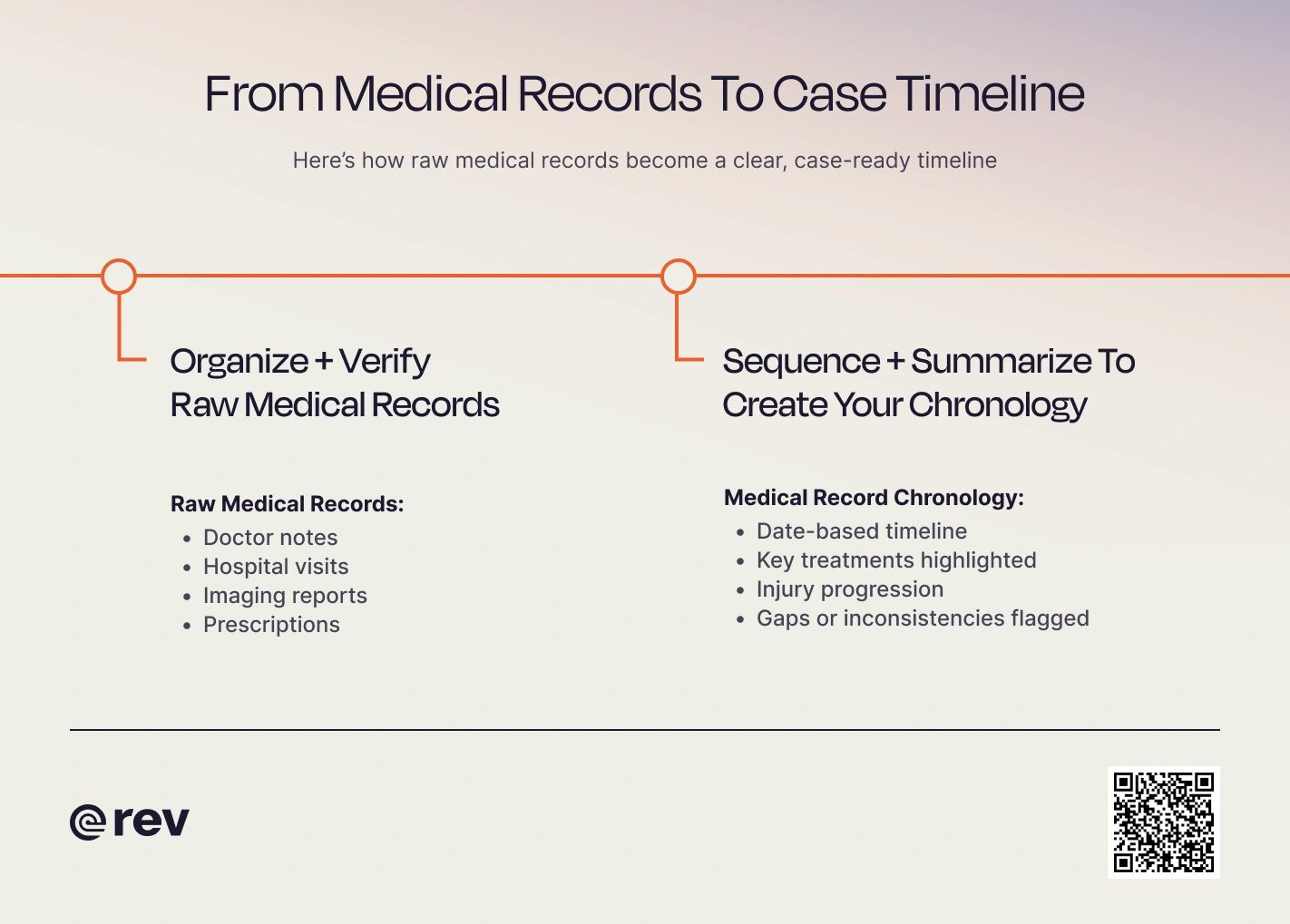
A medical chronology is a structured, chronological summary of a patient’s medical history, related to a specific injury or legal claim. It synthesizes information from medical records, doctor visits, treatments, diagnostic tests, and other healthcare encounters into an organized timeline.
The key components of a medical chronology include:
- The date and provider for each medical encounter
- A summary of the visit
- Diagnoses, prescribed treatments, and test results
- Any changes in the patient’s condition
A strong medical chronology also captures pre-existing conditions that are relevant to the claim. These are often pulled into focus as a defense strategy.
It’s important to note that medical chronologies are different from narrative summaries. A narrative summary is a story-based interpretation of the medical facts. This is used as a persuasive way to tell the story of a patient’s injury and recovery for a judge or jury. While the two have distinct differences, medical chronologies and narrative summaries can complement each other.
Whether the case is a car accident or a workplace injury, the goal is to create a clear, factual record that connects an incident to the medical care that followed. Medical timelines make it easy for attorneys, insurers, and courts to understand the full scope of a client’s injuries.
Who Prepares A Medical Chronology?
A medical chronology is prepared by paralegals, legal nurse consultants (LNCs), or medical record summary specialists working within a personal injury law firm.
In some cases, attorneys may outsource the work to specialized medical-legal transcription services. They may also contract LNCs who have both clinical and legal training to accurately interpret complex medical records.
Outsourcing makes sense for firms managing a high volume of cases. It’s also a good idea to outsource medical chronology creation when there’s a lack of in-house medical expertise. Specialized services ensure medical records are translated accurately and the timeline is built through a clinical lens.
The tradeoff, however, is control. Outsourced vendors likely won’t have full context around case strategy, and any errors in the timeline still fall on the attorney.
Regardless of who builds the chronology, the document must be reviewed and verified by the attorney before it’s used in a case strategy or shared with opposing counsel. An unverified timeline with factual errors or missing records undermines the client’s credibility. Not to mention, inconsistencies also open the door to defense arguments, or worse, the case being dismissed.
How Long Does It Take To Create A Medical Chronology?
It typically takes anywhere from a few hours to a full day to create a medical chronology. The exact time it takes to build it varies depending on the complexity of the case and the volume of medical records involved.
More complex cases, such as those involving years of medical data, multiple providers, or extensive surgical histories, can take several days or longer. Delays in obtaining medical records from providers are one of the most common causes of timeline setbacks. Because of this, it’s important to start the records request process as early as possible.
When Do Personal Injury Lawyers Need a Medical Chronology?
Personal injury lawyers rely on medical chronologies at nearly every stage of a case. During initial case evaluation, the chronology helps attorneys quickly assess the strength of a claim and identify potential gaps in treatment. During discovery, it acts as a central reference point for understanding the evidence.
The chronology can also be a critical tool for helping to build a compelling narrative around a client’s injuries as cases approach settlement negotiations. Though personal injury statistics have found that only four percent of personal injury claims go to trial, a timeline can also be used to strengthen your case in front of a jury. Without one, complex medical records and clinical terms are difficult to interpret.
“One of the most common trial preparation mistakes I see is failing to simplify complex medical documentation into a story a jury can understand,” says Michael Akiva, Managing Partner at Jacoby & Meyers.
“Dense records must be translated into a clear sequence of events tied directly to the injury.”
Medical chronologies are especially important when a case involves disputed causation. This is when the defense argues that the plaintiff’s injuries existed before the incident or were caused by something unrelated. In these situations, a detailed, well-sourced medical chronology can be the deciding factor between a successful claim and a dismissed one.
How To Create A Medical Chronology In 6 Steps
Building an accurate, persuasive medical chronology takes time, attention to detail, and a systematic approach. Below is a step-by-step guide to getting it right.
1. Gather All Medical Records
The foundation of any medical chronology is the complete set of medical records. This includes records from every provider the client has seen in connection with the injury, including:
- Emergency rooms
- Primary care physicians
- Specialists
- Physical therapists
Don’t overlook pre-incident records. Obtaining medical records from before the injury is just as important as collecting post-incident documentation. Pre-existing conditions are often raised by the defense as an alternative explanation for a client’s symptoms. Having a clear picture of the client’s baseline health is critical for refuting these types of claims.
When requesting records, be specific. Request all notes, test results, imaging reports, discharge summaries, billing records, and prescription histories. It’s better to have too much information than to discover a missing piece during deposition prep.
2. Review and Organize Records by Date
Once you have all the records in hand, read through everything carefully before building the timeline. Flag key dates, critical diagnoses, significant changes in condition, and any inconsistencies or gaps in care.
Next, organize all records chronologically and create a master folder that’s easily searchable. This is where tools like Rev can save significant time. By uploading your case documents into Rev’s Multi-File Insights, you can search across all files at once, surface key details instantly, and flag inconsistencies without manually reviewing hundreds of pages.
3. Create the Chronology Structure
The next step is to set up a structured format for the chronology itself. The most common format is a table with consistent columns that typically include:
- Date
- Provider name
- Facility
- Type of visit
- Brief summary
No matter what format you land on, consistency is key. Every entry should follow the same structure so the chronology is easy to scan and reference. Avoid adding subjective commentary or legal conclusions. It’s best to keep it factual and tied directly to what’s documented in the records, in order to build stronger cases.
.webp)
4. Summarize Each Medical Event
For each entry, write a concise, neutral summary of what happened during that encounter. Include the primary complaint or reason for the visit, the provider’s findings, any diagnoses made, treatments administered or prescribed, and next steps or referrals.
The goal is to be informative without being overwhelming. A two- to four-sentence summary per entry is usually enough for straightforward visits. Major events like surgery, hospitalization, or a significant change in diagnosis may require more detail.
5. Identify Gaps and Follow Up
Once your initial chronology is complete, look for gaps. Are there periods where the client wasn’t seeking treatment? Do records from one provider reference a referral that you don’t have records for? Are there test results mentioned in notes that don’t appear in the file?
Gaps in treatment are often used by the defense to argue that the plaintiff’s injuries weren’t serious or were caused by something else. Identifying these gaps early gives attorneys time to address them proactively, whether by obtaining missing records or preparing the client to explain a lapse in care.
6. Review for Accuracy and Completeness
Before finalizing the chronology, verify every date, provider name, and clinical detail against the source records. Even a small error, such as transposing a date or misidentifying a provider, can damage the credibility of the document if it’s caught during deposition or trial.
Have the reviewing attorney do a final pass, then keep the document updated as new records come in. Think of the medical chronology as a living document throughout the life of a legal case.
Medical Chronology Example
Below is an example of what a medical chronology table looks like in practice. This simplified version covers a fictional patient’s first few weeks of care following a car accident.
The length of a medical chronology depends on the complexity of the case. An injury that resulted in a few months of treatment, like the example above, might warrant a two-to three-page chronology.
But a severe case that involves traumatic injuries, multiple surgeries, or years of ongoing treatment can result in a chronology that’s easily 50 pages long.
What’s more important than length is that all facts and details included are accurate. Padding a chronology with irrelevant office visits or redundant details can dilute the most important facts for the case.
Common Errors That Weaken Medical Chronologies Effectiveness
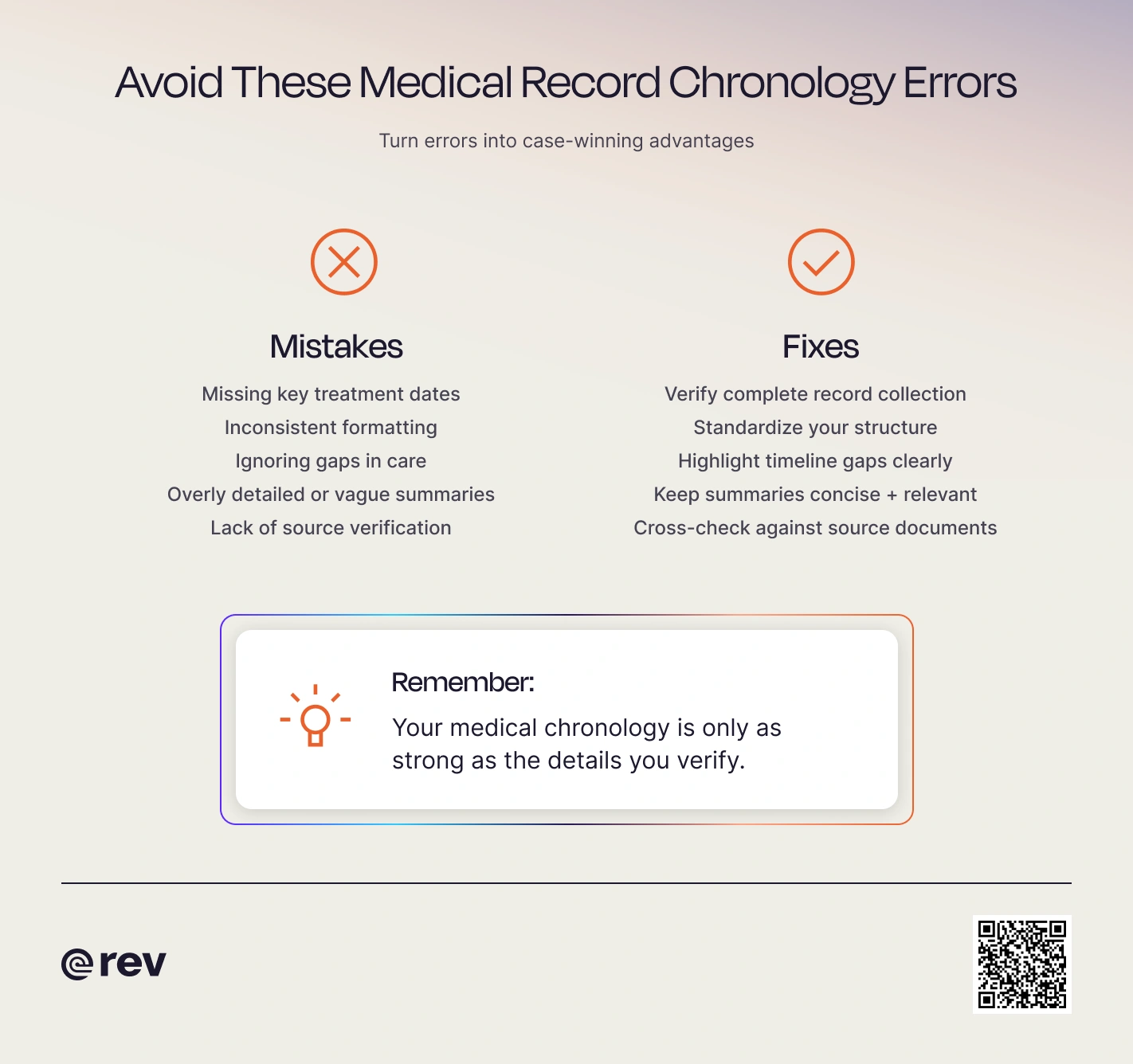
Even the most meticulous legal teams can fall into common traps when building medical chronologies. Here are the common mistakes to avoid and how to fix them:
- Error: Missing pre-incident records. Failing to request records from before the injury leaves the chronology vulnerable to arguments around pre-existing conditions.
- Fix: Request records going back up to five years prior to the incident.
- Error: Incomplete records requests. Relying only on the records the client provides often means you’ll miss key information that could change your case.
- Fix: Send formal records requests to every provider the client mentions, and follow up until all records are received.
- Error: Adding subjective language or legal conclusions. Phrases like “the injury was caused by the accident” have no place in a chronology.
- Fix: Keep every entry strictly factual and tied directly to what the records say.
- Error: Inconsistent formatting. A chronology that switches formats or uses inconsistent date styles is harder to follow and easier to push back on.
- Fix: To keep the legal timeline consistent, establish a template before you start and stick to it throughout.
- Error: Failing to update the document. A chronology built in the early stages of a case will be incomplete by trial if it’s not updated as new records arrive.
- Fix: Assign someone to keep it current.
- Error: Overlooking imaging and test results. Medical records narratives alone can be vague. The specific findings in imaging and lab reports often contain critical details.
- Fix: Make sure to request and include all test results and imaging reports separately from clinical notes.
Defense Strategies For Medical Chronologies
Understanding how defense attorneys challenge medical chronologies is just as important as building them well.
One of the most common defense strategies is pre-existing condition arguments. Defense teams will comb through pre-incident medical records looking for any prior complaints, diagnoses, or imaging findings they can use to argue that the plaintiff’s injuries aren’t new. If a client had any history of back pain before a car accident, for example, the defense will use that to argue the current complaints existed before the crash.
To counter this, personal injury attorneys need to have a complete picture of the client’s baseline health. Be prepared to demonstrate how the incident materially worsened the client’s pre-existing condition, or how the current injuries are clinically distinct from prior complaints. This can be done with detailed medical timelines, visual evidence, and medical expert testimony, if necessary.
“A great approach is to always start at the end and work backwards,” says Dr. Robert Laidlaw, former Neurosurgeon and Medical Director of Claims Doctor.
“You can have a hypothesis of what your clinical conclusion is, whether that’s permanent impairment, causation, or functional loss. Then, work back to the date of the injury, reviewing things to make sure it all fits together sequentially.”
Another frequent defense tactic is pointing out gaps in treatment. If a plaintiff went three months
without seeking care, the defense will argue that the injuries weren’t serious enough to require treatment. Or they may say that the gap suggests the injuries had resolved.
Preparing for this requires working with clients early to understand the context behind any gaps in care. Whether that’s financial barriers, personal circumstances, or a misunderstanding of their own injury, these explanations must be documented. Expert witnesses can also speak to the clinical significance of the gap and whether it’s necessary as part of treatment for the type of injury.
Finally, defenses may also challenge the credibility of the chronology itself by highlighting any errors, inconsistencies, or discrepancies between the timeline and the underlying records. This is why accuracy in building the document is non-negotiable, especially in high-volume, multi-file client cases like mass tort claims.
Attorneys should be prepared to explain how the chronology was built, what sources were used, and how any apparent discrepancies were resolved.
How Tech Can Improve The Medical Chronology Process
The technology revolution is transforming how legal teams build and manage medical chronologies. Where a paralegal might’ve spent days manually reading through stacks of records, today’s AI medical chronology tools can now surface key facts, flag inconsistencies, and organize information in a fraction of the time.
For Michael J. Ortlieb, Partner at Simmons & Ortlieb, technology has significantly impacted the amount of time spent gathering evidence and building a strong case. “Technology allows me to quickly extract key events from large volumes of medical records, which in turn allows me to build detailed treatment timelines and identify causation issues, treatment gaps, and patterns that might otherwise be missed.”
One of the most impactful advances in legal technology is multi-file document analysis. Tools like Rev, for instance, allow legal teams to upload and analyze multiple case documents such as medical records, deposition transcripts, and imaging reports at once.
Instead of cross-referencing records one by one, attorneys and paralegals can search across the entire case file instantly and identify patterns or discrepancies in seconds. This is particularly valuable in large personal injury cases with years of medical history across dozens of providers.
AI transcription is also reshaping how legal teams handle medical dictations, recorded physician statements, and deposition transcripts. Accurate transcription of these audio sources is critical for a complete medical chronology.
Transcription tools like Rev combine industry-leading AI with the option for human review to ensure complex medical terminology is captured correctly. With HIPAA-compliant security, legal teams can manage sensitive patient documents with confidence, knowing their clients’ protected health information is secure throughout the entire case lifecycle.
Build a Stronger Injury Case With The Right Tools
A thorough, accurate medical chronology can be the difference between a settlement that reflects your client’s true damages and one that leaves your client footing the bill.
From gathering records to identifying gaps, every step in the process matters. The right technology can help your team work faster, smarter, and with greater confidence.
Rev’s AI-powered platform helps personal injury legal teams transcribe, organize, and analyze medical documents for chronologies that hold up under scrutiny and tell client stories with clarity.

.webp)



.webp)