


Best Practices for Trial Prep in Personal Injury Cases
Learn the best practices for trial prep in personal injury cases, from evidence gathering to witness coaching, plus get a checklist to help you prep for trial.



Personal injury cases are won or lost long before anyone steps into a courtroom. The attorneys who consistently deliver results for their clients aren't improvising at trial — they're executing on a preparation process that leaves nothing to chance.
Whether you're handling a slip-and-fall, a motor vehicle accident, or a complex mass tort case, the fundamentals of trial prep stay the same. This guide walks through the best practices for trial prep in personal injury cases, from the first client intake call through your closing argument — along with a checklist to keep your team on track.
1. Start Trial Prep During Intake
The best personal injury trial lawyers treat every case as if it's going to trial from day one. That mindset changes how you gather facts, document evidence, and frame your client's story from the very beginning.
At intake, document everything: the client's account of events, their injuries, and their emotional state. It’s also a good idea to record the entire intake call process. These early statements often become critical reference points later on, especially if witness memory fades or facts get challenged. Having a searchable transcript of that first conversation can catch details that would otherwise disappear into handwritten notes.
Starting a thorough PI case intake and review process early means fewer gaps to fill as trial approaches, which means less scrambling as deadlines loom.
2. Build An Evidence Inventory & Keep It Current
You can't present evidence you can't find. Build a running inventory of every piece of evidence in your case. This includes medical records, photos, surveillance footage, police reports, interviews with experts, and all digital communications.
As your case evolves, make sure your inventory does too. From new medical records to surprise documents that defense presents in discovery, a live evidence log keeps your team aligned and prevents anything from falling through the cracks when it matters most.
Pay particular attention to video and audio evidence. Dashcam footage, surveillance recordings, and recorded statements can be highly persuasive — but they need to be transcribed and organized to be usable at trial. Manually searching through hours of raw footage is a trial prep strategy almost guaranteed to lead to lawyer burnout.
“Evidence is what changes the game,” explains Andrew Wachler, Managing Partner at Wachler & Associates.
“When you gather evidence, you have the base of your claim, and everything else is finesse. You also need to demonstrate how serious the injury is and what the financial consequences are…when you have evidence and can show how the injury affected the client, then going to court will be your next move. The insurance [company] knows it, and it will influence their decision process.”
3. Lock Down Your Deposition Strategy
Depositions are where personal injury trials are often decided (aka: does it go to trial or settle out of court?). A strong deposition locks in favorable testimony, surfaces inconsistencies, and gives you ammunition for cross-examination. A weak one hands the other side opportunities to reframe the narrative.
Part of solid deposition preparation is knowing what was said word for word. Accurate transcripts of every deposition let you catch contradictions between what a witness said in deposition and what they say on the stand. That kind of cross-examination preparation can be the difference between a credible witness and a destroyed one.
Review your deposition transcripts with the same rigor you'd apply to any other key document. Highlight inconsistencies, flag admissions, and mark sections for potential use as exhibits. The more time you invest, the sharper your trial cross and deposition questions will be.
And make sure you know the local laws around deposition recordings in your area. In New Jersey, for example, rule 4:14-9 should be followed even when using recording software, including giving at least 10 days' notice to all parties.
4. Prepare Witnesses Thoroughly
Witness testimony can make or break a personal injury case. Good witness prep helps witnesses communicate clearly under pressure, understand what to expect, and avoid missteps that could undermine their credibility.
First, it’s important to cover the basics: explain courtroom procedure, why it’s crucial to listen to the full question before answering, and how it’s okay to answer "I don't know." Consider running mock examination sessions so the experience isn't a shock on the stand.
Expert witnesses often need a different kind of preparation. Focus on making sure their opinions are tightly tied to the record and that they can explain complex medical or technical concepts in plain language (remember: simplifying complex topics is crucial to getting the jury on your side).
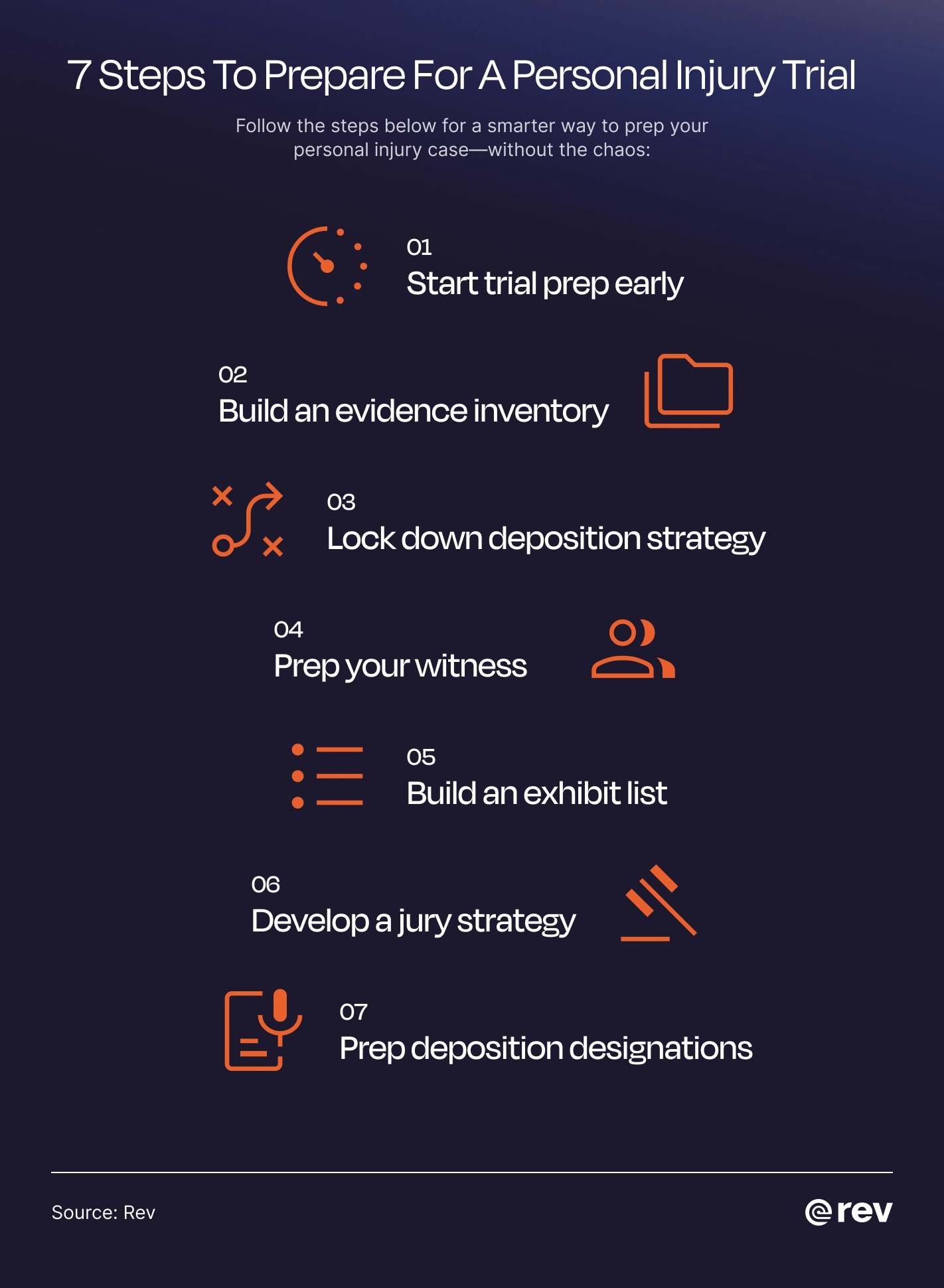
5. Build Your Exhibit List With Intention
Exhibits are the visual anchor of your case narrative. Because of this, every exhibit should serve a specific purpose, and you should know exactly what that purpose is before you submit it.
Start building your exhibit list well in advance of the trial. Identify which documents, photos, medical illustrations, and video clips tell the clearest version of your client's story. Organize them chronologically and thematically so you can move between them efficiently in the courtroom.
You should also consider pre-marking exhibits before trial and getting agreement from opposing counsel when possible.
With Rev, organizing and finding your exhibits is easy. With multi-file search, folder organization, tagging, and timestamped clipping abilities, you can find contradicting statements or key moments in seconds.
6. Develop Your Jury Strategy Before Selection
Understanding your jury is one of the most effective trial prep techniques for injury attorneys, and that work starts way before you walk into voir dire.
Research the venue. Know the community. Think about what values matter to jurors in that jurisdiction and how those values interact with the facts of your case. Would this jury respond well to medical documentation, or would it be more impactful to focus on personal testimony about how the injury changed someone's life?
“You need to translate complex medical facts into clear client impact on a human level,” explains Michael J. Ortlieb, Partner at Simmons & Ortlieb. “[Such as] helping a jury understand that a ‘full thickness rotator cuff tear’ means my client can no longer pick up her son.”
It’s also important to prepare your jury selection questions to surface potential bias early. Personal injury cases can often involve jurors with strong insurance instincts or skepticism about large damages. Get those biases out in the open so you can address them — or remove that juror before they end up in the deliberation room.
7. Prepare Deposition Designations With Care
When a witness can't appear live at trial, deposition designations let you put their testimony before the jury via a video or transcript. But if they aren’t done correctly, they can lose their impact.
Review your deposition transcripts and select the most impactful passages. Keep designations tight. Long, meandering deposition readings can lose jurors. Anticipate the defense's counter-designations and plan your responses ahead of time.
If you're using video depositions, transcript accuracy matters enormously. Precise, timestamped transcripts make it far easier to pull exact clips, match the video to the text, and present deposition testimony in a compelling, court-ready format. In the Rev platform, you can pull timestamped clips on the fly or save them all to a folder ahead of time.
Trial Prep Checklist For Personal Injury Lawyers
Use this personal injury checklist to keep your case preparation on track from intake through closing. Adapt it based on the complexity and specific facts of each case.
The Importance of Thorough Trial Prep
Personal injury trial preparation is the foundation that your entire case relies on. The attorneys who win consistently aren't just talented; they're the most prepared people in the room.
Thorough preparation lets you control the narrative. When you know the evidence backwards and forwards, you can:
- Respond to surprises without losing your footing
- Recognize when opposing counsel is mischaracterizing the record
- Impeach a witness in real time
There's also a direct connection between preparation and client outcomes. Juries are perceptive. They notice when a lawyer is in command of the facts and when they're not. Confidence built on preparation reads as credibility, and credible cases often win.
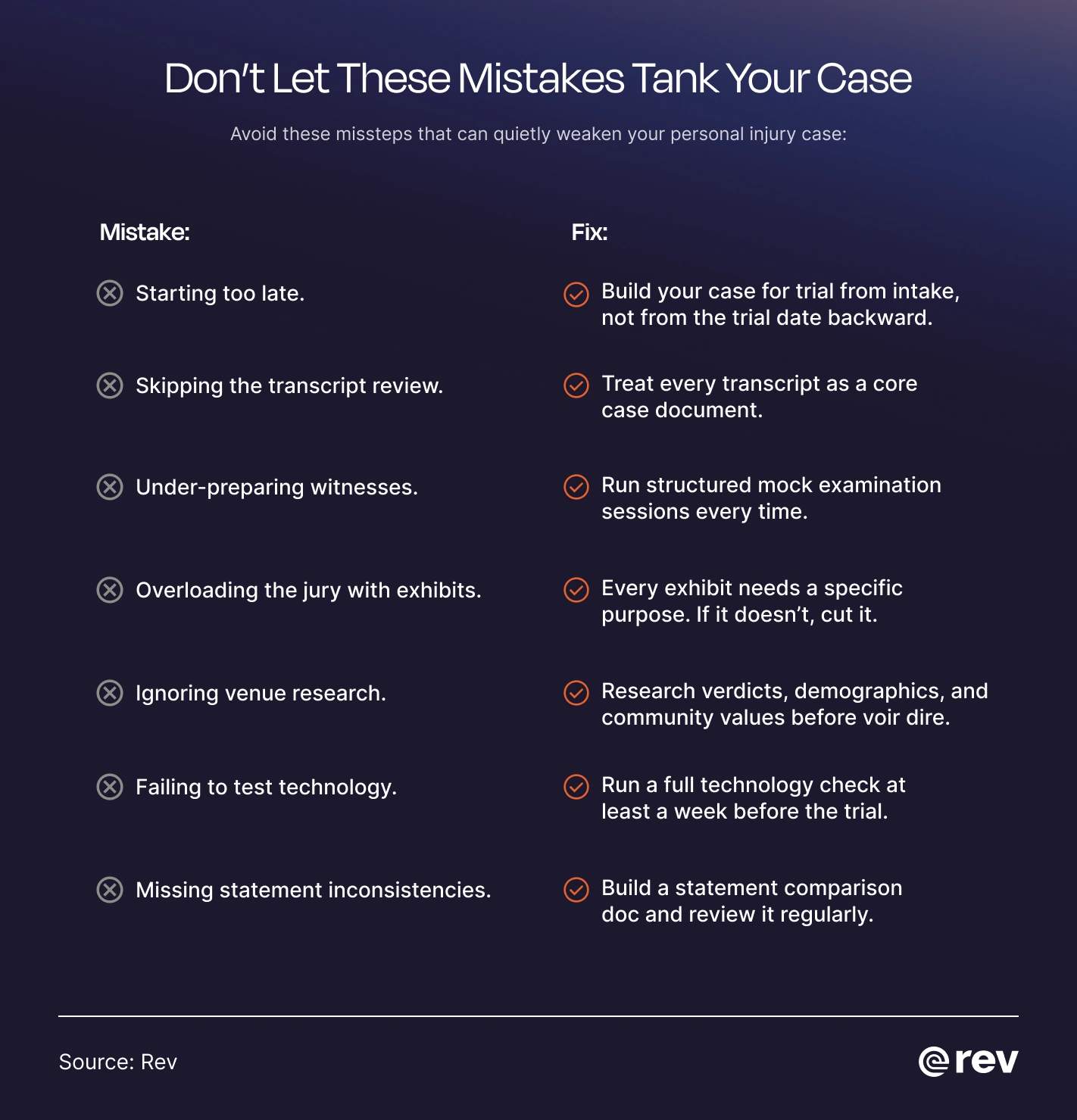
Common Trial Prep Mistakes in Personal Injury Cases
Even experienced personal injury trial lawyers fall into predictable preparation traps. Here are the most common ones — and what to do instead:
- Mistake: Starting too late, aka waiting until 30 days before trial to get serious.
- Fix: Build your case for trial from intake, not from the trial date backwards.
- Mistake: Relying on notes or memory instead of reading deposition transcripts thoroughly.
- Fix: Treat every transcript as a core case document, and read it multiple times.
- Mistake: Under-preparing witnesses and assuming your client will just know what to say.
- Fix: Run mock examination sessions with all your witnesses.
- Mistake: Overloading the jury with exhibits by introducing every document in the file.
- Fix: Cut all exhibits that don’t have a specific purpose.
- Mistake: Ignoring venue and community research ahead of jury selection.
- Fix: Research verdicts, demographics, and community values before voir dire.
- Mistake: Failing to test technology before trial.
- Fix: Run a full technology check at least a week before the trial.
- Mistake: Not cross-referencing what witnesses said at different stages of the case.
- Fix: Build a statement comparison document and review it constantly.
“From my experience, mistakes come up when things are done [at the] last minute,” explains Kellen Sinclair, attorney and partner at Stawicki, Anderson & Sinclair.
“If someone doesn't start their opening/closing statement early, it can hurt them, as that gives the attorney the journey of evidence they need to get in. In addition if one omits to hosting several focus groups before and during trial prep, they can miss out on vital information early in the process.”
How Legal Technology Improves Trial Preparation
The volume of evidence in a modern personal injury case has become almost unmanageable. Hours of surveillance footage, recorded calls, digital medical records, dashcam video, social media content — it adds up fast. The firms that handle high-value cases efficiently aren't doing it with highlighters and manila folders. They're using legal technology that fits into their current workflows.
Accurate transcription is the backbone of evidence management. When every piece of audio and video evidence has a corresponding transcript, your entire case becomes searchable. You can find a specific phrase from a recorded statement in seconds instead of scrubbing through an hour of footage, or compare what a witness said in an intake call vs. during the deposition.
Rev is built for this kind of work. With 96%+ AI accuracy and 99%+ accuracy with human review, Rev produces legal transcripts you can rely on when accuracy is non-negotiable. From client intake calls and medical consultations to deposition transcripts and expert witness interviews, Rev helps personal injury teams turn raw recordings into searchable, citable case evidence.
Imagine: Less time buried in files. More time building the strategy your client needs. It’s a reality you can make happen for your firm.
Build The Case Your Client Deserves
Trial prep is where cases are built or surrendered. The attorneys who consistently deliver results get there through disciplined preparation, organized evidence, and the right tools to support their work.
Rev helps personal injury lawyers review evidence faster, catch the details that matter, and walk into trial knowing the record cold. That's the difference your clients are counting on.

.webp)



.webp)