Jury Research + Workflow for Mock Trial Panels and Focus Groups
Learn the major types of jury research, how to structure a study, and a repeatable workflow for reviewing what was actually said with Rev's guide.


You can know a case inside and out and still get surprised by a jury. A theory that seems straightforward to your legal team may confuse someone hearing it for the first time. A fact you considered minor may become the center of deliberations. Or a phrase you've used for months may land differently with the general public.
Jury research gives legal teams a way to test those reactions before trial. From focus groups to full mock trials, attorneys can observe how participants understand evidence, discuss competing narratives, and respond to witnesses or exhibits.
The challenge is turning hours of participant feedback into information your team can actually use. Below, we'll cover the major types of jury research, how to structure a study, and a repeatable workflow for reviewing what was actually said.
What Is Jury Research?
Jury research is the process of studying how potential jurors may understand and respond to case facts, evidence, arguments, witnesses, and legal concepts. Attorneys and trial consultants may use methods such as mock trials, jury focus groups, surveys, and case-specific attitude research to prepare for trial.
Rather than predicting a verdict with 100% certainty, this type of research aims to understand how people outside the legal team interpret the case. In doing so, attorneys can identify confusions, test arguments, and prepare for issues that might otherwise emerge for the first time at trial.
Keep in mind that jury research is different from jury selection. During jury selection, attorneys participate in voir dire, the questioning of a prospective jury pool to determine whether they can fairly serve on the jury. Research conducted before trial can help attorneys better prepare their voir dire questions, but it doesn't replace the court-supervised jury selection process.
4 Types Of Jury Research
There is no one right way to conduct trial and jury research. The right format depends on what your team needs to learn about your legal argument, and how far the case has progressed.
Mock Trials
Mock trials recreate select portions of the trial experience for a group of participants.
Attorneys may present competing case theories, opening statements, witness testimony, exhibits, or other evidence and then observe how mock jurors react. Participants may also deliberate, giving the legal team a chance to hear how different facts and arguments survive once jury deliberation begins.
Mock trials are particularly useful later in the trial prep process when you want to evaluate the case as a whole. They can help teams test the defense theory, prosecution narrative, key witnesses, exhibits, damages or exposure, and potential deliberation dynamics. Plus, you can use these mock trials to ensure full courtroom accessibility for all types of potential jurors.
Jury Focus Groups
Jury focus groups are generally narrower and more exploratory.
Instead of recreating most of a trial, your team can use focus groups to isolate particular questions. You might test an exhibit, explain a forensic concept, present two ways of describing the same event, or ask participants what information they still need before they could reach a conclusion.
That makes focus groups useful earlier in case development, when there's still time to adjust how the team investigates and presents an issue. For example, a criminal defense team could explain an important forensic concept to a focus group and ask participants to describe the concept back in their own words. If several people misunderstand it in the same way, the attorneys have found a potential communication problem before a real jury ever hears the argument.
"I look for consistent themes [in focus groups] rather than trying to make every panel agree. If one panel loves an argument and another dislikes it, I want to understand what was different about those groups and why they reacted differently. Data is only useful if you understand the context behind it," said Michael T. van der Veen, Attorney at van der Veen, Hartshorn & Levin.
Juror Profiling & Attitude Surveys
This type of research uses case-specific surveys to better understand experiences and opinions that may affect how people approach issues relevant to a case. The emphasis should be on relevant attitudes and experiences, rather than demographic factors such as age, race, gender, or even occupation.
A survey might explore views about law enforcement credibility, self-defense, corporate responsibility, forensic evidence, damages, or another subject directly connected to the litigation. Those findings can help a team develop more thoughtful voir dire questions and identify issues worth exploring further.
Online Jury Research
Online jury research allows mock trials, focus groups, questionnaires, and other research to take place remotely. For some teams, that can make it easier to recruit participants from a broader geographic area or run several panels without organizing multiple in-person sessions.
Remote sessions can also be recorded easily, which gives the legal team a valuable record to revisit later. Instead of relying entirely on facilitator notes, attorneys can return to the transcript and verify exactly how a participant described an exhibit, argument, or witness.
Online mock-juror studies are different from researching the online activity of people who have actually been called for jury service. That practice raises separate ethical considerations, which we'll cover below.
Mock Trial vs. Focus Group: Which Jury Research Format Should You Use?
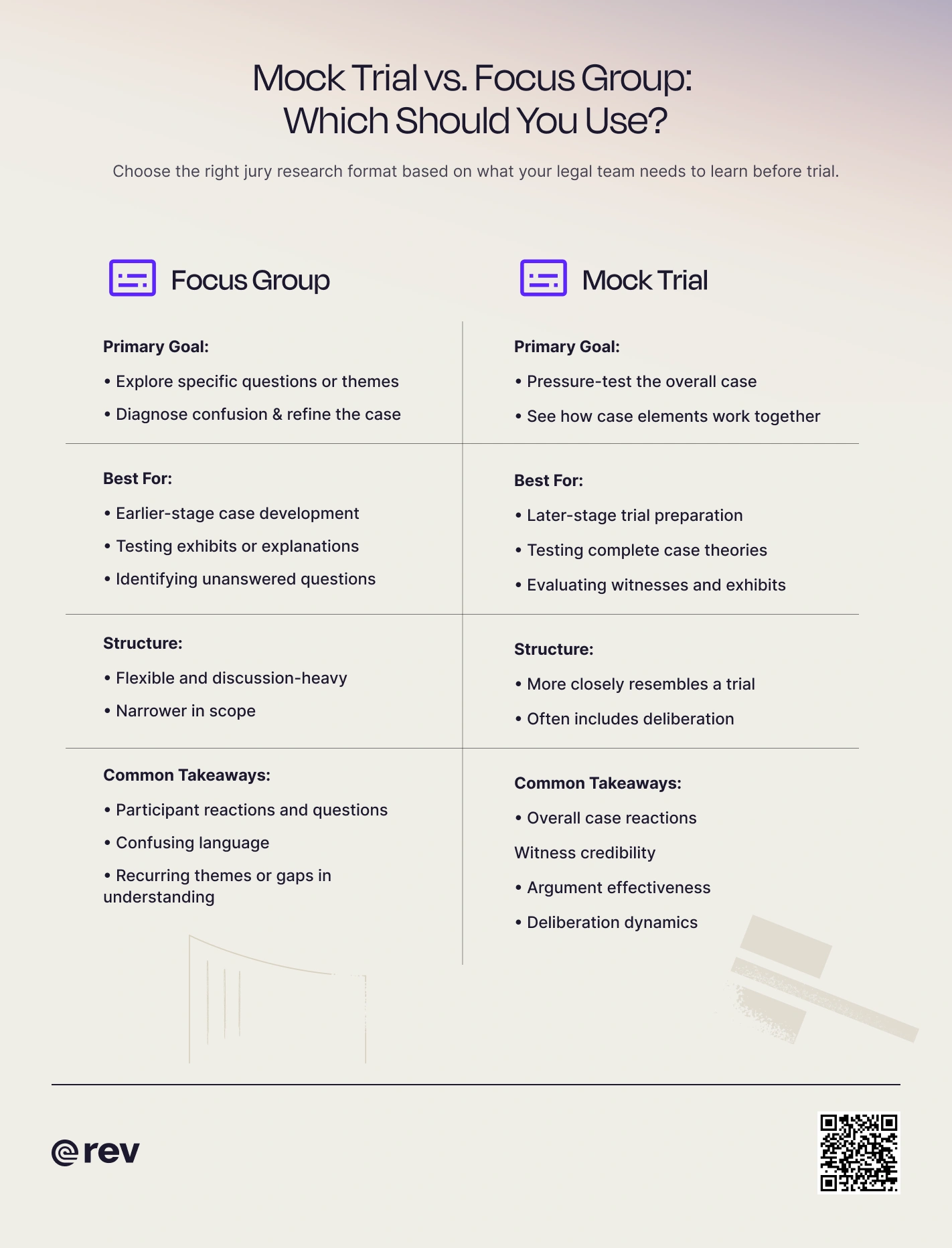
Use a focus group when you want to explore specific questions or themes, and use a mock trial when you want to see how the larger case performs in a more realistic trial and deliberation setting.
A simple way to choose is to consider five things: the primary goal, case stage, structure, time and budget, and output of each format. A focus group aims to explore specific issues before trial with a flexible, discussion-heavy structure on a limited budget, producing reactions, questions, language, and themes. A mock trial aims to test the overall case early or mid-trial with a more formatted structure and a larger budget, producing case reactions and deliberation dynamics.
Imagine a criminal defense case involving complicated forensic evidence. Early in case development, a focus group could help determine whether participants understand the forensic concept and which explanations create confusion.
Later, a mock trial could test the completed defense theory against the prosecution's narrative. The team could then watch how participants use that forensic evidence once they begin deliberating alongside all the other facts in the case.
Choose a focus group when: you need to explore, diagnose, or refine a specific part of the case.
Choose a mock trial when: you want to pressure-test how the complete case works when its major pieces are presented together.
How To Plan A Jury Research Study That Produces Useful Feedback
Good jury research starts before the first participant enters the room. Because if the study is too broad, overly leading, or built around proving the legal team's existing assumptions, the results become much less useful.
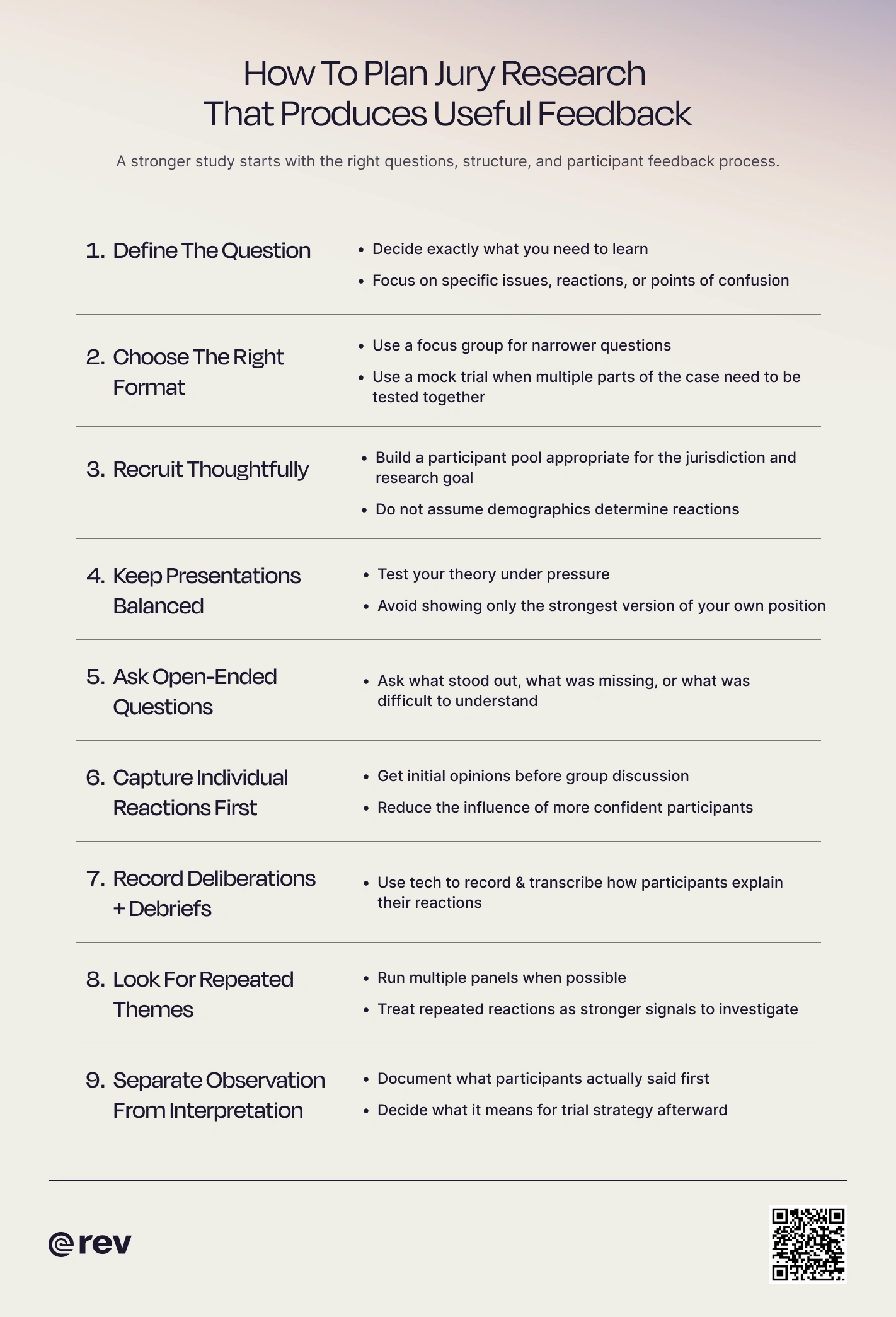
A strong process looks like this:
- Define the question first. Decide what you actually need to learn. "Do jurors like our case?" is much less useful than "What parts of our timeline are difficult to follow?"
- Choose the right format. Use exploratory focus groups for narrow questions and a mock trial when the interaction between multiple parts of the case matters.
- Recruit thoughtfully. Build a participant pool that makes sense for the jurisdiction and research goal without assuming demographic characteristics determine how someone will vote.
- Keep presentations balanced. If you only show participants the strongest version of your own position, you may learn very little about how the case performs under pressure.
- Ask open-ended questions. Questions such as "What stood out to you?" or "What information was missing?" can reveal issues you did not think to test.
- Capture individual reactions before group discussion. Otherwise, a confident participant may shape the opinions everyone expresses afterward.
- Record deliberations and debriefs when appropriate. The discussion itself can be as valuable as the final result.
- Run more than one panel when possible. A theme that appears in a single group may be idiosyncratic. Repeated reactions are more useful signals to investigate.
- Separate observation from interpretation. Document what participants said before deciding what it means for trial strategy.
That last point becomes especially important when a study produces hours of recordings.
A Repeatable Jury Research Workflow for Recorded Mock Panels And Focus Groups
A three-hour mock trial can produce far more information than a few pages of facilitator notes can capture.
One participant may question the timeline early in the session. Another may raise the same issue during deliberations using completely different language. Someone else may confidently repeat a factual point that was never actually presented. Those moments are worth finding again.
This is where jury research technology can make the review process more manageable. Rev turns recorded sessions into searchable transcripts and allows legal teams to search across multiple case files, with findings linked back to the source, every time.
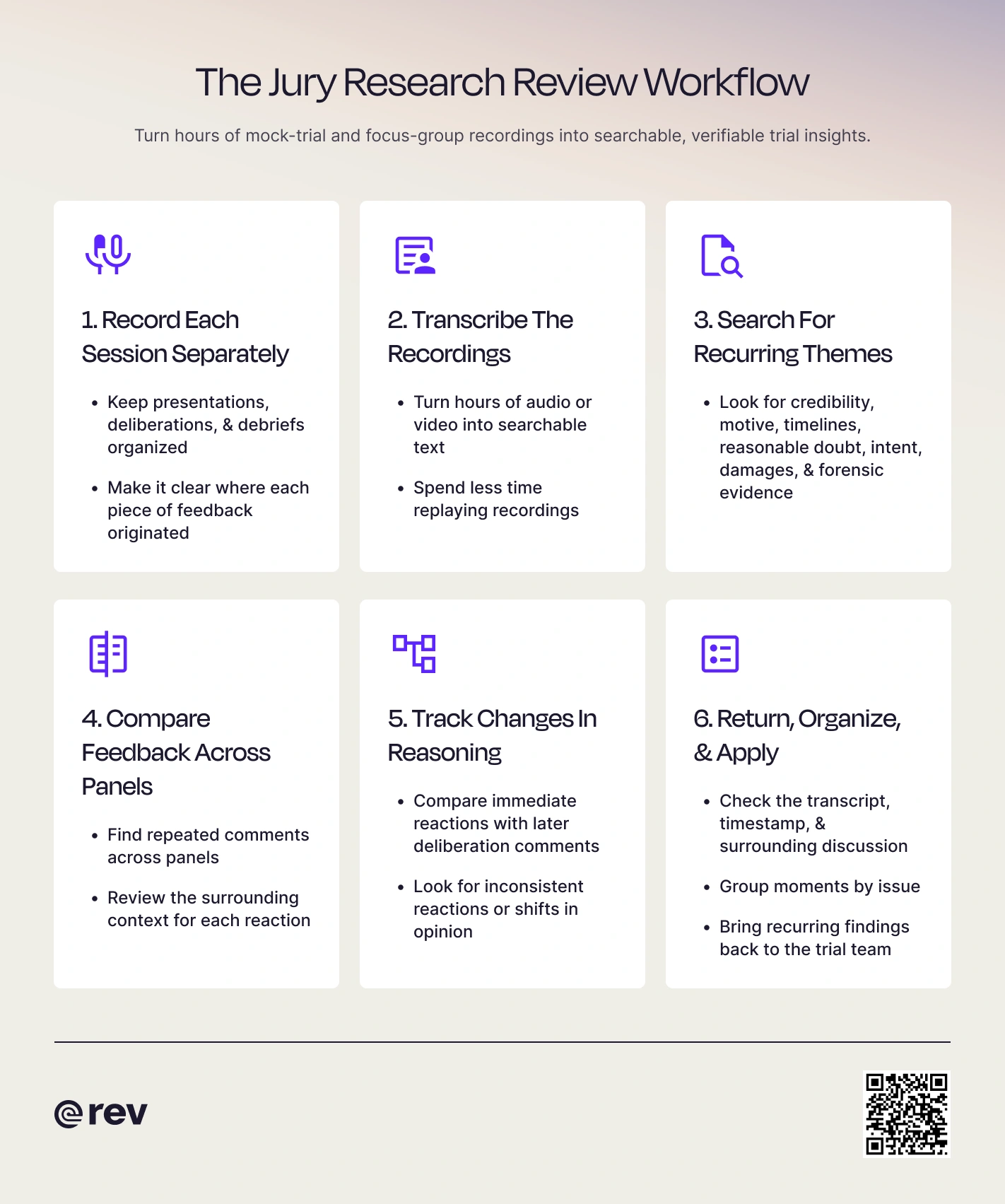
A repeatable jury research workflow looks like this:
- Record each session separately. Keep presentations, deliberations, and participant debriefs organized so your team knows where feedback originated.
- Transcribe the recordings. A searchable transcript is much easier to review than repeatedly scrubbing through several hours of video.
- Search for recurring case themes. Look for terms connected to credibility, motive, timelines, reasonable doubt, intent, damages, forensic evidence, or whichever issues matter in the case.
- Compare statements across panels. If three participants independently express confusion about the same exhibit, find each statement and review the surrounding context.
- Look for changes in participants' reasoning. Compare what someone said immediately after the presentation with what they said later during deliberations.
- Find inconsistent reactions. One participant might describe a witness as credible in an individual questionnaire but question that witness once deliberations begin. Those differences can be worth examining. (hint: Rev will surface these automatically for you)
- Return to the source. Never rely on an AI-generated summary alone. Check the transcript, timestamp, and surrounding conversation before drawing conclusions.
- Tag or organize useful moments. Group feedback around issues such as witness credibility, confusing terminology, strong exhibits, unanswered questions, or competing case narratives.
- Bring the findings back to the legal team. Attorneys can decide whether a recurring reaction warrants a change to trial strategy.
Rev helps with the information-retrieval part of that process. It can make it faster to find, compare, and verify what people said across recorded sessions. That way, judgment remains where it should: with attorneys and the trial team.
How To Turn Mock-Juror Feedback Into Better Trial Preparation
The most useful jury analysis does not end with "Panel A voted this way." To learn more, your team will need to dig deeper.
Why did participants reach that conclusion? Which facts appeared during deliberations without prompting? Where did people get confused? What language did participants use when explaining the case to each other?
Those findings can inform several parts of your trial preparation strategy.
For example, a legal team might:
- Simplify the explanation of an important forensic concept
- Reorganize a timeline that participants consistently misunderstood
- Prepare a witness for an issue mock jurors repeatedly questioned
- Rethink an exhibit that requires too much explanation
- Incorporate participants' natural language into an opening or closing argument
- Develop voir dire questions around attitudes that repeatedly affected discussion
- Identify areas where opposing counsel's narrative may be more persuasive than expected
"Questionnaires, transcripts, and recurrent responses can be arranged by technology, but judgment is still important," explains Reginald Greene, Attorney and Managing Partner at Greene Legal Group.
"Repeated reactions can highlight a flaw in our explanation or supporting data, so I take them seriously. I wouldn't alter my approach based just on one voice, but a single odd response merits examination. I compare the rationale behind panels' decisions rather than considering just the vote totals when they disagree."
Online Jury Research & Ethical Guardrails For Actual Jurors
Researching mock-juror reactions is very different from researching a prospective or sitting juror.
The latter is governed by court rules, ethics requirements, and jurisdiction-specific restrictions. Legal teams should review the rules that apply in their relevant court(s) before conducting online research about actual jurors.
There is also an important line between what attorneys may research and what jurors themselves may research.
Federal model jury instructions tell jurors not to independently research the case, legal issues, parties, witnesses, lawyers, or related topics online. Jurors are expected to decide the case from the evidence and law presented in court rather than outside information.
The same evidence-first mindset is useful for attorneys conducting jury research. Avoid turning demographics, social media posts, or AI-generated characterizations into shortcuts for deciding how someone thinks. Instead, keep conclusions grounded in lawful voir dire information and what a person has actually said or done.
Can Attorneys Research Prospective Jurors Online?
Yes, attorneys may generally review publicly available information about prospective jurors online, but the exact rules vary by jurisdiction and court, and attorneys must avoid prohibited communications.
ABA Formal Opinion 466 concludes that lawyers may passively review a juror's or prospective juror's public internet presence but may not send an access request or otherwise communicate with that person. However, some local rules can be more restrictive.
For example, the New York City Bar states that "attorneys may use social media websites for juror research as long as no communication occurs between the lawyer and the juror as a result of the research."
That difference is a good reminder that there is no universal social-media-research playbook. Check the governing rules, applicable ethics opinions, platform functionality, and any instructions from the judge before researching prospective or sitting jurors online.
Make Jury Research Easier To Review, Not Easier To Overinterpret
The value of all of these jury research methods comes from hearing how people outside your legal team actually process the case. But once several mock trials and focus groups produce hours of recordings, finding those insights can become its own headache.
Rev gives legal teams a searchable record of those sessions so they can quickly find recurring comments, compare statements across panels, and return to the exact source before making strategic decisions.
Your attorneys still decide what the feedback means. Rev simply makes the underlying record easier to find and verify.
Ready to spend less time replaying recordings and more time preparing your case?