

Survey: Over Half of Americans Believe AI Benefits The Courts
Survey reveals 53% of Americans see real benefits in courtroom AI for efficiency and clarifies where the public wants AI used and where they want boundaries.


Many headlines suggest that fear dominates the conversation around artificial intelligence, but our latest data tells a different story. Over half (53%) of the Americans we surveyed believe artificial intelligence offers concrete benefits to the justice system. This majority perspective suggests a public ready to modernize, viewing AI in the legal system as a practical tool for improvement.
But this support isn't a blank check. Our survey reveals that people welcome digital efficiency but draw a hard line at digital judgment. For many, the human element is a requirement rather than just a safeguard.
This collective feedback offers helpful guidance on where oversight must remain a priority. In fact, 61% of people admit they don’t actually know how AI currently supports judges or court officials.
Despite this uncertainty, Americans have clear opinions on where the technology belongs. They consistently back AI for operational roles like court scheduling, yet demand firm boundaries around high-stakes judgment.
Legal professionals who understand this balance between technical speed and human ethics can adopt technology that matches these expectations. Transitioning to an AI-assisted workflow is not about replacing the expert. Instead, it involves automating the logistics so that human judgment can take center stage.
Key Takeaways
- 53% see courtroom AI benefits like case organization (33%), faster resolutions (30%), and lowering legal fees (29%).
- 51% back AI for court scheduling, showing comfort with operational uses.
- 55% support AI transcription with human oversight as a primary tool.
- 75% want AI disclosure, with 63% demanding it for any use.
- Only 10% back AI sentencing, protecting human judgment where it matters most.
Where Americans See Courtroom AI Delivering Value
A majority of Americans believe that integrating AI into the courtroom offers meaningful advantages.
Rather than viewing technology as a replacement for human logic, 53% of respondents see AI as a practical upgrade to the administrative side of the legal system. This outlook suggests that people are most comfortable with AI when it is used to streamline the dense work that often stalls judicial progress.
The most recognized benefit is the ability to navigate the legal system more easily. Specifically, 33% of Americans value AI for its ability to quickly organize and search through massive volumes of case information. This is followed by 30% who believe AI can accelerate case resolutions and reduce long waits for court dates.
Legal teams managing large volumes of information can now use AI tools to perform bulk case file analysis and provide verifiable citations. This approach addresses the public’s desire for better organization while maintaining the paper trail required for courtroom standards.
Affordability and precision are also high priorities for many people. Roughly 29% of respondents believe AI will lower fees by increasing efficiency, potentially making professional legal advice more accessible to the average person. And 22% see the potential for AI to improve fairness by minimizing human clerical errors in the official court record.
These insights show us that, for most Americans, the true value of courtroom AI lies in making the law more efficient and accurate without removing the professional from the process.

Public Sentiment High For AI Use In Legal Logistics And Transcription
Our survey data reveals a public preference for using AI to manage the operational side of the law. Specifically, 51% of Americans say that AI should be allowed to handle court scheduling and logistics. Only 27% oppose this use, while 21% remain unsure.
Delegating administrative burdens to AI lets law firms better address issues like lawyer burnout and allows staff to focus on high-level strategy work.
Support also extends to creating the official record. The survey shows that 55% of respondents support AI transcription when it includes human oversight (only 26% oppose this hybrid approach). This highlights a deep respect for professional court reporters. People want these experts to have better tools rather than removing them from the process.
The importance of that human element becomes even clearer when considering full automation. Only 34% of people favor using AI for transcription without any human intervention, while 45% oppose it. The consensus is that technology should assist the professional court reporter to maintain the accountability they provide.
Desired Boundaries For Courtroom AI
Transparency is a cornerstone of public trust in legal technology. This is clear from our survey findings, as 75% of Americans believe disclosure should be required when AI is used in a legal setting. This group includes 63% who want disclosure for any use and 12% who believe it is necessary only for high-stakes tasks.
Support for mandatory disclosure is high across all age groups, but highest with Gen X:
- Gen X: 81%
- Baby Boomers: 75%
- Millennials: 74%
- Gen Z: 68%
People are open to law firms using AI for research and logistics, but they are much more cautious about AI in the hands of judges or court officials.
They also maintain firm boundaries regarding judicial decisions that impact individual liberty. Only 10% of respondents believe AI should recommend the length of a prison sentence, with 72% stating it should not.
Similarly, only 10% support using AI to predict a person's likelihood of reoffending. These results suggest a strong desire to keep human judgment at the center of criminal defense.
Interestingly, some jurisdictions, such as Kentucky and Pennsylvania, already use risk assessment algorithms for sentencing guidance. These systems typically function as advisory tools with human oversight. This alignment ensures that while AI handles logistics and organization, humans remain responsible for final judgment.

Addressing AI Risks With Built‑In Safeguards
Only 3% of Americans believe there are no risks at all to using AI in courtrooms. However, the most common concerns already have established solutions within professional legal workflows.
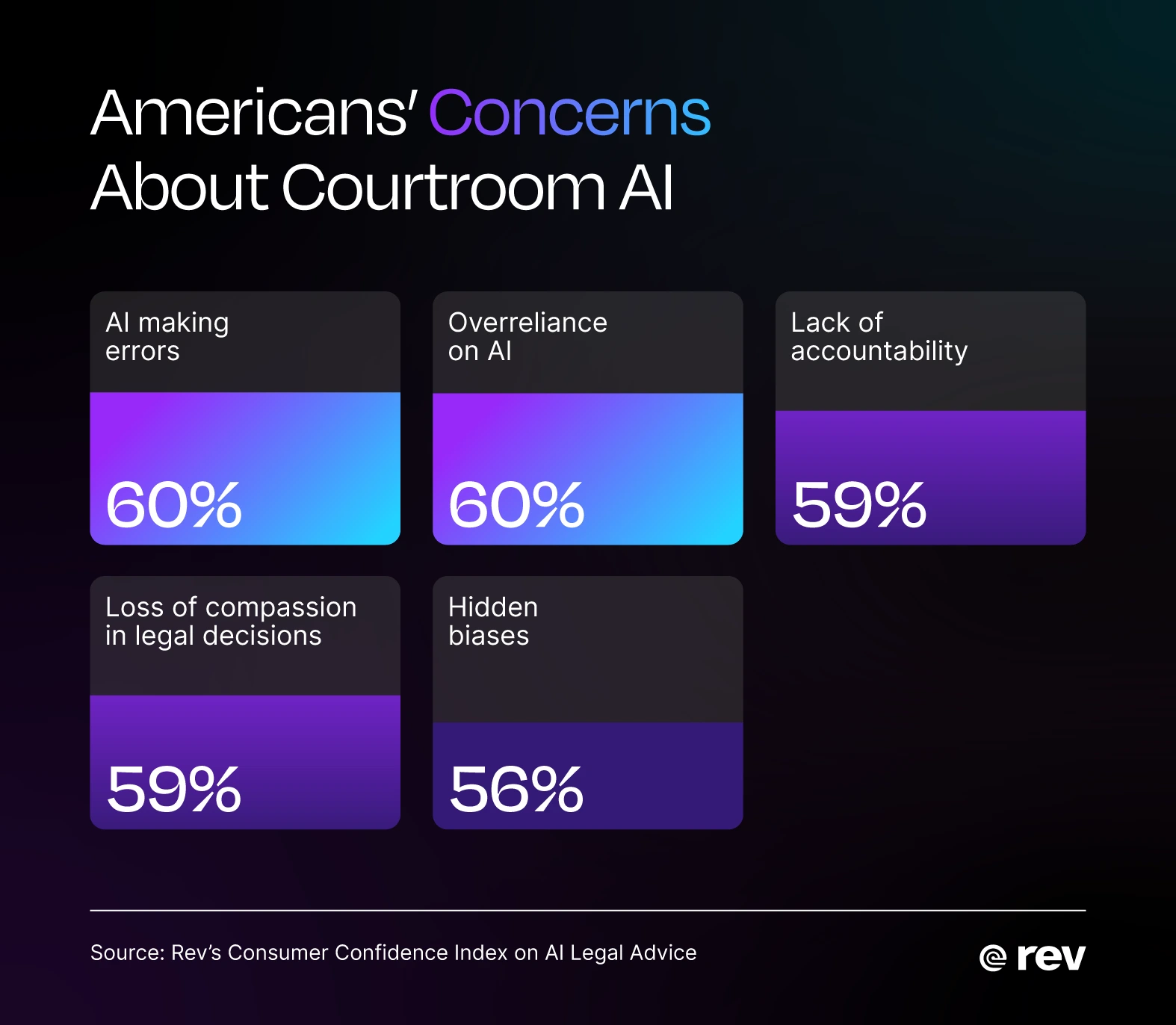
For instance, 60% of respondents worry that AI will make errors or hallucinate facts. This is why the industry is moving toward AI that always cites its sources, allowing for immediate verification of every data point.
Other significant public concerns regarding AI include:
- Overreliance: 60%
- Loss of compassion: 59%
- Lack of accountability: 59%
- Hidden bias: 56%
Gender data shows that men generally express greater concern regarding the technical and ethical risks of AI. Men are more worried than women about AI making mistakes (65% vs. 56%), hidden biases (60% vs. 51%), and a lack of accountability (61% vs. 57%). However, concerns about a loss of compassion are nearly equal between the groups.
These anxieties are the reason human-in-the-loop models are becoming the legal industry-standard. Overreliance can be mitigated by mandatory human review of every AI-generated draft.
Auditable models and regular testing can help identify and manage hidden biases. To ensure empathy remains central to the law, humans must remain the final decision-makers. In addition, documented workflows also provide a clear path for accountability by defining human responsibility for every outcome.
Modern Tools For The Courtroom's Human Standards
The legal industry is at a point where efficiency meets accountability. Leading teams are adopting AI in the legal system for tasks that have earned high levels of trust, such as automated scheduling and bulk case file analysis. These tools help firms manage administrative growth without losing the human touch.
Rev enables this accountable model by providing specialized AI for lawyers built for courtroom standards. By combining professional court reporters with AI that prioritizes multi-file analysis and verifiable citations, Rev helps teams provide efficiency while maintaining accountability. This approach ensures that every transcript and insight is backed by human expertise and documented evidence.
To see how these tools support your firm, request a demo today.
Methodology
The survey of 1,140 adults ages 18 and over was conducted by YouGov for Rev on February 3, 2026. Data is weighted, and the margin of error is approximately +/-4% for the overall sample with a 95% confidence level.