


Speaker 1 (00:00):
(silence)
Mr. Chairman (48:50):
The Committee on Homeland Security on the Border Security and Enforcement will come to order. Without objection, the chair may declare the committee in recess at any point. The purpose of today's hearing is to examine the unique security challenges posed by the northern border, including its vast geographic remote terrain, limited personnel, technology, and infrastructure gaps and policy differences between the United States and Canada related to visas, asylums, and border screening. I'd like to thank our colleagues from the Counterterrorism and Intelligence Subcommittee for partnering with us for this joint hearing. Without objection, I seek unanimous consent that the gentleman from Michigan, Mr. Thanedar, the gentlewoman from Illinois, Ms. Ramirez, and the gentleman from New York, Mr. Kennedy, be permitted to sit with the subcommittee and ask questions of the witnesses.
(49:46)
I would like to now recognize myself for an opening statement. Good afternoon, and welcome to the Joint Border Security and Enforcement and Counterterrorism and Intelligence Subcommittee hearing on the evolving threat landscape at our nation's northern border. As one of the largest land borders in the world, spanning nearly 4,000 contiguous miles, the US border with Canada stretches across dense forest, rugged mountains, and more than 2,000 miles of waterways, including the Great Lakes. Naturally, this diverse terrain provides unique security challenges for the Department of Homeland Security. Some of the trends we will discuss today can be in part attributed to the level of security President Trump and his administration have achieved at the southwest border.
(50:41)
The sustained decline in illegal crossings and apprehensions over the past year and a half are unlike anything we have seen in three decades. And may the United States Border Patrol apprehension along the Southwest border were 94% lower than the monthly average of the Biden-Harris administration. But as illegal crossings have declined, transnational criminal organizations have been forced to shift away from their traditional smuggling routes. The cartels exploit vulnerabilities wherever they may exist. They take advantage of potential security gaps that allow them to traffic illegal drugs, to smuggle humans, weapons, or other contraband.
(51:24)
We cannot allow the northern corridor to become the next preferred quarter for these criminal networks, and yet customs and border protection data has shown that over the last year, illegal crossings have begun to shift north. While overall encounters at the northern border have dropped when compared with the overall national encounters, the percentage of encounters at the northern border have more than doubled since FY23. Likewise, drug seizures at the northern border have steadily increased, reaching record levels this year.
(51:59)
Over the last five fiscal years, CBP has also encountered over 1,500 individuals on the terrorist screening data set. These individuals have attempted to cross the northern border at or between ports of entry. These trends underscore an important reality. Although the northern border presents a different threat profile than the southwest border, it remains a national concern. As such, security along the northern border has improved considerably over the past decade. The Department of Homeland Security has deployed additional surveillance capabilities, strengthened air and marine operations, enhanced intelligence gathering and sharing, and increased coordination with homeland security investigations and other federal, state, and local and tribal partners. These investments have improved situational awareness along one of the world's longest international borders. Even with these investments, significant challenges remain, and Congress has a continued responsibility to ensure that border security is guided by measurable performance, modern technology, and a comprehensive strategy that addresses threats across all domains.
(53:18)
Today's hearing provides an opportunity to examine where progress has been made, identify the gaps that remain, and determine what additional authorities, resources, and oversight are necessary to continue securing the northern border. As criminal organizations adapt, so too must the United States government. Congress must ensure that federal law enforcement agencies and its partners have the personnel, infrastructure, and technology necessary to protect our northern border and safeguard the American people. Thank you to our witnesses for being here today, and I look forward to our productive discussion and continued partnership. I would now like to recognize the ranking member, the gentleman from California, Mr. Correa, for his opening statement.
Mr. Correa (54:05):
Thank you, Mr. Chairman. I want to welcome today our witnesses. Thank you for taking time, your interest for being here with us today. As the chairman just said, America and Canada share the world's longest non-militarized border in the world, spanning 13 states and eight Canadian provinces. This is thanks to a strong alliance and friendship we have with Canada. Canada, great partners international security. And over the decades, both Canadian and American soldiers have fought side by side and have died side by side. And Canada, of course, is our second-largest trading partner in the world, with trade now over $870 billion. And of course over 300,000 individuals cross the Canadian border on a daily basis. And when it comes to security of northern border, it's critical that we work with our Canadian neighbors and partners to combat the threats we face while we also encourage smooth travel and trade. The US and Canada, as neighbors, we face similar challenges: arms trafficking, drug mules, human smugglers, and terrorists attempting to cross the northern border to and from Canada, both north and south. And Democrats, I would say, and my Republican colleagues, I believe, we're committed to upholding the lawful security and secure northern border, but what we will not support, however, are immigration enforcement agencies using unnecessarily aggressive tactics on American citizens or putting their health at risk. Let me repeat what we will not tolerate are immigration enforcement officers trampling on the constitutional rights of American citizens, and we will not support the diversion of precious American resources from national security priorities, criminal investigations, and the facilitation of trade and travel across the northern border.
(56:22)
Sadly, we've watched masked agents roaming on American streets harassing American citizens. We've watched immigration officers stop and ask people for their immigration status based on the color of their skin, ethnicity, accent, or job they are working. Back home, Orange County, California, people ask me if they need to carry their passport and papers with them, and today they ask me if that's even enough. As we see US citizens being detained and arrested, American citizens being detained and arrested, even when they prove they are American citizens, even when their American citizenry is not in question, they're still being detained, arrested, and held.
(57:16)
We've seen reports of CBP and ICE using facial recognition technologies to build databases of immigrants as well as American citizens. American citizens expressing their First Amendment right, the right to free speech, are being tracked and monitored by our federal government. If they say anything at all, it's critical of this administration. We've seen DHS leadership tell their agents that they don't need a judicial warrant to enter American homes and instead just need administrative warrant signed by a supervisor; and this is a clear violation of the Fourth Amendment of our constitution. ICE, CBP, we, none of us are above the law.
(58:14)
The President of the United States promised that he would go after the worst of the worst. Instead, the administration has redirected thousands of law enforcement agents from investigating serious crimes like sex trafficking, child exploitation, terrorism, drug smuggling to focus on conducting immigration sweeps. And for what? To meet an arbitrary mass deportation target of one million deportations a year.
(58:45)
I don't know if you saw this article; just came out. Sister Letty, a Texas nun taken by ICE while walking to Sunday mass. Has happened just this last Sunday. Is this making our country safer? And by the way, she works as a nurse as well, and she was released after her colleagues from both Democrat and Republican side made some phone calls.
(59:16)
In attempt to meet your goals of deportation, you've pulled thousands of law enforcement agents away from your investigations of serious crimes like child sex trafficking, money laundering, and fentanyl trafficking. You've also pulled agents responsible for securing the northern border away from the border. This is despite the consistent staffing and resource shortages at the northern border. Many of these agents have no training in the interior how to address American citizens. These agents have been put in the front lines of American... Immigration sweeps, I should say, in American territory.
(01:00:07)
And sadly today, Americans are witnessing firsthand the costs of these decisions. Renée Good and Alex Pretti, both US citizens were shot and killed in Minneapolis, were protesting. Marimar Martinez, on a way to donate clothing to her local church, was shot five times, five times by a border patrol agent. After shooting her, the agent bragged, and I quote, "I fired five rounds and she had seven holes. Put that in your books, boys."
(01:00:48)
I ask how is all this making our homeland safer? A long time ago, 9/11. Post 9/11, homeland security was created to protect American citizens, to protect Americans from foreign terrorist attack. And this is what we have today. I look forward to hearing from our witnesses today about the very real challenges that we have at the Northern border and how we can help you address those challenges. Thank you, Mr. Chairman, and I yield.
Mr. Chairman (01:01:28):
Thank you, Ranking Member Correa. I now recognize the chairman of the Subcommittee on Counterterrorism and Intelligence, the gentleman from Texas, Mr. Pfluger, to deliver his opening statement.
Mr. Pfluger (01:01:40):
Thank you, Mr. Chairman. Good afternoon. And I'd like to thank our witnesses for being here and also the Border Subcommittee for partnering with the Counterterrorism Subcommittee on such an important issue.
(01:01:52)
From those of us who come from border states, the consequences of unsecured borders are not theoretical, they're a lived reality. In Texas, under the Biden administration, those consequences were unmistakable. When the federal government fails to uphold basic enforcement responsibilities, communities bear the brunt. That is exactly what happened in my state. Public safety deteriorates, law enforcement is pushed past operational limits, and national security vulnerabilities expand in ways that Washington should never have allowed.
(01:02:21)
As we assess the challenges before us, Congress must broaden its focus to include the counterterrorism vulnerabilities emerging along the northern border. For years, the southwest border has demanded urgent attention, and rightfully so, but today we are seeing a troubling shift. Individuals of concern, including those appearing on the terror watch list, are increasingly attempting to reach the United States through Canada. This trend requires us to examine not only illegal crossings, but the broader counterterrorism landscape that dangerous actors may seek to exploit.
(01:02:53)
And with major international events taking place this summer, including the World Cup happening right now, the stakes are even higher. Larger scale global gatherings, especially those with a cross-border nexus, create attractive targets for hostile actors. And it's imperative that we strengthen our posture and close gaps that could be exploited during these heightened international attention events. We know that terrorist organizations rely on complex methods to move people, money, and prohibitive materials across borders, yet our current posture does not fully account for how those methods intersect with the vulnerabilities along the northern border. And we must deepen our understanding of the cross-border facilitation networks that enable illicit movement, including those tied to criminal smuggling pipelines and confront the online extremist ecosystems that fuel radicalization and recruitment.
(01:03:43)
Combined with differing immigration postures between the US and Canada, cross-border travel demonstrates increasing risk that we must be prepared to preempt at border crossings. We must also strengthen defenses against prohibited materials, from chemical and biological attacks to radiological and nuclear components. Although the White House's counterterrorism strategies-
Mr. Pfluger (01:04:00):
... components. Although the White House's counterterrorism strategy prioritizes preventing terrorist access to such materials, northern border interdiction remains uneven. And likewise, cross-border financial flows, including illicit finance and money laundering, must be rigorously monitored to prevent funds from supporting terrorism. Today's hearing is about being proactive. It is about recognizing merging threats, acknowledging where our defenses fall short and ensuring that federal law enforcement has the support, coordination, and resources needed to keep our country safe.
(01:04:32)
As cartels, transnational criminal organizations and violent extremist groups look north for new pathways to exploit, we must ensure that the northern border is prepared for the challenges ahead. And you're going to hear a lot about President Trump. You're going to hear a lot about enforcing the laws. Well, if we don't like the laws, then we should change them right here in this body. But right now we have laws that need to be upheld, and for four years we saw a complete complicitness of not enforcing those laws and that's why we're here today. Unfortunately, that's why we have to talk about these subjects. So if we could just agree that our executive branch would enforce the laws evenly, then we'd be okay. I yield back and thank you, Mr. Chairman.
Mr. Chairman (01:05:10):
Thank you, Chairman Pfluger. I now recognize the ranking member of the full committee, the gentleman from the great state of Mississippi, Mr. Thompson, to deliver his opening statement.
Mr. Thompson (01:05:20):
Thank you very much, Mr. Chairman, from the great state of Mississippi also. Good afternoon. This hearing has been called to examine the threat landscape at our northern border. The northern border faces threats and vulnerabilities ranging from wildlife and drug trafficking to human smuggling. Democrats are committed to addressing those threats. However, we cannot limit today's oversight to just northern border and ignore the flagrant abuses from DHS operations across the country. That would be like fixing the fence around a house that's collapsed.
(01:06:05)
Since the beginning of this second term, President Trump has weaponized DHS and other law enforcement agencies to carry out his cruel mass deportation agenda. Americans across the country have witnessed a cruel agenda firsthand, which has yielded nothing but chaos. The administration claimed that they were going after the worst of the worst. Instead, they have been targeting anyone they suspect to be undocumented based on the color of their skin and accent they have.
(01:06:42)
Nearly 43% of those detained by ICE by January 2026 had no criminal conviction or charges. Let me say that again. By January 2026, nearly 43% of those detained by ICE had zero criminal convictions or charges, so much for the worst of the worst. Masked unidentifiable immigration agents have been conducting non-targeted operations, abducting citizens and non-citizens alike in unmarked vans. There are no limits to where people could be arrested.
(01:07:23)
The Trump administration has deployed or threatened to deploy armed federal agents to sensitive locations like churches, hospitals, schools, daycare, and polling locations. People should not fear from being arrested while praying at houses of worship, seeking medical care or attending to their children. And ICE and CVP agents should not be deployed near voting facilities to intimidate voters. In fact, it is illegal for them to enter polling places. The human cost of these operations cannot be ignored. Countless number of American citizens and protestors have been pepper sprayed, beaten, tased, and aggressively arrested. People have died from these operations. Renee Goode and Alex Pretti, both American citizens, were shot and killed by DHS while protesting. This is not who we are as a country. The constitutional costs cannot be ignored either. Last May, a senior ICE official issued guidance instructing agents to ignore the Fourth Amendment and enter private property without judicial warrants.
(01:08:45)
Additionally, border czar, Tom Homan, bragged about a government database to track American citizens exercising their First Amendment right to protest. Big tech and social media companies have received hundreds of DHS administrative subpoenas requesting the names, emails and phone numbers of social media accounts that track and criticize DHS. DHS agents have tracked down individual American citizens, threatening them and asking for them to remove posts criticizing the department.
(01:09:28)
The shooting down of protestors in the streets and the surveillance and intimidation of those who speak out is reminiscent of our authoritarian adversaries. This should be frightening to all of us. Yet, Republicans keep funding this administration's dangerous agenda. Congressional Republicans just passed a bill giving DHS $70 billion to fund Trump's immigration agenda for the rest of his term. This is on top of the $140 billion ICE and CBP received in last year's Big Ugly Bill, most of which has not been spent yet. Combined, that's more than seven years worth of funding for these agencies in less than a year.
(01:10:21)
For the past year and a half, Democrats have advocated for comprehensive and common sense reforms to DHS immigration enforcement. And at every turn, Trump, DHS, and congressional Republicans have bucked every attempt toward change and reform. But while Republicans bury their head in the sand and turn a blind eye to this harmful agenda, Democrats will call attention to the abuses and hold this administration accountable. With that, Mr. Chair, I yield back.
Mr. Chairman (01:10:59):
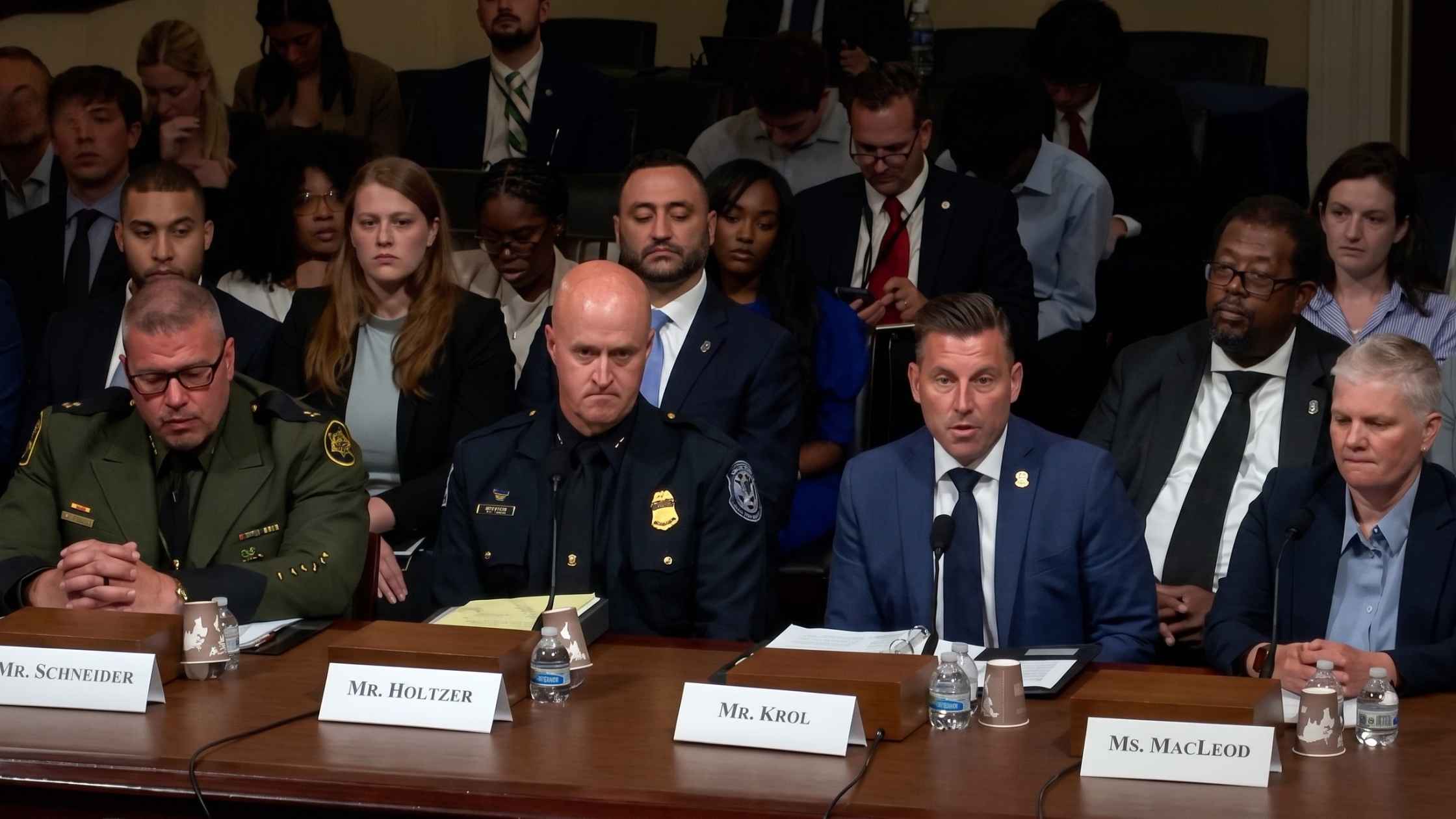
The gentleman yields back. Thank you for your opening statement. Other members of the committee are reminded that opening statements may be submitted for the record. I would now like to formally introduce our witnesses. The first is Mr. Jason Schneider, who serves as the acting deputy chief of the U.S. Border Patrol within U.S. Customs and Border Protection. The second is Mr. Chris Holtzer, who serves as Executive Director of Operations of the Office of Field Operations within U.S. Customs and Border Protection. Our third witness is Mr. Michael Krol, who serves as the Assistant Director of Domestic Operations within HSI. And our fourth witness is Ms. Heather McLeod, who serves as the Director of Homeland Security and Justice at the Government Accountability Offices.
(01:11:51)
I'd first like to thank all of our witnesses for being with us today. At this time, pursuant to committee rule 8C, I would ask our witnesses if they would please raise their right hand and please stand.
(01:12:10)
Do you solemnly swear that the testimony you will give before the Committee on Homeland Security of the United States House of Representatives will be the truth, the whole truth, and nothing but the truth so help you God? May the record reflect that all of the witnesses have responded in the affirmative. Please be seated. We'll now turn to opening statements on behalf of our panel this afternoon and I would now recognize Mr. Schneider for five minutes to summarize his opening statement.
Mr. Schneider (01:12:47):
Chairman Guest, Ranking Member Thompson, Ranking Member Correa, Chairman Pfluger, Ranking Member Magaziner, and distinguished members of the subcommittees. Good afternoon. I am Jason Schneider, acting Deputy Chief of the United States Border Patrol. It is an honor to represent the dedicated men and women who secure our borders every day, often in remote and demanding conditions. Over my 30 years of service, I have served along the southwest, coastal and northern borders, each presenting unique challenges.
(01:13:20)
The northern border is a critical front in our national security mission. Spanning more than 5,500 miles across 13 states, it is the longest international border we secure. This vast expanse encompasses dense forests, major waterways, rugged terrain, and sparsely populated regions with limited infrastructure. The size and complexity of this environment combined with rapidly changing weather require an aggressive and layered enforcement strategy. We leverage every available tool and resource to deny transnational criminal organizations any opportunity to exploit our border. The threat environment continues to evolve and every state is now considered a border state. Smugglers and criminal organizations constantly adapt their tactics in response to our enforcement posture. While overall seizures have fallen 55% compared to last year, narcotics trafficking remains a persistent threat. Border patrol agents are interdicting dangerous drugs, including fentanyl, before they reach American communities.
(01:14:27)
We are implementing a holistic approach to address the northern border threat. Our workforce authorized for 2,269 agents along the northern border is being expanded to meet the operational demands of this environment. We are increasing the number of agents assigned to the northern border to ensure we have the personnel needed to close gaps, surge resources, and maintain operational control. The results speak for themselves. Over the past 17 months, we have made measurable progress in securing our borders. Following a peak in fiscal year 2024, when northern border apprehensions reached over 23,000, we achieved a 67% reduction in fiscal year '25 and an additional 22% decrease this fiscal year. We have apprehended 33 gang and cartel members this year alone, including members of MS-13, Tren de Aragua, and the Latin Kings. These results are the product of the aggressive enforcement, targeted operational adjustments, and the consistent application of consequences through prosecution, detention, and removal for those who violate US immigration law.
(01:15:43)
We are leveraging technology as a force multiplier. Our layered technology enabled approach integrate surveillance systems, remote sensors, mobile detection capabilities, air and marine assets, and advanced communication networks. These tools provide our agents with the advantage needed to detect, identify, classify, and respond to illicit activity. These investments are essential to maintaining operational awareness in remote and challenging terrain.
(01:16:13)
However, technology alone is not enough. Infrastructure investments, including access roads, facilities and communication systems, are critical to sustaining our operational reach and agent safety. We are committed to accelerating the development and deployment of these assets. Continued investment in infrastructure is necessary to eliminate gaps, maximize the effectiveness of our personnel and technology, and ensure we stay ahead of those who threaten our security.
(01:16:44)
The northern border environment remains highly dynamic and challenging. Transnational criminal organizations and cartels continue to pose a persistent threat to the United States and Canada. Migration patterns will shift in response to our actions. We are unwavering in our commitment to expanding our workforce, advancing technology, strengthening infrastructure, and maintaining relentless operational focus to confront these threats and safeguard our nation. Border security is national security.
(01:17:18)
Our agents are exceptionally trained, resilient, and deeply committed to the mission. Every day they stand on the front lines conducting rigorous patrols, responding swiftly to emergencies, interdicting sophisticated smuggling operations, and executing complex search and rescue missions under the most demanding and hazardous conditions. The men and women of the United States Border Patrol consistently deliver results, restoring order and protecting the American people with unmatched discipline and determination. Thank you for the opportunity to appear before you today. I look forward to your questions.
Mr. Chairman (01:17:55):
Thank you, Mr. Schneider. I now recognize Mr. Holtzer for five minutes to summarize his opening statement.
Mr. Holtzer (01:18:03):
Good afternoon, Chairman Guest, Ranking Member Thompson, Ranking Member Correa, Chairman Pfluger, Ranking Member Magaziner and distinguished members of the subcommittees. It is an honor to appear before you today on behalf of the dedicated men and women of U.S. Customs and Border Protection's Office of Field Operations, commonly referred to as OFO. OFO plays a critical role in safeguarding US borders. Our ports of entry, essential for lawful commerce and travel, are constantly targeted by transnational criminal organizations and others seeking to exploit the high volume of cross-border activity.
(01:18:37)
Along our nation's northern border, dedicated OFO personnel stationed at 118 border crossings, safeguard our homeland, enforce immigration and trade laws and ensure the efficient flow of lawful trade and commerce. Within this complex environment, the northern border faces persistent and evolving threats. These include the trafficking of narcotics and other contraband, inadmissible travelers, human smuggling, as well as biological and agricultural threats that could harm our communities and economy.
(01:19:08)
Adding to these challenges and unique to northern border ports of entry is the practice of flagpolling. This occurs when foreign nationals with temporary Canadian status attempt to reenter Canada through a US port of entry to access immigration services. While Canada's policy changes have significantly reduced this activity, OFO remains vigilant, ensuring our resources are not diverted from critical security functions and that our ports are not exploited for purposes outside their intended roles.
(01:19:37)
Despite these complexities, our officers deliver significant results through diligent enforcement actions and strategic operations. In fiscal year 2025, OFO officers along the northern border processed over 56 million travelers and nearly 25 million conveyances. Our effective enforcement operations led to the seizure of nearly 11,000 pounds of narcotics, which represents a significant 51% increase from FY24. These results directly stem from our ability to adapt and target our enforcement operations to meet dynamic threats.
(01:20:09)
I'd like to share a couple of recent examples. In June of 2025, Operation Motor City, a targeted enforcement operation in the Detroit field office, disrupted narcotics and illicit contraband smuggling through specific ports of entry. This operation culminated in nine seizures, including 341 pounds of cocaine and a federal prosecution. In September of 2025, Operation Northern Lights in Montana targeted northbound narcotics smuggling. Beyond drug seizures, the operation led to an inbound seizure of stolen Native American artifacts and initiated a criminal investigation.
(01:20:45)
These operations highlight the importance of OFO enforcement operations considering how seemingly unrelated criminal activities can intersect. These special targeted operations are also in addition to the inbound and outbound enforcement actions and seizures we perform every day. Just two weeks ago near the Blue Water Bridge, OFO selected a vehicle bound for Canada for examination and intercepted 133 pounds of cocaine. OFO's strategy and enforcement approach enables us to respond effectively to dynamic threats.
(01:21:14)
We leverage specialized canines, advanced non-intrusive inspection technology, and the experience, vigilance, and dedication of our highly trained law enforcement personnel. Our approach also includes enhanced information sharing and collaboration with other federal agencies, state, local, and tribal partners, and our Canadian counterparts. To further strengthen our capabilities, we continue to invest in our personnel and port infrastructure. As of March 31st, the northern border is staffed at 95.9% of its allocated CBP officers. We expect to hire an additional 200 officers through Working Family Tax Cut Act funding, which will further strengthen our inspection, targeting, and enforcement capabilities.
(01:21:52)
The Infrastructure Investment Jobs Act also provided $3.4 billion to modernize 20 Northern border land ports of entry, including $ 333 million for equipment. Crucially, our northern border enforcement efforts are amplified through strong partnerships. Shifting trends and adversary tactics mean that efforts to counter transnational criminal activity require coordination and cooperation across the law enforcement community. OFO works extensively with our CVP and DHS colleagues as well as federal, state, local, tribal, and international partners and provides critical capabilities toward the whole of government approach to address drug trafficking and other transnational threats along the northern border.
(01:22:33)
The men and women of OFO are dedicated to securing our nation's borders. With your continued support, we will remain vigilant against evolving threats and ensure the integrity of our ports of entry, which are vital to both national security and economic prosperity. Thank you for the opportunity to testify today. I look forward to your questions.
Mr. Chairman (01:22:50):
Thank you, Mr. Holtzer. I would now like to recognize Mr. Krol for five minutes to summarize his opening statement.
Mr. Krol (01:22:57):
Thank you, sir. Chairman Guest, Chairman Pfluger, Ranking Members Thompson, Correa, Magaziner, and distinguished members of the subcommittee. Thank you for the opportunity to appear before you today. Being the largest investigative agency within DHS and wielding some of the most expansive investigative authorities in the federal government, HSI special agents, criminal analysts, and support staff operate on the front lines of a rapidly evolving threat landscape.
(01:23:24)
With our 8,500 special agents assigned to over 240 domestic field offices and 90 international offices, we are well positioned to confront threats from drug cartels, human trafficking, weapons smuggling networks, money laundering organizations, child exploitation and cyber enabled crime, networks who proliferate illicit trade, travel and finance, in addition to investigating crimes that intersect with terrorism and hostile foreign actors.
(01:23:52)
My testimony today will focus on how the global threat environment is evolving along our northern border, how HSI is addressing these threats and how the Homeland Security Task Forces, co-led by HSI and FBI, have significantly enhanced our ability to synchronize efforts across the law enforcement enterprise to disrupt and dismantle cartels, trafficking networks and designated foreign terrorist organizations from root to branch.
(01:24:19)
The United States and Canada share the longest international border in the world. As such, HSI maintains a robust presence in Canada with six offices, five of which house HSI's visa security program special agents. Our forward deployed workforce in country allows for enhanced integration of efforts with CBSA, RCMP, tribal and provincial partners among others, building capacity, sharing intelligence, coordinating operations and supporting bilateral investigations.
(01:24:54)
Human smuggling remains a persistent and dangerous threat. When networks attempt to smuggle aliens across the border, these attempts can result in a tragic loss of life. As a result of a failed human smuggling attempt from Canada into the United States, eight aliens, including two children, perished. HSI identified and arrested six members of that transnational criminal organization responsible for this tragedy. Delivering consequences to those who perpetrate such horrific actions takes close coordination between HSI special agents, prosecutors from DOJ and the brave members of U.S. Border Patrol, CBP, OFO, among others.
(01:25:34)
In 2024, Canadian law enforcement dismantled a clandestine superlab in Ontario, sparking concern that Canada was emerging as a source country. While information shows that Canadian-produced fentanyl remains relatively low compared to Mexican sources, we do see the seizures of cocaine and fentanyl at the northern border have increased, underscoring the northern border's role is a key vector for high value narcotics.
(01:25:59)
Weapons trafficking follow similar routes. In the past year and a half, HSI has initiated 70 firearms trafficking investigations with a nexus to Canada, resulting in the seizure of over 400 firearms and 50,000 rounds of ammunition and dozens of arrests and indictments. These efforts are critical to disrupting the procurement networks that arm violent criminal groups on both sides of the border. TCOs also target US victims through a myriad of fraud and online exploitation. A recent joint investigation dismantled a Canadian-based criminal organization that defrauded elderly Americans of over $21 million.
(01:26:38)
Even more troubling is the rise in child exploitation cases, with criminals using open web and dark web platforms, encrypted technologies and other forms of messaging to groom victims and trafficking child sexual abuse material across the digital border. The HSI-led DHS Cyber Crime Center is a world leader in this space. And in partnership with Canadian authorities, are using every resource available to us to protect our most vulnerable children.
(01:27:08)
The criminal activities I have described today generate substantial illicit proceeds. Sophisticated complex financial investigations are at the core of the HSI mission. To address the challenges, HSI uses our cross-border financial crime center, the HSTF, or Homeland Security Task Force, National Coordination Center and our partner and international counterparts to identify and dismantle these illicit financial networks.
(01:27:33)
As we confront these evolving threats, I respectfully ask for your continued support of our workforce to ensure that we remain in a position of advantage against our adversaries. Thank you again for the opportunity to testify and I look forward to your questions.
Mr. Chairman (01:27:47):
Thank you, Mr. Krol. I would now like to recognize Ms. McLeod for five minutes to summarize her opening statement.
Ms. McLeod (01:27:54):
Chairman Guest, and Pfluger, Ranking Members Thompson, Correa, and Magaziner, and members of the subcommittee, thank you for the opportunity to be here today to discuss GAO's work examining CBP operations and resources at the northern border. Security threats along the northern border, like drug and firearm smuggling, continue. At the same time, threats such as drone crossings are increasing. My testimony today focuses on key challenges CBP faces in securing the northern border and actions that GAO's work has identified to help CBP address them.
(01:28:35)
GAO reported on northern border security in 2019 and again earlier this year. This work has shown that CBP has expanded surveillance technology along the northern border, but a lack of clear performance metrics and persistent staffing shortages remain. Under the reconciliation bills, CBP has allocated billions of dollars to hire and train agents and support staff and to purchase additional surveillance technology. As CBP spends this additional funding, it is important that decision making is supported by planning, including clear goals and performance measures.
(01:29:16)
Regarding CBP resources along the northern border, GAO found that in recent years, CBP use of aircraft, boats and surveillance technology along the northern border increased. For example, technology like camera towers and sensors have been increasingly deployed. With reconciliation funding, CBP has an opportunity to expand these efforts even more and increase its use of emergency technologies such as autonomous surveillance towers.
(01:29:49)
But our 2019 work found that CBP does not have performance measures to gauge how effectively it is securing the US-Canada border. This includes the effectiveness of various border security investments, including border barriers and technology. Such measures could help CBP assess the effectiveness of northern border operations and take corrective actions as necessary. CBP staffing on the northern border is a persistent challenge. GAO found that the number of CBP agents along the northern border decreased from 2019 to 2024. This decrease in agents assigned to the northern border also came at a time when authorized levels were going up, meaning that CBP wasn't able to fulfill the positions it deemed necessary at the northern border locations.
(01:30:47)
In addition to uniformed agents, our prior work also found that Border Patrol had not filled or retained staff for certain specialist positions across the northern border. Specialists have a range of responsibilities, including monitoring surveillance technology, such as the feeds from camera towers and ground sensors. We recommended that CBP develop a plan to address these workforce gaps. Other factors that may continue to stretch CBP presence at the northern border and affect CBP's ability to meet its mission more generally include increased efforts at the southern border and an expected upcoming retirement surge. We previously reported that CBP has taken action to strengthen its recruitment, hiring, and retention efforts for Border Patrol Agents. Additionally, CBP received billions of dollars in the last year to hire and train additional CBP agents and officers and provide recruitment and retention bonuses, which could help CBP address these workforce challenges.
(01:31:55)
In conclusion, CBP continues to focus its border security operations along the northern border on key threat areas while also monitoring and addressing other threats such as vehicle and drone crossings. Addressing our recommendations related to staffing and performance management would help CBP assess the effectiveness of its northern border efforts, which is particularly important as CBP draws down reconciliation funds. Addressing our recommendations would also help ensure that Border Patrol has sufficient personnel with the appropriate skills to effectively use surveillance technology. Thank you for inviting me today.
Mr. Chairman (01:32:39):
I want to thank, again, all of our witnesses for their opening statement and their willingness to participate in today's hearing. Members will now be recognized by order of seniority for five minutes of questioning. I will begin by recognizing myself for five minutes.
(01:32:59)
First, to our witnesses, we want to thank you for the incredible job that you've done. The men and women at CBP, at DHS, at HSI, what you have accomplished over the last 18 months can be described as nothing more than miraculous. We have seen what I believe is a dramatic change in the carrying out of the law at not only the northern border, but as well as the southern border. We have seen numbers of encounters drop dramatically. We have seen increases in seizures and I believe that today America is safer and that we are more secure than at any time in our nation's history or at least in our recent history.
(01:33:56)
Mr. Schneider, you mentioned in your opening statement that you you have served for 30 years, and thank you for those three decades of service. You mentioned some of the challenges that exist along the northern border, particularly with the size of the area that you must cover, some 4,000 plus miles. Also the geography, but that varies from one end of the border to the other. I want to ask you, are encounters along the northern border since President Trump took office, are those total encounters up or down?
Mr. Schneider (01:34:38):
Chairman, thank you for the question. The apprehensions along the northern border are down since last year, roughly 22% this fiscal year and they were down 67% FY25 compared to FY24.
Mr. Chairman (01:34:50):
And are drug seizures up or down since President Trump took office?
Mr. Schneider (01:34:55):
Drug seizures along the northern border for the U.S. Border Patrol are down by 55%. However, we are still seeing narcotics that are still getting by from the southwest border, going up to northern border cities and being distributed out. We are working with our local, state, federal partners and attacking those networks.
Mr. Chairman (01:35:13):
And at the northern border, our seizures are up, if I'm not mistaken, narcotic seizures?
Mr. Schneider (01:35:18):
Yes. Cross border, they're down, but within the northern border regions they are up. Yes.
Mr. Chairman (01:35:25):
Okay. So cross border encounters down, cross border drug seizures down. And you also mentioned that you are in the process of hiring additional agents that will be staged at the northern border. Is that correct?
Mr. Schneider (01:35:40):
Sir, that is correct. It's a really good news story. We're making history as we speak. Last year alone, we had 86,000 US citizens apply to become a Border Patrol Agent. This fiscal year, 60,000 in the pipeline. We currently have 7,000 in the pre-employment pipeline and 2,000 Border Patrol Agents at the Border Patrol Academy right now and a lot of those will be going to the Northern-
Mr. Schneider (01:36:00):
... at the Border Patrol Academy right now, and a lot of those will be going to the northern border. We have not lowered our standards. We have adjusted the schedules at the US Border Patrol Academy and we're at two shifts. It's good news for us. Our goal is to have 3,500 Border Patrol agents assigned to the northern border in the very near future.
Mr. Chairman (01:36:19):
And let me ask, this is a question I would routinely ask Secretary Mayorkas when he would testify before this committee, is the northern border secure?
Mr. Schneider (01:36:30):
No, not right now. We're getting there, though, sir. We are implementing a holistic approach to include increased staffing, infrastructure, technology. We're close. We'll get there.
Mr. Chairman (01:36:43):
And do we have operational control of the border?
Mr. Schneider (01:36:46):
I mean, I think we have a good understanding. We do not have 100% situational awareness along the 5,500 miles on the northern border, but our agents are out there every day working hard, leveraging technology, leveraging our partnerships with local, state and federal, and our Canadian partners.
Mr. Chairman (01:37:03):
Thank you. Ms. MacLeod, I have looked at the report from February 26th from the GAO. It is a very thorough 60-plus-page report if you include exhibits there. On page 51, you have the conclusion and then the recommendations for executive action. The recommendations deal with staffing shortage in one particular subset of law enforcement officials, specifically the law enforcement information system specialist position. Is that correct?
Ms. McLeod (01:37:41):
Yes, that's correct.
Mr. Chairman (01:37:42):
And it says in the conclusion that we are only 77% staffed for that particular position.
Ms. McLeod (01:37:51):
That is correct. At the time of our review, yes.
Mr. Chairman (01:37:55):
How many employees had CBP authorized for that particular position?
Ms. McLeod (01:38:01):
I don't have that number on here.
Mr. Chairman (01:38:03):
Does 115 sound correct?
Ms. McLeod (01:38:05):
That's about right. Yeah.
Mr. Chairman (01:38:06):
In looking at the report, 88% of those positions had been filled?
Ms. McLeod (01:38:10):
Mm-hmm.
Mr. Chairman (01:38:11):
So total number that needed to be filled to reach the conclusion and the recommendation for executive action would've been the hiring of 27 additional employees. Is that correct?
Ms. McLeod (01:38:22):
Correct. Correct.
Mr. Chairman (01:38:25):
With that, I am over time, so I would now like to recognize the ranking member of the full committee from, again, the great state of Mississippi, Mr. Thompson, for his five minutes of questioning.
Mr. Thompson (01:38:39):
Thank you very much, Mr. Chairman. Let me thank our witnesses for their testimony. Assistant Director Krol, earlier this year, Steve Bannon and other MAGA extremists suggested that ICE send agents to polling places, locations for this November and the White House refused to take the idea off the table. Although ICE officials have told this committee that there are no plans to send ICE to polling locations, earlier this month, there were reports that ICE vehicles were in the parking lot of polling locations in California, and just last week, ICE agents entered a polling place in Syracuse, New York to accost a poll worker for exercising her First Amendment rights. Have you been briefed on the Syracuse or California situation?
Mr. Krol (01:39:40):
Sir, I could speak generally to the Syracuse event.
Mr. Thompson (01:39:44):
Please.
Mr. Krol (01:39:45):
It was my understanding, as an interview for our Office of Professional Responsibility unrelated to the polling event, it was merely that the person that was in that location was a suspect that the agents from OPR would be attempting to interview unrelated to any type of fraud or that location.
Mr. Thompson (01:40:07):
But agents did go into the polling place?
Mr. Krol (01:40:13):
I don't have the specifics, but it is my understanding that that person relayed that the location of her business was that specific location, hence why they went to that location for the interview.
Mr. Thompson (01:40:26):
Okay. Are you familiar with Section 592 of Title 18 of the US Code?
Mr. Krol (01:40:34):
Not directly, sir.
Mr. Thompson (01:40:35):
Well, for your information, it bars the presence of armed federal officers at polling places except to repel armed enemies of the United States. Can you share with us any training that ICE agents might receive relative to Section 592 of Title 18?
Mr. Krol (01:41:05):
I don't have specifics on that, sir.
Mr. Thompson (01:41:08):
Can you provide the committee with that information?
Mr. Krol (01:41:13):
I'd be happy to get that back to you.
Mr. Thompson (01:41:15):
Right. The goal of this statute is to prevent voter intimidation. Unfortunately, it appears that the goal of this administration in its public statement is to intimidate voters or interfere with state and local efforts to administer elections. Will you commit to this committee today that you will not deploy ICE agents to or around polling places while voting is underway?
Mr. Krol (01:41:52):
Sir, what I can say is that there are no plans that I'm aware of for HSI special agents to be in voting locations at all.
Mr. Thompson (01:42:02):
So if it's a violation of the law, you'll follow the law?
Mr. Krol (01:42:07):
That's correct, sir.
Mr. Thompson (01:42:08):
Thank you. Lastly, judicial warrants. Are you aware of ICE agents continuing to enter businesses or residences without judicial warrants?
Mr. Krol (01:42:30):
Sir, what I could say is HSI special agents use judicial warrants to enter locations that are reviewed by whether a state or federal judge in furtherance to our criminal investigations every single day.
Mr. Thompson (01:42:45):
Are you aware of ICE agents entering businesses or residents without judicial warrants?
Mr. Krol (01:42:52):
I'm not specifically aware of those instances, sir. No.
Mr. Thompson (01:42:56):
Thank you. Mr. Schneider, are you aware of any search warrants?
Mr. Schneider (01:43:09):
No, sir. I'm not aware of any.
Mr. Thompson (01:43:12):
Mr. Hotlezer?
Mr. Holtzer (01:43:17):
Holtzer, sir.
Mr. Thompson (01:43:19):
Yes, sir.
Mr. Holtzer (01:43:20):
No, sir.
Mr. Thompson (01:43:20):
Okay. Thank you. I yield back, Mr. Chair.
Mr. Chairman (01:43:23):
Gentleman yields back. The Chair now recognizes the gentleman from Texas, Mr. Pfluger, for his five minutes of questioning.
Mr. Pfluger (01:43:31):
Thank you, Mr. Chairman. Again, I thank the witnesses for your service despite a tough rhetoric and unfortunate rhetoric that you continue to keep our country safe, and we appreciate that.
(01:43:48)
I'll pick up where Mr. Schneider kind of left off on how difficult it is to have situational awareness, operational control, continue to keep the borders safe. Had we not passed a Republican-only reconciliation bill with funding for DHS elements, Ms. MacLeod, what would that look like as far as the resources needed to enforce the northern border? Had we not put in One Big Beautiful Bill 5,000 new Customs officers, 3,000 new Border Patrol agents, and 24-and-a-half billion dollars into the Coast Guard amongst other things, what would that look like in keeping the northern border safe?
Ms. McLeod (01:44:34):
I think the reconciliation funding from the One Big Beautiful Bill and the Secure America Act provided a great opportunity for these DHS components to increase their staffing levels, upgrade facilities and increase their surveillance technology for sure.
Mr. Pfluger (01:44:59):
Mr. Holtzer, how hard is it for CBP, and Mr. Schneider, how hard is it for CBP to allocate resources between hotspots when you have a massive surge with millions of people coming across one border, but then knowing that we have vulnerabilities on the northern border?
Mr. Schneider (01:45:15):
Sir, thank you for the question. It is a challenge. The last four years were extremely difficult for us. At any given time, we had 30% of our Border Patrol agents out in the field doing patrol duties. 30%. The other 70 were doing processing, care, feeding, custody. I'm proud to say today, right now, we have on any given day 80 to 90% of our Border Patrol agents out there doing their job, leveraging, making arrests, doing prosecutions, working with ICE to deport people from this country. So the morale is very high.
(01:45:49)
If we didn't have this funding, so thank you for that, another issue would be our fleet. Our fleet was in dire situation. About 70% of our fleet had reached or was beyond the lifecycle. We are now getting new vehicles in. We're in a good place. I've already talked about the staffing piece. We have a lot of agents at the academy.
Mr. Pfluger (01:46:09):
Mr. Holtzer, as far as the drones that Air and Marine Operations use, how big of an advantage is that to be able to patrol our borders and to see crossings at the time that they're happening?
Mr. Holtzer (01:46:21):
Sir, I'll actually defer that to Chief Schneider, as his office is who oversees that.
Mr. Pfluger (01:46:26):
Okay.
Mr. Schneider (01:46:26):
Sir, thank you for the question. It's a force multiplier for us. When we have agents flying sUAS, small drones, its ability to get up and see a greater area to be able to cover a larger area, and then of course working with our partners, Air and Marine Operations, having that ability for persistent surveillance, not only along the southern border, but also on the northern border, it's a huge force multiplier for us.
Mr. Pfluger (01:46:54):
For the three of you specifically, Mr. Schneider, Holtzer and Krol, I'll start with you, Mr. Krol, do the agencies that you work with and lead, do they enforce the law to the letter of the law?
Mr. Krol (01:47:09):
They do, sir.
Mr. Pfluger (01:47:10):
Okay. Mr. Holtzer?
Mr. Holtzer (01:47:12):
Yes, sir.
Mr. Pfluger (01:47:13):
Mr. Schneider?
Mr. Schneider (01:47:14):
Yes, sir. We do enforce the law proudly.
Mr. Pfluger (01:47:16):
When somebody misses a notice to appear, is that a crime?
Mr. Schneider (01:47:24):
It's an administrative violation, yes.
Mr. Pfluger (01:47:26):
Okay. Mr. Holtzer, when they cross between ports of entry and don't go into a port of entry, what is that considered?
Mr. Holtzer (01:47:36):
Entering without inspection, sir.
Mr. Pfluger (01:47:38):
And what's the consequence of that?
Mr. Holtzer (01:47:41):
Arrest and a detention, sir.
Mr. Pfluger (01:47:43):
Okay. Mr. Krol, thank you for what... Let me get to a topic that's not very fun or nice, but tell us a little bit about what HSI does to arrest and detain and prevent child sex trafficking from happening in this country.
Mr. Krol (01:48:01):
Yeah, certainly a very important topic, very important area. HSI special agents are at the forefront of this fight to protect our children. Emerging technologies, we know that child exploitation violators are early adopters of some of the most prolific technology there is. We work every day with our partners from ICAC task forces across the country. We have our Cyber Crime Center, which is a world leader in that, working with our domestic and international partners to take the fight to global networks that proliferate such abuse.
Mr. Pfluger (01:48:35):
Are we vulnerable on the northern border for people that match the terror watch list or that are traffickers of humans to come in?
Mr. Krol (01:48:42):
I'm sorry, sir?
Mr. Pfluger (01:48:43):
Are we vulnerable at the northern border for those types of people to try to enter our country?
Mr. Krol (01:48:47):
We are.
Mr. Pfluger (01:48:47):
I yield back.
Mr. Chairman (01:48:49):
Gentleman yields back. The Chair now recognizes the gentleman from California, Mr. Correa, for his five minutes of questioning.
Mr. Correa (01:48:56):
Thank you, Mr. Chairman. My 10 years in this committee, I've had the opportunity to speak with agents of all of your departments, hardworking individuals with a heart, with morality, knowing right from wrong. I can tell you right now, you speak about spirit, doing the job with confidence. A lot of the agents I've talked to in all of your departments are not happy arresting hardworking individuals. They want to go after the sex offenders, the drug traffickers, the money launderers. When you put them to arrest people that are working, they don't like it. They've told me that, confidentially. These are your workers.
(01:49:47)
Back home, we spent 20, 30 years winning the confidence of a lot of these individuals that work in our communities so they can report crimes, so they can tell us who the bad actors are. And now when we have situations that when an individual goes to report a crime and they're arrested, you can understand what that does to our communities. Forget about undocumented. Let's talk about American citizens, okay? In my district, and I've asked this of many individuals here, including the secretaries, both of them, " What does it take to prove that you're an American citizen so you won't be harassed? What is it that I have to do? Do my constituents have to do with an accent, dark skin to prove to your agents that you're American citizens?" Mr. Schneider.
Mr. Schneider (01:50:47):
Sir, thank you for the question. If you're a US citizen in this country, you're not required to present any type of identification. You can simply say, "I'm a US citizen."
Mr. Correa (01:50:56):
Mr. Holtzer.
Mr. Holtzer (01:50:59):
I would agree with Mr. Schneider.
Mr. Correa (01:51:01):
Mr. Krol?
Mr. Krol (01:51:04):
Same, sir. I would agree with them.
Mr. Correa (01:51:06):
I hope you're training your agents on this because we've had people that show their blue passport and they're still arrested. I have people, blond hair, blue-eyed, that are arrested. These are the individuals that are witnessing a situation out there. First amendment right. Should those people be arrested? Should they be taken in? Mr. Schneider. Peaceful protest.
Mr. Schneider (01:51:32):
Sir, I mean, depending on the situation, we do have the authority-
Mr. Correa (01:51:36):
An observation, nothing else? An observation? Like we get observed all the time out there?
Mr. Schneider (01:51:41):
Yeah, I would have to take in the totality of the circumstances. We do have the authority under a Supreme Court rule, Terry versus Ohio, 1968, we do have the authority to detain people to include US citizens if they have any ties to a criminal investigation.
Mr. Correa (01:51:57):
If they don't have an American citizen out there observing, okay, you take their photograph, facial scanning. Do you put it in a database?
Mr. Schneider (01:52:14):
I don't believe so, sir.
Mr. Correa (01:52:15):
Mr. Holtzer?
Mr. Holtzer (01:52:18):
Sir, I'm not familiar with that process.
Mr. Correa (01:52:20):
Mr. Krol?
Mr. Krol (01:52:22):
No, sir.
Mr. Correa (01:52:22):
Let me ask the question a different way. Are HSI, Homeland Security, any of your agencies keeping a database on American citizens that have not been charged with any crime?
Mr. Krol (01:52:37):
Not that I'm aware of, sir.
Mr. Holtzer (01:52:39):
Not that I'm aware of either, sir.
Mr. Correa (01:52:42):
Mr. Schneider, how about you?
Mr. Schneider (01:52:44):
Barring an association with a criminal investigation-
Mr. Correa (01:52:47):
Again-
Mr. Schneider (01:52:47):
... or criminal arrest?
Mr. Correa (01:52:48):
... no.
Mr. Schneider (01:52:48):
No.
Mr. Correa (01:52:48):
Then why would your agents essentially say that to American citizens, threatening them saying, "We are going to put your information in a terrorist database"?
Mr. Schneider (01:53:01):
Yes, sir. I'm not aware of that situation or that occurrence.
Mr. Correa (01:53:03):
Mr. Holtzer?
Mr. Holtzer (01:53:05):
Nor am I aware, sir.
Mr. Correa (01:53:06):
Mr. Krol?
Mr. Krol (01:53:08):
I can't speak to why they would say that.
Mr. Correa (01:53:10):
Yeah, there have been cases like this, and I guess we're going to disagree on the facts here, but it comes back to another issue, which is the training. I've talked to your agents and I know that the recent hires have not received the same training as those other agents that you've hired for a number of years. You're so intent on hiring agents, and I get it, you need them, but they're not receiving the same training. You bring them in, you tell them, "Go enforce the laws in the interior of this country," and they don't know how to address the rights of an American citizen.
(01:53:49)
I ran out of time, but I'd love to talk to you about these issues because this is what my constituent's about. We're not a police state, yet. We don't want to get there. And for you to do your job, you have to have the cooperation of American citizens. Thank you, Mr. Chairman, and I yield.
Mr. Chairman (01:54:07):
Gentleman yields back. The Chair will now recognize the gentleman from Oklahoma, Mr. Brecheen, for five minutes of questioning.
Mr. Brecheen (01:54:15):
Thank you, Mr. Chairman. To our witnesses, thank you for your role in securing our borders. 50-year low of border crossings at the southern border. The point of this hearing is to talk about what vulnerabilities are on the northern border. During the Biden administration, there was a significant increase of those that would have a commercial driver's license and in violation of Federal Motor Carrier Safety Administration guidelines, but the states were doing some things to move around that. Are you seeing, given that the second-largest trading partner we have is Canada, are you concerned or seeing any issues regarding commercial drivers, non-domiciled drivers that would utilize our northern border that could be making us vulnerable for any type of attack or activities?
Mr. Holtzer (01:55:17):
Sir, I'm not familiar with any specific instances related to that.
Mr. Brecheen (01:55:23):
Any other panelists?
Mr. Krol (01:55:25):
Sir, what I could say is HSI special agents conduct investigations every day of CDL licensees, transportation and logistic networks that are moving drugs, weapons, any contraband. We conduct undercover operations, cabotage investigations. We investigate the schools and other locations that may be training these CDL drivers, if they're complicit or illicit in providing the training or the CDL licenses themselves.
Mr. Brecheen (01:56:00):
Mr. Schneider, do you have anything to add? I am curious as to they're non-domiciled. They present a driver's license, Canadian-issued. Is there anything more we need to be doing as a nation to look into that?
Mr. Schneider (01:56:14):
Sir, not that I'm aware of. I mean, we work very closely with HSI, with some of the operations that Mr. Krol spoke about. We do encounter these subjects at our checkpoints along the southwest border, however not so much on the northern border.
Mr. Brecheen (01:56:30):
The Chinese nationalists that were crossing under the Biden administration, how do you assess that threat today? They were crossing the northern border. What is the status of that threat today? I loved your commentary about the 85% of your staffing that is securing our border, Mr. Schneider, compared to 70% of them having to be involved in the detaining of those who had crossed. So how is the threat coming from the Chinese nationalists that were exploiting our northern border?
Mr. Schneider (01:57:06):
Sir, thank you for the question. The Chinese national threat along the northern border has drastically reduced because we have more agents out there on the patrol now. Like I talked about, 85% of our Border Patrol agents are actually out doing physical patrols. So we're not encountering those subjects. A little bit on the southwest border, but not to the extent that we were along the northern border during the previous administration.
Mr. Brecheen (01:57:32):
Any other panelists want to comment?
Mr. Krol (01:57:38):
What I would say, sir, is Chinese nationals deploy a little bit more sophisticated approach than most, whereas they're using visa fraud and other efforts to try to enter the United States, which would normally be through a port of entry. HSI uses our visa security program and other affiliations and partnerships with FBI, Department of State and others to make sure that we're pushing those borders out so we identify those that are a threat to the United States and stop them before they enter the United States.
Mr. Brecheen (01:58:10):
Both my previous questions are in tandem with my last question, and it's about fentanyl, and it's a movement across the northern border. What is the change in the last couple of years with what we're seeing, whether it be the drug itself or precursors?
Mr. Schneider (01:58:30):
We're not seeing the level of seizures or cross-border seizures for fentanyl along the northern border. I certainly would defer to my colleagues regarding fentanyl.
Mr. Holtzer (01:58:40):
Yes, sir. Likewise, we're not seeing a drastic change across the northern border. In fact, the most we've seen I think in one area was Blaine, Washington with about two pounds total of fentanyl. The bulk majority of what we see is coming across the southwest border.
Mr. Krol (01:58:54):
What I would say is our work, these are the same cartels that are proliferating this poison throughout the United States that are doing the same in Canada. They will do anything they can do to make money. They will certainly push those drugs northbound. We're doing everything we can to stop them. Obviously, Canada is a source location for them and it's a way for them to make money so they will do anything to get those drugs into Canada.
Mr. Brecheen (01:59:19):
Mr. Chairman, I yield.