António Guterres (00:00):
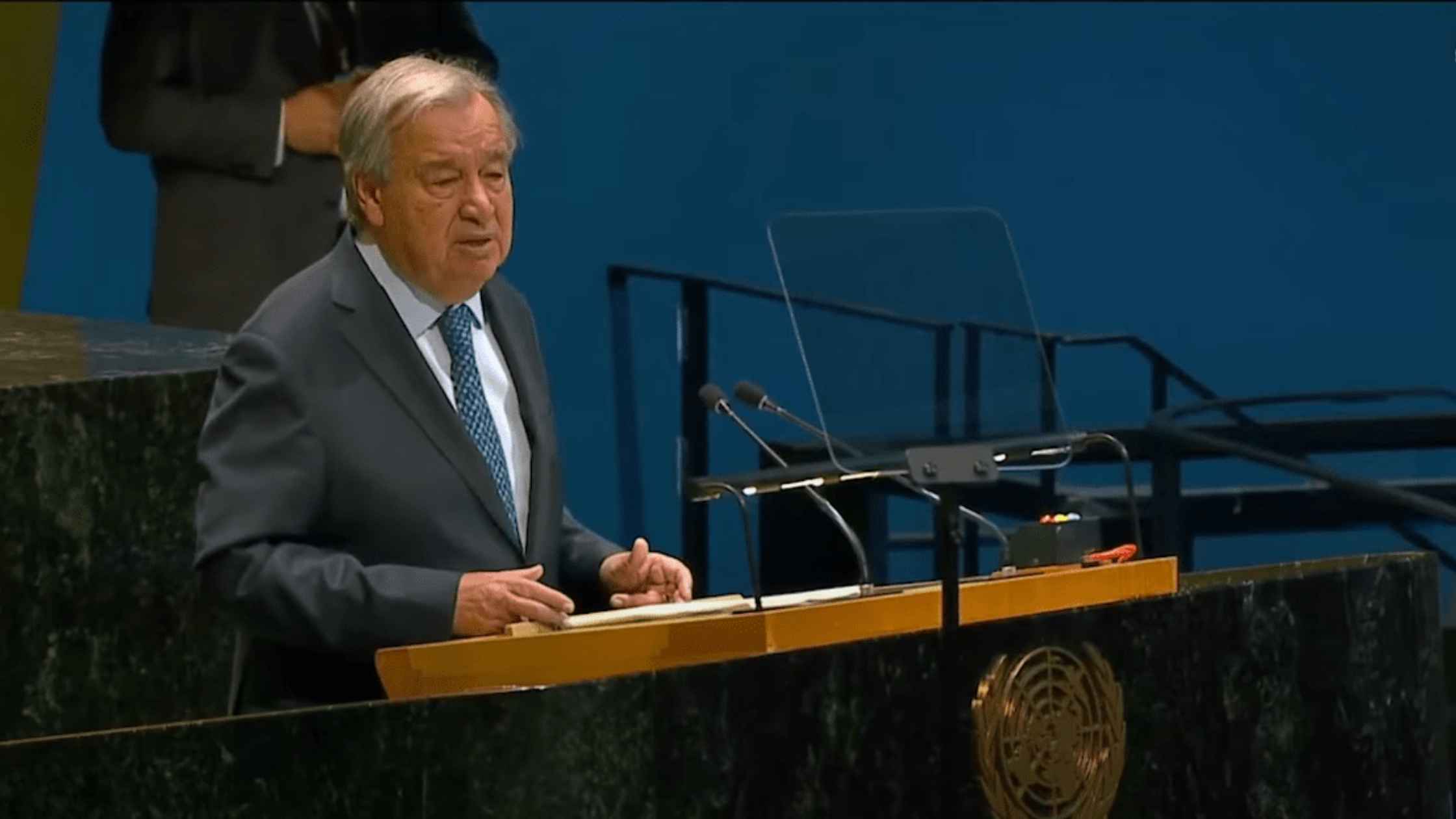
Let me begin with two words we have not been able to say often enough in this hall. Madam President, excellencies, ladies and gentlemen, 80 years ago in a world scorched by war leaders made a choice, cooperation over chaos, law over lawlessness, peace over conflict, and that choice gave birth to the United Nations not as a dream for perfection, but as a practical strategy for the survival of humanity. Many of our founders had seen firsthand the hell of the death camps and the terror of war. They knew that true leadership meant creating a system to prevent the replay of those horrors, a firewall against the flames of conflict and World War III. A forum for sovereign states to pursue dialogue and cooperation and the concrete affirmation of an essential human truth, we are all in this together. And this General Assembly hall is the heartbeat of that truth.
(01:29)
It is why for decades, world leaders have come to this one-of-a-kind podium. It is why you are here today because at its best, United Nations is more than a meeting place. It's a moral compass, a force for peace and peacekeeping. A guardian of international law, a catalyst for sustainable development, a lifeline for people in crisis, a lighthouse for human rights and the center that transforms your decisions, the decisions of member states into action. 80 years on, we confront again the question our founders faced only more urgent, more intertwined, more unforgiving. What kind of world do we choose to build together?
(02:26)
Excellencies, we have our work cut out for us as our ability to carry out that work is being cut from us. We have entered in an age of reckless disruption and relentless human suffering. Look around, the principles of United Nations that you have established are under siege. Listen, the pillars of peace and progress are buckling under the weight of impunity, inequality and indifference. Sovereign nations, invaded; hunger, weaponized; truth, silenced. Rising smoke from bombed-out cities, rising anger in fractured societies, rising seas, swallowing coastlines. Each one a warning each one a question, what kind of world will we choose?
(03:26)
A world of raw power or a world of laws, a world that is a scramble for self-interest or a world where nations come together? A world where might makes right or a world of rights for all? Excellencies, our world is becoming increasingly multipolar and this is positive, reflecting a more diverse, dynamic global landscape. But multi-polarity without effective multilateral institutions can cause chaos. As Europe has learned the hard way, resulting in World War I. It was multipolar, but there was no multilateral institutions.
(04:16)
So let's be clear. International cooperation is not naiveté, it is hard-headed pragmatism. In a world where there's [inaudible 00:04:26] borders isolation is an illusion. No country can stop a pandemic alone. No army can halt rising temperatures. No algorithm can reveal trust once it is broken. These are global stress tests of our system, our solidarity, and our resolve. I'm convinced we can pass these tests and we must. Because people everywhere are demanding something better and we owe them a system worthy of their trust and a future worthy of their dreams. And so we must make the choice, an active choice to reaffirm the imperative of international law, to reassert the centrality of multilateralism, to reinforce justice and human rights, and to recommit to the principles that gave rise to our organization, and to the promise contained in its first words, "We the peoples."
(05:31)
Excellencies, the choices we face are not part of an ideological debate. They're a matter of life and death for millions. As I scan the global landscape, we must make five critical choices. First, we must choose peace rooted in international law. Peace is our first obligation, yet today wars rage with a barbarity, we vowed never to allow. Too often the charter is brandished when convenient and trampled when not. But the charter is not optional, it is our foundation. And when the foundation cracks everything built upon fractures. Around the world, we see countries acting as if the rules don't apply to them. We see humans treated as less than human, and we must call it out. Impunity is the mother of chaos and it has spawned some of the most atrocious conflicts of our times.
(06:38)
In Sudan civilians are being slaughtered, starved and silenced. Women and girls face unspeakable violence. There is no military solution. I urge all parties, including those in this hall and the external support that is fueling this bloodshed, push to protect civilians because the Sudanese people deserve peace, dignity, and hope.
(07:09)
In Ukraine, relentless violence continues to kill civilians, destroy civilian infrastructure and threaten global peace and security. I commend recent diplomatic efforts by the United States and others. We must work for a full ceasefire and a just, lasting peace in accordance with the charter, UN resolutions and international law.
(07:35)
In Gaza, the horrors are approaching a third monstrous year. They are the result of decisions that defy basic humanity. The scale of deaths and destruction are beyond any other conflict in my years as Secretary General. The International Court of Justice has issued legally binding provisional measures in the case named Application of the Convention on the Prevention and Punishment of the Crime of Genocide in the Gaza Strip. Since then, a famine has been declared and the killing has intensified. The measure stipulated by the ICJ must be implemented fully and immediately.
(08:32)
Nothing can justify the horrific Hamas terror attacks of October 7th and taking of hostages, those of which have repeatedly condemned. And nothing can justify the collective punishment of the Palestinian people and the systematic destruction of Gaza. We know what is needed. Permanence ceasefire now. All the hostages released now. Full humanitarian access now. And we must not relent in the only viable answer to sustainable Middle East peace, a two-state solution, as so eloquently reaffirmed yesterday. We must urgently reverse dangerous trends on the ground. Relentless settler expansion and violence and the looming threat of annexation must stop.
(09:27)
Everywhere from Haiti to Yemen, to Myanmar and the Sahel and beyond, we must choose peace anchored in international law. The past year has brought glimmers of hope, including the ceasefire between Cambodia and Thailand, and the agreement between Azerbaijan and Armenia brokered by the United States, but far too many crises continue unchecked impunity prevails, lawlessness is a contagion. It invites mayhem, accelerates terror, and risks, a nuclear free-for-all. When accountability shrinks, graveyards grow. When UN staff and facilities are attacked, violating legal obligations, so too is the core of our ability to serve and deliver.
(10:20)
The Security Council must live up to its responsibilities. It must be more representative, more transparent, and more effective. And beyond crisis response, we must tackle the injustices that ignite conflict, exclusion, inequality, impunity and corruption. The surest way to silence the guns is to raise the volume for justice. Real security is born of fairness and opportunity for all.
(10:56)
Excellencies, this leads me to my second point. We must choose human dignity and human rights. Human rights are not an ornament of peace, they're its bedrock. Human rights, economic, social, cultural, political, and civil are universal, indivisible, and interdependent. Choosing rights means more than words. It means choosing justice over silence. It means protecting freedom and civic space, advancing equality for women and girls, confronting racism and discrimination in all its forms, protecting human rights, defenders, journalists, and freedom of speech, and upholding the rights of refugees and migrants so that mobility is safe and in accordance with international law.
(11:55)
Human rights are a daily battle online and offline. They require political will, but dignity is not only about the protection of rights, it is about rights fulfilled through inclusive and resilient development. Rights that put an end to poverty and hunger. Rights that open doors to education, health, and opportunity. The sustainable development goals are our shared roadmap for achieving these rights. But in order to make progress down this road, we need fuel and that fuel is finance. We've seen what development done right can deliver. In the past decade, millions more have gained access to electricity, clean cooking solutions and to the internet. Child marriage is in retreat. Women's representation is growing.
(13:02)
But cuts to aid are wreaking havoc. They are a death sentence for many. For so many more, a stolen future. This is the great paradox of our time. We have the solutions, but we are siphoning off the fuel that would make it possible to make progress. To choose dignity, we must choose financial justice and solidarity. We need to reform the international financial architecture so that it drives development for all. With bigger and bolder multilateral development banks lending more and mobilizing more private capital for developing countries. With faster and fairer debt relief mechanisms, helping every country in crisis, including middle income countries.
(14:06)
Protecting natural resources by tackling illicit financial flows and abusive tax practices that rob societies of their future. And global financial institutions that represent today's world with far greater participation of developing countries in terms of their composition and their decision making. So let us choose a global economy that works for everyone, men and women. Let us choose human rights and dignity and let us equip ourselves with the means to ensure a transition for people and the planet.
(14:51)
Excellencies, this brings me to the third choice. We must choose climate justice. The climate crisis is accelerating, but so are the solutions. The clean energy future is no longer a distant promise, it's already here. No government, industry or special interest can stop it. But some are trying, hurting economies, locking in higher prices and squandering a historic opportunity. Fossil fuels are a losing bet. Last year, almost all new power capacity came from renewables and the investment is surging. Renewables are the cheapest and fastest source of new power. They create jobs, drive growth, shield economies from volatile oil and gas markets, connect the unconnected, and can free us from the tyranny of fossil fuels, but not at today's pace.
(16:02)
Clean energy investment remains uneven. Twenty-first century grids and storage are not rolling out fast enough, and public subsidies taking from taxpayer money still flow to fossil fuels over clean energy by a factor of nine to one. Meanwhile, emissions, temperatures and disasters keep rising, and those least responsible suffer the most. Science says limiting global temperature rise 1.5 degrees by the end of this century is still possible, but the window is closing. The International Court of Justice has affirmed the legal obligation of states. We must step up action and ambition, especially through strengthened national climate plans.
(16:57)
Tomorrow I will welcome leaders to announce new targets. The G20, the biggest emitters must lead guided by common, but differentiated responsibilities, but all countries must step up and do more as we head to the UN Climate Conference in Brazil. By accelerating action in energy, forests, methane and industrial decarbonization. By defining a credible roadmap to mobilize $1.6 trillion US annually in climate finance by 2035 for developing countries. By supporting just transitions, by doubling finance for adaptation to at least $40 billion US this year, and rapidly deploying proven tools to unlock billions more in concessional finance, and by capitalizing the loss and damaged funds with significant contributions.
(17:57)
All of this requires governments, international financial institutions, philanthropies, civil society and the private sector to work together to provide fiscal space to developing countries and unlock new innovative sources of finance at scale, including solidarity levies on high emitting sectors and debt swaps. We have the solutions and tools, but we must choose climate justice and climate action.
(18:29)
First, we must choose to put technology at the service of humanity. Artificial intelligence is rewriting human existence in real time, transforming how we learn, work, communicate, and what we can trust. And the question is not how to stop it, but how to steer it for the greater good. Technology must be our servant, not our master. It must promote human rights, human dignity, and human agency. Yet today AI's advancement in outpacing regulation and responsibility and is concentrated in a few hands. And the risks are expanding to new frontiers, from biotech to autonomous weapons. We are witnessing the rise of tools for mass surveillance, mass social control, mass disruption, and even mass destruction.
(19:28)
Tools that can drain energy, strain ecosystems and intensify the race for critical minerals, potentially starting instability and conflict. Yet these technologies remain largely ungoverned. We need universal guardrails and common standards across platforms. No company should be above the law. No machines should decide who lives or dies. No system should be deployed without transparency, safety, and accountability. Last month, this Assembly took a historic step establishing an independent international scientific panel on AI and an annual global dialogue on AI governance. Two new pillars of a shared architecture, connecting science with policy to bring clarity and foresight, enabling innovation to flourish while advancing our values and our rights and ensuring governments, companies, and civil society, can help shape common norms.
(20:36)
We must build on these mechanisms and close the capacity gaps. All countries must be able to design and develop AI not just to consume it. I have proposed voluntary financing options to build AI computing power data and skills in developing nations. No country should be locked out of the digital future or locked into systems it cannot shape or trust. And governments must lead with vision and companies must act with responsibility. And we, the international community, must ensure that technology lifts up humanity. So let us choose cooperation over fragmentation, ethics over expediency, and transparency over opacity. Technology will not wait for us, but you can still choose what it serves. So let us choose wisely.
(21:43)
Fifth and finally, to meet all these goals, we must choose to strengthen the United Nations for the 21st century. The forces shaking our world are also testing the foundations of the United Nations system. We are being hit by rising geopolitical tensions and divisions, chronic uncertainty, and mounting financial strain. But those who depend on the United Nations must not be made to bear the cost. Especially now when for every dollar invested to support our core work to build peace, the world spends $750 on weapons of war. This is not only unsustainable, it is indefensible.
(22:30)
In this moment of crisis, the United Nations has never been more essential. The world needs our unique legitimacy, our convening power, our vision to unite nations, to bridge divides and confront the challenges before us. The pact for the future has shown your determination to build a United Nations that is stronger, more inclusive and more effective. That is the logic and the urgency of our UNAT initiative. We are moving swiftly and decisively. I put forward concrete proposals, a revised budget for 2026 that strengthens accountability, improves delivery and cuts costs. Practical reforms to implement mandates more effectively and efficiently with greater impact, and ideas to spark a paradigm shift in the structure of the UN and how its parts work together.
(23:32)
Most of these decisions rest with you, the member states, and we'll move forward in full respect of the established procedures. Together let us choose to invest in a United Nations that adapts, innovates, and is empowered to deliver for people everywhere.
(23:53)
Excellencies, my overriding message comes down to this, now is the time to choose. It's not enough to know what the right choices are, I urge you to make them. I grew up in a world where choices were few. I was raised in the darkness of dictatorship where fear silenced voices and hope was nearly crushed. Yet even the bleakest hours, especially then, I discovered the truth that has never left me. Power does not reside in the ends of those who dominate or divide. Real power resides from people, from our shared resolve to uphold dignity, to defend equality, to believe fiercely in our common humanity and the potential of every human being.
(24:49)
I learned early to persevere, to speak out, to refuse to surrender. No matter the challenge, no matter the obstacle, no matter the hard work. We must and we will overcome. Because in a world of many choices, there is one choice we must never make, the choice to give up. We must never give up. That is my promise to you. For peace, for dignity, for justice, for humanity, for the world we know is possible when we work as one. I will never, ever give up. Thank you.